Page 2 : STAFFING, , By - Shivam Jangra,
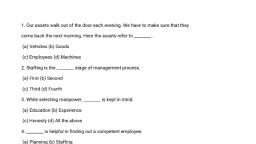
[email protected]; 8285204423, , Topics to be covered as per the latest curriculum of 2021-22, , STAFFING, “Our assets walk out of the door each evening. We have to make sure that they come back, the next morning”. - by Narayana Murthy former, CEO of INFOSYS., , Definition of staffing:, To fill the various posts provided in the organisation is termed as the staffing. Staffing is, ‘putting people to jobs.’, Staffing is that part of the process of management which is concerned with obtaining,, utilising and maintaining a satisfactory and satisfied work force., , 1
Page 3 : STAFFING, , By - Shivam Jangra,
[email protected]; 8285204423, , Importance of staffing:, Helps in discovering and obtaining competent personnel., It leads to higher performance, , Ensures the continuous survival and growth, Ensures optinum utilisation of human resources, Improves job satisfaction and morale of employees, , 1. Staffing helps in discovering and obtaining competent personnel for various jobs., 2. Makes for higher performance, by putting right person on the right job., 3. Ensures the continuous survival and growth of the enterprise through the succession planning, for managers., 4. Helps to ensure optimum utilisation of the human resources. By avoiding overmanning, it, prevents under utilisation of personnel and high labour costs. At the same time it avoids, disruption of work by indicating in advance the shortages of personnel., 5. Improves job satisfaction and morale of employees through objective assessment and fair, reward for their contribution., , Process of staffing:, 1. Estimating the manpower requirements, , 2. Recruitment, , 3. Selection, , 4. Placement and orientation, , 5. Training and development, , 6. Performance appraisal, , 7. Promotion and career planning, , 8. Compensation, , 1. Estimating the manpower requirements:, It means knowing about how many persons we need and of what type. This is done on the, basis of workload analysis and workforce analysis., , 2
Page 4 : STAFFING, , By - Shivam Jangra,
[email protected]; 8285204423, , Workload analysis - Workload analysis would enable an assessment of the number and types, of human resources necessary for the performance of various jobs and accomplishment of, organisational objectives., Workforce analysis - Workforce analysis would reveal the number and type available. It, reveals that whether we are understaffed, overstaffed, or optimally staffed., , 2. Recruitment:, Recruitment may be defined as the process of searching for prospective employees and, stimulating them to apply for jobs in the organisation., , 3. Selection:, Selection is the process of choosing from among the pool of the prospective job candidates, developed at the stage of recruitment., , 4. Placement and orientation:, The employee is given a brief presentation about the company and is introduced to his, superiors, subordinates and the colleagues. He is taken around the workplace and given the, charge of the job for which he has been selected., Placement refers to the employee occupying the position or post for which the person has, been selected., Orientation is, thus, introducing the selected employee to other employees and familiarising, him with the rules and policies of the organisation., , 5. Training and development:, This is done in order to ensure continuous learning of their employees so that they contribute, effectively and efficiently towards the realisation of the organisational goals. Training is given, to make a person job fit whereas development seeks to increase their potential for higher, level jobs., , 6. Performance appraisal:, Performance appraisal means evaluating an employee’s current and/or past performance as, against certain predetermined standards., The employee is expected to know what the standards are and the superior is to provide the, employee feedback on his/her performance., The performance appraisal process, therefore, will include defining the job, appraising, performance and providing feedback., , 7. Promotion and career planning:, Promotions are an integral part of people’s career. They refer to being placed in positions of, increased responsibility. They usually mean more pay, responsibility and job satisfaction., , 8. Compensation:, It refers to all forms of pay or rewards going to employees. It may be in the form of direct, financial payments like wages, salaries, incentives, commissions and bonuses and indirect, payments like employer paid insurance and vacations., , 3
Page 5 : STAFFING, , By - Shivam Jangra,
[email protected]; 8285204423, , Meaning of Recruitment:, Recruitment refers to the process of, finding possible candidates for a job or, a function., It has been defined as ‘the process of, searching for prospective employees, and stimulating them to apply for jobs, in an organisation.’, , Process of recruitment:, (A) Identification of the different sources of labour supply., (B) Assessment of their validity., (C) Choosing the most suitable source or sources., (D) Inviting applications from the prospective candidates, for, the vacancies., , Sources of recruitment:, Sources of Recruitment, , 1. Internal Sources, , 2. External Sources, , Internal sources, 1. Transfers, 2. Promotions, , External sources, Direct recruitment, Casual callers, Advertisement, Employment exchange, Placement agencies and, management consultants, 6. Campus recruitment, 7. Recommendation of employees, 8. Labour contractors, 9. Advertisement on Television, 10. Web publishing, 1., 2., 3., 4., 5., , 4
Page 6 : STAFFING, , By - Shivam Jangra,
[email protected]; 8285204423, , Internal sources of recruitment:, 1. Transfers (horizontal movement of employees)It involves shifting of an employee from one job to another, one department to another or from, one shift to another, without a substantive change in the responsibilities and status of the, employee. It may lead to changes in duties and responsibilities, working condition etc., but not, necessarily salary., 2. Promotions (vertical shifting of employees) –, Promotion refers to the practice of filling higher jobs by promoting employees from lower jobs., Promotion leads to shifting an employee to a higher position, carrying higher responsibilities,, facilities, status and pay., , External sources of recruitment:, 1. Direct recruitment –, Under the direct recruitment, a notice is placed on the noticeboard of the enterprise specifying, the details of the jobs available. Job seekers assemble outside the premises of the organisation, on the specified date and selection is done on the spot., , 2., , 3., , 4., , 5., , 6., , This method of recruitment is very inexpensive as it does not involve any cost of advertising the, vacancies. It is suitable for filling casual vacancies when there is a rush of work or when some, permanent workers are absent., Casual callers –, Many reputed business organisations keep a database of unsolicited applicants in their offices., Such jobseekers can be a valuable source of manpower. A list of such jobseekers can be prepared, and can be screened to fill the vacancies as they arise., The major merit of this source of recruitment is that it reduces the cost of recruiting workforce, in comparison to other sources., Advertisement –, Advertisement in newspapers or trade and professional journals is generally used when a wider, choice is required., Advertisement gives the management a wider range of candidates from which to choose., Advertisements may be placed in leading newspapers. Its disadvantage is that it may bring in a, flood of response, and many times, from quite unsuitable candidates., Employment exchange –, Employment exchanges run by the Government are regarded as a good source of recruitment, for unskilled and skilled operative jobs. In some cases, compulsory notification of vacancies to, employment exchange is required by law., Thus, employment exchanges help to match personnel demand and supply by serving as link, between jobseekers and employers., Placement agencies and management consultants –, Placement agencies provide a nationwide service in matching personnel demand and supply., These agencies compile biodata of a large number of candidates and recommend suitable names, to their clients. Such agencies charge fee for their services and they are useful where extensive, screening is required., Management consultancy firms help the organisations to recruit technical, professional and, managerial personnel. They specialise in middle level and top level executive placements., Campus recruitment –, Many big organisations maintain a close liaison with the universities, vocational schools and, management institutes to recruit qualified personnel for various jobs. Recruitment from, , 5
Page 7 : STAFFING, , By - Shivam Jangra,
[email protected]; 8285204423, , educational institutions is a well established practice of businesses. This is referred to as campus, recruitment., 7. Recommendations of employees –, Applicants introduced by present employees, or their friends and relatives may prove to be a, good source of recruitment., Such applicants are likely to be good employees because their background is sufficiently known., 8. Labour contractors –, Labour contractors maintain close contacts with labourers and they can provide the required, number of unskilled workers at short notice., 9. Advertising on television –, The practice of telecasting of vacant posts over television is gaining importance these days., 10. Web publishing –, There are certain websites specifically designed and dedicated for the purpose of providing, information about both job seekers and job opening., In fact, websites are very commonly visited both by the prospective employees and the, organisations searching for suitable people., , Meaning of Selection:, , Selection is the process of identifying and choosing the best person out of a number, of prospective candidates for a job., At every stage many are eliminated and a few move on to the next stage until the, right type is found., , 6
Page 8 : STAFFING, , By - Shivam Jangra,
[email protected]; 8285204423, , Process of Selection:, 1. Preliminary, screening, , 2. Selection tests, , 3. Employement, Interview, , 4. Reference and, background checks, , 8. Contract of, employment, , 7. Job offer, , 6. Medical examination, , 5. Selection decision, , 1. Preliminary screening:, In this, manager eliminates unqualified or unfit job seekers based on the information supplied, in the application forms. Preliminary interviews help reject misfits for reasons, which did not, appear in the application forms., 2. Selection tests:, An employment test is a mechanism (either a paper and pencil test or an exercise) that, attempts to measure certain characteristics of individuals., Important Tests Used for Selection of Employees:, Intelligence Tests: This test include psychological tests used to measure the level of, intelligence quotient of an individual., Aptitude Tests: This is a measure of an individual’s potential for learning new skills., Personality Tests: It give an insight into person’s emotions, reactions, maturity, and value, system etc., , 3., , 4., , 5., , 6., , 7., 8., , Trade Test: This test seeks to measure the existing skills of the individual., Interest Test: This test is used to know the pattern of interests or involvement of a person., Employment Interview:, This is a formal, in-depth conversation conducted to evaluate the applicant’s suitability for the, job., Reference and Background checks:, It is carried out for the purpose of verifying information and gaining additional information, about the applicant., Previous employers, known persons, teachers and university professors can act as references., Selection decision:, The final decision has to be made from among the candidates who pass the tests, interviews, and reference checks., Medical Examination:, In this step, the candidate is required to undergo a medical fitness test. The job offer is given, to the candidate being declared fit after the medical examination., Job offer:, In this step, job offer is given to those applicants who have passed all the previous hurdles., Job offer is made through a letter of appointment/confirm his acceptance., Contract of employment:, Contract of employment is issued to the selected candidate and includes information like job, title, duties, responsibilities, date of joining, pay and allowances, etc. if the applicant accepts, the job offer., , 7
Page 9 : STAFFING, , By - Shivam Jangra,
[email protected]; 8285204423, , Concept of Training and Development, , Someone has rightly said:, “If you wish to plan for a year, sow seeds,, If you wish to plan for 10 years, plant trees,, If you wish to plan for a lifetime, develop people.”, , Training:, Training is the process of increasing the knowledge and skill of the employees to perform, specific jobs., Training is any process by which the aptitudes, skills and abilities of employees to perform, specific jobs are increased. It is a process of learning new skills and application of knowledge., Development:, Development is the process of the overall growth of a person in all aspects. Development, refers to the learning opportunities designed to help employees grow., Difference between Training and Development, Basis, 1. Meaning, 2. Purpose, 3. Scope, 4. Level of, employees, 5. Depth of, knowledge, , Training, It is a process of increasing, knowledge and skills., It is to enable the employee to do, the job better., It is a job oriented process., It is suitable for the employees at, the lower level., , Development, It is a process of learning and, growth., It is to enable the overall growth of, the employee., It is a career oriented process., Developmental programmes are, designed for middle and top level, managers., The depth of knowledge is limited The depth of knowledge is more as it, as it relates to the present job., has a wider scope., , Benefits or Importance of Training and Development:, , Benefits towards, , 1. The Organisation, , 2. The Employee, , 8
Page 10 : STAFFING, , By - Shivam Jangra,
[email protected]; 8285204423, , 1. Benefits to the organization Training imparts systematic learning to employees thereby helping to, avoid wastage of efforts and money and is considered better than the, hit and trial method., , , , It enhances employee productivity both in terms of quantity and, quality, leading to higher profits., , , , Training equips the future manager who can take over in case of, emergency., , , , Training increases employee morale and reduces absenteeism and, employee turnover., , , , It helps in obtaining effective response to fast changing environment, – technological and economic., , 2. Benefits to the employee Improved skills and knowledge due to training lead to better career of, the individual., , , , Increased performance by the individual help him to earn more., , , , Training makes the employee more efficient to handle machines., Thus, less prone to accidents., , , , Training increases the satisfaction and morale of employees., , Methods of Training:, Methods of Training, , On the job method, , Off the job method, , 1. On the job method:, Under this method the employees are provided training at the actual workplace. In, short, this is learning while doing., 2. Off the job method:, Under this method, the employees are provided training at a place away from the, actual workplace. In short, this is learning before doing., , 9
Page 11 : STAFFING, , By - Shivam Jangra,
[email protected]; 8285204423, , Differentiate between on-the-job and off-the-job training methods, Basis, On-the-job training, Off-the-job training, 1. Meaning, , Under the method the employees are, provided training at the actual, workplace., 2. Level, of This method is more suitable for the, employees, employees at lower level., , Under this method the employees are, provided training at a place away from, the actual workplace., This is more suitable for the employees, at middle and higher level., , 3. Methods, , Internship, apprenticeship etc., , 4. Approach, 5. Work, pressure, , It has a practical approach., In this, employees have work, pressure of performing the actual job., , Vestibule training, case study, computer, modelling etc., It has a theoretical approach., In this, employees have no such work, pressure as it is conducted away from, the actual work place., , Methods of Training:, , Internship Training, Vestibule Training, Apprenticeship Training, , 1. Apprenticeship Programmes: Apprenticeship programmes put the trainee under the, guidance of a master worker. These are designed to acquire a higher level of skill. People, seeking to enter skilled jobs, to become, for example, plumbers, electricians or ironworkers, are often required to undergo apprenticeship training. These apprentices are, trainees who spend a prescribed amount of time working with an experienced guide, or, trainer. A uniform period of training is offered to trainees, in which both fast and slow, learn here, are placed together. Slow learners may require additional training., 2. Internship Training: It is a joint programme of training in which educational institutions, and business firms cooperate. Selected candidates carry on regular studies for the, prescribed period. They also work in some factory or office to acquire practical, knowledge and skills., 3. Vestibule Training: Employees learn their jobs on the equipment they will be using, but, the training is conducted away from the actual work floor. Actual work environments are, created in a class room and employees use the same materials, files and equipment. This, is usually done when employees are required to handle sophisticated machinery and, equipment., , 1, 0