Page 1 :
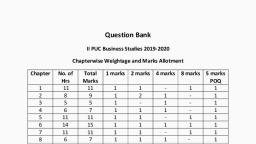
Question Bank, II PUC Business Studies 2019-2020, Chapterwise Weightage and Marks Allotment, Chapter, 1, 2, 3, 4, 5, 6, 7, 8, 9, 10, 11, 12, , No. of, Hrs, 11, 8, 5, 6, 11, 14, 11, 6, 11, 11, 21, 5, 120, , Total, Marks, 11, 9, 5, 7, 11, 15, 11, 7, 11, 11, 19, 7, 124, , 1 marks 2 marks 4 marks 8 marks 5 marks, POQ, 1, 1, 1, 1, 1, 2, 1, 1, 1, 1, 1, 1, 1, 1, 1, 1, 1, 1, 1, 1, 1, 1, 1, 1, 1, 1, 1, 1, 1, 1, 1, 1, 1, 1, 2, 1, 1, 1, 1, 1, 1, 1, 2, 1, 1, 1, 1, 1, 1, 12, 12, 10, 6, 3/10, , Sectionwise Questions in a Question Paper, Section, Questions to be, Questions to be, given, answered, A, 12, 10, B, 12, 10, C, 10, 7, D, 6, 4, E, 3, 2, Total, 43, 33, , Table showing KUAS pattern of questions
Page 2 :
(with special reference to II PU Business Studies Text book), 1, , Knowledge, , Questions relating to simple meanings, one word answers,, years, expansion of abbreviations, very short answers., Understanding Questions relating to Definitions, meanings, short answers,, long and essay type answers requiring explanations like, features, importance, benefits, etc., Application, Multiple Choice Questions and questions relating to, examples, answers requiring contrast, distinction or, comparison, sequential steps/procedure involved in a, process.etc., Skill, Diagrams, Practical Oriented Questions, , 2, , 3, , 4, , Preferable Percentage of KUAS criteria in Question Paper, Knowledge, Understanding, Application, Skill, , 30%, 35%, 25%, 10%, , Practical Oriented Questions based on Skill, Chapter, 1, , 2, , 3, 4, 5, , Practical Oriented Question, Required Answer, Assuming that you are the manager of an organization,, draw the neat diagram of different Levels of, Diagram, Management to specify that authority-responsibility, relationships create different levels of management., As a general manager, list out any ten Fayol’s Principles 10 Principles of, of Management which you would like to adopt in your Management of, business organization., Fayol, Show the different Elements of Business Environment, that influence the success of business Enterprises with, Diagram, a neat diagram., As a manager what logical steps you follow in Planning, 7 steps, process before executing a project?, Draw the Organization Chart showing Divisional and, Diagram
Page 3 :
6, , 7, 8, 9, , 10, , 11, 12, , Functional Structure., As a HR manager, list out any ten sources of, recruitment, to fill in the vacancies in your, organization., Draw the neat diagram of Maslow’s Need Hierarchy., (Triangular diagram), As a manger of an organization, what are the modern, techniques of controlling you would like to adopt?, As a Financial Consultant, give the list of any ten factors, which affect the choice of Capital Structure., Assuming that you are a promoter of a company and, would like to raise capital through primary market., What are the various methods of floating new issues, available to you?, As a marketing manager, suggest any five Sales, Promotion activities to boost up the sales., As an exploited consumer, write a complaint letter to, your nearest District Consumer Forum claiming, reasonable redressal., , 10 sources, , Diagram, Any 5 out of 6, techniques, Any 10 out of 14, points., Five methods, , Any 5 out of 11, Complaint, letter, , QUESTION BANK, Chapter I – Nature and Significance of Management, Sl.No., 1, 2, 3, 4, , 5, , 6, , Question, Part - A, What is Efficiency?, What is Effectiveness concerned with?, Give an example for top level/middle level/supervisory, level management., Which of the following is not a function of management, (a) Planning, (b) Staffing, (c) Cooperating, (d) Controlling, Management is, (a) an art, (b) a science, (c) both art and science, (d) neither, The following is not an objective of management, , K/U/A/S Marks, K, U, , 1, 1, , A, , 1, , A, , 1, , A, , 1
Page 4 :
7, , 8, , 9, 10, 11, 12, , 13, 14, , 15, 16, , 17, , 18, , (a) earning of profits, (b) growth of the organization, (c) providing employment, (d) policy making, Policy formulation is the function of, (a) Top level management, (b) Middle level management, (c) Operational management, (d) All of the above, Coordination is, (a) Function of management, (b) The essence of management, (c) An objective of management, (d) None of the above, Part - B, Define Management., State any two Organizational Objectives of, Management., Define Coordination., Justify the importance of coordination by any two, factors., Part - C, Explain the Objectives of Management., (2+1+1), Give any four grounds to say Management is important., (importance of Management), Part - D, Explain the characteristics of Management., (1+1+2+1+1+1+1), “Management as an art and a science are not mutually, exclusive, but complement to each other”- Elucidate., (3+3+2), Define Coordination. Explain the characteristics of, Coordination., (2+6), ‘Management is a series of continuous interrelated, , A, , 1, , A, , 1, , A, , 1, , U, , 2, , K, , 2, , U, , 2, , A, , 2, , U, , 4, , U, , 4, , U, , 8, , A/U, , 8, , U, , 8, , A/U, , 8
Page 5 :
functions’- Comment., (3+5), Chapter -2, Sl.No., 1, 2, 3, 4, 5, 6, 7, 8, 9, 10, 11, , 12, , 13, , 14, , Principles of Management, , Question, Part - A, Who is known as the Father of General Management?, Name any one new technique of Management, developed on the basis of Principles of Management., Who is called the Father of Scientific Management?, Who advocated separation of planning and execution, functions in any organization?, What is Standardization according to Taylor?, What is the aim of simplification according to Taylor?, How Simplification differs from Standardization, according to Taylor?, Who strongly advocated Piece Wage System?, What is the objective of Method Study according to, Taylor?, State the number of principles of management, propounded by Henri Fayol., Which management principle of Fayol advocates that, there should be only one boss for every individual, employee?, Principles of management are NOT, (a) Universal, (b) Flexible, (c) Absolute, (d) Behavioral, How are Principles of management formed?, (a) In a laboratory, (b) By experiences of managers, (c) By experiences of customers, (d) By propagation of social scientists, Which of the following statement best describes the, principle of ‘Division of Work’?, (a) Work should be divided into small tasks, , K/U/A/S Marks, K, , 1, , U/A, , 1, , K, , 1, , K, , 1, , K, U, , 1, , A, K, , 1, 1, , U, , 1, , K, , 1, , U, , 1, , A, , 1, , A, , 1, , A, , 1, , 1
Page 6 :
15, , 16, 17, 18, 19, 20, 21, 22, 23, , 24, 25, , (b) Labour should be divided, (c) Resources should be divided among jobs, (d) It leads to specialization, ‘She/he keeps machines, materials, tools, etc. ready for, operations by concerned workers’. Whose work is, described by this sentence under functional, foremanship, (a) Instruction Card Clerk, (b) Repair Boss, (c) Gang Boss, (d) Route Clerk, Part - B, Give the meaning of Mental Revolution as propounded, by Taylor., What is Discipline according to Fayol?, State any two differences between Unity of Command, and Unity of Direction., What is Scalar Chain?, What is Gang Plank?, Part - C, Discuss the significance of Principles of Management by, explaining any four points., Explain the Principles of Management contributed by, F.W. Taylor., What are the four aspects of work study developed by, Taylor? Explain., Part - D, Explain the Functional Foremanship of Taylor., Explain the nature of Principles of Management., (7 points with introduction, explanation and conclusion), , A, , 1, , K, K, A, , 2, 2, 2, , U, U, , 2, 2, , U, , 4, , U, , 4, , U, , 4, , U, , 8, , U, , 8, , Chapter 3 Business Environment, Sl.No., 1, , Question, Part - A, What is Business Environment?, , K/U/A/S Marks, K, , 1
Page 7 :
2, , 3, , 4, , 5, , 6, 7, 8, 9, 10, , 11, 12, , Which of the following does not characterize the, business environment?, (a) Uncertainty, (b) Employees, (c) Relativity, (d) Complexity, Which of the following is an example for social, environment?, (a) Money supply in the economy, (b) Consumer Protection Act, (c) The Constitution of the country, (d) Composition of family, Liberalization means, (a) Integration among economies, (b) Reduced government controls and restrictions, (c) Policy of planned disinvestments, (d) None of the above, Which of the following does not explain the impact of, Government policy changes on business and industry?, (a) More demanding customers, (b) Increasing competition, (c) Change in agricultural prices, (d) Market orientation, Part - B, Give the meaning of Globalization., What is Privatization?, Part - C, Explain any four features of Business Environment., Explain any four points to explain how important the, understanding of Business Environment for managers is., Explain any four challenges that were to be faced by, business and industry due to changes in Government, Policy., Part - D, Explain the features of business environment., Explain, with examples, the various dimensions of, business environment., , A, , 1, , A, , 1, , A, , 1, , A, , 1, , K, K, , 2, 2, , U, U, , 4, 4, , U, , 4, , U, A, , 8, 8
Page 8 :
Chapter 4 Planning, Sl.No., , Question, Part - A, , K/U/A/S Marks, , 1, , What is Planning?, , K, , 1, , 2, , Which function of management involves decision, making?, State the first step in Planning Process., What is Single Use Plan?, What is Standing Plan?, Give an example for Single Use Plan., Give an example for Standing Plan., Give an example for a plan which is neither single nor, standing plan., State the meaning of ‘Rule’., What is a ‘Budget’?, Which of the following statement is not correct with, regard to planning?, (a) It is a mental exercise, (b) It provides direction for the future actions, (c) It is end function in the process of management, (d) It involves setting objectives and developing courses, of actions, Which of the following is not the feature of the, planning?, (a) It focuses on achieving objectives, (b) It involves identification and division of work, (c) It is the primary function of the management, (d) It is a pervasive function, Which of the following is an example for the single use, plan?, (a) Policy, (b) Procedure, (c) Budget, (d) Method, Part - B, , U, , 1, , A, K, K, A, A, A, , 1, 1, 1, 1, 1, 1, , K, K, , 1, 1, , A, , 1, , A, , 1, , A, , 1, , 14, , State any two features of Planning., , U, , 2, , 15, , Give the meaning of Planning Premises., , K, , 2, , 3, 4, 5, 6, 7, 8, 9, 10, 11, , 12, , 13
Page 9 :
16, , What do you mean by ‘Objectives’?, , K, , 2, , 17, , What is a ‘Strategy’?, , K, , 2, , 18, , What is a ‘Policy’?, , K, , 2, , 19, , What is ‘Procedure’?, , K, , 2, , 20, , Give the meaning of ‘Programme’., , K, , 2, , 21, , Part - C, Explain the importance of Planning with any four points., , U, , 4, , 22, 23, , Explain any four features of Planning., Explain any four limitations of Planning., , U, U, , 4, 4, , 24, , Explain any two types of Plan., Part - D, Explain the importance and limitations of planning., What is Planning? Explain the various features of, Planning., Explain any four types of Plans., , U, , 4, , U, K, , 8, 8, , U, , 8, , 25, 26, 27, , Chapter -5, Sl.No., 1, 2, 3, 4, 5, 6, 7, 8, 9, 10, , Organising, , Question, Part - A, Which management function translates the plans into, action?, What is Organisation Structure?, Which type of organisation structure is suitable for, enterprises having large variety of products?, What is Delegation?, What is Authority?, What is Responsibility?, Can Accountability be delegated?, When can one say that an organisation is centralized?, What is Decentralisation?, Which of the following is not an element of delegation?, (a) Accountability, (b) Authority, (c) Responsibility, (d) Informal Organization, , K/U/A/S Marks, K, , 1, , K, U, , 1, 1, , K, K, K, U, U, K, A, , 1, 1, 1, 1, 1, 1, 1
Page 10 :
11, , 12, , 13, , 14, , 15, , 16, 17, 18, 19, 20, 21, , 22, 23, 24, , A network of social relationship that arise spontaneously, due to interaction at work is called, (a) Formal Organisation (b) Informal Organization, (c) Decentralisation, (d) Delegation, Which of the following does not follow the scalar chain?, (a) Functional Structure (b) Divisional Structure, (c) Formal Organisation (d) Informal Organization, For delegation to be effective, it is essential that, responsibility be accompanied with necessary, (a) Authority, (b) Manpower, (c) Incentives, (d) Promotions, Span of management refers to, (a) Number of managers, (b) Length of term for which a manager appointed, (c) Number of subordinates under a superior, (d) Number of members in top management, Grouping of activities on the basis of functions is a part of, (a) Decentralized organization, (b) Divisional organisation, (c) Functional organisation, (d) Centralised organisation, Part - B, Define Organizing., Give the meaning of Organizing., Write any two differences between Functional and, Divisional Structures., Give the meaning of Formal Organisation., Compare and contrast Authority and Accountability (any, two)., State any two differences between Delegation and, Decentralisation., Part - C, Explain the steps in the process of Organising, State any two advantages and two disadvantages of, Functional Structure., Write any two advantages and two disadvantages of, Divisional Structure., , A, , 1, , A, , 1, , A, , 1, , A, , 1, , A, , 1, , U, U, A, , 2, 2, 2, , K, A, , 2, 2, , A, , 2, , A, A, , 4, 4, , A, , 4
Page 11 :
25, 26, 27, 28, 29, 30, 31, 32, 33, , State any four features of Formal Organisation., Mention any four features of Informal Organisation., State any two advantages and disadvantages of Informal, Organisation., Distinguish between Formal and Informal Organisation by, taking any four bases., Explain briefly the elements of Delegation., Explain the importance of Delegation (any four points)., Part - D, Explain the importance of Organizing., (1 for introduction + 7), State the advantages and disadvantages of Formal, Organization., What is Decentralization? Explain its importance., (2+6), , U, U, A, , 4, 4, 4, , A, , 4, , U, U, , 4, 4, , U, , 8, , A, , 8, , U, , 8, , Chapter 6 Staffing, Sl.No., , Question, Part - A, , K/U/A/S Marks, , 1, , What is Staffing?, , K, , 1, , 2, , Name one internal source of recruitment., , K, , 1, , 3, , Name any one external source of recruitment., , K, , 1, , 4, , Mention the first step in selection process., , A, , 1, , 5, , State any one type of selection tests., , K, , 1, , 6, 7, , What is meant by Interview in Selection Process?, What is Training?, , K, K, , 1, 1, , 8, , What is the meaning of ‘Development’ in Staffing, Process?, Name on-the-job training method given to plumbers,, electricians or iron workers., State the off-the-job training method given to employees, before handling sophisticated machinery and equipment., , K, , 1, , K, , 1, , K, , 1, , 9, 10
Page 12 :
11, , 12, , 13, , 14, , 15, 16, , 17, 18, 19, 20, 21, 22, 23, 24, 25, 26, 27, 28, , Which one of the following is not a function of staffing, (a) Recruitment, (b) Training, (c) Compensation, (d) Directing, Which one of the following is an internal source of, recruitment, (a)Transfer, (b)Employment exchange, (c)Advertisement, (d)Campus recruitment, Promotion of employees results in, (a) Increase in pay, (b) Increase in responsibility, (c) Increase in job satisfaction (d) All of the above, Which of the following is On–the-Job method of training?, (a) Case study, (b) Coaching, (c) Vestibule Training, (d) Computer modeling, Part - B, Why is staffing both a line as well as staff activity?, Write any two factors which influence the way of, recruitment, selection and training of employees in any, organisation., What is Recruitment?, Give the meaning of Selection., What is Placement?, What is Orientation?, Give the meaning of ‘Transfer’ as an internal source of, recruitment., State the two types of direct financial payments which an, organisation can adopt to pay its employees., State any two differences between Training and, Development., What is Job Rotation?, State any two merits of external sources of recruitment., Write any two demerits of external sources of, recruitment., Mention any two merits of internal sources of, recruitment, Mention any two demerits of internal sources of, recruitment, , A, , 1, , A, , 1, , A, , 1, , A, , 1, , A, , 2, , U, , 2, , K, K, K, K, K, , 2, 2, 2, 2, 2, , U, , 2, , A, , 2, , K, U, U, , 2, 2, 2, , U, , 2, , U, , 2
Page 13 :
29, 30, 31, , Part - C, Explain any four types of tests used for selection of, employees., Explain the internal sources of recruitment., How does training and development of employees benefit, the organizations?, , U, , 4, , U, , 4, , A, , 4, , Part - D, 32, 33, , Explain the stages in Staffing Process., Describe the steps involved in Selection Process, , U, U, , 8, 8, , 34, , Explain the four methods of On-the-Job and any four, ethods of Off-the-Job training., , U, , 8, , 35, , Explain the benefits of training and development to the, organization and to the employees, , U, , 8, , K/U/A/S, , Marks, , K, K, K, U, , 1, 1, 1, 1, , K, K, K, A, , 1, 1, 1, 1, , A, , 1, , Chapter 7, Sl.No., 1, 2, 3, 4, 5, 6, 7, 8, , 9, , Directing, , Question, Part - A, What is Directing?, State any one element of Directing., What is a ‘Motive’?, State any one assumption of Maslow’s Hierarchical, Theory of Needs., State any one Leadership style., State any one pattern of formal communication., Name any one type of Grapevine network., Which one of the following is not an element of, direction?, (a) Motivation, (b) Communication, (c) Delegation, (d) Supervision, The motivation theory which classifies needs in, hierarchical order is developed by, (a) Fred Luthans, (b) Scott, (c) Abraham Maslow (d) Peter F. Drucker
Page 14 :
10, , 11, , 12, , 13, , 14, , 15, , 16, , 17, 18, 19, 20, , Which of the following is not an element of, communication?, (a) Decoding, (b) Communication, (c) Channel, (d) Receiver, The highest level need in the Need Hierarchy of Abraham, Maslow is, (a) Safety Need, (b) Belongingness Need, (c) Self Actualization Need, (d) Prestige Need, Grapevine is, (a) Formal Communication, (b) Barrier to Communication, (c) Lateral Communication, (d) Informal Communication, Status comes under the following type of barriers, (a) Semantic barrier, (b) Organisational Barrier, (c) Non semantic barrier, (d) Psychological barrier, The software company promoted by Narayana Murthy is, (a) Wipro, (b) Infosys, (c) Satyam, (d) HCL, The process of converting the message into, communication symbols is known as, (a) Media, (b) Encoding, (c) Feedback, (d) Decoding, The communication network in which all subordinates, under a supervisor communicate through supervisor only, is, (a) Single Chain, (b) Inverted V, (c) Wheel, (d) Free flow, Part - B, What do you understand by Supervision?, Define Motivation., State any two features of Motivation., Define Leadership., , A, , 1, , A, , 1, , A, , 1, , A, , 1, , A, , 1, , A, , 1, , A, , 1, , U, U, K, U, , 2, 2, 2, 2
Page 15 :
21, 22, 23, 24, 25, 26, 27, 28, 29, 30, , 31, , 32, 33, 34, , Write any two features of Leadership., What is communication?, State any two elements of communication process., State any two psychological barriers to communication., State any two personal barriers to communication., Part - C, Explain the characteristics of Directing as a managerial, process., Explain any four points which emphasise the importance, of Directing., Briefly explain any four benefits of Motivation., Explain briefly any four semantic barriers to, communication., Briefly explain any four organisational barriers to, communication., Part - D, What is Supervision? Explain the role played by a, supervisor., (1+7), Explain any four financial incentives and four nonfinancial incentives., Explain the qualities of a good leader., Suggest the suitable measures to improve communication, effectiveness., , K, K, K, K, K, , 2, 2, 2, 2, 2, , U, , 4, , U, , 4, , U, U, , 4, 4, , U, , 4, , U, , 8, , U, , 8, , U, A, , 8, 8, , K/U/A/S, , Marks, , K, K, K, K, A, , 1, 1, 1, 1, 1, , Chapter 8 Controlling, Sl.No., 1, 2, 3, 4, 5, , Question, Part - A, What is meant by Controlling?, What is ‘Standard’ in controlling process?, Expand PERT/CPM/MIS., What is Ratio Analysis?, Controlling function of an organisation is, (a) Forward looking, (b) Backward looking
Page 16 :
6, , 7, , 8, , 9, 10, 11, 12, 13, 14, 15, 16, 17, 18, , (c) Forward as well as backward looking, (d) None of the above, Management audit is a technique to keep a check on the, performance of, (a) Company, (b) Management of the company, (c) Shareholders, (d) Customers, Budgetary control requires the preparation of, (a) Training schedule (b) Budgets, (c) Network diagram (d) Responsibility centres, Which of the following is not applicable to responsibility, accounting?, (a) Investment Centre (b) Accounting centre, (c) Profit centre, (d) Cost centre, Part - B, Define Managerial Control., State any two traditional techniques of managerial, control., State any two modern techniques of managerial control., Give the meaning of Break-even Analysis., What do you understand by Budgetary Control?, What is Responsibility Accounting?, Part - C, ‘A good control system helps an organisation in many, ways’-Justify this statement with any four points., Explain the limitations of Controlling., Explain briefly the relationship between planning and, controlling., Explain briefly the steps involved in Controlling Process., , A, , 1, , A, , 1, , A, , 1, , U, K, , 2, 2, , K, K, U, K, , 2, 2, 2, 2, , A, , 4, , U, U, , 4, 4, , A, , 4, , Chapter 9 Financial Management, Sl.No., 1, 2, 3, , Question, Part - A, What is Business Finance?, State the primary objective/aim of financial management., What do you understand by ‘Capital Structure’?, , K/U/A/S Marks, K, K, U, , 1, 1, 1
Page 17 :
4, 5, 6, 7, 8, , 9, , 10, , 11, , 12, , 13, , 14, 15, 16, 17, 18, 19, , Write the meaning of ‘Financial Risk’., Give an example for fixed asset., Give an example for current asset., How do you calculate Net Working Capital?, The cheapest source of finance is, (a) Debenture, (b) Equity share capital, (c) Preference share (d) Retained earnings, The decision of acquiring a new machine or opening a new, branch is an example for, (a) Financing decision, (b) Working capital decision, (c) Investment decision (d) None of the above, The decision of how much to be raised from which source, is an example for, (a) Financing decision, (b) Working capital decision, (c) Investment decision (d) None of the above, Companies with higher growth pattern are likely, (a) to pay lower dividends, (b) to pay higher dividends, (c) that dividends are not affected by growth issues, (d) none of the above, Current assets are those assets which get converted into, cash, (a) within six months, (b) within one year, (c) between 1 and 3 years (d) between 3 and 5 years, A fixed asset should be financed through, (a) a long term liability, (b) a short term liability, (c) a mix of ling and short term liabilities, (d) None of the above, Part - B, What do understand by Financial Management?, Give the meaning Investment Decision with an example., What is Financing Decision? Give an example., Give the meaning of Dividend Decision., State the twin objectives of Financial Planning., What is Financial Leverage? Write the formula to calculate, Financial Leverage., , K, A, A, A, A, , 1, 1, 1, 1, 1, , A, , 1, , A, , 1, , A, , 1, , A, , 1, , A, , 1, , U, K/A, K/A, K, K, U, , 2, 2, 2, 2, 2, 2
Page 18 :
20, 21, , 22, 23, 24, 25, 26, 27, , Give the meaning of ‘Trading on Equity’., Write the formula to calculate Debt Service Coverage, Ratio., Part - C, Explain any four factors affecting financing decisions, Explain any four factors affecting dividend decisions., What is Capital Budgeting decision? Explain briefly the, factors affecting capital budgeting decisions., Explain with any four points the importance of financial, planning., Explain any four factors affecting the fixed capital, requirement of an organisation., Explain any four factors affecting the working capital, requirement of an organisation., , K, U, , 2, 2, , U, U, U, , 4, 4, 4, , U, , 4, , U, , 4, , U, , 4, , K/U/A/S, , Marks, , K, K, K, K, K, K, , 1, 1, 1, 1, 1, 1, , U, U, A, , 1, 1, 1, , A, , 1, , Chapter 10 Financial Markets, Sl.No., 1, 2, 3, 4, 5, 6, 7, 8, 9, , 10, , Question, Part - A, Expand IPO/BSE/NSEI/SEBI/NASDAQ/OTCEI/CSDL, What is Money Market?, What is Stock Exchange?, What is the benchmark index of BSE?, What is the benchmark index of NSE?, Name the first and the largest depository presently, operational in India., What is meant by Depository?, Give the meaning of Dematerialisation., Primary and secondary markets, (a) Compete with each other, (b) Complement each other, (c) Function independently, (d) Control each other, The settlement cycle in NSE is, (a) T+5, (b) T+3, (c) T+2, (d) T+1
Page 19 :
11, , 12, , 13, 14, 15, 16, 17, , 18, 19, 20, 21, 22, , The National Stock Exchange of India was recognized as, Stock Exchange in the year, (a) 1999, (b) 1993, (c) 1994, (d) 1995, A Treasury Bill is basically, (a) An instrument to borrow short term funds, (b) An instrument to borrow long term funds, (c) An instrument of capital market, (d) None of the above, No Questions in Part - B, Part - C, Explain briefly the functions of a Financial Market., Explain any four methods of floating new issues in the, primary market., Write any four advantages of ‘Electronic Trading System’, in Stock exchanges, Distinguish between primary market and secondary, market (any four points)., State the objectives of Securities and Exchange Board of, India., Part - D, Explain any four money market instruments., What is Stock Exchange? Explain the functions of stock, exchange., Briefly explain the steps in the Screen based Trading and, Settlement procedure in a Stock Exchange., How does the Demat System works? Explain., Explain the functions of Securities and Exchange Board of, India., Chapter 11, , Sl.No., 1, 2, 3, , A, , 1, , A, , 1, , U, U, , 4, 4, , K, , 4, , A, , 4, , K, , 4, , U, U, , 8, 8, , A, , 8, , A, U, , 8, 8, , K/U/A/S, , Marks, , K, A, K, , 1, 1, 1, , Marketing, , Question, Part - A, State any one Marketing Philosophy or concept., Give an example for the marketing of services., Give the meaning of Product?
Page 20 :
4, 5, 6, 7, 8, 9, 10, 11, 12, 13, 14, 15, 16, 17, 18, 19, 20, 21, 22, 23, 24, 25, 26, 27, 28, 29, 30, 31, 32, , What is Packaging?, What is Labelling?, State any one feature of convenience goods., What is a Brand?, Name any one Distribution Channel., What do you mean by Zero Level distribution channel?, What is Publicity?, Part - B, What is Marketing?, Define Marketing., Define Marketing Management., State any two features of Marketing., State any two examples for the things that can be, marketed other than product?, What is Standardization?, What is Grading of products?, How do you describe Marketing Mix?, What do you mean by Consumer Goods?, Give two examples for Convenience goods., Name any two examples for Durable Products., How do you describe Shopping Products?, State any two functions of packaging., State any two objectives of Pricing., State any two distinguishing features of advertising., What is Personal Selling?, Part - C, Discuss briefly any four differences between Selling and, Marketing., Explain the elements of Marketing Mix., State any four features of speciality products., Briefly explain any four characteristics of industrial, products., State any four considerations to be kept in mind while, choosing a brand name., How does packaging acquire significance in the marketing, of goods?, , K, K, K, K, U, U, K, , 1, 1, 1, 1, 1, 1, 1, , K, U, U, K, A, , 2, 2, 2, 2, 2, , K, K, U, K, A, A, U, U, U, K, K, , 2, 2, 2, 2, 2, 2, 2, 2, 2, 2, 2, , A, , 4, , U, K, U, , 4, 4, 4, , U, , 4, , U, , 4
Page 21 :
33, , Explain any four functions performed by a label., , U, , 4, , 34, , Explain briefly any four objections against advertising., , U, , 4, , 35, , Explain any four functions performed by public relations, department of an organisation., Part - D, , U, , 4, , 36, , Explain any eight functions of Marketing., , K, , 8, , 37, , What is Branding? Explain briefly its advantages to, marketers and customers., , U, , 8, , 38, , What is Pricing? Explain the factors affecting price, determination., Explain the advantages and limitations of advertising., , U, , 8, , A, , 8, , State any eight differences between Advertising and, Personal selling., , A, , 8, , 39, 40, , Chapter 12, Sl.No., 1, 2, 3, 4, 5, 6, 7, 8, 9, , Consumer Protection, , Question, K/U/A/S, Part - A, State any one unfair trade practice of manufacturers and, K, service providers by which consumers are exploited., State any one regulation which provides legal protection, K, to the consumers., In which year the Consumer Protection Act was enacted?, K, Who is a Consumer?, K, Name any one redressal machinery/agency set up under, K, Consumer Protection Act to redress consumer grievances., What is the monetary limit of claim in District Consumer, U, Disputes Redressal Forum?, State the monetary limit of claim in State Consumer, U, Disputes Redressal Commission., What is the monetary limit of claim in National Consumer, U, Disputes Redressal Commission?, Name any one Consumer Organisation/NGO engaged in, K, protecting and promoting consumers’ interests., , Marks, 1, 1, 1, 1, 1, 1, 1, 1, 1
Page 24 :
Model Question Paper-1, II PUC- Business Studies, Max Marks: 100, , Time: 3 Hrs. & 15minutes, , Instructions to candidates:, 1. Write the serial number of questions properly as given in the question, paper while answering., 2. Write the correct and complete answers., Section - A, I. Answer any ten of following questions in a word or a sentence each. While, answering Multiple Choice Questions, write the serial number/alphabet of the, correct choice and write the answer corresponding to it. Each question carries, one mark:, , 10x1=10, , 1. Management is - - - - - - - - ., (a) an art, , (b) a science, , (c) both art and science, , (d) neither, , 2. Who is known as the Father of General Management?, 3. State any one factor of economic environment which affects business practices., 4. Give the meaning of ‘Rule’., 5. A network of social relationship that arise spontaneously due to interaction, at work is called- - - - - - -- -(a) Formal Organization, , (b) Informal Organization, , (c) Decentralization, , (d) Delegation, , 6. State any one internal source of recruitment., 7. Grapevine is -- - - - - - - - (a) Formal Communication, , (b) Barrier to Communication, , (c) Lateral Communication, , (d) Informal Communication, , 8. What is ‘Standard’ in controlling process?, 9. Give the meaning of Capital Structure?
Page 25 :
10. The settlement cycle in NSE is- - - - - - - (a) T+5, , (b) T+3, , (c) T+2, , (d) T+1, , 11. State any one Marketing Philosophy., 12. State any one regulation which provides legal protection to the consumers., , Section– B, II. Answer any ten of the following questions in two or three sentences each., Each question carries 2 marks:, , 10x2=20, , 13. Define Management., 14. What is Scalar Chain?, 15. State any two aspects of Work Study according to Taylor., 16. State any two features of Planning., 17. Differentiate between Delegation and Decentralization by taking any, two factors as basis., 18. State any two limitations of external sources of recruitment., 19. What do you understand by Supervision?, 20. What is Budgetary Control?, 21. State the twin objectives of Financial Planning., 22. Name the two depositories working in Indian financial markets., 23. How do you describe Marketing Mix?, 24. Write any two Rights of Consumers., , Section – C, III. Answer any seven of the following questions in 10-12 sentences each. Each, question carries 4 marks:, 25. Explain F.W.Taylor’s Scientific Management Principles., , 7x4=28
Page 26 :
26. Explain any four points to explain how important the understanding of Business, Environment is for the managers., 27. Explain any four limitations of Planning., 28. Explain any four important tests used for the selection of employees., 29. Explain briefly the steps involved in Controlling Process., 30. Briefly explain any four factors that affect Dividend Decision of a company., 31. Explain any four factors affecting Working Capital Requirements of, a business., 32. Explain any four factors that affect the fixation of price of a product., 33. Explain any two advantages and any two limitations of Advertising., 34. State any four responsibilities of consumers while purchasing, using and, consuming goods and services., , Section – D, IV. Answer any four of the following questions in 20-25 sentences each. Each, question carries 8 marks:, , 4x8=32, , 35. Explain the characteristics of Management., 36. What is Organizing? Explain its importance., 37. Explain the four methods of On-the-Job and any four methods of Off-the-Job, Training., 38. Suggest the suitable measures to improve communication effectiveness., 39. Explain the steps involved in the Screen based Trading and Settlement, Procedure of Securities., 40. Explain any eight functions of Marketing.
Page 27 :
Section – E (Practical Oriented Questions), V. Answer any two of the following questions:, , 2x5=10, , 41. Assuming that you are the manager of an organization, draw the neat diagram, of different Levels of Management to specify that authority-responsibility, relationships create different levels of management., 42. Draw the neat diagram of Maslow’s Need Hierarchy., 43. As an exploited consumer, write a complaint letter to your nearest District, Consumer Forum claiming reasonable redressal., , xxxxxxxxxxxxxxxxxxxxxxxxxxxxxxxx
Page 28 :
II PUC- Business Studies- 2019-2020, Model Question Paper Blueprint (Blank), Marks, allott, ed, , Bridge, Course, , 4, , -, , 1, 2, 3, 4, 5, 6, 7, 8, 9, 10, 11, 12, , 11+1, 8+1, 5+1, 6+1, 11+1, 14+2, 11+2, 6+1, 11+1, 11+2, 21+2, 5+1, , 11, 9, 5, 7, 11, 15, 11, 7, 11, 11, 19, 7, , 4+120, +16 Hrs, , 124, +15, , Chapter, , Bridge, Course, +Teaching Hrs., + POQ, , Knowledge, VS, A, , S, A, , L, A, , Understandng, E, A, , 6, 6 2 2, 16 Q / 42 M, (30% Apprx.), , VS, A, , 2, , S, A, , L, A, , E, A, , 5 5 2, 14 Q / 48 M, (35% Apprx.), , Application, VS, A, , S, A, , L, A, , E, A, , Skill, VS, A, , S, A, , L, A, , Total, E, A, , PO, Q, , 4, 1 3 2 - - - 3, 10 Q / 34 M, 3 Q / 15 M, (25% Apprx.), (10% Apprx.), Total No. of Questions – 43, , VSA, , SA, , LA, , EA, , 1, , 2, , 4, , 8, , -, , -, , -, , -, , -, , -, , 1, 1, 1, 1, 1, 1, 1, 1, 1, 1, 1, 1, , 1, 2, 1, 1, 1, 1, 1, 1, 1, 1, 1, , 1, 1, 1, 1, 1, 2, 2, 1, , 1, 1, 1, 1, 1, 1, -, , 3, 4, 2, 3, 3, 4, 3, 3, 4, 3, 5, 3, , 11, 9, 5, 7, 11, 15, 11, 7, 11, 11, 19, 7, , 1, 1, 1, 1, 1, 1, 1, 1, 1, 1, 1, 1, , 12, , 12, , 10, , 6, , 40, , 124, , 3/12, , 12 24 40 48, Total Marks - 139, , Total, Theory, , 124, , POQ, , -, , 15