Page 2 : CONTROLLING, , BY: SHIVAM JANGRA,
[email protected]; 8285204423, , Topics to be covered as per the latest curriculum of 2021-22, , Controlling, Controlling is not the last function of management but it is the function which bring back the, management cycle to planning., , Controlling means ensuring that activities in an organisation are performed as per, the plans., , “Controlling is measurement and correction of the performance of the subordinates to make, sure that the enterprise objectives and plans devised to attain them are being accomplished.”, – Koontz and O’Donnell, , Characteristics/Nature/Features of controlling:, , 1.Controlling is a goaloriented function, , 1.Controlling is an allpervasive function, , 1.Controlling is both, backward looking as well, as forward looking, , Controlling is continuous, function, , 1. Controlling is a goal-oriented function- Controlling also ensures that an organisation’s, resources are being used effectively and efficiently for the achievement of predetermined, goals. Controlling is, thus, a goal-oriented function., 2. Controlling is an all-pervasive function – It is a primary function of every manager., Managers at all levels of management—top, middle and lower-need to perform controlling, functions to keep a control over activities in their areas. Moreover, controlling is as much, required in an educational institution, military, hospital, and a club as in any business, organisation., 3. Controlling is both backward looking as well as forward looking-, , 1
Page 3 : CONTROLLING, , BY: SHIVAM JANGRA,
[email protected]; 8285204423, , It is a function that brings back the management cycle back to the planning function. The, controlling function finds out how far actual performance deviates from standards, analyses, the causes of such deviations and attempts to take corrective actions based on the same., This process helps in formulation of future plans in the light of the problems that were, identified and, thus, helps in better planning in future periods., 4. Controlling is a continuous function – Controlling is not a one time job but it is an ongoing, process. It is carried on till the organisation in surviving., , Importance of controlling:, Accomplishing organisational goals, Judging accuracy of standards, Making efficient use of resources, Improving employee motivation, Ensuring order and discipline, Facilitating coordination in action, 1. Accomplishing organizational goals- Controlling measures progress towards the, organisational goals and brings to light the deviations, if any, and indicates corrective action., It, thus, guides the organisation and keeps it on the right track so that organisational goals, might be achieved., 2. Judging accuracy of standards – Through strategic controlling, we can easily judge whether, the standard or target set are accurate or not., 3. Making efficient use of resources – Like traffic signal, controlling guides the organization, and keep it on the right track. Each activity is performed according to predetermined, standards. As a result, there is most and effective use of resources., 4. Improving employee’s motivation - A good control system ensures that employees know, well in advance what they are expected to do and what are the standards of performance on, the basis of which they will be appraised. It, thus, motivates them and helps them to give, better performance., 5. Ensuring order and discipline - Controlling creates an atmosphere of order and discipline in, the organisation. Effective controlling system keeps the subordinates under check and, makes sure they perform their functions efficiently. A strict control can have a check over, dishonesty and fraud of employees., 6. Facilitates coordination in action - Controlling provides direction to all activities and efforts, for achieving organisational goals. Each department and employee is governed by predetermined standards which are well coordinated with one another. This ensures that, overall organisational objectives are accomplished., , 2
Page 4 : CONTROLLING, , BY: SHIVAM JANGRA,
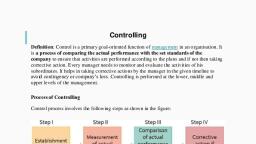
[email protected]; 8285204423, , Process of controlling:, , Analysing, deviations, , Setting, performance, standards, , Measurement, of actual, performance, , Taking, corrective, action, , Comparison of, actual, performance, with standards, , 1. Setting performance standards:, The first step in the controlling process is setting up of performance standards., Standards are the criteria against which actual performance would be measured., Thus, standards serve as benchmarks towards which an organisation strives to, work., Standards can be set in both quantitative as well as qualitative terms. For e.g., standard sale Rs20 lakh p.a., standard profit Rs4 lakh, reduction in cost by 5%., It is important that standards should be flexible enough to be modified whenever, required. Due to changes taking place in the internal and external business, environment, standards may need some modification to be realistic in the changed, business environment., 2. Measurement of actual performance:, The next step is measurement of actual performance. Performance should be, measured in an objective and reliable manner., There are several techniques for measurement of performance. These include, personal observation, sample checking, performance reports, etc. As far as, possible, performance should be measured in the same units in which standards, are set as this would make their comparison easier., In large organisations, certain pieces are checked at random for quality. This is, known as sample checking., 3. Comparison of actual performance with standards:, , , , This step involves comparison of actual performance with the standard. Such, comparison will reveal the deviation between actual and desired results., Comparison becomes easier when standards are set in quantitative terms. For, instance, performance of a worker in terms of units produced in a week can be, easily measured against the standard output for the week., , 4. Analysing deviations:, All deviations need not to be brought to the notice of top management. A range of, deviations should be established and only cases beyond this range should be brought to the, top level management., , 3
Page 5 : CONTROLLING, , BY: SHIVAM JANGRA,
[email protected]; 8285204423, , Deviations should be divided in two broad categories. First, that need to be attended urgently in, one category. Secondly, minor or insignificant decisions., , , , , Critical Point Control: It means keeping focus on some key areas (KRAs) and if there is any, deviation in these key areas, then it must be attended urgently. Key areas means those, areas which have impact on the whole organisation. For example: In a manufacturing, organisation, an increase of 5 per cent in the labour cost may be more troublesome than a, 15 per cent increase in postal charges., Management by exception: It means a manager who tries to control everything may end, up controlling nothing. The deviations which are beyond the specific range should only be, handled by managers and minute or minor deviations can be ignored. For example: If the, plans lay down 2 per cent increase in labour cost as an acceptable range of deviation in a, manufacturing organisation, only increase in labour cost beyond 2 per cent should be, brought to the notice of the management. However, in case of major deviation from the, standard (say, 5 per cent), the matter has to receive immediate action of management on, a priority basis., , 5. Taking corrective action:, , , , , , , The final step in the controlling process is taking corrective action. No corrective action is, required when the deviations are within acceptable limits. However, when the deviations, go beyond the acceptable range, especially in the important areas, it demands immediate, managerial attention so that deviations do not occur again and standards are accomplished., Corrective action might involve training of employees if the production target could not be, met. Similarly, if an important project is running behind schedule, corrective action might, involve assigning of additional workers and equipment to the project and permission for, overtime work., In case the deviation cannot be corrected through managerial action, the standards may, have to be revised., , Regards:, Shivam Jangra,
[email protected]; 8285204423, , ------------------------The End----------------------, , 4