Page 1 :
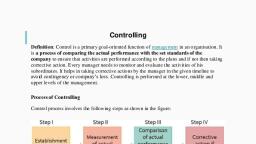
Concept of Controlling, Controlling refers to the process of measurement of performance according to standards, measuring deviations and taking corrective action to achieve predetermined goals. In order to seek results, manager must exercise effective control over the workers., According to Koontz and O’ Donnell, ‘‘Managerial control implies the measurement of accomplishment against the standard and the correction of deviations to assure attainment of objectives according to plans’’., Nature/Features of Controlling, Following are the eminent features of controlling that describes its nature, 1. Goal-oriented Process - Since, controlling ensures that an organisation’s resources are effectively and efficiently utilised for achievement of goals, it is regarded as a goal-oriented process., 2. Pervasive - At the same time, controlling is performed by all managers, i.e. top, middle and lower managers, to keep a check on the activities of their subordinates. It is equally required in a hospital, a club, an educational institution, etc. Therefore, it is regarded as a pervasive. function., 3. Continuous - Control should not be misunderstood as the last function of the management process. By analysing deviations and taking corrective action, it helps in formulating better plans for the future. Thus, it is a function that brings the management cycle back to planning and is regarded as a continuous function., 4. Both a Backward Looking as well as a Forward - Looking Function Controlling is backward looking process because it is like a postmortem of past activities to find out deviations from standard plans and it is also a forward looking process, as it seeks to improve future results by taking corrective action., Importance of Controlling, Controlling is an indispensable function of management due to the following reasons, 1. Accomplishing Organisational Goals - It measures progress towards the organisational goals and find out deviations. In the absence of control system, activities may not be carried out according to plans. Thus, we can say, it guides the organisation and keeps it on the right track, so that it can attain its goals., 2. Judging Accuracy of Standards - Through an effective control system, managers can easily judge the accuracy of standards. It also keeps a careful check on the changes taking place in the organisation and in the environment, which facilitates the review of standards, in the light of such changes., 3. Making Efficient Use of Resources - By exercising control, a manager seeks to reduce wastage and spoilage of resources. Each activity is performed in accordance with predetermined standards and norms, which helps in effective and efficient utilisation of resources., 4. Improving Employees Motivation- It helps employees in realising, what they are expected to do and what are the standards of performance, on the basis of which they are appraised. This motivates them to perform better., 5. Ensuring Order and Discipline - By keeping a check on the activities of the workers, controlling creates an atmosphere of order and discipline among them. It also helps to keep a check on the dishonest behaviour of employees., 6. Facilitating Coordination in Action - It provides direction to all activities and each department and employee is governed by predetermined standards, which helps in establishing coordination among them., Limitations of Controlling, The process of controlling suffers due to following reasons, 1. Difficulty in Setting Quantitative Standards – Control system is effective when standards are defined in quantitative terms. But in some cases, like employee morale, job satisfaction, etc, it is not possible to set quantitative standards. In the absence of these standards, measurement and comparison becomes difficult., 2. Little Control on External Factors -There are certain external factors like change in government policies,technological changes, competition, etc, which are beyond the control of the organisation. Thus, controlling such factors becomes difficult., 3. Resistance from Employees - Employees often resist control as they consider it as restriction or boundation on their freedom., 4. Costly Affair - Control is a costly affair as it involves a lot of expenditure, time and effort. A small firm cannot afford to install an expensive control system. The cost of control system should not exceed the benefits derived from it., Process of Controlling, The main steps in controlling process are, 1. Setting Performance Standards -, Standards are the criteria, against which actual performance would be measured. These serve as benchmarks, towards which an organisation strives to work. The first step of the control process is to establish standards, against which actual results are to be evaluated. Standards are set in quantitative as well as qualitative terms. But, managers should try to set standards in quantitative terms, which can be easily measured and compared later on. If standards are set in qualitative terms, an effort must be made to define them clearly for easy measurement. Due to changes taking place in internal and external environment, standards need to be revised regularly., 2. Measurement of Actual Performance -, Once the standards are fixed, the next step is to measure the actual performance. Generally, it is conducted by the managers to analyse the overall efficiency level of the employees. While measuring the performance, objective and reliable methods should be used, such as sample checking, preparing reports, personal observation, etc. Measurement should be done after the task is completed. However, sometimes performance can be measured during the performance to ensure regular control over the activities. Usually, in large organisations, certain pieces are checked at random, instead of checking the whole lot. This is called sample checking., 3. Comparing Actual Performance with Standards-, This step involves comparison of actual performance with the standard. Such comparison helps in revealing the deviations between actual and desired results. Comparison becomes easier when standards are set in quantitative terms., 4. Analysing Deviations -, Under this step, deviations in key areas of business need to be attended on urgent basis as compared to deviations in certain insignificant areas. There is a need to determine the acceptable range of deviations in all operational areas. Following points should be kept in mind, while analysing deviations, (i) Critical Point Control -According to this principle, control system should first focus on Key Result Areas (KRAs) which are critical to the success of the organisation. It is because, it is not possible to keep a check on all the activities of the enterprise. Therefore, if anything goes wrong at the critical points or key areas, immediate action should be taken. e.g. A 5% increase in labour cost is more critical than a 20% increase in postal charges, as 5% increase in labour cost will affect profitability., (ii) Management/Control by Exception - It suggests that, if manager tries to control everything, he may end up in controlling nothing. Thus, in this context, it is stated that managers should first handle the deviations, which are beyond the specific range and they should not waste their time and energy in finding solutions of minor deviations. e.g. 2% increase in labour cost is acceptable range of deviation. If the labour cost exceed beyond 2%, immediate action should be taken., 5. Taking Corrective Action -, This is the final step in which manager takes corrective measures to bring back everything on track in the organisation, i.e. according to set plans, corrections are required in KRAs, which are critical to the success of the organisation, or, in areas where deviations go beyond the permissible limits. Corrective action may involve training of employees, hiring labour for extra time, replacement of machinery, etc. Sometimes, if deviations cannot be corrected despite the best efforts of managers, standards may be revised., Multiple Choice Questions, 1. Controlling means ensuring that activities in an organisation are performed as per the ............ ., (a) plans (b) goals (c) resources (d) None of these, 2. Which of the following describes the nature of controlling?, (a) Goal oriented process (b) Pervasive function, (c) Continuous process (d) All of these, 3. Controlling provides direction to all activities of each department and employee, which helps in establishing ......... among them., (a) organising (b) directing (c) planning (d) co-ordination, 4. Textile manufacturer Super textiles reported 43% fall in its profits in the fourth quarter ended 31st March, 2021, which is beyond the acceptable range of 25% decided by the company. This was due to higher fuel cost and lower yield, on account of demonetisation. The company aims to implement cost saving measures by restructuring contracts and its business processes to meet its targets in the future. Name the function of management discussed above., (a) Planning (b) Organising, (c) Staffing (d) Controlling, 5. Mr. Albert is working as a Head, Product Development, at Orchid Chemicals and, Pharmaceuticals Limited. He provides all such opportunities to his employees that are necessary for their skill development and promotion. All these efforts have improved the employees’ motivation to achieve the desired targets in time. Name the point of importance, the manager has tried to achieve in the controlling process., (a) Judging accuracy of standards, (b) Improves employees motivation, (c) Ensures order and discipline, (d) Facilitates co-ordination in action, 6. In an organisation, all the workers take things easy and it has also resulted in loss of secrecy and confidential information being leaked out. To supervise the affairs of the workers, the company decides to install Closed Circuit Televisions (CCTVs), which the employees consider as restriction on their freedom. Identify the limitation of controlling the company is suffering., (a) Ensure order and discipline, (b) Resistance to change, (c) Judging accuracy of standards, (d) None of the above, 7. Mahima Jain is the Senior Manager in the Advisory Services Department of Kodes Ltd. She regularly prepares performance reports of her subordinates as a part of the appraisal. Identify the step of the controlling process performed by her., (a) Analysing Deviations, (b) Measurement of Actual Performance, (c) Taking Corrective Actions, (d) Setting Performance Standards, 8. Which of the following is the limitation of controlling?, (a) Little control on external factors, (b) Resistance from employees, (c) Difficulty in setting quantitative standards, (d) All of the above, 9. Which of the following examples is suitable for the stage ‘analysing deviations’?, (a) High labour turnover (b) Deficit production, (c) Budgeted production (d) Actual production, 10. Kapil, Kamal & Co. is a large manufacturing unit. Recently the company had conducted time and motion studies and concluded that on an average, a worker could produce 300 units per day. However, it has been noticed that the average daily production of a worker is in the range of 200-225 units. Identify the step in the process of controlling which helped in finding out that the actual production of worker is less than the set target., (a) Setting standards, (b) Measurement of actual performance, (c) Comparison of actual with standard performance, (d) Taking corrective actions, 11. Under controlling of HR area, corrective action must be taken for, (a) high labour turnover rate, (b) low labour turnover rate, (c) zero labour turnover rate, (d) low labour absenteeism, 12. Which of the following statements signifies the deviations?, (a) Wastage is reduced due to initiatives taken by workers., (b) Workers may become more responsible due to provision of amenities and incentives., (c) Carelessness while handling tools and machines., (d) None of the above, 13. For the following two statements, choose the correct option., Statement I “Routine problems should be left to the subordinates” is governed by the principle, ‘Management by exception’., Statement II Management by exception principle suggest that, if manager tries to control everything, he may end up in controlling nothing., Alternatives, (a) Statement I is correct and Statement II is wrong, (b) Statement II is correct and Statement I is wrong, (c) Both the statements are correct, (d) Both the statements are incorrect, 14. If normal wastage of stationary (which is 5% of totalcost) has increased by 40% whereas the normal wastage in the raw material (which is 10% of total cost) increases merely by 5%, identify the principle governing the wastage in an organisation., (a) Critical point control, (b) Management by exception, (c) Taking corrective actions, (d) Span of management, 15. Mr. Martin is working as a production manager in Cairn India Limited. He is assisted by qualified and competent workforce. Employees feel accomplished and their zeal to work gives good rise to production. However, it led to increase in labour cost from acceptable range of 2% to 5% by the end of the year, which needed immediate attention of the management. Identify the governing principle that relates to the above deviation of labour cost., (a) Critical Point Control, (b) Management by Exception, (c) Taking Corrective Actions, (d) Span of Management, ● Assertion-Reasoning MCQs, Directions (Q. Nos. 1 to 5) There are two statements marked as Assertion (A) and Reason (R). Read the statements and choose the appropriate option from the options given below., (a) Both Assertion (A) and Reason (R) are true and Reason, (R) is the correct explanation of Assertion (A), (b) Both Assertion (A) and Reason (R) are true, but Reason, (R) is not the correct explanation of Assertion (A), (c) Assertion (A) is true, but Reason (R) is false, (d) Assertion (A) is false, but Reason (R) is true, 1. Assertion (A) Controlling is regarded as goal oriented process., Reason (R) Controlling ensures that an organisation’s resources are effectively and, efficiently utilised for achievement of goal., 2. Assertion (A) Critical point control system should first focus on key result areas., Reason (R) It is not possible to keep a check on all the activities of the enterprise., 3. Assertion (A) Controlling is backward looking as well as forward looking process., Reason (R) Controlling is the end of the management function cycle., .4. Assertion (A) Deviations in key areas of business need to be attended more urgently as compared to deviations in certain insignificant areas., Reason (R) Deviation can be positive, when actual performance is better than the standard performance., 5. Assertion (A) By keeping a check on the activities of the workers, directing creates an atmosphere of order and discipline among them., Reason (R) Controlling is performed by all managers., ● Case Based MCQs, 1. Direction Read the following text and answer the, question no. (i) to (vi) on the basis of the same., Kaira Machines Limited is engaged in manufacturing of machine components. The company has planned to venture into automobile parts as well for which, it started doing the market research. The target production for machine parts is 450 units per day per worker. The company had been successfully attaining this target until two months ago. The company follows a practice where only significant deviations from a budget or plan are brought to the attention of management. Over the last three months, it has been observed that daily production varies between 400-410 units per day per worker. Management called the supervisor and asked him to find out the reasons for low productivity. CCTV cameras were installed to keep a check on employees. It was found that some of the workers used to spend more time for lunch than allotted. The report for the same was prepared and submitted by the supervisor to the management., (i) Identify the function of management highlighted in the case., (a) Planning (b) Organising, (c) Staffing (d) Controlling, (ii) “The company follows a practice where only significant deviations from a budget or plan are brought to the attention of management ’’., Which concept is mentioned here?, (a) Span of Management, (b) Scalar Chain, (c) Key Result Areas, (d) Management by Exception, (iii) “Over the last two months, it has been observed that daily production varies between 400-410 units per worker”. Which step of one of the functions of management has carried out by the company here?, (a) Setting Objectives, (b) Measuring Actual Performance, (c) Analysing Deviations, (d) Planning Premises, (iv) “It was found that some of the workers used to spend more than the allotted time for lunch”. Which step should be taken by the company after receiving report by the supervisor?, (a) Identify various alternatives, (b) Setting up standard, (c) Taking corrective measures, (d) Follow up, (v) “It was found that some of the workers used to spend more than the allotted time for lunch”. Which step highlighted in the given lines?, (a) Identify various alternatives, (b) Analysing deviations, (c) Taking corrective measures, (d) Follow up, (vi) Which importance of controlling is highlighted in the case?, (a) Accomplishing organisational goals, (b) Judging accuracy of standards, (c) Making efficient use of resources, (d) Improving employees motivation, 2. Direction Read the following text and answer the question no. (i) to (vi) on the basis of the same., Gem Ltd. is a large company engaged in assembly of room-heaters. Recently the company had conducted the various studies and concluded that on an average a worker can assemble 25 room heaters in a day. The target volume of the company in a day is assembling of 2,500 units of room-heaters. However, the assembly of room heaters per day is 2,000 units only. To find out the reason, the company compared actual performance of each worker and observed that some of the workers were busy in gossiping. The company decided to keep a close check on the activities of the workers to minimise the dishonest and unethical behaviour as the part of workers., (i) As per the study conducted by company, how many workers are required to meet the daily target volume of Gem Ltd.?, (a) 25 (b) 250 (c) 100 (d) None of these, (ii) Identify the function of management discussed above., (a) Planning (b) Staffing (c) Directing (d) Controlling, (iii) “......... observed through CCTV that some of the workers were busy in gossiping.” Identify the step in the function of management identified, as, highlighted above., (a) Measurement of Actual Performance, (b) Comparing Actual Performance with Standards, (c) Analysing Deviations, (d) Taking Corrective Actions, (iv) “The company decided to keep a close check on the activities of the workers to minimise the dishonest and unethical behaviour as the part of workers.” Identify the point of importance of the function of management identified, as highlighted above., (a) Accomplishing organisational goals, (b) Ensuring order and discipline, (c) Making efficient use of resources, (d) Judging accuracy of standards, (v) “The company decided to keep a close check on the activities of the workers to minimise the dishonest and unethical behaviour as the part of workers.”, Which step is highlighted in the above lines?, (a) Measurement of Actual Performance, (b) Comparing Actual Performance with Standards, (c) Analysing Deviations, (d) Taking Corrective Actions, (vi) “The company compared actual performance of each worker”. Identify the step in the function of management identified, as highlighted above., (a) Measurement of Actual Performance, (b) Comparing Actual Performance with Standards, (c) Analysing Deviations, (d) Taking Corrective Actions, 3. Direction Read the following text and answer the question no. (i) to (vi) on the basis of the same. Mr. Rajhans Aggarwal is working on the post of Manager in a big company of Mumbai. He has fixed standards for all the workers in his department. All the workers know the basis on which their appraisal will be done. This is the very reason that they continue to make efforts to give better performance., Mr. Aggarwal takes the help of the methods- personal observation and sample checking in order to evaluate the performance of his subordinates. On the basis of these very methods, he gets acquainted with the deviation between the actual and desired work. When Mr. Aggarwal was controlling his department, he was aware that controlling all the activities was neither easy nor economical. Therefore, he focused his attention only on the key result areas. In this way, the performance of his department turned out to be the best of all. The company honoured him with the award of being the Best Manager., (i) ‘The employees were informed about the basis on which their work appraisal would be done.’ Identify the point of importance of controlling to which this fact is related., (a) Judging accuracy of standards, (b) Making efficient use of resources, (c) Improving employee motivation, (d) Facilitating co-ordination in action, (ii) In order to exercise control over his department, Mr. Aggarwal took the help of methods of ‘Personal Observation’ and sample checking. Identify the stage of ‘Control Process’ referred here., (a) Setting performance standards, (b) Measurement of actual performance, (c) Comparison of actual performance with standards, (d) Analysing deviation, (iii) Identify the stage of ‘controlling process’ on which the information on the deviation between actual and desired performance is obtained., (a) First (b) Second, (c) Third (d) Fourth, (iv) Mr. Aggarwal has focussed his attention only on the ‘key result areas’ in his department. Identify the point from the following to which his thought is related., (a) Setting performance standards, (b) Measurement of actual performance, (c) Comparison of actual performance, (d) Analysing deviation, (v) “When Mr. Aggarwal was controlling his department, he was aware that controlling all the activities was neither easy nor economical”. Which concept of controlling depicted through these lines?, (a) Measuring Actual Performance, (b) Critical Point Control, (c) Management by Exception, (d) None of the above, (vi) Identify the function of management highlighted in the given case., (a) Planning (b) Organising, (c) Staffing (d) Controlling, ● Short Answer (SA) Type Questions, 1. Explain how controlling helps in, (i) accomplishing organisational goals., (ii) judging accuracy of standards. (CBSE 2013), 2. XYZ Ltd. is a manufacturer of wall clocks and the company is opting a good control system in order to achieve the targets on time. In context of this, give some of the advantages of controlling., 3. ‘‘Control implies taking action.’’ Explain., 4. In KCF Ltd, a food joint, it is being observed that sales are declining day-by-day as the company is not able to produce products as per the satisfaction of customers. Suggest, if the company imposes a control system, it would be effective or not., 5. Vikas was the chief operation officer of ‘Yalet Ltd’. A company providing advanced software solutions of Indian Defence Services. They had been carrying on business successfully for the last twelve years and earning enough profits. But from the last one year, they realised that though the business isgetting big orders which are being fulfilled in time, even then the revenues kept on decreasing. Vikas was not able to find out where the problem was. He started keeping a close check on the progress of activities as he could sense thatsomething was wrong. He wanted to take some action before any major damage could be done tothe business. Vikas appointed a cyber security expert who monitored the company’s processes and found out that the computer operator was deleting the entries from the computers and pocketing the revenues. He was caught and handed over to the police. This created an atmosphere of order and discipline in the organisation and helped in minimising dishonest behaviour on the part of the employees., (i) Identify the function of management highlighted in the above paragraph., (ii) Explain any three other ways in which this function of management may help the organisation. (CBSE 2019), 6. Timely Ltd. is a manufacturer of premium wall clocks. The company has been doing extremely well and has been able to carve a niche in the market. The company recently decided to go global. To achieve the above objective, the company decided to increase its production to 30,000 units per month. But, after two months, the management observed that only 45,000 units were manufactured. Company is opting for a good control system in order to achieve the targets on time. In context to this, give some of the advantages of controlling., 7. ILT Ltd. is a small enterprise. Suggest whether this company can afford to install an expensive control system or not., 8. Blue Pharmacy is a company engaged in the production of life-saving drugs. The company has no internal system of performance appraisal and for the past two years, it has not declared any incentives or bonus to its employees, inspite of enormous profits. One of its employee, Mr.Sangeet has discovered a new medication for dengue during in-house research. The company has got patent on it in its own name and no reward or compensation was given to Sangeet. All these factors have de-motivated the eomployees and the company is started facing the problem of high employee turnover ratio, increased absenteeism, falling levels of productivity, etc. Due to a combined result of all these factors, Blue Pharmacy was not able to meet its organisational objectives. Design a control plan, suggesting measures to Blue Pharmacy to be able to achieve its objectives., 9. How does controlling help in decision-making? Illustrate your answer with a suitable example., 10. XYZ Ltd. is a leading manufacturer of bone China cups. Recently, the company had conducted a comparative analysis, concluded that on an average, workers could produce 120 units per day. However, it has been noticed that they were producing only 80-90 units per day, due to lack of resources and obsolescence of machinery., (i) What steps will you suggest to ensure that the actual performance is in accordance with the planned targets?, (ii) Who is responsible for the non-completion of work?, 11. ‘AS Ltd’ is a large company engaged in assembly of air-conditioners. Recently, the company had conducted the ‘time’ and ‘motion’ study and concluded that on an average a worker can assemble ten air-conditioners in a day. The target volume of the company in a day is assembling of 1,000 units of air-conditioners. The company is providing attractive allowances to reduce labour turnover and absenteeism. All the workers are happy. Even then the assembly of air-conditioners per day is 800 units only. To find out the reason, the company compared actual performance of each worker and observed through CCTV that some of the workers were busy in gossiping., (i) Identify the function of management discussed above., (ii) State those steps in the process of the function identified which are discussed in the above paragraph. (CBSE 2015), 12. ‘‘An effort to control everything may end up in controlling nothing.’’ Explain. (NCERT), 13. The manager of production department of Allistar Pvt. Ltd. engaged in manufacturing of pens, is of the opinion that even the minutest deviation should be emphasised upon and corrective action should be taken immediately., (i) Do you agree with his opinion., (ii) Explain the advantages of using critical point control., 14. ‘‘An ideal control technique is the one that checks every bit of performance.’’ Comment., 15. You are the manager of a tyre manufacturing company. If it is reported to you that postal expenses have increased by 20% and cost of raw materials by 2%, which of the two deviations is more critical to you. Give reason., ● Long Answer (LA) Type Questions, 1. Sawaj Ltd. is a manufacturer of wrist watches and the company is opting a good control system in order to achieve the targets on time. In context of this, give some points of importance of controlling., 2. Briefly explain the nature of controlling., 3. Managers at a New York City import-export company suspected that two employees were robbing it. Corporate Defense Strategies (CDS) of Maywood, New Jersey, advised the firm to install a software program that could secretly log every single stroke of the suspects’ computer keys and send an encrypted e-mail report to CDS. Investigators revealed that the two employees were deleting orders from the corporate books after processing them, pocketing the revenues, and building their own company from within. The programme picked up on their plan to return to the office late one night to steal a large shipment of electronics. Police hid in the rafters of the firm’s warehouse, and when the suspects entered, they were arrested. The pair was charged with embezzling $3 million over two and a half years, a sizable amount of revenue for a $25 million-a-year firm., (i) With reference to the above case, explain the concept of controlling., (ii) Explain why controlling sometimes become ineffective., 4. Ram Rahim is the sales head of Good Fortune Ltd. His team includes three people. Each of the three team members are supposed to sell 20 electric mixers in a month. At the end of the month of March, he checked the reports of sales persons. 2 members sold less than 20 mixers, whereas one member sold more than 20 mixers. He decided to hear the reasons of non- accomplishment of target. The reasons they disclosed was the inadequate supply of mixers which lead to less sales. Ram Rahim directed the production department to ensure timely supply of mixers in future., (i) Name the function of management discussed above., (ii) State the steps of function identified in part (i) by quoting the lines., 5. Give the meaning of ‘controlling’. Explain the steps in the process of controlling., Multiple Choice Questions, 1. An efficient control system helps to, (a) accomplishes organisational objectives, (b) boosts employee morale, (c) judges accuracy of standards, (d) All of the above, 2. Which of the following is not an importance of controlling?, (a) Judging accuracy of standards, (b) Effective use of resources, (c) Ensures order and discipline, (d) Exploitation of resources, 3. ‘Controlling provides direction to all activities and efforts for achieving organisational goals’. Which importance of controlling is referred here?, (a) Judging accuracy of standards, (b) Effective use of resources, (c) Ensures order and discipline, (d) Facilitates co-ordination in action, 4. Each employee of ‘Bhoomika Ltd.’ should manufacture 10 tables per day as per the terms of employment. All the employees met the said target except a few who manufactured between 4 to 6 tables per day. The management look a decision to install Closed Circuit Television (CCTV’s) in the factory for monitoring the activities of the employees. Identify the managerial function discussed above., (a) Planing (b) Organising, (c) Staffing (d) Controlling, 5. Under management by exception, manager ......... ., (a) Set up a range and deviation with-in the range are ignored and beyond range are taken seriously., (b) All deviations are taken seriously, (c) Both (a) and (b), (d) None of the above, Short Answer (SA) Type Questions, 1. Which function of management ensures a manager that activities in an organisation are performed as per plans? Name and state some points of its importance., 2. Explain how controlling helps in, (i) Making efficient use of resources., (ii) Improving employees’ motivation., 3. Enumerate the following limitations of controlling., (i) Difficulty in setting quantitative standards., (ii) Resistance from employees., 4. Explain how ‘critical point control’ helps in the controlling process., 5. ‘Controlling provides direction to all activities and efforts for achieving organisational goals’. Which importance of controlling is referred here? Discuss it, briefly., Long Answer (LA) Type Questions, 1. A company M Ltd. is manufacturing mobile phones both for domestic Indian market as well as for export. It had enjoyed a substantial market share and also had a loyal customer following. But lately, it has been experiencing problems because its targets have not been met with regard to sales and customer satisfaction. Also, mobile market in India has grown tremendously and new players have come with better technology and pricing. This is causing problems for the company. It is planning to revamp its controlling system and take other steps necessary to rectify the problems it is facing., (i) Identify the benefits that the company will derive from a good control system., (ii) How can the company relate its planning with control in this line of business to ensure that its plans are actually implemented and targets attained?, (iii) Give the steps in the control process that the company should follow to remove the problems it is facing., 2. FedEx operates an $18 billion delivery system from its eight U.S. and seven international hubs. It operates more than 630 airplanes, 42,500 vehicles, and 44,400 drop-off locations. It delivers more than three million express packages to customers in more than 200 countries. Effective control was one of the key to FedEx’s increased profits during the past decade. An important part of that control system was the ability to track customers’ parcels at each stage of collection, shipment and delivery. Also, at FedEx, its controls help identify which customers generate the greatest profits and which eventually end up costing the company. FedEx closes accounts that aren’t profitable to serve, such as those in small, widely scattered locations. The Internet has enabled FedEx to attract and hold new customers by providing them with crucial information as needed. Customers can log onto the Internet and follow the progress of their packages. By providingtimely information about services and costs, along with parcel progress to its customers, FedEx has been able to expand rapidly its customer base. More than 2.5 million customers are connected electronically with FedEx. With reference to the above case, explain the steps involved in the process of controlling.