Page 3 :
NOSE :, The nose has a pair of slit like openings called external nares or nostrils for, entry of air into the nasal cavity., The nasal cavity is divisible into right and left nasal chambers by a, mesethmoid cartilage., i. Vestibule : It is the proximal part about, the nostrils. Its skin has hair for filtering, the air and traping the dust and suspended, particles in the inhaled air., ii. Respiratory part (conditioner) : The, middle thin walled highly vascular part for, Bone, Upper, cartilage, warming and moistening the inhaled air., iii. Olfactory or sensory chamber : The, uppermost part is lined by olfactory, epithelium for detection of smel., Lower, cartilage, Skin, Pharynx :, >It is divisible into three parts., >The nasopharynx is the uppermost, part from the nasal chamber it leads, into oropharynx (common passage, for food and air)., Nasopharynx, >This continues below as the, Oropharynx, laryngopharynx., Laryngopharyrx, Between the nasopharynx and, oropharynx is the palate bone., The pharynx has a set of lymphoid, organs called tonsils., Larynx :, >It is called voice box., >It is the part of the respiratory tract which contains vocal cords for producing, sound., >The larynx extends from the laryngopharynx and the hyoid bone to the trachea., > It is a hollow, tubular structure., >Its wall is made up of cartilage plates held by membranes and muscles. Internally, it, is lined by a pair of folds of elastic vocal cords (true vocal cords)., > Voice is produced by passage of air between the vocal cords and modulations, created by tongue, teeth, lips and nasal cavity., >The larynx opens into the layngopharynx through a slit like opening called glottis., >This opening of the trachea or wind pipe is guarded by a leaf like flap called, epiglottis., > It prevents the entry of food into trachea., Нyoid, bone, Epiglottis, Thyrohyoid, membrane, Laryngeal, prominence, (Adam's Apple), Thyroid, cartilage, Tracheal cartilage
Page 4 :
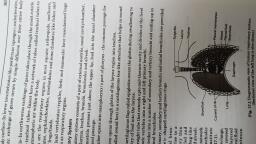
Trachea (wind pipe) :, *It is a long tube 10 to 12 cm in, length., *It runs through the neck in front of, the oesophagus and extends into and, upto the middle of thoracic cavity., * It is supported by 'C' shaped 16 to, 20 rings of cartilage which prevent, the collapse of trachea., It is lined internally with ciliated,, pseudostratified epithelium and, mucous glands that trap the, unwanted particles preventing their, entry into the lungs., Larynx, Trachea, Right main, Left main, bronchus, bronchus, Bronchi :, The trachea divides into right and left, primary bronchi as it reaches the middle of, the thoracic cavity. The bronchi are supported, internally by C' shaped incomplete rings of, cartilage. The primary bronchi divide to form, secondary and tertiary bronchi which lead into, terminal bronchioles ending into alveoli., Bronchioles, Bronchi, Trachea, Rings of, cartilage, Pleural, membrane, Pleural, cavity, Diaphragm, Lungs :, These are the main respiratory organs of humans., > One pair of spongy and elastic lungs are present in the thoracic cavity., >Each lung is enclosed and protected by a double pleural membrane, outer, parietal and inner visceral membrane., > Between the two pleura is a pleural cavity filled with a lubricating fluid called, pleural fluid. It is secreted by the membranes., >The right lung is larger and divided into 3 lobes, while the left lung is smaller, and divided into 2 lobes., > Each lobe of the lung has the terminal bronchioles ending in a bunch of air, sacs, each with 10 to 12 alveoli., Nasal cavity, Nostril, Larynx, Mouth, Pharynx, Lorynx, Trachea, Trachea-, Left, lung, Right main, bronchus, Right main, bronchus, Left main, bronchus, Ribs, Right lung, Diophragm, Alveoli :, >These are thin walled lobulated, structures, like a bunch of grapes., > Each alveolus is surrounded by a, network of capillaries of pulmonary, artries and veins., >These have highly elastic wall made, up of a single layer of squamous, epithelium resting on a basement, membrane of connective tissue., > There are about 700 million alveoli, in the lungs and they provide the, surface area for exchange of gases.
Page 5 :
• Diaphragm : It is a muscular septum that separates the thoracic and, abdominal cavity. It is dome shaped and on contraction it becomes, flattened., Mechanism, of respiration, Cellular, respiration, External, Internal, breathing, respiration, respiration, Itts physeccal process, Oy whith gases exchange, Takes place between, eauctonimentlungs., Brea thing, Inspiratfon, Expiration, Oafr omes fnef de the lungs O aer pes oukfde, O sternum goes outsfde, O Dtphroym betomes flat, a goeg daonword., O lecs to PnCYeUse The, volceme of thorcic, case., O sternum gees 1nefde, O atphragm Reloxed., O pecrease n the volume, of thoracrt cage., a. Inspiration, (Breathing in), Air, b. Expiration, (Breathing out), Rib cage moves, up and forward, Rib cage, moves down, and inward, Pressure in lungs, decreases and air, comes rushing in, Diaphragm contracts and moves down, Diaphragm relaxes and moves up, Nasal cavity, Nostril -, Mouth, - Pharynx, Larynx, Trachea-, Left, Right main, bronchus, lung, Right lung, >Ribs, Diaphragm