Page 2 :
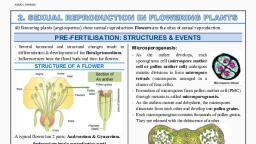
Ww, , , , , , , , , , , , , , , sp WAl REPRODUCTION IN FL ING PLANTS, “, Stigma, /, 2, —Style _ Hilum 3, Stigma Funicle Micropyle, Micropylar pole, ~ Outer integument, Inner integument, Nucellus, Embryo sac, 7*——Chalazal pole, (b) (c) (d), Figure 2.7 (a) A dissected iscus showing floral parts have been removed);, (b) Multica rpous pistil (c) A multicarpellary, apocarpous, Synoecium of Michelia; (d) A diagrammatic 1 f a typical anatropous ovule, Class XI. Arising from the placenta are the megasporangia, commonly, called ovules. The number of ovules in an ovary may be one (wheat,, «paddy, mango) to many (papaya, water melon, orchids), The Megasporangium (Ovule) : Let us familiarise ourselves with the, structure of a typical angiosperm ovule (Figure 2.7d). The ovule is a small, structure attached to the placenta by means of a stalk called funicle., The body of the ovule fuses with funtcle in the region called hilum. Thus,, hilum represents the junction between ovule and funicle. Each ovule has, one or two protective envelopes called integuments, Integuments encircle, the ovule except at the tip where a small opening called the micropyle is, organised. Opposite the micropylar end, is the chalaza, representing the b, i, , basal part of the ovule,, Enclosed within the integuments is a mass of cells called the nucellus,, , Cells of the nucellus have abundant reserve food materials, Located in the, nucellus is the embryo sac or female gametophyte. An ovule generally has, a single embryo sac formed from a megaspore through reduction division,, , Megasporogenesis : The process of formation of Megaspores from the, megaspore mother cell is called megasporogenesis, Ovules generally, differentiate a single megaspore mother cell (MMC) in the micropylar region
Page 4 :
2-nucleate, , 4-nucleate 8 1, nucleate, , umediately, , ] walls are laid down, , female gametophyte, , central cell, : 1 thin the embryo, egg apparatus s ' ees, piceéall two synergids, at the, , t role in, , he antipodals, j, , igh 8-nucleate is 7-celled, , 3 Pollin, , the pr, In I female gametes, in flowering 1 and embryo sac, , respectively t rt f re non tile, th be, , brought togethe t jon to ur. How ts this achi, , Pollination is the mechanism to achieve this objective. Transfer, of pollen grains (shed from the anther) to the stigma of a pistil is, termed pollination Flowering plants have evolved an amazing array, of adaptations to achieve pollination. They make use of external, agents to achieve pollination Can you list the possible external, agents?, , Kinds of Pollination : Depending on the source of pollen, pollination, can be divided into three types., , () Autogamy : In this type, pollination is achieved within the same, flower. Transfer of pollen grains from the anther to the stigma of the, same flower (Figure 2.92). In a normal flower which opens and, exposes the anthers and the stigma. complete autogamy is rather, rare. Autogamy in such flowers requires synchrony in pollen release, and stigma receptivity and also, the anthers and the stigma should
Page 5 :
BOLOSy, , , , lie close to each other so that self pollination, ean occur. Some plants such as Violg, (common pansy}, Oxalls, and Commeting, produce two types of flowers, ki chasmogamous [lower vi, flowers of other species with exposed anthers, and stigma, and clelstogamous [lowers whic i, do not open at all (Figure 2.9¢). In euch flowers,, the anthers and stigma lie close to eac, , , , which are sinvlar to, , h other,, When anthers dehisce in the flower buds., , pollen grains come in contact with the, to effec, , slgma, pollination. Thus, eleis togamous, , flowers are invariably aulogamous, , , , as there is, no chance of cross-pollen lan, , ding on the, stigma. ©, , istogamous flowers produce, assured seed-set even in the, pollinators. Do you think that ¢, advantageous or disadvant, plant? Why?, , absence of, leistogamy is, ageous to the, ( @ettonogamy - Transfer of pollen gr, © anther to the stigma of another flower of, the same plant Although Reilono, functionally cross, pollinating, , rains from, , , , , Pollination tiny, agent. genetice, “ulogumy since the Pollen, the same plant,, , (W) Xenogamy ~ Py,, , olving a, ally it is similar to, grains come from, , ~Chaamogamous, flower, , Pollination, To, Figure 2.9 (a) Self- pollinated ., , 3 associated |, {b) Cross pollinated flowers; eee ed loss of pollen, (c) Cletstogamous flowers OUS amount of, , , , , , , , on om