Page 1 :
Principles of Inheritance and variation, NITIN SARKAR, M.SC LIMNIOLOGY, Mob.No. 8233795344, Introduction – the process by which characters are transferred from one generation to the next, generation is called inheritance or heredity., The difference in traits of individuals of progeny, from each other and from their parents is called, variation., The branch of science which deals with inheritance and variation is called genetics., 1. Mendel’s Experiment –, Gregor Johann mendal (1822-1884) Is known as ‘Father of genetics’., Mendel performed his experiments with garden pea plants (Pisum sativum)., He conducted artificial pollination / Cross- Pollination experiments using several true- breeding varieties, having contrasting trails as known as shown., He observed one trait at a time., He hybridised plants with alternate forms of a single trait (monohybrid cross). The seeds thus produced, were gowns to develop into plants of first filial generation (F1)., Mendel then self-pollinated the F1 plants to generate plants of second filial generation (F2)., Later, Mendel also crossed pea plants that differed in two characters (Dihybrid cross)., , 2. Mendel’s Experimental plant –, , a), b), c), d), , Mendel selected garden pea as his experimental material because of the following reasons:, It is an annual plants with a short life cycle. So several generation can be studied within a short period., It has perfect bisexual flowers containing both male and female part., The flowers are predominantly self pollination. It is easy to get pure line for several generations., It is easy to cross pollinate them because pollens from one plants can be introduced to the stigma of, another plant by removing the anthers., e) Pea plants produces a large number of seeds in one generation., f) Pea plants could easily be raised, maintained and handled., g) A numbers of easily detectable contrasting characters / traits were available.
Page 2 :
3. Mendel’s observations –, , , , , , , , , , , , , Phenotype – Visible expression of genetic constitution e.g. Tall / dwarf., Genotype – Genetic constitution of individuals e.g. TT,Tt, tt, Monohybrid cross – Cross involving study of inheritance of one character. e.g. Height of plants., Dihybrid cross – Cross between plants differing in two traits / cross involving study of inheritance of, two genes or characters, e.g . Color and shape of seeds., Homozygous – The individuals carrying similar alleles for a trait. e.g. TT or tt, Heterozygous – The individuals carrying different alleles for a trait. e.g. Tt, F1 progenies always resemble one of the parents and trait of the other parent was not seen., In monohybrid cross, F2 generation stage expressed both the parental traits in the proportion 3 : 1, The contrasting traits did not show any blending in either F1 and F2 generations., In dihybrid cross, he got identical results as in monohybrid cross., He found that the phenotypes in F2 generation appeared in the ratio 9:3:3:1, , 4. Mendel’s Laws of Inheritance –, , , , , Based on his hybridization experiments, mendel proposed the laws of inheritance., His theory was rediscovered by hugo de vries of Holland, carl correns of Germany and Eric von, Tschermark of Austria in 1901., Hugo de vries, Correns and tschermark are thus referred to a rediscoveries of Mendelism.
Page 3 :
a) Law of Dominance –, This law states that when two alternative forms of a traits or character (Genes or alleles) are, present in an organism, only one factor expresses itself in F1 progeny and is called dominance, while the other hat remains masked is called recessive., Characters are controlled by discrete units called Factors. Factor occur in pairs., b) Law of segregation or Law of purity of gametes –, , , , , The law states that the factors or alleles of a pair segration from each other during gamete, formation such that a gamete receives only one of the two factors. They do not show any blending, but simply remain together., Homozygous parents produce all gametes that are similar, heterozygous parent produces two, types of gametes, each having one alleles in equal proportion., , c) Law of independent Assortment –, , , , , According to this law the two factors of each character assort or separate out independent of the, factors of other characters at the time of gamete formation and get randomly rearranged in the, offspring producing both parental and new combinations of characters., When two pairs of traits are combined in a hybrid, segregation of one pair of characters is, independent of the other pair of characters., , 5. Incomplete Dominance –, , , , , It is a phenomenon in which the F1 hybrid exhibits characters intermediate of the parental genes., Here, the phenotypes ratio deviates from the Mendel’s monohybrid ratio., It is seen in flower colours of Mirabilis jalapa ( 4 O’ clock plant ) and Antirrhinum majus ( snapdragon),, where red colour is due to genetic constitution RR, White colour is due to genetic constitution rr and, pairs colours is due to genetics constitution Rr., , 6. Co- Dominance, , The alleles which are able to express themselves independently, even when present together called codominance alleles and this biological phenomenon is called Co-dominance., For example, ABO blood grouping in human, , , , ABO blood groups are controlled by gene I. Gene I has three allele IA , IB and IC / i
Page 4 :
, , , , , IA and IB produce RBC surface antigen which are sugar polymers A and B, respectively, whereas i dose, not produce any antigen., IA and IB are dominant over I hence IA and IB are dominance alleles and I is recessive alleles as in IAi, and IBi., When IA and IB are present together, both express equally and produce both surface antigen A and B,, hence show co- dominance., Since human are Diploid, each person possesses any two of the three ‘I’ gene alleles, resulting into six, different genotypic combinations and four phenotypic expressions., , 7. Test cross –, , , , , , It is a method devised by Mendel to determine the genotypes of an organism., In this cross, the organism with dominant phenotype is crossed with the recessive individuals., In a monotypes cross between violets colours flower (W) and white colours flower (w), the F1 hybrid was, violet colour flower. The cross areIf all the F1 progeny are violets coloured, then the plant is homozygous dominated. i.g. WW and if the, progenies are in 1:1 ratio then the plant is heterozygous, i.g.Ww., , 8. Pleiotropy –, , , , , , , it is the phenomenon in which a single gene exhibits or controls multiple phenotypic expression., The pleiotropic gene affects the metabolic pathway, resulting in different phenotypes., For example, phenylktonuria is caused by mutation in the gene coding for the enzyme phenylalanine, hydroxylase. The affercted individuals show mental retardation as well as reduction in hair and skin, pigmentation., In Drosophila, gene for wing size influences nature of balancers, colour of eye, dorsal bristles, fertility and, longevity.
Page 5 :
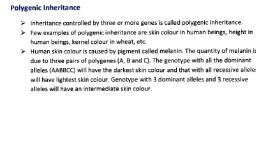
9. Polygenic Inheritance –, , , , , , It is a types of inheritance, in which a trait is controlled by three or more genes, such trait are called, polygenic traits., The phenotype reflects contribution of each allele and is also influenced by the environment., For example, humanb skin colour. Suppose three genes A,B and C control skin colour with A, B, C being, the dominnat alleles and a,b,c being the recessive alleles.then,, The F2 gerenation will have varied skin tones, with each type of alleles in the genotype determining the, darkness or lightness of the skin., , 10. Chromosomal Theory of Inheritance –, , , The chromosomal theory of inheritance was proposed independently by Walter Sutton and Theodore, Boveri in 1902. They stated that behavior of chromosomes was parallel to behaviour of genes and used, chromosome movement to explain Mendal’s laws. According to this theory,, 1. The hereditary factors are carried in the nucleus. Nucleus contain chromosomes., 2. Like the mendalian alleles, chromosome are also found in pairs., 3. The sperm and egg having haploid sets of chromosome fuse to re-establish the diploid state., 4. The two alleles of a gene pair are location on homologous sites on homologous chromosomes in a, linner order. As there are two chromosomes of each kind in somatic (diploid) cell there must be, two genes of each kind, one in each of the homologous chromosomes., 5. Homologous chromosome synapse during meiosis and get separated to pass into differents cells., This forms the basis for segregation and independent assortment. A gamete receives only one, chromosome of each type and thus has only one gene for a trait. The paired condition is restored, by fusion of gametes., , 11.Linkage and Recombination –, , , , , T.H.Morgan carried out several dihybrid crossed in Drosophila to study the genes that are sex-linked., He observed that when the two genes in a dihybrid cross are located on the same chromosome, the, proporation of parental gene combination in the progeny was much higher than the non-parental or, recombination of gene., Reason for selection Drosophila melanogaster (fruits fly), 1. They could be grown on simple synthetic medium in the laboratory., 2. They complete their life cycle in two weeks., 3.A single mating could produce a large number of progeny., 4. There was clear differentiation of the sexes,i.e. Male and female files are easily distinguishable., 5.It has many types of hereditary variations that can be seen with low power microscopes.
Page 6 :
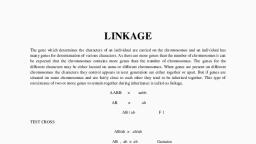
, , , , , , Morgan hybridised yellow bodies and white eyes females with brown bodies and red eyed males (wild, type)(cross-A) and inter crossed their F1 progeny., F2 generation ratio deviated from 9:3:3:1., Morgan’s observations:, 1. Genes are present on the chromosomes in a linear fashion., 2.When genes are grouped on the same chromosome, they are always inherited together. These are said, to be linked., 3.Some genes are tightly linked or associated and show little recombination., 4.When the genes are loosely linked they show higher percentage of combination., 5. Strength of linkage between genes is inversely proportional to the distance between them., Alfred Sturtevant determined that genes of Drosophila are arranged in a linear order.He measured the, distance between genes and prepared chromosome maps with the position of genes on the chromosomes, based on percentage of recombinans. These are also called genetic map., , 12. Sex Determination mechanism –, , , , Finalisation of sex at the time of zygote formation is called Sex determination., Two types of chromosome are present in individuals- sex determination (which determine the sex of, individuals) and autosomes., Sex Determination Mechanism, , Male Heterogamety, Males produce different types, Of gametes in term of the sex chromosome, , XX-XY Type, , XX-XO Type, , female Heterogamety, Females produce different types, Of gametes in term of the sex chromosome, , ZZ-ZW Type, , ZZ-ZO Type
Page 7 :
1. XX-XY Type –, Seen in many insects and mammals including humans, Droso[hila melanogaster., Males have X and Y Chromosomes along with autosome [A] and females have a pair of X chromosomes., , 2. XX-XO Type Seen in grasshopper and cockroach., Males have Only one X chromosome besides autoosme and females ahaev a pair of X chromosomes., , 3. ZZ-ZW Type –, Seen in birds, Fowl and fishes., Females have one Z and one W chromosome whereas males have a pair of Z chromosomes., , 4. ZO-ZZ Type Seen in butterfly and moths., Females have only one Z chromosome besides autosomes and males have a pair of Z chromomsomes.
Page 8 :
13. Sex Deteremination in human –, Human show Xy type of sex determination mechanism., Out of 23 paur of chromosomes, 22 are autosmoe (same in both males and females), Female shave a pair of X – chromosomes., Males have an X and a Y chromosome., During Spermatogenesis males produce two types of gametes with equal probability – sperm carring, either X and y chromosome., During oogenesis, females produce only one types of gametes – having X chromosome., An ovum fertilized by the sperm carring X chromosome develops into a femake (XX) and an ovum, fertilised by the sperm carrying Y chromosome develops into a males (XY), Hence. It is evidence that genetic constitution of sperm determines the sex of the child. In every, pregnancy, there is always 50% probability of either male or female child. So it is not corrent to blane, women fir producing female child., , 14. Sex determination in honeybee –, , , , , , Honeybee show haplodiploid sex determination system., Offspring formed from union of a sperm and an egg develops as a female (queen or Worker), which are, diploid, having 32 chromosome., Unfertilised egg developed by parthenogenesis form male (drone), which sre haploid having 16, chromosomes., Males produce sperms by mitosis, so they, neither have father nor sons but have grandfather and, grandmother.
Page 9 :
15. Pedigree Analysis, , , The study of inheritance of genetic traits in several generations of a Human family in the from of a, family tree diagram is called pedigree analysis., Advantages1. it help in genetic counseling to avoid disorders in future generations., 2. it show the origin of a trait and flow of a trait family., 3. It is important to know the possibility of expressive recessive alleles that can cause genetic disorders, like colour blindness, haemophillia. Etc, 4. Control crosses cannot be made in human, so pedigree analysis helps us to study inheritance pattern, of a traits., 5. it help us to understand whether the trait is dominant or recessive autosomal or sex – linkage., 6. It predicts the harmful effects of marriage between close relatives., 7. It is extensively used in medical research., , 16. Mutations, , Mutation is defined as the sudden inheritance change in the genetic material. It can be of the following, two major types,, 1.Point mutation- It is the mutation in a single base pair, which is replaced by another base pair. For, example, in sickle – cell anaemia, point mutation in ß – globin chain results in change of glutamate to value., 2.Frameshift mutation – it is the change in the reading frame because of insertion or deletion of base 3pairs., (1) Insertion - it is the addition of one or more nucleotide in the DNA segment. Insertion of three or, its multiple bases do not change the reading frame but add a new amino acid., (2) Deletion – it is the removal of one or more nucleotide from the DNA segment. Deletion of three or, its multiple bases do not change the reading frame but remove one or more amino acids., Normal DNA – ATC GAT CGA, Insertion – ATC C [G]A TCG, , Deletion – ATC ATC GA, 17. Mendelian Disorders –, , , , Mendelin disorders are caused due to alteration or mutation in single gene., These follow Mendel’s principles of inheritance.
Page 10 :
a) Haemophilia –, , , , , , , , , it is a sex-linked recessive disorder. It is also known as bleeder’s disease., Patient continues to bleed even with a minor a minor cut because of a defect in blood coagulation., The gene for haemophilia is location on X – chromosome., More males suffer from haemophilia than females because in males single gene for the defect is able, to express as males have only one X- Chromosome., The defective alleles produce non- functional proteins which later form a non-functional cascade of, proteins involved in blood clotting., Females suffer from this disease only in homozygous condition, i.e. XhXh, Queen Victoria was a carrier of this disease and produced haemophilic offspring., , b) sickle-cell anaemia –, , , , , , , , It is an autosome- linked recessive trait., The disease is controlled by a single pair of allele HbA and Hbs., Only the heterozygous individuals for Hbs , i.e., Hbs Hbs show the disease phenotype., The heterozygous individuals are carriers (HbA Hbs)., Due to point mutation, Glutamic acid (Glu) is replaced by valine (Val) at the sixth position of ß- globin, chain of haemoglobin molecules., It occurs due to single base substitution at 6th codon of 𝛽 − 𝑔𝑙𝑜𝑏𝑖𝑛gene from GAG to GUG mutated, haemoglobin molecules undergoes polymerization under low oxygen tension causing the change in the, shape of RBC from biconcave disc to elongatied sickle like structure. As a result, the cells cannot pass, through narrow capillaries. Blood capillaries are elongated and thus affect blood supply to different, organ., , c) Phenylketonuria –, , , , , , it is an inborn error of metabolism and is inherited as autosomal recessive trait., The affected individuals lacks an enzyme called phenylalanine hydroxylase that converts the amino acid, phenylalanine into tyrosine in liver., Phenylalanine is accumulated and gets converted into phenylpyruvic acid and other derivatives . this, affects the brain, resulting in mental disorder., Phenylalanine is also excreted through urine because of its poor absorption by kindey.
Page 11 :
d) Thalassemia –, , , , , , It is an autosome- linked recessive disease., It occurs due to either mutation or deletion resulting in reduced rate of synthesis of one of globin chains, of haemoglobin., Anaemia is the characteristic of this disease., Thalassemia is classified into two types1. α − Thalassemia – production of α − globin chain is affected. It is controlled by the closely linked, genes HbA1 and HbA2 on chromosome 16. It occur due to mutation or deletion of one or more of, the four genes., 2. 𝛽- Thalassemia - production of 𝛽 − 𝑔𝑙𝑜𝑏𝑖𝑛 chain is affected. It occurs due to mutation of one or, both HbB genes on chromosome 11., , e) Colourblindness –, , , , , , It is a sex – linked recessive disorder., It Results in defect in either red or / and green coone of eye, resulting in failture to discriminate between, red and green colour., The gene for colour blindness is present on X chromosome., It is observed more in males (XcY) because of presence of only one X chromosome as compared to two, chromosome of females. It occurs in 8% males and 0.4% females., , 18. Chromosomal Disorders –, , , , , , Chromosomal disorders are caused due to excress, absence or abnormal arrangement of one or more, chromosomes., Aneuploidy – something the chromatids fail to segregate during cell division, resulting in grain or less of, a chromosome. This is called aneuploidy. It is of two types1) Trisomy – additional copy of a chromosome in an individuals, i.e., (2n+1), 2) Monosomy – lack of copy of a chromosome in an individuals, i.e., (2n-1), Polyploidy- Failture of cytokinesis after telophase stage of cell division results in an increase in whole, set of chromosomes in an organism. It is called polyploidy. It is often seen in plants., , A) Down’s syndrome –, , , , Cause – additional copy of chromosome number 21 or trisomy of chromosome 21., Symptoms1. Short statured with small round head., 2. Partially open mouth with protruding furrowed tongue., 3. Palm is broad with characteristic palm crease., 4. Physical, psychomotor and mental development retarded., , B) Klinefelter’s syndroms, , , Cause – presence of an additional copy of X chromosome resulting in the karyotype 44+XXY. i.e, 47, chromoosme., Symptoms –, 1. Sex of the individuals is masculine but possess feminine characters., 2. Gynaecomastia, i.e., development of breasts., 3. Poor beard growth and often sterile.
Page 12 :
4. Feminine pitched voice., 5. They are sterile., 6. Tall status., C) Turner’s syndrome –, , , Cause- Absence of one of the X chromosome, resulting in the karyotype 44+XO. i.e., have 45, chromosomes., , , , Symptoms –, 1. Sterile female with rudimentary ovaries., 2. Lack of other secondary sexual characters., 3. Underdeveloped feminine chararcters., 4. Poor development of breasts., 5. Short stature, small uterus, puffy fingers.