Page 1 :
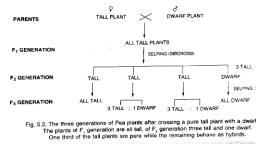
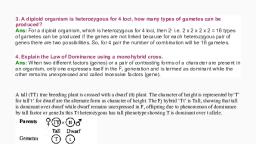
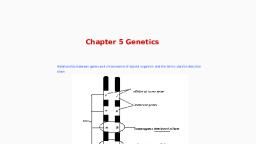
X, , TALL PLANT, , PAREN TS, , a, DWARF PLANT, , l, , !, , ALL TALL PLANTS, , F1 GENERATION, , F2 GENERATION, , F3 GENERATION, , SELFING (SIBCROSS), , I, TALL, , TALL, , TALL, , !, , !, , !, , ALL TALL, , I, , II, , I, , I, , I, , 3TALL : 1 DWARF, , I, , 3 TALL, , 3 TALL : 1 DWARF, , DWARF, , l, , I, , SELFING (SIBCAO SS), , ALL DWARF, , 1 DWARF, , a dwarf one., Fig. 5.2. The three generations of Pea plants after crossing a pure tall plant with, The plants of F 1 generation are all tall, of F2 generation three tall and one dwarf., One third of the tall plants are pure while the remaining behave as hybrids.
Page 2 :
~, , PARENTS, , PLANT WITH, ROUND SEEDS &, YELLOW COTYLEDONS, , ><, , l, , rJ, , PLANT WITH, WRINKLE SEEDS &, GREEN COTYLEDO NS, , ALL PLANTS WITH ROUND, SEEDS & YELLOW COTYLEDO NS, , F1 GENERATION, , j, I, , SELFING, , F2 GENERATION, 9 ROUND, YELLOW, , 3 ROUND, GREEN, , 3 WRINKLE, YELLOW, , DIHYBRID RATIO 9 : 3 : 3: 1, Fig. 5.3. Showing the result of a dihybrid cross., , 1 WRfNKLE, GREEN
Page 3 :
Mendel's Principles of Inheritance or Mendelism f~·, 'M endelism or Mendelian principles are rules of inheritance first discovered by Mendel., Ther~ are four principles or laws of inheritance based on monohybri d and polybybrid cros~es.
Page 4 :
One Gene Inberitan4', inheritance)., Eve~ ch~a cter is ~~trolled by a gene that has two alleles (monogenic, hvbrid, Study of 1nhen tance of a single pair of alleles (factors) of a character at a time (mono, hvbrid ~ s ,, cross) is called one gene inher itance .. On the basis of his observations on mono, the formation of, Mendel propo sed a set of gener alisat ions (postulates) which resulted into, following three laws of inher itance ., ~, , 1. Principle of Paired Factors, , .. The two, A chara cter is repre sente d in an organ ism (diploid) by at least two factors, may represent the, factors lie on the two homo logou s chrom osom es at the same locus. They, dwarf Pea plants), same (hom ozygo us, e.g., TI in case of pure tall Pea plants_, tt in case of, plants ) of the same, or alternate expre ssion s (heter ozygo us, e.g., Tt in case of hybrid tall Pea, called alleles or, character. Facto rs repre sentin g the alternate or same form of a character are, in Table 5.1., allelo morp hs. The seven types of traits selected by Mendel in Pea are given
Page 5 :
2. Law or Principle of Dominance, In heterozygous individuals or hybrids, a character is represented by two contrasting, factors called alleles or allelomorphs. Out of the two ·contrasting alleles, only one is able to, express its effect in the individual. It is called dominant factor or dominant aDele .. The, other allele which does not show its effect in the heterozygous individual is called. recessive, factor or recessive allele. Mendel used letter symbols to denote factors. The letter symbol, refers to the dominant factor. It is given a capital or upper case ietter of the alphabet. A, corresponding small or lower case letter is assigned to the recessive factor, e.g. , T (tallness), and t (dwarfness). Mendel experimented with Pisum sativum for seven characters only. In, each case he found that one expression of the character or trait.(e.g., T or tallness in case, of height) is dominant over the other expression in the character or trait (e.g. ~ tor dwarfness, in case of height, Table 5.2). This can also be proved experimentally.
Page 6 :
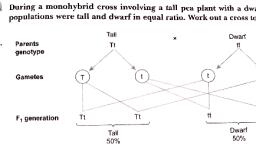
Talce two Pea plants, one pure or homozygou s tall (height 1.2-2.0m) and the other pure, or homozygous dwarf (height 0.25-0.5m ; Fig. 5.9). Cross the two and raise their progeny, called first filial or F 1 generation. All plants of F 1 generation are tall (height 1.2-2.0 m) though, they have also received -a factor for dwarfness. That the factor for dwarfness is present in, F 1 plants can be tested by self breeding them when individuals of F 2 generation will be both, tall and dwarf in the ratio of 3 : 1. Therefore, in F 1 plants both the factors for tallness and, dwarfness are present. However, the factor for dwarfness is unable to express itself in the, presence of factor for tallness. Hence, the factor for tallness is dominant over the factor, for dwarfness. The factor for dwarfness is recessive.
Page 7 :
Exceptions to Principle of Dominance and Principle of Paired Factors, (A) Incomplete Dominance (Intermediate Inheritance), _Incomplete (partial Qr mosaic) dominance is the phenomenon where none of the two, contrasting alleles or factors is dominant. Th~1 expression of the character in a hybrid or F 1, individual is intermediate or a fine mixture 01 .the expression of the two factors (as-found .in, homo~ygous · state). Incomplete ~or mosaic inh~ritance is not- an examp-le of pre-mendelian, concept of blending inheritance because the parental types reappear in the-F 2 generation. It, is however, considered by some workers to be ~n example of quantitative inheritruace where, only a single gene pair is involved} 2 phenotynic ratio is 1 : 2 : 1, similar to genott pic ratio.
Page 8 :
(i) Carl Correns reported incomplet e dominanc e in case, of flowers of Four O'Clock. -In Mirabilis jalapa (Four O ', , ------ -~-- --~- ---- ---~, , Clock,-ve m. Gulbansi) and Antirrhin um majus (Snapdragon, or Dog flower), there are two types of flower colour in pure, state, red and white. When the two types of plants are crossed~, the hybrid or plants of F 1 generatio n have pink flowers (Figs., 5.4 & 5.5). If the latt~r/are selfed, the plants of F 2 generatio n, are of three types- red, pink and white flowered in the ratio, of 1 : 2 : 1. The pink colour apparently appears either due to, mixing of red and white colours (incomple te dominanc e) or, expression of a single gene for pigmente d flower which produces only pink colour (quantitat ive inheritanc e).
Page 9 :
RE:D (RA), , •, , -WHITE- (WW), , PINK (t,W), , _., , Fig. 5.5. Incomplete domlnancl', in Mlrabl/ls Jalapa (Four O'clock)
Page 11 :
(C) Multiple Alleles, , More than two alternate orms of a gene present on the same locus are called multi le, alleles. They are roduced due to e ate mutation of the same gene ut in different, directions. hey show meristic type of germinal variations. Thus the wild type of allele for, red eye colour (w+ or W) in Drysophila melanogaster mutated to form allele for white eye, (_w). Further mutations in both have produced as much as 15 alleles which are recessive to, wild type and dominant over white eye (w) but have incomplete intermediate dominance over
Page 12 :
1, 0, one another. Some of these alleles -are wine (ww), coral (wc ), blood rwb ), cherry (~,, apricot (wa), eosine (we~ buff (wb), tinged (wt), honey (wh), ecru (wee) , pearl ( w P), and, ivory (w i). The coat colour (Agouti, Chinchilla, Himalayan and Albino types) of rabbits is also, regulated by multiple alleles. Despite the presence of several alleles of the same gene in a, population, an individual can have only two alleles., Characteristics. (i) There are more than two alleles of the same gene, e. g., 15 alleles, for eye colour in Drosophila, 3 alleles for blood groups in humans, 4 alleles for coat colour, in Rabbit. (ii) All the multiple alleles occur on the same gene locus of the same chromosom e, or its homologue. (iii) A chromosom e contains only one allele of the group. (iv) An, individual possesses only two alleles while the gametes carry single allele. (v) Multiple alleles, express different alternatives of the same character. (vi) Diff~rent alleles show codominan ce,, dominance- recessivene ss or intermediat e dominance amongst themselves _ They, however,, ·, follow mendelian pattern of inheritance.
Page 14 :
themselves forming antigens A and B. Such alleles which are able to express themselves in, the presence of each other are called codominant. Thus blood group alleles show both, codorninant and dominant-recessive relationships (IA = 18 > i)., A human being carries two of the three alleles, one from each parent. -The maximum, number of possible genotypes is six for the four phenotypes. The phenotypes are tested by, two antisera, anti-A and anti-B., Blood Group, Phenotype, , Genotype, , Antigen, , Anti body, , Reaction with, Anti-A, , Null, , a, b, both, , A, , b, , JB JB, ]Bi, , B, , a, , JA [B, , A, B both, , Null, , 0, , ii, , A, , [A [A,, , B, , AB, , [Ai, , Anti-B, , Percentage, in India, 40, , +, , 22, 33, , +, , 5, , +, , +
Page 16 :
case of others (secondary effect). Occasionally a number of related changes are caused by, a gene. They are together called syndrome. In cotton a gene for the lint also influences the, height of plan~ size of the boll, number of ovules and viability of seeds. In Garden Pea the, gene which controls the flower colour also controls the colour of the seed coat and presence, of red spots in the leaf axils. In Drosophila a single gene influences the size of the ~os,,, character of balancers, position of dorsal bristles, eye colour~ shape of spermathe c~ fertility, and longevity. In human beings pleiotropy is exhibited by syndrome called sickle cell, anaemia.