Page 1 :
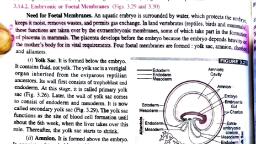
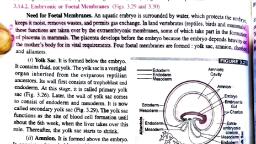
Extra-Embryonic, The, , or, , Foetal Membranes (Fig. 3.31), , growing embryo/foetus develops, , four membranes called the extra embryonic or, foetal membranes. These include chorion, aminon, allantois and yolk sac., i) Chorion. It is made up of trophoblast outside and somatopleuric extraembryonic, mesoderm inside. It completely surounds the embryo and protects it. It also takes, in, the formation of placenta., , part
Page 2 :
(i) Amnion. It is composed of trophoblast inside and somatopleuric extraembryonic, mesoderm outside. The space between the embryo and the amnion is called the amniotic, cavity which is filled with a clear, watery fluid secreted by both the embryo and the, membrane. The amniotic fluid prevents desiccation of the embryo and acts as a protective, , cushion that absorbs shocks., (i) Allantois. The allantois is, , traembryonic, , of endoderm inside and, exmesoderm outside. It is a sac-like structure which arises from the gut of the, the yolk sac. In human the allantois is small and nonfunctional except for, , splanchnopleuric, , composed, , embryo near, furnishing blood vessels to the placenta., (iv) Yolk sac. The primary yolk sac consists, extraembryonic mesoderm outside. The yolk, that it functions, , as, , the site of, , early, , sac, , of endoderm inside and splanchnopleuric, is nonfunctional in human beings except, , blood cell formation.