Notes of Class 12, Biology Environmental Issues - Study Material
Page 1 :
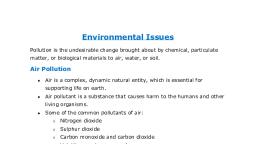
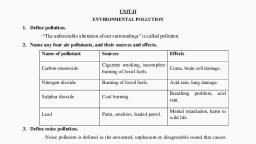
Chapter 16: Environmental Issues, , Pollution- Any undesirable change in the biological, physical or chemical characteristics of air, land, water, or soil which directly or indirectly affect human beings., Pollutants- Any substances or agents responsible for pollution are called pollutants., The various classes of pollutants area. On the basis of nature, i. Quantitative – Those components which become pollutants when their concentration, reaches beyond a threshold value. E.g. CO, CO2, NO2., ii. Qualitative – These are harmful products which do not occur naturally in environment,, but are passed through human activities. E.g. DDT, pesticides, fungicides, etc., b. On the basis of persistence, i. Primary pollutants – Pollutants persisting in the form in which they are added to the, environment. E.g. Particulate matters, CO2, SO2, DDT, etc., ii. Secondary pollutants – pollutants which are formed by the interactions among primary, pollutants and are more toxic than primary pollutants. E.g. O 3 , smog, peroxyacyl, nitrates (PAN), etc., c. On the basis of nature of disposal, i. Biodegradable – The pollutant degrades by natural means, such as by heat or microorganisms. E.g. sewage, domestic wastes, etc., ii. Non-biodegradable – The pollutant which either do not degrade or degrade very slowly, in nature. E.g. polythene bags, DDT, BHC, radioactive materials, etc., , Air Pollution, Causes of air pollutioni. Burning of fossil fuels which emit harmful gases like SO2, CO, etc., ii. Use of insecticides, pesticides and fertilizers in agriculture., iii. Manufacturing industries which release large amount of CO, hydrocarbon, organic, compounds etc, in air., iv. During mining, dust and chemicals are released in the air., v. Household kitchen fires, painting etc., emit toxic chemicals in air., Primary air pollutants: It includes directly emitted substances from some identifiable sources. E.g., CO2, CO, NOx, SOx, hydrocarbons, particulate matter, etc., Secondary air pollutants: They are formed by reaction among the primary pollutants. E.g. peroxyacyl, nitrate (PAN), ozone, aldehydes, smog, acid rain (Oxides of Sulphur and Nitrogen with moisture), etc., Effects of air pollutioni. It causes serious respiratory and heart problems., ii. It causes global warming.
Page 2 :
iii. It results in acid rain damaging crops by reducing rate of photosynthesis and growth and, increased sensitivity to drought and diseases in plants) , building etc., iv. It affects biodiversity including water ecosystem., v. It causes the depletion of ozone layer., , Control measuresi., , Particulate matter released in thermal power plant can be removed bya. Electrostatic precipitation- Attaching the dust particles with negatively charged electrons, produced from high voltage electrostatic precipitator and collected to grounded collecting, plates., b. Scrubber- The exhaust is allowed to pass through a spray of lime/water to remove SO 2, present., ii. Gaseous pollutants can be removed by combustion, absorption (scrubber) and adsorption, (activated charcoal)., iii. Good maintenance of automobiles and use of lead free petrol/diesel, iv. Use of thermal or catalytic combustion., Why unleaded petrol is prescribed to use?, The lead present in petrol inactivates the catalysts like platinum-palladium and rhodium that, converts hydrocarbons into CO2 and H2O; CO and NO to CO2 and N2 respectively., Controlling Vehicular air pollution in major cities, i., , Use of compressed natural gas (CNG) that burns more efficiently, more cheaply and cannot be, adulterated like petrol/ diesel., ii. Phasing out of old vehicles., iii. Using unleaded petrol or low sulphur petrol/diesel or catalytic converter., e.g. Euro II norm stipulates sulphur can be controlled at 350 ppm in diesel and 150 ppm in, petrol, aromatic hydrocarbons at 42%. Its goal is to reduce sulphur in petrol and diesel to 50, ppm and bring down the level to 35%. Bharat stage II (Equivalent to Euro II norms)., The Air (Prevention and Control of Pollution) Act, 1981 (amended 1987), includes noise as an air, pollution., Noise pollution: Noise pollution is measured in decibels. Generally sound above 80 dB is termed as, noise. A sound more than 115 dB is harmful to the ears. A sudden loud of 150 dB or more generated by, take-off of a jet plane or rockets may cause permanent loss of hearing., Noise pollution can be prevented/reduced by, i., ii., iii., , muffling or use of sound absorbent materials, delimitation of horn free zones and, following permissible sound level of crackers and loud speakers.
Page 3 :
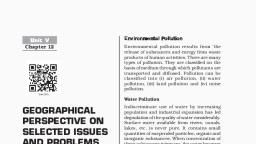
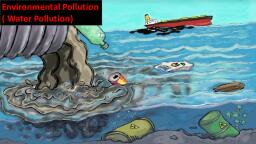
Water pollution and its controlSources of water pollution:, i., ii., iii., iv., v., , Clay and silt in water due to soil erosion, leaching of minerals, etc., Domestic waste, sewage waste, soap, detergents, etc., Run off from agricultural fields, having fertilizers and pesticides., Oil spills from oil tankers, off shore oil refineries., Industrial and municipal waste that contains organic and inorganic residues., , Effects of water pollution:, i., , ii., iii., iv., , v., , Increase in Biochemical Oxygen Demand (BOD) - It is the amount of dissolved oxygen, needed by aerobic organisms for decomposition of dead organic matter in water bodies over, a specific period of time. It measures the amount of organic matter present in sewage., Algal bloom- Excessive growth of planktonic (free floating) algae which deteriotes water, quality and fish mortality. It is due to large amount of organic nutrients present in water., Biomagnification- It refers to the increase in concentration of the toxicant at successive, trophic levels., Eutrophication- It is the natural ageing of a lake/ water bodies by biological enrichment of, its water. It may be natural or cultural or accelerated eutrophication., a. Natural eutrophication- It occurs slowly at a rate which may not be detectable in, human lifetime., b. Cultural or accelerated eutrophication- The eutrophication process (aeging of water, bodies) which is induced by addition of pollutants from human activities., Harmful effects on human health – Many water-borne infectious diseases like cholera,, dysentery, typhoid, jaundice and worm infection may affects our human health. Excess, quantities of heavy metals may cause harmfull effects like minamita disease (Mercury),, Blue-baby syndrome (Nitrate), Itai-itai (Cadmium), etc., Excess of metals, in water, Mercury, , Harmful effects, Minamita disease (Japan, 1952), , Nitrate, , Methemoglobinemia (Blue-baby syndrome) in infants., , Arsenic, , Black foot disease, , Flouride, , Knock knee disease or skeleton fluorosis, , Copper, , Hypertension, Uraemia, , Lead, , Anaemia, vomiting, damage to liver, kidneys and brain, , Zinc, , Cramps, renal damage, , Cobalt, , Diarrhoea, bone defects, paralysis, , Chromium, , Gastrointestinal ulcers, nephritis and nervous system, disorders, , Cadmium, , Skeleton deformities called itai-itai
Page 4 :
Control of water pollutioni. Dilution of the pollutants., ii. The pollutants must be treated chemically and converted into non toxic substances before, releasing in water., iii. Radioactive wastes should be removed by oxidation., iv. Proper sewage treatment., v. Use of biological agents for removal of pollutants., Integrated waste water treatmenti., ii., , The conventional methods of sedimentation, filtering and chlorine treatment of waste water., The innovative approach where water (containing heavy metals) is made to flow through 6, connected marshes over 60 ha of marshlands which neutralize, absorb and assimilate the, pollutants., , Solid waste- Anything that goes out in trash is solid waste., Municipal solid waste- The wastes from homes, office, stores, schools, hospitals which is collected, and disposed by municipality., Control of solid wastei., ii., iii., iv., v., , The biodegradable wastes can be put into pits, recyclable wastes can be reused and nonbiodegradable can be disposed., Reduction in garbage generation and increase of biodegradable substances instead of nonbiodegradable plastic bags., Dumping of waste in sanitary landfills., Burning through incineration and pyrolysis., Construction materials as flyash is being converted into bricks for constructing works., E-waste- It comprises irreparable computers and other electronic goods., Case study of remedies for plastic waste:, , Polyblend, a fine powder of recycled modified plastic, was developed by Ahmed Khan., This mixture was mixed with the bitumen that is used to lay roads., The blends of polyblend and bitumen help –, i., ii., , Enhanced the water repellent properties of bitumen road., Increases the road life by three times., , Integrated organic farming-It is a cyclical, zero-waste procedure, where wastes of one process are, recycled as nutrients for other., E,g. integrated farming of bee keeping, dairy farm, water harvesting, composting and agriculture., The farm waste acts as fertilizer for crops, crop waste as compost that gives natural fertilizer or natural, gas to supply energy to the farm., , Radioactive waste: Nuclear energy waste effectsi., ii., , The radiation given off by nuclear waste causes lethal at high doses and cancer at lower doses., Its accidental leakage may create serious problems. (e.g. Chernobyl incident).
Page 5 :
Management- It should be buried within rocks, 500 m below earth’s surface in shield containers, after sufficient pretreatment., , Greenhouse effects, The warming up of earth’s surface due to absorption of heat by greenhouse gases like CO 2, CFCs,, CH4 etc. present in the atmosphere., Effects of Greenhouse effectsi., ii., iii., iv., v., , It leads to global warming., Melting of polar ice caps., It will raise the sea level, submerging the coastal areas., Effects on range of species due to change in latitudinal and altitudinal zonation., Increase the size of ozone holes, Control of global warming-, , i., ii., iii., iv., v., , Reducing use of fossil fuel., Complete replacement of use of CFCs., Improving efficiency of energy usage or use of renewable energy., Reducing deforestation, use of nitrogen fertilizers., Increasing vegetation cover/ forests., , Ozone layer- The protective shield present in upper atmosphere (stratosphere) that protects the earth from, the harmful UV radiation from the sun. The thickness of Ozone is measured by Dobson unit., Causes of depletion- Excessive use of CFCs (Chlorofluorocarbon) as refrigerants and nitrogen oxides, from fertilizers., Effects:, a. UV-B damages DNA and mutations may occur causing skin cancer cataracts, snow blindness,, etc., b. It affects photosynthesis, germination and growth in plants., Montreal protocol, 1987 to control emission of ozone layer depleting substances., Degradation by improper resource utilization and maintenance:, i., ii., , Soil erosion and desertification., Waterlogging and soil salinity., , Deforestation:, Causes –, a. Conversion of forests into agricultural lands., b. Clearing of forests for making houses, industries, timber, firewoods, etc., c. Jhum cultivation or slash and burn agriculture in hilly areas., Effects –, i., ii., iii., , Increase in CO2 concentration in atmosphere., Loss of biodiversity., Disturbance of hydrological cycle and soil erosion.



 Learn better on this topic