Page 1 :
Telegram @neetquestionpaper, , 35, Organisms and, Population, An isolated, biological entity (e.g., unicellular or multicellular) which is, able to perform biological processes independently called as organism., Individual organism is the basic unit of ecological hierarchy., , Organism and its Environment, Organism’s life exists not just in a few favourable habitats, but even in, extreme and harsh conditions, e.g., desert, rainforests, deep ocean and, other unique habitats., The suitability of environment directly affects the growth of residing, population and manifests in the form of various biological communities., , Components of Environment, The surface of the earth consists of three elements, i.e., land, sea and, air. On the basis of three elements, it is divided into hydrosphere, (water), lithosphere (land), atmosphere (air) and pedosphere (composed, of disintegrating compounds of rock and stone forming soil)., , Biomes, A large regional unit characterised by a major vegetation type and, associated fauna found in a specific climatic zone is referred to as, biome.
Page 2 :
Telegram @neetquestionpaper, , 576, , Handbook of Biology, Deserts, , Grasslands, , Mean annual temperature (°C), , Temperature 20-30°C with, increasing rain precipitation, up to 75-80 cm, the species, richness and productivity, increases with high biomass., , Lack of water, temperature is, very high/very low, less, precipitation, arid climate, leads to sparse population, with desert adapted feature, like spine, etc., , Tropical Forest, Most suitable combination of, temperature (20-30°C) and, precipitation (150-430 cm), leads to well-adapted community, with evergreen plants and animals., , 30, 25, 20, 15, 10, 5, 0, –5, , –10, –15, , 50, , 100 150 200 250 300 350 400 450, Mean annual precipitation (cm), , Arctic and Alpine Tundra, Very low temperature and, precipitation, therefore very low, biodiversity is present at high, latitudes in Northern hemisphere., , Coniferous Forest, Low temperature and high, precipitation result into marshy, floors in forest because of high, humus deposition, which, supports high biodiversity., , Temperate Forest, Moderate temperature and, precipitation, therefore, soft woody and hard woody, plants and all types of, animals are present., , Different types of biomes of the world, , Habitat and Microhabitat, The natural abode of air organism including its total environment is, called its habitat., Microhabitat is a small part of a habitat with its own characteristic, environmental features, e.g., forest floors, tree canopies, etc., , Niche/Ecological Niche, It refers to the functional role of species in its habitat and more, precisely in its microhabitat., , Responses to Abiotic Factors, Organisms cope up with the stressful conditions or possibilities to, manage with the adverse situation., With following modifications, an organism can stabilise its relationship, with environment.
Page 3 :
Telegram @neetquestionpaper, Organisms and Populations, 577, Regulate, Some organisms are able to maintain a constant body temperature and, constant osmotic concentration despite changes in the external, environment, e.g., thermoregulation. Human is an isothermic, organism, it regulates the temperature in summers by sweating and in, winters by shivering. The process of regulation mostly occurs in birds, and higher animals., , Conform, It is the strategy of adjustment of organisms towards environmental, conditions. In this, an organism controls its physiology in the tune of, environmental conditions, e.g., poikilotherms. These organisms fail to, maintain their body temperature and change it with the environment,, e.g., fishes., , Migrate, It is the movement of an organism from less favourable conditions to, more favourable conditions., On the basis of driving factors of migration, it is of following four types, (i) Diurnal migration When migration is controlled by the cycle, of day and night, e.g., the movement of planktons towards the, surface of aquatic bodies during night and descent to depth, during day., (ii) Metamorphic migration This type of migration is controlled, by stage of life, e.g., salmon fishes living in Pacific ocean ascend, freshwater stream once in life for spawning and after laying, eggs, they die. Offsprings return back to the ocean to develop for, the period of years before they again repeat the event., (iii) Periodic migration These migrations are controlled by size, and population, e.g., several insects migrate from their place of, origin, when population increases beyond carrying capacity of, that place., (iv) Annual migration This migration is regulated by the time of, year, e.g., Siberian Cranes migrate to India at specific period, (July to September month)., , Suspend, During unfavourable conditions, organisms slow down their metabolic, process, e.g.,, (i) Lower plants produce spores with thick covering to sustain, unfavourable conditions and germinate in favourable, conditions.
Page 4 :
Telegram @neetquestionpaper, , 578, , Handbook of Biology, , (ii) Polar bears undergo hibernation during winters., , Internal level, , rs, me, r, o, nf, Co Regulators, , Partial regulators, , External level, , Diagrammatic representation of organismic response, , Adaptations, Organisms are adapted morphologically, physiologically, behaviourally, to survive and reproduce in their habitat by making adjustments with, environment., Adaptations are of two types, Types of Adaptations, Genotypic Adaptations, , Phenotypic Adaptations, , • Genetic variations which enable a, sub-population to adapt itself to a, particular habitat and environmental conditions., , • It involves physiological,, , • Genotypic variants in a population or, individual species due to change in, environment are called ecotypes., , and morphological, modification., • Phenotype variants formed, in a population due to change, in environment are called, ecophenes or ecads, , Strategic Adaptations in Plants, 1. Plant Adaptations to Light Regime, (i) Heliophytes/Sun Loving Plants, (a) Stem with short internodes, leaves thicker and bladed, phototropism., (b) High respiration rate. ‘These plants grow in bright light, but, some heliophytes can grow in partial shade, e.g., sugarcane,, sunflower, maize and Bougainvillea etc., (ii) Sciophytes/Shade Loving Plants, Stem thin, long internode, sparsely branched, poorly developed, conducting and mechanical tissue., These plants grow in partial shade or low light, but some, sciophytes are not damaged by bright light, e.g., Drosera,, Nepenthese, birch, spruce, etc., These are aerobic, show low rate of respiration., l, , l
Page 5 :
Telegram @neetquestionpaper, Organisms and Populations, 579, (iii) Stratification, In a forest, plants get arranged in various strata (layers/ arrangement, according to their size, i.e., grasses, herbs, shurbs and trees) according, to their shade tolerance, it is called as stratification., , 2. Plant Adaptations to Aquatic Environments, The plants growing in aquatic habitat are called as hydrophytes or, aquatic plants. Hydrophytes are of five types, (i) Emergent Hydrophytes (Amphibious Plants), Plants grow in shallow water of marshy area/swamps., Long shoot, aerial leaves with stomata, root well-developed,, rhizome present., Cuticle present to avoid dessication, developed vascular bundles,, e.g.,Ranunculus., l, , l, , l, , (ii) Submerged Hydrophytes, Poorly developed roots., Thin leaves, stomata are absent., Leaves are finely dissected., Stem soft, flexible, spongy with no cuticle layer in epidermal cells., Aerenchyma occurs in the roots and stem. Vascular tissues are, reduced. e.g., Hydrilla, Vallisneria., l, , l, , l, , l, , l, , (iii) Suspended Hydrophytes, Roots are absent., Never come in contact with the bottom., In all characters, they resemble with the submerged hydrophytes,, e.g., Utricularia, Lemna species., l, , l, , l, , (iv) Free-floating Hydrophytes, Plants are free floating in water, no connection with bottom., Plants have air storing organs (e.g., inflated petiole in Eichhornia)., Roots help in balancing and root tips are covered by root pockets., Stomata are present on the upper surface of leaves, e.g., Azolla,, Trappa, Eichhornia etc., l, , l, , l, , l, , (v) Anchored Hydrophytes with Floating Leaves, These plants float on surface but rooted at bottom of shallow water, body., Large leaves, long petiole, vascular system is well-developed., Large air cavities, leaves with wax to avoid wetting., Stomata present on upper surface of leaves e.g., Nymphoides,, Potamogeton species., l, , l, , l, , l
Page 6 :
580, , Telegram @neetquestionpaper, , Handbook of Biology, , 3. Plant Adaptations to Water Scarcity and Heat, Xerophytic plants which live in dry conditions and show high rate of, transpiration than absorption of water. Deep root system, woody stem,, green photosynthetic leaves reduced to spine to prevent water loss., There are mainly four types of xerophytic plants which are discussed below, (i) Ephemerals or Drought Escapers, These plants live for a brief period during the rain., Small size and larger shoots and roots., They are generally found in arid zone, e. g. , Euphorbia species,, Solanum, Argemone mexicana., l, , l, , l, , (ii) Annuals or Drought Evaders, These plants live for a few month even after stoppage of rain., They need small quantity of water for their growth and development., Similar to ephemeral xerophytes, but grow for longer periods, e.g.,, Echinops echinatus and Solanum surattense., l, , l, , l, , (iii) Succulent or Drought Resistant, These plants store water and mucilage in fleshy organs., They have water storage region made up of thin-walled, parenchymatous cells., Stem is green, photosynthetic and have thick cuticle., They are called phylloclades (stems of indefinite growth) and, cladodes (1-2 internode long stems), e.g., Opuntia and Euphorbia., l, , l, , l, , l, , (iv) Non-Succulent Perennial Xerophytes or Drought Endurers, These are true xerophytes or euxerophytes., They have smaller shoot system and very extensive root., Leaflets of leaves are often small, vertical, thick and leathery, e.g.,, Nerium and Calotropis procera., l, , l, , l, , 4. Plant Adaptations to Saline Environment (Halophytes), Halophytes show following characteristics as their adaptations, (i), , Accumulation of, Several Compounds, , (ii) Maintain High, , Osmotic Pressure, , Growing with NaCl, MgCl2 and high, concentration of salt., They have a high osmotic pressure, (minimum of 40 bars)., , (iii) Structural Adaptations, , Succulent leaves, stem or both, thick cuticle,, sunken stomata. These have substances like, tannins and other wax substances to reduce, insolation and prevent desiccation., , (iv) Secretion of Some, , They secrete salt like atriplex, spartina, through chalk or salt glands, , Products
Page 7 :
Telegram @neetquestionpaper, Organisms and Populations, 581, Halophytic adaptations including structural and physiological, modifications can be explained through the example of mangroves., Stilt Roots, • Additional support to the, plants., • They developed by, nodes as well as, internodes, e.g., sugar, cane, bamboo, all grass, family Rhizophora., , Sunken stomata, , Thick cuticle, Parenchymatous tissue, (water storage tissue), , Pneumatophore, It is negatively geotrophic, vertical roots., , Chlorenchymatous tissue, (palisade tissue), , Knee Roots System, allow the gases exchange,, e.g., Bruguiera, gymnorrphiza, , Plank Roots, , Salt Gland, Several mangroves secrete, salt through salt glands, (e.g., Avicennia), , • The exposed vertical, portion helps in aeration, and widely spreading, roots help in improved, anchorage in unstable, mud., • Plank roots also called, Buttress Roots, snake roots, • They provide stability to huge trees specially in tropical area., • They can grow up to 10 m in height, e.g., Heritiera littoralis and, Pellicioera rhizophorae., , Structural modifications in plants to saline environment, , 5. Plant Adaptations to Oligotropic Soils, l, , l, , l, , l, , Oligotropic soils are poor in nutrients., One such type of soil, which supports dense vegetation is the one, found in tropical rainforests., Top soil of oligotropic region has shallow while subsoil has dense, clay mixed with Fe - Al (iron-aluminium) compounds., Major adaptation of tropical plants is the presence of mycorrhizae, (plant roots with fungi)., , Mycorrhizae are of two types, (i) Ectomycorrhiza When the fungal hyphae present outside, the host cell, it is called ectomycorrhiza., (ii) Endomycorrhiza When the fungal hyphae present inside, the host cell, it is called endomycorrhiza.
Page 8 :
582, , Telegram @neetquestionpaper, , Handbook of Biology, , Strategic Adaptations in Animals, l, , l, , l, , Animals also develop strategies to live better in their environment., Animal adaptations may be of two types, (i) Short term It is temporary like increase of heartbeat., (ii) Long term It is permanent in nature like typical type of beak,, claw, etc., In animal, most adaptations occur against environmental changes, and stress conditions. These may be physiological and behavioural, adaptations, e.g., migration, hibernation, aestivation, camouflage,, mimicry, echolocation, water scarcity and prevention of freezing., , 1. Adaptations to Cold Environment, Some animals protect themselves from excessive cold by developing, hard covering as they cannot undergo hibernation and cannot migrate,, e.g., barnacles and molluscs of intertidal zone of cold areas, several, insects and spiders., Some animals are adapted to colder environment by developing extra, solutes in their body fluids and special ice nucleating proteins in the, extracellular spaces., These extra solutes which prevent freezing, are glycerol and antifreeze, proteins. Ice fish (Chaenocephalus) or Antarctic fish (Trematomus), remain active even in extremely cold sea water due to this hardness., Mammals from colder climates generally have shorter ears and limbs, to minimise heat loss. This is called Allen’s rule., , 2. Adaptations to Water Scarcity, l, , l, , l, , Animals face water scarcity in desert areas. They show two types of, adaptations for reducing water loss and ability to tolerate arid, conditions. Camel has a number of adaptations to desert conditions, like water consumption, tolerance with temperature, etc., The animal produces dry faeces and urine., Camel can rehydrate itself quickly. Its storage capacity of water is about, 80 litres., , 3. Adaptations to Environmental Stress, These are of three types, (i) Hibernation and aestivation Hibernation or winter sleep, and aestivation or summer sleep are quite common in, ectothermal animals., (ii) Acclimatisation It is the development of a favourable, morphological and physiological response to a change in the, environment., (iii) Migration It is the movement of an animal to other places for, food, climate and other reasons.
Page 9 :
Telegram @neetquestionpaper, Organisms and Populations, 583, 4. Adaptations for Protection from Predators, Camouflage, It is the ability of an organism to blend with the surrounding or, background. Organisms use camouflage to mask their location,, identity and movement, e.g., many insects, reptiles and mammals, (like military colouration dress), insects (like butterfly)., Mimicry, It is the resemblance of a species with another species in order to, obtain advantage, especially against predation., The species which is copied is called model, while the animals, which copy are known as a mimic or mimictic., l, , l, , These are of two types, (i) Batesian mimicry In this mimicry, the mimic is, defenceless, e.g., viceroy butterfly mimics unpalatable toxic, monarch butterfly., (ii) Mullerian mimicry In this mimicry, there is a resemblance, between two animal species, especially insects to their mutual, benefit, e.g., monarch butterfly and queen butterfly., Warning Colouration, Dart frogs (Phyllobates bicolor, Dendrobates pumilio) found in tropical, rainforests of South America are highly poisonous as well as brightly, coloured to be easily noticed. Predators usually avoid them., , Population and Community, As combination of several populations in an area makes community,, the relationship between these two is established. The comparative, account of both population and community is given below., , Differences between Community and Population, Community, , Population, , It is a grouping of individuals of different, species found in an area., , It is a grouping of individuals of a single, species in an area., , Interbreeding is absent amongst different, members of a community., , Individuals interbreed freely., , Different members of a community are, morphologically and behaviourly dissimilar., , Morphologically and behaviourly similar, species are found in a population., , It is a large unit of organisation., , It is a small unit of organisation., , In a biotic community, there is often a, relationship of eating and being eaten., , There is no relationship of eating and, being eaten.
Page 10 :
584, , Telegram @neetquestionpaper, , Handbook of Biology, , Characteristics of Population, Dispersal, Emigration, , Immigration, , Exit of individuals, from population., , Entry of individuals, into population., , Natality (Birth rate), , Density, , Natality is the rate of production, of new individuals per unit of, population per unit time., Natality is expressed as, ∆Nn/∆t =Absolute natality rate, , Density is the number, of individuals, per unit area or volume., Density is represented, as, N, D= —, S, N = Total number of, individuals,, S = Space/Area, , Dispersion, It indicates how the, individuals of a population, are distributed in space, and time. Three possible ways, of dispersion are uniform,, random and clumped., , ∆Nn/N∆t = Specific natality rate, (i.e. Natality rate per unit of population), Where,, N = Initial number of organisms, n = New individuals in the population, t = Time, , Characteristics of, Population, , Mortality (Death rate), , Biotic Potential, It is the maximum reproduction, capacity of a population, under optimum, environmental conditions., Vital index = Number of birth/, Number of death, It is the highest possible vital, index of a species, therefore when the, species has its highest birth rate and, lowest mortality., , Age Distribution, , It is the rate of loss of individuals, per unit time due to death, (i) Specific Mortality, Minimum death rate under ideal, conditions due to natural processes., (ii) Realised Mortality, Actual death rate due to abnormal, conditions like disease,, natural hazards., , The ratio of various age, groups is very important, for future aspects of population., (i) Pre-reproductive, Juvenile or dependent phase, (ii) Reproductive, Adult phase, (iii) Post-reproductive, Old age., , Population Growth Curves, S-shaped, , 0, , dN, — = rN, dt, The growth rate, of the population, accelerates, , Time (t), (a) Exponential, (unrestricted) growth, , Carrying capacity, of environment, , Population size (N), , Population size (N), , J-shaped, , 0, , dN, — =rN (K – N/K), dt, , The rate, accelerates, , The, rate, slows, down, Point of, maximum, growth, , Time (t), (b) Logistic (restricted), growth, , (a), Expanding, population, (Triangular-shaped), (b), Stable, population, (Bell-shaped), (c), Declining, population, (Urn-shaped), Post-reproductive, Reproductive, Pre-reproductive
Page 11 :
Telegram @neetquestionpaper, Organisms and Populations, 585, Population Interactions, Organisms belonging to different populations interact for their necessities, Population Interaction (on the basis of species involved), 1. Intraspecific (within the species), 2. Interspecific (between species) These are of two types, (i) Antagonism (one species or both may be harmed), e.g.,, Coytes kill and ingest gray fox in South California., (ii) Symbiosis (one species or both may be benefitted), e.g.,, Mycorrhizal roots., Population interactions can also be categorised on the basis of its, nature., Population Interactions, (on the basis of interaction of nature), , Positive Interaction, , Negative Interaction, , (one or both may be benefitted), , Mutualism, , Proto-cooperation, , The association is, No obligatory in nature, obligatory, e.g., roots, but both the partners get, of some leguminous plants, benefitted, e.g., sea anemone, and N2 -fixing bacteria., and hermit crab., , (one or both may be affected), , Commensalism, Only one might be, benefitted but other, is not affected,, e.g., epiphytes., , Competition, , Parasitism, , Predation, , It is presumed that the, superior competitor, eliminates the inferior, one. It is of two types, (i) Intraspecific competition, (ii) Interspecific competition, , It is an interaction between two, individuals, where the parasite, gets the benefit at the expense, of the host. It is of different categories, , It is the eating of, one species by, another., Predators consume, other living animals,, e.g., Nepenthes., , (i) Ectoparasites, e.g.,human body lice., (ii) Endoparasites, Gause’s competitive exclusion, e.g., Plasmodium malariae., principle states that the two, (iii) Facultative parasites, closely related species, e.g., Oyster prawn., competing for the same resources, (iv) Obligate parasites, cannot co-exist indefinitely and, e.g.,Taenia solium., the competitively inferior one will, be eliminated eventually., , Interaction and adaptation of organisms into their environment can be, accomplished by various strategies. These strategies ultimately help in, the establishment of new communities. Detailed study of these, processes of establishments throws light on several new fields of, environmental studies.
Page 12 :
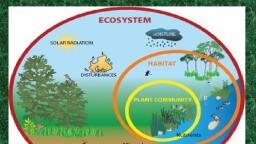
Telegram @neetquestionpaper, , 36, Ecosystem, An ecosystem consists of biological community that occurs in some, local and the physical and chemical factors that make up its non-living, or abiotic environment., , Ecosystem, ‘Ecosystem is normally an open system because there is a continuous, entry and loss of energy and materials’., The term ecosystem was first used by AG Tansley in 1935 to, describe the whole complex of living organisms living together as a, sociological unit and their habitats., The ecosystem is also called as biocoenosis (Mobius; 1877),, microcosm (Forbes; 1887) and biogeocoenosis (Sukachey)., It is also known as ecocosm or biosystem., , Types of Ecosystem, On the basis of origin, the ecosystem can be of following types, Ecosystem, , Natural Ecosystem, , Artificial Ecosystem, These systems are maintained and, manipulated by men for different, purposes, e.g., croplands,, township, etc., , The ecosystems which are, capable of operating and, maintaining themselves., It is further classified as, , Terrestrial Ecosystem, , Aquatic Ecosystem, , e.g, forest, desert,, grassland, etc., , e.g., pond, lake, river, etc.
Page 13 :
Telegram @neetquestionpaper, Ecosystem, 587, Components of Ecosystem, Eugene P Odum explained the components of ecosystem on the basis, of trophic levels which are as follows, Inorganic Substances, Carbon, nitrogen, sulphur, potassium,, carbon dioxide, water, etc., , Abiotic Components, , Organic Substances, Proteins, carbohydrates, lipid, etc., , Climatic Regime, Temperature, humidity,, soil, light, pressure, etc., , Producers (autotrophic component), Autotrophic organisms, i.e., plants (green), and photosynthetic bacteria, , Biotic Components, , Macroconsumers (heterotrophic components), Phagotrophs or heterotrophs, i.e., animals and, non-green plants, Microconsumers (decomposers), Transformers or decomposers,, i.e., bacteria and fungi, , Components of ecosystem, , Abiotic Components, Abiotic components of an ecosystem consist of two things, i.e.,, materials (e.g., water, minerals, gases, etc.) and energy., The important abiotic components include temperature, wind, light,, water, soil and minerals, etc., 1. Temperature, It is the most ecologically relevant environmental factor. Latitude,, altitude, topography, vegetation and slope aspects are some, factors which influence the temperature., Temperature regulated periodic activities are reported from animals,, e.g., diurnal (active during day), nocturnal (active during night),, auroral (active at dawn), vesperal (active during evening) and, crepuscular (active in twilight).
Page 14 :
588, , Telegram @neetquestionpaper, , Handbook of Biology, , 2. Water, It is the most important factor for all living processes. Infact the life on, earth originated in water and without water, it is unsustainable., Water constitutes the most part of our body and blood. On the basis of, water availability in plants, they are grouped into three communities, namely hydrophytes, mesophytes and xerophytes., 3. Light, Light with wavelength between 400–760 nm is the visible light. The, part of light which is effective in photosynthesis (i.e., 400-700 nm) is, termed as Photosynthetically Active Radiation (PAR)., This band of energy provides radiant energy for photosynthesis and, thus supports all autotrophic organisms., 4. Soil, It is weathered top surface of earth’s crust constituted by mineral, matters (sand, silt and clay), organic matter (humus) and, microorganisms (bacteria, fungi, etc)., Soil is the medium of anchorage and supply of nutrients and water to, plants and plants are the ultimate source of energy for animals and, humans. Hence, soil constitutes the important life support component, of the biosphere., , Biotic Components, The biotic components are divided into following categories, (i) Autotrophic components (producers) Living organisms, which fix light energy to manufacture the complex organic, food from simple inorganic substances, e.g., green plants., (ii) Heterotrophic components (macroconsumers) Living, organisms that ingest other organisms and are therefore, called heterotrophs. They derive their food directly or, indirectly through green plants, e.g., animals, etc., (iii) Decomposers (microconsumers) Decomposers are also called, as saprobes or saprophytes or mineralisers, as they release, minerals trapped in organic substances, e.g., fungi, mould,, bacteria, etc.
Page 15 :
Telegram @neetquestionpaper, Ecosystem, 589, On the basis of their role in trophic structure, macroconsumers or, consumers are categorised as, , Consumers, (i) Primary consumers (herbivores) These organisms feed directly, on producers. These are also known as key industry animals, e.g.,, protozoans (pond ecosystem), deer (forest ecosystem), etc., (ii) Secondary consumers (carnivores) The group of organisms, which feed on primary consumers, e.g., insects, game fishes, etc., (iii) Tertiary consumers (top carnivores) These animals eat other, carnivores. Some ecosystems have top carnivores like lion and, vulture., Note Detritivores These organisms depend on the organic detritus left by, decomposers (bacteria and fungi), e.g., earthworms., , Ecosystem : Structure and Characteristics, Boundary of, Ecosystem, An invisible boundary inside, which the conditions are, habitable for organisms, of that specific ecosystem., , Sun, The ultimate, source of energy, for any ecosystem., , Climate, The region of ecosystem, which results by the interaction, between organisms., , Earth-Giant, Ecosystem, , Producers, Man, Forest Grassland Desert engineered, 1, , 3, , 2, Terrestrial, ecosystems, , 4, , Freshwater Marine, 5, , Nutrient Pool, , May be, terrestrial, or aquatic, , R, , Aquatic, ecosystems, , Decomposers, E, G, Materials, Energy, , 6, , I, , Consumers, M, , E, , Nutrient Pool, A reservoir in which the mineral, products from decomposers are, present and are absorbed by producers., , Structure of an ecosystem (generalised)
Page 16 :
590, , Telegram @neetquestionpaper, , Handbook of Biology, , Features of Ecosystem, A comparative account of several ecosystems is given in the following, table, Comparative Summary of Marine, Grassland,, Forest and Desert Ecosystems, Marine, Ecosystem, , Component, , Grassland, Ecosystem, , Forest, Ecosystem, , Desert, Ecosystem, , Soil and, atmosphere., , Rainfall less than, 25 cm, extreme of, temperature and, cold., , Abiotic, components, , Temperature, CO 2 , H2O , nitrate,, zones, air, O 2 ,, phosphate and, mineral rich salts, sulphates, roughly, 19% of the earth’s, etc., crust., , Biotic, components, , Phytoplanktons,, diatoms and, dinoflagellates., , Dichanthium and, Cynodon., , Mainly trees like, teak, sal., , Producers, , Microscopic algae,, members of, Phaeophyta and, Rhodophyta., , Digitaria,, Dactyloctenium,, Setaria and also, few shrubs., , Cycads, cacti,, Quercus in, temperate forest, palm, coconut,, Pinus, Abies,, etc., Cedrus, Juniperus, and, Rhododendron., , Deer, sheep, cow,, buffaloes, rabbit,, mouse. Also some, insects, termites, and millipedes., , Leafhoppers, flies, Animals, insects,, some reptiles and, beetle, bugs,, spider, deer,, camel., mouse and, moles., , Shrubs, bushes,, some grasses and, very few trees., , Macroconsumers, Primary, , Crustaceans,, molluscs and, fishes., , Secondary, , Carnivorous fishes. Fox, jackal, snake,, frogs, lizards and, birds., , Lizard, fox, snake Reptiles, and birds., , Tertiary, , Herring, shad and, mackerel carnivore, fishes like cod,, haddock, halibut,, etc., , Hawk and vulture., , Lion, tiger, wild, cats, etc., , Vultures, , Mucor, Aspergillus,, Penicillium,, Fusarium,, Cladosporium and, Rhizopus., , Mostly fungi, Aspergillus,, Polyporus,, Fusarium, etc., Bacteria Bacillus,, Clostridium and, Streptomyces., , Fungi and bacteria, which are, thermophilic., , Microconsumers, Decomposers Chiefly bacteria, and fungi.
Page 17 :
Telegram @neetquestionpaper, Ecosystem, 591, Functions of Ecosystem, Following are the important functional aspects of the ecosystem, 1. Productivity, 2. Energy flow, 3. Development and stabilisation, 4. Decomposition, 5. Nutrient cycle, Before going in detail about the functional aspects of ecosystem, we, need the better understanding of food chain and food web., , Food Chain, As the biotic factors of the ecosystem are linked together by food, a, particular linking makes a chain called food chain. It is ‘A group of, organisms in which there is a transfer of food energy which takes place, through a series of repeated process of eating and being eaten’., It is always straight and usually contains 4-5 trophic levels., , Types of Food Chains, On the basis of habits of organisms involved, the food chain can be, categorised as, Parasitic Food Chain (PFC), It is also called auxillary food, chain. This chain begins, with the host and usually ends, with parasites, due to which its, pyramid of number is inverted., Its food sequence is as follows, Plant, Herbivores, Parasites, , Grazing Food Chain (GFC), It is the most common food chain., It is also called as predator food, chain. The sequence of food chain, in an aquatic ecosystem is as follows, , Producers (autotrophs), Phytoplanktons like weeds,, diatoms and other green algae, , Hyper-parasites, , Food, Chain, , Primary Consumers (herbivores), Zooplanktons like dinoflagellates, Secondary Consumers, (primary carnivores), Aquatic insects, crustaceans, and other aquatic organisms, , Tertiary Consumers, (secondary carnivores like small fish), , Detritus Food Chain (DFC), It starts from the dead organic matter and ends in, inorganic compounds. A common detritus food, chain with earthworm is as follows, Detritus, , Earthworm, Frog, , Top Carnivores (large fish), , Types of food chain, , Sparrow, , Falcon, , Snake, , Peacock
Page 18 :
592, , Telegram @neetquestionpaper, , Handbook of Biology, , Food Web, It is the network of food chains which become interconnected at, various trophic levels. In any complex food web, one can recognise, several different trophic levels., In a food web, a given species may occupy more than one trophic level., The complexity of food web varies greatly and this can be expressed by, a measure called connectance of the food web., Actual number of interspecific interaction, Connectance =, Potential number of interspecific interaction, A typical food web can be represented as follows, Hawk, , Lion, , Owl, , Bird, , Snake, Fox, , Frog, Caterpillar, Deer, Grasshopper, , Rabbit, , Green plants, , Food web, , 1. Productivity, It refers to the rate of biomass production, i.e., the rate at which the, sunlight is captured by the producers for the synthesis of energy rich, organic compounds., It is the amount of organic matter accumulated per unit area per unit, time., Production Ecology is the branch of Ecology that deals with the rate, of production of organic matter in ecosystem.
Page 19 :
Telegram @neetquestionpaper, 593, Ecosystem, It is of following types, Productivity, Primary Productivity, , Secondary Productivity, , The rate at which radiant energy is, stored by the photosynthetic and, chemosynthetic activities of producers., It is of following types, , Gross Primary, Productivity, (GPP), , It is the rate of energy, storage at consumer level,, i.e., herbivore, carnivore, and decomposers., , Net Productivity, It is the rate of, storage of organic, matter not used, by the heterotrophs, or consumers., , Net Primary, Productivity, (NPP), , It is the total rate of, photosynthesis including, the organic matter used, up in respiration., , It is the rate of storage, of organic matter in excess, of respiratory utilisation., , Measurement of Productivity, As a result of photosynthesis, there is an increase in dry mass. The, Relative Growth Rate (R) is defined as the gain in mass per unit of, plant mass in unit time., Increase in dry mass in unit time, R =, Dry mass of plant, w − w0, The increase in dry mass in unit time is equal to t, t, wt = dry mass after time t,, w0 = dry mass at the start of time period., The Net Assimilation Rate (NAR) relates increase in dry mass to, leaf area., Increase in dry mass in unit time, NAR =, Leaf area, Biomass is the total dry mass of all organisms in an ecosystem., Total biomass = Biomass of primary producers + Biomass of consumers, + Biomass of decomposers + Biomass of dead organisms., , 2. Energy Flow, ‘The movement of energy in ecosystem is termed as energy flow’., It is unidirectional energy transformation. The flow of energy in, ecosystem is controlled by two laws of thermodynamics., (i) First law Energy can neither be created nor be destroyed, but, can be transferred or transformed to another form.
Page 20 :
594, , Telegram @neetquestionpaper, , Handbook of Biology, , (ii) Second, law In, every, activity, involving, energy, transformation, dissipation of some energy takes place., The incident radiation of plant is about 1 × 10⁶ kJ/m 2/yr and of this,, about 95-99% is immediately lost by plants through reflection,, radiation or heat of evaporation., The remaining 1-5% is used in the production of organic molecules., Organisms at each trophic level depend on those belonging to the lower, trophic level for their energy requirements., Each trophic level contains certain mass of living matter at a, particular time called standing crop. The standing crop is measured, as the mass of living organisms (biomass)., The number of trophic level in the food chain is restricted as the, transfer of energy follows 10% law given by Raynold Lindemann., Following diagram clearly describes the flow of energy in a food chain, applying 10% law, , 1 × 10⁶ Solar energy, , Autotrophs, Phototroph, 0.5 x 10⁶, 10000, absorbed, GPP, , Herbivores, C, 800, secondary, production, , C, , 8000, NPP, , a th, De, , 0.5 × 10⁶, Not absorbed, (reflected), , R, , R, , 2000, R, , 0.49 × 10⁶, Heat of evaporation,, conduction, convection, , E, , R, 80, C, secondary, production, , E, , 8, , E, , Death, E, , E, , Death, , E, , Death, , Detritivores and decomposers, , Energy flow through a grazing food chain, , R = Energy loss through respiration, E = Energy loss from grazing, food chain to detritivores and decomposers through excretion,, C = Consumption by organisms., Here, biomass 800, 80 and 8 kJ/m 2/yr, NPP shows that only 10%, energy is transferred to the next trophic level., , Ecological Pyramids, These are the diagrammatic representation of the relationships among, numbers, biomass and energy content of the producers and consumers, of an ecosystem. The concept was proposed by Charles Elton (1927)., Hence, these are also known as Eltonian pyramids.
Page 21 :
Telegram @neetquestionpaper, Ecosystem, 595, Types of Pyramids, Pyramids can be of different types including upright or inverted or, spindle-shaped., One, vulture, Few, snakes, Several frogs, , Numerous, parasites, Several birds, , Many grasshoppers, Single long tree, , Crop plants, , Forest ecosystem, , Grassland ecosystem, Upright, In most of the ecosystems,, e.g., grassland ecosystem, , Pyramid of, Numbers, Inverted, Only in some tree, ecosystems, , Upright, Most terrestrial and, aquatic ecosystems, , Types of, Pyramids, , Pyramid of, Biomass, Inverted, In marine ecosystem, , Pyramid of Energy, , Numerous parasites, Large fish, , Several birds, , Crustaceans, and small fish, , Single tree, , Phytoplanktons, Tree ecosystem, Always Upright, e.g., pond ecosystems, , One One, tiger bird, Several Several, rabbits fishes, Numerous, grasses, and plants, , Numerous, phytoplanktons, , Pyramid of energy, , Marine ecosystem
Page 22 :
596, , Telegram @neetquestionpaper, , Handbook of Biology, , Spindle-shaped pyramid is seen in the forest ecosystem where the, number of producers is lesser and they support a greater number of, herbivores, which in turn support a fewer number of carnivores., , Carnivores, Herbivores, Producers, , Partly upright pyramid of number, , 3. Development and Stabilisation, An ecosystem develops and stabilises through the process of, ecological succession., , Ecological Succession, It is a sequence of seres (developmental stage of a community) from, barren land to the climax., The initial community of the area which is replaced in time by a, sequence of succeeding communities until the climax is reached is, called pioneer stage or pioneer community. The intermediate, stages between pioneer and climax stages (i.e., final stage) are called as, seral stages., , Causes of Succession, The causes of ecological succession can be of three types which are as, follows, Initial or Initiating, Causes, , These causes are both climatic, and biotic. It includes factors, such as erosion, wind, fire, etc., These heavily affect the, population of that locality., , Ecesis Causes, , These are also called as, continuing causes which modify, the population to adapt several, conditions of environment., , Stabilising, Causes, , The climatic causes determine, the nature of climatic climax,, i.e., the end point of succession.
Page 23 :
Telegram @neetquestionpaper, Ecosystem, 597, Changes During Biotic Succession, The following changes may occur due to ecological succession, (i) Small short lived plants to large long lived plants., (ii) Unstable biotic community to stable biotic community., (iii) Little diversity to high diversity., (iv) Greater niche specialisation., (v) Increase in biomass., (vi) Increase in soil differentiation., (vii) Increase in humus content of the soil., (viii) Aquatic or dry conditions to mesic conditions., (ix) Simple food chains to complex food webs., , Types of Succession, Primary, Succession, , Allogenic, Succession, When the succession is, caused by the factors, external to the, community., , Clarke (1954), defined, it as the succession which, begins on a bare area, where no life has existed., , Secondary, Succession, , Autogenic, Succession, The succession, which is brought, about by organisms, themselves., , Biological, Succession, , Heterotrophic, Succession, The succession which begins, predominantly on, organic environment and, dominance of, heterotrophic organisms, mainly occurs., , It refers to the community, development on the sites, previously occupied, by well-developed, communities., , Autotrophic, Succession, Succession that begins, predominantly on, inorganic environment, and characterised by the, dominance of autotrophic, organisms., , Various types of succession
Page 24 :
598, , Telegram @neetquestionpaper, , Handbook of Biology, , Process of Succession, The succession is a slow and complex phenomenon, which is categorised, into following stages and substages, This means the development of bare areas, without any form of life., It may be caused by following factors, Topographic, e.g., soil erosion by various factors., Climatic, e.g., glaciers, dry period, hailstorm, fire, etc., Biotic, e.g., human, fungi, viruses, etc., It is the successful establishment of a species in a, barren area. It is completed in following substages, Migration The seed, spores and propagules, reach to barren area., Ecesis Adjustment of establishing species with, environment prevailing there., Aggregation Multiplication of species in numbers., , Nudation, , Invasion, , Competition and, Co-action, Reaction, Stabilisation, , After aggregation, the individuals of a species compete, with other organisms for space, nutrition and other, resources., The modification of the environment through the, influence of living organisms on it is called reaction., The stage at which final or climax community becomes, more or less stabilised for a longer period of time, in that particular environment., , The processes involved in succession, , Examples of Biological Succession, Hydrosere and xerosere are the two main biological successions., They are discussed below, (i) Hydrosere/Hydrarch Succession, In this succession, a pond and its community are converted into a land, community.
Page 26 :
600, , Telegram @neetquestionpaper, , Handbook of Biology, , Developments in Xerosere/Xerarch succession occurs in following stages, Bare Rock, , Crustose Lichen Stage (pioneer community), e.g., Rhizocarpon, Rhinodina, etc., , Foliose Lichen Stage, e.g., Parmelia, Dermatocarpon, etc., Moss Stage, e.g., Polytrichum, Grimmia, etc., , Seral, Communities, , Herb Stage, e.g., several herbs., Shrub Stage, e.g., Rhus, Phytocarpus, etc., Forest Stage (climax community), e.g., trees., , Succession on bare rock, , 4. Decomposition, The process of decomposition completely takes place outside the body, of decomposers., They digest the organic substances outside their body and then absorb, it. Hence, they are also known as osmotrophs (absorptive).
Page 27 :
Telegram @neetquestionpaper, Ecosystem, 601, Process of Decomposition, There are three processes which occur simultaneously during, decomposition., Fragmentation of, Detritus, , The detrivore animals like, earthworms and termites, eat the detritus and convert, it into simple inorganic substances., This is called fragmentation., , Leaching, , Soluble part of the detritus, (i.e., sugar, inorganic nutrients) gets, leached to the lower layers of soil, by percolating water., , Catabolism, , It is carried out by saprotrophic, bacteria and fungi. It is completed, in following two substages., , Humification, , Mineralisation, , It is the process of partial, decomposition of detritus, to form humus. It is a dark, coloured, amorphous, organic, matter rich in cellulose, lignin,, etc. It is slightly acidic and acts, as reservoir of nutrients., , It is the release of, inorganic substances, i.e., CO2, H2O and, minerals., , Factors Affecting Decomposition, (i) Chemical nature of detritus Slow decomposition (cellulose,, lignin, tannin, resin), fast decomposition (protein, nucleic acid)., (ii) Soil pH Acidic (slow decomposition), alkaline soil (fast, decomposition)., (iii) Temperature Temperature ∝ rate of decomposition., (iv) Moisture Amount of moisture ∝ rate of decomposition., (v) Aeration Amount of air ∝ rate of decomposition., , 5. Nutrient Cycling, For the maintenance of ecosystem, the nutrients get recycled in, ecosystem. The cycling of nutrients is also known as biogeochemical, cycling. This can be categorised as, Nutrient Cycle/Biogeochemical Cycle, Gaseous Cycles, , Sedimentary Cycles, , In these cycles, the, main reservoirs of chemicals, are atmosphere and ocean,, e.g., carbon cycle,, nitrogen cycle, etc., , In these cycles, the, main reservoirs are, soil and rocks, e.g.,, phosphorus, and sulphur cycle., , Hydrological Cycle, In this cycle, the, reservoir may be, in atmosphere, or in soil,, e.g., water cycle.
Page 28 :
602, , Telegram @neetquestionpaper, , Handbook of Biology, , Carbon Cycle, The atmospheric carbon dioxide is virtually the only source of carbon., This gas is used by all the plants in photosynthesis and the end, products (organic substances) of this complex process are used in the, construction of living matter. The complete carbon cycle looks like, CO2 in atmosphere, , Photosynthesis, (terrestrial food chains), , Combustion of fossil, fuels for vehicles,, electricity and heat, , Burning of forests,, fuel wood and, organic debris, , Respiration and, decomposition, , Coal, , Detritus food chain, , Photosynthesis Plankton, (aquatic food, chains), CO2 in, water, Organic, sediments, Decay, organisms, Calcareous, sediments, , Oil and gas, , Limestone and dolomite, , The carbon cycle, , Phosphorus Cycle, It lacks an atmospheric component. The basic source and the great, reservoir of phosphorus are the rocks and other deposits, which have, been found in the past geological ages., Weathering, , P, P Inorganic, in rocks, , Organic, in plants, , Decay, P, , Inorganic, in water, , P Available, inorganic in soil, , Organic, P in soil, , P Unavailable, inorganic in soil, River, , P Inorganic, in ocean, , Uplift over, geological time, , P, , Phosphorus cycle in nature, , Inorganic in, sediments
Page 29 :
Telegram @neetquestionpaper, Ecosystem, 603, Hydrological (Water) Cycle, Water moves in ecosystem through various reservoirs, i.e., ocean,, atmosphere and living organisms. Following diagrammatic, representation gives the idea of water cycle., Atmosphere, , Respiration, , Precipitation, , Evaporation, , Precipitation, , Evaporation, , Precipitation, , Tran, spir, Pre, atio, cipi, n, tatio, n, Plants, , Animals, , Water cycle in nature, , Ecosystem Services, Healthy ecosystems are the base for a wide range of economic,, environmental and aesthetic goods and services. The products of, ecosystem processes are named as ecological or ecosystem services., Ecosystem services refer to a wide range of conditions and processes, through which natural ecosystems and the species that are part of, them, help to sustain and fulfil human life., These services maintain biodiversity and the production of ecosystem, goods, such as seafood, wild game, forage, timber, biomass fuels,, natural fibres and many pharmaceuticals, industrial products and, their precursors. It is also the transformation of a set of natural assets, (soil, plants and animals, air and water) into things that we value., Robert Constanza et. al., have tried to put price tags on, nature’s life-support services. Scientists have estimated this price to be, 33 trillion US dollars a year, while our global gross production is only, 18 trillion US dollar.
Page 30 :
Telegram @neetquestionpaper, , 37, Biodiversity and, Conservation, Biodiversity (Gk. bios–life; divsersity–forms) or Biological diversity can, be defined as the vast array of species of living organisms present on, the earth., The term, ‘Biodiversity, was coined by WG Rosen (1985), but later, popularised by EO Wilson., Due to difference in habitat and environment, the biodiversity can be, studied at global as well as country level. In India, maximum species of, arthropods are found (approx 68,389) among animals, while among, plants, maximum species of angiosperms are found (17,500)., , Levels of Biodiversity, For the convenience of study, the biodiversity can be categorised in the, following three levels of biological organisations, , 1. Genetic Diversity (Within species diversity), The diversity in number and types of genes as well as chromosomes, present in different species and the variation in the genes and their, alleles in same species., It is useful as it involves the adaptation to change in the, environmental conditions and is also essential for healthy breeding., It also helps in speciation., , 2. Species Diversity (Between species diversity), It means the species richness in any habitat. Greater the species, richness, greater will be their diversity. India is among the world’s 15
Page 31 :
Telegram @neetquestionpaper, Biodiversity and Conservation, 605, nations that are exceptionally rich in species diversity. Number of, individuals of different species represents the species evenness and, species equitability., , 3. Community and Ecosystem Diversity, (Ecological diversity), It is the diversity at ecosystem or community level. An ecosystem is, referred to as natural when it is undisturbed by human activities., Diversity at the level of community or ecosystem has three, perspectives, i.e., α, β and γ (Whittaker; 1965)., l, , γ - diversity, It is also called regional, diversity which represents, the total richness of species, in all the habitats found, within a region., , α-diversity, Site1, , γ, , It is also called local diversity., It is the diversity within community., , α1, , Region, , β, , α2, , α3, Site 3, , Site2, , β, β -diversity, It is the diversity between two, communities which develop, due to change in habitats along, environmental gradients., , Schematic representation of various levels of diversity, , Patterns of Biodiversity, 1. Latitudinal Gradient, Generally, species diversity decreases as we move away from the, equator towards poles.
Page 32 :
Telegram @neetquestionpaper, , 606, , Handbook of Biology, , Evergreen coniferous forests, Very rare biodiversity, but, plants are evergreen, , Decreasing biodiversity, towards poles, , 1, 66 –° N, 2, 1, 23 –° N, 2, , Temperate deciduous forests, and grasslands, Due to less rain, the diversity, is sparse and productivity is, low., , Tropical deciduous forests, , The biodiversity is nearly, equal to tropical rainforest., 0° Equator, , Tropical, region, , Tropical rainforest, 1, 23 –° S, 2, , Temperate, region, , 1, 66 –° S, 2, , The region of highest, biodiversity due to, suitable environment., , Temperate deciduous, forests and grasslands, Somewhat unfavourable, conditions lead to low, biodiversity and, productivity., , Biodiversity pattern on earth, , 2. Altitudinal Gradient, The impact of altitude is significant on the type of biodiversity. Mostly, the increasing altitude leads to decrease in biodiversity as only some, species can adapt the conditions prevailing at high altitude., Following graph gives the clear idea of this relationship, 2000, , Species richness, , 1600, 1200, , 800, 400, 0, 0, , 1000 2000, , 3000, , 4000, , Elevation (m), , Effect of altitude on biodiversity, , 5000
Page 33 :
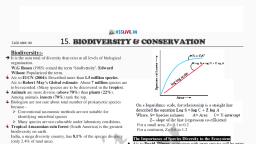
Telegram @neetquestionpaper, Biodiversity and Conservation, 607, 3. Species-Area Relationship, According to German naturalist and geographer Alexander von, Humboldt ‘‘Species richness increases with increasing explored area,, but only up to a certain limit’’., The relationship between species richness and area gives a rectangular, hyperbola curve for a wide variety of taxa like birds, bats, freshwater, fishes and flowering plants., On a logarithmic scale, the relationship is a straight line and is, described by the following equation, log S = log C + Z log A, Here, S is species richness, Z is slope of line or regression coefficient,, C is Y intercept, while A is area., Y-axis, , e, al, sc, g, -lo, lo, g, , Species richness, , S = CAZ, , los S = log C + Z log A, , Area, , X-axis, , Species-area relationship, , Ecologists have discovered that the value of Z-line is similar for a small, region or area particular, regardless of taxonomic group or region, (i.e., 0.1–0.2). But, if we consider a large area (i.e., whole continent),, the value of Z deviates between 0.6-1.2., , Importance of Biodiversity, Biodiversity is essential not only for ecosystem, but also for the, survival of human race. It maintains high productivity and human, health.
Page 34 :
608, , Telegram @neetquestionpaper, , Handbook of Biology, , The detailed description of importance of biodiversity is given below, Ecosystem Services, Biodiversity offers several, services like oxygen,, pollination of plants,, waste treatment and, biological control of, pests, etc., , Scientific Values, Several scientific researches, are performed over various, plant and animal species, which are used by humans, to their scientific knowledge, development., , Importance, of, Biodiversity, , Drugs and Medicines, The medicine of plant origin, have singnificant importance, in our therapy system., e.g., ayurveda., , Stability of Ecosystem, According to long term, ecosystem experiment, by David Tilman, the, ecosystem with more, species tends to be more, stable., , Food Source, Both plants and animals provide, ultimate source of food to the, population. 85% of the worlds food, production is met by cultivating less, than 20 plant species., , Other Useful Products, , Fibres, , Several products like gum,, resin, dye, fragrence, tea,, coffee latex, etc., are obtained, from biodiversity., , Biodiversity provides important raw, material for textile industry,, e.g., cotton, hemp, jute, etc., , Importance of biodiversity, , The importance of biodiversity is described through an analogy, (the ‘rivet popper hypothesis’) used by Paul Ehrlich in which he, compared ecosystem with airplane and the species with rivets., , Loss of Biodiversity, The loss of biological diversity is a global crisis. Out of the 1.6 million, species known to inhabit the earth, about 1/4 to 1/3 is likely to get, extinct within the next few decades. Tropical forests are estimated to, contain 50-90% of the world’s total biodiversity., The IUCN (International Union for Conservation of Nature and, Natural Resources) Red List (2004) documents the extinction of, 784 species (including 338 vertebrates, 359 invertebrates and, 87 plants) in the last 500 years., Some examples of recent extinctions include the dodo (Mauritius),, quagga (Africa), thylacine (Australia), Steller’s sea cow (Russia), and three subspecies of tiger (Bali, Java, Caspian).
Page 35 :
Telegram @neetquestionpaper, Biodiversity and Conservation, 609, The last twenty years alone have witnessed the disappearance of, 27 species. Careful analysis of records shows that the extinctions, across taxa are not random; some groups like amphibians appear to be, more vulnerable to extinction., Adding to the grim scenario of extinctions, the fact is that more than, 15,500 species worldwide are facing the threat of extinction., Presently, 12% of all bird species, 23% of all mammal species, 32% of, all amphibian species and 31% of all gymnosperm species in the world, are facing the threat of extinction., In general, loss of biodiversity in a region may lead to, Decline in the plant production., Lowered resistance to environmental perturbations such as drought., Increased variability in certain ecosystem processes, such as plant, productivity, water use and pest and disease cycles., l, , l, , l, , IUCN and Red List Categories, International Union for Conservation of Nature and Natural Resources, (IUCN) is now called World Conservation Union (WCU),, headquartered at Morges, Switzerland., The Red Data Book, catalogue the taxa who face the risk of, extinction. It was initiated in 1963. The Red List contains 9 categories, of individuals according to their threats. These are, Extinct (Ex), Extinct in the Wild (EW), Regionally Extinct (RE), Critically endangered (CR), Endangered (EN), Vulnerable (VU), Near Threatened (NT), Least Concern (LC), Data Defecient (DD), l, , l, , l, , l, , l, , l, , l, , l, , l, , Out of these categories, 4, 5 and 6 are the threatened categories.
Page 36 :
610, , Telegram @neetquestionpaper, , Handbook of Biology, , Causes of Biodiversity Loss, Unbalanced human activities lead to accelerated extinction of species, from the world. The major causes of biodiversity reduction are termed, as ‘Evil Quartat’., Some important causes of biodiversity loss are given below, Habitat Loss, , Coextinction, In ecosystem, the species, are related with each other, in a trophic structure., Extinction of one species led to, the extinction of others as well,, it is called coextinction., , Causes of, Biodiversity, Loss, , Alien Species Invasion, When alien species invade in a, system by any method, they do, not have any environmental barrier, which lead to overcrowding of, the species and resulted into the, replacement of inhabited species., , This is the most important cause of, of biodiversity loss, e.g., the tropical, rainforest once covering 14% surface, of earth, now covers not more than 6%., After removal of these habitats, the, harbouring species also lost., , Overexploitation, The human dependency on, nature for food, shelter turns, into ‘‘greed’’ ‘‘need’’ which, in turn led to heavy loss of, natural resources, i.e., biodiversity., , Factors causing biodiversity loss, , Biodiversity Conservation, Conservation means protection, upliftment and scientific, management of biodiversity so as to maintain it at its optimum level, and derive sustainable benefits for the present as well as future, strategies., The following are the three major reasons to conserve biodiversity, Narrow utilitarian The useful human products like food, fibres,, drugs and medicines are obtained from biodiversity., Broadly utilitarian Biodiversity provides ecosystem services like, providing oxygen, pollinating crops and controlling floods and erosions, etc., Ethical utilitarian Every living species has an intrinsic value,, though it may not have direct economic value and also every species, has right to live., , Methods of Biodiversity Conservation, Some main strategies of conservation are as follows, (i) All the threatened species should be protected. Priority should be, given to ones belonging to the monotypic genera, endangered over, vulnerable, vulnerable over rare and rare over other species.
Page 37 :
Telegram @neetquestionpaper, Biodiversity and Conservation, 611, (ii) All the possible varieties (old or new) of food, forage and timber, plants, medicinal plants, livestock, aquaculture animals,, microbes should be conserved., (iii) Wild relatives of economically important organisms should be, identified and conserved in protected areas., (iv) Critical habitats for feeding/breeding/resting/nursing of each, species should be identified and safeguarded., (v) Resting/feeding places of migratory/wide ranging animals, should be protected, pollution controlled and exploitation, regulated., (vi) National Wildlife Protection Law should be enacted (in India,, 1972), wildlife protection strategies should be formulated (1983), and protection programmes should be integrated with the, international programmes., (vii) Ecosystems should be prioritised., (viii) The reproductive capacity of the exploited species and, productivity of the ecosystem should be determined., (ix) International trade in wildlife should be highly regulated., (x) Development of reserves or protected areas should be initiated., (xi) Introduction of new species should be in strict control of, regulatory laws., (xii) Pollution reduction and public awareness should be promoted., Biodiversity Conservation, , In situ, , Ex situ, , It is the conservation of living resources, through their maintenance within the, natural ecosystem in which they occur., , It means the conservation outside the, habitats by perpetuating sample, population in genetic resource centre,, e.g., zoos, botanical gardens, etc. These, can also be categorised as, , Protected areas network, Hotspots, , Sacred lands, Biosphere, and groves reserves, , Terrestrial, , National, parks,, wildlife, sanctuaries, , Marine, , Sacred plants, Seed banks,, home garden gene banks,, cryopreservation, , Botanical garden,, Arborata, zoological, gardens, aquaria
Page 38 :
612, , Telegram @neetquestionpaper, , Handbook of Biology, , The detailed description of these protected areas is given below, , 1. Hotspot, The concept of hotspot was given by Norman Myers in 1988. Hotspots, are the areas that are extremely rich in species diversity, have high, endemism and are under constant threat., Among the 34 hotspots (cover less than 2% of earth land area) of the, world, two are found in India extending into neighbouring countries, The Western Ghats/Sri Lanka and the Indo–Burma Region, (covering the Eastern Himalayas also known as cradle of speciation)., The key criteria for determining a hotspot are as follows, (i) Number of endemic species, i.e., the species which are found, nowhere else., (ii) Degree of threat which is measured in terms of habitat loss., , Hotspots in India, The two hotspots in India are as follows, (i) Eastern Himalaya, , The Eastern Himalayan hotspot extends to the North-Eastern India, and Bhutan. The temperate forests are found at altitudes of 1,780 to, 3,500 metres. Many deep and semi-isolated valleys found in this region, are exceptionally rich in endemic plant species., Besides being an active centre of evolution and rich diversity of, flowering plants, the numerous primitive angiosperm families (e.g.,, Magnoliaceae and Winteraceae) and primitive genera of plants, like, Magnolia and Betula, are found in Eastern Himalaya., (ii) Western Ghat, , The Western Ghats region lies parallel to the Western coast of Indian, Peninsula for almost, 1600 km, in Maharashtra, Karnataka, Tamil, Nadu and Kerala., The forests at low elevation (500 m above mean sea level) are mostly, evergreen, while those found at 500-1,500 metres height are generally, semi-evergreen forests. The Agasthyamalai hills, the Silent valley and, the new Amambalam reserve are the main centres of biological, diversity.
Page 39 :
Telegram @neetquestionpaper, Biodiversity and Conservation, 613, 2. Wetlands, These are an integral part of the watersheds and generally lie at the, interface between the land and water. On the basis of their function of, filtering water before entering into the large water bodies, they are, also known as ‘kidneys of ecosystem’., A convention for the protection of wetlands held in Ramsar on 2nd, February 1972, since then 2nd February was celebrated as World, Wetland Day., In India, there are 26 Ramsar sites present., , 3. National Parks of India, India’s first national park (IUCN Category-II Protected area) was, Hailey National Park, now known as Jim Corbett National Park,, established in 1935. By 1970, India had only five national parks., In 1972, India enacted the Wildlife Protection Act and Project, Tiger to safeguard habitat. Further, Federal Legislation strengthening, the protections for wildlife was introduced in the 1980s. As on April, 2012, there are 102 national parks., Some important national parks of India are mentioned in the following, table with their belonging states, Some National Parks in India, Name, Bandipur National Park, , State, Karnataka, , Bannerghatta National Park, , Karnataka, , Bhitarkanika National Park, , Odisha, , Buxa Tiger Reserve, , West Bangal, , Corbett National Park, , Uttarakhand, , Dachigam National Park, , Jammu and Kashmir, , Dibru-Saikhowa National Park, , Asom, , Gir National Park, , Gujarat, , Great Himalayan National Park, , Himachal Pradesh, , Gugamal National Park, , Maharashtra, , Hemis National Park, , Jammu and Kashmir, , Indravati National Park, , Chhattisgarh, , Intanki National Park, , Nagaland
Page 41 :
Telegram @neetquestionpaper, 615, Biodiversity and Conservation, Some important sanctuaries of India are given in following table, Some Important Sanctuaries in India, Name and Location, , Area, (in sq km), , Key Vertebrate Species being, Protected, , Chilka Lake (Odisha), , 990, , Flamingoes, sandpipers, ducks, water, fowls, cranes, golden plovers and, ospreys., , Keoladeo Ghana, , 29, , Migratory birds Siberian crane, spoon, bill, herons, egrets and variety of other, local birds., , Bird Sanctuary, (Rajasthan), , Mammals Blue bull, wild boar, black, buck and spotted deer., Reptiles Python., Mudumalai Wildlife, Sanctuary, Nilgiri (Tamil, Nadu), , 520, , Mammals Flying squirrel, porcupine,, elephant, sambhar, cheetal, barking deer,, mouse, deer, four-horned antelope, giant, squirrel, wild dog, cat and civet., Reptiles Rat snake, python, flying lizard, and monitor lizard., , Manas Wildlife Sanctuary,, Kamrup (Asom), , —, , Tiger, wild boar, sambhar, golden, langoor, one-horned rhino, panther,, swamp deer, wild dog and wild buffalo., , Periyar Sanctuary (Kerala), , 777, , Mammals Elephants, leopard, black, langoor, sambhar, gaur, bison., Birds Egret and horn bills., , Sultanpur Lake Bird, Sanctuary (Uttar Pradesh), , 12, , Birds Cranes, duck, green pigeon, drake, and spot bill., Reptiles Python and crocodile., , 5. Biosphere Reserves, These are special protected areas of land and/or coastal environments,, wherein people are an integral component of the system. These are the, representative examples of natural biomes and contain unique, biological communities within. They represent a specified area zonated, for particular activities., These consist of, Core zone No human activity is allowed in this zone., Buffer zone Limited activity is permitted., Manipulation zone Several human activities are allowed., l, , l, , l
Page 43 :
Telegram @neetquestionpaper, Biodiversity and Conservation, 617, 7. Botanical Gardens, These play an important role in the conservation of plant species as, that there are several instances when plants believed to be extinct,, were found living only in a botanical garden. Sophora toromiro is the, famous example., Record of threatened plants that are in cultivation have been kept in, Green Books. The Indian Green Book prepared by BSI which lists, 100 such species which are rare, endangered or endemic, but all are, growing in a living state in various botanical gardens., With the help of above measure, we can easily protect the biodiversity, present all around us. The protection of biodiversity cannot be only, accomplished by government organisation, but it is the cumulative, responsibility of every individual.