Page 1 :
MICROBES IN SEWAGE TREATMENT:-, Large amounts of organic matter and microbes are present in the municipal waste water (called sewage)., The sewage is made less polluting by passing it through sewage treatment plants (STPs) before it is discharged into water bodies., The treatment involves two steps:- (i) Primary treatment (ii) Secondary treatment.
Page 2 :
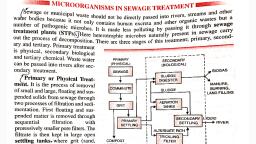
PRIMARY TREATMENT, It is a physical process of removing small and large particles through filtration and sedimentation., Firstly, the sewage is passed through the wire mesh of screens of sequentially smaller pore sizes to remove floating objects (like polythene bags etc)., Then the grit is sedimented by passing the sewage into a grit chamber., The sewage is then kept in settling tanks, where the suspended materials settle down to form the primary sludge., The effluent is taken for secondary treatment.
Page 3 :
SECONDARY TREATMENT, It is a biological process by the heterotrophic bacteria naturally present in the sewage., The primary effluent is passed into large aeration tanks where it is constantly agitated and air is pumped out., This causes the rapid growth of aerobic microbes into ‘flocs’ which consume the organic matter of sewage leading to the reduction in biochemical oxygen demand (BOD)., After the significant reduction in BOD of sewage, the effluent is passed into settling tanks where flocs are sedimented leading to the formation of activated sludge., A part of this activated sludge is used as inoculum which is pumped back into the aeration tanks., The major part of this sludge is pumped into anaerobic sludge digesters, where its digestion occurs by the anaerobic bacteria producing methane, hydrogen sulphide and carbon dioxide. These gases form biogas., After secondary treatment the effluent is released into natural water bodies like streams and rivers., The Ministry of Environment and Forests has initiated the programmes like Ganga Action Plan and Yamuna Action Plan for the treatment of sewage before it is released into the rivers.
Page 4 :
PRODUCTION OF BIOGAS BY MICROBES, Biogas constitutes methane (60%) and CO₂ (40%)., A large quantity of methane, along with carbon dioxide and hydrogen is produced by methanogens like Methanobacterium by acting on cellulosic compounds. These bacteria are found in anaerobic sludge during sewage treatment and in the rumen of cattle., Cattle dung contains cellulosic materials as well as methanogens so it is used for the production of biogas., Indian Agricultural Research Institute (IARI) and Khadi and Village Industries Commission (KVIC) developed the technology of biogas production in India.
Page 5 :
The steps involved in its production are as follows:-, The biogas plant consists of a 10-15 feet deep concrete tank in which slurry of dung is fed., A floating cover is kept over the slurry which keeps on rising as the gas is produced in the tank by microbial activity., An outlet connected to a pipe is present in the biogas plant for the removal of biogas and supply of it to required place., The spent slurry is removed through another outlet which can be used as a fertiliser.
Page 6 :
MICROBES AS BIOCONTROL AGENTS, The natural method of pest and pathogen control involving the use of viruses, bacteria and other insects is called Biocontrol/Biological control., An organic gardener holds the view that eradication of pests is undesirable because without them the beneficial organism which depends upon them for food will also suffer so these insects should be kept at manageable levels by a system of checks and balances within an ecosystem. For e.g. Ladybird beetle feeds on aphids while Dragonflies prey upon mosquitoes., The spores of a bacterium Bacillus thuringiensis (Bt) are toxic to certain insect larvae and kill them but are not harmful to other insects., The fungus Trichoderma is another biological control being developed for use in the treatment of plant disease. It is free living fungi in soil and root ecosystems and is effective against several plant pathogens., Baculoviruses are pathogens that attack insects and other arthropods. The majority of Baculoviruses used as biocontrol agents belong to the genus Nucleopolyhedrovirus.
Page 7 :
MICROBES AS BIOFERTILISERS, The use of biofertilisers to reduce the use of chemical fertilisers is called organic farming. Biofertilisers are organisms that enrich the nutrient quality of the soil. The main sources of biofertilisers are bacteria, fungi and cyanobacteria., Bacteria :- Rhizobium (Symbiotic bacteria) and Azospirillum, Azatobacter (Free-living bacteria) can fix atmospheric nitrogen and enrich the nitrogen content of the soil., Fungi :- they form mutually beneficial or symbiotic association with the root of higher plant (mycorrhiza). Many members of the genus Glomus form mycorrhiza. In these associations the fungal symbiont absorbs phosphorus from the soil and passes it to the plant. Mycorrhiza show other benefits also, such as resistance to root-borne pathogens, tolerance to salinity and drought and an overall increase in plant growth., Cyanobacteria :- they are autotrophic microbes many of which can fix atmospheric nitrogen such as Anabaena, Nostoc and Oscillatoria. In paddy fields, cyanobacteria serve as an important biofertiliser. They also add organic matter to the soil and increase its fertility.