Notes of XII D, Biology & Genetics And Evolution CHAPTER 6 MOLECULAR BASIS OF INHERITANCE.pdf - Study Material
Page 1 :
Class XII (BIOLOGY), UNIT II – GENETICS -18 MARKS, MOLECULAR BASIS OF INHERITANCE (CHAPTER 6), , Class XII – Biology, Unit VII- GENETICS (18 marks), , Chapter 5, , MOLECULAR BASIS, OF, INHERITANCE, , TAMPHASANA GIRLS' HIGHER SECONDARY SCHOOL, MANIPUR, , 1
Page 2 :
Class XII (BIOLOGY), UNIT II – GENETICS -18 MARKS, MOLECULAR BASIS OF INHERITANCE (CHAPTER 6), THE SEARCH FOR GENETIC MATERIAL, Nucleic Acids:, They are building blocks of genetic material., They are polymer of nucleotides., They are first isolated by Friedrich Meischer., They are of two types: (1) DNA (deoxyribonucleic acid) (2) RNA (Ribonucleic acid)., DNA AS GENETIC MATERIAL, TRANSFORMATION EXPERIMENT (GRIFFITH’S EXPERIMENT), In 1928, F. Griffith conducted an experiment in mice using a bacterium called Streptococcus pneumonia or, Diplococcus pneumonia causing pneumonia., This bacterium produces two types of colonies:, (1) R-strain/R-type: Avirulent or non-pathogenic. Form rough colonies., (2) S-strain/S-type: Virulent or pathogenic. Form smooth colonies., Materials: Griffith used R-II type (avirulent) and S-III type (virulent) in his experiment., Procedure:, S-III type, , Injected to mice, , Mice died, , R-II type, , Injected to mice, , Mice lived, , Heat killed S-III type, , Injected to mice, , Mice lived, , Heat killed S-III type, +, R-II type, , Injected to mice, , Mice died +, , Live S-III type, recovered from dead, mice, , Conclusion: He concluded that the live R-II type bacterium had somehow been transformed by some chemical, substance released by heat killed S-III type into live S-III type bacterium. This must be due to transfer of genetic, material. However, he did not mention the chemical nature of the transforming substance/genetic material., BIOCHEMICAL CHARACTERISATION OF THE TRANSFORMING PRINCIPLE:, In 1944, Oswald Avery, Mac Leod and Mc Carty determined the “biochemical nature of the transforming, principle”., They purified biochemicals (protein, RNA and DNA) from the heat-killed S-strain Streptococcus, pneumonia. Each biochemical fraction was divided into two fractions. For example, the protein fraction was, divided into two fractions; one fraction was treated with proteinase and the other without it. Similarly, the, RNA fraction was divided into two fractions; one fraction was treated with RNase and the other without it., Likewise, the DNA fraction was divided into two fractions; one fraction was treated with DNase and the, other without it. All the fractions were mixed to R-type bacteria separately. They found that only DNA of Stype could be able to transform R-type to S-type bacteria. Therefore, they concluded that DNA is the, hereditary material., , 2
Page 3 :
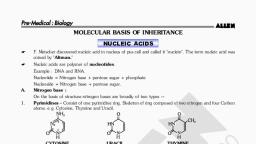
Class XII (BIOLOGY), UNIT II – GENETICS -18 MARKS, MOLECULAR BASIS OF INHERITANCE (CHAPTER 6), Experiment, R-type bacteria + Protein S - type, R-type bacteria + Protein S – type + Proteinase, R-type bacteria + RNA S - type, R-type bacteria + RNA S – type + RNase, R-type bacteria + DNA S - type, R-type bacteria + DNA S – type + DNase, , Result, R-type bacteria, R-type bacteria, R-type bacteria, R-type bacteria, S-type bacteria (transformation), R-type bacteria, , N.B. Proteinase – protein digesting enzyme, RNAase – RNA digesting enzyme, DNAase - DNA digesting enzyme, BACTERIOPHAGE EXPERIMENT:, Hershey and Chase proved that DNA is a genetic material. They used bacteriophage (virus that infects bacteria)., They made two different preparation of bacteriophage. In one bacteriophage, the DNA was made radioactive with, 32, P and in other bacteriophage, the protein coat was made radioactive with 35S., The two radioactive bacteriophages were allowed to infect the E. coli separately., Then, as the infection proceeded, the viral coats were removed from the bacteria by agitating them in a blender., They found that the bacteria which were infected with bacteriophage having radioactive DNA ( 32P) were, radioactive in the bacterial cells indicating that DNA was the material that had pass from the virus to bacteria., However, bacteria that were infected with viruses that had radioactive proteins (35S) were not radioactive. This, proved that DNA is the genetic material., STRUCTURE OF DNA:, DNA is a polymer of deoxyribonucleotides., A nucleotide has 3 components – Nitrogenous base, pentose sugar and, phosphate group., Nitrogenous base are of 2 types- purines and pyrimidines., Purines- Adenine and Guanine; Pyrimidines- Thymine and Cytosine (In, RNA thymine is replaced by Uracil)., Nitrogenous base is linked to the pentose sugar at 1C atom through Nglycosidic bond to form nucleoside., Phosphate group is attached to the pentose sugar at 5C atom of one, nucleotide and 3C atom of another nucleotide by phosphodiester bond., SALIENT FEATURES OF DOUBLE HELICAL STRUCTURE OF DNA (WATSON & CRICK), 1. DNA is made up of two polynucleotide chains/strands., 2. The two chains are antiparallel, i.e. one strands runs from 5 →3,, and the other runs from 3→5., 3. The two strands are coiled in the right handed form., 4. The sugar- phosphate backbones are present outside while the bases, are stack inside., 5. The bases are held together by H-bonds., 6. Purine always pair with pyrimidine with A = T, G C., 7. Number of base pairs per complete turn is 10bp., 8. Distance between two stack base pairs is 0.34 nm., 9. Diameter of DNA is 2 nm., 3
Page 4 :
Class XII (BIOLOGY), UNIT II – GENETICS -18 MARKS, MOLECULAR BASIS OF INHERITANCE (CHAPTER 6), , Chargaff rule: The amount of purine is equal to the amount of pyrimidine. A+ G/T + C = 1., DNA PACKAGING, In prokaryotes:, DNA (negative charge) is held with some non-histone protein (positive charge) to form a compact mass called, nucleiod., In eukaryotes:, The DNA (negative charged) is coiled around the positively charged histone, proteins (rich in lysine and arginine). The unit of compaction is called nucleosome., There are 5 types of histone proteins- H1, H2A, H2B, H3 and H4. H2A, H2B, H3 and, H4 (in pairs) form the histone octamer. H1 histone protein is present in linker, DNA., , Types of Chromatin: (1) Euchromatin, Sl. No., 1, 2, 3, , Euchromatin, It is loosely packed, It is lightly stained, It is transcriptionally active, , (2) Heterochromatin, Heterochromatin, It is tightly packed, It is densely stained, It is transcriptionally inactive, , RNA (Ribonucleic acid), RNA is another nucleic acid., RNA is considered as the first genetic material (e.g. plant virus, animal virus etc.) because of its catalytic, nature (ribozyme)., RNA has nitrogenous bases (A, G, C & U), ribose sugar with 2 -OH group., , 4
Page 5 :
Class XII (BIOLOGY), UNIT II – GENETICS -18 MARKS, MOLECULAR BASIS OF INHERITANCE (CHAPTER 6), TYPES OF RNA, (1) mRNA (messenger RNA), , (2) rRNA (ribosomal RNA), , (3) tRNA (transfer RNA), , mRNA:, It constitutes about 2-5% of total RNA., mRNA carries the genetic information from the DNA to the ribosome for protein synthesis., rRNA:, It constitutes about 70-80% of total RNA., It forms the structural part of ribosome., tRNA (soluble RNA):, It is the smallest RNA., It constitutes about 10-15% of total RNA., tRNA transfers the amino acid from the cytoplasm to, ribosome for protein synthesis, Structure of tRNA., It was suggested by Robert Holley., It is clover leaf like in 2D structure., It is L-shaped in 3D structure., A typical tRNA has 5 arms or loops:, (1) Amino acid binding site: Amino acid is attached to this site. It bears ACC-OH group at the 3 end of the tRNA., (2) TC loop: It contains pseudouridine. Ribosome binds to this site., (3) Anticodon loop: It has 3 ribonucleotides which pairs with the codon of mRNA during protein synthesis., (4) DHU loop: It contains dihydrouridine. Enzyme (amino acyl tRNA synthetase) binds to this site., (5) Extra arm: Function is unknown., , DNA REPLICATION:, The synthesis of DNA from DNA is called DNA replication., It occurs in S-phase of cell cycle., Semi-conservative mode of DNA replication:, It was first suggested by Watson and Crick (1953)., It is a type of DNA replication in which one strand of the daughter duplex is derived from the parent and the, other strand is newly formed., Meselson and Stahl’s experiment for semi-conservative mode of DNA replication., (i) They grew E.coli in a medium containing 15NH4Cl for many generations to incorporate 15N (heavy isotope of, 14, N) to newly synthesised DNA. This heavy DNA molecule 15N could be distinguished from the normal 14N, DNA molecule by centrifugation., (ii) Then they transferred the cells into a medium containing normal 14NH4Cl (14N)., (iii) The DNA extracted from the cells after first generation of transfer (20 min) from 15N to 14N medium had an, intermediate or hybrid DNA (15N14N)., 5
Page 6 :
Class XII (BIOLOGY), UNIT II – GENETICS -18 MARKS, MOLECULAR BASIS OF INHERITANCE (CHAPTER 6), (iv) The DNA extracted from cells after 2nd generation (40 min) was composed of equal amount of light DNA, (14N) and hybrid DNA (15N14N)., (v) This clearly proved that DNA replication is semi-conservative., , Fig. Messelson and Stahl’s experiment, , Steps in DNA replication:, DNA replication starts at origin of replication (ori). Prokaryotic cell has single ori whereas eukaryotic cell, has multiple ori., (1) Unwinding of DNA:, The two strands are separated by the helicase. The separated strands are stabilised by single stranded, binding (SSB) proteins. Unwinding creates supercoiling of DNA. This supercoiling is prevented by topoisomerase., The open DNA looks like a Y-shaped structure called replication fork., (2) RNA primer:, It is a short RNA molecule of 5-10 bases. It is synthesised at the, 5 end of the new DNA strand by primase. The new DNA molecule, cannot be synthesized without RNA primer., (3) Synthesis of new DNA strand:, DNA polymerase III is the main polymerase enzyme which, synthesizes DNA. DNA polymerase III can polymerise DNA from 5→, 3. Therefore, only one strand can be synthesised in a continuous manner., The continuously synthesised strand is called leading strand. The other, strand is synthesized in a discontinuous manner by building short DNA, segments called Okazaki fragments. An RNA primer is required every time an okazaki fragment is to be built. The, discontinuously synthesised strand is called lagging strand. The RNA primer is removed and replaced with DNA by, DNA polymerase I and later the DNA segments are join by DNA ligase., (4) Proof reading:, Sometimes a wrong base is inserted during replication; it is corrected through proof reading by DNA polymerase (I,, II & III)., , 6
Page 7 :
Class XII (BIOLOGY), UNIT II – GENETICS -18 MARKS, MOLECULAR BASIS OF INHERITANCE (CHAPTER 6), Note:, , , , DNA replication is semidiscontinuous, that is, one strand of the new DNA molecule builds up continuously, and the other in pieces., DNA replication is semiconservative, since in the two newly formed molecules, one parental strand is, conserved and the other strand is newly synthesised, , CENTRAL DOGMA, , The transfer of information from DNA to RNA then to protein constitutes the Central Dogma., , TRANSCRIPTION:, Transcription is the synthesis of RNA strand by copying from a complementary template DNA strand., The flow of genetic information from DNA to mRNA is called transcription., mRNA is synthesised from the template stand/ antisense strand/anticoding strand., Prokaryotic DNA contains only exons (coding sequence)., Eukaryotic DNA contains both exons and introns (non-coding sequence)., Transcription unit:, It is a segment of DNA that codes for a single RNA molecule., It comprises of promoter, structural gene and terminator., Promoter: It is region of DNA where RNA polymerase first binds., Structural gene: It the region of DNA which is transcribed., Terminator: It is the region of DNA where transcription ends., Transcription in prokaryotes:, RNA polymerase synthesizes RNA. RNA polymerase is made up of 6 subunits: α, α, β, β, and , (holoenzyme). When the RNA polymerase is without , it is called as core enzyme., There are three steps in transcription: Initiation, elongation and termination., (1) Initiation:, RNA polymerase (initiated by factor) binds to DNA at a, specific sequence called the promoter., (2) Elongation:, As the synthesis of RNA chain initiates, the factor, dissociates from the holoenzyme. Further, elongation is done, by core enzyme (α, α, β, β,). RNA polymerase can, transcribe RNA from 5→3 direction using the DNA template, (3→5)., (3) Termination:, Elongation of RNA continues till the RNA polymerase meets, the terminator region. At terminator region RNA polymerase, 7
Page 8 :
Class XII (BIOLOGY), UNIT II – GENETICS -18 MARKS, MOLECULAR BASIS OF INHERITANCE (CHAPTER 6), associates transiently with termination factor, Rho () factor, and transcription is stopped., Transcription in eukaryotes:, RNA polymerase I synthesizes rRNA (28S, 18S, 5.8S)., RNA polymerase II synthesizes mRNA., RNA polymerase III synthesizes tRNA and 5S rRNA., In eukaryotes, the transcribed RNA is called as heterogenous nuclear RNA (hnRNA). Therefore, post, transcriptional modification is required to convert it to mRNA., Post transcriptional modification of hnRNA (eukaryotes):, The hnRNA is modified to mRNA before translation., 1. Splicing: In splicing introns are removed and exons are joined., 2. 5 Capping: The 5 end of the hnRNA is capped by methyl guanosine., 3. Poly A tail: Adenine residues are added to the 3 end of hnRNA., GENETIC CODE, The sequence of DNA which codes for amino acid is called genetic code., Genetic code was explained by Nirenberg (1961) and Khorana (1964)., Salient features of genetic code:, 1. Triplet code: Genetic code is triplet i.e. 3 bases (nucleotide) = 1 codon =.1 aminoacid, 2. Unambiguous: A particular codon codes for only one amino acid. E.g. UUU codes for phenylalanine., 3. Degeneracy: It means a particular amino acid may have more than one codon. E.g. phenylalanine has 2, codons (UUU, UUC). The first two bases of a codon for the same amino acids are constant but the third base, can be change or wobble. This is called wobble hypothesis., 4. Commaless and non-overlapping: It is read continuously without punctuation., 5. Polarity: mRNA is read from 5→3 direction., 6. Start codon: Initiation codon for polypeptide synthesis is AUG which codes for methionine and GUG codes, for valine., 7. Termination codon: There are three termination codons –UAA, UAG and UGA., 8. Universal: Genetic code is universal., , TRANSLATION:, The process of polymerization of amino acids to form a polypeptide is called translation., Steps in translation:, (1) Activation of amino acids, , (2) Amino acylation of tRNA, , (3) Initiation, , (4) Elongation (5) Termination., , (1) Activation of amino acids:, Amino acids are activated by amino acyl tRNA synthetase to form amino acyl adenylate enzyme, complex. ATP is required., , 8
Page 9 :
Class XII (BIOLOGY), UNIT II – GENETICS -18 MARKS, MOLECULAR BASIS OF INHERITANCE (CHAPTER 6), (2) Amino acylation of tRNA:, Amino acyl adenylate enzyme complex reacts with tRNA to form aminoacyl tRNA complex (charged, tRNA), , (3) Initiation:, Initiation requires initiation factors and GTP. The small ribosomal subunit binds to the initiation codon, (AUG) of mRNA. The first aminoacyl tRNA carrying methionine binds to initiation codon of mRNA followed by, attachment of larger ribosomal sub-unit to complete the ribosome. The first tRNA is at the P-site leaving the A-site, of the ribosome exposed., (4) Elongation:, The second aminoacyl tRNA then enters the A site. A peptide bond is formed between the first two amino, acids by peptidyl transferase. The first amino acid loses its tRNA which moves out. Ribosome then jumps from the, initial codon to the next codon of the mRNA towards 3’ end. This makes the second tRNA to lie at P-site while the, A-site is made empty. The third aminoacyl tRNA then enters the A site and binds to third codon. In the presence of, peptidyl transferase, a peptide bond is formed between second and third amino acids and tRNA of second amino acid, becomes free. In this way the peptide chain is synthesized., (5) Termination:, Termination of the polypeptide chain occurs when a stop codon (UAA, UAG, and UGA) comes at A site. A, release factor binds to the stop codon, terminating translation and releasing the complete polypeptide from the, ribosome., GENE EXPRESSION AND REGULATION:, Gene expression refers to the expression of genetic information stored in DNA through protein expression., Eukaryotic gene regulation:, In eukaryotes, the gene regulation could be exerted at, (i) transcriptional level (formation of primary transcript),, (ii) processing level (regulation of splicing),, (iii) transport of mRNA from nucleus to the cytoplasm,, (iv) translational level., Prokaryotic gene expression:, OPERON:, An operon is a unit of transcription which consists of structural gene, promoter, operator and regulator gene., Structural gene: These are genes which synthesises mRNA., Promoter: This is the region of DNA where RNA polymerase first binds for transcription., Operator: It is the site at which a protein called repressor binds. It controls the transcription by regulating the, accessibility of the promoter to RNA polymerase., Regulator gene: It produces repressor protein. If repressor binds to operator the gene is switch off as RNA, polymerase cannot bind to promoter., Repressor binds to operator – RNA polymerase cannot bind to promoter – gene is switch off, , 9
Page 10 :
Class XII (BIOLOGY), UNIT II – GENETICS -18 MARKS, MOLECULAR BASIS OF INHERITANCE (CHAPTER 6), Lac operon (Lactose operon), It is an inducible operon in which the gene is switch on in the presence of a chemical (inducer/lactose)., It was proposed by Jacob and Monod in 1961., It consists of:, (i) Structural gene: It consists of 3 genes (polycistronic)- Z, Y and A, Z codes for β-galactosidase that hydrolyses lactose to glucose and galactose., Y codes galactoside permease for allowing entry of lactose inside the cell., A codes for transacetylase., (ii) Promoter: This is the region of DNA where RNA polymerase first binds for transcription., (iii) Operator: It controls the transcription. If repressor binds to operator the gene is switch off., (iv) Regulator gene: It produces repressor protein., (v) Inducer : Lactose is an inducer., , , , , Switch off: Lac operon is switch off when lactose/inducer is absent. The repressor protein binds to operator, which makes the lac operon to switch off., Switch on: Lac operon is switch on when lactose/inducer is present. Binding of inducer to the repressor, inactivates the repressor to bind to the operator which makes the lac operon to switch on., , GENOME:, The haploid set of chromosome of an organism constitutes a genome., Human genome (23 chromosomes) contains 3 billion base pairs., HUMAN GENOME PROJECT (HGP):, HGP is a project to understand the sequence of nucleotide base pairs of human DNA, and of identifying and, mapping all of the genes of the human genome., Goals:, 1., 2., 3., 4., 5., 6., , To identify sequence of and number of all the base pair present in human genome., To identify all the approximately 20,000-25,000 genes present in human genome., To identify the functions of all genes., To identify genes that cause human disorders., Store the information in data bases., Transfer of technologies developed during HGP to industry., , 10
Page 11 :
Class XII (BIOLOGY), UNIT II – GENETICS -18 MARKS, MOLECULAR BASIS OF INHERITANCE (CHAPTER 6), Methodology:, Two types of approaches are used:, Expressed sequence tags (EST): Identify all the genes that are expressed as mRNA., Sequence annotation: Sequencing the whole genome (both coding and non-coding) and later assigning different, regions in the sequence with functions ( a term referred to as sequence annotation)., Salient features of Human Genome:, (i) Human genome has 3.1 billion nucleotide base pairs., (ii) Average gene size is 3000 bp., (iii) Human genome consists of about 30,000 genes., (iv) The function of over 50% of discovered genes is unknown, (v) Chromosome I has 2968 (maximum genes) and Y – chromosome has 231 genes (least)., (vi) Less than 2% of genome codes for protein., (vii) Repeated sequences make up very large portion of the human genome, (vii) 99.9% of nucleotide base pairs are similar in all human beings., (viii) 0.1% makes the differences in human beings., DNA FINGERPRINTING:, It is a technique used to identify a person base on identifying differences in some specific, regions in DNA sequence called as repetitive DNA., Alec Jeffreys invented DNA fingerprinting., Principle of DNA fingerprinting:, There are repetitive DNA sequences which are tandemly repeated in human DNA. They can be separated as satellite, from the bulk DNA. These satellite DNA shows polymorphism. DNA polymorphism is the basis behind DNA, fingerprinting. Among the satellite DNA, Variable Number Tandem Repeats” (VNTR), also called as, minisatellites are used as genetic markers in DNA fingerprinting., Techniques of DNA fingerprinting:, 1. The DNA is extracted from cells (WBC/ sperm), 2. The DNA molecules are fragmented with the help of restriction endonucleases. The fragments of DNA also, contain the VNTRs., 3. The fragments are separated according to size by gel electrophoresis., 4. Fragments of a particular size having VNTRs are multiplied through PCR technique. They are treated with, alkaline chemicals to split them into single stranded DNAs., 5. The separated fragments of single stranded DNA are transferred onto a nylon membrane., 6. Hybridisation is done using Radioactive VNTR probes (Southern Blotting), 7. Detection of hybridised DNA by autoradiography., 8. The dark bands on X-ray film represent the DNA fingerprints., Applications of DNA Fingerprinting:, (i) Individuality: It can help to distinguish one human being from another with exception of monozygotic twins., (ii) Paternity/Maternity Disputes: It can identify the real genetic mother, father and the offspring., (iii) Human Lineage: DNA from various probables is being studied to find out human lineage., (iv) Hereditary Diseases: The technique is being used to identify genes connected with hereditary diseases., (v) Forensics: DNA finger printing is very useful in the detection of crime and legal pursuits., (vi) Sociology: It can identify racial groups, their origin, historical migration and invasions., 11



 Learn better on this topic