Page 1 :
AND, 12 BIOTECHNOLOGY, ITS APPLICATIONS, During mid 1970s traditional methods of crop, improvement like selection, breeding for yield, resistance, to disease and draught were in, practice. But by this time, new techniques like cell and, protoplast culture, gene, transfer etc., have emerged. Transgenic plants are, , and their diplodization have lead to release, technique, of, better varieties in many crops. Organisms whose, genes have been altered by manipulation are cal d, , Genetically Modified Organism (GMO). The working, of GMO is due to nature of transferred genes, nature of, host organism and food web formed. Some useful, of GM plants in agricultural biotechnology are, , supposed to be resistant to diseases, predators and, drought and even can be grown without fertilizer and, pesticides. It has been reported that 5.5 million farmers, , aspects, , as under:, 1. Improvement of nutritional quality., , are being benefitted by using transgenic plants in 58.7, million hectares (148 million acres) all over the world., , Animal cell culture and their, , products, , are, , 2. Better nitrogen fixation., , being, , 3. Induction and selection of mutants, resistant to, , employed in a variety of areas of research in, , pathogens, adverse soil conditions, draught, salinity etc., 4. Production of disease resistant plant., 5. Micropropagation for bio-mass energy, , biotechnology. These areas include production of, antiviral vaccines, cancer research, cell fusion techniques,, genetic manipulation, production of monoclonal, , production., , antibodies, and pharmaceutical drugs, chromosomal, analysis of cells, recombinant proteins etc., , 6. Enhanced efficiency of mineral usage by plants to, prevent early exhaustion of fertility of soil., 7. To reduce post harvest losses., 8. Reduced rehance on chemical pesticides i.e., to, develop pest resistant crops., Following methods are being used by agricultural, bio-technologists for introducing the better characters, , The applications of biotechnology include, , therapeutics, processed food, bioremediation, waste, treatment, energy production etc. The production of, technologies based on genetic engineering are often, referred to as modern biotechnology., , MAJOR RESEARCH AREAS OF, , in plants., , BIOTECHNOLOGY, , 1. Tissue culture technique. Plant tissue culture, technique is used to select somaclones that are resistant, to herbicides. The plants in which herbicidal resistance, , (i) To supply best catalyst (microbe or pure enzyme), , in the form of organism with better characteristics)., (ii) To create optimal conditions by genetic, , engineering, , for, , a, , catalyst to, , has been selected for tissue culture is limited to few, , species., , function., , ii) Purification of protein/organic compound by, developing downstream technologies., 1., , BIOTECHNOLOGICAL APPLICATIONS IN, AGRICULTURE, of, Latest researches in the, are, , field, , biotechnology, , proving more useful in contributing to improved, production and propagation of new cultivars which, prove better in relation to nutritional quality, disease, , and salt resistance and other characters. With, of, engineering techniques, the time, , mprovement, , for generating, drastically, , genetic, evaluating, , and, , germplasm can be, biotechnological1, frontiers to products of, new, , reduced. Chemical and, , progresses have opened new, improved value from agricultural, , raw, , materials., , second phase, Biotechnology has been considered as the, of green revolution. Considerable research is in progress, , to increase the yield, improved fixation of nitrogen,, increased nutritional quality and greater tolerance to, stresses., salinity, alkalinity, acidity and other, through anther culture, , Haploids produced, , 2. Cell fusion. Proplasts from different cells are, made to fuse by treating them with certain chemicals or, electric current. By this method chromosomes of different, species can be combined particularly in those species, , which are otherwise incompatible., 3. Somatic cell hybridization or cytoplast or cybrid, Power et. al. (1970) crossed oat with maize by this, technique. Usually by protoplast fusion heterokaryon is, , formed, without the fusion of nuclei. One or both the, nuclei may be lost later on. Sometimes one nucleus is left, in the mixture of both the cytoplasms. This product is, called Cytoplast or Cybrid. The study of cybrids is, proving useful for investigation of posible, recombination within extrachromosomal genomes., 4. Somaclonal variations. The method refers to, , heritable changes which accumulate in callus from a, somatic explant and express in the progeny of in vitro, regenerants obtained from callus. Somaclonal variations, have been found to be taking place both for nuclear and, , cytoplasmic origin., , 669
Page 2 :
MODERN'S, , 670, , abc OF, BIOLOGY-Xm, better amino acid balance. Crop improvement, nent, is mainly, aimed to increase the yield, rotein, contents and, improvement of characters like I, king, of, , 5. Organ culture technique. The technique is being, used to culture isolated embryos. This is being done in, those cases where viable zygotes are produced but due, to incompatible genic interactions normal embryo and, , and malting quality of barley., The four major types of seed, , endosperm formation is checked., 6. Embryo rescue. Sometimes embryo formed in, various crosses suffers from post fertilization, development inhibitory actions. Due to this normal viable, seeds are not formed. Such hybrid embryos can be saved, , quality wheat, , proteins, , are alhitu, , (soluble in water), globulin (soluble in salt, protamines (soluble in alcohol) and lutelins, , dilute acid or alkali). Prolamin is the, protein of cereals and it is deficie in, , by growing them in artificial media., 7. Genetic engineering. It promises rapid, acceleration of plant breeding efforts for crop, improvement. Some success has been achieved in, , proline, glutamine and asparagine., , tions),, (soluble in, major stora, lysine, rich, , Table 12.1. Some seed storage proteins, whose, have been cloned., , developing varieties resistant to herbicides, viral diseases, and insect pests., In vitro plants are formed directly from the explants, , Protein, , 1., , Zein, , Source, Maize, , such as meristems, segments etc., or indirectly via, , 2., , Phaseolin, , Fresh bean, , initiation and differentiation of callus. The first method, , 3., , Legumin, , Pea, , ensures maintenance of clones (clonal stability) and, , ., , Hordein, , 5., , Glycinin, , Barley, , second method, , generally, , leads to, , genetic variability., , Embryo culture technique is used in those plants where, the seeds are dormant, recalcitrant or abort at, early, A. IMPROVING NUTRTIONAL QUALITY, , Seed proteins which provide about 70% of the, proteins are deficient in some of essential amino acids., , Eight species of cereals contribute over 50% of the total, world food calorie, , requirements., , Cereal seeds have, , Soybean, , The main storage proteins of rice is, glutelin. In oats, globulin forms the principal nitrogen storing protein., An increase in free threonine levels has been, achieved, in barley and maize seeds. Alternation in the, relative, proportions of different proteins in the seed maybe, more effective, way of maintaining amino acid balance., The genes coding for a number of, storage proteins have, been cloned. Nutritional, improvement can be, , stages., , low, , a, , lysine, tryptophan and threonine contents, where, as, legume seeds are deficient in methionine and cysteine., Some seeds crops like rice have low, protein contents but, , by, , achieved, , site directed, , mutagenesis with the objective of, introducing more lysine or methionine codons into gene, , sequences., , CLONAL PROPAGATION OF, RARE AND ELITE TREES, , FAST MULTIPLICATION, , LARGE SCALE, , MULTIPLICATION, , VIRUS-FREE TREES, , BIOMASS ENERGY, AND CYBRID, , GENETIC VARIABILITY+, , SOMATIC HYBRIDS, , PRODUCTION, , HAPLOID, TRIPLOID,, , WIDE HYBRIDIZATION, , POLYPLOIDS, , CRYOPRESERVATION+, , BIOTECHNOLOGY, , OF GERMPLASM, , PRESERVATION OF POLLEN, , IN, , TREE IMPROVEMENT, , INTERNATIONALEXCHANGE, OF GERMPLASM, INCREASED, , 12.1. Various, , aspects, , for which, , RECALCITRATION, , BREAKING DORMANCY, , MICROGRAFTING FLOWERING, NOVEL TREES, , MUTANT TREES RESISTANT TO, , DISEASES, PESTS, POLLUTANTS, ADVERSE SOIL, DROUGHT, TEMPERATURE, , Fig., , TREES FROM, , OVERCOMING SELF STERILITY, , PHOTOSYNTHESIS, , NITROGEN FIXATION, , protoplast,, , genes, nes, , cell, tissue and organ culture, , improvement of trees., , EARLY FLOWERING3, , technology, , can, , be, , employed, , tor, , t
Page 3 :
TECHNOLOGYAND ITS APPLICATIONS, , 671, , B.SALT AND DROUGHT TOLERANCE, , nfestans. From among more than 800 plants about 2% of, Somaclones displayed enhanced resistance to late blight, , Salinity isa problem in large area of India., , reeulation with organic and inorganic solutes,, , ar, , of potato disease. In maize, somaclonal variation has, , tmentation, patch clamp studies, acidic, , induced resistance to, , race, , T of soluthern, , corn, , blight, , aroteins and genetic engineering of plants are some of, pr, areas which represent an interface of basic and, , caused by Drechslera maydis. Transgenic tobacco plants, , anplied knowledge. Saltrich soils have less productivity, , exhibited protection against fungus Rhizoctonia solani., , that express, , barley ribosome inactivating protein (RIP), , ate, The production of selections with increased salt, , Bt COTTON, , and drought tolerance has relied on obtaining variants, during cell cultures., , Insect resistant plants can also be developed. Progress, , a, , arising, C. PRODUCTION OF DISEASED RESISTANT, PLANTS, , Plant viruses cause serious losses of yield and quality, The losses may range from 5-90%., in most crops., Substantial crop losses occur due to attacks by insect, , pests and microbial pathogens., , Presently, , little know, , mechanism of disease, , is available about genetic, resistance in plants. Genetic engineeringg promises to, have an enormous impact on the improvement of crop, species. It has been suggested to develop new genes for, disease resistance and to expand the utilization of existing, , how, , disease resistant genes using genetic manipulation, techniques. Genetic transformation can boost plant, breeding efforts for developing disease resistant varieties., disease, Cloning of plant genes responsible for pest and, resistance will help in elucidating some of the biological, mechanisms of resistance., , Now the disease resistant genes can be isolated and, transferred to high yielding susceptible plants to produce, To locate the pathogen gene is a, if the, difficult task. Difficulties may be further enhanced, disease resistant character is polygenic trait. But inspite, , pathogen free plants., , of all these drawbacks, still it is possible to identify,, host. Several, 1Solate and transfer the gene/genes to the, identified for, disease resistant somaclones have been, caused, by Alternaria, resistance to early blight of potato, diseases like, Solani. Similarly in sugarcane resistance to, been recovered. Scientists, , fiji and downy mildew, have tried to use to, produce tobacco, , to, , in enginering insect resistance in transgenic plants has, been made through the expression of insect toxin gene of, Bacilus thuringiensis in plants. Most strains of this toxin, gene are toxic to lepidopetran larvae. The toxicity is due, , to toxin gene named as Bt-2. Bt toxin gene has been, cloned from the bacteria and expressed in plants to providee, resistance from insects without the requirement of, insecticides. It has created a type of biopesticide e.g. Bt, , cotton, Bt corn, rice, tomato, potato and, , soyabean etc., , Sal bacterium Bacillus thuringiensis (Bt) forms a cry, , is toxic to larvae of, certain insects as lepidopterans (tobacco bud worm,, armyworm), coleopterans (beetles) and dipterans (flies,, There are several different types of cry, , (crystal) protein., , This cry, , protein, , mosquitoes)., different groups of, proteins. Each cry protein is toxic to, , insects. B. thuringiensis produces some types of protein, in a specific stage of their growth and, , crystals, development. The gene encoding cry protein i.e., cry gene, , has been isolated and transferred into several crops., control, Proteins encoded by the genes cry IA and cry lI Ab, the corn, the cottonbollworms and that of cry IAb controls, the, controls, Ab, lI, borer. The protein formed by gene cry, root, corn, beetle and cry III Bb controls, Colorado, , potato, worm. This is a case where transgene product directly, interest., produces the phenotype of, , have, , transfer system, resistance to, increased, with, , Agrobacterium gene, , plants, , TMV., Cross, , protection phenomenon, , means, , that, , plants, , resist infection by second, njected with one strain of virus, been found to be, strain. Cross protection has, the, number of viral diseases. Although, , related, , etfective in, , understood,, , is not fully, mechanism of cross protection, from viral disease, , been suggested that protection, of gene, COuld be achieved with the help, , it has, , Genetically engineered, , cross, , useful tool of developing, Dactericidal, , attacins have, , transter., , protection provides, , disease resistant, , plants., , an, , Some, , cecropins and, proteins like lysozyme,, silk moth, , giant, exhibited, have, proteins, , of, been located in pupae, , iylophora cecropia. These, , pathogen like Phytophthora, antifugal activity against, , bt-2 genes are resistant, Fig 12.2. Transgenic plants containing, , to insects. Leftcontrol, Rightbt-2 transgenic plants.
Page 4 :
MODERN'S abc OF, , 672 -, , BIOLOGY-X, pests., , som, of some, in Europe to check the attack of, since World War I, used, is, being, Bacillus thuringiensis, far., so, have been identified, More than 30 serotypes of B. thuringiensis, useful insects., not c a u s e harm to, insects and they do, affect, specific, only, are applicable:, Cry genes, insect resistance, two major principles, F o r transgenic crop formation with, endotoxins from Bt., () Introduction of protein delta, , i) Introduction of protease inhibitors of plants., , Cry protein at about 0.004, , % in, , transgenic, , tobacco, , plants, , killed insects Menduca sexta, , withi, , e, , week., , Why, , Bt toxin does not kill the Bacillus bacterium ?, , Bt toxin is present in the form of inactive protoxin., However when this inactive form is ingested by a insect,, , it is converted into active toxic form. This happens due, , to alkaline pH of gut which solubilizes the crystals., Such toxic activated forms binds to surface of midgut, epithelial cells. This forms pores and leads to formation, of cell swelling and lysis. Due to all this, finally insect, is killed., , recombinant therapeutics have been approved, , human use in world over. lndia alone is marketingfor, 12, , of them. With the advent, , of, , genetic, , engineering, it is, , now possible to produce a number of hormones like, , insulin, steroid hormones like corticose, sex hormones, like testosterone and estradial, relaxin, erythropoetin, These, bovin somatotrophin, genetically, hormones and growth factors are highly purified,, acting with less side effects., , (BST)., , erngineered, fast, , A nematode Meloidogyne incognita attacks roots of, tobacco plants. As a result, crop yield is decreased., , Through Agrobacterium vectors, normal copy of genes, specific to the nematodes were introduced into host, plant. Introduced gene (complementary DNA) generated, from in RNA by using enzyme reverse transcriptase., The genes of nematodes were introduced into host plants, in awaythat both sense and antisense RNA were formed., Antisense RNA is complementary to sense or coding, RNA. A dsRNA (double stranded RNA) was formed, from these two complementary RNAs. The ds RNA by, a process called RNA interference neutralized (silence), specific in RNA of nematode. Due to all this, in transgenic, host, parasite could not survive by expressing specific, interferring RNA. Thus tobacco transgenic plant could, be saved from the attack of nematode., BIOTECHNOLOGICAL APPLICATIONS IN, MEDICINE, Valuable pharmaceutical proteins like interferon,, insulin, antibiotics have been expressed in plants due to, introduction of transgenes. Such plants can produce, proteins which are used in diagnosing and curing human, diseases. Therapeutic protein hirudin (prevents blood, clotting) has been produced from transgenic Brassica, napus. Hirudin accumulates in seeds. About 30, , SYNTHETIG HIRUDIN GENE, , INTRODUCED INTO, , BRASSICA NAPUSS, , SEEDS CONTAINING HIRUDIN, ISOLATION AND, PURIFICATION, , 2, , PURIFIEDD, , HIRUDIN, , TRANSGENIC BRASSICA NAPUS, Fig. 12.3. A simplified representation of the production of, , hirudin from transgenic Brassica napus seeds., , .The first biological washing powder was manufactured as long ago as 1913, using an extract from, pancreas which contained trypsin. Since then, the detergent industry has become the largest singe, , outlet for industrial enzymes. Proteases remove protein stains such as blood, grass, egg and humai", Sweat; lipases digest only arnd fatty stains; amylases remove residues of starch substances., Sovabeans which are grown commercially for a huge scale of oil protein and other ingredients have, been genetically modified to be resistant to certain herbicides.
Page 5 :
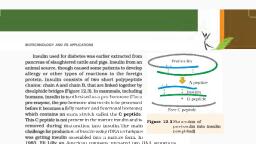
OTECHNOLOGYAND ITS APPLICATIONS, , 673, , B1IOTE, , Evamples, , tobacco, transgenic plants, (tubers), sugarcane (stems) and maize, , of such, , leaves), p o t a t o, , are, , formed of 21 amino acid residue, while B-chain is formed, of 30 amino acid residue. The A-chain had an N-terminal, , Glycine (GLY) and a C-terminal Asparagine (Asn), while, , (endospermn)., , the B-chain has an N-terminal Phenylalanine (Phe) and, , A. EDIBLE VACCINES, , Vaccines of common, I cultures, , use are, , usually produced by, , Such vaccines contain weakened, , or animals., , a C-terminal Alanine (Ala). Two disulfide bonds (-S-S-, , present between two chains lie between cysteine amino, , can bear cheaper, ei inactivated pathogens. Crop plants, or, which, can be utilised as, areactors to produce antigens, edible vaccines., , of these, Even tissues, , transgenic plants can be eaten, , raw, , plants are :, (a) No storage problem., b) Easy delivery system by feeding., as compared to recombinant, ( Cheap alternative, bacterial fermentation., vaccines produced by, several pathogens have been, Antigens from, banana and tomato, such antigenic, expressed in plants. In, banana and, proteins have been expressed. Transgenic, consumed by patients suffering from, tomato can be, Foot and mouth disease of, cholera and hepatitis B., sugar, animals can be cured by feeding them transgenic, Advantages of such, , acids located at 7th and 20th position of A-chain and, , 7th and 19th position of B-chain, A third disulfide bond, also occurs in the A-chain between cysteine (Cys) amino, , acids at 6th and 11th position (Fig. 12.4)., Both chains of insulin are biosynthesized as a single, chain, proinsulin (Fig. 12.5) in which A, , polypeptide, and B-chains are interlinked by a connecting polypeptide, of 33 amino acids (Fig 12.4 and 12.5)., Its synthesis is controlled by the gene located on the, short arm of chromosome 11. It then undergoes, , proteolytic processing forming insulin., determined, Primary structure of ribonuclease w a s, consists of a, by Hirs, Moore and Stein (1960). Itresidues with single, Lysine, polypeptide chain of 124 amino acid, C-terminus., at, valine, (Val), (Lys) at N-Terminus and, disulfide, are joined by 4 covalent, residue, Eighty cysteine, , linkages., , vaccines can be uséd as, beet. In near future, these, encoding, conventional vaccines. In such cases gene, transferred, then, , ******, , antigen is isolated from pathogen and, , CONNECTING, , *, , PEPTIDE (33 RESIDUES), , (29+3 ARG+1 LYS), , and expressed., B. PRIMARY, , STRUCTURE, , OF, , INSULIN, , COO, GLY, , sequence, , amino acid,, The first protein whose, determined, was, forming its primary structure was, is formed, insulin (Frederick Sanger, 1954). This protein, interlinked, chains-A-and B-chain,, oftwo polypeptide, 12.4). A-chain is, bonds, , A-CHAIN, , (21 aa), , NH3, , ALA, , PHE, DISULPHIDE, , LINKAGES-, , (Fig., , covalently by two disulfide, , ASN, , B-CHAIN, , (30 aa), , S, , S, 7, , 20, , 21, , Gly, , Asn, , Gly, , Gly, , A-Chaln, , Cys, , B-Chaln, , Leu, , Phe, , Fig., , Cys, 19, , Cys, 7, , 12.4. Primary, , structure, , Gly, 20, , of human insulin (Diagrammatic)., , Ala, 30
Page 6 :
MODERNS, nEPNS ats, a OF, , 674, , e7,7, , LEACHAIN, , VAL, ASCOOH, , (o19 20, , VAL) BCHAIM, , u, , 2, , CONNECTING, ALA, PEPTIDE, , (H1sS), , 11, , 12 1, 1 6 17, , 18 1, , 20 21, , 22, , Fig. 12.5. Structure of Proinsulin., , Genetically engineered insulin, , Sharpy-Shafer suggested that diabetes occurs due to, , Insulin is a proteinaceous hormone secreted by B-cells, of Islets of Langerhans., ATG, , TGA ATG, , SYNTHETIC A CHAIN, GENE (63 NUCLEOTIDES), , TGA, , SYNTHETIC BCHAIN, GENE (90 NUCLEOTIDES), B GAL, GENE, , pBR 322 WITH E. COLI, , failure of some islands of pancreas to secrete insulin., Earlier insulin required for diabetes was, extracted, from pancreas of slaughtered cattle and pigs. The process, , was quite tiresome and difficult and yields of insulin, , would be low. In some patients it developed allergy, or, other side effects to foreign protein. In 1983 Eli Lilly, an, American Company prepared two DNA, sequences for, A and B chains of human insulin and introduced, them, in plasmids of E. coli. This led to, production of insulin, , chains., Eli Lilly has started selling humulin since 5th July, , pGALGENE, , ATG, , ATG, , 1983. Eli Lilly and Ranbaxy launched a new insulin, project namely humalog (an analog of 5, 6 human, insulin), which is more expensive than human insulin, , products. Humalog is absorbed within 10-15 minutesas, , AGT, , against 30-60 minutes, , of other insulin, C. GENE THERAPY, , AGT, , TRANSFORME.COL, FUSION PROTEINS, , Gene, , PRODUCED, M, , TMET, B GAL, , SEQUENCE, , MET-, , ACHAIN, , BCHAN, , In, - MET, , immuno deficiency). SCID occurs due to defect in the, , A CHAIN, , B CHAINJ, , Fig., , Strategy, , used for, , synthesis, , DNA segment., , therapy, hereditary diseases like sickie, , cell anaemia to killer diseases like SCID (Severe combined, INSULIN, , 12.6., , non-functional gene., Under gene, , BCHAIN, , -s, , gene therapy normal genes are inserted into individual, , Or embryo to take over the function and compensate for, , CYANOGEN, BROMIDE, , A CHAIN, , therapy is humans, is to replace 'a faulty genea, by, a normal healthy functional gene. Gene therapy is, collection of methods which ermits the correction of a, gene defect which has been diagnosed in a child/embryo., , CLEAVE MET, RESIDUE WITH, , MERd, , products., , of insulin from cloned, , gene for enzyme adenosine deaminase (ADA). Sucn, , patients bear non-functional T-lymphocytes. As a resul, they fail to mount immune responses against attack, pathogens. The first clinical gene therapy was gve, , a 4 year girl in 1990 with ADA deficiency. The ideal
Page 7 :
CHNOLOGY AND ITS APPLICATIONS, BOTEG, , 675, , NORMAL, ALLELE, , NORMAL ALLELE INTRODUCED, INTO RETROVIRUSs, , RETROVIRus, , RETROVIRUS, , INFECTS LYMPHOCYTE, , EXTRACTED FROM BONE MARROW OF, THE PATIENT AND CULTURED, , LYMPHOCYTE, , .RETROVIRUS FORMs A DNA COPY OF ITS RNA,, THIS DNA CARRYING THE NORMAL ALLELE, INSERTS INTO CHROMOSOME OF HOST CELL, , BONE, ENGINEERED, , CELLS REINJECTED, BONE, , INTO PATIENTS BONE MARROW, , MARROWV, , Fig., , 12.7. Gene, , therapy, , is to provide functional, approach, The defect is caused, ADA which breaks down toxins., It is cured in, due to deletion of gene for ADA synthesis., children by two methods:, , for SCID, , patient, , of SCID., 11. Liver cancer, , 7. Atherosclerosis, , treatment, , ) Bone marrow transplantation., , i) Enzyme replacement therapy., disease is not, However by applying above methods,, completely cured., cells are, kind of white blood, SCID sufferer. A good, extracted from bone m a r r o w of a, is introduced, human gene encoding this enzyme, of, copy, in which, by gene therapy outside, into such cells. This is done, culture, in, lymphocytes from blood are grown, , Lymphocytes,, , in, , a, , retroviral, , a, the body. A functional ADA cDNA (using, are, reinjected, introduced into such cells. They, , vector) is, , 12. Lung cancer, , 8. Haemophilia, , engineered lymphocytes., mmortal. But, , if, , a, , introduced into bone, better gene is, a, , permanent, , early embryonic stage,, cure can be achieved., considered, that are being, trials of diseases, marrow, , cells at, , an, , Clinical, , for using somatic gene therapPy, , D. MOLECULAR DIAGNOSIS, , knowing, For any disease, an early diagnosis by, is, required., etc.,, symptoms, pathophysiolo8y some, techniques like, and, Recombinant DNA molecules, Polymerase Chain, , Reactions have proved very rewarding, , has already been discussed, in this regard. PCR technique, linked immunosorbant, in Chapter 11. In ELISA (Enzyme, a r e expressed to produce, assay) cloned genes, sensitive, help in developing, recombinant, , proteins, diagnostic techniques., , ENZYME-LINKED IMMUNOSORBENT ASSAY, , (ELISA), Introduction., , detection of, , viruses,, , technique is widely used for, , fungi,, , the, , bacteria, mycoplasmas-like, and, , It, , needs very small amount of reagents., etc. It, the infectious diseases like tuberculosis, AIDS,, two groups of workers--Engvall, was first developed by, and Schuurs in 1971., Weeman, and, Perlamann,, , Vollar et. al (1976) and Clark and Adams (1977) used, ELISA for the detection of virus infection. In India, Usha, , SCID, Breast, , Elisa, , sensitive and specific test,, organisms, etc. It is a very, is used to detect, , and, , 4. AIDS, , 1. Colon cancer, 5., 2. Cystic fibrosis, leukaemia 6., 3. Acute myeloid, , 14. Sickle cell anaemia, , 10. Leukaemia, , into SCID sufferers., , infusion of genetically, Usually patients need regular, are not, Because such cells, , 13. Osteoporesis, , 9. Hypercholestromia, , cancer
Page 8 :
MODERN'S abc OF BIOLOGY, , 676, , eg. for Tuberculosis:, , it for detection of, infection. More several modifications of original ELISA, M., , Joshi of Mumbai also used, , virus, , IfELISA reader vaue 350 sero unit/mi., , =, , If<200 sero unit/ml = -, , are known., , ve, , Ifbetween 200-350 sero unit/ml, , Principle and General procedure (Fig. 12.9). ELISA, , =, , is based on the ability of low molecular weight antibodies, to couple with enzymes, to produce enzymatically active, immunological conjugates. This allows the detection of, immune reaction with histochemical staining techniques, because the antibody component is involved in immune, reaction and the conjugated enzyme can be used for, staining reaction using appropriate substrate. It can be, used to detect antigen as well as antibodies in the serum, of patient., , +ve, , ivocal., , SERUM OF, , PATIENT, , In ELISA technique, a, polystryrene or polyvinyl, chloride microtitre plate is used, which has wells to, provide a solid phase for immune reaction. It involves the, , IMMOBILISED ANTIGENN, , ANTIHUMAN IMMUNOGLOBULIN, , following steps (for the detection of specific antigens):, (a) ELISA-wells of polystyrene or polyvinyl chloride, , COUPLED TO, ENZYME PEROXIDASE, , microtitre are coated with antibodies., , (b) Patient's serum is added to the wells and, incubated at 37°C for a specific period of time., , Antigen-, , antibody complexes are formed at the bottom of wells., Excess of serum is washed by, repeated washing of wells., , CHROMAToGEN, (H,O2 +4-CHLORONAPTHOL), , (cNow enzyme-linked antigen to be detected is added, the wells and incubated at 37°C for a, specific period., The enzyme being labelled, gets attached to, to, , Antigen, , antibody complex. Excess of enzyme is again washed, away by repeated washings., , POSITIVE: IF PURPLE COLOUR DEVELOPS, , (d) Now substrate is added to the wells and incubated, at 37°C for a, specific period of time. Enzyme reacts with, the substrate to form, particular colour complex., (e) Reaction is stopped with a, provided solution of, , PATIENT A, , sulphuric acid., , () Reading is taken with an ELISA reader, , PATIENT B, , NEGATIVE, , (Fig. 12.8)., , Fig., , 12.9., , PATIENT C, , POSITIVE, , Enzyme-linked, , immunosorbent assay (ELISA)., , E. DNA PROBES, , DNA, , probe is a small DNA segment (20-50 bases, long) that recognize complementary sequence in DNA, molecule and thus, allow identification and, isolation, , of, , specific, , DNA sequence from an, organism., Uses of DNA, probes, 1. They are used in, genetic engineering. For, identification of recombinant clone, carrying desired, , WELLS OF, , ELISA, , Fig. 12.8. ELISA reader., , (g)In this way, a number of readings are taken and, by comparing them with a set of standard reading,, inference can be concluded., , DNA insert., 2., , They are frequently used for variety of, including diagnosis of infectious diseases, purposes, , of food, , test., 3., , identificatio, contaminants, variety of microbial tests,, forensie, , Probes, , can, , also be used to, of crop, , organism e.g., varieties, 4., , identify strains of arn, , species., , Development of RFLP maps.
Page 10 :
678, , MODERN'S abc OF BIOLOGY-X, is used to, , -, , 3. PCR technique, suspected cancer patients., , APPLICATION OF MOLECULAR DIAGNOSIS, , .Very, , low concentration, , of bacteria or, , virus, , pathogen) at the time, when symptoms of disease are, not visible can be detected by amplification of their, , nucleic acids, , by Polymerase, , Chain Reaction, , 2. PCR technique is being widely used to detect HIV, in, , suspected, , AIDS, , patients., , mutatione, , n, , 4. Cloned genes are used as probes to, detect.the, presence of its complementary DNA strands, 5., , (PCR)., , detect, , ELISA, , technique is widely used to detect virusee, , fungi, bacteria, mycoplasma like organisms., 6., , ELISA test is also used, , to, , tuberculosis, AIDS etc., , Ises,, , diagnose diseases like, , PRACTICE PROBLEMS- BIOTECHNOLOGY, 1. Name the two human diseases caused, 2. What are DNA vaccines ?, , by the absence of a protein,, , 3. Why is sickle cell anaemia called 'molecular disease' ? How can sickle cell haemoglobin be identified ?, 4., , What are the genetic engineering strategies to create the following traits in transgenic crops:, , (a) Herbicide tolerance, (c) Insect resistance, , (b) Abiotic stress tolerance, (d) Virus resistance, , 5. The Agrobacterium is considered 'Natural Genetic Engineer of Plants'. Comment., 6. What is meant by 'Golden Rice' ? In what way it is different from normal rice?, , 7. What is second green revolution?, 8. What is, , embryonic stem cell technology?, ANSWERS TO PRACTICE PROBLEMS, , 1., , Thalassaemia (Absence of, , B-chain of Hb), , and SCID, , (Absence, , 2. Genetically engineered vaccines., , of enzyme adenosine, , deaminase)., , 3. Sickle cell anaemia involves, , change in the molecular structure of haemoglobin. In this disease, red blood cells bear the, shape of a sickle. Protein finger printing technique can be used to identify the disease., 4. (a) Over production of, target enzyme (usually in the chloroplast) in plant, so that it becomes insensitive to herbicide)., (b) Production of transgenic plants which over express the, genes for one or more stress related osmolytes like sugars («g,, trehalose and fructans), sugar alcohols (e.g., mannitol), amino acids (eg, proline, glycine) and, proteins (eg, antifreeze, proteins)., (c) Production of transgenic crops with introduction of pest resistant, genes into cropS., (d) Utilization of genes from viruses itself eg., viral coat, protein gene., , 5. Agrobacterium is called genetic engineer of plants since these bacteria have natural ability to transfer T-DNA of their, , plasmids into plant genome upon infection of cells at wound site and cause an unorganised growth of cell mass called, crown gall., 6. Prof. Ingo Potrykus and Dr. Peter Beyer developed genetically engineered rice called Golden rice which is enriched m, , Vitamin A by introducing three genes involved in biosynthetic pathway for carotenoid, the precursor of Vitamin A. The, colour of golden rice is yellow due to, synthesis of pro-vitamin A in entire grain., , 7. With the help of latest genetic engineering techniques, foreign desired genes are inserted into cell and tissue culture, , systems to form genetically modified (GM) or transgenic crops. This all has led to second green revolution., 8. Itis the technology of producing transgenic animals, chimeric mice and different specialised cells by using embryonic stem, , cells (inner cell mass) of blastocyst., , ETHICAL IsSUES, Certain acts are regulated by communities to consider, their ligitimacy. Such regulations are called ethics. Some, ethical issues are as under:, , (ii) Technical know how., (iv) New designing concept., , Biopatents are being granted by the Government for, biological entities and products derived from them., , 1. BIOPATENT, , Countries like USA, Japan, members of European Union, , Government grants the patent to certain inventors as, , are granting biopatents., , permission to use invention for commercial purpose., Patent is given to, i) For producing new product or invention., , (ii) Modified and improved earlier invention., , Biopatents are givern to:, ) For discovery of new strains of micro, , organisms., i ) Transgenic (genetically modified) plants ana, , animals.
Page 11 :
ANOLOGY AND ITS APPLICATIONS, , BIOTECH, , Gii) Discovery of cell lines., v) New, , 679, , biotechnological methods., ()Unearthing the DNA sequences., , B1ological resources or bioresources include the, organisms which are used to derive, commercial benefits., , (uProteins formed by various DNA, sequences., (vii Formation of new products., (vii) New production techniques., (i) For product applications., Biopatents help in economic, for individual, inyolved and country concerned.growth, Biopatents are being, done due to their ethical and political values, also., Biopatents sometimes become 'absurd' and, causing if they are done in broad sense eg., a problem, of'All trasnsgenic plants of Brassica family willbiopatent, monopoly to few powertul corporates only. Thisprovide, type of, is, , Example, for, , thousands of years neem is, being used in India for, killing pests and as medicine. One, of, companies patented neem. As a result, the American, any body using, neem, , wil have to, pay for it. This was called as, legalised, Biopiracy, permits the piracy of gene resources, and, knowledge from non-western countries. Such piracy, was, , theft., , claimed by them, , heritage of seeds or, by patent. It is a type of, legalised stealing. Patents (basic, intellectual, property rights or IPRs) were meaning, shared between, freely, everybody who required them. But after getting a, one will have, patent,, to buy it to use it, Even those, legally., communities will have, , normally unacceptable and may effect the, research in the fields like plant breeding and, agriculture., 2. BIOETHICS, acts, , to, , are, , are, , being adopted in the fields, , recombinant, , DNA, , technology, , studies., , Bioethical, , concerns, , () For the, , production, , like, , proteins many, factory., , and, , related to, , animals, , of, , Unexpected, , pharmaceutical, , i) Animals undergo great, , reduced, , to, , agriculture is needed, feed the world. The, of, tightening corporate monopoly, on food, by patenting the seeds may cause famine. It also, diverts the various countries to, successful, , are, , implementation of sustainable, organic agriculture which, food security and better health for all., Gurdial Nijar presented his views at, court, , can ensure, , physical sufferings while, , or, , (1998) by saying that indigenous knowledge, has fed, clothed and healed the world, for millinea. The, concept of patenting is unethical for third world., , It denies the, , vice-, , farmers, , Biotechnological studies have been considered, as mere, exploitation of living beings., , cummulative innovative genius of, , the several, , generations., , BIOPIRACY, , 1. Adalberto, , (vi) Biodiversity may be affected due to, , biotechnological experiments, thus posing a threat to, environment., , Validity of above concerns should be evaluated by, , impartial decision that, , whether these activities should be carried or not ?, , Antonio, Judge of State of Amazoans, points out that Harry Wickham took about 70,000 seeds, on behalf of Kew Gardens, Britain. This, only act plunged, the State of Amazoans in to starvation for, years, , altogether., , 2. American countries are also opposing the new, , patents on life and to commercialisation of science., 3. Several scientist have called for various, , 3. BIOPIRACY, , Pirates in general terms were blood thirsty. They, stole and killed others to enrich themselves. The, , Diopirates are slightly different. They do not kill, they, , completely protected by, , over, , sOME INTERESTING ASPECTS OF, , (v), , each community and to take the, , Superior, , in Brasilia, , versa., , are, , learned it,, , to, , the status of, , introduction of hunman genes to various animals, , They, , pay for it, who had, , through each generation., , Open University,, , performing experiments on them., (iii) There is violation of 'integrity of, species' due, to, transferring of a transgene from one species to another., (iv) 'Concept of humanness' is diluted due to, , patent., , passed, , down, , (1999) is of the view that transgenic, , pharmaceutical products, , are, , was, , Traditional knowledge of bioresources used, by, communities residing in remote areas is, being, exploited, to, develop modern commercial methods. For example,, use of herbs etc., as, drugs., Mae-Wan Ho biologist from, UK, , of biology like, , biotechnology, , it, , as, , regulated by communities to, consider their legitimacy. Such regulationis called ethics., Bioethics include standards followed by us to, regulate, the activities linked with biological activities., methods, , invention., , knowledge, , biopatent, , Certain, , as, , This means, that once, free, can be, protected, , law. As, , a, , result, no body hunts them. Such practices are beingg, , employed by corporations and different Governments., , Scientists go and collect various genetic materials like, seed etc., from country like India or Amazon., , Governments to, , improve, , a, , moratorium, , on global, , releases of transgenic crops and to ban patents on, living, , organisms., , There were more than 2,00,000 varieties of rice in, India alone thousands of years back., India is, considered one of the most richest countries for, various varieties of rice. In India for, special aroma
Page 12 :
MODERN'S, , | 680, , (o) Tissue culture. These methodsare, , and flavour 27 identified varieties of Basmati are, , available. This varieties in grown in India for, centuries. Inspite of all this an American company, in 1997, , succeeding in getting the biopatent mark, from US Patent and Trademark office. The, company,, , thereby, got the permission to sell a new variety of, Basmati. This variety was developed from Indian, local Basmati varieties. Indian basmati was cross, , breeded with semi-dwarf varieties of rice and claimed, as new invention., , the, , (a) Foods. The important foods employing micro-, , mutations and resistance., , ically impr, , (g) Genetic engineering.It is also called, , DNA technology and brings about, genetic make up of an organism., , microbial action., , (e), , Sewage treatment. Different types of bacteria,, fungi and algae also take part in removal of organic, (, , sewage., , Bio-gas(Gobargas).It produced, , is, by fermentation, of cow dung, farm, refuge, garbage etc., by methane bacteria, in anaerobic conditions. The, remains of, , organic, , plant can be used as manure., , biogas, , (g Bio-fertilizers. These are nitrogen fixing microorganisms which are found either in the soil or associated, with the plants. The biofertilizers are, likely to reduce the, need of chemical fertilizers., , (h) Organic acids like lactic, gluconic, acetic and, citric acid are obtained by, biotechnology., () Enzymes. Enzymes required for industrial and, medicinal use are available for microbial processes., j) Vitamins. Some vitamins like By Bi2 are products, of micro-organisms., , (k) Antibiotics. A number of antibiotics are derived, from the fermentatiorn of organic compounds., , (1) Vaccines. Vaccines are used for providing, immunity against important diseases. Vaccines contain, , are, , recombina, , improvement of, , derivatives, , of, , commonly used as antiertility formulation., , fatsare, , TRANSGENIC ANIMALS, Definition. The organisms (animals ) which have, , Soya, sauce etc., , (b) Dairy products. Dairy products include, yoghurt, curd, cheese, butter etc. Their, preparation, depends, upon, scientific strains of, micro-organisms., (c) Alcoholic beverages. For the, preparation of beer,, wine, whisky etc., d) Non-alcoholic beverages are, produced by curing, of coffee beans and tea leaves, by fermentation due to, , being used fon, forestry, induction, o, , (p) Transplants. Test tube abies and emby, transplant techniques are useful tools for rapid, multiplication and production of genetica, superior varieties., , organisms during their preparation are bread, dosa,, , matter in the, , improvement of agriculture,, , (r) Steroids. These, , APPLICATION OF BIOTECHNOLOGY, , abc OF BIOLOGY-, , had their DNA, an, , extra, , manipulated, , (foreign) gene, , to, , possess and, , are known as, , animals., , Introduction. Conventional, , animal, , express, transgenic, , husbandry, , involves the proper feeding, caring, management, and, breeding methods for the increased production of their, yield which may be in the form of meat, milk, eggs, etc, In animal husbandry, selective breeding aims to, , increase, frequency of desired genes and the desired, phenotype. For many farm animals, the conventional, breeding has already achieved high yielding animals, but by this procedure, it seems that the, productivity, would soon be approaching a plateau. To sustain an, ever, the, , increasing world population, new methods must be, developed to meat this increasing demand for animal, products. Secondly, selective breeding is a painfully, slow process and, especially with, larger animals with, long gestation period, can take many years to establish, desired phenotypic changes., The advent of technology of transgenesis, also, called transfection and its, application to animal, , breeding programmes may greatly increase the speed, , and range of selective, , breeding., , The, , transgenesis, , involves the transfer of desired isolated gene, , or, , gene, , fragments or individual chromosome orchromosomal, fragments, or isolated nuclei from one organism to, another organism., The first recorded examples of the transfer of a, , foreign gene into an animal by recombinant, , technology, , was, , the insertion and, , DNA, , expression of a rat, , modified or inactivated or killed pathogens or their, , gene for growth hormone (rGH) into the mouse, , antigens., , metallo-thionein (mMT) gene in 1882. The subsequent, , (m) Hormones. Insulin, growth hormone and other, hormones are mostly synthesized through the use of, microbes and genetic engineering, (n) Monoclonal antibodies. Antibodies against, pathogens can be obtained from clonal cultures of, , progeny were all much larger than the parents and the, transgenic mouse was called "super mouse" (Fig. 12.11)., , microbes., , Since then, many transgenic animals including cattle,, rabbits, chickens and fish have been, , goats, pigs,, produced (Table 12.2).
Page 13 :
B I O T E C H N O L O G Y, , AND ITS APPLICATIONS-, , Table 12.2. Examples of transgenic animals., Genes transferred, , T r a n s g e n i c animnals, , mMT/GH; mMT/bGH (b=bovine): mMT/oGH (0= ovine;, , 1. Mouse, , mMT/hGHh=human); mMT/hGRF; mMT/hf IX(factor IX), , 3. Cow, , ALV (Avian Leukosis Virus); REV (Raticulo Endotheliosis Virus), BPV (Bovine, , 4. Fish, , hGH; Cd-crystallin(c= chicken); AFP(Anti-Freeze Protein)., , 2. Chickens, , Papilloma Virus);Lactoferin, , hMT/pGH (p porcine); MLV(Moloneymurine Leukemia Virus), , 5.Pig, , rGH; bPRIL (prolactin)/bGH, oglobulin heavy chain )/rb., , hMT/hGH; rbEu (Imn, , 6. Rabbit, , mMT/TK (Thymidine kinase); oMT/ OGH; oBLG (B-Lactoglobulin)/hf IX, , 7. Sheep, , A varient of tPA gene (humarn tissue-type plasminogen activator)., , 8. Goat, all, About 95 % of, , the, , existing transgenic, , animals, , are, , mice., , TRANSFECTION, WITHTARGETING, VECTOR, , ES CELLS, , WITH A RARE, EMBRYO DERIVEDD, CELL, STEM (ES) CELLS TARGETED, , PURE POPULATION, OF TARGETED ES CELLS, , CROSS, BREED, TRANSGENIC AND, TRANSGENIC, , NORMAL MICE, , MOUSE, , TO STUDY, INHERITANCE, , INJECTION OF, , ES CELLS INTO, , TRANSPLANTATION, , 3LASTOCYST, , NORMAL MOUSE, , SURROGATE MOTHER, , stem cells., Fig. 12.11. Gene targeting using embryonic, , and drugs from the milk, food and urine of transgenic, , MECHANISM OF TRANSGENESIS, Transgenesis, 1.Transfer, , involved, , a, , number, , animals which may be used as bioreactors e.g., , of methods like, , ofwhole nucleus from a, , somatic cell of, , a, , animal., superior donor into the enucleated egg of recipient, the, 2. Transfer of a part of dissected embryo into, , enucleated unfertilized egg., 3. Transfer of a chromosome or chromosomal, , tragments., 4. DNA microinjection technique., 5. Gene targeting using embryonic stem cells., Frequency of success of transgenesis, cattle have been, Now the transgenic pigs, sheep and, is only about, success, produced, although the frequency of, T7%, , successful fish, to 2-5% in mice while, as 70 %., can be as, , compared, , transgenics, , high, , Significance of transgenesis, , farming., 1. Role of transgenesis in, useful, of, extraction, proteins, Molecular farming involves the, molecular, , were, i) Transgenic goats with LAtPA protein, acid promotor, producedby microinjecting murine whey, , c-DNA with LAtPA protein coding, dissolves the blood clot and is, gene. The LAtPA protein, useful for treating coronary thrombosis., , (WAP) carrying, , a, , (ii) Transgenic sheep with human antihaemophillic, factor IX gene was produced with the help of BLG-gene, (B-Lactoglobulin gene), which acts as vector gene, , Transgenic ewes, , secrete human factor, , IX in their milk., , (ii) Transgenicsheep having humana, antitrypsin, , gene (ho, AT) was produced with the help of ovine B, , lactoglobulin gene promotor. Transgenic ewes produce, ho, AT protein in their milk and can be used against the, , emphysema., Thus by transgenesis the animals are genetically, modified in such a way that they start acting bioreactors
Page 14 :
MODERN'S abc OF BIOLOGY, , 682, producing useful products, , in abundance and, , continously., , 2. Study of diseases and gene therapy. Many, the following, transgenic animals help us to understand, facts:, of, (i) How do genes contribute to the development, , disease?, ii) These, cancer,, , act, , as, , cystic fibrosis,, , like, models for human diseases, rheumatoid arthritis, Alzheimer's, their, new methods of, , disease, etc, and their, treatment., , extensively for detecting the cancer, In these, genes (oncogenes) and their gene therapy., naked, retroviruses, adeno- associated virus (AAVs) and, have been used, , DNA have been used as vectors and gene therapy., (iv) In 1991, the transgenic cow with a bovine alphaSI casein promotor driving a c-DNA was produced., This foreign gene encodes for the lactoferrin (a ironbinding protein) which has the antibacterial properties., , 3. Increased production of biological products, G) Transgenic sheep with genes like cysE and cys M, , with, , milk of transgenic cow contained about 24, human protein per itre of milk and was found t, , grams of, , nutritionally balanced product for human, , abies, than that of natural cow milk. Such human milk, proteins can be extracted and used pharmaceuticall, , more, , 4. For study of normal physiology and development, Transgenic animals have been successfully utilized to, understand:, , possible, , Transfections of cultured mammalian cells, , (iii), , Gii) In 1997, first transgenic cow,named Rosie, human alpha-lactalbumin gerne was produced, , G) Mechanism of regulation of genes., , i) Mode of effects of gernes on the normal functions, , of the body and its development eg. study of biological, role of insulin-like growth factor in regulating the body's, , growth., 5. Vaccine safety testing. Transgenic mice are first, to be used as laboratory animals to test the efficacv of, a newly discovered vaccine betore it is used on human, , beings e.g. polio vaccine. If such vaccines are found, satisfactory and reliable on mice, then these are tested, on, , the, , monkeys much closely related, , to, , man., , 6. Chemical safety testing. For this transgenic, , animals with foreign genes are produced so that the, , (coding for two enzymes -serine acetyl transferase and, 0-acetyl serine sulphhydrylase) have been produced. In, , transgenic animals become more sensitive to the toxic, chemicals of them, thenon-transgenic animals. Then these, animals are exposed to toxic chemicals arnd their effects, , non-transgenic sheep because these two, of the amino, enzymes are essential for the biosynthesis, , are observed. The time required to obtain the results, , the transgenic sheep, wool production was found to much, , more, , than the, , acids involved in the formation of wool., , ii) In 1985, the transgenic fishes of many species like, rainbow, common carp, catfish, goldfish, salmon, Tilapia,, trout and zebra fish have been produced by microinjection, , coding for rat or human growth hormone, (rGH or hGH). It was found that transgenic fish with, hGH gene was found to be twice in size than the nontransgenic fish., , of genes, , is less., So contrary to some popular view points, transgenic, animal studies are not about producing animal monsters, , but rather introducing specific and economically, , significant traits into livestock that will have benefits to, mankind. These encouraging results have made, transfection and production of transgenic animals a, , fascinating, , thrust of research., , SUMMARY OF ANTICIPATED CHANGES INVOLVING TRANSGENIC ANIMALS, Efficiency of meat production., , Improved quality of meat., Milk quality and quantity., , Egg production., Wool quality and quarntity., Disease resistance in animals., , Production of low cost pharmaceuticals and biologicals., Study of normal physiology and development., , Nucleus with, , only residual plasma membrane., , Karyoplast:, Transformation:, Uptake of genes by the cells of bacteria or other microbes and causing phenotyple, changes, , into the, , recipient, , cells., , target, B-globin gene from one person to another person by, Oliver Smithies: (1985), gene transfer technique., Produced transgenic goats with LAtPA gene., John McPherson and Karl Ebert:, with human antihaemophillic factor IX gene., J.P. Simmons (1988): Produced transgenic sheep, Alan Colman et.al.(1999): Produce transgenic sheep having ha,AT genes., First to transfer