Page 1 :
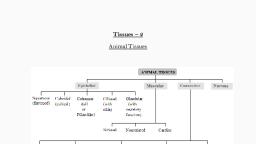
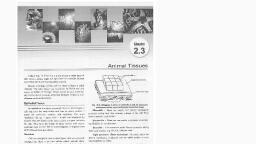
Animal Tissues
Page 2 :
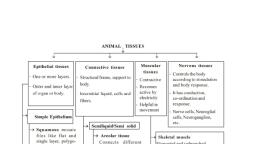
I. Generalizations, A. Definition, , B. Four general categories of animal tissue, 1. epithelial, 2. muscle, 3. nerve, 4. connective
Page 3 :
II. Epithelial tissue A. General Traits or characteristics, 1. found on a body surface either internal or external, 2. tightly packed cells, 3. free border or free surface, 4. rest on a basement membrane, 5. nonvascular
Page 4 :
B. Naming or classifying epithelial tissue, First Name, a. Simple, b. Stratified, c. Pseudostratified, , Second name, a. Cuboidal, b. Squamous, c. Columnar
Page 6 :
D. Specific examples, 1. stratified squamous, a. Location, b. function
Page 7 :
Examples continued, 2. transitional, a. Location, b. Function
Page 8 :
Examples continued, 3. simple cuboidal, a. Location, b. function
Page 9 :
III. Muscle tissue, A. General traits, 1. excitable tissue, , 2. can shorten
Page 10 :
B. Types of muscle tissue, 1. skeletal muscle, a. multinucleate, b. voluntary, c. striated
Page 11 :
2. Smooth muscle, a. Involuntary, b. Visceral, c. structure
Page 12 :
3. Cardiac muscle-mixture of two, a. One nucleus/cell, b. Autorythmic, c. Striated, d. Intercalated disc
Page 13 :
IV. Nervous tissue, A. General Traits, 1. Irritable, 2. Conductive
Page 14 :
B. Two cell types, 1. neurons, a. Cell body, b. Axon, c. Dendrite, , 2. Glia cells (caretakers)
Page 15 :
V. Connective Tissues, A. Common traits, 1. possess fibers, 2. widely scattered cells, 3. ground tissue (matrix), 4. analogy
Page 16 :
B. Areolar Connective Tissue-loose irregular
Page 17 :
C. Tendon-dense regular
Page 18 :
D. Ligament
Page 19 :
E. Bone
Page 20 :
F. Blood
Page 21 :
G. Adipose tissue
Page 22 :
VI. Membranes, A. Cutaneous, B. Mucous, 1. contain glands, 2. open to outside, Serous, 1. occur in paired sheets, 2. don’t open to outside, 3. no glandular tissue