Page 1 :
| Biodiversity and Conservation, , , , , , , , * Biodiversity. The term biodiversity is used to describe diversity at all levels of, biological organisation., — Biosphere reserves. Refers to protected area of land and/or coastal environme, having unique biodiversity., \ Cryopreservation. A method of storage of live materials at ultra low temperature, i.e., in liquid nitrogen (at ~ 196°C),, * Ecological/Ecosystem diversity. The variety in the types of ecosystem., «- Endemism. Refer to the occurrence of species to a particular region and not found, , nt, , anywhere else,, + Exotic/Alien species. Species which are introduced into an ecosystem to which they, , are not native., Gene banks. Institutes which maintain stock of viable seeds, live plants, tissue, , culture and frozen germ plasm with the whole range of genetic variability., ¢ Genetic diversity. The diversity of genes within a species., Hot spots. Regions with very high levels of species richness and high degree of, , endemism., IUCN. International Union for Conservation of Nature and Natural Resources., , * Offsite collections. Live collections of wild and domesticated species in botanical, , gardens, zoological parks etc., eed data book, Record of threatened species of plants and animals maintained by, , IUCN., + Sacred forests. Forest patches protected by tribal communities, due to religious, , sanctity accorded to these forests., * Speciation. Process of formation of new species., * Species diversity. The variety of species within a region., , we Apecies richness. Number of species per unit area., , 412
Page 2 :
oowersrry AND CONSERVATION, , ae”, , aS, , , , SS ——__, IMP (OTES/CHAPTER A, ORTANT NOTES/CHAPTER AT A GLANCE, «° The term ‘Biodiversity’ was ulnrined ty thy eee, describe ‘the combined diversi, , Sociobiologist Edward Wilson to, ‘ i it 5 : ., 6 Diversity exists at all lo Y at all the levels of biological organisation’., , vels i ‘ ¢, ae elle to Metans of biological organisation ranging from macromolecules, , . i most important level, iodi, and ecological diversity, ae, , (i) Genetic diversity, — Genetic diversity ;, : is th iati i, Pestics, og y ie variations in the genes and their alleles in the same, —The medicinal i, nbes ean Rauwolfia vomitoria growing in different Himalayan, Bilis chemicet variation in terms of potency and concentration of the, hare ical (reserpine) that the plant produces, _ are more th, i i ; i, . {ae 50,000 genetically different strains of rice, and 1,000, (ii) Species diversity, —It is the variation in the numb:, , The Western Ghats h, Eastern Ghats., , (iii) Ecological diversity, , —It is the variety in the types of ecosystems in a region, ¢.g., — India with its deserts, rain forests, mangroves, coral reefs, wetlands, estuaries, , and alpine meadows has a greater ecosystem diversity than a Scandinavian, country like Norway., , * It has taken millions of years of evolution to develop this rich diversity in nature., , ¢ We could lose all that wealth in less than two centuries, if the present rates of species, losses continue., , versity are: Genotic diversity, specion diversity, , er and richness of the species of a region, e.g., , GLOBAL BIODIVERSITY (Fig. 15.1), , , , , , , , , , , , Invertebrates Vertebrates Plants, , , , , , , , , , , , , , , , Other animal groups ae Mossas Forme and, allies, , , , Amphibians Algae Lichens, , odiversity proportionate number of species, invertebrates and vertebrates, , umber of plant and animal species described so, , Fig. 15.1. Representing global bi, of major taxa of plants,, , e According to IUCN (2004), the total n, far is slightly more than 1,5 million., , ave a greater amphibian species diversity than the
Page 3 :
414 BIOLOGY— x),, © We have no clear idea about the total number of species that exist on Earth. |, A conservative and scientifically sound estimate has been made by Robert May, put,, the global species diversity at about 7 million., ¢ More than 70 per cent of all the species recorded are animals, while plants (including, algae, fungi, bryophytes, gymnosperms and angiosperms) account for about 22 poy, , cent,, « Among animals, more than 70 per cent are insects., ¢ Biologists are not sure about the number of prokaryotic species due to following, reasons., (i) The conventional taxonomic methods are not suitable for identifying microbja}, species., (ii) Many of the prokaryotic species cannot be cultured in labo, * If we accept biochemical or molecular criteria for deciding a species, their number, , might run into millions., , Biodiversity in India, « India has only 2.4 per cent of the world’s land area, but has 8.1 per cent global species, , ratory conditions, , biodiversity., e Hence, India is one of the 12 mega diversity countries of the world., In India there are about 45000 species of plants and twice as many of animals; many, more species are yet to be discovered and named., « If we apply Robert May’s global estimates, then only 22 per cent of the total species, have been recorded so far., There are probably more than 1,00,000 plant species and more than 3,00,000 animal, , species yet to be discovered and described., , Patterns of Biodiversity, * Biodiversity is not uniform throughout the world but varies with change in latitude, , and altitude., , Latitudinal Gradients, ¢ In general, species diversity decreases as we move away from the equator towards, , the poles., With very few exceptions, tropics (latitudal range of 23.5°N to 23.5°S) harbour more, , species than temperate or polar areas., , Colombia located near the equator has nearly 14,000 species of birds while New York, at 41°N has 105 species and Greenland at 71°N only 56 species., , India, with much of its land area in the tropical latitudes, has more than 1,200 species, of birds., , A forest in a tropical region like Equator has up to 10 times as many species of, vascular plants as a forest of equal area in a temperate region like the Midwest of the, USA., , The Amazonian rain forest in South America has the greatest biodiversity on earth;, it harbours about 40,000 species of plants, 1,25,000 species of insects, 3,000 of fishes,, 1,300 of birds, 427 of mammals, 427 of amphibians, 378 of reptiles and more than, , 1,25,000 of invertibrates., , sr
Page 4 :
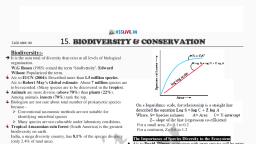
potheses fi, Evolutionary babe sr Biodiversity in the Tropical Are, in the tropical regions: AVE Proposed followin, aa Me, . # hypotheses to explain higher biodiversity, , oe at Seen But species mutant nt glaciations in the past, which killed, - the tropical regions to flourish and evolve undisturbed for, Ggre Solar énecey | , a8 no such distur:, Deeauetivity and ey is available in the tropi iehe pesorra Shorey, i, fee Neiverty in the tropics Topics, which contributes to higher, specialisation and lead too ne Constant and ’ i, _ badin - es Srtater snecian Ace oe which promote niche, —« German naturalist, hijaclae Smadar e Alexander Von Humboldt observed that within a, aga cen ie sed with increasing explored area, but only upto a limit., Ts bats tect i richness and area for a wide variety of taxa (angiosperm, plants water fishes) is found to be a rectangulal ppl ie. 15.2), , Species richness ——>, , , , ¥ Area ——>, ‘Showing species area relationship. Note that on log scale the relationship becomes linear., , ¢ On the logarithmic scale, the relationship is a straight line, and is described by the, equation:, , [ Log S = Log C + ZlogA, , where S = species richness, A = Area,, Z = Slope of the line (regression coefficient), , C = Y-intercept., Value of Z lies in the range of 0.1 to 0.2, regardless of the taxonomic group or the, , region., , e The species area relationship among very large areas like the entire continents has, ‘a much steeper slope of the line (Z values in the range of 0.6 to 1.2)., , ie © The Z value for frugivorous (fruit-eating) birds and mammals in the tropical forests, , i is found to be 1.15., at : ~Umportance of Species Diversity to Ecosystems, ie __e Ecologists believe that communities with more species tend to be more, , those with less species., , stable than
Page 5 :
416 BIOLOGY,, , , , , * Astable community has the follawing attributes., (i) It should not show too much variation in productivity from year to your,, (ii) It muat be either resistant or resilient to sensonal disturbances., (ii) It must also be resistant to invasions by alien species. |, * David Tilman had shown the following features, through his ecological experiry,.,.,, , using outdoor plots., (i) The plots with more species showed less year to year variation in total bion,,,.., , (ii) The plots with increased diversity showed higher productivity., * We now realise that rich biodiversity is not only essential for ecosystem healt), \,,, imparative for the survival of the human race on the Earth., \ Rivet Popper Hypothesis, It was given by Stanford ecologist Paul Ehlrich, to explain the importance of wp..., |, , diversity to the ecosystem., —lIt states that if an aeroplane equivalent to an ecosystem has thousands of r,,,., , equivalent to species., —If each passenger removes a rivet (= species) from the aeroplane, then it may .,,, , effect flight safety initially but over a period of time, it may make the plane danger..., weak., , — Removal of rivets (= species) from a critical part (= species performing major econy st,, functions) like wing will pose an immediate and serious threat to safety of the iy},, , — This analogy is comparable to the functioning of an ecosystem., Loss of Biodiversity, ¢ The colonisation of tropical Pacific Islands by human beings has led to the extincti.:,, of more than two thousand species of native bird:, * The IUCN Red List (2004) document the extinction of 784 species in the Jast 5, years that include 359 invertebrates, 338 vertebrates and 87 plants., + Some of the animals that have become extinct recently include:, (1) Steller’s sea cow (Russia) (it) Dodo (Mauritius), (iii) Thylacine (Australia) (iv) Quagga (Africa), (v) Three sub-species (Bali, Javan, Caspian) of Tiger., +27 species have become extinct in the last twenty years., * More than 15,500 species worldwide are facing threat including 12 per cent of bird, species, 23 per cent of all mammal species, 82 per cent of ai] amphibian species and, , 31 per cent gymnosperm species., « Before humans appeared on Earth, there have been five episodes of ‘mass extinction, (i.e., loss of large number of species in a short time), and ‘Sixth Extinction’ present|,, , in process., » The current rate of species extinction is 100—1,000 times faster than the pre-human, , times and our activities are responsible for the faster rate., » Loss of biodiversity in a region can lead to the following:, (i) Decline in plant production, (ii) Lowered resistance to environmental perturbation., (iii) Increased variability in ecosystem processes like water use, pest/disease cycles,, , plant productivity, etc.