Page 2 :
It is the branch of chemistry, that deals with the study of, nature of surfaces and the, different processes taking, place at the surface., The important surface phenomena are, adsorption, corrosion, electrode process,, heterogeneous catalysis, dissolution etc.
Page 3 :
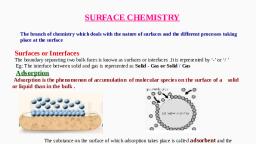
ADSORPTION, It is the process of concentration or accumulation of a, substance on the surface of another substance., The substance which is adsorbed is called adsorbate and, the substance whose surface on which adsorption takes, , place is called adsorbent., The commonly used adsorbents are charcoal, silica gel,, alumina gel, clay, colloids, metals in finely divided state, etc.
Page 4 :
Adsorption is a surface phenomenon. Some examples of, adsorption are:, 1. Powdered charcoal adsorbs gases like H2, O2, CO, Cl2, NH3,, SO2 etc., 2. Silica gel adsorbs moisture., , 3. Animal charcoal adsorbs colouring material from sugar, solutions ., Desorption: The process of removal of an adsorbed substance, from the surface of adsorbent is called desorption. i.e. it is the, , reverse of adsorption.
Page 5 :
Distinction between adsorption and absorption, In adsorption, the substance is concentrated only at the, surface while in absorption, the substance is uniformly, distributed throughout the bulk of the solid., So adsorption is a surface phenomenon while absorption is, a bulk phenomenon., Sorption: If adsorption and absorption occur simultaneously,, the process is called sorption., Mechanism of Adsorption, •The surface particles of the adsorbent are not in the same, environment as the particles inside the bulk (inner part)., •Inside the adsorbent, all the forces are mutually balanced., •But at the surface, there is always some unbalanced or, residual forces., •These forces of the adsorbent are responsible for, adsorption
Page 6 :
Heat of adsorption (Enthalpy of Adsorption), •Adsorption is an exothermic process. i.e. some heat is always, evolved during adsorption., , • The amount of heat evolved when 1 mole of an adsorbate is, adsorbed on the surface of an adsorbent is called heat of adsorption., , Thermodynamic aspects of adsorption, •Adsorption is an exothermic process., •When a gas is adsorbed, the degree of freedom (randomness) of, its molecules decreases and hence the entropy decreases. i.e., ΔS, becomes negative., , •Adsorption is thus accompanied by decrease in enthalpy as well, as decrease in entropy of the system.
Page 7 :
For a process to be spontaneous, ΔG must be negative., On the basis of equation,, ΔG = ΔH – TΔS,, , ΔG can be negative if ΔH >TΔS., As the adsorption proceeds, ΔH becomes less and less negative, ultimately ΔH becomes equal to TΔS and ΔG becomes zero. At, this state equilibrium is attained., Types of adsorption:, Depending on the force of attraction between adsorbent and, , adsorbate, adsorption is of two types –, •physical adsorption or physisorption and, •chemical adsorption or chemisorption .
Page 8 :
Physisorption, 1. It arises because of van der, Waals’ forces., 2. It is not specific in nature., 3. It is reversible in nature., 4. It depends on the nature of gas., More easily liquefiable gases are, adsorbed readily., 5. Enthalpy of adsorption is low (2040 kJ mol–1 )in this case., 6. Low temperature is favourable for, adsorption. It decreases with, increase of temperature., 7. No appreciable activation energy, is needed., 8. It depends on the surface area. It, increases with an increase of, surface area., 9. It results into multimolecular, layers on adsorbent surface, under high pressure., , Chemisorption, 1. It is caused by chemical bond, formation., 2. It is highly specific in nature., 3. It is irreversible., 4. It also depends on the nature of, gas. Gases which can react with, the adsorbent show, chemisorption., 5. Enthalpy of adsorption is high (80240 kJ mol–1) in this case., 6. 6. High temperature is favourable, for adsorption. It increases with, the increase of temperature., 7. High activation energy is, sometimes needed., 8. It also depends on the surface, area. It too increases with an, increase of surface area., 9. It results into unimolecular layer.
Page 9 :
Adsorption Isotherms, An equation or a graph relating the extent of adsorption and, pressure at constant temperature is known as adsorption isotherm., , Freundlich adsorption isotherm:, Freundlich gave an empirical relationship between the quantity of, gas adsorbed by unit mass of solid adsorbent and pressure, at a, particular temperature., The relationship can be expressed by the following equation:, , x/m = k.P1/n (where n > 1), where, •x is the mass of the gas adsorbed,, •m is the mass of the adsorbent,, •k and n are constants which depend on the nature of the adsorbent, and the gas at a particular temperature.
Page 10 :
The relationship can be represented in the form of a graph as follows:, From the graph it is clear that x/m, (extend of adsorption) increases, with pressure upto a certain pressure, called saturation pressure (Ps) and, after that it becomes constant., If we take logarithm of the above, equation, we get, , This equation is of the form y = mx+c, equation for a straight, line., So if we plot log x/m against log P,, we get a straight line, which verifies Freundlich isotherm.
Page 11 :
•Freundlich isotherm explains the behaviour of, adsorption in an approximate manner., •The factor 1/n can have values between 0 and 1, When 1/n = 0, x/m = a constant. i.e. the adsorption is independent of, pressure., When 1/n = 1, x/m = k.p, the adsorption varies linearly with, , pressure., Freundlich adsorption isotherm failed to explain adsorption at very, high pressures.
Page 12 :
Applications of adsorption:, The important applications of adsorption are:, 1. Production of high vacuum: For the complete evacuation of a, , vessel, activated charcoal is used., 2. Gas masks: The poisonous gases in coal mines can be removed, by using gas masks containing activated charcoal., 3. Control of humidity: Silica and aluminium gels are used as, adsorbents for removing moisture and controlling humidity., , 4. Animal charcoal is used for the purification of cane sugar, solution.
Page 13 :
6.Adsorption finds application in heterogeneous catalysis., 7.A mixture of noble gases can be separated by adsorption on, coconut charcoal at different temperatures., 8.In curing diseases: A number of drugs are used to kill germs by, getting adsorbed on them., , 9.In froth floatation process for the purification of sulphide ores, in metallurgy., 10.Adsorption indicators like eosin, fluorescein etc. are used in, volumetric analysis., 11.Chromatographic analysis for the separation of a mixture is, , based on adsorption.
Page 14 :
CATALYSIS, A catalyst is a substance that changes the rate of a chemical, reaction without undergoing any permanent chemical change by, itself., The process of changing the rate of a chemical reaction by a, , catalyst is known as Catalysis., Eg: MnO2 (Manganese dioxide) acts as a catalyst in the, decomposition of KClO3 (Potassium chlorate) ., , 2KClO3 ------->2KCl + 3 O2
Page 15 :
Promoters and poisons:, Promoters are substances that enhance the activity of a catalyst, , while poisons decrease the activity of a catalyst., For example, in Haber’s process for the manufacture of ammonia,, molybdenum (Mo) acts as a promoter for the catalyst iron.
Page 16 :
Homogenous and Heterogeneous Catalysis:, Homogeneous Catalysis: It is a catalytic process in which the, reactants and the catalyst are in the same state., , (i) Oxidation of sulphur dioxide into sulphur trioxide with, dioxygen in the presence of oxides of nitrogen as the catalyst, in the lead chamber process., , The reactants, sulphur dioxide and oxygen, and the catalyst,, nitric oxide, are all in the same phase., (ii) Hydrolysis of methyl acetate is catalysed by H+ ions furnished, by hydrochloric acid.
Page 17 :
(iii) Hydrolysis of sugar is catalysed by H+ ions furnished by, sulphuric acid., , b) Heterogeneous catalysis, The catalytic process in which the reactants and the catalyst are in, different phases is known as heterogeneous catalysis., >>>Some of the examples of heterogeneous catalysis are given, below:, (i) Oxidation of sulphur dioxide into sulphur trioxide in the, presence of Pt.
Page 18 :
(ii) Combination between dinitrogen and dihydrogen to form, ammonia in the presence of finely divided iron in Haber’s process., The reactants are in gaseous state while the catalyst is in the solid, state., (iii) Oxidation of ammonia into nitric oxide in the presence of, platinum gauze in Ostwald’s process., The reactants are in gaseous state while the catalyst is in the solid, state., (iv) Hydrogenation of vegetable oils in the presence of finely, divided nickel as catalyst., , One of the reactants is in liquid state and the other in gaseous state, while the catalyst is in the solid state.
Page 19 :
Adsorption Theory of Heterogeneous Catalysis :, This theory explains the mechanism of heterogeneous catalysis., According to this theory the catalytic activity takes place on the, surface of the catalyst., >The mechanism involves five steps:, (i) Diffusion of reactants to the surface of the catalyst., (ii) Adsorption of reactant molecules on the surface of the, catalyst., (iii) Occurrence of chemical reaction on the catalyst’s surface, through formation of an intermediate., (iv) Desorption of reaction products from the catalyst surface., (v) Diffusion of reaction products away from the catalyst’s, surface.
Page 21 :
Important features of solid catalysts, 1. Activity :The activity is the ability of a catalyst to increase the, rate of a chemical reaction. It depends upon the strength of, chemisorption., • The reactants must get adsorbed reasonably strongly on to, the catalyst to become active. However, they must not get, adsorbed so strongly that they are immobilised and other, reactants are left with no space on the catalyst’s surface for, adsorption., • It has been found that for hydrogenation reaction, the, catalytic activity increases from Group 5 to Group 11, metals with maximum activity being shown by groups 7-9, elements of the periodic table, e.g.: H2 combines with O2 to form H2O in presence of Platinum (Pt), catalyst
Page 22 :
(b) Selectivity:, The selectivity of a catalyst is its ability to direct a reaction, to yield a particular product selectively, when under the same, reaction conditions many products are possible., Selectivity of different catalysts for same reactants is different., For example, starting with H2 and CO, and using different, catalysts, we get different products., , Thus, it can be inferred that the action of a catalyst is highly, selective in nature. As a result a substance which acts as a, catalyst in one reaction may fail to catalyse another reaction.
Page 23 :
Shape-Selective Catalysis by Zeolites :, The catalytic reaction that depends upon the pore structure of the, catalyst and the size of the reactant and product molecules is called, , shape-selective catalysis., --Zeolites are good shape-selective catalysts because of their, honey comb-like structures. They are microporous, aluminosilicates with three dimensional networks of silicates in, which some silicon atoms are replaced by aluminium atoms., They contain Al–O–Si framework., --The reactions taking place in zeolites depend upon the size, and shape of reactant and product molecules as well as upon the, pores and cavities of the zeolites., They are found in nature as well as prepared artificially.
Page 24 :
•Zeolites are used as catalysts in petrochemical industries for, cracking of hydrocarbons and isomerisation., , •An important zeolite catalyst used in the petroleum industry is, ZSM-5., •It converts alcohols directly into gasoline (petrol) by, dehydrating them to give a mixture of hydrocarbons .
Page 25 :
Enzyme Catalysis, Enzymes are complex nitrogenous organic compounds which are, , produced by living plants and animals., --They are actually protein molecules of high molecular mass., They are very effective catalysts and catalyse numerous, reactions taking place in plants and animals., -- So enzymes are also called biochemical catalysts and the, , phenomenon is known as biochemical catalysis.
Page 26 :
(i) Inversion of cane sugar: The invertase enzyme converts, cane sugar into glucose and fructose., , (ii) Conversion of glucose into ethyl alcohol: The zymase, enzyme converts glucose into ethyl alcohol and carbon, dioxide., , (iii) Conversion of starch into maltose: The diastase, enzyme converts starch into maltose.
Page 27 :
(iv) Conversion of maltose into glucose: The maltase, enzyme converts maltose into glucose., (v) Decomposition of urea into ammonia and carbon dioxide:, The enzyme urease catalyses this decomposition., , (vi) In stomach, the pepsin enzyme converts proteins into, peptides while in intestine, the pancreatic trypsin, converts proteins into amino acids by hydrolysis., (vii) Conversion of milk into curd: It is an enzymatic, reaction brought about by lacto bacilli enzyme present in, curd.
Page 28 :
Characteristics of enzyme catalysis :, The important characteristics of enzyme catalysis are:, , 1. Enzymes are highly specific in nature., 2. Enzyme activity is highly efficient., 3. The enzyme activity is maximum at a particular temperature, called optimum temperature (298- 310K)., 4. The enzyme activity is maximum at a particular pH called, , optimum pH (5-7)., 5. The enzymatic activity is increased in the presence of certain, substances, known as co-enzymes., 6. Enzymes activity is inhibited or poisoned by the presence of, certain substances.
Page 29 :
Mechanism of enzyme catalysis:, There are a number of cavities present on the surface of colloidal, particles of enzymes., , These cavities have characteristic shape and possess active groups, such as -NH2, -COOH, -SH, -OH, etc. These are the active centers, on the surface of enzyme particles., The molecules of the reactant (substrate) fit into these cavities just, like a key fits into a lock. So an activated complex is formed, which, , then decomposes to yield the products., This theory is known as lock and key theory.
Page 30 :
Thus, the enzyme-catalysed reactions may be considered to, proceed in two steps :, Step 1:, The enzyme combines with the substrate to form an activated, complex., E + S → ES*, Step 2:, Decomposition of the activated complex to form product., ES* → E + P
Page 31 :
THE COLLOIDAL STATE, Colloid is an intermediate state between true solution and, suspension. Here the particle size is in between 1 nm and 1000nm., The particles do not settle down under the influence of gravity., , They cannot be filtered by ordinary filter paper, but can be filtered, by ultra filters. They are heterogeneous and translucent., Colloids are heterogeneous systems containing two phases –, dispersed phase and dispersion medium., The substance which is dispersed (distributed) is called dispersed, , phase and the medium in which the particles are dispersed is called, dispersion medium., e.g.: In starch solution, starch is the dispersed phase and water, is the dispersion medium.
Page 32 :
Classification colloids, 1. Based on the physical state of dispersed phase and the, dispersion medium:, Depending upon physical state of the dispersed phase and the, dispersion medium, there are eight types of colloidal systems. A, gas mixed with another gas forms a homogeneous mixture and, hence is not a colloidal system. The different types colloidal, dispersion are:
Page 33 :
2.Based on the attraction between the dispersed phase and the, dispersion medium, colloids are of two types:, Lyophilic (solvent loving) and Lyophobic (solvent hating)., , If the force of attraction between dispersed phase and dispersion, medium is strong, it is called lyophilic sol., e.g. gum, gelatin, starch, rubber etc in suitable dispersion medium., An important characteristic of these sols is that if the dispersion, medium is separated from the dispersed phase (say by evaporation),, the sol can be reconstituted by simply remixing with the dispersion, medium., That is why these sols are also called reversible sols., Furthermore, these sols are quite stable and cannot be easily, coagulated.
Page 34 :
If the force of attraction between dispersed phase and dispersion, medium is weak, it is called lyophobic sol., , e.g. Arsenic sulphide (As2S3) sol, sulpher sol and metal sols like, gold sol, silver sol etc., These sols are readily precipitated (or coagulated) on the addition, of small amounts of electrolytes, by heating or by shaking and, hence, are not stable., , Further, once precipitated, they do not give back the colloidal sol, by simple addition of the dispersion medium. Hence, these sols are, also called irreversible sols., Lyophobic sols need stabilising agents for their preservation.
Page 35 :
3.Based on the nature of particles: Based on this, colloids are of, three types – Multimolecular colloids, Macro molecular colloids, , and Associated colloids., 1. Multimolecular colloids:, They contain an aggregate of atoms or molecules having, dimension < 1nm., These particles are bind together by weak van der Waal’s force, , of attraction and form particles of colloidal dimension., e.g. Arsenic sulphide (As2S3) sol, sulpher sol and metal sols like, gold sol, silver sol etc.
Page 36 :
2. Macromolecular colloids:, , Macromolecules (Polymers) in suitable solvents form, solutions in which the size of the particle is in the colloidal, range. Such systems are called macromolecular colloids., •These colloids are quite stable and resemble true solutions in, many properties., , Example: solutions of starch, cellulose, proteins, enzymes,, polythene, nylon, polystyrene, synthetic rubber, etc. in suitable, dispersion medium
Page 37 :
3. Associated colloids:, These are substances which behave as normal strong, , electrolytes at low concentrations, but as colloids at higher, concentrations., The colloidal behavior is because of the formation of, aggregates. They are also called micelles., >>The formation of micelles takes place only above a, particular temperature called Kraft temperature (Tk) and, above a particular concentration called critical micelle, concentration (CMC)., >>Surface active agents such as soaps and synthetic, detergents are examples for micelles. These colloids have, both lyophobic and lyophilic parts
Page 38 :
Mechanism of micelle formation :, , •An example for micelle is soap solution., • Soap is sodium or potassium salt of a higher fatty acid and may, be represented as RCOO–Na+ ., •When dissolved in water, it dissociates into RCOO– and Na+, ions., , •The RCOO– ions consist of two parts — a long hydrocarbon, chain R (also called non-polar ‘tail’) which is hydrophobic, (water repelling), and a polar group COO– (also called polarionic ‘head’), which is hydrophilic (water loving).
Page 39 :
The RCOO– ions are present on, the surface with their COO–, groups in water and the, , hydrocarbon chains (R) at the, surface., But at critical micelle, concentration, the anions are, pulled into the bulk of the solution, , and aggregate to form a spherical, shape. Thus a micelle is formed.
Page 40 :
Cleansing action of soaps :, •The cleansing action of soap is due to micelle formation., , •The soap molecules form micelle around the oil droplet in such a, way that hydrophobic part is in the oil droplet and hydrophilic, part projects out., •Since the polar groups (hydrophilic end) can interact with water,, the oil droplets are pulled in water and removed from the dirty, , surface., •Thus soap helps in emulsification and washing away of oils and, fats.
Page 41 :
Preparation of colloids, , Some of the methods used for the preparation of colloids are:, a) Chemical methods: Colloidal solutions can be prepared by, chemical reactions like oxidation, reduction, double, decomposition, hydrolysis etc., 1. Oxidation:, , Sulphur sol can be prepared by passing H2S gas through an, aqueous solution of sulphur dioxide, , SO2 + 2H2S ------>3S(sol) + 2H2O
Page 43 :
b) Electrical disintegration (Bredig’s arc method):, This method is used for the preparation of metal sols like Ag, Au,, Pt etc. The metal whose sol is to be prepared is taken in the form of, , two rods and it is kept in suitable dispersion medium containing, small amount of electrolyte., The whole arrangement is kept in an ice bath., When high voltage is passed through the metal, the intense heat, produced vapourises the metal, which then condensed to form, , particles of colloidal dimension.
Page 44 :
c) Peptization:, The process of conversion of a freshly prepared precipitate into a, , colloidal sol by shaking it with suitable dispersion medium in the, presence of small amount of electrolyte is called peptization., The electrolyte added is called peptizing agent., , Purification of colloids, The colloidal solution prepared contains excess amount of, electrolyte and some other soluble impurities. Some methods, , used for purification of colloids are:
Page 45 :
1. Dialysis:, >Here the sol particles are taken in a parchment or, cellophane bag and it is suspended in a running stream of, water., >The impurities are diffused through the membrane and the, sol particles are left behind. These particles are then, suspended in suitable dispersion medium so as to get a, colloidal dispersion., >The speed of dialysis can be increased by using hot water, instead of cold water. Then the process is known as hot, water dialysis.
Page 46 :
>The speed of dialysis can also be increased by dipping, , two electrodes and passing electricity. Then the process is, known as electrodialysis., , 2. Ultrafiltration:, --Here the colloidal particles are filtered using ultrafilter, paper., --The sol particles are retained on the filter paper while the, impurities and the electrolyte are passed through it., , --When these sol particles are suspended in suitable, dispersion medium, we get a colloidal solution
Page 47 :
Properties of colloids, 1. Tyndall effect:, , When a light beam is passed through a colloidal solution,, we can see the path of the light beam. This phenomenon is, known as Tyndall effect. It is due to the scattering of light, beam by the colloidal particles. The visible path is called, tyndall cone.
Page 48 :
Tyndall effect is observed only when the following conditions are, satisfied:, , (i) The diameter of the dispersed particles is much larger than the, wavelength of the light used., (ii) The refractive indices of the dispersed phase and the dispersion, medium differ greatly in magnitude., True solutions do not show tyndall effect since the size of particles, , are very small so that they cannot scatter the light beam. Thus, tyndall effect is used to distinguish a colloidal solution from a true, solution., Ultramicroscope used to see the colloidal particles works on the, principle of tyndall effect.
Page 49 :
2. Brownian movement, •In colloids, the particles of dispersion medium are in a state, of continuous zig-zag motion., •This motion was first observed by Robert Brown and it is, known as Brownian movement., •It is independent of the nature of the colloidal particles but, depends on the size of the particles and viscosity of the, solution., •Smaller the size and lesser the viscosity of the medium,, faster is the motion., •Brownian movement is due to the unbalanced bombardment, of particles of the dispersed phase by the particles of, dispersion medium., •It is responsible for the stability of colloids
Page 50 :
3. Charge on colloidal particles:, , Colloidal particles always carry an electric charge. For a given, colloidal solution, the nature of the charge is the same on all the, particles
Page 51 :
Due to the positive or negative charge in the sol particles, they, attract the counter ions (opposite ions) from the medium. Thus a, , double layer of opposite charges is formed. This is known as, Helmholtz electrical double layer., •The layer in which the ions are directly adsorbed to the sol, particles is termed as fixed layer., •The second layer is mobile and is termed as diffused layer., , •Due to the opposite charges on the fixed and diffused layers, there, arises a potential difference between these layers., • This potential difference between the fixed layer and the, diffused layer of opposite charges is called the electrokinetic, potential or zeta potential.
Page 53 :
4. Electrophoresis:, , •Since colloidal particles carry charge, they move under the, influence of an electric field. This movement of colloidal, particles is called electrophoresis., •The positively charged sol particles move towards cathode, (cataphoresis) and the negatively charged particles move towards, , the anode (anaphoresis)., •If the movement of the sol particles is prevented by some, suitable method, the particles of dispersion medium itself move, under the presence of electric field. This migration is termed as, electro-osmosis
Page 54 :
5. Coagulation (precipitation or flocculation) :, , The process of settling of colloidal particles is called coagulation or, precipitation of the sol., This can be done by different ways - by electrophoresis, by mixing, two oppositely charged sols, by continuous dialysis, by boiling, by, the addition of electrolyte.
Page 55 :
When an electrolyte is added to the sol, the ions carrying opposite, charge to that of the sol neutralize the charge and causes, precipitation., , The ion of the electrolyte which causes the precipitation is called, the coagulating ion or the flocculating ion. A negatively charged ion, causes the precipitation of positively charged sol and vice versa., Generally, the greater the valency of the coagulating ion, the, greater will be the coagulating power. This is known as Hardy –, , Schulze rule.
Page 56 :
Thus for the coagulation of a negative sol like As2S3, the, , flocculating power of the +ve ions is of the order:, Al3+ > Ba2+ > Na+, •Similarly for a +ve sol like ferric hydroxide, the flocculating, power of the counter ion is of the order:, [Fe(CN)6] 4- > PO43- > SO4 2- > Cl, , Coagulating value:, The minimum concentration of an electrolyte in millimoles per litre, required for the coagulation of a sol within 2 hours is called, coagulating value., , The smaller the coagulating value, the higher will be the coagulation, power.
Page 57 :
When a lyophilic sol is added to a lyophobic sol, the lyophilic, particles form a layer around lyophobic particles and thus, protect them from electrolytes., EMULSIONS, These are colloidal solutions in which a liquid is dispersed in, another liquid., Generally one of the two liquids is water. There are two types of, emulsions:, , 1. Oil in water (O/W) type and, 2. Water in oil (W/O) type.
Page 58 :
•In oil in water type emulsion, oil is the dispersed phase and water, is the dispersion medium., E.g. milk., , In milk, the liquid fat is dispensed in water ., •In water in oil type emulsion, water is the dispersed phase and oil, is the dispersion medium., E.g. butter and cream, , An emulsion obtained by mixing oil with water or water with oil is, not stable. In order to prepare a stable emulsion, a third substance, called emulsifying agent is added., The common emulsifying agents for O/W emulsions are proteins,, gums, natural and synthetic soaps, etc., and for W/O, heavy metal, salts of fatty acids, long chain alcohols, lampblack, etc.
Page 59 :
Applications of Colloids :, 1. Formation of Delta: Deltas are formed at the river mouth. This is, because river water is a negatively charged colloid of sand particles., When this water enters into sea, the positive ions present in sea water, coagulate the colloidal solution of sand and so the particles settle, down. This will result in the formation of delta., , 2. Electrical precipitation of smoke (Cottrell precipitation): Smoke, is a colloidal solution of carbon, arsenic compounds, dust particles, etc. in air. The smoke before coming out of the chimney is passed, through a chamber (Cottrell precipitator) containing plates having a, charge opposite to that of smoke particles. Thus neutralization of, charges occurs and the particles settle down and pure air flows out of, the chimney.
Page 60 :
3. Purification of drinking water, , 4. Medicines:, 5. Tanning:, 6. Photographic plates and films:, 7. Rubber industry: Rubber latex is a colloidal solution of, rubber particles which are negatively charged. Rubber is obtained, by coagulation of the latex., , 8. Food articles: Milk, butter, halwa, ice creams, fruit juices,, etc., are all colloids in nature., 9. Blood, 10. Industrial products: Paints, inks, synthetic plastics, rubber,, graphite lubricants, cement, etc., are all colloidal in nature