Page 1 :
{write down following example and identify the parties involved in transaction., , Deven sold goods of Rs.5000 on credit to Mahendra on 21 April 2020 and Drew a bill. Same bill was, duly accepted and returned to Deven on 22 April 2020. Before selling the finished goods to Mahendra,, Deven purchased raw material from Hardik with Rs. 5000 on credit on which process had been done., , After few days, when Hardik asked for the payment to Deven, Instead of making a cash payment Deven, endorsed the same bill which was accepted by Mahendra and settled the payment., , Types of Bill of Exchange :, , i) Trade Bill : A bill of exchange which is drawn by a creditor on his debtor with valuable, consideration is known as trade bill. It is a bill drawn and accepted for genuine trade, transactions., , ii) Accommodation Bill : A bill of exchange which has been drawn for mutual financial, accommodation of parties involved in is known as accommodation bill. Such bills are, drawn and accepted without any valuable consideration. The main objective of such bill, is to oblige friends., , iii) Inland Bill : A bill of exchange which is drawn between two parties that are located or, reside in the same country and thus, are made payable in the same country is known as, inland bill of exchange., , iv) Foreign Bill : A bill which is drawn in one country and made payable in another country, is known as foreign bill. For example, a bill drawn in India and is made payable in Australia or vice versa., , A further classification of Bill of Exchange are as follows :, , i) After Date Bill : After date bill is payable at a fixed period. The due date of this bill is, calculated from the date of drawing. Grace period of three days are allowed on these bills., , ii) After Sight Bill : The due date of this bills calculated from the date of acceptance, Grace, period of three days are allowed on these bills., , iii) Bill payable on Demand or At sight : These bills are payable immediately on presentation to the Drawee. Time period is not mentioned for these bills. Also grace days are not, allowed for such bills.
Page 3 :
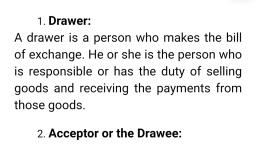
Features of Bill of Exchange, An instrument which a creditor (seller) draws upon his debtor(buyer), It carries an absolute order to pay a specified sum., , The sum is payable to the person whose name is mentioned in the bill or to any other person, or, the order of the drawer, or to the bearer of the instrument., , It requires to be stamped, duly signed by the maker and accepted by the drawee., , It contains the date by which the sum should be paid to the creditor., , TNT, , Bill of, , Exchange, , , , TENT) Lie), , Drawer: The person who makes the bill, or who gives the order to pay a certain sum of money, is, the drawer of the instrument., , Drawee: The person who accepts the bill of exchange, or who is directed to pay a certain sum, is, called drawee., , Payee: The person receiving payment is called the payee, who can be a designated person or the, drawer himself., , Now, apart from the parties mentioned above, there are some other parties to a bill of, exchange, described as under:, , Holder: The holder of the bill of exchange, is the person who possesses the bill and who has the, right to recover the amount from the parties., , Acceptor: The person who accepts the bill is called acceptor. Usually, a debtor or drawee is the, acceptor. However, it can be accepted by some other person also, on behalf of the, debtor/drawee., , Endorser: If the holder of the bill, endorses it to another person, then the person will be called, as the endorser., , Endorsee: The person to whom the bill of exchange is endorsed, is called as an endorsee|
Page 4 :
Difference Between Bill of Exchange & Promissory Note :, 1) Parties., , There are three parties to a bill of exchange, namely, the drawer, the drawee and the payee; while in a, promissory note there are only two parties — maker and payee., , 2) Nature of payment., , In a bill of exchange, there is an unconditional order to pay, while in a promissory note there is an, unconditional promise to pay., , 3) Acceptance., , A bill of exchange requires an acceptance of the drawee before it is presented for payment, while a, promissory note does not require any acceptance since it is signed by the persons who is liable to pay., , 4) Liability., , The liability of the maker of a promissory note is primary and absolute, while the liability of a drawer of, bill of exchange is secondary and conditional. It is only when the drawee fails to pay that the drawer, would be liable as a surety., , 5) Notice of dishonor., , In case of dishonor of bill of exchange either due to non-payment or non-acceptance, notice must be, given to all persons liable to pay. But in the case of a promissory note, notice of dishonor to the maker is, not necessary., , 6) Maker’s position., , The drawer of a bill of exchange stands in immediate relationship with the acceptor and not the payee., While in the case of a promissory note, the maker stands in immediate relationship with the payee., , 7) Nature of acceptance., , A promissory note can never be conditional, while a bill of exchange can be accepted conditionally., 8) Copies., , A bill of exchange can be drawn in sets, but a promissory note cannot be drawn in sets., , 9) Payable to bearer., , A promissory note cannot be made payable to a bearer, while a bill of exchange can be so drawn, provided it is not payable to bearer on demand., , 10) Payable to maker., , In a promissory note, the maker cannot pay to himself. While in the case of a bill of exchange, the, drawer and the payee may be one person]