Notes of Class 12th, Accountancy 12th class MQ.pdf - Study Material
Page 2 :
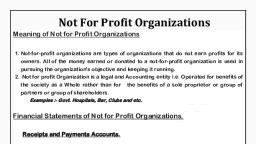
Chapter 1, Financial Statements of Not-for-Profit Organizations, , Meaning of not-for-profit organisations, Not-for-profit organisations are set up for providing service to its members and the public in, general., Examples: Clubs, Charitable institutions, Schools, Religious organisations, Trade unions,, Welfare societies and societies for the promotion of art and culture., Characteristics of not-for-profit organisations, The main characteristics of Not-for-profit organisations are:, 1. Not-for-profit organisations are formed with the main aim of providing service to a specific, group or the public at large such as education, health care, recreation, sports and so on without, any consideration of caste, creed and colour. Its sole aim is to provide service either free of cost, or at nominal cost, and not to earn profit., 2. These are organised as charitable trusts/societies and subscribers to such organisation are, called members., 3. Their affairs are usually managed by a managing/executive committee elected by its members, (called trustees), who are fully accountable to their members and the society for the utilisation of, the funds raised for meeting the objectives of the organisation., 4. The main sources of income of such organisations are: (i) subscriptions from members, (ii), donations,, (iii) legacies, (iv) Government grants, (v) income from investments, (vi) Cash subsidy (i.e., financial assistance from government and government agencies), etc., 5. Normally, Not-for-Profit Organisations do not manufacture, purchase or sell goods and may not, have credit transactions. Hence they need not maintain many books of account (as the business, organisations do) and Trading and Profit and Loss Account. Most of their transactions are in cash, or through the bank., 6. The funds raised by such organisations through various sources are credited to capital fund, or general fund., 7. The surplus generated in the form of excess of income over expenditure is not distributed, amongst the members. It is simply added in the capital fund., 8. The main objective of keeping records in such organisations is to meet the statutory, requirement and help them in exercising control over utilisation of their funds. They also have to, prepare the financial statements at the end of each accounting period (usually a financial year)
Page 3 :
and ascertain their income and expenditure and the financial position, and submit them to the, statutory authority called Registrar of Societies. The final accounts of a ‘not-for-profit, organisation’ consist of the following:, (i) Receipt and Payment Account, (ii) Income and Expenditure Account, and, (iii) Balance Sheet, 9. The Not-for-Profit Organisations earn their reputation on the basis of their contributions to the, welfare of the society rather than on the customers’ or owners’ satisfaction., 10. The accounting information provided by such organisations is meant for the present and, potential contributors and to meet the statutory requirement., Important Terms, Not-for-Profit Organisations: The organisations that are used for the welfare of the society and, are set up as charitable institutions which function without any profit motive., Capital fund/General fund: Not-for-profit organisations do not maintain any capital account., Instead they maintain capital fund/general fund that goes on accumulating as the funds raised by, such organisations through various sources are credited to this fund. (Capital Fund, therefore,, is also called 'Accumulated Fund'.), Members: The subscribers to not-for-profit organisations are called members., Registrar of Societies: Not-for-profit organisations ascertain their income and expenditure and, the financial position, and submit them to the statutory authority, called Registrar of Societies., Accounting Records of Not-for-Profit Organisations, Not-for-profit organisations are required by law to keep proper accounting records and keep, proper control over the utilization of their funds. This is why they usually keep a cash book in, which all receipts and payments are duly recorded. They also maintain a ledger containing the, accounts of all incomes, expenses, assets and liabilities which facilitates the preparation of, financial statements at the end of the accounting period. In addition, they are required to maintain, a stock register to keep complete record of ail fixed assets and the consumables., They do not maintain any capital account. Instead they maintain capital fund which is also called, general fund that goes on accumulating due to surpluses generated, life membership fee,, legacies, etc. received from year to year. In fact, a proper system of accounting is desirable to, avoid or minimise the chances of misappropriations or embezzlement of the funds contributed by, the members and other donors., Final Accounts or Financial Statements of Not-for-Profit Organisations, The Not-for-Profit Organisations are also required to prepare financial statements at the end of, the each accounting period. Although these organisations are non-profit making entities and they, are not required to make Trading and Profit & Loss Account but it is necessary to know whether, the income during the year was sufficient to meet the expenses or not. Not only that they have to, provide the necessary financial information to members, donors, and contributors and also to the
Page 4 :
Registrar of Societies. For this purpose, they have to prepare their final accounts at the end of, the accounting period and the general principles of accounting are fully applicable in their, preparation. As stated earlier, the final accounts of a ‘not-for-profit organisation’ consist of the, following:, 1. Receipt and Payment Account: It is the summary of cash and bank transactions which helps, in the preparation of Income and Expenditure Account and the Balance Sheet. Besides, it is a, legal requirement as the Receipts and Payments Account has also to be submitted to the, Registrar of Societies along with the Income and Expenditure Account, and the Balance Sheet., 2. Income and Expenditure Account: Income and Expenditure Account is just like as Profit and, Loss Account prepared on ‘accrual basis’ of accounting in case of the business organisations., The Not-for- Profit Organisations usually prepare the Income and Expenditure Account and a, Balance Sheet with the help of Receipt and Payment Account., 3. Balance Sheet: ‘Not-for-Profit’ Organisations prepare Balance Sheet for ascertaining the, financial position of the organisation. The preparation of their Balance Sheet is on the same, pattern as that of the business entities. It shows assets and liabilities as at the end of the year., Assets are shown on the right, Important Terms, Receipt and Payment Account: Receipt and Payment Account is a summary of the cash book,, which gives summarised picture of various receipts and payments. It is prepared on 'cash basis', of accounting., Income and Expenditure Account: Income and Expenditure Account is the summary of income, and expenditure for the accounting year. It is just like a profit and loss account prepared on, 'accrual basis' of accounting in case of the business organisations., hand side and the liabilities on the left-hand side. However, there will be a Capital Fund or, General Fund in place of the Capital and the surplus or deficit as per Income and Expenditure, Account which is either added to/deducted from the capital fund, as the case may be. It is also a, common practice to add some of the capitalised items like legacies, life membership fees and, entrance fees (capitalised portion) directly in the capital fund., Besides the Capital or General Fund, there may be other funds created for specific purposes or, to meet the requirements of the contributors/donors such as building fund, sports fund, etc. Such, funds are shown separately on the liabilities side of the balance sheet., Sometimes, it becomes necessary to prepare Balance Sheet as at the beginning of the year in, order to find out the opening balance of the capital/general fund., In order to check the accuracy of the ledger accounts, not-for-profit organisations also prepare a, trial balance which facilitates the preparation of accurate Receipt and Payment Account as well, as the Income and Expenditure Account and the Balance Sheet. In fact, if an organisation has, followed the double entry system they must prepare a trial balance for checking the accuracy of, the ledger accounts and it will also facilitate the preparation of Receipt and Payment account,, Income and Expenditure Account and the Balance Sheet.
Page 5 :
Receipt and Payment Account — Salient Features, 1. Receipt and Payment Account is prepared at the end of the accounting year on the basis of, cash receipts and cash payments recorded in the cash book. It is a summary of cash and bank, transactions under various heads. For example, subscriptions received from the members on, different dates which appear on the debit side of the cash book, shall be shown on the receipts, side of the Receipt and Payment Account as one item with its total amount. Similarly, salary, rent,, electricity charges paid from time to time appear on the credit side of the cash book. The total, salary paid, total rent paid, total electricity charges paid during the year will be recorded on the, payment side of the Receipt and Payment Account., Receipt and Payment Account is a summary of the cash book. Its form is identical with that of, simple cash book (without discount and bank columns) with debit and credit sides. Receipts are, recorded on the debit side while payments are entered on the credit side., 2. Receipt and Payment Account gives summarised picture of various receipts and payments,, irrespective of whether they pertain to the current period, previous period or succeeding period., It shows the total amounts of all receipts and payments irrespective of the period to which they, pertain. For example, in the Receipt and Payment account for the year ending on March 31,, 2020, we record the total subscriptions received during 2019-20 including the amounts related to, the years 2018-19 and 2020—21 on the receipts side. Similarly, we record taxes paid during, 2019—20 on the payments side even if they relate to the years 2018-19 and 2020-21., 3. It includes all receipts and payments whether they are of capital nature or of revenue nature., 4. The opening balance in Receipt and Payment Account represents cash in hand/cash at bank, which is shown on its debit side and the closing balance of this account represents cash in hand, and bank balance as at the end of the year, which appear on the credit side of the Receipt and, Payment Account. However, if there is bank overdraft at the end it shall be shown on its debit, side as the last item., 5. It begins with opening balance of cash in hand and cash at bank (or bank overdraft) and closes, with the year-end balance of cash in hand/cash at bank or bank overdraft. In fact, the closing, balance in this account (difference between the total amount of receipts and payments) which is, usually a debit balance reflects cash in hand and cash at bank unless there is a bank overdraft., 6. No distinction is made in receipts/payments made in cash or through bank. With the exception, of the opening and closing balances, the total amount of each receipt and payment is shown in, this account., 7. Receipt and Payment Account does not show any non-cash item like depreciation, outstanding, expenses, accrued income, etc. This is because Receipt and Payment Account is prepared on, “Cash Basis” of Accounting., Preparation of Receipt and Payment Account, 1. Take the opening balances of cash in hand and cash at bank and enter them on the debit side., In case there is bank overdraft at the beginning of the year, enter the same on the credit side of, this account., 2. Show the total amounts of all receipts on its debit side irrespective of their nature (whether
Page 6 :
capital or revenue) and whether they pertain to past, current and future periods., 3. Show the total amounts of all payments on its credit side irrespective of their nature (whether, capital or revenue) and whether they pertain to past, current and future periods., 4. None of the receivable income and payable expense is to be entered in this account as they, do not involve inflow or outflow of cash. In other words, Receipt and Payment Account does not, show any non-cash item like depreciation, outstanding expenses, accrued income, etc., 5. Find out the difference between the total of debit side and the total of credit side of the account, and enter the same on the credit side as the closing balance of cash/bank. In case, however, the, total of the credit side is more than that of the total of the debit side, show the difference on the, debit as bank overdraft and close the account., It may be noted that the receipts side of the Receipt and Payment Account gives a list of revenue, receipts (for past, current and future periods) as well as capital receipts. Similarly, the payments, side of the Receipts and Payments Account lists the Revenue Payments (for past, current and, future periods) as well as Capital Payments., Format of Receipts and Payments Account, RECEIPTS AND PAYMENTS ACCOUNT, Dr., , for the year ended..., , Receipts, , Rs., , Payments, , To Balance b/d (Opening, Balance):, , By Balance b/d (Opening Balance), , Cash in Hand, , (in case of Bank Overdraft), , Cash at Bank, , By Salaries, , To Subscriptions:, , By Rent, , For Previous Year(s), , ..., , By Postage Expenses, , For Current Year, , ..., , By Advertisement Expenses, , Cr., Rs., , ..., , For Next Year(s), , By Newspapers and Magazines, etc., , To General Donations, , By Repairs, , ..., , To Specific Donations, , By Audit Fee, , ..., , To Grant for Specific Purpose, , By Maintenance Expenses, , To Entrance/Admission Fees, , By Insurance, , To General Grants, , By Honorarium, , To Sale of Newspapers, Grass,, , By Municipal Tax, , ...
Page 7 :
etc., To Sale of Old or Used Sports, Materials, , By Prize Distributed, , …, , To Interest on investments, , By Office Expenses, , …, , To Dividends, , ... By Expenses on Show, , To Rent Received, , ... By Miscellaneous Payments, , To Interest Received, , By Purchase of Fixed Assets (e.g.,, Furniture), , ..., , To Miscellaneous Receipts, , By Sports Equipment, , ..., , To Life Membership Fees, , By Investments, , To Subscriptions, Purpose, , for, , Specific, , By Books, , To Legacies (General), , By Loan (Repayment), , To Legacies (Specific), , By Buildings, , To Endowment Fund, , ... By Balance c/d (Closing Balance):, , To Sale of Fixed Assets, , ... Cash in Hand, , To Receipts on, Specific Fund,, , Account, , of, , Cash at Bank*, , Ae., Match Fund, Prize Fund, etc., To Balance c/d (Bank Overdraft)*, …, , ..., , *Either of the two will appear., Income and Expenditure Account — Salient Features, 1. Income and Expenditure Account is the summary of income and expenditure for the, accounting year. Thus, it is a nominal account. It is just like a profit and loss account prepared on, accrual basis of accounting in case of the business organisations. The Income and, Expenditure Account serves the same purpose as the profit and loss account of a business, organisation does., 2. It includes only revenue items (i.e. revenue receipts and revenue expenditure) related to the, current period only., 3. All the revenue items relating to the current period are shown in this account — the expenses, and losses on the expenditure side and incomes and gains on the income side., 4. It shows the net operating result in the form of surplus (i.e. excess of income over expenditure)
Page 8 :
or deficit (i.e. excess of expenditure over income), which is transferred to the capital fund shown, in the balance sheet., 5. The Income and Expenditure Account is prepared on accrual basis of accounting with the help, of Receipts and Payments Account along with additional information regarding outstanding and, prepaid expenses and depreciation etc. Hence, many items appearing in the Receipts and, Payments need to be adjusted. For example, as shown in Example 1 (Diamond Cricket Club),, subscription amount of Rs.2,65,000 received during the year 2019-20 appearing on the receipts, side of the Receipt and Payment Account includes receipts for the periods other than the current, period. But the subscription amount of Rs.2,25,000 pertaining to the current year only will be, shown as income in Income and Expenditure Account for the year 2019-20., Steps in the Preparation of Income and Expenditure Account, Following steps may be helpful in preparing an Income and Expenditure Account from a given, Receipt and Payment Account:, 1. Persue the Receipt and Payment Account thoroughly., 2. Exclude the opening and closing balances of cash and bank as they are not an income., 3. Exclude the capital receipts and capital expenditures as these are to be shown in the Balance, Sheet., 4. Consider only the revenue receipts to be shown on the income side of Income and, Expenditure Account. Some of these need to be adjusted by excluding the amounts relating to, the preceding and the succeeding periods and including the amounts relating to the current year, not yet received, i.e. accrued incomes., 5. Take the revenue expenditures to the expenditure side of the Income and Expenditure Account, with due adjustments as per the additional information provided relating to the outstanding and, prepaid expenses., 6. Consider the following items not appearing in the Receipt and Payment Account that need to, be recorded in Income and Expenditure Account for determining the surplus/deficit for the current, year :, (a) Depreciation of fixed assets, (b) Provision for doubtful debts, if required, (c) Profit or loss on sale of fixed assets, Format of Income and Expenditure Account, Name of the Organisation, Dr., Expenditure, To Salaries, , INCOME AND EXPENDITURE ACCOUNT for the year, ended..., , Cr., , Rs. Income, By Subscriptions, , Rs., ...
Page 9 :
Add: Outstanding at the end, , Add: Outstanding at the end, , ..., , Advance in the beginning, , ..., , Less: Outstanding in the, beginning, To Rent, , ..., Less: Outstanding in the, beginning, , To Insurance, Premium, Less: Prepaid, , Less: Advance at the end, , To Audit Fees, , By Entrance/Admission Fees, , To Printing and Stationery, , By General Donations, , To Honorarium, , By Legacy Donation (General), , To Telephone, Expenses, , By Sale of Old Newspapers, , To Repairs, , By Rent, , To Depreciation, , By Gain (Profit) on Sale of Fixed, Assets, , To Loss on Sale of Fixed Assets, , By Sundry Receipts, , To Sports Material, Used, , By Deficit, , To Surplus, , (Excess of Expenditure over, Income)*, , ..., , (Excess of Income over, Expenditure)*, , *Either of the two will appear., , Distinction between Income and Expenditure Account and Receipt and Payment Account, Basis, Nature, , Income and Expenditure, , Receipt and Payment Account, , It is like as profit and loss account, It is the summary of the cash book,, hence it is a nominal account., hence a real account., , Nature of Items It records income and expenditure of It records receipts and payments of, revenue nature only., cash and bank of revenue as well as
Page 10 :
capital nature items., Period, , Items in income and expenditure Receipts and payments items may, relate only to the current period., relate to preceding and succeeding, periods also., , Basis of, Accounting, , It is prepared on accrual basis of It is prepared on cash basis of, accounting., accounting., , Debit side, , Debit side of this account records Debit side of this account records, expenses and losses., the receipts., , Credit side, , Credit side of this account records Credit side of this account records, income and gains., the payments., , Depreciation, , It includes depreciation as an It does not include depreciation as, expenditure since income and depreciation is a non-cash expense, expenditure account is a nominal while Receipt and Payment Account, account., is prepared on cash basis of, accounting., , Opening, Balance, , There is no opening balance., , Balance in the beginning represents, cash in hand /cash at bank or bank, overdraft at the beginning., , Closing Balance Balance at the end represents Balance at the end represents cash, surplus (excess of income over in hand at the end and bank balance, expenditure) or deficit (excess of (or bank overdraft)., expenditure over income)., Treatment of some peculiar items in the financial statements of a not-for-profit, organisation, 1. Donations, It is a sort of gift in cash or property received from some person or organisation. It appears on the, receipts side of the Receipts and Payments Account. Donation can be for specific purposes or for, general purposes., (i) Specific Donations: If donation received is to be utilised to achieve specified purpose, it is, called Specific Donation. The specific purpose can be an extension of the existing building,, construction of new computer laboratory, creation of a book bank, etc. Such donation is to be, capitalised and shown on the liabilities side of the Balance Sheet irrespective of the fact whether, the amount is big or small. The intention is to utilise the amount for the specified purpose only., (ii) General Donations: Such donations are to be utilised to promote the general purpose of the, organisation. These are treated as revenue receipts as it is a regular source of income hence, it, is taken to the income side of the Income and Expenditure Account of the current year.
Page 11 :
2. Legacies, It is the amount received as per the will of a deceased person. It appears on the receipts side of, the Receipt and Payment Account and is directly added to capital fiind/general fund in the, balance sheet, because it is not of recurring nature., Legacies of a small amount may be treated as income and shown on the income side of the, Income and Expenditure Account. However, in the absence of any information legacy is always, directly added to capital fund in the Balance Sheet., 3. Life Membership Fees, Some members prefer to pay lump sum amount as life membership fee instead of paying, periodic subscription. Life membership fee is the membership fee paid in lump sum to become a, life member of a not-for-profit organisation. It is treated as capital receipt and added directly in the, capital/general fund., 4. Entrance Fees/admission fee, Entrance fee is paid only once by the member at the time of becoming a member., > For some organisations like educational institutions, the entrance fees is a regular income and, the amount of entrance fees is small. It is treated as a revenue receipt and hence shown on the, income side of the Income and Expenditure Account., > In case of organisations like clubs and some charitable institutions, the amount of entrance, fees is quite high. Hence, it is treated as non-recurring item and credited directly to, capital/general fund., If there is specific instruction that entrance fee is to be capitalised, then it is treated as capital, receipt and directly added in capital/general fund. However, in the absence of any specific, instruction, it should be treated as a revenue receipt and hence shown on the income side of the, Income and Expenditure Account., 5. Sale of old asset, Receipts from the sale of an old asset appear in the Receipts and Payments Account of the year, in which it is sold. It is treated as capital receipt and shown in the Balance Sheet as deduction, from the asset., But any gain or loss on the sale of asset is taken to the Income and Expenditure Account of the, year., For example, if a furniture with book value of Rs.800 is sold for Rs.700, this amount of Rs.700 will, be appearing as receipt in Receipts and Payments Account. Rs.100 will be shown on the, expenditure side of the Income and Expenditure Account as a loss on sale of old asset. In the, balance sheet, book value of the asset sold Rs.800 will be deducted from total book value of the, asset., 6. Sale of Periodicals, It is an item of recurring nature and shown on the income side of the Income and Expenditure, Account.
Page 12 :
7. Sale of Sports Materials, Sale of sports materials (used materials like old balls, bats, nets, etc) is the regular feature with, any Sports Club. It is usually shown as an income in the Income and Expenditure Account., 8. Payments of Honorarium, It is the amount paid to the person who is not the regular employee of the institution. Payment to, an artist for giving performance at the club is an example of honorarium. This payment of, honorarium is shown on the expenditure side of the Income and Expenditure Account., 9. Endowment Fund, It is a fund arising from a bequest or gift, the income of which is devoted for a specific purpose., Hence, it is a capital receipt and shown on the Liabilities side of the Balance Sheet as an item of, a specific purpose fund., 10. Government Grant, Schools, colleges, public hospitals, etc. depend upon government grant for their activities. The, recurring grants in the form of maintenance grant is treated as revenue receipt (i.e. income of the, current year) and shown as an income in the Income and Expenditure Account., Cash subsidy from the government or government agencies is treated as revenue receipt (i.e., income of the current year) and shown as an income in the Income and Expenditure Account., However, grants such as building grant are treated as capital receipt and transferred to the, building fund account., Important Terms, Legacy: It is the amount received as per the will of a deceased person., Life membership fee: It is the membership fee paid in lump sum to become a life member of a, not-for-profit organisation. Entrance fee: It is the admission fee paid only once by the member at, the time of becoming a member., Honorarium: It is the amount paid to the person who is not the regular employee of the, institution, e.g. payment to an artist for giving performance at the club., Endowment fund: It is a fund arising from a bequest or gift, the income of which is devoted for a, specific purpose., Treatment of Membership Subscriptions, Subscription is a membership fee paid by the member on annual basis. This is the main source, of income of not-for-profit organisations. Subscription paid by the members appear as receipt in, the Receipt and Payment Account. It is shown as income in the Income and Expenditure, Account., Receipt and Payment Account shows the total amount of subscription actually received during, the year which may include subscriptions received related to previous year's outstanding, subscriptions or subscriptions received in advance from some members for the next year. While
Page 13 :
Income and Expenditure Account records subscriptions income related to the current year only, irrespective of the fact whether it has been received or not (since Income and Expenditure, Account is prepared on accrual basis)., Alternately, the above amount of subscriptions to be shown as income can also be, ascertained by preparing the subscription account as follows:, Dr., , Subscription Account, , Particulars, , Cr., , Amount Particulars, (Rs.), , Amount, (Rs.), , To Balance b/d (outstanding at, the beginning), , XXX, , By Balance b/d (opening advance, subscription), , XXX, , To Income and Expenditure A/c, (Bal. Fig.), , xxx, , By Cash/Bank A/c (total, subscription received, , xxx, , To Balance c/d (closing advance, subscription), , xxx, , during the current year), By Balance c/d (outstanding at, the end), , xxxx, , xxx, xxxx, , Calculation of Income from Subscription for the Current Year:, Details, , Amount (Rs.), , Subscription received during the year (as per Receipts and Payment A/c), , XXX, , Add: Closing outstanding subscription, , XXX, , Add: Opening advance subscription, , XXX, , Less: Opening outstanding subscription, , (xxx), , Less: Closing advance subscription, , (xxx), , Income from subscription to be shown in Income and Expenditure A/c, , xxxx, , Special Funds (e.g. match fund, sports fund, building fund, etc.), The Not-for-Profit Organisations often create special funds for certain purposes/ activities such as, prize fund’, ‘match fund’ and ‘sports fund’, ‘building fund’, etc. Such funds are invested in, securities and the income earned on such investments is added to the respective fund, not, credited to Income and Expenditure Account. Similarly, the expenses incurred on such specific, purposes are also deducted from the special fund., For example, a club may maintain a special fund for sports activities. In such a situation, the, interest income on sports fund investments is added to the sports fund and all expenses on, sports deducted therefrom. The special funds are shown in balance sheet., If, after adjustment of income and expenses the balance in specific or special fund is negative, it, is transferred to the debit side of the Income and Expenditure Account.
Page 14 :
Balance Sheet (an extract), Liabilities, , Amount Assets, (Rs.), , Match Fund, , x% Match Fund Investment, , Opening balance, Add: Income, match fund, , XXX, (interest), , Accrued interest on match, fund, , from XXX, , Amount, (Rs.), XXX, xxx, , investment, , investment received, Add: Accrued income (interest) XXX, on match, fund investment, Add: Donation for match fund, , XXX, , Add: Sale of match tickets, , XXX, , Less: Match Expenses, , (xxx), , xxxx, , Preparation of Balance Sheet, The following procedure is adopted to prepare the Balance Sheet:, 1. Take the Capital/General Fund as per the opening balance sheet and add surplus from the, Income and Expenditure Account. Further, add legacies, life membership fees, etc. received, during the year., 2. Take all the fixed assets (not sold/discarded/or destroyed during the year) with additions (from, the Receipts and Payments account) after charging depreciation (as per Income and Expenditure, account) and show them on the assets side., 3. Compare items on the receipts side of the Receipts and Payments Account with income side, of the Income and Expenditure Account. This is to ascertain the amounts of:, (a) subscriptions due but not yet received, i.e. subscriptions outstanding incomes received in, advance, e.g. subscriptions received in advance sale of fixed assets made during the year items, to be capitalised (i.e. shown in the Balance Sheet) e.g. legacies, interest on specific fund, investment and so on., 4. Similarly, compare items on the payments side of the Receipt and Payment Account with, expenditure side of the Income and Expenditure Account. This is to ascertain the amounts of:, (a) outstanding expenses prepaid expenses purchase of a fixed asset during the year, depreciation on fixed assets stock of consumable items like stationery in hand, , Treatment of Some Important Adjustments, Adjustment 1:
Page 15 :
Dr., , Receipts and Payment A/c for the year ending 31 March, 2020, , Receipts, , Amount Payments, (Rs.), , Cr., Amount, (Rs.), , By Furniture (1.1.2020), , 20,000, , Additional Information: On 1.4.2019 Furniture was Rs.50,000. Depreciate Furniture @10% p.a., Treatment:, Depreciation on opening balance of furniture Rs.50,000 will be calculated for full year and, depreciation on furniture purchased on 1.1.2020 Rs.20,000 will be calculated for 3 months i.e.,, (50,000 x 10%) + (20,000 x 10% x 3/12) = 5,000 + 500 = Rs.5,500., Dr., , Income and Expenditure A/c for the year ending 31 March, 2020, , Expenditure, , Amount Income, (Rs.), , To Depreciation on Furniture, , Cr., , Amount, (Rs.), , 5,500, , Balance Sheet as on 31 March, 2020, Liabilities, , Amount Assets, (Rs.), , Amount, (Rs.), , Furniture, , 50,000, , Add: Purchases, , 20,000, , Less: Depreciation, , (5.500), , 64,500, , Adjustment 2:, Dr., , Receipts and Payment A/c for the year ending 31 March, 2020, , Receipts, To Interest on Investment, , Amount Payments, (Rs.), 3,000 By 10% Govt. Bonds, (1.10.2019), , Cr., Amount, (Rs.), 80,000, , Treatment:, Interest on investment (Govt. Bonds) purchased on 1.10.2019 @ 10% p.a. for 6 months, = 80,000 x 10/100 x 6/12 = Rs.4,000, Interest received (appearing in Receipts and Payments Account) is Rs.3,000., Therefore, interest accrued = 4,000 — 3,000 = Rs.1,000.
Page 16 :
Dr., , Income and Expenditure A/c for the year ending 31 March, 2020, , Expenditure, , Amount Income, (Rs.), , Cr., Amount, (Rs.), , By Interest on Investment 3,000, Add: Accrued Interest 1,000, , 4,000, , Balance Sheet as on 31 March, 2020, Liabilities, , Amount Assets, (Rs.), 10% Govt. Bonds, Accrued Interest on Investment, , Amount, (Rs.), 80,000, 1,000, , Adjustment 3:, Dr., , Receipts and Payment A/c for the year ending 31 March, 2020, , Receipts, , Amount Payments, (Rs.), By Telephone Charges, Rates and Taxes, , Cr., Amount, (Rs.), 7,500, 2,000, , Additional Information:, (i) A quarter’s charge for Telephone Rs.1,500 is outstanding. There is no change in, quarterly charge., (ii) On 31.3.2020, Rates and Taxes were paid up to 30.6.2020; annual charge being Rs.2,000., Treatment:, (i) Quarterly charge for telephone = Rs.1,500. Therefore, annual telephone charges = 1,500 x 4 =, Rs.6,000., Payment made for telephone expenses during the year 2019-20 (appearing in Receipts and, Payment Account) is Rs.7,500., Thus, telephone expenses paid is for 15 months., Still a quarters charge for Telephone Rs.1,500 is outstanding. It means the payment during the, year Rs.7,500 includes 6 months telephone charges Rs.3,000 outstanding at the beginning of the, year., (ii) Annual rates and taxes = Rs.2,000. Rates paid up to 30.6.2020 means that 3 months prepaid, rates and taxes Rs.500 (i.e. 2,000/12 x 3) is at the beginning as well as at the end of the year, 2019-20., Balance Sheet as on 1 April, 2019, Liabilities, Telephone charges outstanding, , Amount Assets, (Rs.), 3,000 Prepaid Rates and Tax (2000 x, , Amount, (Rs.), 500
Page 17 :
3/12), , Dr., , Income and Expenditure A/c for the year ending 31 March, 2020, , Expenditure, , Cr., , Amount Income, (Rs.), , Amount, (Rs.), , To Telephone Charges, Paid, , 7,500, , Less:, outstanding, , Opening, , (3,000), , Add:, outstanding, , Closing, , L500, , 6,000, , To Rates and Taxes, Paid, , **, 2,000, , Add: Opening prepaid, , 500, , Less: Closing prepaid, , 1500), , 2,000, , Balance Sheet as on 31 March, 2020, Liabilities, , Amount Assets, (Rs.), , Telephone charges outstanding, , 1,500 Prepaid Rates and Tax, , Amount, (Rs.), 500, , Adjustment 4:, Dr., , Receipts and Payment A/c for the year ending 31 March, 2020, Receipts, , Amount Payments, (Rs.), , To Legacies, , 24,000, , To Donations, , 32,000, , To Entrance Fees, , 10,000, , Cr., Amount, (Rs.), , Additional Information: 50% Legacies, Donations and Entrance Fees are to be treated as, income., Treatment:, 50% legacies, 50% entrance fees and 50% donations are to be shown on the income side of, Income and Expenditure Account and the remaining 50% amounts are to be capitalised i.e., shown on the liabilities side of the Balance Sheet., Dr., , Income and Expenditure A/c for the year ending 31 March, 2020, , Cr.
Page 18 :
Expenditure, , Amount Income, (Rs.), , Amount, (Rs.), , By Legacies, , 12,000, , By Donations (General), , 16,000, , By Entrance Fees (Income), , 5,000, , Balance Sheet as on 31 March, 2020, Liabilities, , Amount Assets, (Rs.), , Amount, (Rs.), , Capital Fund, Opening Balance, Add: Legacies, , 12,000, , Add: Entrance Fees, (Capitalised portion), , 5,000, , Donations (specific), , ?, 16,000, , Adjustment 5:, Dr., , Receipts and Payment A/c for the year ending 31 March, 2020, , Receipts, , Amount Payments, (Rs.), , To Interest on Investment @5%, p.a. for full year, , 5,000 Interest on loan, , Cr., Amount, (Rs.), 1,200 1, , Additional Information: On 31 March 2019, the organisation took a loan of Rs.20,000 @ 10%, p.a., Treatment:, (i) Interest on investment Rs.5,000 is for full year. It means Investment in the beginning were, Rs.1,00,000 (i.e. 5,000/5 x 100)., Investment Rs.1,00,000 will be shown on the assets side of opening and closing Balance Sheets, both., (ii) Interest on Loan for full year = 10% of Rs.20,000 = Rs.2,000. Out of this Rs.1,200 has been, paid (appearing on the payment side of Receipt and Payment Account). Therefore, outstanding, interest on loan = 2,000 — 1,200 = Rs.800., , Dr., , Income and Expenditure A/c for the year ending 31 March, 2020, , Cr.
Page 19 :
Expenditure, , Amount Income, (Rs.), , To Interest on Loan 1,200 Add:, O/s interest 800, , Amount, (Rs.), , 2,000 By Interest on Investment, , 5,000, , Balance Sheet as on 1 April, 2019, Liabilities, , Amount Assets, (Rs.), , Loan @10% p.a., , Amount, (Rs.), , 20,000 Investments, , 1,00,000, , Balance Sheet as on 31 March, 2020, Liabilities, , Amount Assets, (Rs.), , Loan @10% p.a., Outstanding Interest on Loan, , Amount, (Rs.), , 20,000 Investments, 800, , 1,00,000, , Adjustment 6:, Dr., , Receipts and Payment A/c for the year ending 31 March, 2020, , Receipts, To Sale of Furniture (Book value, Rs.6,000), , Amount Payments, (Rs.), , Cr., Amount, (Rs.), , 4,000 By Books, , 6,000, , Additional Information:, (i) Books on 1.4.2019 and 31.3.2020 were Rs.13,500 and Rs.16,500 respectively., (ii) Furniture on 1.4.2019 and 31.3.2020 were Rs.16,000 and Rs.8,000 respectively., Treatment:, (i) Books on 1.4.2019 = Rs.13,500. Purchase of books during the year 2019-20 = Rs.6,000, (appearing on the payment side of Income and Expenditure Account). Thus, balance of books on, 31.3.2020 should be Rs.19,500 (i.e. Rs.13,500 + Rs. 6,000). But the balance of books on, 31.3.2020 is Rs.16,500. It means books have been depreciated by Rs.3,000 (i.e. Rs.19,500Rs.16,500)., (ii) Book value of furniture on 1.4.2019 = Rs.16,000. Book value of furniture sold during the year, = Rs.6,000. Thus, book value of furniture on 31.3.2020 should be Rs.10,000 (i.e. Rs.16,000 Rs.6,000). But the book value of furniture on 31.3.2020 is Rs.8,000. It means furniture has been, depreciated by Rs.2,000 (Rs.10,000 — Rs.8,000)., Book value of furniture sold = Rs.6,000. But sale proceeds is Rs.4,000. Thus, loss on sale of, furniture = 6,000 - 4,000 = Rs.2,000.
Page 20 :
Dr., , Income and Expenditure A/c for the year ending 31 March, 2020, , Expenditure, , Amount Income, (Rs.), , Cr., Amount, (Rs.), , To Depreciation on Books, (13,500 + 6,000 - 16,500), , 5,000, 3,000, , To Depreciation on Furniture, (16,000 - 6,000 - 8,000), , 2,000, , To Loss on Sale of Furniture, (6,000 - 4,000), , 2,000, , Balance Sheet as on 1 April, 2019, Liabilities, , Amount Assets, (Rs.), Books, Furniture, , Amount ( j, 13,500, lo,UUU, , Balance Sheet as on 31 March, 2020, Liabilities, , Amount Assets, (Rs.), Books, Furniture, , Amount, (Rs.), 16,500, 8,000, , Adjustment 7:, Dr., , Receipts and Payment A/c for the year ending 31 December, 2020, , Receipts, , Amount Payments, (Rs.), , Cr., Amount, (Rs.), , To Subscriptions, 2019 5,000, 2020 83,000, 2021 3,000, , 91,000, , Additional Information: Subscription for 2020 still owing Rs.7,000 and Subscription received in, 2020 included Rs.4,000 from a life member., Treatment: Subscriptions received in 2020 Rs.83,000 includes Rs.4,000 from a life member. Life, membership fee is to be capitalised. It is directly added in the capital fund in the Balance Sheet.
Page 21 :
Dr., , Income and Expenditure A/c for the year ending 31 December, 2020, , Expenditure, , Amount Income, (Rs.), By Subscriptions, Received for 2020 83,000 Add:, Outstanding for 2020 7,000 Less:, Life membership fees (4,000), , Cr., Amount, (Rs.), 86,000, , Balance Sheet as on 1 January, 2020, Liabilities, , Amount Assets, (Rs.), Subscription Outstanding, , Amount, (Rs.), 5,000, , Balance Sheet as on 31 December, 2020, Liabilities, , Amount Assets, (Rs.), , Subscription, Received, in, Advance Capital Fund, Opening Balance ? Add: Life, membership fees 4,000, , 3,000 Subscription Outstanding, , Amount, (Rs.), 7,000, , Adjustment 8:, Dr., , Receipts and Payment A/c for the year ending 31 December, 2020, , Receipts, , Amount Payments, (Rs.), , To Subscriptions for Tournament, To Donations, , 60,000 By Tournament Expenses, , Cr., Amount, (Rs.), 40,000, , 6,00,000, , Additional Information-. Donations and Surplus on account of tournament are to be kept in, reserves for a permanent pavilion. Treatment: Balance Sheet as on 31 December, 2020, Liabilities, , Amount Assets, (Rs.), , Pavilion Fund, Donations 6,00,000, Add: Surplus from tournament, (60,000 - 40,000) 20,000, , 6,20,000, , Amount, (Rs.)
Page 22 :
Multiple Choice Questions (SET A), Select the correct alternative:, Q. 1. Receipts and Payments Account generally show:, (A) A Debit balance, (B) A Credit balance, (C) Surplus or Deficit, (D) Capital Fund, , Q. 2. Income and Expenditure Account records transactions of:, (A) Revenue nature only, (B) Capital nature only, (C) Both revenue and capital nature, (D) Income of only revenue nature and expenditure of revenue and capital nature., , Q. 3. Income and Expenditure Account reveals:, (A) Surplus or Deficiency, (B) Cash in Hand, (C) Net Profit, (D) Capital Account, , Q. 4. The amount of ‘Subscription received from members’ by a Non-profit organisation is shown, in which of the following?, (A) Debit side of Income and Expenditure Account, (B) Credit side of Income and Expenditure Account, (C) Liability side of Balance Sheet, (D) Assets side of Balance Sheet, , Q. 5. Donation received for a special purpose:, (A) Should be credited to Income and Expenditure Account, (B) Should be credited to separate account and shown in the Balance Sheet, (C) Should be shown on the assets side
Page 23 :
(D) Should not be recorded at all., , Q. 6. Subscription received by a school for organising annual function is treated as:, (A) Capital Receipt (i.e., Liability), (B) Revenue Receipt (;.e., Income), (C) Asset, (D) Earned Income, , Q. 7. The amount of ‘Entrance Fees’ received by a Non-profit organisation (if it is received, regularly) is shown in which of the following?, (A) Liability side of Balance Sheet, (B) Assets side of Balance Sheet, (C) Debit side of Income and Expenditure Account, (D) Credit side of Income and Expenditure Account, , Q. 8. Out of following items, which one is shown in the Receipts and Payments Account?, (A) Outstanding Salary, (B) Depreciation, (C) Life Membership Fees, (D) Accrued Subscription, , Q. 9. Not-for-profit organisations prepare:, (A) Trading Account, (B) Trading & Profit and Loss Account, (C) Income and Expenditure Account, (D) All of the above, , Q. 10. The Receipts and Payments Account is a summary of:, (A) Debit and Credit balance of Ledger Accounts, (B) Cash Receipts and Payments, (C) Expenses and Incomes
Page 24 :
(D) Assets and Liabilities, , Q. 11. Receipts and Payments Account is a :, (A) Personal Account, (B) Real Account, (C) Nominal Account, (D) Real and Nominal Account, both, , Q. 12. Income and Expenditure Account is a:, (A) Personal Account, (B) Real Account, (C) Nominal Account, (D) Real and Nominal Account, both, , Q. 13. Credit side balance in Income & Expenditure Account reveals:, (A) Excess of cash receipts over payments, (B) Excess of cash payments over receipts, (C) Excess of expenditure over income, (D) Excess of income over expenditure, , Q. 14. Source of income for a not-for-profit organisation is :, (A) Subscription from Members, (B) Donation, (C) Entrance Fees, (D) All of the above, , Q. 15. Which of the following represent capital receipt:, (A) Life Membership Subscription, (B) Donation, (C) Subscription, (D) Interest on Investments
Page 26 :
Q. 16. Amount received from sale of grass by a club should be treated as :, (A) Capital Receipt, (B) Revenue Receipt, (C) Asset, (D) Earned Income, , Q. 17. The amount received for sale of old sports materials by a Non-profit organisation is shown, in which of the following?, (A) Debit side of Income and Expenditure Account, (B) Liability side of Balance Sheet, (C) Credit side of Income and Expenditure Account, (D) Assets side of Balance Sheet, , Q. 18. If there is a ‘Match Fund’, then match expenses and incomes are transferred to:, (A) Income and Expenditure A/c, (B) Assets side of Balance Sheet, (C) Liabilities side of Balance Sheet, (D) Both Income and Expenditure A/c and to Balance Sheet, , Q. 19. Subscription received in advance during the current year is :, (A) an income, (B) an asset, (C) a liability, (D) none of these, , Q. 20. Subscription received in cash during the year amounted to Rs.40,000; subscription, outstanding at the end of previous year was Rs. 1,500 and outstanding at the end of current year, was Rs.2,000. Subscription received in advance for next year was Rs.800. The amount credited, to Income & Expenditure Account will be:, (A) Rs.38,700, (B) Rs.39,700, (C) Rs.40,300, (D) Rs.41,300
Page 27 :
Q. 21. Subscription received in cash during the year amounted to Rs.5,00,000; subscription, outstanding at the end of previous year was Rs.20,000 and outstanding at the end of current year, was Rs.25,000. Subscription received in advance for next year was Rs. 8,000 and received in, advance during previous year was Rs.7,000. The amount credited to Income & Expenditure, Account will be :, (A) Rs.5,04,000, (B) Rs.5,06,000, (C) Rs.4,96,000, (D) Rs.4,94,000, , Q. 22. Subscription received in cash during the year amounted to Rs.60,000; subscription, received in advance for next year was Rs.3,000 and received in advance during previous year, was Rs.2,000. Subscription in arrear at the end of current year was Rs.5,400. The amount, credited to Income & Expenditure Account will be:, (A) Rs.53,600, (B) Rs.66,400, (C) Rs.55,600, (D) Rs.64,400, , Q. 23. Subscription received in cash during the year amounted to Rs.3,00,000; subscription, received in advance for next year was Rs. 10,000 and received in advance during previous year, was Rs.8,000. Subscription in arrear at the end of previous year was Rs. 18,000 and subscription, in arrear at the end of current year was Rs. 12,000. The amount credited to Income &, Expenditure Account will be :, (A) Rs.2,96,000, (B) Rs.3,04,000, (C) Rs.2,92,000, (D) Rs.3,08,000, , Q. 24. What amount will be credited to the Income and Expenditure Account for the year ending, 31st March, 2020 on the basis of the following information? :, , Outstanding Subscription, Advance Subscription, , 3,000, , 31-3-2019, , 31-3-2020, , 10,000, , 25,000, 2,000, , Subscriptions received during the year 2019-20 were Rs.4,00,000.
Page 28 :
(A) Rs.3,84,000, (B) Rs.4,16,000, (C) Rs.3,86,000, (D) Rs.4,14,000, , Q. 25. There are 200 members, each paying an annual subscription of Rs. 1,000; subscription, received during the year Rs. 1,95,000; subscriptions received in advance at the beginning of the, year Rs. 3,000 and at the end of the year Rs.2,000. Amount shown in Income & Expenditure, Account will be :, (A) Rs. 2,00,000, (B) Rs. 1,96,000, (C) Rs. 1,94,000, (D) Rs. 2,01,000, , Q. 26. The opening balance of Prize Fund was Rs.32,800. During the year, donations received, towards this fund amounted to Rs. 15,400; amount spent on prizes was Rs. 12,300 and interest, received on prize fund investment was Rs.4,000. The closing balance of Prize Fund will be :, (A) Rs. 56,500, (B) Rs.64,500, (C) Rs.39,900, (D) Rs. 31,900, , Q. 27. Salary paid in cash during the current year was Rs. 80,000; Outstanding salary at the end, was Rs.4,000; Salary paid in advance last year pertaining to the current year was Rs.3,200; paid, in advance during current year for next year was Rs.5,000. The amount debited to Income and, Expenditure Account will be:, (A) Rs.85,800, (B) Rs.77,800, (C) Rs. 82,200, (D) Rs. 74,200, , Q. 28. Salary paid in cash during the current year was Rs.30,000; Outstanding salary at the end, of previous year was Rs.2,000 and outstanding salary at the end of current year was Rs.3,000., Salary paid in advance during current year for next year was Rs.2,600. The amount debited to, Income and Expenditure Account will be :, (A) Rs.33,600
Page 29 :
(B) Rs.26,400, (C) Rs.31,600, (D) Rs.28,400, , Q. 29. Salary paid for the year ended 31st March, 2020 amounted to Rs.75,000. How much, amount will be recorded in Income and Expenditure Account in the following case?, 31-3-2019, , 31-3-2020, , Outstanding Salary, , 6,500, , 6,000, , Prepaid Salary, , 1,200, , 1,000, , (A) Rs.75,700, (B) Rs.74,300, (C) Rs.75,300, (D) Rs.74,700, , Q. 30. How much amount will be shown in Income and Expenditure Account in the following, case?, 1-4-2019, , 31-3-2020, , Creditors for Stationery, , 8,000, , 6,000, , Stock of Stationery, , 3,000, , 3,200, , During 2019-20 payment made for Stationery was Rs.60,000., (A) Rs.57,800, (B) Rs.62,200, (C) Rs.61,800, (D) Rs.5 8,200, , Q. 31. How much amount will be shown in Income and Expenditure Account in the following, case?, 31-3-2019, Unpaid for Medicines 10,000, Stock of Medicines, , 31-3-2020, 12,000, , 8,000, , 13,000, , Payment made for medicines during 2019-20 was Rs.2,50,000., (A) Rs.2,53,000
Page 30 :
(B) Rs.2,47,000, (C) Rs.2,57,000, (D) Rs.2,43,000, , Q. 32. If a General Donation of huge amount is received by a school, that donation is treated as :, (A) Revenue Receipt (Income), (B) Capital Receipt (Liability)., (C) Assets, (D) Earned Income, , Q. 33. If a general donation of smaller amount is received by a school, that donation will be, shown in:, (A) Liability Side, (B) Asset Side, (C) Debit side of Receipt and Payment A/c, (D) Credit side of Receipt and Payment A/c, , Q. 34. Out of the following items, which one is shown in the ‘Receipts and Payments Account’ of, a not for profit organisation?, (A) Accrued subscription, (B) Outstanding salary, (C) Depreciation, (D) None of these, , Q. 35. Out of the following items, which is not shown in the ‘Receipts and Payments A/c’ of a not, for profit organisation?, (A) Subscription received in advance, (B) Subscription due, (C) Last year subscription received, (D) All of the above, , Q. 36. Out of the following items, which is shown in the ‘Receipts and Payments A/c’ of a not for, profit organisation?
Page 31 :
(A) Subscription received in advance, (B) Last year subscription received, (C) Current year subscription received, (D) All of the above, , Answers, Multiple Choice Questions (SET A), Select the correct alternative:, 1., , A, , 2., , A, , 3., , A, , 4., , B, , 5., , B, , 6., , A, , 7., , D, , 8., , C, , 9., , C, , 10., , B, , 11., , B, , 12., , C, , 13., , D, , 14., , D, , 15., , A, , 16., , B, , 17., , C, , 18., , C, , 19., , C, , 20., , B, , 21., , A, , 22., , D, , 23., , C, , 24., , B, , 25., , A, , 26., , C, , 27., , C, , 28., , D, , 29., , D, , 30., , A, , 31., , B, , 32., , B, , 33., , C, , 34., , D, , 35., , B, , 36., , D, , Multiple Choice Questions (SET B), Select the correct alternative:, 1. Receipts and Payments Account is prepared on, (a) Cash Basis., (b) Time Basis., (c) Accrual Basis., (d) Sales Basis., , 2. Not-for-Profit Organisations prepare
Page 32 :
(a) Income and Expenditure Account., (b) Trading and Profit and Loss Account,, (c) Trading Account., (d) Both (a) and (c)., , 3. Receipts and Payments Account is a summary of, (a) Debit and Credit balances of Ledger Account., (b) Cash receipts and payments., (c) incomes and Expenses., (d) Balances of assets and liabilities., , 4. Income and Expenditure Account is prepared on, (a) Cash Basis., (b) Accrual Basis., (c) Both (a) and (b)., (d) Sales Basis,, , 5. Legacy Donation received by NPO to be used for specific purpose is accounted as, (a) Revenue Receipt., (b) Capital Receipt., (c) an Asset., (d) is decided by the Management., , 6. Life Membership Fee received by NPO is accounted as, (a) Revenue Receipt., (b) Capital Receipt., (c) an Asset., (d) Miscellaneous Receipt., , 7. Salaries paid during the year ended 31st March, 2020 is Rs. 36,000. Salaries paid in advance, at the end of previous year were Rs. 54,000. The amount of Salaries to be debited to income and, Expenditure Account for the year ended 31st March, 2020 will be
Page 33 :
(a) Rs. 54,000., (b) Rs. 36,000., (c) Rs. 90,000., (d) Rs. 18,000., , 8. Title of the account which shows Surplus/Deficit of NPO is, (a) Cash Book., (b) Income and Expenditure Account., (c) Receipts and Payments Account., (d) Balance Sheet., , 9. Main source of Income for a Not-for-Profit Organisation is, (a) Rent., (b) Salaries., (c) Donations and Subscriptions., (d) Sale of Assets., , 10. Identify revenue receipt from the following:, (a) Donations for Building, (b) Subscription, (c) Life Membership Fees, (d) Legacy donation for Library., , 11. Identify capital receipt from the following:, (a) Life Membership Fees, (b) Rent Receipt, (c) Entrance fees, (d) Sports expenses., , 12. General Donation received by NPO is shown in the, (a) Credit side of income and Expenditure Account,
Page 34 :
(b) Debit side of income and Expenditure Account, (c) Liabilities side of Balance Sheet, (d) Assets side of the Balance Sheet., , 13. Specific Donation received by NPO is shown in the, (a) Credit side of Income and Expenditure Account,, (b) Debit side of Income and Expenditure Account, (c) Liabilities side of Balance Sheet., (d) As is decided by the management., , 14. Income and Expenditure Account is a, (a) Real Account., (b) Nominal Account., (c) Personal Account., (d) Valuation Account., , 15. Receipts and Payments Account is a, (a) Real Account., (b) Nominal Account., (c) Personal Account., (d) Revenue Account., , 16. Identify the item which is not shown under Receipts and Payments Account in case of NPO., (a) Salaries, (b) Rent, (c) Depreciation, (d) Honorarium, , 17. Compute Rent for the year ended 31st March, 2020 from the following:, 1.4.2019, , 31.3.2020
Page 35 :
Outstanding Rent, Prepaid Rent, , Rs. 19,000, , Rs. 14,000, , Rs. 5,600, , Rs. 10,400, , Rent paid during the year Rs. 2,97,800., (a) Rs. 2,97,800, (b) Rs. 2,88,000, (c) Rs. 2,50,000, (d) Rs. 2,00,000, , 18. Choose NPO from the following:, (a) Reliance Industries Limited, (b) Indian Hoc Important Federation, (c) Infosys Ltd., (d) Private Hospital, , 19. Furniture as on 31st March, 2019 Rs. 4,40,000. Furniture (having Book value as on 1st April,, 2018 of Rs. 40,000) sold at a loss of 20% on 31st December, 2018. Furniture is depreciated @, 10% p.a. Furniture costing Rs. 3,00,000 was also purchased on 1st October, 2018. Calculate, Loss on sale of furniture., (a) Rs. 9,400, (b) Rs. 6,400, (c) Rs. 8,000, (d) Rs. 7,400, , 20. Subscriptions received in advance by a club are shown, (a) in the credit side of the Income and Expenditure Account., (b) in the assets side of the Balance Sheet., (c) in the liabilities side of the Balance Sheet., (d) in the payments side of Receipts and Payments Account., , 21. Subscription received during the year 2019-20: Rs. 1,50,000. Outstanding Subscription as on, 31st March, 2019: Rs. 1,00,000. The amount shown as subscription receipt will be
Page 36 :
(a) Rs. 50,000., (b) Rs. 1,50,000., (c) Rs. 1,00,000., (d) Rs. 1,25,000., , 22. Subscription received during the year 2019-20: Rs. 1,50,000; Subscription Rs. 75,000 is, outstanding:, (a) Rs. 1,50,000, (b) Rs. 75,000, (c) Rs. 2,25,000, (d) Rs. 2,00,000., , 23. Calculate the amount of credit purchase from the following information:, Particulars, , 1st April, 2019(Rs.), , 31st March, 2020 (Rs.), , 4,600, , 11,800, , Creditors for Stationery, , During the year ended 31st March, 2020, payment made to creditors of Rs. 56,800., (a) Rs. 54,000, (b) Rs. 64,000, (c) Rs. 74,000, (d) Rs. 44,000, , 24. Credit purchase of stationery is Rs. 64,000, which is 80% of total purchase, compute cash, purchase of stationery,, (a) Rs. 16,000, (b) Rs. 24,000, (c) Rs. 8,000, (d) Rs. 40,000., , 25. Out of the following, which one is a special receipt?, (a) Subscriptions
Page 37 :
(b) Rent Received, (c) Contribution for Annual Dinner, (d) General Donation, , 26. Out of the following, which is Unrestricted Fund?, (a) Annuity Fund, (b) Sports Fund, (c) Capital Fund, (d) Endowment Fund, , 27. Subscription received in advance during the current year is, (a) an income., (b) an asset., (c) a liability., (d) None of these., , 28. If there is a 'Match Fund', then Match Expenses and Match Incomes are transferred to, (a) Income and Expenditure A/c., (b) Assets side of Balance Sheet., (c) Match Fund in Liabilities side of Balance Sheet., (d) Both Income and Expenditure A/c and to Balance Sheet., , Answers, Multiple Choice Questions (SET B), Select the correct alternative:, 1. (a);, , 2. (a);, , 3. (b);, , 4. (b);, , 5. (b);, , 6. (b);, , 7. (c);, , 8. (b);, , 9. (c);, , 10. (b);, , 11. (a);, , 12. (a);, , 13. (c);, , 14.(b);, , 15. (a);, , 16. (c);, , 17. (b);, , 18. (b);, , 19. (d);, , 20. (c);, , 21.(a);, , 22. (c);, , 23. (b);, , 24. (a);, , 25. (c);, , 26. (c);, , 27. (c);, , 28. (c)
Page 39 :
Chapter 2, Accounting for Partnership Firms, Meaning of Partnership, When two or more persons join hands to set up a business and share its profits and losses, they, are said to be in partnership., Section 4 of the Indian Partnership Act 1932 defines partnership as the ‘relation between, persons who have agreed to share the profits of a business carried on by all or any of, them acting for all’., Persons who have entered into partnership with one another are individually called ‘partners’, and collectively called ‘firm’. The name under which the business is carried is called the ‘firm’s, name’., Features/Characteristics of Partnership, The essential features/characteristics of partnership are:, 1. Two or More Persons: In order to form partnership, there should be at least two persons, coming together for a common goal. In other words, the minimum number of partners in a firm, can be two. There is however, a limit on their maximum number. By virtue of Section 464 of the, Companies Act 2013, the Central Government is empowered to prescribe maximum number of, partners in a firm but the number of partners can not be more than 100. The Central government, has prescribed the maximum number of partners in a firm to be 50 under Rule 10 of the, Companies (Miscellaneous) Rules, 2014. Thus, a partnership firm cannot have more than 50, partners., 2. Agreement: Partnership is the result of an agreement between two or more persons to do, business and share its profits and losses. The agreement becomes the basis of relationship, between the partners., Partnership agreement can be either oral or written. The Partnership Act does not require that the, agreement must be in writing. In other words, it is not necessary that such agreement is in written, form. An oral agreement is equally valid. But in order to avoid disputes, it is preferred that the, partners have a written agreement., Wherever partnership agreement is in writing, the document which contains terms of the, agreement is called ‘Partnership Deed’. It generally contains the details about all the aspects, affecting the relationship between the partners including the objective of business, contribution of, capital by each partner, ratio in which the profits and the losses will be shared by the partners, and entitlement of partners to interest on capital, interest on loan, etc., Contents Clauses of the Partnership Deed: The Partnership Deed usually contains the, following details:, > Names and Addresses of the firm and its main business; Names and Addresses of all partners;
Page 40 :
> Amount of capital to be contributed by each partner;, > The accounting period of the firm;, > The date of commencement of partnership;, > Rules regarding operation of Bank Accounts;, > Profit and loss sharing ratio;, > Rate of interest on capital, loan, drawings, etc.;, > Mode of auditor’s appointment, if any;, > Salaries, commission, etc., if payable to any partner;, > The rights, duties and liabilities of each partner;, > Treatment of loss arising out of insolvency of one or more partners;, > Settlement of accounts on dissolution of the firm;, > Method of settlement of disputes among the partners;, > Rules to be followed in case of admission, retirement, death of a partner; and, > Any other matter relating to the conduct of business., > The deed should be properly drafted and prepared as per the provisions of the ‘Stamp Act’ and, preferably registered with the Registrar of Firms., The clauses of partnership deed can be altered with the consent of all the partners., 3. Business: The agreement should be to carry on some business. Mere co-ownership of a, property does not amount to partnership. For example, if Piyush and Yash jointly purchase a plot, of land, they become the joint owners of the property and not the partners. But if they are in the, business of purchase and sale of land for the purpose of making profit, they will be called, partners., 4. Sharing of Profit: Another important element of partnership is that, the agreement between, partners must be to share profits and losses of a business. Though the definition contained in the, Partnership Act describes partnership as relation between people who agree to share the profits, of a business, the sharing of loss is implied. Thus, sharing of profits and losses is important. If, some persons join hands for the purpose of some charitable activity, it will not be termed as, partnership., 5. Mutual Agency: The business of a partnership concern may be carried on by all the partners, or any of them acting for all. This statement has two important implications:, > First, every partner is entitled to participate in the conduct of the affairs of its business., ^ Second, that there exists a relationship of mutual agency between all the partners. Each, partner carrying on the business is the principal as well as the agent for all the other partners. He, can bind other partners by his acts and also is bound by the acts of other partners with regard to
Page 41 :
business of the firm. Relationship of mutual agency is so important that one can say that there, would be no partnership, if the element of mutual agency is absent., 6. Liability of Partnership: Each partner is liable jointly with all the other partners and also, severally to the third party for all the acts of the firm done while he is a partner. Not only that the, liability of a partner for acts of the firm is also unlimited. This implies that his private assets can, also be used for paying off the firm’s debts., A partnership firm has no separate legal entity, apart from the partners constituting it., However, a Limited Liability Partnership (LLP) is a legal entity separate from its partners., Limited Liability Partnership (LLP) is an incorporated partnership formed and registered, under the Limited Liability Partnership Act, 2008 with limited liability and perpetual, succession., It is viewed as an alternative corporate business vehicle that provides the benefits of limited, liability but allows its partners the flexibility of organising their internal structure as a partnership, based on a mutually arrived agreement., Salient features:, 1. Limited Liability Partnership is a corporate and a legal entity separate from its partners., 2. Every Limited Liability Partnership shall have at least two partners and shall also have at least, two individuals as designated partners, of whom at least one shall be a resident in India., 3. The Indian Partnership Act, 1932, shall not be applicable to Limited Liability Partnership., 4. The Limited Liability Partnership has a perpetual succession., 5. The Central government has the power to investigate into the affairs of a Limited Liability, Partnership, if required, by appointment of a Competent Inspector for the purpose., Important Terms, Partnership: Partnership is the relation between persons who have agreed to share the profits of, a business carried on by all or any of them acting for all., Partners: Persons who have entered into partnership with one another are individually called, 'partners'., Firm: When two or more persons enter into partnership with one another, they are collectively, called 'firm'. Partnership Deed: Wherever partnership agreement is in writing, the document, which contains terms of the agreement is called 'Partnership Deed'., Mutual agency: Relationship of mutual agency between the partners implies that each partner, carrying on the business is the principal as well as the agent for all the other partners. He can, bind other partners by his acts and also is bound by the acts of other partners with regard to, business of the firm., Limited Liability Partnership (LLP): It is an incorporated partnership formed and registered, under the Limited Liability Partnership Act, 2008 with limited liability and perpetual succession.
Page 42 :
Provisions of the Indian Partnership Act, 1932, Normally, the partnership deed covers all matters affecting relationship of partners amongst, themselves. However, if there is no express agreement on certain matters, the provisions of the, Indian Partnership Act, 1932 shall apply., 1. Profit Sharing Ratio, If the partnership deed is silent about the profit sharing ratio, the profits and losses of the firm are, to be shared equally by partners, irrespective of their capital contribution in the firm., 2. Interest on Capital, No partner is entitled to claim any interest on the amount of capital contributed by him in the firm, as a matter of right. However, interest can be allowed when it is expressly agreed to by the, partners. Thus, no interest on capital is payable if the partnership deed is silent on the issue., Interest on partners' capitals is payable only out of the profits of the business and not if the firm, incurs losses during the period., 3. Interest on Drawings, No interest is to be charged on the drawings made by the partners, if there is no mention in the, Deed., 4. Interest on Loans and Advances, If any partner has advanced some money to the firm beyond the amount of his capital for the, purpose of business, he shall be entitled to get an interest on the amount at the rate of 6% per, annum., , 1. Interest on Partner's Loan is a charge against the profits, i.e. debited to Profit and Loss, A/c., Profit & Loss A/c, , Dr., , To Interest on Partner's Loan A/c, 2. Interest on Partner's Loan is credited to the Partner's Loan A/c., Interest on Partner's Loan A/c, , Dr., , To Partners Loan A/c, 5. Remuneration for Firm’s Work, No partner is entitled to get salary or other remuneration for taking part in the conduct of the, business of the firm unless there is a provision for the same in the Partnership Deed., Important Tips, The Indian Partnership Act, 1932 also specifies that subject to contract between the partners:
Page 43 :
1. If a partner derives any profit for himself/herself from any transaction of the firm or from the use, of the property or business connection of the firm or the firm's name, he/she shall account for the, profit and pay it to the firm., 2. If a partner carries on any business of the same nature as and competing with that of the firm,, he/she shall account for and pay to the firm, all profit made by him/her in that business., Special Aspects of Partnership Accounts, Accounting treatment for partnership firm is similar to that of a sole proprietorship business with, the exception of the following aspects:, > Maintenance of Partners’ Capital Accounts;, > Distribution of Profit and Loss among the partners;, > Adjustments for Wrong Appropriation of Profits in the Past;, > Reconstitution of the Partnership Firm; and, > Dissolution of Partnership Firm., The first three aspects mentioned above have been taken up in the following sections of this, chapter. The remaining aspects have been covered in the subsequent chapters., Maintenance of Capital Accounts of Partners, All transactions relating to partners of the firm are recorded in the books of the firm through their, capital accounts. This includes the amount of money brought in as capital, withdrawal of capital,, share of profit, interest on capital, interest on drawings, partners’ salary, commission to partners,, etc., There are two methods by which the capital accounts of partners can be maintained. These are:, (i) fixed capital method, and fluctuating capital method., The difference between the two lies in whether or not the transactions other than, addition/withdrawal of capital are recorded in the capital accounts of the partners., 1. Fixed Capital Method, Under the fixed capital method, the capitals of the partners shall remain fixed unless additional, capital is introduced or a part of the capital is withdrawn as per the agreement among the, partners., All items like share of profit or loss, interest on capital, drawings, interest on drawings, etc. are, recorded in a separate account, called Partner’s Current Account., The partners’ capital accounts will always show a credit balance, which shall remain the same, (fixed) year after year unless there is any addition or withdrawal of capital., The partners’ current account on the other hand, may show a debit or a credit balance., Thus under this method, two accounts are maintained for each partner viz., capital account and
Page 44 :
current account. While the partners’ capital accounts shall always appear on the liabilities side in, the balance sheet, the partners’ current accounts’ balance shall be shown on the liabilities side, if, they have credit balance and on the assets side, if they have debit balance., The partner’s capital account and the current account under the fixed capital method would, appear as shown below:, Partner’s Capital Account, , Dr., , Date Particulars, , Amount Date Particulars, (Rs.), , Cr., , Amount, (Rs.), , To Bank Alc (withdrawal of, capital), , XXX, , By Balance b/d (opening, balance), , XXX, , To Balance c/d (closing, balance), , XXX, , By Bank A/c (additional, capital), , XXX, , XXX, , XXX, , Partner’s Current Account, , Dr., Date Particulars, , Amount Date Particulars, (Rs.), , Cr., Amount, (Rs.), , To Balance b/d (Dr., , XXX, openingBy, balance), Balance b/d (Cr., , XXX, , To Bank A/c (Drawings), , XXX, , By Interest on Capital, , XXX, , To Interest on drawings, , XXX, , By Salary/Commission, , XXX, , To Profit & Loss A/c (Share, of loss), , XXX, , By Profit & Loss A/c (Share, of Profit), , XXX, , To Balance c/d (Cr. closing, balance), , XXX, , By Balance c/d (Dr. closing, balance), , XXX, , XXX, , XXX, , Proforma of Partner’s Capital and Current Account under Fixed Capital Method, 2. Fluctuating Capital Method, Under the fluctuating capital method, only one account, i.e. capital account is maintained for each, partner. All the adjustments such as share of profit and loss, interest on capital, drawings, interest, on drawings, salary or commission to partners, etc. are recorded directly in the capital accounts
Page 45 :
of the partners. This makes the balance in the capital account to fluctuate from time to time., That’s the reason why this method is called fluctuating capital method., In the absence of any instruction, the capital account should be prepared by fluctuating capital, method., The proforma of capital accounts prepared under the fluctuating capital method is given, below., Partner’s Capital Account, , Dr., Date Particulars, , Cr., , Amount Date Particulars, (Rs.), , Amount, (Rs.), , To Bank A/C (withdrawal of, capital), , XXX, , By Balance b/d, , To Bank A/c (Drawings), , XXX, , By Bank, introduced), , To Interest on drawings, , XXX, , By Interest on capital, , XXX, , To Profit and Loss A/c for, share of loss), , XXX, , By Salary/Commission, , XXX, , To Balance c/d, , XXX, , By, Profit, and, Appropriation A/c, , (fresh, , XXX, , capital, , Loss, , XXX, , XXX, , for share of profit), XXX, , XXX, , Proforma of Partner’s Capital Account under Fluctuating capital Method, Distinction between Fixed and Fluctuating Capital Accounts, The main points of differences between the fixed and fluctuating capital methods can be summed, up as follows:, Basis, 1., Number, accounts, , Fixed Capital Account, , Fluctuating Capital Account, , of Under this method, two separate Each partner has one account, i.e., accounts are maintained for each capital account, under this method., partner viz. ‘capital account’ and, ‘current account’., , 2. Adjustments, , All adjustments for drawings, All adjustments for drawings,, salary, interest on capital, etc. are salary, interest on capital, etc. are, made in the current accounts and made in the capital accounts., not in the capital accounts., , 3. Fixed balance, , The capital account balance The balance of the capital account, remains unchanged unless there is fluctuates from year to year., addition to or withdrawal of capital., , 4. Credit balance, , The capital accounts always show The, , capital, , account, , may
Page 46 :
a credit balance., , sometimes show a debit balance., , Distribution of Profit among Partners: Profit and Loss Appropriation Account, The profits and losses of the firm are distributed among the partners in an agreed ratio. However,, if the partnership deed is silent, the firm’s profits and losses are to be shared equally by all the, partners., In the case of sole proprietorship, the profit or loss, as ascertained by the profit and loss account, is transferred to the capital account of the proprietor. In case of partnership, however, certain, adjustments such as interest on drawings, interest on capital, salary to partners, and commission, to partners are required to be made. For this purpose, it is customary to prepare a Profit and Loss, Appropriation Account of the firm and ascertain the final figure of profit and loss to be distributed, among the partners, in their profit sharing ratio., Profit and Loss Appropriation Account is merely an extension of the Profit and Loss, Account of the firm. It shows how the profits are appropriated or distributed among the, partners., All adjustments in respect of partner’s salary, partner’s commission, interest on capital, interest, on drawings, etc. are made through this account. It starts with the net profit/net loss as per Profit, and Loss Account., The journal entries for preparation of Profit and Loss Appropriation Account and making, various adjustments through it are given as follows:, Journal, Date Particulars, , 1., (a), , Transfer of the balance of Profit and Loss, Account to Profit and Loss Appropriation, Account, If Profit and Loss Account shows a credit balance, (net profit*):, Profit and Loss A/c Dr., , (b), , To Profit and Loss Appropriation A/c (* Net profit here, means net profit after charging interest on partners, loan and provision for managers commission but, before charging interest on partners’ drawings and, providing interest on capitals, salary, commissions, etc.), If Profit and Loss Account shows a debit balance, (net loss):, Profit and Loss Appropriation A/c Dr., To Profit and Loss A/c, , L.F., , Dr., , Cr., , Amount, (Rs.), , Amount, (Rs.)
Page 47 :
2., , Interest on Drawings, , (a), , For charging interest on drawings to partners’, capital/current A/cs:, Partners’ Capital/Current A/c (individually) Dr., To Interest on Drawings A/c, , (b), , For transferring interest on drawings to Profit and, Loss Appropriation A/c:, Interest on Drawings A/c, , Dr., , To Profit and Loss Appropriation A/c, 3., , Interest on Capital, , (a), , For crediting interest on capital to partners’, capital/current A/cs:, Interest on Capital A/c, , Dr., , To Partners Capital/Current A/cs (individually), (b), , For transferring interest on capital to Profit and, Loss Appropriation A/c: Profit and Loss, Appropriation A/c, Dr., To Interest on Capital A/c, , 4., , Partner’s Salary, , (a), , For crediting salary to partner’s capital/current, Ales:, Partner’s Salary A/c Dr., Partners’ Capital/Current A/cs (individually), , (b), , For transferring salary to Profit and Loss, Appropriation Account: Profit and Loss, Appropriation A/c, Dr., Partner’s Salary A/c, , 5., , Partner’s Commission, , (a), , For crediting commission to partners’ capital, /current A/cs:, Partner’s Commission A/c, , Dr., , Partners’ Capital/Current A/cs (individually), (b), , For transferring commission to Profit and Loss, Appropriation A/c:, Profit and Loss Appropriation A/c, , Dr., , Partner’s Commission A/c, 6., , Transfer a proportion of net profit to General, Reserve A/c, Profit and Loss Appropriation A/c, General Reserve A/c, , Dr.
Page 48 :
7., , Share of Profit or Loss after appropriations, , (a), , For distribution of share of profit after, appropriations in profit sharing ratio:, Profit and Loss Appropriation A/c, , Dr., , To Partners’ Capital/Current A/cs (individually), (b), , For distribution of share of Loss after, appropriations in profit sharing ratio:, Partners’ Capital/Current A/cs (individually) Dr., To Profit and Loss Appropriation A/c, , The Proforma of Profit and Loss Appropriation Account is given as follows:, Dr., , Profit and Loss Appropriation A/c, , Particulars, , Amount Particulars, (Rs.), , Cr., Amount, (Rs.), , * 1. To Profit and Loss A/c (Net, Loss), , XXX * 1. By Profit and Loss A/c (Net, Profit), , XXX, , 3. To Interest on Capital, (individually), , XXX 2. By Interest on Drawings, (individually), , XXX, , 4. To Partner’s Salary, (individually), , XXX 3. By Loss transferred to, Partners’, , XXX, , 5. To Partner’s Commission, (individually), , XXX Capital/Current A/c, (individually, , 6. To Transfer to General, Reserve, , XXX in their profit-sharing ratio), , * 7. To Profits transferred to, Partners’, , XXX, , Capital/Current A/c (individually, in their profit-sharing ratio), xxxx, , xxxx, , * Either of the two will appear, Calculation of Interest on Capital, Let us discuss, with examples, various cases of calculation of interest on capitals., Case I: No interest is allowed on partners’ capitals unless it is expressly agreed among
Page 49 :
the partners. Example: Yashoda and Kirtida are partners sharing profits and losses in the, ratio of 3:2 and having capitals Rs.2,00,000 and Rs.1,50,000 respectively. Net profit during, the year 2019-20 was Rs.50,000. The partnership deed is silent as to the payment of, interest on capital., In this case, no interest will be paid on the partners’ capital since the partnership deed is silent as, to the payment of interest on capital. The whole amount of net profit Rs.50,000 will be distributed, in 3:2, i.e. Yashoda Rs.30,000 and Kirtida Rs.20,000., Case II: The interest on capital is allowed only when the firm has earned profit during the, accounting year. Hence, no interest on capital will be allowed during the year if the firm, has incurred net loss., Example: Krishna and Balram are partners sharing profits equally and having capitals, Rs.2,00,000 and Rs.5,00,000 respectively. Interest on capital is provided @8% p.a. and the, firm incurred a loss of Rs.10,000 during the year., In this case, no interest on capital will be allowed to any partners since the firm has incurred, losses during the accounting year. The firm’s loss of Rs.10,000 will, however, be shared by the, partners in their profit-sharing ratio,, i. e. Rs.5,000 each., Case III: When the Partnership Deed specifically provides for interest on capital, it is, credited to the partners at the agreed rate with reference to the time period for which the, capital remained in business during a financial year., Example: Radha, Lalita and Vishakha entered into partnership, bringing in Rs.3,00,000,, Rs.2,00,000 and Rs.1,00,000 respectively into the business. They decided to share profits, and losses equally and agreed that interest on capital will be provided to the partners @10, per cent per annum. There was no addition or withdrawal of capital by any partner during, the year. Net Profit during the year ending 31.3.2020 was Rs.1,50,000., In this case, the interest on capital works out to Rs.30,000 (10% on Rs.3,00,000) for Radha,, Rs.20,000 (10% on, 000) for Lalita, and 10,000 (10% on Rs.1,00,000) for Vishakha. Total interest on capitals =, Rs.60,000. Therefore, divisible profits = 1,50,000 - 60,000 = Rs.90,000 will be distributed equally,, i.e. Rs.30,000 each., Case IV: If in a year the net profit is less than the amount due to the partners as interest on, capital, the payment of interest on capital will be restricted to the amount of profits. In that, case, the profit will be effectively distributed in the ratio of interest on capital of each, partner., Example: Shivek and Yash are partners sharing profits and losses in the ratio of 3:2. Their, capital accounts showed balances of Rs.1,50,000 and Rs.2,00,000 respectively on Jan 01,, 2020. The partnership deed provides for interest on capital @ 8% p.a. and the firm earned, a profit of Rs.14,000 during the year., Interest on Shivek’s Capital = 8% of Rs.1,50,000 = Rs.12,000 and Interest on Yash’s Capital =, 8% of Rs.2,00,000 = Rs.16,000. Thus, Total Interest on Capital payable = Rs.12,000 + Rs.16,000, = Rs.28,000, As the profit for the year is Rs.14,000, which is less than the amount of interest on capital due to, partners, i.e. Rs.28,000 interest will be paid to the extent of available profit i.e., Rs.14,000. In, other words, Shivek and Yash will get profit in the ratio of interest on capital, 12000 : 16000 = 3:4,, i.e. Shivek Rs.6,000 and Yash Rs.8,000.
Page 50 :
Case V: Interest on capital is calculated with due allowance for any addition or withdrawal, of capital during the accounting period., When there are both addition and withdrawal of capital by partners during a financial year, the, interest on capital is calculated as follows:, (i) On the opening balance of the capital accounts of partners, interest is calculated for the whole, year;, (ii) On the additional capital brought in by any partner during the year, interest is calculated from, the date of introduction of additional capital to the last day of the financial year., (iii) On the amount of capital withdrawn (other than usual drawings) during the year interest for, the period from the date of withdrawal to the last day of the financial year is calculated and, deducted from the total of the interest calculated under points: (i) and (ii) above., Alternately, Interest on capital can be calculated with respect to the amounts remained invested, for the relevant periods., Example 1: Gunjan and Pragya are partners in a firm. Their capital accounts as on April 1,, 2019 showed a balance of 2,00,000 and 3,00,000 respectively. On July 1, 2019, Gunjan, introduced additional capital of 50,000 and Pragya, 60,000. On October 1 Gunjan withdrew, Rs.30,000, and on January 1, 2020 Pragya withdrew, Rs.15,000 from their capitals. Interest, is allowed @ 8% p.a., First Method:, Interest on Gunjan’s Capital:, Particulars, , Details, , Interest on Rs.2,00,000 for full year, , Amount (Rs.), , 2,00,000 x 8/100, , 16,000, , Add: Interest on Rs.50,000 for 9 months, , 50,000 x 8/100 x 9/12, , 3,000, , Less: Interest on Rs.30,000 for 6 months, , 30,000 x 8/100 x 6/12, , (1,200), , Interest on Capital, , 17,800, , Interest on Pragya’s Capital:, Particulars, Interest on Rs.3,00,000 for full year, , Details, , Amount (Rs.), , 3,00,000 x 8/100, , 24,000, , Add: Interest on Rs.60,000 for 9 months, , 60,000 x 8/100 x 9/12, , 3,600, , Less: Interest on Rs.15,000 for 3 months, , 15,000 x 8/100 x 3/12, , (300), , Interest on Capital, , 27,300, , Second Method:, Interest on Gunian’s Capital = (2,00,000 x 8/100 x 3/12) + (2,50,000 x 8/100 x 3/12) + (2,20,000 x, 8/100 x 6/12), = 4,000 + 5,000 + 8,800 = Rs.17,800, Interest on Pragyas Capital = (3,00,000 x 8/100 x 3/12) + (3,60,000 x 8/100 x 6/12) + (3,45,000 x, 8/100 x 3/12)
Page 51 :
= 6,000 + 14,400 + 6,900 = Rs.27,300, Third Method:, Calculation of Interest on Gunjan’s Capital:, Amount of capital remained in the business (Rs.), , No. of months, , Product(Rs.), , (i), , (ii), , (iii) = (i) x (ii), , 2,00,000, , 3, , 6,00,000, , 2,50,000, , 3, , 7,50,000, , 2,20,000, , 6, , 13,20,000, 26,70,000, , Interest = 26,70,000 x 8/100 x 1/12 = Rs.17,800, In this method, interest on capital is calculated on the 'product' for a period of one month., Calculation of Interest on Pragya’s Capital:, Amount of capital remained in the business, , No. of months, , Product (Rs.), , (i), , (ii), , (iii) = (i) x (ii), , 3,00,000, , 3, , 9,00,000, , 3,60,000, , 6, , 21,60,000, , 3,45,000, , 3, , 10,35,000, 40,95,000, , Interest = 40,95,000 x 8/100 x 1/12 = Rs.27,300, Example 2: On 1.4.2019 Mohan and Sohan entered into partnership for doing business of, dry fruits. Mohan introduced Rs.1,00,000 as capital and Sohan introduced Rs.50,000. The, partnership deed provided for interest on capital @ 6% per annum. Since Sohan could, introduce only Rs.50,000 it was further agreed that as and when there will be a need, Sohan will introduce further capital. Sohan was also allowed to withdraw from his capital, when the need for the capital was less. During the year ended 31.3.2020, Sohan introduced, and withdrew the following amounts of capital:, Date, , Capital Introduced (Rs.), , Capital Withdrawn (Rs.), , 01.5.2019, , 10,000, , —, , 30.6.2019, , -, , 5,000, , 30.9.2019, , 97,000, , —, , 01.2.2020, , -, , 87,000
Page 52 :
Interest on Mohan’s capital = 1,00,000 x 6 /100 = Rs.6,000, Calculation of Interest on Sohan’s Capital:, Date, , Amount, (Rs.), , Months, , Product, (Rs.), , 1.4.2019, , 50,000, , 1, , 50,000, , 1.5.2019, , 60,000, , 2, , 1,20,000, , 30.6.2019, , 55,000, , 3, , 1,65,000, , 30.9.2019, , 1,52,000, , 4, , 6,08,000, , 1.2.2020, , 65,000, , 2, , 1,30,000, 10,73,000, , Interest = 10,73,000 x 6/100 x 1/ 12 = Rs.5,365, Alternately,, Interest on Sohan’s Capital = (50,000 x 6/100 x 1/12) + (60,000 x 6/100 x 2/12) + (55,000 x 6/100, x 3/12)+ (1,52,000 x 6/100 x 4/12) + (65,000 x 6/100 x 2/12)= Rs.5,365, Case VI: When opening capitals of partners are not given, in such a situation before, calculation of interest on capital the opening capitals will have to be worked out with the, help of partners’ closing capitals by making necessary adjustments for the additions and, withdrawal of capitals, drawings, share of profit or loss, if already shown in the capital, accounts., Calculation of opening capital:, Details, , Amount (Rs.), , Closing Capital, , XXX, , Add: Drawings, , XXX, , Less: Share of profit already distributed, , (xxx), , Add: Withdrawal of Capital, , XXX, , Less: Addition to Capital, , (xxx), , Opening Capital, , xxx, , Example: Harsh and Keshav are partners sharing profits and losses in the ratio of 3:1., Their capitals at the end of the financial year 2019-20 were Rs.1,50,000 and Rs.75,000., During the year 2019-20, Harsh’s drawings were Rs.20,000 and the drawings of Keshav, were Rs.5,000, which had been duly debited to partner’s capital accounts. Profit before, charging interest on capital for the year was Rs.16,000. The same had also been, distributed in their profit-sharing ratio. Keshav had brought additional capital of Rs.16,000, on October 1, 2019. Interest on capital is allowed @ 12% p.a., Calculation of Opening Capitals:
Page 53 :
Particulars, , Harsh (Rs.), , Keshav (Rs.), , 1,50,000, , 75,000, , 20,000, , 5,000, , (12,000), , (4,000), , -, , (16,000), , 1,58,000, , 60,000, , Capital at the end, Add: Drawings during the year, Less: Share of profit already distributed, Less: Additional capital, Capital in the beginning, Interest on Harsh’s Capital = 12% of 1,58,000= Rs.18,960, , Interest on Keshav’s Capital = (60,000 x 12/100 x 6/12) + (76,000 x 12/100 x 6/12), = 3,600 + 4,560 = Rs.8,160, Total interest payable to the partners = 18,960 + 8,160 = Rs.27,120., But profit for the year is Rs.16,000, which is less than total interest payable., Therefore, the payment of interest on capital will be restricted to the amount of profits., In that case, the profit will be effectively distributed in the ratio of interest on capital of each, partner,i. e. 18,960 : 8,160., Interest on Harsh’s Capital = 18,960/27,120 x 16,000= Rs.11,186, Interest on Keshav’s Capital = 8,160/27,120x 16,000= Rs.4,814, Interest on capital is generally provided for in two situations:, (i) when the partners contribute unequal amounts of capitals but share profits equally, and, where the capital contribution is same but profit sharing is unequal., Thus, if partners' capitals are equal and their, profit-sharing ratio is also equal, there is no need to provide for interest on capitals., For example, Neel and Madhav are partners sharing profits and losses equally. Their Balance, Sheet as on 31 March 2019 was as follows:, , Balance Sheet as at March 31, 2019, Liabilities, , Amount, (Rs.), , Assets, , Neel's Capital, , 10,00,000 Sundry Assets, , Madhav's Capital, , 10,00,000, , Creditors, , Amount, (Rs.), 25,00,000, , 5,00,000, 25,00,000, , 25,00,000, , Net profit during the year 2019-20 was Rs.4,00,000. Interest on capitals is provided @ 5% p.a., In this situation, partners' capitals are equal (i.e. Rs.10,00,000 each) and their profit-sharing ratio, is also equal. So there is no need to provide for interest on capitals. Share of profit of each
Page 54 :
partner will be Rs.2,00,000 (i.e. 1/2 x Rs.4,00,000)., Had interest on capital be provided, total interest payable = Rs.50,000 + Rs.50,000 =, Rs.1,00,000. Therefore, divisible profit would be Rs.3,00,000 (i.e. Rs.4,00,000 -Rs.1,00,000)., Share of divisible profit of each partner would be Rs.1,50,000 (i.e. 1/2 x Rs.3,00,000). Thus,, appropriations of net profit of the firm Rs.4,00,000 would be as follows:, Neel: Interest on capital + Share of divisible profit = Rs.50,000 + Rs.1,50,000 = Rs.2,00,000, Madhav: Interest on capital + Share of divisible profit = Rs.50,000 + Rs.1,50,000 = Rs.2,00,000, It is quite clear that if partners' capitals are equal and their profit sharing ratio is also equal, there, is no need to provide for interest on capitals because in such a situation appropriations of net, profit of the firm will be same if we provide for interest on capitals or not., Interest on Drawings, , `, , The partnership agreement may also provide for charging of interest on money withdrawn out of, the firm by the partners for their personal use. Charging interest on drawings discourages, excessive amounts of drawings by the partners., Situation I: No interest is charged on the drawings if there is no express agreement among, the partners about it., Situation II: If the partnership deed provides for interest on drawings and amount, date, and rate of interest on drawings are given., In this situation, the interest is charged at an agreed rate, for the period money remained, outstanding from the partners during an accounting year., Example: Shreya withdrew Rs.50,000 on 1st August, 2019 during the year 2019-20., Interest on Shreya’s Drawings for 8 months @10% p.a. = 50,000 x 10% x 8/12 = Rs.3,333, Situation III: When Varying Amounts are Withdrawn at Different Intervals, When the partners withdraw different amounts of money at different time intervals, the interest is, calculated using the product method. Under the product method, for each withdrawal, the, money withdrawn is multiplied by the period (usually expressed in months) for which it remained, withdrawn during the financial year. The products so calculated are totalled and interest for 1, month at the specified rate is worked out, on the total of the products., Example: Sneh withdrew the following amounts from her firm, for personal use during the year, ending March 31, 2020. The rate of interest to be charged is 7% p.a., Date, , Amount Withdrawn (Rs.), , April 1, 2019, , 16,000, , June 30, 2019, , 15,000, , October 31, 2019, , 10,000, , December 31, 2019, , 14,000, , March 1, 2020, , 11,000, , Calculation of Interest on Drawings, Date, , Amount (Rs.), , Months, , Product (Rs.)
Page 55 :
April 1, 2019, , 16,000, , 12, , 1,92,000, , June 30, 2019, , 15,000, , 9, , 1,35,000, , October 31, 2019, , 10,000, , 5, , 50,000, , December 31, 2019, , 14,000, , 3, , 42,000, , March 1, 2020, , 11,000, , 1, , 11,000, , Total, , 4,30,000, , Interest on drawings = Sum of Products x Rate x 1/12 = Rs.4,30,000 x 7/100 x 1/12 = Rs.2,508, (approx.), Situation IV: When Fixed Amount is Withdrawn Every Month throughout the year, > If the amount is withdrawn on the first day of every month, interest on total amount of drawings, during the year will be calculated for months., Interest on drawings, = Total drawings (monthly drawings x 12) x Rate of interest /100 x 6 1/2 /12, > If the amount is withdrawn at the end of every month, it will be calculated for 5 1/2 months., Interest on drawings, = Total drawings (monthly drawings x 12) x Rate of interest /100 x 5 1/2 /12, > If the amount is withdrawn at the middle of the month, it will be calculated for 6 months., Interest on drawings, = Total drawings (monthly drawings x 12) x Rate of interest /100 x 6/12, Average period = (Total period in months after first drawings + Total period in months after last, drawings)/2, (a) If the amount is withdrawn on the first day of every month, average period = (12 + l)/2 = 6, months, (b) If the amount is withdrawn at the end of every month, average period = (11 + 0)/2 =, 5 3/4 months, (c) If the amount is withdrawn at the middle of the month, average period = (11.5 + 0.5)/2 = 6, months, Example: Aashish withdrew Rs.10,000 per month from the firm for his personal use during the, year ending March 31, 2020. Interest on drawings is charged @ 8% p.a., (a) When the amount is withdrawn at the beginning of each month:, Interest on drawings = (10,000 x 12) x 8/100 x 6.5/12 = Rs.5,200, (b) When the amount is withdrawn at the end of each month:, Interest on drawings = (10,000 x 12) x 8/100 x 5.5/12 = Rs.4,400, (c) When the amount is withdrawn in the middle of each month:, Interest on drawings = (10,000 x 12) x 8/100 x 6/12 = Rs.4,800, Situation V: When Fixed Amount is withdrawn every month during the first six months., > If the amount is withdrawn on the first day of every month, interest on total amount of drawings, will be calculated for 314 months., Interest on drawings
Page 56 :
= Total drawings (monthly drawings x 6) x Rate of interest /100 x 3 1/4/12, > If the amount is withdrawn at the end at every month, it will be calculated for 214 months., Interest on drawings, = Total drawings (monthly drawings x 6) x Rate of interest /100 x 2 1/4/12, > If the amount is withdrawn during the middle of the month, it will be calculated for 3 months., Interest on drawings, = Total drawings (monthly drawings x 6) x Rate of interest /100 x 3/12, Average period = (Total period in months after first drawings + Total period in months after last, drawings)/2, (a) If the amount is withdrawn on the first day of every month, average period = (6 + l)/2 = 3, months, (b) If the amount is withdrawn at the end of every month, average period = (5 + 0)/2 = 2 months, (c) If the amount is withdrawn during the middle of the month, average period = (5.5 + 0.5)/2 = 3, months, Example: Govind withdrew Rs.10,000 per month from the firm for his personal use during the, first six months of the year ending March 31, 2020. Interest on drawings is charged @ 10% p.a., (a) When the amount is withdrawn at the beginning of each month:, Interest on drawings = (10,000 x 6) x 10/100 x 3.5/12 = Rs.1,750, (b) When the amount is withdrawn at the end of each month:, Interest on drawings = (10,000 x 6) x 10/100 x 2.5/12 = Rs.1,250, (c) When the amount is withdrawn in the middle of each month:, Interest on drawings = (10,000 x 6) x 10/100 x 3/12 = Rs.1,500, Situation VI: When Fixed Amount is withdrawn Quarterly throughout the year, > If the amount is withdrawn at the beginning of each quarter, the interest is calculated on the, total money withdrawn during the year, for a period of 714 months., Interest on drawings = Total drawings (quarterly drawings x 4) x Rate of interest /100 x 7/4/12, > If the amount is withdrawn at the end of each quarter, it will be calculated for a period of 4(4, months. Interest on drawings = Total drawings (quarterly drawings x 4) x Rate of interest /100 x, 4(4/12, > If the amount is withdrawn at the middle of each quarter, it will be calculated for a period of 6, months. Interest on drawings = Total drawings (quarterly drawings x 4) x Rate of interest /100 x, 6/12, Average period = (Total period in months after first drawings + Total period in months after last, drawings)/2, (a) If the amount is withdrawn at the beginning of each quarter, average period = (12 + 3)/2 = 7, months, (b) If the amount is withdrawn at the end of each quarter, average period = (9 + 0)/2 = 4 months, (c) If the amount is withdrawn at the middle of each quarter, average period = (10.5 + 1.5)/2 = 6, months, Example: Suppose Rishabh and Bhavesh are partners in a firm, sharing profits and losses, equally. During financial year 2019-20, Bhavesh withdrew Rs.30,000 quarterly. Interest is to be, charged on drawings @ 8% per annum.
Page 57 :
(a) If the amount is withdrawn at the beginning of each quarter: Interest on drawings =, (30,000 x 4) x 8% x 7.5/12 = Rs.6,000, Average period of 7 months is the average of 12, 9, 6 and 3, i.e. (12+9+6+3)/4 = 30/4 = 7, months., Second Method:, Statement Showing Calculation of Interest on Drawings, Date, , Amount (Rs.), , Months, , Interest on drawings (Rs.), , April 1, 2019, , 30,000, , 12, , 30,000 x 8/100 = 2,400, , July 1, 2019, , 30,000, , 9, , 30,000 x 8/100 x 9/12 = 1,800, , Oct. 1, 2019, , 30,000, , 6, , 30,000 x 8/100 x 6/12 = 1,200, , Jan. 1, 2020, , 30,000, , 3, , 30,000 x 8/100 x 3/12 = 600, , Total, , 1,20,000, , = 6,000, , Third Method:, Instead of above cumbersome calculation, the same result can be obtained by calculating the, interest on the sum of product for a period of 1 month, as given below:, Statement Showing Calculation of Interest on Drawings, Date, , Amount (Rs.), , Months, , Product (Rs.), , April 1, 2019, , 30,000, , 12, , 3,60,000, , July 1, 2019, , 30,000, , 9, , 2,70,000, , Oct. 1, 2019, , 30,000, , 6, , 1,80,000, , Jan. 1, 2020, , 30,000, , 3, , 90,000, , Total, , 9,00,000, , Interest on drawings = 9,00,000 x 8/100 x 1/12 = Rs.6,000, (b) If the amount is withdrawn at the end of each quarter., Interest on drawings = (30,000 x 4) x 8% x 4.5/12 = Rs.3,600, Alternately,, Statement Showing Calculation of Interest on Drawings, Date, , Amount (Rs.), , Months, , Product (Rs.), , June 30, 2019, , 30,000, , 9, , 2,70,000, , September 30, 2019, , 30,000, , 6, , 1,80,000, , December 31, 2019, , 30,000, , 3, , 90,000, , March 31, 2020, , 30,000, , 0, , 0
Page 58 :
Total, , 5,40,000, , Interest on drawings = 5,40,000 x 8/100 x 1/12 = Rs.3,600, Average period of 4 months is the average of 9, 6, 3 and 0 i.e. (9+6+3 + 0)/4 = 18/4 = 4 months., (c) If the amount is withdrawn at the middle of each quarter: Interest on drawings = (30,000 x, 4) x 8% x 6/12 = Rs.4,800, Situation VII: When Fixed Amount is withdrawn half yearly, > If the amount is withdrawn at the beginning of each half year, the interest is calculated on the, total money withdrawn during the year, for a period of 9 months., Interest on drawings, = Total drawings (half yearly drawings x 2) x Rate of interest/100 x 9/12, > If the amount is withdrawn at the end of each half year, it will be calculated for a period of 3, months., Interest on drawings, = Total drawings (half yearly drawings x 2) x Rate of interest/100 x 3/12, > If the amount is withdrawn at the middle of each half year, it will be calculated for a period of 6, months., Interest on drawings, = Total drawings (half yearly drawings x 2) x Rate of interest/100 x 6/12, Average period = (Total period in months after first drawings + Total period in months after last, drawings)/2, (a) If the amount is withdrawn at the beginning of each half year, average period = (12 + 6)/2 = 9, months, (b) If the amount is withdrawn at the end of each half year, average period = (6 + 0)/2 = 3 months, (c) If the amount is withdrawn at the middle of each half year, average period = (9 + 3)/2 = 6, months, Example: Suppose Bhavya and Akshat are partners in a firm, sharing profits and losses equally., During financial year 2019-20, Bhavya withdrew Rs.50,000 semi-annually. Interest is to be, charged on drawings @10% per annum., (a) If the amount is withdrawn at the beginning of each half year:, Interest on drawings = (50,000 x 2) x 10% x 9/12 = Rs.7,500, (b) If the amount is withdrawn at the end of each half year:, Interest on drawings = (50,000 x 2) x 10% x 3/12 = Rs.2,500, (c) If the amount is withdrawn at the middle of each half year:, Interest on drawings = (50,000 x 2) x 10% x 6/12 = Rs.5,000, Situation VIII: When Dates of Withdrawal are not specified, When the total amount withdrawn is given but the dates of withdrawals are not specified, it is, assumed that the amount was withdrawn evenly throughout the year in the middle of every, month. For calculation of interest, the period would be taken as 6 months, which is the average, period assuming, that amount is withdrawn evenly in the middle of the month, throughout the, year., Example: Vrinda withdrew Rs.60,000 from partnership firm during the year ending March 31,, 2020 and the interest on drawings is to be charged at the rate of 8% p.a.
Page 59 :
Interest on drawings = Rs.60,000 x 8% x 6/12 = Rs.2,400., Guarantee of Minimum Profit to a Partner, Sometimes a partner is admitted into the firm with a guarantee of certain minimum amount by, way of his share of profits of the firm. Such assurance may be given by all the old partners in a, certain ratio or by any of the old partners, individually to the new partner. The minimum, guaranteed amount shall be paid to such new partner when his share of profit as per the profitsharing ratio is less than the guaranteed amount., For example, Madhulika and Rakshita, who are partners in a firm decide to admit Kanishka into, their firm, giving her the guarantee of a minimum of Rs.25,000 as her share in firm’s profits. The, firm earned a profit of Rs.1,20,000 during the year and the agreed profit sharing ratio between, the partners is decided as 2:3:1., Since the profit-sharing ratio between the partners is 2:3:1, Madhulika’s share in profit comes to, Rs.40,000 (2/6 of Rs.1,20,000); Rakshita, Rs.60,000 (3/6 of Rs.1,20,000) and Kanishka, Rs.20,000 (1/6 of Rs.1,20,000)., Thus, Kanishka’s share of profit Rs.20,000 is Rs.5,000 short of the guaranteed amount, Rs.25,000. This deficiency of Rs.5,000 shall be borne by the guaranteeing partners Madhulika, and Rakshita in their profit-sharing ratio, which in this case is 2:3. Madhulika’s share in the, deficiency comes to Rs.2,000 (2/5 of Rs.5,000), and that of Rakshita Rs.3,000 (3/5 of Rs.5,000)., The total profit of the firm will be distributed among the partners as follows:, Madhulika will get Rs.38,000 (her share Rs.40,000 minus share in deficiency Rs.2,000), Rakshita Rs.57,000 (Rs.60,000- Rs.3,000), Kanishka Rs.25,000 (Rs.20,000 + Rs.2,000 + Rs.3,000)., In the absence of provision in the partnership deed, the deficiency arising out of guarantee of, profit to a partner is borne by the other partners in their old profit sharing ratio., If only one partner gives the guarantee, say in the above case, only Rakshita gives the, guarantee, the whole amount of deficiency 5,000 will be borne by her only. In that case, profit, distribution will be as follows:, Madhulika Rs.40,000; Rakshita Rs.55,000 (Rs.60,000 - Rs.5,000) and Kanishka Rs.25,000, (Rs.20,000 + Rs.5,000), Past Adjustments, Sometimes a few omissions or errors in the recording of transactions or the preparation of, summary statements are found after the final accounts have been prepared and the profits, distributed among the partners. The omission may be in respect of interest on capitals, interest, on drawings, partner’s salary, partner’s commission, etc. There may also be some changes in the, provisions of partnership deed or system of accounting having impact with retrospective effect., Such omissions and commissions need adjustments for correction of their impact. Instead of, altering old accounts, necessary adjustments can be made either:, (i) through ‘Profit and Loss Adjustment Account’, or directly in the capital/current accounts of the, concerned partners., 1. Adjustments through Profit and Loss Adjustment Account, Step 1: Work out the amounts of omitted items that are to be credited to partners’, capital/current accounts such as interest on capital, partner’s salary, partner’s, commission, etc.
Page 60 :
The following journal entry for each adjustment is recorded:, Profit and Loss Adjustment A/c, , Dr., , To Partner’s capital/current A/c (individually), Step 2: Work out the amounts of omitted items which are to be debited to Partners’, Capital/Current Accounts such as interest on drawings., The following journal entry is recorded:, Partner’s capital/current A/c (individually) Dr., To Profit and Loss Adjustment A/c, Step 3: Work out the balance of the Profit and Loss Adjustment Account. The credit, balance of the Profit and Loss Adjustment Account reflects the profit and the debit, balance, the loss. The balance of the Profit and Loss Adjustment Account is transferred to, the partners’ capital/current accounts in their profit-sharing ratio. Thus, the Profit and, Loss Adjustment Account will stand closed., The following journal entries are recorded:, (a) If it is a credit balance (profit):, Profit and Loss Adjustment A/c, , Dr., , To Partner’s capital/current A/c (individually), (b) If it is a debit balance (loss), Partner’s capital/current A/c (individually) Dr., To Profit and Loss Adjustment A/c, 2. Adjustments made directly in the partners’ capital/current accounts, The adjustment can also be made directly in the partners’ capital/current accounts without, opening a Profit and Loss Adjustment Account. In such a situation, we shall prepare a statement, to find out the net effect of omissions and commissions and then to debit the capital/current, account(s) of the partner(s) who had been credited in excess and credit the capital/current, account(s) of the partner(s) who had been debited in excess., Example 1: Rameez and Zaheer are equal partners. Their capitals as on April 01, 2019 were, Rs.50,000 and Rs.1,00,000 respectively. After the accounts for the financial year ending March, 31, 2020 have been prepared, it is discovered that interest at the rate of 6 % per annum, as, provided in the partnership deed has not been credited to the partners’ capital accounts before, distribution of profit., In this case, the interest on capital not credited to the partners’ capital accounts works out to be:, Rameez: Rs.3000 (6/100 x Rs.50,000), Zaheer: Rs.6,000 (6/100 x Rs.1,00,000), Total interest on capitals = Rs.3,000 + Rs.6,000 = Rs.9,000. Had the interest on capital been duly, provided, the firm’s profit would have reduced by Rs.9,000. By this omission, the whole amount, of profit as per Profit and Loss Account (without adjustment of Rs.9,000) has been distributed, among the partners in their profit-sharing ratio (i.e equally), and the amounts of interest on capital, have not been credited to their capital accounts. This error can be rectified in any of the following, ways:, (a) Through Profit and Loss Adjustment Account, Adjustment Entries
Page 61 :
Date, , 2020, 31 Mar., , Particulars, , L.F., , Profit and Loss Adjustment A/c, , Dr., , Dr., , Cr., , Amount, (Rs.), , Amount, (Rs.), , 9,000, , To Rameez’s capital A/c, , 3,000, , To Zaheer’s capital A/c, , 6,000, , (For omission of interest on capital), Rameez’s capital A/c, , Dr., , 4,500, , Zaheer’s capital A/c, , Dr., , 4,500, , To Profit and Loss Adjustment A/c, (Being loss on adjustment in profit sharing, ratio 1 : 1), , 9,000, , (b) Directly in Partners’ Capital Accounts, For direct adjustment in partners’ capital accounts first a statement to ascertain the net effect of, omission on partners’ capital accounts will be worked out as follows and then the adjustment, entry can be recorded., Statement Showing Net Effect of Omission of Interest on Capital (Adjustment Table), Details, , Rameez, (Rs.), , Zaheer (Rs.), , Total (Rs.), , Omission of interest on capital, now Cr., credited, , 3,000, , 6,000, , 9,000, , Profit Rs.9,000 excess credited, now Dr., debited in 1:1, , 4,500, , 4,500, , 9,000, , Dr. 1500, , Cr. 1,500, , Net effect/Adjustment, , 1,500, -, , The statement shows that Rameez has got excess credit of Rs.1,500 while Zaheer’s account has, been credited less by Rs.1,500. In order to rectify the error Rameez’s capital account should be, debited and that of Zaheer, credited with Rs.1,500 by passing the following adjustment entry:, Adjustment Entry, Date Particulars, , 2020 Rameez’s Capital A/c Dr., 31 Mar., , To Zaheer’s Capital A/c, , L.F., , Dr., , Cr., , Amount, (Rs.), , Amount, (Rs.), , 1,500, 1,500
Page 62 :
(Adjustment for omission of interest on capital), , Example 2: Asha and Sony are partners in a firm sharing profits equally. Their capital accounts, as on December 31, 2020 showed balances of Rs.60,000 and Rs.50,000 respectively., After taking into account the profits of the year 2020, which amounted to Rs.20,000, it was, subsequently found that the following items have been left out while preparing the final accounts, of the year ended 2020:, (i) The partners were entitled to interest on capitals @6% p.a., (ii) The drawings of Asha and Sony for the year 2020 were Rs.8,000 and Rs.6,000 respectively., The interest on drawings was also to be charged @5% p.a., (iii) Asha was entitled to salary of Rs.5,000 p.a. and Sony, a commission of Rs.2,000 p.a., (a) Adjustments through Profit and Loss Adjustment Account, First, we ascertain the partners’ capital at the beginning of the year and interest on partners’, capitals., Calculation of opening capitals and interest on capitals:, Particulars, , Asha (Rs.), , Sony (Rs.), , Closing capital, Less: Share of Profit credited (Rs.20,000 shared, equally), , 60,000, , 50,000, , (10,000), , (10,000), , 8,000, , 6,000, , 58,000, , 46,000, , 3,480, , 2,760, , Add: Drawings, Opening capital, Interest on capital @6% p.a., , Interest on drawings @5% p.a. for an average period of 6 months:, Asha = 8,000 x 5/100 x 6/12 = Rs.200 Sony = 6,000 x 5/100 x 6/12 = Rs.150, Books of Asha and Sony Adjustment Entries, , Date, , 2020, 31 Dec., , Particulars, , Profit and Loss Adjustment A/c, , L.F., , Dr., , Dr., , Cr., , Amount, (Rs.), , Amount, (Rs.), , 6,240, , To Asha’s Capital A/c, , 3,480, , To Sony’s Capital A/c, , 2,760
Page 63 :
(For omission of interest on capital), , Profit and Loss Adjustment A/c, , Dr., , 5,000, , To Asha’s Capital A/c, , 5,000, , (For omission of salary), , Profit and Loss Adjustment A/c, , Dr., , 2,000, , To Sony’s Capital A/c, , 2,000, , (For omission of commission), , Asha’s Capital A/c, , Dr., , 200, , Sony’s Capital A/c, , Dr., , 150, , To Profit and Loss Adjustment A/c, , 350, , (For omission of interest on drawings), , Asha’s Capital A/c, , Dr., , 6,445, , Sony’s Capital A/c, , Dr., , 6,445, , To Profit and Loss Adjustment A/c, , 12,890, , (For loss on adjustment in profit sharing, ratio 1:1), , (b) Adjustments made directly in the partners’ Capital/Current Accounts First format of, adjustment table:, Adjustment Table, , Details, , Asha (Rs.), , Sony (Rs.), , Total (Rs.), , 2,760, , 6,240, , Omission of Interest on Capital, , Cr., , 3,480, , Omission of Salary, , Cr., , 5,000, , Omission of Commission, , Cr., , 5,000, 2,000, , 2,000
Page 64 :
Total, , Cr., , 8,480, , 4,760, , 13,240, , Omission of Interest on Drawings, , Dr., , 200, , 150, , 350, , Net Omission, , Cr., , 8,280, , 4,610, , 12,890, , Profit less credited, now debited (loss Dr., on adjustment), , 6,445, , 6,445, , 12,890, , Cr. 1,835, , Dr. 1,835, , -, , Net effect, , 1,835, , First format of Adjustment Table can be used if the profit of the year has been distributed in, correct profit-sharing ratio (though there are omissions related to Interest on Capital, Interest on, Drawings, etc.)., If, however, the profit is also distributed in wrong profit sharing ratio besides omissions of Interest, on Capital, Interest on Drawings, etc. then the second format given below should be used., Second format of adjustment table:, Adjustment Table, Details, , Asha (Rs.), , Sony ( '), , Total (Rs.), , Profit Distributed, , Dr., , 10,000, , 10,000, , 20,000, , Omission of Interest on Drawings, , Dr., , 200, , 150, , 350, , Total, , Dr., , 10,200, , 10,150, , 20,350, , Omission of Interest on Capital, , Cr., , 3,480, , 2,760, , 6,240, , Omission of Salary, , Cr., , 5,000, , Omission of Commission, , Cr., , Share of divisible profit, , Cr., , Total, , Cr., , Net effect, , 5,000, 2,000, , 2,000, , 3,555, , 3,555, , 7,110, , 12,035, , 8,315, , 20,350, , Cr. 1,835 Dr., , -, , The adjustment table shows that Asha has been credited less by Rs.1,835 while Sony has got, excess credit of Rs.1,835. In order to rectify the error, Sony’s Capital Account should be debited, and that of Asha, credited with Rs.1,835 by passing the following adjustment entry:, , Books and Asha and Sony Adjustment Entry, , 1,835
Page 65 :
Date, , Particulars, , L.F., , 2020 Sony’s Capital A/c, 31 Dec., , Dr., , Dr., , Cr., , Amount, (Rs.), , Amount, (Rs.), , 1,835, , To Asha’s Capital A/c, (Being adjustment for omissions of Interest on, Capital, salary, commission and Interest on Drawings), , Multiple Choice Questions (SET A), Select the Correct alternative:, (i) Features or Characteristics of Partnership, Q. 1. Features of a partnership firm are :, (A) Two or more persons are carrying common business under an agreement., (B) They are sharing profits and losses in the fixed ratio., (C) Business is carried by all or any of them acting for all as an agent., (D) All of the above., , Q. 2. Following are essential elements of a partnership firm except:, (A) At least two persons, (B) There is an agreement between all partners, (C) Equal share of profits and losses, (D) Partnership agreement is for some business., , Q. 3. In case of partnership the act of any partner is :, (A) Binding on all partners, (B) Binding on that partner only, (C) Binding on all partners except that particular partner, (D) None of the above, , Q. 4. Which of the following statement is true?, (A) a minor cannot be admitted as a partner, , 1,835
Page 66 :
(B) a minor can be admitted as a partner, only into the benefits of the partnership, (C) a minor can be admitted as a partner but his rights and liabilities are same of adult partner, (D) none of the above, , Q. 5. Oustensible partners are those who, (A) do not contribute any capital but get some share of profit for lending their name to the, business, (B) contribute very less capital but get equal profit, (C) do not contribute any capital and without having any interest in the business, lend their name, to the business, (D) contribute maximum capital of the business, , Q. 6. Sleeping partners are those who, (A) take active part in the conduct of the business but provide no capital. However, salary is paid, to them., (B) do not take any part in the conduct of the business but provide capital and share profits and, losses in the agreed ratio, (C) take active part in the conduct of the business but provide no capital. However, share profits, and losses in the agreed ratio., (D) do not take any part in the conduct of the business and contribute no capital. However, share, profits and losses in the agreed ratio., , Q. 7. The relation of partner with the firm is that of:, (A) An Owner, (B) An Agent, (C) An Owner and an Agent, (D) Manager, , Q. 8. What should be the minimum number of persons to form a Partnership :, (A) 2, (B) 7, (C) 10, (D) 20
Page 67 :
Q. 9. Number of partners in a partnership firm may be :, (A) Maximum Two, (B) Maximum Ten, (C) Maximum One Hundred, (D) Maximum Fifty, , Q. 10. Liability of partner is :, (A) Limited, (B) Unlimited, (C) Determined by Court, (D) Determined by Partnership Act, , Q. 11. Which one of the following is NOT an essential feature of a partnership?, (A) There must be an agreement, (B) There must be a business, (C) The business must be carried on for profits, (D) The business must be carried on by all the partners, , Q. 12.X, Y and Z are partners sharing profits and losses equally. Their capital balances on, March, 31,2012 are Rs.80,000, Rs.60,000 and Rs.40,000 respectively. Their personal assets are, worth as follows : X — Rs.20,000, Y— Rs. 15,000 and Z— Rs. 10,000. The extent of their liability, in the firm would be :, (A) X— Rs. 80,000 : T— Rs.60,000 : and Z— Rs.40,000, (B) X— Rs.20,000 : Y— Rs.15,000 : and Z— Rs.10,000, (C) X— Rs. 1,00,000 : Y— Rs.75,000 : and Z— Rs.50,000, (D) Equal, , Q. 13. Every partner is bound to attend diligently to his, business., (A) Rights, (B) Meetings, (C) Capital, (D) Duties, , ..........., , in, , the, , conduct, , of, , the
Page 68 :
Q. 14. Forming a Partnership Deed is :, (A) Mandatory, (B) Mandatory in Writing, (C) Not Mandatory, (D) None of the Above, , Q. 15. Partnership Deed is also called ..........., (A) Prospectus, (B) Articles of Association, (C) Principles of Partnership, (D) Articles of Partnership, , Q. 16. Which of the following is not incorporated in the Partnership Act?, (A) profit and loss are to be shared equally, (B) no interest is to be charged on capital, (C) all loans are to be charged interest @6% p.a., (D) all drawings are to be charged interest, , Q. 17. When is the Partnership Act enforced?, (A) when there is no partnership deed, (B) where there is a partnership deed but there are differences of opinion between the partners, (C) when capital contribution by the partners varies, (D) when the partner’s salary and interest on capital are not incorporated in the partnership deed, , Q. 18. In the absence of Partnership Deed, the interest is allowed on partner’s capital:, (A) @ 5% p.a., (B) @ 6% p.a., (C) @ 12% p.a., (D) No interest is allowed, , Q. 19. In the absence of a partnership deed, the allowable rate of interest on partner’s loan
Page 69 :
account will be :, (A) 6% Simple Interest, (B) 6% p.a. Simple Interest, (C) 12% Simple Interest, (D) 12% Compounded Annually, , Q. 20. A and B are partners in partnership firm without any agreement. A has given a loan of, Rs.50,000 to the firm. At the end of year loss was incurred in the business. Following interest, may be paid to A by the firm :, (A) @5% Per Annum, (B) @ 6% Per Annum, (C) @ 6% Per Month, (D) As there is a loss in the business, interest can’t be paid, , Q. 21. A and B are partners in a pertnership firm without any agreement. A has withdrawn, Rs.50,0()0 out of his Capital as drawings. Interest on drawings may be charged from A by the, firm :, (A) @ 5% Per Annum, (B) @ 6% Per Annum, (C) @ 6% Per Month, (D) No interest can be charged, , Q. 22. A and B are partners in a partnership firm without any agreement. A devotes more time for, the firm as compare to B. A will get the following commission in addition to profit in the firm’s, profit:, (A) 6% of profit, (B) 4% of profit, (C) 5% of profit, (D) None of the above, , Q. 23. In the absence of partnership deed, the following rule will apply :, (A) No interest on capital, (B) Profit sharing in capital ratio, (C) Profit based salary to working partner
Page 70 :
(D) 9% p.a. interest on drawings, , Q. 24. In the absence of agreement, partners are not entitled to :, (A) Salary, (B) Commission, (C) Equal share in profit, (D) Both (a) and (b), , Q. 25. Interest on capital will be paid to the partners if provided for in the partnership deed but, only out of:, (A) Profits, (B) Reserves, (C) Accumulated Profits, (D) Goodwill, , Q. 26. Which one of the following items cannot be recorded in the profit and loss appropriation, account?, (A) Interest on capital, (B) Interest on drawings, (C) Rent paid to partners, (D) Partner’s salary, , Q. 27. If any loan or advance is provided by partner then, balance of such Loan Account should, be transferred to :, (A) B/S Assets side, (B) B/S Liability Side, (C) Partner’s Capital A/c, (D) Partner’s Current A/c, , Q. 28. A, B and C were Partners with capitals of Rs.50,000; Rs.40,000 and Rs.30,000, respectively carrying on business in partnership. The firm’s reported profit for the year was Rs., 80,000. As per provision of the Indian Partnership Act, 1932, find out the share of each partner in, the above amount after taking into account that no interest has been provided on an advance by, A of Rs.20,000 in addition to his capital contribution.
Page 71 :
(A) Rs.26,267 for Partner B and C and Rs.27,466 for Partner A., (B) Rs.26,667 each partner., (C) Rs.33,333 for A Rs.26,667 for B and Rs.20,000 for C., (D) Rs.30,000 each partner., , Q. 29. X, Y and Z are partners in a firm. At the time of division of profit for the year, there was, dispute between the partners. Profit before interest on partner’s capital was Rs.6,000 and Y, determined interest @24% p.a. on his loan of Rs. 80,000. There was no agreement on this point., Calculate the amount payable to X, Y and Z respectively., (A) Rs.2,000 to each partner., (B) Loss of Rs.4,400 for X and Z; Twill take Rs.14,800., (C) Rs.400 for X, Rs.5,200 for Land Rs.400 for Z., (D) None of the above., , Q. 30. X, Y and Z are partners in a firm. At the time of division of profit for the year there was, dispute between the partners. Profit before interest on partner’s capital was Rs.6,00,000 and Z, demanded minimum profit of Rs.5,00,000 as his financial position was not good. However, there, was no written agreement on this point., (A) Other partners will pay Z the minimum profit and will share the loss equally., (B) Other partners will pay Z the minimum profit and will share the loss in capital ratio., (C) X and Y will take Rs.50,000 each and Z will take Rs.5,00,000., (D) Rs.2,00,000 to each of the partners., , Q. 31. On 1st June, 2018 a partner introduced in the firm additional capital Rs. 50,000. In the, absence of partnership deed, on 31st March, 2019 he will receive interest:, (A) Rs.3,000, (B) Zero, (C) Rs.2,500, (D) Rs. 1,800, , Q. 32. On 1st January 2019, a partner advanced a loan of Rs. 1,00,000 to the firm. In the, absence of agreement, interest on loan, on 31st March, 2019 will be :, (A) Nil, (B) Rs. 1,500
Page 72 :
(C) Rs.3,000, (D) Rs.6,000, , Q. 33. A partner introduced additional capital of Rs. 30,000 and advanced a loan of Rs.40,000 to, the firm at the beginning of the year. Partner will receive year’s interest :, (A) Rs.4,200, (B) Rs.2,400, (C) Nil, (D) Rs. 1,800, , Q. 34. In the absence of partnership deed, partners share profits or losses :, (A) In the ratio of their Capitals, (B) In the ratio decided by the court, (C) Equally, (D) In the ratio of time devoted, , Q. 35. In the absence of Partnership Deed:, (A) Interest will not be charged on partner’s drawings, (B) Interest will be charged @ 5% p.a. on partner’s drawings, (C) Interest will be charged @ 6% p.a. on partner’s drawings, (D) Interest will be charged @ 12% p.a. on partner’s drawings, , Q. 36. In the absence of express agreement, interest @ 6% p.a. is provided:, (A) On opening balance of partner’s capital accounts, (B) On closing balance of partner’s capital accounts, (C) On loan given by partners to the firm, (D) On opening balance of partner’s current accounts, , Q. 37. Which of the following items are recorded in the Profit & Loss Appropriation Account of a, partnership firm?, (A) Interest on Capital, (B) Salary to Partner
Page 73 :
(C) Transfer to Reserve, (D) All of the above, , Q. 38. Is rent paid to a partner appropriation of profits?, (A) It is appropriation of profit, (B) It is not appropriation of profit, (C) If partner’s contribution as capital is maximum, (D) If partner is a working partner., , Q. 39. According to Profit and Loss Account, the net profit for the year is Rs.1,50,000. The total, interest on partner’s capital is Rs. 18,000 and interest on partner’s drawings is Rs.2,000. The net, profit as per Profit and Loss Appropriation Account will be :, (A) Rs.1,66,000, (B) Rs.1,70,000, (C) Rs.1,30,000, (D) Rs.1,34,000, , Q. 40. According to Profit and Loss Account, the net profit for the year is Rs.4,20,000. Salary of a, partner is Rs.5,000 per month and the commission of another partner is Rs. 10,000. The interest, on drawings of partners is Rs.4,000. The net profit as per Profit and Loss Appropriation Account, will be :, (A) Rs.3,54,000, (B) Rs.3,46,000, (C) Rs.4,09,000, (D) Rs.4,01,000, , Q. 41. A and B are partners. According to Profit and Loss Account, the net profit for the year is, Rs.2,00,000. The total interest on partner’s drawings is Rs.1,000. A’s salary is Rs.40,000 per, year and B’s salary is Rs.3,000 per month. The net profit as per Profit and Loss Appropriation, Account will be :, (A) Rs.1,23,000, (B) Rs.1,25,000, (C) Rs.1,56,000, (D) Rs.1,58,000
Page 75 :
Q. 42. According to Profit and Loss Account, the net profit for the year is Rs. 1,40,000. The total, interest on partner’s capital is Rs. 8,000 and a partner is to be allowed commission of Rs.5,000., The total interest on partner’s drawings is Rs.1,200. The net profit as per Profit and Loss, Appropriation Account will be :, (A) Rs.1,28,200, (B) Rs.1,44,200, (C) Rs.1,25,800, (D) Rs.1,41,800, , Q. 43. Sangeeta and Ankita are partners in a firm. Sangeeta’s capital is Rs.70,000 and Ankita’s, Capital is Rs.50,000. Firm’s profit is Rs.60,000. Ankita share in profit will be:, (A) Rs.25,000, (B) Rs.30,000, (C) Rs.35,000, (D) Rs.20,000, , Q. 44. A, B and C are partners. A’s capital is Rs.3,00,000 and B’s capital is Rs.1,00,000. C has, not invested any amount as capital but he alone manages the whole business. C wants, Rs.30,000 p.a. as salary. Firm earned a profit of Rs.1,50,000. How much will be each partner’s, share of profit:, (A) A Rs.60,000; B Rs.60,000; C Rs.Nil, (B) A Rs.90,000; B Rs.30,000; C Rs.Nil, (C) A Rs.40,000; B Rs.40,000 and C Rs.40,000, (D) A Rs.50,000; B Rs.50,000 and C Rs.50,000., , Q. 45. Net profit of a firm is Rs.49,500. Manager is entitled to a commission of 10% on profits, before charging his commission. Manager’s Commission will be:, (A) Rs.4,950, (B) Rs.4,500, (C) Rs.5,500, (D) Rs.495, , Q. 46. Net profit of a firm is Rs.79,800. Manager is entitled to a commission of 5% of profits after, charging his commission. Manager’s Commission will be:, (A) Rs.4,200
Page 76 :
(B) Rs.380, (C) Rs.3,990, (D) Rs.3,800, , Q. 47. Ram and Shy am are partners in the ratio of 3: 2. Before profit distribution, Ram is entitled, to 5% commission of the net profit (after charging such commission). Before charging, commission, firm’s profit was Rs.42,000. Shyam’s share in profit will be:, (A) Rs. 16,000, (B) Rs.24,000, (C) Rs.26,000, (D) Rs. 16,400, , Q. 48. A, B and C are partners in the ratio of 5: 3: 2. Before B’s salary of Rs. 17,000 firm’s profit, is Rs.97,000. How much in total B will receive from the firm?, (A) Rs. 17,000, (B) Rs.40,000, (C) Rs.24,000, (D) U 1,000, , Q. 49. A, B and C are partners in a firm without any agreement. They have contributed, Rs.50,000, Rs.30,000 and Rs.20,000 by way of capital in the firm. A was unable to work for six, months in a year due to illness. At the end of year, firm earned a profit of Rs. 15,000. A’s share in, the profit will be :, (A) Rs.7,500, (B) Rs.3,750, (C) Rs.5,000, (D) Rs.2,500, , Q. 50. In a partnership firm, partner A is entitled a monthly salary of Rs.7,500. At the end of the, year, firm earned a profit of Rs.75,000 after charging A’s salary. If the manager is entitled a, commission of 10% on the net profit after charging his commission, Manager’s commission will, be :, (A) Rs.7,500, (B) Rs. 16,500, (C) Rs.8,250
Page 77 :
(D) Rs. 15,000, , Q. 51. Seeta and Geeta are partners sharing profits and losses in the ratio 4:1. Meeta was, manager who received the salary of Rs.4,000 p.m. in addition to a commission of 5% on net, profits after charging such commission. Profit for the year is Rs. 6,78,000 before charging salary., Find the total remuneration of Meeta., (A) Rs.78,000, (B) Rs.88,000, (C) Rs.87,000, (D) Rs.76,000, , Q. 52. Which of the following statement is true?, (A) Fixed capital account will always have a credit balance, (B) Current account can have a positive or a negative balance, (C) Fluctuating capital account can have a positive or a negative balance, (D) All of the above, , Q. 53. Which accounts are opened when the capitals are fixed?, (A) Only Capital Accounts, (B) Only Current Accounts, (C) Capital Accounts as well as Current Accounts, (D) Either Capital Accounts or Current Accounts, , Q. 54. Which accounts are opened when the capitals are fluctuating?, (A) Only Capital Accounts, (B) Only Current Accounts, (C) Capital Accounts as well as Current Accounts, (D) Either Capital Accounts or Current Accounts, , Q. 55. Balance of partner’s current accounts are :, (A) Debit balance, (B) Credit balances
Page 78 :
(C) Debit or Credit balances, (D) Neither Debit nor credit balances, , Q. 56. Which item is recorded on the credit side of partner’s current accounts :, (A) Interest on Partner’s Capitals, (B) Salaries of Partners, (C) Share of profits of Partners, (D) All of the Above, , Q. 57. If the Partners’ Capital Accounts are fixed ‘salary payable to partner’ will be recorded:, (A) On the debit side of Partners’ Current Account, (B) On the debit side of Partners’ Capital Account, (C) On the credit side of Partners’ Current Account, (D) None of the above, , Q. 58. It the Partner’s Capital Accounts are fixed, interest on capital will be recorded:, (A) On the credit side of Current Account, (B) On the credit side of Capital Account, (C) On the debit side of Current Account, (D) On the debit side of Capital Account, , Q. 59. If the Partner’s Capital Accounts are fluctuating, in that case following item/items will be, recorded in the credit side of capital accounts:, (A) Interest on capital, (B) Salary of partners, (C) Commission of partners, (D) All of the above, , Q. 60. If the Partner’s Capital Accounts are fluctuating, in that case “transfer to reserves” will be, recorded in the, (A) Profit and Loss Account, (B) Profit and Loss Appropriation Account
Page 79 :
(C) Partner’s Capital Accounts, (D) None of the Above, , Q. 61. Interest on partner’s capitals will be credited to :, (A) Profit and Loss Account, (B) Profit and Loss Appropriation Account, (C) Interest Account, (D) Partner’s Capital Accounts, Q. 62. For the firm interest on drawings is, (A) Capital Payment, (B) Expenses, (C) Capital Receipt, (D) Income, Q. 63. Interest on Partner’s drawings will be debited to :, (A) Profit and Loss Account, (B) Profit and Loss Appropriation Account, (C) Partner’s Current Account, (D) Interest Account, Q. 64. When partners’ capital accounts are floating, which one of the following items will be, written on the credit side of the partners’ capital accounts? :, (A) Interest on drawings, (B) Loan advanced by partner to the firm, (C) Partner’s share in the firm’s loss, (D) Salary to the active partners, Q. 65. When partners’ capital accounts are fixed, which one of the following items will be written, in the partner’s capital account:, (A) Partner’s Drawings, (B) Additional capital introduced by the partner in the firm, (C) Loan taken by partner from the firm, (D) Loan Advanced by partner to the firm, Q. 66. Interest on partner’s drawings will be credited to, (A) Profit and Loss Account
Page 80 :
(B) Profit and Loss Appropriation Account, (C) Partner’s Capital Accounts, (D) None of the Above, Q. 67. For the firm interest on capital is :, (A) Capital Payment, (B) Capital Receipt, (C) Loss, (D) Income, Q. 68. On 1st April 2018, Ts Capital was Rs.2,00,000. On 1st October 2018, he introduces, additional capital of Rs. 1,00,000. Interest on capital @ 6% p.a. on 31 st March, 2019 will be:, (A) Rs.9,000, (B) Rs. 18,000, (C) Rs. 10,500, (D) Rs.15,000, Q. 69. X and Y are partners in the ratio of 3: 2. Their capitals are Rs.2,00,000 and 1 Rs. 1,00,000, respectively. Interest on capitals is allowed @ 8% p.a. Firm earned, a profit of Rs. 60,000 for the year ended 31st March 2019. Interest on Capital will be:, (A) X Rs. 16,000; Y Rs.8,000, (B) X Rs.8,000; Y Rs.4,000, (C) X Rs. 14,400; Y Rs.9,600, (D) No Interest will be allowed, Q. 70.X and Y are partners in the ratio of 3 : 2. Their capitals are Rs.2,00,000 and Rs. 1,00,000, respectively. Interest on capitals is allowed @ 8% p.a. Firm earned a profit of Rs. 15,000 for the, year ended 31st March 2019. Interest on Capital will be :, (A) X Rs. 16,000; Y Rs. 8,000, (B) X Rs.9,000; Y Rs.6,000, (C) X Rs. 10,000; Y Rs.5,000, (D) No Interest will be allowed, Q. 71.X and Y are partners in the ratio of 3 : 2. Their capitals are Rs.2,00,000 and Rs. 1,00,000, respectively. Interest on capitals is allowed @ 8% p.a. Firm incurred a loss of Rs.60,000 for the, year ended 31st March 2019. Interest on Capital will be:, (A) X Rs. 16,000; Y Rs.8,000, (B) X Rs.8,000; Y Rs.4,000, (C) X Rs. 14,400; Y Rs.9,600
Page 81 :
(D) No Interest will be allowed, Q. 72. X and Y are partners in the ratio of 3 : 2. Their capitals are Rs.2,00,000 and Rs. 1,00,000, respectively. Interest on capitals is allowed @ 8% p.a. Firm earned a profit of Rs. 15,000 for the, year ended 31st March 2019. As per partnership agreement, interest on capital is treated a, charge on profits. Interest on Capital will be :, (A) X Rs. 16,000; Y Rs.8,000, (B) X Rs.9,000; Y Rs.6,000, (C) X Rs. 10,000; Y Rs.5,000, (D) No Interest will be allowed, Q. 73. A and B contribute Rs. 1,00,000 and Rs.60,000 respectively in a partnership firm by way, of capital on which they agree to allow interest @ 8% p.a. Their profit or loss sharing ratio is 3 :2., The profit at the end of the year was Rs.2,800 before allowing interest on capital. If there is a, clear agreement that interest on capital will be paid even in case of loss, then B’s share will be:, (A) Profit Rs.6,000, (B) Profit Rs.4,000, (C) Loss Rs.6,000, (D) Loss Rs.4,000, (vi) Interest on Drawings, Q. 74. Partners are supposed to pay interest on drawing only when by the, (A) Provided, Agreement, (B) Permitted, Investors, (C) Agreed, Partners, (D) ‘A’ & ‘C’ above, Q. 75. Where will you record interest on drawings:, (A) Debit Side of Profit & Loss Appropriation Account, (B) Credit Side of Profit & Loss Appropriation Account, (C) Credit Side of Profit & Loss Account, (D) Debit Side of Capital/Current Account only., Q. 76. How would you close the Partner’s Drawing Account:, (A) By transfer to Capital or Current Account Debit Side., (B) By transfer to Capital Account Credit Side., (C) By transfer to Current Account Credit Side., (D) Either ‘B’ or ‘C, Q. 77. If date of drawings of the partner’s is not given in the question, interest is charged for how
Page 82 :
much time (A) 1 month, (B) 3 months, (C) 6 months, (D) 12 months, Q. 78. Vikas is a partner in a firm. His drawings during the year ended 31st March, 2019 were Rs., 72,000. If interest on drawings is charged @ 9% p.a. the interest charged will be :, (A) Rs.324, (B) Rs.6,480, (C) Rs.3,240, (D) Rs.648, Q. 79. If a fixed amount is withdrawn by a partner on the first day of every month, interest on the, total amount is charged for months:, (A) 6, (B) 6 ½, (C) 5 ½, (D) 12, Q. 80. If a fixed amount is withdrawn by a partner on the last day of every month, interest on the, total amount is charged for ........... months:, (A) 12, (B) 6 ½, (C) 5 ½, (D) 6, Q. 81. If a fixed amount is withdrawn by a partner in the middle of every month, interest on the, total amount is charged for ........... months, (A) 6, (B) 6 ½, (C) 5 ½, (D) 12, Q. 82. In a partnership firm, a partner withdrew Rs.5,000 per month on the first day of every, month during the year for personal expenses. If interest on drawings is charged @ 6% p.a. the, interest charged will be:, (A) Rs.3,600, (B) Rs. 1,950, (C) Rs. 1,800
Page 83 :
(D) Rs. 1,650, Q. 83. Ajay is a partner in a firm. He withdrew Rs.2,000 per month on the last day of every month, during the year ended 31st March, 2019. If interest on drawings is charged @ 9% p.a. the, interest charged will be :, (A) Rs.990, (B) Rs. 1,080, (C) Rs. 1,170, (D) Rs.2,160, Q. 84. Sushil is a partner in a firm. He withdrew Rs.4,000 per month in the middle of every month, during the year ended 31st March, 2019. If interest on drawings is charged @ 8% p.a. the, interest charged will be :, (A) Rs.2,080, (B) Rs. 1,760, (C) Rs.3,840, (D) Rs. 1,920, Q. 85. If fixed amount is withdrawn by a partner on the first day of each quarter, interest on the, total amount is charged for months, (A) 4.5, (B) 6, (C) 7.5, (D) 3, Q. 86. If a fixed amount is withdrawn by a partner on the last day of each quarter, interest on the, total amount is charged for months, (A) 6, (B) 4.5, (C) 7.5, (D) 3, Q. 87. If a fixed amount is withdrawn by a partner in each quarter, interest on the total amount is, charged for months, (A) 3, (B) 6, (C) 4.5, (D) 7.5, Q. 88. Anuradha is a partner in a firm. She withdrew Rs.6,000 in the beginning of each quarter
Page 84 :
during the year ended 31st March, 2019. Interest on her drawings @ 10% p.a. will be :, (A) Rs.900, (B) Rs. 1,200, (C) Rs. 1,500, (D) Rs.600, Q. 89. Bipasa is a partner in a firm. She withdrew Rs.6,000 at the end of each quarter during the, year ended 31st March, 2019. Interest on her drawings @ 10% p.a. will be :, (A) Rs.900, (B) Rs.600, (C) Rs. 1,500, (D) Rs. 1,200, Q. 90. Charulata is a partner in a firm. She withdrew Rs. 10,000 in each quarter during the year, ended 31st March, 2019. Interest on her drawings @ 9% p.a. will be:, (A) Rs. 1,350, (B) Rs.2,250, (C) Rs.900, (D) Rs. 1,800, Q. 91. If equal amount is withdrawn by a partner in the beginning of each month during a period, of 6 months, interest on the total amount will be charged for, months, (A) 2.5, (B) 3, (C) 3.5, (D) 6, Q. 92. If equal amount is withdrawn by a partner in the end of each month during a period of 6, months, interest on the total amount will be charged for…………… months, (A) 2.5, (B) 3, (C) 3.5, (D) 6, Q. 93. If equal amount is withdrawn by a partner in each month during a period of 6 months,, interest on the total amount will be charged for ........... months, (A) 6, (B) 3
Page 85 :
(C) 2.5, (D) 3.5, Q. 94. X is a partner in a firm. He withdrew regularly Rs. 1,000 at the beginning of every month, for the six months ending 31st March, 2019. If interest on drawings is charged @ 8% p.a. the, interest charged will be :, (A) Rs.240, (B) Rs.140, (C) Rs.100, (D) Rs.120, Q. 95. Y is a partner in a firm. He withdrew regularly Rs.3,000 at the end of every month for the, six months ending 31st March, 2019. If interest on drawings is charged @ 10% p.a. the interest, charged will be :, (A) Rs.375, (B) Rs.450, (C) Rs.525, (D) Rs.900, Q. 96. Z is a partner in a firm. He withdrew regularly Rs.2,000 every month for the six months, ending 31st March, 2019. If interest on drawings is charged @ 8% p.a. the interest charged will, be:, (A) Rs.480, (B) Rs.280, (C) Rs.200, (D) Rs.240, Q. 97. A partner withdraws Rs. 8,000 each on 1st April and 1st Oct. Interest on his drawings @, 6% p.a. on 31st March will be:, (A) Rs.480, (B) Rs.720, (C) Rs.240, (D) Rs.960, Q. 98. A partner draws Rs.2,000 each on 1st April 2018, 1st July 2018, 1st October, 2018 and 1st, January 2019. For the year ended 31st March, 2019 interest on drawings @ 8% per annum will, be:, (A) Rs.540, (B) Rs.320, (C) Rs.960
Page 86 :
(D) Rs.400, Q. 99. A partner withdraws from firm Rs.7,000 at the end of each month. At the rate of 6% per, annum total interest will be:, (A) Rs.5,040, (B) Rs.2,310, (C) Rs.3,570, (D) Rs. 1,370, (vii) Adjustments in the Closed Accounts, Q. 100. Anu and Tanu are equal partners with fixed capitals of Rs.2,00,000 and Rs. 1,00,000, respectively. After closing the accounts for the year ending 31st March, 2019 it was discovered, that interest on capitals @ 8% p.a. was omitted to be provided. In the adjusting entry :, (A) Anu will be credited by Rs. 16,000 and Tanu will be credited by Rs.8,000, (B) Anu will be debited by Rs. 16,000 and Tanu will be debited by Rs.8,000, (C) Anu will be credited by Rs.4,000 and Tanu will be debited by Rs.4,000, (D) Anu will be debited by Rs.4,000 and Tanu will be credited by Rs.4,000, Q. 101. Sony and Romy are equal partners with fixed capitals of Rs.4,00,000 and Rs.3,00,000, respectively. After closing the accounts for the year ending 31st March, 2019 it was discovered, that interest on capitals was provided @ 8% instead of 10% p.a. In the adjusting entry:, (A) Sony will be credited by Rs.8,000 and Romy will be credited by Rs.6,000., (B) Sony will be debited by Rs.8,000 and Romy will be debited by Rs.6,000., (C) Sony will be debited by Rs. 1,000 and Romy will be credited by Rs. 1,000., (D) Sony will be credited by Rs. 1,000 and Romy will be debited by Rs. 1,000., Q. 102. Asha and Vipasha are equal partners with fixed capitals of Rs.5,00,000 and Rs.2,00,000, respectively. After closing the accounts for the year ending 31st March, 2019 it was discovered, that interest on capitals was provided @ 6% instead of 5% p.a. In the adjusting entry:, (A) Asha will be debited by Rs. 1,500 and Vipasha will be credited by Rs. 1,500;, (B) Asha will be credited by Rs. 1,500 and Vipasha will be debited by Rs. 1,500;, (C) Asha will be debited by Rs.5,000 and Vipasha will be debited by Rs.2,000;, (D) Asha will be credited by Rs.5,000 and Vipasha will be credited by Rs.2,000;, Q. 103. P and Q sharing profits in the ratio of 2: 1 have fixed capitals of Rs.90,000 and Rs.60,000, respectively. After closing the accounts for the year ending 31st March, 2019 it was discovered, that interest on capitals was provided @ 6% instead of 8% p.a. In the adjusting entry:, (A) P will be credited by Rs. 1,800 and Q will be credited by Rs. 1,200;, (B) P will be debited by Rs.200 and Q will be credited by Rs.200;, (C) P will be credited by Rs.200 and Q will be debited by Rs.200;
Page 87 :
(D) P will be debited by Rs. 1,800 and Q will be debited by Rs. 1,200;, Q. 104. A and B sharing profits in the ratio of 7 : 3 have fixed capitals of Rs.2,00,000 and Rs., 1,00,000 respectively. After closing the accounts for the year ending 31st March, 2019 it was, discovered that interest on capitals was provided @ 12% instead of 10% p.a. In the adjusting, entry :, (A) A will be debited by Rs.4,000 and B will be debited by Rs.2,000;, (B) A will be credited by Rs.4,000 and B will be credited by Rs.2,000;, (C) A will be debited by Rs.200 and B will be credited by Rs.200;, (D) A will be credited by Rs.200 and B will be debited by Rs.200;, Q. 105. X and Yare partners in the ratio of 3: 2. Their fixed capitals are Rs.2,00,000 and Rs., 1,00,000 respectively. After closing the accounts for the year ending 31st March, 2019, it was, discovered that interest on capital was allowed @ 12% instead of 10% per annum. By how much, amount X will be debited/credited in the adjustment entry: ., (A) Rs.600 (Debit), (B) Rs.400 (Credit), (C) Rs.400 (Debit), (D) Rs.600 (Credit), Q. 106. X, Y and Z are equal partners with fixed capitals of Rs.2,00,000, Rs.3,00,000 and, Rs.4,00,000 respectively. After closing the accounts for the year ending 31st March, 2019 it was, discovered that interest on capitals @ 8% p.a. was omitted to be provided. In the adjusting entry:, (A) Dr. X and Cr. Y by Rs. 8,000, (B) Cr. X and Dr. Z by Rs.8,000, (C) Dr. X and Cr. Z by Rs. 8,000, (D) Cr. X and Dr. Y by Rs.8,000, Q. 107. P, Q and R are equal partners with fixed capitals of Rs.5,00,000, Rs.4,00,000 and, Rs.3,00,000 respectively. After closing the accounts for the year ending 31st March, 2019 it was, discovered that interest on capitals was provided @ 7% instead of 9% p.a. In the adjusting entry:, (A) P will be credited by Rs.2,000 and Q will be debited by Rs.2,000., (B) P will be debited by Rs.2,000 and Q will be credited by Rs.2,000., (C) P will be debited by Rs.2,000 and R will be credited by Rs.2,000., (D) P will be credited by Rs.2,000 and R will be debited by Rs.2,000., Q. 108. A, Y and Z are equal partners with fixed capitals of Rs.5,00,000, Rs.3,00,000 and Rs., 1,00,000 respectively. After closing the accounts for the year ending 31st March, 2019 it was, discovered that interest on capitals was provided @ 6% instead of 5% p.a. In the adjusting entry:, (A) Dr. X and Cr. Z by Rs.2,000, (B) Cr. Z and Dr. Z by Rs.2,000
Page 88 :
(C) Dr. Z and Cr. Y by Rs.2,000, (D) Cr. Z and Dr. Y by Rs.2,000, Q. 109. P, Q and R sharing profits in the ratio of 2 : 1 : 1 have fixed capitals of Rs.4,00,000,, Rs.3,00,000 and Rs.2,00,000 respectively. After closing the accounts for the year ending 31st, March, 2019 it was discovered that interest on capitals was provided @ 6% instead of 8% p.a. In, the adjusting entry :, (A) Cr. P Rs. 1,000; Dr. Q Rs.1,500 and Cr. R Rs.500, (B) Dr. P Rs.500; Cr. Q Rs. 1,500 and Dr. R Rs. 1,000, (C) Cr. R. Rs.500; Dr. Q Rs. 1,500 and Cr. R Rs. 1,000, (D) Dr. P Rs. 1,000; Cr. Q Rs. 1,500 and Dr. R Rs.500, Q. 110. A, B and C sharing profits in the ratio of 2 : 2 : 1 have fixed capitals of Rs.3,00,000,, Rs.2,00,000 and Rs. 1,00,000 respectively. After closing the accounts for the year ending 31st, March, 2019 it was discovered that interest on capitals was provided @ 12% instead of 10% p.a., In the adjusting entry:, (A) Cr. A Rs. 1,200; Dr. B Rs.800 and Dr. C Rs.400, (B) Dr. A Rs. 1,200; Cr. B Rs.800 and Cr. C Rs.400, (C) Cr. A Rs.800; Cr. B Rs.400 and Dr. C Rs. 1,200, (D) Dr. A Rs.800; Dr. B Rs.400 and Cr. C Rs.1,200, Q. 111. X, Y and Z are partners in the ratio of 4 : 3 : 2. Salary to X Rs. 15,000 and to Z Rs.3,000, omitted and profits distributed. For rectification, now X will be credited :, (A) Rs. 15,000, (B) Rs.1,000, (C) Rs. 12,000, (D) Rs. 7,000, (viii) Guarantee of Profit to a Partner, Q. 112. When a partner is given guarantee by other partners, loss on such guarantee will be, borne by :, (A) Partnership firm, (B) All the other partners, (C) Partners who give the guarantee, (D) Partner with highest profit sharing ratio., Q. 113. Guarantee given to partner ‘A’ by the other partners ‘B & C’ means :, (A) In case of loss ‘A’ will not contribute towards that loss., (B) In case of insufficient profits ‘A’ will receive only the minimum guarantee amount.
Page 89 :
(C) In case of loss or insufficient profits ‘A’ will withdraw the minimum guarantee amount., (D) All of the above., Q. 114. P, Q and R are partners in a firm in 3 : 2 : 1. R is guaranteed that he will get minimum of, Rs.20,000 as his share of profit every year. Firm’s profit was Rs.90,000. Partners will get:, (A) P Rs.40,000; Q Rs.30,000; R Rs.20,000;, (B) P Rs.42,500; Q Rs.27,500; R Rs.20,000;, (C) P Rs.45,000; Q Rs.30,000; R Rs. 15,000;, (D) P Rs.42,000; Q Rs.28,000; R Rs.20,000;, Q. 115. X, Y and Z are partners in the ratio of 5 : 4 : 3. 2fhas given to Z a guarantee of minimum, Rs. 10,000 profit. For the year ending 31st March, 2019, firm’s profit is Rs.28,800. X’s share in, profit will be :, (A) Rs.9,200, (B) Rs.9,600, (C) Rs.7,200, (D) Rs. 12,000, Q. 116. E, F and G share profits in the ratio of 4 : 3 : 2. G is given a guarantee that his share of, profits will not be less than Rs.75,000. Deficiency if any, would be borne by E and F equally, Firm’s profit was Rs.2,70,000. F’s share of profit will be :, (A) Rs.90,000, (B) Rs.82,500, (C) Rs.97,500, (D) Rs.75,000, Q. 117. X, Y and Z are partners in the ratio of 6 : 4 : 1. In the firm X has guaranteed Z for his, minimum profit of Rs. 15,000. Firm’s profit was Rs.99,000. In the firm profit X’s share will be:, (A) Rs.30,000, (B) Rs. 15,000, (C) Rs.48,000, (D) Rs.45,000, Q. 118. P, Q and R are partners in 3 : 2 : 1. R is guaranteed that his share of profit will not be, less than Rs.70,000. Any deficiency will be borne by P and Q in the ratio of 2 : 1. Firm’s profit, was Rs.2,40,000. Share of P will be :, (A) Rs. 1,00,000, (B) Rs. 1,10,000, (C) Rs. 1,20,000
Page 90 :
(D) Rs. 1,02,000, Q. l\9. X, Y and Z are partners in 5 : 4 : 1. Z is guaranteed that his share of profit will not be less, than Rs. 80,000. Any deficiency will be borne by X and Y in 3 : 2. Firm’s profit was Rs.5,60,000., How much deficiency will be borne by Y :, (A) 1 2,14,400, (B) Rs. 14,400, (C) Rs. 2,09,600, (D) Rs.9,600, Q. 120. P and Q are partners sharing profits in the ratio of 1 : 2. R was manager who received, the salary of Rs. 10,000 p.m. in addition to commission of 10% on net profits after charging such, commission. Total remuneration to R amounted to Rs. 1,80,000. Profit for the year before, charging salary and commission was :, (A) Rs.7,20,000, (B) Rs.6,00,000, (C) Rs.7,80,000, (D) Rs.6,60,000, Q. 121. X and Y are partners. X draws a fixed amount at the beginning of every month. Interest, on drawings is charged @8% p.a. At the end of the year interest on Xs drawings amounts to, Rs.2,600. Drawings of X were:, (A) Rs.8,000 p.m., (B) Rs.7,000 p.m., (C) Rs.6,000p.m., (D) Rs.5,000 p.m., Q. 122. A and B are partners. B draws a fixed amount at the end of every month. Interest on, drawings is charged @15% p.a. At the end of the year interest on B's drawings amounts to, Rs.8,250. Drawings of B were :, (A) Rs. 12,000 p.m., (B) Rs. 10,000 p.m., (C) Rs.9,000 p.m., (D) Rs.8,000 p.m., Q. 123. A and B are partners with a profit sharing ratio of 2 : 1 and capitals of Rs.3,00,000 and, Rs.2,00,000 respectively. They are allowed 6% p.a. interest on their capitals and are charged, 10% p.a. interest on their drawings. Their drawings during the year were A Rs.60,000 and B, Rs.40,000. B's share of net profit as per profit and loss appropriation account amounted to, Rs.40,000. Net Profit of the firm before any appropriations was :, (A) Rs. 1,22,000, (B) Rs. 1,13,000
Page 91 :
(C) Rs. 1,17,000, (D) Rs. 1,45,000, Q. 124. A and B are partners in a firm. They are entitled to interest on their capitals but the net, profit was not sufficient for this interest, then the net profit will be distributed among partners in :, (A) Agreed Ratio, (B) Profit Sharing Ratio, (C) Capital Ratio, (D) Equally, , Answers, Multiple Choice Questions (SET A), Select the correct alternative:, 1., , D, , 2., , C, , 3., , A, , 4., , B, , 5., , C, , 6., , B, , 7., , C, , 8., , A, , 9., , D, , 10., , B, , 11., , D, , 12., , B, , 13., , D, , 14., , C, , 15., , D, , 16., , D, , 17., , A, , 18., , D, , 19., , B, , 20., , B, , 21., , D, , 22., , D, , 23., , A, , 24, , D, , 25., , A, , 26., , C, , 27., , B, , 28., , A, , 29., , c, , 30., , D, , 31., , B, , 32., , B, , 33., , B, , 34., , c, , 35, , A, , 36., , C, , 37., , D, , 38., , B, , 39., , D, , 40., , A, , 41., , B, , 42., , A, , 43., , B, , 44., , D, , 45, , A, , 46., , D, , 47., , A, , 48., , D, , 49., , C, , 50., , D, , 51., , A, , 52., , D, , 53., , C, , 54., , D, , 55., , c, , 56., , D, , 57., , C, , 58., , A, , 59., , D, , 60., , B, , 61., , D, , 62., , D, , 63., , C, , 64., , D, , 65., , B, , 66., , B, , 67., , C, , 68., , D, , 69., , A, , 70., , C, , 71., , D, , 72., , A, , 73., , D, , 74., , D, , 75., , B, , 76., , A, , 77., , c, , 78., , C, , 79., , B, , 80., , C, , 81., , A, , 82., , B, , 83., , A, , 84., , D, , 85., , C, , 86., , B, , 87, , B, , 88., , C, , 89., , A, , 90., , D
Page 92 :
91., , C, , 92., , A, , 93., , B, , 94., , B, , 95., , A, , 96., , D, , 97., , B, , 98., , D, , 99., , B, , 100., , C, , 101., , D, , 102., , A, , 103., , B, , 104., , D, , 105., , C, , 106., , C, , 107., , D, , 108., , A, , 109., , D, , 110., , B, , 111., , D, , 112., , C, , 113., , C, , 114., , D, , 115., , A, , 116., , B, , 117., , C, , 118., , A, , 119., , D, , 120., , C, , 121., , D, , 122., , B, , 123., , D, , 124., , C, , Multiple Choice Questions (SET B), Select the Correct alternative:, 1. The written agreement among the partners is called, (a) Partnership Deed., (b) Partnership buy laws., (c) Partnership Constitution., (d) a contract., 2. The liability of the partners in a partnership firm under Indian Partnership Act, 1932 is, (a) Limited., (b) Unlimited., (c) No Liability., (d) Depending on the situation., 3. Interest on Capital is allowed on, (a) the opening capital., (b) the capital at the year end., (c) average capital of the year., (d) the capital in the middle of the year., 4. In the absence of the Partnership Deed, Interest on Capital, (a) is allowed @ 6% per annum., (b) is allowed @ 10% per annum., (c) is allowed at the borrowing rate.
Page 93 :
(d) is not allowed., 5. In case of fixed capitals, partners will have, , (a) credit balances in their Capital Accounts., (b) debit balances in their Capital Accounts., (c) may have credit or debit balances in their Capital Accounts., (d) credit balance or nil balance in their Capital Accounts., 6. In case of fixed capitals, interest on capital, , (a) is credited to Partner's Capital Account., (b) is credited to Partner's Current Account., (c) may be credited to Partner's Capital or Current Account., (d) is debited to Partner's Capital Account., 7. In case of fluctuating capitals, interest on capital, , (a) is credited to Partner's Capital Account., (b) is credited to Partner's Current Account., (c) may be credited to Partner's Capital or Current Account., (d) Interest Payable Account., 8. Current Accounts of partners are maintained if, (a) capitals are fixed., (b) capitals are fluctuating., (c) whether capitals are fixed or fluctuating., (d) as is decided by the Partners., 9. In the absence of Partnership Deed, profit of a firm is divided among the partners, , (a) in the ratio of capital., (b) Equally., (c) in the ratio of time devoted for the firm's business., (d) According to the managerial abilities of the partners., 10. Interest on. Capitals of Partners under the Fluctuating Capital Accounts Method is credited to, (a) Interest Payable Account.
Page 94 :
(b) Profit and Loss Account., (c) Partners' Capital Accounts., (d) Partners' Current Accounts., 11. When guarantee is given to partner by some partners, deficiency on such guarantee will be, borne by, (a) All of the other partners., (b) Partnership firm., (c) Partner who gave the guarantee., (d) None of the partners., 12. In the absence of an agreement to the contrary, the partners are, , (a) entitled to 6% interest on their capitals, only when there are profits., (b) entitled to 9% interest on their capitals, only when there are profits., (c) entitled to interest on their capitals at the bank rate, only when there are profits., (d) not entitled to interest on their capitals., 13. Which of the following items will not be shown in Profit and Loss Appropriation Account?, (a) Interest on Capital, (b) Commission to a partner, (c) Interest on Drawings, (d) Interest on Partner's Loan, 14. Which of the following items will not be shown in the debit of Profit and Loss Appropriation, Account?, (a) Interest on Capital, (b) Commission to a partner, (c) Interest on Drawings, (d) Salary to partners, 15. Which of the following is not an essential feature of partnership?, , (a) An agreement, oral or written, should exist among the partners., (b) Agreement should be to carry on lawful business., (c) All the partners should contribute capital in the firm.
Page 95 :
(d) There should be at least two partners., 16. A manager gets 5% commission on net profit after charging such commission, gross profit, Rs.5,80,000 and expenses of indirect nature other than manager's commission areRs.1,60,000., Commission amount will be, (a) Rs.21,000., (b) Rs.20,000., (c) Rs.15,000., (d) Rs.22,000., 17. If the Partnership Deed provides for payment of interest on capital of the partners, then, interest can be paid only out of, (a) Accumulated Profits., (b) Past Profits., (c) Current Profits., (d) Total Profits., 18. As per Indian Partnership Act, 1932 if Partnership Deed does not exist partners are entitled to, (a) Salary., (b) Interest on Capital., (c) Equal Profit Share., (d) Commission., 19. Relationship between the partners is of, (a) Close relatives., (b) Agent and principal., (c) Junior-senior relationship., (d) Senior-subordinate Relationship., 20. There are two partners in a firm P and Q. R is admitted into the firm for 1/3rd share of profit, with the guaranteed profit of Rs.18,000 p.a. The firm's total profit is Rs.42,000.1f P stood as, guarantor of guaranteed profit to R, how much profit would be given to P?, (a) Rs. 20,000, (b) Rs. 15,000, (c) Rs. 10,000, (d) Rs. 18,000
Page 96 :
21. In the absence of Partnership Agreement, interest on drawings of a partner is charged, (a) @ 8% per annum, (b) @ 9% per annum, (c) @ 12% per annum, (d) No interest is charged, 22. In the absence of Partnership; interest on loan of a partner is allowed, (a) @ 8% per annum, (b) @ 6% per annum, (c) No interest is allowed, (d) @ 12 % per annum, , Answers, Multiple Choice Questions (SET B), Select the correct alternative:, 1. (a);, , 2. (b);, , 3. (a);, , 4. (d);, , 5. (d);, , 6. (b);, , 7. (a);, , 8. (a);, , 9. (b);, , 10. (c);, , 11. (c);, , 12. (d);, , 13. (d);, , 14. (c);, , 15. (c);, , 16. (b);, , 17. (c);, , 18. (c);, , 19. (b);, , 20. (c);, , 21. (d);, , 22. (b).
Page 97 :
Chapter 3, Valuation of Goodwill and Change in Profit Sharing, Ratio of Existing Partners, , Goodwill, Goodwill is also one of the special aspects of partnership accounts which requires adjustment, (also valuation if not specified) at the time of reconstitution of a firm viz., a change in the profitsharing ratio, the admission of a partner or the retirement/death of a partner., , Meaning of Goodwill, Over a period of time, a well-established business develops an advantage of good name,, reputation and wide business connections. This helps the business to earn more profits as, compared to a newly set up business. In accounting, the monetary value of such advantage is, known as “goodwill”., In other words, goodwill is the value of the reputation of a firm in respect of the profits expected in, future over and above the normal profits. It is generally observed that when a person pays for, goodwill, he/she pays for something, which places him in the position of being able to earn super, profits as compared to the profit earned by other firms in the same industry., In simple words, goodwill can be defined as “the present value of a firm’s anticipated excess, earnings” or as “the capitalised value attached to the differential profit capacity of a, business”. Thus, goodwill exists only when the firm earns super profits. Any firm that earns, normal profits or is incurring losses has no goodwill., Goodwill is regarded as an intangible fixed asset., , Factors Affecting the Value of Goodwill, The main factors affecting the value of goodwill are as follows:, 1. Nature of business: A firm that produces high value added products or having a stable, demand is able to earn more profits and therefore has more goodwill., 2. Location: If the business is centrally located or is at a place having heavy customer traffic, the, goodwill tends to be high., 3. Efficiency of management: A well-managed concern usually enjoys the advantage of high, productivity and cost efficiency. This leads to higher profits and so the value of goodwill will also, be high., 4. Market situation: The monopoly condition or limited competition enables the concern to earn, high profits which leads to higher value of goodwill., 5. Special advantages: The firm that enjoys special advantages like import licences, low rate
Page 98 :
and assured supply of electricity, long-term contracts for supply of materials, well-known, collaborators, patents, trademarks, etc. enjoy higher value of goodwill., , Need for Valuation of Goodwill, Normally, the need for valuation of goodwill arises at the time of sale of a business., But, in the context of a partnership firm it may also arise in the following circumstances:, 1. Change in the profit-sharing ratio amongst the existing partners, 2. Admission of new partner, 3. Retirement of a partner, 4. Death of a partner, 5. Dissolution of a firm involving sale of business as a going concern, 6. Amalgamation of partnership firms, Methods of Valuation of Goodwill, Since goodwill is an intangible asset it is very difficult to accurately calculate its value. Various, methods have been advocated for the valuation of goodwill of a partnership firm. Goodwill, calculated by one method may differ from the goodwill calculated by another method. Hence, the, method by which goodwill is to be calculated, may be specifically decided between the existing, partners and the incoming partner., The important methods of valuation of goodwill are as follows:, > Average Profits Method, > Super Profits Method, > Capitalisation Method, , 1. Average Profits Method, Under this method, the goodwill is valued at agreed number of years’ purchase of the average, profits of the past few years. It is based on the assumption that a new business will not be able to, earn any profits during the first few years of its operations. Hence, the person who purchases a, running business must pay in the form of goodwill a sum which is equal to the profits he is likely, to receive for the first few years. The goodwill, therefore, should be calculated by multiplying the, past average profits by the number of years during which the anticipated profits are expected to, accrue in future (called ‘number of years purchase')., (a) Simple Average Profits Method, Suppose the profit/loss for the last five years of a firm are as follows:, 2016 Rs.2,00,000; 2017 loss (Rs.1,00,000); 2018 Rs.1,50,000; 2019 Rs.2,50,000 and 2020, Rs.5,00,000.
Page 99 :
Average Profits = (2,00,000 - 1,00,000 + 1,50,000 + 2,50,000 + 5,00,000)/5 = 10,00,000/5 =, Rs.2,00,000., It is expected that the average profits of Rs.2,00,000 are likely to continue for four years in future,, i.e. goodwill is valued at four years purchase of average profits of last five years., Thus, Goodwill of the firm = Average Profit x Number of years purchase = Rs.2,00,000 x 4 =, Rs.8,00,000, (b) Weighted Average Profits Method, The above calculation of goodwill is based on the assumption that no change in the overall, situation of profits is expected in the future. The above illustration is based on simple average., Sometimes, if there exists an increasing or decreasing trend, it is considered to be better to give, a higher weightage to the profits of the recent years than those of the earlier years because the, recent profit is likely to be maintained in the future by the firm. Hence, it is a advisable to work out, weighted average based on specified weights like 1, 2, 3, 4 and so on for respective year’s profit., Weighted average profits method should be used only if the specific weights are assigned for the, respective year's profit., For example, the profits of firm for the last five years are as follows:, 2015-16:, , Rs.20,000, , 2016-17:, , Rs.24,000, , 2017-18:, , Rs.30,000, , 2018-19:, , Rs.25,000, , 2019-20:, , Rs.18,000, , The goodwill is valued on the basis of three years’ purchase of weighted average profits based, on weights 1, 2, 3, 4 and 5 respectively. The valuation of goodwill will be as follows:, Year, , Profit (Rs.), , Weight, , Product (Rs.), , 2015-16, , 20,000, , 1, , 20,000, , 2016-17, , 24,000, , 2, , 48,000, , 2017-18, , 30,000, , 3, , 90,000, , 2018-19, , 25,000, , 4, , 1,00,000, , 2019-20, , 18,000, , 5, , 90,000, , 15, , 3,48,000, , Weighted Average Profit = Rs.3,48,000/15 = Rs.23,200, Goodwill = Weighted Average Profit x Number of years purchase = Rs.23,200 x 3 = Rs.69,600, Actual profit (for the purpose of valuation of goodwill) = Net profit (given) + Abnormal lossAbnormal gain-Depreciation (if not provided) - Partners' salary (if not provided) - Interest on
Page 100 :
partners' capitals (if not provided) - Management cost (annual charge) ± Rectification, , 2. Super Profits Method, The basic assumption in the average profits (simple or weighted) method of calculating goodwill, is that if a new business is set up, it will not be able to earn any profits during the first few years, of its operations. Hence, the person who purchases an existing business has to pay in the form of, goodwill a sum equal to the actual profits he is likely to receive for the first few years. But it is, contended that the buyer’s real benefit does not lie in total profits; it is limited to such amounts of, profits which are in excess of the normal return on capital employed in similar business., Therefore, it is desirable to value goodwill on the basis of the excess profits and not the actual, profits. The excess of actual profits over the normal profits is termed as ‘super profits’., The steps involved in calculation of goodwill by super profits method are:, 1. Calculate the average profits based on the past few years of performance., 2. Calculate the normal profit on the capital employed on the basis of the normal rate of return., Normal Front = Capital Employed x Normal Rate of Return (NRR)/100, 3. Calculate the super profits by deducting normal profit from the average profits., Super Profits = Actual (average) Profits - Normal Profits, 4. Calculate goodwill by multiplying super profits by given number of years’ purchase., Goodwill = Super Profits x Number of years’ purchase, For example, suppose an existing firm earns Rs.18,000 on the capital of Rs.1,50,000 and the, normal rate of return is 10%. The Normal profits will work out at Rs.15,000 (1,50,000 x 10/100)., The super profits in this case will be Rs.3,000 (Rs. 18,000 — 15,000)., The goodwill under the super profit method is ascertained by multiplying the super profits by, certain number of years’ purchase. If it is expected that the benefit of super profits is likely to be, available for 5 years in future, the goodwill will be valued at Rs.15,000 (3,000 x 5)., , 3. Capitalisation Methods, Under this method, the goodwill can be calculated in two ways:, ^ by capitalising the average profits, or by capitalising the super profits., A. Capitalisation of Average Profits: Under this method, the value of goodwill is ascertained by, deducting the actual capital employed (net tangible assets) in the business from the capitalised, value of the average profits on the basis of normal rate of return. This involves the following, steps:, 1. Ascertain the average profits based on the past few years’ performance., 2. Ascertain the capitalised value of average profits/capitalised value of the firm on the basis of, the normal rate of return.
Page 101 :
Capitalised value of the firm = Average Profits x 100/Normal Rate of Return, Where 100/Normal Rate of Return is called the ‘required rate of return multiplier., 3. Ascertain the actual capital employed (net tangible assets) by deducting outside liabilities from, the total assets (excluding goodwill)., Net tangible assets = Total Assets (excluding goodwill) - Outside Liabilities, 4. Compute the value of goodwill by deducting net tangible assets from capitalised value of the, firm., Goodwill = Capitalised value of the firm - Net tangible assets, For example, a business has earned average profits of Rs.1,00,000 during the last few years and, the normal rate of return in a similar business is 10%. The value of total assets (excluding, goodwill) of the business is Rs.10,00,000 and its external liabilities are Rs.1,80,000., Capitalised Value of Average Profits/Capitalised value of the firm, = Rs.1,00,000 x 100/10 = Rs.10,00,000, Net tangible assets /Actual capital employed = Total Assets (excluding goodwill) — External, Liabilities, = 10,00,000 - 1,80,000 = Rs.8,20,000, Goodwill = Capitalised value of the firm - Net tangible assets, = Rs.10,00,000 - Rs.8,20,000 = Rs.1,80,000, B. Capitalisation of Super Profits: Goodwill can also be ascertained by capitalising the super, profit directly. Under this method, there is no need to work out the capitalised value of average, profits. It involves the following steps:, 1. Calculate actual capital employed of the firm, which is equal to total assets (excluding goodwill), minus outside liabilities., Capital Employed = Total Assets (excluding goodwill) — Outside Liabilities, 2. Calculate normal profits on capital employed., Normal Profit = Capital Employed x Normal Rate of Return (NRR)/100, 3. Calculate average profit for past years., 4. Calculate super profits by deducting normal profits from average profits., Super Profits = Actual (average) Profits - Normal Profits, 5. Multiply the super profits by the required rate of return multiplier to get the value of goodwill of, the firm., Goodwill = Super Profits x 100/Normal Rate of Return
Page 102 :
In other words, goodwill is the capitalised value of super profits., The amount of goodwill worked out by capitalising the super profits will be exactly the same as, calculated by capitalising the average profits., (i) Super Profit Method:, Normal Profit = Capital Employed x Normal Rate of Return/100 = 4,00,000 x 15/100 = Rs.60,000, Adjusted Average Profit = Average profit - Annual remuneration of all the partners, = (1,90,000 + 2,20,000 + 2,50,000)/3 - 1,00,000 = 2,20,000 - 1,00,000, = Rs.1,20,000, Super Profit = Adjusted Average Profit - Normal Profit = 1,20,000 - 60,000 = Rs.60,000 Goodwill, = Super Profit x Number of years’ purchase = 60,000 x 2 = Rs.1,20,000, (ii) Capitalisation Method:, Capitalised value of the firm = Average Profit x 100/Normal rate of return, = 1,20,000 x 100/15, = Rs.8,00,000, Actual capital employed = Rs.4,00,000, Goodwill = Capitalised value of the firm - Actual Capital Employed, = 8,00,000 - 4,00,000, = Rs.4,00,000, , Change in Profit Sharing Ratio among the Existing Partners, Sometimes, the partners of a firm decide to change their existing profit-sharing ratio without any, admission or retirement of a partner. This results in a gain of additional share in future profits of, the firm for some partners while a loss of a part thereof for other partners., For example, A, B and C are partners in a firm sharing profits in the ratios of 8 : 5 : 3. It is felt that, A will not be able to actively participate in the affairs of the firm. Hence, with effect from January, 1, 2020, they decided that, in future they will share the profits in the ratio of 5 : 6 : 5. Goodwill of, the firm is valued at Rs.1,60,000., Calculation of sacrifice/gain of partners:, Sacrificing ratio = Old ratio - New ratio, A’s = 8/16 - 3/16 = 3/16 (sacrifice), B’s = 5/16 - 6/16 = -1/16 (gain), C’s = 3/16 - 5/16 = -2/16 (gain)
Page 103 :
Compensation payable to A:, By B = 1/16 x 1,60,000 = Rs.10,000, C = 2/16 x 1,60,000 = Rs.20,000, , Method: Adjustment of goodwill through partners’ capital/current accounts, Gaining partners’ capital/current accounts are debited and sacrificing partners’ capital/current, accounts are credited with appropriate amounts., The Journal entry for adjustment of goodwill is as follows:, , Journal, Date, , Particulars, , L.F., , Gaining Partner’s Capital/Current A/c, , Dr., , Cr., , Amount, , Amount, , Dr., , To Sacrificing Partner’s Capital/Current A/c, (Adjustment of goodwill made between partners due, to change in profit sharing ratio), The Journal Entry for treatment of goodwill in our example will be as follows:, , Journal, Date, , Particulars, , L.F., , 2020 1 B’s Capital A/c Dr., Jan., C’s Capital A/c Dr., , Dr., , Cr., , Amount, , Amount, , 10,000, 20,000, , To A’s Capital A/c, , 30,000, , (Adjustment of goodwill made between partners due, to change in profit sharing ratio), Any change in the profit-sharing ratio, like admission of partner, may also involve adjustments in, respect of revaluation of assets and liabilities and transfer of accumulated profits and losses to, partners' capital/current accounts in the old profit-sharing ratio. All this is done in the same way, as in case of admission of a partner., , II Method: Raising goodwill at its full value in the old profit-sharing ratio and then, writing it off in the new ratio, Journal
Page 104 :
Date, , Particulars, , L.F., , Goodwill A/c, , Dr., , Cr., , Amount, , Amount, , Dr., , To Partner’s Capital/Current A/c (individually), (Being goodwill raised at its full value in the old profitsharing ratio), Partner’s Capital/Current A/c (individually), , Dr., , To Goodwill A/c, (Being goodwill written off at its full value in the new, profit-sharing ratio), , The Journal Entries for treatment of goodwill in the above example will be as follows:, Journal, Date, , Particulars, , 2020 Goodwill A/c, 1 Jan., , L.F., , Dr., , Dr., , Cr., , Amount, , Amount, , 1,60,000, , To A’s Capital A/c, , 80,000, , To B’s Capital A/c, , 50,000, , To C’s Capital A/c, , 30,000, , (Being goodwill raised at its full value in the old profitsharing ratio 8:5:3), As Capital A/c, , Dr., , 50,000, , B’s Capital A/c, , Dr., , 60,000, , C’s Capital A/c, , Dr., , 50,000, , To Goodwill A/c, , 1,60,000, , (Being goodwill written off at its full value in the new, ratio 5:6:5), Note: We assume that partners1 capitals are fluctuating, unless otherwise specified., Treatment of Workmen’s Compensation Fund/Reserve, Workmen’s Compensation Fund/ Reserve is created to meet the liability on account of workmen’s, compensation. On admission of a new partner, if there is workmen’s compensation claim, it will, be set off from Workmen’s Compensation Fund/Reserve., The surplus of Workmen’s Compensation Fund/Reserve (i.e. workmen’s compensation
Page 105 :
fund/reserve - workmen’s compensation claim) will be distributed among the existing partners, in their old profit-sharing ratio, i.e. credited in their capital/current accounts., Example: A and B are partners sharing profits and losses in the ratio of 3 : 1. They admit C for, l/4th share in profits . On that date, Workmen’s Compensation Fund stood in the Balance Sheet, at Rs.6,000., Additional Information: Liability on account of Workmen’s Compensation amounted to, Rs.2,000., In this case, liability on account of Workmen’s Compensation amounted to Rs.2,000 will be set off, from Workmen’s Compensation Fund and the surplus of Workmen’s Compensation Fund, Rs.4,000 (i.e. Rs.6,000 —2,000) will be distributed among the existing partners in their old profitsharing ratio, 3:1., The following Journal Entry will be passed:, Journal, Date, , Particulars, , L.F., , Workmen’s Compensation Fund A/c Dr., , Dr., , Cr., , Amount, , Amount, , 6,000, , To Workmen’s Compensation Claim A/c, , 2,000, , To A’s Capital/Current A/c, , 3,000, , To B’s Capital/Current A/c, , 1,000, , (Being workmen’s compensation claim set off from, Workmen’s Compensation Fund and the Surplus, distributed between A and B in their old ratio 3:1), Workmen's compensation claim Rs.2,000 will be shown on the liabilities side of the revised, Balance Sheet., In case there is no workmen’s compensation claim, the total amount of Workmen’s, Compensation Fund will be distributed among the existing partners in their old profit-sharing ratio., In the above example, if there is no workmen’s compensation claim, the following Journal Entry, will be passed:, Journal, Date, , Particulars, , Workmen’s Compensation Fund A/c Dr., , L.F., , Dr., , Cr., , Amount, , Amount, , 6,000, , To A’s Capital/Current A/c, , 4,500, , To B’s Capital/Current A/c, , 1,500
Page 106 :
(Being workmen’s Compensation Fund distributed, between A and B in their old ratio 3:1), In case, Workmen’s Compensation Claim exceeds Workmen’s Compensation Fund, the excess, amount of liability (i.e. Workmen’s Compensation Claim — Workmen’s Compensation Fund), will be debited to Revaluation A/c., In our example, if Workmen’s Compensation claim is Rs.7,000, the excess amount of liability, Rs.1,000 (i.e. Rs.7,000 - 6,000) will be debited to Revaluation Account., The following Journal Entry will be passed:, Journal, Date, , Particulars, , L.F., , Dr., , Cr., , Amount, , Amount, , Workmen’s Compensation Fund A/c, , Dr., , 6,000, , Revaluation A/c, , Dr., , 1,000, , To Workmen’s Compensation Claim, , 7,000, , (Workmen’s Compensation Claim Rs.6,000, set off from Workmen’s Compensation Fund, and Rs.1,000 debited to Revaluation A/c), Treatment of Investment Fluctuation Fund/Reserve, Investment Fluctuation Fund/Reserve is created to meet the loss on account of decrease in, market value of investments made by the partnership firm, say in Shares in X Ltd., x % Govt., Bonds, etc., Loss due to fall in market value of investments will be set off from Investment Fluctuation, Fund/Reserve and the Surplus of Investment Fluctuation Fund/Reserve (i.e. Investment, Fluctuation Fund/Reserve — Decrease in market value of investments) will be distributed, among the old partners in their old profit-sharing ratio, i.e. credited to their Capital/Current, Accounts., Example: X and Y are partners sharing profits and losses in the ratio of 3 : 1. They admit Z for, l/4th share. On that date, Investment Fluctuation Fund stood in the Balance Sheet of Rs.4,100., Investments (shares in A limited) at Rs.7,000. Market value of investments is Rs.4,500., In this case, decrease in value of investment Rs.2,500 (i.e. Rs.7,000 - Rs.4,500) will be set off, from Investment Fluctuation Fund., The surplus of Investment Fluctuation Fund Rs.1,600 (i.e. Rs.4,100 -2,500) will be distributed, among the existing partners in their old profit-sharing ratio, 3:1., The following Journal Entry will be passed:
Page 107 :
Journal, Date, , Particulars, , L.F., , Investment Fluctuation Fund A/c, , Dr., , Dr., , Cr., , Amount, , Amount, , 4,100, , To Investments A/c, , 2,500, , To X’s Capital/Current A/c, , 1,200, , To Y’s Capital/Current A/c, , 400, , (Being fall in value of investment Rs.2,500 set off, from Investment Fluctuation Fund and the Surplus, Rs.1,600 distributed between X and Y in their old, profit-sharing ratio 3:1), Investments will be shown on the assets side of the revised Balance Sheet at the current market, value, i.e. Rs.4,500., In case, there is no decrease in value of investments, the total amount of Investment Fluctuation, Fund will be distributed among the existing partners in their old profit-sharing ratio., In the above example, if there is no decrease in value of investments the following Journal Entry, will be passed:, Journal, Date, , Particulars, , L.F., , Investment Fluctuation Fund A/c Dr., , Dr., , Cr., , Amount, , Amount, , 4,100, , To X’s Capital/Current A/c, , 3,075, , To Y’s Capital/Current A/c, , 1,025, , (Being Investment Fluctuation Fund, between X and Y in their old ratio 3:1), , distributed, , In case, fall in value of investments exceeds Investment Fluctuation Fund, the excess amount of, loss will be debited to Revaluation A/c., Example: A and B are partners sharing profits and losses in the ratio of 3 : 1. They admit C for, l/4th share. On that date, Investment Fluctuation Fund stood in the Balance Sheet of Rs.5,000, and Investments (shares in A limited) at Rs.20,000. Market value of investments is Rs.12,000., In this case, loss on account of fall in market value of investments is Rs.8,000 (i.e. Rs.20,000 Rs.12,000), which is more than the amount of Investment Fluctuation Fund Rs.5,000. Therefore,, the excess amount of loss Rs.3,000 (i.e. Rs.8,000 - 5,000) will be debited to Revaluation, Account. The following Journal Entry will be passed:, Journal, Date, , Particulars, , L.F., , Dr., , Cr.
Page 108 :
Amount, Investment Fluctuation Fund A/c, , Dr., , 5,000, , Revaluation A/c, , Dr., , 3,000, , To Investments A/c, , Amount, , 8,000, , (Being fall in market value of investments Rs.5,000, set off from Investment Fluctuation Fund and, Rs.3,000 debited to Revaluation A/c), , Multiple Choice Questions (SET A), Select the Correct alternative:, Q. 1. Sacrificing Ratio:, (A) New Ratio - Old Ratio, (B) Old Ratio - New Ratio, (C) Old Ratio - Gaining Ratio, (D) Gaining Ratio - Old Ratio, Q. 2. Gaining Ratio:, (A) New Ratio - Sacrificing Ratio, (B) Old Ratio - Sacrificing Ratio, (C) New Ratio - Old Ratio, (D) Old Ratio - New Ratio, Q. 3. A and B were partners in a firm sharing profit or loss euqally. With effect from 1 st April,, 2019 they agreed to share profits in the ratio of 4 : 3. Due to change in profit sharing ratio, As, gain or sacrifice will be :, (A) Gain 1/14, (B) Sacrifice 1/14, (C) Gain 4/7, (D) Sacrifice 3/7, Q. 4. A and B were partners in a firm sharing profit or loss equally. With effect from 1st April,, 2019 they agreed to share profits in the ratio of 4 : 3. Due to change in profit sharing ratio, B’s, gain or sacrifice will be :, (A) Gain — 1/14, (B) Sacrifice —1/14, (C) Gain 4/7
Page 109 :
(D) Sacrifice 3/7, Q. 5. A and B were partners in a firm sharing profit or loss in the ratio of 3 : 5. With effect from 1st, April, 2019, they agreed to share profits or losses equally. Due to change in profit sharing ratio,, A’s gain or sacrifice will be :, (A) Gain 3/8, (B) Gain 1/8, (C) Sacrifice 3/8, (D) Sacrifice 1/6, Q. 6. A and B were partners in a firm sharing profits and losses in the ratio of 2 : 1. With effect, from 1st January, 2019 they agreed to share profits and losses equally. Individual partner’s gain, or sacrifice due to change in the ratio will be :, (A) Gain by A 1/6; Sacrifice by B 1/6, (B) Sacrifice by A 1/6; Gain by B 1/6, (C) Gain by A 1/2; Sacrifice by B 1/2, (D) Sacrifice by A 1/2; Gain by B 1/2, Q. 7. A and B share profits and losses in the ratio of 3 : 2. With effect from 1st January, 2019,, they agreed to share profits equally. Sacrificing ratio and Gaining Ratio will be :, (A) Sacrifice by A 1/10; Sacrifice by B 1/10, (B) Gain by A 1/10; Gain by B 1/10, (C) Sacrifice by A 1/10; Gain by B 1/10, (D) Gain by A 1/10; Sacrifice by B 1/0, Q. 8. A and B were partners in a firm sharing profit or loss in the ratio of 3 : 1. With effect from, Jan. 1, 2019 they agreed to share profit or loss in the ratio of 2 : 1. Due to change in profit-loss, sharing ratio, B's gain or sacrifice will be :, (A) Gain 1/12, (B) Sacrifice 1/12, (C) Gain -1/3, (D) Sacrifice 1/3, Q. 9. A, B and C were partners sharing profit or loss in the ratio of 7 : 3 : 2. From Jan. 1, 2019, they decided to share profit or loss in the ratio of 8 : 4 : 3. Due to change in the profit-loss sharing, ratio, B’s gain or sacrifice will be :, (A) Gain 1/60, (B) Sacrifice 1/60, (C) Gain 2/60, (D) Sacrifice 3/60
Page 110 :
Q. 10. X, Y and Z are partners in a firm sharing profits and losses in the ratio of 5:3:2. The, partners decide to share future profits and losses in the ratio of 3:2:1. Each partner’s gain or, sacrifice due to change in the ratio will be :, (A) X Sacrifice 1/30; Y Gain 1/30; Z Nil, (B) X Gain 1/30; 7 Nil; Z Sacrifice 1/30, (C) X Nil; 7 Sacrifice 1/30; Z Gain 1/30, (D) X Nil; 7 Gain 1/30; Z Sacrifice 1/30, Q. 11. A, B and C were partners in a firm sharing profits and losses in the ratio of 3:2:1. The, partners decide to share future profits and losses in the ratio of 2:2:1. Each partner’s gain or, sacrifice due to change in ratio will be :, (A) Sacrifice A 3/30Gain B 2/30Gain C 1/30, (B) Gain A 2/30Gain B 1/30; Sacrifice C 3/30, (C) Sacrifice A 3/10 Gain B 1/30; Gain C 2/30, (D) Gain A 1/30; Gain B 1/15; Sacrifice C 1/30, Q. 12. A, B and C were partners in a firm sharing profits and losses in the ratio of 4:3 : 2. The, partners decide to share future profits and losses in the ratio of 2:2: 1. Each partner’s gain or, sacrifice due to change in the ratio will be :, (A) Sacrifice A 2/45; Sacrifice B 1/45; Gain C 3/45, (B) Gain A 2/14 Sacrifice B 3/45; Gain C 1/45, (C) Sacrifice A 2/25; Gain B 3/45; Sacrifice C 1/45, (D) Gain A 2/45, , Gain B 1/45; Sacrifice C 3/45, , Q. 13. A, B and C were partners in a firm sharing profits in 4 : 3 : 2 ratio. They decided to share, future profits in 4 : 3 : 1 ratio. Sacrificing ratio and gaining ratio will be :, (A) A Sacrifice 4/72 B Sacrifice 3/72 C Gain 7/72, (B) A Gain 3/72; B Gain 4/72; C Sacrifice 7/72, (C) A Sacrifice 3/72 B Sacrifice 4/72; C Gain 7/72, (D) A Gain 4/72; B Gain 3/72; C Sacrifice 7/72, Q. 14. X, Y and Z were partners sharing profits in the ratio 2:3:4 with effect from 1st January,, 2019 they agreed to share profits in the ratio 3 : 4 : 5. Each partner’s gain or sacrifice due to, change in the ratio will be :, (A) A Gain 1/36 Nil; Z Sacrifice 1/36, (B) X Sacrifice 1/36 Nil; Z Gain 1/36, (C) X Gain 1/36 Y Sacrifice 1/36; Z Nil, (D) X Sacrifice 1/36 Y Gain 1/36 Nil
Page 111 :
Q. 15. X, Y and Z were in partnership sharing profits in the ratio 4:3:1. The partners agreed to, share future profits in the ratio 5:4:3. Each partner’s gain or sacrifice due to change in ratio will be, :, (A) X Sacrifice 2/24, , Y Sacrifice 1/24;, , (B) X Gain 2/24, , Y Gain 1/24, , (C) X Sacrifice Y Sacrifice, , Z Gain 3/24, , Z Sacrifice 3/24, , Z Gain ~, , (D) X Sacrifice 2/24 Y Gain 3/24 Z Sacrifice 1/24, Q. 16. A, B and C are equal partners in the firm. It is now agreed that they will share the future, profits in the ratio 5:3:2. Sacrificing ratio and gaining ratio of different partners will be :, (A) A Sacrifice 5/30; B Gain 1/30; C Gain 4/30, (B) A Gain 5/30; B Sacrifice 4/30; C Sacrifice 1/30, (C) A Gain 5/30 B Sacrifice 1/30; C Sacrifice 4/30, (D) A Sacrifice 5/30; B Gain 4/30; C Gain 1/30, Q. 17. (A) Goodwill is a fictitious asset, (B) Goodwill is a current asset, (C) Goodwill is a wasting asset, (D) Goodwill is a intangible asset, Q. 18. The excess amount which the firm can get on selling its assets over and above the, saleable value of its assets is called :, (A) Surplus, (B) Super profits, (C) Reserve, (D) Goodwill, Q. 19. Which of the following is NOT true in relation to goodwill?, (A) It is an intangible asset, (B) It is fictitious asset, (C) It has a realisable value, (D) None of the above, Q. 20. When Goodwill is not purchased goodwill account can :, (A) Never be raised in the books, (B) Be raised in the books, (C) Be partially raised in the books, (D) Be raised as per the agreement of the partners
Page 112 :
Q. 21. The Goodwill of the firm is NOT affected by :, (A) Location of the firm, (B) Reputation of firm, (C) Better customer service, (D) None of the above, Q. 22. Capital employed by a partnership firm is Rs.5,00,000. Its average profit is Rs.60,000. The, normal rate of return in similar type of business is 10%. What is the amount of super Profits?, (A) Rs.50,000, (B) Rs. 10,000, (C) Rs.6,000, (D) Rs.56,000, Q. 23. Weighted average method of calculating goodwill is used when :, (A) Profits are not equal, (B) Profits show a trend, (C) Profits are fluctuating, (D) None of the above, Q. 24. The profits earned by a business over the last 5 years are as follows : Rs. 12,000; Rs., 13,000; Rs. 14,000; Rs. 18,000 and Rs.2,000 (loss). Based on 2 years purchase of the last 5, years profits, value of Goodwill will be :, (A) Rs. 23,600, (B) Rs. 22,000, (C) Rs. 1,10,000, (D) Rs. 1,18,000, Q. 25. The average profit of a business over the last five years amounted to Rs.60,000. The, normal commercial yield on capital invested in such a business is deemed to be 10% p.a. The, net capital invested in the business is Rs.5,00,000. Amount of goodwill, if it is based on 3 years, purchase of last 5 years super profits wil be:, (A) Rs. 1,00,000, (B) Rs. 1,80,000, (C) Rs. 30,000, (D) Rs. 1,50,000, Q. 26. Under the capitalisation method, the formula for calculating the goodwill is :, (A) Super profits multiplied by the rate of return, (B) Average profits multiplied by the rate of return
Page 113 :
(C) Super profits divided by the rate of return, (D) Average profits divided by the rate of return, Q. 27. The net assets of a firm including fictitious assets of Rs.5,000 are Rs.85,000. The net, liabilities of the firm are Rs.30,000. The normal rate of return is 10% and the average profits of, the firm are Rs. 8,000. Calculate the goodwill as per capitalisation of super profits., (A) Rs.20,000, (B) Rs.30,000, (C) Rs.25,000, (D) None of these, Q. 28. Total Capital employed in the firm is Rs.8,00,000, reasonable rate of return is 15% and, Profit for the year is Rs. 12,00,000. The value of goodwill of the firm as per capitalization method, would be :, (A) Rs. 82,00,000, (B) Rs. 12,00,000, (C) Rs. 72,00,000, (D) Rs.42,00,000, Q. 29. The average capital employed of a firm is Rs.4,00,000 and the normal rate of return is, 15%. The average profit of the firm is Rs.80,000 per annum. If the remuneration of the partners is, estimated to be Rs. 10,000 per annum, then on the basis of two years purchase of super-profit,, the value of the Goodwill will be:, (A) Rs. 10,000, (B) Rs.20,000, (C) Rs.60,000, (D) Rs.80,000, Q. 30. A firm earns Rs. 1,10,000. The normal rate of return is 10%. The assets of the firm, amounted to Rs.11,00,000 and liabilities to Rs. 1,00,000. Value of goodwill by capitalisation of, Average Actual Profits will be :, (A) Rs.2,00,000, (B) Rs. 10,000, (C) Rs. 5,000, (D) Rs. 1,00,000, Q. 31. Capital invested in a firm is Rs. 5,00,000. Normal rate of return is 10%. Average profits of, the firm are Rs.64,000 (after an abnormal loss of Rs.4,000). Value of goodwill at four times the, super profits will be :, (A) Rs. 72,000, (B) Rs. 40,000
Page 114 :
(C) Rs.2,40,000, (D) Rs. 1,80,000, Q. 32. P and Q were partners sharing profits and losses in the ratio of 3 : 2. They decided that, with effect from 1st January, 2019 they would share profits and losses in the ratio of 5 : 3., Goodwill is valued at Rs. 1,28,000. In adjustment entry :, (A) Cr. P by Rs. 3,200; Dr. Q by Rs. 3,200, (B) Cr. P by Rs.37,000; Dr. Q by Rs.37,000, (C) Dr. P by Rs.37,000; Cr. Q by Rs.37,000, (D) Dr. P by Rs. 3,200 Cr. Q by Rs. 3,200, Q. 33. A, B and C are partners sharing profits in the ratio of 4 : 3 : 2 decided to share profits, equally. Goodwill of the firm is valued at Rs. 10,800. In adjusting entry for goodwill :, (A) A’s Capital A/c Cr. by Rs.4,800; B's Capital A/c Cr. by Rs.3,600;, C’s Capital A/c Cr. by Rs.2,400., (B) A’s Capital A/c Cr. by Rs.3,600; B’s Capital A/c Cr. by Rs.3,600;, C’s Capital A/c Cr. by Rs.3,600., (C) A’s Capital A/c Dr. by Rs. 1,200; C’s Capital A/c Cr. by Rs. 1,200;, (D) A’s Capital A/c Cr. by Rs. 1,200; C’s Capital A/c Dr. by Rs. 1,200, Q. 34. A, B and C were partners sharing profits and losses in the ratio of 7 : 3 : 2. From 1st, January, 2019 they decided to share profits and losses in the ratio of 8:4:3. Goodwill is Rs., 1,20,000. In Adjustment entry for goodwill:, (A) Cr. A by Rs.6,000; Dr. B by Rs.2,000; Dr. C by Rs.4,000, (B) Dr. A by Rs.6,000; Cr. B by Rs.2,000; Cr. C by Rs.4000, (C) Cr. A by Rs.6,000; Dr. B by Rs.4,000; Dr. C by Rs.2,000, (D) Dr. A by Rs.6,000; Cr. B by Rs.4,000; Cr. C by Rs.2,000, Q. 35. P, Q and R were partners in a firm sharing profis in 5 : 3 : 2 ratio. They decided to share, the future profits in 2 : 3 : 5. For this purpose the goodwill of the firm was valued at Rs. 1,20,000., In adjustment entry for the treatment of goodwill due to change in the profit sharing ratio :, (A) Cr. P by Rs.24,000; Dr. R by Rs.24,000, (B) Cr. P by Rs.60,000; Dr. R by Rs.60,000, (C) Cr. P by Rs.36,000; Dr. R by Rs.36,000, (D) Dr. P by Rs.36,000; Cr. R by Rs.36,000, Q. 36. A, B and C are partners in a firm sharing profits in the ratio of 3 : 4 : 1. They decided to, share profits equally w.e.f. 1st April, 2019. On that date the Profit and Loss Account showed the, credit balance of Rs.96,000. Instead of closing the Profit and Loss Account, it was decided to, record an adjustment entry reflecting the change in profit sharing ratio. In the journal entry:
Page 115 :
(A) Dr. A by Rs. 4,000;, , Dr. B by Rs. 16,000; Cr. C by Rs.20,000, , (B) Cr. A by Rs. 4,000;, , Cr. B by Rs.16,000; Dr. C by Rs.20,000, , (C) Cr. A by Rs. 16,000;, , Cr. B by Rs. 4,000; Dr. C by Rs.20,000, , (D) Dr. A by Rs. 16,000;, , Dr. B by Rs. 4,000; Cr. C by Rs.20,000, , Q. 37. A, B and C are partner sharing profits in the ratio of 1 :2 : 3. On 1-4-2019 they decided to, share the profits equally. On the date there was a credit balance of Rs. 1,20,000 in their Profit, and Loss Account and a balance of Rs. 1,80,000 in General Reserve Account. Instead of closing, the General Reserve Account and Profit and Loss Account, it is decided to record an adjustment, entry for the same. In the necessary adjustment entry to give effect to the above arrangement:, (A) Dr. A by Rs.50,000; Cr. B by Rs.50,000, (B) Cr. A by Rs.50,000; Dr. B by Rs.50,000, (C) Dr. A by Rs.50,000; Cr. C by Rs.50,000, (D) Cr. A by Rs.50,000; Dr. C by Rs.50,000, Q. 38. X, Y and Z are partners in a firm sharing profits in the ratio 4:3:2. Their Balance Sheet as, at 31-3-2019 showed a debit balance of Profit & Loss A/c Rs. 1,80,000. From 1-4-2019 they will, share profits equally. In the necessary journal entry to give effect to the above arrangement when, A-, Y and Z decided not to close the Profit & Loss Account:, (A) Dr. X by Rs.20,000; Cr. Z by Rs.20,000, (B) Cr. X by Rs.20,000; Dr. Z by Rs.20,000, (C) Dr. X by Rs.40,000; Cr. Z by Rs.40,000, (D) Cr. X by Rs.40,000; Dr. Z by Rs.40,000, Q. 39. Arun and Varun are partners sharing profits in the ratio of 4 : 3. Their Balance Sheet, showed a balance of Rs.56,000 in the General Reserve Account and a debit balance of Rs., 14,000 in Profit and Loss Account. They now decided to share the future profits equally. Instead, of closing the General Reserve Account and Profit and Loss Account, it is decided to pass an, adjustment entry for the same. In adjustment entry :, (A) Dr. Arun by Rs.3,000; Cr. Varun by Rs.3,000, (B) Dr. Arun by Rs.5,000; Cr. Varun by Rs.5,000, (C) Cr. Arun by Rs.5,000; Dr. Varun by Rs.5,000, (D) Cr. Arun by Rs.3,000; Dr. Varun by Rs.3,000, Q. 40. X, Y and Z are partners in a firm sharing profits in the ratio of 3 : 2 : 1. They decided to, share future profits equally. The Profit and Loss Account showed a Credit balance of Rs.60,000, and a General Reserve of Rs.30,000. If these are not to be shown in balance sheet, in the journal, entry:, (A) Cr. X by Rs. 15,000; Dr. Z by Rs. 15,000, (B) Dr. X by Rs. 15,000; Cr. Z by Rs. 15,000, (C) Cr. X by Rs.45,000; Cr. 7 by Rs.30,000; Cr. Z by Rs. 15,000
Page 116 :
(D) Cr. X by Rs.30,000; Cr. 7 by Rs.30,000; Cr. Z by Rs.30,000, Q. 41. X Y and Z are partners sharing profits and losses in the ratio 5:3:2. They decide to share, the future profits in the ratio 3:2:1. Workmen compensation reserve appearing in the balance, sheet on the date if no information is available for the same will be :, (A) Distributed to the partners in old profit-sharing ratio, (B) Distributed to the partners in new profit-sharing ratio, (C) Distributed to the partners in capital ratio, (D) Carried forward to new balance sheet without any adjustment, Q. 42. Any change in the relationship of existing partners which results in an end of the existing, agreement and enforces making of a new agreement is called, (A) Revaluation of partnership., (B) Reconstitution of partnership., (C) Realization of partnership., (D) None of the above., , Answers, Multiple Choice Questions (SET A), Select the correct alternative:, , 1., , B, , 2., , C, , 3., , A, , 4., , B, , 5., , B, , 6., , B, , 7., , C, , 8., , A, , 9., , A, , 10., , D, , 11., , A, , 12., , c, , 13., , D, , 14., , A, , 15., , A, , 16., , C, , 17., , D, , 18., , D, , 19., , B, , 20., , A, , 21., , D, , 22., , B, , 23., , B, , 24., , B, , 25., , C, , 26., , C, , 27., , B, , 28., , C, , 29., , B, , 30., , D, , 31., , A, , 32., , D, , 33., , D, , 34., , A, , 35., , C, , 36., , B, , 37., , C, , 38., , A, , 39., , D, , 40., , C, , 41., , A, , 42., , B
Page 118 :
Multiple Choice Questions (SET B), Select the correct alternative:, 1., , Which of the following statement is Correct?, , (a) Goodwill is a fictitious asset., (b) Goodwill is a current asset., (c) Goodwill is a wasting asset., (d) Goodwill is an intangible asset., 2., , Excess amount that a firm gets over and above the market value of assets at the time of sale, of its business is, , (a) Profit., (b) Super profit., (c) Reserve., (d) Goodwill., 3. When Goodwill is not a purchased goodwill, Goodwill, (a) is not shown in the Balance Sheet., (b) is shown in the, , Balance Sheet., , (c) may or may not be shown in the Balance Sheet., (d) is partly shown, 4., , in the Balance Sheet., , Capital employed by a partnership firm is Rs. 5,00,000. Its average profit is Rs. 60,000. The, normal rate of return is similar type of business is 10%.The amount of super profit is, , (a) Rs. 50,000., (b) Rs. 10,000., (c) Rs. 6,000., (d) Rs. 56,000., 5., , Weighted Average Profit Method of calculating goodwill is useful when, , (a) Profits are not similar over the years., (b) Profit shows a trend either rising or falling,, (c) Profits are higher in one year and lower in another., (d) Profits are similar in all the years., 6. Following are the factors affecting goodwill except, (a) Nature of Business., (b) Location of the customers.
Page 119 :
(c) Technical Know-how., (d) Efficiency of Management., 7. Average profit of a business over the last five years was Rs. 60,000. The normal yield on, capital invested in such a business is estimated at 10% p.a. The net capital invested in the, business is Rs. 5,00,000. Amount of goodwill, if it is based on 3 years' purchase of last 5, years super profits will be, (a) Rs. 1,00,000., (b) Rs. 1,80,000., (c) Rs. 30,000., (d) Rs. 1,50,000., 8., , Under the Capitalisation Method of valuation of Goodwill the formula for calculating goodwill, is:, , (a) Super profits multiplied by the rate of return., (b) Average profits multiplied by the rate of return,, (c) Super profits divided by the rate of return., (d) Average profits divided by the rate of return., 9., , Net assets of a firm including fictitious assets of Rs. 5,000 are Rs. 85,000. Net liabilities of, the firm are Rs. 30,000. Normal Rate of Return is 10% and the Average Profit of the firm is, Rs. 8,000. Value of goodwill as per Capitalisation of Super Profit Method will be, , (a) Rs. 20,000., (b) Rs.30,000., (c) Rs. 25,000., (d) Rs.15,000., 10. Total Capital employed in the firm is Rs. 8,00,000, Normal Rate of Return is 15% and profit, for the year is Rs. 1,20,000. Value of goodwill as per Capitalisation Method would be, (a) Rs. 8,20,000., (b) Rs.1,20,000., (c) Nil., (d) Rs.4,20,000., 11. Average Capital Employed of a firm is Rs. 4,00,000 and the Normal Rate of Return is 15%., Average profit of the firm is Rs. 80,000 per annum. If management cost is estimated at Rs., 10,000 per annum, then on the basis of two years purchase of Super Profit, value of, Goodwill will be, (a) Rs. 10,000., (b) Rs.20,000.
Page 120 :
(c) Rs. 60,000., (d) Rs.80,000., 12. A firm earns profit of Rs. 1,10,000. The Normal Rate of Return is 10%. Assets of the firm are, Rs. 11,00,000 and liabilities Rs. 1,00,000. Value of goodwill by Capitalisation of Average, Profit will be, (a) Rs. 2,00,000., (b) Rs.10,000., (c) Rs. 5,000., (d) Rs.1,00,000., 13. Capital invested in a firm is Rs. 5,00,000. Normal Rate of Return of 10%. Average profits of, the firm are Rs. 64,000 (after an abnormal loss of Rs. 4,000). Value of Goodwill at four years, purchase of Super Profit will be, (a) Rs. 72,000., (b) Rs.40,000., (c) Rs. 2,40,000., (d) Rs.1,80,000., 14. Net Profits during the last three years of a firm are:, Year, Profit (Rs.), , I, , II, , 18,000, , 20,000, , III, 22,000, , The Capital investment of the firm is Rs. 60,000. Normal Rate of Return is 10%. Value of, Goodwill on the basis of three years purchase of the Super Profit for the last three years will be, (a) Rs. 21,000., (b) Rs.42,000., (c) Rs. 84,000., (d) Rs.20,000., 15. M/s. Supertech India has assets of Rs. 5,00,000, whereas Liabilities are: Partners Capitals—, Rs. 3,50,000, General Reserve—Rs. 60,000 and Sundry Creditors—Rs. 90,000. If Normal, Rate of Return is 10% and Goodwill of the firm is valued at Rs. 90,000 at 2 years purchase, of Super Profit. The Average Profit of the firm will be, (a) Rs. 46,000., (b) Rs. 86,000., (c) Rs. 1,63,000., (d) Rs. 23,000., 16. A firm earned Rs. 60,000 as profit, the normal rate of return being 10%. Assets of the firm, are Rs. 7,20,000 (excluding goodwill) and Liabilities are Rs. 2,40,000. Find the value of
Page 121 :
Goodwill by Capitalisation of Average Profit Method., (a) Rs. 2,40,000, (b) Rs.1,80,000, (c) Rs. 1,20,000, (d) Rs. 60,000, 17. Jagat and Kama! are partners in a firm. Their Capitals are: Jagat Rs. 3,00,000 and Kamal, Rs. 2,00,000. During the year ended 31st March, 2020 the firm earned a profit of Rs., 1,50,000. The normal rate of return is 20%. Calculate the value of Goodwill of the Firm by, Capitalisation Method., (a) Rs. 2,00,000, (b) Rs. 5,00,000, (c) Rs. 3,50,000, (d) Rs. 2,50,000, 18. Seema and Reema are partners in a firm. Their Capitals are: Seema Rs. 3,00,000 and, Reema Rs. 2,00,000. During the year ended 31st March, 2019 the firm earned a profit of Rs., 1,50,000. The normal rate of return is 20%. Calculate the value of goodwill of the firm by, Super Profit Method if the goodwill is valued at 2 years' purchase of Super Profit., (a) Rs. 5,00,000, (b) Rs. 1,00,000, (c) Rs. 1,50,000, (d) Rs. 2,00,000, 19. Average Profit of the firm is Rs. 6,00,000. Total tangible Assets in the firm are Rs. 28,00,000, and Outside Liabilities are Rs. 8,00,000. In the same type of business, the normal rate of, return is 20% of the capital employed. Calculate the value of goodwill by Capitalisation of, Super Profit Method., (a) Rs. 10,00,000, (b) Rs. 5,00,000, (c) Rs. 2,50,000, (d) Rs. 15,00,000, 20. Ram and Prem are partners in a retail business. Balances in Capital and Current Accounts, as on 31st March, 2020 were:, Capital Account (Rs.), , Current Account (Rs.), , Ram, , 2,00,000, , 50,000, , Prem, , 2,40,000, , 10,000 (Dr.), , The firm earned an average profit of Rs. 90,000. If the normal rate of return is 10%. Find the, value of Goodwill by Capitalisation Method.
Page 122 :
(a) Rs. 4,20,000, (b) Rs. 2,10,000, (c) Rs. 1,10,000, (d) Rs. 2,20,000, 21. in the event of change in profit-sharing ratio, General Reserve existing in the Balance Sheet, is transferred to Capital Accounts of partners in their, (a) sacrificing ratio., (b) gaining ratio., (c) old profit-sharing ratio., (d) new profit-sharing ratio., 22. If the existing profit-sharing ratio among A, B and C of 3: 2: 1 is changed to 1: 2: 3, then the, partner(s) whose share will be unaffected is/are, (a) A., (b) B., (c) C., (d) A and C., 23. X and Y shared profits and losses in the ratio of 3: 2. With effect from 1st April, 2020, they, agreed to share profits equally. Goodwill of the firm was valued at Rs. 60,000. The adjustment, entry will be, (a), , Dr. Y's Capital A/c and Cr. X's Capital A/c by Rs. 6,000., , (b), , Dr. X's Capital A/c and Cr. Y's Capital A/c by Rs. 6,000., , (c), , Dr. X’s Capital A/c and Cr. Y's Capital A/c by Rs. 600., , (d), , Dr. Z’s Capital A/c and Cr. X's Capital A/c by Rs. 600., , 24. A, B and C are partners sharing profits in the ratio of 5: 3: 2. They decided to share future, profits in the ratio of 2: 3: 5. What will be the accounting treatment of Workmen, Compensation Reserve appearing in the Balance Sheet on that date when no other, information is available for the same?, (a) Distributed among partners in their capital ratio., (b) Distributed among partners in their new profit-sharing ratio., (c) Distributed among partners in their old profit-sharing ratio., (d) Carried forward to new Balance Sheet., 25. The ratio in which one or more partners of the firm forego and sacrifice their share of profits, in favour of one or more partners of the firm is known, (a) Sacrificing Ratio.
Page 123 :
(b) Gaining Ratio., (c) No change in ratio., (d) Either (a) or (b)., 26. Out of the following which is not a part of change in the Profit-sharing Ratio:, (a) Determination of Sacrificing Ratio and Gaining Ratio, (b) Accounting of Goodwill, (c) Accounting of Reserves, Accumulated Profits and Losses, (d) Dissolution of Partnership Firm, 27. A and B were partners in a firm sharing profits equally. With effect from 1st April, 2020, they, decided to share profits in the ratio of 4:3. Due to change in profit-sharing ration's gain or, sacrifice will be, (a) Gain 1/14., (b) Sacrifice 1/14., (c) Gain 3/4., (d) Sacrifice 3/7., 28. Assets are revalued and liabilities are reassessed at the time of change in profit-sharing ratio, so that, (a) assets and liabilities are shown at their present values., (b) gaining partner is not put to an advantage and sacrificing partner is not put to disadvantage, and vice versa., (c) Both (a) and (b)., (d) Assets and liabilities are shown at their market values., 29. Raju and Gaurav were partners in a firm sharing profits and losses in the ratio of 2:1. With, effect from 1st January, 2020, they decided to share profits and losses equally. Individual, partner's gain or sacrifice due to change in the ratio will be, (a) Gain by Raju 1/6, Sacrifice by Gaurav 1/6., (b) Sacrifice by Raju 1 /6, Gain by Gaurav 1 /6., (c) Gain by Raju 1/2, Sacrifice by Gaurav 1/2., (d) Sacrifice by Raju 1/2, Gain by Gaurav 1/2., 30. Raman and Rajan were partners in a firm sharing profits or losses in the ratio of 3:1 With, effect from 1st January, 2020, they agreed to share profits in the ratio of 2:1. Due to change, in profit-sharing ratio, Rajan's gain or sacrifice will be, (a) Gain 1/12., (b) Sacrifice 1/12.
Page 124 :
(c) Gain 2/60., (d) Sacrifice 3/60., 31. Neha, Nisha and Yamini are partners in a firm sharing profits and losses in the ratio of 5:3: 2., They decided to share future profits and losses in the ratio of 3:2:1. Each partner's gain or, sacrifice due to change in the ratio will be, (a) Neha Sacrifice 1/30; Nisha Gain 1/30; Yamini Nil., (b) Neha Gain 1/30; Nisha Nil; Yamini Sacrifice 1/30., (c) Neha Nil; Nisha Sacrifice1/30; Yamini Gain 1/30., (d) Neha Nil; Nisha Gain 1/30; Yamini Sacrifice1/30., 32. At the time of change in profit-sharing ratio, sacrificing ratio is determined so that, (a) assets and liabilities are shown at their present values., (b) gaining partner is not putto an advantage and sacrificing partner is not put to disadvantage, and vice versa., (c) gaining partner can compensate the sacrificing partner for the sacrifice of profit share., (d) assets and liabilities are shown at their current estimated values., , Answers, Multiple Choice Questions (SET B), Select the correct alternative:, 1.(d), , 2. (d), , 3. (a), , 4. (b), , 5. (b), , 6. (b), , 7. (c), , 8. (c), , 9. (b), , 10. (c), , 11. (b), , 12. (d), , 13. (a), , 14. (b), , 15. (b), , 16. (c), , 17. (d), , 18. (b), , 19. (a), , 20. (a), , 21. (c), , 22. (b), , 23. (a), , 24. (c), , 25. (a), , 26. (d), , 27. (a), , 28. (b), , 29. (b), , 30. (a);, , 31. (d), , 32. (c)
Page 125 :
Chapter 4, Admission of a New Partner, , When firm requires additional capital or managerial help or both for the expansion of its business,, a new partner may be admitted to supplement its existing resources., According to the Partnership Act 1932, a new partner can be admitted into the firm only with the, consent of all the existing partners unless otherwise agreed upon., The following categories of individuals cannot be admitted as a new partner:, 1. Persons of unsound mind/Lunatic persons, 2. Insolvent persons, 3. Any other person who has been disqualified by law, With the admission of a new partner, the partnership firm is reconstituted and a new agreement is, entered into to carry on the business of the firm., A newly admitted partner acquires two main rights in the firm:, 1. Right to share the assets of the partnership firm; and, 2. Right to share the profits of the partnership firm., For the right to acquire share in the assets and profits of the partnership firm, the partner brings, an agreed amount of capital either in cash or in kind., In the case of an established firm which may be earning more profits than the normal rate of, return on its capital the new partner is also required to contribute some additional amount known, as premium for goodwill. This is done primarily to compensate the existing partners for loss of, their share in profits of the firm., Various matters that need adjustments at the time of admission of a new partner, Following are the other important points which require attention at the time of admission of a new, partner:, 1. New profit-sharing ratio and Sacrificing ratio;, 2. Valuation and adjustment of goodwill;, 3. Distribution of accumulated profits (reserves);, 4. Revaluation of assets and Reassessment of liabilities; and, 5. Adjustment of partners’ capitals.
Page 126 :
New Profit-Sharing Ratio and Sacrificing Ratio, When new partner is admitted he acquires his share in profits from the old partners. In other, words, on the admission of a new partner, the old partners sacrifice a share of their profit in, favour of the new partner., The new partner is required to compensate the old partners for their loss of share in the super, profits of the firm for which he brings in an additional amount known as premium for goodwill., This amount is shared by the existing partners in the ratio in which they sacrifice their shares in, favour of the new partner, which is called sacrificing ratio., Sacrificing ratio: The ratio in which the old partners agree to sacrifice their share of profit in, favour of the incoming partner is called sacrificing ratio., The sacrificing ratio is normally clearly given as agreed among the partners which could be the, old ratio, equal sacrifice, or a specified ratio. The difficulty arises where the ratio in which the new, partner acquires his share from the old partners is not specified. Instead, the new profit sharing, ratio is given. In such a situation, the sacrificing ratio is to be worked out by deducting each, partner’s new share from his old share., Sacrifice by a Partner = Old Share of Profit - New Share of Profit, Example: Rohit and Mohit are partners in a firm sharing profits in the ratio of 5 : 3. They, admit Bijoy as a new partner for 1/7 share in the profit. The new profit sharing ratio is 4 : 2, : 1., Rohit’s sacrifice = 5/8 - 4/7 = 3/56, Mohit’s sacrifice = 3/8 - 2/7 = 5/56, Thus, sacrificing ratio between Rohit and Mohit will be 3 : 5., What will be the share of new partner and how he will acquire it from the existing partners is, decided mutually among the old partners and the new partner., However, if nothing is specified as to how does the new partner acquire his share from the old, partners, it may be assumed that he gets it from them in their old profit-sharing ratio (i.e.,, sacrificing ratio = old profit-sharing ratio)., In any case, on admission of a new partner, the profit-sharing ratio among the old partners will, change keeping in view their respective contribution to the profit-sharing ratio of the incoming, partner. Hence, there is a need to ascertain the new profit-sharing ratio among all the partners., This depends upon how the new partner acquires his share from the old partners., Case I: Old profit-sharing ratio and proportionate share of the new partner are given., Nothing is specified as to the ratio in which the new partner acquires his share from the, old partners., In this case, it may be assumed that the new partner acquires his share of profit from the existing, partners in their old profit-sharing ratio, i.e. sacrificing ratio = old ratio., Example: Anil and Vishal are partners sharing profits in the ratio of 3 : 2. They admitted, Sumit as a new partner for 1/5 share in the future profits of the firm.
Page 127 :
Sumit’s share =1/5. Therefore, combined share of Anil and Vishal =1-1/5 = 4/5 Anil’s new share =, 3/5 x 4/5 = 12/25 Vishal’s new share = 2/5 x 4/5 = 8/25, New profit sharing ratio of Anil, Vishal and Sumit = 12/25 : 8/25 : 1/5 = 12 : 8 : 5., In Case I, the new profit sharing ratio between Anil and Vishal = 12 : 8 = 3 : 2 = Their old profit, sharing ratio. In other words, the new profit-sharing ratio between Anil and Vishal remains, unchanged. This means that Sumit acquires his share of profit from the old partners in their old, profit-sharing ratio. Thus, sacrificing ratio of Anil and Vishal = Their old profit-sharing ratio = 3:2., Hence, there is no need to calculate the sacrificing ratio., Case II: Old profit sharing ratio, share of the new partner and the new ratio between old, partners are given Example: Amar and Bahadur are partners in a firm sharing profits in the, ratio of 3 : 2. They admitted Mary as a new partner for 1/4 share. The new profit sharing, ratio between Amar and Bahadur will be 2 : 1., Marry’s share =1/4., Therefore, combined share of Amar and Bahadur = 1 - 1/4 = 3/4, which is to be shared by Amar, and Bahadur in 2 : 1.Thus,, Amar’s new share = 2/3x3/4 = 6/12, Bahadur’s new share =1/3x3/4 = 3/12, Therefore, new profit sharing ratio of Amar, Bahadur and Mary = 6/12:3/12: 1/4 = 2: 1 : 1, Calculation of Sacrificing Ratio: Old ratio — New ratio Amar’s sacrifice = 3/5 - 2/4 = 2/20, Bahadur’s sacrifice = 2/5 - 1/4 = 3/20, Therefore, sacrificing ratio among Amar and Bahadur = 2:3., In Case II, since new profit sharing ratio between the old partners has changed (from 3 : 2 to 2, :1), therefore, sacrificing ratio have been calculated, which is not the same as the old profit, sharing ratio., Case III: Old partners’ old profit sharing ratio, new partner’s share and sacrificing ratio are, given Example: Akshay and Bharti are partners sharing profits in the ratio of 3:2. They, admit Dinesh as a new partner for l/5th share in the future profits of the firm which he gets, equally from Akshay and Bharti., Sacrificing ratio of Akshay and Bharti =1:1, Therefore, Akshays sacrifice = Bharti’s sacrifice = 1/2 x 1/5= 1/10, Calculation of new profit-sharing ratio: New share of an existing partner = Old share —, Sacrificing share Akshay’s new share = 3/5 - 1/10 = 5/10 Bharti’s new share = 2/5 - 1/10 = 3/10, Therefore, new profit-sharing ratio between Akshay, Bharti and Dinesh = 5/10:3/10: 1/5 = 5:3:2, Case IV: Old partners’ old profit-sharing ratio, new partner’s share and old partners’, absolute sacrificing share are given, Example: Anshu and Nitu are partners sharing profits in the ratio of 3 : 2. They admitted
Page 128 :
Jyoti as a new partner for 3/10 share which she acquired 2/10 from Anshu and 1/10 from, Nitu., Sacrificing ratio of Anshu and Nitu = 2/10:1/10 = 2:1, Calculation of new profit-sharing ratio: New share of an existing partner = Old share Sacrificing share Anshu’s new share = 3/5 -2/10 = 4/10 Nitu’s new share = 2/5 — 1/10 = 3/10, Therefore, new profit-sharing ratio between Anshu, Nitu and Jyoti = 4/10:3/10:3/10 = 4:3:3, Case V: Old partners’ old profit-sharing ratio and their relative sacrificing share are given, Example: Ram and Shyam are partners in a firm sharing profits in the ratio of 3:2. They, admit Ghanshyam as a new partner. Ram surrenders 1/4 of his share and Shyam 1/3 of his, share in favour of Ghanshyam., Share surrendered by Ram (Ram’s sacrificing share) = 1/4 x 3/5 = 3/20 Shyam’s sacrificing share, = 1/3 x 2/5 = 2/15, Therefore, Sacrificing Ratio of Ram and Shyam = 3/20 : 2/15 = 9 : 8, Calculation of new profit-sharing ratio: New share of an existing partner = Old share Sacrificing share Ram’s new share = 3/5 — 3/20 = 9/20 Shyam’s new share = 2/5 — 2/15 = 4/15, Ghanshyam’s share = Ram’s sacrificing share + Shyam’s sacrificing share = 3/20 + 2/15 = 17/60, Therefore, New profit sharing ratio among Ram, Shyam and Ghanshyam = 9/20 : 4/15 : 17/60 =, 27 : 16 : 17, If A and B are partners, who share profits and losses in the ratio 3 : 2, admitted C as a partner., "A sacrifices 1/4 from his share" means that 1/4 is the absolute sacrificing share of A., Therefore, A's sacrifice = ¼, "A sacrifices 1/4 of his share" means that 1/4 is not the absolute sacrificing share of A, but the, relative sacrificing share. That is, A's sacrifice = 1/4 x 3/5 = 3/20. Thus, 3/20 is A's absolute, sacrificing share., Case VI: Not all the old partners sacrifice their share of profit in favour of the new partner., In fact some old partner(s) may gain on admission of a new partner., Example: Ramesh and Suresh are partners in a firm sharing profits in the ratio of 4 : 3., They admitted Mohan as a new partner. The profit sharing ratio of Ramesh, Suresh and, Mohan will be 2 : 3 : 1., Ramesh’s sacrifice = old share - new share = 4/7 - 2/6 = 10/42, Suresh’s sacrifice = old share - new share = 3/7 - 3/6 = —3/42 (gain), Thus, Suresh gains 3/42th share of profit on Mohan’s admission. So, he will also compensate an, amount equal to, “Goodwill of the firm x 3/42” to Ramesh.
Page 129 :
In Case VI,, Ramesh's sacrifice = Suresh's gain + Mohan's share (gain), = 3/42 + 1/6 = 10/42., In this case, the whole sacrifice is by Ramesh., Treatment of Goodwill, The new partner who acquires his share in the profits of the firm from the existing partners has to, bring in some additional amount to compensate them for loss of their share in super profits. It is, termed as his share of goodwill (also called premium for goodwill)., The amount of premium for goodwill to be brought in by the new partner has to be shared by the, existing partners in their sacrificing ratio., When a new partner is admitted, there may be two methods of treatment of goodwill:, (i) When the new partner pays his share of goodwill in cash (called Premium Method); and, (ii) When the new partner does not bring in his share of goodwill in cash (called Revaluation, Method), Treatment of Goodwill: New partner brings goodwill in cash, Situation I: Goodwill (premium) paid privately, When the new partner brings his share of goodwill (premium) in cash but this amount is paid to, the old partners in their sacrificing ratio directly (privately) by the new partner, no journal entry is, made in the books of the firm. For example, Madhu and Sudesh are partners in a firm sharing, profits in the ratio of 3 :1. On April 1, 2020 they admit Rajni as a new partner for l/4th share. Rajni, paid Rs.50,000 privately to Madhu and Sudesh as her share of premium., In this case, Since Rajni has paid goodwill premium to Madhu and Sudesh privately outside the, business, hence no journal entry will be recorded in the books of the firm., Situation II: Goodwill (premium) paid through the firm which is retained in the business, When the amount of premium for goodwill paid in cash by the new partner through the firm, which, is generally the case, the following journal entries are passed:, Journal, Date, , Particulars, , L.F., , (i), , Cash/ Bank A/c, , (ii), , To Premium for Goodwill A/c (Amount brought by new, partner as premium), Premium for Goodwill A/c, To Existing Partners’ Capital A/c (Individually), , Dr., , Dr., , Dr., , Cr., , Amount, , Amount
Page 130 :
(Goodwill distributed among the existing partners in, their sacrificing ratio), , Situation III: Goodwill (premium) brought by the new partner and the same withdrawn by, the sacrificing partners fully or partly., If the partners decide that the amount of premium credited to their capital accounts should be, retained in business, there is no need to pass any additional entry. If, however, they decide to, withdraw their amounts, (in full or in part) the following additional entry will be passed:, Journal, Date, , Particulars, , L.F., , Existing Partner’s Capital A/c (Individually), , Dr., , Cr., , Amount, , Amount, , Dr., , Cash/Bank A/c, (Being amount of goodwill withdrawn by the existing, partners), , Situation IV: Goodwill (premium) brought in kind, A new partner instead of bringing in cash may bring his share of premium (goodwill) in the form of, assets., In such a situation, the amount of assets brought in will be debited and new partner’s capital, account is credited with his share of capital and the premium for goodwill account with his share, of goodwill. Afterwards, premium for goodwill will be transferred to the capital/current accounts of, the old partners in their sacrificing ratio. The following journal entries will be passed:, Journal, Date, , Particulars, , L.F., , (a) For bringing capital and share of premium, (goodwill) in the form of assets:, Assets A/c (individually), , Dr., , To New Partner’s Capital A/c, Premium for Goodwill A/c, (b) For transferring premium for goodwill to the capital, accounts of the sacrificing partners:, Premium for Goodwill A/c, To Sacrificing Partners’ Capital A/c (individually), , Dr., , Dr., , Cr., , Amount, , Amount
Page 131 :
Situation V: When the new partner brings in his share of goodwill in cash and some, amount of goodwill already exists in the Balance Sheet., As per AS-26, Goodwill is shown in the books (Balance Sheet) only when the, consideration in money or money’s worth has been paid for it. In other words, AS-26 implies, that normally goodwill should not be brought into books unless it is paid for, and whenever it is, recorded it should be written-off over a period. Thus, the existing goodwill must be written off by, debiting the old partners’ capital/current accounts in their old profit-sharing ratio. The Journal, entry will be:, Journal, Date, , Particulars, , Old Partners’ Capital/Current A/c, (individually), , L.F., , Dr., , Cr., , Amount, , Amount, , Dr., , To Goodwill A/c, (Being existing goodwill written-off in old, ratio), Situation VI: When the new partner brings in his share of goodwill in cash, some amount, of goodwill already exists in Balance Sheet and it is decided that the existing goodwill, should continue to appear in the books at its old value., If it is decided that the existing goodwill should continue to appear in the books at its old value,, the amount to be brought in by new partner will have to be proportionately reduced i.e., he will be, required to bring cash only for his share of the excess of the agreed value of goodwill over the, amount of goodwill already appearing in books., Hence, no journal entry will be recorded for writing off the existing amount of goodwill., Treatment of Goodwill: New partner does not bring goodwill premium, In such a situation, goodwill is adjusted in two alternative ways:, 1. Goodwill Account is raised and written off at its full value. (Not in Syllabus), 2. Goodwill is adjusted through Partners’ Capital/Current Accounts., Alternative I: Goodwill Account is raised and written off at its full value., When goodwill account is to be raised and written off in the books of account, there are two, possibilities:, No goodwill appears in books at the time of admission, and ^ Goodwill already exists in books at, the time of admission., A. When no goodwill exists in the books, When no goodwill exists in the books at the time of the admission of a new partner, the goodwill
Page 132 :
account must be raised at its full value. This can be done by debiting goodwill account with its full, value and crediting the old partners’ capital/current accounts in their old profit-sharing ratio., The goodwill thus raised will appear in the balance sheet of the firm at its full value. However, as, per AS-26, Goodwill should not be shown in the Balance Sheet unless it is paid for. Therefore,, goodwill (full value) should also be written off by debiting all partners’ capital/current accounts, (including new partner’s account) in their new profit-sharing ratio and then crediting goodwill, account., Journal, Date, , Particulars, , L.F., , Dr., , Cr., , Amount, , Amount, , (i) For raising goodwill at full value in the old ratio, Goodwill A/c, , Dr., , To Old Partners’ Capital/Current A/cs (individually), (ii) For writing off goodwill at full value in the new ratio, All Partners’ Capital/Current A/cs (individually) Dr., To Goodwill A/c, , When goodwill is raised and written off, Goodwill Account will stand closed and no, goodwill account shall appear in the Balance sheet., Sometimes, a partner may bring in a part of his share of goodwill: In such a situation, after, distributing the amount brought in for goodwill among the old partners in their sacrificing ratio, the, goodwill account is raised and written off in the books based on the portion of premium not, brought by the new partner., Amount of goodwill to be raised and written off:, (New partner’s share of goodwill - Goodwill brought in by the new partner) x 1/New partner’s, share, B. When goodwill already exists in the books, If the books already show some balance in the Goodwill Account, the adjustment for goodwill in, the old partners’ capital accounts in their old profit-sharing ratio shall be made only for the, difference between the valued goodwill and the amount of existing goodwill., The amount of existing goodwill may be less than the valued goodwill or it may be more than the, valued goodwill., (i) When the value of goodwill appearing in the books is less than the valued goodwill: If, existing goodwill is less than the valued goodwill, the difference between the valued goodwill and, the amount of existing goodwill will be debited to Goodwill Account and credited to old partner’s, capital/current accounts in their old profit sharing ratio. Then, Goodwill Account (amount of, valued goodwill) will be written off in all partners’ capital/current accounts (including new partner’s
Page 133 :
account) in their new ratio. Thus, the journal entries will be as under:, Journal, Date, , Particulars, , L.F., , 0) Goodwill A/c (valued goodwill — existing, goodwill), , Dr., , Cr., , Amount, , Amount, , Dr., , To Old Partners’ Capital/Current A/cs, (individually), (Goodwill raised in old ratio), All Partners’ Capital/Current A/cs, (individually), , (ii), , Dr., , To Goodwill A/c (valued goodwill), (Goodwill written off in new ratio), , (ii) When the value of goodwill appearing in the books is more than the valued goodwill: If, the existing goodwill is more than the valued goodwill, the difference will be debited to the old, partners’ capital/ current accounts in their old profit-sharing ratio and credited to the Goodwill, Account. Then, Goodwill Account (amount of valued goodwill) will be written off in all partners’, capital/current accounts (including new partner’s account) in their new ratio. Thus, the journal, entry will be as under:, Journal, Date Particulars, , (i), , Old Partners’ Capital/Current A/c, (individually), , L.F., , Dr., , Cr., , Amount, , Amount, , Dr., , (existing goodwill — valued goodwill), To Goodwill A/c, (Goodwill written off in old partners’, accounts in old ratio), (ii), , All Partners’ Capital/Current A/c, (individually), , Dr., , To Goodwill A/c (valued goodwill), (Goodwill written off in new ratio), , Hidden Goodwill, Sometimes the value of goodwill is not given at the time of admission of a new partner. In such a
Page 134 :
situation it has to be inferred from the arrangement of the capital and profit sharing ratio., Suppose, A and B are partners sharing profits equally. They admitted C as a new partner for, equal share in the profit. C brings in Rs.60,000 as his capital. Combined capital of A and B after, all adjustments is Rs.90,000., Based on C’s capital and his share in profit, the total capital of the newly constituted firm works, out to be Rs.1,80,000 (Rs.60,000 x 3). But the actual total capital of A, B and C works out as, Rs.1,50,000 (Rs.90,000 + Rs.60,000). Hence, value of goodwill of the firm = Rs.30,000, (Rs.1,80,000 - Rs.1,50,000)., Important Terms, Hidden Goodwill: When the value of goodwill of the firm is not given but has to be inferred on the, bases of net worth of the firm, it is called 'hidden goodwill'., Adjustment for Accumulated Profits and Losses, At the time of admission of a new partner, the firm may have accumulated profits (undistributed, profits). These are usually in the form of General Reserve, Reserve Fund, Credit Balance of, Profit and Loss Account. They appear on the liabilities side of the balance sheet. These, accumulated profits belong to the existing partners as these had been earned with their efforts, before the admission of a new partner. The new partner is not entitled to have any share in such, accumulated profits. These are distributed among the old partners by transferring it to their, capital/current accounts in old profit-sharing ratio. The journal entry will be:, Journal, Date, , Particulars, , L.F., , Reserve A/c / Profit and Loss A/c, , Dr., , Cr., , Amount, , Amount, , Dr., , To Old Partners’ Capital/Current A/cs (individually), (Being accumulated profits distributed in old profitsharing ratio), , Similarly, if there are some accumulated losses in the form of Debit Balance of Profit and Loss, Account (appearing on the assets side of the balance sheet), the same should be transferred to, the old partners’ capital/ current accounts, i.e. debited in old profit-sharing ratio. The journal entry, will be:, Journal, Date, , Particulars, , L.F., , Dr., , Cr., , Amount, , Amount
Page 135 :
Old Partners’ Capital/Current A/cs, , Dr., , (individually), To Profit and Loss A/c, (Being accumulated losses distributed in old profitsharing ratio), , Sometimes the partners may decide not to change the existing portions of the Profit and Loss, Account or the General Reserve Account. Instead they decide to make adjustments directly in, their capital/current accounts. In such a situation, the gain or the sacrifice of the partner(s) has to, be calculated and an adjustment entry for the same has to be recorded., Treatment of Deferred Revenue Expenditure, Deferred Revenue Expenditure (e.g. Advertisement Suspense A/c) appears on the assets side of, the Balance Sheet. On admission of a new partner, it is debited in old partners’ capital/current, accounts in their old profit-sharing ratio., For example, A and B are partners sharing profit in the ratio of 3 : 1. They admit C for 1 /4th, share. Advertisement Suspense A/c appearing on the assets side in the balance sheet is, Rs.10,000., Journal, Date, , Particulars, , L.F., , Dr., , Cr., , Amount, , Amount, , As Capital A/c Dr., , 7,500, , B’s Capital A/c Dr., , 2,500, , To Advertisement Suspense A/c, , 10,000, , (Advertisement Suspense A/c debited in old ratio), , Revaluation of Assets and Reassessment of Liabilities, At the time of admission of a new partner, it is always desirable to ascertain whether the assets, of the firm are shown in books at their current values. In case the assets are overvalued or, undervalued, these are revalued. Similarly, a reassessment of the liabilities is also done so that, these are brought in the books at their correct values., It is necessary to revalue assets and liabilities of a firm in case of admission of a partner so that, the new partner is neither put to an advantage nor to disadvantage due to change in the market, value of assets and liabilities., At times there may also be some unrecorded assets and liabilities of the firm. These also have to, be brought into the books of the firm. For this purpose the firm has to prepare the Revaluation, Account.
Page 136 :
The gain or loss on revaluation of each asset and liability is transferred to this account and finally, its balance is transferred to the capital accounts of the old partners in their old profit-sharing ratio., In other words, the revaluation account is credited with increase in the value of each asset and, decrease in its liabilities because it is a gain; and is debited with decrease in the value of assets, and increase in its liabilities because it is a loss., Similarly, unrecorded assets are credited and unrecorded liabilities are debited to the revaluation, account., If the revaluation account finally shows a credit balance, then it indicates net gain; and if there is, a debit balance then it indicates net loss, which will be transferred to the capital accounts of the, old partners in old ratio., Important Terms, Revaluation Account: Revaluation account is prepared to revalue assets and liabilities on, reconstitution of a firm. Two reasons for preparation of 'Revaluation Account' at the time of, admission of a partner are:, (i) To record the effect of revaluation of assets and liabilities., (ii) To ensure that the profits or losses on revaluation of assets and liabilities may be divided, amongst the old partners., Revaluation Account is also called Profit and Loss Adjustment Account., The journal entries recorded for revaluation of assets and reassessment of liabilities are, as follows:, Journal, Date, , Particulars, , 1. For increase in the value of an asset:, , L.F., , Dr., , Asset A/c (gain), To Revaluation A/c, 2. For reduction in the value of a liability:, , Dr., , Liability A/c (gain), To Revaluation A/c, 3. For recording or selling an unrecorded asset:, , Dr., , Unrecorded Asset A/c or Cash/Bank A/c, Revaluation A/c, 4. For reduction in the value of an asset:, , Dr., , Revaluation A/c, To Asset A/c (loss), 5. For increase in the amount of a liability:, , Dr., , Dr., Amount, , Cr., Amount
Page 137 :
Revaluation A/c, To Liability A/c (loss), 6. For recording or making payment of an, unrecorded liability:, , Dr., , Revaluation A/c, To Unrecorded Liability A/c or Cash/Bank A/c, 7. (a), , For transfer of gain on revaluation in old ratio:, , Dr., , Revaluation A/c, To, Old, Partners’, (individually), , Capital/Current, , A/cs, , Or, (b), , For transferring loss on revaluation in old, ratio:, , Dr., , Old Partners’ Capital/ Current A/cs (individually), Revaluation A/c, , Dr., , Revaluation A/c (or Profit and Loss Adjustment A/c), , Particulars, , Amount, , Particulars, , Cr., Amount, , 4. To Asset A/c (Decrease in, value of Asset), , XXX 1. By Asset A/c (Increase in, value of asset), , XXX, , 5. To Liability A/c (Increase in, amount of, , XXX 2. By Liability A/c (Decrease in, amount of, , XXX, , liability), , XXX liability), , XXX, , 6. To Unrecorded Liability or, Cash/Bank A/c, , XXX 3. By Unrecorded Asset or, Cash/Bank A/c, , XXX, , 7. (a) To Profit credited to old, partners’, , 7. (b) By Loss debited to old, partners’, , capital/current A/cs (individually), , capital/ current A/cs (individually), , in old profit sharing ratio, , in old profit-sharing ratio, xxxx, , Revaluation Account Adjustments, , xxxx
Page 138 :
1. Change in Value of Assets and Liabilities, Balance Sheet, Liabilities, , Amount Assets, (Rs.), , Sundry creditors, , 1,00,000 Furniture, , Employee Provident Fund, , 20,000 Building, , Outstanding expenses, , 10,000 Stock, Patents, , Amount, (Rs.), 40,000, 5,00,000, 80,000, 7,500, , Plant and Machinery, , 80,000, , Investment, , 50,000, , Adjustments:, (a) Furniture is reduced by 10%., (b) Building is appreciated by 20%., (c) Furniture is brought up to Rs.50,000., (d) Building appreciated at/to Rs.5,50,000., (e) Furniture is revalued at Rs.30,000., (f) Furniture is reduced to 60%., (g) Stock is overvalued by Rs.4,000., (h) Stock is undervalued by Rs.5,000., (i) Stock is undervalued by 20%., (j) 5% provision/reserve is created on sundry creditors for discount., (k) A creditor of Rs.2,000 is not likely to claim his money and is to be written off., (l) Patents are valueless / Patents will be completely written off., (m) Employees’ Provident Fund is to be increased by Rs.5,000., (n) Stock includes Rs.1,000 for obsolete items., (o) Stock is overvalued by 60%., (p) Sundry creditors were unrecorded to the extent of Rs.5,000./A creditor of Rs.5,000 not, recorded in the books was to be taken into account., (q) Sundry creditors were valued at Rs.1,10,000, one bill for goods purchased have been omitted, from books., (r) 10% depreciation will be charged on plant and machinery., (s) Plant and machinery be valued at 125%., (t) Outstanding expenses were brought down to Rs.9,000.
Page 139 :
(u) Outstanding expenses will be paid off, (v) Furniture of Rs.30,000 were taken over by partners A and B equally at book value. Remaining, furniture were revalued at Rs.8,000., (w) Market value of investments is Rs.45,000., (x) Investments were revalued at Rs.60,000., (y) Stock was taken over by a partner, Krishna at Rs.90,000., (z) A liability on account of damages of Rs.7,000, included in Sundry Creditors, is settled at, Rs.12,000., Treatment in Revaluation A/c and Balance Sheet of the Reconstituted Firm:, Dr., , Revaluation A/c/Profit and Loss Adjustment A/c, , Particulars, , Amount Particulars, (Rs.), , Cr., Amount, (Rs.), , (a) To Furniture A/c, , 4,000 (b) By Building A/c, , (e) To Furniture A/c, , 10,000 (c) By Furniture A/c, , 10,000, , (f) To Furniture A/c, , 16,000 (d) By Building A/c, , 50,000, , 4,000 (h) By Stock A/c, , 5,000, , 7,500 (i) By Stock A/c, , 20,000, , (g) To Stock A/c, (l) To Patents A/c, , 1,00,000, , (m) To Employee Provident Fund, A/c, , 5,000 (j) By Provision for discount on, creditors, , 5,000, , (n) To Stock A/c, , 1,000 (k) By Creditors A/c, , 2,000, , (o) To Stock A/c, (p) To Creditors A/c, (q) To Creditors A/c, , 30,000 (s) By Plant and Machinery A/c, , 20,000, , 5,000 (t) By Outstanding expenses, , 1,000, , 10,000 (x) By Investments, , (r) To Plant and Machinery A/c, , 8,000 (y) By Stock, , (v) To Furniture A/c, , 2,000, , (w) To Investments A/c, , 5,000, , (z) To Provision for Damages A/c, , 5,000, , 10,000, 10,000, , Revised Balance Sheet of the Reconstituted Firm, Liabilities, , (j) Sundry Creditors (1,00,000 -, , Amount Assets, (Rs.), 95,000 (a) Furniture, , Amount, (Rs.), 36,000
Page 140 :
5%), (k) Sundry Creditors, (m) Employee Provident Fund, , 98,000 (b) Building, 25,000 (c) Furniture, , 6,00,000, 50,000, , (p) Sundry Creditors, , 1,05,000 (d) Building, , (q) Sundry Creditors, , 1,10,000 (e) Furniture, , 30,000, , (t) Outstanding expenses, , 9,000 (0 Furniture, , 24,000, , (z) Provision for Damages, , 5,000 (g) Stock, , 76,000, , 1,00,000 (h) Stock, , 85,000, , (i) Stock, , 1,00,000, , (n) Stock, , 79,000, , (o) Stock, , 50,000, , Sundry Creditors, , 5,50,000, , (r) Plant and Machinery, , 72,000, , (*) Plant and Machinery, , 1,00,000, , (v) Furniture, , 8,000, , (w) Investments, , 45,000, , (x) Investments, , 60,000, , Adjustment (i): Stock is undervalued by 20% means that the stock shown in balance sheet at, Rs.80,000 is 80%. Therefore, current value of stock = 80,000/80 x 100 = Rs.1,00,000. Thus,, value of stock increased by Rs.20,000., Adjustment (o): Stock is overvalued by 60% means that the stock shown in balance sheet at, Rs.80,000 is 160%. Therefore, current value of stock = 80,000/160 x 100 = Rs.50,000. Thus,, value of stock decreased by Rs.30,000., Adjustment (u): Outstanding expenses will be paid off. Balance of Cash/Bank will decreased by, Rs.10,000 on assets side of the balance sheet. Outstanding expenses will not be shown in the, revised balance sheet on the liabilities side. Adjustment (v): Furniture of Rs.30,000 taken over by, partners A and B equally. A's and B's capital accounts will debited with Furniture A/c by, Rs.15,000 each., Adjustment (y): Book value of stock is Rs.80,000. The same is taken over by a partner, Krishna, at Rs.90,000. Thus, gain on revaluation of stock is Rs.10,000, which will be credited to, revaluation account. Also, Krishna's capital account will debited with Stock A/c by Rs.90,000. No, stock will be shown in the balance sheet., Adjustment (z): Provision for damages Rs.5,000 will be debited to revaluation account and will, shown on the liabilities side of balance sheet separately. Sundry Creditors will appear in the, balance sheet at the same value Rs.1,00,000.
Page 141 :
2. Unrecorded Assets and Unrecorded Liabilities, Adjustments:, (a) A reserve of Rs.1,300 to be made for outstanding bill for repair./ There was an outstanding, repairs bill of Rs.1,300 which will be shown in the books of accounts., (b) A liability to the extent of Rs.3,000 created in respect of outstanding salary., (c) Prepaid/unexpired insurance Rs.2,000., (d) There is a typewriter of Rs.2,000 (not recorded in the books) was sold at the same amount., (e) Rs.2,000 be provided for an outstanding electricity bill., (f) There is a claim against the firm for damages, a liability to the extent of Rs.5,000 should be, created A claim of Rs.5,000 for damages against the firm was likely to be maintained. Provision, for the same was to be made., (g) A liability of Rs.18,000 will be created against bills receivables discounted., (h) There was a claim on account of workmens compensation of Rs.10,000, (i) Investment worth Rs.6,000 (not mentioned in the balance sheet) is to be taken into account., (j) A provision be made for Rs.2,000 for outstanding legal charges., (k) Two months salary @ Rs.6,000 p.m. was outstanding., (l) An old computer previously written off was sold for Rs.4,000., Treatment in Revaluation A/c and Balance Sheet of the Reconstituted Firm:, Dr., Particulars, , Revaluation A/c, , Cr., , Amount Particulars, (Rs.), , Amount, (Rs.), , (a) To Reserve for O/s Bill for, repair, , 1,300 (c), By, Insurance, , (b) To O/s Salary A/c, , 3,000 *(d), By, Cash/Bank, (unrecorded typewriter), , (e) To Provision for Electricity Bill, , 2,000 (i) By Investment A/c, , 6,000, , (f) To Claim for damages A/c, , 5,000 (1) By Cash/Bank A/c (unrecorded, computer), , 4,000, , (g) To Liability for B/R discounted, A/c, , 18,000, , (h) To Workmen’s Compensation, Claim A/c, , 10,000, , (j) To Provision for outstanding, legal charges, , 2,000, , Prepaid/Unexpired, , A/c, , 2,000, , 2,000
Page 142 :
(k) To Outstanding Salary, , 12,000, , *On the assets side of the revised balance sheet, cash/bank balance will increase by Rs.2,000,, i.e. amount realised by selling unrecorded typewriter., Balance Sheet of the Reconstituted Firm, Liabilities, , Amount Assets, (Rs.), , Amount, (Rs.), , (a) Reserve for O/s Bill for repair, , 1,300 (c) Prepaid/Unexpired Insurance, , 2,000, , (b) O/s Salary, , 3,000 (i) Investment, , 6,000, , (e) Provision for Electricity Bill, , 2,000, , (f) Claim for damages, , 5,000, , (g) Liability for B/R discounted, , 18,000, , (h) Workmens, Claim, , Compensation, , 10,000, , (j) Provision for outstanding legal, charges, , 2,000, , (k) To Outstanding Salary, , 12,000, , 3. Bad Debts and Provision for Bad and Doubtful Debts, I. Balance Sheet, Liabilities, , Amount Assets, (Rs.), , Amount, (Rs.), , Debtors/Book debts, , 30,000, , Less: Provision for, doubtful debts, , (5,000), , 25,000, , Instead of deducting from debtors, provision for doubtful debts may also appear on the liabilities, side of balance sheet., Adjustments:, (a) Provision for doubtful debts is created up to/equal to/at 20% of debtors. OR Debtors were, revalued at book value less 20% provision for bad and doubtful debts., (b) Provision for doubtful debts is raised to Rs.7,000., (c) Provision for doubtful debts is reduced by Rs.3,000.
Page 143 :
(d) Provision for doubtful debts is reduced to 10% on debtors., (e) Provision for doubtful debts was found in excess by Rs.1000., (f) Bad debts to be written off Rs.6,000., (g) All debtors are considered good./Provision for doubtful debts is no longer required., (h) An old customer, whose account was written off as bad debts, has promised to pay Rs. 1,000, in settlement of his full debt of Rs.3,000., (i) An amount of Rs.1,000 due from Gopal, a debtor, was doubtful and a provision for the same, was required., Treatment:, , Dr., , Revaluation A/c, , Particulars, , Cr., , Amount Particulars, (Rs.), , Amount, (Rs.), , (a) To Provision for Doubtful, Debts, , 1,000 (c) By Provision for Doubtful Debts, , 3,000, , (b) To Provision for Doubtful, Debts, , 2,000 (d) By Provision for Doubtful Debts, , 2,000, , (f) To Bad Debts, , 1,000 (e) By Provision for Doubtful Debts, , 1,000, , (i) To Provision for Doubtful, Debts, , 1,000 (g) By Provision for Doubtful Debts, , 5,000, , (h) By Debtors (Bad Debts recovered), , 1,000, , Balance Sheet of the Reconstituted Firm, Liabilities, , Amount Assets, (Rs.), (a) Debtors, , Amount, (Rs.), 30,000, , Less: Provision for Doubtful 16,000, Debts, 1, (b) Debtors, , 30,000, , Less: Provision for Doubtful (7,000, Debts, 1, (c) Debtors, , 24,000, , 30,000, , 23,000
Page 144 :
Less: Provision for Doubtful (2,000, Debts, 1, (d) Debtors, , 28,000, , 30,000, , Less: Provision for Doubtful (3,000), Debts, (e) Debtors, , 27,000, , 30,000, , Less: Provision for Doubtful (4,000, Debts, 1, , 26,000, , (f) Debtors, , 24,000, , (g) Debtors, , 30,000, , (h) Debtors, , 30,000, , Less: Provision for Doubtful (5,000), Debts, Add: Bad Debts recovered, (i) Debtors, , 1,000, 30,000, , Less: Provision for Doubtful (6,000, Debts, 1, , Adjustment (h):, Date, , 26,000, , 24,000, , Journal Entries, , Particulars, , Bad debts A/c, , L.F., , Dr., , Dr., , Cr., , Amount, (Rs.), , Amount, (Rs.), , 6,000, , To Debtors A/c, , 6,000, , (For writing off bad debts), Provision for doubtful debts A/c, , Dr., , 5,000, , Revaluation A/c, , Dr., , 1,000, , To Bad debts A/c, (Being bad debts Rs.5,000 set for doubtful, off from provision Rs.1,000 and balance, debited to Revaluation A/c), II. Balance Sheet, , 6,000, debts
Page 145 :
Liabilities, , Amount, (Rs.), , Assets, , Amount, (Rs.), , Debtors, , 5,000, , Adjustment: Rs.500 proved bad and Mr. X, one of the debtors of Rs.500 promised to pay the, amount. 10% provision is made for doubtful debts., Treatment:, Dr., , Revaluation A/c, , Particulars, , Cr., , Amount Particulars, (Rs.), , To Bad Debts, , 500, , To Provision for Doubtful Debts, , 400, , Amount, (Rs.), , [10% of (5,000 - 500* - 500**)], Bad Debt= Rs.500* and Good Debt = Rs.500**. Provision is calculated neither on bad debts nor, on good debts. It calculated for doubtful debts only. That is why, for calculating provision for, doubtful debts both bad debt and good debt have been deducted from debtors., Balance Sheet of the Reconstituted Firm, Liabilities, , Amount Assets, (Rs.), , Amount, (Rs.), , Debtors 5,000 Less: Bad Debts, (500) Less: Provision for Doubtful, Debts (4001, , 4,100, , Journal Entries, Date, , Particulars, , Bad debts A/c Dr., , L.F., , Dr., , Cr., , Amount, (Rs.), , Amount, (Rs.), , 500, , 500, , 900, , 500, , To Debtors A/c (For writing off bad debts), Revaluation A/c Dr., Bad debts, To Provision for doubtful debts, (Being bad debts Rs.500 and provision for doubtful, debts Rs.400 debited to Revaluation A/c), , 400
Page 146 :
III., , Balance Sheet, , Liabilities, , Amount Assets, (Rs.), , Amount, (Rs.), , Debtors, , 30,000, , Cash/Bank, , 1,00,000, , Adjustment: Debtors Rs.3,000 proved bad and will be written off and a provision of 5% is to be, made for bad and doubtful debts. A debtors whose dues of Rs.5,000 were written off as bad, debts paid Rs.4,000 in full settlement., Treatment:, Dr., , Revaluation A/c, , Particulars, , Cr., , Amount Particulars, (Rs.), , Amount, (Rs.), , To Bad Debts, , 3,000 By Cash/Bank A/c (Bad debts, recovered), , To Provision for Doubtful Debts, , 1,350, , 4,000, , [10% of (30,000 - 3000)], , Balance Sheet of the Reconstituted Firm, Liabilities, , Amount Assets, (Rs.), , Amount, (Rs.), , Debtors 30,000, Less: Bad Debts (3,000), Less: Provision for Doubtful Debts, (1.3501, Cash/Bank (1,00,000 + 4,000), , 25,650, , 1,04,000, , Journal Entries, Date, , Particulars, , Bad debts A/c, , L.F., , Dr., , Dr., , Cr., , Amount, (Rs.), , Amount, (Rs.), , 3,000
Page 147 :
To Debtors A/c (For writing off bad debts), , 3,000, , Revaluation A/c Dr., , 4,350, , To Bad debts, , 3,000, , To Provision for doubtful debts, , 1,350, , (Being bad debts and provision for doubtful debts, debited to Revaluation A/c), Cash/Bank A/c, , Dr., , 4,000, , To Revaluation A/c, , 4,000, , (Being bad debts recovered transferred to, Revaluation A/c), , IV., , Balance Sheet, , Liabilities, , Provision for Bad Debts, , Amount Assets, (Rs.), , Amount, (Rs.), , 2,000 Debtors, , 18,000, , Adjustment: Debtors 1,500 will be written off as bad debts and a provision of 5% is to be made, for doubtful debts., Treatment:, Dr., , Revaluation A/c, , Particulars, , Cr., , Amount Particulars, (Rs.), , To Provision for Bad and Doubtful, Debts [5% of (18,000 - 1,500) 500], , Amount, (Rs.), , 325, , Balance Sheet of the Reconstituted Firm, Liabilities, , Amount Assets, (Rs.), , Amount, (Rs.), , Debtors, , 18,000, , Less: Bad Debts, , (1,500), , Less:, Provision, Doubtful Debts, , for, , (825), , 15,675
Page 148 :
Journal Entries, Date, , Particulars, , L.F., , Bad debts A/c, , Dr., , Dr., , Cr., , Amount, (Rs.), , Amount, (Rs.), , 1,500, , To Debtors A/c, , 1,500, , (For writing off bad debts), Provision for bad and doubtful debts A/c, , Dr., , 1,500, , To Bad debts A/c, , 1,500, , (Being provision utilised for writing off bad, debts), Revaluation A/c, , Dr., , 325, , To Provision for bad and doubtful debts A/c, [Being provision for bad debts created =, 5% of (18,000 - 1,500) — Rs.500 =, Rs.3251, , V., , 325, Rs.500 =, Rs.825 -, , Balance Sheet, Liabilities, , Provision for Bad Debts, , Amount Assets, (Rs.), , Amount, (Rs.), , 4,000 Debtors, , 36,000, , Adjustment: Debtors Rs.2,000 will be written off as bad debts and a provision of 4% is to be, made for bad and doubtful debts., Treatment:, Dr., Particulars, , Revaluation A/c, Amount Particulars, (Rs.), By Provision for Bad and Doubtful, Debts [2,000 - 4% of (36,000 2,000)], , Cr., Amount, (Rs.), 640
Page 149 :
Balance Sheet of the Reconstituted Firm, Liabilities, , Amount Assets, (Rs.), , Amount, (Rs.), , Debtors, , 36,000, , Less: Bad Debts, , (2,000), , Less: Provision for, Doubtful Debts, , (1,360), , 32,640, , Journal Entries, Date, , Particulars, , L.F., , Bad debts A/c, , Dr., , Dr., , Cr., , Amount, (Rs.), , Amount, (Rs.), , 2,000, , To Debtors A/c, , 2,000, , (For writing off bad debts), Provision for bad and doubtful debts A/c, , Dr., , 2,000, , To Bad debts A/c, , 2,000, , (Being provision utilised for writing off, bad debts), Provision for bad and doubtful debts A/c, , Dr., , 640, , 640, , Revaluation A/c (Being provision for bad, debts decreased), , VI., Liabilities, , Balance Sheet, Amount Assets, (Rs.), , Amount, (Rs.), , Book Debts, , 63,000, , Less: Provision for, Doubtful Debts, , (2,000), , 61,000, , Adjustment: Bad Debts amount to Rs.3,000 will be written off and a provision of 3% on debtors, for bad and doubtful debts will be maintained., Treatment:
Page 150 :
Dr., , Revaluation A/c, , Particulars, , Cr., , Amount Particulars, (Rs.), , To Bad Debts, , 1,000, , To Provision for Bad and Doubtful, Debts, , 3,000, , Amount, (Rs.), , [5% of (63,000 - 3,000)], , Balance Sheet of the Reconstituted Firm, Liabilities, , Amount Assets, (Rs.), , Amount, (Rs.), , Book Debts, , 63,000, , Less: Bad Debts, , (3,000), , Less: Provision for, Doubtful Debts, , (3,000), , 57,000, , Journal Entries, Date, , Particulars, , Bad debts A/c Dr., , L.F., , Dr., , Cr., , Amount, (Rs.), , Amount, (Rs.), , 3,000, , To Debtors A/c (For writing off bad debts), , 3,000, , Provision for bad and doubtful debts A/c Dr., , 2,000, , Revaluation A/c Dr., , 1,000, , To Bad debts A/c, , 3,000, , (Being provision Rs.2,000 utilised for writing off bad, debts and bad debts of Rs. 1,000 debited to, revaluation account), Revaluation A/c Dr., To Provision for bad and doubtful debts A/c (Being, provision for bad debts decreased), , 3,000, 3,000
Page 151 :
VII., , Balance Sheet, Liabilities, , Amount Assets, (Rs.), , General Reserve, , Amount, (Rs.), , 50,000 Debtors, , 1,32,000, , Less: Provision for, doubtful debts, , (2,000), , 1,30,000, , Adjustment: 10% of the general reserve is to be transferred to provision for doubtful debts., Treatment: Since more provision for doubtful debts is created by transfer from general reserve,, provision for doubtful debts will not be debited to revaluation account., Balance Sheet of the Reconstituted Firm, Liabilities, , Amount Assets, (Rs.), , Amount, (Rs.), , Debtors, , 1,32,000, , Less: Provision for, Doubtful Debts, , (7,000), , 1,25,000, , Remaining 90% of the general reserve Rs.45,000 will be distributed among the old partners in, their old profit-sharing ratio/to be discussed later)., Treatment of Contingency Reserve, Contingency Reserve is created to meet the liability on account of contingencies, if any., On admission of a new partner, if any contingent liability becomes actual liability, it will be set off, from Contingency Reserve. The balance of Contingency Reserve (i.e. Contingency Reserve Liability) will be distributed among the existing partners in their old profit-sharing ratio, i.e., credited in their capital/current accounts., Example: A and B are partners sharing profits and losses in the ratio of 3 : 1. They admit C for, l/4th share in profits. On that date, Contingency Reserve stood in the Balance Sheet at Rs.6,000., Additional information: A bills receivable of Rs.2,000 under discount was dishonored., In this case, liability amounted to Rs.2,000 will be set off from Contingency Reserve and the, balance of Contingency Reserve Rs.4,000 (i.e. Rs.6,000 - 2,000) will be distributed among the, existing partners in their old profit-sharing ratio, 3:1. The following Journal Entry will be passed:, Journal, Date, , Particulars, , L.F., , Dr., , Cr., , Amount, , Amount
Page 152 :
Contingency Reserve A/c Dr., , 6,000, , To Liability of B/R Dishonored, , 2,000, , To As Capital/Current A/c, , 3,000, , To B’s Capital/Current A/c, , 1,000, , (Being liability amounted to Rs.2,000 will be set off, from Contingency Reserve and the Balance, distributed between A and B in their old ratio 3:1), Liability for B/R dishonoured Rs.2,000 will be shown on the liabilities side of the Balance Sheet., In the given example, if there is no liability on account of contingencies, the total amount of, contingency reserve will be distributed among the existing partners in their old profit-sharing ratio., The following Journal Entry will be passed:, Journal, Date, , Particulars, , L.F., , Contingency Reserve A/c Dr., , Dr., , Cr., , Amount, , Amount, , 6,000, , To As Capital A/c, To B’s Capital A/c, , 4,300, , (Being contingency Reserve distributed between A, and B in their old ratio 3:1), , 1,500, , Steps for Recording Journal Entries, Step 1. Entries for amount of capital and premium for goodwill brought in by the new partner or, treatment of goodwill when the new partner does not bring his/her share of goodwill in cash., Step 2. Entries for transfer of accumulated profits (general reserve, credit balance of profit and, loss account, etc.), accumulated losses (debit balance of profit and loss account), deferred, revenue expenditure, goodwill appearing on the assets side of the balance sheet, workmen's, compensation fund, investment fluctuation fund, contingency reserve, etc., Step 3. Entries for revaluation of assets and liabilities., Step 4. Entries for extra adjustments for additional capital introduced/withdrawal of capital by the, existing partner(s), assets taken over by partner, etc., , Dr., Particulars, , Revaluation Account, Amount Particulars, (Rs.), , Cr., Amount, (Rs.)
Page 153 :
To Stock A/c, , 1,500 By Plant and Machinery A/c, , 3,000, , To Furniture A/c, , 1,000 By Investments A/c, , 1,000, , To Provision for Doubtful, Debt, , 600 By Sundry Creditors A/c, , To Outstanding Electricity, A/c, , 200, , 100, , To Profit on Revaluation, transferred to:, As Capital A/c, , 480, , B’s Capital A/c, , 320, , 800, 4,100, , 4,100, , Partner’s Capital Accounts, , Dr., Particulars, To Balance c/d, , A, , B, , 30,480, , 20,320, , C, , Particulars, , 15,000 By Balance b/d, , Cr., A, , B, , C, , 30,000, , 20,000, , 480, , 320, , 30,480, , 20,320, , Cash A/c, , 15,000, , Revaluation A/c, 30,480, , 20,320, , 15,000, , 15,000, , Balance Sheet (after C’s admission), Liabilities, , Amount Assets, (Rs.), , Provision for O/s Electricity Bill, Creditors, , 200 Stock, 19,900 Plant and Machinery, , Capitals:, , Furniture, , A, , 30,480, , Debtors 12,000, , B, , 20,320, , Less: Provision (600), , C, , 15,000, , 65,800 Investment, Cash in Hand (3,000 + 15,000), 85,900, , Amount, (Rs.), 13,500, 33,000, 9,000, , 11,400, 1,000, 18,000, 85,900
Page 154 :
Steps for Preparing Partners' Capital A/cs, Step 1. Start with opening balance of partners' capital accounts (By Balance b/d, if credit balance, or To Balance b/d, if debit balance)., Step 2. Transfer the gain/loss on revaluation of assets and liabilities., Step 3. Transfer accumulated profits (general reserve, credit balance of profit and loss account,, etc.), accumulated losses (debit balance of profit and loss account), deferred revenue, expenditure, goodwill appearing on the assets side of the balance sheet, surplus of workmen's, compensation fund, investment fluctuation fund, contingency reserve, etc., Step 4. Credit the new partner's capital account with Cash/Bank A/c by the amount of capital, brought in., Step 5. Adjustment of premium for goodwill brought by the new partner or treatment of goodwill, when the new partner does not bring his/her share of goodwill in cash., Step 6. Finding the closing balance of partners' capital/current accounts., , Multiple Choice Questions (SET A), Select the Correct alternative:, Q. 1. A new partner may be admitted into a partnership ;, (A) With the consent of any one partner, (B) With the consent of majority of partners, (C) With the consent of all old partners, (D) With the consent of 2/3rd of old partners, Q. 2. On the admission of a new partner :, (A) Old firm is dissolved ., (B) Old partnership is dissolved, (C) Both old partnership and firm are dissolved, (D) Neither partnership nor firm is dissolved, Q. 3. A and B are partners sharing profit in the ratio of 3 : 2. They admit C as a partner by giving, him 1/3 share in future profits. The new ratio will be :, (A) 12: 8:5, (B) 8: 12 : 5, (C) 5:5:12, (D) None of the Above
Page 155 :
Q. 4. X and Y are partners sharing profit in the ratio of 3 : 2. Z was admitted with 1/4 share in, profits which he acquires equally from X and Y. The new ratio will be:, (A) 9:6: 5, (B) 19: 11: 10, (C) 3 : 3 : 2, (D) 3 : 2 : 4, Q. 5. A and B share profits in the ratio of 2 : 1. C is admitted with 1/4 share in profits. C acquires, 3/4 of his share from A and 1/4 of his share from B. The new ratio will be:, (A) 2 : 1 : 1, (B) 23 : 13 : 12, (C) 3:1:1, (D) 13 : 23 : 12, Q. 6. B and N are partners in a firm sharing profits in the ratio of 3 : 2. They admit S as a partner, for l/4th share in the profits. S acquires his share from B and N in the ratio of 2 : 1. The new, profit-sharing ratio will be :, (A) 2:1:4, (B) 19: 26: 15, (C) 3:2:4, (D) 26: 19: 15, Q. 7. A and B are partners sharing profits and losses in the ratio of 7 : 5. They agree to admit C,, their manager, into partnership who is to get l/6th share in the profits. He acquires this share as, l/24th from A and l/8th from B. The new profit sharing ratio will be :, (A) 13:7:4, (B) 7 : 13 : 4, (C) 7 : 5 : 6, (D) 5 ; 7 : 6, Q. 8. A and B share profits in the ratio of 3 : 2. They agreed to admit C on the condition that A, will sacrifice —th of his share of profit in favour of C and B will sacrifice yrth of his profits in favour, of C. The new profit sharing ratio will be :, (A) 12 : 9 : 4, (B) 3 : 2 : 4, (C) 66:48: 11, (D) 48: 66: 11, Q. 9. A and B are partners in a firm sharing profits and losses in the ratio of 3 : 2. A new partner, C is admitted. A surrenders 1/15th share of his profit in favour of C and B surrenders 2/15th of his
Page 156 :
share in favour of C. The new ratio will be :, (A) 8 : 4 : 3, (B) 42 : 26 : 7, (C) 4 : 8 : 3, (D) 26 : 42 : 7, Q. 10. A and B are partners sharing profit or loss in the ratio of 4 : 1. A surrenders 1/4 of his, share and B surrenders 1/2 of his share in favour of C, a new partner. What will be the C’s, share?, (A) 3/4, (B) 1/5, (C) 1/10, (D) 3/10, Q. 11. A and B are partners in a business sharing profits and losses in the ratio of 7 : 3, respectively. They admit C as a new partner. A sacrificed l/7th share of his profit and B sacrificed, l/3rd of his share in favour of C. The new profit-sharing ratio of A, B and C will be:, (A) 3:1:1, (B) 2 : 1 : 1, (C) 2:2:1, (D) None of the above, Q. 12. A and B are partners sharing profit or loss in the ratio of 3 : 2. C is admitted into, partnership as a new partner. A sacrifice 1/3 of his share of B sacrifice 1/4 of his share in favour, of C. What will be the C’s share in the firm?, (A) 1/5, (B) 2/10, (C) 3/10, (D) None of the above, Q. 13. A and B are partners in a firm sharing profits and losses in the ratio of 2 : 3. C is admitted, for 1/5 share in the profits of the firm. If C gets it wholly from A, the new profit sharing ratio after, C’s admission will be :, (A) 1 : 3 : 3, (B) 3 : 1 : 1, (C) 2 : 2 : 1, (D) 1 : 3 : 1, Q. 14. A and B are partners sharing profits in the ratio of 4 : 3. They admitted C as a new partner, who gets l/5th share of profit, entirely from A. The new profit sharing ratio will be :
Page 157 :
(A) 20: 8:7, (B) 13 : 15 : 15, (C) 13 : 15 : 7, (D) 15 : 13 : 5, Q. 15. A, B, C, D are in partnership sharing profits and losses in the ratio of 9 : 6 : 5 : 5. E joins, the partnership for 20% share. A, B, C and D would in future share profits among themselves as, 3/10 : 4/10 : 2/10 : 1/10. The new profit sharing ratio will be:, (A) 3 : 4 : 2 : 1 : 5, (B) 9 : 6 : 5 : 5 : 5, (C) 6 : 8 : 4 : 2 : 5, (D)8:6:4:2:5, Q. 16. A and B are in partnership sharing profits and losses as 3:2. C is admitted for l/4th share., Afterwards D enters for 20 paisa in the rupee. The new profit sharing ratio after D’s admission will, be :, (A) 9 : 6 : 5 : 5, (B) 6 : 9 : 5 : 5, (C) 3 : 2 : 4 : 5, (D) 3 : 2 : 5 : 5, Calculation of Sacrificing Ratio :, O. 17. The formula for calculating the sacrificing ratio is :, (A) New share - Old share, (B) Old share - New share, (C) Gaining Ratio - Old Ratio, (D) Old Ratio - Gaining Ratio, Q. 18. X and Tare partners sharing profits in the ratio of 3 : 2. Z is admitted as a partner., Calculate sacrificing ratio if new profit sharing ratio is 9 : 7 : 4., (A) 3 : 1, (B) 3 : 2, (C) 1 : 3, (D) 9 : 7, O 19, Q.19 ' A and B are partners sharing profits in the ratio of 5 : 3. A surrenders 1/4 th of his share, and B surrenders 1/5 of his share in favour of C, a new partner. What is the sacrificing ratio?, (A) 4 : 5
Page 158 :
(B) 5 : 4, (C) 12 :25, (D) 25 : 12, Q. 20. A and B are partners sharing profits in the ratio of 11 : 4. C was admitted. A surrendered, 1/11th of his share and B1/4 of his share in favour of C. The 11 : 4 sacrificing ratio will be :, (A) 11:4, (B) 1 : 1, (C) 4:11, (D) 7 : 4, Q. 21. P and 0 are partners sharing profits in the ratio of 9 : 7. R is admitted as a partner with, 9/20 th share in the profits, which he takes 1/5th from P and 1/4th from Q. Sacrificing ratio will be, :, (A) 5 : 4, (B) 9 : 7, (C) 7 : 9, (D) 4 : 5, Q. 22. A, B and C are partners sharing in the ratio of 5 : 4 : 3. They admit D for 1/7 th share. It is, agreed that B would retain his original share. Sacrificing ratio will be :, (A) A, B and C - 5:4:3, (B) A and C -4 : 3, (C) A and C - 5:4, (D) A and C - -5:3, Q- 23. A and B are partners sharing profits and losses in the ratio of 5 : 4. C is 1 admitted for, 1/5th share. A and B decide to share equally in future. Sacrificing ratio will be:, (A) 5 :4, (C) 2 : 7, (C) 7 : 2, (D) 1 : 1, Q. 24. A and B are partners. They admit C for 1/3rd share. In future the ratio between A and B, would be 2 : 1. Sacrificing ratio will be :, (A) 2:1, (B) 1 : 1, (C) 5 : 1, (D) 1 : 5
Page 159 :
Q. 25. A and B are partners sharing profits and losses as 2 : 1. C is admitted and profit sharing, ratio becomes 4:3:2. Goodwill is valued at Rs.94,500. C brings required goodwill in cash., Goodwill amount will be Credited to :, (A) A 114,000 and B Rs. 7,000, (B) A Rs. 12,000 and B Rs. 9,000, (C) A Rs.21,000, (D) A Rs.94,500, Q. 26. X and Y are partners sharing profits and losses in the ratio of 3 : 2. They admit Z into, partnership with |th share in profits which he acquires equally from X and Y. Z brings in, Rs.40,000 as goodwill in cash. Goodwill amount will be credited to :, (A) X Rs.20,000; Y Rs.20,000, (B) X Rs.25,000; Y Rs.15,000, (C) X Rs.24,000; Y Rs. 16,000, (D) X Rs. 4,000; Y Rs. 4,000, Q. 27. A and B are partners sharing profits and losses in the ratio of 3 : 2. C is admitted into, partnership for 1/5th share in profit. He pays Rs. 1,00,000 as goodwill. The ratio of the partners, A, B and C in the new firm would be 3 : 1 : 1. Goodwill will be credited to:, (A) Only A Rs. 1,00,000, (B) Only B Rs. 1,00,000, (C) A Rs.60,000; B Rs.40,000, (D) A Rs.75,000; B Rs.25,000, Q. 28. A and B are partners in a firm sharing profits in the ratio of 2 : 1. C is admitted as a, partner. A and B surrender 1/2 of their respective share in favour of C. C is to bring his share of, premium for goodwill in cash. The goodwill of the firm is estimated at Rs. 60,000. Credit will be, given to :, (A) A Rs. 15,000; B Rs. 15,000, (B) A Rs.40,000; B Rs. 20,000, (C) A Rs.30,000; B Rs. 30,000, (D) A Rs.20,000; B Rs. 10,000, Q. 29. P and S are partners sharing profits in the ratio of 3 : 2. R is admitted with 1/5th share and, he brings in Rs.84,000 as his share of goodwill which is Credited to the Capital Accounts of P, and S respectively with Rs.63,000 and Rs.21,000. New profit sharing ratio will be :, (A) 3 : 1 : 5, (B) 9 : 7 : 4, (C) 3 : 2 : 5, (D) 7 : 9 : 4
Page 161 :
Q. 30. Partners A, B and C share the profits of a business in the ratio of 3 : 2 : 1 respectively., They admit D who brings in Rs.60,000 for his share of goodwill. A, B, C and D decide to share, the profits respectively in the ratio of 5 : 3 : 2 : 2. Credit will be given to :, (A) A Rs. 6,000; B Rs.6,000, (B) A Rs.30,000; B Rs. 18,000; C Rs. 12,000, (C) A Rs.30,000; B Rs.20,000; C Rs. 10,000, (D) A Rs.30,000; B Rs.30,000, Q. 31. A and B are partners sharing profits and losses as 2 : 1. C and D are admitted and profit, sharing ratio becomes 3 : 2 : 4 : 1. Goodwill is valued at Rs.90,000. C and D bring required, goodwill in Cash. Credit will be given to :, (A) A Rs.30,000; B Rs. 15,000, (B) A Rs.66,000; B Rs.24,000, (C) A Rs.33,000; B Rs. 12,000, (D) A Rs.27,000; B Rs. 18,000, Q. 32. A and B are partners sharing profits and losses in 3 : 2. They admit C into partnership for, 3/10 th share in the profits. A surrenders 1/3 rd of his share and B surrenders -1/4th of his share, in favour of C. Goodwill of the firm is valued at 4 Rs.3,00,000 but C is unable to bring his share of, goodwill in cash. Credit will be given to :, (A) A Rs. 54,000; B, , Rs. 36,000, , (B) A Rs. 60,000; B Rs. 30,000, (C) A Rs.2,00,000; B Rs. 1,00,000, (D) A Rs. 1,80,000; fi Rs. 1,20,000, Q. 33. 4 and 5 are partners sharing profits in the ratio of 7 : 5. C is admitted into the partnership, for 1/6th share which he acquires 1/24th from A and 1/8fh from B. C does not pay anything for his, share of goodwill. On C’s admission firm’s goodwill was valued at Rs. 1,80,000. Credit will be, given to :, (A) A Rs. 22,500; B, , Rs. 7,500, , (B) A Rs. 7,500; B Rs. 22,500, (C) A Rs. 45,000; B, , Rs. 1,35,000, , (D) A Rs.1,35,000; B Rs. 45,000, Q. 34. X and Y are partners in a firm sharing profits in the ratio of 5 : 3. They admitted Z as a new, partner. The new profit sharing ratio will be 4 : 3 : 2. The firm’s goodwill on Z’s admission was, valued at Rs. 1,26,000. But Z could not bring any amount of goodwill in Cash. Credit will be given, to :, (A) X Rs. 17,500; Y Rs.10,500, (B) X Rs. 16,000; Y Rs.12,000, (C) X Rs. 22,750; Y Rs. 5,250
Page 162 :
(D) X Rs. 1,02,375; Y Rs.23,625, Q. 35. A and B are partners sharing profits in the ratio of 3 : 2. They admit C into the partnership, with 1/4th share in future profits. The new profit sharing ratio is 5 : 4 : 3. The firm’s goodwill on, C’s admission was valued at Rs. 1,44,000. But C could not bring any amount for goodwill in, Cash. Credit will be given to :, (A) A Rs. 80,000; B Rs.64,000, (B) A Rs. 20,000; B Rs. 16,000, (C) A Rs. 1,05,600; B Rs.38,400, (D) A Rs. 26,400; B Rs. 9,600, Q. 36. P, Q and R share profits in the ratio of 5 : 3 : 2. S is entitled for 1/5 th share in profits which, he acquires equally from P, Q and R. Goodwill of the firm is to be valued at three year’s purchase, of last four year’s profits which are Rs.50,000; Rs.60,000; (-) Rs.30,000 and Rs.40,000. S cannot, bring his share of goodwill in cash. Credit will be given to :, (A) P Rs.30,000; Q Rs.30,000; R Rs.30,000, (B) P Rs. 6,000; Q Rs. 6,000; R Rs. 6,000, (C) P Rs.45,000; Q Rs.27,000; R Rs. 18,000, (D) P Rs. 9,000; Q Rs. 9,000; R Rs. 9,000, Q. 37. When a new partner brings his share of goodwill in cash, the amount is debited to:, (A) Goodwill A/c, (B) Capital A/c of the new partner, (C) Cash A/c, (D) Capital A/cs of the old partners, Q. 38. When a new partner does not bring his share of goodwill in cash, the amount is debited to, :, (A) Cash A/c, (B) Premium A/c, (C) Current A/c of the new partner, (D) Capital A/cs of the old partners, Q. 39. If, at the time of admission, some profit and loss account balance appears in the books, it, will be transferred to :, (A) Profit & Loss Adjustment Account, (B) All partners’ Capital Accounts, (C) Old partners’ Capital Accounts, (D) Revaluation Account
Page 163 :
Q. 40. If at the time of admission, there is some unrecorded liability, it will be :, (A) Debited to Revaluation Account, (B) Credited to Revaluation Account, (C) Debited to Goodwill Account, (D) Credited to partners’ Capital Accounts, Q. 41. If the new partner brings his share of goodwill in cash, it will be shared by old partners in :, (A) Ratio of sacrifice, (B) Old profit-sharing ratio, (C) New profit-sharing ratio, (D) In Capital ratio, Q.42. A and B share profits and losses equally. They have Rs.20,000 each as capital. They admit, C as equal partner and goodwill was valued at Rs.30,000. C is to bring in Rs.30,000 as his, capital and necessary cash towards his share of goodwill. Goodwill Account will not remain open, in books. If profit on revaluation is Rs. 13,000, find the closing balance of the capital accounts., (A) Rs.31,500; Rs.31,500; Rs.30,000, (B) Rs.31,500; Rs.31,500; Rs.20,000, (C) Rs.26,500; Rs.26,500; Rs.30,000, (D) Rs.20,000; Rs.20,000; Rs.30,000, Q. 43. In the absence of an express agreement as to who will contribute to new partners’ share of, profit, it is implied that the old partners will contribute :, (A) Equally, (B) In the ratio of their capitals, (C) In their old profit-sharing ratio, (D) In the gaining ratio, Q. 44. When a new partner brings goodwill in Cash, it is credited to :, (A) His Capital A/c, (B) Sacrificing Partner’s Capital A/cs, (C) Old Partner’s Capital A/cs, (D) All Partner’s Capital A/cs, Q. 45. If the incoming partner brings the amount of goodwill in Cash and also a balance exists in, goodwill account, then this goodwill account is written off among the old partners in, (A) The new profit-sharing ratio, (B) The old profit-sharing ratio
Page 164 :
(C) The sacrificing ratio, (D) The gaining ratio, Q. 46. If, at the time of admission, the revaluation A/c shows a profit, it should be credited to :, (A) Old partners capital accounts in the old profit-sharing ratio., (B) All partners capital accounts in the new profit-sharing ratio., (C) Old partners capital accounts in the new profit-sharing ratio., (D) Old partners capital accounts in the sacrificing ratio., Q. 47. Revaluation Account or Profit and Loss Adjustment A/c is a, (A) Real Account, (B) Personal Account, (C) Nominal Account, (D) Asset Account, Q. 48. In case of admission of a partner, the entry for unrecorded investments will be:, (A) Debit Partners Capital A/cs and Credit Investments A/c, (B) Debit Revaluation A/c and Credit Investment A/c, (C) Debit Investment A/c and Credit Revaluation A/c, (D) None of the above, Q. 49. When the balance sheet is prepared after the new partnership agreement, the assets and, liabilities are recorded at:, (A) Historical cost, (B) Current cost, (C) Realisable value, (D) Revalued figures, Q. 50. Goodwill of a firm of A and B is valued at Rs.30,000. It is appearing in the books at Rs., 12,000. C is admitted for 1/4 share. What amount he is supposed to bring for goodwill?, (A) Rs.3,000, (B) Rs.4,500, (C) Rs.7,500, (D) Rs. 10,500, Q. 51. A and B are partners of a partnership firm sharing profits in the ratio of 3 : 2 respectively. C, was admitted for l/5th share of profit. Machinery would be appreciated by 10% (book value Rs., 80,000) and building would be depreciated by 20% (Rs.2,00,000). Unrecorded debtors of Rs., 1,250 would be brought into books now and a creditor Amounting to Rs.2,750 died and need not, pay anything on this account. What will be profit/loss on revaluation?
Page 165 :
(A) Loss Rs.28,000, (B) Loss Rs. 40,000, (C) Profits Rs.28,000, (D) Profits Rs.40,000, , Answers, Multiple Choice Questions (SET A), Select the correct alternative:, , 1., , C, , 2., , B, , 3., , D, , 4., , B, , 5., , B, , 6., , D, , 7., , A, , 8., , C, , 9., , B, , 10., , D, , 11., , A, , 12., , C, , 13., , D, , 14., , C, , 15., , C, , 16., , A, , 17., , B, , 18., , A, , 19., , D, , 20., , B, , 21., , D, , 22., , D, , 23., , C, , 24., , D, , 25., , C, , 26., , A, , 27., , B, , 28., , D, , 29., , B, , 30., , D, , 31., , C, , 32., , B, , 33., , B, , 34., , C, , 35., , D, , 36., , B, , 37., , C, , 38., , C, , 39., , C, , 40., , A, , 41., , A, , 42., , A, , 43., , C, , 44., , B, , 45., , B, , 46., , A, , 47., , C, , 48., , C, , 49., , D, , 50., , C, , 51., , A
Page 166 :
Multiple Choice Questions (SET B), Select the correct alternative:, 1., , A and B are sharing profits and losses in the ratio of 3: 2. They admit C as a partner and give, him 2/10th share in the profits. The new profit-sharing ratio will be, , (a) 12:8:5., (b) 3:2:2., (c) 3:2:5., (d) 2:1:2., 2., , A and B are sharing profits and losses in the ratio of 5: 3. They admit C as a partner and give, him 3/10th share of the profits. This share he will get 1 /5th from A and 1/10th from B., , The new profit-sharing ratio will be, (a) 5:6:3., (b) 2:4:6., (c) 17:11:12., (d) 18:24:38., 3., , Profit or Loss on revaluation of assets and reassessment of liabilities is transferred to, Partners' Capital Accounts in their, , (a) Capital Ratio., (b) Equal Ratio., (c) Old Profit-sharing Ratio., (d) Gaining Ratio., 4., , In case of fixed capitals, undistributed profits. General Reserves, etc., are transferred to (a), Partners’ Capital Accounts., , (b) Partners Current Accounts., (c) Revaluation Account., (d) Profit and Loss Adjustment Account., 5. Unrecorded assets or liabilities are transferred to, (a) Partners’ Capital Accounts., (b) Revaluation Account., (c) Profit and Loss Account., (d) Partners' Current Accounts., 6. X and Y are partners sharing profits in the ratio of 3: 2, and capitals as Rs. 100,000 and Rs., 50,000 respectively. Z is admitted for 1/5th share in profits. The amount Z will contribute as, capital will be
Page 167 :
(a) Rs. 50,000., (b) Rs. 35,000., (c) Rs. 37,500., (d) Rs. 60,000., 7., , X and Y are partners sharing profits and losses in the ratio of 3:2. Z was admitted for the, 1/5th share and for this he brings Rs. 150,000, as capital. If capitals are to be proportionate, to profit-sharing ratio, the respective capitals of the partners will be, , (a) Rs. 3,00,000: Rs. 3,00,000: Rs.1,50,000., (b) Rs. 3,60,000: Rs. 2,40,000: Rs. 1,50,000., (c) Rs. 1,50,000: Rs.' 1,50,000: Rs. 1,50,000., (d) Rs. 1,50,000: Rs. 2,00,000: Rs. 4,00,000., 8., , Goodwill brought by the incoming partner is distributed among the old partners in their, , (a) Old profit-sharing ratio., (b) New profit-sharing ratio., (c) Sacrificing ratio., (d) Gaining ratio., 9., , When goodwill existing in the books is written off at the time of admission of a partner, it is, transferred to Partners' Capital Accounts in their, , (a) Old profit-sharing ratio., (b) New profit-sharing ratio., (c) Sacrificing ratio., (d) Gaining ratio., 10. A and B are partners sharing profits in the ratio of 2: 3, they admit C as a partner for 1/4th, share, the sacrificing ratio of A and B will be, (a) 2:3., (b) 1:1., (c) 3:2., (d) 2:1., 11. When a new partner is admitted, the balance of General Reserve appearing in the Balance, Sheet at the time of admission is credited to, (a) Profit and Loss Appropriation Account., (b) Capital Accounts of all the partners., (c) Capital Accounts of Old Partners., (d) Revaluation Account.
Page 168 :
12. If X pays Rs. 1,50,000 as his share of goodwill to Y (Privately), an existing partner* the, treatment will be, (a) Goodwill Account will be debited by Rs. 1,50,000., (b) Goodwill Account will be debited byRs.6,00,000., (c) Goodwill Account will be credited by Rs. 1,50,000., (d) No entry will be passed., 13. Increase in the value of liabilities at the time of admission of a partner is, (a) Debited to Revaluation Account., (b) Credited to Revaluation Account., (c) Credited to Partner's Capital Account., (d) Debited to Partner's Capital Account., 14 & 15 : NOT IN SYLLABUS, 16. P and Q are partners in a firm having capitals of Rs. 15,000 each. R is admitted for 1/3rd, share for which he has to bring Rs. 20,000 for his share of capital. The amount of goodwill, will be, (a) Rs. 8,000., (b) Rs. 10,000., (c) Rs. 9,000., (d) Rs. 11,000., 17. When the new partner brings cash for goodwill, the amount is credited to, (a) Revaluation Account., (b) Cash Account., (c) Premium for Goodwill Account., (d) Realisation Account., 18. At the time of admission, if the profit-sharing ratio among the old partners does not change, then sacrificing ratio will be, (a) equal., (b) according to the contribution of capital., (c) their old profit-sharing ratio., (d) according to new partner.
Page 169 :
Answers, Multiple Choice Questions (SET B), Select the correct alternative:, 1. (a), , 2. (c), , 3. (c), , 4. (b), , 5. (b), , 6. (c), , 7. (b), , 8. (c), , 9. (a), , 10. (a), , 11. (c), , 12. (d), , 13. (a), , 14. (b), , 15. (b), , 16. (b), , 17. (c), , 18. (c)
Page 170 :
Chapter 5, Retirement / Death of a Partner, , Retirement or death of a partner also leads to reconstitution of a partnership firm. On the, retirement or death of a partner, the existing partnership deed comes to an end, and in its place,, a new partnership deed needs to be framed whereby, the remaining partners continue to do their, business on changed terms and conditions., There is not much difference in the accounting treatment at the time of retirement or in the event, of death. In both the cases, we are required to determine the sum due to the retiring partner (in, case of retirement) and to the legal representatives (in case of deceased partner) after making, necessary adjustments in respect of goodwill, revaluation of assets and liabilities, transfer of, accumulated profits and losses, etc. In addition, we may also have to compute the new profitsharing ratio among the remaining partners and so also their gaining ratio. This chapter covers all, these aspects in detail., The retirement of a partner may take place with the consent of all other partners, in accordance, with terms of the deed (i.e. there may be express agreement to that effect) or in case of, retirement at will or by giving notice in writing by a partner desiring to do so., Ascertaining the Amount Due to Retiring/Deceased Partner, Calculation of the amount due to the retiring partner or the legal representative/executor, of a deceased partner:, Particulars, , Amount, (Rs.), , Credit balance of his capital account, , XXX, , Add: Credit balance of his current account (if any), , XXX, , Add: His share of goodwill, , XXX, , Add: His share of accumulated profits (reserves), , XXX, , Add: His share in the gain of revaluation of assets and liabilities, , XXX, , Add: His share of profits up to the date of retirement/death, , XXX, , Add: Interest on his capital up to the date of retirement/death, , XXX, , Add: Salary/commission, if any, due to him up to the date of, retirement/death, , XXX, , Less: Debit balance of his current account (if any), , (xxx), , Amount, (Rs.), , XXX
Page 171 :
Less: His share of goodwill to be written off, if necessary, , (xxx), , Less: His share of accumulated losses, , (xxx), , Less: His share of loss on revaluation of assets and liabilities, , (xxx), , Less: His share of loss up to the date of retirement/death, , (xxx), , Less: His drawings up to the date of retirement/death, , (xxx), , Less: Interest on drawings, if involved, up to the date of, retirement/death, , (xxx), , Amount Due to Retiring Partner/Deceased Partner’s Executor, , (xxx), , xxx, , Thus, as in the case of admission, the various accounting aspects involved on retirement or, death of a partner are as follows:, 1. Calculation of new profit-sharing ratio and gaining ratio, 2. Treatment of goodwill, 3. Revaluation of assets and liabilities including adjustment in respect of unrecorded assets and, liabilities, 4. Distribution of accumulated profits and losses, 5. Ascertainment of share of profit or loss from the date of last balance sheet up to the date of, retirement/death, 6. Adjustment of capital, if required, 7. Settlement of the amounts due to retired/deceased partner, Calculation of New Profit-Sharing Ratio and Gaining Ratio, New profit-sharing ratio is the ratio in which the remaining (continuing) partners will share, future profits after the retirement or death of any partner., The new share of each of the remaining partner will consist of his own share in the firm plus the, share acquired from the retiring /deceased partner., New share of Continuing Partner = Old Share + Gaining Share, The ratio in which the continuing partners have acquired the share from the, retiring/deceased partner is called the gaining ratio., Gaining ratio = New ratio - Old ratio, Situation I: The continuing partners acquire the share of retiring or deceased partner in, the old profit-sharing ratio, In that case, the gaining ratio of the remaining partners will be the same as their old profit-sharing, ratio among them. So there is no need to compute the gaining ratio and there is no need to, compute the new profit sharing ratio among them, as it will be same as the old profit sharing ratio, among them. In fact, in the absence of any information regarding the ratio in which the remaining, partners acquire the share of retiring/deceased partner, it is assumed that they will acquire it in, their old profit-sharing ratio and so share the future profits in their old ratio.
Page 172 :
For example, Asha, Deepti and Nisha are partners in a firm sharing profits and losses in the ratio, of 3 : 2 : 1. If Deepti retires, the new profit sharing ratio between Asha and Nisha will be 3 : 1,, unless they decide otherwise. Gaining ratio will also be equal to 3 : 1., Situation II: The continuing partners may acquire the share in the profits of the, retiring/deceased partner in a proportion other than their old ratio, In that case, again, there is no need to calculate the gaining ratio as it will be the ratio in which, they have acquired the share of profit from the retiring/deceased partner. However, there is need, to compute the new profit-sharing ratio among them., For example, Naveen, Suresh and Tarun are partners sharing profits and losses in the ratio of 5 :, 3 : 2. Suresh retires from the firm and his share was acquired by Naveen and Tarun in the ratio 2, : 1. In such a case, the new share of profit will be calculated as follows:, Gaining Ratio = 2:1, Share acquired by Naveen = 2/3 x 3/10 = 2/10, Share acquired by Tarun = 1/3 x 3/10 = 1/10, New share of Continuing Partner = Old Share + Gaining Share New share of Naveen, = 5/10 + 2/10 = 7/10, New share of Tarun = 2/10 + 1/10 = 3/10, Thus, the new profit-sharing ratio of Naveen and Tarun = 7:3., Situation III: Continuing partners may agree on a specified new profit-sharing ratio, In that case, the ratio so specified will be the new profit-sharing ratio. So, there is no need to, calculate new profit-sharing ratio. However, in such a situation, the gaining ratio should be, calculated by deducting the old share of each continuing partner from his new share., Gaining share of a continuing partner = New share — Old share, For example, Amit, Dinesh and Gagan are partners sharing profits in the ratio of 5 : 3 : 2. Dinesh, retires. Amit and Gagan decide to share the profits of the new firm in the ratio of 3 : 2., The gaining ratio will be calculated as follows:, Gaining share of a continuing partner = New share — Old share, Amit’s Gaining Share = 3/5 - 5/10 = 1/10, Gagan’s Gaining Share = 2/5 - 2/10 = 2/10, Thus, Gaining Ratio of Amit and Gagan =1:2., This implies Amit gains 1/3 and Gagan gains 2/3 of Dinesh’s share of profit., Thus, the problem of calculating gaining ratio arises primarily when the new profit-sharing ratio of, the continuing partners is specified., Differences between Sacrificing Ratio and Gaining Ratio, Basis, 1. Meaning, , Sacrificing Ratio, , Gaining Ratio, , The ratio in which the old partners The ratio in which the continuing, sacrifice their share of profits in partners acquire the share of profits, favour of the new partner is called from the retiring/ deceased partner is
Page 173 :
sacrificing ratio., , called the gaining ratio., , 2. Effect on, Partner’s Share, of Profit, , Old partners’, decreases., , share, , of, , profit Continuing partners’ share of profit, increases., , 3. Mode of, calculation, , Sacrificing ratio = Old ratio — Gaining ratio = New ratio — Old ratio, New ratio, , 4. When to, calculate, , Calculated when a new partner is Calculated when a partner retires/dies, admitted or there is change in or there is change in profit sharing, profit sharing ratio among the ratio among the existing partners., existing partners., , Treatment of Goodwill, The retiring or deceased partner is entitled to his share of goodwill at the time of retirement/death, because the goodwill has been earned by the firm with the joint efforts of all the existing partners., Hence, at the time of retirement/death of a partner, goodwill is valued as per agreement among, the partners and the retiring/deceased partner is compensated for his share of goodwill by the, continuing partners (who have gained due to acquisition of share of profit from the, retiring/deceased partner) in their gaining ratio., The accounting treatment for goodwill on retirement/death of a partner depends upon whether or,, not goodwill already appears in the books of the firm., When Goodwill does not Appear in the Books, There are two methods in which the retiring partner can be given the necessary credit for loss of, his share of goodwill. These are as follows:, I Method: Goodwill is raised at its full value and written off immediately, If it is decided that goodwill should not be shown in the balance sheet of the reconstituted firm,, then after raising goodwill at its full value by crediting all the partners’ capital/current accounts, (including that of the retired/deceased partner’s account), it should be written off by debiting the, remaining partners’ capital/current accounts in their new profit sharing ratio and crediting the, goodwill account with its full value., Journal, Date, , Particulars, , For raising goodwill at its Full value:, Goodwill A/c, To All Partners’ Capital/Current A/cs, (individually), (Being goodwill raised at full value and credited, to all the partners in profit sharing ratio), , L.F., , Dr., , Dr., , Cr., , Amount, , Amount
Page 174 :
For writing off goodwill:, Remaining Partners’ Capital/Current A/cs, (individually), , Dr., , To Goodwill A/c, (Being goodwill written off and debited to remaining, partners in the new ratio), , II Method: Goodwill is adjusted directly through partners’ capital/current accounts, No goodwill account is raised at all in firm’s books. It is decided that the goodwill account should, not appear in firm’s books at all. In that case, it is adjusted directly through partners’, capital/current accounts by recording the following journal entry:, Journal, Date, , Particulars, , Continuing Partners’ Capital/Current A/c, (individually), , L.F., , Dr., , Cr., , Amount, , Amount, , Dr., , To Retiring/Deceased Partner’s Capital A/c, (Retiring/deceased compensated by the remaining, partners in their gaining ratio), , Sometimes, goodwill is raised to the extent of retired/deceased partner's share and written, off immediately:, In this case, goodwill account is raised only to the extent of retired/deceased partner's share by, debiting goodwill account with the proportionate amount and credited only to the retired/deceased, partner's capital account. Thereafter, the remaining partners' capital accounts are debited in their, gaining ratio and goodwill account is credited to write it off., When a continuing partner also sacrifices a part of his share in fixture profits: It may also, happen that as a result of decision on the new profit-sharing ratio among the remaining partners,, a continuing partner may also sacrifice a part of his share in future profits. In such a situation his, capital account will also be credited along with the retiring/deceased partner’s capital account in, proportion to his sacrifice and the other continuing partners’ capital accounts will be debited, based on their gain in the future profit ratio., When Goodwill is already Appearing in the Books, If goodwill is already appearing in the books of the firm, there are two possibilities:, (a) the book value of goodwill is lower than its current value, and the book value is greater than, its current value., These are discussed as follows.
Page 175 :
(a) If the book value of goodwill is lower than its present value I Method: Goodwill is raised, at its full value and written off immediately, In this case, the goodwill is raised by debiting goodwill account with the excess of its current, value over the book value and crediting all partners’ capital/current accounts in their old profit, sharing ratio, and then the full value of the goodwill is written olf by debiting the remaining, partners’ capital/current accounts in their new profit sharing ratio and crediting the goodwill, account (full value)., II Method: When goodwill is directly adjusted through partners’ capital/current accounts, Existing goodwill is written off by debiting all partners’ capital/current accounts in their old profit, sharing ratio and crediting goodwill account. Then, present value of goodwill is adjusted through, partners’ capital/current accounts., (b) If the book value of goodwill is greater than its current value, I Method: Goodwill is raised at its full value and written off immediately, In this case, the difference between the book value of goodwill and its current value will be, credited to Goodwill Account and debited to all Partners’ capital/current accounts in their old, profit-sharing ratio. Then, the full value of the goodwill is written off by debiting the remaining, partners’ capital/current accounts in their new profit-sharing ratio., Hidden Goodwill, If the firm has agreed to settle the retiring or deceased partner’s account by paying him a lump, sum amount, then the amount paid to him in excess of what is due to him, based on the balance, in his capital account after making necessary adjustments in respect of accumulated profits and, losses and revaluation of assets and liabilities, etc., shall be treated as his share of goodwill, (known as hidden goodwill)., Adjustment of Accumulated Profits and Losses, Sometimes, the Balance Sheet of a firm may show accumulated profits in the form of credit, balance of profit and loss account, general reserve or reserve fund and/or accumulated losses in, the form of profit and loss account debit balance. The retiring/deceased partner is entitled to, his/her share in the accumulated profits and is also liable to share the accumulated losses, if any., These accumulated profits or losses belong to all the partners and should be transferred to the, capital accounts of all partners in their old profit-sharing ratio., The following journal entries are recorded for the purpose:, Journal, Date, , (i), , Particulars, , For transfer of accumulated profits, (reserves):, , L.F., , Dr., , Reserves A/c, Profit and Loss A/c, , Dr., , Dr., , Cr., , Amount, , Amount
Page 176 :
To All Partners’ Capital/Current A/cs, (Individually), (Being reserves/accumulated profits, transferred to all partners’ capital/current, accounts in old profit-sharing ratio), (ii), , For transfer of accumulated losses:, , Dr., , All Partners’ Capital/Current A/cs, (Individually), To Profit and Loss A/c, (Being accumulated loss transferred to all, partners’ capital/current in their old profitsharing ratio), , Treatment of Workmen’s Compensation Fund/Reserve, Workmen’s Compensation Fund/ Reserve is created to meet the liability on account of workmen’s, compensation. On retirement/death of a partner, if there is workmen’s compensation claim, it will, be set off from Workmen’s Compensation Fund. The surplus of Workmen’s Compensation Fund, (i.e. workmen’s compensation fund- workmen’s compensation claim) will be distributed among all, the partners (including the retiring/deceased partner) in their old profit-sharing ratio, i.e. credited, in their capital/current A/cs., For example, A, B and C are partners sharing profits and losses in the ratio of 3 : 2 : 1. C retires., On that date, Workmen’s Compensation Fund stood in the Balance Sheet at Rs.6,000. Liability, on account of Workmen’s Compensation amounted to Rs.2,000., In this case, liability on account of Workmen’s Compensation amounted to Rs.2,000 will be set off, from Workmen’s Compensation Fund and the surplus of Workmen’s Compensation Fund, Rs.4,000 (i.e. Rs.6,000 -2,000) will be distributed among all the partners (including the, retiring/deceased partner) in their old profit sharing ratio 3:2: 1., The following Journal Entry will be passed:, Journal, Date, , Particulars, , Workmen’s Compensation Fund A/c, , L.F., , Dr., , Dr., , Cr., , Amount, (Rs.), , Amount, (Rs.), , 6,000, , To Workmen’s Compensation Claim, , 2,000, , To As Capital A/c, , 2,000, , To B’s Capital A/c, , 1,333, , To C’s Capital A/c, , 667
Page 177 :
(Being Workmen’s Compensation Claim set off from, Workmen’s Compensation Fund and the, Surplus distributed in the old ratio 3:2: 1), , Workmen's compensation claim Rs.2,000 will be shown on the liabilities side of the revised, Balance Sheet., In case there is no workmen’s compensation claim, the total amount of Workmen’s, Compensation Fund will be distributed among all the partners in their old profit-sharing ratio., For example, A, B and C are partners sharing profits and losses in the ratio of 3 : 2 : 1. C retires., On that date, Workmen’s Compensation Fund stood in the Balance Sheet at Rs.6,000., The following Journal Entry will be passed:, Journal, Date, , Particulars, , L.F., , Workmen’s Compensation Fund A/c, , Dr., , Cr., , Amount, , Amount, , Dr., , 6,000, , To A’s Capital A/c, , 3,000, , To B’s Capital A/c, , 2,000, , To C’s Capital A/c, , 1,000, , (Being Workmen’s Compensation Fund distributed, between A and B in their old ratio 3:2:1), , In case Workmen’s Compensation Claim exceeds Workmen’s Compensation Fund, the excess, amount of liability (i.e. Workmen’s Compensation Claim—Workmen’s Compensation Fund) will, be debited to Revaluation A/c., For example, A, B and C are partners sharing profits and losses in the ratio of 3 : 2 : 1. C retires., On that date, Workmen’s Compensation Fund stood in the Balance Sheet at Rs.6,000., Workmen’s Compensation claim is Rs.7,000., In this case, liability on account of Workmen’s Compensation amounted to Rs.7,000 which is, more than the amount of Workmen’s Compensation Fund Rs.6,000. Therefore, the excess, amount of liability Rs.1,000 (i.e. Rs.7,000 — 6,000) will be debited to Revaluation Account., The following Journal Entry will be passed:, Journal, Date, , Particulars, , Workmen’s Compensation Fund A/c, , L.F., , Dr., , Dr., , Cr., , Amount, , Amount, , 6,000
Page 178 :
Revaluation A/c Dr., , 1,000, , To Workmen’s Compensation Claim (Being, Workmen’s Compensation Claim Rs.6,000 set off, from Workmen’s Compensation Fund and Rs.1,000, debited to Revaluation A/c), , 7,000, , Workmen's compensation claim Rs.7,000 will be shown on the liabilities side of the revised, Balance Sheet., Treatment of Investment Fluctuation Fund/Reserve, Investment Fluctuation Fund is created to meet the loss on account of decrease in market value, of investments made by the partnership firm, say in Shares in X Ltd., x% Govt. Bonds, etc., Loss due to fall in market value of investments will be set off from Investment Fluctuation Fund, and the Surplus of Investment Fluctuation Fund (i.e. Investment Fluctuation Fund - Decrease in, market value of investments) will be distributed among all the partners (including, retiring/deceased partner) in their old profit sharing ratio, i. e. credited to their Capital/Current, A/cs., For example, X, Y and Z are partners sharing profits and losses in the ratio of 3 : 2 : 1. Z retires., On that date, Investment Fluctuation Fund stood in the Balance Sheet of Rs.4,100 and, Investments (shares in A limited) at Rs.7,000. Market value of investments is Rs.4,500., In this case, decrease in value of investment Rs.2,500 (i.e. Rs.7,000 - Rs.4,500) will be set off, from Investment Fluctuation Fund and the surplus of Investment Fluctuation Fund Rs.1,600 (i.e., Rs.4,100 - 2,500) will be distributed among all the partners (including retiring/deceased partner), in their old profit sharing ratio 3:2:1., The following Journal Entry will be passed:, Journal, Date, , Particulars, , Investment Fluctuation Fund A/c, , L.F., , Dr., , To Investments A/c, , Dr., , Cr., , Amount, , Amount, , 4,100, 2,500, , To X’s Capital A/c, , 800, , To Y’s Capital A/c, , 533, , To Z’s Capital A/c, , 267, , (Being fall in value of investment Rs.2,500 set off, from Investment Fluctuation Fund and the Surplus, Rs.1,600 distributed in old ratio 3:2: 1), , Investments will be shown on the assets side of the revised Balance Sheet at the current market, value, i.e. Rs.4,500., In the above example, in case there is no decrease in value of investments, the total amount of
Page 179 :
Investment Fluctuation Fund will be distributed among all partners in their old profit-sharing ratio., The following Journal Entry will be passed:, , Journal, Date, , Particulars, , L.F., , Investment Fluctuation Fund A/c, , Dr., , Cr., , Amount, , Amount, , Dr., , 4,100, , 2,050, , To X’s Capital A/c, , 1,367, , To Y’s Capital A/c, , 683, , To Z’s Capital A/c, (Being Investment Fluctuation Fund distributed in old, ratio 3:2: 1), , In case, decrease in value of investments exceeds Investment Fluctuation Fund, the excess, amount of loss will be debited to Revaluation A/c. For example, A, B and C are partners sharing, profits and losses in the ratio of 3 : 2 : 1. C retires. On that date, Investment Fluctuation Fund, stood in the Balance Sheet of Rs.5,000 and Investments (shares in A limited) at Rs.20,000., Market value of investments is Rs.12,000., In this case, loss on account of fall in market value of investments is Rs.8,000 (i.e. Rs.20,000 —, Rs.12,000), which is more than the amount of Investment Fluctuation Fund Rs.5,000. Therefore,, the excess amount of loss Rs.3,000 (i.e. Rs.8,000 - 5,000) will be debited to Revaluation, Account., The following Journal Entry will be passed:, Journal, Date, , Particulars, , Dr., , Cr., , Amount Amount, Investment Fluctuation Fund A/c, Revaluation A/c, , Dr., Dr., , To Investments A/c, , 5,000, 3,000, 8,000, , (Fall in market value of investments Rs.5,000 set off, from Investment Fluctuation Fund and Rs.3,000, debited to Revaluation A/c), , Investments will be shown on the assets side of the revised Balance Sheet at the current market, value, i.e. Rs.12,000., Adjustment for Revaluation of Assets and Liabilities, At the time of retirement or death of a partner, there may be some assets which may not have
Page 180 :
been shown at their current values. Similarly, there may be certain liabilities which have been, shown at a value different from the obligation to be met by the firm. Not only that, there may be, some unrecorded assets and liabilities which need to be brought into books. As learnt in case of, admission of a partner, a Revaluation Account (also called Profit and Loss Adjustment, Account) is prepared in order to ascertain net gain (loss) on revaluation of assets and/or, liabilities and bringing unrecorded items into firm’s books and the same is transferred to the, capital/ current accounts of all partners including retiring/deceased partner in their old profit, sharing ratio., Journal, Date, , Particulars, , L.F., , 1. For increase in the value of an asset:, , Dr., , Asset A/c (gain), To Revaluation A/c, 2. For reduction in the value of a liability:, , Dr., , Liability A/c (gain), To Revaluation A/c, , 3. For recording or selling an unrecorded asset:, , Dr., , Unrecorded Asset A/c or Cash/Bank A/c, Revaluation A/c, 4. For reduction in the value of an asset:, , Dr., , Revaluation A/c, To Asset A/c (loss), 5. For increase in the amount of a liability:, , Dr., , Revaluation A/c, To Liability A/c (loss), 6. For recording/making, unrecorded liability:, , payment, , of, , an, , Dr., , For transfer of gain on revaluation in old, ratio:, , Dr., , Revaluation A/c, To Unrecorded Liability A/c or Cash/Bank A/c, 7. (a), , Revaluation A/c, To, All, Partners’, (individually), , Capital/Current, , A/cs, , Or, (b), , For transferring loss on revaluation in old, ratio:, , Dr.
Page 181 :
All Partners’ Capital/ Current A/cs (individually), Revaluation A/c, , Dr., , Revaluation A/c (or Profit and Loss Adjustment A/c), , Particulars, , Amount Particulars, , 4. To Asset A/c, , XXX, , (Decrease in value of Asset), 5. To Liability A/c, , Cr., Amount, , 1. By Asset A/c, , XXX, , (Increase in value of asset), XXX, , (Increase in amount of, , 2. By Liability A/c, , XXX, , (Decrease in amount of, , liability), , XXX, , liability), , XXX, , 6. To Unrecorded Liability or, Cash/Bank A/c, , XXX, , 3. By Unrecorded Asset or, Cash/Bank A/c, , XXX, , 7. (a) To Profit credited to all, partners’, , 7. (b) By Loss debited to all, partners’, , capital/current A/cs (individually), , capital/ current A/cs (individually), , in old profit-sharing ratio, , in old profit-sharing ratio, xxxx, , xxxx, , Disposal of Amount Due to Retiring Partner, The outgoing partner’s account is settled as per the terms of partnership deed, i.e. in lumpsum, immediately or in various instalments with or without interest as agreed or partly in cash, immediately and partly in installment at the agreed intervals. In the absence of any agreement,, Section 37 of the Indian Partnership Act, 1932 is applicable, which states that the outgoing, partner has an option to receive either interest @ 6% p.a. till the date of payment or such share, of profits which has been earned with his/her money (i.e., based on capital ratio). Hence, the total, amount due to the retiring partner which is ascertained after all adjustments have been made is, to be paid immediately to the retiring partner. In case the firm is not in a position to make the, payment immediately, the amount due is transferred to the retiring Partners Loan Account, and, as and when the amount is paid it is debited to his account. The necessary journal entries, recorded are as follows:, Journal, Date, , Particulars, , L.F., , 1. When retiring partner is paid cash in full:, 2. Retiring Partners’ Capital A/c, Cash/Bank A/c, , Dr., , Dr., , Cr., , Amount, , Amount
Page 182 :
When retiring partner’s whole amount is treated as, loan:, Retiring Partner’s Capital A/c, , Dr., , Retiring Partner’s Loan A/c, 3. When retiring partner is partly paid in cash and the, remaining amount treated as loan:, Retiring Partner’s Capital A/c (Total Amount due) Dr., Cash/Bank A/c (Amount Paid), To Retiring Partner’s Loan A/c (Amount of Loan), , 1. The balance of the retiring partner's loan account is shown on the liabilities side of the Balance, Sheet till the last installment is paid to him/her., , Death of a Partner, As stated earlier, the accounting treatment in the event of death of a partner is similar to that in, case of retirement of a partner, and that in case of death of a partner his claim is transferred to, his executors account and settled in the same manner as that of the retired partner. However,, there is one major difference that, while the retirement normally takes place at the end of an, accounting period, the death of a partner may occur any time. Hence, in case of death of a, partner, his claim shall also include his share of profit or loss, interest on capital, interest on, drawings (if any) from the date of the last Balance Sheet to the date of his death. of these, the, main problem relates to the calculation of profit for the intervening period (i.e., the period from, date of the last balance sheet till the date of the partner’s death). Since it is considered, cumbersome to close the books and prepare final account, for the period, the deceased partner’s, share of profit may be calculated on the basis of last year’s profit (or average of past few years), or on the basis of sales., (i) On the basis of last year’s profit:, Deceased partner’s share of profit = Last Year’s Profit x Proportionate Period x Share of, Deceased Partner, (ii) On the basis of average profit of past few years:, Deceased partner’s share of profit = Average Profit x Proportionate Period x Share of Deceased, Partner, (iii) On the basis of sales:, Deceased partner’s share of profit, = Sales during Intervening Period x Rate of Profit x Share of Deceased Partner, If rate of profit is not given,, it is calculated as follows: Rate of Profit = Last Year's Profit / Last Year's Sales, Example: Bakul, Champak and Darshan were partners in a firm sharing profits in the ratio of 5 :
Page 183 :
4 : 1. The profit of the firm for the last 3 years ending on March 31, 2018, March 31, 2019 and, March 31, 2020 were Rs.1,36,000, Rs.1,54,000 and Rs.1,00,000 respectively. Champak dies on, June 30, 2020. The sales during the year 2019-20 were Rs.8,00,000 and the sales from April 1,, 2018 to June 2020 was Rs.1,50,000., Champak’s share of profit for the period from April 1 to June 30, 2020, shall be calculated as, follows:, (i) On the basis of last year’s profit:, Champak’s share of profit = Rs.1,00,000 x 3/12x 4/10 = Rs.10,000, (ii) On the basis of average profit of last 3 years:, Champaks share of profit = (1,36,000+ 1,54,000 + 1,00,000/3) x 3/12 x 4/10 = Rs.13,000, (iii) On the basis of sales:, Champak’s share of profit = Rs.1,50,000 x 1,00,000/8,00,000 x 4/10 = Rs.7,500, The Journal Entry for deceased partner’s share of profit for the intervening period in the year of, death will be as follows:, , Date, , Particulars, , L.F., , Profit and Loss Suspense A/c, , Dr., , Cr., , Amount, , Amount, , Dr., , To Deceased Partner’s Capital/Current A/c, (Share of profit for the intervening period), , In case, deceased partner’s share of loss is calculated during the intervening period, the following, Journal Entry will be passed:, Journal, Date, , Particulars, , Deceased Partner’s Capital/Current A/c, , L.F., , Dr., , Cr., , Amount, , Amount, , Dr., , To Profit and Loss Suspense A/c, (Share of loss for the intervening period), , 1. Profit & Loss Appropriation A/c is prepared to distribute profit among partners according to the, provisions of partnership deed or Partnership Act, whereas Profit & Loss Suspense A/c is, prepared to calculate profit for a particular time period before the end of the accounting year., 2. Profit and Loss Suspense A/c (deceased partner's share of profit) will be shown on the asset, side of the Balance Sheet after death of a partner. However, Profit and Loss Suspense A/c, (deceased partner's share of loss) will be shown on the liabilities side of the Balance Sheet., 3. If ratio change then instead of debiting P&L Suspense A/c we will debit gaining partners
Page 184 :
Multiple Choice Questions (SET A), Select the Correct alternative:, Q. 1. Retiring partner is compensated for parting with the firm’s future profits in favour of, remaining partners. The remaining partners contribute to such compensation amount in :, (A) Gaining Ratio, (B) Capital Ratio, (C) Sacrificing Ratio, (D) Profit Sharing Ratio, Q. 2. ‘Gaining Ratio’ means :, (A) Old Ratio - New Ratio, (B) New Ratio - Old Ratio, (C) Old Ratio - Sacrificing Ratio, (D) New Ratio - Sacrificing Ratio, Q. 3. What treatment is made of accumulated profits and losses on the retirement of a partner?, (A) Credited to all partner’s capital accounts in old ratio., (B) Debited to all partner’s capital accounts in old ratio., (C) Credited to remaining partner’s capital accounts in new ratio., (D) Credited to remaining partner’s capital accounts in gaining ratio., Q. 4. At the time of retirement of a partner, profit on revaluation will be credited to:, (A) Capital Account of retiring partner, (B) Capital Accounts of all partners in the old profit-sharing ratio., (C) Capital Accounts of the remaining partners in their old profit-sharing ratio, (D) Capital Accounts of the remaining partners in their new profit-sharing ratio, Q. 5. What journal entry will be recorded for writing off the goodwill already existing in Balance, Sheet at the time of retirement of a partner?, (A) Retiring Partner’s Capital A/c, , Dr., , To Goodwill A/c, (B) All Partner’s Capital A/cs (including retiring) Dr. (in old ratio), To Goodwill A/c, (C) Remaining Partner’s Capital A/csDr. (in gaining ratio), To Goodwill A/c
Page 185 :
(D) Remaining Partner’s Capital A/csDr. (in new ratio), To Goodwill A/c, Q. 6. What journal entry will be recorded for deceased partner’s share in profit from the closure of, last balance sheet till the date of his death?, (A) Profit and Loss A/c, , Dr., , To Deceased Partner’s Capital A/c, (B) Deceased Partner’s Capital A/c Dr., To Profit and Loss A/c, (C) Deceased Partner’s Capital A/c Dr., To Profit and Loss Suspense A/c, (D) Profit and Loss Suspense A/c, , Dr., , To Deceased Partner’s Capital A/c, Q. 7. On retirement of a partner, goodwill will be credited to the Capital Account of:, (A) Retiring Partner, (B) Remaining Partners, (C) All Partners, (D) None of the Above, Q. 8. On the death of a partner, the amount due to him will be credited to :, (A) All partner’s Capital Accounts, (B) Remaining partner’s Capital Accounts, (C) His Executor’s Account, (D) Governments’ Revenue Account, Q. 9. How goodwill is recorded on the retirement of a partner?, (A) Remaining Partner’s Capital A/cs Dr. (In Gaining Ratio), To Retiring Partner’s Capital A/c (with his share of goodwill), (B) Remaining Partner’s Capital A/cs Dr. (In New Ratio), To Retiring Partner’s Capital A/c, (C) Goodwill A/c, , (with his share of goodwill), Dr., , To All Partner’s Capital A/cs (In Old Ratio), (D) Goodwill A/c, To Retiring Partner’s Capital A/c, , Dr., (with his share)
Page 186 :
Q. 10. A, B and C are partners in 3 : 4 : 2. B wants to retire from the firm. The profit on, revaluation on that date was Rs.36,000. New ratio of A and C is 5 : 3. Profit on revaluation will be, distributed as :, (A) A Rs. 16,000; B Rs. 12,000; C Rs.8,000, (B) A Rs. 12,000; B Rs. 16,000; C Rs.8,000, (C) A Rs.22,500; C Rs.13,500, (D) A Rs.23,625; CRs. 12,375, Q. 11. A, B and C are partners sharing profits in the ratio of 5 : 2 : 1. If the new ratio on the, retirement of A is 3 : 2, what will be the gaining ratio?, (A) 11: 14, (B) 3 : 2, (C) 2 : 3, (D) 14:11, Q. 12. P, Q and R are partners sharing profits in the ratio of 5 : 4 : 3. Q retires and P and R, decide to share future profits equally. Gaining Ratio will be :, (A) 5 : 3, (B) 1 : 1, (C) 1 : 3, (D) 3 : 1, Q. 13. A, B and C are partners sharing profits in the ratio of 1/2 : 1/4 : 1/4. New ratio on the, retirement of B will be :, (A) 2 : 4, (B) 1 : 2, (C) 2 : 1, (D) 1/4 : 1/2, Q. 14. A, B and C are partners sharing profits in the ratio of 1/4 : 3/10 : 9/20. The New ratio on, the retirement of C will be :, (A) 6:5, (B) 5:6, (C) 4 : 3, (D) 4 : 10, Q. 15. X, y and Z have been sharing profits in the ratio of 4 : 2 : 1 Z retires. X and Y take Z’s, share equally. New profit sharing ratio will be :, (A) 5 : 2
Page 187 :
(B) 5 : 3, (C) 9 : 5, (D) 4 : 2, Q. 16. P, Q and R have been sharing profits and losses in the ratio of 5 : 3 : 2. Q retires. His, share is taken by P and R in the ratio of 2 : 1. New profit sharing ratio will be:, (A)6:4, (B)7:3, (C) 7 : 2, (D) 6 : 3, Q. 17. A, B and C share profits and losses of the firm equally. B retires from business and his, share is purchased by A and C in the ratio of 2 : 3. New profit sharing ratio between A and C, respectively would be :, (A) 01: 01, (B) 02 : 02, (C) 07 : 08, (D) 03 : 05, Q. 18. P, Q and R have been sharing profits in the ratio of 8 : 5 : 3. P retires. Q takes 3/16th, share from P and R takes 5/16th share from P. New profit sharing ratio will be :, (A) 1 : 1, (B) 10 : 6, (C) 9 : 7, (D) 5 : 3, Q. 19. A, B and C are equal partners. C retires. He surrenders 3/5th of his share in favour of A, and 2/5th in favour of B. New ratio will be :, (A) 3 : 2, (B) 8 : 7, (C) 7:8, (D) 2 : 3, Q. 20. P, Q and R are partners sharing profits in the ratio of 4 : 3 : 2.Q retires and his share was, taken up by P and R in the ratio 3 : 2. New profit sharing ratio will be :, (A) 16 : 29, (B) 29 : 16, (C) 3 : 2, (D) 2 : 3
Page 188 :
Q. 21. L, P and G are three partners sharing profits in the ratio 15 : 9 : 8. G retires. L and P, decided to share profits in equal ratio. Gaining ratio will be :, (A) 15: 9, (B) 9:15, (C) 7 : 1, (D) 1 : 7, Q. 22. On 1st April, 2019 A, B and C were partners sharing profits and losses in the ratio of 5 : 3 :, 2 respectively. On this date B retires. The new profit sharing ratio of A and C will be 3 : 2. Gaining, ratio will be :, (A) 1 :2, (B) 2 : 1, (C) 1 : 1, (D) 5 : 2, Q. 23. B, P and L sharing profits in the ratio 4:3:2. B retires, P and L decided to share profits in, future in the ratio of 5 : 3. Gaining ratio will be :, (A)11:21, (B)21: 11, (C) 11 : 13, (D) 13 : 11, Q. 24. P, Q and R were partners sharing profits in the ratio 2 : 2 : 1. Q retires and the new profit, sharing ratio of P and R will be 3 : 1. Gaining ratio will be :, (A) 1 : 7, (B) 2 : 1, (C) 1 : 2, (D) 7 : 1, Q. 25. A, B and C are equal partners in a firm. B retires and the remaining partners decide to, share the profits of the new firm in the ratio of 5 : 4. Gaining ratio will be :, (A) 1 :1, (B) 1 : 2, (C) 2 : 1, (D) 5 : 4, Q. 26. A, B and C are partners sharing profit or loss in the ratio of 3 : 2 : 1. B retires and after B's, retirement A and C agreed to share profit or loss in the ratio of, 3 : 2 in future. Their gaining ratio will be :
Page 189 :
(A) 3 : 1, (B) 1 : 3, (C) 3:7, (D) None of the above, Q. 27. A, B and C are partners sharing profit or loss in the ratio of 4 : 3 : 2. C retires and after C’s, retirement A and B agreed to share profit or loss in the ratio of, 4 : 3 in future. Their gaining ratio will be :, (A) 3 : 2, (B) 4 : 3, (C) 3 : 4, (D) 1 : 1, Q. 28. A, B and C are partners sharing profit or loss in the ratio of 2 : 3 : 4. A retires and after A’s, retirement B and C agreed to share profit or loss in the ratio of 3 : 4 in future. Their gaining ratio, will be :, (A) 2 : 3, (B) 4 : 3, (C) 3 :4, (D) 1 : 1, Q. 29. A, B and C were partners in a firm sharing profits and losses in the ratio of 2:2:1. The, capital balance are Rs.50,000 for A, Rs.70,000 for B, Rs.35,000 for C. B decided to retire from, the firm and balance in reserve on the date was, Rs.25,000. If goodwill of the firm was valued at Rs.30,000 and profit on revaluation was Rs.7,500, then, what amount will be payable to B?, (A) Rs.70,820 (B)(A) Rs.76,000, (C) Rs.75,000, (D) Rs.95,000, Q. 30. P, Q and R are sharing profits and losses equally. R retires and the goodwill is appearing, in the books at Rs.30,000. Goodwill of the firm is valued at Rs. 1,50,000. Calculate the net, amount to be credited to R's Capital A/c., (A) Rs.60,000, (B) Rs.50,000, (C) Rs.40,000, (D) Rs. 10,000, Q. 31. Ram, Krishna and Ganesh were sharing profits and losses in the ratio of 5:3:2. Ram, retires and Krishna and Ganesh share the future profits and losses equally. Goodwill of the firm is
Page 190 :
valued at Rs. 1,00,000. Calculate the amount of goodwill to be debited to Krishna’s and, Ganesha’s Capital A/c., (A) Rs.60,000 & Rs.40,000, (B) Rs.20,000 & Rs.30,000, (C) Rs.40,000 & Rs.60,000, (D) Rs.30,000 & Rs.20,000, Q. 32. A, B and C are partners with profit sharing ratio 4:3:2.B retires and goodwill was valued, Rs. 1,08,000. If A & C share profits in 5 : 3, find out the goodwill shared by A and C in favour of, B., (A) Rs.22,500 and, , Rs. 13,500, , (B) Rs. 16,500 and, , Rs. 19,500, , (C) Rs.67,500 and, , Rs.40,500, , (D) Rs. 19,500 and, , Rs. 16,500, , Q. 33. A, B and C are sharing profits in the ratio of 3 : 2 : 1. B retires and on the day of B’s, retirement Goodwill is valued at Rs. 60,000. A and C decided to share future profits in the ratio of, 3 : 2. Journal entry will be :, (A), , A’s Capital A/c Dr., , 18,000, , C’s Capital A/c, , Dr., , 42,000, , To B’s Capital A/c, (B), , A’s Capital A/c Dr., , 6,000, , C’s Capital A/c, , Dr., , 60,000, , 14,000, , To B’s Capital A/c, (C), , A’s Capital A/c Dr., , 36,000, , C’s Capital A/c, , Dr., , 20,000, , 24,000, , To B’s Capital A/c, (D), , A’s Capital A/c Dr., , 12,000, , C’s Capital A/c, , Dr., , 60,000, , 8,000, , To B’s Capital A/c, , 20,000, , Q. 34. P, Q and R share profits in the ratio of 5 : 4 : 3. R retires and the new ratio is 5 : 3. If R is, given Rs.6,000 as goodwill, journal entry will be :, (A), , P’s Capital A/c Dr., , 1,000, , Q’s Capital A/c, , Dr., , To R’s Capital A/c, (B), , P’s Capital A/c Dr., , 5,000, , 5,000, 6,000
Page 191 :
O’s Capital A/c, , Dr., , 1,000, , To P’s Capital A/c, (C), , P’s Capital A/c Dr., , 3,750, , Q’s Capital A/c, , Dr., , 6,000, , 2,250, , To P’s Capital A/c, (D), , P’s Capital A/c Dr., , 3,333, , Q’s Capital A/c, , Dr., , 6,000, , 2,667, , To P’s Capital A/c, , 6,000, , Q. 35. X, Y and Z were partners in a firm sharing profits in the ratio of 3 : 2 : 1. X retired and the, new profit sharing ratio between Yand Z will be 5 : 4. On A”s retirement the goodwill of the firm, was valued at Rs.54,000. Journal entry will be:, (A), , Ys Capital A/c, , Dr., , Z’s Capital A/c Dr., , 30,000, , 24,000, , To X’s Capital A/c, (B), , 54,000, , Ys Capital A/c, , Dr., , 15,000, , Z’s Capital A/c A/c, , Dr., , 12,000, , To X’s Capital A/c, (C), , Y’s Capital A/c, , 27,000, , Dr. 12,000, , Z’s Capital A/c Dr., , 15,000, , To X’s Capital A/c, (D), , X’s Capital A/c Dr., , 27,000, , 27,000, , To Ys Capital A/c, , 12,000, , To Z’s Capital A/c, , 15,000, , Q. 36. A, B and C are partners sharing profits in the ratio of 3 :4 : 5. B retires and the goodwill of, the firm is valued at Rs.42,000. A and C decide to share profits in the ratio of 3 :4. Journal entry, will be :, (A), , A’s Capital A/c Dr., , 6,000, , C’s Capital A/c, , Dr., , 8,000, , To P’s Capital A/c, (B), , A’s Capital A/c Dr., , 7,500, , C’s Capital A/c, , Dr., , To P’s Capital A/c, (C), , A’s Capital A/c Dr., , 22,500, , 14,000, , 6,500, 14,000
Page 192 :
C’s Capital A/c, , Dr., , 19,500, , To P’s Capital A/c, (D), , P’s Capital A/c Dr., , 42,000, , 14,000, , To A’s Capital A/c, , 7,500, , To C’s Capital A/c, , 6,500, , Q. 37. P, Q and R were partners sharing profits in the ratio 5:3:2 respectively. P retires from the, firm and Q and R decide to share future profits equally. Goodwill is valued at Rs.50,000., Adjustment entry for goodwill will be :, (A), , Q’s Capital A/c, , Dr., , R's Capital A/cDr., , 10,000, , 15,000, , To P's Capital A/c, (B), , Q's Capital A/c, , Dr., , R's Capital A/cDr., , 30,000, , 25,000, 20,000, , To P’s Capital A/c, (C), , Q's Capital A/c, , Dr., , R's Capital A/cDr., , 12,500, , 50,000, 12,500, , To P’s Capital A/c, (D), , Q's Capital A/c, , Dr., , P’s Capital A/c Dr., , 15,000, , 25,000, 10,000, , To P’s Capital A/c, , 25,000, , Q. 38. X, Y and Z are partners sharing profits in the ratio of 2 : 3 : 5. Goodwill is already, appearing in their books at a value of Rs.60,000. X retires and Y and Z decided to share future, profits equally. Journal entry for existing goodwill will be :, (A), , Y’s Capital A/c, , Dr., , 12,000, , To X’s Capital A/c, (B), , Ys Capital A/c, , Dr., , 12,000, 60,000, , To X’s Capital A/c, (C), , 60,000, , X’s Capital A/c, , Dr., , 2,400, , Y’s Capital A/c, , Dr., , 3,600, , Z’s Capital A/c, , Dr., , 6,000, , To Goodwill A/c, (D), , X’s Capital A/c, , 12,000, Dr., , 12,000
Page 193 :
Ys Capital A/c, , Dr., , 18,000, , Z’s Capital A/c, , Dr., , 30,000, , To Goodwill A/c, , 60,000, , Q. 39. A, B and C are partners in a firm sharing profit/loss in the ratio of 2 : 2 : 1. On March 31,, 2019, C died. Accounts are closed on Dec., 31 every year. The sales for the year 2018 was, Rs.6,00,000 and the profits were Rs.60,000. The sales for the period from Jan. 1,2019 to March, 31, 2019 were Rs.2,00,000. The share of deceased partner in the current year’s profits on the, basis of sales is :, (A) Rs.20,000, (B) Rs.8,000, (C) Rs.3,000, (D) Rs.4,000, Q. 40. A, B and C were partners sharing profits and losses in the ratio of 2 : 2 : 1. Books are, closed on 31st March every year. C dies on 5th November, 2018. Under the partnership deed,, the executors of the deceased partner are entitled to his share of profit to the date of death,, calculated on the basis of last year’s profit. Profit for the year ended 31 st March, 2018 was, Rs.2,40,000. C s share of profit will be :, (A) Rs.28,000, (B) Rs.32,000, (C) Rs.28,800, (D) Rs.48,000, Q. 41. P, Q and R were partners sharing profits in the ratio of their Capital contribution which, were Rs.6,00,000; Rs.4,00,000 and Rs.5,00,000 respectively. Their books are closed on 31st, March every year. P dies on 24th August, 2018. Under the partnership deed, deceased partner is, entitled to his share of profit/loss to the date of death based on the average profits of preceding, three years. Profits were 2015 Rs.50,000; 2016 Rs. 1,20,000 (Loss); 2017 Rs.30,000 and 2018, Rs.60,000. P's share of profit/loss will be :, (A) Rs.3,200, (B) Rs.6,400, (C) Rs. 12,000, (D) Rs. 4,800
Page 194 :
Answers, Multiple Choice Questions (SET A), Select the correct alternative:, 1., , A, , 2., , B, , 3., , A., , 4., , B, , 5., , B, , 6., , D, , 7., , A, , 8., , C, , 9., , A, , 10., , B, , 11., , D, , 12., , C, , 13., , C, , 14., , B, , 15., , C, , 16., , B, , 17., , C, , 18., , A, , 19., , B, , 20., , B, , 21., , D, , 22., , A, , 23., , B, , 24., , D, , 25., , C, , 26., , C, , 27., , B, , 28., , C, , 29., , D, , 30., , C, , 31., , B, , 32., , D, , 33, , B, , 34., , B, , 35., , C, , 36., , B, , 37., , D, , 38., , D, , 39., , D, , 40., , C, , 41., , D, , Multiple Choice Questions (SET B), Select the correct alternative:, 1., , Which of the following statement is correct?, , (a) Goodwill at the time of retirement of a partner is credited to remaining Partners’ Capital, Accounts in sacrificing ratio., (b) Goodwill at the time of retirement of a partner is credited to remaining Partners’ Capital, Accounts in gaining ratio., (c) Goodwill at the time of retirement of a partner is debited to remaining Partners' Capital, Accounts in sacrificing ratio., (d) Goodwill at the time of retirement of a partner to the extent of retiring Partner's Share is, debited to remaining Partners’ Capital Accounts in gaining ratio., 2., , Revaluation Account is prepared to give effect to, , (a) change in value of assets alone., (b) change in value of liabilities alone.
Page 195 :
(c) undistributed profits and losses., (d) change in the values of assets and liabilities., 3., , On retirement of a partner, unrecorded assets are, , (a) debited to Revaluation Account., (b) credited to Revaluation Account., (c) credited to Partner's Capital Account., (d) debited to Profit and Loss Appropriation Account., 4., , At the time of retirement of a partner, profit (gain) on revaluation will be credited to the, Capital Accounts of, , (a) retiring partner., (b) all partners in their old profit-sharing ratio., (c) the remaining partners in their old profit-sharing ratio., (d) the remaining partners in their new profit-sharing ratio., 5., , increase in liability at the time of retirement of a partner is, , (a) credited to Revaluation Account., (b) debited to Revaluation Account., (c) debited to Profit and Loss Account., (d) debited to Profit and Loss Appropriation Account, 6., , Increase in the value of assets at the time of retirement of a partner is, , (a) credited to Revaluation Account., (b) debited to Revaluation Account., (c) debited to Profit and Loss Account., (d) debited to Profit and Loss Appropriation Account., 7., , Decrease in liabilities at the time of retirement of a partner is, , (a) credited to Revaluation Account., (b) debited to Revaluation Account., (c) debited to Profit and Loss Account., (d) debited to Profit and Loss Appropriation Account., 8., , Decrease in the value of assets at the time of retirement of a partner is, , (a) credited to Revaluation Account., (b) debited to Revaluation Account.
Page 196 :
(c) debited to Profit and Loss Account., (d) debited to Profit and Loss Appropriation Account., 9., , Gaining ratio is, , (a) Old Profit Share - New Profit Share. ', (b) Old Profit - sharing Ratio., (c) New Profit - sharing Ratio., (d) New Profit Share - Old Profit Share., 10. On the retirement of Hari from the firm of Hari, Ram and Sharma, the Balance Sheet showed, a debit balance of Rs. 12,000 in the Profit and Loss Account. For calculating the amount, payable to Hari, this balance will be transferred, (a) to the credit of the Capital Accounts of Hari, Ram and Sharma equally., (b) to the debit of the Capital Accounts of Hari, Ram and Sharma equally., (c) to the debit of the Capital Accounts of Ram and Sharma equally., (d) to the credit of the Capital Accounts of Ram and Sharma equally., 11. A, B and C are partners sharing profits in the ratio of 3:2:1, C retired. New profit-sharing ratio, will be, (a) 1:3., (b) 3:2., (c) 1:1., (d) None of these., 12. A, S and C are partners sharing profits in the ratio of 3: 2:1, C retired, and new profit-sharing, ratio is 3:2. Gaining ratio will be, (a) 3:2., (b) 1:2., (c) 2:1., (d) None of these., 13. A, B and C are partners sharing profits in the ratio of 3:2:1,.C retires. If A and Stake the share, of retiring partner equally, new profit-sharing ratio will be, (a) 7:5., (b) 3:2., (c) 1:1., (d) None of these., 14. A, Sand Care partners sharing profit and losses in the ratio of 2:2:1.S retired from the firm. At, that time goodwill of the firm was valued at Rs. 30,000. What contribution has to be made by
Page 197 :
A and C to pay S?, (a) Rs. 20,000 and Rs. 10,000, (b) Rs. 15,000 and Rs. 15,000, (c) Rs. 8,000 and Rs. 4,000, (d) Rs. 6,000 and Rs. 6,000, 15. A, B and Care partners in the firm, sharing-profits in the ratio of 2:2:1. Their Capital Accounts, stand as Rs. 50,000, Rs. 50,000 and Rs. 25,000, respectively. S retired from the firm and, balance in the General Reserve on that date was Rs. 15,000. if goodwill of the firm is Rs., 30/000 and profit on revaluation is Rs. 7,050, what amount will be transferred to S's Loan, Account?, (a) Rs. 50,820, (b) Rs. 70,820, (c) Rs. 8,820, (d) None of these, 16. Retiring partner is compensated by the continuing partners in their, (a) Gaining Ratio., (b) Capital Ratio., (c) Sacrificing Ratio., (d) Profit-sharing Ratio., 17. Accumulated profits on the retirement of a partner are, (a) credited to all Partners’ Capital Accounts in old profit-sharing ratio., (b) debited to ail Partners’ Capital Accounts in old profit-sharing ratio., (c) credited to remaining Partners’ Capital Accounts in new profit-sharing ratio., (d) credited to remaining Partners’ Capital Accounts in gaining ratio., 18. Partner's Capital Account is debited, (a) to record the General Reserve., (b) to record the gain on revaluation., (c) to record the Profit and Loss A/c (Dr.)., (d) to record the shortage of capital brought in., 19. The amount due to deceased partner is paid to, (a) His Father., (b) His Wife., (c) His Legal Heir,
Page 198 :
(d) Remaining Partners., 20. Gaining ratio is, (a) Old Profit-sharing Ratio - New Profit-sharing Ratio., (b) Old Profit-sharing Ratio - New Profit-sharing Ratio., (c) New Profit-sharing Ratio - Old Profit-sharing Ratio,, (d) New Profit-sharing Ratio - Old Profit-sharing Ratio., 21. A, B and C were partners sharing profits in the ratio of 4:5:3. C died and remaining partners, decided to share profits in the ratio of 7:8, the gaining ratio will be ., (a) 8:7., (b) 4:5., (c) 1:1., (d) 2:1., 22. A, B and C were partners, sharing profit and losses in the ratio of 3:2:1. B died, the firm, decided to value the goodwill on the basis of 3 years' purchase of average of 5 years profits., The profits of the firm for the last five years before charging interest on capital were Rs., 11,000, Rs. 9,000, Rs. 11,000, Rs. 7,000 and Rs. 8,000. The capital of the firm stood at Rs., 50,000 and interest rate is 8%. Value of goodwill will be, (a) Rs. 10,000., (b) Rs. 15,600., (c) Rs. 21,000., (d) Rs. 11,000., 23. X, Y and Z were partners sharing profits in the ratio of 2:2:1. Y died on 30th June, 2020 and, profit for the accounting year ended 31st March, 2020 was Rs. 36,000. If profit share of, deceased partner is to be calculated on the basis of previous year's profit, amount of profit, credited to Y’s Capital Account will be, (a) Rs. 3,000., (b) Rs. 2,400., (c) Rs. 3,600., (d) Rs. 2,800., 24. Choose the odd one:, (a) Revaluation Account, (b) Realisation of assets., (c) Adjustment of goodwill., (d) Gaining ratio.
Page 199 :
25. The Partnership Deed does not have a clause on rate of interest to be paid on amount due, to heirs of deceased partner. At what rate interest on the outstanding amount shall be, payable?, (a) At the rate at which the banks grant loan., (b) At the rate of interest provided ¡n the Partnership Act, 1932., (c) At the rate of interest demanded by the heirs of the deceased partner., (d) 8% p.a., 26. Amit, Sudhir and Aman were partners sharing profits in the ratio of 3:2:1. Sudhir died on 30th, June, 2020. Journal entry passed for Sudhir's share of profit from the beginning of the year, up to the date of death will be:, (a), , Profit and Loss A/c, , ...Dr., , To Sudhir's Capital A/c, (b), , Sudhir's Capital A/c, , ...Dr., , To Profit and Loss A/c, (c, , Sudhir's Capital A/c, , ...Dr., , To Profit and Loss Suspense A/c, (d), , Profit and Loss Suspense A/c, , ...Dr., , To Sudhir's Capital A/c, 27. Pawan, Karman and Harman were partners sharing profits equally. Pawan died on 31st July,, 2020. Journal entry passed for Pawan's share of loss for the intervening period will be:, (a), , Pawan's Capital A/c, , ...Dr., , To Profit and Loss Suspense A/c, (b), , Pawan's Capital A/c, , ...Dr., , To Karman's Capital A/c, (c), , Pawan's Capital A/c, , ...Dr., , To Profit and Loss A/c, (d), , Profit and Loss Suspense A/c, , ...Dr., , To Pawan's Capital A/c, 28, Raj, Manoj and Vasu are partners sharing profits and losses in the ratio of 3:2:1. Manoj died
Page 200 :
on 30th June, 2019. Loss from 1st April, 2019 to 30th June, 2019 was estimated at Rs., 45,000. Raj and Vasu decided to share future profits in the ratio of 3:2 with effect from.1st, July, 2019.The Journal entry to record the Manoj's share of loss till the date of death is:, (a) Manoj's Capital A/c, , ...Dr., , Rs. 15,000, , To Raj's Capital A/c, , Rs. 4,500, , To Vasu's Capital A/c, (b) Raj's Capital A/c, , Rs. 10,500, ...Dr., , Rs. 15,000, , To Vasu's Capital A/c, (c) Vasu's Capital A/c, , Rs. 15,000, ...Dr., , Rs. 15,000, , To Raj's Capital A/c, (d) Raj's Capital A/c, , Rs. 15,000, ...Dr., , Rs. 15,000, , To Manoj's Capital A/c, , Rs. 15,000, , 29. Balance of Revaluation Account in case of fixed capitals, is transferred to, (a) Partners’ Capital Accounts., (b) Partners Current Accounts., (c) Profit and Loss Account., (d) Realisation Account., 30. On the death of a partner, his share in the profits of the firm till the date of his death is, transferred to the, (a) Debit of Profit and Loss Account, (b) Credit of Profit and Loss Account., (c) Debit of Profit and Loss Suspense Account., (d) Credit of Profit and Loss Suspense Account, 31. A, Band Care partners sharing profit and losses in the ratio of 2:2:1.B died, at that time, goodwill of the firm valued at Rs. 30,000. What contribution has to be made by A and C in, order to pay B's Executor?, (a) Rs. 20,000 and Rs. 10,000., (b) Rs. 15,000 and Rs. 15,000., (c) Rs. 8,000 and Rs. 4,000.
Page 201 :
(d) Rs. 6,000 and Rs. 6,000., 32. A, B and Care partners in a firm, sharing profits in the ration of 2:2:1.Their Capital Accounts, stood as Rs. 50,000, Rs. 50,000 and Rs. 25,000 respectively. B died, and balance in the, reserve on that date was Rs. 15,000. If goodwill of the firm is Rs. 30,000 and profit on, revaluation is Rs. 7,050, what amount will be transferred to B's Executor's Account?, (a) Rs. 50,820., (b) Rs. 70,820., (c) Rs. 8,820., (d) Rs. 60,820., , Answers, Multiple Choice Questions (SET B), Select the correct alternative:, 1.(d), , 2. (d), , 3. (b), , 4. (b), , 5. (b), , 6. (a), , 7. (a), , 8. (b), , 9. (d), , 10. (b), , 11. (b), , 12. (a), , 13. (a), , 14. (c), , 15. (b), , 16. (a), , 17. (a), , 18. (c), , 19. (c), , 20. (d), , 21. (a), , 22. (b), , 23. (c), , 24. (b), , 25. (b), , 26. (d), , 27. (a), , 28. (a), , 29. (b), , 30. (c), , 31. (c), , 32. (b).
Page 203 :
Chapter 6, Dissolution of a Partnership Firms, , According to Section 39 of the Partnership Act 1932, the dissolution of partnership between, all the partners of a firm is called the dissolution of the firm. That means the Act recognises, the difference in the breaking of relationship between all the partners of a firm and between some, of the partners; and it is the breaking or discontinuance of relationship between all the partners, which is termed as the dissolution of partnership firm. This brings an end to the existence of firm,, and no business is transacted after dissolution of firm except the activities related to closing of, the firm as the affairs of the firm are to be wound up by selling firm’s assets and paying its, liabilities and discharging the claims of the partners., Dissolution of Partnership (or Reconstitution of Partnership Firm), Dissolution of partnership changes the existing relationship between partners but the firm may, continue its business as before. The dissolution of partnership may take place in any of the, following ways:, 1. Change in the profit-sharing ratio amongst the existing partners;, 2. Admission of a new partner;, 3. Retirement of a partner;, 4. Death of a partner;, 5. Insolvency of a partner;, 6. Completion of the venture, if partnership is formed for that; and, 7. Expiry of the period of partnership, if partnership is for a specific period of time., Dissolution of Firm, Dissolution of firm may take place without the intervention of court or by the order of a court., Dissolution of a firm takes place in any of the following ways:, 1. Dissolution by Agreement: A firm is dissolved:, (a) with the consent of all the partners or in accordance with a contract between the partners., 2. Compulsory Dissolution: A firm is dissolved compulsorily in the following cases:, (a) when all the partners or when all except one partner, become insolvent, rendering them, incompetent to sign a contract;, (b) when the business of the firm becomes illegal; or when some event has taken place which, makes it unlawful for the partners to carry on the business of the firm in partnership, e.g., when a, partner who is a citizen of a country becomes an alien enemy because of the declaration of war, with his country and India.
Page 204 :
3. On the happening of certain contingencies: Subject to contract between the partners, a firm, is dissolved:, (a) if constituted for a fixed term, by the expiry of that term;, (b) if constituted to carry out one or more ventures, by the completion thereof;, (c) by the death of a partner;, (d) by the adjudication of a partner as an insolvent., 4. Dissolution by Notice: In case of partnership at will, the firm may be dissolved if any one of, the partners gives a notice in writing to the other partners, signifying his intention of seeking, dissolution of the firm., 5. Dissolution by Court: At the suit of a partner, the court may order a partnership firm to be, dissolved on any of the following grounds:, (a) when a partner becomes insane;, (b) when a partner becomes permanently incapable of performing his duties as a partner;, (c) when a partner is guilty of misconduct which is likely to adversely affect the business of the, firm;, (d) when a partner persistently commits breach of partnership agreement;, (e) when a partner has transferred the whole of his interest in the firm to a third party;, (f) when the business of the firm cannot be carried on except at a loss; or when, on any ground,, the court regards dissolution to be just and equitable., Distinction between Dissolution of Partnership and Dissolution of Firm, Basis, , Dissolution of Partnership, , Dissolution of Firm, , 1. Termination of, business, , The business is not terminated., , The business of the firm is, closed., , 2. Settlement of, assets and, liabilities, , Assets and liabilities are revalued Assets are sold and liabilities are, and new balance sheet is drawn. paid-off. For this purpose,, For this purpose, Revaluation Realisation Account is prepared., Account is prepared., , 3. Court’s, intervention, , Court does not intervene because A firm can be dissolved by the, partnership is dissolved by mutual courts order., agreement., , 4. Economic, relationship, , Economic relationship between the Economic relationship between, partners continues, though in a the partners comes to an end., changed form., , 5. Closure of books The books of accounts are not The books of account are closed, closed because the business is not because the business of the firm, terminated., is closed., 6. Other dissolution It, , may, , or, , may, , not, , involve It necessarily involves dissolution
Page 205 :
dissolution of firm., , of partnership., , Dissolution of firm necessarily brings in dissolution of partnership but dissolution of partnership, does not necessarily mean dissolution of firm., Important Terms, Dissolution of partnership: It means the breaking of relationship between some of the partners;, and it changes the existing relationship between partners but the firm may continue its business, as before., Dissolution of firm: It means the breaking or discontinuance of relationship between all the, partners. This brings an end to the existence of firm, and no business is transacted after, dissolution of firm except the activities related to closing of the firm., Settlement of Accounts on Dissolution of a Firm, In case of dissolution of a firm, the firm ceases to conduct business and has to settle its, accounts. For this purpose, it disposes off all its assets for satisfying all the claims against it. In, this context, it should be noted that, subject to agreement among the partners, the following rules, as provided in Section 48 of the Partnership Act 1932 shall apply:, (a) Treatment of Losses, Losses, including deficiencies of capital, shall be paid:, (i) first out of profits,, (ii) next out of capital of partners, and lastly, if necessary, by the partners individually in their, profit-sharing ratio., (b) Application of Assets, The amount realised from sale of assets of the firm, including any sum contributed by the, partners to make up deficiencies of capital, shall be applied/utilised in the following manner and, order:, (i) in paying the debts of the firm to the third parties (i.e. payment of outside/external liabilities of, the firm such as creditors, loans, bank overdraft, bills payable, partners relatives loan etc.);, Secured loans, e.g. bank loan obtained by mortgage of plant and machinery, are repaid before, the unsecured loans such as creditors, bills payable, etc., (ii) in paying each partner proportionately what is due to him/her from the firm for advances as, distinguished from capital (i.e. partner’s loan);, If balance amount is not adequate enough to pay off full amount of all partners' loans, they are to, be paid proportionately., (iii) in paying to each partner proportionately what is due to him on account of capital; and the, balance, if any, shall be divided among the partners in their profit-sharing ratio., Private Debts and Firm’s Debts, Where Private Debts and Finn’s Debts co-exist, the following rules, as stated in Section 49 of, the Partnership Act 1932, shall apply., (a) The property of the firm shall be applied first in the payment of debts of the firm and then the, surplus, if any, shall be divided among the partners as per their claims, which can be utilised for, payment of their private liabilities., (b) The private property of any partner shall be applied first in payment of his private debts and
Page 206 :
the surplus, if any, may be utilised for payment of the firm’s debts, in case the firm’s liabilities, exceed the firm’s assets., Thus, if the assets of the firm are not adequate enough to pay off firm’s liabilities, the partners, have to contribute out of their net private assets (private assets minus private liabilities)., The private property of the partner does not include the personal properties of his wife and, children., Private Debts: 'Private Debts' means personal/private liabilities of a partner. Firm's Debts: 'Firm's, Debts' means debts of the firm e.g. bank loan, creditors, etc., Inability of a Partner to Contribute Towards Deficiency, In the context of settlement of accounts among the partners, there is still another important, aspect to be noted, i.e., when a partner is unable to contribute towards the deficiency of his, capital account (the account finally showing a debit balance), he/she is said to be insolvent, and, the sum not recoverable is treated as capital loss for the firm. In the absence of any agreement,, to the contrary, such a capital loss is to be borne by the remaining solvent partners in accordance, with the principle laid down in Garner vs. Murray case, which states that the solvent partners, have to bear such loss in the ratio of their capitals as on the date of dissolution. However, the, accounting treatment relating to dissolution of partnership on account of insolvency of, partners is not in CBSE syllabus for class XII., Preparation of Realisation Account, When the firm is dissolved, its books of account are to be closed and the profit or loss arising on, realisation of its assets and discharge of liabilities is to be computed., For this purpose, a Realisation Account is prepared to ascertain the net effect (profit or loss) of, realisation of assets and payment of liabilities which is transferred to partners capital/current, accounts in their profit-sharing ratio., Hence, all assets (other than cash in hand bank balance and fictitious assets, if any), and all, external liabilities are transferred to this account. It also records the sale of assets, and payment, of liabilities and realisation expenses. The balance in this account is termed as profit or loss on, realisation which is transferred to partners’ capital/ current accounts in their profit-sharing ratio., Important Term, Realisation Account: On dissolution of a firm, Realisation Account is prepared to record the, sale of assets, and payment of liabilities and realisation expenses. It is prepared to calculate, profit or loss on realisation which is transferred to partners' capital/current accounts in their profit, sharing ratio., Dr., Particulars, , Realisation Account, Amount, (Rs.), , Particulars, , 1. To Sundry Assets, (excluding cash, bank, , 2. By External Liabilities, (including, , and the fictitious, assets/transferred:, , provisions, if any), transferred:, , Cr., Amount, (Rs.)
Page 207 :
Land and Building, , XXX Sundry creditors, , XXX, , Plant and Machinery, , XXX Bills payables, , XXX, , Furniture and Fittings, , XXX Bank overdraft, , XXX, , Bills receivables, , XXX Outstanding expenses, , XXX, , Sundry debtors, , XXX Partners relatives loan, , XXX, , 5. To Cash/Bank (payment of, liabilities), , XXX Provision for doubtful debts, , XXX, , 6. To Partner’s Capital, /Current A/c, , XXX Provision for depreciation, , XXX, , (liability assumed by the partner), 7. (b) To Cash/Bank A/c, (payment to, , Investment Fluctuation Fund, XXX 3. By Cash/Bank A/c, , creditor as amount due exceeds, , (sale/realisation of assets), , the agreed value of asset taken, , 4. By Partner’s Capital, /Current A/c, , over), , (assets taken by the partner), , 8. (a) lb Cash/Bank A/c, (payment of realisation, expenses), (b) To Partner’s Capital, /Current A/c, , (amount received from creditor, , XXX as value of asset taken over, , exceeds the amount due), , partner), , 9. By Cash/Bank A/c, , (c) (i)To Partner’s, Capital/Current, , (sale of unrecorded assets, including, , 11. (b) By Partner’s Capital/, , 10. To Cash/Bank A/c, , Current A/c (individually), , 11. (a) To Partner’s, Capital/Current A/c, , XXX, , XXX goodwill, if any), , paid to the partner), , (payment of unrecorded, liabilities), , XXX, , XXX 7. (c) By Cash/ Bank A/c, , (realisation expenses paid by, the, , A/c (remuneration/commission, , XXX, , XXX (Loss transferred to partners’, , capital /Current accounts in, , XXX
Page 208 :
(individually), , their profit sharing ratio), , (Profit transferred to partners’, , XXX, , capital /Current accounts in their, profit sharing ratio), xxxxx, , XXXXX, , Format of Realisation Account, The Journal Entries for preparation of Realisation Account to close the books of account, are given as follows:, 1. For transfer of assets, All asset accounts including existing goodwill but excluding cash, bank and the fictitious assets, (e.g. debit balance of profit and loss account), if any are closed by transfer to the debit of, Realisation Account at their book values., Realisation A/c, , Dr. (Book value), , To Assets (Individually) A/c, 1. Sundry debtors are transferred at gross value and the provision for doubtful debts is, transferred to the credit side of Realisation Account along with liabilities. The same thing will, apply to fixed assets, if provision for depreciation account is maintained., 2. Goodwill appearing in the Balance Sheet is also transferred to the debit of Realisation Account, at the book value., 2. For transfer of external liabilities including provisions, if any, All external liability accounts (i.e. liabilities other than partners’ loans and partners’ capitals), including provisions (e.g. provision for doubtful debts, provision for depreciation, etc.), if any, are, closed by transferring them to the credit of Realisation account., External Liabilities (individually) A/c, , Dr. (Book value), , To Realisation A/c, 1. Bank overdraft is also transferred to the credit of Realisation Account since on dissolution of, the partnership firm, it is an external liability. Thus, bank overdraft is not shown on the credit side, of bank account as in case of reconstitution of a partnership firm., 2. Investment Fluctuation Fund is also transferred to the credit of Realisation Account along with, external liabilities.
Page 209 :
3. For sale/realisation of assets, Cash/Bank A/c Dr. (realised amount), To Realisation A/c, 4. For an asset taken over by a partner, Partner’s Capital/Current A/c, , Dr., , To Realisation A/c, When an asset is taken over by a partner, his capital/current account is debited because the, claim of the partner against the firm is reduced by the agreed amount of the asset taken over., 5. For payment of liabilities, Realisation A/c, , Dr., , To Cash/Bank A/c, After transferring liabilities like creditors and bills payables in the Realisation Account, in the, absence of any information regarding then payment, such liabilities are treated as fully paid., 6. For a liability which a partner takes responsibility to discharge, Realisation A/c Dr., To Partner’s Capital/Current A/c, When a liability is discharged by a partner, at the time of dissolution, his/her capital/current, account is credited because the claim of the partner against the firm is increased by the amount, of liability assumed., 7. For settlement with the creditor through transfer of assets, (a) When a creditor accepts an asset in full and final settlement of his account, no journal, entry is recorded., (b) If the creditor accepts an asset only as part payment of his/her dues, the entry will be, made for cash payment only., (c) When a creditor accepts an asset whose value is more than the amount due to him,, he/she will pay cash to the firm for the difference.
Page 210 :
8. Realisation Expenses, Expenses incurred by the firm in the process of realisation of assets and payment of liabilities,, are called realisation expenses,, (a) When realisation expenses are paid by the firm:, Realisation A/c, , Dr., , To Cash/Bank A/c, , (b) When realisation expenses are paid by a partner on behalf of the firm:, Realisation A/c, , Dr., , To Partner’s Capital/Current A/c, (c) When a partner has agreed to undertake the dissolution work for an agreed, remuneration (e.g. commission) and bears the actual realisation expenses:, (i) For agreed remuneration to such partner, Realisation A/c, , Dr., , To Partner’s Capital /Current A/c, (ii) For payment of realisation expenses, If the partner himself incurs/pavs the realisation expenses:, No journal entry is recorded as he was to bear the actual realisation expenses., If payment of realisation expenses is made by the firm on behalf of the partner:, The following journal entry will be recorded (assuming that these expenses were paid by the, partner by drawing cash from the firm):, Partner’s Capital /Current A/c Dr., To Cash/Bank A/c, When a partner is deputed to realise the assets and make payment of liabilities for an agreed, remuneration (e.g. commission). However, there is no mention in the question that the partner, bears the actual realisation expenses. In this case, the partner will be paid the agreed, remuneration but the firm will pay the realisation expenses. The journal entries will be:
Page 211 :
(i) For agreed remuneration to such partner, Realisation A/c, , Dr., , To Partner's Capital/Current A/c, (ii) For payment of realisation expenses by the firm, Realisation A/c, , Dr., , To Cash/Bank A/c, 9. For settlement of unrecorded assets, (i) If an unrecorded asset is taken over by a partner:, Partner’s Capital/Current A/c Dr., To Realisation A/c, (ii) If unrecorded assets are sold:, Cash/Bank A/c, , Dr., , To Realisation A/c, Asset sold to a partner and Asset taken over by a partner: In example 2, the old computer is, sold to a partner, Nitin. Thus, cash/bank balance will increase. So, cash/bank account has been, debited. If, instead, it was given that the old computer was taken over by Nitin, in that case Nltin's, captial account would be debited, not cash/bank account., On dissolution of the firm, the journal entry for realisation of goodwill, if any will be:, Cash/Bank A/c, , Dr., , To Realisation A/c, However, if a partner agrees to take over the firm’s goodwill, the following journal entry will be, recorded:, Partner’s Capital/Current A/c Dr., To Realisation A/c, 10. For settlement of any unrecorded liability or contingent liability, Realisation A/c, To Cash/Bank A/c, , Dr.
Page 212 :
11. For transfer of profit or loss on realisation, (a) In case of profit on realisation, Realisation A/c, , Dr., , To Partners’ Capital /Current A/c (individually), (b) In case of loss on realisation, Partners’ Capital /Current A/c (individually) Dr., To Realisation A/c, 12. For transfer of accumulated profits (reserve fund or general reserve or credit balance of, profit and loss account) and Workmen’s Compensation Fund Reserve Fund/General, Reserve/Profit and Loss A/c, , Dr., , Workmen’s Compensation Fund A/c, , Dr., , To Partners’ Capital /Current A/c (individually), 13. For transfer of fictitious assets (e.g. debit balance of profit and loss account, deferred, revenue advertisement expenditure, etc.) to partners’ capital/current accounts in their profitsharing ratio, Partners’ Capital /Current A/c (individually) Dr., To Fictitious Asset A/c, 14. Settlement of partner’s loan, (a) For settlement of loan advanced by a partner (appearing on the liabilities side of the, balance sheet), (i) If the partner’s loan is settled at the same amount:, Partner’s Loan A/c, , Dr., , To Cash/Bank A/c, (ii) If the partner’s loan is settled at a loss to the firm:, Partner’s Loan A/c, , Dr., , Realisation A/c, , Dr., , To Cash/Bank A/c
Page 213 :
(iii) If the partner’s loan is setded at a profit to the firm, the journal entry will be:, Partner’s Loan A/c, , Dr., , To Cash/Bank A/c, To Realisation A/c, (b) For settlement of loan given to a partner by the firm (appearing on the asset side of the, Balance Sheet):, Partner’s Capital/Current A/c Dr., To Loan to Partner A/c, 15. For settlement of partners’ capital accounts, (a) If the partner’s capital account shows a credit balance, the same must be paid to the, partner., The following journal entry is recorded:, Partners’ Capitals A/cs (individually), , Dr., , To Cash/Bank A/c, (b) If any partner’s capital account shows a debit balance, he brings in the necessary, cash., The following journal entry is recorded:, Cash/Bank A/c, To Partner’s Capital A/c, , Dr.
Page 214 :
Multiple Choice Questions (SET A), Select the Correct alternative:, Q. 1. In which condition a partnership firm is deemed to be dissolved?, (A) On a partner’s admission, (B) On retirement of a partner, (C) On expiry of the period of partnership, (D) On loss in partnership, Q. 2. Court can make an order to dissolve the firm when :, (A) Some partner has become fully mad, (B) Partnership deed is fully followed, (C) Continued future profits are expected, (D) Firm is running legal business, Q. 3. On dissolution of a firm, realisation account is debited with, (A) All assets to be realised, (B) All outside liabilities of the firm, (C) Cash received on sale of assets, (D) Any asset taken over by one of the partners, Q. 4. On dissolution of a firm, out of the proceeds received from the sale of assets ............, wiltjbe paid first of all, (A) Partner’s Capital, (B) Partner’s Loan to Firm, (C) Partner’s additional capital, (D) Outside Creditors, Q. 5. At the time of dissolution of firm, “Loan of partners” (Loans given by partners to the firm) is, paid out of the amount realised on sale of assets :, (A) After making the payment of loans given by third party, (B) After making the payment of balance of Capital Accounts of partners, (C) After making the payment of above (A) and (B), (D) Before the payment of loans given by third party, Q. 6. At the time of dissolution of firm, at which stage the balance of partner’s capital accounts is, paid?, (A) After making the payment to third party’s loans, (B) Before making the payment of partners in respect of their loans, (C) After making the payment to third party for their loans as well as partners loans, (D) None of the above., Q. 7. On firm’s dissolution, which one of the following account should be prepared at the last?, (A) Realisation Account, (B) Partner’s Capital Accounts
Page 215 :
(C) Cash Account, (D) Partner’s Loan Account, , Q. 8. In the event of dissolution of a partnership firm, the provision for doubtful debts is, transferred to :, (A) Realisation Account, (B) Partners Capital Accounts, (C) Sundry Debtors Account, (D) None of the above, Q. 9. On dissolution, if a partner undertakes to make payment of a liability of the firm, debited), (A) Profit & Loss Account, (B) Realisation Account, (C) Partner’s Capital Account, (D) Cash Account, , is, , Q. 10. Unrecorded liability, when paid on dissolution of a firm is debited to :, (A) Partner’s Capital A/cs, (B) Realisation A/c, (C) Liabilities A/c, (D) Asset A/c, Q. 11. On dissolution of a partnership firm, profit or loss on realisation is distributed among the, partners, (A) In capital ratio, (B) In Profit sharing ratio, (C) Equally, (D) None of the above, Q. 12. On dissolution of the firm, amount received from sale of unrecorded asset is credited to :, (A) Partner’s Capital Accounts, (B) Profit and Loss Account, (C) Realisation Account, (D) Cash Account, Q. 13. Realisation A/c is a :, (A) Nominal A/c, (B) Real A/c, (C) Personal A/c, (D) Real A/c as well as Personal A/c, Q. 14. In the event of dissolution of firm, the partner’s personal assets are first used for payment, of the :
Page 216 :
(A) Firm’s liabilities, (B) The personal liabilites, (C) None of the two, (D) Any of the two, Q. 15. A partnership firm is compulsorily dissolved) :, (A) When the business of the firm is declared illegal, (B) When a partner of the firm dies, (C) When a partner of the firm becomes insolvent, (D) When a partner transfers his share to some other person without the consent of other, partners, Q. 16. At the time of firm’s dissolution, Balance of General Reserve shown in the Balance Sheet, is credited to :, (A) Realisation Account, (B) Creditor’s Account, (C) Partner’s Capital Account, (D) Profit & Loss Account, Q. 17. On dissolution, goodwill account is transferred to) :, (A) In the Capital Accounts of Partners, (B) On the credit of Cash Account, (C) On the Debit of Realisation Account, (D) On the Credit of Realisation Account, Q. 18. At the time of dissolution of partnership firm, fictitious assets are transferred to :, (A) Capital Accounts of Partners, (B) Realisation Account, (C) Cash Account, (D) Partners’ Loan Account, Q. 19. At time of dissolution of partnership firm, the balance of profit and loss account shown in, the assets side of Balance sheet of the firm is transferred to: (A) Realisation Account, (B) Cash Account, (C) Capital Accounts of partners, (D) Loan Accounts of partners, Q. 20. At the time of dissolution of partnership firm, the amount of ‘Bills Payable’ shown in the, liability side of Balance Sheet is transferred to :, (A) Capital Accounts of Partners (B) Realisation Account, (C) Cash Account, (D) Loan Account of Partners, Q. 21. On dissolution, the final balance of capital accounts are transferred to :, (A) Realisation Account
Page 217 :
(B) Cash Account, (C) Profit & Loss Account, (D) Loan Accounts of Partners, Q. 22. Change in the existing agreement between the partners is called :, (A) Dissolution of Firm, (B) Dissolution of Partnership, (C) Dissolution of Business, (D) All of the Above, Q. 23. On dissolution, the balance of ‘Profit & Loss Account’ appearing on the assets side of a, Balance Sheet is transferred to :, (A) On the debit of Realisation Account, (B) On the credit of Realisation Account, (C) On the debit of Partner’s Capital Accounts, (D) On the credit of Partner’s Capital Accounts, Q. 24. On dissolution of a firm, a partner paid Rs.700 for firm’s realisation expenses. Which, account will be debited?, (A) Cash Account, (B) Realisation Account, (C) Capital Account of the Partner, (D) Profit & Loss A/c, Q. 25. On taking responsibility of payment of realisation expenses by a partner, the account, credited will be :, (A) Realisation Account, (B) Cash Account, (C) Capital Account of the Partnei, (D) None of the Above, Q. 26. On dissolution of firm, loss calculate in realisation account is debited/credited to which, account?, (A) Cash Account (Credit), (B) Partners’ Capital Accounts (Debit), (C) Partners’ Capital Accounts (Credit), (D) Realisation Account (Debit), Q. 27. Profit or loss of realisation account is transferred to :, (A) Profit & Loss Account, (B) Capital Accounts of Partners, (C) Balance Sheet, (D) None of the Above, Q. 28. Which of the following is transferred to Realisation Account :
Page 218 :
(A) Balance of Cash Account, (B) Balance of Profit & Loss Account, (C) Amount realised on sale of assets, (D) Reserves, Q. 29. Which of the following is not transferred to Realisation Account:, (A) Balance of Cash Account, (B) Balance of Reserves, (C) Balance of Profit & Loss Account, (D) All of the Above, Q. 30. On taking responsibility of payment of a liability of Rs.50,000 by a partner, the account, credited will be :, (A) Realisation Account, (B) Cash Account, (C) Capital Account of the Partner, (D) Liability Account, Q. 31. Cash balance shown in the Balance Sheet is shown on dissolution of firm in : (A), Realisation Account, (B) Cash Account, (C) Capital Account, (D) None of the Account, Q. 32. On firm’s dissolution, on realisation of goodwill (which was shown in Balance Sheet) will, be credited to :, (A) Cash A/c, (B) Realisation A/c, (C) Profit & Loss A/c, (D) None of the A/c, Q. 33. On dissolution of a firm, its Balance Sheet revealed total creditors Rs.50,000; Total Capital, Rs.48,000; Cash Balance Rs.3,000. Its assets were realised at 12% less. Loss on realisation will, be :, (A) Rs.6,000, (B) Rs. 11,760, (C) Rs. 11,400, (D) Rs.3,600, Q. 34. On firm’s dissolution, when a partner voluntarily gives his personal asset to firms’ creditor, as payment, the account credited will be :, (A) Realisation A/c, (B) Partner’s Capital A/c, (C) Cash A/c, (D) None of the A/c
Page 219 :
Q. 35. On dissolution, when a partner takes over an unrecorded asset, ............ is credited :, (A) Capital Account of the Partner, (B) Cash Account, (C) Asset Account, (D) Realisation Account, Q. 36. On dissolution, when a partner takes over an asset ............ Is debited, (A) Realisation Account, (B) Partner’s Capital Account, (C) Cash Account, (D) Asset Account, Q. 37. In case of dissolution, assets are transferred to Realisation Account:, (A) At Book Value, (B) At Market Value, (C) Cost or Market Value, whichever is lower, (D) None of the Above, Q. 38. On dissolution, the balance of a partner’s capital account appearing on the assets side of, a balance sheet is transferred to :, (A) On the Debit of Realisation Account, (B) On the Credit of Realisation Account, (C) On the Debit of Partner’s Capital Account, (D) On the Credit of Cash Account, Q. 39. On dissolution, partner’s loan is transferred to :, (A) Partner’s Capital Account, (B) Realisation Account, (C) Partner’s Loan Account, (D) Revaluation Account, Q. 40. Sundry Creditors amounted to Rs.8,000. These were paid at a discount of 5%., Realisation account will be debited by, (A) Rs.8,000, (B) Rs.7,600, (C) Rs.400, (D) Rs. 8,400, Q. 41. There was an Unrecorded asset of Rs.2,000 which was taken over by a partner at Rs., 1,500. Partner’s Capital Account will be debited by ............, (A) Rs.2,000, (B) Rs. 1,500, (C) Rs.500, (D) Rs.3,500
Page 220 :
Q. 42. On dissolution of a firm, an unrecorded furniture of the value of Rs.5,000 was taken up by, a partner for Rs.4,300. Which Account will be credited and by how much amount? :, (A) Cash Account by Rs.4,300, (B) Realisation Account by Rs.700, (C) Partner’s Capital Account by Rs.5,000, (D) Realisation Account by Rs.4,300, Q. 43. On the basis of following data, final payment to a partner on firm’s dissolution will be made, :, Debit balance of Capital Account Rs. 14,000; Share of his profit on realisation Rs.43,000; Firm’s, asset taken over by him for Rs. 17,000., (A) Rs.31,000, (B) Rs.29,000, (C) Rs. 12,000, (D) Rs.60,000, Q. 44. On payment of expenses of dissolution, account will be debited :, (A) Realisation Account, (B) Cash Account, (C) Profit & Loss Account, (D) None of the Above, Q. 45. An unrecorded asset was valued at Rs. 1,00,000. On firm’s dissolution, it was sold for, 52%. Realisation account will be credited with :, (A) Rs.52,000, (B) Rs.48,000, (C) Rs. 1,00,000, (D) None of the Above, Q. 46. On firm’s dissolution, a partner undertook firm’s creditors at Rs. 17,000. In this case the, account will be credited :, (A) Creditors A/c, (B) Cash A/c, (C) Realisation A/c, (D) Partner’s Capital A/c, Q. 47. On dissolution, losses are first of all met:, (A) Out of Capital, (B) Out of Profits, (C) Out of private assets of partners, (D) Out of loan from Bank, Q. 48 ............ is prepared at the time of dissolution :, (A) Revaluation Account, (B) Profit & Loss Account, (C) Profit and Loss Appropriation Account
Page 221 :
(D) Realisation Account, Q. 49. While transferring assets to realisation account, be transferred:, (A) Patents, (B) Goodwill, (C) Cash, (D) Investments, , is omitted to, , Q. 50. If total assets are Rs.2,00,000; total liabilities are Rs.40,000; amount realised on sale of, assets is Rs. 1,75,000 and realisation expenses are Rs.3,000, the profit or loss on realisation will, be :, (A) Profit Rs. 12,000, (B) Loss Rs.68,000, (C) Loss Rs.28,000, (D) Loss Rs.25,000, Q. 51. On dissolution of a firm, debtors were Rs. 17,000. Of these Rs.500 became bad and the, rest realised 60%. Which account will be debited and by how much amount?, (A) Realisation Account by Rs. 16,500, (B) Profit & Loss Account by Rs.500, (C) Cash Account by Rs.9,900, (D) Debtors Account by Rs.7,100, Q. 52. In the Balance Sheet Total Debtors appear at Rs.50,000 and Provision for Doubtful Debts, appear at Rs. 1,500. How much amount will be realised from Debtors, if bad debts amount to X, 10,000 and remaining debtors are realised at a discount of 5%, (A) Rs.38,000, (B) Rs.36,500, (C) Rs.36,575, (D) Rs.39,500, Q. 53. How much amount will be paid to Creditors for Rs.25,000 if Rs.5,000 of the creditors are, not to be paid and the remaining creditors agreed to accept 5% less amount?, (A) Rs. 18,750, (B) Rs. 19,000, (C) Rs. 19,750, (D) Rs.20,000, Q. 54. P, a partner, is to bear all expenses of realisation for which he is to be paid Rs.2,000. P, had to pay realisation expenses of Rs.2,500. How much amount will be debited to Realisation, Account?, (A) Rs.500, (B) Rs.2,500, (C) Rs.4,500, (D) Rs.2,000
Page 222 :
Q. 55. How much amount will be paid to A, if his opening capital is Rs.2,00,000 and his share of, realisation profit amounts to Rs. 10,000 and he has taken over assets valuing Rs.25,000 from the, firm?, (A) Rs.2,35,000, (B) Rs. 1,65,000, (C) Rs.2,15,000, (D) Rs. 1,85,000, Q. 56. Investments valued Rs.2,00,000 were not shown in the books. One of the creditors took, over these investments in full satisfaction of his debt of Rs.2,20,000. How much amount will be, deducted from creditors?, (A) Rs.20,000, (B) Rs.2,20,000, (C) Rs.4,20,000, (D) Rs.2,00,000, Q. 57. If creditors are Rs.25,000, capital is X 1,50,000 and cash balance is X 10,000, what will be, the amount of sundry assets?, (A) Rs. 1,75,000, (B) X 1,85,000, (C) X 1,65,000, (D) X 1,40,000, Q. 58. If opening capitals of partners are A Rs.3,00,000, B Rs.2,00,000 and C Rs.1,00,000 and, their drawings during the year are A Rs. 50,000, B Rs.40,000 and C Rs. 30,000 and creditors are, Rs.60,000, what will be the amount of assets of the firm?, (A) Rs.5,40,000, (B) Rs.4,20,000, (C) Rs.4,80,000, (D) Rs.6,60,000, Q. 59. If total assets of a firm are Rs. 12,00,000 and total liabilities are Rs.2,40,000, what will be, the capitals of P, Q and R if they share profits in the ratio of their capitals and profit sharing ratio, is 1 : 2 : 3 :, (A) P Rs.4,80,000; Q Rs.3,20,000; R Rs. 1,60,000, (B) P Rs. 1,60,000; Q Rs.3,20,000; R Rs.4,80,000, (C) P Rs.2,00,000; Q Rs.4,00,000; R Rs.6,00,000, (D) P Rs.6,00,000; Q Rs.4,00,000; R Rs.2,00,000, Q. 60. On dissolution of a firm, a partner’s capital account has a credit balance of Rs.42,000. His, share of profit in realisation account is Rs. 9,000. He has paid firm’s realisation expenses, Rs.3,000. He will finally get a payment of:, (A) Rs.39,000, (B) Rs.42,000, (C) Rs.54,000, (D) Rs.48,000
Page 223 :
Q. 61. On dissolution of a firm, a partner took over Rs. 17,000 investments for Rs. 14,000. Which, one of the following account will be debited/credited with how much amount?, (A) Partner’s Capital Account Debit with Rs. 14,000, (B) Partner’s Capital Account Credit with Rs. 17,000, (C) Realisation Account Credit with Rs. 17,000, (D) Realisation Account Credit with Rs.3,000, Q. 62. On dissolution of firm, which item is debited to the realisation account?:, (A) Realisation expenses paid by partner, (B) Balance of reserve fund, (C) Amount of unrecorded asset, (D) Creditor’s balance shown in the Balance Sheet, Q. 63. At the time of dissolution of a firm, Creditors are Rs. 70,000; Partners’ capital is Rs., 1,20,000; Cash Balance is Rs. 10,000. Other assets realised Rs. 1,50,000. Profit/Loss in the, realisation account will be :, (A) Rs.60,000 (Loss), (B) Rs.80,000 (Profit), (C) Rs.40,000 (Loss), (D) Rs.30,000 (Loss), Q. 64. On dissolution of a firm, debtors Rs. 17,000 were shown in the Balance Sheet. Out of this, Rs.2,000 became bad. One debtor became insolvent. 70% were, recovered from him out of Rs.5,000. Full amount was recovered from the balance debtors. On, account of this item, loss in realisation account will be :, (A) Rs.5,100, (B) Rs. 1,500, (C) Rs.3,500, (D) Rs.2,000, Q. 65. X, Yand Z are partners in a firm in the ratio of 4 : 3 : 2. On firm’s dissolution, firm’s total, assets are Rs.70,000, creditors are Rs. 15,000. Realisation expenses are Rs.2,100. Assets, realised 15% more than the book-value. Creditors were paid 2% more. For profit/loss on, realisation, Fs capital account will be debited/credited with :, (A) Credit Rs.8,100, (B) Credit Rs.2,700, (C) Debit Rs.2,700, (D) Debit Rs.2,400, Q. 66. On dissolution of a firm, firm’s Balance Sheet total is Rs.77,000. On the assets side of the, Balance Sheet items were shown preliminary expenses Rs.2,000; Profit & Loss Account (Debit), Balance Rs.4,000 and Cash Balance Rs. 1,800. Loss on realisation was Rs.6,300. Total assets, (including cash balance) realised will be :, (A) Rs.69,200, (B) Rs.71,000, (C) Rs.64,700
Page 224 :
(D) Rs.62,900, Q. 67. On dissolution of a firm, partners’ capital accounts balance was Rs.63,000; creditors, balance was Rs. 12,000 and profit & loss account debit balance was Rs.6,000. Profit on, realisation of assets was Rs.7,800. Total amount realised from assets was:, (A) Rs.81,000, (B) Rs.76,800, (C) Rs.70,800, (D) None, Q. 68. On dissolution of a firm, a partner took-over the investments of Rs. 15,000 at Rs. 19,000., By how much amount the Realisation Account will be credited?, (A) Rs.4,000, (B) Rs. 19,000, (C) Nil, (D) Rs.23,000, Q. 69. Anu, Bina and Charan are partners. The firm had given a loan of Rs.20,000 to Bina. On, the event of dissolution, the loan will be settled by :, (A) Transferring it to debit side of Realization Account., (B) Transferring it to credit side of Realization Account., (C) Transferring it to debit side of Bina’s Capital Account., (D) Bina paying Anu and Charan privately., , Answers, Multiple Choice Questions (SET A), Select the correct alternative:, 1, , C, , 2, , A, , 3, , A, , 4, , D, , 5, , A, , 6, , C, , 7, , C, , 8, , A, , 9, , B, , 10, , B, , 11, , B, , 12, , c, , 13, , A, , 14, , B, , 15, , A, , 16, , C, , 17, , c, , 18, , A, , 19, , C, , 20, , B, , 21, , B, , 22, , B, , 23, , C, , 24, , B, , 25, , C, , 26, , B, , 27, , B, , 28, , C, , 29, , D, , 30, , C, , 31, , B, , 32, , B, , 33, , C, , 34, , B, , 35, , D, , 36, , B, , 37, , A, , 38, , C, , 39, , C, , 40, , B
Page 225 :
41, , B, , 42, , D, , 43, , C, , 44, , A, , 45, , A, , 46, , D, , 47, , B, , 48, , D, , 49, , C, , 50, , C, , 51, , C, , 52, , A, , 53, , B, , 54, , D, , 55, , D, , 56, , B, , 57, , C, , 58, , A, , 59, , B, , 60, , C, , 61, , A, , 62, , A, , 63, , D, , 64, , C, , 65, , B, , 66, , C, , 67, , B, , 68, , B, , 69., , C, , Multiple Choice Questions (SET B), Select the correct alternative:, , 1., , Which of the following is not the mode of dissolution of the firm?, , (a) By Mutual Agreement, (b) On happening of an event, (c) Dissolution by court, (d) Retirement of a partner, 2., , At the time of dissolution of firm, Loan given by partner to the firm is paid out ofthe amount, realised on sale of assets, , (a) after payment of outside liabilities but before repayment of capital., (b) after payment of capital of partners., (c) after payment of outside liabilities or capital., (d) before payment of outside liabilities., 3., , At the time of dissolution of firm, at what stage the balances of Partners' Capital Accounts, are paid?, , (a) After Payment of Outsiders' Liabilities, (b) Before payment of loan by partner, (c) After payment of Outsiders' Liabilities and Partner's Loan, (d) Before payment of Outside Liabilities., 4., , On dissolution, if a partner pays firm's liability which ofthe following account is debited?, , (a) Profit and Loss Account, (b) Realisation Account.
Page 226 :
(c) Partner's Capital Account, (d) Cash Account, 5., , Amount received from sale of unrecorded asset at the time of dissolution ofthe firm is, credited to, , (a) Partners’ Capital Accounts., (b) Profit and Loss Account., (c) Realisation Account., (d) Cash Account., 6., , On dissolution, Goodwill Account is transferred to, , (a) In the Capital Accounts of Partners., (b) On the Credit of Cash Account., (c) On the Debit of Realisation Account, (d) On the Credit of Realisation Account., 7. At the time of dissolution of partnership firm, Deferred Revenue Expenditure (Advertisement, Expenditure) is transferred to, (a) Capital Accounts of Partners., (b) Realisation Account., (c) Cash Account., (d) Loan by Partner Account., 8., , Realisation expenses Rs. 15,000 were paid by the firm on behalf of a partner. The Journal, entry passed will be:, Rs., , (a) Realisation A/c, , ...Dr., , 15,000, , To Cash/Bank A/c, (b) Realisation A/c, , 15,000, ...Dr., , 15,000, , To Concerned Partner's Capital A/c, (c) Concerned Partner's Capital A/c, , 15,000, ...Dr., , 15,000, , To Cash/Bank A/c, (d) Cash/Bank A/c, To Realisation A/c, , Rs., , 15,000, ...Dr., , 15,000, 15,000
Page 227 :
9. Realisation expenses of Rs. 10,000 were to be borne and were also paid by a partner. The, Journal entry passed will be:, Rs., (a) Realisation Account, , .,.Dr., , 10,000, , To Cash A/c, (b) Cash A/c, , 10,000, ...Dr., , 10,000, , To Realisation A/c, (c) Concerned Partner's Capital A/c, , Rs., , 10,000, ...Dr., , To Cash/Bank A/c, , 10,000, 10,000, , (d) No Entry, 10. Which of the following is transferred to Realisation Account?, (a) Balance of Cash Account, (b) Balance of Reserves, (c) Balance of Profit and Loss Account, (d) Patents Account, 11. On firm's Dissolution, Patents realised at Rs. 40,000. State which account will be credited., (a) Cash A/c, (b) Realisation A/c, (c) Profit and Loss A/c, (d) Patents A/c, 12. At the time of dissolution^ partner gives his personal asset to firm's creditor in settlement, the, account credited will be, (a) Realisation A/c., (b) Partner's Capital A/c., (c) Cash A/c., (d) Creditor's A/c., 13. On dissolution of a firm, an unrecorded furniture of Rs. 5,000 was taken by a partner for Rs., 4,300 against payment. Which Account will be credited and by how much amount?, (a) Cash Account by Rs. 4,300., (b) Realisation Account by Rs.700., (c) Partner's Capital Account by Rs. 5,000., (d) Realisation Account by Rs. 4,300.
Page 228 :
14. On the basis of following data, what final payment to a partner on firm's dissolution will be, made: Debit balance of Capital Account Rs. 14,000. Share of his profit on realisation Rs., 43,000; Firm's asset taken by him for Rs. 17,000., (a) Rs. 31,000, (b) Rs. 29,000, (c) Rs. 12,000, (d) Rs. 60,000, 15. At the time of dissolution of a firm, Debtors were Rs. 17,000 out of which Rs. 500 became, bad and the rest realised 60%. Which account will be debited and by how much amount?, (a) Realisation Account by Rs. 16,500., (b) Profit and Loss Account by Rs. 500., (c) Cash Account by Rs. 9,900., (d) Debtors Account by Rs. 7,100., 16. In the Balance Sheet, Debtors exist at Rs. 50,000 and Provision for Doubtful Debts at Rs., 1,500. How much amount will be realised from Debtors, if bad debts are Rs. 10,000 and, remaining debtors are realised at a discount of 5%?, (a) Rs. 38,000, (b) Rs. 36,500, (c) Rs. 36,575, (d) Rs. 39,500, 17. P, a partner, is to bear realisation expenses for which he is to be paid Rs. 2,000. P had to, pay realisation expenses of Rs. 2,500. How much amount will be debited to Realisation, Account?, (a) Rs. 500, (b) Rs. 2,500, (c) Rs. 4,500, (d) Rs. 2,000, 18. Investments of Rs. 2,00,000 were not shown in the books. One of the creditors took these, investments in settlement of his debt of Rs. 2,20,000. How much amount will be payable to, that creditor?, (a) Rs. 20,000, (b) Rs. 2,20,000, (c) Rs. 4,20,000, (d) Nil
Page 229 :
19. Anu, Bina and Charan are partners. The firm had given a loan of Rs. 20,000 to Bina. They, decided to dissolve the firm. In the event of dissolution, the loan will be settled by, (a) transferring it to debit side of Realisation Account., (b) transferring it to credit side of Realisation Account., (c) transferring it to debit side of Bina's Capital Account., (d) Bina paying Anu and Charan privately., 20. Rohit, a partner is to carry out dissolution and he gets Rs. 50,000 as remuneration., Realisation Expenses were Rs. 25,000. Realisation Account will be debited with, (a) Rs. 50,000., (b) Rs. 75,000., (c) Rs. 25,000., (d) Rs. 1,00,000., 21. The firm paid realisation expenses of Rs. 10,000 on behalf of Nihar,a partner with whom it, was agreed at Rs. 25,000. Realisation Expenses came to Rs. 35,000. Realisation Account, will be debited by, (a) Rs. 10,000., (b) Rs. 35,000., (c) Rs. 25,000., (d) Rs. 70,000., 22. A firm is dissolved, Pawan, a partner is to carry out dissolution. Rs. 50,000 is fixed as his, remuneration. Realisation Expenses were Rs. 25,000, which were paid by Pawan. Pawan's, Capital Account will be credited by, (a) Rs. 50,000., (b) Rs. 75,000., (c) Rs. 25,000., (d) Rs. 1,00,000., 23. A firm is dissolved, Param, a partner is to carry out dissolution for which he will get Rs., 5,000, including expenses. Realisation Expenses were Rs. 2,500. Realisation Account will, be debited by, (a) Rs. 5,000., (b) Rs. 2,500., (c) Rs. 7,500., (d) None of these., 24. A firm is dissolved, Raman, a partner is to carry out dissolution for which he will get Rs., 50,000, including expenses. Realisation Expenses were Rs. 25,000, which were paid by the, firm. Realisation Account will be debited by
Page 230 :
(a) Rs. 50,000., (b) Rs. 25,000., (c) Rs. 75,000., (d) None of these., 25. Harman carried out dissolution of the firm for a remuneration of Rs. 20,000. He later agreed, to take stock valued at Rs. 18,000 in settlement of his remuneration. What accounting, treatment will be given for this arrangement:, Rs., (a) Harman's Capita! A/c, , ...Dr., , Rs., , 20,000, , To Stock A/c, , 18,000, , To Realisation A/c, , 2,000, , (b) Harman's Capital A/c, , ...Dr., , 18,000, , To Realisation A/c, , 18,000, , (c) No Entry, (d) Realisation A/c, , ...Dr., , 18,000, , To Harman's Capital A/c, , 18,000, , Answers, Multiple Choice Questions (SET B), Select the correct alternative:, 1. (d), , 2. (a), , 3. (c), , 4. (b), , 5. (c), , 6. (c), , 7. (a), , 8. (c), , 9. (d), , 10. (d), , 11. (b), , 12. (b), , 13. (d), , 14. (c), , 15. (c), , 16. (a), , 17. (d), , 18. (d), , 19. (c), , 20. (b), , 21. (c), , 22. (b), , 23. (a), , 24. (a), , 25. (c)
Page 232 :
Chapter 7, Accounting for Share Capital, , A company form of organisation is the third stage in the evolution of forms of organisation., Its capital is contributed by a large number of persons called shareholders who are the real, owners of the company. But neither it is possible for all of them to participate in the management, of the company nor considered desirable. Therefore, they elect a Board of Directors as their, representative to manage the affairs of the company. In fact, all the affairs of the company are, governed by the provisions of the Companies Act, 2013., A company means a company incorporated or registered under the Companies Act, 2013, or under any other earlier Companies Acts., A company usually raises its capital in the form of shares (called share capital) and debentures, (debt capital.), Nature and Classes of Shares, A ‘Share’ refers to the unit into which the total share capital of a company is divided., Thus, a share is a fractional part of the share capital and forms the basis of ownership interest in, a company. The persons who contribute money through shares are called ‘shareholders., As per the Companies Act, 2013a company can issue two types of shares:, (i) Preference shares, and, (ii) Equity shares (also called ordinary shares)., Preference Shares, According to Section 43 of The Companies Act, 2013, a preference share is one, which fulfils the, following conditions:, (a) That it carries a preferential right to dividend before any dividend is paid to the equity, shareholders. (The dividend payable to preference shareholders may be either a fixed, amount or calculated by a fixed rate of the nominal value of each share.), (b) That it carries a preferential right to the repayment of capital on the winding up of the, company before anything is paid to equity shareholders., Equity Shares, According to Section 43 of The Companies Act, 2013, an equity share is a share which is not a, preference share. In other words, shares which do not enjoy any preferential right in the payment, of dividend or repayment of capital, are termed as equity/ordinary shares., The dividend on equity shares is not fixed and it may vary from year to year depending upon the, amount of profits available for distribution., Important Terms, 1. Share: A 'Share' refers to the unit into which the total share capital of a company is divided., 2. Preference Shares: Preference Shares are shares which carry a preferential right at the time
Page 233 :
of payment of dividend and at the time of repayment of capital., 3. Equity shares: Equity shares are shares which do not carry a preferential right at the time of, payment of dividend and at the time of repayment of capital., Differences between ‘Preference Shares’ and ‘Equity Shares’, Basis, , Preference Shares, , Dividend, , Preference share is a share which Equity share is a share which does not, enjoys preferential right at the time of enjoy preferential right at the time of, payment of dividend. Dividend is paid payment of dividend. Dividend is paid, on preference shares before it is paid on equity shares after it is paid on, on equity shares., preference shares., , Repayment, Capital, , Equity Shares, , of Enjoy preferential right at the time of Do not enjoy preferential right at the, repayment of capital., time of repayment of capital., , Rate of Dividend, , Rate of dividend may be fixed., , Conversion, , Preference shares may be converted Equity shares are not convertible., into equity shares if the terms of issue, provide for it., , Voting Rights, , Preference shareholders have voting Equity shareholders have voting rights, rights in special circumstances., in all circumstances., , Participation, Management, , Arrears, , Rate of dividend is proposed every, year by the directors and approved by, the shareholders., , in Preference shareholders do not have Equity shareholders have the right to, the right to participate in the participate in the management of the, management of the company., company., Arrears on cumulative preference If dividend is not declared during the, shares are paid before dividend is year, it is not accumulated to be paid, paid on equity shares., the coming years., , Private Placement of Shares means issue and allotment of shares to a select group of persons, privately and institutional investors, not to the public., Employees Stock Option Plan (ESOP) means option granted by the company to its employees, and employee directors to subscribe the shares of the company at a price that is lower than the, market price. But it is not an obligation on the employee to subscribe for it., Issue of Shares to the Public, A salient characteristic of the capital of a company is that the amount on its shares can be, gradually collected in easy instalments spread over a period of time depending upon its growing, financial requirement. The first instalment is collected along with application and is thus, known, as application money, the second on allotment (termed as allotment money), and the remaining, instalment are termed as first call, second call and so on. The word ‘final’ is suffixed to the last, instalment., The important steps in the procedure of issue of shares are:, 1. Issue of Prospectus: The company first issues the prospectus to the public. Prospectus is an
Page 234 :
invitation to the public that a new company has come into existence and it needs funds for doing, business. It contains complete information about the company and the manner in which the, money is to be collected from the prospective investors., 2. Receipt of Applications: When prospectus is issued to the public, prospective investors, intending to subscribe the share capital of the company would make an application along with the, application money and deposit the same with a scheduled bank as specified in the prospectus., The company has to get minimum subscription within 120 days from the date of the issue of, the prospectus. Minimum subscription is the minimum amount which in the opinion of the, Board of Directors must be raised through the issue of shares so that the company has, necessary funds to carry out its objectives as stated in its Memorandum of Association., According to SEBI (Disclosure and Investor Protection) Guidelines 2000, minimum subscription, of capital cannot be less than 90% of the issued amount., If the company fails to receive the same within the said period, the company cannot proceed for, the allotment of shares and application money should be returned within 130 days of the date of, issue of prospectus. If a delay occurs beyond 8 days from the date of closure of subscription list,, the company shall be liable to pay the amount with interest at the rate of 15% [Section 73(2)]., 3. Allotment of Shares: The allotment of shares implies a valid contract between the company, and the applicants who now become the allottees and assume the status of shareholders or, members of the company., If minimum subscription has been received, the company may proceed for the allotment of, shares after fulfilling certain other legal formalities. Letters of allotment are sent to those whom, the shares have been allotted, and letters of regret to those to whom no allotment has been, made., Issue of shares at par: Shares are to be issued at par when their issue price is exactly equal to, their nominal value(face value)., Issue of shares at a premium: When the shares of a company are issued at a price more than, its nominal value (face value), the excess amount is called security premium., Issue of shares at a discount: When the shares of a company are issued at an amount less, than the nominal or par value of shares, the difference between the nominal value and issue, price represents discount on the issue of shares, which is a capital loss. For example, when a, share of the nominal value of Rs. 100 is issued at Rs. 98, it is said to have been issued at a, discount of 2%., As a general rule, a company cannot ordinarily issue shares at a discount. It can do so only in, cases such as 'reissue of forfeited shares' (to be discussed later) and issue of sweat equity, shares. 'Sweat equity shares' means such equity shares as are issued by a company to its, directors, promotors or employees at a discount., Accounting Treatment— Issue of Shares to the Public, On application, The amount of money paid with various instalment represents the contribution to share capital, and should ultimately be credited to ‘Share Capital Account’., However, for the sake of convenience, initially individual accounts are opened for each, instalment. All money received along with application is deposited with a scheduled bank in a, separate account opened for the purpose. It must be noted that the application money should be
Page 235 :
at least 5% of the face value of the share., The journal entry for receipt of application money is as follows:, Journal, Date, , Particulars, , L.F., , Bank AIc, , Dr., , Cr., , Amount, (Rs.), , Amount, (Rs.), , Dr., , To Share Application AIc, (Rein? amount received on application for shares (a) ?, per share), , On allotment, When minimum subscription has been received and certain legal formalities on the allotment of, shares have been duly compiled with, the directors of the company proceed to make the, allotment of shares., It is customary to ask for some amount called “Allotment Money” from the allottees on the shares, allotted to them as soon as the allotment is made., > When the allotment is made, the amount of application money received has to be transferred to, share capital account’., The journal entries with regard to allotment of shares are as follows:, Journal, Date, , Particulars, , L.F. Dr., Amount, (Rs.), , (i), , For Transfer of Application Money, Share Application A/c Dr, To Share Capital A/c, (Being application monev on shares transferred to Share, Capital), , (ii), , For Amount Due on Allotment, Share Allotment A/c Dr, To Share Capital A/c, (Being allotment money due on shares allotted @ ? per, share), , (iii), , For Receipt of Allotment Money, Bank A/c Dr, To Share Allotment A/c, , Cr., Amount, (Rs.)
Page 236 :
(Being allotment money received on Shares @ Rs.per, share), , On Calls, Calls play a vital role in making shares fully paid-up and for realising the full amount of shares, from the shareholders. In the event of shares not being fully called up till the completion of, allotment, the directors have the authority to ask for the remaining amount on shares as and, when they decide about the same., It is also possible that the timing of the payment of calls by the shareholders is determined at the, time of share issue itself and given in the prospectus., Two points are important regarding the calls on shares:, First, the amount on any call should not exceed 25% of the face value of shares., Second, there must be an interval of at least one month between the making of two calls unless, otherwise provided by the articles of association of the company., A minimum of 14 days’ notice is given to the shareholders to pay the amount of any call., When a call is made and the amount of the same is received, the journal entries are as, given below:, Journal, Date, , Particulars, , L.F Dr., Amount, (Rs.), , (i), , For Call Amount Due, , Cr., Amount, (Rs.), , Dr., , Share Call A/c, To Share Capital A/c, (Being call money due on Shares, ( Rs. per share), (ii), , For Receipt of Call Amount, , Dr., , Bank A/c, To Share Call A/c, (Being call money received), , 1. The word 'First', 'Second', or 'Third' must be added between the words 'Share' and 'Call' in the, 'Share Call account’ depending upon the identity of the call made. For example, in case of first, call it will be termed as 'Share First Call Account', in case of second call it will be 'Share Second, Call Account' and so on. Another point to be noted is that the words 'and Final' will also be added, to the last call, say, if second call is the last call it will be termed as 'Second and Final Call'. It is, also possible that the whole balance after allotment may be collected in one call only. In that case, the first call itself, shall be termed as the 'First and Final Call'., 2. The procedure for accounting for the issue of both equity and preference shares is the same.
Page 237 :
To differentiate between the two the words 'Equity' and 'Preference' is prefixed to each and every, instalment., Sometimes a combined account for share application and share allotment called ‘Share, Application and Allotment Account’ is opened in the books of a company. The combined, account is based on the reasoning that allotment without application is impossible while, application without allotment is meaningless. These two stages of share capital are closely interrelated., When a combined account for share application and share allotment is maintained, journal, entries are recorded in the following manner:, Journal, Date, , Particulars, , L.F. Dr., Amount, (Rs.), , (i), , For receipt of application money, , Dr., , Bank A/c, , Dr., , Cr., Amount, (Rs.), , To Share Application and Allotment A/c, (Being money received on applications for, shares @, (ii), , For transfer of application money and for allotment, amount due, Share Application and Allotment A/c Dr, To Share Capital A/c, (For transfer of application monev of shares (a) per share, to Share Capital Account and allotment of shares @ per, share due), , Calls in Arrears, If a shareholder makes a default in sending the call amount due on allotment or on any calls, the, amount not so sent is called ‘calls in arrears’/unpaid calls. In other words, it is the unpaid amount, on allotment or on any calls due. Calls in Arrears represent the debit balance of all the calls, account. Such amount shall appear as ‘Note to Accounts’. However, where a company maintains, ‘Calls in Arrears’ Account, it needs to pass the following additional journal entry:, Journal, Date, , Particulars, , L.F. Dr., Amount, (Rs.), , Calls in Arrears A/c, To Share First Call A/c, To Share Second and Final Call A/c, , Dr., , Cr., Amount, (Rs.)
Page 238 :
(Being calls in arrears brought into, account), On receipt of the call amount, call money shall be credited to the respective call account or to, calls in arrears account. The journal entry will be as follows:, Journal, Date, , Particulars, , L.F. Dr., Amount, (Rs.), , Bank A/c, , Cr., Amount, (Rs.), , Dr, , To Share Call/Calls in Arrears A/c, (Calls in arrears received), , Interest on Calls-in-Arrears, The Articles of Association of a company may empower the directors to charge interest at a, stipulated rate on calls in arrears. If the articles are silent in this regard, the rule contained in, Table F shall be applicable which states that the interest at a rate not exceeding 10% p.a. shall, be charged on calls-in-arrears., Categories of Share Capital of a Company, From accounting point of view, the share capital of the company can be classified as follows:, 1. Authorised Capital, Authorised capital is the amount of share capital which a company is authorised to issue by its, Memorandum of Association. The company cannot raise more than the amount of capital as, specified in the Memorandum of Association. It is also called Nominal Capital or Registered, Capital., It should be noted that the company need not issue the entire authorised capital for public, subscription at a time. Depending upon its requirement, it may issue share capital but in any, case, it should not be more than the amount of authorised capital. The authorised capital can,, however, be increased or decreased as per the procedure laid down in the Companies Act, 2013The amount of authorised capital, together with the number of shares in which it is divided, is, stated in the Memorandum of Association but the classes of shares in which the company's, capital is to be divided, along with their respective rights and obligations, are prescribed by the, Articles of Association of the company., 2. Issued Capital, It is that part of the authorised capital which is offered to the public for subscription and includes, the shares allotted to vendors and the signatories to the company’s memorandum., The authorised capital which is not offered for public subscription is known as ‘unissued, capital’. Unissued capital may be offered for public subscription at a later date., 3. Subscribed Capital, It is that part of the issued capital which has been actually subscribed by the public. When the
Page 239 :
shares offered for public subscription are subscribed fully by the public, the issued capital and, subscribed capital would be the same. However, if the number of shares subscribed is less than, what is offered (i.e., the case of under subscription) the company may allot only the number of, shares for which subscription has been received., In case, the number of shares subscribed is more than what is offered (i.e., the case of over, subscription) , the allotment will be equal to the offer. A company cannot allot more number of, shares than what is offered for subscription. In other words, the fact of over subscription is not, reflected in the books., 4. Called up Capital, It is that part of the subscribed capital which has been called up on the shares. The company, may decide to call the entire amount or part of the face value of the shares. For example, if the, face value (also called nominal value) of a share allotted is Rs. 10 and the company has called, up only per share, in that case, the called up capital is Rs. 7 per share. The remaining may be, collected from its shareholders as and when needed., ‘Uncalled Capital’ is that portion of the subscribed capital which has not yet been called up. The, company may collect this amount any time when it needs further funds., A company may reserve a portion of its uncalled capital to be called only in the event of winding, up of the company. Such uncalled amount is called ‘Reserve Capital of the company. It is, available only for the creditors on winding up of the company. In other words, Reserve Capital is, a portion of uncalled capital that is reserved by the company to be called in the event of, winding up of the company., Top Tip, Difference between 'Capital Reserve' and 'Reserve Capital': 'Capital Reserve' is the reserve, that is created out of capital profits/gains whereas, that part of the share capital which has not yet, been called up and has been kept as reserve to be called up in the event of the winding up of the, company is called 'Reserve Capital'., 5. Paid up Capital, It is that portion of the called up capital which has been actually received from the shareholders., When the shareholders have paid all the call amount, the called up capital is the same to the paid, up capital. If any of the shareholders has not paid amount on calls, such an amount may be, called as ‘calls in arrears’., Paid up capital = Called-up capital - Call in arrears, Disclosure of Share Capital in Balance Sheet of a Company, Balance Sheet of as at (As per Shedule III of the Companies Act, 2013), Particulars, , I. EQUITY AND LIABILITIES, 1. Shareholders’ Funds (a) Share Capital, , Notes to Accounts:, Note No. 1: Share Capital, , Note, No., , Current, (Rs.), 1., , Year Previous, (Rs.), , Year
Page 240 :
Particulars, , Current Year, (Rs.), , Previous Year, (Rs.), , Authorised or Registered or Nominal Capital:, , XXX, , ... shares of.... each, Issued Capital:, , XXX, , .... shares of.... each issued to public, .... shares of.... each issued to vendor, , XXX, , .... shares of.... each issued to the signatories to the MOA, , XXX, , Subscribed Capital:, , XXX, , xxx, , Subscribed and fullv paid capital Vshares of.... each issued to, public, ... shares of.... each fully paid issued to vendor, , XXX, , .... shares of.... each issued to the signatories to the MOA, , XXX, , Subscribed bur not fullv paid capital, , x xX, , xxx, , Vshares of.... each issued to public, ….. each called up, Less: Calls-in-arrears, , (xxx), , xxx, xxx, , Important Terms, 1. Subscribed and fully paid up capital: It is that part of the issued capital which is fully called, up by the company and fully paid up by the shareholders., 2. Subscribed but not fully paid up capital: It is that part of the issued capital which is either, not fuly called up by the company or not fully paid up by the shareholders or both., Calls in Advance, Sometimes shareholders pay a part or the whole of the amount of the calls not yet made. The, amount so received from the shareholders is known as “Calls in Advance”. The amount received, in advance is a liability of the company and should be credited to ‘Call in Advance Account.” The, amount received will be adjusted towards the payment of calls as and when they become due., Important Term, Calls in advance refers to the amount paid by shareholders in excess of the amount due from, them. Or, it is the amount received in advance before the due date., The following journal entries will be recorded:, Journal, Date, , Particulars, , L.F. Dr., Amount, (Rs.), , Cr., Amount, (Rs.)
Page 241 :
(i), , For the amount of calls received in advance, , (ii), , Bank A/c Dr, To Calls in Advance A/c, (Being amount received on call in advance), For adjusting ‘Calls in Advance’ on the due date of the, calls, Calls in Advance A/c Dr, To Particular Call A/c, (Being calls in advance adjusted with the call money due), , It is mandatory for a company to maintain Calls-in-Advance Account., The balance in ‘Calls in Advance’ account is shown as a separate item under the title Equity and, Liabilities in the company balance sheet under the head ‘current liabilities’, as sub-head ‘other, current liabilities. It is not added to the amount of paid-up share capital., Interest on Calls-in-Advance, As ‘Calls-in-Advance’ is a liability of the company, it is under obligation, if provided by the, Articles, to pay interest on such amount from the date of its receipt up to the date when, appropriate call is due for payment. A stipulation is generally made in the Articles regarding the, rate at which interest is payable. However, if Articles are silent on this account, Table F is, applicable which provides for interest on calls in advance at a rate not exceeding 12% per, annum., Over Subscription, There are instances when applications for more shares of a company are received than the, number of shares offered to the public for subscription. This usually happens in respect of shares, issue of well-managed and financially strong companies and is said to be a case of ‘Over, Subscription’., In such a condition, three alternatives are available to the directors to deal with the situation:, First Alternative, When the directors decide to fully accept some applications and totally reject the others; the, application money received on rejected applications is fully refunded., Second Alternative, When the directors opt to make a proportionate allotment to all applicants (called ‘pro-rata’, allotment), the excess application money received is normally adjusted towards the amount due, on allotment., Important Term, Pro-rata allotment of shares: The proportionate allotment of shares in case of over, subscription, is called 'pro-rata' allotment.
Page 242 :
Third Alternative, When the application for some shares are rejected outrightly; and pro-rata allotment is made to, the remaining applicants, the money on rejected applications is refunded and the excess, application money received from applicants to whom pro-rata allotment has been made is, adjusted towards the amount due on the allotment of shares allotted., Under Subscription, Under subscription is a situation where number of shares applied for is less than the number for, which applications have been invited for subscription. For example, a company offered 11,000, shares for subscription to the public but the applications were received for 10,000 shares only. In, such a situation, the allotment will be confirmed to 10,000 shares and entries shall be made, accordingly. It must be ensured that the company has received the minimum subscriptions., Important Terms, 1. Securities Premium: When shares/debentures are issued at a price higher than the face, value, then the excess amount received is known as Securities premium., 2. Bonus shares: Bonus shares are shares distributed by a company to its current shareholders, as fully paid shares free of charge out of company's retained earnings or securities premium, reserve account. A bonus issue is usually based upon the number of shares that shareholders, already own., 3. Preliminary Expenses: Preliminary expenses are the expenses incurred prior to the, incorporation of a company., 4. Buy-back of Shares: When a company purchase its own shares, it is called 'Buy-back of, Shares'. Section 68 of The Companies Act, 2013 provides that the company can buy their own, shares from either from the free reserves, securities premium reserve or from the proceeds of, any other securities. In case shares are bought back out of free reserves, the company must, transfer a sum equal to the nominal value of shares bought back to 'Capital Redemption Reserve, Account'., The journal entries for shares issued at a premium are as follows:, 1. For Premium Amount called with Application money, Journal, Date, , Particulars, , L.F. Dr., Amount, (Rs.), , Bank A/c Dr., To Share Application A7c, (Being money received on application for, per share, including premium), Share Application A/c Dr., , shares @ ?, , Cr., Amount, (Rs.)
Page 243 :
To Share Capital A/c, To Securities Premium Reserve A/c (For transfer of, application money to share capital and securities, premium account), , 2. Premium Amount called with Allotment Money, Journal, Date, , Particulars, , L.E Dr., Amount, (Rs.), , Cr., Amount, (Rs.), , Share Allotment A/c Dr., To Share Capital A/c, To Securities Premium Reserve A/c, (For amount due on allotment of shares @ ?— per share, including premium), Bank A/c Dr., To Share Allotment A/c, (For allotment money received including premium), , 3. Premium Amount called with Call Money, Journal, Date, , Particulars, , L.F. Dr., Amount, (Rs.), , Cr., Amount, (Rs.), , Share Call A/c Dr, To Share Capital A/c, To Securities Premium Reserve A/c, (For amount due on Ist/2nd call @ ? per share including, premium), Bank A/c Dr, To Share Call A/c, (Being call money received including premium), , Forfeiture of Shares, It may happen that some shareholders fail to pay one or more instalments, viz. allotment money, and/or call money. In such circumstances, the company can forfeit their shares, i.e. cancel their, allotment and treat the amount already received thereon as forfeited to the company within the
Page 244 :
framework of the provisions in its Articles of Association. These provisions are usually based on, Table F which authorise the directors to forfeit the shares for non-payment of calls made., Important Term, Forfeiture of Shares: Forfeiture of shares means cancellation of shares for the non-payment of, a part of called up amount and treating as forfeited the amount already received., Forfeiture of Shares issued at Par, When shares are forfeited, all entries relating to the shares forfeited (except those relating to, premium), already recorded in the accounting records must be reversed. Accordingly, share, capital account is debited with the amount called-up in respect of shares are forfeited and, crediting (i) the respective unpaid calls accounts or calls in arrears account and (ii) share, forfeiture account with the amount already received on forfeited shares., The following journal entry will be passed for forfeiture of shares:, Journal, Date, , Particulars, , L.F. Dr., Amount, (Rs.), , Cr., Amount, (Rs.), , Share Capital A/c, (Called up amount), , Dr., , To Share Forfeiture A/c, (Amount already received), To Share Allotment A/c, (unpaid allotment amount), To Share Calls A/c, (individually) (unpaid calls amount), (Being shares forfeited for non-pavment of allotment, monev and calls made), , Alternately, if Calls in Arrears Account is maintained, Calls in Arrears Account is credited and, not the Share Allotment and/or Share Call(s) Account(s). In that case, the following journal entry, will be passed for forfeiture of shares:, Journal, Date, , Particulars, , L.F. Dr., Amount, (Rs.), , Share Capital AIc (Called up amount), To Share Forfeiture A/c, (Amount already received), To Calls in Arrears A/c, , Dr., , Cr., Amount, (Rs.)
Page 245 :
(unpaid allotment and calk amount), (Being shares forfeited for non-payment of allotment, money and calls made), The balance of Shares Forfeiture Account is shown as an addition to the total paid-up capital of, the company under the head 'Share Capital' under title 'Equity and Liabilities' of the Balance, Sheet till the forfeited shares are reissued., Forfeiture of Shares issued at a Premium, If shares were initially issued at a premium and the premium amount has been fully realised, but, some of the shares are forfeited due to non-payment of call money (which does not include, premium), the accounting treatment for forfeiture shall be on the same pattern as in the case of, shares issued at par., The important point to be noted in this context is that the securities premium account is not to be, debited at the time of forfeiture if the premium has been received in respect of the forfeited, shares and the amount of share forfeiture account shall be excluding premium amount., In the entry of forfeiture of shares issued at a premium, Share Capital Account is debited with the, called up amount (excluding premium) and Share Forfeiture Account is credited with the amount, already received on forfeited shares excluding premium amount, i.e. share forfeiture account, does not include premium received on forfeited shares., In case, however, if the premium amount has not been received, either wholly or partially, in, respect of the shares forfeited, the Securities Premium Reserve Account will also be debited with, the amount of premium not received along with the Share Capital Account at the time of, forfeiture. This will usually be the case when even the amount due on allotment has not been, received. Thus, the journal entry to record the forfeiture of shares issued at a premium on which, premium has not been fully received, will be:, Journal, Date, , Particulars, , Share Capital A/c Dr., Securities Premium Reserve A/c Dr., To Share Forfeiture A/c, To Share Allotment A/c, To Share Calls A/c, (individually), (Being shares forefeited for non-pavment of allotment, money and calls made), OR, Share Capital A/c Dr., Securities Premium Reserve A/c Dr., , Dr., , Cr., , Amount, (Rs.), , Amount, (Rs.)
Page 246 :
To Share Forfeiture A/c, To Calls-in-Arrears A/c, (Being shares forefeited for non-pavment of allotment, money and calls made), , Re-issue of Forfeited Shares, The directors can either cancel or re-issue the forfeited shares. In most cases, they reissue such, shares. Forfeited shares may be reissued at par, premium or discount., Case A: Reissue at par/paid-up value, Journal, Date, , Particulars, , L.F. Dr., Amount, (Rs.), , Bank A/c, , Cr., Amount, (Rs.), , Dr., , To Share Capital A/c, (Being forfeited shares reissued at par), , Case B; Re-issue at premium (i.e. at a price more than paid-up value), Journal, Date, , Particulars, , L.F. Dr., Amount, (Rs.), , Cr., Amount, (Rs.), , Bank A/c Dr., To Share Capital A/c, To Securities Premium Reserve A/c, (Being forfeited shares reissued at premium), , Case C: Reissue at Discount (i.e. at a price less than paid-up value), In this context, it must be noted that the amount of discount allowed cannot exceed the amount, that had been received on forfeited shares at the time of initial issue, and that the discount, allowed on reissue of forfeited shares should be debited to the ‘Share Forfeiture Account’., Journal, Date, , Particulars, , L.F. Dr., Amount, (Rs.), , Bank A/c (@ re-issued price) Dr. Shares Forfeited A/c, , Cr., Amount, (Rs.)
Page 247 :
(Discount on re-issue) Dr., To Share Capital A/c (@ paid-up value), (Being forfeited shares reissued at discount), , Maximum discount on re-issue of forfeited shares = Amount forfeited (i.e. amount already, received at the time of forfeiture) Minimum re-issue price of a forfeited share = Paid-up value of a, share - Forfeited amount per share = Amount not received, The balance, if any, left in the Share Forfeiture Account relating to reissued shares, should be, treated as capital profit and transferred to Capital Reserve Account. The journal entry will be:, Journal, Date, , Particulars, , L.F. Dr., Amount, (Rs.), , Shares Forfeited A/c Dr., To Capital Reserve A/c, (Being balance of shares forfeited account after re-issue, transferred to capital reserve account), , Cr., Amount, (Rs.)
Page 248 :
Multiple Choice Questions (SET A), Select the correct alternative:, , Q. 1. A company has ................, (A) Separate Legal Entity, (B) Perpetual Existence, (C) Limited Liability, (D) All of the Above, , Q. 2. Shareholders are :, (A) Customers of the Company, (B) Owners of the Company, (C) Creditors of the Company, (D) None of these, , Q. 3. Who are the real owners of a company?, (A) Government, (B) Board of Directors, (C) Equity shareholders, (D) Debentureholders, , Q. 4. A Company is created by :, (A) Special act of the Parliament, (B) Companies Act, (C) Investors, (D) Members, , Q. 5. An artificial person created by Law is called :, (A) Sole Tradership, (B) Partnership Firm, (C) Company
Page 249 :
(D) All of the Above, , Q. 6. The liability of members in a Company is :, (A) Limited, (B) Unlimited, (C) Stable, (D) Fluctuating, , Q. 7. Liability of a shareholder is limited to ................ of the shares allotted to him:, (A) Paid up Value, (B) Called up value, (C) Face value, (D) Reserve Price, , Q. 8. Maximum number of members in a private company is :, (A) 7, (B) 200, (C) 20, (D) No Limit, (ii) Meaning, Nature and Types of Shares, , Q. 9. Capital of a Company is divided in units which is called :, (A) Debenture, (B) Share, (C) Stock, (D) Bond, , Q. 10. Shareholders receive from the company :, (A) Interest, (B) Commission, (C) Profit
Page 250 :
(D) Dividend, , Q. 11. Equity shares cannot be issued for the purpose of:, (A) Cash Receipts, (B) Purchase of assets, (C) Redemption of debentures, (D) Distribution of dividend, , Q. 12. A Company may issue, (A) Equity Shares, (B) Preference Shares, (C) Equity and Preference both shares, (D) None of the Above, , Q. 13. A company cannot issue :, (A) Redeemable Equity Shares, (B) Redeemable Preference Shares, (C) Redeemable Debentures, (D) Fully Convertible Debentures, , Q. 14. To whom dividend is given at a fixed rate in a company?, (A) To equity shareholders, (B) To preference shareholders, (C) To debentureholders, (D) To promoters, , Q. 15. Preference shareholders have, (A) Preferential right as to dividend only, (B) Preferential right in the management, (C) Preferential right as to repayment of capital at the time of liquidation of the company, (D) Preferential right as to dividend and repayment of capital at the time of liquidation of the
Page 251 :
company, , Q. 16. The shares on which there is no any pre-fixed rate of dividend is decided, but the rate of, dividend is fluctuating every year according to the availability of profits, such share are called :, (A) Equity Share, (B) Non-cumulative preference share, (C) Non-convertible preference share, (D) Non-guaranteed preference share, , Q. 17. Preference shares, in case the holders of these have a right to convert their preference, shares into equity shares at their option according to the terms of issue, such shares are called :, (A) Cumulative Preference Share, (B) Non-cumulative Preference Share, (C) Convertible Preference Share, (D) Non-convertible Preference Share, , Q. 18. A preference share which does not carry the right of sharing in surplus profits is called, (A) Non-Cumulative Preference Share, (B) Non-participating Preference Share, (C) Irredeemable Preference Share, (D) Non-convertible Preference Share, , Q. 19. Which shareholders have a right to receive the arrears of dividend from future profits :, (A) Redeemable Preference Shares, (B) Participating Preference Shares, (C) Cumulative Preference Shares, (D) Non-Cumulative Preference Shares, , Q. 20. Which shareholders are returned their capital after some specified time :, (A) Redeemable Preference Shares, (B) Irredeemable Preference Shares, (C) Cumulative Preference Shares
Page 252 :
(D) Participating Preference Shares, , Q. 21. The following statements apply to equity/preference shareholders. Which one of them, applies only to preference sharehoders?, (A) Shareholders risk the loss of investment, (B) Shareholders bear the risk of no dividends in the event of losses, (C) Shareholders usually have the right to vote, (D) Dividends are usually given at a set amount in every financial year., , Q. 22. Unless otherwise stated, a preference share is always deemed to be :, (A) Cumulative, participating and non-convertible, (B) Non-cumulative, non-participating and non-convertible, (C) Cumulative, non-participating and non-convertible, (D) Non-cumulative, participating and non-convertible, (iii) Meaning, Nature and Types of Share Capital, , Q. 23. Nominal Share Capital is ................, (A) that part of authorised capital which is issued by the company, (B) the amount of capital which is actually applied by the prospective shareholders, (C) the amount of capital which is actually paid by the shareholders, (D) the maximum amount of share capital which a company is authorised to issue, , Q. 24. The portion of the capital which can be called-up only on the winding up of the Company is, called ................, (A) Authorised Capital, (B) Called up Capital, (C) Uncalled Capital, (D) Reserve Capital, , Q. 25. Capital included in the Total of Balance Sheet of a Company is called :, (A) Issued Capital, (B) Subscribed Capital
Page 253 :
(C) Called up Capital, (D) Authorised Capital, , Q. 26 ................ is transferred to Capital Reserve., (A) Profit from sale of fixed assets, (B) Premium on issue of shares, (C) Profit on forfeiture of shares, (D) All of the Above, , Q. 27. Reserve Capital is also known by :, (A) Capital Reserve, (B) Called up Capital, (C) Subscribed Capital, (D) None of the above, , Q. 28. Reserve Capital is :, (A) Subscribed Capital, (B) Capital Reserve, (C) Uncalled Capital, (D) Part of the uncalled capital which may be called only at the time of liquidation of the Company, , Q. 29. In the Balance Sheet of a company, under the heading share capital, at the last is shown :, (A) Authorised Share Capital, (B) Subscribed Share Capital, (C) Issued Share Capital, (D) Reserve Share Capital, , Q. 30. Which of the following is not shown under the heading ‘Share Capital’ in a Balance Sheet:, (A) Subscribed Capital, (B) Issued Capital, (C) Reserve Capital
Page 254 :
(D) Authorised Capital, , Q. 31. Reserve Capital is a part of:, (A) Paid-up Capital, (B) Forfeited Share Capital, (C) Assets, (D) Capital to be called up only on liquidation of company, , Q. 32. Which of the following statements is true?, (A) Authorised Capital = Issued Capital, (B) Authorised Capital > Issued Capital, (C) Paid up Capital > Issued Capital, (D) None of the above, , Q. 33. Authorised Capital of a Company is mentioned in :, (A) Memorandum of Association, (B) Articles of Association, (C) Prospectus, (D) Statement in lieu of Prospectus, , Q. 34. In case of private placement of shares, the lock in period is :, (A) 1 Year, (B) 2 Years, (C) 3 Years, (D) None of the above, , Q. 35. In case of private placement of shares and company does not invite the general public for, subscription of shares in that case, company instead of issuing prospectus :, (A) Prepares the statement in lieu of prospectus, (B) Prepares the Report, (C) Prepares the Budget
Page 255 :
(D) Prepares the Asset side of Balance Sheet, , Q. 36. In case of private placement of shares, to raise the amount of capital a company :, (A) invites the public through prospectus, (B) does not invite the public, (C) invites the public through advertisement, (D) invites the public through memorandum of association, , Q. 37. Shares issued by a company to its employees or directors in consideration of ‘Intellectual, Property Rights’ are called :, (A) Right Equity Shares, (B) Private Equity Shares, (C) Sweat Equity Shares, (D) Bonus Equity Shares, (iv) Issue and Allotment of Shares, , Q. 38. A Company may issue the shares :, (A) By Private Placement of Shares, (B) By Public Subscription of Shares, (C) For Consideration other than cash, (D) By All of the Above, , Q. 39. Public subscription of shares include :, (A) To Issue Prospectus, (B) To Receive Applications, (C) To Make Allotment, (D) All of the Above, , Q. 40. Which of the following will define, when appropriation of a certain number of shares is, made to an applicant in response to his application?, (A) Share allotment, (B) Share forfeiture
Page 256 :
(C) Share trading, (D) Share Purchase, , Q. 41. Issue of shares at a price lower than its face value is called :, (A) Issue at a Loss, (B) Issue at a Profit, (C) Issue at a Discount, (D) Issue at a Premium, , Q. 42. According to Companies Act, Minimum Subscription has been fixed at ................ of the, issued amount., (A) 25%, (B) 50%, (C) 90%, (D) 100%, , Q. 43. One of the conditions, in addition to others, for allotment of shares is :, (A) Resolution in General Meeting, (B) Receiving Minimum Subscription, (C) Full Subscription by Public, (D) Full Payment on Application, , Q. 44. Persons who start a company are called ................, (A) Shareholders, (B) Directors, (C) Promoters, (D) Auditors, , Q. 45. Minimum subscription amount of 90% is related to which share capital:, (A) Authorised Capital, (B) Issued Capital
Page 257 :
(C) Paid up Capital, (D) Reserve Capital, , Q. 46. Share Application Account is in the nature of:, (A) Real Account, (B) Personal Account, (C) Nominal Account, (D) None of the above, , Q. 47. As per SEBI Guidelines, Application money should not be less than of the issue price of, each share., (A) 10%, (B) 15%, (C) 25%, (D) 50%, , Q. 48. 4,000 Equity Shares of Rs. 10 each were issued at 8% premium to the promoters of a, company for their services. Which account will be debited?, (A) Share Capital Account, (B) Goodwill Account/Incorporation Cost Account, (C) Securities Premium Reserve Account, (D) Cash Account, , Q. 49. If vendors are issued fully paid shares of Rs. 1,25,000 in consideration of net assets of Rs., 1,50,000, the balance of Rs.25,000 will be credited to :, (A) Statement of Profit & Loss, (B) Goodwill Account, (C) Security Premium Reserve Account, (D) Capital Reserve Account, , Q. 50. Issue of shares at a price higher than its face value is called :, (A) Issue at a Profit
Page 258 :
(B) Issue at a Premium, (C) Issue at a Discount, (D) Issue at a Loss, , Q. 51. On issue of shares Premium is :, (A) Profit, (B) Income, (C) Revenue Receipt, (D) Capital Profit, Q. 52. Which of the following is not a capital profit?, (A) Profit prior to incorporation of the company, (B) Profit from the sale of fixed assets, (C) Premium on issue of shares, (D) Compensation received on the termination of a contract, , Q. 53. Maximum limit of Premium on shares is:, (A) 5%, (B) 10%, (C) No Limit, (D) 100%, , Q. 54. When a company issues shares at a premium, the amount of premium should be received, by the company :, (A) Along with application money, (B) Along with allotment money, (C) Along with calls, (D) Along with any of the above, , Q. 55. Amount of securities premium can be utilised for:, (A) Writing off the preliminary expenses of the company, (B) Issuing bonus shares to the shareholders of the company
Page 259 :
(C) Buy-back of its own shares, (D) All of the above, , Q. 56. For what purpose securities premium reserve account cannot be utilized?, (A) Amortization of preliminary expenses, (B) Distribution of dividend, (C) Issue of fully paid bonus shares, (D) Buy Back of own shares, Q. 57. Premium on the issue of shares should be shown :, (A) On the Assets side of balance sheet, (B) On the Equity & Liabilities side of balance sheet, (C) In profit & loss Statement, (D) None of the Above, , Q. 58. A Company issued 50,000 shares of Rs.20 each at 5% premium. Rs.10 were payable on, application and balance on allotment. What will be the allotment amount?, (A) Rs.5,00,000, (B) Rs.4,75,000, (C) Rs.5,50,000, (D) Rs.5,25,000, , Q. 59. Interest on calls in arrears is charged according to Table F at:, (A) 6% p.a., (B) 10% p.a., (C) 5% p.a., (D) 12% p.a., , Q. 60. Amount of Calls in Arrears is shown in the Balance Sheet, (A) as deduction from issued capital, (B) as deduction from subscribed capital, (C) as addition to subscribed capital
Page 260 :
(D) on the assets side, , Q. 61. As per Table F, the Company is required to pay …………. interest on the amount of calls, in advance, (A) 12% p.a., (B) 5% p.a., (C) 10% p.a., (D) 6% p.a., , Q. 62. Amount of Calls in Advance is, (A) Added to Share Capital, (B) Deducted from Share Capital, (C) Shown on the Assets side, (D) Shown on the Equity & Liabilities side, , Q. 63. Following amounts were payable on issue of shares by a Company : Rs.3 on application,, Rs.3 on allotment, Rs.2 on first call and Rs.2 on final call. X holding 500 shares paid only, application and allotment money whereas Y holding 400 shares did not pay final call. Amount of, calls in arrear will be :, (A) Rs.3,800, (B) Rs.2,800, (C) Rs. 1,800, (D) Rs.6,200, , Q. 64. Metacaf Ltd. issued 50,000 shares of Rs.100 each payable Rs.20 on application (on 1st, May 2012); Rs.30 on allotment (on 1st January 2013); Rs.20 on first call (on 1st July 2013) and, the balance on final call (on 1st February 2014). Shankar, a shareholder holding 5,000 shares did, not pay the first call on the due date. The second call was made and Shankar paid the first call, amount along with the second call. All sums due were received., Total amount received on 1st February was :, (A) Rs. 15,00,000, (B) Rs. 16,00,000, (C) Rs. 10,00,000, (D) Rs. 11,00,000
Page 261 :
Q. 65. A shareholder holding 600 shares paid the amount of call @ Rs.5 per share on 1st, November 2018 whereas the call was due on 1st March 2019. Interest on calls in advance as per, Table F will be :, (A) Rs.45, (B) Rs.60, (C) Rs.50, (D) Rs.120, , Q. 66. From which account, expenses on issue of shares will be written off first of all:, (A) Statement of Profit and Loss, (B) Miscellaneous Expenditure Account, (C) Share Issue Expenses Account, (D) Securities Premium Reserve Account, , Q. 67. Pro-rata allotment of shares is made when there is :, (A) Under subscription, (B) Oversubscription, (C) Equal subscription, (D) As and when desired by directors, Q. 68. Authorised capital of a Company is divided into 5,00,000 shares of Rs. 10 each. It issued, 3,00,000 shares. Public applied for 3,60,000 shares. Amount of issued capital will be :, (A) Rs.30,00,000, (B) Rs.36,00,000, (C) Rs.50,00,000, (D) Rs.6,00,000, , Q. 69. A Company invited applications for 1,00,000 shares and it received applications for, 1,50,000 shares. Applications for 30,000 shares were rejected and the remaining were allotted, shares on prorata basis. How many shares an applicant for 3,000 shares will be allotted :, (A) 2,500 Shares, (B) 3,600 Shares, (C) 4,500 Shares
Page 262 :
(D) 2,000 Shares, , Q. 70. E Ltd. had allotted 10,000 shares to the applicants of 14,000 shares on pro-rata basis. The, amount payable on application was Rs.2. F applied for 420 shares. The number of shares, allotted and the amount carried forward for adjustment against allotment money due from F will, be :, (A) 60 shares; Rs.120, (B) 340 shares; Rs.160, (C) 320 shares, Rs.200, (D) 300 shares; U40, (C.F. Foundation, June 2013), , Q. 71. If applicants for 80,000 shares were allotted 60,000 shares on prorata basis, the, shareholder who was allotted 1,200 shares must have applied for :, (A) 900 Shares, (B) 3,600 Shares, (C) 1,600 Shares, (D) 4,800 Shares, , Q. 72. A Company offered 50,000 shares of Rs. 10 each at par payable as to Rs.3 on, applications, Rs.5 on allotment and the balance on final call. Applications were received for, 60,000 shares and the allotment was made pro-rata. The excess application money was to be, adjusted on allotment and call. How much amount will be transferred from Share Application A/c, to Share Allotment A/c?, (A) Rs. 1,80,000, (B) Rs.30,000, (C) Rs. 1,50,000, (D) Rs.50,000, , Q. 73. A company issued 4,000 equity shares of Rs. 10 each at par payable as under : On, application Rs.3; on allotment Rs.2; on first call Rs.4 and on final call Rs.1 per share., Applications were received for 13,000 shares. Applications for 3,000 shares were rejected and, pro-rata allotment was made to the applicants for 10,000 shares. How much amount will be, received in cash on first call? Excess application money is adjusted towards amount due on, allotment and calls., (A) Rs.6,000
Page 263 :
(B) Nil, (C) Rs. 16,000, (D) Rs. 10,000, Q. 74. A company issued 4,000 equity shares of Rs.10 each at par payable as under : On, application Rs.3; on allotment Rs.2; on first call Rs.4 and on final call Rs.1 per share., Applications were received for 10,000 shares. Allotment was made pro-rata. How much amount, will be received in cash on allotment?, (A) Rs.8,000, (B) Rs. 12,000, (C) Nil, (D) None, , Q. 75. A company issued 5,000 equity shares of Rs. 100 each at par payable as to :, Rs.40 on application; Rs.50 on allotment and Rs.10 on call., Applications were received for 8,000 shares. Allotment was made on pro-rata. How much amount, will be received in cash on allotment?, (A) Rs.2,50,000, (B) Rs. 1,20,000, (C) Rs. 1,30,000, (D) Rs.50,000, , Q. 76. A Company purchased a building for Rs.3,60,000 and issued as payment equity shares at, 20% premium. Journal Entry will be :, (A), , Building A/c, , Dr., , 4,00,000, , To Share Capital A/c, , 3,20,000, , To Securities Premium Reserve A/c, (B), , Share Capital A/c, , Dr., , 4,00,000, , To Building A/c, , 3,60,000, , To Securities Premium Reserve A/c, (C), , Building A/c, , Dr., , 3,00,000, , To Securities Premium Reserve A/c, Building A/c, , Dr., , 40,000, , 3,60,000, , To Share Capital A/c, , (D), , 80,000, , 3,60,000, , 60,000
Page 264 :
To Share Capital A/c, , 60,000, , To Securities Premium Reserve A/c 3,00,000, , Q. 77. A Company purchased a Building for Rs. 12,00,000 out of which Rs.2,00,000 were paid in, cash. Balance amount was paid by issue of equity shares of Rs. 10 each at 25% premium. How, many shares will be issued by the Company :, (A) 1,00,000 Shares, (B) 80,000 Shares, (C) 1,20,000 Shares, (D) 96,000 Shares, , Q. 78. If shares of Rs.4,00,000 are issued for purchase of assets of Rs.5,00,000, Rs. 1,00,000, will be treated as ................ :, (A) Discount, (B) Premium, (C) Profit, (D) Loss, , Q. 79. A Building was purchased for Rs. 9,00,000 and payment was made in Rs. 100 shares at, 20% premium. Securities Premium Reserve A/c will be, (A) Debited by Rs. 1,50,000, (B) Credited by Rs. 1,50,000, (C) Debited by Rs. 1,80,000, (D) Credited by Rs. 1,80,000, , Q. 80. A company purchased machinery for Rs. 1,80,000 and in consideration issued shares at, 20% premium. What will be the face value of shares issued :, (A) Rs. 1,50,000, (B) Rs. 1,44,000, (C) Rs. 1,80,000, (D) Rs.2,16,000, (v) Forfeiture of Shares
Page 265 :
Q. 81. Forfeiture of shares results in the reduction of:, (A) Subscribed Capital, (B) Authorised Capital, (C) Reserve Capital, (D) Fixed Assets, , Q. 82. Which one of the following items is not a part of subscribed capital?, (A) Equity Shares, (B) Preference Shares, (C) Forfeited Shares, (D) Bonus Shares, , Q. 83. At the time of forfeiture of shares the share capital account is debited with (A) Face value, (B) Called up value, (C) Paid up value, (D) Issued value, , Q. 84. Voluntary return of shares for concellation by the shareholders is called (A) Cancellation of, shares, (B) Forfeiture, (C) Surrender of shares, (D) None of these, , Q. 85. If the Premium on the forfeited shares has already been received, then Securities, Premium A/c should be :, (A) Credited, (B) Debited, (C) No treatment, (D) None of these, , Q. 86. Balance of share forfeiture account is shown in the balance sheet under the head, (A) Share Capital Account
Page 266 :
(B) Reserve and Surplus, (C) Current Liabilities and Provisions, (D) Unsecured Loans, , Q. 87. On an equity share of Rs.10 the company has called up Rs.8 but Rs.6 have been received, by the company is forfeited, the capital account should be debited by:, (A) Rs.10, (B) Rs. 8, (C) Rs. 6, (D) Rs. 2, , Q. 88. If a share of Rs. 10 issued at a premium of Rs.3 on which the full amount has been called, and Rs.8 (including premium) paid is forfeited the capital account should be debited with :, (A) Rs. 5, (B) r 8, (C) Rs.10, (D) Rs.13, , Q. 89. If a share of Rs.10 issued at a premium of Rs.1 on which Rs. 9 (including premium) have, been called and Rs.7 including premium is paid is forfeited, the capital account should be debited, by :, (A) Rs.10, (B) Rs. 7, (C) Rs. 8, (D) Rs. 9, , Q. 90. 600 shares of Rs.10 each were forfeited for non-payment of Rs.2 per share on first call, and Rs.5 per share on final call. Share Forfeiture Account will be credited with:, (A) Rs. 1,200, (B) Rs. 1,800, (C) Rs.3,000, (D) Rs.4,200
Page 267 :
Q. 91. 800 shares of Rs.10 each issued at 20% premium were forfeited for non-payment of, allotment money of Rs.5 (including premium) and first & final of Rs.3 per share. Share Forfeiture, Account will be credited with :, (A) Rs. 1,600, (B) Rs.2,400, (C) Rs.3,200, (D) Rs.4,800, , Q. 92. 800 shares of Rs.10 each issued at 30% premium (to be paid on allotment) were forfeited, for non-payment of Rs.2 per share on first call and Rs.2 per share on final call. Share Forfeiture, Account will be credited with :, (A) Rs.2,400, (B) Rs.4,800, (C) Rs.3,200, (D) Rs.7,200, , Q. 93. A Company forfeited 300 shares of Rs.10 each, Rs.8 per share called up, on which X had, paid application and allotment money of Rs.6 per share. Share Forfeiture Account will be credited, with :, (A) Rs. 600, (B) Rs. 1,800, (C) Rs. 1,200, (D) Rs.2,400, , Q. 94. On 300 equity shares of Rs.10 the company has called up Rs. 8 but Rs. 6 have been, received by the company are forfeited, the forfeiture account should be credited by :, (A) Rs.2,400, (B) Rs. 1,200, (C) Rs. 1,800, (D) Rs. 600, , Q. 95. If 400 shares of Rs. 10 issued at a premium of Rs.3 on which the full amount has been, called and (including premium) have been received are forfeited, the forfeiture account should be, credited with :, (A) Rs.3,200
Page 268 :
(B) Rs.2,000, (C) Rs. 1,200, (D) Rs.2,800, , Q. 96. If 500 shares of Rs.10 issued at a premium of Rs.1 on which Rs.9 (including premium), have been called and Rs.7 including premium have been paid are forfeited, the forfeiture account, should be credited by :, (A) Rs.3,000, (B) Rs.3,500, (C) Rs.4,000, (D) Rs.4,500, , Q. 97. A Company forfeited the following shares :, 200 shares of Rs.10 each; called up Rs.9 per share, paid-up tl per share. Journal Entry for, forfeiture will be) :, (A) Share Capital A/c, , Dr., , 2,000, , To Share Forfeiture A/c, , 200, , To Calls in Arrears A/c, (B) Share Capital A/c, , Dr., , 1,800, 2,000, , To Share Forfeiture A/c, , 1,800, , To Calls in Arrears A/c, (C) Share Capital A/c, , Dr., , 200, 1,800, , To Share Forfeiture A/c, , 1,400, , To Calls in Arrears A/c, (D) Share Capital A/c, , Dr., , 400, 1,800, , To Share Forfeiture A/c, , 400, , To Calls in Arrears A/c, , 1,400, , Q. 98. A Ltd. forfeited 500 shares of Rs.10 each, Rs.7 called up, issued at a premium of Rs.2 per, share to be paid at the time of allotment for non-payment of first call of Rs.2 per share. Entry on, forfeiture will be :, (A) Share Capital A/c, , Dr., , 3,500, , Securities Premium Reserve A/c, , Dr., , 1,000
Page 269 :
To Share First Call A/c, , 1,000, , To Share Forfeiture A/c, , 3,500, , (B) Share Capital A/c, , Dr., , 4,500, , Securities Premium Reserve A/c, , Dr., , 1,000, , To Share First Call A/c, , 1,000, , To Share Forfeiture A/c, , 4,500, , (C) Share Capital A/c, , Dr., , 4,500, , To Share First Call A/c, , 1,000, , To Share Forfeiture A/c, , 3,500, , (D) Share Capital A/c, , Dr., , 3,500, , To Share First Call A/c, , 1,000, , To Share Forfeiture A/c, , 2,500, , Q. 99. The amount of discount on reissue of forfeited shares cannot exceed :, (A) 5% of the face value, (B) 10% of the face value, (C) The amount received on forfeited shares, (D) The amount not received on forfeited shares, , (CPT Dec., 2012), , Q. 100. Discount allowed on re-issue of forfeited shares is debited to :, (A) Share Capital A/c, (B) Share forfeiture A/c, (C) Statement of Profit & Loss, (D) General Reserve A/c, , Q. 101. The balance of the forfeited shares account after re-issue of forfeited shares is, transferred to :, (A) Statement of Profit & Loss, (B) Share Capital A/c, (C) Capital Reserve A/c, (D) General Reserve A/c
Page 270 :
Q. 102. X Ltd. forfeited 500 shares of t) 0 each fully called up for non-payment of final call of Rs.3, per share 300 of these shares were reissued at Rs.9 per share, fully paid up. What is the amount, to be transferred to Capital Reserve Account?, (A) Rs.3,500, (B) U,\00, (C) Rs.3,200, (D) Rs. 1,800, , Q. 103. T Ltd. forfeited 400 shares of Rs. 10 each, Rs.7 called up, for non-payment of first call of, Rs.2 per share. Out of these, 300 shares were reissued for Rs.6 per share as Rs.7 paid up. What, is the amount to be transferred to Capital Reserve Account?, (A) Rs. 1,700, (B) Rs. 1,200, (C) Rs.2,100, (D) Rs. 300, , Q. 104. 400 shares of Rs.10, on which Rs.8 has been called and Rs.5 has been paid, are, forfeited. Out of these, 300 shares are re-issued for Rs.9 as fully paid. What is the amount to be, transferred to Capital Reserve Account?, (A) Rs. 1,200, (B) Rs. 1,600, (C) Rs.2,000, (D) Rs. 1,700, , Q. 105. R Ltd. forfeited 600 shares of Rs. 100 each Rs.70 called up on which Mahesh has paid, application and allotment money of Rs.50 per share. Of these, 400 shares were re-issued to, Naresh as fully paid-up for Rs.110 per share. What is the amount to be transferred to Capital, Reserve?, (A) Rs.30,000, (B) Rs.36,000, (C) Rs.24,000, (D) Rs.20,000, , Q. 106. Madhu Ltd. forfeited 800 shares of Rs.10 each issued at 10% premium to Shyam (Rs.9
Page 271 :
called up) on which he did not pay Rs.3 of allotment (including premium) and first call of Rs.2., Out of these, 600 shares were re-issued to Ram as fully paid up for Rs.9 per share. What is to, amount to be transferred to capital Reserve?, (A) Rs.2,400, (B) Rs. 1,800, (C) Rs.3,000, (D) Rs.3,600, , Q. 107. If a share of Rs. 100 on which Rs.60 has been paid, is forfeited, it can be re-issued at the, minimum price of:, (A) Rs. 60, (B) Rs.100, (C) Rs. 40, (D) Rs.140, , Q. 108. A Company forfeited 1,000 shares of Rs. 10 each fully called, on which Rs.6,000 has, been paid. Out of these 800 shares were reissued upon payment of Rs.6,600. What is the, amount to be transferred to Capital Reserve?, (A) Rs.4,800, (B) Rs.6,000, (C) Rs.4,600, (D) Rs.3,400, , Q. 109. A company forfeited 700 shares of Rs.10 each, on which only Rs.5 per share was paid., Of these, 200 shares were reissued at Rs.9 per share. Amount from Share Forfeiture Account to, Capital Reserve Account will be transferred :, (A) Rs.800, (B) Rs.200, (C) Rs.3,500, (D) Rs.2,500, , Q. 110. 300 equity shares of Rs.10 each were issued at Rs.5 per share premium. Only Rs.4, per share on application has been paid on these shares. These shares were forfeited. Later on, out of these, 200 shares were reissued at Rs.12 per share as fully paid. What will be amount of, Capital Reserve?
Page 272 :
(A) Rs. 500, (B) Rs. 1,200, (C) Rs. 200, (D) Rs. 800, , Q. 111. 700 shares of Rs. 10 each were reissued as Rs. 9 paid up for Rs.7 per share. Entiy for, reissue will be :, (A), , Bank A/c, , Dr., , 4,900, , Share Discount A/c, , Dr., , 1,400, , To Share Capital A/c, (B), , Bank A/c, , Dr., , 6,300, 4,900, , To Share Capital A/c, (C), , Bank A/c, , 4,900, , Dr., , 4,900, , Share Forfeiture A/c Dr., , 1,400, , To Share Capital A/c, (D), , Bank A/c, , 6,300, , Dr., , 4,900, , Share Forfeiture A/c Dr., , 2,100, , To Share Capital A/c, , 7,000, , Q. 112. A Ltd. forfeited 2,000 shares of Rs.10 each fully called up for non-payment of final call of, Rs.2 per share. 1,200 of these shares were reissued at Rs.7 per share, fully paid up. What is the, amount to be transferred to Capital Reserve Account?, (A) Rs. 7,600, (B) Rs. 1,200, (C) Rs. 12,400, (D) Rs. 6,000, , Q. 113. Using information given in Q. 112 what is the net balance in Share Forfeiture Account:, (A) Rs.9,600, (B) Rs.6,400, (C) Rs. 16,000, (D) Rs.2,800
Page 274 :
Q. 114. B Ltd. forfeited 300 shares of Rs. 100 each, Rs.70 called up, for non-payment of first call, of Rs.20 per share. Out of these, 200 shares were reissued for Rs. 60 per share as Rs.70 paid, up. What is the amount to be transferred to Capital Reserve Account?, (A) Rs. 13,000, (B) Rs. 8,000, (C) Rs. 2,000, (D) Rs. 7,000, , Q. 115. 2,000 shares of Rs.10, on which XI has been called and X5 has been paid, are forfeited., Out of these, 1,500 shares are re-issued for X9 as fully paid. What is the amount to be, transferred to Capital Reserve Account?, (A) Rs.6,000, (B) Rs.7,500, (C) Rs. 10,000, (D) Rs. 8,500, , Q. 116. A-Ltd. forfeited 400 shares of Rs.20 each Rs. 15 called up on which application and, allotment money of Rs.11 per share has been received. Of these, 100 shares were re-issued as, fully paid-up for X24 per share. What is the amount to be transferred to Capital Reserve?, (A) Rs. 1,500, (B) Rs.4,400, (C) Rs.1,100, (D) Rs.3,500, , Q. 117. Z Ltd. forfeited 300 shares of Rs. 10 each issued at 20% premium (Rs.9 called up) on, which Rs.4 of allotment (including premium) and first call of X2 has not been received. Out of, these, 100 shares were re-issued as fully paid up for Rs.9 per share. What is to amount to be, transferred to capital Reserve?, (A) Rs.400, (B) Rs.300, (C) Rs.500, (D) Rs.600, , Q. 118. Using information given in Q. 117, what is the net balance left in Share Forfeiture, Account:
Page 275 :
(A) Rs. 1,400, (B) Rs. 1,500, (C) Rs.900, (D) Rs. 1,000, , Q. 119. P Ltd. forfeited 150 shares of Rs.10 each, issued at a premium of Rs.2, for non-payment, of the final call of Rs.3. Out of these, 100 shares were re-issued at Rs. 11 per share. How much, amount would be transferred to capital reserve? (A) Rs.700, (B) Rs.500, (C) Rs. 1,200, (D) Rs.300, , Q. 120. XY Limited issued 2,50,000 equity shares of Rs. 10 each at a premium of Rs.1 each, payable as Rs.2.5 on application, Rs.4 on allotment and balance on the first and final call., Applications were received for 5,00,000 equity shares but the company allotted to them only, 2,50,000 shares. Excess money was applied towards amount due on allotment. Last call on 500, shares was not received and shares were forfeited after due notice. This is a case of:, (A) Over subscription, (B) Pro-rata allotment, (C) Forfeiture of Shares, (D) All of the above
Page 276 :
Answers, Multiple Choice Questions (SET A), Select the correct alternative:, , 1., , D, , 2., , B, , 3., , C, , 4., , B, , 5., , C, , 6., , A, , 7., , C, , 8., , B, , 9., , B, , 10., , D, , 11., , D, , 12., , C, , 13., , A, , 14., , B, , 15., , D, , 16., , A, , 17., , C, , 18., , B, , 19., , C, , 20., , A, , 21., , D, , 22., , C, , 23., , D, , 24., , D, , 25., , B, , 26., , D, , 27., , D, , 28., , D, , 29., , B, , 30., , C, , 31., , D, , 32., , B, , 33., , A, , 34., , C, , 35., , A, , 36., , B, , 37., , C, , 38., , D, , 39., , D, , 40., , A, , 41., , C, , 42., , c, , 43., , B, , 44., , C, , 45., , B, , 46., , B, , 47., , C, , 48., , B, , 49., , C, , 50., , B, , 51., , D, , 52., , D, , 53., , C, , 54., , D, , 55., , D, , 56., , B, , 57., , B, , 58., , C, , 59., , B, , 60., , B, , 61., , A, , 62., , D, , 63., , B, , 64., , B, , 65., , D, , 66., , D, , 67., , B, , 68., , A, , 69., , A, , 70., , D, , 71., , C, , 72., , B, , 73., , A, , 74., , C, , 75., , C, , 76., , C, , 77., , B, , 78., , B, , 79., , B, , 80., , A, , 81., , A, , 82., , C, , 83., , B, , 84., , C, , 85., , C, , 86., , A, , 87., , B, , 88., , C, , 89., , C, , 90., , B, , 91., , C, , 92., , B, , 93., , B, , 94., , C, , 95., , B, , 96., , A, , 97., , C, , 98., , D, , 99., , C, , 100., , B, , 101., , C, , 102., , D, , 103., , B, , 104., , A, , 105., , D, , 106., , A, , 107., , C, , 108., , D, , 109., , A, , 110., , D, , 111., , C, , 112., , D, , 113., , B, , 114., , B, , 115., , A, , 116., , C, , 117., , A, , 118., , D, , 119., , A, , 120., , D
Page 277 :
Multiple Choice Questions (SET B), Select the correct alternative:, 1. Premium on issue of shares can be used for, (a) issue of partly paid bonus shares., (b) writing off losses incurred during the year., (c) writing off discount/loss on Issue of debentures,, (d) writing off past losses., , 2. When shares are forfeited. Share Capital Account is debited with, (a) nominal (face) value of shares., (b) called-up share capital., (c) paid-up value of shares., (d) market value of shares., , 3. If a share of Rs. 10 issued at a premium of Rs. 2 on which the full amount has been called and, Rs. 8 (including premium) paid is forfeited, the Share Capital Account will be debited with, (a) Rs. 12., (b) Rs.10., (c) Rs. 8., (d) Rs. 6., , 4. If discount on reissue of shares is less than the amount forfeited, the surplus is transferred to, (a) Capital Reserve., (b) General Reserve., (c) Securities Premium Reserve., (d) Statement of Profit and Loss., , 5. A company has issued 10,000 Equity Shares of Rs. 10 each and it has called the total nominal, (face) value. It has received the total amount, except the final call of Rs. 3 on 500 Equity, Shares.These 500 Equity Shares will be shown as, (a) Subscribed and fully paid-up., (b) Subscribed but not fully paid-up.
Page 278 :
(c) Issued share capital., (d) None of these., , 6. On an equity share of Rs. 20, the company called-up Rs. 16 but Rs. 14 has been received by, the company, Equity Share Capital Account will be credited by, (a) Rs. 20., (b) Rs. 16., (c) Rs. 14., (d) Rs.2., , 7. X Ltd. forfeited 2,000 shares of Rs. 10 each (which were issued at par) held by Naresh for nonpayment of allotment money of Rs.4 per share.The called-up value per share was Rs. 9.On, forfeiture, the amount debited to Share Capital Account will be, (a) Rs. 10,000., (b) Rs. 8,000., (c) Rs. 2,000., (d) Rs. 18,000., , 8. Green Ltd. had allotted 10,000 shares to the applicants of 14,000 shares on pro rata basis., The amount payable on application is Rs. 2 per share. Mohan applied for 420 shares. The, number of shares allotted and the amount carried forward for adjustment against allotment, money due from Mohan are, (a) 60shares, Rs. 120., (b) 320 shares, Rs. 200., (c) 340shares, Rs. 100., (d) 300shares, Rs.240., , 9. Star Ltd. issued 10,000 equity shares of Rs. 100 each at a premium of 20%. Mamta, who has, been allotted 2,000 shares did not pay first and final call of Rs. 5 per share. On forfeiture of, Mamta's shares, amount debited to Securities Premium Reserve Account will be, (a) Rs. 5,000., (b) Rs. 10,000., (c) Rs. 15,000., (d) NIL.
Page 279 :
10. Anthony Ltd. Issued 40,000 equity shares of Rs. 20 each payable as Rs. 5 on application; Rs., 7 on allotment and Rs. 8 on final call. Company received the due amount but one shareholder, holding 250 shares did not pay the allotment money and another shareholder holding 150 shares, failed to pay the amount due on final call. Total amount of Calls-in-Arrears is, (a) Rs. 1,750., (b) Rs. 3,200., (c) Rs. 6,000., (d) Rs. 4,950., , 11. Gopal Ltd. purchased machine of Rs. 1,15,000 from Indian Traders, payment of Rs. 10,000, was made by issuing cheque and the remaining amount by issue of equity shares of the face, value of Rs. 10 each fully paid at an issue price of Rs. 10.50 each. Amount of securities premium, will be, (a) Rs. 6,000., (b) Rs. 7,000., (c) Rs. 5,000., (d) Rs. 4,000., , 12. Mohar Ltd. forfeited 160 shares of Rs. 10 each on which the holder had paid only the, application money of Rs. 2 per share. Out of these, 40 shares were reissued to Gaurav as fully, paid for Rs. 9 per share.The gain on reissue Is, (a) Rs. 320., (b) Rs. 160., (c) Rs. 40., (d) None of these., , 13. MIG Ltd. forfeited 40 shares of Rs. 10 each issued at a premium of 40% to Raj who had, applied for 48 shares. After having paid Rs. 6 (including Rs. 2 premium), he did not pay, allotment money of Rs. 2 (including Rs. 1 premium) and on his subsequent failure to pay the, first call of Rs. 3 (including Rs. 1 premium) his shares were forfeited. The amount to be credited, to Forfeited Shares Account is, (a) Rs. 288., (b) Rs. 200., (c) Rs. 192., (d) Rs. 160.
Page 280 :
14. On a share of Rs. 10 issued at a premium of Rs. 2, whole amount is called-up and Rs. 7 is, received, Share Capital Account will be credited by, (a) Rs. 10, (b) Rs.12., (c) Rs.7., (d) Rs.2., , 15. On a share of Rs. 20 issued at a premium of Rs. 4 on which Rs. 16 (including premium) is, called-up and Rs. 10 (including premium) paid is forfeited, the Share Capital Account will be, debited by, (a) Rs.20., (b) Rs.12., (c) Rs.10., (d) *16., , 16. At the time of reissue of all forfeited shares, (a) General Reserve is debited with the credit balance left in the Forfeited Shares Account., (b) General Reserve is credited with the credit balance left in the Forfeited Shares Account., (c) Capital Reserve is debited with the credit balance left in the Forfeited Shares Account., (d) Capital Reserve is credited with the credit balance left in the Forfeited Shares Account., , 17. Deepak Ltd. offered for subscription 5,50,000 equity shares of, applied for 5,00,000 shares., , Rs. 10 each.The public, , The call ( Rs. 8 per share) was received except from Gopal, who holds 4,000 shares has not paid, after application money of Rs. 2 per share and from Shyam who holds 1,000 shares has paid, only Rs. 6 per share. Gopal's shares were forfeited. The amount of subscribed capital to be, disclosed in the Balance Sheet is, (a) Rs.39,96,000., (b) Rs.39,74,000., (C) Rs.49,46,000., (d) Rs.49,74,000., , 18. If a shareholder does not pay his dues on allotment, for the amount due, there will be a
Page 281 :
(a) Credit balance in the Shares Allotment Account., (b) Debit balance In the Shares Forfeiture Account., (c) Credit balance in the Shares Forfeiture Account., (d) Debit balance in the Shares Allotment Account,, , 19. Sun & Moon Ltd. invited applications for 25,000 equity shares of Rs. 10 each and received, 30,000 applications along with the application money of Rs. 4 per share. Which of the following, alternatives can be followed?, (i) Refund the excess application money and full allotment to rest of the applicants,, (li) Not to allot any share to some applicants, full allotment to some of the applicants and pro rata, allotment to the rest of the applicants,, (iii) Not to allot any share to some applicants and make pro rata allotment to other applicants., (iv) Make pro rata allotment to all the applicants and adjust the excess money received towards, call money., (a) only (I) above., (b) both (i) and (iii) above,, (c) All of the above., (d) only (li) above., , Answers, Multiple Choice Questions (SET B), Select the correct alternative:, I. (c), , 2. (b), , 3. (b), , 4. (a), , 5. (b), , 6. (b), , 7. (d), , 8. (d), , 9. (d), , 10. (d), , 11. (c), , 12. (c), , 13. (b), , 14. (a), , 15. (b), , 16. (d), , 17. (b), , 18. (d), , 19. (c).
Page 282 :
Chapter 8, Accounting for Issue of Debentures, , Meaning of Debentures, The word ‘debenture has been derived from a Latin word ‘debere which means ‘to borrow’., Debenture is a written instrument acknowledging a debt under the common seal of the company., It contains a contract for repayment of principal after a specified period or at intervals or at the, option of the company and for payment of interest at a fixed rate payable usually either halfyearly or yearly on fixed dates. According to section 2(30) of The Companies Act, 2013,, ‘Debenture includes Debenture Inventory, Bonds and any other securities of a company whether, constituting a charge on the assets of the company or not., ‘Bond’ is also an instrument of acknowledgement of debt. Traditionally, the Government issued, bonds, but these days, bonds are also being issued by semi-government and non-governmental, organisations., The terms ‘Debentures’ and ‘Bonds’ are now being used inter-changeably., Distinction between Shares and Debentures, Basis, , Shares, , Debentures, , Ownership, , A ‘share’ represents ownership of the A ‘debenture’ is an acknowledgement of, company. A share is a part of the owned debt. A debenture is a part of the, capital., borrowed capital., , Return, , The return on shares is known as The return on debentures is called, ‘dividend’. The rate of dividend may vary ‘interest’. The rate of interest on, from year to year depending upon the debentures is prefixed. The payment of, profits of the company., dividend is an appropriation of profits,, whereas the payment of interest is a, charge on profits and is to be paid even if, there is no profit., , Repayment, , Normally, the amount of shares is not Generally, the debentures are issued for, returned during the life of the company. a specified period and repayable on the, However, companies can buy back its expiry of that period., shares specially when market value of, shares are less than its book value., , Voting, Rights, , Shareholders enjoy voting rights., , Debentureholders do not normally enjoy, any voting right., , Security, , Shares are not secured by any charge., , Debentures are generally secured and, carry a fixed or floating charge over the, assets of the company.
Page 283 :
Convertibilit Shares cannot, y, debentures., , be, , converted, , into Debentures can be converted into shares, if the terms of issue so provide, and in, that case these are known as convertible, debentures., , A fixed charge is created on a specific asset whereas a floating charge is on the general, assets of the company. The fixed charge is created against those assets which are held by a, company for use in operations, not meant for sale whereas floating charge involves all assets, excluding those assigned to the secured creditors., Types of Debentures, A company may issue different kinds of debentures which can be classified as under:, From the Point of view of Security, 1. Secured Debentures: Secured debentures refer to those debentures where a charge is, created on the assets of the company for the purpose of payment in case of default. The charge, may be fixed or floating., 2. Unsecured Debentures: Unsecured debentures do not have a specific charge on the assets, of the company. However, a floating charge may be created on these debentures by default., Normally, these kinds of debentures are not issued., From the Point of view of Tenure, 1. Redeemable Debentures: Redeemable debentures are those which are payable on the expiry, of the specific period either in lump sum or in instalments during the life time of the company., Debentures can be redeemed either at par or at premium., 2. Irredeemable Debentures: Irredeemable debentures are also known as Perpetual Debentures, because the company does not give any undertaking for the repayment of money borrowed by, issuing such debentures. These debentures are repayable on the winding-up of a company or on, the expiry of a long period., From the Point of view of Convertibility, 1. Convertible Debentures: Debentures which are convertible into equity shares or in any other, security either at the option of the company or the debentureholders are called convertible, debentures. These debentures are either fully convertible or partly convertible., 2. Non-Convertible Debentures: The debentures which cannot be converted into shares or in any, other securities are called non-convertible debentures. Most debentures issued by companies fall, in this category., From Coupon Rate Point of view, 1. Specific Coupon Rate Debentures: These debentures are issued with a specified rate of, interest, which is called the coupon rate. The specified rate may either be fixed or floating. The, floating interest rate is usually tagged with the bank rate., 2. Zero Coupon Rate Debentures: These debentures do not carry a specific rate of interest. In, order to compensate the investors, such debentures are issued at substantial discount and the, difference between the nominal value and the issue price is treated as the amount of interest, related to the duration of the debentures., From the view Point of Registration, 1. Registered Debentures: Registered debentures are those debentures in respect of which all, details including names, addresses and particulars of holding of the debentureholders are
Page 284 :
entered in a register kept by the company. Such debentures can be transferred only by executing, a regular transfer deed., 2, Bearer Debentures: Bearer debentures are the debentures which can be transferred by way of, delivery and the company does not keep any record of the debentureholders. Interest on, debentures is paid to a person who produces the interest coupon attached to such debentures., Issue of Debentures for Cash, The procedure for the issue of debentures is the same as that for the issue of shares. The, intending investors apply for debentures on the basis of the prospectus issued by the company., The company may either ask for the entire amount to be paid on application or by means of, instalments on application, on allotment and on various calls. Debentures can be issued at par, at, a premium or at a discount., Debentures can also be issued for consideration other than cash or as a collateral security (which, will be discussed later)., Issue of Debentures at Par, Debentures are said to be issued at par when their issue price is equal to the face value. The, journal entries recorded for such issue are as under:, (a) If whole amount is received in one instalment:, Journal, Date, , Particulars, , L.F. Dr., Amount, (Rs.), , Cr., Amount, (Rs.), , On receipt of the application money, Bank A/c Dr., To x% Debenture Application & Allotment A/c, On Allotment of debentures, x% Debenture Application & Allotment A/c Dr., To x% Debentures A/c, , (b) If debenture amount is received in two instalments:, Journal, Date, , Particulars, , L.F. Dr., Amount, (Rs.), , On receipt of application money, , Dr., , Bank A/c, To x% Debenture Application A/c, For adjustment of applications money on Dr., allotment, , Cr., Amount, (Rs.)
Page 285 :
x% Debenture Application A/c, To x% Debentures A/c, For allotment money due, , Dr., , x% Debenture Allotment A/c, To x% Debentures A/c, On receipt of allotment money, , Dr., , Bank A/c, To x% Debenture Allotment A/c, , Normally the whole amount of debenture is collected on application or in two instalments, i.e., on, application and allotment. However, if debenture money is received in more than two instalments,, following additional entries will be recorded:, (i) On making the first call, x% Debenture First Call A/c Dr., To x% Debentures A/c, (ii) On the receipt of the first call, Bank A/c Dr., To x% Debenture First Call A/c, Note: Similar entries may be made for the second call and the final call., Issue of Debentures at a Discount, When a debenture is issued at a price below its nominal value, it is said to be issued at a, discount. For example, the issue of Rs. 100 debentures at Rs. 95, Rs. 5 being the amount of, discount., The Companies Act, 2013 does not impose any restrictions upon the issue of debentures at a, discount., Top Tip, If nothing is specified, discount on issue of debentures is adjusted with allotment money., Issue of Debentures at a Premium, A debenture is said to be issued at a premium when the issue price is more than its nominal, value. For example, the issue of Rs. 100 debentures for Rs. 110, Rs. 10 being the premium., The amount of premium is credited to Securities Premium Reserve account and is shown on the, liabilities side of the balance sheet under the head “Reserves and Surpluses”., Over Subscription, When the number of debentures applied for is more than the number of debentures offered to the, public, the issue is said to be over subscribed. A company, however, cannot allot more, debentures than it has invited for subscription. The excess money received on over subscription
Page 286 :
may, however, be retained for adjustment towards allotment and the respective calls to be made., But the money received from applicants to whom no debentures have been allotted, will be, refunded to them., Terms of Issue of Debentures, When a company issues debenture, it usually mentions the terms on which they will be, redeemed on their maturity. Redemption of debentures means discharge of liability on account of, debentures by repayment made to the debentureholders. Debentures can be redeemed either at, par or at a premium., Debentures are never redeemed at a discount., Depending upon the terms and conditions of issue and redemption of debentures, the following, six situations are commonly found in practice:, (i) Issued at par and redeemable at par (ii) Issued at a discount and redeemable at par, (iii) Issued at a premium and redeemable at par (iv) Issued at par and redeemable at a premium, (v) Issued at a discount and redeemable at a premium (vi) Issued at a premium and redeemable, at a premium, 1. Issued at par and redeemable at par, The following journal entries will be passed for issue of debentures:, Journal, Date, , Particulars, , L.F. Dr., Amount, (Rs.), , Cr., Amount, (Rs.), , For receipt of application money, Bank A/c Dr., To x% Debenture Application & Allotment A/c, For allotment of debentures, x% Debenture Application & Allotment A/c Dr., To x% Debentures A/c, , 2. Issued at a discount and redeemable at par, Journal, Date, , Particulars, , L.F. Dr., Amount, (Rs.), , For receipt of application money, Bank A/c, To x% Debenture Application & Allotment A/c, , Dr., , Cr., Amount, (Rs.)
Page 287 :
For allotment of debentures at a discount, , Dr., , x% Debenture Application & Allotment A/c Dr., Discount on Issue of Debentures A/c, To x% Debentures A/c, , 3. Issued at premium and redeemable at par, Journal, Date, , Particulars, , L.F. Dr., Amount, (Rs.), , Cr., Amount, (Rs.), , For receipt of application money, Bank A/c Dr., To x% Debenture Application & Allotment A/c, For allotment of debentures at a premium, x% Debenture Application & Allotment A/c, , Dr., , To x% Debentures A/c, (with nominal value of debenture), To Securities Premium Reserve A/c, (with premium on issue), , 4. Issued at par and redeemable at a premium, Journal, Date, , Particulars, , L.F. Dr., Amount, (Rs.), , For receipt of application money, , Cr., Amount, (Rs.), , Dr., , Bank A/c, To Debenture Application & Allotment A/c, For allotment of debentures at par and redeemable Dr., at premium, Dr., Debenture Application & Allotment A/c Loss on, Issue of Debentures A/c (with premium on, redemption) To x% Debentures A/c (with nominal, value of debenture), To Premium on Redemption of Debenture A/c, , 1. When debentures are redeemable at a premium, a provision has to be made right at the time
Page 288 :
of the issue by debiting the amount to 'Loss on Issue of Debentures A/c' and crediting 'Premium, on Redemption of Debenture A/c'., 2. Premium on redemption of debentures is a liability of a company payable in future. It is shown, under the head 'Non-current liabilities' under sub-head 'Other Long-term Liabilities' until, debentures are redeemed., , 5. Issued at a discount and redeemable at a premium, Journal, Date, , Particulars, , L.F. Dr., , Cr., , Amount, (Rs.), , (Rs, Amoun .), t, , For receipt of application money, Bank A/c, , Dr., , To x%Debenture Application & Allotment A/c, For allotment of debentures, redeemable at premium, , at, , a, , discount, , x% Debenture Application & Allotment A/c, , and, , Dr., , Loss on Issue of Debentures A/c Dr., (with discount on issue and premium on redemption), To x% Debentures A/c (with nominal value of, debenture), To Premium on Redemption of Debentures A/c, , When debentures are issued at a discount and are redeemable at a premium, the amount of, discount on issue of debentures is also debited to 'Loss on Issue of Debentures'. Thus, Loss on, Issue of Debentures includes discount on issue of debentures and premium on redemption of, debentures., Writing-off Discount or Loss on Issue of Debentures (AS 16), Discount or loss on issue of debentures is to be written off in the year debentures are allotted, from Security Premium Reserve (if it exists) and then from Statement of Profit and Loss as, Financial Cost (AS 16)., The following journal entry is passed:, Journal, Date, , Particulars, , Securities Premium Reserve A/c Dr., , L.F., , Dr., , Cr., , .Amount, (Rs.), , .Amount, (Rs.)
Page 289 :
Statement of Profit and Loss Dr., To Discount or Loss on Issue of Debentures A/c, (Being discount or loss on issue of debentures writtenoff), , Interest on Debentures, When a company issues debenture, it is under an obligation to pay interest thereon at fixed, percentage periodically until debentures are repaid. Interest on debentures is calculated at the, nominal value of debentures., Interest on debenture is a charge against the profit of the company and must be paid whether the, company has earned any profit or not., According to Income Tax Act, 1961, a company must deduct income tax at a prescribed rate from, the interest payable on debentures if it exceeds the prescribed limit. It is called Tax Deducted at, Source (TDS) and is to be deposited with the tax authorities. Of course, the debentureholders, can adjust this amount against the tax due from them., The following journal entries are recorded in the books of a company in connection with the, interest on debentures:, Journal, Date, , Particulars, , L.F. Dr., Amount, (Rs.), , When interest is due, Debenture Interest A/c, , Dr., , To TDS Payable/Income Tax Payable A/c, To Debentureholders A/c, (Being amount of interest due on debenture and tax, deducted at source), For payment of interest to debentureholders, Debentureholders A/c, , Dr., , To Bank A/c, (Being amount of interest paid to debentureholders), On payment of tax deducted at source to the Government, TDS Payable/Income Tax Payable A/c, , Dr., , To Bank A/c, (For payment of tax deducted at source on interest on, debentures), On transfer of Debenture Interest to Statement of Profit, and Loss, , Cr., Amount, (Rs.)
Page 290 :
Statement of Profit and Loss, , Dr., , To Debenture Interest A/c, (Being debenture interest transferred to statement of, profit and loss), , Issue of Debentures as a Collateral Security, A collateral security may be defined as a subsidiary or secondary or additional security besides, the primary security when a company obtains a loan or overdraft from a bank or any other, financial institution. It may pledge or mortgage some assets as a secured loan against the said, loan. But the lending institutions may insist on additional assets as collateral security so that the, amount of loan can be realised in full with the help of collateral security in case the amount from, the sale of principal security falls short of the loan money. In such a situation, the company may, issue its own debentures to the lenders in addition to some other assets already pledged. Such, an issue of debentures is known as ‘Debentures issued as Collateral Security’., Debentures issued as Collateral Security: When the company issues debentures to the, lenders as an additonal/ secondary security, in addition to other assets already pledged/some, primary security. Such issue of debentures is called debentures issued as a collateral security., If the company fails to repay the loan along with interest, the lender is free to receive his money, from the sale of primary security and if the realisable value of the primary security falls short to, cover the entire amount, the lender has the right to invoke the benefit of collateral security, whereby debentures may either be presented for redemption or sold in the open market., Example: X Company has issued 9%, 10,000 debentures of Rs. 100 each for a loan of Rs., 10,00,000 taken from a bank. Debentures issued as collateral security can be dealt within two, ways in the books of the company:, First Method, No entry is made in the books of accounts since no liability is created by such issue of, debentures. However, on the liability side of the balance sheet, below the item of bank loan, a, note to the effect that it has been secured by issue of debentures as a collateral security is, appended., Books of X Company Balance Sheet as at ______, , Particulars, I. EQUITY AND LIABILITIES 1. Non-current Liabilities, , Note No. Amount (Rs.), 1., , 10,00,000, , Long-term borrowings, , Notes to Accounts, , Particulars, , Amount (Rs.)
Page 291 :
1. Long-term borrowings, , 10,00,000, , Bank Loan, (Secured by issue of 10,000, 9% debentures of Rs. 100 each as Collateral, Security), , Second Method, The issue of debentures as a collateral security may be recorded by means of journal entry as, follows:, , Journal, Date, , Particulars, , L.F. Dr., , Cr., , Amount, (Rs.), Debenture Suspense A/c Dr., , 10,00,000, , Amount, (Rs.), 10,00,000, , To 9% Debentures A/c, (For issue of 10,000, 9% debentures of Rs. 100 each as, collateral security for bank loan of Rs. 10,00,000), Debenture Suspense account will appear in the balance sheet as a deduction from the, debentures in notes to accounts of long-term borrowings., Books of X Company, Balance Sheet as at ______(an Extract), Particulars, , Note No., , I. EQUITY AND LIABILITIES, , Amount (Rs.), , 1., , 10,00,000, , 1. Non-current Liabilities Long-term borrowings, , Notes to Accounts, Particulars, , Details, , Amount (Rs.), , 1. Long term borrowings, Bank loan, , 10,00,000, , 10,000, 9% debentures of Rs. 100 each, , 10,00,000, , Less: Debenture Suspense A/c, , (10,00,000), , In both the methods, the journal entry for obtaining loan from bank will be as follows:, Bank A/c, , Dr., , 10,00,000, , 10,00,000
Page 292 :
To Bank Loan A/c, , 10,00,000, , (For obtaining bank loan), When the loan is repaid, the issue entry will be cancelled by a reverse entry, as given below:, Journal, Date, , Particulars, , 9% Debentures A/c Dr., To Debenture Suspense A/c, (For cancellation of 9% debentures on repayment of bank, loan), , L.F., , Dr., , Cr., , Amount, (Rs.), , Amount, (Rs.), , 10,00,000, , 10,00,000
Page 293 :
Multiple Choice Questions (SET A), , Select the correct alternative:, Q. 1. Debenture holders are :, (A) Owners of the Company, (B) Debtors of the Company, (C) Creditors of the Company, (D) Promoters of the Company, , Q. 2. Debentures represent the :, (A) Long-term Borrowings of a Company, (B) The Investment of Equity-Shareholders, (C) Directors’ shares in a company, (D) Short-term Borrowings of a Company, , Q. 3. Zero Coupon Bonds are issued :, (A) At Zero Interest Rate, (B) With Specified Rate of Interest, (C) Without Specified Rate of Interest, (D) None of These, , Q. 4. Interest payable on debentures is :, (A) an appropriation of profits of the company, (B) a charge against profits of the company, (C) transferred to sinking fund investment account, (D) transferred to general reserve, , Q. 5. A debenture holder is entitled to :, (A) Fixed dividend, (B) Share in profits, (C) Voting rights in the company
Page 294 :
(D) Interest at the fixed rate, , Q. 6. On liquidation of company, principal amount of debentures is returned :, (A) First of All, (B) Last of All, (C) Before Equity Capital, (D) After Equity Capital, , Q. 7. Which of the following statements is false?, (A) Debenture is a form of public borrowing., (B) It is customary to prefix debentures with the agreed rate of interest., (C) Debenture interest is a charge against profits., (D) The issue price and redemption value of debentures cannot differ., , Q. 8. Which of the following is not a characteristic of Bearer Debentures?, (A) They are treated as negotiable instruments., (B) Their transfer requires a deed of transfer., (C) They are transferable by mere delivery., (D) The interest on it is paid to the holder irrespective of identity., , Q. 9. Which of the following statements is false?, (A) At maturity, debenture holders get back their money., (B) Debentures can be forfeited for non-payment of call money., (C) In company’s balance sheet, debentures are shown under the head Long term Borrowings., (D) Interest on debentures is a charge against profits., , Q. 10. Which of the following statements is false :, (A) A Company can issue redeemable debentures., (B) A Company can issue debentures with voting rights., (C) A Company can issue convertible debentures., (D) A Company can buy its own debentures and shares.
Page 295 :
Q. 11. The Principal amount of debentures will be repaid by the company either at the end of a, specified period or by instalments during the life time of the company. Such types of debentures, are called :, (A) Redeemable Debentures, (B) Irredeemable Debentures, (C) Convertible Debentures, (D) Bearer Debentures, , Q. 12. The debentures whose principal amount is not repayable by the company during its life, time, but the payment is made only at the time of Liquidation of the company, such debentures, are called :, (A) Bearer Debentures, (B) Redeemable Debentures, (C) Irredeemable Debentures, (D) Non-Convertible Debentures, , Q. 13. Debenture Application Account is in the natutre of, (A) Real Account, (B) Personal Account, (C) Nominal Account, (D) None of the above, , Q. 14. Discount on issue of Debentures is in the nature of, (A) Revenue loss, (B) Capital loss, (C) Deferred Revenue Expenditure, (D) None of the above, , Q. 15. Premium received on issue of debentures may be utilised for, (A) For writing off discount allowed on issue of shares, (B) For writing off premium allowed on redemption of debentures, (C) For writing off preliminary expenses
Page 296 :
(D) For All of the Above, , Q. 16. ‘A’ Limited purchased the assets from ‘B’ Limited for Rs.5,40,000. ‘A’ Limited issued 10%, debentures of Rs. 100 each at 10% discount against the payment. The number of debentures, received by ‘B’ Limited will be :, (A) 54,000, (B) 5,400, (C) 60,000, (D) None of the above, , Q. 17. ‘A’ Limited purchased the assets from ‘B’ Limited for Rs.5,40,000. ‘A’ Limited issued 10%, debentures of Rs. 100 each at 20% premium against the payment. The number of debentures, received by ‘B’ Limited will be :, (A) 4,500, (B) 5,400, (C) 45,000, (D) 6,000, , Q. 18. ‘A’ Limited purchased the assets from ‘B’ Limited for Rs.8,10,000. ‘A’ Limited issued 10%, debentures of Rs. 100 each at 10% discount against the payment. The number of debentures, received by ‘B’ Limited will be :, (A) 8,100, (B) 9,000, (C) 90,000, (D) None of the above, , Q. 19. Debentures of a Company can be issued :, (A) For Cash, (B) For Consideration other than Cash, (C) As a Collateral Security, (D) Any of the above, , Q. 20. On issue of debentures as a collateral security, which account is credited?, (A) Debentures Account
Page 297 :
(B) Bank Loan Account, (C) Debenture Holdings Account, (D) Debenture Suspense Account, , Q. 21. Debentures issued as collateral security will be debited to :, (A) Bank Account, (B) Debentures Suspense Account, (C) Debentures Account, (D) Bank Loan Account, , Q. 22. When debentures of Rs. 1,00,000 are issued as Collateral Security against a loan of Rs., 1,50,000, the entry for issue of debentures will be :, (A) Credit Debentures Rs. 1,50,000 and debit bank A/c Rs. 1,50,000, (B) Debit Debenture Suspense A/c Rs. 1,00,000 and Credit Bank A/c Rs. 1,00,000, (C) Debit Debenture Suspense A/c Rs. 1,00,000 and Credit Debentures A/c, Rs. 1,00,000., (D) Debit Cash A/c Rs. 1,50,000 and Credit Bank A/c Rs. 1,50,000, , Q. 23. Interest on debentures issued as a collateral security is paid on :, (A) Nominal value of debentures, (B) No interest is paid, (C) Face value of debentures, (D) Paid up value of debentures, , Q. 24. Loss on Issue of Debentures is written off:, (A) In the year of the issue of debentures, (B) During the life of the debentures, (C) Within 3 years of the issue of debentures, (D) In the year of redemption of debentures, , Q. 25. When debentures are to be redeemed at premium an extra entry has to be made at the, time of issue of debentures, which a/c should be credited in this entry?
Page 298 :
(A) Loss on issue of debentures a/c, (B) Debenture redemption premium a/c, (C) Bank a/c, (D) Debenture holder’s a/c, , Q. 26. Premium on Redemption of Debentures Account is :, (A) Personal Account, (B) Real Account, (C) Nominal Account, (D) All of the Above, , Q. 27. X Ltd. acquired assets of Rs.20 lakhs and took over creditors of Rs.20 thousand from, LLtd. XLtd. issued 8% debentures of Rs.200 each at a discount of 10% as purchase, consideration. Number of debentures issued will be :, (A) 11,000, (B) 9,000, (C) 10,000, (D) 10,100, , Q. 28. X Ltd. purchased a building for Rs.60,00,000 payable as 20% in Cash and balance by, allotment of 8% debentures of Rs.500 each at a premium of 20%. Number of debentures issued, will be :, (A) 9,600, (B) 8,000, (C) 12,000, (D) 10,000, , Q- 29. Sunrise Ltd purchased a building for Rs.5,00,000 payable as 15% in cash and balance by, allotment of 9% debentures of Rs. 100 each at a premium of 25%. Number of debentures issued, will be :, (A) 4,250, (B) 4,000, (C) 5,000, (D) 3,400
Page 299 :
Q. 30. If Vendors are issued debentures of Rs.80,000 in consideration of net assets of Rs., 1,00,000, the balance of Rs.20,000 will be credited to :, (A) Statement of Profit & Loss, (B) Goodwill Account, (C) General Reserve Account, (D) Capital Reserve Account, , Q. 31. If Vendors are issued debentures of Rs.4,40,000 in consideration of assets of Rs., 5,00,000 and liabilities of Rs. 1,00,000, the balance of Rs.40,000 will be debited to:, (A) General Reserve Account, (B) Capital Reserve Account, (C) Goodwill Account, (D) Statement of Profit & Loss, , Q. 32. A Ltd. issued 1,000, 10% debentures of Rs. 100 each at a premium of 5%. What will be, the total amount of interest for one year :, (A) Rs. 10,500, (B) Rs. 10,000, (C) Rs. 5,250, (D) Rs. 5,000, , Q. 33. On 1st April 2007, Sunrise Limited issued 5,000, 8% debentures of Rs. 100 each at a, discount of 5%. What will be the total amount of interest for the year ending 31st March 2008?, (A) Rs.38,000, (B) Rs.42,000, (C) Rs.40,000, (D) Rs.25,000, , Q. 34. Globe Ltd. issues 20,000, 9% debentures of Rs. 100 each at a discount of 5% redeemable, at the end of 5 years at a premium of 6%. For what amount ‘Loss on Issue of Debentures, Account’ will be debited?, (A) Rs. 1,00,000, (B) Rs. 1,20,000
Page 300 :
(C) Rs.2,80,000, (D) Rs.2,20,000, , Q. 35. Issued 5,000, 12% debentures of Rs. 100 each at a discount of 2%, redeemable at a, premium of 5%. In such case :, (A) Loss on Issue will be Credited by Rs. 10,000., (B) Loss on Issue will be debited by Rs.35,000., (C) Premium on Redemption will be debited by Rs.25,000., (D) Premium on Redemption will be credited by Rs.35,000., , Q. 36. Issued 4,000, 12% debentures of Rs. 100 each at a premium of 4%, redeemable at a, premium of 10%. In such case :, (A) Loss on Issue will be debited by Rs.24,000, (B) Loss on Issue will be debited by Rs.56,000, (C) Loss on Issue will be debited by Rs.40,000, (D) Premium on Redemption will be credited by Rs.24,000, , Answers, Multiple Choice Questions (SET A), Select the correct alternative:, 1., , C, , 2., , A, , 3., , C, , 4., , B, , 5., , D, , 6., , C, , 7., , D, , 8., , B, , 9., , B, , 10., , B, , 11., , A, , 12., , C, , 13., , B, , 14., , B, , 15., , D, , 16., , D, , 17., , A, , 18., , B, , 19., , D, , 20., , A, , 21., , B, , 22., , C, , 23., , B, , 24., , A, , 25., , B, , 26., , A, , 27., , A, , 28., , B, , 29., , D, , 30., , D, , 31., , C, , 32., , B, , 33., , C, , 34., , D, , 35., , B, , 36., , C
Page 301 :
Multiple Choice Questions (SET B), , Select the correct alternative:, 1. Debentures are part of, (a) Shareholders'Funds., (b) Borrowed Funds., (c) Borrowings from Bank., (d) None of these., , 2. Debentures are shown in the Balance Sheet of a company under the head of, (a) Non-current Liabilities., (b) Current Liabilities., (c) Share Capital., (d) None of these., , 3. Debentureholders are, (a) owners of the company., (b) lenders of the company., (c) vendors of the company., (d) customers of the company., , 4. Debenture interest is paid, (a) at a predetermined rate., (b) at variable rate., (c) at a rate based on net profit of the company., (d) at a rate as determined by the company from time to time., , 5. At the time of issue of debentures, Debentures Account is, (a) credited by the amount received., (b) credited by the issue price of the debentures., (c) credited by the nominal (face) value of the debentures.
Page 302 :
(d) None of the above., , 6. When debentures are issued at a discount, the discount is written off, (a) after debentures have been redeemed., (b) in the year when debentures are issued,, (c) during the life of the debentures., (d) None of these., , 7. Interest on Debentures is paid on, (a) Amount received on Issue., (b) Nominal (Face) Value., (c) On Premium., (d) None of these., , 8. Debentures issued as Collateral Security, (a) are recorded in the books., (b) are not recorded in the books., (c) may or may not be recorded in the books., (d) None of these., , 9. X Ltd. purchased building of Y Ltd. for Rs. 4,00,000. The consideration was paid by issue of, 10% Debentures of Rs. 100 each at a discount of Rs. 20.10% Debentures Account is credited, with, (a) Rs. 5,20,000., (b) Rs. 5,00,000., (c) Rs. 4,80,000., (d) Rs. 3,20,000., , 10. Discount or Loss on Issue of Debentures is written off from, (a) Securities Premium Reserve., (b) Securities Premium Reserve (if it exists) and thereafter from Statement of Profit and Loss., (c) Statement of Profit and Loss.
Page 303 :
(d) General Reserve., , 11. Discount on Issue of Debentures is restricted to, (a) 10%., (b) 20%., (c) 25%., (d) None of these., , 12. Electronics Ltd. issued 10,000, 6% Debentures of Rs. 100 each at a premium of Rs. 10. It will, credit 6% Debentures Account by, (a) Rs. 11,00,000., (b) Rs. 10,00,000., (c) Rs. 9,00,000., (d) Rs. 8,00,000., , 13. HP Ltd. issued 5,000,8% Debentures of Rs. 100 each at Rs. 95. It will credit 8% Debentures, Account by, (a) Rs. 5,00,000., (b) Rs. 4,75,000., (c) Either (a) or (b) as it decides., (d) Rs. 5,25,000., , 14. Which of the following is Correct with respect to debentures?, (a) They can be issued on credit., (b) They can be issued for consideration other than cash., (c) They cannot be issued as collateral security., (d) They can be issued partly on credit and partly in cash., , 15. Apple Computers Ltd. issued 10,000,7% Debentures of Rs. 100 each at a discount of Rs. 6, on 1st October, 2019. Interest for the year ended 31 st March, 2020 will be, (a) Rs. 65,800., (b) Rs. 32,900.
Page 304 :
(c) Rs. 70,000., (d) Rs. 35,000., , 16. William Pens Ltd. issued 10,000, 7% Debentures of Rs. 100 each at a discount of Rs. 4. It, has a balance in Securities Premium Reserve of Rs. 25,000. It will write off Discount on Issue of, Debentures, (a) Rs. 40,000 from Securities Premium Reserve., (b) Rs. 40,000 from Statement of Profit and Loss., (c) Rs. 25,000 from Securities Premium Reserve and Rs. 15,000 from Statement of Profit and, Loss (Finance Cost)., (d) Rs. 15,000 from Securities Premium Reserve and Rs. 25,000 from Statement of Profit and, Loss (Finance Cost)., , 17. Luxor Pens Ltd. issued 10,000,7% Debentures of Rs. 100 each at a discount of Rs. 4, redeemable at a premium of Rs. 6. It will write off Loss on Issue of Debentures, (a) from Securities Premium Reserve., (b) from Statement of Profit and Loss., (c) from General Reserve., (d) None of these., , 18. Which of the following statement is Correct?, (a) A debentureholder is an owner of the company., (b) A debentureholder can get his money back only on the liquidation of the company., (c) A debenture issued at a discount can be redeemed at a premium., (d) A debentureholder receives interest only in the event of profits., , 19. In the Balance Sheet of a company, interest accrued and due on debentures is shown under, the main head, (a) Share Capital., (b) Reserves and Surplus., (c) Current Liabilities., (d) Non-current Liabilities.
Page 305 :
Answers, Multiple Choice Questions (SET B), Select the correct alternative:, 1. (b), , 2. (a), , 3. (b), , 4. (a), , 5. (c), , 6. (b), , 7. (b), , 8. (c), , 9. (b), , 10. (b), , 11. (d), , 12. (b), , 13. (a), , 14. (b), , 15. (d), , 16. (c), , 17. (b), , 18. (c), , 19. (c)
Page 307 :
Chapter 9, Redemption of Debenture – NOT IN SYLLABUS, , Chapter 10, Financial Statements of a company, , Meaning, Financial statements are the basic and formal annual reports through which the corporate, management communicates financial information to its owners and various other external parties, which include investors, tax authorities, government, employees, etc., The financial statements of a company generally include:, (a) Balance Sheet (position statement), and, (b) Statement of Profit and Loss., Balance Sheet and Statement of Profit and Loss are required for external reporting and also for, internal needs of the management like planning, decision-making and control., , Financial statements:, Financial statements are the end products of accounting process, which reveal the financial, results of a specified period and financial position as on a particular date., Apart from Balance Sheet and Statement of Profit and Loss, there is also a need to know about, movements of cash during a year. Therefore, the Cash Flow Statement is also taken as an, integral component of the financial statements of a company., , Balance Sheet of Company, Every company registered under the Companies Act, 2013 shall prepare its balance sheet,, statement of profit and loss and notes to account thereto in accordance with the manner, prescribed in the revised Schedule III to the Companies Act, 2013 to harmonise the disclosure, requirement with the accounting standards.
Page 308 :
Balance Sheet of Company as at 31st March, 20...., Particulars, , I. EQUITY AND LIABILITIES, 1. Shareholders’ Funds, (a) Share Capital, (b) Reserves and Surplus, (c) Money received against share warrants, 2. Share Application money pending allotment, , 3. Non-current Liabilities, (a) Long term borrowings, (b) Deferred tax liabilities (net), (c) Other long-term liabilities, (d) Long term provisions, 4. Current Liabilities, (a) Short-term borrowings, (b) Trade payables, (c) Other current liabilities, (d) Short-term provisions, Total, , II. ASSETS, 1. Non-Current Assets, (a) Fixed assets, (i) Tangible assets, (ii) Intangible assets, , Note, No., , Figure as at the Figure as at the, end of current end of previous, year (Rs.), year (Rs.)
Page 309 :
(iii) Capital work-in-progress, (iv) Intangible assets under development, (b) Non-current investments, (c) Deferred tax assets (net), (d) Long-term loans and advances, (e) Other non-current assets, 2. Current Assets, (a) Current investments, (b) Inventories, (c) Trade receivables, (d) Cash and cash equivalents, (e) Short term loans and advances, (f) Other current assets, , Total, , Current Liability:, A liability is classified as current liability when it satisfies any one of the following conditions:, (i) It is expected to be settled in the company's normal operating cycle. (Operating cycle means, the time between the acquisition of assets for processing and their realization in cash or cash, equivalents. It may vary from few days to few years. Where the operating cycle cannot be, identified, it is assumed to have a duration of 12 months.), (ii) It is held for the purpose of being traded., (iii) It is due to be settled within 12 months after the reporting date., (iv) The company does not have an unconditional right to defer settlement of the liability for at, least 12 months after the reporting date., Non-current Liability:, A non-current Liability is a liability which is not classified as current liability., Current Assets:, An asset is classified as current asset when it satisfies any one of the following conditions:
Page 310 :
(i) It is expected to be realized in, or is intended for sale or consumption in the company's normal, operating cycle., (ii) It is held primarily for the purpose of being traded., (iii) It is expected to be realized within 12 months after the reporting date., (iv) It is cash or cash equivalents unless it is restricted from being exchanged or used to settle a, liability for at least 12 months after the reporting date., Non-current Assets:, All assets other than current assets shall be classified as 'Non-Current Assets'., , Items appearing under ‘Equity and Liabilities’ in the balance sheet, Shareholders’ Funds, The shareholders’ funds are sub-classified on the face of the balance sheet as follows:, (a) Share Capital, (b) Reserves and Surplus, and (c) Money received against Share Warrants., 1. Share Capital: Disclosures relating to share capital are to be given in notes to accounts., Balance Sheet of _________as _________at, (as per Schedule III of the Companies Act, 2013), Particulars, , I. EQUITY AND LIABILITIES, , Note, No., , Current Year, (Rs.), , Previous Year, (Rs.), , Current Year, (Rs.), , Previous Year, (Rs.), , 1., , 1. Shareholders’ Funds (a) Share Capital, Notes to Accounts:, Note No. 1: Share Capital, Particulars, , Authorised or Registered or Nominal Capital:, , XXX, , ... shares of .... each, , Issued Capital:, , XXX
Page 311 :
.... shares of.... each issued to public, .... shares of..., each issued to vendor, , XXX, , .... shares of.... each issued to the signatories to the MOA, , XXX, , Subscribed Capital:, , XXX, , xxx, , Subscribed and fully paid capital, …. shares of.... each issued to public, ... shares of.... each fully paid issued to vendor, , XXX, , .... shares of.... each issued to the signatories to the MOA, , XXX, , xxx, , (xxx), , xxx, , Subscribed but not fully paid capital, ……. shares of.... each issued to public, ……. each called up, Less: Calls-in-arrears, , xxx, , 2. Reserves and Surplus: Reserves and Surplus are required to be classified as:, (i) Capital Reserve (e.g. gain on reissue of forfeited shares), (ii) Capital Redemption Reserve, (iii) Securities Premium Reserve, (iv) Debenture Redemption Reserve, (v) Revaluation Reserve, (vi) Stock Options Outstanding Account, (vii) Other Reserves (e.g. General Reserve, Subsidy Reserve), (viii)Surplus, i.e. Balance in Statement of Profit and Loss (disclosing appropriation such as, dividend, bonus shares, transfer to/from reserve, etc.), Important Terms
Page 312 :
1. A reserve specifically represented by earmarked investments shall be termed as "Fund"., 2. 'Debit' balance of statement of profit and loss shall be shown as a negative figure under, 'Surplus' head., 3. The balance of "Reserve and Surplus" after adjusting negative balance of Surplus, if any, shall, be shown under "Reserve and Surplus" head even if the resulting figure is 'negative'., 4. Preliminary expenses and discount or loss on issue of debentures are to be written-off, completely in the same year. They should be written-off first from securities premium reserve (if, any) and the balance from statement of profit & loss., 5. ICAI's Guidance Note on Accounting for Employee share-based payments requires a credit, balance in the 'Stock option outstanding Account' to be disclosed as a separate item under, 'Reserve and Surplus' in the balance sheet., 3. Money received against share warrants: A share warrant is a financial instrument which, gives holder the right to acquire equity shares. A disclosure of the money received against share, warrants is to be made since shares are yet to be allotted against the share warrants., Money received against share warrants is to be disclosed as a separate line item under, Shareholders’ Fund., Share application money pending allotment, If a company has issued shares but date of allotment falls after the balance sheet date, share, application money not exceeding the issued capital and to the extent non-refundable shall be, classified as non-current. It will be shown on this face of balance sheet as share application, money pending allotment., Share application money to the extent refundable or where minimum subscription is not met,, such amount shall be shown separately under 'Other Current liabilities'., Non-current liabilities, 1. Long-term borrowing: Loans which are repayable in more than 12 months/operating cycle, are classified as long-term borrowings on the face of balance sheet., Examples:, • Debentures/Bonds • Long-term loans, • Long-term deposits • Public deposits, • Term-loans from bank, Borrowings: Total borrowings are categorised into long-term borrowings, short-term borrowings, and current maturities to long-term debt., (i) Loans which are repayable in more than 12 months/operating cycle are classified as long-term, borrowings on the face of balance sheet., (ii) Loans repayable on demand or whose original tenure is not more than 12 months/operating, cycle are classified as short-term borrowings on the face of balance sheet.
Page 313 :
(iii) Current maturities to long-term loan include amount repayable within 12 months/operating, cycle under other current liabilities with Note to Account., 2. Deferred Tax Liabilities (Net) are always non-current. (Accounting Treatment Not to be, Evaluated), 3. Other Long-term Liabilities, • Trade payables to be settled beyond 12 months from the date of balance sheet or beyond the, operating cycle are classified under “other long-term liabilities” with Note to Account., • Premium on redemption of debenture is also shown under “other long-term liabilities” with Note, to Account., Sundry creditors have been replaced with the term ’Trade Payables' and are classified as, current and non-current liabilities., • Trade payables to be settled beyond 12 months from the date of balance sheet or beyond the, operating cycle are classified under "other long-term liabilities" with Note to Account., • The balance of trade payables are classified as current liabilities on the face of balance sheet., 4. Long-term provisions: All provisions for which the related claims are expected to be settled, beyond 12 months after the reporting date are classified as long-term provisions., Examples, • Provision for employee benefits/ Retirement benefits payable to employees e.g. Provident Fund, • Provision for Warranties, The amount of provision settled within 12 months from balance sheet date or within operating, cycle period from date of its recognition is classified as short-term provisions and shown under, current liabilities on the face of balance sheet. Others are depicted as long-term provisions under, non-current liabilities on the face of balance sheet., Current liabilities, 1. Short-term Borrowings, • Bank Overdraft, • Loans repayable on demand from banks and other parties, • Short-term deposits payable on demand, 2. Trade Payables: A trade payable refers to the amount due on account of goods purchased or, services rendered in the normal course of business. Examples:, • Creditors, • Bills Payable or Acceptance to be setded within 12 months, 3. Other Current Liabilities
Page 314 :
• Unpaid/Unclaimed dividends, • Interest accrued and due/not due on borrowings, • Income received in advance (e.g. advance from customers)/Unearned income, • Calls in advance and Interest on calls in advance, • Outstanding expenses, • Provident Fund payable/ESI payable/GST payable, • Current maturities of long-term debts, • Application money received for allotment of securities and due for refund and interest due, thereon, • Unpaid matured deposits and interest thereon, • Unpaid matured debentures and interest thereon, 4. Short-term Provisions: All provisions for which the related claim is expected to be settled, within 12 months after the reporting period are classified as Short-term provisions and shown, under the head ‘Current Liabilities’. Examples:, • Provision for tax, • Provision for doubtful debts, Items appearing under ‘Assets’ in the balance sheet, 1. Non-current assets, 1. Fixed Assets: Fixed assets are those assets which are acquired for purpose of reuse in the, business but not for purpose of resale. Both tangible and intangible assets are non-current., Even if the useful life of the fixed asset is less than 12 months, it will still fall under non-current, assets., (i) Tangible Assets: Tangible assets are assets which can be physically seen and touched., Examples:, • Land, • Buildings, • Plant and Equipment, • Furniture & Fixture, • Vehicles, • Office Equipment, • Livestock
Page 315 :
• Computer and Related Equipment, Provision for Depreciation/Accumulated Depreciation will be deducted from tangible assets under, notes to account and the net tangible assets will be shown on the face of the balance sheet, under this head., , (ii) Intangible Assets: Intangible Assets are those fixed assets which are not tangible., Examples:, • Goodwill, • Brand/Trademarks, • Computer Software, • Mining rights, • Masthead and Publishing titles, • Copyrights, • Patents and other intellectual property rights, • Recipes, formulae, models, designs and prototypes, • Licenses and franchise, (iii) Capital work in Progress, (iv) Intangible Assets under Development - like patents, intellectual property rights, etc. which, are being developed by the company., 2. Non-Current Investments:, Non-current investments are investments which are held not with the purpose to resell but to, retain them. Non-current Investments are further classified into ‘Trade Investments’ and ‘Other, Investments’., • Trade Investments are investments made by a company in shares or debentures of another, company, not being its subsidiary, to promote its own trade and business., • Other Investments are those investments which are not trade investments., Investments are also classified into current and non-current categories. Investments expected to, realise within 12 months are considered as current investments under current assets. Others are, classified as non-current investments under non- current assets. Both are however shown on the, face of the balance sheet., 3. Deferred Tax Assets (Net) (Accounting Treatment Not to be Evaluated)., 4. Long-term Loans and Advances
Page 316 :
• Capital Advances, • Security Deposits, e.g. for telephones, electricity, etc., 5. Other non-current assets e.g. Trade receivables (debtors and bills receivable) to be realised, beyond 12 months or operating cycle, , Current assets, 1. Current Investments: Current investments are those investments which are held to be, converted into cash within a short period i.e., within 12 months., Examples:, • Marketable securities, • Treasury Bills, • Debenture Redemption Investment, • Investments in Equity Instrument, Preference shares, Government Securities, Debentures, or, Mutual Funds with maturity period less than 12 months, 2. Inventories: All inventories are always treated as current. Inventories include:, • Stock of raw materials • Work-in-progress, • Stock of finished goods • Stock in trade (i.e. Goods required for trading), • Stores and Spares • Loose tools, • Goods in transit, 3. Trade Receivables: Trade receivables refer to the amount due on account of goods sold or, services rendered in the normal course of business. It includes both Debtors and Bills, receivables., Sundry debtors have been replaced by the term 'Trade Receivables'., • Trade receivables to be realised beyond 12 months from reporting date/operating cycle are, classified as "Other non- current assets" under the head Non-Current Assets with Note to, Accounts., • Others are classified as current assets and shown on the face of the balance sheet., 4. Cash and cash equivalents: While preparing the Balance-Sheet, ‘Cash and Cash, Equivalents’ will be shown under, ‘Current Assets’, and include the following:, • Balance with banks; Cheques, drafts on hand and Cash on hand, • Earmarked balances with banks (for example, for unpaid dividend) shall be separately stated, • Balances with banks held as margin money or security against the borrowings
Page 317 :
• Bank deposits with more than 12 months maturity, 5. Short-term Loans and Advances, 6. Other Current Assets, • Prepaid expenses, e.g. unexpired insurance, advance to suppliers, • Accrued incomes, e.g. interest accrued on investments, • Advance tax, • Goodwill, Patents, etc. to be written off within 12 months, • Interest due on calls-in-arrears, Contingent Liabilities: Those liabilities which may or may not arise because they are dependent, on a happening in future. It is not recorded in the books of accounts but is disclosed in the Notes, to Accounts for the information of the users., Examples:, 1. Proposed Dividend (as per AS-4) AS-4 deals with, (a) Contingencies, and, (b) Events which occur after Balance Sheet date., Proposed dividend is not a liability till it has been approved/declared by the shareholders. Thus,, proposed dividend is not shown on the face of the balance sheet but is disclosed in Notes to, Accounts as a contingent liability., 2. Claims against the company not acknowledged as debts, Classification of items in balance sheet of a company under Major heads and Sub-heads, , Items, , Major Head, , Sub-head (if any), Other Current Assets, , 1., , Prepaid Insurance, , Current Assets, , 2., , Investment in shares or debentures of, another company, , Non-Current Assets Non-Current Investments, , 3., , Calls-in-arrears, , Shareholders’ Funds Share Capital/Subscribed, Capital, , 4., , Unpaid/unclaimed dividend, , Current Liabilities, , 5., , Capital Reserve, , Shareholders’ Funds Reserves and Surplus, , Other Current Liabilities
Page 318 :
6., , Loose Tools, , Current Assets, , Inventories, , 7., , Capital work-in-progress, , Non-Current Assets Fixed Assets, , 8., , Patents being developed by the, company, , Non-Current Assets Fixed Assets- Intangible, Assets under development, , 9., , Interest accrued and due on debentures Current liabilities, , Other Current Liabilities, , 10., , Accrued Interest on Calls in advance, , Current Liabilities, , Other Current Liabiliites, , 11., , Interest due on calls in arrears, , Current Assets, , Other Current Assets, , 12. Trademarks, , Non-Current Assets Fixed Assets-Intangible, , 13. Premium on redemption of debentures, , Non-Current, Liabilities, , 14. Plant and Machinery, , Non-Current Assets Fixed Assets-Tangible, , 13. Patents, , Non-Current Assets Fixed Assets —Intangible, , 16. Balance of statement of profit & loss, , Shareholders Fund, , Reserves and Surplus, , 17. Interest accrued on investment, , Current Assets, , Other Current Assets, , 18. Livestock, , Non-Current Assets Fixed Asset-Tangible, , 19. Licenses and franchise, , Non-Current assets, , 20. Securities Premium Reserve, , Shareholders' Funds Reserves and surplus, , 21. Work in progress, , Current assets, , Inventories, , 22. Debentures with maturity period in, current year, , Current liabilities, , Other Current Liabilities, , 23. Cheques and Bank Drafts in Hand, , Current Assets, , Cash & Cash Equivalents, , 24. Long term Investments with maturity, , Current Assets, , Current Investments, , Other Long-term Liabilities, , Fixed Assets-Intangible
Page 319 :
period less than six months, 25. Mining Rights, , Non-Current Assets Fixed Assets-Intangible, , 26. Publishing Titles, , Non-Current Assets Fixed Assets-Intangible, , 27. Debtors, , Current Assets, , Trade Receivables, , 28. Bank Overdraft, , Current Liabilities, , Short term borrowings, , 29. Subsidy Reserve, , Shareholders’ funds Reserves and surplus - other, reserves, , 30. Capital redemption reserve, , Shareholders’ funds Reserves and surplus, , 31. Debit balance in Statement of P&L, , Shareholders’ Funds Reserves and Surplus, , 32. Debenture Redemption Reserve, , Shareholders’ Funds Reserves and Surplus, , 33. Provision for tax, , Current Liabilities, , Short term Provisions, , 34. Retirement Benefits Payable to, employees, , Non-Current, Liabilities, , Long-term Provisions, , 35. Calls in Advance, , Current Liabilities, , Other Current Liabilities, , 36. Stores & Spares, , Current Assets, , Inventories, , 37. Provision for employee benefits, , Non-Current, liabilities, , Long-term Provisions, , 38. Term loan from Bank, , Non-Current, Liabilities, , Long-term Borrowings, , 39. Computer Software, , Non-Current Assets Fixed Assets— Intangible, , 40. Income received in advance, , Current Liabilities, , 41. Capital Advances, , Non-Current Assets Long term Loans and, Advances, , Other Current Liabilities
Page 320 :
42. Provision for warranties, , Non-Current, Liabilities, , 43. General Reserve, , Shareholders’ Funds Reserves and Surplus, , 44. Short term loans and advances, , Current Assets, , 45. Design, , Non-Current Assets Fixed Assets— Intangible, , 46. Loan payable on demand, , Current Liabilities, , 47. Computer and related equipment, , Non-Current Assets Fixed Assets-Tangible, , 48. Goods acquired for trading, , Current Assets, , Inventories, , 49. Long Term Provisions, , Non-Current, liabilities, , Long-term Provisions, , 50. Goodwill, , Non-Current assets, , Fixed Assets- Intangible, , 51. Copyrights, , Non-Current Assets Fixed Assets— Intangible, , 52. Stock of finished goods, , Current Assets, , Inventories, , 53. 9% Debentures repayable after three, years, , Non-Current, liabilities, , Long-term Borrowings, , 54. Balances with banks, , Current Assets, , Cash and Cash Equivalents, , 55. Goods-in-transit, , Current Assets, , Inventories, , 56. Vehicles, , Non-Current assets, , Fixed Assets-Tangible, , 57. Cash in hand, , Current Assets, , Cash and Cash Equivalents, , 58. Short term deposits payable on demand Current Liabilities, 59. Office Equipments, , Long-term Provisions, , Short term loans and, advances, , Short-term Borrowings, , Short-term Borrowings, , Non-Current Assets Fixed Assets-Tangible
Page 321 :
60. Net loss as shown by statement of Profit Shareholders' Funds Reserves and Surplus, and Loss, (as a negative item), 61. Bonds, , Non-Current, Liabilities, , Long-term Borrowings, , 62. Buildings, , Non-Current assets, , Fixed Assets- Tangible, , 63. Raw material, , Current Assets, , Inventories, , 64. Provision for bad debts, , Current Liabilities, , Short-term Provisions, , 65. Negative balance as per statement of, Profit and Loss, , Shareholders' Funds Reserves and Surplus, , 66. Loan payable after 3 years, , Non-Current, Liabilities, , Long-term Borrowings, , 67. Advance Tax, , Current Assets, , Other Current Assets, , 68. Land, , Non-Current Assets Fixed Assets-Tangible, , 69. Cash at bank, , Current Assets, , Cash and Cash Equivalents, , 70. Trade payables, , Current Liabilities, , Trade Payables, , 71. Cash and cash equivalents, , Current Assets, , Cash and Cash Equivalents, , 72. 5 years loan obtained from SBI, , Non-Current, Liabilities, , Long-term Borrowings, , 73. Investments, , Non-Current Assets Non-Current Investments, , 74. Share Forfeited Account, , Shareholders' Funds Share Capital, , 75. Acceptances, , Current Liabilities, , 76. Preliminary expenses, , Shareholders' Funds Reserves and Surplus, , (as a negative item), , Trade Payables, , (as a negative item)
Page 322 :
77. Interest accrued but not due on, borrowings, , Current Liabilities, , Other Current Liabilities, , 78. Bills Receivables, , Current Assets, , Trade Receivables, , 79. Advances from customers, , Current Liabilities, , Other Current Liabilities, , 80. Discount/Loss on issue of debentures, , Shareholders' Funds Reserves and Surplus, (as a negative item), , 81. Security Deposits for telephone, , Non-Current Assets Long-term Loans and, Advances, , 82. Proposed dividend, , Contingent Liability to be disclosed in Notes to, Accounts,, , 83. Furniture and Fittings, , Non-Current Assets Fixed Assets— Tangible, , 84. Patents to be written off within 12 months Current Assets, , Other Current Assets, , 85. Balances with Banks held as margin, money, , Current Assets, , Cash and Cash Equivalents, , 86. Public Deposits, , Non-Current, Liabilities, , Long-term Borrowings, , 87. Authorised Capital, , Shareholders' Funds Share Capital, , 88. Mastheads, , Non-Current Assets Fixed Assets — Intangible, , 89. 10% Debentures, , Non-Current, Liabilities, , Long-term Borrowings, , 90. Trade Receivables to be realised beyond Non-Current Assets Other Non-Current Assets, 12 months, 91. Debenture Redemption Investment, , Current Assets, , Current Investments, , 93. Treasury Bills, , Current Assets, , Current Investments
Page 323 :
94. Models, , Non-Current Assets Fixed Assets—Intangible, , 95. Investments in Mutual Funds for less, than 12 months, , Current Assets, , 96. Trade Investments, , Non-Current Assets Non-Current Investments, , 97. Brand, , Non-Current Assets Fixed Assets—Intangible, , 98. Recipes/ Formula, , Non-Current Assets Fixed Assets—Intangible, , 99. Provision for Depreciation/Accumulated, Depreciation, , Deducted from tangible assets shown as notes to, accounts, note on the face of Balance Sheet, , 100. Provident Fund Payable, , Current Liabilities, , Other Current Liabilities, , 101. GST Payable, , Current Liabilities, , Other Current Liabilities, , 102. Application money received for allotment Current Liabilities, of securities and due for refund and interest, thereon, , Other Current Liabilities, , 103. Outstanding expenses, , Current Liabilities, , Other Current Liabilities, , 104. Unpaid matured debentures and interest Current Liabilities, thereon, , Other Current Liabilities, , 105. Trade payables to be settled beyond 12 Non-Current, months, Liabilities, , Other Long-term Liabilities, , Current Investments, , 106. Stock option outstanding account, , Shareholders’ Funds Reserves and Surplus, , 107. Revaluation Reserve, , Shareholders' Funds Reserves and Surplus, , 108. Gain on reissue of forfeited shares, (Capital Reserve), , Shareholders' Funds Reserves and Surplus, , 109. Provident Fund, , Non-Current, Liabilities, , 110. Investment in Land for investment, , Non-Current Assets Non-Current Investment, , Long-term Provisions
Page 324 :
purpose, , Statement of Profit and Loss, Statement of Profit and Loss for the year ended 31 March, 20…., Particulars, , I, , Revenue from operations, , II, , Other income, , III, , Total Revenue (I+II), , IV, , Less: Expenses:, , Note, No., , Figure as at the end Figure as at the end, of current reporting of previous reporting, period, period, —, , • Cost of materials consumed, • Purchases of stock-in-trade, • Changes in inventories of, finished goods work-in-progress, and stock-in-trade, • Employee benefits expense, • Finance costs, • Depreciation and amortisation, expense, • Other expenses, Total expenses, V, , Profit before tax (III—IV), , VI, , Less: Tax provision, , VII, , Profit after tax (V-VI), , The items of statement of profit and loss are discussed as follows:, 1. Revenue from operations, This includes:, (i) Sale of products
Page 325 :
(ii) Sale of services, (iii) Other operating revenues, In respect to a finance company, revenue from operations shall include revenue from interest,, dividend and income from other financial services., 2. Other income, (i) Interest income (in case of a company other than a finance company),, (ii) Dividend income,, (iii) Net gain on sale of investments,, (iv) Other non-operating income (net of expenses directly attributable to such income)., 3. Expenses, (a) Cost of Materials consumed: It applies to manufacturing companies. It consists of raw, materials and other materials consumed in manufacturing of goods., (b) Purchase of Stock-in-trade: It means purchases of goods for the purpose of trading., (c) Changes in inventories of finished goods, work-in-progress (WIP) and stock-in-trade: It, is the, difference between opening inventory and closing inventory of finished goods, WIP and stock-intrade., (d) Employees benefit expenses: Expenses incurred on employees towards salary, wages,, leave encashment, staff welfare, etc., are shown under this head. Employees benefit expenses, may be further categorised into direct and indirect expenses., (e) Finance cost: It is the expenses towards interest charges during the year on the borrowings., Only the interest cost is to be shown under this head. Other financial expenses such as bank, charges are shown under "Other Expenses"., (f) Depreciation and Amortisation Expenses: Depreciation is the diminution in the value of, fixed assets whereas amortisation is writing off the amount relating to intangible assets., (g) Other expenses: All other expenses which do not fall in the above categories are shown, under other expenses., Other expenses may further be categorised into direct expenses, indirect expenses and, non-operating expenses.
Page 326 :
Multiple Choice Questions (SET A), , Select the correct alternative:, Q. 1. Balance sheet of a company is required to be prepared in the format given in, (A) Schedule III Part II, (B) Schedule III Part I, (C) Schedule III Part III, (D) Table A, , Q. 2. As per Companies Act, the Balance Sheet of a company is required to be presented in, ................, (A) Horizontal Form, (B) Vertical Form, (C) Either Horizontal or Vertical Form, (D) Neither of the above, , Q. 3. Which of the following is not required to be prepared under the Companies Act, (A) Statement of Profit and Loss, (B) Balance Sheet, (C) Report of Director’s and Auditor’s, (D) Funds Flow Statement, , Q. 4. According to prescribed order of assets in a Company’s Balance Sheet ................ assets, should be shown first of all., (A) Non-Current Assets, (B) Current Assets, (C) Current Investments, (D) Loans and Advances, , Q. 5. In a Company’s Balance Sheet ................ appear under the head ‘non-current assets.
Page 327 :
(A) Goodwill, (B) Patents, (C) Vehicles, (D) All of the above, , Q. 6. Calls in Arrears appear in a Company’s Balance Sheet under, (A) Reserve & Surplus, (B) Shareholder’s Funds, (C) Contingent Liabilities, (D) Short-term Borrowings, , Q. 7. Calls in advance appear in a Company’s Balance Sheet under, (A) Share Capital, (B) Current Liability, (C) Long-term Borrowings, (D) Reserve & Surplus, , Q. 8. Short-term Borrowings appear in a Company’s Balance Sheet under the head, (A) Current Assets, (B) Current Liabilities, (C) Non-Current Liabilities, (D) Non-Current Assets, , Q. 9. Fixed Deposits appear in a Company’s Balance Sheet under :, (A) Current Assets, (B) Current Liabilities, (C) Long-term Provisions, (D) Long-term Borrowings, , Q. 10. Goodwill appears in a Company’s Balance Sheet under the Sub-head, (A) Unamortized Assets
Page 328 :
(B) Non-Current Investment, (C) Intangible Assets, (D) Tangible Assets, , Q. 11. Share Forfeiture Account appears in a Company’s Balance Sheet under the Sub-head, ................, (A) Share Capital, (B) Reserve & Surplus, (C) Contingent Liability, (D) Commitments, , Q. 12. Expenses allowed on issue of shares appears in a Company’s Balance Sheet under:, (A) Share Capital, (B) Current Liability, (C) Unamortized Expenditure, (D) Contingent Liability, , Q. 13. Securities Premium Reserve appears in a Company’s Balance Sheet under : (A) Share, Capital, (B) Long-term Provision, (C) Short-term Provision, (D) Reserve & Surplus, , Q. 14. Prepaid Expenses appear in a Company’s Balance Sheet under the Sub-head, (A) Other Current Assets, (B) Short-term Loans & Advances, (C) Intangible Assets, (D) Other Non-Current Assets, , Q.15 ................ appear in a Company’s Balance Sheet under the Sub-head Short-term Provision, (A) Interest Accrued but not due on Borrowings, (B) Provision for Tax
Page 329 :
(C) Unpaid Dividend, (D) Calls in Advance, , Q. 16. Provision for Tax appears in a Company’s Balance Sheet under the Sub-head ................, (A) Short-term Provisions, (B) Reserves and Surplus, (C) Long-term Provisions, (D) Other Current Liabilities, , Q. 17. Bills Receivables appear in a Company Balance Sheet under the Sub-head, (A) Current Investments, (B) Cash Equivalents, (C) Trade Receivables, (D) Short term Loans and Advances, , Q. 18. Marketable securities appear in a Company Balance Sheet under the Sub-head, (A) Current Investments, (B) Non-Current Investments, (C) Intangible Assets, (D) Short-term Loans and Advances, , Q. 19. ‘Claims against the Company not acknowledged as debts’ is shown under the head, ................, (A) Current Liabilities, (B) Non-Current Liabilities, (C) Commitments, (D) Contingent Liabilities, , Q. 20. Unclaimed dividend appears in a Company’s balance Sheet under the Sub-head, (A) Short-term Borrowings, (B) Trade Payables
Page 330 :
(C) Other Current Liabilities, (D) Short-term Provisions, , Q. 21. Interest accrued and due on debentures appear in a Company’s Balance Sheet under the, Sub-head ................, (A) Short-term Borrowings, (B) Trade Payables, (C) Other Current Liabilities, (D) Short-term Provisions, , Q. 22. Interest accrued but not due on loans appear in a Company’s Balance Sheet under the, Sub-head ................, (A) Short-term Borrowings, (B) Trade Payables, (C) Other Current Liabilities, (D) Short-term Provisions, , Q. 23. 6% Debentures appear in a Company’s Balance Sheet under the Sub-head, (A) Long-term Provisions, (B) Long-term Borrowings, (C) Other Current Liabilities, (D) Other Long-term Liabilities, , Q. 24. Interest accrued on Investments appear in a Company’s Balance Sheet under the Subhead ................, (A) Non-Current Investments, (B) Current Investments, (C) Other Current Assets, (D) Other Non-Current Assets, , Q. 25. ‘Accumulated Dividend Arrears’ on preference shares is shown in the Company’s Balance, Sheet as :, (A) Current Liability
Page 331 :
(B) Contingent Liability, (C) Commitments, (D) Short-term Provision, , Q.26. 50,000, 9% Debentures redeemable within 12 months of the date of Balance Sheet will be, shown under :, (A) Short-term Borrowings, (B) Short-term Provision, (C) Other Current Liability, (D) Trade Payables, , Q. 27. Which one of the following is Commitment?, (A) Proposed Dividend, (B) Interim Dividend, (C) Unpaid/Unclaimed Dividend, (D) Dividend Arrears on Cumulative Preference Shares, , Q. 28. Which of the following items is shown under the head ‘Current Assets’ while preparing the, Balance Sheet of a company?, (A) Trade Investment, (B) Underwriting Commission, (C) Inventories, (D) Livestock, , Q. 29. While preparing the Balance Sheet of a company ‘Underwriting Commission’ is shown, under which head?, (A) Unamortized Expenditure, (B) Current Assets, (C) Non-Current Assets, (D) Current Liability, , Q. 30. Which of the following items is shown under the head ‘Current Liabilities’ while preparing, the Balance Sheet of a company?
Page 332 :
(A) Securities Premium Reserve, (B) Debentures, (C) Livestock, (D) None of the above, , Q. 31. While preparing the Balance Sheet of a company ‘Securities Premium’ is shown under :, (A) Current Liability, (B) Share Capital, (C) Long-term Borrowings, (D) None of the above, , Q. 32. Which of the following items is shown under the head ‘Non-Current Assets’ while, preparing the Balance Sheet of a company?, (A) Underwriting Commission, (B) Current Investment, (C) Inventory, (D) Patents, , Q. 33. Under which heading the item ‘Bills Discounted but not yet matured’ will be shown in the, Balance Sheet of a company?, (A) Current Liability, (B) Current Assets, (C) Contingent Liabilities, (D) Unamortized Expenditure, , Q. 34. Which one of the following items is shown under the heading ‘current liabilities’ in the, Balance Sheet of a company?, (A) Investments, (B) Reserve Fund, (C) Unclaimed Dividend, (D) Livestock
Page 333 :
Q. 35. While preparing the Balance Sheet of a Company which item is shown under the head, ‘Long term Borrowings’?, (A) 6% Debentures, (B) Security Premium Reserve, (C) Trade Payables, (D) None of the above, , Q. 36. Share Capital of a Company consists of 5,00,000 Shares of Rs.10 each, Rs.8 called up., All the shareholders have duly paid the called-up amount. Share capital will be shown as :, (A) Subscribed and Fully Paid, (B) Subscribed but not fully paid, (C) Any of the above, (D) None of the above, , Q. 37. A Company has issued 2,00,000 Equity Shares of Rs.10 each and it has called the entire, nominal value of the share. It has received the entire amount except final call of Rs.3 per share, on 5,000 shares. Subscribed Capital will be shown as follows:, (A) Subscribed and fully paid 2,00,000 Equity Shares, of Rs.10 each, Less: Call in Arrears, (B) Subscribed but not fully paid 2,00,000 Equity, Shares of Rs.10 each, Less: Call in Arrears, , 20,00,000, 15,000, , 19,85,000, , 20,00,000, 15,000, , (C) Subscribed and fully paid 1,95,000 Equity Shares, of Rs.10 each, , 19,85,000, , 19,50,000, , Subscribed but not fully paid 5,000 Equity Shares of, Rs. 10 each, , 50,000, , Less: Call in Arrears, , 15,000, , 35,000, 19,85,000, , (D) Can be shown as (B) or as (C), , Q. 38. Change in Inventories means :
Page 334 :
(A) Difference between Opening Inventories and Closing Inventories, (B) Difference between Closing Inventories and Opening Inventories, (C) Difference between Opening Inventories and Closing Inventories, if Opening Inventories are, higher, (D) Difference between Closing Inventories and Opening Inventories, if Closing Inventories are, higher., , Answers, Multiple Choice Questions (SET A), , Select the correct alternative:, 1, , B, , 2, , B, , 3, , D, , 4, , A, , 5, , D, , 6, , B, , 7, , B, , 8, , B, , 9, , D, , 10, , C, , 11, , A, , 12, , C, , 13, , D, , 14, , A, , 15, , B, , 16, , A, , 17, , C, , 18, , A, , 19, , D, , 20, , C, , 21, , C, , 22, , C, , 23, , B, , 24, , C, , 25, , C, , 26, , C, , 27, , D, , 28, , C, , 29, , A, , 30, , D, , 31, , D, , 32, , D, , 33, , C, , 34, , C, , 35, , A, , 36, , B, , 37, , C, , 38, , A
Page 335 :
Multiple Choice Questions (SET B), , Select the correct alternative:, 1. A company has issued 1,00,000 Equity Shares of f 10 each. It has called the total nominal, value of the share. lt has received the calls made except the final call off 3 on 1,000 shares., Subscribed capital will be shown as follows:, (a) Subscribed and not fully paid-up:, 1,00,000 Equity Shares of f 10 each, , 10,00,000, , Less: Calls-in-Arrears, , 3,000, 9.97.000, , (b) Subscribed and fully paid-up:, , Rs., , 1,00,000 Equity Shares of f 10 each, , 10,00,000, , Less: Calls-in-Arrears, , 3,000, 9.97.000, , (c) Subscribed and fully paid-up:, , Rs., , 99.000 Equity Shares off 10 each, , 9,90,000, , (d) Subscribed but not fully paid-up:, 1.000, , Equity Shares off 10 each, , Less: Calls-in-Arrears, , 10,000, 3,000, , 7,000, 9.97.000, , (d), , Can be shown either as (b) or as (c)., , 2. Debentures redeemable after 10 years from the date of issue are shown as, (a) Long-term Borrowings., (b) Other Long-term Liabilities,, (c) Short-term Borrowings.
Page 336 :
(d) Other Short-term Liabilities., 3. Name the item out of the following which is shown as Short-term Provision:, (b) Interest Accrued but not Due, (d) Interest Accrued and Due, (a) Provision for Tax, (c) Employees' Provident Fund, , 4. Money Received Against Share Warrants is shown as, (a) Shareholders'Funds., (b) Other Non-current Liabilities,, (c) Long-term Provisions., (d) Trade Payables., , 5. Share Application Money (refundable) is shown as, (a) Other Long-term Liabilities., (b) Intangible Fixed Assets., (c) Short-term Provisions., (d) Capital Work-in-Progress., , 6. Cails-in-Advance and interest thereon is shown as, (a) Shareholders'Funds., (b) Other Long-term Liabilities,, (c) Other Current Liabilities., (d) Other Current Liabilities., , 7. Mining Rights are, (a) Tangible Fixed Assets., (b) Other Current Liabilities.
Page 337 :
(c) Intangible Assets Under Development., (d) Short-term Borrowings., , 8. Premium on Redemption of Debentures is shown as, (a) Long-term Borrowings., (b) Short-term Borrowings., (c) Other Long-term Liabilities., (d) Short-term Provisions., , 9. Bills Payable is shown as, (a) Long-term Borrowings., (b) Short-term Borrowings., (c) Other Current Liabilities., (d) Trade Payables., , 10. Surplus, i.e Balance in Statement of Profit and Loss is shown as, (a) Share Capital., (b) Reserves and Surplus., (c) Other Long-term Liabilities., (d) Current Liabilities., , 11. In a Company's Balance Sheet, Debit (Negative) balance of Statement of Profit and Loss is, shown under, (a) Non-current Liabilities., (b) Current Liabilities., (c) Non-current Assets., (d) Reserves and Surplus.
Page 338 :
12. Patents and Trademarks are examples of, (a) intangible Fixed Assets., , v, , (b) Tangible Fixed Assets., (c) Intangible Assets under Development., (d) Capital Work-in-Progress., , 13. Identify the item which is not a part of Shareholders' Funds:, (a) Share Application Money Pending Allotment, (b) Share Capital, (c) Reserves and Surplus, (d) Money Received against Share Warrants., , 14. From the given items which is not shown under Current Liabilities:, (a) Trade Payables, (b)Short-term Provisions, (c) Short-term Borrowings, (d)Inventories, , 15. From the given items which is a part of Current Liabilities:, (a) Inventories, (b)Trade Payables, (c) Cash and Cash Equivalents, (d)Trade Receivables, , 16. Which of the following is not shown as Non-Current Liabilities?, (a) Trade Payables, (b) Long-term Borrowings, (c) Deferred Tax Liabilities
Page 339 :
(d) Long-term Provisions, , 17. Which of the following is not a Long-term Borrowing?, (a) Bonds, (b) Debentures, (c) Public Deposits, (d) Trade Payables, , 18. Which of the following is not a Short-term Borrowing?, (a) Deposits, (b) Loans repayable on demand, (c) Bank Overdraft, (d) Trade Receivables, , 19., , Which of the following is not a Non-Current Asset?, , (a) Fixed Assets, (c) Long-term Loans and Advances, (b) Share Capital, (d) Non-current Investments, , 20. If the Operating Cycle cannot be identified, it is assumed to be a period of, (a) 10 months,, (b) 11 months,, (c) 9 months., (d) 12 months., , 21. Cash and Cash Equivalents does not include, (a) Cheques.
Page 340 :
(b) Balances with banks., (c) Bank deposits with more than 12 months maturity., (d) Inventories., , 22. In a company's Balance Sheet Provision for Employees Benefits to be settled within 12, months is shown under, (a) Non-current Liabilities., (b) Current Liabilities., (c) Non-current Assets., (d) Current Assets., , 23., , Out of the following items, identify which of the following item is not shown in the Note to, , Accounts on Other Expenses:, (a) Courier Expenses, (b) Internet Expenses, (c) Rent for factory, (d) Wages, , 24. Out of the following, identify the item that is not shown in the Note to Accounts on Finance, Costs:, (a) Interest paid on term loan, (b) Bank Deposit, (c) Interest paid on Bank Overdraft, (d) Discount on Issue of Debentures Written off., , 25. Who of the following is not the Internal User of Financial Statements?, (a) Creditors, (b) Shareholders, (c) Management
Page 341 :
(d) Employees, , 26. Which of the following is not the limitation of financial statements?, (a) Ignore qualitative aspects., (b) Personal bias., (c) Ignores price level change., (d) Provide information about the profitability of the business., , Answers, Multiple Choice Questions (SET B), , Select the correct alternative:, 1. (c), , 2. (a), , 3. (a), , 4. (a), , 5. (b), , 6. (c), , 7. (b), , 8. (c), , 9. (d), , 10. (b), , 11. (d), , 12. (a), , 13. (a), , 14. (d), , 15. (b), , 16. (a), , 17. (d), , 18. (d), , 19. (b), , 20. (d), , 21.(d), , 22. (b), , 23. (d), , 24. (b), , 25. (a), , 26. (d)
Page 342 :
Chapter 11, Analysis of Financial Statements, , Meaning of Analysis of Financial Statements, 1. ‘Financial Statement Analysis’ or ‘Financial Analysis’ is the process of identifying the financial, strengths and weaknesses of the firm by properly establishing relationships between the various, items of the balance sheet and the statement of profit and loss., 2. ‘Financial Statement Analysis’ is a systematic process of the critical examination of the, financial information contained in the financial statements in order to understand and make, decisions regarding the operations of the firm., 3. ‘Financial Statement Analysis’ essentially involves regrouping and analysis of information, provided by financial statements to establish relationships and throw light on the points of, strengths and weaknesses of a business enterprise, which can be useful in decision-making, involving comparison with other firms (cross-sectional analysis/inter-firm comparison) and, with firm’s own performance over a time period (time series analysis/intra-firm comparison)., Objectives of Analysis of Financial Statements, 1. Assessing the earning capacity or profitability of the firm as a whole as well as its different, departments so as to judge the financial health of the firm., 2. Assessing the managerial efficiency by using financial ratios to identify favourable and, unfavourable variations in managerial performance., 3. Assessing the short term and the long-term solvency of the enterprise to assess the ability, of the company to repay principal amount and interest., 4. To facilitate inter-firm and intra-firm comparisons-Assessing the performance of business, in comparison to that of others through inter firm comparison, and identifying the reasons for, change in the profitability/financial position of the firm., 5. Assessing developments in future by forecasting and preparing budgets., 6. Ascertaining the relative importance of different components of the financial position of, the firm., Importance/Significance of Analysis of Financial Statements, Financial analysis is useful and significant to different users in the following ways:, 1. Finance manager, • Financial analysis focuses on the facts and relationships related to managerial performance,, corporate efficiency, financial strengths and weaknesses and creditworthiness of the company.
Page 343 :
• It helps in constant review of financial operations and to analyse causes of major deviations, which further help in taking corrective actions., 2. Top management, • Top management is interested to see that the resources are used most efficiently and the firm’s, financial condition is sound., • It helps the management in measuring the success of company’s operations, appraising the, individual’s performance and evaluating the system of internal control., 3. Trade payables/Creditors, • Trade payables, through an analysis of financial statements, appraise not only the ability of the, company to meet its short-term obligations, but also judge the probability of its continued ability to, meet all its financial obligations in future., • Trade payables are particularly interested in the firm’s ability to meet their claims over a very, short period of time, i.e. firm’s liquidity position., 4. Lenders/Bankers, • Suppliers of long-term debt are concerned with the firm’s long-term solvency and survival. They, analyse the firm’s profitability over a period of time and its ability to generate cash., • Financial statement analysis has significance for bankers and lenders since they are interested, in assessing whether the interest on credit extended by them will be received periodically and the, company will be able to repay the principal amount or not., • Long-term lenders analyse the historical financial statements to assess the liquidity, solvency,, profitability and efficiency of the enterprise., 5. Investors/Owners, • Investors, who have invested their money in the company’s shares, are interested about its, earnings. As such, they concentrate on the analysis of the firm’s present and future profitability., • They are also interested in the firm’s capital structure to ascertain its influences on firm’s, earning and risk., • They also evaluate the efficiency of the management and determine whether a change is, needed or not., 6. Labour unions: Labour unions analyse the financial statements:, • To assess whether an enterprise can presendy afford a wage increase., • To check whether an enterprise can increase productivity or raise the prices of, products/services to absorb a wage increase., 7. Others, (a) The economists, researchers, etc., analyse the financial statements to study the present, business and economic conditions.
Page 344 :
(b) The government agencies need it for price regulations, taxation and other similar purposes., (c) Tax authorities are interested to analyse the financial statements to know about the, performance of the company and to collect various types of taxes., Limitations of Financial Analysis, 1. It is just a historical analysis as it analyses what has happened till date. It doesn’t reflect on, the current and future positions., 2. It ignores price level changes as a change in price level makes analysis of financial, statements of different accounting years invalid., 3. Monetary information alone is considered in financial analysis while non-monetary aspects/, qualitative aspects are ignored, e.g. quality of management, quality of staff etc., 4. It suffers from the limitations of financial statements as the analysis is based on the, information given in financial statements., 5. It is affected by the personal ability and bias of the analyst. In other words, financial, analysis is not free from bias of accountants such as method of inventory valuation, method of, depreciation etc., 6. It may lead to window dressing, i.e. showing better financial position by manipulating the, books of accounts., 7. As there may be difference in accounting policies followed by different firms, meaningful, inter-firm comparison may not be possible.
Page 345 :
Multiple Choice Questions (SET A), , Select the correct alternative:, Q. 1. Feature of financial analysis is to present the data contained in financial statements in, (A) Easy form, (B) Convenient and rational groups, (C) Comparable form, (D) All of the Above, , Q. 2. Which analysis is considered as dynamic :, (A) Horizontal Analysis, (B) Vertical Analysis, (C) Internal Analysis, (D) External Analysis, , Q. 3. Which analysis is considered as static :, (A) Horizontal Analysis, (B) Vertical Analysis, (C) Internal Analysis, (D) External Analysis, , Q. 4. Which analysis is based only on one year’s data :, (A) Cash Flow Statement, (B) Dividend Analysis, (C) Vertical Analysis, (D) Horizontal Analysis, , Q. 5. Main objective of analysis of financial statements is, (A) To know the financial strength, (B) To make a comparative study with other firms, (C) To know the efficiency of management
Page 346 :
(D) All of the Above, , Q. 6. Analysis of Financial Statements is significant:, (A) For Creditors, (B) For Managers, (C) For Employees, (D) For all of the above, , Q. 7. Financial analysis becomes significant because it:, (A) Ignores price level changes, (B) Measures the efficiency of business, (C) Lacks qualitative analysis, (D) Is effected by personal bias, , Q. 8. When bad position of the business is tried to be depicted as good, it is known as ................, (A) Personal Bias, (B) Price Level Changes, (C) Window Dressing, (D) All of the Above, , Q. 9. For whom the analysis of financial statements is not significant?, (A) Investor, (B) Government, (C) Ambassador of India, (D) Company’s Employee, , Q. 10. Main limitation of analysis of financial statements is, (A) Affected by window dressing, (B) Difficulty in forecasting, (C) Do not reflect changes in price level, (D) All of the Above
Page 347 :
Q- 11. Which of the following is not a limitation of analysis of financial statements?, (A) Affected by personal bias, (B) To know the financial strength, (C) Lack of Qualitative Analysis, (D) Based on accounting concepts, , Q. 12. Financial analysis become useless because it:, (A) Measures the profitability, (B) Measures the Solvency, (C) Lacks Qualitative Analysis, (D) Makes a comparative study, , Q. 13. Parties interested in financial analysis are :, (A) Investors, (B) Government, (C) Financial Institutions, (D) All of the Above, , Q. 14. Main limitation of financial analysis is :, (A) To know earning capacity, (B) To know financial strength, (C) Do not reflect changes in price level, (D) Comparative study with other firms, , Q. 15. For whom analysis of financial statements is not significant?, (A) Political Adviser of Prime Minister, (B) Investors, (C) Management, (D) Financial Institutions, , Answers
Page 348 :
Multiple Choice Questions (SET A), Select the correct alternative, 1, , D, , 2, , A, , 3, , B, , 4, , C, , 5, , D, , 6, , D, , 7, , B, , 8, , C, , 9, , C, , 10, , D, , C, , 13, , D, , 14, , c, , 15, , A, , 11, , B, , 12
Page 349 :
Multiple Choice Questions (SET B), Select the correct alternative:, Select the correct alternative:, 1.Comparative Statements show the changes in, (a) Percentages., (b) Absolute amounts,, (c) Both (a) and (b)., (d) Ratios., 2. From financial statement analysis, the creditors are interested to know, (a) Liquidity., (b) Profit., (c) Efficiencies., (d) Share capital., 3. While preparing Common-size Balance Sheet, each item of Balance Sheet is expressed as %, of, (a) Non-current Assets., (b) Current Assets,, (c) Non-current Liabilities., (d) Total Assets., 4. Which analysis is considered as dynamic?, (a) Horizontal Analysis, (b) Vertical Analysis, (c) Internal Analysis, (d) External Analysis, 5. Which analysis is considered as static?
Page 350 :
(a) Horizontal Analysis, (b) Vertical Analysis, (c) Internal Analysis, (d) External Analysis, 6. Creditors or Suppliers are interested to know the, (a) Profitability of the firm in relation to turnover., (b) Profitability of the firm in relation to investments., (c) Short-term solvency/liquidity of the concern., (d) Effective utilisation of its (firm's) resources., 7. Comparison of values of one period with those of another period for the same firm is, (a) Intra-firm comparison., (b) Inter-firm comparison., (c) Pattern comparison., (d) Trend comparison., 8. Which of the following is not a limitation of Financial Statement Analysis?, (a) Ignores the Qualitative Elements, (b) Not free from personal bias, (c) Intra-firm Comparison, (d) Ignores the price level changes, , Answers, Multiple Choice Questions (SET B), Select the correct alternative:, 1. (c), , 2. (a), , 3. (d), , 6. (c), , 7. (a), , 8. (c)., , 4. (a), , 5. (b)
Page 351 :
Chapter 12, Tools of Analysis of Financial Statements, , The most commonly used techniques of financial analysis are as follows:, 1. Comparative statements, 2. Common-size statements, 3. Ratio analysis, 4. Cash flow analysis, Comparative Statements, Comparative statements refer to the statements showing the profitability and financial, position of a firm for different periods of time in a comparative form to give an idea about, the position of two or more periods., It usually applies to the two important financial statements, namely, balance sheet and statement, of profit and loss prepared in a comparative form. Thus, comparative statements are:, (i) Comparative statement of profit and loss, and, (ii) Comparative balance sheet, These are prepared by providing columns for the figures for both the current year as well as for, the previous year and for the changes during the year, both in absolute and percentage terms., Comparative Statements: Comparative statements indicate the trend and direction of financial, position and operating results of a firm over a period of time. This analysis is also known as, 'horizontal analysis'/'time series analysis'., The following steps may be followed to prepare the comparative statements:, Step 1: List out absolute figures in rupees relating to two points of time (as shown in columns II, and III)., Step 2: Find out change in absolute figures by subtracting the first year (Column II) from the, second year (Column III) and indicate the change as increase (+) or decrease (-) and put it in, column IV, Step 3: Calculate the percentage change as follows and put it in column V., Absolute Increase or Decrease (Column IV)/First year absolute figure (Column II) X 100
Page 352 :
Particulars, , First Year, , (I), , (II), , xxx, , Second Year Absolute Increase Percentage Increase, (+) or Decrease (-) (+) or Decrease (-), (III), (IV) = (III - II), (V), , xxx, , xxx, , %, , Uses of Comparative Statements:, (i) It is possible to find out not only the balances of accounts as on different dates and summaries, of different operational activities of different periods, but also the extent of their increase or, decrease between these dates., (ii) The figures in the comparative statements can be used for identifying the direction of changes, and also the trends in different indicators of performance of an organisation., , Common Size Statements:, Common size statements are the statements which indicate the relationship of different items of a, financial statement with a common item by expressing each item as a percentage of that, common item, for example, as a percentage of net revenue from operations for statement of, profit & loss and total assets/total liabilities for balance sheet., The percentage thus calculated can be easily compared with the results of corresponding, percentages of the previous year or of some other firms, as the numbers are brought to common, base., Common Size Statement: Common Size Statement, also known as component percentage, statement, is a financial tool for studying the key changes and trends in the financial position and, operational result of a company., The following procedure may be adopted for preparing the common size statements:, Step 1: List out absolute figures in rupees at two points of time, say year 1, and year 2 (Column II, & III)., Step 2: Choose a common base (as 100). Net revenue from operations is taken as base (100) in, case of statement of profit and loss and total assets/total liabilities (100) in case of balance sheet., Step 3: For all items of Columns II and III, work out the percentage of that total. Column IV and V, shows these percentages.
Page 353 :
Particulars, , I, , Year 1, , II, , Year 2, , III, , Percentage in, , Percentage in, , Year 1, , Year 2, , IV, , V, , Common size statements also allow an analyst to compare the operating and financing, characteristics of two companies of different sizes in the same industry. This analysis is, also known as ‘Vertical analysis’., , Particulars, , I, , Firm 1, , II, , Firm 2, , HI, , Firm 1, , Firm 2, , Percentage, , Percentage, , IV, , V, , Uses of common size statements: Common size statements are useful, both, in intra-firm, comparisons over different years and also in making inter-firm comparisons for the same year or, for several years., (i) If a common size statement is prepared for a single firm for successive periods, it shows the, changes of the respective percentages over a period of time., (ii) Inter-firm comparison or comparison of the company’s position with the related industry as a, whole is possible with the help of common size statements.
Page 354 :
Multiple Choice Questions (SET A), , Select the correct alternative:, Q. 1. The most commonly used tools for financial analysis are :, (A) Comparative Statements, (B) Common Size Statements, (C) Accounting Ratios, (D) All of the above, , Q. 2. This item is not used as a tool for Analysis of Financial Statements :, (A) Cash Flow Statement, (B) Fund Flow Statement, (C) Ratio Analysis, (D) No. of Employees Statement, , Q. 3. Which one of the following items is not a tool used for financial analysis?, (A) Comparative Statements, (B) Ratio Analysis, (C) Common Size Statements, (D) Statement of Dividend Distribution, , Q. 4. Which one of the following items is not a method/tool of analysis of financial statements?, (A) Trend Analysis, (B) Statement of Affairs, (C) Cash Flow Statement, (D) Comparative Statements, , Q. 5. Which one of the following items is not a method/tool of analysis of financial statements?, (A) Accounting Ratio, (B) Break Even Point, (C) Statement of Receipts and Payments
Page 355 :
(D) Fund Flow Statement, , Q. 6. Which one of the following items is not a method/tool of analysis of financial statements?, (A) Fund Flow Statement, (B) Common Size Statement, (C) Statement of Trade Receivables, (D) Cash Flow Statement, , Q. 7. Which of the following is the objective of comparative Statements?, (A) To make the data simpler and understandable, (B) To indicate the trend, (C) To help in forecasting, (D) All of the Above, , Q. 8. Which of the following is device of comparative statements?, (A) Comparison expressed in terms of absolute data, (B) Comparison expressed in terms of percentages, (C) Comparison expressed in terms of ratios, (D) All of the Above, , Q. 9. Comparative Balance Sheet:, (A) Provides a summarized view of the operations of the firm, (B) Presents the financial position of the firm, (C) Presents the change in various items of balance sheet, (D) None of the above, , Q. 10. Comparative Statement of Profit & Loss provides information about:, (A) Rate of increase or decrease in revenue from operations, (B) Rate of increase or decrease in cost of revenue from operations, (C) Rate of increase or decrease in net profit, (D) All of the above
Page 356 :
Q. 11. Which analysis depicts the relationship between two figures :, (A) Ratio Analysis, (B) Trend Analysis, (C) Cumulative figures and averages, (D) Dividend Analysis, , Q. 12. In which analysis total cost are equal to total revenue from Operations :, (A) Trend Analysis, (B) Ratio Analysis, (C) Break-Even Point Analysis, (D) Fund Flow Statement Analysis, , Q. 13. Fixed Assets of a company increased from Rs.3,00,000 to Rs.4,00,000. What the, percentage of change?, (A) 25%, (B) 33.3%, (C) 20%, (D) 40%, , Q. 14. A Company’s current liabilities decreased from Rs.4,00,000 to Rs.3,00,000. What is the, percentage of change?, (A) 25%, (B) 33.3%, (C) 20%, (D) 40%, , Q. 15. A company’s working capital is Rs. 10 lakh (Negative balance) in the year 2018. It became, Rs.15 lakh (Positive balance) in the year 2019. What is the percentage of change?, (A) 150%, (B) 100%, (C) 250%, (D) 50%
Page 357 :
Q. 16. A company’s Revenue from Operations are Rs.20,00,000; Cost of Revenue from, Operations is Rs. 14,00,000 and indirect expenses are Rs.2,00,000. What is the amount of Gross, Profit?, (A) Rs. 18,00,000, (B) Rs.4,00,000, (C) Rs. 8,00,000, (D) Rs.6,00,000, , Q. 17. Revenue from Operations Rs.4,00,000; Cost of Revenue from Operations 60% of, Revenue from Operations; Operating expenses Rs. 30,000 and rate of income tax is 40%. What, will be amount of profit after tax?, (A) Rs.64,000, (B) Rs.78,000, (C) Rs.52,000, (D) Rs.96,000, , Q. 18. Revenue from Operations Rs. 8,00,000; Gross Profit Ratio 32%; Indirect Exp. 10% of, Gross Profit and income tax 40%. What will be the amount of profit after tax?, (A) Rs. 1,38,240, (B) Rs. 1,02,400, (C) Rs.92,160, (D) Rs.1,53,600, , Q. 19. Revenue from Operations Rs.4,00,000; Cost of Revenue from Operations 60% of, Revenue from Operations, indirect expenses 15% of Gross Profit; Income Tax 40%. Calculate, net profit after tax, (A) Rs.64,000, (B) Rs. 54,400, (C) Rs.81,600, (D) Rs.96,000, , Q. 20. Payment of Income Tax is considered as, (A) Direct Expenses, (B) Indirect Expenses
Page 358 :
(C) Operating Expenses, (D) None of the Above, , Q. 21. Interest on Loans is, (A) Direct Expenses, (B) Indirect Expenses, (C) Operating Expenses, (D) None of the Above, , Q. 22. Revenue from Operations less cost of Revenue from Operations is called :, (A) Net Profit, (B) Operating Profit, (C) Gross Profit, (D) Total Profit, , Q. 23. Which objective is not fulfilled by comparative Statement of Profit & Loss :, (A) To compare the items of Statement of Profit & Loss of two years, (B) To know the absolute changes in items of Statement of Profit & Loss, (C) To show the change in financial position, (D) To know the percentage changes in items of Statement of Profit & Loss, , Q. 24. In comparative statements change in different items is presented in the form of ................, (A) Money Values, (B) Percentages, (C) Both Money Values and Percentages, (D) None of the above, , Q. 25. Which of the following is not a form of presenting financial analysis :, (A) Absolute figure Comparison, (B) Ratio Method, (C) Cumulative figures and averages
Page 359 :
(D) Annual Report, , Q. 26. Which objective is not fulfilled by comparative financial statement:, (A) Indicate the extent of change in assets and liabilities, (B) Indicate the extent of change in items of Statement of Pofit & Loss, (C) Show effect of operative activities on assets and liabilities, (D) Show the direction of change in assets and liabilities, , Q. 27. ‘No profit no loss’ point is called :, (A) Fund Flow Point, (B) Cash Flow Point, (C) Trend Analysis, (D) Break Even Point, , Q. 28. Net profit is obtained by deducting ................ from Gross Profit., (A) Operating Expenses, (B) Non-Operating Exp., (C) Operating and Non-Operating Exp., (D) None of the Above, , Q. 29. Amount left after deducting gross profit from Revenue from Operations is generally :, (A) Cost of Revenue from Operations, (B) Material consumed, (C) Opening Inventory + Purchases - Closing Inventory, (D) All of the above, , Q. 30. What is gross profit + materials consumed?, (A) Purchases, (B) Revenue from Operations, (C) Opening Inventory, (D) Closing Inventory
Page 360 :
Q. 31. Main objective of Common Size statement is :, (A) To present the changes in various items, (B) To provide for a common base for comparison, (C) To establish relationship between various items, (D) All of the Above, , Q.32. Main objective of Common Size Balance Sheet is :, (A) To establish relationship between revenue from operations and other items of statement of, profit & loss, (B) To present changes in assets and liabilities, (C) To present changes in various items of income and expenses, (D) All of the Above, , Q. 33. Common Size Statements are prepared, (A) In the form of Ratios, (B) In the form of Percentages, (C) In both of the Above, (D) None of the Above, , Q. 34. Which of the following is untrue :, (A) Common size Balance Sheet, (B) Common size Statement of Profit & Loss, (C) Common size cash Flow Statement, (D) None of the Above, , Q. 35. Main objective of Common Size Statment of Profit & Loss is :, (A) To present changes in assets and liabilities, (B) To judge the financial soundness, (C) To establish relationship between revenue from operations and other items of statement of, Profit & Loss, (D) All of the Above
Page 361 :
Q. 36. In the Statement of Profit & Loss of a Common Size Statement:, (A) Figure of net revenue from operations is assumed to be equal to 100, (B) Figure of gross profit is assumed to be equal to 100, (C) Figure of net profit is assumed to be equal to 100, (D) Figure of assets is assumed to be equal to 100, , Q. 37. In the Balance Sheet of a Common Size Statement:, (A) Figure of share capital is assumed to be 100, (B) Figure of current liabilities is assumed to be 100, (C) Figure of fixed assets is assumed to be 100, (D) Figure of total assets is assumed to be 100, , Q. 38. Total assets of a firm are Rs.20,00,000 and its fixed assets are Rs.8,00,000. What will be, the percentage of fixed assets on total assets?, (A) 60%, (B) 40%, (C) 29%, (D) 71%, , Q. 39. If total assets of a firm are Rs. 8,20,000 and its fixed assets are Rs.5,90,400, what will be, the percentage of current assets on total assets?, (A) 42%, (B) 58%, (C) 28%, (D) 72%, , Q. 40. If net revenue from operations of a firm are Rs. 1,20,000; cost of revenue from operations, is Rs.66,000 and operating expenses are Rs.21,600, what will be the percentage of operating, income on net revenue from operations?, (A) 55%, (B) 45%, (C) 73%, (D) 27%
Page 362 :
Q. 41. If net revenue from operations of a firm are Rs. 15,00,000; Gross Profit is Rs.9,00,000 and, operating expenses are Rs.75,000, what will be percentage of operating income on net revenue, from operations?, (A) 45%, (B) 55%, (C) 35%, (D) 65%, , Q. 42. Main objective of Trend Analysis is, (A) To make comparative study of the financial statements for a number of years, (B) To indicate the direction of movement, (C) To help in forecasts of various items, (D) All of the Above, , Q. 43. What will be the trend percentage, if the Inventory of a firm is Rs.2,00,000; Rs.2,40,000;, Rs.3,00,000 and Rs.4,00,000 respectively?, (A) 1, 1.2, 1.5,2, (B) 10, 12, 15,20, (C) 100, 120, 150, 200, (D) None of the Above, , Q. 44. In a common size Balance Sheet, total liabilities are assumed to be equal to, (A) 1, (B) 10, (C) 100, (D) 1,000, , Q. 45. In a common size Statement of Profit & Loss, the amount of net revenue from operations, is assumed to be equal to, (A) 1, (B) 10, (C) 100, (D) 1,000
Page 363 :
Answers, Multiple Choice Questions (SET A), Select the correct alternative:, , 1, , D, , 2, , D, , 3, , D, , 4, , B, , 5, , C, , 6, , C, , 7, , D, , 8, , D, , 9, , C, , 10, , D, , 11, , A, , 12, , C, , 13, , B, , 14, , A, , 15, , C, , 16, , D, , 17, , B, , 18, , A, , 19, , C, , 20, , B, , 21, , B, , 22, , C, , 23, , C, , 24, , C, , 25, , D, , 26, , B, , 27, , D, , 28, , C, , 29, , D, , 30, , B, , 31, , D, , 32, , B, , 33, , B, , 34, , C, , 35, , C, , 36, , A, , 37, , D, , 38, , B, , 39, , C, , 40, , D, , 41, , B, , 42, , D, , 43, , C, , 44, , C, , 45, , C
Page 364 :
Multiple Choice Questions (SET B), , Select the correct alternative:, 1. Comparison of actual values of one firm with those of another firm belonging to the same, industry is, (a) inter-firm Comparison., (b) intra-firm Comparison., (c) Pattern Comparison., (d) Standard Comparison., 2. While preparing Common-size income Statement, each item of income Statement is, expressed as % of, (a) Revenue from Operations., (b) Other income., (c) Total Income., (d) Profit before Tax., 3. While preparing Common-size Balance Sheet, each item of Balance Sheet is expressed as %, of, (a) Current Assets., (b) Non-current Assets., (c) Non-current Liabilities., (d) Total Assets., 4. Under which tool of financial analysis, 100% is taken as base and all other related amounts are, expressed as a percentage of base?, (a) Comparative Statement, (b) Common-size Statement, (c) Ratio Analysis, (d) Cash Flow Statement, , 5. Which technique of financial analysis shows a comparative study of items or components, financial statements for two or more years?, (a) Common-size Statement, (b) Ratio Analysis, , of
Page 365 :
(c) Comparative Statement, (d) Trend Analysis, 6. Which one of the following is tool of financial analysis?, (a) Comparative Statements, (b) Common-size Statements, (c) Cash Flow Statement, (d) All of these, , Answers, Multiple Choice Questions (SET B), , Select the correct alternative:, 1. (a), , 2. (a), , 3. (d), , 4. (b), , 5. (c), , 6. (d).
Page 367 :
Chapter 13, Ratios Analysis, , Meaning of Ratio Analysis, Ratio Analysis describes the significant relationship which exists between various items of a, balance sheet and a statement of profit and loss of a firm. It is possible to assess the profitability,, solvency and efficiency of a firm through the technique of ratio analysis., Objectives of Ratio Analysis, 1. To provide a deeper analysis of the profitability, liquidity, solvency and efficiency levels in the, business;, 2. To provide information for making cross-sectional analysis by comparing the performance with, the best industry standards; and, 3. To know the areas of the business which need more attention;, 4. To know about the potential areas which can be improved with the effort in the desired, direction;, 3. To provide information derived from financial statements useful for making projections and, estimates for future., Classification of Accounting Ratios, 1. Liquidity Ratios: To meet its commitments, business needs liquid funds. Liquidity of business, refers to the firm’s ability to meet its current obligations/short term liabilities, and the ratios, calculated to measure it are known as ‘Liquidity Ratios’. These are essentially short-term in, nature., 2. Solvency Ratios: Solvency of business is determined by its ability to meet its contractual, obligations towards stakeholders, particularly towards external stakeholders, and the ratios, calculated to measure solvency position are known as ‘Solvency Ratios’. These are essentially, long-term in nature., 3. Activity (or Turnover) Ratios: Activity or turnover ratios are calculated for measuring the, efficiency of operations of business based on effective utilisation of resources. Hence, these are, also known as ‘Efficiency Ratios’., 4. Profitability Ratios: Profitability refers to the analysis of profits in relation to revenue from, operations or funds (or assets) employed in the business and the ratios calculated to meet this, objective are known as ‘Profitability Ratios’., Liquidity Ratios
Page 368 :
Liquidity ratios are calculated to measure the short-term solvency of the business, i.e. the firm’s, ability to meet its current obligations. These are analysed by looking at the amounts of current, assets and current liabilities in the balance sheet. The two ratios included in this category are, current ratio and liquid ratio., 1. Current Ratio, Current ratio is the ratio of current assets to current liabilities. It is expressed as follows:, Current Ratio =Current Assets/Current Liabilities, Current assets include current investments, inventories, trade receivables (debtors and bills, receivables), cash and cash equivalents, short-term loans and advances and other current assets, such as prepaid expenses, advance tax and accrued income, etc., Current liabilities include short-term borrowings, trade payables (creditors and bills payables),, other current liabilities and short-term provisions., Significance: It provides a measure of degree to which current assets cover current liabilities., The excess of current assets over current liabilities provides a measure of safety margin, available against uncertainty in realisation of current assets and flow of funds., The ratio should be reasonable. It should neither be very high nor very low. Both the situations, have their inherent disadvantages., A very high current ratio implies heavy investment in current assets which is not a good sign as it, reflects under utilisation or improper utilisation of resources., A low current ratio endangers the business and puts it at risk of facing a situation where it will not, be able to pay its short-term debt on time. If this problem persists, it may affect firm’s credit, worthiness adversely., Normally, it is safe to have current ratio within the range of 2:1., Note:, 1. (Net) Working capital = Current Assets - Current Liabilities, 2. In ratio analysis, Inventories do not include 'Loose Tools' and 'Stores and Spares'., , 2. Quick Ratio (or Liquid Ratio), It is the ratio of quick assets (or liquid assets) to current liabilities. It is expressed as:, Quick ratio =Quick Assets/Current Liabilities, The quick assets are defined as those assets which are quickly convertible into cash. While, calculating quick assets we exclude the inventories at the end and other current assets such as, prepaid expenses, advance tax, etc., from the current assets because they are not quickly, convertible into cash, and hence considered as non-liquid current assets., Quick assets = Current assets - Closing inventory - Other current assets (prepaid expenses,
Page 369 :
advance tax, etc.), Alternately, Quick assets = Current investments+Trade receivables + Cash and cash, equivalents + Short term loans and advances, Because of exclusion of non-liquid current assets, quick ratio (or liquid ratio) is considered better, than current ratio as a measure of liquidity position of the business. It is calculated to serve as a, supplementary check on liquidity position of the business and is therefore, also known as ‘AcidTest Ratio’., Significance: The quick ratio provides a measure of the capacity of the business to meet its, short-term obligations without any flaw. Normally, it is advocated to be safe to have a quick ratio, of 1 : 1 as unnecessarily low ratio will be very risky and a high ratio suggests unnecessarily, deployment of resources in otherwise less profitable short-term investments., , Solvency Ratios, The persons who have advanced money to the business on long-term basis are interested in, safety of their periodic payment of interest as well as the repayment of principal amount at the, end of the loan period. Solvency ratios are calculated to determine the ability of the business to, service its debt in the long run., The following ratios are normally computed for evaluating solvency of the business:, 1. Debt-Equity Ratio, 2. Proprietary Ratio, 3. Total Assets to Debt Ratio, 4. Interest Coverage Ratio, , 1. Debt-Equity Ratio, Debt-Equity Ratio measures the relationship between long-term debt and shareholders' funds. It, is computed as follows:, Debt-Equity Ratio = Long-term Debts/Shareholders’ Funds, where:, • Long-term Debts (also termed as 'Debt') = Non-Current Liabilities, = Long term borrowings + Other long-term liabilities + Long-term provisions, • Shareholders Funds (also termed as 'Equity'), = Share capital + Reserves and Surplus + Money received against share warrants
Page 370 :
Significance: This ratio measures the degree of indebtedness of an enterprise and gives an idea, to the long-term lender regarding extent of security of the debt., A low debt equity ratio reflects more security. If debt component of the total long-term funds, employed is small, outsiders feel more secure. In other words, from security point of view,, capital structure with less debt and more equity is considered favourable as it reduces the, chances of bankruptcy., A high debt equity ratio, on the other hand, is considered risky as it may put the firm into difficulty, in meeting its obligations to outsideRs. However, from the perspective of the owners, greater use, of debt (trading on equity) may help in ensuring higher returns for them if the return on, investment is higher than the rate of interest payable., Normally, it is considered to be safe if debt equity ratio is 2 : 1., However, it may vary from industry to industry., , 3. Total Assets to Debt Ratio, This ratio measures the extent of the coverage of long-term debts by assets. It is calculated as:, Total assets to Debt Ratio = Total assets/Long-term debts, Significance: This ratio primarily indicates the rate of external funds in financing total assets and, the extent of coverage of long-term debts by assets. The higher ratio indicates that assets have, been mainly financed by owners' funds and the long-term loans is adequately covered by assets., 4. Interest Coverage Ratio, It is a ratio which deals with the servicing of interest on long-term debts. It is a measure of, security of interest payable on long-term debts., It expresses the relationship between profits available for payment of interest and the amount of, interest payable. It is calculated as follows:, Interest Coverage Ratio = Net Profit before Interest and Tax/Interest on long term debts, Significance: It reveals the number of times interest on long-term debts is covered by the profits, available for payment of interest. A higher interest coverage ratio ensures safety of interest on, debts., Activity (or Turnover) Ratio, These ratios indicate the speed at which activities of the business are being performed. The, activity ratios express the number of times assets employed, or any constituent of assets, is, turned into revenue from operations during an accounting period. Higher turnover ratio means, better utilisation of assets and signifies improved efficiency and profitability, and as such are, known as efficiency ratios., The important activity ratios calculated under this category are:, 1. Inventory Turnover Ratio
Page 371 :
2. Trade Receivables Turnover Ratio, 3. Trade Payables Turnover Ratio, 4. Working Capital Turnover Ratio, , 1. Inventory Turnover Ratio, It determines the number of times inventory is converted into revenue from operations during an, accounting period. It expresses the relationship between the cost of revenue from operations and, average inventory., Inventory turnover Ratio = Cost of Revenue from Operations/Average Inventory, where, Average Inventory = (Opening Inventory + Closing Inventory)/2, Cost of Revenue from Operations = Revenue from Operations - Gross Profit (or + Gross Loss), Alternately,, Cost of Revenue from Operations = Opening Inventory + Net Purchases + Direct Expenses, — Closing Inventory, • Net purchases = Cash purchases + Credit purchases - Returns outward, • Direct expenses include wages, carriage inward, etc., • Cost of Revenue from Operations = Opening Inventory + Net Purchases + Direct Expenses Closing Inventory, Decrease in Inventories = Opening Inventory-Closing Inventory, Cost of Revenue from Operations = Net Purchases + Direct Expenses + Decrease in Inventories, Significance: It studies the frequency of conversion of inventory of finished goods into revenue, from operations. It is also a measure of liquidity. It determines how many times inventory is, purchased or replaced during a year., Low inventory turnover ratio may be due to bad buying, obsolete inventory, etc., and is a danger, signal. High inventory turnover ratio is good but it must be carefully interpreted as it may be due, to buying in small lots or selling quickly at low margin to realise cash. Thus, it throws light on, utilisation of inventory of goods., 3. Trade Payables Turnover Ratio, Trade payables turnover ratio indicates the pattern of payment of trade payable. As trade payable, arise on account of credit purchases, it expresses relationship between net credit purchases and, average trade payables., Trade Payables Turnover ratio = Net Credit Purchases/Average Trade Payables, Where, Average Trade Payables = (Trade Payables + Closing Trade Payables)/2
Page 372 :
Trade payables =Creditors + Bills payable, Significance: It reveals average payment period., Average Payment Period = Number of days/months in a year, Trade Payables Turnover Ratio, Lower Trade Payables Turnover ratio means credit allowed by the supplier is for a long period or, it may reflect delayed payment to suppliers which is not a very good policy as it may affect the, reputation of the business., 4. Working Capital Turnover Ratio, Working Capital Turnover Ratio =, Net Revenue from Operations Working Capital, where, Working Capital = Current Assets - Current Liabilities, Significance: High Working Capital Turnover Ratio is a good sign and implies efficient utilisation, of resources, resulting in higher liquidity and profitability in the business., Profitability Ratios, The profitability or financial performance is mainly summarised in the statement of profit and loss., Profitability ratios are calculated to analyse the earning capacity of the business which is the, outcome of utilisation of resources employed in the business. There is a close relationship, between the profit and the efficiency with which the resources employed in the business are, utilised. The various ratios which are commonly used to analyse the profitability of the business, are:, 1. Gross profit ratio, 2. Operating profit ratio, 3. Operating ratio, 4. Net profit ratio, 5. Return on Investment (ROI) or Return on Capital Employed (ROCE), 1. Gross Profit Ratio, Gross profit ratio as a percentage of revenue from operations is computed to have an idea about, gross margin. It is computed as follows:, Gross Profit Ratio = Gross Profit/Net Revenue of Operations x 100, Significance: It indicates gross margin on products sold. It also indicates the margin available to, cover operating expenses, non-operating expenses, etc., Change in gross profit ratio may be due to change in selling price or cost of revenue from, operations or a combination of both.
Page 373 :
> A low gross profit ratio may indicate unfavourable purchase and sales policy., > Higher gross profit ratio is always a good sign as it indicates higher gross margin on products, sold., 2. Operating Profit Ratio, It is calculated to reveal operating margin. It is calculated as under:, Operating Profit Ratio = Operating Projit/Revenue from Operations x 100, Particulars, , Amount (Rs.), , Gross Profit, , XXX, , Less: Operating expenses, , (xxx), , Add: Operating incomes, , XXX, , Operating profit, , xxx, , Less: Non-operating expenses, , (xxx), , Add: Non-operating incomes, , xxx, , Net profit before tax, , xxx, , Less: Tax provision, , (xxx), , Net profit after tax, , xxx, , Thus, If Gross profit is given in the question, then:, Operating profit = Gross profit - Operating expenses + Operating incomes Alternately, If, Net profit is given in the question, then:, Operating profit = Net profit before tax - Non-operating incomes + Non-operating expenses, where:, • Operating expenses = Office expenses, Administrative expenses, Selling expenses,, Distribution expenses, Depreciation and amortisation expenses, Employee benefit expenses, • Operating incomes = Commission received, Royalty received, etc., • Non-operating expenses = Loss by fire/Accidental loss, Loss on sale of non-current assets,, Interest on long-term debts paid, Bank charges, etc., • Non-operating incomes = Interest received, Rent received, Dividend received, Profit on sale of, non-current assets, Speculation gain, etc.
Page 374 :
Significance: Operating Profit Ratio helps to analyse the performance of business and throws, light on the operational efficiency of the business. It is very useful for inter-firm as well as intrafirm comparisons., 3. Operating Ratio, It is computed to analyse cost of operations (or operating costs) in relation to revenue from, operations. Operating Costs = Cost of Revenue from Operations + Operating Expenses, , Operating Ratio =, , Cost of Revenue from Operations + Operating Expenses X 100, Net Revenue from Operations, , where,, Operating expenses = Office expenses + Administrative expenses + Selling expenses +, Distribution expenses+ Depreciation and amortisation expenses + Employee benefit expenses, Significance: Lower operating ratio is a very healthy sign because it would mean higher, operating profit ratio. This is because Operating Ratio =100- Operating Profit Ratio., 4. Net Profit Ratio, Net profit ratio is based on all inclusive concept of profit. It relates revenue from operations to net, profit after operating as well as non-operating expenses and incomes. It is calculated as under:, Net Profit Ratio = Net profit/Revenue from Operations X 100, Net profit = Gross profit - Operating and Non-operating expenses + Operating and Nonoperating incomes, Generally, net profit refers to net profit after tax. However, as per CBSE guidelines, Net Profit, Ratio is to be calculated on the basis of net profit before and after tax., Significance: Net Profit Ratio is a measure of net profit margin in relation to revenue from, operations. It reflects the overall efficiency of the business, assumes great significance from the, point of view of investoRs., 5. Return on Investment (ROI) or Return on Capital Employed (ROCE), It explains the overall utilisation of funds by a business enterprise. It is calculated as follows:, Return on Investment = Net Profit before Interest and Tax/Capital Employed x 100, Capital employed means the long-term funds employed in the business and includes, shareholders' funds and long-term debts. Thus,, Capital employed = Shareholders' Funds + Long-term Debts (i.e. Non-current liabilities), Alternately, Capital employed = Non-current assets + Working capital, Balance Sheet Equation:, Equity and Liabilities = Total Assets = Shareholders' funds + Non-current liabilities + Current
Page 375 :
liabilities = Non-current assets + Current assets, Shareholders funds + Non-current liabilities = Non-current assets + Current assets - Current, liabilities, Capital employed = Non-current assets + Working capital, Significance: Return on Investment measures return on capital employed in the business. It, reveals the efficiency of the business in utilisation of funds entrusted to it by shareholders,, debenture-holders and long-term loans., For inter-firm comparison, ROI is considered a good measure of profitability., It also helps in assessing whether the firm is earning a higher ROI as compared to the interest, rate paid on long-term debts. This is so because if ROI >, Rate of Interest on Debt, it is advantageous for a company to use more debt to increase Earnings, per share (Trading on equity).
Page 376 :
Multiple Choice Questions (SET A), , Select the correct alternative:, Q. 1. Two basic measures of liquidity are :, (A) Inventory turnover and Current ratio, (B) Current ratio and Quick ratio, (C) Gross Profit ratio and Operating ratio, (D) Current ratio and Average Collection period, , Q. 2. Current Ratio is :, (A) Solvency Ratio, (B) Liquidity Ratio, (C) Activity Ratio, (D) Profitability Ratio, , Q. 3. Current Ratio is :, (A) Liquid Assets/Current Assets, (B) Fixed Assets/Current Assets, (C) Current Assets/Current Liabilities, (D) Liquid Assets/Current Liabilities, , Q. 4. Liquid Assets do not include :, (A) Bills Receivable, (B) Debtors, (C) Inventory, (D) Bank Balance, , Q. 5. Ideal Current Ratio is :, (A) 1 : 1, (B) 1 : 2, (C) 1 : 3
Page 377 :
(D) 2 : 1, , Q. 6. Working Capital is the :, (A) Cash and Bank Balance, (B) Capital borrowed from the Banks, (C) Difference between Current Assets and Current Liabilities, (D) Difference between Current Assets and Fixed Assets, , Q. 7. Current assets include only those assets which are expected to be realised within, (A) 3 months, (B) 6 months, (C) 1 year, (D) 2 years, , Q. 8. The ................ of a business firm is measured by its ability to satisfy its short term, obligations as they become due., (A) Activity, (B) Liquidity, (C) Debt, (D) Profitability, , Q. 9. Ideal Quick Ratio is :, (A) 1 :1, (B) 1 : 2, (C) 1 : 3, (D) 2 : 1, , Q. 10. Quick Assets do not include, (A) Cash in hand, (B) Prepaid Expenses, (C) Marketable Securities
Page 378 :
(D) Trade Receivables, , Q. 11. Current Assets do not include :, (A) Prepaid Expenses, (B) Inventory, (C) Goodwill, (D) Bills Receivable, , Q. 12. Quick Ratio is also known as :, (A) Liquid Ratio, (B) Current Ratio, (C) Working Capital Ratio, (D) None of the Above, , Q. 13. Liquid Assets include :, (A) Debtors, (B) Bills Receivable, (C) Bank Balance, (D) All of the Above, , Q. 14. Liquid Ratio is equal to liquid assets divided by :, (A) Non-Current Liabilities, (B) Current Liabilities, (C) Total Liabilities, (D) Contingent Liabilities, , Q. 15. Patents and Copyrights fall under the category of:, (A) Current Assets, (B) Liquid Assets, (C) Intangible Assets, (D) None of Above
Page 379 :
Q. 16. Cash Balance Rs.15,000; Trade Receivables Rs.35,000; Inventory Rs.40,000; Trade, Payables Rs.24,000 and Bank Overdraft is Rs.6,000. Current Ratio will be :, (A) 3.75 : 1, (B) 3 : 1, (C) 1 : 3, (D) 1 : 3.75, , Q. 17. Trade Receivables Rs.40,000; Trade Payables Rs.60,000; Prepaid Expenses Rs. 10,000;, Inventory Rs. 1,00,000 and Goodwill is Rs. 15,000. Current Ratio will be :, (A) 1 : 2, (B) 2 : 1, (C) 2.33 : 1, (D) 2.5 : 1, , Q. 18. Cash Balance Rs.5,000; Trade Payables Rs.40,000; Inventory Rs.50,000; Trade, Receivables Rs.65,000 and Prepaid Expenses are Rs. 10,000. Liquid Ratio will be, (A) 1.75 : 1, (B) 2 : 1, (C) 3.25 : 1, (D) 3 : 1, , Q. 19. Current Assets Rs.4,00,000; Current Liabilities Rs.2,00,000 and Inventory is Rs.50,000., Liquid Ratio will be :, (A) 2 : 1, (B) 2.25 : 1, (C) 4 : 7, (D) 1.75 : 1, , Q. 20. Which of the following transactions will improve the Current Ratio :, (A) Cash Collected from Trade Receivables, (B) Purchase of goods for cash, (C) Payment to Trade Payables, (D) Credit purchase of Goods
Page 380 :
Q. 21. Which of the following transactions will improve the quick ratio?, (A) Sale of goods for cash, (B) Sale of goods on credit, (C) Issue of new shares for cash, (D) All of the Above, , Q. 22. A company’s Current Ratio is 2 : 1. After cash payment to some of its creditors, Current, Ratio will:, (A) Decrease, (B) Increase, (C) As before, (D) None of these, , Q. 23. A Company’s Current Assets are Rs. 8,00,000 and its current liabilities are Rs.4,00,000., Subsequently, it purchased goods for Rs. 1,00,000 on credit. Current ratio will be ................, (A) 2 : 1, (B) 2.25 : 1, (C) 1.8:1, (D) 1.6:1, , Q. 24. A company’s Current assets are Rs. 3,00,000 and its current liabilities are Rs.2,00,000., Subsequently, it paid Rs.50,000 to its trade payables. Current ratio will be ................, (A) 2 : 1, (B) 1.67:1, (C) 1.25:1, (D) 1.5:1, , Q. 25. Current Assets of a Company were Rs. 1,00,000 and its current ratio was 2:1. After this, the company paid Rs.25,000 to a Trade Payable. The Current Ratio after the payment will be :, (A) 5 : 1, (B) 2 : 1, (C) 3 : 1, (D) 4 : 1
Page 381 :
Q. 26. Current liabilities of a company were Rs.2,00,000 and its current ratio was 2.5 : 1. After, this the company paid Rs. 1,00,000 to a trade payable. The current ratio after the payment will be, :, (A) 2 : 1, (B) 4 : 1, (C) 5 : 1, (D) None of the above, , Q. 27. A Company’s liquid assets are Rs. 10,00,000 and its current liabilities are Rs.8,00,000., Subsequently, it purchased goods for Rs. 1,00,000 on credit. Quick ratio will be ................, (A) 1.11:1, (B) 1.22:1, (C) 1.38 : 1, (D) 1.25 : 1, , Q. 28. A Company’s liquid assets are Rs.5,00,000 and its current liabilities are Rs.3,00,000., Thereafter, it paid 1,00,000 to its trade payables. Quick ratio will be:, (A) 1.33 : 1, (B) 2.5 : 1, (C) 1.67:1, (D) 2 : 1, , Q. 29. The ................ is a measure of liquidity which excludes ................ generally the least, liquid asset., (A) Current ratio, Accounts receivable, (B) Liquid ratio, Accounts receivable, (C) Current ratio, inventory, (D) Liquid ratio, inventory, , Q. 30. Assuming that the current ratio is 2 : 1, purchase of goods on credit would: (A) Increase, Current ratio, (B) Decrease Current ratio, (C) have no effect on Current ratio, (D) decrease gross profit ratio
Page 382 :
Q. 31. Assuming that the current ratio is 2 : 1, Cash paid against Bills Payable would: (A), increase current ratio, (B) Decrease Current ratio, (C) have no effect on Current ratio, (D) decrease gross profit ratio, , Q. 32. Assuming liquid ratio of 1.2 : 1, cash collected from debtors would :, (A) increase liquid ratio, (B) decrease liquid ratio, (C) have no effect on liquid ratio, (D) increase gross profit ratio, , Q. 33. Liquid Assets :, (A) Current Assets - Prepaid Exp., (B) Current Assets - Inventory + Prepaid Exp., (C) Current Assets - Inventory - Prepaid Exp., (D) Current Assets + Inventory - Prepaid Exp., , Q. 34. Current Assets Rs.85,000; Inventory Rs.22,000; Prepaid Expenses Rs.3,000. Then liquid, assets will be :, (A) Rs.63,000, (B) 60,000, (C) X 82,000, (D) X 1,10,000, , Q. 35. A Company’s Quick Ratio is 1.5 : 1; Current Liabilities are Rs.2,00,000 and Inventory is X, 1,80,000. Current Ratio will be :, (A) 0.9:1, (B) 1.9:1, (C) 1.4:1, (D) 2.4:1
Page 383 :
Q. 36. A Company’s Quick Ratio is 1.8 : 1; Liquid Assets are Rs.5,40,000 and Inventory is Rs., 1,50,000. Its Current Ratio will be :, (A) 2 : 1, (B) 2.3 : 1, (C) 1.8:1, (D) 1.3:1, , Q. 37. A Company’s Current Ratio is 2.8 : 1; Current Liabilities are Rs.2,00,000; Inventory is Rs., 1,50,000 and Prepaid Expenses are Rs. 10,000. Its Liquid Ratio will be :, (A) 3.6 : 1, (B) 2.1 : 1, (C) 2 : 1, (D) 2.05 : 1, , Q. 38. A Company’s Current Ratio is 3 : 1; Current Liabilities are Rs.2,50,000; Inventory is, Rs.60,000 and Prepaid Expenses are Rs. 5,000. Its Liquid Assets will be :, (A) Rs.6,90,000, (B) Rs.6,95,000, (C) Rs.6,85,000, (D) Rs.8,15,000, , Q. 39. On the basis of following data, the liquid ratio of a company will be : Current Ratio 5 : 3;, Current Liabilities Rs.75,000 and Inventory Rs.25,000, (A) 1 : 1, (B) 2 : 1.8, (C) 3 : 2, (D) 4 : 3, , Q. 40. Current ratio of a firm is 9 : 4. Its current liabilities are Rs. 1,20,000. Inventory is, Rs.30,000. Its liquid ratio will be :, (A) 1 : 1, (B) 1.5 : 1
Page 384 :
(C) 2 : 1, (D) 1.6:1, , Q. 41. A firm’s current ratio is 3.5 : 2. Its current liabilities are Rs.80,000. Its working capital will, be :, (A) Rs. 1,20,000, (B) Rs. 1,60,000, (C) Rs.60,000, (D) Rs.2,80,000, , Q. 42. A Company’s Current Ratio is 3 : 1 and Liquid Ratio is 1.2 : 1. If its Current Liabilities are, Rs.2,00,000, what will be the value of Inventory?, (A) Rs.2,40,000, (B) Rs.3,60,000, (C) Rs.4,00,000, (D) Rs.40,000, , Q. 43. A Company’s Current Ratio is 2.5 : 1 and Liquid Ratio is 1.6 : 1. If its Current Assets are, Rs.7,50,000, what will be the value of Inventory?, (A) Rs.4,50,000, (B) Rs.4,80,000, (C) Rs.2,70,000, (D) Rs. 1,80,000, , Q. 44. Current Ratio of a Company is 2.5 : 1. If its working capital is Rs. 60,000, its current, liabilities will be :, (A) Rs.40,000, (B) Rs.60,000, (C) Rs. 1,00,000, (D) Rs.24,000, , Q. 45. A Company’s Current Assets are Rs.6,00,000 and working capital is Rs.2,00,000. Its
Page 385 :
Current Ratio will be :, (A) 3 : 1, (B) 1.5 : 1, (C) 2 : 1, (D) 4 : 1, , Q. 46. A Company’s Current Ratio is 2.4 : 1 and Working Capital is Rs.5,60,000. If its Liquid, Ratio is 1.5, what will be the value of Inventory?, (A) Rs.6,00,000, (B) Rs.2,00,000, (C) Rs.3,60,000, (D) Rs.6,40,000, , Q. 47. A Company’s Current Ratio is 2.5 : 1 and its Working Capital is Rs.60,000. If its Inventory, is Rs. 52,000, what will be the liquid Ratio?, (A) 2.3 : 1, (B) 2.8 : 1, (C) 1.3 : 1, (D) 1.2 : 1, , Q. 48. If a Company’s Current Liabilities are Rs.80,000; Working Capital is Rs.2,40,000 and, Inventory is Rs.40,000, its quick ratio will be:, (A) 3.5 : 1, (B) 4 : 1, (C) 4.5 : 1, (D) 3 : 1, , Q. 49. A Company’s Liquid Assets are Rs.2,00,000, Inventory is Rs. 1,00,000, Prepaid Expenses, are Rs.20,000 and Working Capital is Rs.2,40,000. Its Current Ratio will be:, (A) 1.33:1, (B) 4 : 1, (C) 2.5 : 1, (D) 3 : 1
Page 386 :
(B) Solvency Ratios, , Q. 50. Long term solvency is indicated by :, (A) Current Ratio, (B) Quick Ratio, (C) Net Profit Ratio, (D) Debt/Equity Ratio, , Q. 51. Debt Equity Ratio is :, (A) Liquidity Ratio, (B) Solvency Ratio, (C) Activity Ratio, (D) Operating Ratio, , Q. 52. Debt Equity Ratio is :, (A) Long Term Debts/Shareholder’s Funds, (B) Short Term Debts/Equity Capital, (C) Total Assets/Long term Debts, (D) Shareholder’s Funds/Total Assets, , Q. 53. Proprietary Ratio is :, (A) Long term Debts/Shareholder’s Funds, (B) Total Assets/Shareholder’s Funds, (C) Shareholder’s Funds/Total Assets, (D) Shareholder’s Funds/Fixed Assets, , Q. 54. Fixed Assets Rs.5,00,000; Current Assets Rs.3,00,000; Equity Share Capital Rs.4,00,000;, Reserve Rs.2,00,000; Long-term Debts Rs.40,000. Proprietary Ratio will be :, (A) 75%, (B) 80%, (C) 125%
Page 387 :
(D) 133%, , Q. 55. The ................ ratios provide the information critical to the long run operation of the firm., (A) Liquidity, (B) Activity, (C) Solvency, (D) Profitability, , Q. 56. If Debt equity ratio exceeds ................ , it indicates risky financial position., (A) 1 : 1, (B) 2 : 1, (C) 1 : 2, (D) 3 : 1, , Q. 57. In debt equity ratio, debt refers to :, (A) Short Term Debts, (B) Long Term Debts, (C) Total Debts, (D) Debentures and Current Liabilities, , Q. 58. Proprietary Ratio indicates the relationship between Proprietor’s Funds and, (A) Long-Term Debts, (B) Short Term & Long Term Debts, (C) Total Assets, (D) Debentures, , Q. 59. The formula for calculating the Debt Equity Ratio is :, (A) Short Term Debts/Shareholder’s Funds, (B) Shareholder’s Funds/Fixed Assets, (C) Short Term + Long Term Debts/Shareholder’s Funds, (D) None of the Above
Page 388 :
Q. 60. Equity Share Capital Rs.20,00,000; Reserve 5,00,000; Debentures Rs. 10,00,000; Current, Liabilities Rs. 8,00,000. Debt-equity ratio will be :, (A) .4:1, (B) .32 : 1, (C) .72 : 1, (D) .5 : 1, , Q. 61. Debt equity ratio of a company is 1 : 2. Which of the following transactions will increase it:, (A) Issue of new shares for, , cash, , (B) Redemption of Debentures, (C) Issue of Debentures for cash, (D) Goods purchased on credit, , Q. 62. Satisfactory ratio between Long-term Debts and Shareholder’s Funds is :, (A) 1 : 1, (B) 3 : 1, (C) 1 : 2, (D) 2 : 1, , Q. 63. On the basis of following data, the Debt-Equity Ratio of a Company will be: Equity Share, Capital Rs.5,00,000; General Reserve Rs.3,20,000; Preliminary Expenses Rs.20,000;, Debentures Rs.3,20,000; Current Liabilities Rs.80,000., (A) 1 : 2, (B) .52 : 1, (C) .4 : 1, (D) .37 : 1, , Q. 64. On the basis of following information received from a firm, its Debt-Equity Ratio will be :, Equity Share Capital Rs.5,80,000; Reserve Fund Rs.4,30,000; Preliminary Expenses Rs.40,000;, Long term Debts Rs. 1,28,900; Debentures Rs.2,30,000., (A) .42 : 1, (B) .53 : 1
Page 389 :
(C) .63 : 1, (D) .37 : 1, , Q. 65. On the basis of following data, the proprietary ratio of a Company will be : Equity Share, Capital Rs.6,00,000; Debentures Rs.2,40,000; Statement of Profit & Loss Debit Balance, Rs.40,000., (A) 74%, (B) 65%, (C) 82%, (D) 70%, , Q. 66. On the basis of following information received from a firm, its Proprietary Ratio will be :, Fixed Assets Rs.3,30,000; Current Assets Rs. 1,90,000; Preliminary Expenses Rs.30,000; Equity, Share Capital Rs.2,44,000; Preference Share Capital Rs. 1,70,000; Reserve Fund Rs.58,000., (A) 70%, (B) 80%, (C) 85%, (D) 90%, , Q. 67. On the basis of following data, a Company’s Total Assets-Debt Ratio will be: Working, Capital Rs.2,70,000; Current Liabilities Rs.30,000; Fixed Assets Rs.4,00,000; Debentures, Rs.2,00,000; Long Term Bank Loan Rs. 80,000., (A) 37%, (B) 40%, (C) 45%, (D) 70%, , Q. 68. On the basis of following information received from a firm, its Total Assets-Debt Ratio will, be :, Working Capital Rs.3,20,000; Current Liabilities Rs. 1,40,000; Fixed Assets Rs.2,60,000;, Debentures Rs.2,10,000; Long Term Bank Debt Rs.78,000., (A) 40%, (B) 60%, (C) 30%
Page 390 :
(D) 70%, (C) Activity Ratios, , Q. 69. Inventory Turnover Ratio is :, (A) Average Inventory/Revenue from Operations, (B) Average Inventory/Cost of Revenue from Operations, (C) Cost of Revenue from Operations/Average Inventory, (D) G.P./Average Inventory, , Q. 70. Opening Inventory 11,00,000; Closing Inventory Rs. 1,50,000; Purchases Rs.6,00,000;, Carriage Rs.25,000; Wages Rs.2,00,000. Inventory Turnover Ratio will be :, (A) 6.6 Times, (B) 7.4 Times, (C) 7 Times, (D) 6.2 Times, , Q. 71. Revenue from Operations Rs.8,00,000; Gross Profit Ratio 25%; Opening Inventory Rs., 1,00,000; Closing Inventory Rs.60,000. Inventory Turnover Ratio will be :, (A) 10 Times, (B) 7.5 Times, (C) 8 Times, (D) 12.5 Times, , Q. 72. On the basis of following data, the cost of revenue from operations by a company will be :, Opening Inventory Rs.70,000; Closing Inventory Rs.80,000; Inventory Turnover Ratio 6 Times., (A) Rs.1,50,000, (B) Rs.90,000, (C) Rs.4,50,000, (D) Rs.4,80,000, , Q. 73. Opening Inventory of a firm is Rs.80,000. Cost of revenue from operations is Rs.6,00,000., Inventory Turnover Ratio is 5 times. Its closing Inventory will be: (A) Rs.1,60,000
Page 391 :
(B) Rs.1,20,000, (C) Rs.80,000, (D) Rs.2,00,000, , Q. 74. Cost of revenue from operations Rs.6,00,000; Inventory Turnover Ratio 5; Find out the, value of opening inventory, if opening inventory is Rs.8,000 less than the closing inventory., (A) Rs.1,12,000, (B) Rs. 1,16,000, (C) Rs.1,28,000, (D) Rs. 1,24,000, , Q. 75. Revenue from Operations Rs.2,00,000; Inventory Turnover Ratio 5; Gross Profit 25%., Find out the value of Closing Inventory, if Closing Inventory is Rs.8,000 more than the Opening, Inventory., (A) Rs. 3 8,000, (B) Rs.22,000, (C) Rs.34,000, (D) Rs.26,000, , Q. 76. If the inventory turnover ratio is divided into 365, it becomes a measure of .................., (A) Sales efficiency, (B) Average Age of Inventory, (C) Sales Turnover, (D) Average Collection Period, , Q. 77. If average inventory is Rs.50,000 and closing inventory is Rs.2,000 less than the opening, inventory, opening and closing inventory will be :, (A) Rs.52,000 and Rs.50,000, (B) Rs.50,000 and Rs.48,000, (C) Rs.48,000 and Rs.46,000, (D) Rs.51,000 and Rs.49,000, Q. 78. Opening Inventory Rs.50,000; Closing Inventory Rs.40,000 and cost of revenue from, operations Rs.7,20,000. What will be Inventory Turnover Ratio?
Page 392 :
(A) 18 Times, (B) 16 Times, (C) 14.4 Times, (D) 8 Times, , Q. 79. Average Inventory Rs.60,000; Inventory Turnover Ratio 8; Gross Profit 20% on revenue, from operations; what will be Gross Profit?, (A) Rs.1,20,000, (B) Rs.96,000, (C) Rs.80,000, (D) Rs.15,000, , Q. 80. Opening Inventory Rs.75,000; Closing Inventory Rs.1,05,000; Inventory Turnover Ratio 6;, Gross Profit 20% on cost; what will be Gross Profit?, (A) Rs.1,35,000, (B) Rs.1,08,000, (C) Rs.90,000, (D) Rs.18,000, , Q. 81. Opening Inventory Rs.40,000; Purchase Rs.4,00,000; Purchase Return Rs.12,000, what, will be Inventory turnover ratio if Closing Inventory is less than Opening Inventory by Rs.8,000?, (A) 9 Times, (B) 10.78 Times, (C) 11 Times, (D) 8.82 Times, , Q. 82. The formula for calculating the Trade Receivables Turnover Ratio is :, (A) Total Revenue from Operations/Average, (B) Debtors Credit Revenue from Operations/Average Debtors, (C) Net Credit Revenue from Operations/Average Debtors + Average Bills Receivable, (D) None of the Above, Q. 83. Total revenue from operations Rs.9,00,000; Cash revenue from operations Rs.3,00,000;, Debtors Rs.1,00,000; B/R Rs.20,000. Trade Receivables Turnover Ratio will be :
Page 393 :
(A) 5 Times, (B) 6 Times, (C) 7.5 Times, (D) 9 Times, , Q. 84. Total revenue from operations Rs.27,00,000; Credit revenue from operations Rs., 18,00,000; Opening Debtors Rs.3,20,000; Closing Debtors Rs.4,00,000; Provision for Doubtful, Debts Rs. 60,000. Trade Receivables Turnover Ratio will be :, (A) 7.5 times, (B) 9 times, (C) 6 times, (D) 5 times, , Q. 85. Credit revenue from operations Rs.24,00,000; Trade Receivables Turnover Ratio 6 times;, Opening Debtors Rs.3,20,000. Closing Debtors will be :, (A) Rs.4,00,000, (B) Rs.4,80,000, (C) Rs. 80,000, (D) Rs. 7,20,000, , Q. 86. A firm makes credit revenue from operations of Rs.2,40,000 during the year. If the trade, receivables turnover ratio is 8 times, calculate closing debtors, if the closing debtors are more by, Rs.6,000 than the opening debtors :, (A) Rs.33,000, (B) Rs.36,000, (C) Rs.24,000, (D) Rs.27,000, , Q. 87. Credit revenue from operations Rs.3,00,000. Trade Receivables Turnover Ratio 5;, Calculate Closing Debtors, if closing debtors are two times in comparison to Opening DebtoRs., (A) Rs.40,000, (B) Rs. 60,000, (C) Rs. 80,000, (D) Rs. 1,20,000
Page 394 :
Q. 88. Credit revenue from operations Rs.5,60,000; Debtors Rs.70,000; B/R Rs. 10,000. Average, Collection Period will be :, (A) 52 Days, (B) 53 Days, (C) 45 Days, (D) 46 Days, , Q. 89. Credit revenue from operations Rs.6,00,000; Cash revenue from operations Rs.1,50,000;, Debtors Rs.1,00,000; B/R Rs.50,000. Average Collection Period will, be :, (A) 2 Months, (B) 2.4 Months, (C) 3 Months, (D) 1.6 Months, , Q. 90. On the basis of following data, a Company’s closing debtors will be:, Credit revenue from operations Rs.9,00,000; Average Collection period 2 months; Opening, debtors are Rs. 15,000 less as compared to closing debtoRs., (A) Rs.1,42,500, (B) Rs.1,57,500, (C) Rs.1,80,000, (D) Rs.75,000, , Q. 91. Total credit revenue from operations of a firm is Rs.5,40,000. Average collection period is, 3 months. Opening debtors are Rs. 1,10,000. Its closing debtors will be :, (A) Rs.1,35,000, (B) Rs.1,60,000, (C) Rs.2,20,000, (D) Rs.1,80,000, , Q. 92. The formula for calculating Trade Payables Turnover Ratio is :, (A) Net Credit Purchases/Average Creditors
Page 395 :
(B) Net Credit Purchases/Average Creditors + Average Bills Payable, (C) Cash Purchases/Total Creditors, (D) None of the Above, , Q. 93. Credit Purchases Rs. 12,00,000; Opening Creditors Rs.2,00,000; Closing Creditors, Rs.1,00,000. Trade Payables Turnover Ratio will be :, (A) 6 times, (B) 4 times, (C) 8 times, (D) 12 times, , Q. 94. Total Purchases Rs.4,50,000; Cash Purchases Rs.1,50,000; Creditors Rs.50,000; Bills, Payable Rs.10,000. Trade Payables Turnover Ratio will be :, (A) 7.5 times, (B) 6 times, (C) 9 times, (D) 5 times, , Q. 95. Credit Purchases Rs.6,00,000; Trade Payables Turnover Ratio 5; Calculate closing, creditors, if closing creditors are Rs.10,000 less than opening creditors., (A) Rs.1,15,000, (B) Rs.1,25,000, (C) Rs.1,30,000, (D) Rs.1,10,000, , Q. 96. Credit Purchases Rs.9,60,000; Cash Purchases Rs.6,40,000; Creditors Rs.2,40,000; Bills, Payable Rs.80,000. Average Payment Period will be :, (A) 3 months, (B) 4 months, (C) 2.4 months, (D) 6 months, Q. 97. Current Assets Rs.5,00,000; Current Liabilities Rs. 1,00,000; Revenue from Operations, Rs.28,00,000. Working Capital turnover Ratio will be:
Page 396 :
(A) 7 times, (B) 5.6 times, (C) 8 times, (D) 10 times, , Q. 98. On the basis of following data, the Working Capital Turnover Ratio of a company will be :, Liquid Assets Rs.3,70,000; Inventory Rs.80,000; Current Liabilities Rs. 1,50,000; Cost of revenue, from operations Rs.7,50,000., (A) 2.5 Times, (B) 3 Times, (C) 5 Times, (D) 3.8 Times, , Q. 99. A firm’s current assets are Rs.3,60,000; current ratio is 3 : 1. Cost of revenue from, operations is Rs. 12,00,000. Its working capital turnover ratio will be :, (A) 3 Times, (B) 5 Times, (C) 8 Times, (D) 4 Times, (D) Profitability Ratios, , Q. 100. Opening Inventory Rs. 1,00,000; Closing Inventory Rs. 1,20,000; Purchases, Rs.20,00,000; Wages Rs.2,40,000; Carriage Inwards Rs. 1,50,000; Selling Exp. Rs.60,000;, Revenue from Operations Rs.30,00,000. Gross Profit ratio will be :, (A) 29%, (B) 26%, (C) 19%, (D) 21%, , Q. 101. Cash Revenue from Operations Rs.4,00,000; Credit Revenue from Operations, Rs.21,00,000; Revenue from Operations Return Rs. 1,00,000; Cost of revenue from operations, Rs. 19,20,000. G.P. ratio will be, (A) 4%, (B) 23.2%
Page 397 :
(C) 80%, (D) 20%, , Q. 102. A firm’s credit revenue from operations is Rs.3,60,000, cash revenue from operations is, Rs.70,000. Cost of revenue from operations is Rs.3,61,200. Its gross profit ratio will be :, (A) 11%, (B) 15%, (C) 18%, (D) 16%, , Q. 103. On the basis of following data, a Company’s Gross Profit Ratio will be :, Net Profit Rs.40,000; Office Expenses Rs.20,000; Selling Expenses Rs.36,000; Total revenue, from operations Rs.6,00,000., (A) 16%, (B) 20%, (C) 6.67%, (D) 12.5%, , Q. 104. What will be the amount of Gross Profit, if revenue from operations are Rs.6,00,000 and, Gross Profit Ratio is 20% of cost?, (A) Rs. 1,50,000, (B) Rs. 1,00,000, (C) Rs. 1,20,000, (D) Rs.5,00,000, , Q. 105. What will be the amount of Gross Profit, if revenue from operations are Rs.6,00,000 and, Gross Profit Ratio 20% of revenue from operations?, (A) Rs. 1,50,000, (B) Rs. 1,00,000, (C) Rs. 1,20,000, (D) Rs. 5,00,000, Q. 106. Revenue from operations is Rs. 1,80,000; Rate of Gross Profit is 25% on cost. What will, be the Gross Profit?
Page 398 :
(A) Rs.45,000, (B) Rs.36,000, (C) Rs.40,000, (D) Rs.60,000, , Q. 107. Operating ratio is :, (A) Cost of revenue from operations + Selling Expenses/Net revenue from operations, (B) Cost of production + Operating Expenses/Net revenue from operations, (C) Cost of revenue from operations + Operating Expenses/Net Revenue from Operations, (D) Cost of Production/Net revenue from operations., , Answers, Multiple Choice Questions (SET A), Select the correct alternative:, 1, , B, , 2, , B, , 3, , C, , 4, , C, , 5, , D, , 6, , C, , 7, , C, , 8, , B, , 9, , A, , 10, , B, , 11, , C, , 12, , A, , 13, , D, , 14, , B, , 15, , C, , 16, , B, , 17, , D, , 18, , A, , 19, , D, , 20, , C, , 21, , D, , 22, , B, , 23, , C, , 24, , B, , 25, , C, , 26, , B, , 27, , A, , 28, , D, , 29, , D, , 30, , B, , 31, , A, , 32, , C, , 33, , C, , 34, , B, , 35, , D, , 36, , B, , 37, , C, , 38, , C, , 39, , D, , 40, , C, , 41, , C, , 42, , B, , 43, , C, , 44, , A, , 45, , B, , 46, , C, , 47, , D, , 48, , A, , 49, , B, , 50, , D
Page 399 :
51, , B, , 52, , A, , 53, , C, , 54, , A, , 55, , C, , 56, , B, , 57, , B, , 58, , C, , 59, , D, , 60, , A, , 61, , C, , 62, , D, , 63, , C, , 64, , D, , 65, , D, , 66, , C, , 67, , B, , 68, , A, , 69, , C, , 70, , D, , 71, , B, , 72, , C, , 73, , A, , 74, , B, , 75, , C, , 76, , B, , 77, , D, , 78, , B, , 79, , A, , 80, , B, , 81, , C, , 82, , C, , 83, , A, , 84, , D, , 85, , B, , 86, , A, , 87, , C, , 88, , B, , 89, , C, , 90, , B, , 91, , B, , 92, , B, , 93, , C, , 94, , D, , 95, , A, , 96, , B, , 97, , A, , 98, , A, , 99, , B, , 100, , D, , 101 D, , 102, , D, , 103, , A, , 104, , B, , 105, , C, , 106 B, , 107, , C
Page 400 :
Multiple Choice Questions (SET B), , Select the correct alternative:, 1. Young India Ltd. has a Operating Profit Ratio of 20%. To maintain this ratio at 25%,, management may, a) Increase selling price of Stock- in-trade., b), , Reduce Cost of Revenue from Operations., , c) Increase selling price of Stock-in-Trade and to reduce Cost of Revenue from Operations., d) All of the above., , 2. A transaction involving a decrease in Debt-Equity Ratio and increase in Current Ratio is, a) issue of Debentures against the purchase of fixed assets., b) Issue of Debentures for cash., c) Redemption of Preference shares for cash., d) Issue of Equity shares for cash., , 3. Current Ratio is 2 : 1. On the sale of fixed asset (Book value 20,000) for 18,000, state, whether the Current Ratio will, a) Improve., b) Decline., c) Not change., d) Can't say., , 4. If opening inventory is Rs. 1,20,000, Cost of Revenue from Operations is 10,00,000 and, Inventory Turnover Ratio is 5 Times, then Closing Inventory will be, a) 3,20,000., b) 2,80,000., c) 1,60,000., d) 4,00,000., 5. A transaction involving a decrease in both Current Ratio and Quick Ratio is
Page 401 :
a) Sale of Non—current Asset for cash., b) Sale of Stock-in-Trade at loss., c) Cash payment of a Current Liability., d) Purchase of Stock-in-Trade on credit;, , 6. lf Current Ratio ofa firm is 2.5 :1 and its Current Liabilities are ,00,000. Its Working, Capital will be, a) 3,00,000., b) 3,75,000., c) 11,00,000., d) 7,00,000., , 7. Non-current Assets of a firm are 26,00,000, Current Assets are 9,00,000 and, Shareholders’ Funds are 21,50, 000.TotaI debts of the firm will be, a) 43,50,000., b) 13,50,000., c) 21,50,000., d) 38,50,000., , 8. Sincere Ltd. has a Proprietary Ratio of 25%. To maintain this ratio at 30%, management, may ~, a) increase Equity., b) Reduce Debt., c) Either Increase Equity or Reduce Debt., d), , lncrease Current Assets., , 9. Working Capital is 7,20,000; Trade Payables 40,000; Other Current Liabilities 2,00,000;, Calculate Current Ratio., a) 3 : 1, b), , 4:1
Page 402 :
c) 5 :1, d), , 7:1, , 10. Current Assets are 4,00,000; Inventories 2,00,000; Working Capital 2,40,000, calculate, Current Ratio., a) 2.5:1, b), , 1:1, , c) 2:1, d) 1:2, , 11. Which ratio is not a part of Solvency Ratio?, a) Current Ratio, b), , Debt to Equity Ratio, , c) otal Assets to Debt Ratio, d), , Proprietary Ratio, , 12. Name the aggregate of Shareholders’ Funds and Total Debts:, a) Total Debts, b) Capital Employed, c) Total Assets, d) Non-current Assets, , 13. From the following, which ratio is not a part of Activity Ratio:, a) inventory Turnover Ratio, b), , Trade Receivables Turnover Ratio, , c) Working Capital Turnover Ratio, d), , Debt to Equity Ratio, , 14. if Credit Revenue from Operations is T 7,00,000, Cash Revenue from Operations is
Page 403 :
1,00,000. Cost of Revenue from Operations is 6,40,000, then Gross Profit Ratio will be, a) 15%., b), , 18%., , c), , 25%., , d) 20%., , 15. if Revenue from Operations is l,60,000 and Gross Profit is 40,000, Gross Profit Ratio will, be, a) 30%., b) 25%., c) 40%., d) 50%., , 16. Name the difference between Capital Employed and Non-current Liabilities:, a) Shareholders’ Funds, b), , Capital Employed, , c) Total Debts, d) Total Assets, , 17. Revenue from Operations 9,00,000, Gross Profit 25% on Cost, Operating Expenses, 90,000, OperatingRatio will be, a) 100%., b) 50%., c) 90%., d) 10%, , 18. Calculate Operating Profit Ratio if Revenue from Operations is 5,00,000, Operating Profit, is 75,000., a) 25%, b) 12%
Page 404 :
c) 13.33%, d), , 15%, , 19. From the following, which ratio is not a part of Profitability Ratio:, a) Proprietary Ratio, b) Gross Profit Ratio, c) Operating Ratio, d) Net Profit Ratio, , 20. From the following information, calculate Proprietary Ratio: Share Capital 5,00,000, Noncurrent Assets 22,00,000, Reserves and Surplus 3,00,000, Current Assets 10,00,000., a) 100%, b) 70%, c) 40%, d) 25%, , 21. The two basic measures of operational efficiency of a company are, a) Inventory Turnover Ratio and Working Capital Turnover Ratio, b) Liquid Ratio and Operating Ratio., c) Liquid Ratio and Current Ratio., d) Gross Profit Margin and Net Profit Margin., , 22. A transaction involving an increase in Current Ratio but no change in Working Capital:, a) Purchase of goods on credit, b) Cash payment of Non-current Liability, c) Payment to a Trade Creditor, d) Sale of Fixed Assets for Cash, , 23. A transaction involving decrease in Current Ratio and an increase in Quick Ratio: .
Page 405 :
a) Purchase of Stock-in-Trade for cash, b) Sale of Non-current Assets for Cash, c) Sale of Stock-in-Trade at loss, d) Cash payment of Non-current Liability, , 24. A transaction involving increase in both Current Ratio and Quick Ratio:, a) Purchase of Stock-in-Trade on Credit, b) Sale of Stock at Loss, c) Cash payment of Non-current Liability, d) Sale of Non-current Asset for Cash, , Answers, Multiple Choice Questions (SET B), Select the correct alternative:, 1. (d), , 2. (d), , 3. (a), , 4. (b), , 5. (d), , 6. (a), , 7. (b), , 8. (c), , 9. (b), , 10. (a), , 11. (a), , 12. (c), , 13. (d), , 14. (d), , 15. (b), , 16. (a), , 17. (c), , 18. (d), , 19. (a), , 20. (d), , 21. (a), , 22. (c), , 23. (c), , 24. (d)
Page 407 :
Chapter 14, Cash Flow Statements, , A cash flow statement is a financial statement which shows the inflows and outflows of cash and, cash equivalents from various activities (operating activities, investing activities and, financing activities) of an enterprise during an accounting period., Cash and Cash Equivalents, As per AS-3, ‘Cash’ comprises cash in hand and demand deposits with banks., ‘Cash equivalents’ means short-term highly liquid investments that are readily convertible into, known amounts, of cash and which are subject to an insignificant risk of changes in value., An investment normally qualifies as cash equivalents only when it has a short maturity, of say, 3, months/90 days or less from the date of acquisition., Investments in shares are excluded from cash equivalents unless they have maturity of 3 months, or less from the date of acquisition., Examples of Cash Equivalents:, 1. Preference shares of a company acquired shortly before their specific redemption date,, provided there is only insignificant risk of failure of the company to repay the amount at maturity., 2. Short-term marketable securities which can be readily converted into cash are treated as cash, equivalents and is liquidable immediately without considerable change in value., As per CBSE guidelines, Current Investments are to be taken as Marketable securities unless, otherwise specified. In other words, if nothing is specified, current investments will be, considered as a part of cash and cash equivalents while preparing cash flow statement., ‘Cash Flows’ implies movement of cash and cash equivalents (in and out) due to some noncash items., Non-cash items: Non-cash items are the items other than cash and cash equivalents, e.g., machinery, share capital, etc. Receipt of cash from a non-cash item is termed as cash inflow., For example, sale proceeds from sale of machinery is cash inflow. Other examples of cash, inflows include collection of cash from trade receivables, receipt of dividend, etc. J, Rs. Cash payment in respect of non-cash items is termed as cash outflow. For example,, purchase of machinery by paying cash is cash outflow. Other examples of cash outflows include, payment to trade payables, payment of salaries to employees, interest payments, etc., Cash management includes the investment of excess cash in cash equivalents. Hence, purchase
Page 408 :
of marketable securities or short-term investment is not considered while preparing cash flow, statement as it constitutes cash equivalents only. It is only the movement between the items of, cash and cash equivalents. There is no flow of cash and cash equivalents., Objectives of Cash Flow Statement, 1. The primary objective of cash flow statement is to provide useful information about cash flows, (inflows and outflows) of an enterprise during a particular period under various heads, i.e.,, operating activities, investing activities and financing activities., 2. This information is useful in providing users of financial statements with a basis to assess the, ability of the enterprise to generate cash and cash equivalents and the needs of the enterprise to, utilise those cash flows., Cash flow statement is not a substitute of Statement of Profit and Loss, This statement is true. Statement of Profit and Loss shows both cash and non-cash items and, shows the net income of the firm during an accounting period. However, a Cash Flow Statement, shows only cash inflows and outflows from various activities during an accounting period, which, do not represent profit., State, giving reasons, whether the following transactions will result in inflow or outflow or, no flow of Cash or Cash equivalents:, , S. No. Transaction, , Effect on Cash and, Cash Equivalents, , 1., , Sale of fixed asset (Book, Value Rs. 100,000) at a loss, of Rs. 5,000, , Cash inflow Rs., 95,000, , There is movement of cash in from a, noncash item, i.e., fixed asset., , 2., , Purchase of Stock-in-trade, for Cash, , Cash outflow, , There is movement of cash out from, a noncash item, i.e., stock-in-trade., , 3., , Cash received from debtors, , Cash inflow, , There is movement of cash in from a, noncash item, i.e., debtors., , 4., , Cash deposited in, No effect on Cash, Bank/Short term deposits in and Cash, Banks, Equivalents, , It simply represents the movement, between items of cash and cash, equivalents., , 5., , Cash withdrawn from Bank, , No effect on Cash, and Cash, Equivalents, , It simply represents the movement, between items of cash and cash, equivalents., , 6., , Sale of marketable securities No effect on Cash, for cash at par, and Cash, Equivalents, , It simply represents the movement, between items of cash and cash, equivalents., , 7., , Proposed Dividend, , Dividend is not yet paid since it is, not yet declared/ approved by the, , No effect on Cash, and Cash, , Reason
Page 409 :
Equivalents, , shareholders. Hence, there is no, outflow of cash and cash, equivalents., , 8., , Dividend/Interest Paid, , Cash outflow, , There is movement of cash out from, a noncash item., , 9., , Interest received on, debentures held as, investment, , Cash inflow, , There is movement of cash in from a, noncash item, i.e., investments., , 10., , Discount received on making No effect on cash, There is no inflow or outflow of cash, payment to suppliers, and cash equivalents on discount received., , 11., , Old furniture written off, , No effect on cash, There is no inflow or outflow of cash, and cash equivalents when an old furniture is written off., , 12., , Purchase of fixed assets on, long term deferred payment, , No effect on cash, There is no immediate outflow of, and cash equivalents cash., , 13., , Charging of depreciation on No effect on cash, Depreciation is a non-cash expense., furniture, and cash equivalents There is no inflow or outflow of cash, when depreciation is charged on, furniture., , 14., , Payment of cash to creditors Cash outflow, , 15., , Goodwill written off, , No effect on cash, There is no inflow or outflow of cash, and cash equivalents and cash equivalents., , 16., , Refund of Tax, , Cash inflow, , 17., , Provision for Tax, , No effect on cash, There is no outflow of cash yet. Only, and cash equivalents provision for tax has been made, from Statement of Profit and Loss., , There is movement of cash out from, a noncash item, i.e., creditors., , There is movement of cash in from, noncash item., , Benefits/Advantages of Cash Flow Statement, 1. A cash flow statement when used along with other financial statements (i.e. Balance Sheet, and Statements of profits and Loss) provides information that enables users to evaluate, changes in net assets of an enterprise, its financial structure (including its liquidity and solvency), and its ability to affect the amounts and timings of cash flows in order to adapt to changing, circumstances and opportunities., 2. Cash flow information is useful in assessing the ability of the enterprise to generate cash and, cash equivalents and enables users to develop models to assess and compare the present value, of the future cash flows of different enterprises., 3. It also enhances the comparability of the reporting of operating performance by different, enterprises because it eliminates the effects of using different accounting treatments for the same, transactions and events.
Page 410 :
4. It also helps in balancing its cash inflow and cash outflow, keeping in response to changing, condition. It is also helpful in checking the accuracy of past assessments of future cash flows and, in examining the relationship between profitability and net cash flow and impact of changing, prices., Classification of Activities for Preparation of Cash Flow Statement, As per AS-3, the various activities of an enterprise that result into cash inflows or cash outflows, are to be classified into three categories — (i) Operating Activities, (2) Investing Activities, and (3), Financing Activities — so as to show separately the cash flows generated (or used) by (in) these, activities. This helps the users of cash flow statement to assess the impact of these activities on, the financial position of an enterprise and also on its cash and cash equivalents., I. Cash flows from Operating Activities, Operating activities are the principal revenue generating activities (or the primary or main, activities) of the enterprise and these activities are not investing or financing activities., For example, for a company manufacturing garments, operating activities are procurement of raw, material, manufacturing expenses incurred, sale of garments, etc., Significance: The amount of cash from operations’ indicates the internal solvency level of the, company, and is regarded as the Important indicator of the extent to which the operations of the, enterprise have generated sufficient cash flows to maintain the operating capability of the, enterprise, paying dividends, making of new investments and repaying of loans without recourse, to external source of financing., Cash flows from operating activities generally result from the transactions and other events that, enter into the determination of net profit or loss., Examples of Cash Inflows from Operating Activities, • Cash receipts from sale of goods and the rendering of services to customers, • Cash receipts from royalties, fees, commissions and other revenues, Examples of Cash Outflows from Operating Activities, • Cash payments to suppliers for goods and services purchased, • Cash payments to and on behalf of the employees (i.e. payment of employees benefits, expenses), • Cash payments of operating expenses e.g. office and administrative expenses, selling and, distribution, expenses, etc., • Cash payments to an insurance enterprise for premiums and claims, annuities, and other policy, benefits, • Cash payments of income taxes (unless they can be specifically identified with financing, and investing activities). For example, dividend tax paid is cash outflow from financing activities, and capital gain tax paid is cash outflow from investing activities., 1. An enterprise may hold securities and loans for dealing or for trading purposes. In either case, they represent 'Inventory' specifically held for resale. Therefore, cash flows arising from the, purchase and sale of dealing or trading securities are classified as operating activities., 2. Cash advances and loans made by financial enterprises (whose main business is lending
Page 411 :
and borrowings) are usually classified as operating activities since they relate to main activity of, that enterprise., II. Cash Flows from Investing Activities, Investing activities are the acquisition and disposal of long-term assets and long-term, investments. In, other words, investing activities relate to purchase and sale of fixed assets such as machinery,, furniture, land and building, etc and long-term investments., Significance: Separate disclosure of cash flows from investing activities is important because, they represent the extent to which expenditures have been made for resources intended to, generate future income and cash flows., Examples of Cash Outflows from Investing Activities, • Cash payments to acquire fixed assets (both tangible and intangible fixed assets) and, capitalised research and development, • Cash payments to acquire shares, warrants or debt instruments of other enterprises (other, than the instruments those heldfor trading purposes), • Cash advances and loans made to third party by non-financial enterprises (since advances, and loans made by a financial enterprise is classified as operating activities), Examples of Cash Inflows from Investing Activities, • Cash receipts from sale of fixed assets (both tangible and intangible fixed assets), • Cash receipt from the repayment of advances or loans made to third parties (except in case of, financial enterprise), • Cash receipts from sale of shares, warrants or debt instruments of other enterprises (except, those held for trading purposes), • Interest received in cash from loans and advances made to third parties, • Dividend received from investments in other enterprises, III. Cash Flows from Financing Activities, As per AS-3, financing activities are activities that result in changes in the size and composition, of the owners’ capital (including preference share capital in case of a company) and borrowings, of the enterprise. In simple words, financing activities relate to long-term funds or capital of, an enterprise, e.g., cash proceeds from issue of equity shares, debentures, raising longterm bank loans, repayment of bank loan, etc., Significance: Separate disclosure of cash flows arising from financing activities is important, because it is useful in predicting claims on future cash flows by providers of funds ( both capital, and borrowings ) to the enterprise., Examples of Cash Inflows from Financing Activities, • Cash proceeds from issuing shares (equity or/and preference), • Cash proceeds from issuing debentures, loans, bonds and other short-term borrowings/longterm borrowings
Page 412 :
Examples of Cash Outflows from Financing Activities, • Cash repayments of amounts borrowed, e.g. redemption of debentures or preference shares,, buy back of equity shares, repayment of long-term debts, etc., • Interest paid on debentures and long-term debts Dividends paid (both final dividend and interim, dividend), 1. A transaction may include cash flows that are classified differently. For example, when the, instalment paid in respect of a fixed asset acquired on deferred payment basis includes both, interest and loan, the interest element is classified under financing activities and the loan element, is classified under investing activities., 2. Same activity may be classified differently for different enterprises. For example, purchase of, shares is an operating l activity for a share brokerage firm (an investment company) while it is, investing activity in case of other enterprises., Treatment of Some Particular Items, Extraordinary items, Extraordinary items are not the regular phenomenon, i.e. non-recurring in nature., Examples:, (i) Loss due to theft or earthquake or flood, (ii) Insurance proceeds from the famine settlement/ earthquake disaster settlement, Cash flows associated with extraordinary items should be classified and disclosed separately as, arising from operating, investing or financing activities. This is done to enable users to, understand their nature and effect on the present and future cash flows of an enterprise., Interest and Dividend, In case of a non-financial enterprise:, Rs. Payment of interest and dividends are classified as cash outflows from financing activities., Rs. Receipt of interest and dividends are classified cash inflows from investing activities., In case of a financial enterprise (whose main business is lending and borrowing):, Rs. Interest paid, interest received and dividend received are classified as operating activities., Rs. Dividend paid is a cash outflow from financing activities., 1. Examples of activities which are an investing activity for every type of enterprise: •, Purchase of Goodwill • Purchase of Fixed assets • Sale of fixed assets, 2. Examples of activities which are a financing investing activity for every type of, enterprise:, • Dividends paid, • Issue of Shares, • Redemption of Preference shares, • Buy Back of shares, • Issue of Debentures
Page 413 :
• Redemption of Debentures, • Obtaining Long Term Loans, • Repayment of long-term loans, Taxes, S. No. Types of Taxes, , Classification of Activities, , 1. Income tax (i.e. tax on normal profit/operating profit), , Cash outflow from operating, activities, , 2. Capital gains tax (i.e. tax on capital profits e.g. gain on Cash outflow from investing, sale of land and building), activities, 3. Dividend tax (i.e. tax on the amount distributed as, dividend to shareholders), , Cash outflow from financing, activities, , AS-3 requires that cash flows arising from taxes on income should be classified as cash flows, from operating activities unless they can be specifically identified with financing and investing, activities., Non-Cash Transactions, As per AS-3, investing and financing transactions that do not require the use of cash or cash, equivalents are termed as non-cash transactions. They should be excluded from a cash flow, statement since there is no inflow or outflow of cash and cash equivalents., Examples of non-cash transactions:, (i) Issue of shares or debentures to the vendors for the purchase of fixed assets, (ii) Redemption of debentures by converting them into equity shares, (iii) Issue of fully paid bonus shares, Non-cash transactions should be excluded from a cash flow statement. They should be disclosed, elsewhere in the financial statements in a way that provide all the relevant information about, these investing and financing activities., Classify the following transactions into cash flows from operating activities, investing, activities and financing activities:, S. No. Transaction, , Cash flow, , Activities, , 1., , Purchase of machinery for cash, , Cash outflow, , Investing activities, , 2., , Proceeds from issuance of equity share capital, , Cash inflow, , Financing activities, , 3., , Cash revenue from operations, , Cash inflow, , Operating activities, , 4., , Proceeds from long-term borrowings, , Cash inflow, , Financing activities, , 5., , Proceeds from sale of old machinery, , Cash inflow, , Investing activities, , 6., , Cash receipt from trade receivables, , Cash inflow, , Operating activities
Page 414 :
7., , Trading commission received, , Cash inflow, , Operating activities, , 8., , Purchase of non-current investment, , Cash outflow, , Investing activities, , 9., , Redemption of preference shares for cash, , Cash outflow, , Financing activities, , 10., , Cash purchases, , Cash outflow, , Operating activities, , 11., , Proceeds from sale of non-current investment, , Cash inflow, , Investing activities, , 12., , Purchase of goodwill, , Cash outflow, , Investing activities, , 13., , Cash paid to suppliers for goods purchased, , Cash outflow, , Operating activities, , 14., , Interim dividend paid on equity shares, , Cash outflow, , Financing activities, , 15., , Employee benefits expenses paid, , Cash outflow, , Operating activities, , 16., , Proceeds from sale of patents, , Cash inflow, , Investing activities, , 17., , Interest received on debentures held as, investments by a non-frnancial enterprise, , Cash inflow, , Investing activities, , 18., , Interest paid on long-term borrowings by a nonfrnancial enterprise, , Cash outflow, , Financing activities, , 19., , Office and administrative expenses paid, , Cash outflow, , Operating activities, , 20., , Manufacturing overheads paid, , Cash outflow, , Operating activities, , 21., , Dividend received on shares held as investment by Cash inflow, a non-frnancial enterprise, , Investing activities, , 22., , Rent received on property held as investment, , Cash inflow, , Investing activities, , 23., , Selling and distribution expenses paid, , Cash outflow, , Operating activities, , 24., , Income tax paid, , Cash outflow, , Operating activities, , 25., , Dividend paid on preferences shares, , Cash outflow, , Financing activities, , 26., , Rent paid, , Cash outflow, , Operating activities, , 27., , Bank overdraft and Cash credit, , Cash inflow, , Financing activities, , 28., , Underwriting commission paid, , Cash outflow, , Financing activities, , 29., , Brokerage paid on purchase of non-current, investment, , Cash outflow, , Investing activities, , 30., , Refund of income-tax received, , Cash inflow, , Operating activities, , 31., , Purchase of property, plant or equipment for cash Cash outflow, , Investing activities, , 32., , Sale of property, plant or equipment, , Investing activities, , Cash inflow
Page 415 :
33., , Procurement of loans, , Cash inflow, , Financing activities, , 34., , Buy back of equity shares, , Cash outflow, , Financing activities, , 35., , Tax paid on sale of land and building, , Cash outflow, , Investing activities, , 36., , Dividend distribution tax paid, , Cash outflow, , Financing activities, , 37., , Dividend paid by a finance company, , Cash outflow, , Financing activities, , 38., , Dividend paid by a non-financial company, , Cash outflow, , Financing activities, , 39., , Interest paid by a finance company, , Cash outflow, , Financing activities, , 40., , Interest received by a finance company, , Cash inflow, , Operating activities, , 41., , Dividend received by a Mutual Fund Company, , Cash inflow, , Operating activities, , 42., , Purchase of shares by a share brokerage firm, , Cash outflow, , Operating activities, , 43., , Securities premium reserve on issue of shares or, debentures, , Cash inflow, , Financing activities, , 44., , Redemption of debentures by payment in lump, sum, , Cash outflow, , Financing activities, , 45., , Loan element of the installment paid in respect of, a machinery purchased on long-term deferred, payment basis, , Cash outflow, , Investing activities, , 46., , Short-term loans and advances made to third, parties by a financial enterprise, , Cash outflow, , Operating activities, , 47., , Cash receipt from sale of debt instruments of other Cash inflow, enterprises, , Investing activities, , 48., , Interest received in cash from loans and advances Cash inflow, made to third parties, , Investing activities, , 49., , Cash receipt from the repayment of advances or, loans made to third parties, , Cash inflow, , Investing activities, , 50., , Purchase of securities for trading purpose, , Cash outflow, , Operating activities, , 51., , Cash payments for insurance premiums, , Cash outflow, , Operating activities, , 52., , Cash receipts from royalties, fees, commissions,, etc., , Cash inflow, , Operating activities, , 53., , Cash proceeds from short-term borrowings, , Cash inflow, , Financing activities, , 54., , Receipt of interest by a bank, , Cash inflow, , Operating activities, , As per CBSE guidelines, Bank overdraft and cash credit are to be taken as short-term borrowings, i.e. financing activities.
Page 416 :
Cash Flow from Operating Activities (Indirect Method), Operating activities are the main source of revenue and expenditure in an enterprise. Therefore,, the ascertainment of cash flows from operating activities need special attention., Indirect method of ascertaining cash flow from operating activities begins with the amount of net, profit/loss. This is so because statement of profit and loss incorporates the effects of all operating, activities of an enterprise. However, Statement of Profit and Loss is prepared on accrual basis, (and not on cash basis). Moreover, it also includes certain non-operating items such as interest, paid, profit/loss on sale of fixed assets, etc. and non-cash items (such as depreciation, goodwill, written-off, etc.). Therefore, it becomes necessary to adjust the amount of net profit/loss as, shown by Statement of Profit and Loss for arriving at cash flows from operating activities., Let us look at the example:, Statement of Profit and Loss for the year ended March 31, 2020, Particulars, I. Revenue from Operations, II. Add: Other Income (profit on sale of land), III. Total Revenue (I+II), , Amount (Rs.), 1,00,000, 2,000, 1,02,000, , IV. Less: Expenses, Cost of Materials Consumed, , 30,000, , Purchases of stock-in-trade, , 10,000, , Employees Benefits Expenses, , 10,000, , Finance Costs, , 5,000, , Depreciation, , 5,000, , Other Expenses, , 12,000, , Total Expenses, , 72,000, , V. Profit before Tax (III-IV), , 30,000, , The above Statement of Profit and Loss shows the amount of net profit of Rs. 30,000. This has to, be adjusted for arriving at cash flows from operating activities., Let us take various items one by one., 1. Depreciation: Depreciation is a non-cash item and hence, Rs. 5,000 charged as depreciation, does not result in any cash outflow, whereas it resulted in decrease in net profit. Therefore, this, amount must be added back to the net profit for calculating cash flow from operating activities., 2. Finance costs: Finance costs (Interest payments on long-term borrowings) of Rs. 5,000 is a, cash outflow from financing activities, whereas it resulted in decrease in net profit. Therefore, this, amount must also be added back to net profit while calculating cash flow from operating, activities.
Page 417 :
However, this amount of finance cost (Interest payments on long-term borrowings) will be shown, as cash outflow under the head of financing activities., 3. Other income: Other income includes profit on sale of land. It is a cash inflow from investing, activity, whereas it resulted in increase in net profit., Hence, this amount must be deducted from the amount of net profit while calculating cash flow, from operating activities., The above example gives you an idea as to how various adjustments are made in the amount of, net profit/loss. Other important adjustments relate to: Changes in Working Capital (other than, cash and cash equivalents), which are necessary to convert net profit/loss which is based on accrual basis into cash flows, from operating activities., The adjustments related to working capital changes are as follows:, Decrease in current assets and increase in current liabilities are added to net profit/loss to arrive, at net cash flow from operating activities. This is so because decrease in current assets and, increase in current liabilities both will result in net decrease in working capital, which implies cash, inflow from operating activities., Rs. Increase in current assets and decrease in current liabilities are deducted from net profit/loss, arrive at net cash flow from operating activities. This is so because increase in current assets and, decrease in current liabilities both will result in net increase in working capital, which implies cash, outflow from operating activities., For the purpose of adjustments related to Changes in Working Capital, following points are, important:, 1. Cash and cash equivalents should not be taken as current assets., 2. Current Investments should not be taken as current assets since they are to be taken as, marketable securities unless otherwise specified. In other words, current assets are treated as a, part of cash and cash equivalents., 3. Short-term loans and advances should not be taken as current assets., • If Short-term loans and advances are increasing, it is shown as cash outflow from investing, activities (short-term loans and advances made to third parties)., • If Short-term loans and advances are decreasing, it is shown as cash inflow from investing, activities (repayments of short-term loans and advances made to third parties)., 4. Short-term borrowings (e.g. cash credit or bank overdraft) should not be taken as current, liabilities., • If short-term borrowings are increasing, it is shown as cash inflow from financing activities, (proceeds from shortterm borrowings), • If short-term borrowings are decreasing, it is shown as cash outflow from financing activities, (repayments of short-term borrowings), 5. Short-term provisions should not be taken as current liabilities. Short-term provisions include, provision for tax or provision for doubtful debts., To conclude: As per AS-3, under indirect method, net cash flow from operating activities is, determined by adjusting net profit/loss for the effect of:, 1. Non-cash items such as depreciation, goodwill written-off, preliminary expenses written off,, provision
Page 418 :
made for doubtful debts, etc., which are to be added back., 2. Non-operating items, i.e. all other items for which the cash effects are investing or financing, cash flows., The treatment of such items depends upon their nature., Non-operating expenses (e.g. finance cost, i.e. interest paid on long-term borrowings,, discount/loss on issue of debentures written off, premium on redemption of debentures or, preference shares, loss on sale of fixed assets and non-current investments, etc.) are to be, added back to net profit because they are financing/investing activities, not operating activities, but resulted in decrease in the amount of net profit., Non-operating incomes (e.g. interest income, dividend income, rental income, profit on sale of, fixed assets and non-current investments, etc.) received are to be deducted from the amount of, net profit to calculate cash flow from operating activities. This is so because they are investing, activities, not operating activities but resulted in increase in the amount net profit., 3. Adjustments related to working capital changes, Add decrease in current assets (other than current investments, cash and cash equivalents and, shortterm loans and advances) and increase in current liabilities (other than short-term, borrowings and short-term provisions) to the operating profit to arrive at cash generated from, operating activities., Subtract increase in current assets (other than current investments, cash and cash equivalents, and shortterm loans and advances) and decrease in current liabilities (other than short-term, borrowings and short-term provisions) from the operating profit to arrive at cash generated from, operating activities., CALCULATION OF CASH FLOWS FROM OPERATING ACTIVITIES (Indirect Method), Particulars, , Details, (Rs.), , Net Profit/Loss before Tax and Extraordinary Items, , xxx or (xxx), , Add: Non-cash and non-operatim expenses for which deductions, already made in Statement of Profit and Loss, • Depreciation, , xxx, , • Intangible Assets amortised (Goodwill, Patents, etc. written-off), , xxx, , • Loss on sale of fixed assets or non-current assets, , xxx, , • Finance cost (Interest paid on long-term borrowings), , xxx, , • Preliminary expenses written off, , xxx, , • Discount/loss on issue of debentures written off, , xxx, , • Provision made for doubtful debts, , xxx, , • Premium on redemption of debentures, , xxx, , Less: Non-operatim incomes for which additions already made in, , Amount, (Rs.)
Page 419 :
Statement of Profit and Loss, , • Interest income, , (xxx), , • Dividend income, , (xxx), , • Rental income, , (xxx), , • Profit on sale of fixed assets or non-current assets, , (xxx), , • Excess provision for depreciation written back, , (xxx), , • Excess provision for doubtful debts written back, , (xxx), , Operating Profit before working capital changes, Add: Decrease in current assets, , xxx or (xxx), XXX, , (other than current investments, cash and cash, equivalents and short-term loans and advances), and Increase in, current liabilities (other than short-term borrowings and shortterm, provisions), Less: Increase in current assets (other than current investments,, cash and cash, equivalents and short-term loans and advances), and Decrease in, current liabilities (other than short-term borrowings and shortterm, provisions), Cash Generated from (or used in) Operating Activities before Tax and, Extraordinary Items, , Less: Income Tax paid (Tax on normal profits/operating profits), Add: Income Tax Refund received, , xxx, , (xxx), , (xxx), xxx or (xxx), , (xxx), xxx, , Cash Generated from (or used in) Operating Activities after Tax but, before Extraordinary Items, , xxx or (xxx), , +/— Effects of Extraordinarv Items, , xxx or (xxx), , (e.g. insurance proceeds from earthquake disaster settlement will be, added whereas loss due to theft will be subtracted), Net Cash from (or used in) Operating Activities, , xxx or, (xxx), , While working out the cash flow from operating activities, the starting point is the 'Net profit/loss, before tax and extraordinary items', not the 'Net profit as per Statement of Profit and Loss'.
Page 420 :
Consider the following to understand how appropriations of profits are made:, Statement of Profit and Loss, Particulars, , Amount (Rs.), , Revenue from Operations, , XXX, , Add: Other Income (which includes Income Tax Refund received), , XXX, , Total Revenue, , XXX, , Less: Total Expenses (which includes loss due to earthquake), , (xxx), , Net Profit before Tax, , xxx or(xxx), , Less: Provision for Tax made during the current year, , (xxx), , Net Profit after Tax, , xxx, , Less: Transfer to Reserves (e.g. transfer to general reserve), , (xxx), , Less: Final Dividend paid, , (xxx), , Less: Interim Dividend paid, , (xxx), , Net Profit after Appropriations (to be added to previous year's balance of xxx or(xxx), Statement of Profit and Loss), , Thus, if Balance Sheet is given, the difference between the current year's and previous year's, balance of Statement of Profit and Loss is Net Profit/Loss (after appropriations). For calculating, cash flow from operating activities, the starting point is the 'Net profit/loss before tax and, extraordinary items'., Net profit/loss before tax and extraordinary items will be calculated by adding all the, appropriations made from profits (e.g. Provision for Tax net of Income Tax Refund, Dividend, paid, Transfer to general reserve, etc.) and then adding/ subtracting extraordinary item(s)., , CALCULATION OF NET PROFIT/LOSS BEFORE TAX AND EXTRAORDINARY ITEMS:, , Particulars, , Amount (Rs.), , Net Profit/Loss after Appropriations (difference between the current year's xxx or (xxx), and previous year's, balance of Statement of Profit and Loss)
Page 421 :
Add: Interim Dividend paid, , xxx, , Add: Final Dividend paid, , xxx, , Add: Transfer to Reserves (e.g. transfer to general reserve), , xxx, , Add: Provision for Tax made during the current year, , xxx, , Less: Income Tax Refund received, , (xxx), , Net Profit/Loss before Tax, , xxx or(xxx), , Less: Loss due to earthquake or, , (xxx) or xxx, , Add: Proceeds from Insurance Claim (Extraordinary item), Net Profit before Tax and Extraordinary Items, , xxx or(xxx)
Page 422 :
Multiple Choice Questions (SET A), Select the correct alternative:, , Q. 1. Cash flow statement is prepared for financial planning of .................., (A) Long range, (B) Medium range, (C) Short range, (D) Very Long range, , Q. 2. Which of the following is source of cash?, (A) Cash deposited into Bank, (B) Cash withdrawn from Bank, (C) Sale of Goods costing Rs. 10,000 for Rs.8,000, (D) Sale of marketable securities for cash, , Q. 3. Which of the following is not source of cash?, (A) Issue of shares, (B) Purchase of Machinery, (C) Sale of Asset, (D) Dividend received, , Q. 4. Which of the following is not application of cash?, (A) Increase in Debtors, (B) Increase in Inventory, (C) Increase in Bills Payable, (D) Increase in Prepaid Expenses, , Q. 5. Cash from operating activities consists of:, (A) Operating Profit, (B) Decrease/Increase in Current Assets, (C) Decrease/Increase in Current Assets
Page 423 :
(D) All of the Above, , Q. 6. While calculating operating profit which will be added to net profit:, (A) Preliminary Expenses Written off, (B) Depreciation, (C) Loss on Sale of Asset, (D) All of the Above, , Q. 7. While calculating operating profit which will be added to net profit, (A) Profit on Sale of Asset, (B) Increase in General Reserves, (C) Interest received, (D) Refund of Tax, , Q. 8. While calculating cash flow from operating activities which will be deducted: (A) Decrease in, Prepaid Expenses, (B) Increase in Trade Payables, (C) Increase in Trade Receivables, (D) Decrease in Trade Receivables, , Q. 9. While calculating cash flow from operating activities which will be added :, (A) Increase in Inventory, (B) Increase in Creditors, (C) Decrease in Bills Payable, (D) Increase in Trade Receivables, , Q. 10 Cash from Operating activities will decrease due to :, (A) Increase in Current Assets, (B) Decrease in Current Liabilities, (C) Neither of the two, (D) Both A and B above
Page 424 :
Q. 11 Which of the following is incorrect about the statement of cash flows?, (A) It provides information about the cash receipt and cash payments of an enterprise., (B) It reconciles ending cash balance with the balance as per bank statement., (C) It provides information about the operating, investing and financing activities., (D) It explains the deviation of cash from Earnings., , Q. 12. The statement of cash flows clarifies cash flows according to, (A) Operating and non-operating flows, (B) Investing and non-operating flows, (C) Inflows and outflows, (D) Operating, investing and financing activities, , Q. 13. An example of cash flow from operating activity is :, (A) Purchase of own debenture, (B) Sale of fixed assets, (C) Interest paid on term-deposits by a bank, (D) Issue of equity share capital, , Q. 14. An example of Cash Flow from Operating Activity is :, (A) Cash receipts from sale of goods and services, (B) Sale of long-term investments, (C) Interest Received, (D) Issue of Debentures, , Q. 15. Which of the following is an example of cash flow from Operating Activities?, (A) Issue of Shares, (B) Purchase of Machinery, (C) Purchase of Investment, (D) Purchase of Inventory for Cash
Page 425 :
Q. 16. An example of cash flow from investing activity is :, (A) Issue of debenture, (B) Repayment of long-term loan, (C) Purchase of raw materials for cash, (D) Sale of investment by non-financial enterprise., , Q. 17. An example of Cash Flows from Investing Activity is :, (A) Cash Revenue from Operations, (B) Commission Received, (C) Payment of cash for purchase of fixed assets, (D) Dividend paid, , Q. 18. An Example of cash flow from financing activity is :, (A) Payment of dividend, (B) Receipt of dividend on investment, (C) Cash received from customer, (D) Purchase of fixed asset, , Q. 19. An example of Cash Flows from Financing Activity is :, (A) Credit Revenue from Operations, (B) Cash receipts from issue of shares, (C) Sale of Investments, (D) Interest Received, , Q. 20. If a machine whose original cost is Rs.40,000 having accumulated depreciation Rs., 12,000, were sold for Rs.34,000 then while preparing Cash Flow Statement its effect on cash, flow will be :, (A) Cash flow from financing activities, , Rs.34,000, , (B) Cash flow from financing activities, , Rs. 6,000, , (C) Cash flow from investing activities, , Rs. 34,000, , (D) Cash flow from investing activities, , Rs. 6,000
Page 426 :
Q. 21. If 6% Pref. share capital Rs.2,00,000 were redeemed at a premium of 5%, while preparing, Cash Flow Statement its effect on cash flow will be :, (A) Cash used from financing activities, , Rs.2,12,000, , (B) Cash received from financing activities Rs.2,12,000, (C) Cash used (Payment) from financial activities, , Rs.2,10,000, , (D) Cash used (Payment) from financial activities, , Rs.2,00,000, , Q. 22. If the amount of goodwill is Rs.40,000 at the beginning of a year and Rs.48,000 at the end, of that year then while preparing cash flow statement its effect on cash flow will be :, (A) Cash used (Payment) in Investing Activities, , Rs. 8,000, , (B) Cash received from operating activities Rs. 8,000, (C) Cash used (Payment) from Operating Activities Rs. 8,000, (D) Cash used (Payment) from Financial Activities Rs.8,000, , Q. 23. How will you deal increase in the balance of ‘Securities Premium Reserve’ while preparing, a Cash Flow Statement?, (A) Cash Flow from Operating Activities, (B) Cash Flow from Investing Activities, (C) Cash Flow from Financing Activities, (D) Cash Equivalent, , Q. 24. Fine Garments Ltd. is engaged in the export of readymade garments. The company, purchased a machinery of Rs. 10,00,000 for the use in packaging of such garments. Cash flow, due to the purchase of machinery will be cash flow from :, (A) Cash Flow from Operating Activities, (B) Cash Flow from Investing Activities, (C) Cash Flow from Financing Activities, (D) Cash Equivalent, , Q. 25. A Ltd., engaged in the business of retailing of two wheelers, invested Rs. 50,00,000 in the, shares of a manufacturing company. Dividend received on this investment will be :, (A) Cash Flow from Operating Activities, (B) Cash Flow from Investing Activities, (C) Cash Flow from Financing Activities
Page 427 :
(D) Cash Equivalent, , Q. 26. How will you treat payment of dividend in a Cash flow statement?, (A) Cash Flow from Operating Activities, (B) Cash Flow from Investing Activities, (C) Cash Flow from Financing Activities, (D) Cash Equivalent, , Q. 27. How will you treat Bank Overdraft in a Cash Flow Statement?, (A) Cash Flow from Operating Activities, (B) Cash Flow from Investing Activities, (C) Cash Flow from Financing Activities, (D) Cash Equivalent, , Q. 28. Where will you show purchase of Goodwill in a Cash Flow Statement?, (A) Cash Flow from Operating Activities, (B) Cash Flow from Investing Activities, (C) Cash Flow from Financing Activities, (D) Cash Equivalent, , Q. 29. How will you treat payment of ‘Interest on Debentures’ while preparing a Cash Flow, Statement?, (A) Cash Flow from Operating Activities, (B) Cash Flow from Investing Activities, (C) Cash Flow from Financing Activities, (D) Cash Equivalent, , Q. 30. Interest received by a finance company is classified under which kind of activity while, preparing a Cash flow statement?, (A) Cash Flow from Operating Activities, (B) Cash Flow from Investing Activities, (C) Cash Flow from Financing Activities
Page 428 :
(D) No Cash Flow, , Q. 31. State whether cash deposited in bank will be classified under which kind of activity?, (A) Cash Flow from Operating Activities, (B) Cash Flow from Investing Activities, (C) Cash Flow from Financing Activities, (D) No Cash Flow, , Q. 32. Mention the net amount of‘Source’ or ‘Use’ of cash when a fixed asset having book value, of Rs. 15,000 is sold at a loss of Rs. 5,000., (A) Use Rs.5,000, (B) Source Rs. 10,000, (C) Use 115,000, (D) Source 115,000, , Q. 33. Dividend paid by a Trading company is classified under which kind of activity while, preparing cash flow statement?, (A) Cash Flow from Operating Activities, (B) Cash Flow from Investing Activities, (C) Cash Flow from Financing Activities, (D) No Cash Flow, , Q. 34. A company receives a dividend of X2 Lakhs on its investment in other company’s shares., In case of a Finance Company, it will be classified under which kind of activity?, (A) Cash Flow from Operating Activities, (B) Cash Flow from Investing Activities, (C) Cash Flow from Financing Activities, (D) No Cash Flow, , Q. 35. How will you classify loans given by Tata Finance Company?, (A) Cash Flow from Operating Activities, (B) Cash Flow from Investing Activities
Page 429 :
(C) Cash Flow from Financing Activities, (D) No Cash Flow, , Q. 36. How will you classify deposits by customers in Axis Bank?, (A) Cash Flow from Operating Activities, (B) Cash Flow from Investing Activities, (C) Cash Flow from Financing Activities, (D) No Cash Flow, , Q. 37. A Mutual Fund Company receives a dividend of Rs.20 Lakhs on its investments in another, company’s shares. Where will it appear in a Cash Flow Statement?, (A) Cash Flow from Operating Activities, (B) Cash Flow from Investing Activities, (C) Cash Flow from Financing Activities, (D) No Cash Flow, , Q. 38. Dividend paid by a finance company is classified under which kind of activity while, preparing cash flow statement?, (A) Cash Flow from Operating Activities, (B) Cash Flow from Investing Activities, (C) Cash Flow from Financing Activities, (D) No Cash Flow, , Q. 39. Dividend paid by a manufacturing company is classified under which kind of activity while, preparing cash flow statement?, (A) Cash Flow from Operating Activities, (B) Cash Flow from Investing Activities, (C) Cash Flow from Financing Activities, (D) No Cash Flow, , Q. 40. Interest paid by an investment company will come under which kind of activity while, preparing cash flow statement?, (A) Cash Flow from Operating Activities
Page 430 :
(B) Cash Flow from Investing Activities, (C) Cash Flow from Financing Activities, (D) No Cash Flow, , Q. 41. Which of the following item is not considered as Cash Equivalents?, (A) Short term Deposits in Bank, (B) Commercial Papers, (C) Treasury Bills, (D) Investment, , Q. 42. Which of the following item is considered as Cash Equivalents?, (A) Marketable Securities, (B) Debtors, (C) Investment, (D) Bills of Exchange, , Q. 43. Which of the following is considered as Cash Equivalents?, (A) Bank deposits for 2 months, (B) Commercial Papers, (C) Treasury Bills, (D) All of the above, , Q. 44. Cash deposit with the bank with a maturity date after two months belongs to which of the, following in the cash flow statement:, (A) Investing activities, (B) Financing activities, (C) Cash and Cash equivalents, (D) Operating activities, , Answers
Page 431 :
Multiple Choice Questions (SET A), Select the correct alternative:, , 1, , C, , 2, , C, , 3, , B, , 4, , C, , 5, , D, , 6, , D, , 7, , B, , 8, , C, , 9, , B, , 10, , D, , 11, , B, , 12, , D, , 13, , C, , 14, , A, , 15, , D, , 16, , D, , 17, , C, , 18, , A, , 19, , B, , 20, , C, , 21, , C, , 22, , A, , 23, , C, , 24, , B, , 25, , B, , 26, , C, , 27, , C, , 28, , B, , 29, , C, , 30, , A, , 31, , D, , 32, , B, , 33, , C, , 34, , A, , 35, , A, , 36, , A, , 37, , A, , 38, , C, , 39, , C, , 40, , A, , 41, , D, , 42, , A, , 43, , D, , 44, , C
Page 432 :
Multiple Choice Questions (SET B), , Select the correct alternative:, 1. Dividend received by other than financial enterprise is shown in Cash Flow Statement under, (a) Operating Activities., (b) Investing Activities., (c) Financing Activities., (d) General Activities., , 2. Dividend received by financial enterprise is shown in Cash Flow Statement under, (a) Operating Activities., (b) Investing Activities., (c) Financing Activities., (d) General Activities., , 3. Payment of income Tax is shown as, (a) Operating Activities., (b) investing Activities., (c) Financing Activities., (d) General Activities., , 4. Dividend paid by a financial company is shown as cash outflow under, (a) Operating Activities., (b) investing Activities., (c) Financing Activities., (d) Cash and Cash Equivalent., , 5. Dividend paid by a non-financial company is shown as, (a) Operating Activity., (b) Investing Activity., (c) Financing Activity.
Page 433 :
(d) Cash and Cash Equivalent., , 6. Which of the following is shown under Financing Activity?, (a) interest paid, (b) Commission Received, (c) Cash received against sale of goods, (d) Cash paid for purchase of goods., , 7. Which of the following is not included in Cash and Cash Equivalents?, (a) Balances with Banks, (b) Bank deposits with 100 days of maturity, (c) Cheques and Drafts on hand, (d) Cash on hand, , 8. Which of the following is not part of Cash and Cash Equivalents?, (a) Inventories, (b) Current investments, (c) Short-term Deposits, (d) Marketable Securities, , 9. Which of the following is not added as Non-Cash Expense?, (a) Goodwill amortised, (b) Depreciation, (c) interest on debentures paid, (d) All of these, , 10. ABC Ltd. has Machinery written down value of which on 1st April, 2018 was Rs. 8,60,000 and, on 31st March, 2019 was Rs. 9,50,000. Depreciation for the year was Rs. 40,000. in the, beginning of the year, a part of machinery was sold for Rs. 25,000, which had a written down, value of Rs. 20,000. Calculate Cash Flow from Investing Activities., (a) Rs. 1,25,000, (b) Rs. (1,25,000)
Page 434 :
(c) Rs. 2,50,000, (d) Rs. (2,50,000), , 11. Refer to Q. 10, calculate Gain (profit) on sale of Machinery., (a) Rs. 6,000, (b) Rs. 5,000, (c) Rs. 10,000, (d) Rs. 12,000, , 12. Refer to Q. 10, calculate the amount of purchase of Machinery., (a) Rs. 1,50,000, (b) Rs. 3,00,000, (c) Rs. 11,50,000, (d) Rs. 50,000, , 13. Exe Ltd. has balance in Provision for Tax Account of Rs. 50,000 and Rs. 75,000'as on 31st, March, 2018 and 2019 respectively. it made a provision for tax during the year of € 65,000. The, amount of tax paid during the year was,, (a) Rs. 50,000., (b) Rs. 60,000., (c) Rs. 40,000., (d) Rs. 75,000, , 14. While preparing Cash Flow Statement, ‘interest paid on debentures’ will be considered as a, (a) Operating Activity., (b) Financing Activity., (c) investing Activity., (d) Both Operating and Financing Activity., , 15. Amongst the following payment of bonus to the employees by an insurance company is which, type of activity?, (a) Operating Activity
Page 435 :
(b) investing Activities, (c) Financing Activity, (d) Both operating and Financing Activity, , 16. Adjustment for Proposed Dividend is:, , a) Add previous year's proposed dividend under net profit before tax and extra-ordinary, items and deduct it under Financing Activity., b) Add current year's proposed dividend under net profit before tax and extraordinary, items and deduct previous year's proposed dividend under Financing Activity., c) Add current year's proposed dividend under Net Profit before Tax and Extraordinary, items and deduct current year's proposed dividend under Financing Activity., d) None of the above., , 17. Buy-back of shares is an extra-ordinary item for, (a) Operating Activities., (b) investing Activities., (c) Financing Activities., (d) Cash and Cash Equivalents., , 18. Voluntary retirement compensation paid to employees is an example of extraordinary item for, (a) Operating Activities., (b) Investing Activities., (c) Financing Activities., (d) Cash and Cash Equivalents., , 19. Which of the following transactions will result into ‘Flow of Cash’?, (a) Deposited Rs. 10,000 into bank., (b) Withdrew cash from bank Rs. 14,500., (c) Sale of Machinery of the book value of Rs. 74,000 at a loss of Rs. 9,000., (d) Converted Rs. 2,00,000, 9% Debentures into equity shares., , 20. ‘Koval Ltd! is a financing company. Under which activity will the amount of interest paid on a, loan settled in the current year be shown?
Page 436 :
(a) investing Activities, (b) Financing Activities, (c) Both Investing and Financing Activities, (d) Operating Activities, , 21. GSC Ltd. purchased machinery of Rs. 10,00,000 issuing a cheque of Rs. 2,50,000 and 10%, Debentures of Rs. 7,50,000. ln the Cash Flow Statement, the transaction will be shown as, (a) Outflow under Investing Activity Rs. 10,00,000, inflow under Financing Activity as Receipt for, Debentures Rs. 7,50,000., (b) Outflow under investing Activity Rs. 2,50,000., (c) Inflow of Rs. 7,50,000 as Financing Activity., (d) None of the above., , 22. Angel Ltd., a stock broker, purchased 5,000 shares of Tata Housing Ltd. it is, (a) Operating Activity., (b) Investing Activity., (c) Financing Activity., (d) General Activity., , 23. IDFC Bank Ltd. issued 1,00,000, 9% Debentures of Rs. 100 each for subscription. issue was, subscribed. The amount of receipt will be shown as, (a) Operating Activity., (b) investing Activity., (c) Financing Activity., (d) General Activity., , 24. Discount/Loss on lssue of Debentures debited to Statement of Profit and Loss (Finance Cost), is, (a) added under Operating Activities and Debentures are shown under Financing Activities at net, amount received., (b) added under Operating Activities and Debentures are shown under investing Activities at net, amount received., (c) deducted under Operating Activities and shown as inflow under Financing Activities., (d) added under Investing Activities and shown as Operating Activities at net amount received.
Page 437 :
25. Which of the following transactions will result into flow of cash?, (a) Cash withdrawn from bank Rs. 20,000., (b) issued 20,000, 9% Debentures to the vendor of machinery., (c) Received Rs. 19,000 from debtors., (d) Deposited cheques of Rs. 10,000 into bank., , 26. Kaveri Ltd. a financing company, obtained loan and advances of ? 5,00,000 during the year, @ 12% p.a. It will be included in which of the following activities while preparing the Cash Flow, Statement?, (a) Investing Activities, (b) Financing Activities, (c) Both Investing and Financing Activities, (d) Operating Activities, , 27. Which of the following transactions will not result into flow of cash?, (a) issue of equity shares of Rs. 1,00,000., (b) Purchase of machinery of Rs. 1,75,000., (c) Redemption of 9% Debentures of Rs. 3,50,000., (d) Cash deposited into bank Rs. 15,000.
Page 438 :
Answers, Multiple Choice Questions (SET B), Select the correct alternative:, , 1.(b), , 2. (a), , 3. (a), , 4. (c), , 5. (c), , 6. (a), , 7. (b), , 8. (a), , 9. (c), , 10. (b), , 11. (b), , 12. (a), , 13. (c);, , 14. (b), , 15. (a), , 16. (a), , 17. (c), , 18. (a), , 19. (c), , 20 (d), , 21. (b), , 22. (b), , 23. (c), , 24. (a), , 25. (c), , 26. (d), , 27. (d)



 Learn better on this topic