Page 1 :
PLUS ONE ZOOLOGY, HUMAN PHYSIOLOGY, , BREATHING, AND EXCHANGE, OF GASES, TLB’S Biology Classes
Page 2 :
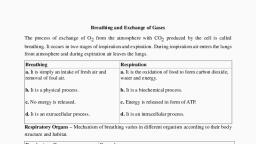
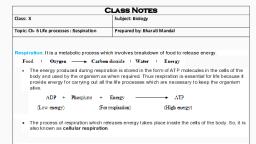
BREATHING AND EXCHANGE OF GASES, , BREATHING, •, , The process of exchange of oxygen, from the atmosphere with the, carbon dioxide produced by the, cell, , is, , called, , respiration, , or, , breathing., , TLB’S Biology Classes, , 2
Page 3 :
BREATHING AND EXCHANGE OF GASES, , RESPIRATORY ORGANS, • Lower, sponges,, , invertebrates, coelenterates, , like, flat, , worms etc. exchange oxygen, with CO2 by simple diffusion, over their entire body surfaces., , TLB’S Biology Classes, , 3
Page 4 :
BREATHING AND EXCHANGE OF GASES, , RESPIRATORY ORGANS, , • Earthworms, , Moist cuticle, , TLB’S Biology Classes, , 4
Page 5 :
BREATHING AND EXCHANGE OF GASES, , RESPIRATORY ORGANS, , • Insects, Tracheal tubes, (A network of tubes to, transport atmospheric air, within the body)., , TLB’S Biology Classes, , 5
Page 6 :
BREATHING AND EXCHANGE OF GASES, , RESPIRATORY ORGANS, , • Aquatic arthropods and, Molluscs, , Gills, , TLB’S Biology Classes, , 6
Page 7 :
BREATHING AND EXCHANGE OF GASES, , RESPIRATORY ORGANS, , • Terrestrial Arthropods, and Molluscs, , Lungs, , TLB’S Biology Classes, , 7
Page 8 :
BREATHING AND EXCHANGE OF GASES, , RESPIRATORY ORGANS, , • Fishes, Gills, , TLB’S Biology Classes, , 8
Page 9 :
BREATHING AND EXCHANGE OF GASES, , RESPIRATORY ORGANS, , • Amphibians, Skin, Lungs, , TLB’S Biology Classes, , 9
Page 10 :
BREATHING AND EXCHANGE OF GASES, , RESPIRATORY ORGANS, , • Reptiles, Birds and, Mammals, Lungs, , TLB’S Biology Classes, , 10
Page 11 :
BREATHING AND EXCHANGE OF GASES, , RESPIRATORY ORGANS, , TLB’S Biology Classes, , 11
Page 12 :
BREATHING AND EXCHANGE OF GASES, , HUMAN RESPIRATORY SYSTEM, , TLB’S Biology Classes, , 12
Page 14 :
BREATHING AND EXCHANGE OF GASES, ●, , External nostrils, , • Nasal passage, • Nasal chamber, , TLB’S Biology Classes, , 14
Page 15 :
BREATHING AND EXCHANGE OF GASES, , • The nasal chamber opens into, nasopharynx, which is a portion, of pharynx, the common passage, for food and air., , TLB’S Biology Classes, , 15
Page 16 :
BREATHING AND EXCHANGE OF GASES, , LARYNX, Upper part of the trachea, • Larynx is a cartilaginous box, which helps in sound production, and hence called the sound box, , TLB’S Biology Classes, , 16
Page 17 :
BREATHING AND EXCHANGE OF GASES, , GLOTTIS & EPIGLOTTIS, • Opening of the larynx is called, glottis, • A large leaf like cartilaginous lid, guards the opening of larynx, (glottis) called epiglottis., • Epiglottis prevent the entry of, food into the larynx., , TLB’S Biology Classes
Page 18 :
BREATHING AND EXCHANGE OF GASES, , BRONCHI, • Trachea, , is, , a, , straight, , tube, , extending up to the mid-thoracic, cavity, which divides at the level, of 5th thoracic vertebra into a, right and left primary bronchi., , TLB’S Biology Classes, , 18
Page 19 :
BREATHING AND EXCHANGE OF GASES, , BRONCHI AND BRONCHIOLES, • Each bronchi undergoes repeated, divisions to form the secondary, and, , tertiary, , bronchi, , and, , bronchioles., • Bronchioles ending up in very, thin terminal bronchioles., , TLB’S Biology Classes, , 19
Page 20 :
BREATHING AND EXCHANGE OF GASES, CARTILAGINOUS RINGS, • The tracheae, primary,, secondary and tertiary, bronchi, and initial, bronchioles are, supported by incomplete, cartilaginous rings., , TLB’S Biology Classes, , 20
Page 21 :
BREATHING AND EXCHANGE OF GASES, , ALVEOLI, • Each terminal bronchiole gives, rise to a number of very thin,, irregular, , walled, , and, , vascularised bag-like structures, called alveoli., , TLB’S Biology Classes, , 21
Page 22 :
BREATHING AND EXCHANGE OF GASES, , LUNGS, • The branching network, of bronchi, bronchioles, and, , alveoli, , comprise, , the lungs., , TLB’S Biology Classes, , 22
Page 23 :
BREATHING AND EXCHANGE OF GASES, , PLEURA, •, , Two lungs which are covered by a, double layered pleura, with pleural, fluid between them., , •, , It reduces friction on the lung surface., , TLB’S Biology Classes, , 23
Page 24 :
BREATHING AND EXCHANGE OF GASES, , PLEURA, • The outer pleural membrane is in, close contact with the thoracic, lining whereas the inner pleural, membrane is in contact with the, lung surface., , TLB’S Biology Classes, , 24
Page 25 :
BREATHING AND EXCHANGE OF GASES, , THE CONDUCTING PART OF RESPIRATION, •, , The, , part, , starting, , external, , nostrils, , up, , terminal, , bronchioles, , with, , the, , to, , the, , constitute, , the conducting part., •, , The conducting part transports, the atmospheric air to the alveoli,, clears it from foreign particles,, humidifies and also brings the air, to body temperature., , TLB’S Biology Classes, , 25
Page 26 :
BREATHING AND EXCHANGE OF GASES, , RESPIRATORY PART OF THE, RESPIRATORY SYSTEM., • The alveoli and their ducts form, the respiratory or exchange part, of the respiratory system., • Exchange part is the site of, actual diffusion of O2 and CO2, between blood and atmospheric, air., , TLB’S Biology Classes, , 26
Page 27 :
BREATHING AND EXCHANGE OF GASES, , THORACIC CHAMBER, •, , The lungs are situated in the thoracic, chamber which is anatomically an air-tight, chamber., , •, , The thoracic chamber is formed dorsally by, the vertebral column, ventrally by the, sternum, laterally by the ribs and on the, lower side by the dome-shaped diaphragm., , TLB’S Biology Classes, , 27
Page 28 :
BREATHING AND EXCHANGE OF GASES, , THORACIC CHAMBER, •, , The anatomical setup of lungs in thorax is, such that any change in the volume of the, thoracic cavity will be reflected in the lung, (pulmonary) cavity., , •, , Such, , an, , arrangement, , is, , essential, , for, , breathing, as we cannot directly alter the, pulmonary volume., , TLB’S Biology Classes, , 28
Page 29 :
BREATHING AND EXCHANGE OF GASES, Respiration involves the following steps:, (i) Breathing or pulmonary ventilation by which atmospheric air is drawn in and, CO2 rich alveolar air is released out., (ii) Diffusion of gases (O2 and CO2 ) across alveolar membrane., , TLB’S Biology Classes, , 29
Page 30 :
BREATHING AND EXCHANGE OF GASES, Respiration involves the following steps:, (iii) Transport of gases by the blood., (iv) Diffusion of O2 and CO2 between, blood and tissues., (v) Utilisation of O2 by the cells for, catabolic, , reactions, , and, , resultant, , release of CO2., , TLB’S Biology Classes, , 30
Page 31 :
BREATHING AND EXCHANGE OF GASES, Respiration involves the following steps:, , TLB’S Biology Classes, , 31
Page 32 :
BREATHING AND EXCHANGE OF GASES, , MECHANISM OF BREATHING, , TLB’S Biology Classes, , 32
Page 33 :
BREATHING AND EXCHANGE OF GASES, MECHANISM OF BREATHING, Breathing involves two stages :, ●, ●, , Inspiration during which atmospheric air is drawn in and, Expiration by which the alveolar air is released out., , TLB’S Biology Classes, , 33
Page 34 :
BREATHING AND EXCHANGE OF GASES, INSPIRATION, 1. Diaphragm contracts., 2. Volume of thoracic chambers increases in, anterio posterior axis., 3. External inter coastal muscles contracts., 4. The ribs and the sternum raised., 5. Volume of thoracic chamber increases in, dorso ventral axis, 6. Pulmonary volume increases., 7. Intra pulmonary pressure becomes less, than atmospheric pressure., 8. Air from outside move in to the lungs., , TLB’S Biology Classes
Page 35 :
BREATHING AND EXCHANGE OF GASES, EXPIRATION, , , , , , , , , 1. Diaphragm and inter coastal muscles, relaxes, 2. Thoracic and pulmonary volume decreases., 3. Intra pulmonary pressure increases above, the atmospheric pressure, 4. Air from lungs expelled., , TLB’S Biology Classes, , 35
Page 36 :
BREATHING AND EXCHANGE OF GASES, , MECHANISM OF BREATHING, INSPIRATION, , EXPIRATION, , TLB’S Biology Classes, , 36
Page 37 :
BREATHING AND EXCHANGE OF GASES, , RATE OF BREATHING, • On an average, a healthy, human breathes 12-16, times/minute., , TLB’S Biology Classes, , 37
Page 38 :
BREATHING AND EXCHANGE OF GASES, , SPIROMETER, • The volume of air involved in, breathing movements can be, estimated, spirometer, clinical, , by, , using, , which, , helps, , assessment, , a, in, of, , pulmonary functions., , TLB’S Biology Classes
Page 39 :
BREATHING AND EXCHANGE OF GASES, , RESPIRATORY VOLUMES, AND CAPACITIES, , TLB’S Biology Classes, , 39
Page 40 :
BREATHING AND EXCHANGE OF GASES, , RESPIRATORY VOLUMES, , TLB’S Biology Classes, , 40
Page 41 :
RESPIRATORY VOLUMES AND CAPACITIES, , TLB’S Biology Classes
Page 42 :
BREATHING AND EXCHANGE OF GASES, TIDAL VOLUME (TV), Volume of air inspired or expired, during a normal respiration., It is approx. 500 ml., i.e., a healthy, man can inspire or expire, approximately 6000 to 8000 ml, of air per minute., , TLB’S Biology Classes
Page 43 :
BREATHING AND EXCHANGE OF GASES, INSPIRATORY RESERVE VOLUME (IRV), , • Additional volume of air, a person, can inspire by a forcible inspiration., • This averages 2500 ml to 3000 ml., , TLB’S Biology Classes, , 43
Page 44 :
BREATHING AND EXCHANGE OF GASES, EXPIRATORY RESERVE VOLUME (ERV), , • Additional volume of air, a person can expire by a forcible expiration., • This averages 1000 ml to 1100 ml., , TLB’S Biology Classes, , 44
Page 45 :
BREATHING AND EXCHANGE OF GASES, RESIDUAL VOLUME (RV), •, , Volume of air remaining in, the, , lungs, , even, , after, , a, , forcible expiration., •, , This averages 1100 ml to, 1200 ml., , TLB’S Biology Classes, , 45
Page 46 :
BREATHING AND EXCHANGE OF GASES, , RESPIRATORY CAPACITIES, , TLB’S Biology Classes, , 46
Page 47 :
BREATHING AND EXCHANGE OF GASES, RESPIRATORY CAPACITIES, , 1. Inspiratory Capacity (IC):, , 3.Functional Residual Capacity (FRC):, , 2. Expiratory Capacity (EC):, , 4.Vital Capacity (VC):, , TLB’S Biology Classes, , 47
Page 48 :
BREATHING AND EXCHANGE OF GASES, INSPIRATORY CAPACITY (IC), •, , Total volume of air a person can inspire, after a normal expiration., , •, , This includes tidal volume and inspiratory, reserve volume ( TV+IRV)., , TLB’S Biology Classes, , 48
Page 49 :
BREATHING AND EXCHANGE OF GASES, EXPIRATORY CAPACITY (EC), • Total volume of air a person can, expire after a normal inspiration., • This includes tidal volume and, expiratory reserve volume (TV+ERV)., , TLB’S Biology Classes, , 49
Page 50 :
BREATHING AND EXCHANGE OF GASES, FUNCTIONAL RESIDUAL CAPACITY (FRC), , • Volume of air that will remain, in the lungs after a normal, expiration., • This includes ERV+RV., , TLB’S Biology Classes, , 50
Page 51 :
BREATHING AND EXCHANGE OF GASES, VITAL CAPACITY (VC), •, , The maximum volume of air a, person can breathe in after a, forced expiration., , •, , VC includes ERV, TV and IRV, or the maximum volume of, air a person can breathe out, after a forced inspiration., , TLB’S Biology Classes, , 51
Page 52 :
BREATHING AND EXCHANGE OF GASES, TOTAL LUNG CAPACITY, • Total, , volume, , of, , air, , accommodated in the lungs, at the end of a forced, inspiration., • This includes RV, ERV, TV, and IRV or vital capacity +, residual volume., , TLB’S Biology Classes, , 52
Page 53 :
BREATHING AND EXCHANGE OF GASES, Tidal Volume (TV):, • Volume of air inspired or expired during a normal respiration., •, , It is approx. 500 mL., i.e., a healthy man can inspire or expire approximately 6000 to 8000, mL of air per minute., , Inspiratory Reserve Volume (IRV):, • Additional volume of air, a person can inspire by a forcible inspiration. This averages, 2500mL to 3000 mL., Expiratory Reserve Volume (ERV):, ●, , Additional volume of air, a person can expire by a forcible expiration., , ●, , This averages 1000mL to 1100 mL., , Residual Volume (RV):, ●, ●, ●, , Volume of air remaining in the lungs even after a forcible expiration., This averages 1100 mL to 1200 mL., By adding up a few respiratory volumes described above, one can derive various pulmonary, capacities, which can be used in clinical diagnosis., , TLB’S Biology Classes, , 53
Page 54 :
BREATHING AND EXCHANGE OF GASES, Inspiratory Capacity (IC):, • Total volume of air a person can inspire after a normal expiration., •, , This includes tidal volume and inspiratory reserve volume ( TV+IRV), , Expiratory Capacity (EC):, • Total volume of air a person can expire after a normal inspiration., •, , This includes tidal volume and expiratory reserve volume (TV+ERV)., , Functional Residual Capacity (FRC):, ●, ●, , Volume of air that will remain in the lungs after a normal expiration., This includes ERV+RV., , Vital Capacity (VC):, ●, ●, , The maximum volume of air a person can breathe in after a forced expiration., This includes ERV, TV and IRV or the maximum volume of air a person can breathe, out after a forced inspiration., TLB’S Biology Classes, , 54
Page 55 :
BREATHING AND EXCHANGE OF GASES, Total Lung Capacity (TLC):, • Total volume of air accommodated in the lungs at the end of a forced, inspiration., • This includes RV, ERV, TV and IRV or vital capacity + residual volume., , TLB’S Biology Classes, , 55
Page 56 :
PLUS ONE ZOOLOGY, HUMAN PHYSIOLOGY, , BREATHING, AND EXCHANGE, OF GASES, TLB’S Biology Classes, , PART, , 3
Page 57 :
BREATHING AND EXCHANGE OF GASES, , EXCHANGE OF GASES, , TLB’S Biology Classes, , 57
Page 58 :
BREATHING AND EXCHANGE OF GASES, , EXCHANGE OF GASES, • Alveoli are the primary sites of, exchange of gases., • Exchange of gases also occur, between blood and tissues., , TLB’S Biology Classes, , 58
Page 59 :
BREATHING AND EXCHANGE OF GASES, , DIFFUSION OF GASES, • O2 and CO2 are exchanged in, alveoli and tissues by simple, diffusion, , mainly, , based, , on, , pressure/concentration gradient., , TLB’S Biology Classes, , 59
Page 60 :
BREATHING AND EXCHANGE OF GASES, , PARTIAL PRESSURE, • Pressure, , contributed, , by, , an, , individual gas in a mixture of gases, is called partial pressure and is, represented as pO2 for oxygen and, pCO2 for carbon dioxide., Oxygen, Carbon dioxide, TLB’S Biology Classes, , 60
Page 61 :
BREATHING AND EXCHANGE OF GASES, , GAS EXCHANGE IN ALVEOLI, , TLB’S Biology Classes, , 61
Page 62 :
BREATHING AND EXCHANGE OF GASES, PARTIAL PRESSURE OF O2, ●, , Partial pressure of inspired air that is entering, in lungs is 159., , ●, , From the atmospheric air 02 diffuses into the, alveoli and alveolar pO2 becomes 104., , ●, , O2 from alveoli diffuses in to the blood and, blood pO2 becomes 95., , ●, , Blood delivers O2 to the tissues and blood pO2, changes to 40., , ●, , Thus pO2 in the alveoli is higher than that of, deoxygenated blood and O2diffuses in to the, blood., , TLB’S Biology Classes, , 62
Page 64 :
BREATHING AND EXCHANGE OF GASES, , EXCHANGE OF GASES, , TLB’S Biology Classes
Page 65 :
BREATHING AND EXCHANGE OF GASES, HoW FAR THE STRUCTURE OF ALVEOLI IS FAVOURABLE FOR, GASEOUS EXCHANGE, • The diffusion membrane of alveoli is, made up of three major layers, – Squamous epithelium of alveoli,, – The endothelium of alveolar, capillaries, – The basement substance in between, them., • Its total thickness is much less than a, millimetre., , TLB’S Biology Classes, , 65
Page 66 :
BREATHING AND EXCHANGE OF GASES, , TRANSPORT OF GASES, , TLB’S Biology Classes, , 66
Page 67 :
BREATHING AND EXCHANGE OF GASES, , TRANSPORT OF OXYGEN, • About 97 per cent of O2 is, transported, , by, , RBCs, , in, , the, , blood., • The remaining 3 per cent of O2 is, carried, , in, , a, , dissolved, , state, , through the plasma., , TLB’S Biology Classes
Page 68 :
BREATHING AND EXCHANGE OF GASES, TRANSPORT OF OXYGEN, • Haemoglobin is a red coloured, iron containing pigment present, in the RBCs., • O2 can bind with haemoglobin in, a reversible manner to form, oxyhaemoglobin., , TLB’S Biology Classes
Page 69 :
BREATHING AND EXCHANGE OF GASES, , OXYHAEMOGLOBIN, • Each haemoglobin molecule, can carry a maximum of four, molecules of O2., , TLB’S Biology Classes
Page 70 :
BREATHING AND EXCHANGE OF GASES, , • What are the factors which favour the formation of oxyhaemoglobin, in lungs and its dissociation in tissues?, , TLB’S Biology Classes
Page 71 :
BREATHING AND EXCHANGE OF GASES, WHAT ARE THE FACTORS WHICH FAVOUR THE, FORMATION OF OXYHAEMOGLOBIN IN LUNGS ?, , • In the alveoli,, – high pO2, – low pCO2, – lesser H+ concentration and, – lower temperature, in the alveoli help in the formation of, oxyhaemoglobin in the lung alveoli., , TLB’S Biology Classes
Page 72 :
BREATHING AND EXCHANGE OF GASES, WHAT ARE THE FACTORS WHICH FAVOUR THE, DISSOCIATION OF OXYHAEMOGLOBIN IN TISSUES?, , • In the tissues, – low pO2, – high pCO2, – high H+ concentration and, – higher temperature, • These conditions are favourable for, dissociation of oxygen from the, oxyhaemoglobin., TLB’S Biology Classes, , 72
Page 73 :
BREATHING AND EXCHANGE OF GASES, , OXYGEN DISSOCIATION CURVE, , TLB’S Biology Classes, , 73
Page 74 :
BREATHING AND EXCHANGE OF GASES, OXYGEN DISSOCIATION CURVE, • A sigmoid curve is obtained when, percentage saturation of haemoglobin, with O2 is plotted against the pO2. This, curve is called the Oxygen dissociation, curve, • It is highly useful in studying the effect, of factors like pCO2, H+ concentration,, etc.,, , on, , binding, , of, , O2, , with, , haemoglobin., , TLB’S Biology Classes, , 74
Page 75 :
BREATHING AND EXCHANGE OF GASES, , TRANSPORT OF CARBON DIOXIDE, , TLB’S Biology Classes, , 75
Page 77 :
BREATHING AND EXCHANGE OF GASES, TRANSPORT OF CARBON DIOXIDE, CO2 transport takes place in 3 methods, As carbamino haemoglobin●, Nearly 20-25 per cent of CO2 is transported by RBCs., As bicarbonate ●, 70 per cent of CO2 is carried as bicarbonates., As carbonic acid ●, About 7 per cent of CO2 is carried in a dissolved state through, plasma as carbonic acid, , TLB’S Biology Classes, , 77
Page 79 :
BREATHING AND EXCHANGE OF GASES, TRANSPORT OF CARBON DIOXIDE, , As bicarbonate, •, , RBC contains the enzyme carbonic anhydrase which convert CO2 and, water to carbonic acid., , •, , Carbonic acid soon dissociates in to H+ ions and bicarbonate ions, (HCO3-), , •, , Bicarbonate ion soon diffuses out of the RBC., , •, , At the alveolar site pCO2 is low and the reaction is reversed., , •, , Thus CO2 trapped as bicarbonates from tissues is transported to, alveoli and released out as CO2, , Tissues, , Lungs
Page 80 :
BREATHING AND EXCHANGE OF GASES, , TRANSPORT OF CARBON DIOXIDE, , TLB’S Biology Classes, , 80
Page 81 :
BREATHING AND EXCHANGE OF GASES, TRANSPORT OF CARBON DIOXIDE, As Carbonic acid, • About 7 per cent of CO2 is, carried, , in, , a, , dissolved, , state, , through plasma., • In Plasma CO2 combines with, H2O to form Carbonic acid, , TLB’S Biology Classes
Page 82 :
BREATHING AND EXCHANGE OF GASES, , TRANSPORT OF CARBON DIOXIDE, , • Every 100 ml of deoxygenated, blood delivers approximately, 4 ml of CO2 to the alveoli., , TLB’S Biology Classes, , 82
Page 83 :
BREATHING AND EXCHANGE OF GASES, , REGULATION OF RESPIRATION, , TLB’S Biology Classes, , 83
Page 84 :
BREATHING AND EXCHANGE OF GASES, REGULATION OF RESPIRATION, , • A specialised centre present in, the medulla region of the brain, called respiratory rhythm centre, , Respiratory, Rhythm Centre, , is primarily responsible for the, regulation of respiration., , TLB’S Biology Classes, , 84
Page 85 :
BREATHING AND EXCHANGE OF GASES, , REGULATION OF RESPIRATION, •, , Another centre present in the pons, region, , of, , the, , brain, , called, , pneumotaxic centre can moderate the, , •, , functions of the respiratory rhythm, , Pneumotaxic centre, , centre., , Respiratory, Rhythm Centre, , Neural signal from this centre can, reduce the duration of inspiration and, there by alter the respiratory rate., , TLB’S Biology Classes, , 85
Page 86 :
BREATHING AND EXCHANGE OF GASES, , REGULATION OF RESPIRATION, • A, , chemosensitive, , area, , is, , situated, , adjacent to the rhythm centre which is, highly sensitive to CO2 and hydrogen, ions., • Increase, , in, , these, , substances, , can, , activate this centre, which in turn can, , Pneumotaxic centre, , signal, , Respiratory, Rhythm Centre, , the rhythm, , centre to, , make, , necessary adjustments in the respiratory, process by which these substances can, be eliminated., , TLB’S Biology Classes, , Chemosensitive, area, 86
Page 87 :
BREATHING AND EXCHANGE OF GASES, , REGULATION OF, RESPIRATION, , • Receptors associated with aortic, arch and carotid artery also can, recognise changes in CO2 and H+, concentration, , and, , send, , necessary signals to the rhythm, centre for remedial actions., , TLB’S Biology Classes, , 87
Page 88 :
BREATHING AND EXCHANGE OF GASES, , DISORDERS OF RESPIRATORY, SYSTEM, , TLB’S Biology Classes, , 88
Page 89 :
BREATHING AND EXCHANGE OF GASES, , ASTHMA, • Difficulty in breathing causing, wheezing due to inflammation of, bronchi and bronchioles., , TLB’S Biology Classes
Page 90 :
BREATHING AND EXCHANGE OF GASES, , EMPHYSEMA, • Chronic, , disorder, , in, , which, , alveolar walls are damaged due, to which respiratory surface is, decreased., • One of the major causes of this, is cigarette smoking., , TLB’S Biology Classes, , 90
Page 91 :
BREATHING AND EXCHANGE OF GASES, OCCUPATIONAL RESPIRATORY, DISORDERS, •, , In certain industries, especially those, involving grinding or stone-breaking, so, much dust is produced that the defence, mechanism of the body cannot fully, cope with the situation., , •, , Long exposure can give rise to, inflammation, leading, to, fibrosis, (proliferation of fibrous tissues) and, thus causing serious lung damage., , •, , Workers in such industries should wear, protective masks., TLB’S Biology Classes, , 91
Page 92 :
BREATHING AND EXCHANGE OF GASES, , END OF THE CHAPTER, , TLB’S Biology Classes