Notes of +2 Zoology 22-23, Zoology locomotion - Study Material
Page 1 :
PLUS ONE ZOOLOGY, HUMAN PHYSIOLOGY, , LOCOMOTION, AND, MOVEMENT, TLB’S Biology Classes
Page 2 :
LOCOMOTION AND MOVEMENT, , WHAT IS THE DIFFERENCE BETWEEN, LOCOMOTION AND MOVEMENT ?, , TLB’S Biology Classes, , 2
Page 3 :
LOCOMOTION AND MOVEMENT, MOVEMENT, •, , Movement is one of the significant, features of living beings., , •, , Animals and plants exhibit a wide, range of movements., , •, , Streaming of protoplasm in the, unicellular organisms like Amoeba, is a simple form of movement., , TLB’S Biology Classes, , 3
Page 4 :
LOCOMOTION AND MOVEMENT, MOVEMENT, •, , Movement of cilia, flagella and tentacles, are shown by many organisms., , •, , Human beings can move limbs, jaws,, eyelids, tongue, etc., , TLB’S Biology Classes, , 4
Page 5 :
LOCOMOTION AND MOVEMENT, LOCOMOTION, • In Paramoecium, cilia helps, in the movement of food, through cytopharynx and in, locomotion as well., , TLB’S Biology Classes, , 5
Page 6 :
LOCOMOTION AND MOVEMENT, LOCOMOTION, • Hydra can use its tentacles for, capturing its prey and also use them, for locomotion., , TLB’S Biology Classes, , 6
Page 7 :
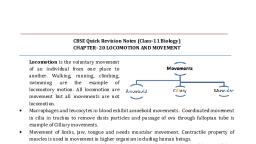
LOCOMOTION AND MOVEMENT, WHAT IS THE DIFFERENCE BETWEEN LOCOMOTION AND MOVEMENT, , •, , Motion of part of the body is known, as movement ., , •, , Movement of whole body from one place to, another place is locomotion., , TLB’S Biology Classes, , 7
Page 8 :
LOCOMOTION AND MOVEMENT, WHAT IS THE DIFFERENCE BETWEEN LOCOMOTION AND MOVEMENT, •, •, •, , Walking, running, climbing, flying, swimming are all some, forms of locomotory movements., Locomotion is the voluntary movements resulting in a, change in location., All locomotion are movements but all, movements are not locomotion., , TLB’S Biology Classes, , 8
Page 9 :
LOCOMOTION AND MOVEMENT, TYPES OF MOVEMENT, • Cells of the human body exhibit three main, types of movements., , • Amoeboid Movement, • Ciliary Movement, • MuscularMovement, , TLB’S Biology Classes
Page 10 :
LOCOMOTION AND MOVEMENT, AMOEBOID MOVEMENT, ●, , Amoeba like movement is known as, amoeboid movement ., , ●, , It is effected by pseudopodia formed, by the streaming of protoplasm (as, in Amoeba)., , ●, , Eg., , Phagocytosis, , by, , leucocytes,, , migration of macrophages through, tissues., , TLB’S Biology Classes
Page 11 :
LOCOMOTION AND MOVEMENT, CILIARY MOVEMENT, ●, , Movement with the help of cilia is known as, ciliary movement., , ●, , Inner, lining of, trachea, , Ciliary movement occurs in most of our, internal tubular organs which are lined by, ciliated epithelium., , ●, , The coordinated movements of cilia in the, trachea help us in removing dust particles and, some of the foreign substances inhaled along, with the atmospheric air., , TLB’S Biology Classes
Page 12 :
LOCOMOTION AND MOVEMENT, CILIARY MOVEMENT, ●, , Passage of ova through the, female reproductive tract is, facilitated, , by, , the, , ciliary, , movement., , TLB’S Biology Classes
Page 13 :
LOCOMOTION AND MOVEMENT, MUSCULAR MOVEMENT, ●, , Movement with the help of muscles., , ●, , E.g. movements of limbs, tongue,, jaw etc., , TLB’S Biology Classes
Page 14 :
LOCOMOTION AND MOVEMENT, , HUMAN MUSCULAR SYSTEM, , TLB’S Biology Classes
Page 15 :
LOCOMOTION AND MOVEMENT, HUMAN MUSCULAR SYSTEM, ●, , It includes muscles which are, mesodermal in origin., , ●, , Muscles constitute 40-50% of the, body weight., , ●, , Muscles have excitability,, contractility, extensibility &, elasticity., , TLB’S Biology Classes
Page 16 :
LOCOMOTION AND MOVEMENT, , TYPES OF MUSCLES, , TLB’S Biology Classes
Page 17 :
LOCOMOTION AND MOVEMENT, Based on location, muscles are 3 types:, , TYPES OF MUSCLES, Skeletal, (Striated or, voluntary), , Visceral (Nonstriated or Smooth), , TLB’S Biology Classes, , Cardiac
Page 18 :
LOCOMOTION AND MOVEMENT, , 1. SKELETAL MUSCLES, (STRIATED MUSCLES), , TLB’S Biology Classes
Page 19 :
LOCOMOTION AND MOVEMENT, 1. SKELETAL MUSCLES, (STRIATED MUSCLES), ●, , Skeletal muscles are closely associated with the, skeletal components of the body., , ●, , They have a striped appearance under the, microscope, , and, , hence, , are, , called, , striated, , muscles., ●, , As their activities are under the voluntary, control of the nervous system, they are known, as voluntary muscles too., , ●, , They are primarily involved in locomotory, actions and changes of body postures., , TLB’S Biology Classes
Page 20 :
LOCOMOTION AND MOVEMENT, 2. CARDIAC MUSCLES, ●, , As, , the, , name, , suggests,, , Cardiac, , muscles are the muscles of heart., ●, , Many cardiac muscle cells assemble, in a branching pattern to form a, cardiac muscle., , ●, , Based, , on, , appearance,, , cardiac, , muscles are striated., ●, , They are involuntary in nature as the, nervous system does not control their, activities directly., TLB’S Biology Classes
Page 21 :
LOCOMOTION AND MOVEMENT, 3. VISCERAL MUSCLES, (NON STRIATED MUSCLES OR SMOOTH MUSCLES), ●, , Visceral muscles are located in the inner walls of, hollow visceral organs of the body like the, alimentary canal, reproductive tract, etc., , ●, , They do not exhibit any striation and are smooth, in appearance., , ●, , Hence,, , they, , are, , called, , smooth, , muscles, , (nonstriated muscle)., ●, , Their activities are not under the voluntary, control of the nervous system and are therefore, known as involuntary muscles., , ●, , They assist, in the transportation of food through, the digestive tract and gametes through the, genital tract., , TLB’S Biology Classes
Page 22 :
LOCOMOTION AND MOVEMENT, , STRUCTURE OF SKELETAL MUSCLE, , TLB’S Biology Classes
Page 23 :
LOCOMOTION AND MOVEMENT, STRUCTURE OF SKELETAL MUSCLE, Fascicles & Fascia, ●, , Each skeletal muscle in our body is, made of a number of muscle bundles, called fascicles., , ●, , Fascicles are, , held together by, , connective tissue layer called fascia., ●, , Each, , muscle, , bundle, , contains, , a, , number of muscle fibres, TLB’S Biology Classes
Page 27 :
LOCOMOTION AND MOVEMENT, STRUCTURE OF MYOFIBRIL, Actin and Myosin, ●, , Each myofibril has alternate dark and light, bands on it., , ●, , The striated appearance of myofibril is due to, the distribution pattern of two important, proteins – Actin and Myosin., , TLB’S Biology Classes
Page 28 :
LOCOMOTION AND MOVEMENT, I-band and ‘A’ band, ●, , The light bands contain actin and is, called I-band or Isotropic band,, , ●, , The dark band is called ‘A’ band, , or, , Anisotropic band which contains myosin., ●, , Both the proteins are arranged as rodlike structures, parallel to each other and, also to the longitudinal axis of the, myofibrils., , ●, , Actin filaments are thinner as compared, to the myosin filaments., TLB’S Biology Classes
Page 29 :
LOCOMOTION AND MOVEMENT, ‘Z’ line & ‘M’ line, ●, , The elastic fibre in the centre of ‘I’ band, which bisects it is known as ‘Z’ line., , ●, , Thin fibrous membrane, , found in the, , middle of ‘A’ band are called ‘M’ line., , TLB’S Biology Classes
Page 30 :
LOCOMOTION AND MOVEMENT, Sarcomere, ●, , The ‘A’ and ‘I’ bands are arranged, alternately throughout the length of, the myofibrils., , ●, , The, , portion, , of, , the, , myofibril, , between two successive ‘Z’ lines is, considered as the functional unit of, contraction, , and, , is, , called, , a, , sarcomere., TLB’S Biology Classes
Page 31 :
LOCOMOTION AND MOVEMENT, ‘H’ zone, ●, , In a resting state, the edges of thin, filaments on either side of the thick, filaments partially overlap the free ends of, the thick filaments leaving the central part, of the thick filaments., , ●, , This central part of thick filament, not, overlapped by thin filaments is called the, ‘H’ zone., , TLB’S Biology Classes
Page 32 :
LOCOMOTION AND MOVEMENT, , STRUCTURE OF MYOFIBRIL, ●, , ‘A’ band and ‘I’ band, , ●, , ‘Z’ line and ‘M’ line, , ●, , Sarcomere, , ●, , ‘H’ zone, , TLB’S Biology Classes
Page 33 :
LOCOMOTION AND MOVEMENT, STRUCTURE OF SKELETAL MUSCLE, , TLB’S Biology Classes
Page 35 :
LOCOMOTION AND MOVEMENT, STRUCTURE OF MYOFIBRIL, , ●, , ‘A’ band and ‘I’ band, , ●, , ‘Z’ line and ‘M’ line, , ●, , Sarcomere, , ●, , ‘H’ zone, , TLB’S Biology Classes
Page 36 :
LOCOMOTION AND MOVEMENT, , STRUCTURE OF CONTRACTILE PROTEINS, , TLB’S Biology Classes
Page 37 :
LOCOMOTION AND MOVEMENT, STRUCTURE OF ACTIN FILAMENT, , ●, , Each actin (thin) filament is made of two ‘F’ (filamentous) actins helically wound to, each other., , ●, , Each ‘F’ actin is a polymer of monomeric ‘G’ (Globular) actins., , ●, , Two filaments of another protein, tropomyosin also run close to the ‘F’ actins, throughout its length., , ●, , A complex protein Troponin is distributed at regular intervals on the tropomyosin., TLB’S Biology Classes
Page 38 :
LOCOMOTION AND MOVEMENT, STRUCTURE OF MYOSIN FILAMENT, ●, , Each myosin (thick) filament is also a, polymerised protein., , ●, , Many, , monomeric, , Meromyosins, , proteins, , constitute, , one, , called, thick, , filament., ●, , Each, , meromyosin, , has, , two, , important, , parts, a globular head with a short arm, called heavy meromyosin (HMM), , and a, , tail called light meromyosin (LMM)., , TLB’S Biology Classes
Page 39 :
LOCOMOTION AND MOVEMENT, STRUCTURE OF MYOSIN FILAMENT, ●, , The HMM component, i.e.; the head, and short arm projects outwards at, regular distance from the surface of, myosin filament and is known as, , cross arm., ●, , The globular head is an active, , ATPase, , enzyme and has binding sites for ATP, and active sites for actin., , TLB’S Biology Classes
Page 40 :
LOCOMOTION AND MOVEMENT, , MECHANISM OF, MUSCLE CONTRACTION, SLIDING FILAMENT THEORY, , TLB’S Biology Classes
Page 41 :
MECHANISM OF MUSCLE CONTRACTION, , SLIDING FILAMENT THEORY, ●, , Mechanism of muscle contraction, is best explained by the sliding, filament theory., , ●, , This theory states that contraction, of a muscle fibre takes place by, the sliding of the thin filaments, over the thick filaments., , TLB’S Biology Classes
Page 42 :
MECHANISM OF MUSCLE CONTRACTION, SLIDING FILAMENT THEORY, ●, , Muscle contraction is initiated by a, signal sent by the central nervous system, (CNS) via a motor neuron., , ●, , A motor neuron along with the muscle, fibres connected to it constitute a motor, unit., , ●, , The junction between a motor neuron, and the sarcolemma of the muscle fibre, is called the neuromuscular junction or, motor-end plate, TLB’S Biology Classes
Page 43 :
MECHANISM OF MUSCLE CONTRACTION, SLIDING FILAMENT THEORY, ●, , A neural signal reaching this junction releases a neurotransmitter (Acetyl choline), which generates an action potential in the sarcolemma., , ●, , This spreads through the muscle fibre and causes the release of calcium ions into the, sarcoplasm., , TLB’S Biology Classes
Page 44 :
MECHANISM OF MUSCLE CONTRACTION, SLIDING FILAMENT THEORY, , ●, , Increase in Ca++ level leads to the, binding of calcium with a subunit, of troponin on actin filaments, and thereby remove the masking, of active sites for myosin., , TLB’S Biology Classes
Page 45 :
MECHANISM OF MUSCLE CONTRACTION, SLIDING FILAMENT THEORY, ●, , Utilising the energy from ATP hydrolysis, the myosin head now binds to the, exposed active sites on actin to form a cross bridge, , TLB’S Biology Classes
Page 46 :
MECHANISM OF MUSCLE CONTRACTION, SLIDING FILAMENT THEORY, ●, , This pulls the attached actin, filaments towards the centre of ‘A’, band., , TLB’S Biology Classes
Page 47 :
MECHANISM OF MUSCLE CONTRACTION, SLIDING FILAMENT THEORY, ●, , The ‘Z’ line attached to these actins, are also pulled inwards thereby, causing a, shortening of the, sarcomere, i.e., contraction., , TLB’S Biology Classes
Page 48 :
MECHANISM OF MUSCLE CONTRACTION, SLIDING FILAMENT THEORY, , ●, , The myosin, releasing the ADP and, P1 goes back to its relaxed state., , ●, , A new ATP binds and the crossbridge is broken., , ●, , The ATP is again hydrolysed by the, myosin head and the cycle of cross, bridge formation and breakage is, repeated causing further sliding., , TLB’S Biology Classes
Page 49 :
MECHANISM OF MUSCLE CONTRACTION, SLIDING FILAMENT THEORY, ●, , ●, ●, , The process continues till the Ca++ ions are pumped back to the sarcoplasmic cisternae resulting in, the masking of actin filaments., This causes the return of ‘Z’ lines back to their original position, i.e., relaxation., The reaction time of the fibres can vary in different muscles., , TLB’S Biology Classes
Page 50 :
MECHANISM OF MUSCLE CONTRACTION, SLIDING FILAMENT THEORY, , TLB’S Biology Classes
Page 51 :
MECHANISM OF MUSCLE CONTRACTION, SLIDING FILAMENT THEORY, , TLB’S Biology Classes
Page 52 :
MECHANISM OF MUSCLE CONTRACTION, SLIDING FILAMENT THEORY, , TLB’S Biology Classes
Page 53 :
MECHANISM OF MUSCLE CONTRACTION, SLIDING FILAMENT THEORY, , TLB’S Biology Classes
Page 54 :
MECHANISM OF MUSCLE CONTRACTION, SLIDING FILAMENT THEORY, ●, , During shortening of the muscle, i.e.,, contraction, the ‘I’ bands get, reduced, whereas the ‘A’ bands, retain the length., , TLB’S Biology Classes
Page 55 :
MECHANISM, OF MUSCLE, CONTRACTION, LOCOMOTION, AND MOVEMENT, , MUSCLE FATIGUE, , TLB’S Biology Classes
Page 56 :
MECHANISM OF MUSCLE CONTRACTION, MUSCLE FATIGUE, ●, , Repeated activation of the muscles can, lead to the accumulation of lactic acid due, to anaerobic breakdown of glycogen in, them, causing fatigue., , TLB’S Biology Classes
Page 58 :
MECHANISM OF MUSCLE CONTRACTION, RED MUSCLE FIBRE, ●, , Muscle contains a red coloured oxygen, storing pigment called myoglobin., , ●, , Myoglobin content is high in some of the, muscles which gives a reddish appearance., , ●, , Such muscles are called the Red fibres., , ●, , These, , muscles, , also, , contain, , plenty, , of, , mitochondria which can utilise the large, amount of oxygen stored in them for ATP, production., ●, , These muscles, therefore, can also be called, aerobic muscles., , TLB’S Biology Classes
Page 59 :
MECHANISM OF MUSCLE CONTRACTION, WHITE MUSCLE FIBRE, ●, , Some of the muscles possess very less, quantity of myoglobin and therefore, appear, pale or whitish., , ●, , These are the White fibres., , ●, , Number of mitochondria are also few in, them, but the amount of sarcoplasmic, reticulum is high., , ●, , They depend on anaerobic process for, energy., , TLB’S Biology Classes
Page 61 :
LOCOMOTION AND MOVEMENT, , SKELETAL SYSTEM, , TLB’S Biology Classes
Page 62 :
SKELETAL SYSTEM, ●, , Skeletal system consists of a framework of bones and a, few cartilages., , ●, , Bone and cartilage are specialised connective tissues., , ●, , Bones has a very hard matrix due to calcium salts in it, and, , cartilages, , has, , slightly, , pliable, , matrix, , due, , to, , chondroitin salts., , TLB’S Biology Classes
Page 63 :
SKELETAL SYSTEM, In human beings,Skeletal System is made, up of 206 bones and a few cartilages., It is grouped into two principal divisions –, ●, , ●, , axial skeleton and, appendicular skeleton., , TLB’S Biology Classes
Page 64 :
SKELETAL SYSTEM, , Axial skeleton, , TLB’S Biology Classes
Page 65 :
SKELETAL SYSTEM, , Axial skeleton, ●, , Axial skeleton comprises 80 bones, distributed along the main axis of the body., , ●, , The skull,, , ●, , vertebral column,, , ●, , sternum and, , ●, , ribs constitute axial skeleton., TLB’S Biology Classes
Page 66 :
SKELETAL SYSTEM, SKULL, ●, , The skull is composed of two sets of bones (22 bones), , ●, , and hyoid bone and ear ossicles, , TLB’S Biology Classes
Page 67 :
SKELETAL SYSTEM, SKULL, ●, , Cranial - 8 bones., , ●, , They form the hard protective outer, covering, cranium for the brain., , ●, , Facial bones -14 bones., , ●, , The facial region is made up of 14, skeletal elements which form the front, part of the skull., , TLB’S Biology Classes
Page 68 :
SKELETAL SYSTEM, , Hyoid Bone, , ●, , A single U-shaped bone called, hyoid is present at the base of the, buccal, , cavity, , and, , it, , is, , also, , included in the skull., , TLB’S Biology Classes
Page 69 :
SKELETAL SYSTEM, Ear Ossicles, ●, , Each middle ear contains three, tiny bones –, , ●, , Malleus,, , ●, , Incus and, , ●, , Stapes, collectively called, , Ear Ossicles., , TLB’S Biology Classes
Page 71 :
SKELETAL SYSTEM, , Vertebral Column, , TLB’S Biology Classes
Page 72 :
SKELETAL SYSTEM, , TLB’S Biology Classes
Page 73 :
SKELETAL SYSTEM, Vertebral Column, ●, , Our vertebral column is formed by 26, serially arranged units called vertebrae, and is dorsally placed., , ●, , It extends from the base of the skull and, constitutes the main framework of the, trunk., , TLB’S Biology Classes
Page 74 :
SKELETAL SYSTEM, Vertebral Column, , ●, , Each vertebra has a central, hollow, , portion, , (neural, , canal) through which the, spinal cord passes., , TLB’S Biology Classes
Page 75 :
SKELETAL SYSTEM, Vertebral Column, ●, , First, , vertebra, , is, , the, , atlas, , and, , it, , articulates with the occipital condyles., , TLB’S Biology Classes
Page 76 :
SKELETAL SYSTEM, Vertebral Column, ●, , The vertebral column is differentiated, into, , ●, , Cervical (7),, , ●, , thoracic (12),, , ●, , lumbar (5),, , ●, , Sacral (1-fused) and, , ●, , coccygeal, , (1-fused), , regions, , starting, , from the skull., , TLB’S Biology Classes
Page 77 :
SKELETAL SYSTEM, , Vertebral Column, ●, , The number of cervical vertebrae, are seven in almost all mammals, including human beings., , TLB’S Biology Classes
Page 78 :
SKELETAL SYSTEM, Vertebral Column, ●, , The vertebral column protects the spinal, cord, supports the head and serves as, the point of attachment for the ribs and, musculature of the back., , ●, , Sternum is a flat bone on the ventral, midline of thorax., , TLB’S Biology Classes
Page 79 :
SKELETAL SYSTEM, , Ribs, , TLB’S Biology Classes
Page 80 :
SKELETAL SYSTEM, SKELETAL SYSTEM, , TLB’S Biology Classes
Page 81 :
SKELETAL SYSTEM, , Ribs, ●, , There are 12 pairs of ribs., , ●, , Each, , rib, , is, , a, , thin, , flat, , bone, , connected dorsally to the vertebral, column, , and, , ventrally, , to, , the, , sternum., , TLB’S Biology Classes
Page 82 :
SKELETAL SYSTEM, , Ribs, ●, , It has two articulation surfaces on, its dorsal end and is hence called, bicephalic., , TLB’S Biology Classes
Page 83 :
SKELETAL SYSTEM, , Ribs, ●, , First seven pairs of ribs are called, true ribs., , ●, , Dorsally, they are attached to the, thoracic vertebrae and ventrally, connected to the sternum with the, help of hyaline cartilage., , TLB’S Biology Classes
Page 84 :
SKELETAL SYSTEM, , Ribs, ●, , The 8th , 9th and 10th pairs of ribs do, not articulate directly with the, sternum but join the seventh rib, with the help of hyaline cartilage., , ●, , These are called vertebrochondral, (false) ribs., , TLB’S Biology Classes
Page 85 :
SKELETAL SYSTEM, , Ribs, ●, , Last 2 pairs (11th and 12th ) of ribs are, not, , connected, , ventrally, , and, , are, , therefore, called floating ribs., ●, , Thoracic vertebrae, ribs and sternum, together form the rib cage, , TLB’S Biology Classes
Page 87 :
SKELETAL SYSTEM, Appendicular Skeleton, ●, , The bones of the limbs along with their, girdles, , constitute, , the, , appendicular, , skeleton., ●, , Each limb is made of 30 bones., , TLB’S Biology Classes
Page 88 :
SKELETAL SYSTEM, Bones of the hand (fore limb), ●, , The bones of the hand (fore limb) are, , ●, , humerus,, , ●, , radius and, , ●, , ulna,, , ●, , carpals (wrist bones – 8 in number),, , ●, , metacarpals (palm bones – 5 in number) and, , ●, , phalanges (digits – 14 in number), TLB’S Biology Classes
Page 89 :
SKELETAL SYSTEM, Appendicular Skeleton, Bones of the hand (fore limb), , TLB’S Biology Classes
Page 90 :
SKELETAL SYSTEM, Appendicular Skeleton, Bones of the Leg (hind limb), ●, , Femur (thigh bone – the longest bone),, , ●, , tibia and fibula,, , ●, , tarsals (ankle bones – 7 in number),, , ●, , metatarsals (5 in number) and, , ●, , phalanges (digits – 14 in number) are the, bones of the legs (hind limb), , ●, , A cup shaped bone called patella cover, the knee ventrally (knee cap)., TLB’S Biology Classes
Page 91 :
SKELETAL SYSTEM, SKELETAL SYSTEM, , TLB’S Biology Classes
Page 92 :
SKELETAL SYSTEM, , Pectoral girdle, , TLB’S Biology Classes
Page 93 :
SKELETAL SYSTEM, Pectoral girdle, ●, , Pectoral girdle bones help in the articulation, of the upper limbs with the axial skeleton., , ●, , Each half of pectoral girdle consists of a, , ●, , clavicle and, , ●, , a scapula ., , TLB’S Biology Classes
Page 94 :
SKELETAL SYSTEM, Scapula, ●, , Scapula is a large triangular flat bone, situated in the dorsal part of the thorax, between the second and the seventh ribs., , Acromian process, ●, , The dorsal, flat, triangular body of scapula, has a slightly elevated ridge called the, spine which projects as a flat, expanded, process called the acromion., , ●, , The clavicle articulates with this., TLB’S Biology Classes
Page 95 :
SKELETAL SYSTEM, Glenoid cavity, ●, , Below the acromion is a depression called, the, , glenoid cavity, , which articulates, , with the head of the humerus to form the, shoulder joint., , TLB’S Biology Classes
Page 96 :
SKELETAL SYSTEM, Clavicle, ●, , Each clavicle is a long slender bone, with two curvatures., , ●, , This bone is commonly called the, , collar bone., , TLB’S Biology Classes
Page 97 :
SKELETAL SYSTEM, , Pelvic girdle, , TLB’S Biology Classes
Page 98 :
SKELETAL SYSTEM, Pelvic girdle, ●, , Pelvic girdle bones help in the, articulation of the the lower limbs, with the axial skeleton, , ●, , Formed of two coxal bones., , ●, , Each coxal is bone formed by the, fusion of 3 bone –, , ●, , ilium ,, , ●, , pubis and, , ●, , ischium, TLB’S Biology Classes
Page 99 :
SKELETAL SYSTEM, Acetabulum, ●, , The cavity formed at the point of fusion of the, three bones –ileum, ischium and pubis to which, the thigh bone articulates., , TLB’S Biology Classes
Page 100 :
SKELETAL SYSTEM, Pubic Symphasis, ●, , The pubis bone of the two sides, articulate at the median line and, forms pubic symphasis., , TLB’S Biology Classes
Page 101 :
SKELETAL SYSTEM, , JOINTS, , TLB’S Biology Classes
Page 102 :
SKELETAL SYSTEM, JOINTS, ●, , The place of articulation between two or, more bones or between a bone and a, cartilage is known as joints., , ●, , 3 types of joints are there, , 1. Fibrous joints, 2. Cartilaginous joints, , 3. Synovial joints, TLB’S Biology Classes
Page 103 :
SKELETAL SYSTEM, 1. Fibrous joints, ●, , Fibrous, , joints, , do, , not, , allow, , any, , movement., ●, , This type of joint is shown by the flat, skull bones which fuse end-to-end with, the help of dense fibrous connective, tissues in the form of sutures, to form, the cranium., , TLB’S Biology Classes
Page 104 :
SKELETAL SYSTEM, 2. Cartilaginous joints, ●, , In cartilaginous joints, the bones involved, are joined together with the help of, cartilages., , ●, , The joint between the adjacent vertebrae, in the vertebral column is of this pattern, and it permits limited movements., , TLB’S Biology Classes
Page 105 :
SKELETAL SYSTEM, , 3. Synovial joints, ●, , Synovial joints are characterised by the, presence of a fluid filled synovial cavity, between the articulating surfaces of the, two bones., , ●, , Such, , an, , arrangement, , allows, , considerable movement., ●, , These joints help in locomotion and, many other movements., , TLB’S Biology Classes
Page 106 :
SKELETAL SYSTEM, , 3. Synovial joints, ●, , Ball and socket joint, (between, , humerus, , and, , pectoral, , girdle(Shoulder joint) femur and pelvic, girdle (Hip joint)),, ●, , hinge joint (knee joint, elbow joint),, , ●, , pivot joint (between atlas and axis),, , ●, , Gliding joint (between the carpals), , ●, , saddle, , joint, , metacarpal, examples., , (between, of, , thumb), , carpal, are, , and, some, , TLB’S Biology Classes
Page 107 :
LOCOMOTION AND MOVEMENT, , DISORDERS OF MUSCULAR, AND SKELETAL SYSTEM, , TLB’S Biology Classes
Page 108 :
DISORDERS OF MUSCULAR AND SKELETAL SYSTEM, , Myasthenia gravis, ●, , Auto, , immune, , disorder, , affecting, , neuromuscular junction leading to, fatigue, weakening and paralysis of, skeletal muscles., , TLB’S Biology Classes
Page 109 :
DISORDERS OF MUSCULAR AND SKELETAL SYSTEM, , Muscular dystrophy, ●, , Progressive degeneration of skeletal, muscles mostly due to genetic disorder, , TLB’S Biology Classes
Page 110 :
DISORDERS OF MUSCULAR AND SKELETAL SYSTEM, , Tetany, ●, , Rapid spasms(wild contractions) in muscle, due to low calcium ions in body fluid, , TLB’S Biology Classes
Page 111 :
DISORDERS OF MUSCULAR AND SKELETAL SYSTEM, , Arthritis, • inflammation of joints, , TLB’S Biology Classes
Page 112 :
DISORDERS OF MUSCULAR AND SKELETAL SYSTEM, , Osteoporosis, ●, , Age related disorder characterized by, decreased bone mass and increased, chances of fractures., , ●, , Decreased levels of oestrogen is a, common cause, , TLB’S Biology Classes
Page 113 :
DISORDERS OF MUSCULAR AND SKELETAL SYSTEM, , Gout, • Inflammation of joints due to, accumulation of uric acid crystals, , TLB’S Biology Classes
Page 114 :
LOCOMOTION AND MOVEMENT, , END OF THE CHAPTER, , TLB’S Biology Classes



 Learn better on this topic