Notes of +1 2021-22 Zoology, Zoology cockroach.pdf - Study Material
Page 1 :
COCKROACH
Page 3 :
●, , Body - Head, Thorax & Abdomen, , ●, , Head is triangular shape, , ●, , The mouth parts consisting of, –, , A labrum (upper lip), , –, , A pair of mandibles,, , –, , A pair of maxillae, , –, , A labium (lower lip), , –, , Hypopharynx
Page 4 :
COCKROACH
Page 5 :
●, , ●, , ●, , Thorax, –, , Prothorax, , –, , Mesothorax, , –, , Metathorax, , Each thoracic segment bears a pair of walking legs, The first pair of wings arises from mesothorax and the second, pair from metathorax. Fore-wings known as tegmina., , ●, , Abdomen, , ●, , Abdomen consists of 10 segments, , ●, , In both sexes, the10th segment bears a pair of jointed, filamentous structures called anal cerci.
Page 6 :
Difference between male & female cockroach, Male cockroach, , Female cockroach, , Abdomen is long and narrow, In the abdomen 9 segments are, visible, , Short and broad abdomen, In he abdomen 7 segments are, visible, , Anal styles are present, , Anal styles are absent, , 7th tergum covers 8th tergum, , 7th tergum covers 8th and 9th terga, , Brood pouch is absent, , Brood pouch is present, , Antenna is long, , Antenna is short
Page 8 :
Foregut:, ●, , ●, , ●, , ●, , ●, , ●, , It starts with mouth. The mouth opens into a short tubular, pharynx, leading to a narrow tubular passage called, oesophagus., This in turn opens into a sac like structure called crop used for, storing of food., The crop is followed by gizzard or proventriculus., It has an outer layer of thick circular muscles and thick inner, cuticle forming six highly chitinous plate called teeth., Gizzard helps in grinding the food particles, A ring of 6-8 blind tubules called hepatic or gastric caecae is, present at the junction of foregut and midgut, which secrete, digestive juice.
Page 9 :
Midgut:, ●, ●, , Malpighian tubules., They help in removal of excretory products from, haemolymph., Hindgut, , ●, , ●, , The hindgut is differentiated into ileum, colon, and rectum., The rectum opens out through anus
Page 10 :
Circulatory system, ●, , Open type, , ●, , Haemocoel, , ●, , Haemolymph – plasma and haemocytes, , ●, , ●, , Heart is differentiated into funnel shaped, chambers with ostia on either side, Blood from the sinuses enter hearts through, ostia and is pumped anteriorly to sinuses again.
Page 11 :
Respiratory system, ●, , Trachea, , ●, , Presence of spiracles, , ●, , Gas exchange takes place at the tracheoles by diffusion, , Excretory system, ●, , Malpighian tubules, , ●, , Uricotelic – nitrogenic waste as uric acid, , ●, , Fat body, nephrocytes, cuticle and urecose glands
Page 12 :
Nervous system, –, , Supra oesophageal or cerebral ganglia or Brain, , –, , Sub eosophageal ganglia, , –, –, , ●, , ●, , ●, , Circum esophageal connectives, A double ganglionated ventral nerve cord, , From the lower side of the brain arises a pair of short, thick, circum-oesophageal connective which run round the, oesophagus and meet the sub-oesophageal ganglia., The sub- oesophageal ganglia are a pair of large ganglia, present on the ventral side of oesophagus., The ventral nerve cord runs along the ventral wall of thorax, and abdomen and possesses nine fused ganglia, out of, which three are thoracic and six are abdominal in position
Page 14 :
Sensory organs, ●, , ●, , ●, , ●, , ●, , Antennae, eyes, maxillary palps, labial palps, anal cerci,, etc., The compound eyes are situated at the dorsal surface of, the head., Each eye consists of about 2000 hexagonal ommatidia., With the help of several ommatidia, a cockroach can, receive several images of an object., This kind of vision is known as mosaic vision with more, sensitivity but less resolution, being common during night, (nocturnal vision).
Page 15 :
Sensory organs, ●, , ●, , ●, , ●, , ●, , Antennae, eyes, maxillary palps, labial palps, anal cerci,, etc., The compound eyes are situated at the dorsal surface of, the head., Each eye consists of about 2000 hexagonal ommatidia., With the help of several ommatidia, a cockroach can, receive several images of an object., This kind of vision is known as mosaic vision with more, sensitivity but less resolution, being common during night, (nocturnal vision).
Page 16 :
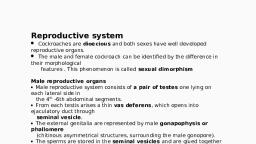
Reproductive system, Male Reproductive System of Cockroach, The male reproductive system of cockroaches consists of a, pair of the testis, vas-deferens, ejaculatory duct, mushroom, gland, seminal vesicle, phallic gland, genital pouch and, external genitalia., Testis: The male reproductive system consists of a pair of, trilobed testis, one on each side of the 4th to 6th abdominal, segments., Vas-deferens: From each testis, a vas-deferens arises that, passes down and connects to the seminal vesicle. This opens, into the ejaculatory duct., Seminal vesicles: The vas-deferens dilates to form a seminal, vesicle which helps in the storage of sperms. It is made up of, many white sacs which are meant for the storage of sperm., The sperms are glued together to form spermatophores.
Page 17 :
Ejaculatory Duct: The two seminal vesicles unite to form a wide, glandular and muscular duct called the ejaculatory duct. During, copulation or meeting, the spermatophores move down the, ejaculatory duct, which opens to the outside by the genital pore, present ventral to the anus., Mushroom Gland: The seminal vesicles bear a number of, finger-like projections forming characteristic mushroom-shaped, glands in the 6th to 7th abdominal segments. The secretion of, this gland nourishes the sperms., Genital Pouch: The genital pouch is situated at the end of the, abdomen and is formed by the 9th and 10th tergum and ventrally, by the 9th sternum. It contains genital pore, dorsal anus and, gonapophysis., External Genitalia: The external genitalia is represented by the, chitinous asymmetrical structure called male gonapophysis or, phallomere, which surrounds the male gonophore (genital pore).
Page 18 :
Cockroach male reproductive system
Page 19 :
Female Reproductive System of Cockroach, The female reproductive system of cockroaches consists of a, pair of ovaries, oviduct, vagina, spermatheca, collaterial glands,, genital pouch and external genitalia., Ovaries: The female reproductive system includes a pair of, ovaries present in between the 2nd to 6th segments of the, abdomen. Each ovary is formed by a group of ovarian tubules, that contains rows of ova in various stages of development., Oviduct and Vagina: The ovary continues down in the form of, a short, muscular tube called an oviduct. The right and left, oviduct units form a single median oviduct, also called the, vagina, which opens into the genital chamber., Spermatheca: A pair of spermatheca present in the 6th, segment opens into the genital chamber, and it is used for, storing the sperm. The left spermatheca is large and functional,, while the right spermatheca is reduced and non-functional.
Page 20 :
Genital Pouch or Chamber: The genital pouch is a sizable boatshaped structure surrounded by three pairs of chitinous plates, that help in copulation, deposition of the egg. It is formed by the, 7th,8th and 9th abdominal segments. It is divided into two, chambers. The smaller chamber is called the genital atrium and is, opening for the collaterial gland, spermatheca and opening of the, common oviduct. Its large posterior part is called the vestibulum., Collaterial Gland: Collaterial glands are present on either side of, a genital chamber into which they open. Collaterial glands help in, the formation of egg cases or ootheca. The ootheca is a dark, reddish to the blackish-brown capsule, about 8mm long. They are, dropped or glued to a suitable surface, usually in a crack or, crevice producing 9 to 10 ootheca, each containing 14 to 16 eggs., External Genitalia: The gonapophyses contains three chitinous, plates.
Page 21 :
Cockroach female reproductive system
Page 22 :
Fertilization, ●, , Fertilization takes place within the vestibulum of the female, genital pouch., , ●, , Thefirtilized eggs are encased in capsules called Ootheca., , ●, , Sixteen eggs are laid into a single ootheca., , ●, , ●, , ●, , ●, , The ootheca which is laid at a suitable place by the female, cockroach contains fertilized eggs., The nymph look very much like adults., The nymph grows by moulting about 13 times to reach the, adult form., The next to last nymphal stage has wing pads but only, adults cockroaches have wings.



 Learn better on this topic