Page 1 :
Chapter 10, Mechanical Properties of Fluids, , 1 Marks Questions, 1.State the law of floatation?, Ans.Law of floatation states that a body will float in a liquid, if weight of the liquid displaced, by the immersed part of the body is at least equal to or greater than the weight of the body., , 2. The blood pressure of humans is greater at the feet than at the brain?, Ans.The height of the blood column in the human body is more at the feet than at the brain, as since pressure is directly dependent on height of the column, so pressure is more at feet, than at the brain., , 3. Define surface tension?, Ans.It is measured as the force acting on a unit length of a line imagined to be drawn, tangentially anywhere on the free surface of the liquid at rest., , 4.Does Archimedes principle hold in a vessel in a free fall?, Ans. Archimedes’s Principle will not hold in a vessel in free – fall as in this case, acceleration, due to gravity is zero and hence buoyant force will not exist., , 5.Oil is sprinkled on sea waves to calm them. Why?, Ans. Since the surface tension of sea-water without oil is greater than the oily water,, therefore the water without oil pulls the oily water against the direction of breeze, and sea, waves calm down.
Page 2 :
6.A drop of oil placed on the surface of water spreads out, but a drop of water placed on, oil contracts. Why?, Ans .Since the cohesive forces between the oil molecules are less than the adhesive force, between the oil molecules and the drop of oil spreads out and reverse holds for drop of, water., , 7.Water rises in a capillary tube but mercury falls in the same tube. Why?, Ans .The capillary rise is given by :→, , h = height of capillary, T = Surface tension, Θ = Angle of contact, r = Radius of capillary, P = Density of liquid, g = Acceleration due to gravity, For mercury – glass surface, θ is obtuse hence Cos θ is negative, hence h is negative hence, mercury will depress below the level of surrounding liquid., , 8.The diameter of ball A is half that of ball B. What will be their ratio of their terminal, velocities in water?, Ans. The terminal velocity is directly proportional to the square of radius of the ball,, therefore the ratio of terminal velocities will be 1:4., , 9.Find out the dimensions of co-efficient of viscosity?, Ans.Since
Page 3 :
10.Define viscosity?, Ans.Viscosity is the property of a fluid by virtue of which an internal frictional force comes, into play when the fluid is in motion and opposes the relative motion of its different layers., , 11.What is the significance of Reynolds’s Number?, Ans.Reynolds’s Number (NR)
Page 4 :
s = Density of liquid, D = Diameter of tube, VC = Critical velocity, n = Co-efficient of viscosity, If NR lies b/w o to 2000, the flow of liquid is stream lined if NR lies above 3000, the flow of, liquid is turbulent., , 12.Give two areas where Bernoulli’s theorem is applied?, Ans.Bernoulli’s theorem is applied in atomizer and in lift of an aero plane wing., , 13.What is conserved in Bernoulli’s theorem?, Ans.According to Bernoulli’s theorem, for an incompressible non – Viscous liquid (fluid), undergoing steady flow the total energy of liquid at all points is constant., , 14.If the rate of flow of liquid through a horizontal pipe of length l and radius R is Q., What is rate of flow of liquid if length and radius of tube is doubled?, Ans .From Poiseuille’s formula, rate of flow of liquid through a tube of radius ‘R’ is and, length ‘l’ is :-, , If R and l are doubled then rate of flow Q1 is
Page 5 :
Q1 = 8 Q, , 15.Water is coming out of a hole made in the wall of tank filled with fresh water. If the, size of the hole is increased, will the velocity of efflux change?, Ans.Velocity of efflux,, , Since the velocity of efflux is independent of area of hole,, , it will remain the same., , 16.The accumulation of snow on an aero plane wing may reduce the lift. Explain?, Ans .Due to the accumulation of snow on the wings of the aero plane, the structure of wings, no larger remains as that of aerofoil. As a result, the net upward force (i.e. lift) is decreased., , 17.The antiseptics used for cuts and wounds in human flesh have low surface tension., Why?, Ans.Since the surface tension of antiseptics is less, they spread more on cuts and wounds and, as a result, cut or wound is healed quickly., , 18.Why should detergents have small angles of contact?, Ans.Since, Capillary rise = h =, , i.e. h is directly dependent on θ (Angle of contact), Now If θ→ Small then Cos θ is large and if detergents should have smaller angle of contact, then detergent will pentrate more in the cloth and clean better., , 19. Can Bernoulli's equation be used to describe the flow of water through a rapid in a, river? Explain., Ans. No, Bernoulli's equation cannot be used to describe the flow of water through a rapid in a river
Page 6 :
because of the turbulent flow of water. This principle can only be applied to a streamline, flow., , 20. Does it matter if one uses gauge instead of absolute pressures in applying, Bernoulli's equation? Explain., Ans. No. It does not matter if one uses gauge pressure instead of absolute pressure while, applying Bernoulli's equation. The two points where Bernoulli's equation is applied should, have significantly different atmospheric pressures., , 21. Two vessels have the same base area but different shapes. The first vessel takes, twice the volume of water that the second vessel requires to fill upto a particular, common height. Is the force exerted by the water on the base of the vessel the same in, the two cases? If so, why do the vessels filled with water to that same height give, different readings on a weighing scale?, Ans. Yes, Two vessels having the same base area have identical force and equal pressure acting on, their common base area. Since the shapes of the two vessels are different, the force exerted, on the sides of the vessels has non-zero vertical components. When these vertical, components are added, the total force on one vessel comes out to be greater than that on the, other vessel. Hence, when these vessels are filled with water to the same height, they give, different readings on a weighing scale.
Page 7 :
2 Marks Questions, 1.Write the characteristics of displacement?, Ans: (1) It is a vector quantity having both magnitude and direction., (2) Displacement of a given body can be positive, negative or zero., , 2.Draw displacement time graph for uniformly accelerated motion. What is its shape?, Ans: The graph is parabolic in shape, , 3.Sameer went on his bike from Delhi to Gurgaon at a speed of 60km/hr and came back, at a speed of 40km/hr. what is his average speed for entire journey., Ans:, , 4.What causes variation in velocity of a particle?, Ans: Velocity of a particle changes, , (1) If magnitude of velocity changes, (2) If direction of motion changes.
Page 8 :
5.Figure. Shows displacement – time curves I and II. What conclusions do you draw, from these graphs?, Ans:, (1) Both the curves are representing uniform linear motion., (2) Uniform velocity of II is more than the velocity of I because slope of curve (II) is greater., , 6.Displacement of a particle is given by the expression x = 3t2 + 7t – 9, where x is in, meter and t is in seconds. What is acceleration?, Ans:, , 7.A particle is thrown upwards. It attains a height (h) after 5 seconds and again after 9s, comes back. What is the speed of the particle at a height h?, Ans:, , As the particle comes to the same point as 9s where it was at 5s. The net displacement at 4s is, zero.
Page 9 :
8.Draw displacement time graph for a uniformly accelerated motion? What is its, shape?, Ans: Graph is parabolic in shape, , 9.The displacement x of a particle moving in one dimension under the action of, constant force is related to the time by the equation where x is in meters and t is in, seconds. Find the velocity of the particle at (1) t = 3s (2) t = 6s., Ans:, , (i), , For, , (ii) For, , 10.A balloon is ascending at the rate of 4.9m/s. A pocket is dropped from the balloon, when situated at a height of 245m. How long does it take the packet to reach the, ground? What is its final velocity?
Page 10 :
Ans:, , For packet (care of free fall) a = g = 9.8m/s2 (downwards), , Since time cannot be negative, t = 7.6s, Now, , 11.A car moving on a straight highway with speed of 126km/hr. is brought to stop within, a distance of 200m. What is the retardation of the car (assumed uniform) and how long, does it take for the car to stop?, Ans:
Page 11 :
a = -3.06m/s2 (Retardation), Now V = u + at, , t = 11.4s, , 12.State the angle of contact and on what values do the angle of contact depends?, Ans. Angle of contact between a liquid and a solid is defined as the angle enclosed between, the tangents to the liquid surface and the solid surface inside the liquid, both the tangents, being drawn at the point of contact of liquid with the solid. It depends upon:1) Upon nature of liquid and solid in contact, 2) The Medium which exists above the free surface of liquid., , 13.Hydrostatic pressure is a scalar quantity even though pressure is force divided by, area, and force is a vector. Explain?, Ans.Since due to applied force on liquid, the pressure is transmitted equally in all directions,, inside the liquid. Since there is no fixed direction for the pressure due to liquid. Hence it is a, scalar quantity., , 14.Find the work done in blowing a soap bubble of surface tension 0.06 N/m from 2cm, radius to 5cm radius?
Page 12 :
Ans.Here, Surface tension = s = 0.06N/m, ri = 2cm = 0.02m, r2 = 5cm = 0.05m, Since bubble has two surface, initial surface area of the bubble = 2x4π r12, = 2x4π(0.02)2, = 32πx10-4m2, Find surface of the bubble = 2x4πr22, = 2x4π(0.05)2, = 200πx10-4m2, Increase in surface area = 200πx10-4-32πx10-4, = 168πx10-4m2, ∴ work done = surface tension x Increase in surface area, = 0.06x168πx10-4, Work done = 0.003168J, , 15.Why does not the pressure of atmosphere break windows?, Ans.Pressure of atmosphere does not break windows as atmospheric Pressure is exerted on, both sides of a window, so no net force is exerted on the window and hence uniform, pressure does not break the window., , 16.If a big drop of radius R is formed by 1000 small droplets of water, then find the, radius of small drop?
Page 13 :
Ans.Let r = Radius of small drop, R = Radius of Big drop, Now, Let P = Density of water, Mass of 1000 small droplets = 1000 × volume × Density =, , Mass of Big drop =, , Now, Mass of 1000 small droplets = Mass of Big drop, , Taking cube root on both sides:→, , Hence the radius of small drop is, , times the radius of big drop., , 17.A boulder is thrown into a deep lake. As it sinks deeper and deeper into water, does, the buoyant force changes?, Ans.The buoyant force does not change as the boulder sinks because the boulder displaces, the same volume of water at any depth and because water is practically incompressible, its
Page 14 :
density is practically the same at all depth and hence the weight of water displaced or the, buoyant force is same at all depths., , 18.At what depth in an ocean will a tube of air have one – fourth volume it will have on, reaching the surface? Given Atmospheric Pressure = 76 cm of Hg and density of Hg =, 13.6g/cc?, Ans.Let volume of bubble on reaching the surface = V, Let h = height at which volume becomes, , Now, Initial volume = V1= V, Final volume = V2 =, Pressure on the bubble at the surface; P1 = 76cm of Hg, Pressure on the bubble at a depth of h cm is :→, , Acc, to Boyle’s Law,
Page 15 :
h = 3100.8 cm, , 19.Why is it painful to walk barefooted on a road covered with pebbles having sharp, edges?, Ans.It is painful to walk bare – footed on a road covered with pebbles having sharp edges, because they have small area and since: Pressure =, , Area is less i.e. pressure is more., , It Means out feet exert greater pressure on pebbles and in turn pebbles exert equal reaction, on the feet., , 20.A liquid stands at the same level in the U – lube when at rest. If A is the area of cross, section of tube and g is the acceleration due to gravity, what will be the difference in, height of the liquid in the two limbs when the system is given acceleration ‘a’?, , Ans. Let l = Length of the horizontal portion of tube., Mass of liquid in the portion CD = Volume X Density, Let P = Density of water, Volume = Area X Length
Page 16 :
A = Area of cross – section of tube., =, , So, Mass of liquid in portion CD =, , Force on the above Mass towards left =, , Force =, , Also due to difference in height of liquid, the downward force exerted on liquid in the, horizontal portion CD, , Pressure =, , Pressure = h P g, h = height; P = Density; g = acceleration due to gravity, So, Force = Pressure X Area, Force = h P g X A →2), Equating equation 1) and equation 2) for force on C D :→, , 21.Two ballons that have same weight and volume contains equal amounts of helium., One is rigid and other is free to expand as outside pressure decreases. When released,, which balloon will rise higher?, Ans.The balloon that is free to expand will displace more air as it rises than the balloon is, rigid and restrained from expanding. Since the balloon is free to expand will experience
Page 17 :
more buoyant force and rises higher., , 22.An object floats on water with 20% of its volume above the water time. What is the, density of object? Given Density of water = 1000kg|m3., Ans.Let volume of entire object = V, Volume of object under water VW = V -, , Let Pw = Density of water, Buoyant force, FB = VW × PW × g, g = acceleration due to gravity, FB = 0.8 V × PW g → 1), If P = Density of object, Weight of object = Mass × Acceleration due to gravity, Mass of object = Volume of object × Density, =V×P, Weight of object = P V g, , 2)
Page 18 :
Acc. to principle of floatation,, Buoyant force = Weight of object, From equation 1) & 2), , Now, Density of water = PW=1000, P = 1000 X 0.8, P = 800Kg|m3, Hence, Density of object = 800 Kg|m3., , 23.A cubical block of iron 5cm on each side is floating on mercury in a vessel:1) What is the height of the block above mercury level?, 2) Water is poured into vessel so that it just covers the iron block. What is the height of, the water column?, Given Density of mercury = 13.6g|cm3 and Density of iron = 7.2g|cm3, Ans. 1) Let h = height of cubical block above mercury level, Volume of cubical Iron Block = l × b × h, =5×5×5, = 125 cm3., Mass of cubical Iron Block = Volume × Density of Iron, = 125 × 7.2
Page 19 :
= 900 g → 1), Volume of Mercury displaced = Length × Breadth × Decreased height, = l × b × (5 – h), = 5 × 5 × (5 – h), Mass of Mercury displaced = Volume of Mercury × Density of Mercury, = 5 × 5 × (5 – h) × 13.6 → 2), From, Principle of flotation :→, Weight of Iron Block = Weight of Mercury Displaced, Mass of Iron Block ×, , = Mass of Mercury Displaced ×, , From equation 1) & 2), , h = 2.35cm, , 2) When water is poured, let x = height of block in water, Depth of block in mercury = (5 – x) cm
Page 20 :
Mass of water displaced = 5 × 5 × x × 1 = 25 x gm, 1 = Density of water in g|cm3, Mass of Mercury displaced = 5 × 5 × (5 – x) × 13.6 = 25 X 13.6 (5 – x) gm, Acc. to principle of floatation,, Weight of Iron Block = Weight of water displaced + Weight of mercury displaced., 900 = 25 x + (25 × 13.6 (5-x)), 900 = 25 x + 1700 (5-x), 900 = 25 x + 8500 – 1700 x, 900 – 8500 = - 1700 x + 25 x, , 2.54 cm = x, , 24.What should be the pressure inside a small air bubble of 0.1mm radius situated just, below the water surface? Surface tension of water = 7.2 × 10⁻² N/m and atmospheric, pressure = 1.013 × 10⁵ N/m2?, Ans.Radius of air bubble ; R = 0.1mm, = 0.1 × 10⁻³ m (1 mm=10-3m), Surface tension of water, T = 7.2 × 10⁻² N|m., The excess pressure inside an air bubble is given by :→
Page 21 :
P2 = Pressure inside air bubble, P1 = Atmospheric pressure, , 25.Why is a soap solution a better cleansing agent than ordinary water?, Ans.Since a cloth has narrow spaces in the form of fine capillaries, Capillary rise is given, by:→, h = height of capillary, T = Tension surface, Θ = Angle of contact, r = Radius, P = Density, g = Acceleration due to gravity., , Now, addition of soap to water reduces the angle of contact θ, this will increase Cosθ and, hence the value of h. that is, the soap water will rise more in narrow spaces in the cloth and, clean fabrics better than water alone., , 26.If the radius of a soap bubble is r and surface tension of the soap solution is T.
Page 23 :
= 24 π r2 T, , 27.Find the work done in breaking a water drop of radius 1 mm into 1000 drops. Given, the surface tension of water is 72 × 10-3 N/m?, Ans.Initial Radius = R = 10-3 m (= 1 mm), Final Radius = r, Since 1 drop breaks into 1000 small droplets, so, Initial volume = 1000 X Final Volume, , On, taking cube root on both sides,, , Initial Surface Area = 4 π R2, , Final Surface Area = 1000 × (4 π r2)
Page 24 :
Increase in Surface Area = Final surface Area – Initial surface Area, , Now, work Done = Surface Tension X Increase in surface Area, , Work Done, , Work Done = 8.14 × 10⁻⁶J, , 28.What is the energy stored in a soap babble of diameter 4 cm, given the surface, tension = 0.07 N/m?, Ans.Diameter of soap bubble = 4 cm = 4 × 10⁻²m, Radius of soap bubble = 2 × 10⁻²m, Increase in surface Area = 2 × 4 π R2
Page 25 :
(, , 2, a bubble has 2 surfaces), , Increase in Surface Area = 2 × 4 π × (2 X 10-2)2, , Now, energy stored = Surface Tension × Increase in Surface Area, , Energy Stored, , 29.What is the work done in splitting a drop of water of 1 mm radius into 64 droplets?, Given the surface tension of water is 72 × 10-3 N/m2?, Ans.Let R = radius of bigger drop = 1mm = 10-3m, r = radius of smaller drop, Bigger volume = 64 × smaller Volume
Page 26 :
Taking cube root on both sides, , Initial Surface Area = 4 π R2, , Final Surface Area =, , Increase in Surface = Final Surface Area – Initial Surface Area, , Work Done = Surface Tension ×Increase in Surface Area
Page 27 :
Work Done = 2.7 × 10⁻⁶ J, , 30.What is terminal velocity? What is the terminal velocity of a body in a freely falling, system?, Ans.It is the maximum constant velocity acquired by the body while falling freely in a, viscous medium. In a freely falling system, g = 0. Therefore, the terminal velocity of the body, will also be zero., , 31.What is the cause of viscosity in a fluid? How does the flow of fluid depend on, viscosity?, Ans.Internal friction is the cause of viscosity of fluid. The flow of fluid decreases when, viscosity increases, because viscosity is a frictional force and greater the friction, lesser is the, flow of liquid., , 32.If eight rain drops each of radius 1 mm are falling through air at a terminal velocity, of 5 cm | s. If they coalesce to form a bigger drop, what is the terminal velocity of bigger, drop?, Ans.Let the radius of smaller drop = r, Let the radius of bigger drop = R, Volume of smaller drop =, , Volume of bigger drop =, , Now, according to the question,
Page 28 :
Volume of bigger drop = Volume of 8 smaller drops., , Taking cube – root, , Now, Terminal velocity of each small drop =, , Terminal velocity of bigger drop =, , = Co-efficient of viscosity, P = Density of body, , = Density of fluid, g = acceleration due to gravity, Dividing eq4 2) by 1)
Page 29 :
Given Terminal velocity of small drop = 5 cm | s, , VT = 20 cm |s, , 33.Why does the cloud seem floating in the sky?, Ans.The terminal velocity of a raindrop is directly proportional to the square of radius of, drop. When falling, large drops have high terminal velocities while small drops have small, terminal velocities hence the small drops falls so slowly that cloud seems floating., , 34.A metal plate 5 cm × 5 cm rests on a layer of castor oil 1 mm thick whose co-efficient, of viscosity is 1.55 Nsm-2. What is the horizontal force required to more the plate with a, speed of 2 cm | s?, Ans.Length of metal plate = 5 cm, Breadth of metal plate = 5 cm, A = Area of metal plate = Length X Breadth, A=5×5, A = 25 cm2, Co – efficient of viscosity =, , d x = Small thickness of layer = 1 mm = 10-3m, Small velocity = d v = 2 × 10⁻² m | s, Now, velocity gradient =
Page 30 :
Now, horizontal force F=, , F = 0.0775 N, , 35.A small ball of mass ‘m’ and density ‘d’ dropped in a viscous liquid of density ‘d’., After some time, the ball falls with a constant velocity. What is the viscous force on the, ball?, Ans.Now, Volume =, , Mass of ball = m, Density of ball = d, Volume of ball =, , Density of viscous liquid = d1, Mass of liquid displaced by the ball =, , When the ball falls with a constant velocity (terminal velocity), we have :→
Page 31 :
Viscous force F = weight of ball in water →2), Weight of ball in water = Weight of ball – Weight of liquid displaced by the ball, , Hence from equation 2), , Viscous force, F =, , 36.Water flows faster than honey. Why?, Ans.Since from, Poiseuille’s formula,, , V=, , V = Volume of liquid plowing per second, R = Radius of narrow tube, P = Pressure difference across 2 ends of tube., , = co-efficient of viscosity, L = height of tube., Since, V, faster., , for water is less than honey, so V for water is greater and hence it flows
Page 32 :
37.What is stoke’s law and what are the factors on which viscous drag depends?, Ans.Acc. to stoke’s law:F=6, , The viscous drag force F depends on :-, , F = Viscous drag, 1), , co-efficient of viscosity, , 2) r = radius of spherical body, 3) V = Velocity of body, , 38.Water flows through a horizontal pipe of which the cross – section is not constant., The pressure is 1cm of mercury where the velocity is 0.35m/s. Find the pressure at a, point where the velocity is 0.65m/s., Ans.At one point, P, = 1cmof Hg, = 0.01m of Hg, = 0.01 x (13.6x103) x 9.8 Pa, Velocity, V1 = 0.35m|s, At an other point, P2 = ?, V2 = 0.65m|s, Density of water, s = 103 Kg | m3, Acc. to Bernoulli’s theorem,, P 1+
Page 33 :
= 0.01x13.6x103x9.8-, , =, , =, , =, , = 1332.8 – 150, = 1182.8 Pa or, , P2 = 0.00887 m 0f Hg, , 39.Two pipes P and Q having diameters 2 × 10⁻² m and 4 × 10⁻² m respectively are joined, in Series with the main supply line of water. What is the velocity of water flowing in, pipe P?, Ans.Diameter of pipe P = 2 × 10⁻² m, Diameter of Pipe Q = 4 × 10⁻² m, Acc. to the equation of continuity;, , aQ, aP = Cross – section area of pipe P and Q, vP, vQ = Velocity of liquid at pipe P and Q, Now,
Page 34 :
Now, from equation A), , i.e. Velocity of water in pipe P is four times the velocity of water in pipe Q., , 40.A horizontal pipe of diameter 20 cm has a constriction of diameter 4 cm. The velocity, of water in the pipe is 2m/s and pressure is 10 N/m2. Calculate the velocity and pressure, at the constriction?, Ans.Acc. to equation of continuity,
Page 36 :
s = Density, , So,, , 41.The reading of a pressure metre attached to a closed is 2.5 × 10⁵ N/m2. On opening the, valve of pipe, the reading of the pressure metre reduces to 2.0 × 10⁵ N/m2. Calculate the, speed of water flowing through the pipe?, Ans.Pressure, , P1=2.5×10⁵N/m2, , at end 1, Pressure, , end 2, , P2 = 2.0×10⁵N/m2
Page 37 :
v 1= 0 (, , Initially pipe was closed), , v2 = ?, Density of water = s = 1000 Kg|m3, Acc. to Bernoulli’s theorem for a horizontal pipe,, , 42.A large bottle is fitted with a siphon made of capillary glass tubing. Compare the Coefficient of viscosity of water and petrol if the time taken to empty the bottle in the two, cases is in the ratio 2:5. Given specific gravity of petrol = 0.8, , Ans., , Q1 = rate of flow of liquid in case 1, P1 = Pressure
Page 38 :
R = Radius, s1 = specific gravity in 1st Case, , = Co-efficient of viscosity, s2 = Density of water, , v = volume of liquid, t1 = time Case 1, , Now,, , Now,, , Equating equation 1) & 2) for
Page 39 :
43.Under a pressure head, the rate of flow of liquid through a pipe is Q. If the length of, pipe is doubled and diameter of pipe is halved, what is the new rate of flow?, Ans.From Poisudlie’s equation for flow liquid through a tube of radius R and length l :, , Now if diameter is halved:→, , For radius =, , Length is doubled :→, , Rate of flow liquid
Page 40 :
(, , from equation 1), , 44. A U-shaped wire is dipped in a soap solution, and removed. The thin soap film, formed between the wire and the light slider supports a weight of, , N (which, , includes the small weight of the slider). The length of the slider is 30 cm. What is the, surface tension of the film?, Ans. The weight that the soap film supports, W =, , N, , Length of the slider, l = 30 cm = 0.3 m, A soap film has two free surfaces., ∴Total length = 2l = 2, , 0.3 = 0.6 m, , Surface tension,, , Therefore, the surface tension of the film is, , ., , 45. During blood transfusion the needle is inserted in a vein where the gauge pressure, is 2000 Pa. At what height must the blood container be placed so that blood may just, enter the vein? [Use the density of whole blood from Table 10.1].
Page 41 :
Ans.Gauge pressure, P = 2000 Pa, Density of whole blood,, , Acceleration due to gravity, g = 9.8, , Height of the blood container = h, Pressure of the blood container, P = h, , g, , =0.1925 m, The blood may enter the vein if the blood container is kept at a height greater than 0.1925 m,, i.e., about 0.2 m., , 46. Toricelli's barometer used mercury. Pascal duplicated it using French wine of, density, , . Determine the height of the wine column for normal atmospheric, , pressure., Ans. 10.5 m, Density of mercury,, , Height of the mercury column,, , = 0.76 m, , Density of French wine,, , Height of the French wine column =, , Acceleration due to gravity, g =, , The pressure in both the columns is equal, i.e.,
Page 42 :
Pressure in the mercury column = Pressure in the French wine column, , = 10.5 m, Hence, the height of the French wine column for normal atmospheric pressure is 10.5 m., , 47. A hydraulic automobile lift is designed to lift cars with a maximum mass of 3000 kg., The area of cross-section of the piston carrying the load is 425, , . What maximum, , pressure would the smaller piston have to bear?, Ans.The maximum mass of a car that can be lifted, m = 3000 kg, Area of cross-section of the load-carrying piston, A = 425, , =, , The maximum force exerted by the load, F = mg, = 3000, , 9.8, , = 29400 N, The maximum pressure exerted on the load-carrying piston,, , =, , Pressure is transmitted equally in all directions in a liquid. Therefore, the maximum, pressure that the smaller piston would have to bear is, , .
Page 43 :
3 Marks Questions, 1.Calculate the radius of new bubble formed when two bubbles of radius r1 and r2, coalesce?, Ans.Consider two soap bubble of radii r1 and r2 and volumes as vi and v2. Since bubble is in, the form of a sphere: →, , Ifs = surface tension of the soap solution, p1& p2 = excess pressure inside the two soap bubbles, , Let r be the radius of the new soap bubble formed when the two soap bubble coalesce under, and excess of pressure inside this new soap bubble then, V=, , P=, , As the new bubble is formed under isothermal condition, so Boyle’s law holds good and, hence, P1 v1 + p2 v2 = pv
Page 44 :
16 sπr12+16Sπr22 = 16Sπr2, r=, , 2.A liquid drop of diameter 4 mm breaks into 1000 droplets of equal size. Calculate the, resultant change in the surface energy. Surface tension of the liquid is 0.07 N/m?, Ans.Since the diameter of drop = 4mm, Radius of drop = 2mm = 2x10⁻³m, S = Surface tension = 0.07N/m, Let r be the radius of each of the small droplets volume of big drop = 1000 x volume of the, small droplets, , or R = 10r, , original surface area of the drop = 4πR2, Total surface area of 1000x4πr2-4πR2, = 4π [1000r2-R2], Increase in surface = 4x
Page 45 :
= 4x, , = 8x, , =, , Increase in surface energy = Surface tension x Increase in surface area, = 0.07x, , = 3168x10-8J, , 3.Two capillary tubes of length 15 cm and 5 cm and radii 0.06 cm and 0.02 cm, respectively are connected in series. If the pressure difference a cross the end faces is, equal to the pressure of 15 cm high water column, then find the pressure difference, across the :, , 1) first tube, 2) Second tube., Ans .From, Poiseuille’s formula for flow of liquid through a tube of radius ‘r’ :→, , V = Volume of liquid, r = Radius of tube, Pressure Gradient, , = Co – efficient of viscosity
Page 46 :
When two tubes are connected in series, then the volume of liquid through both the tubes is, equal., Radius of first tube = 0.06 cm, Radius of second tube = 0.02 cm, Length of first tube = 15 cm, Length of second tube = 5 cm, , Now, Volume of liquid through first tube =, , Volume of liquid through second tube,, , Equating above equations for tubes connected in Series, , Now, Pressure in first tube =, S = Density of liquid, Pressure in Second tube =, , 15 cm = height of water column., , Now,
Page 47 :
∴ Pressure difference across first tube = 15-14.464, = 0.536 cm of water column, Pressure difference across second tube = 14.464 cm of water column., , 4..A metallic sphere of radius 1 × 10⁻³ m and density 1 × 10⁴ kg | m3 enters a tank of, water after a free fall through a high ‘h’ in earth’s gravitational field. If its velocity, remains unchanged after entering water, determine the value of h. Given :Co-efficient of viscosity of water = 1 × 10⁻³ Ns | m2; g = 10 m | s2; density of water = 1 ×, 103 kg | m3?, Ans. The velocity acquired by the sphere in falling freely through a height h is, As per the conditions of the problem, this is the terminal velocity of sphere in water i.e., Terminal Velocity of sphere in water is :By Stoke’s Law, the terminal velocity VT of sphere in water is given by :-
Page 48 :
r = Radius of sphere = 1 X 10⁻³ m, P = Density of sphere = 1 X 10+4 Kg/+m3, , = Density of liquid = 1 X 10³ Kg/m3, g = Acceleration due to gravity = 10 m/s2, , = Co-efficient of viscosity = 1 X 10⁻³ Ns/m2, , From equation 1) →, , 5.What is terminal velocity and derive an expression for it?, Ans.Terminal velocity is maximum constant velocity a acquired by the body which is falling, freely in a viscous medium., When a small spherical body falls freely through viscous medium then 3 forces acts on it:-
Page 49 :
1) Weight of body acting vertically downwards, 2) Up thrust due to buoyancy = weight of liquid displaced, 3) Viscous drag (FV) acting in the direction opposite to the motion of body., Let s = Density of material, r = Radius of spherical body, So = Density of Medium., ∴ True weight of the body = w = volume x density x g, W=, , Up ward thrust FT = Volume of Medium displaced, =, , V = Terminal velocity of body, Acc. to stoke’s law, FV =, , When the body attains terminal velocity, thon, FT + FV = W, =, , V=, , 1) V directly depends on radius of body and difference of the pressure of material and
Page 50 :
medium., 2) V inversely depends of co-efficient of viscosity, , 6..What is equation of continuity? Water plows through a horizontal pipe of radius, 1cm, at a speed of 2m/s. What should be the diameter of nozzle if water is to come out at a, speed of 10m/s?, Ans.Consider a non-viscous liquid in streamline flow through a tube A B of varying crosssection, , Let a1, a2 = area of cross – section at A and B, V1, V2 = Velocity of flow of liquid at A and B, S1, S2 = Density of liquid at A and B, Volume of liquid entering per second at A = a1 v1, Mass of liquid entering per second at A = a1 v1 s1, Moss of liquid entering per second at B = a1 v1 s2., If there is no loss of liquid in tube and flow is steady, then, Mass of liquid entering per second at A = Mass of liquid leaving per second at B, a 1 v 1 s1 = a 2 v 2 s2, If the liquid is incompressible,, s1 = s2 = s
Page 52 :
D2 = D1, , =2, , = 2x, , = 2x, , D2 = 0.894cm, , 7.What is Bernoulli’s theorem? Show that sum of pressure, potential and kinetic energy, in the streamline flow is constant?, Ans.Acc. to this theorem, for the streamline flow of an ideal liquid, the total energy that is, sum of pressure energy, potential energy and kinetic energy per unit mass remains constant, at every cross-section throughout the flow., Consider a tube A B of varying cross – section., , p1 = Pressure applied on liquid at A, p2 = Pressure applied on liquid at B
Page 54 :
Work done by pressure energy = Increase in P. E. /sec + Increase in K. E/sec, From equation 1, 2, & 3, P1 v – p2 v = (mgh2 – mgh1) +, , P1 v + mgh1 +, Dividing throughout by m →, , Density, , Hence, →4), Constant, , Pressure energy per unit mass, , gh = potential energy per unit mass, = kinetic energy per unit mass, , Hence from equation), Bernoulli’s theorem is proved., , 8.In a horizontal pipeline of uniform area of cross – section, the pressure falls by 5 N/m2, between two points separated by a distance of 1 Km. What is the change in kinetic, energy per Kg of oil flowing at these points? Given Density of oil = 800 Kg/m3?
Page 55 :
Ans. Acc. to Bernoulli’s theorem, total energy is conserved:→, , For a horizontal pipe, h = 0, , At ends 1 and 2 :→, , Change in K. E =, , Change in K. E. per Kg, , Given, P1 – P2 = 5 N|m2,, S = 800 Kg /m3, Change in K. E. =, , 9.1) Water flows steadily along a horizontal pipe at a rate of 8 × 10⁻³m3/s. If the area of, cross – section of the pipe is 40 × 10-4 m2, Calculate the flow velocity of water.
Page 56 :
2) Find the total pressure in the pipe if the static pressure in the horizontal pipe is 3 ×, 104 Pa. Density of water is 1000 Kg/m3., 3. What is the net flow velocity if the total pressure is 3.6 × 10⁴ Pa?, Ans. 1) Velocity of water =, , Given, Rate of flow = 8 × 10⁻³ m3/s, Area of cross – Section = 40 × 10-4 m2, So, Velocity of water =, , = 2 m /s, 2) Total Pressure = Static Pressure +, , 3) Total Pressure = Static Pressure +, , Total Pressure – Static Pressure
Page 57 :
10. A 50 kg girl wearing high heel shoes balances on a single heel. The heel is circular, with a diameter 1.0 cm. What is the pressure exerted by the heel on the horizontal, floor?, Ans.Mass of the girl, m = 50 kg, Diameter of the heel, d = 1 cm = 0.01 m, Radius of the heel, r, , Area of the heel, , =, =, , Force exerted by the heel on the floor:, F = mg, = 50, , 9.8, , = 490 N, Pressure exerted by the heel on the floor:, , =, , Therefore, the pressure exerted by the heel on the horizontal floor is, , ., , 11. A vertical off-shore structure is built to withstand a maximum stress of 109 Pa. Is
Page 58 :
the structure suitable for putting up on top of an oil well in the ocean? Take the depth, of the ocean to be roughly 3 km, and ignore ocean currents., Ans. Yes, The maximum allowable stress for the structure, P =, , Pa, , Depth of the ocean, d = 3 km =, , Density of water,, , Acceleration due to gravity, g = 9.8, , The pressure exerted because of the sea water at depth, d =, , =, , =, , The maximum allowable stress for the structure (109 Pa) is greater than the pressure of the, sea water (, , ). The pressure exerted by the ocean is less than the pressure that, , the structure can withstand. Hence, the structure is suitable for putting up on top of an oil, well in the ocean., , 12. Figure 10.24 (a) shows a thin liquid film supporting a small weight =, , N., , What is the weight supported by a film of the same liquid at the same temperature in, Fig. (b) and (c)? Explain your answer physically., , Ans.Take case (a):
Page 59 :
The length of the liquid film supported by the weight, l = 40 cm = 0.4 cm, The weight supported by the film, W =, , N, , A liquid film has two free surfaces., ∴Surface tension, , In all the three figures, the liquid is the same. Temperature is also the same for each case., Hence, the surface tension in figure (b) and figure (c) is the same as in figure (a), i.e.,, , N., Since the length of the film in all the cases is 40 cm, the weight supported in each case is, , N., , 13. What is the pressure inside the drop of mercury of radius 3.00 mm at room, temperature? Surface tension of mercury at that temperature (20°C) is, , . The atmospheric pressure is, , Pa. Also give the excess, , pressure inside the drop., Ans., , Radius of the mercury drop, r = 3.00 mm =, , m, , Surface tension of mercury, S =, , Atmospheric pressure,, , =, , Pa, , Total pressure inside the mercury drop, = Excess pressure inside mercury + Atmospheric pressure
Page 60 :
=, , =, , Excess pressure, , = 310 Pa, , 14. In deriving Bernoulli's equation, we equated the work done on the fluid in the tube, to its change in the potential and kinetic energy. (a) What is the largest average velocity, of blood flow in an artery of diameter, , m if the flow must remain laminar? (b), , Do the dissipative forces become more important as the fluid velocity increases?, Discuss qualitatively., Ans.(a) 1.966 m/s (b) Yes, (a) Diameter of the artery, d =, , m, , Viscosity of blood,, , Density of blood,, , Reynolds' number for laminar flow, NR = 2000, The largest average velocity of blood is given as:, , = 1.966 m/s
Page 61 :
Therefore, the largest average velocity of blood is 1.966 m/s., (b) As the fluid velocity increases, the dissipative forces become more important. This is, because of the rise of turbulence. Turbulent flow causes dissipative loss in a fluid.
Page 62 :
4 Marks Questions, 1. Explain why, (a) The blood pressure in humans is greater at the feet than at the brain, (b) Atmospheric pressure at a height of about 6 km decreases to nearly half of its value, at the sea level, though the height of the atmosphere is more than 100 km, (c) Hydrostatic pressure is a scalar quantity even though pressure is force divided by, area., Ans:(a) The pressure of a liquid is given by the relation:, P=h, , g, , Where,, P = Pressure, h = Height of the liquid column, = Density of the liquid, g = Acceleration due to the gravity, It can be inferred that pressure is directly proportional to height. Hence, the blood pressure, in human vessels depends on the height of the blood column in the body. The height of the, blood column is more at the feet than it is at the brain. Hence, the blood pressure at the feet, is more than it is at the brain., (b)Density of air is the maximum near the sea level. Density of air decreases with increase in, height from the surface. At a height of about 6 km, density decreases to nearly half of its, , value at the sea level. Atmospheric pressure is proportional to density. Hence, at a height of 6, km from the surface, it decreases to nearly half of its value at the sea level., (c)When force is applied on a liquid, the pressure in the liquid is transmitted in all, directions. Hence, hydrostatic pressure does not have a fixed direction and it is a scalar, physical quantity.
Page 63 :
2. Fill in the blanks using the word(s) from the list appended with each statement:, (a) Surface tension of liquids generally . . . with temperatures (increases / decreases), (b) Viscosity of gases. with temperature, whereas viscosity of liquids . . . with, temperature (increases / decreases), (c) For solids with elastic modulus of rigidity, the shearing force is proportional to ...,, while for fluids it is proportional to ... (shear strain / rate of shear strain), (d) For a fluid in a steady flow, the increase in flow speed at a constriction follows, (conservation of mass / Bernoulli's principle), (e) For the model of a plane in a wind tunnel, turbulence occurs at a ... speed for, turbulence for an actual plane (greater / smaller), Ans:(a) decreases, The surface tension of a liquid is inversely proportional to temperature., (b) increases; decreases, Most fluids offer resistance to their motion. This is like internal mechanical friction, known, as viscosity. Viscosity of gases increases with temperature, while viscosity of liquids, decreases with temperature., (c) Shear strain; Rate of shear strain, With reference to the elastic modulus of rigidity for solids, the shearing force is proportional, to the shear strain. With reference to the elastic modulus of rigidity for fluids, the shearing, force is proportional to the rate of shear strain.
Page 64 :
(d) Conservation of mass/Bernoulli's principle, For a steady-flowing fluid, an increase in its flow speed at a constriction follows the, conservation of mass/Bernoulli's principle., (e) Greater, For the model of a plane in a wind tunnel, turbulence occurs at a greater speed than it does, for an actual plane. This follows from Bernoulli's principle and different Reynolds' numbers, are associated with the motions of the two planes., , 3. A U-tube contains water and methylated spirit separated by mercury. The mercury, columns in the two arms are in level with 10.0 cm of water in one arm and 12.5 cm of, spirit in the other. What is the specific gravity of spirit?, Ans.The given system of water, mercury, and methylated spirit is shown as follows:, , Height of the spirit column,, , Height of the water column,, , = Atmospheric pressure, , = Density of spirit, , = Density of water, , = 12.5 cm = 0.125 m, , = 10 cm = 0.1 m
Page 65 :
Pressure at point B =, , Pressure at point D =, , Pressure at points B and D is the same., , Therefore, the specific gravity of spirit is 0.8., , 4. In problem 10.9, if 15.0 cm of water and spirit each are further poured into the, respective arms of the tube, what is the difference in the levels of mercury in the two, arms? (Specific gravity of mercury = 13.6), Ans. Height of the water column,, , Height of the spirit column,, , = 10 + 15 = 25 cm, , = 12.5 + 15 = 27.5 cm, , Density of water,, , Density of spirit,, , Density of mercury =, , Let h be the difference between the levels of mercury in the two arms., Pressure exerted by height h, of the mercury column:, =h, =h, , g, 13.6g … (i), , Difference between the pressures exerted by water and spirit:
Page 66 :
=, = 3g … (ii), Equating equations (i) and (ii), we get:, 13.6 hg = 3g, h = 0.220588, , 0.221 cm, , Hence, the difference between the levels of mercury in the two arms is 0.221 cm., , 5. Figures 10.23 (a) and (b) refer to the steady flow of a (non-viscous) liquid. Which of, the two figures is incorrect? Why?, , Ans. (a), Take the case given in figure (b)., , Where,
Page 67 :
= Area of pipe1, , = Area of pipe 2, , = Speed of the fluid in pipe1, , = Speed of the fluid in pipe 2, From the law of continuity, we have:, , When the area of cross-section in the middle of the venturimeter is small, the speed of the, flow of liquid through this part is more. According to Bernoulli's principle, if speed is more,, then pressure is less., Pressure is directly proportional to height. Hence, the level of water in pipe 2 is less., Therefore, figure (a) is not possible., , 6. (a) What is the largest average velocity of blood flow in an artery of radius, , m if the flow must remain laminar? (b) What is the corresponding flow rate? (Take, viscosity of blood to be, , Ans. (a)Radius of the artery, r =, , Pa s)., , m, , Diameter of the artery, d =, , Viscosity of blood,, , Density of blood,, , Reynolds' number for laminar flow, NR = 2000, The largest average velocity of blood is given by the relation:
Page 68 :
= 0.983 m/s, Therefore, the largest average velocity of blood is 0.983 m/s., (b) Flow rate is given by the relation:, R = π r2, , Therefore, the corresponding flow rate is, , ., , 7. Mercury has an angle of contact equal to 140° with soda lime glass. A narrow tube of, radius 1.00 mm made of this glass is dipped in a trough containing mercury. By what, amount does the mercury dip down in the tube relative to the liquid surface outside?, Surface tension of mercury at the temperature of the experiment is 0.465 N, , Density of mercury =, , ., , Ans.Angle of contact between mercury and soda lime glass, θ = 140°, Radius of the narrow tube, r = 1 mm =, , m, , Surface tension of mercury at the given temperature, s = 0.465 N, , Density of mercury,, , Dip in the height of mercury = h, Acceleration due to gravity, g = 9.8, , Surface tension is related with the angle of contact and the dip in the height as:, , .
Page 69 :
= - 0.00534 m, = - 5.31 mm, Here, the negative sign shows the decreasing level of mercury. Hence, the mercury level dips, by 5.34 mm., , 8. The cylindrical tube of a spray pump has a cross-section of 8.0, , one end of which, , has 40 fine holes each of diameter 1.0 mm. If the liquid flow inside the tube is 1.5 m, , , what is the speed of ejection of the liquid through the holes?, Ans. Area of cross-section of the spray pump,, , Number of holes, n = 40, Diameter of each hole, d = 1 mm =, , Radius of each hole, r = d/2 =, , Area of cross-section of each hole,, , Total area of 40 holes,, , =, , =, , Speed of flow of liquid inside the tube,, , = 1.5 m/min = 0.025 m/s
Page 70 :
Speed of ejection of liquid through the holes =, , According to the law of continuity, we have:, , = 0.633 m/s, Therefore, the speed of ejection of the liquid through the holes is 0.633 m/s., , 9. In Millikan's oil drop experiment, what is the terminal speed of an uncharged drop, of radius, , and density, , temperature of the experiment to be, , ? Take the viscosity of air at the, , . How much is the viscous force on, , the drop at that speed? Neglect buoyancy of the drop due to air., Ans. Terminal speed = 5.8 cm/s; Viscous force =, , Radius of the given uncharged drop,, , Density of the uncharged drop,, , Viscosity of air,, , Density of air, , can be taken as zero in order to neglect buoyancy of air., , Acceleration due to gravity, g = 9.8, , Terminal velocity (v) is given by the relation:
Page 71 :
Hence, the terminal speed of the drop is 5.8 cm, , ., , The viscous force on the drop is given by:, , Hence, the viscous force on the drop is, , .
Page 72 :
5 Marks Questions, 1.Velocity time graph of a moving particle is shown. Find the displacement (1) 0 – 4 s (2), 0 – 8 (3) 0 12 s from the graph. Also write the differences between distance and, displacement., , Ans: (1) Displacement, Diving (0 – 4) s, S1 = area of OAB s, S1 = 15, , 4 = 60 m, , (2) Displacement (0 – 8s), S2 = S1 + area (CDEF), S2 = 60 + (-5), , 4 = 60 -20 = 40m, , (3) Displacement (0 – 12s), S3 = S1 + area (CDEF) + area (FGHI), , S3 = 60 – 20 + 40 = 80m, Distance, , Displacement, , 1. Distance is a scalar quantity 1. Displacement is a vector quantity., 2. Distance is always positive, , 2. Displacement can be positive negative or zero.
Page 73 :
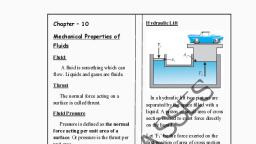
2.State the principle on which Hydraulic lift work and explain its working?, Ans.Hydraulic lift works on the principle of the Pascal’s law. Acc to this law, in the absence, of gravity, the pressure is same at all points inside the liquid lying at the same horizontal, plane, Working of Hydraulic effect:→, , a = Area of cross –section of piston at C, A = Area of cross – section of piston at D., Let a downward force f be applied on the piston C. Then the pressure exerted on the liquid, P, , =, , Acc to Pascal’s law, this pressure is transmitted equally to piston of cylinder D., ∴ Upward fore acting on the piston of cylinder D will be :→
Page 74 :
F = PA, =, , As A ≫ a, F ≫f, i.e. small fore applied on the smaller piston will be appearing as a very large force on the, large piston. As a result of which heavy load placed on larger piston is easily lifted upwards., , 3.Show that if two soap bubbles of radii a and b coalesce to from a single bubble of, radius c. If the external pressure is P, show that the surface tension T of soap solution is, :→, , Ans .Pressure inside the bubble of radius, a = P1 =P +, , Volume of bubble of radius a,, , Pressure inside the bubble of radius, b =, , Volume of the bubble of radius, , Pressure inside the bubble of radius C =, , Volume of bubble of radius C,, , Since, temperature remains the same during the change, from Boyle’s Law:→
Page 75 :
Taking, , common from above equation, , 4. Explain why, (a) The angle of contact of mercury with glass is obtuse, while that of water with glass is, acute.
Page 76 :
(b) Water on a clean glass surface tends to spread out while mercury on the same, surface tends to form drops. (Put differently, water wets glass while mercury does not.), (c) Surface tension of a liquid is independent of the area of the surface, (d) Water with detergent dissolved in it should have small angles of contact., (e) A drop of liquid under no external forces is always spherical in shape, Ans.(a) The angle between the tangent to the liquid surface at the point of contact and the, surface inside the liquid is called the angle of contact (θ), as shown in the given figure., , are the respective interfacial tensions between the liquid-air, solid-air, and, solid-liquid interfaces. At the line of contact, the surface forces between the, three media must be in equilibrium, i.e.,, , The angle of contact θ , is obtuse if, , (as in the case of mercury on glass). This angle
Page 77 :
is acute if, , (as in the case of water on glass)., , (b)Mercury molecules (which make an obtuse angle with glass) have a strong force of, attraction between themselves and a weak force of attraction toward solids. Hence, they tend, to form drops., On the other hand, water molecules make acute angles with glass. They have a weak force of, attraction between themselves and a strong force of attraction toward solids. Hence, they, tend to spread out., (c) Surface tension is the force acting per unit length at the interface between the plane of a, liquid and any other surface. This force is independent of the area of the liquid surface., Hence, surface tension is also independent of the area of the liquid surface., (d) Water with detergent dissolved in it has small angles of contact (θ). This is because for a, small θ, there is a fast capillary rise of the detergent in the cloth. The capillary rise of a liquid, is directly proportional to the cosine of the angle of contact (θ). If θ is small, then cosθ will be, large and the rise of the detergent water in the cloth will be fast., (e) A liquid tends to acquire the minimum surface area because of the presence of surface, tension. The surface area of a sphere is the minimum for a given volume. Hence, under no, external forces, liquid drops always take spherical shape., , 5. Explain why, (a) To keep a piece of paper horizontal, you should blow over, not under, it, (b) When we try to close a water tap with our fingers, fast jets of water gush through, the openings between our fingers, (c) The size of the needle of a syringe controls flow rate better than the thumb pressure, exerted by a doctor while administering an injection, (d) A fluid flowing out of a small hole in a vessel results in a backward thrust on the, vessel, (e) A spinning cricket ball in air does not follow a parabolic trajectory
Page 78 :
Ans.(a) When air is blown under a paper, the velocity of air is greater under the paper than, it is above it. As per Bernoulli's principle, atmospheric pressure reduces under the paper., This makes the paper fall. To keep a piece of paper horizontal, one should blow over it. This, increases the velocity of air above the paper. As per Bernoulli's principle, atmospheric, pressure reduces above the paper and the paper remains horizontal., (b) According to the equation of continuity:, , = Constant, For a smaller opening, the velocity of flow of a fluid is greater than it is when the opening is, bigger. When we try to close a tap of water with our fingers, fast jets of water gush through, the openings between our fingers. This is because very small openings are left for the water, to flow out of the pipe. Hence, area and velocity are inversely proportional to each other., (c) The small opening of a syringe needle controls the velocity of the blood flowing out. This, is because of the equation of continuity. At the constriction point of the syringe system, the, flow rate suddenly increases to a high value for a constant thumb pressure applied., (d) When a fluid flows out from a small hole in a vessel, the vessel receives a backward, thrust. A fluid flowing out from a small hole has a large velocity according to the equation of, continuity:, , = Constant, According to the law of conservation of momentum, the vessel attains a backward velocity, because there are no external forces acting on the system., (e)A spinning cricket ball has two simultaneous motions - rotatory and linear. These two, types of motion oppose the effect of each other. This decreases the velocity of air flowing, below the ball. Hence, the pressure on the upper side of the ball becomes lesser than that on, the lower side. An upward force acts upon the ball. Therefore, the ball takes a curved path. It, does not follow a parabolic path., , 6. Glycerine flows steadily through a horizontal tube of length 1.5 m and radius 1.0 cm., If the amount of glycerine collected per second at one end is, , , what is
Page 79 :
the pressure difference between the two ends of the tube? (Density of glycerine =, , and viscosity of glycerine = 0.83 Pa s), Ans., , Length of the horizontal tube, l = 1.5 m, Radius of the tube, r = 1 cm = 0.01 m, Diameter of the tube, d = 2r = 0.02 m, Glycerine is flowing at a rate of, , ., , M=, , Density of glycerine,, , Viscosity of glycerine,, , = 0.83 Pa s, , Volume of glycerine flowing per sec:, , =, , According to Poiseville's formula, we have the relation for the rate of flow:, , Where, p is the pressure difference between the two ends of the tube
Page 80 :
=, , Reynolds' number is given by the relation:, , Reynolds' number is about 0.3. Hence, the flow is laminar., , 7. In a test experiment on a model aeroplane in a wind tunnel, the flow speeds on the, upper and lower surfaces of the wing are 70 m, , the lift on the wing if its area is 2.5, , and 63 m, , ? Take the density of air to be 1.3 kg, , Ans.Speed of wind on the upper surface of the wing,, , Speed of wind on the lower surface of the wing,, , = 1.3 kg, , According to Bernoulli's theorem, we have the relation:, , Where,, , = 70 m/s, , = 63 m/s, , Area of the wing, A = 2.5, , Density of air,, , respectively. What is, , .
Page 81 :
= Pressure on the upper surface of the wing, , = Pressure on the lower surface of the wing, The pressure difference between the upper and lower surfaces of the wing provides lift to, the aeroplane., Lift on the wing, , = 1512.87, =, , Therefore, the lift on the wing of the aeroplane is, , ., , 8. What is the excess pressure inside a bubble of soap solution of radius 5.00 mm, given, that the surface tension of soap solution at the temperature (20 °C) is, , ? If an air bubble of the same dimension were formed at depth of, 40.0 cm inside a container containing the soap solution (of relative density 1.20), what, would be the pressure inside the bubble? (1 atmospheric pressure is, , Ans.Excess pressure inside the soap bubble is 20 Pa;, Pressure inside the air bubble is, , Soap bubble is of radius, r = 5.00 mm =, , Surface tension of the soap solution, S =, , Relative density of the soap solution = 1.20, ∴Density of the soap solution,, , ).
Page 82 :
Air bubble formed at a depth, h = 40 cm = 0.4 m, Radius of the air bubble, r = 5 mm =, , 1 atmospheric pressure =, , Acceleration due to gravity, g = 9.8, , Hence, the excess pressure inside the soap bubble is given by the relation:, , = 20 Pa, Therefore, the excess pressure inside the soap bubble is 20 Pa., The excess pressure inside the air bubble is given by the relation:, , = 10 Pa, Therefore, the excess pressure inside the air bubble is 10 Pa., At a depth of 0.4 m, the total pressure inside the air bubble, = Atmospheric pressure + h, , g + P'
Page 83 :
Therefore, the pressure inside the air bubble is, , 9. A tank with a square base of area 1.0, , is divided by a vertical partition in the, , middle. The bottom of the partition has a small-hinged door of area 20, , . The tank is, , filled with water in one compartment, and an acid (of relative density 1.7) in the other,, both to a height of 4.0 m. compute the force necessary to keep the door close., Ans. Base area of the given tank, A = 1.0, , Area of the hinged door, a = 20, , Density of water,, , Density of acid,, , Height of the water column,, , Height of the acid column,, , =4m, , =4m, , Acceleration due to gravity, g = 9.8, Pressure due to water is given as:, , Pressure due to acid is given as:
Page 84 :
Pressure difference between the water and acid columns:, , Hence, the force exerted on the door = ΔP, , a, , =, , = 54.88 N, Therefore, the force necessary to keep the door closed is 54.88 N., , 10. A manometer reads the pressure of a gas in an enclosure as shown in Fig. 10.25 (a), When a pump removes some of the gas, the manometer reads as in Fig. 10.25 (b) The, liquid used in the manometers is mercury and the atmospheric pressure is 76 cm of, mercury., (a) Give the absolute and gauge pressure of the gas in the enclosure for cases (a) and, (b), in units of cm of mercury., (b) How would the levels change in case (b) if 13.6 cm of water (immiscible with, mercury) are poured into the right limb of the manometer? (Ignore the small change in, the volume of the gas)., , Ans.(a) 96 cm of Hg & 20 cm of Hg; 58 cm of Hg & –18 cm of Hg
Page 85 :
(b) 19 cm, (a) For figure (a), Atmospheric pressure,, , = 76 cm of Hg, , Difference between the levels of mercury in the two limbs gives gauge pressure, Hence, gauge pressure is 20 cm of Hg., Absolute pressure = Atmospheric pressure + Gauge pressure, = 76 + 20 = 96 cm of Hg, For figure (b), Difference between the levels of mercury in the two limbs = –18 cm, Hence, gauge pressure is–18 cm of Hg., Absolute pressure = Atmospheric pressure + Gauge pressure, = 76 cm – 18 cm = 58 cm, (b) 13.6 cm of water is poured into the right limb of figure (b)., Relative density of mercury = 13.6, Hence, a column of 13.6 cm of water is equivalent to 1 cm of mercury., Let h be the difference between the levels of mercury in the two limbs., The pressure in the right limb is given as:, , = Atmospheric pressure + 1 cm of Hg, = 76 + 1 = 77 cm of Hg … (i), The mercury column will rise in the left limb., Hence, pressure in the left limb,, , …….(ii)
Page 86 :
Equating equations (i) and (ii), we get:, 77 = 58 + h, ∴h = 19 cm, Hence, the difference between the levels of mercury in the two limbs will be 19 cm., , 11. A plane is in level flight at constant speed and each of its two wings has an area of, 25, , . If the speed of the air is 180 km/h over the lower wing and 234 km/h over the, , upper wing surface, determine the plane's mass. (Take air density to be 1 kg, , Ans.The area of the wings of the plane, A = 2, , 25 = 50, , Speed of air over the lower wing,, , = 180 km/h = 50 m/s, , Speed of air over the upper wing,, , = 234 km/h = 65 m/s, , Density of air,, , Pressure of air over the lower wing =, , Pressure of air over the upper wing=, , The upward force on the plane can be obtained using Bernoulli's equation as:, , ………(i), , The upward force (F) on the plane can be calculated as:, , Using equation (i), , ).
Page 87 :
= 43125N, Using Newton's force equation, we can obtain the mass (m) of the plane as:, F = mg, , = 4400.51 kg, 4400 kg, Hence, the mass of the plane is about 4400 kg., , 12. Two narrow bores of diameters 3.0 mm and 6.0 mm are joined together to form a Utube open at both ends. If the U-tube contains water, what is the difference in its levels, in the two limbs of the tube? Surface tension of water at the temperature of the, experiment is, , water to be, , Ans.Diameter of the first bore,, , . Take the angle of contact to be zero and density of, , (, , )., , = 3.0 mm =, , m, , Hence, the radius of the first bore,, , Diameter of the second bore,, , = 6.0 mm, , Hence, the radius of the second bore,, , Surface tension of water, s =, , Angle of contact between the bore surface and water, θ= 0
Page 88 :
Density of water,, , Acceleration due to gravity, g = 9.8, , Let, , and, , be the heights to which water rises in the first and second tubes respectively., , These heights are given by the relations:, , ….(i), , …….(ii), , The difference between the levels of water in the two limbs of the tube can be calculated as:, , = 4.97 mm, Hence, the difference between levels of water in the two bores is 4.97 mm., , 13. (a) It is known that density, , Where, , of air decreases with height y as, , is the density at sea level, and, , is a constant. This, , density variation is called the law of atmospheres. Obtain this law assuming that the, temperature of atmosphere remains a constant (isothermal conditions). Also assume, that the value of gremains constant.
Page 89 :
(b) A large He balloon of volume 1425, , is used to lift a payload of 400 kg. Assume, , that the balloon maintains constant radius as it rises. How high does it rise?, [Take, , = 8000 m and, , = 0.18 kg, , ]., , Ans.(a) Volume of the balloon, V = 1425, , Mass of the payload, m = 400 kg, Acceleration due to gravity, g = 9.8, , Density of the balloon =, Height to which the balloon rises = y, Density (, , ) of air decreases with height (y) as:, , This density variation is called the law of atmospherics., It can be inferred from equation (i) that the rate of decrease of density with height is directly, proportional to , i.e.,
Page 90 :
Where, k is the constant of proportionality, Height changes from 0 to y, while density changes from, , Integrating the sides between these limits, we get:, , ……….(ii), , Comparing equation (i) and (ii), we get:, , ……..(iii), , From equation (i) and (ii), we get:, , Density, , =, , to, , .
Page 91 :
=, , From equation (ii) and (iii), we can obtain y as:, (b), , Log =, , = 8000m = 8km, Hence, the balloon will rise to a height of 8 km.