Page 1 :
ee, , , , , , ie} FLUID, , 1 | Fluid is the name given to a substance which, begins to flow when external force is applied on it., Liquids and gases are fluids. Fluids do not have, their own shape but take the shape of the, containing vessel. The branch of physics which, deals with the study of fluids at rest is called, hydrostatics and the branch which deals with the, study of fluids in motion is called hydrodynamics., §(b)| FLUID EXERTS THRUST, , 2|When a fluid is kept in a container, the, molecules of the fluid in random motion due to, their thermal velocities are constantly colliding, with the walls of the container and rebounding, from them. They suffer a change in momentum,, due to which they transfer some momentum to the, walls. This momentum transferred to the walls per, unit time by the molecules of fluid accounts for the, force or thrust of fluid on the walls of the container., 8(b) LIQUID IN EQUILIBRIUM ', , L3}4 liquid in equilibrium of rest always exerts a, force normal to the surface of contact . The surface, may be the bottom or the wall of the vessel in which, , the liquid is contained or a body immersed in the, liquid., , , , , , To understand it, consider a surface CD in, contact with a liquid at rest. Let the liquid be, exerting a force F on the small area of the surface, at B along AB, which is not perpendicular to the, surface but is inclined at an angle 6 with the surface,, Fig. 8(b).1. In reaction, the surface will exert an
Page 2 :
FIGURE 8(b).1, , equal and opposite force R (= F) along the, , direction BA. Resolving the reactional force R (=, , F) into two rectangular components we have, F cos 6 acts along BD and F sin 6 along BE. Since., a liquid cannot resist any tangential force,, therefore, the liquid near B should begin to flow, along BD. But the liquid is at rest, hence no, component force should act along BD i.e., , Fcos@=0. Since F #0,, cos9=0 or 0@=90°, , This shows that the liquid at rest exerts a force, at B perpendicular to surface CD. As the point B, can be taken anywhere on the surface of container, in contact with liquid, therefore, the liquid must, exert force perpendicular to the surface in contact, at all points. Thus we conclude that the liquid at rest, exerts a normal force on the surface in contact with, it., , It can be shown that the forces acting on a fluid, in equilibrium of rest have to be perpendicular to its, , surface.
Page 3 :
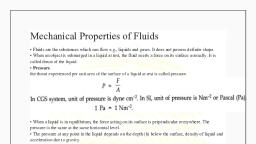
Consider a liquid in a vessel in a state of, equilibrium of rest. Let F be the force acting on the, liquid surface along the direction OA, making an, angle @ with the free surface of the liquid, Fig., 8(b).2. Resolving F into two rectangular components, we have : F cos 6 along OB and F sin 6 along, OD., , , , , , c D, FIGURE 8(b).2, , , , , , Here, Fcos@ acting parallel to the liquid, surface (called tangential component of force) will, tend to move the liquid. Thus the liquid will be in, equilibrium of rest only if there is no flow of liquid,, which is so, if, , F cos@ = 0., As F+0, cos8=0 or 6=90°., , Hence the forces acting on a liquid in, equilibrium of rest must be acting perpendicular to, the surface of liquid., , §(b)) THRUST AND PRESSURE OF THE LIQUID, , 4 | The total normal force exerted by liquid at rest., on a given surface in contact with it is called thrust, of liquid on that surface. S.1. unit of thrust is newton, and its cgs unit is dyne., , The normal force (or thrust) exerted by a liquid, at rest per unit area of the surface in contact with it is, called pressure of liquid or hydrostatic pressure., , Let F be the normal force acting on a surface, of area A in contact with liquid, then pressure, exerted by liquid on this surface is, , , , , , P=F/A, , , , , , , , UNIT of Pressure in system S.I. is Nm~2 or, Pascal (denoted by Pa) and in cgs system it is, , dyne/cm?. The dimensional formula for pressure is, [ML7!'T-2)., , Pressure is a scalar quantity because at one, level inside the liquid, the pressure is exerted
Page 4 :
eS, equally in all directions, which shows that a definite, direction is not associated with hydrostatic, pressure., , Bi SOME APPLICATIONS OF THE CONCEPT, i OF PRESSURE, , 1. The bags and suitcases are provided with, broad handles so that small pressure is exerted on, the hand while carrying them., , , , 2. Railway tracks are laid on large sized, wooden, iron or cement sleepers so that the thrust, due to weight of train is spread over a large arca,, This reduces the pressure on ground which would, prevent the yielding of ground., , 3. It is painful to walk bare footed on a road, covered with edge pebbles. It is duc to the fact that, if our body weight is supported on a very small area, of the sharp edge of the pebble on the road, it will, exert in reaction., a large pressure on our feet., , 4. It is difficult to walk bare footed on a sandy, ground as the sand yiclds under our weight., , This difficulty can be overcome by spreading, the wooden board on the sand. In this situation, the, thrust on the sand due to our weight will get spread, over the whole area of the board and hence a very, , small pressure is exerted on the sand. Duc to which,, the sand does not yield., , 5. Pins and nails are made to have pointed ends, in order to have least area of contact between the, pin and the given surface. Duc to this, the pin if, pressed, will exert high pressure on the surface,, and hence will easily penetrate the surface,, , ae) PRESSURE EXERTED BY A LIQUID COLUMN, 6, , Consider a liquid of density p contained in a, cylindrical vessel of cross sectional area a. Leth be, the heightiof liquid column, p be its density and g, be the acceleration due to gravity. The weight of, liquid will exert a downward thrust on the bottom, , surface of the vessel. Therefore, pressure due to, liquid acts on that surface,, , Weight of liquid inside the vessel = volume, x density of liquid x acc. due to gravity, “= ahx pxe, “+ Thrust of liquid on-area a = weight of, liquid = ah p g, “. Liquid pressure on the base of vessel is, , thrust ah Pg, P oe . =hpg wht)
Page 5 :
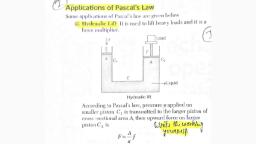
——~ PASCAL’S LAW, [ 7) ht states that if gravity effect is neglected, the, pressure at every point of liquid in equilibrium of rest, is sane., , This law also accounts for the principle of, pansmission of pressure in liquids or gases. In this, form, Pascal's law states that the increase in pressure, at one point of the enclosed liquid in equilibrium of, rest is transmitted equally to all other points of the, liquid and also to the walls of the container, provided, the effect of gravity is neglected., , Proof. Consider two points C and D inside the, liquid in a container which is in equilibrium of rest., Imagine a right circular cylinder with axis CD of, uniform cross-sectional area A such that points C, and D lie on flat faces of the cylinder, Fig. 8(b).3., The liquid inside the cylinder is in equilibrium, under the action of forces exerted by the liquid