Page 1 :
Chapter 2 (18 Marks), Collection, Organisation and Presentation of, Data
Page 2 :
Overview- Collection of Data, Meaning, , Source of Data, Methods of collecting primary data, Methods of collecting secondary data, , Census, Sampling, Statistical error
Page 3 :
Collection of Data, It is the first step in any statistical investigation., The purpose of collection of data is to collect evidence for reaching, a sound and clear solution to a problem., Data – Information, which can be expressed in numbers.
Page 4 :
Important terms, Investigator- The person who conducts the statistical enquiry., Enumerator- The investigator need the help of certain persons to, collect the information, known as enumerator., , Respondents- The persons, from whom the statistical information is, to collected are known as respondents., Survey- Survey is a method of gathering information from, individuals. Survey is conducted by asking questions about a, product or candidate or anything from a large group of peoples., Variable- A variable is a quantity used to measure an “attribute”, (such as height, weight, number etc.) of some thing or some persons,, which can take different values in different situations.
Page 5 :
Collection of Dataf Data, , Sources of Data, , Methods of collecting Data
Page 6 :
Sources of Data, , Internal, Sources, , Sources, , Primary Data, , Secondary, Data
Page 7 :
Internal Sources, In an organization, when data is collected from its own reports and, record, it is known as internal sources., Data collected and compiled through internal sources is known as, internal data., , Examples: A company publishes its annual report on the profit and, loss, total sales, loans, wages etc.
Page 8 :
Sources, Refers to the data collected from outside the organization., Data collected and compiled through external sources is known as, external data., Examples: Tour and travels company obtain information on “UP, tourism” from Uttar Pradesh Transport corporation., Data can be collected from primary as well as secondary sources.
Page 9 :
Primary Sources, , Primary source of data implies collection of data from its source of, origin., It offer you first hand quantitative information relating to your, statistical study., Primary source of data offers you “Primary data”., Data collected by the investigator for his own purpose, for the first, time, from beginning to end., These are collected from the source of origin., The concern investigator is the first person who collects these, information., These are the first hand information., , Primary data once collected and published becomes the secondary data.
Page 10 :
Secondary Sources, Secondary source of collection of data implies obtaining the relevant, statistical information from an agency or an institution which is already in, possession of that information., It does not offer you first hand information relating to your statistical, study., It rely on the information which is already existing., Secondary source of data offers you “Secondary data”., Data collected by other person are called secondary data., These are those which are already in existence, and which have been, collected, for some other purpose than the answering of question in hand., These are second hand data., , These are available in the form of published or unpublished reports.
Page 11 :
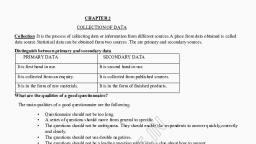
Sources of Data, Basis, , Primary Data, , Secondary Data, , Originality Primary data are original, Secondary data are not, because they are collected original since investigator, by the investigator himself, makes use of the data, collected by other agency, Source, Primary data are collected Secondary data are already, by some agency or person collected and processed by, by using the method of data some person or agency and, collection, is ready for use, Time Factor It requires longer time for, Secondary data requires, data collection, less time
Page 12 :
Basis, , Primary Data, , Secondary Data, , Cost Factor, , The collection of primary data, requires a considerable, amount, of money and personals as whole, plan of investigation is initiated, , The collection of secondary, data is cheaper as it is taken, from published or, unpublished material., , Reliability, Primary data is more reliable and, and Suitability suitable to the enquiry as the, investigator himself collects it, , Secondary data is less, reliable and less suitable as, someone else has collected, the data which may not, serve the purpose., , Precautions, , There is no great need for, precautions while using primary, data, , Secondary data should for, organizational set up in, case of secondary data, , Organisation, factors, , Collection of primary data requires There is no need for, elaborate organization set up, organizational set in case of, secondary data
Page 14 :
Direct Personal Investigation, Direct Personal Investigation is the method by which the data are, personally collected by the investigator from the information., The investigator establishes direct relation with the persons from, whom the information is to be obtain., The investigator should be very diligent, efficient, impartial and, tolerant.
Page 15 :
Suitability, The field of investigation is limited or not very large., A greater degree of originality of the data is required., Information is to be kept secret., Accuracy of the data is of great significance, and, When direct contact with the informants is required.
Page 16 :
Merits, Originality: Data have a high degree of originality., Accuracy: Data are fairly accurate when personally collected., Reliability: Because the information is collected by the investigator, himself, the reliability of the data is not doubt., , Related information: When in direct contact with the informants, the, investigator may obtained other related information as well., Uniformity: There is a fair degree of uniformity in the data collected, by the investigator himself from the informants. It facilities, comparison., Elastic: This method is fairly elastic, because the investigator can, always make necessary adjustments in his set of questions.
Page 17 :
Demerits, Difficult to cover wide areas: Direct personal investigation becomes, very difficult when the areas of the study is very wide., Personal Bias: This method is highly prone to the personal bias of, the investigator. As a result, the data may be lose their credibility., Costly: This method is very expensive in terms of the time, money, and efforts involved., , Limited coverage: In this method, area of investigation is generally, small. The results are, therefore, less representative. This may be, lead to wrong conclusion.
Page 18 :
Precautions, Investigator should be well verse with the statistical technique and, should have good temperament., Investigator should be familiar with the culture, tradition and the, language of the concern area., Investigator should ask straight, simple and unambiguous question, from informants., No personal bias should be used by the investigator.
Page 19 :
Indirect Oral Investigation, The investigator approach approach third parties, who are in the, possession of information about the subject of enquiry., This method is used when the are of investigation is very or the, respondent are reluctant to part with the information due to various, reasons., The investigator prepares a small list of questions relating to the, investigation and the questions are asked from the different persons, and their answers are recorded., The persons to whom these questions are put are known as, witnesses.
Page 20 :
Suitability of this method, When concern informants are unable to give information due to their, ignorance or they are not prepare to be part with the information;, , When the are of the information is very large;, When secret or sensitive information about the informant has to be, gather;, , When the problem of investigation is complex and the needs, expert’s opinion.
Page 21 :
Merits, Wide coverage: This method is suitable when the area of, investigation is large., Economical: It is economical in terms of money, time and, manpower., Free from bias: This method is relatively free from personal, prejudice as the information is collected from the persons who are, well aware of the situation., , Expert opinion: Under this method, an investigator can seek opinion, of the experts.
Page 22 :
Demerits, Indirect information: The result can erroneous because information, is obtained from other persons, not directly connected., Lack of accuracy: As compared with direct personal observation, the, degree of accuracy of the data is likely to be lower., Partiality of witness: The persons, providing the information may be, prejudice or bias., Lack of interest of informants: Since the interest of the person,, providing the information, is not at stake, the collected information, is often vague and unreliable., Lack of uniformity: The information collected from different, persons may be homogenous and comparable.
Page 23 :
Precaution, The number of the witness should be fairly large., Only those witness should be selected who posses sufficient, knowledge about the purpose investigation;, , The investigator should be neither disbelieved nor completely, believed the information provided by the witness;, Efforts should be made to make cross check system to ascertain the, accuracy;, It must be ensured that interviews are not subjective in their, approach and the witness are not prejudicial in favour of or against a, particular point of view.
Page 24 :
Direct Personal Investigation vs Indirect Oral Investigation, Basis, , Direct Personal, Investigation, , Indirect Oral Investigation, , Coverage, , This method is suitable for, limited area, , This method can be used to, cover a wide area of, investigation, , Originality, , Information collected is, original in character, , This method lacks originality, as data is collected from the, witness, , Reliability and, Accuracy, , Information collected by, the investigator is more, accurate and reliable, , There is possibility of, unreliable and inaccurate, information due to indirect, collection of data, , Cost, , This method is more, expensive, , It is economic in method
Page 25 :
Information from correspondent, Under this method, local agents or correspondent are appointed and, train to collect the information from the respondents., This method is used when information at regular intervals of time is, to be collected from different places., Agents or correspondents regularly collect the data in their, jurisdiction and sent to their investigator., This method is often adopted by newspapers and periodicals.
Page 26 :
Suitability, When regular and continuous information is required;, When the area of the investigation is very large;, , When high degree of accuracy is not required.
Page 27 :
Merits, Wide coverage: This method is useful in situation where the area of, investigation is very large and periodic information is to be collected, from the distant places., Economy: It is very economical in terms of money and resources., Suitable for special purpose: This method is suitable for some, special purpose of investigation., Continuity: It is very useful for collecting regular information.
Page 28 :
Demerits, Lack of Uniformity: The information supplied by the different, correspondent often lacks of uniformity and hence, not comparable., , Danger of partiality: The personal bias of the correspondent may, inter the reports and to that extend, the accuracy is affected., Lack of Accuracy of high degree: This method cannot be used, where high degree of accuracy is required., Time consuming: A lot of time is consumed to collect the, information.
Page 29 :
Precautions, Appointment of correspondent should be made with full, precautions., , The correspondent should not be prejudice., The number of respondent should be fairly large and reasonable., Correspondent should be educated and familiar with the problem.
Page 30 :
Telephonic interviews, , Under this method, data is collected through an interview over the, telephone with the interviewer., , Telephone interview is better in the case where the respondent are, reluctant to answer certain question in personal interviews., Many of the shows on television conduct “polls” on the telephonic, interview., The response rate is lower and fewer question may be asked before, the respondent gets tired of the proceedings.
Page 31 :
Suitability, When the respondent have a telephone connection., When the data is to collect in shorter duration.
Page 32 :
Merit, Wide coverage: This method is useful for conducting enquiry over a, large area., , Economical: This method is cheaper as it required less time, money, and labour., Clarity doubt: It is possible to assist the respondents by clarifying, the question.
Page 33 :
Demerit, Limited use: The disadvantage of this method is access to people., This method is not possible for people who do not own telephone., , Visual feedback is not possible: Telephone interviews also obstruct, visual reactions of the respondents. Which becomes helpful in, obtaining information on sensitive issues.
Page 34 :
Mailed Questionnaire Method, Under this method, the investigator makes a questionnaire, pertaining to the field of investigation and sent it to the respondents,, along with a covering letter, to collect information from them., A questionnaire consist of a list of questions pertaining to the, investigation. Blank spaces are left for writing the answers., Usually a self addressed stamped envelop is enclosed for returning, the questionnaire by post., Respondents are assured of the secrecy of the information supplied, by them., This method is adopted by research workers and other official and, non-official agencies.
Page 35 :
Questionnaire filled by the enumerators, Under this method, the enumerator personally visits informants, along with a questionnaire, asked questions and note down their, replies in the questionnaire in his own language., The enumerator assist the informants to understand the true nature, of questions and fill up the schedule himself, to avoid vague and, ambiguous replies., , In order to get reliable information, the enumerator should be, tactful, unbiased, well trained and hard working., This method is usually used by the government, semi government, organisations, big business houses, and research institutes etc., The questionnaire filled by the investigator is known as “schedule”.
Page 36 :
Suitability, This method is mostly used whenField of investigation is large., , The investigation needs specialized and skilled investigators, and, The investigators are well versed in the local language and, cultural norms of the informants.
Page 37 :
Merits, Wide coverage: This method is capable of a wide coverage in terms of the, area involved. Even illiterates can furnished the required information., Accuracy: There is a fair degree of accuracy in the results. This is because, investigations are done by the specialized enumerators., Personal contact: Unlike in the case of mailing questionnaire, there is, personal contact with the informants in this method. Accordingly, accurate, and right answer are obtained., Impartiality: This method is impartial. This is because the enumerators, themselves do not need the required information, so they are impartial to, the nature of the information that they obtain., Completeness: Schedules have the merits of completeness because these, are filled by the enumerators themselves.
Page 38 :
Demerits, Expensive: This is a very expensive method of investigation because of, the involvement of the trained investigators., Availability of the enumerators: Competent enumerators may not be, available. Accuracy of the information accordingly suffers., , Time consuming: Enumerators need specialize training for particular, investigation. The process of investigation thus becomes time, consuming., Not suitable for private investigation: Since this method is very, expensive, it is generally not suitable for private investigation. This, method is generally used by the government institutions., Partial: If the enumerators are biased, then the data will not be, accurate.
Page 39 :
Precautions, Enumerators should be the person of high integrity and properly, train to used the statistical tools., Enumerators should be polite, tactful, laborious, honest to his assign, works., There should be timely evaluation of the work of enumerators., , The informant should be properly educated about the objective of, the investigation., Questions in the schedules should be small in length, simple and, clear.
Page 40 :
Qualities of a good questionnaire, Limited number of questions: The number of questions in a, questionnaire should be as limited as possible. Questions should be, only relating to the purpose of enquiry., Simplicity: Language of the questions should be simple, lucid, and, clear. Questions should be short, not too long or complex., Mathematical questions should be avoided., Proper order of the questions: Questions must be placed in a proper, order., No undesirable questions: Undesirable questions or personal questions, must be avoided. The question should not offend the informants., Non-controversial: Questions should be such as can be answer, impartially. No controversial questions should be asked.
Page 41 :
Calculations: Questions involving calculation by the respondents must, be avoided. Investigator himself should do the calculation job., Pre testing pilot survey: Some questions be asked from the informants, on trial basis. If their answers involve some difficulty these can be, reframe accordingly. Such testing is technically called pilot survey., Instructions: A questionnaire must show clear instructions for filling in, the forms., Cross verification: Such questions may be asked which help cross, verifications., Request for return: Request should be made to the respondent to return, the questionnaire completed in all respects. The informants must be, assured that the information conveyed by him will be treated as, confidential.
Page 42 :
Construction of Questionnaire or Schedule, Covering letter: A very polite covering letter should be sent to the, respondents along with the questionnaire., It should clearly explain in brief, the objectives and the scopes of, the survey., It should ensure the respondents about their secrecy., In case of the mailed questionnaire method, a self addressed, stamped envelope should be enclosed., To ensure quick and better response, the respondents may also be, offered certain incentives.
Page 43 :
Decision regarding question: To frame questionnaire or schedule, first, of all we have to take decision regarding various question to be, incorporated. The selection of questions depends upon the purpose of, enquiry., , The questions in the questionnaire may be broadly classified as under:, Simple alternative questions: These questions may be answered, between two alternatives such as yes or no, right or wrong, true or, false. Such types of questions can be used where two clear cut, alternative exists., Multiple Choice Questions (MCQ): In such questions, the possible, answers are printed in the questionnaire and the respondent is, supposed to tick any one of them. MCQs are very easy and, convenient for the respondents to answer.
Page 44 :
Specific information questions: The questionnaire should start from, general questions and proceed to more specific ones. This helps the, respondents feel comfortable. Such questions are asked to obtain, some specific information., , Open questions: These type of questions are to be answered by the, respondent in his own words. The questions should be such that it is, possible to answer them in a few words. Such questions leave the, door open to any answer.