Page 1 :
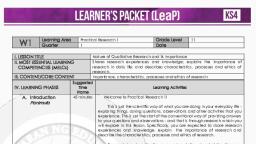
W1, , Learning Area, Quarter, , Practical Research 1, , 1, , I. LESSON TITLE, II. MOST ESSENTIAL LEARNING, COMPETENCIES (MELCs), III. CONTENT/CORE CONTENT, IV. LEARNING PHASES, A. Introduction, , Panimula, , Grade Level, Date, , 11, , Nature of Qualitative Research and its Importance, Shares research experiences and knowledge; explains the importance of, research in daily life; and describes characteristics, processes and ethics of, research., Importance, characteristics, processes and ethics of research, , Suggested, Time, Frame, 45 minutes, , Learning Activities, Welcome to Practical Research 1!, This is just the scientific way of what you are doing in your everyday life exploring things, asking questions, observations and other activities that you, experience. This is just the start of the conventional way of providing answers, to your questions and observations - and that is through research which you, will explore in this lesson. Specifically, you are expected to share research, experiences and knowledge, explain the importance of research and, describe the characteristics, processes and ethics of research., Research is an investigation or experimentation aimed at the discovery, and interpretation of facts, revision of accepted theories or laws in the light, of new facts, or practical application of such new or revised theories or laws, (Merriam-Webster Dictionary, Retrieved from https://www.merriamwebster.com/dictionary/research)., According to Zarah (2020), the main purpose of research is to inform, action, to prove a theory and contribute to developing knowledge in a field, or study. This article will highlight the significance of research with the following, points:, 1., 2., 3., 4., 5., 6., , a tool for building knowledge and for facilitating learning;, means to understand various issues and increase public awareness;, an aid to business success;, a way to prove lies and to support truths;, means to find, gauge and seize opportunities;, a seed to love reading, writing, analyzing and sharing valuable, information; and, 7. nourishment and exercise for the mind., Moreover, since the purpose of research is to inform action. Thus, a, research study should seek to contextualize its findings within the larger body, of research. Research must always be of high quality in order to produce, knowledge that is applicable outside of the research setting. Furthermore, the, results of the study may have implications for policy and future project, implementation., , To read further about the importance of research, you may copy this link, to, your, browser:, https://graduate.kennesaw.edu/newsletter/posts/, seven_reasons_why_research_is_important.php, Research involves a systematic process that focuses on being objective, and gathering a multitude of information for analysis so that the researcher, can come to a conclusion. The scientific research process is a multiple-step, process where the steps are interlinked with the other steps in the process. If, changes are made in one step of the process, the researcher must review all, the other steps to ensure that the changes are reflected throughout the, process., , 1
Page 2 :
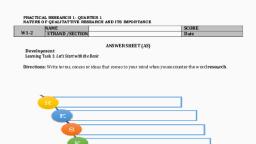
IV. LEARNING PHASES, , Suggested, Time, Frame, , Learning Activities, The research process often begins with a very broad idea for, a topic you’d like to know more about. You do some preliminary research to, identify a problem. After refining your research questions, you can lay out the, foundations of your research design, leading to a proposal that outlines your, ideas and plans. Although different models of the research process exist,, each containing different numbers of stages, most include the same general, elements., , To read further about the research process, you may copy this link to, your browser: https://www.scribbr.com/category/research-process/, Research is a process of collecting, analyzing and interpreting, information to answer questions. But to qualify as research, the process must, have certain characteristics: it must, as far as possible, be systematic,, controlled, rigorous, valid and verifiable, empirical and critical., Characteristics of Research, 1. Empirical. Research is based on direct experience or observation by the, researcher., 2. Logical. Research is based on valid procedures and principles., 3. Cyclical. Research is a cyclical process because it starts with a problem, and ends with a problem., 4. Analytical. Research utilizes proven analytical procedures in gathering, the data, whether historical, descriptive, and experimental and case, study., 5. Critical. Research exhibits careful and precise judgment., 6. Methodical. Research is conducted in a methodical manner without, bias using systematic method and procedures., 7. Replicability. The research design and procedures are replicated or, repeated to enable the researcher to arrive at valid and conclusive, results., , B. Development, , Pagpapaunlad, , 45 minutes, , Learning Task 1: Let’s Start with the Basic, Directions: Write terms, concepts or ideas that comes to your mind when you, encounter the word research., , 2
Page 3 :
IV. LEARNING PHASES, , Suggested, Time, Frame, , Learning Activities, Learning Task 2: Decide if it is TRUE or FALSE!, Directions: On the space provided, write TRUE if the statement is correct and, FALSE otherwise., __________ 1. Research is said to be critical if it exhibits cautious judgement., __________ 2. Research is based on invalid procedures and principles., __________ 3. Research is not based on observation by the researcher., __________ 4. The research process begins with a very broad idea of a topic., __________ 5. The purpose of research is not to inform action., Learning Task 3: Just YES or NO!, Directions: Write YES on the space before the number if the statement, describes characteristics of research and NO if not., __________ 1. Research starts with a problem and ends with an answer., __________ 2. Research utilizes proven logical process in gathering the data., __________ 3. Research replicates to arrive at valid and conclusive results., __________ 4. Research is conducted in a organized manner with bias., __________ 5. Research utilizes historical and experimental procedures., , C. Engagement, , 60 minutes, , Pakikipagpalihan, , Learning Task 4: Share your Stuff, Directions: Share your personal experiences on research by completing the, table below. Answer the guide questions that follow., Your own experience of research, (or research that you know), , What is the importance of this, research to life?, , Guide Questions, 1. Based on your experiences, how do you define research?, 2. What are the features of a research?, 3. Is research essential in our everyday living?, , D. Assimilation, , Paglalapat, , 60 minutes, , Learning Task 5: FB (Follow and Build) Time!, Directions: Follow each process on the cycle below and build your own, mnemonic device for you to easily remember the research process cycle., Answer the guide questions that follow., , 3
Page 4 :
IV. LEARNING PHASES, , Suggested, Time, Frame, , Learning Activities, , Process, , Your idea(s) / note(s), , Term(s) to be used, , My mnemonic device to easily remember the research cycle is, ____________________., Guide Questions, 1. Which among the processes is the easiest step in a research? Why?, 2. How about the most difficult? Why?, 3. Based on the activity, what are the characteristics of a research?, V. ASSESSMENT, , 15 minutes, , (Learning Activity Sheets for, Enrichment,, Remediation, or, Assessment to be given on Weeks, 3 and 6), , Learning Task 6: Time to assess!, Directions: Read and analyze each item. Encircle the letter of the correct, answer., 1. Which among the following terms is an investigation or experimentation, aimed at the discovery and interpretation of facts?, A. Case study, B. Ethics, C. Inquiry, D. Research, 2. Cincy Merly provides data based on valid procedures and principles., Which among the characteristics describes the statement?, A. Analytical, B. Critical, C. Cyclical, D. Logical, 3. Which of the following terms implies logical research?, A. Research is based on observation by the researcher., B. Research is based on valid procedures and principles., C. Research utilizes historical and experimental procedures., D. Research replicates to arrive at valid and conclusive results., 4. Peejay conducted research in a organized manner without bias. Which of, the characteristics describes the statement?, A. Analytical, B. Logical, C. Methodical, D. Replicability, 5. Which among the following terms refers to a process of collecting,, analyzing and interpreting information to answer questions?, A. Research, B. Observation C. Interpretation D. Reflection, , VI. REFLECTION, , 15 minutes, , In your journal, write your personal insights about the lesson using the, prompts below., I understand that ___________________., I realize that ________________________., I need to learn more about __________., , Prepared by:, , PEEJAY G. GECOLEA EdD, CINCY MERLY B. GECOLEA EdD, , Checked by: ISABELITA R. HIZON EdD, , 4
Page 5 :
REFERENCES, Abueg, L. C. Practical Research 1. University of the Philippines, Buensuceso, Dacanay, Manalo & San Gabriel (2016). Practical Research 1 Teacher’s Guide: First Edition., Department of Education, Creswell, J. (2014). Research design: Qualitative, quantitative, and mixed methods approaches. Los, Angeles: Sage., Gecolea, Cincy Merly B. and Gecolea, Peejay G. (2020). Self-Learning Module in Practical Research 1., Department of Education, Division of Calamba City, ANSWER KEY, Learning Task 1: Let’s Start with the Basic, The answers of the learners vary., Learning Task 2: Decide if it is TRUE or FALSE!, 1. TRUE, 2. FALSE, 3. FALSE, 4. TRUE, 5. FALSE, Learning Task 3: Just YES or NO!, 1. NO, 2. YES, 3. YES, 4. NO, 5. YES, Learning Task 4: Share your Stuff, The answers of the learners vary., Learning Task 5: FB (Follow and Build) Time!, The answers of the learners vary., Learning Task 6: Time to assess!, 1. D, 2. D, 3. B, 4. C, 5. A, , 5