Page 1 :
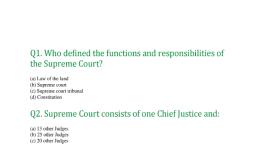
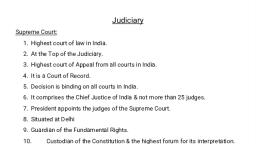
Q1. Who defined the functions and responsibilities of, the Supreme Court?, (a) Law of the land, (b) Supreme court, (c) Supreme court tribunal, (d) Constitution, , Q2. Supreme Court consists of one Chief Justice and:, (a) 13 other Judges, (b) 25 other Judges, (c) 20 other Judges, (d) 30 other Judges, , Q3. The judges of the Supreme Court of India are, appointed by the, (a) President, (b) Vice President, (c) Prime Minister, (d) Home Minister, , Q4. By convention who is appointed as the chief, justice of India?, (a) Senior-most judge of the High Court, (b) Junior-most judge of the Supreme Court, (c) Senior-most judge of the Supreme Court, (d) Senior Member of Law Commission, , Q5. Supreme Court sits at:, (a) Chandigarh, (b) Delhi, (c) Kolkata, (d) Shimla
Page 2 :
Q6. The salaries and allowances of the judges’ are, determined by, (a) Parliament, (b) Executive, (c) Judiciary, (d) President, , Q7. What is the maximum number of judges of the, Supreme Court of India including the Chief Justice?, (a) 20, (b) 21, (c) 26, (d) 34, , Q8. In Golaknath vs the State of Punjab case, the, Supreme Court was led by Chief Justice, (a) Suba Rao, (b) R. S. Pathak, (c) J. S. Verma, (d) R. C. Lahoti, , Q9. A judge of a High Court can be transferred to, another, (a) High Court by the Prime Minister, (b) Supreme Court by the Chief Justice of India, (c) High Court on the recommendation of the Chief Minister of a State, (d) High Court by the President after consultation with the Chief Justice of India, , Q10. The process of judicial appointments is, influenced by:, (a) Council of Ministers, Governors and Chief Ministers and Chief Justice of India, (b) President
Page 3 :
(c) Election Commissioner of India, (d) Comptroller and Auditor General, , Q11. The executive plays a crucial role; the, legislature has the powers of removal. This has, ensured…, (a) Balance of Power, (b) Judicial Interpretation, (c) Separation of Power, (d) Both balance of power and independence of the judiciary, , Q12. The number of Judges is Supreme Court of India, is, (a) 26, (b) 30, (c) 18, (d) 25, , Q13. Which is not the issue of original jurisdiction of, Supreme Court of India, (a) Dispute of fundamental rights, (b) Dispute between States, (c) Interpretation of the constitution, (d) To give opinion to president, , Q14. Where is H.Q. of Supreme Court of India, (a). New Delhi, (b) Mumbai, (c) Bangalore, (d) Kolkata