Page 1 :
08, , Units and, Measurements, Quick Revision, 1. Physical Quantities All the quantities which, can be measured directly or indirectly and, in terms of which laws of Physics are described, are called physical quantities., These can be divided into two types, namely, fundamental and derived quantities., ● Fundamental Quantities The physical, quantities which are independent of other, physical quantities and are not defined in, terms of other physical quantities are called, fundamental or base quantities., e.g. Mass, length, time, temperature, luminous, intensity, electric current, amount of, substance, etc., ● Derived Quantities Those quantities which, can be derived from the fundamental physical, quantities are called derived quantities., e.g. Velocity, acceleration, linear momentum,, etc., 2. Physical Unit The standard amount of a, physical quantity chosen to measure the, physical quantity of same kind is called a, physical unit. The physical units can be, classified into following two types, ● Fundamental Units The units of, fundamental quantities are known as, fundamental units., , Derived Units The units of measurement, of all other physical quantities, which can, be obtained from fundamental units are, called derived units., 3. System of Units It is the complete set of, units, both fundamental and derived physical, units., The common system of units used in, mechanics are as follows, ●, The FPS System It is the British, engineering system of units. It uses foot as, the unit of length, pound as the unit of mass, and second as the unit of time., ● The CGS System It is the French system of, units, which uses centimetre, gram and, second as the units of length, mass and time,, respectively., ● The MKS System It uses metre, kilogram, and second as the fundamental units of, length, mass and time, respectively., ● The International System of Units, (SI Units) The system of units which is, accepted internationally for measurement is, the ‘Systeme International d’ Units (French, for International System of Units),, abbreviated as SI., ●
Page 2 :
4. Fundamental Quantities and their SI Units, Fundamental, quantity, , SI unit, , Symbol, , Length, , metre, , m, , Mass, , kilogram, , kg, , Time, , second, , s, , Electric current, , ampere, , A, , Temperature, , kelvin, , K, , Amount of, substance, , mole, , mol, , Luminous intensity, , candela, , cd, , 5. Supplementary Quantities and their SI Units, Supplementary, quantity, , SI unit, , Plane angle, , radian, , Solid angle, , steradian, , Symbol, rad, sr, , 6. Some Important Practical Units, For Length/Distance, ● Astronomical Unit It is the mean distance, of the earth from the sun., 1 AU = 1.496 ´ 10 11 m, ●, Light year It is the distance travelled by, light in vacuum in one year., 1 ly = 9.46 ´ 10 15 m, -6, ● Micro or micrometer, 1 mm = 10, m, ●, , Nanometer, 1 nm = 10 -9 m, , ●, , Angstrom, 1 Å = 10 -10 m, , Fermi This unit is used for measuring, nuclear sizes. 1 Fm = 10 -15 m, For Mass, ● Pound, 1 lb = 0.4536 kg, ●, , ●, , Slug, 1 slug = 14.59 kg, , ●, , Quintal, 1 q = 100 kg, , ●, , Tonne or metric tonne, 1 t = 1000 kg, , ●, , Atomic mass unit (It is defined as the, (1/12)th of the mass of one 12, C-atom) 1 u or, 6, amu = 1.66 ´ 10 –27 kg., , For Area, -28, ● Barn, 1 barn = 10, m2, 2, ● Acre, 1 acre = 4047 m, 4, ● Hectare, 1 hectare = 10, m2, 7. Accuracy and Precision of Instruments, The accuracy of a measurement is a measure of, how close the measured value is to the true, value of the quantity. While, precision tells us, to what resolution or limit the quantity is, measured., 8. Errors in Measurement, Difference in the true value and the measured, value of a quantity is called error in, measurement., Error = True value – Measured value, In general, the errors can be further classified as, ●, Systematic Errors Those errors that tend, to be in one direction, either positive or, negative are called systematic errors. Some, of the sources of systematic errors are, (a) Instrumental errors They occur due to, imperfect design or manufacture or, calibration of the measuring instrument., (b) Imperfection in experimental, technique or procedure These types of, errors occur due to the experimental, arrangement limitations., (c) Personal errors These errors arise due, to inexperience of the observer such as lack, of proper setting of the apparatus and, taking observations without observing, proper precautions, etc., (d) Errors due to external causes Various, parameters such as change in, temperature, pressure, volume, etc. during, experiment may affect the reading of, measurement., ● Random Errors The errors which occur, irregularly and are random in magnitude, and direction are called random errors., ● Least Count Error The smallest value that, can be measured by a measuring instrument, is called the least count of the instrument, and error in its value is called least count, error.
Page 3 :
●, , ●, , ●, , ●, , Absolute Error The magnitude of the, difference between the true value of the, quantity and the individual measured value, is called the absolute error of the, measurement. It is denoted by | D a |., Suppose, the measured values are, a 1, a 2, a 3, K , a n , then arithmetic mean of, a + a2 + K + an, these values is a Mean = 1, ., n, If we take arithmetic mean a Mean as the true, value, then the absolute errors in the, individual measured value will be, Da 1 = a Mean – a 1, Mean Absolute Error It is the arithmetic, mean of the magnitudes of absolute errors in, all the measurements of the quantity., n | Da |, i, Mean absolute error, D a Mean = S, i =1, n, Relative Error or Fractional Error It is, defined as the ratio of mean absolute error to, the mean value of the quantity measured., D a Mean, Relative error, da =, a Mean, Percentage Error When fractional error or, relative error is expressed in percentage,, then it is called percentage error., D a Mean, Percentage error, da % =, ´ 100%, a Mean, , 9. Combination of Errors, ● Error in Sum or Difference, Let X = A + B or X = A - B, where, A and B are physical quantities have, measured value A ± DA, B ± DB ,, respectively., , ●, , So, the maximum possible error in sum and, difference, DZ = DA + DB, Error in Product or Quotient, A, Let, X =, X = A ´ B or, B, So, the maximum possible error in product, DZ, DA DB, or quotient is, =, +, Z, A, B, , ●, , Error in Case of a Measured Quantity, Raised to a Power, Relative error of Z = A n B m is, DZ, DB ù, é DA, = ± ên, +m, Z, B úû, ë A, , 10. Significant Figures, The digits that are known reliably plus the first, uncertain digit are known as significant digits, or significant figures., Rules for Determining the Number of, Significant Figures, Rule 1 All non-zero digits are significant., Rule 2 All the zeros between two non-zero, digits are significant, no matter where, the decimal point is, if at all., Rule 3 If the number is less than one, the, zero(s) on the right of decimal point, and to the left of first non-zero digit, are not significant., Rule 4 In a number without a decimal point,, the terminal or trailing zeros is not, significant., Rule 5 The trailing zero(s) in a number with a, decimal points are significant., 11. Rules for Arithmetical Operations with, Significant Figures, Some rules of arithmetical operations with, significant figures are as given below, ● Addition and Subtraction In both,, addition and subtraction, the final result, should retain as many decimal places as, are there in the number with the least, decimal places., ● Multiplication and Division In, multiplication or division, the final result, should retain as many significant figures, as, are there in the original number with the, least significant figures., 12. Rounding Off The result of computation with, approximate numbers, which contains more, than one uncertain digit, should be rounded, off. While rounding off measurements, we use, the following rules by convention
Page 4 :
Rule 1 If the digit to be dropped is less than 5,, then the preceding digit is left, unchanged., Rule 2 If the digit to be dropped is more than, 5, then the preceding digit is raised by, one., Rule 3 If the digit to be dropped is 5 followed, by digits other than zero, then the, preceding digit is raised by one., Rule 4 If the digit to be dropped is 5 and, followed by zeros, then the preceding, digit is left unchanged, if it is even., Rule 5 If the digit to be dropped is 5 and, followed by zeros, then the preceding, digit is raised by one, if it is odd., 13. Dimensions of a Physical Quantity, The dimensions of a physical quantity are the, powers (or exponents) to which the units of, base quantities are raised to represent a, derived unit of that quantity. There are seven, base quantities represented with square brackets, [ ] such as length [L], mass [M], time [T], electric, current [A], thermodynamic temperature [K],, luminous intensity [cd] and amount of, substances [mol]., 14. Dimensional Formulae and, Dimensional Equations, The expression which shows how and which of, the fundamental quantities represent the, dimension of the physical quantity is called the, dimensional formula of the given physical, quantity., Some of the dimensional formulae are as given, below, Acceleration = [M 0 L1 T -2 ], Mass density = [ML-3 T 0 ], Volume = [M 0 L3 T 0 ], , The equation obtained by equating a physical, quantity with its dimensional formula is called, the dimensional equation of the given, physical quantity., 15. Dimensional Analysis and its Applications, The dimensional analysis helps us in deducing, the relations among different physical quantities, and checking the accuracy, derivation and, dimensional consistency or homogeneity of, various numerical expressions. Its applications, are as given below, ● Checking the Dimensional Consistency, of Equations The principle of homogeneity, of dimension states that, a physical quantity, equation will be dimensionally correct, if the, dimensions of all the terms occurring on, both sides of the equation are same., ● Conversion of One System of Units into, Another If M 1, L 1 and T1 are the, fundamental units of mass, length and time, in one system and while for other system,, M 2, L 2 and T2 are the fundamental units of, mass, length and time, then n 1 = [M a1 L b1 T c1 ], and n 2 = [M a2 Lb2 T2c ]., From n 1u 1 = n 2u 2, where u 1 and u 2 are two, units of measurement of the quantity and n 1, and n 2 are their respective numerical values., n [M a L b T c ], Then, n 2 = 1 a 1 b 1 c 1, [M 2 L 2 T 2 ], a, , b, , éM ù éL ù é T ù, = n1 ê 1 ú × ê 1 ú × ê 1 ú, ë M 2 û ë L 2 û ë T2 û, ●, , c, , Deducing Relation among the Physical, Quantities The method of dimensions is, used to deduce the relation among the, physical quantities. We should know the, dependence of the physical quantity on other, quantities.
Page 5 :
012, , CBSE New Pattern ~ Physics 11th (Term-I), , Objective Questions, Multiple Choice Questions, 1. The quantity having the same unit in all, system of unit is, (a) mass, (c) length, , (b) time, (d) temperature, , 2. The SI unit of thermal conductivity is, (a) J m -1 K -1, (c) W m -1 K -1, , (b) W-m K -1, (d) Jm K -1, , directly proportional to the velocity., The unit of the constant of, proportionality is, (b) kg-ms -2, (d) kg-s, , 128 kg m -3 . In certain units in which, the unit of length is 25 cm and the unit, of mass is 50 g, the numerical value of, density of the material is, (b) 16, , (c) 640, , (d) 410, , 5. If the value of work done is, , 10 10 g-cm 2 s -2 , then its value in SI units, will be, (a) 10 kg-m 2 s -2, (c) 104 kg-m 2 s -2, , (b) 102 kg-m 2 s -2, (d) 103 kg-m 2 s -2, , 6. Amongst the following options, which, is a unit of time?, (a) Light year, (c) Year, , 8. The ratio of the volume of the atom to, the volume of the nucleus is of the, order of, (b) 1025, (d) 1010, , 9. Which of the following measurement is, most precise?, (a) 5.00 mm, (c) 5.00 m, , (NCERT Exemplar), , (b) 5.00 cm, (d) 5.00 km, , 10. A student measured the length of a rod, , 4. The density of a material in SI units is, , (a) 40, , 4.5 ´ 109 m, 3.83 ´ 108 m, 2.5 ´ 104 m, 4 ´ 107 m, , (a) 1015, (c) 10 20, , 3. The damping force on an oscillator is, , (a) kg-ms -1, (c) kgs -1, , (a), (b), (c), (d), , (b) Parsec, (d) None of these, , 7. The moon is observed from two, , diametrically opposite points A and B, on earth. The angle q subtended at the, moon by the two directions of, observation is 1°54¢; given that the, diameter of the earth to be about, 1.276×10 7 m. Compute the distance of, the moon from the earth., , and wrote it as 3.50 cm. Which, instrument did he use to measure it?, , (a) A meter scale, (b) A vernier calliper where the 10 divisions in, vernier scale matches with 9 divisions in, main scale and main scale has 10 divisions, in 1 cm, (c) A screw gauge having 100 divisions in the, circular scale and pitch as 1 mm, (d) A screw gauge having 50 divisions in the, circular scale and pitch as 1 mm, , 11. The length, breadth and height of a, rectangular block of wood were, measured to be l = 1213, . ± 0.02 cm,, b = 816, . ± 0.01 cm and, h = 3.46 ± 0.01 cm., (a) 0.88%, (c) 0.78%, , (b) 0.58%, (d) 0.68%, , 12. A student measures the time period of, , 100 oscillations of a simple pendulum, four times. The data set is 90 s, 91s, 92s, and 95s. If the minimum division in the, measuring clock is 1s, then the reported, mean time should be, , (a) (92 ± 2) s, (c) (92 ± 18, . )s, , (b) (92 ± 5 ) s, (d) (92 ± 3) s
Page 6 :
13. In successive experiments while, , measuring the period of oscillation of a, simple pendulum. The readings turn, out to be 2.63 s, 2.56 s, 2.42 s, 2.71s and, 2.80 s. Calculate the mean absolute, error., (a) 0.11 s, , (b) 0.42 s, , (c) 0.92 s (d) 0.10 s, , 14. The period of oscillation of a simple, pendulum is T = 2p L / g . Measured, value of L is 20 cm known to 1 mm, accuracy and time for 100 oscillations of, the pendulum is found to be 90 s using a, wrist watch of 1s resolution.What is the, percentage error in the determination, of g ?, (a) 5%, (c) 4%, , (b) 3%, (d) 7%, , 15. Calculate the mean percentage error in, five observations,, 80.0, 80.5, 81.0, 81.5 and 82., (a) 0.74%, (c) 0.38%, , (b) 1.74%, (d) 1.38%, , 16. Calculate the relative errors in, , measurement of two masses 1.02 g, ± 0.01g and 9.89g + 0.01g ., (a) ± 1% and ± 0.2%, (c) ± 2% and ± 0.3%, , (b) ± 1% and ± 0.1%, (d) ± 3% and ± 0.4%, , 17. The density of a material in the shape, , of a cube is determined by measuring, three sides of the cube and its mass. If, the relative errors in measuring the, mass and length are respectively 1.5%, and 1%, the maximum error in, determining the density is, (a) 2.5%, , (b) 3.5%, , (c) 4.5% (d) 6%, , 18. Percentage errors in the measurement, , of mass and speed are 2% and 3%,, respectively. The error in the estimation, of kinetic energy obtained by, measuring mass and speed will be, (a) 8%, (c) 12%, , (b) 2%, (d) 10%, , 19. If the length of a pendulum is increased, by 2%, then in a day, the pendulum, (a) loses 764 s, (c) gains 236 s, , (b) loses 924 s, (d) loses 864 s, , 20. The length and breadth of a rectangular, , sheet are 16.2 cm and 10.1 cm,, respectively. The area of the sheet in, appropriate significant figures and error is, (NCERT Exemplar), , (a) 164 ± 3 cm2, (c) 163.6 ± 2.6 cm2, , (b) 163.62 ± 2.6 cm2, (d) 163.62 ± 3 cm2, , 21. In an experiment, four quantities, , a, b , c and d are measured with, percentage error 1%, 2%, 3% and 4%,, respectively. Quantity P is calculated as, a3 b2, follows P =, , percentage error in, cd, P is, (a) 14%, , (b) 10%, , (c) 7%, , (d) 4%, , 22. A physical quantity z depends on four, observables a, b , c and d, as z =, , a 2b 2/3, ., cd 3, , The percentages of error in the, measurement of a, b , c and d are 2%,, 1.5%, 4% and 2.5% respectively. The, percentage of error in z is, (a) 13 . 5%, , (b) 16 . 5%, , (c) 14 . 5% (d) 12 .25%, , 23. The respective number of significant, , figures for the numbers 23.023, 0.0003, and 2.1 ´ 10 -3 are, (a) 5, 1, 2, (c) 5, 5, 2, , (b) 5, 1, 5, (d) 4, 4, 2, , 24. If 3.8 ´ 10 - 6 is added to 42 ´ 10 -6, , giving due regard to significant figures,, then the result will be, (a) 4.58 ´ 10- 5, (c) 45 ´ 10- 5, , (b) 4.6 ´ 10- 5, (d) None of these, , 25. The numbers 5.355 and 5.345 on, , rounding off to 3 significant figures will, give, , (a) 5.35 and 5.34, (c) 5.35 and 5.35, , (b) 5.36 and 5.35, (d) 5.36 and 5.34
Page 7 :
26. The mass and volume of a body are, , 4.237 g and 2.5 cm 3 , respectively. The, density of the material of the body in, correct significant figures is, (NCERT Exemplar), , (a) 1.6048 g cm-3, (c) 1.7 g cm-3, , (b) 1.69 g cm-3, (d) 1.695 g cm-3, , 27. If mass M , distance L and time T are, , fundamental quantities, then find the, dimensions of torque., (a) [ML2T-2], (c) [MLT], , (b) [MLT-2], (d) [ML2T], , 28. Let l , r , c and v represent inductance,, resistance, capacitance and voltage,, respectively. The dimension of l in SI, rcv, units will be, (a) [LT2], (c) [A - 1], , (b) [LTA], (d) [LA - 2], , 29. Obtain the dimensional formula for, universal gas constant., (a), (b), (c), (d), , [M L2 T- 2 mol- 1 K - 1], [ML3 T- 1 mol- 2 K - 2], [M2 LT- 1 mol- 1 K - 1], [M 3 LT- 2 mol- 1 K - 2], , physical parameters have the same, dimensions?, I. Energy density, II. Refractive index, III. Dielectric constant, IV. Young’s modulus, V. Magnetic field, (b) III and V, (d) I and V, , 31. If P , Q , R are physical quantities,, having different dimensions, which of, the following combinations can never, be a meaningful quantity?, (a) (P - Q) / R, (c) PQ / R, , with distance x from a fixed origin as, A x, U =, , where A and B are, x +B, constants. The dimensions of AB are, (a) [ML5 /2 T- 2], (c) [M3/2L3 T- 2], , (b) [ML2 T- 2], (d) [ML7 /2 T- 2], , 33. In the formula, X = 3YZ 2 , X and Z, , have dimensions of capacitance and, magnetic induction. The dimensions of, Y in MKSQ system are, (a) [M-3L-2T4Q4], (c) [M-2L-3T2 Q4], , (b) [ML2T8 Q4], (d) [M-2L-2TQ2], , 34. If the velocity v (in cms -1 ) of a particle, , is given in terms of t (in second) by the, b, ,, relation v = at +, t +c, then the dimensions of a, b and c are, a, b, c, , (a), (b), (c), (d), , [L], [L2 ], [LT2 ], [LT-2 ], , [LT], [T], [LT], [L], , [T2 ], [LT-2 ], [L], [T], , 35. A book with many printing errors, , 30. Which two of the following five, , (a) I and IV, (c) I and II, , 32. The potential energy of a particle varies, , (b) PQ - R, (d) (PR - Q 2 ) / R, , contains four different formulae for the, displacement y of a particle under going, a certain periodic motion,, where, a = maximum displacement of, the particle, v = speed of the particle,, T = time period of motion., Which are the correct formulae on, dimensional grounds?, (a) y = a sin, , 2pt, T, , æaö, (c) y = ç ÷ sin (t /a), èT ø, , (b) y = a sin vt, (d) None of these, , 36. If speedV , area A and force F are, , chosen as fundamental units, then the, dimensional formula of Young’s, modulus will be, (a) [FA 2 V -3], (c) [FA 2 V -2], , (b) [FA -1 V 0], (d) [FA 2 V -1]
Page 8 :
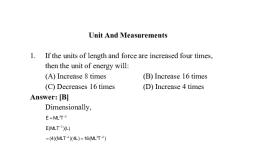
37. If dimensions of critical velocity v c of a, liquid flowing through a tube are, expressed as [h x r y r z ], where h, r and r, are the coefficient of viscosity of liquid,, density of liquid and radius of the tube, respectively, then the values of, x , y and z are given by, (a) 1, - 1, - 1, (c) -1, - 1 , - 1, , (b) -1, - 1, 1, (d) 1, 1, 1, , 38. The density of a material in CGS, , system is 10 g cm -3 . If unit of length, becomes 10 cm and unit of mass, becomes 100 g, the new value of, density will be, (a) 10 units, (c) 1000 units, , (b) 100 units, (d) 1 unit, , 39. When 1 m, 1 kg and 1 min are taken as, , the fundamental units, the magnitude of, the force is 36 units. What will be the, value of this force in CGS system?, (a) 105 dyne, (c) 108 dyne, , (b) 103 dyne, (d) 104 dyne, , 40. The solid angle subtended by the, , periphery of an area 1 cm 2 at a point, situated symmetrically at a distance of, 5 cm from the area is ……… steradian., (a) 2 ´ 10-2 (b) 4 ´ 10-2, , (c) 6 ´ 10-2 (d) 8 ´ 10-2, , 41. Measure of two quantities along with, , the precision of respective measuring, instrument is A = 25, . ms -1 ± 0.5 ms -1 ,, B = 0.10 s ± 0.01 s. The value of AB will, (NCERT Exemplar), be ……… ., (a) (0.25 ± 0.08) m, (c) (0.25 ± 0.05) m, , (b) (0.25 ± 0.5) m, (d) (0.25 ± 0.135) m, , 42. It is claimed that two cesium clocks, if, , allowed to run for 100 yrs without any, disturbance may differ by only about, 0.02 s. Then the accuracy of the clock, in measuring a time interval of, 1 s is ……… ., , (a) 10-10, (c) 10-5, , (b) 10-11, (d) 10-8, , 43. Photon is quantum of radiation with, energy E = hn, where n is frequency, and h is Planck’s constant. The, dimensions of h are the same as that, of ……… ., (a), (b), (c), (d), , linear impulse, angular impulse, linear momentum, energy, , 44. Which amongst the following statement, is incorrect regarding mass?, , (a) Its SI unit is kilogram., (b) It does not depend on the location of the, object in space., (c) It is the basic property of matter., (d) While dealing with atoms, kilogram is a, convenient unit for measuring mass., , 45. Choose the incorrect statement out of, the following., , (a) Every measurement by any measuring, instrument has some errors., (b) Every calculated physical quantity that is, based on measured values has some errors., (c) A measurement can have more accuracy, but less precision and vice-versa., (d) The percentage error is different from, relative error., , 46. Given that T stands for time period and, l stands for the length of simple, pendulum. If g is the acceleration due, to gravity, then which of the following, statements about the relation T 2 = l / g, is correct?, (a) It is correct both dimensionally as well as, numerically., (b) It is neither dimensionally correct nor, numerically., (c) It is dimensionally correct but not, numerically., (d) It is numerically correct but not, dimensionally.
Page 9 :
Codes, , 47. Match the following columns., Column I, , Column II, -1, , A., , Capacitance, , p., , volt (ampere), , B., , Magnetic, induction, , q., , volt-sec, (ampere)-1, , C., , Inductance, , r., , newton, (ampere)-1, (metre)-1, , D., , Resistance, , s., , coulomb 2(joule)-1, , Codes, A, , B, , C, , D, , (a) q, , r, , s, , p, , (b) s, , r, , q, , p, , (c) r, , s, , p, , q, , (d) s, , p, , q, , r, , 48. Match the Column I (unit) with, , Column II (value) and select the correct, option from the codes given below., Column I, , Column II, , A., , 1 are, , p., , 200 mg, , B., , 1 bar, , q. 1013, ., ´ 10 5 Pa, , C., , 1 carat, , r., , 10 2 m 2, , A, , B, , C, , D, , (a) s, , r, , p, , q, , (b) r, , q, , s, , p, , (c) r, , p, , s, , q, , (d) r, , s, , p, , q, , Assertion-Reasoning MCQs, For question numbers 50 to 59, two, statements are given-one labelled, Assertion (A) and the other labelled, Reason (R). Select the correct answer to, these questions from the codes (a), (b), (c), and (d) are as given below, (a) Both A and R are true and R is the, correct explanation of A., (b) Both A and R are true but R is not the, correct explanation of A., (c) A is true but R is false., (d) A is false and R is also false., , 50. Assertion Unit chosen for measuring, , physical quantities should not be easily, reproducible., Reason Unit should change with the, changing physical conditions like, temperature, pressure, etc., , 51. Assertion The unit used for measuring, , Codes, A, , B, , (a) q, (c) r, , B, , C, , nuclear cross-section is ‘barn’., , (b) r, , r, , p, , (d) r, , p, , q, , Reason 1 barn = 10 - 14 m 2 ., , C, , A, , p, , r, , q, , p, , 52. Assertion When we change the unit of, , 49. Names of units of some physical, , quantities are given in Column I and, their dimensional formulae are given in, Column II and select the correct option, from the codes given below., Column I, , Column II, , measurement of a quantity, its, numerical value changes., , Reason Smaller the unit of measurement, smaller is its numerical value., , 53. Assertion Parallax method is used for, , A., , Pa-s, , p., , [L T K ], , measuring distances of nearby stars only., , B., , Nm-K -1, , q., , [MLT -2A -1K -1 ], , C., , J kg -1 K -1, , r., , [ML-1T -1 ], , D., , Wb m -1 K -1, , s., , [ML2T -2K -1 ], , Reason With increase in the distance, of star from earth, the parallactic angle, becomes too small to be measured, accurately., , 2, , -2, , -1
Page 10 :
54. Assertion Out of two measurements, , Case Based MCQs, , l = 0.7 m and l = 0.70 m, the second one, is more accurate., , Direction Answer the questions from, 60-64 on the following case., , Reason In every measurement, the last, digit is not accurately know., , Measurement of Physical Quantity, All engineering phenomena deal with definite, and measured quantities and so depend on, the making of the measurement. We must be, clear and precise in making these, measurements. To make a measurement,, magnitude of the physical quantity (unknown), is compared., The record of a measurement consists of, three parts, i.e. the dimension of the quantity,, the unit which represents a standard quantity, and a number which is the ratio of the, measured quantity to the standard quantity., , 55. Assertion Random errors arise due to, , random and unpredictable fluctuations, in experimental conditions., Reason Random errors occurred due, to irregularly with respect to sign and, size., , 56. Assertion When a quantity appears, , with a power n greater than one in an, expression, its error contribution to the, final result decreases n times., , Reason In all mathematical, operations, the errors are not additive, in nature., , 57. Assertion Special functions such as, trigonometric, logarithmic and, exponential functions are not, dimensionless., , Reason A pure number, ratio of, similar physical quantities, such as, angle and refractive index, has some, dimensions., , 58. Assertion Specific gravity of a fluid is a, dimensionless quantity., Reason It is the ratio of density of fluid, to the density of water., , 59. Assertion The method of dimensions, , analysis cannot validate the exact, relationship between physical quantities, in any equation., Reason It does not distinguish, between the physical quantities having, same dimensions., , 60. A device which is used for, , measurement of length to an accuracy, of about 10 -5 m, is, (a) screw gauge, (c) vernier callipers, , (b) spherometer, (d) Either (a) or (b), , 61. Which of the technique is not used for, measuring time intervals?, (a), (b), (c), (d), , Electrical oscillator, Atomic clock, Spring oscillator, Decay of elementary particles, , 62. The mean length of an object is 5 cm., , Which of the following measurements is, most accurate?, (a) 4.9 cm, (c) 5.25 cm, , (b) 4.805 cm, (d) 5.4 cm, , 63. If the length of rectangle l = 10.5 cm,, breadth b = 21, . cm and minimum, possible measurement by scale = 01, . cm,, then the area is, (a) 22.0 cm 2, (c) 22.5 cm 2, , (b) 21.0 cm 2, (d) 21.5 cm 2
Page 11 :
64. Age of the universe is about 10 10 yr,, , whereas the mankind has existed for, 10 6 yr. For how many seconds would, the man have existed, if age of universe, were 1 day?, (a) 9.2 s, (c) 8.6 s, , Significant Digits, Normally, the reported result of measurement, is a number that includes all digits in the, number that are known reliably plus first digit, that is uncertain. The digits that are known, reliably plus the first uncertain digit are, known as significant digits or significant, figures., e.g. When a measured distance is reported to, be 374.5 m, it has four significant figures 3, 7,, 4 and 5. The figures 3, 7, 4 are certain and, reliable, while the digit 5 is uncertain. Clearly,, the digits beyond the significant digits, reported in any result are superfluous., , 65. In 4700 m, significant digits are, (b) 3, , (c) 4, , (d) 5, , 66. To determine the number of significant, figures, scientific notation is, (a) a b, (c) a ´ 102, , (b) a ´ 10b, (d) a ´ 104, , 67. 5.74 g of a substance occupies 1.2 cm 3 ., Express its density by keeping the, significant figures in view., (a) 4.9 g cm-3, (c) 4.8 g cm-3, , 69. Consider the following rules of, significant figures., , (b) 10.2 s, (d) 10.5 s, , Direction Answer the questions from, 65-69 on the following case., , (a) 2, , (c) 4700 m = 4.700 ´ 103 m, here there is change, in numbers of significant numbers., (d) Change in unit changes the number of, significant figure., , (b) 5.2 g cm-3, (d) 4.4 g cm-3, , 68. Choose the correct option., (a) Change in unit does not change the, significant figure., (b) 4.700 m= 4700 mm, here there is a change, of significant number from 4 to 2 due to, change in unit., , I. All the non-zero digits are significant., II. All the zeroes between two non-zero, digits are significant., III. The terminal or trailing zero(s) in a, number without a decimal point are, significant., Which of the above statement(s) is/are, correct?, (a) I and II, (c) I and III, , (b) II and III, (d) All of these, , Direction Answer the questions from, 70-74 on the following case., Combination of Errors, Maximum absolute error in the sum or, difference of two quantities is equal to sum of, the absolute error in the individual quantities,, i.e. Z = A + B , then ± DZ = ± DA ± DB, Maximum fractional error in a product or, division of quantities is equal to the sum of, fractional errors in the individual quantities, A, DZ, DA DB, i.e. AB or , then, =±, +, B, Z, A, B, Two resistors of resistances R1 = 100 ± 3 W, and R 2 = 200 ± 4W are connected (a ) in series, and ( b) in parallel., , 70. The percentage error in the value of R1, is, , (a) 3%, , (b) 4%, , (c) 6%, , (d) 0.3%, , 71. The fractional error in the value of R2 is, 1, 40, 1, (c), 100, , (a), , 1, 50, 1, (d), 200, , (b)
Page 12 :
72. Find the equivalent resistance of the, series combination., (a), (b), (c), (d), , (250 ± 7) W, (320 ± 6) W, (300 ± 7) W, (300 ± 1) W, , 73. The percentage error in equivalent, resistance in series combination is, (a) 2%, (c) 2.5%, , (b) 2.3%, (d) 3%, , 74. Find the equivalent resistance of the, , parallel combination having error of, 1.8 W., , (a) (66 ± 1) W, (c) (66.3 ± 2) W, , (b) (66.7 ± 1.8) W, (d) (67 ± 3) W, , Direction Answer the questions from, 75-79 on the following case., Dimensional analysis and its applications, The expression which shows how and which, of the base quantities represent the, dimensions of a physical quantity is called the, dimensional formula of the given physical, quantity. The recognition of concepts of, dimensions, which guide the description of, physical behaviour is of basic importance as, only those physical quantities can be added or, subtracted which have the same dimensions., A thorough understanding of dimensional, analysis helps us in deducing certain relations, among different physical quantities and, checking the derivation, accuracy and, dimensional consistency or homogeneity of, various mathematical expressions. When, magnitudes of two or more physical quantities, are multiplied, their units should be treated in, the same manner as ordinary algebraic, symbols. We can cancel identical units in the, numerator and denominator. The same is true, for dimensions of a physical quantity., Similarly, physical quantities represented by, symbols on both sides of a mathematical, equation must have the same dimensions., , 75. Statement I The method of, , dimensions analysis cannot validate the, exact relationship between physical, quantities in any equation., Statement II It does not distinguish, between the physical quantities having, same dimensions., Which of the following statement(s), is/are correct?, (a) Only I, (c) Only II, , (b) I and II, (d) None of these, , 76. The quantity having same dimension, as that of Planck’s constant is, (a) work, (b) linear momentum, (c) angular momentum (d) impulse, , 77. If speed v, acceleration A and force F ,, , are considered as fundamental units,, the dimension of Young’s modulus will, be, , (a) [v -4A - 2F], (c) [v -2 A 2 F - 2], , (b) [v -2 A 2 F 2], (d) [v -4A 2 F 1], , 78. Given that, the amplitude of the, scattered light is, (i) directly proportional to amplitude of, incident light, (ii) directly proportional to the volume, of the scattering dust particle, (iii) inversely proportional to its distance, from the scattering particle and, (iv) dependent upon the wavelength l of, the light., Then, the relation of intensity of, scattered light with the wavelength is, (a), , 1, l2, , (b), , 1, l4, , (c), , 1, l6, , (d), , 1, l7, , 79. Find the value of power of 60 J/min on, a system that has 100 g, 100 cm and 1, min as the base units., (a) 2.16 ´ 104 units, (c) 3 ´ 104 units, , (b) 2.16 ´ 106 units, (d) 4 ´ 107 units
Page 13 :
020, , CBSE New Pattern ~ Physics 11th (Term-I), , ANSWERS, Multiple Choice Questions, 1. (b), 11. (b), , 2. (c), 12. (a), , 3. (c), 13. (a), , 4. (a), 14. (b), , 5. (d), 15. (a), , 6. (c), 16. (b), , 7. (b), 17. (c), , 8. (a), 18. (a), , 9. (a), 19. (d), , 10. (b), 20. (a), , 21. (a), 31. (a), , 22. (c), 32. (d), , 23. (a), 33. (a), , 24. (b), 34. (d), , 25. (d), 35. (a), , 26. (c), 36. (b), , 27. (a), 37. (a), , 28. (c), 38. (b), , 29. (a), 39. (b), , 30. (a), 40. (b), , 41. (a), , 42. (b), , 43. (b), , 44. (d), , 45. (d), , 46. (c), , 47. (b), , 48. (c), , 49. (d), , 52. (c), , 53. (a), , 54. (b), , 55. (b), , 56. (d), , 57. (d), , 58. (a), , 59. (a), , 62. (a), 72. (c), , 63. (a), 73. (b), , 64. (c), 74. (b), , 65. (a), 75. (b), , 66. (b), 76. (c), , 67. (c), 77. (d), , 68. (a), 78. (b), , 69. (a), 79. (b), , Assertion-Reasoning MCQs, 50. (d), , 51. (c), , Case Based MCQs, 60. (d), 70. (a), , 61. (c), 71. (b), , SOLUTIONS, 1. Time is the quantity which has same unit in, all systems of unit, i.e. second. Other three, quantities, i.e. mass, length and temperature, have different units in different system of, units., , 2. The coefficient of thermal conductivity is, given by, K =, , L dQ, ADT dt, , where, L = length of conductor, A = area of, conductor, DT = change in temperature, dQ, and, = rate of flow of heat., dt, metre, ´ watt, \ Unit of K =, (metre) 2 ´ (kelvin), = Wm-1K -1, , 3. Given, damping force µ velocity, F µ v Þ F = kv Þ, Unit of k =, , k =, , F, v, , Unit of F, kg - ms -2, =, = kg s -1, Unit of v, ms -1, , 4. To convert a measured value from one, system to another system, we use, N 1u1 = N 2u2, where, N is numeric value and u is unit., , We get,, \, , 128 ×, , kg, 50 g, =N2, 3, m, (25 cm) 3, , mass ù, é, êëQ density = volume úû, 128 ´ 1000 g, N 2 ´ 50 g, Þ, =, 100 ´ 100 ´ 100 cm3 25 ´ 25 ´ 25 cm3, 128 ´ 1000 ´ 25 ´ 25 ´ 25, N2 =, = 40, Þ, 50 ´ 100 ´ 100 ´ 100, , 5. Given, work done,, W = 10 10 g-cm 2 s -2, which is in CGS system of units., g, In SI unit,W = 10 10 2 cm2, s, (10 -3 kg)(10 -4 m2 ), = 10 10, 1s 2, = 10 3 kg-m2 s -2, , 6. We know that, 1 light year = 9.46 ´ 10 11 m, = distance that light travels in 1 year with, speed 3 ´ 10 8 m/s., 1 parsec = 3.08 ´ 10 16 m, = Distance at which average radius of earth’s, orbit subtends an angle of 1 parsecond., Here, year represent time.
Page 14 :
7. We have, q = 1° 54 ¢ = (60 + 54)¢, = 114 ¢ = (114 ´ 60) ¢ ¢, Since, 1¢¢ = 4.85 ´ 10 - 6 rad, = (114 ´ 60 ) ¢¢ ´ (4.85 ´ 10 - 6 ) rad, = 3.33 ´ 10 - 2 rad, Also, diameter of earth, b = 1. 276 ´ 10 7 m, Hence, the earth-moon distance is given as, 1.276 ´ 10 7, D = b /q =, = 3.83 ´ 10 8 m, 3.33 ´ 10 -2, , 8. We know that, radius of atom, ra = 10 -10 m, Radius of nucleus, rn = 10 -15 m, \, , Ratio,, , ra 10 -10, =, = 10 5, rn 10 -15, , 4, 3, 3, pra, ær ö, 3, Ratio of volume =, =ç a÷, 4, 3, è rn ø, prn, 3, = (10 5 ) 3 = 10 15, , 9. All given measurements are correct upto two, decimal places. As here 5.00 mm has the, smallest unit and the error in 5.00 mm is, least (commonly taken as 0.01 mm if not, specified), hence 5.00 mm is most precise., , Mean deviation of a simple pendulum, S | x - xi | 2 + 1 + 3 + 0, =, =, = 1.5, N, 4, Given, minimum division in the measuring, clock, i.e. simple pendulum = 1 s. Thus, the, reported mean time of a oscillating simple, pendulum = ( 92 ± 2) s., , 13. The mean period of oscillation of the, pendulum,, 2 . 63 + 2.56 + 2.42 + 2.71 + 2.80, 5, 13.12, =, = 2.624 = 2.62 s, 5, The absolute errors in the measurements are, DT 1 = 2.63 s - 2.62 s = 0.01 s, DT 2 = 2.56 s - 2.62 s = - 0.06 s, DT 3 = 2.42 s - 2.62 s = - 0.20 s, DT 4 = 2.71 s - 2.62 s = 0.09 s, DT 5 = 2.80 s - 2.62 s = 0.18 s, The arithmetic mean of all the absolute errors, is, 5, | DT i |, DT mean = å, 5, i =1, T mean =, , = [(0.01 + 0.06 + 0.20 + 0.09 + 0.18)] / 5, = 0.54 / 5 = 0.108 ~, - 0.11 s, , 10. If student measure 3.50 cm, it means that, there in an uncertainly of order 0.01 cm., For vernier scale with 1 MSD, = 1mm and 9 MSD = 10 VSD, \ LC of VC = 1 MSD - 1 VSD, 1 æ, 9ö, 1, =, cm, ç1 - ÷ =, ø, è, 10, 10, 100, , 11. Volume of block, V = lbh, The percentage error in the volume is given by, DV, Db Dh ö, æ Dl, ´ 100 = ç, +, +, ÷ ´ 100, è l, V, b, h ø, æ 0.02 0.01 0.01 ö, =ç, +, +, ÷ ´ 100, è1213, 816, 3.46 ø, ., ., æ 200 100 100 ö, =ç, +, +, ÷, è1213 816 346 ø, = 01649, ., + 01225, ., + 0.2890, = 0.58% (rounded off to two significant figures), , 12. Arithmetic mean time of a oscillating simple, S xi, 90 + 91 + 92 + 95, pendulum =, =, = 92 s, N, 4, , 14. As we know, time period of oscillation is T, = 2p, , L, g, , So,, g = 4 p 2L /T 2, Therefore, relative error in g is, ( Dg / g ) = ( DL /L ) + 2 ( DT /T ), Given, DL = 1 mm = 01, . cm, L = 20 cm,, DT = 1 s and T = 90 s, 0.1 æ 1 ö, Dg, Þ, =, +2 ç ÷ = 0.027, è 90 ø, 20, g, Thus, the percentage error in g is, Dg, =, ´ 100%, g, = 0.027 ´ 100% = 27, . %~, - 3%, , 15. Mean of the five observations,, m=, , 80.0 + 80.5 + 81.0 + 81.5 + 82, 5
Page 15 :
405.0, = 81, 5, \ Mean error, é| 80 - m | + | 80.5 - m | + | 81.0 - m |, ù, ê, ú, +, |, 81, ., 5, m, |, +, |, 82, m, |, û, =ë, 5, é| 80 - 81 | + | 80.5 - 81 | + | 81.0 - 81 |, ù, ê, ú, + | 81.5 - 81| + |82 - 81|û, =ë, 5, 1 + 0.5 + 0 + 0.5 + 1 3, =, = = 0.6, 5, 5, 0.6, \ Mean % error =, ´ 100% = 0.74%, 81, =, , 16. The error in the measurement of mass 1.02 g, is ± 0.01 g,, whereas that of another measurement 9.89 g, is also ± 0.01 g., \ The relative error in 1.02 g, = [ ± 0.01 /1.02) ] ´ 100% = ± 0.98% @ ± 1%, Similarly, the relative error in 9.89 g, = [ ± 0.01 / 9.89] ´ 100% = ± 0.1%, The relative errors in measurement of two, masses are ± 1% and ± 0.1%., Mass, M, M, or r = 3, =, Volume L3, L, Dr DM, 3DL, Þ Error in density, =, +, r, M, L, , 17. Q Density, r =, , So, maximum % error in measurement of r is, Dr, DM, 3DL, ´ 100 =, ´ 100 +, ´ 100, r, M, L, or % error in density = 1.5 + 3 ´ 1, % error = 4.5%, 1, 18. Kinetic energy, K = mv 2, 2, DK, Dm, 2Dv, \, ´ 100 =, ´ 100 +, ´ 100, K, m, v, = 2% + 2 ´ 3% = 8%, l, 19. Time period, T = 2p, g, DT 1 Dl, =, T, 2 l, , or, For 1 s ,, DT =, , 1 æ Dl ö, 1, ç ÷ T = ´ 0.02 ´ T = 0.01 T, 2è l ø, 2, , For a day, the pendulum loses,, DT = 24 ´ 60 ´ 60 ´ 0.01 = 864 s, , 20. Given, length, l = (16.2 ± 0.1) cm, Breadth, b = (10.1 ± 0.1) cm, Area, A = l ´ b, = (16.2 cm) ´ (10.1 cm) = 163.62 cm2, Rounding off to three significant digits,, area, A = 164 cm2, D A Dl Db 0.1 0.1, =, +, =, +, A, l, b 16.2 10.1, 1.01 + 1.62 2.63, =, =, 16.2 ´ 10.1 163.62, 2.63, 2.63, Þ, DA = A ´, = 163.62 ´, 163.62, 163.62, = 2.63 cm2 » 3 cm2, (By rounding off to one significant figure), \ Area, A = A ± DA = (164 ± 3) cm2, a 3b 2 Da, 21. Given, P =, ,, ´100% = 1%,, a, cd, Db, Dc, ´ 100% = 2%,, ´ 100% = 3%, b, c, Dd, and, ´ 100% = 4%, d, ö, æ DP, ´ 100 ÷ %, \ % error in P = ç, ø, è P, æ 3Da 2Db Dc Dd ö, =ç, +, +, +, ÷ ´ 100%, è a, b, c, d ø, Db, ö, æ Da, ´ 100% + 2, ´ 100%, ÷, ç3, a, b, ÷, =ç, Dc, Dd, ÷, ç, ç, +, ´ 100% +, ´ 100% ÷, ø, è, c, d, = 3 ´ 1% + 2 ´ 2% + 3% + 4% = 14%, a 2b 2 / 3, 22. Given, z =, c d3, According to question,, æ 2ö, % error in z = ( 2)% error in a + ç ÷ % error in, è 3ø, æ1ö, b, + ç ÷ % error in c + ( 3)% error in d, è 2ø, Dz, Da 2 Db 1 Dc, Dd, =2, +, +, +3, z, a, d, 3 b, 2 c, 2, 1, = 2 ´ 2 % + ´ 1.5 % + ´ 4 % + 3 ´ 2.5 %, 3, 2, = 14.5%
Page 16 :
23. The reliable digit plus the first uncertain digit, is known as significant figures., For the number 23.023, all the non-zero, digits are significant, hence 5., For the number 0.0003, number is less than, 1, the zero(s) on the right of decimal point, but to the left of the first non-zero digit are, not significant, hence 1., For the number 2.1 ´ 10 -3 , significant figures, are 2., , 24. By adding 3.8 ´ 10 -6 and 42 ´ 10 -6 , we get, = 45.8 ´ 10 -6 = 4.58 ´ 10 -5, As least number of decimal figures in given, values is 1, so we round off the result to, 4.6 ´ 10 -5 ., , 25. The number 5.355 rounded off to three, significant figures becomes 5.36, since, preceding digit of 5 is odd, hence it is raised, by 1., On other hand, the number 5.345 rounded off, to three significant figures becomes 5.34., Since, the preceding digit of 5 is even., , 26. In this question, density should be reported, to two significant figures., 4.237g, Density =, = 1.6948, 2.5 cm3, As rounding off the number, we get density, = 17, . g cm -3, , 27. Dimensions of torque,, t=F ´r, = [MLT-2 ] [L], = [ML2 T-2 ], , 28. Dimensions of given quantities are, l = inductance = [M 1 L2 T-2 A -2 ], r = resistance = [M 1 L2 T-3 A -2 ], c = capacitance = [M - 1 L- 2 T4 A 2 ], v = voltage = [M 1 L2 T-3 A -1 ], l, are, So, dimensions of, rcv, 2, -2, -2, é l ù [M L T A ], -1, =, êë rcv úû [M 1 L2 T-2 A -1 ] = [A ], , 29. According to ideal gas equation, i.e. pV = nRT ,, where n is the number of moles of gases., , \ Universal gas constant, R =, , ( p ) (V ), (n )(T ), , Dimensional formula of R =, , [ML-1 T -2 ] [L3 ], [mol] [K], , = [ML2 T -2 mol -1K-1 ], [ML2 T-2 ], Energy, 30. I. Energy density =, =, [L3 ], Volume, = [ML-1 T-2 ], II. Refractive index has no dimensions., III. Dielectric constant has no dimensions., IV. Young’s modulus,, F l [MLT-2 ][L], Y =, = [ML-1 T-2 ], =, [L]2[L], ADl, V. Magnetic field,, [MLT-2 ], F, B=, = [MT-2 A -1 ], =, [A][L], I l, , 31. In this question, it is given that P , Q and R, are having different dimensions, hence they, cannot be added or subtracted, so we can say, that (a) is not meaningful. We cannot say, about the dimension of product of these, quantities, hence (b), (c) and (d) may be, meaningful., A x, 32. Given, U =, x+B, Dimensions of U = Dimensions of potential, energy = [ML2 T -2 ], According to the principle of homogeneity,, Dimensions of B = Dimensions of x = [M 0 LT 0 ], \ Dimensions of A, Dimensions of U ´ Dimensions of ( x + B ), =, Dimensions of x, =, , [ML2 T-2 ] [M 0 LT0 ], = [ML5/ 2 T-2 ], [M 0 L1/ 2 T0 ], , Hence, dimensions of AB, = [ML5/ 2 T-2 ] [M 0 LT0 ], = [ML7/ 2 T-2 ], , 33. According to question, [ X ] = Dimensions of, capacitance = [M -1L-2 T2 Q 2 ], and [Z ] = Dimensions of magnetic induction., = [MT -1Q -1 ]
Page 17 :
Given,, \, Þ, , X = 3YZ 2 ,, [X ], [Y ] = 2, [Z ], [Y ] =, , [M -1L-2 T2Q 2 ], = [M -3 L-2 T4 Q 4 ], [M 2 T -2Q -2 ], , b, 34. Given, v = at +, t +c, Since, LHS is equal to velocity, so at and, b, must have the dimensions of velocity., t +c, [LT-1 ], v, \ at = v or a = Þ [a ] =, = [LT-2 ], [T], t, Now, c = time, \, c =t, [c ] = [ T], b, Now,, =v, t +c, \, , (Q quantities are added), , b = v ´ time, [b ] = [LT-1 ][T] = [L], , 35. The dimensions of LHS of each relation is, [L],therefore the dimensions of RHS should, be [L] as per the principle of homogeneity, and the argument of the trigonometrical, function, i. e. angle should be dimensionless., 2pt, (a) As, is dimensionless, therefore, T, dimensions of RHS = [L]. Thus, this, formula is correct., (b) Dimensions of RHS, = [L]sin [LT-1 ] [T] = [L] sin [L], As angle is not dimensionless here,, therefore, this formula is incorrect., (c) Dimensions of RHS, [L], [T], =, = [LT-1 ] sin [TL-1 ], sin, [T], [L], As angle is not dimensionless here,, therefore this formula is incorrect., \ Thus, the correct formula on the, dimensional ground is option (a)., , 36. Let Young’s modulus is related to speed, area, and force, as Y = F A V, Substituting dimensions, we have, [ML-1 T-2 ] = [MLT-2 ]x [L2 ] y [LT-1 ]z, x, , y, , z, , Comparing power of similar quantities, we, have, x = 1, x + 2y + z = - 1 and -2x - z = - 2, Solving these, we get x = 1, y = -1, z = 0, So,, [Y] = [ FA -1 V 0 ], , 37. Given, critical velocity of liquid flowing, through tube is expressed as , v c µ h x r y r z, Coefficient of viscosity of liquid,, h = [ ML-1 T-1 ], Density of liquid, r = [ML-3 ], Radius of a tube, r = [L ], Critical velocity of liquid, v c = [ M 0 LT-1 ], Þ, , [M 0 LT-1 ] = [ML-1 T-1 ] x [ML-3 ]y [L]z, , [ M 0 LT-1 ] = [ M x + yL- x - 3 y + z T- x ], Comparing powers of M, L and T, we get, x + y = 0, - x - 3y + z = 1, - x = - 1, On solving above equations, we get, x = 1, y = - 1, z = -1, Mass, 38. Q Density =, Volume, [M], \ Dimensions of density = 3 = [ML-3 ], [L], Given, n1 = 10, M 1 = 1 g, L 1 = 1 cm,, In new system, n2 = ?, M 2 = 100 g, L 2 = 10 cm, So, conversion of 10g cm -3 (n1 ) into new system, é M ù éL ù, n2 = n1 ´ ê 1 ú ê 1 ú, ë M2 û ë L 2 û, , -3, , -3, , æ 1 öæ1ö, = 10 ´ ç, ÷ç ÷, è100 ø è10 ø, 1, = 10 ´, ´ 10 ´ 10 ´ 10, 100, = 100 units, , 39. As, dimensional formula of force = [ MLT -2 ], n1 = 36, M 1 = 1 kg, L 1 = 1 m, T 1 = 1 min = 60 s, n2 = ?, M 2 = 1 g, L 2 = 1 cm, T 2 = 1 s, So, conversion of 36 units into CGS system,, éM ù, i. e. n2 = n1 ê 1 ú, ë M2 û, , a, , é L1 ù, êL ú, ë 2û, 1, , b, , é T1 ù, êT ú, ë 2û, 1, , c, , -2, , é1 kg ù é 1 m ù é1 min ù, n2 = n1 ê, ú ê, ú ê, ú, ë 1g û ë1 cm û ë 1 s û, 1, -2, é1000 g ù é100 cm ù é 60 s ù, 3, = 36 ê, úê, úû êë 1 s úû = 10 dyne, 1, g, 1, cm, ë, ë, û, , Þ
Page 18 :
40. Solid angle, d W =, , dA, 1 cm2, =, 2, r, ( 5 cm) 2, , = 0.04 steradian, = 4 ´ 10 -2 steradian, , 41. Given, A = 2.5 ms -1 ± 0.5 ms -1,, B = 0.10 s ± 0. 01 s, x = AB = ( 2.5)( 010, . ) = 0.25 m, Dx DA DB, =, +, x, A, B, 0.5 0.01 0.05 + 0.025 0.075, =, +, =, =, 2.5 010, ., 0.25, 0.25, Dx = 0.075 = 0.08 m, rounding off to two, significant figures., AB = ( 0. 25 ± 0.08 ) m, 42. 100 years in seconds = 100 ´ 365 ´ 24, ´ 60 ´ 60 s. Error that may occur in the clock, after these many seconds is 0.02 s, 0.02 s, \ Error in 1 s =, 100 ´ 365 ´ 24 ´ 60 ´ 60, = 10 -11 (approx.), , 43. We know that, energy of radiation, E = hn, [h ] =, , [ E ] [ML2 T-2 ], =, = [ML2 T-1 ], [T-1 ], [n ], , Dimensions of linear impulse = Dimension of, momentum = [MLT-1 ], As we know that, linear impulse J = DP, Þ Angular impulse = tdt = DL, = change in angular momentum, Hence, dimensions of angular impulse, = dimension of angular momentum, = [ML2 T-1 ], This is similar to the dimensions of Planck’s, constant h., Dimensions of energy is [ML2 T-2 ] ., , 44. Statement given in option (d) is incorrect and, it can be corrected as, While dealing with atoms, kilogram is an, inconvenient unit. In this case, there is an, important standard unit of mass called, unified atomic mass unit (u), which has been, established for expressing the mass of atom., Rest statements are correct., , 45. When the relative error is expressed in, percentage, we call it as percentage error., Thus, statement (d) is incorrect while all, other statements regarding measurement of a, quantity are correct., , 46. The correct relation for time period of simple, pendulum is T = 2p( l/ g ) 1 / 2 ., So, the given relation is numerically incorrect, as the factor of 2p is missing., But, it is dimensionally correct., , 47. Capacitance,, C =, , Q, V, , =, , Q, , 2, , W, , = (coulomb) 2 joule-1, , Magnetic induction,, newton, F, B=, =, il ampere ´ metre, = (newton) (ampere) -1(metre) -1, e, volt, Inductance, L =, =, dl / dt ampere /second, = volt -second (ampere) -1, volt, V, Resistance, R = =, I ampere, = volt (ampere) -1, Hence, A ® s, B ® r, C ® q and D ® p., , 48. Are is also unit of area, 1 are = 10 2 m 2, Atmospheric pressure is measured in SI unit, of bar., 1 bar = 1.013 ´ 10 5 N/m 2 = 1.013 ´ 10 5 Pa, Carat is the unit of mass., i.e., 1 carat = 200 mg, Hence, A ® r, B ® q and C ® p., , 49. Dimensions of Pa-s is [ML-1 T-2 ] × [T], = [ML-1T -1 ], Dimensions of Nm K -1 is, [MLT-2 ][L][K -1 ] = [ML2 T-2K -1 ], Dimensions of J-kg -1 K -1 is, [ML2 T-2 ][M -1 ][K -1 ] = [L2 T-2K -1 ], Dimensions of Wbm -1 K -1 is, [ML2 T-2 A -1 ][L-1 ][K -1 ] = [MLT-2 A -1K -1 ], Here, W is for weber, unit of magnetic flux, BA with dimensions
Page 19 :
[MLT-2 ], [L2 ] = ML2 T-2 A -1, [AT] [LT-1 ], Hence, A ® r, B ® s, C ® p and D ® q., , 50. The unit chosen for measuring any physical, quantity, should be easily reproducible, i.e., replicas of the unit should be available easily., Also, unit should not change with changing, physical conditions like temperature,, pressure, etc., Therefore, A is false and R is also false., , 51. Barn is used in nuclear physics for measuring, the cross-sectional area of nuclei., One barn is equal to 10 -28 m2 ., Therefore, A is true but R false., , 52. Changing the unit of the measurement, the, numerical value of the quantity also changes., For example, let the length of scale be 1 m., Its value in CGS unit is 100 cm., Therefore, the numerical value changes., Also, we can say that from the above, example smaller the unit of measurement,, greater is its numerical value., Therefore, A is true but R is false., , 53. Parallax method is used for measuring, distances of nearby stars only., If D is a distance of a far away star from, b, Earth, then, D=, q, where, q is called parallactic angle and b is, the distance between the two different, positions on Earth from where the star is, being observed., \ With increase in the distance of star,, parallactic angle becomes too small to be, measured accurately., Therefore, both A and R are true and R is, the correct explanation of A., , 54. Accuracy of the measurement is the measure, of how close the measured value is to the, true value., So, the greater the significant figures in the, digit, greater will be its accuracy., , Since, 0.70 m has more significant figure, (i.e., 2) as compare to 0.7 m (i.e., 1). So, it, will be more accurate., Also, in general, the last digit is not, accurately known in every measurement., Therefore, both A and R are true but R is, not the correct explanation of A., , 55. Random errors are those errors, which occur, irregularly and hence are random with, respect to sign and size., These can arise due to random and, unpredictable fluctuations in experimental, conditions, personal (unbiased) errors by the, observer taking readings, etc., Therefore, both A and R are true but R is, not the correct explanation of A., , 56. In all mathematical operations, the errors are, of additive nature., When a quantity appears with a power n, greater than one in an expression, its error, contribution to the final result increases n, times., So, quantities with higher power in the, expression should be measured with, maximum accuracy., Therefore, A is false and R is also false., , 57. The arguments of special functions, such as, the trigonometric, logarithmic and, exponential functions must be dimensionless., A pure number, ratio of similar physical, quantities, such as angle as the ratio, (length/length), refractive index as the ratio, of (speed of light in vacuum/speed of light in, medium), etc. has no dimensions., Therefore, A is false and R is also false., Density of fluid, 58. Relative density of a fluid =, Density of water, As the density of any substance has same, units, hence relative density is dimensionless., Therefore, both A and R are true and R is, the correct explanation of A., , 59. The method of dimensions can only test the, dimensional validity but not the exact, relationship between physical quantities in, any equation.
Page 20 :
This is because it does not distinguish, between the physical quantities having same, dimensions., Therefore, both A and R are true and R is, the correct explanation of A., 60. A screw gauge and a spherometer can be, used to measure length accurately as less as, 10 - 5 m., , 61. Spring oscillator cannot be used to measure, time intervals., , 62. Given, length, l = 5 cm, Now, checking the errors with each options, one-by-one, we get, D l 1 = 5 - 4.9 = 0.1 cm, D l 2 = 5 - 4.805 = 0.195 cm, D l 3 = 5 . 25 - 5 = 0 . 25 cm, D l 4 = 5 . 4 - 5 = 0 . 4 cm, Error D l 1 is least., Hence, 4.9 cm is most precise or accurate., , 63. Area of rectangle, A = Length ´ Breadth, So, A = lb = 10.5 ´ 21, . = 22.05 cm 2, Minimum possible measurement of, scale = 01, . cm., So, area measured by scale = 22.0 cm 2 ., Age of mankind, 64. Magnification in time =, Age of universe, 10 6, = 10 - 4, 10 10, Apparent age of mankind = 10 - 4 ´ 1 day, =, , = 10 - 4 ´ 86400 s, = 8.64 s » 8.6 s, 65. As, we know that, the terminal or trailing, zero(s) in a number without a decimal point, are not significant. So, 4700 m has two, significant figures., 66. Every number is expressed as a ´ 10 b , where a, is a number between 1 & 10 and b is any, positive or negative exponent (or power) of 10., 67. There are 3 significant figures in the, measured mass whereas there are only 2, significant figures in the measured volume., Hence, the density should be expressed to, only 2 significant figures., 5.74, Density =, = 4.8 g cm-3, 1. 2, , 68. There is no change in number of significant, figures on changing the units. For it, the, convention is that we write,, 4700 m = 4.700 ´ 10 3 m, This convention ensures no change in, number of significant numbers., , 69. Following rules of significant figures are, I. All the non-zero digits are significant., II. All the zeroes between two non-zero, digits are significant, no matter where the, decimal point is, if at all., III. The terminal or trailing zero(s) in a, number without a decimal point are not, significant. Thus, 123 m = 12300 cm, = 123000 mm has three significant figures,, the trailing zero(s) being not significant., , 70. Given, R1 = (100 ± 3) W, \, , 3, DR1, ´ 100 =, ´ 100 = 3%, 100, R1, , 71. Given, R2 = ( 200 ± 4 )W, \, , DR2, 4, 1, =, =, R2, 200 50, , 72. The equivalent resistance of series, combination,, i.e. R S = R1 + R2 = (100 ± 3) W + ( 200 ± 4 ) W, = ( 300 ± 7 ) W, , 73. As, R S = ( 300 ± 7 ) W, \, , 7, DR S, ´ 100 =, ´ 100 = 2.3%, 300, RS, , 74. The equivalent resistance of parallel, combination,, R¢ =, , R1 R2, R1 + R2, , 200, = 66.7 W, 3, DR ¢ = 18, . W, R ¢ = ( 66.7 ± 18, . )W, =, , Given,, \, , 75. The method of dimensions can only test the, dimensional validity but not the exact, relationship between physical quantities in, any equation., This is because, it does not distinguish, between the physical quantities having same, dimensions.
Page 21 :
E, n, é ML2 T-2 ù, 2 -1, So, dimensions of h = ê, ú = [ML T ], -1, T, ë, û, , 76. Planck’s constant, h =, , Angular momentum, L = mvr, Dimensions of L = [M] [LT-1 ] [L] = [ML2 T-1 ], Work, W = Force ´ Displacement, Dimensions, of W = [MLT-2 ] ´ [L] = [ML2 T-2 ], \, Linear momentum, p = Mass ´ Velocity, Dimensions of p = [M][LT-1 ] = [MLT-1 ], Force, Impulse, I =, Time, -2, [MLT ], Dimensions of I =, = [MLT-3 ], [T], Hence, only angular momentum has same, dimensions as that of Planck’s constant., , 77. Dimensions of speed [ v ] = [LT-1 ], Dimensions of acceleration [A] = [LT-2 ], Dimensions of force [F] = [MLT-2 ], Dimensions of Young modulus [Y] =, [ML-1 T-2 ], Let dimensions of Young’s modulus is, expressed in terms of speed, acceleration and, force as, …(i), [ Y ] = [ v ] a [ A ] b [F ] g, Then substituting dimensions in terms of M,, L and T, we get, [ML-1 T-2 ] = [LT-1 ]a [LT-2 ]b[MLT-2 ]g, = [ M gLa + b+ g T- a - 2b - 2g ], Now comparing powers of basic quantities on, both sides, we get, g =1, a + b + g = -1, and - a - 2b - 2g = -2, Solving these, we get, a = -4, b = 2, g = 1, Substituting the values of a, b and g in Eq. (i),, we get, [Y] = [v -4 A 2F 1 ], , 78. According to the question, the expression for, the scattered amplitude of light ( A s ) in terms, of amplitude of incident light ( A i ), volume, (V ) , distance from scattering particle (x) and, wavelength ( l ) can be given as, \, A s = kA 1i V 1 x -1 ld, where, k is the constant of proportionality., Writing the dimensions on both sides of the, above equation, we get, [L] = [L] [L3 ] [L-1 ] [Ld ] = [L3 + d ], Comparing the powers of L on both sides, we, get, or, 1=3+d, or, d = -2, 1, i. e., As µ 2, l, But, intensity ( I s ) µ [amplitude ( A s )] 2, 1, \, Is µ 4, l, Work done, 79. Given, power, P1 =, Time taken, 60 J 60 J, =, =, = 1 W or kg-m 2 s -3, 1min 60 s, which is the SI unit of power., Given, P1 = 1 W, M 1 = 1kg = 1000 g, L 1 =1 m = 100 cm , T 1 = 1 s, In new system, P2 = ?, M 2 = 100 g, L 2 = 100 cm,, T 2 = 1 min = 60 s, \ Conversion of 60 J per min or 1W in a new, system, i.e., a, , b, , c, , 2, , -3, , éM ù éL ù éTù, P2 = P1 ê 1 ú ê 1 ú ê 1 ú, ë M 2 û ë L 2 û ë T2 û, Now, [power] = [ML2 T -3 ], So,, a = 1, b = 2, and, c = -3, 1, , Þ, , é 1000 ù é 100 ù é 1 ù, P2 = 1 ê, ë 100 úû êë 100 úû êë 60 úû, = 216, . ´ 10 6 units, , \ 60 J min, , -1, , = 2.16 ´ 10 6 new units of power