Page 2 :
Gravitation, , 2., , XI (Physics), , i), ii), *, , *, , *, , *, , *, , *, *, , *, , Gravitation : Any two matter particles of the universe, always attract each other, this attraction is called as, gravitation., Mass : The amount of matter present in the body is called, its mass., Weight : The force with which a body is attracted towards, the centre of the Earth is called its weight., Inertial & Gravitational mass :, Mass : Mass is aproperty of a body which determined, the effect of a force applied to it., The concept of mass can be formed in two different ways., in terms of acceleration produced when the body is acted, upon by a force and, in terms of gravitational force of the Earth on the body., Inertial mass (mi) : Inertial mass of body is mass of body, which determines the force acting on body which is given, by Newton’s second law i.e. F = ma., Gravitational mass (mg) : Gravitational mass of body is, mass of the body which determines the gravitational force, acting on it due to Earth., Gravitational force : The force of attraction between any, two matter particles in the universe is called gravitational, force. This is always attractive., Electrostatic force (Electric force) : The force which is, acting between charged bodies is called as electrostatic, force. It may be attractive or repulsive., Nuclear force : The force responsible for the boundness, of the nucleus is called nuclear force. It is a short range, force and is always attractive. The range of force is 10-15, m i.e. this force is attractive only inthe nucleus., Gravitational and electric force are long range force where, as nuclear force is a short range force., Comparison of relative strength of the three forces is, , Newton’s Law of Gravitation, Newton’s Law of Gravitation : Every particle of matter in, the universe attract every other particle of matter with a, force which is directly proportional to product of their, masses and inversely proportional to the square of the, distance between them., , *, , F, , *, , *, *, , G, *, *, *, , *, i), ii), iii), , v), , m1 m2, , F, , 1, r2, , ;, , F, , G., , m1 m2, r2, , vi), , G., , m1 m2, .r, r3, , G., , m1 m2, . r. ro, r3, , where ro = unit vector.., Universal gravitational constant (G) : Gravitational force, is, If m1 = m2 = 1 kg, r = 1m, then, F= G, G= F, Gravitational constant is defined as the force of, attraction between two unit masses separated by a unit, distance apart., The value of G was initially determined by Cavendish., Units and Dimension:, S.I. system : Nm2/kg2 or m3/kg.s2, C.G.S. system : dyne cm2 /gm2 or cm3/gm.s2, , G, , iv), , F, , Where,, G = universal gravitational constant, F = gravitational force whose direction is towards the, centre of attracting bodies., Gravitational force in vector form, , F r2, , MLT, , m1 m 2, M 1L3T, , 2, , L2, , M M, 2, , The value of G is 6.673 x 10⁻¹¹ Nm2/kg2., The value of G is 6.673 x 10⁻⁸ dyne cm2/gm2., Gravitational constant (G) is called universal constant :, Value of G is independent of the mass, size, shape and, medium between the bodies and material i.e. nature of the, bodies. It also does not depend upon the separation, between the bodies, therefore it is called universal, constant. Its value remains constant at every place in the, universe., Gravitational force (F), Gravitational force (F) : The gravitational force of, attraction between two bodies, is towards the centre of attracting body., acts along the line joining the two masses., is a central force as it acts along the line joining the centres, of the two bodies., is independent of the presence or absence of other masses, or medium between the two masses., is independent of shape and size of the bodies till the, masses remains same and the distance between the centre, is fixed., is a mutual force hence it is action reaction force, hence it, , obeys Newton’s third law of motion i.e. F12, vii) equal in magnitude and opposite in direction., , F21
Page 3 :
Gravitation, , XI (Physics), viii) is conservative force i.e. net force of action and reaction, is zero., ix) always attractive force., x) Although mass of Moon is quite small as compared to, the mass of Sun, tidal effect of Moon’s pull is very large, (as compared to that of Sun) due to small distance, between Moon and Earth., Gravity, * Gravity: The force ofattraction exerted by. Earth on a, body is called gravitational pull or gravity or weight., * Units and Dimension:, * S.I. system : newton (N). * C.G.S. system : dyne, [Gravity] = [M1L1T-2], * It is a vector quantity. It is directed towards the centre of, Earth., * Gravity holds the atmosphere around Earth., * If gravity suddenly disappears, i) all bodies will loose their weight., ii) we shall be thrown away from the surface of Earth due to, centrifugal force., iii) the motion of planets around the Sun will cease because, centripetal force shall not be provided., iv) motion of the satellite around the Earth will also be not, possible as no centripetal force will be provided., Acceleration due to gravity, * Acceleration due to gravity or gravitational acceleration, (g), Acceleration due to gravity is defined as the constant, acceleration produced in a body when it falls freely under, the effect of gravity., * Units and Dimension, * S.I. system : m/s2., * C.G.S.system : cm/s2., 1 2, [g] = [M° L T ]., * The value of acceleration due to gravity on Earth surface, in S.I. system is 9.8 m/s2., * The value of (g) on Earth surface in C.G.S. system is 980, cm/s2., * It is a vector quantity. It is directed towards the centre of, Earth., * The value f g changes with height, depth, shape of the, Earth and rotation of Earth., * The value of g is zero at the centre of Earth., * The value of g on the surface of Earth is maximum i.e. 9.8, m/s2., * If we go above the surface of Earth or below the surface, of Earth, ‘g’ decreases., Freely falling bodies, , i), , ii), *, , A body is said to be a freely falling, body, when it falls, under the effect of gravity of the earth alone and the, effect of all other forces is negligible. A freely falling body, is one which falls with the acceleration due to gravity., For a freely falling body, the apparent weight is zero., Relation between g, G and M (on Earth surface):, We know, , GMm, .......(i), R2, , F, , F = mg ......... (ii), from (i) and (ii) , we get, *, , From above equation, , *, , G, g, , g, G, , R2, M, , *, , The mass of earth, M, , *, , If R = constant then g, , g1, g2, *, , *, , If M is constant then g, , Weight of the body Gravitational force, =, at height h, at height h, GMm, , b R hg, , g, , We know,, , LM R OP, NR hQ, g LR hO, g MN R PQ, Note:, , gh, , ;, , 2, , GM, R2, , 2, , 2, , *, i), ii), , 1, R2, , R 22, R 12, , gh, g, , *, , 5.98 x 1024 kg, , Relation between g, G and M (at height ‘h’ above the, Earth surface), , mg h, *, , gR 2, G, M, , M1, M2, , g1, g2, *, , M, R2, , h, , Mass of Sun = 2 x 1030 kg., Radius of Sun = 7 x 10³ km., , GM, , bR hg, , 2
Page 4 :
Gravitation, , XI (Physics), iii) g on Sun is about 27 times that of on the Earth, , bg, , s, , 27 g E, , g, , iv) Among the Planets, the value of g is minimum for the, Mercury (gM = 0.4 gE.), v) Among the Planets, the value of g is maximum for the, , b, , Jupiter g J, *, *, *, , gE, 6, , FG W, H, , -, , 163, . m / s2, , WE, 6, , IJ, K, , -, , Mass of body remains same as on Earth., Height attained by a body during high jump is 6 times of, that on the Earth., , hM, hE, hM, *, , 9.8, 6, , -, , Weight of a body is 1/6 times that on the Earth., M, , *, *, , g, , On the Moon., Mass of Moon = 7 x 10²² kg., Radius of Moon1470 km., Value of g is nearly 1/6 times that of Earth., , gM, *, , 2.5 g E, , *, -, , gE, gM, , gE, gE / 6, , 6, , ;, , hM, hE, , 6, , hE, , Time taken by a body to reach the ground is, , 6 times of, , Examples:, i) Aryabhatta : First artificial satellite of India., ii) Rohini,, iii) Insat - 1 A., Projection of satellite, For projection of satellite, minimum two stage rocket is, used., Single stage rocket : First stage (single stage) rocket takes, the satellite up to required height from the surface of, Earth., Second stage rocket : With the help of second stage, rocket, horizontal velocity is given to the satellite. When, horizontal velocity is equal to critical velocity, satellite, revolves in a circular orbit around the Earth., The shape of the orbit of the satellite depends upon the, horizontal velocity given to it., Let vh be the horizontal velocity of projection, vc be the, critical velocity and ve be the escape velocity of the, satellite then, i) If vh <vc, satellite will return to the Earth by taking, parabolic path., ii) If vh = vc, satellite revolves in a circular orbit round the, Earth., iii) If vc < vh < ve , satellite moves in an elliptical orbit., iv) If vh > Ve satellite will escape in the space from the, gravitational influence of the Earth., , that on the Earth., , tM, tE, tM, , gE, gM, 6, , gE, gE / 6, , 6, , tE, , * Period of revolution of Moon around the Earth is 27 days., Projection of a Satellite :, * Planet: The planets are heavenly body revolving around, the Sun., * The Sun and the nine planets, revolving around it,, constitute the solar system., * Nine planets : Mercury, Venus, Earth, Mars, Jupiter, Saturn., Uranus, Neptune., * Satellite : A heavy body which revolves round the planet, in a stable orbit is known as satellite., OR, Any smaller body which revolves round another larger, body under the influence of its gravitation is known as, satellite., * Types of satellite:, 1) Natural satellite : The satellite which is created by nature, is called as natural satellite. * Examples:, i) All planets are natural satellite of Sun., ii) Earth is a natural satellite of Sun., iii) Moon is natural satellite of the Earth., iv) The planet Saturn has 10 natural satellite (called Moon)., v) The planet Jupiter has 12 natural satellite (called Moon)., 2) Artificial satellite : The man made satellite which have, been made to revolve round the earth are known as, artificial satellite., , *, , Critical velocity (vc) : The horizontal velocity given to a, satellite so as to put it into a circular orbit round the Earth, is called as critical velocity., , vc, , b, , GM, OR Vc, R h, , g, , GM, r, , *, i), ii), , Critical velocity of satellite is, vc does not depend upon the mass of satellite (m), vc depends on height of satellite., , iii), , vc, , 1, r, , iv) vc is minimum when h is maximum., v) vc is maximum when h is minimum., vi) If r1 and r2 are two orbital radius then their ratio of critical, , Vc1, velocities are, , *, , vc, , b, , Vc2, , GM, R h, , g, , r2, r1
Page 5 :
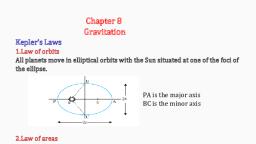
Gravitation, , XI (Physics), , bR hg, , b g, b g, , gh R h, R h, , g, , 2, , 2, , GM, r, , GM, R h, , gR 2, R h, , vc, , T, , T, , 2, , r, , g, R, , P, , *, , 2, , R h, gh, , 141, . hr, , The minimum period of satellite close to Earth surface is, 5077 sec or 84.6 min or 1.41 hr or 0.0588 days, , R, g, , 2, , I, JK, , GM, r, , 1, r, , ;, , P1, P2, , r2, r1, , When a satellite of mass m is orbiting with linear speed v, on the orbital path of radius r around the Earth, its angular, momentum is given by, , L, , When satellite is close to Earth, R h R ; gh = g, , R, g, , m, , For two identical satellite revolving around Earth, , P, , 2, , = 1.23 x 10⁻³ rad /s, , Linear and Angular Momentum, * Linear momentum of satellite, P = m x vc, , When h is maximum. T is maximum, When h is minimum T is MINIMUM, GM = gh(R+h)2, , FT, GH, , mv c r, , mr, , GM, = m GM. r, r, , *, , Angular momentum of a satellite depends on, i) the mass of the satellite (m), ii) the mass of the Earth (M), iii) the radius of the orbit (r) of the satellite., * Kepler’s law of planetary motion, i) First law (Law of elliptical orbit) : Every planet revolves, around the Sun in an elliptical orbit with the Sun at one, focus of the ellipse., ii) Second law (Law of area). : The radius vector drawn from, the Sun to a planet sweeps out equal area in equal interval, of time i.e areal velocity of the planet around the Sun, always remains constant., Explanation :, , The square of a period of a satellite is directly proportional, to cube of the radius of the orbit., , T2, , r3, , If r1 and r2 are the two orbital radius then their ratio of, , F T I FG r IJ ., period is G J, HT K Hr K, 2, , 3, , 2, , 2, , 1, , 1, , *, , If distance between Earth and Sun is doubled then year, will be of 1032 days or 2.82 years, , cT, , *, , h, , 3, , 2, , R, , GM, gR 2, =, R3, R3, , *, , bR hg, g b R hg, , gR 2, r3, , If satellite is close to earth then (R+h), , GM, , T 2, , *, , *, , 3, , h, , *, , R, , Period of satellite is, independent of mass of satellite, depends on height of satellite, , T, , *, , g, , r3, GM, , 2, , 3, , *, , gh R h, , gR 2, , GM, , b R hg, , 2, , r, , 2 r, GM, r, , 2 r, vc, , T, , *, , b, , ; vc, , ):, , GM, ;, r3, GM, ( R h) 3, , Critical velocity in terms of altitude, , vc, , iii), iv), v), *, , b, , gh R h, , vc, , *, i), ii), , Angular velocity (, , 2, , GM, , *, , *, , GM, , gh, , 2, , r3, , h, , An artificial satellite completes 10 to 20 revolutions in a, day., , *, , If in a given time interval, the planet goes from position, P1 to position P2 and in the same time interval it goes from, position P3 to P4. Then according to this law, area P1SP2 area P3SP4, where, S = position of the Sun, The linear velocity of the planet when closer to the Sun is, more than its linear velocity when it is away from the Sun.
Page 6 :
Gravitation, , XI (Physics), *, , This law follows the law of conservation of angular, momentum., Note : The areal velocity means area swepts by radius, vector per unit time., iii) Third law (Law of period): The square of the period of, revolution of a planet around the Sun, is directly, proportional to cube of semi major axis of its elliptical, orbit i. e. T, , 2, , GMm, r2, F, E;, but,, m, F, , *, , r ., , Explanation :, , *, , According to Kepler’s 3rd law, T2 r 3, Where, T = period of revolution of planet around the sun, r = semi major axis., T2 = K r3, Where K = constant for planet, , *, , 2, 1, 2, 2, , T, T, , i), ii), , *, , *, , 3, 1, 3, 2, , It is given by . E, *, , *, *, , *, , F, m, , If m = 1 then, E=F, Thus, gravitational intensity is equal to gravitational force, at that point for unit mass., Gravitational intensity is also called strength of, gravitational field., Unit and dimensions:, S.I. system : N/kg., C.G.S. system : dyne/gm., [E] = [MoL1T-2], The intensity of gravitational field according to Newton’s, law of gravitation, , is zero., , FG E, H, , GM, , IJ, K, , 0, , Intensity at, , *, , Intensity of gravitational field is equal to acceleration, due to gravity at the surface of Earth., Gravitational Potential : Gravitational potential at a point, is work done in bringing the unit mass from infinity to, that point in the gravitational fleld against the gravitational, force., Gravitational potential is, , *, , Vgravitational, *, , P. E., mass of a body, , 2, , Work done, mass of a body, , *, , Unit and dimensions:, S.I. system : J/kg., C.G.S. system : erg/gm., [Vgravitational ] = [M°L2T-2]., Gravitational potential is scalar quantity., , *, , Gravitational potential at distance r is, , *, *, , Gravitational potential at is zero i.e. maximum., Relation between gravitational intensity and, gravitational potential, , r, r, , where, T1 and T2 = periods of any two planets around the Sun, r1 and r2 the respective semi major axes., Note :, The time period of a planet when close to the sun is more, less the period when it is away from the Sun., This law follows the law of conservation of angular, momentum. Gravitational Potential Energy, Gravitational field : The imaginary region round the body, in which its gravitationalforce of attraction can be, experienced by other bodies is called gravitational field., Intensity of gravitational field (E) : Intensity of, gravitational field at any point in gravitational field is, defined as the gravitational force experienced by unit, mass kept at that point., , 1, r2, , *, , *, *, , Intensity of gravitational, field decreases as distance, increases. E, , 3, , F GM, m, r2, GM, E, r2, , ;, , E, , *, *, , *, , *, , *, , GM, r, , FG dV IJ bp. g.g, H dr K, , i.e. gravitational intensity is the negative rate of change, of gravitational potential., The negative potential gradient (p.g.) gives the, gravitational intensity., Inside the hollow spherical shell, potential is constant., Therefore, intensity of gravitational field inside the, spherical shell is zero., Gravitational potential energy: The work done in bringing, a body from infinity to a point in the gravitationalfield is, called gravitational potential energy., OR, Gravitational potential energy is the energy stored in a, body or system due to its position in gravitationalfield or, configuration of the fields., Gravitational potential energy, = Gravitational potential, mass of body, , P. E., , GM, r, , m, , Where, ‘r’is the distance of the point from the centre of, the mass of body., Negative sign shows that gravitational potential energy, due to the attractive force.
Page 7 :
Gravitation, , XI (Physics), *, , Gravitational potential energy of body of mass ‘m’ on the, , GMm, R, , surface of Earth P. E., *, , Gravitational potential energy of a body of mass ‘m’ at, height ‘h’ above Earth surface is. P. E., , *, *, , *, , *, , *, , *, , GMm, R h, , The maximum value of gravitational potential energy is, zero at infinity and at all other points it is negative., Gravitational potential energy goes on increasing with, increase in distance r (as it becomes less negative) and, becomes zero or maximum at r = ), It is found that gravitational potential energy at any point, is independent of the path along which the test mass is, displaced., It depends on the straight line, distance between the body, and the test mass., Binding energy, Binding energy : The binding energy of a satellite is, defined as the minimum energy that must be supplied to, a satellite in order to free it from the Earth’s gravitational, influence., When satellite is at rest on the Earth’s surface then,, ii) P. E., , i) K.E.= 0, , iii), , GMm, R, , GMm, R, , T. E., , Negative sign shows that satellite is bound to Earth due, to gravitational force exerted by Earth., , GMm, R, , iv) B. E., *, *, *, , P.E. of a satellite at surface of Earth is T.E. of satellite, Binding energy of a satellite is negative of potential energy, at the surface of the Earth., B. E. in terms of weight (W) :, , B.E., , 2, , gR m, R, , GMm, R, , = mgR, , GM, R2, , = (mg) R, , B.E. W.R., *, , g, , mg, , K.E. = 0, , iii), , T.E., , GMm, R h, GMm, iv) B.E., R h, , *, , When satellite revolving at height ‘h’ above Earth surface, then,, , i), , K.E., , 1, mv c2, 2, , GMm, 2 R h, , When the satellite is orbiting in its orbit, then no energy, is required to keep it in its orbit., * When velocity of the satellite increases its kinetic energy, increases and it start moving in circular path of smaller, radius., * When satellite is taken to greater height the potential, energy increases (becomes less negative) and kinetic, energy decreases., * For the orbiting satellite the kinetic energy is less than, potential energy (magnitudinally), K.E. < P. E., * For revolving satellite :, i) BE = - ( T.E. ), ii) K. E. = B. E., iii) K. E. = - ( T. E. ) iv) P. E. = +2 ( T. E. ), v) P. E. = -2 ( B. E. ) vi) P. E. = - 2 ( K. E. ), Escape Velocity, * Escape Velocity : The minimum velocity with which, satellite should beprojectédso that it escapes from the, Earth’s gravitational influence is called escape velocity., * Escape velocity of a body at rest on the Earth surface is, , ve, *, *, *, *, *, *, *, , 2GM, OR, R, , 2Rg, , 11.2 km / s, , If a body falls freely from infinite height, then, it will reach, the surface of Earth with velocity of 11.2 km/s ., If velocity of projection (v) of the body from the surface, of a planet is greater than the escape velocity (ve) of that, planet the body will escape out from the gravitational, field of that planet and will move in the interstellar space, with velocity vs which is given by, , *, , g.D, , Escape velocity is independent of the mass of the, projected body., The value of escape velocity does not depend on the, angle and direction of projection., Escape velocity depends on mass and radius of planet., Escape velocity of a body is different for different planets., Escape velocity from the surface of Earth, , 2Rg, , ii) P.E., , GMm, R h, , GM, R h, , *, , W, , When satellite is at rest at a height ‘h’ above the Earth, surface then,, , i), , 1, GM, m, vc, 2, R h, GMm, K.E., 2 R h, GMm, ii) P.E., iii) T.E., R h, GMm, iv) B.E. 2 R h, , vs, , v2 v2e, , Escape velocity of a satellite moving in a circular orbit at, height h above the Earth’s surface is, , ve, , GM, R h OR ve, , R h gh
Page 8 :
Gravitation, , XI (Physics), *, , Escape velocity depends upon height of the body from, the surface of planet., , *, , For revolving satellite (magnitude). ve, , *, , Satellite revolving close to Earth surface, , ve, *, , *, *, , *, *, , 2 vc, , OR v e, , 1.414 vc, , If the orbital velocity of a body is increased 2 times, (K.E. is doubled) or its speed is increased by 41.4%, the, body attains escape velocity and escapes into space., Weightlessness, Weight of the body : The gravitational force exerted by, the earth on the body is called weight of the body., When body is on the Earths surface it exerts a force on, the Earth equal to its weight and Earth will give the, reaction of equal magnitude but in opposite direction., Due to this reaction body feels weight., Weight of the person in a lift :, When a person is standing in a stationary lift, his weight, is equal to the force of gravity exerted by the Earth. The, actual weight of the person W = mg, If lift start moving down with an acceleration a, then the, apparent weight of the person is Wap, , *, *, , *, , *, , *, *, , *, , *, , vc, , Wap, , satellite. Consequently the floor of reaction on the, astronaut. As there is no reaction, the astronaut has a, feeling of weightlessness., * Centripetal acceleration of a satellite is equal to, acceleration due to gravity., * The forces acting on astronaut in a satellite., i) Gravitational force towards the center of Earth., ii) Normal reaction away from centre., iii) Centrifugal force away from the centre., , N, , mv 2, r, , GMm, r2, , ......... ( i ), , Centripetal force is provided by gravitational force and is, , mv2, given by, r, , GMm, ...........( ii ), r2, GMm, Putting value of, from equation (ii) in eq. (i ), r2, mv 2 mv 2, N, r, r, N 0, Since normal reaction is zero in satellite, astronaut feels, weightlessness., , m g a, , W , i.e. person experiences a feeling of partial, , weightlessness., When lift and person are in free fall i.e. both will move, down with an acceleration g., i.e. a = g., , Wap, , m g a = m (g - g) = m 0, , Wap, , 0, , i.e. a person will experience a feeling of complete, weightlessness., When lift is in free fall, the floor of the lift moved down, with the same acceleration as the person, and hence it, did not exert any reaction on the person., When body is taken at the centre of the Earth, At the centre of the Earth, the effective value of, acceleration due to gravity is zero., Therefore, W = m g = m 0, W=0, When Bodies are at null point in outer space When a, body projected up, the pull of the Earth goes on, decreasing. But at the same time the gravitational pull of, the moon on the body goes on increasing. At one, particular position, the two gravitational pulls may be, equal and opposite and the net pull on the body becomes, zero. This is zero gravity region or the null point and the, body is said to appear weightless., Weightlessness in a satellite : When the astronaut is in, orbiting satellite, then both, the astronaut and satellite,, are in a continuous start of fall towards the Earth with the, same acceleration due to gravity. Since the downward, acceleration of the astronaut is the same as that of the, satellite, he does not exert any force on the floor of the, , *, *, *, *, , Variation of Acceleration Due to Gravity, Variation of value of ‘g’ on the surface of Earth due to, shape of Earth :, The Earth is not perfectly spherical in shape but elliptical., The Earth is flatter at the poles and bulging at the equator., Its equatorial radius is about 21 kms more than the polar, radius R E, , GM, R2, RE RP, , *, , g, , *, , The, , gE, *, , The, , gP, *, *, *, *, , RP, , value, , 21 km, , g, gE, of, , 1, R2, gP, , g, , at, , equator, , is, , minimum, , poles, , is, , maximum, , 2, , 9.78 m / s ., value, , of, , ‘g’, , at, , 2, , 9.83 m / s ., , The value of ‘g’ increases from equator to poles., The value of ‘g’ decreases from poles to equator., Variation in value of ‘g’ above the Earth surface, (variations of g with altitude) :, As we go above the surface of the Earth, the value of g, decreases (when h is comparable with R).
Page 9 :
Gravitation, , XI (Physics), R2, , gh, g, *, i), , R h, , Note :, , *, , R2, , gh, g, , R2 1, , gh, g, , h, R, , 1, gh, g, , gd, , g, ., 2, , ii) If h = 0.414 R then g h, , h, R, , h, 1, R, , gh, *, *, , *, *, , 1, g, 2, 1, d, 1, 2, R, , g, *, , ;, , d, R, , g 1, 1, 2, , d, R, d, , R, 2, , Graph of variation in value of ‘g’ (graph of g and R) :, , 2h, 1, R, 2h, g 1, R, , *, *, *, *, *, *, *, , ‘g’ at the surface of Earth is maximum., ‘g’ at the centre of Earth is zero., The graph of d and g is linear., ‘d’ increases, ‘g’ decreases or vice versa., The graph of ‘h’ and ‘g’ is inverse square., h increases, g decreases or vice versa., Variation of of value of ‘g’due to rotation of Earth (effect, of latitude ) :, , *, , Latitude at a place : Latitude at a place ( ) is defined as, the angle which the line joining the place to the centre of, the earth makes with the equatorial plane., Earth rotates about its polar axis from west to east., Therefore, every object or particle on it is in motion. Let, ‘ ’ be the latitude of the point P.., , 0, , ............ ( ii ), , G, , GM, R2, , 4, R3, 3, R2, , = density of Earth., , 4, RG, 3, , ............ ( i ), , At depth, we have,, , gd, *, , g, 2, , *, , *, , where, , d, R, , 2h, h, 1, + terms with higher power of, R, R, , equation (ii) is valid when h << R., Variation of value of ‘g’ below the surface of Earth [effect, of depth (d)] :, The value of ‘g’ decreases as we go below the surface of, Earth because the effective mass of Earth attracting the, body decreases., Consider a body of mass ‘m’ situated at a depth ‘d’., Resultant radius [distance from centre of Earth] is (R - d)., Hence there will be gravitational attraction between mass, m and sphere of radius (R - d)., At surface, we have, , g, , R, R, , ............ ( iii ), , If g d, , 2, , 2, , If h < < R , then terms of h2 , h3 ---, , gh, g, , g, , Note :, , 1, 2, , R, R d, g, R, d, g 1, R, , gd, , g, ., 4, , If h = R then g h, , R d, , gd, g, , .......... ( i ), , 2, , 4, 3, , R d G, , .............. ( ii ), , From equation ( i ) and ( ii ), we get, , The acceleration due to gravity at point P is, , g' R, , 2, , cos 2 .
Page 10 :
Gravitation, , XI (Physics), Where,, = angular velocity of rotation of Earth about its polar, axis, = latitude of a place, *, , *, *, *, , *, , As, increases, cos, decreases., Therefore ‘g’ will increase. So, the value of g increases as, we move from equator to pole due to rotation of Earth i.e., ‘g’ increases with latitude ( )., If the rate of rotation of Earth increases i.e. value of, (of Earth) increases then the value of ‘g’ will decrease., If the rate of rotation of Earth decreases i.e. value of, (of Earth) decreases then the value of ‘g’ will increase., If Earth stops rotating about its axis i.e., = 0 then the, value of ‘g’ will increase everywhere except at the poles., This increase will be maximum at the equator and will go, on decreasing towards the poles., At the equator, cos (0) = 1, , gE, , 00, , g ' gE :, , to an observer on Earth equator is called Geostationary, satellite., , *, *, , *, *, , 2, , g R, , ‘g’ at equator is minimum., Maximum effect of rotation takes place at equator., , *, , *, *, , At the poles g ', , *, , 900, cos 90, , *, , 0, , gP, , *, , g, , ‘g’ at poles is maximum. The value of ‘g’ at poles will, remain same, Wheather the Earth is rotating or stationary, (as there is no term of in the above equation) i.e. there, is no effect of rotational motion of the Earth on ‘g’ at, poles., The difference between the values of acceleration due to, gravity at poles and equator is given by, , gP g E, , g, , gP, *, , gP :, , gE, , *, *, *, , 2, , g R, R, , *, , increase by factor R 2 at equator.., Explanation : Due to rotation of Earth, the acceleration, due to gravity on equator is g ' g R 2, when Earth stops rotating,, 1, , g R 0, , Increase in value of, , g, , R h, vc, 2 42400, 24 60 60, , satellite is T, , 2, , If the Earth stops rotating then the value of ‘g’ will, , g', , Geostationary satellite is also called as geosynchronous, satellite., Geosynchronous satellite : The angular speed of, geostationary satellite is synchronised with the angular, speed of Earth about its axis. Therefore it is called as, Geosynchronous satellite., Geostationary satellite is also called as communication, satellite., Communication satellite : Geostationary satellites are, used for the communication purpose, therefore they are, also called communication satellite., Height : The height of communication satellite from Earth, surface is 36000 km., Height of communication satellite from centre of Earth is, 42400 km i.e. radius of geo - stationary satellite., R + h = 6400 + 36000 = 42400 km, Period : The period of communication satellite is same as, period of rotation of Earth i.e. 24 hours or 1 day., Angular velocity : Its sense of rotation should be the, same as that of the Earth about its own axis i.e. from West, to East in equatorial plane (In anticlockwise direction)., Angular speed of this satellite is same as that of Earth., The relative angular velocity of this satellite related to, Earth is zero., Critical velocity : The critical velocity of geostationary, , 2, , 0, , vc, *, *, *, , =g, , g', g, , 1, , g', 2, , g R, , g g R, Increase in value of g R 2 ., , 2, , Geostationary or Geosynchronous or Communication or, Parking Satellite, * Geostationary satellite : A satellite which appears to be, at a fixed position at a particular height (i.e. stationary), , *, , 2, , vc, , 3.08 km / s, , The orbit of such satellite is called geostationary orbit,, geosynchronous orbit or parking orbit., The 1st Indian communication satellite is APPLE., A geostationary satellite always stays over the same place, on the Earth. Such a satellite is never at rest. Such a, satellite appears stationary due to its zero relative velocity, w.r.t. the place on the Earth., We can say that a communication satellite is equivalent, to a T.V. tower, 36,000 km high.