Notes of Physics 12th New 2022-23, Physics Theory Notes - Optics - Study Material
Page 2 :
4., 1., , What is the speed of light in free space?, Does light have the same speed in all, mediums?, Ans. Light and all other electromagnetic radiations, travel at the same speed in free space, which is, the maximum possible speed and is considered a, universal constant denoted by c0. The modern, accepted value is c0 = 299 792458 m/s (exact), ( 3.0 108 m/s). Light travels slowly through, any medium than it does in free space. The speed, of light in a medium depends upon the frequency, of light. Alternatively, light of a given frequency, has different speeds in different media., What happens when, en a narrow parallel beam of, light travelling in one medium meets the, surface bounding some new medium?, Ans. In general, when a narrow parallel beam of, light meets an interface, i.e., a surface separating, two media, it is partly reflected and the remaind, remainder, passes into the new medium. Because of this, reflection,, tion, occurring simultaneously with, refraction, we can see the image of the, surrounding objects faintly reflected from the, surface of a pool of water or a flat, , Define relative refractive index., , Ans. Definition :When a monochromatic light, passes from medium 1 (in which its speed, isc1) into, to medium 2 (in which its speed is, c2), the refractive index of medium 2, relative to medium 1 is defined as the ratio, of the speed of light in medium 1 to that in, medium 2., 1, , n2, , speed of light in medium 1, speed of light in medium 2, , c1, c2, , [Notes :(1) Monochromatic light means, light of single frequency., (2)The refractive index of medium 2, , 2., , relative to medium 1 is also denoted by, , 5., , Express the refractive, , .], , index, , of a, , medium with respect to another as a ratio, of their absolute refractive indices., Ans. If the speed of a monochromatic ray of light, 1, , n2, 2, , in medium 1 is ci and that in medium 2 is c2,, the refractive index of medium 2 relative to, medium 1 is ., This may be written, 1, , 2, , glass sheet. The fraction of the inciden, incident light that, is reflected increases with the angle of incidence., For oblique incidence, the beam of light bends as, it enters the new medium. This change of, direction as light passes obliquely from one, medium to another results from a change in the, speed off light and is called refraction., , so, that multiplying and dividing the right, hand side by c0, the speed of light in free, space,, c0 /c2, n2, 1n2, c0 /c1 n1, where n1, , 3., Define absolute refractive index of a medium., Ans. Definition : Absolute refractive index, or the, refractive index of a medium relative to free, space, is defined as the ratio of the speed of light, in free space to that in the medium, c0, Speed of light in free space, speed of light in the medium c, [Note: The absolute refractive index is also, denoted by the Greek alphabet .]], , n2, , c1, , and n 2, , c2, , are respectively, , the absolute refractive indices of the, mediums 1 and 2. Therefore, the refractive, index of medium 1 relative to medium 2 is, , n, , 11th (Sci.) –Optics, , 2, , n1, , ., , Page-1
Page 3 :
6., , When a monochromatic ray of light (of, frequency f)) passes from medium 1 (refractive, index, n1) into medium 2 (refractive index, n2),, show that the relative refractive index 1n2 =, where, and, are the wavelengths of the, , light in the respective mediums., Ans. Let the speed of light in medium 1 be c1and that, in medium 2 be c2. The frequency f of the light, remains unchanged in refraction, so that, c1 =, and c2 =, where and, are the wavelengths of the light, in the respective mediums., Therefore, the refractive index of medium 2, relative to medium 1 is, c1, f 1, 1, 1 n2, c2, f 2, 2 ., 7. State the laws of refraction of light., Ans. Laws of refraction :, (1) The refracted ray lies in the plane of incidence,, which is the plane of the incident ray and the, normal to the interface of the two mediums at the, point of incidence., (2) For a monochromatic ray of light passing, obliquely from one medium to another, the ratio, of the sine of the angle of incidence to the sine of, the angle of refraction is constant for that pair of, mediums and is equal to the refractive index of, the second medium relative to the first for that, frequency. This is called Snell's law. If i is the, angle of incidence in medium 1 of refractive, index n1 and r is the angle of refraction in, = 1n2 =, , or n1 sin i = n2 sin r (Snell’s law), , [Note :Willebrord Snelll (1580, (1580-1626), Dutch, Physicist, after much experimental work, put, forward the law around 1621.], 8., With a neat labeled ray diagram, explain the, phenomenon of total internal reflection., Ans. Whenever a light ray comes across a, medium of different refractivee index, there is, simultaneous reflection and refraction., sin i, From Snell's law,, sin r n1, …..(1), sin i, n2, When a light is incident from a rarer medium, n1, <n2, the angle of refraction r is less than the, angle of incidencee i. In this circumstance, some, part of the incident light always passes into the, second medium for any incident angle i < 90°., sin r, , 11th (Sci.) –Optics, , When a light ray travelling in a denser, medium is incident normally (i = 0°) onto an, interface, the ray passes undeviated into the, rarer medium as shown by the ray 1 in Fig., However, for an oblique incidence from a, denser medium, n2 <n1 in Eq. (1) means sin r, is greater than sin i, so that r>i (the ray 2 in, the figure). As i increases from a small value,, sin i increases. sinr, si approaches unity and r, approaches 90°. Under these conditions, the, refracted ray (the ray 3 in the figure) grazes, the interface, just escaping the denser, medium. Hence, the angle i for which sin r =, 1, i.e., r = 90°, is called the critical angle of, incidence (iC) for the pair of mediums., , For i >iC, gives a value for sin r greater than, unity. Since, there cannot be any real angle, that satisfies the equation, there is no refracted, ray. For an angle of incidence in the denser, medium greater than the critical, c, angle, the, incident ray is completely reflected at the, interface (the ray 4 in the figure) and no light, enters the rarer medium. This phenomenon is, called total internal reflection., 9. State the conditions for total internal, reflection., Ans., s. Conditions for total internal reflection :, (1) A ray of light must approach an interface, from the denser medium., (2) The angle of incidence in the denser medium, must be greater than the critical angle of, incidence for the pair of mediums., 10. Define, ine critical angle. How is this angle, related to the refractive index of(i) the, rarer medium relative to the denser, medium (ii) the denser medium relative to, the rarer medium?, OR, * Explain critical angle formula with a neat, labelled ray diagram., Ans. Definition: When a light ray travelling in a, denser medium meets an interface with a rarer, medium, the angle of incidence in the denserdenser, , Page-2
Page 4 :
medium for which the beam just emerges into the, rarer medium, i.e., the angle of refraction in the, rarer medium is 90°, is called the critical angle for, the two mediums., , Totally reflecting prisms, , Critical angle, , 11., , If i and r are the angles of incidence and, refraction, and n1 and n2 are the refractive indices, of the two media, then, n1 sin i = n2 sin r, [Snell's law], At the critical angle, i=iC and r = 90°, so that, n1 sin iC = n2, [ sin r = sin 90° = 1 ], n, siniC= 2 = 2n1, n1, Here 2n1 is the reciprocal of the refractive index, of the denser medium relative to the rarer medium, 1, Thus, sin iC=, ., 1 n2, Give two examples where total internal, reflection is commercially used., OR*, State at least three applications of total, internal reflection., , Ans., (1) Totally reflecting prisms are used in reflex, cameras, binoculars and periscopes., (2) Optical fibres (thin fibres of high quality glass), used in communications and endoscopy (the visual, observation of various internal body cavities), transmit light signals by total internal reflection., (3) A diamond gem is given strategic cuts so that total, internal reflections give the gem its sparkling, brilliance., 12. Explain the use of a totally reflecting prism., Ans . Th e cri ti cal angl, an gl e for crown, cro wn gl ass - ai r, interface is about 41.2°. If a ray of light is incident, on the interface through glass at an angle greater, than this, the ray is totally internall, internally reflected. The, simplest type of a totally reflecting prism is a right, prism (45°-45°-90°)., 90°). A ray of light may be, internally reflected only once at the hypotenuse, as, shown in Fig. (a), or may enter and leave through, the hypotenuse after undergoing two in, internal, reflections, as shown in Fig. b).. In each case, if the, ray enters one face of the- prism normally, the, angle of incidence at the glass-to, to-air interface is, 45°, i.e., greater than the critical angle., 11th (Sci.) –Optics, , Two such prisms are used in a periscope (each, prism turning the ray by 90°) and a prism, binocular (each prism turning the ray by, 180°)., 13 Explain t he occurrence of a mirage., Ans. When the surface of the Earth is heated by, the Sun, a layer of hot air of lower mass, density (and refractive index) is sometimes, produced just at the, , Formation of mirage (Schematic), , surface. The layers of air away from the, surface are progressively cooler. When there, is a steep vertical temperature gradient, the, optically rarer region of hot air, a just above the, Earth's surface may reflect a ray of light back, up into the denser air above, as shown in Fig., An inverted image, formed below the actual, object's true location, gives the illusion of the, object being reflected in a pool of water. To, see a mirage one must be looking down a, featureless surface such as that of a desert or, asphalt pavement of a highway on a calm, sunny day., 14. What is an optical fibre? Mention at least, two areas of application of optical fibres., Ans. An optical fibre is a sort, s, of flexible light, pipe within which light is constrained to travel, as a result of successive total internal, reflections. An optical fibre consists of a, transparent core filament surrounded by a, plastic matrix called cladding (Fig.). The core, has a diameter, meter of few thousandths of a, micrometer and is usually made of glass., , Page-3
Page 5 :
The cladding has a refractive index lower than, that of core. Each composite filament, called an, optical fibre, is very flexible and an optical, transmission line is made up of a bundl, bundle of such, optical fibres enclosed in a protective plastic, jacket., Because the refractive index of the core is, more than that of the cladding, light travels along, the core by total internal reflections if it strikes, the interface between the core and the cladding at, an angle of incidence more than the critical angle., 15. What is dispersion of white light?, OR, Explain the dispersion of white light produced, by a prism., Ans.The, The separation of a parallel beam of white light, into its constituent colours after, ter passing through a, prism, is, called, dispersion, of, light., , When a narrow, parallel beam of white light passes, through a prism, its constituent colours undergo, different deviations because the refractive index of, the material of a prism depends upon the, frequency of the light and different colours, correspond to different frequencies. The deviation, is maximum for the light of highest frequency, i.e.,, the smallest wavelength (that of extreme violet) iin, the beam. Hence, in the emergent beam, the, constituent rays are angularly separated. This, phenomenon is called dispersion., 16. What is a prism? What are the refracting faces,, the refracting edge, the principal section and, the refracting angle of a prism?, Ans., (1) Prism : A prism is a block of transparent medium, bounded by usually three plane faces., (2) Refracting faces of a prism : The refracting faces, of a prism are two of its plane faces which are, highly polished, and form the incident and the, emergent faces of the prism., [Note : The third face, called the base of the prism,, is grounded or left unpolished.], (3) Refracting edge of a prism : The refracting edge, of a prism is the straight edge at which the two, refracting faces of the prism meet., 11th (Sci.) –Optics, , (4) Principal section of a prism : The principal, section of a prism is the transverse section of, the prism perpendicular to its refracting edge., (5) Refracting angle of a prism : The refracting, angle A of a prism is the included angle, between the two refracting, refract, faces of the prism., 17., , For a ray of light passing through a, prism, explain the deviation suffered by the, ray and prove the following relations :, A = r1 + r2 and i + e = A +, where the symbols have their usual, meanings., For a prism, prove the relation, i + e = A + ,where the symbols have their, , Ans. When a ray of light enters a prism through, one refracting face and emerges out through, the other, the ray is said to pass through the, prism, and the emergent ray is not parallel to, the incident ray. On passing through the, prism, the angle through which the direction, of the ray is changed from its incident, direction is called the angle of deviation ., This angle is the sum of the two deviations, suffered by the ray at each refraction at the, two refracting faces., Consider a principal section ABC of a, triangular prism (refractive index, n2), surrounded by a medium 1 (n, ( 1) Let n2 > n1., Figure shows a monochromatic, monoc, ray of light, passing through the prism. Ray PQ is incident, on the refracting face AB at an angle of, incidence i and r1 is the angle of refraction., Ray QR, the refracted ray inside the prism, is, then incident on the second refracting face AC, at an angle of incidence r2. RS is the emergent, ray and e the angle of emergence. The ray, suffers deviations, and, at the two faces, AB and AC, respectively, and is the total, deviation., , Refraction of Light through a prism, , Page-4
Page 6 :
QM and RM are the normals to the two refracting, faces at points Q and R, respectively. The rays PQ, and SR are produced to meet at T., Since, AQM = ARM = 90°. AQMR is a, cyclic quadrilateral., A + QMR = 180°, ... (1), Also, from QMR,, r1 + r2 + QMR=180°, ...(2), Therefore, from Eqs. (1) and (2),, A = r1 + r2, ...(3), From the diagram,, i = TQM = 1 + r1 and, e = TRM = 2 + r2 ….(opposite angles), 1 = i – r1 and 2 = e – r2, is the exterior angle of ΔQTR, so that, = 1+ 2, …..(interior opposite angles), = i + r – (r1 + r2), …..(4), so that, from Eq.(3),, δ i +e –A, i+e=A+, 18. Discuss the -i curve for a prism and hence, derive the prism formula., Ans. For refraction of a monochromatic ray of, light through a prism, as the angle of incidence is, increased from a low value, the angle of deviation, initially decreases and then increases after going, through a minimum value m called the angle of, minimum deviation. Therefore, the graph of the, angle of deviation against the angle of incidence, i is a nearly parabolic curve such that the same, occurs for two values of angle of incidence, i1 and, i2 , i1 = i and i2 = e, When, ,i=e, Then, by Snell's law, r1 = r2( =r say), Therefore, from the prism relations,, A = r1 + r2 and i + e = A+ ,, A = 2r or r =, and 2i = A +, , [Note : The factors of 2 in the prism formula, are within the arguments of the sine functions, and cannot be cancelled out.], 19. Define (i) angular dispersion (ii)dispersive, power and derive their expressions., Ans., Definition :The angular separation between, the two extreme rays of different colours in, the dispersed beam of a polychromatic light is, called the angular dispersion., Definition : The dispersive power of the, material of a prism is defined as the angular, dispersion between the rays of the extreme, colours divided by the deviation of the ray of, the mean colour., When white light is dispersed, the deviation is, maximum for the extreme violet ray ( V) and, minimum for the extreme red ray ( R). The, deviation for yellow ray Y is approximately, intermediate between them. Then, the angular, dispersion between the rays of the extreme, colours is θ = V – R, The dispersive power of the material of the, prism is, , 20. What is a thin prism ? For a thin prism,, show that (1) the deviation produced, isgiven by =A(n–1), (2) the dispersive power, , Ans. A thin prism is a prism whose refracting, angle A is very small; A is usually between 2°, and 5°. The angle of minimum deviation m, for such a prism is also equally small., (1) The prism formula for any prism in general,, is, , m, , i, , nY, , sin, i, , ……(1), , n2, sin, , The refractive index of the material of the prism, with respect to the surrounding medium is sin, i, , n2, , r, , sin, , This is the prism formula., 11th (Sci.) –Optics, , For very small angles, the sine of an angle, is approximately equal to the angle in radian., Hence, for a thin prism we can writesin, , and, , Therefore, Eq. (1) becomes, Page-5
Page 7 :
A, i, , n2, 2, , (replacing by ), where the subscript m has been dropped because a, thin prism is almost exclusively used at minimum, deviation., (2) Let nV,nR and nY be the refractive indices of the, material of the prism for violet, red and yellow, light, V, R and Y,be, be the corresponding angles of, minimum deviation, respectively., Then, from Eq. (2) ,, V = A(nV– 1), R = A(nR –1) and, V = A(nV– 1), By definition, the dispersive power is, V, , Primary rainbow (one internal reflection), , R, , The value for this deviation is 137°42!, 137°42 for, , Y, , A(nV nR ) nV nR, A(nY 1), nY 1, 21. What is a rainbow? How is it formed?, Ans. A rainbow is the phenomenon of dispersion in, nature on a huge scale when water droplets in air, or rain drops disperse sunlight into its constituent, colours. It appears as arcs of the colours of the, spectrum across the sky when the Sun is behind, the observer., Rainbows are produced by refraction,, dispersion and internal reflection of the sunlight by, the water drops. When two bows are visible, the, inner bow is known as the' primary bow. The outer, bow, in which the colours are reversed with, respect to the primary bow, is known as the, secondary bow., 22. Explain the formation of a primary rainbow., Ans. A rainbow is caused by the dispersion of the, sunlight into its constituent colours by the water, droplets present in the clouds., s. The brighter, rainbow usually seen is the primary rainbow. At, each water drop, the sunlight refracts into it, gets, totally internally reflected once and emerges out, with a second refraction., As shown in Fig., the deviation at each refraction, is (i–r) while, ile at each internal reflection it is(180° –, 2r)., ). For all the parallel rays entering the upper half, of the drop, the total deviation, 5, in the clockwise, sense is thus given by, = 2(i – r) + (180° – 2r), , red light and 139°37!, 139°37 for violet light. Thus, an, observer standing with his back to the Sun, receives these rays for the red light at an angle, of 180°–137°42! = 42°18! with the line, joining, ining the Sun to him, and those for the, violet light at 180°–139°, 180°, 37!= 40° 23!with this, line. Therefore, this primary bow is violet in, colour on the lower side and red on the upper,, the other colours falling in between. The, rainbow appears curved like a bow, bo because, this phenomenon is the same in all planes, passing through the line. For a primary bow to, be visible to an observer on the ground, the, Sun must not be more than 42° above the, horizon., [Note : The elementary theory of rainbow was, first given by Antonius, tonius de Demini and later, developed byDescartes. The complete theory, was first proposed by Thomas Young and, later worked out in detail by George Airy and, others.], , = 180° + 2i – 4r, 11th (Sci.) –Optics, , Page-6
Page 8 :
23., , E x pl ai n th e f ormati, o rmati oon, n of a s eco nd ary, a ry, rainbow. Why are the colours in the secondary, rainbow, inbow in opposite order to that in the, primary bow?, OR, * Why is the sequence of colours in the, secondary rainbow opposite to that in the, primary rainbow?, , Ans. Sometimes, when a primary rainbow is seen,, afainter secondary bow is seen higher in the sky., It is formed by the sunrays undergoing two, refractions and two internal reflections at each, water drop, Fig shows. The secondary rainbow is, produced by the rays incident on the lower half of, the drop, refracted at B, then internally reflected, at C and D, and finally emerges into the air, downwards along EF., If i and r are the angles of incidence and, refraction at B, the deviation of the light at B and, E is (i – r) each and (180° – 2r) at C and D. For, all the parallel rays entering the lower half of the, drop, the total deviation, , in the anticlockwise, sense is thus given by, , Secondary rainbow (two internal reflections), , = 2(i – r) +2(180°– 2r), = 360° + 2i – 6r, The deviation is such that the observer,, looking away from the Sun, sees the red colour in, an arc subtending, ing an angle of 50°34' and the, violet at an angle of 54° with the line joining the, Sun to the observer. Therefore, the secondary or, the outer bow is violet on the outside and red on, the inside, in reverse order of the colours as, compared with the primary bow., 11th (Sci.) –Optics, , 24. State the laws of reflection light:, Ans: Laws of reflection of light, (1) The incident and reflected rays, and the, normal to the reflecting surface at the point of, incidence, lie in the same plane., (2) The incident and reflected rays make equal, angles with the normal on opposite sides of it., 25. What is a spherical mirror? What are its, two types?, Ans. A spherical mirror, mirro is a spherical reflecting, surface which may be taken to be a section of, a hollow sphere., There are two types of spherical mirrors :, (1) a concave mirror, which has its inner surface, reflecting, or, which has its outer surface, reflecting., 26. Define the following terms for a spherical, mirror or surface: (1) pole (2) centre of, curvature (3) radius of curvature, cur, (4), principal axis., Ans., (1) Pole :The, The centre of a spherical mirror or, surface is called of the pole spherical mirror, or surface., (2) Centre of curva, rvature: The centre of the, sphere, of which the spherical mirror or, surface is a section, is called, call the centre of, curvature of the, he spherical mirror or, o surface., (3) Radius of curvature:, curvature The radius of the, sphere, of which the spherical mirror or, surface is a section, is called the radius of, curvature of the, he spherical mirror or surface., (4) Principal axis : The line passing through the, pole and the centre of curvature of a spherical, mirror or surface is called the principal axis of, the spherical mirror., 27. Define the, he principal, prin, focal point of a, spherical mirror. What is focal plane?, Ans: Definition: A narrow parallel beam of light., parallel to the principal axis, after reflection, from a spherical mirror either converges to, (for a concavee mirror), mirror or appears to diverge, from (for a convex mirror), mirror a single point on, the principal axis. This point, po the is called the, principal focal, ocal point or principal, prin, focus of the, spherical mirror., Page-7
Page 9 :
(4), , A narrow, parallel beam, m of light, close to, but not parallel in the principal, ipal axis, converges, at or appears to diverge from, m a single poin, point on a, plane perpendicular to the principa, principal axis and, passing through the principal focus. Such a, plane called the focal plane., , [Note : All points on a focal plane are focal, points, so that there are an infinite number of, focal points. The point of inter, tersection of the, principal axis with the focal, ocal plane is the, principal focal point or principal focus., focus.], 28., , State the new Cartesian sign convention usedin, ray optics., Ans. New Cartesian sign convention in ray, optics:, (1) In a ray diagram, the principal axis is drawn, horizontal and the incident, dent rays are always shown, directed from the left to the right., (2) The pole of a spherical surface, or the optical, centre of a lens, and the principal axis are, respectively taken to be the, he origin and the x-axis, of the Cartesian coordinate axes., izontal distances are measured from the origin, (3) Horizontal, distances to the right are considered positive, while those to the left negative., 11th (Sci.) –Optics, , Vertical distances are measured from the, principal axis; distances above are, considered positive while those below, negative., , 29. An object is placed in front of a concave, mirror at the following positions : (1) at, infinity (2) between infinity and centre of, curvature (3) at the centre of curvature (4), between the centre of curvature and focal, plane (5) in the focal plane (6) between the, pole and focal plane., In each case, state the position of the, image formed, and its nature and relative, to the object, Ans. Image formation In a concave mirror :, (1) Object at infinity :A real image is formed, in the focal plane., plane It is inverted and highly, diminished relative, ive to the object., (2) Object between infinity, i, and centre of, curvature: A real image is formed between, the focal plane and centre of curvature. It is, inverted and diminished relative to the, object :, (3) Object at the centre, cen, of curvature : A real, image is formed at the centre of curvature. It, is inverted relative to the object and the, same size as that of the object., (4) Object between the centre of curvature, and focal plane : A real image is formed, beyond centre of curvature., curv, It is inverted, (5) Object in the focal plane : An, imperceptible real image, imag is formed at, infinity. It is inverted and highly magnified, relative to the object., 30. Explain the properties of the image, formed after reflection of light from a, plane surface., Ans., i. The image of an object kept in front of a, plane reflecting, , surface, , is, , virtual, , and, , laterally inverted., ii. Image is of the same size as that of the, object., iii. It is situated at the same distance as that of, object but on the other side of the reflecting, surface., Page-8
Page 10 :
vi. Hence, the expression of focal power is given, 31. Explain the formula to find the number of, images formed when an object is placed in, between two plane mirrors inclined at an, angle#., Ans:, i. If an object is kept between two plane mirrors, inclined at an angle $,, multiple images (N) are, formed due to multiple reflections from both the, mirrors., ii. The number of images can be calculated using, %&', , formula, n =, , (, , ., , iii. Exact number of images seen (N) depends upon, the angle between the mirrors and position of the, object., iv. When n is an even integer, for all positions of the, object the number of images formed are N =n, =n–l., v. When n is an odd integer:, a. For an object placed, ed at the angle bisector, of the mirrors: N=n – 1, b. For an object placed off the angle bisector of, the mirrors:, vi. If n is. not an integer, N = m, where m is integral, part of n., , by the formula, P =, , 3, , 33. What is lateral magnification? How does it, vary in different types of spherical, mirrors?, Ans:, i. Ratio of linear size of image to that of the, object, measured perpendicular to the, principal axis, is defined as the lateral, magnification., ,, +, *, .for, for spherical lenses=, m=, , ,, , -, , +, , -, , (For spherical mirrors), , ii. For any position of the object, a convex, mirror always forms virtual, erect and, diminished image. Thus, lateral, magnification for convex lens is always, m< 1., iii. In the case of a concave mirror, it depends, upon the position of the object., , its expression?, Ans:, i. Converging or diverging ability of a lens or of a, mirror is defined as its focal power., ii. This implies, more the power of any spherical, mirror or a lens, the more is its ability to converge, or diverge the light that passes through it., iii. In case of convex lens or concave mirror, more the, convergence, shorter is the focal length as shown, in the figure., , 34. Explain spherical aberration for spherical, mirrors. How can it be minimized? Can it, be eliminated by some curved mirrors?, Ans., i. In case of spherical mirrors (excluding small, aperture spherical mirror), The rays coming, from a distant object farther from principal, axis do not remain paraxial. Thus, the focus, gradually shifts towards the pole., >, ii. The relation 2, ? giving a single, pointfocus is not followed and the image, does not getconverged at a single point, resulting into a distorted or defective image., iii. This phenomenon is known as spherical, aberration., iv. It occurs due to spherical shape of the, reflecting surface, hence known as spherical, aberration., , iv. Similarly, in case of concave lens or convex, mirror, more the divergence, shorter is the focal, length., v This explains that the focal power of any spherical, lens or mirror is inversely proportional to, the focal length., , v. The rays near the edge of the mirror converge, at focal point FM- Whereas, the rays near the, principal axis converge at point FP. The, distance between FM and FP is measured as, the longitudinal, tudinal spherical aberration., , 32. What is focal power of a spherical mirror or a, lens?, What may be the reason for using P = )as, , 11th (Sci.) –Optics, , Page-9
Page 11 :
vi., , In spherical aberration, single point image is not, possible at any point on the screen and the image, formed is always a circle., vii. Att a particular location of the screen (across, B in figure), the diameter of this circle is, minimum. This is called the circle of least, confusion. Radius of this circle is transverse, spherical aberration., Remedies for Spherical Aberration:, i., Spherical aberration can be minimized by, reducing the aperture of the mirror., ii. Spherical aberration, ation in curved mirrors can be, completely eliminated by using parabolic mirror., 35. Explain chromatic aberration for spherical, lenses. State a method to minimize or eliminate, it., Ans., i., Lenses are prepared by using a transparent, material medium having different, fferent refractive, index for different colours. Hence angular, dispersion is present., ii. If the lens is thick, this will result into notably, different foci corresponding to each colour for, a polychromatic beam, like a white light. This, defect is called chromatic aberration., iii. As violet light has maximum deviation, it is, focused closest to the pole., , Reducing/eliminating chromatic aberration:, , i., , ii., , 36., , Eliminating chromatic aberrations for all colours, is impossible. Hence, it is minimised by, eliminating aberrations, berrations for extreme colours., This is achieved by using either a convex and a, concave lens in contact or two thin convex lenses, with proper separation. Such a combination is, called achromatic combination., (1)What is the relation between the, focal length, f and the radius of, cu rv, rva, a tu r e, R, of s p h e ri cal mi r ro rr?, (2) What is the mirror equation? State it., , Ans., (1) For a spherical mirror, the principal focus is, midway between the pole and centre of curvature., , 37 For refraction at a spherical surface,, n n1 n2 n1, derive the relation 2, u, R, considering the formation of a real image., OR, *Explain refraction at a single spherical, surface (convex) and obtain the relation, between u, v and R., Ans. Consider a convex spherical surface APB, separating two transparent mediums 1 and 2., Their absolute refractive indices are n1 and n2,, respectively, with n2>n1. Let O be a luminous, point object on the principal axis in the rarer, medium,, as, shown, in, Fig., , The ray OP along the principal axis is, incident normally on the spherical surface, sur, and, passes into the denser medium undeviated. A, second ray OD is incident obliquely on the, surface at an angle of incidence i with the, normal CN. Let the angle of refraction r for, this ray be such that the refracted ray meets, the ray OP forming a real point image I on the, principal axis. The angles made by the, incident ray OD, the refracted ray Dl and the, normal CN with the principal axis are C, E, and B respectively., To make small angle approximations, (sinθ θ and tan θ θ,θin radian), we, consider the ray OD close to and almost, parallel to the axis). Then, i, r,C,E and B may, be treated as very small angles., By Snell's law,, n1 sin i = n2 sin r or n1i = n2r, In triangles DOC and DIC,, DIC i and B are, the respective exterior angles., i = C A B and B E A Q or r= B R E, , >, , (2), , The relation between the object distance, u, the, image distance, , and the focal length, f, of a, spherical mirror is called the mirror equation :, 3, , @, , A, , -, , 11th (Sci.) –Optics, , D .C A B=, , D .B R E=, , D CAD E, , .D R D = B, , Now ,C, D, HJ, , KLM HI, HJ, , +, , HN, , AD, , F G HI, HJ, , , E, , KLM HI, , O, , HN, , KLM HI, HN, , = (n2 – n1), , VW, , , B, , TQU VX, , KLM HI, HP, , HP, , Page-10
Page 12 :
According to the new Cartesian sign convention,, object distance PO = –u,, image distance PI = + v, and radius of curvature PC = + R, O, R, Z, [, >, Y, 38.Derive the lens maker’s equation., Hence obtain the thin lens equation., OR, * Derive the lens maker’s equation and, deduce the lens formula from it., Ans :Consider, Consider a thin convex lens(refrac, lens(refractive, index n2)placed in a rarer medium (refractive, index n1). Let R1 and R2 be the radii of curvature, of the two spherical surfaces of the lens., , Adding Eqs. (2) and (3) eliminates ]! and, we get,, , . R D =2, .D, , D Z R [, Y, , Y, , R, , -, , Y, , R, , -, , -, , 2, 1, , >, , R, , R 1? 2, , >, , R, , >, , ?, , 2, , >, , R, , >, , ?, , n2, , >, , ?, , …… (4), , The focal length of a lens is the image, distance when the object is at infinity. ie.,] = f, for u = ∞., Substituting these values in Eq. (4), 3, , (1n2, , >, , R, , >, , ?, , ……(5), , where1n2, , ,^, , Consider a luminous point object O on the, principal axis in front of the lens at a distance u, from the optical centre P. The ray OP incident on, the lens along its principal axis passes through, undeviated. A paraxial ray OD suffers two, refractions, at the two spherical surfaces of the, lens. For refraction at a spherical surface,, O, R, ….. (1), @, >, Now for the refraction at the first surface, the, refracted ray is DE. If there was no second, surface, the ray DE would have proceeded in the, denser medium and met the ray OP. thus forming, a real image at \!. Let PI' = ]!.. Thus, in this case,, the object distance is u.. the image distance is ]!, and the radius of curvature is R1 Substituting, these values in Eq. (1), O, R ......(2), >, , But the denser medium does not eextend far, beyond the first surface so that the ray DE suffers, another refraction at the second surface and, emerges out into the rarer medium. This emergent, ray meets the ray OP at I which is the image, produced by the lens. Let PI =]., Thus, for the refraction, tion at the second surface,, the incident ray DE is in a medium of refractive, index n2 the refracted ray is in a medium of, refractive index n1. and I! acts as the virtual object, with object distance PI! = ]!.. Accordingly, Eq. (1), for this case becomes, …… (3), , 11th (Sci.) –Optics, , Equation (5) is called the lens makers', equation. Since the right hand sides of Eqs., (4) and (5) are the same, equating their left, hand sides gives, , R, …….(6), 3, ,, This is lens formula.., 39. Give the meanings of (1) optical centre of a, lens (2) principal focus of a lens (3), principal foci of a convex (converging) lens, (4) principal foci of a concave (diverging), lens (5) focal length of a lens., Ans., (1) Optical centre of a lens : The optical centre, of a thin lens is a point on the principal axis, coinciding with the centre of the lens such, that a light ray directed towards it passes, through the lens undeviated., (2) Principal focus of a lens :The, :, principal, locusof alens is a point on the principal axis, where, re light rays(i) parallel to the principal, axis are convergent orappear to diverge, from, (ii) diverging from, orappearing to, converge, are rendered parallel to theprincipal, axis after refraction through the lens., (3) Principal foci of a convex (converging), (c, lens:, Thetwo points on the principal axis where, light raysparallel to the principal axis are, brought together, andfrom where diverging, light rays are rendered parallelto the principal, axis, after refraction, are called theprincipal, foci of the convex, vex (converging) lens., Page-11
Page 13 :
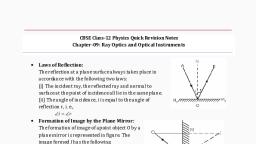
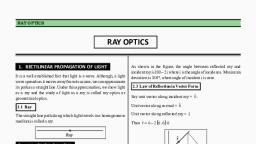
(4), , (5), , Principal foci of a concave (diverging) lens, :The two points on the principal axis such that, light rays parallel to the principal axis appear to, diverge from them, and to which light rays, appearing to diverse are rendered parall, parallel to the, principal axis, after refraction, are called the, principal foci of the concave (diverging) lens., Focal length of alens : The distance between the, optical centre and the principal focus of a lens is, called the focal length of the lens., It is taken to be the distance between the, optical centre and the second principal focus, so, that the focal length of a convex lens is positi, positive, while that of a concave lens is negative, , Thus, in this case,, , R, …….(1), 3, @a, The ray DE, however, suffers another, refraction by the lens L2 and meets the ray OP, at I which is the images produced by the lens, system. Let PI = ]., ] For the lens L2, I! acts as, the virtual object with object distance PI! = ]!., Accordingly, in this case,, R, , …..(2), , 3, @, @a, Adding Eqs. (1) and (2), , A, R, ……(3), 3, 3, The focal length f of the lens system is the, image distance when the object is at infinity,, i.e., ], for u =∞, ∞, Substituting these values in Eq. (3),, 1 1 1, A, For more than two thin lenses,, , 1, , 40., , Obtain an expre ssion for the resultant, focal length of a combination of two or, more thin lenses in contact., *Discuss the system of two thin convex, lenses in contact., Ans : Consider two thin convex lenses L1 and L2 ,, of focal lengths f1 and f2 respectively, placed in, contact with each other. Since the lenses are thin,, the effective optical centre of the system can be, taken to their point of contact P fig., , 1, , A, , 1, , A, , 1, , %, , A. .., , 41.. (i) What is power of a lens?, (ii) What is the SI unit of the power of a, lens?, (iii) What is the combined power of two or, more thin lenses placed in contact?, Ans., (i) The power of a lens, which gives the, measure of the degree to which a lens can, converge or diverge a parallel beam of light,, is defined as the reciprocal of its focal length, :P= ., 3, , (ii) The SI unit of the power of a lens is the, dioptre (symbol D). One dioptre is the power, of a lens whose focal length is one metre., (iii) When two or more thin lenses are placed in, contact, their, eir resultant or combined focal, length(f)is given by, Two thin lenses in contact, , Consider a luminous point object O in front of the, lens L1 on the common principal axis and at a, distance u>f1. The ray, ay OP along the principal axis, passes undeivated.. A paraxial ray OD suffers two, refractions by the two lenses. The lens L1 alone, would have formed a real image at II!.let PI =]!., 11th (Sci.) –Optics, , 3, , 3, , A, , 3, , A, , 3c, , A..,, , wheref1,f2, f3, ... are the focal lengths of the, lenses in contact. Hence, the resultant or, combined power P of a combination of two, or more thin lenses in contact is equal to the, sum of their individual powers :, P1 = P1 + P2+ P3+..,where P1= ,P2= , P3 =, 3, , 3, , 3c, , ,....,, , are the powers of the lenses in contact., Page-12
Page 14 :
42.. What is meant by the observed size of an, object? How is it related to the angle subtended, by the object at the eye?, Ans. An object appears small or big depending on the, size of its image on the retina of the eye. This, apparent size of an object as perceived by the eye, is called its observed size., , when an object is held very close to the eye., only a blurred image is, formed on the retina., 45. What is a simple magnifier or a simple, simp, microscope?, Ans. A simple magnifier, or a simple microscope,, is a single convex lens of short focal length, so held that the object lies within its focal, length and the virtual, virtu erect and magnified, image of the object is formed at the near, point of the eye., , Angle subtended by an object at the eye and the observed size, , As an object is brought closer to the eye,, accommodation permits the eye to increase its, power and form a large retinal image. Also, the, angle $!subtended, subtended by the object at the eye when it, iscloser is greater than the angle $ when it is at, more distance. Thiss shows that the apparent size, of an object depends on the angle subtended by, the object at the eye., distinct vision., 43. Explain the least distance of distin, Ans.The, The human eye can normally focus objects from, about 25 cm to infinity by changing the focal, length of the crystalline lens. The short focal, length of the lens, ens required for nea, near vision is, produced by contraction of the ciliary muscles., Thus, to fix focus on an object held very close to, the eye produces considerable strain on the ciliary, muscles. The minimum distance at which the eye, can focus without any strain is called the near, inct vision. The, is taken to be 25, normal eye of a, young adult., [Note - The near point recedes with age, from, about7 cm for a child 10 years old to about 200, cm for an adult60 years old, 44. Give reason: An object held very cl, close to the, eye cannot be seen clearly., Ans. The human eye can normally focus from, about25 cm (the near point) to infinity (the far, point) by changing the focal length of the, crystalline lens. For near vision, the focal, length of the lens should be small. Contraction, of the ciliary muscles relaxes the suspensory, ligaments. This increases the curvature of the, lens and decreases its focal length. There is a, limit to which the contracting ciliary muscles, can reduce, educe the focal length of the lens. Thus,, as an object is brought closer to the eyes, the latter, can focus on the object for short durations with, consider able strain or not focus at all. Hence,, 11th (Sci.) –Optics, , 46. Define the magnifying power of a simple, microscope and derive an expression for it., The magnifying power of a, simple microscope is defined as the ratio of, the visual angle subtended by the image at, the eye to that subtended by the object held at, the least distance of distinct vision and, viewed directly., It a small object is seen directly without any, strain on the eye,, ye, it subtends the maximum, visual angle at the eye when it is at the least, distance off distinct vision. Let this angle of, C,, as shown in Fig. (a)., A simple microscope is a convex lens of, short focal length placed between the object, and the eye such that the object lies just, within the focal length of the lens and the, magnified virtual image is formed at the, least distance of distinct vision. The eye is, then able to focus upon the virtual image, which subtends a larger angle at the eye and, the object appears larger., , The image subtends an angle E at the lens,, Fig. (b).. However, as the image is observed, by keeping the eye close, clos to the lens, E is also, the angle subtended by the image at the eye., The magnifying power (M) of a simple, microscope is given by, d, , E, C, , Page-13
Page 15 :
Since the object being viewed is very small, the, angles C and E are also small. With the angles, measured in radian,, an, we can use the small angle, approximation. Therefore,, , C, , f, , tan C, , Vf, , f, , W, , …..., ...…...(1), , again, E, , f, , tan E, , -, , …..……(2), eq. 2g1, , d, , d, , f, , -, , W, , W, , f, , -, , This is expression for magnifying power of, simple microscope., 47. Describe the construction and worki, working of two, lens compound microscope., Draw a neat labelled ray diagram., Ans. Construction: A compound micr, microscopic, consists of two converging lenses or lens systems, mounted coaxially at the two ends of a metal tube., One of the lenses systems, called the objective,, has a short focal length, f0, and small aperture The, second converging lens of system is kept at a, convenient distance., Working : The objective is adjusted so that the, is just out side its, focal length. The objective then form areal, inverted and magnified image, A1B1.By proper, bject distance, this image is, adjustment of the object, formed at inside the near point of the eye., , 48. Define the magnifying power of a, compound microscope and derive an, expression for it., Ans. Definition: The magnifying power of a, compound microscope is defined as the ratio, of the visual angle subtended by the final, image to that subtended by the object when it, is held at the near point(D.D.V.), point, of the eye, and viewed directly., Derivation: LetCbe the visual anglesubtended, by a small object AB when it isheld at the near, point of the eye and viewed directly. Let E be, the visual angle subtended by the final image, A2B2. Since a compound microscope is used, to view a very tiny object, the angles C and E, are also small. With the angles measured in, radian, we can use the small angle, approximation. Therefore,, , C, E, , tan C, tan E, , f, , W, , h i, , J h, , and, h i, , h i, , lm, , J h, , Where, here D = least distance of distinct vision,, and ue = distance of the intermediate image, A1B1 from the eyepiece., , Let u0 and ]0 be the object and image, distances for the objective. The magnifying, power M of the compound microscope is, given by., In this case,, , f, , f, , magnificationproduced, W, , and =dk =, The image A1B1, now serves as the real objet for, the of eye piece. The eye piece, ce performing the, function of a simple magnifier, forms a virtual,, highly magnified image A2B2 which is inverted, relative to the object AB., 11th (Sci.) –Optics, , -j, , @n, , -n, , by, , magnify, magnifying, , *' = linear, the, , objective, , power, , of, , the, , eyepiece., , d *' dk, Thus, the magnifying power of a compound, microscope is equal to the product of (i) the, linear magnification produced by the objective, obje, and(ii) magnifying power of the eyepiece,, acting as a simple microscope., Page-14
Page 16 :
49. Define the magnifying power of a refracting, telescope and derive an expression for it., OR, * Draw a neat labelled ray diagram for a, refracting telescope., ain an expression for its magnifying power., Obtain, Ans.: Definition : The magnifying power of a, telescope is definedd us the ratio of the visual angle, subtended by the final image to that subtended by, the object when viewed directly., Derivation: Since the object distance is, practically infinite, the visual angle subtended by, the object at the unaided eye,, , is the same as that, , 50., , What are the differences between the, two lens-systems, systems of (1) a compound, microscope (2) a telescope?, , Ans., (1) In a compound microscope,, micro, the objective, has a short focal length and a small aperture, while the eyepiece has a larger focal length, and a larger aperture., (2) In a telescope, the objective has a large focal, length and a large aperture while the eyepiece, has a shorter focal length and a smaller, aperture., 51. What are the functions of the objective, and, , the, , eyepiece, , in, , a, , compound, , subtended by the parallel rays at the objective. A, celestial object a tan astronomical distance appears, very small and so C.is very-small., small. Al, Also, the parallel, rays from the object-are brought to a locus at the, focal plane of the objective. Therefo, Therefore, O1B1=f0 and,, f, , tan C, , o f, , f, , tan E, , f, , o f, , normal adjustment is, p, C, , which, , can, , then, , be, , further, , microscope : To act as a simple magnifier, and form a highly magnified image at the, least distance of distinct vision (the near, point of the eye). Its larger aperture permits, most of the light rays admitted by the small, , j, , Therefore, the magnifying power of a telescope in, , d, , resolution, , he eyepiece in a compound, Functions of The, , 3n, , In the normal adjustment, O2B1= k , the focal length, of the eyepiece. The angle E subtendedby the final, image at the far point of the eye isvery small and, the same as that subtended bythe intermediate, image A1B1., , E, , To form a real magnified image of high, , magnified by the eyepiece., , in the small angle approximation., , C, , Ans. Function of the objective in a microscope:, , aperture of the objective., 52. What are the functions of the objective, , pq, k, , ', , p q, , ', k, , Thus, the magnifying power of a telescope equal to, the ratio of the focal length of the to that of the, eyepiece. Therefore, for magnifying power, the, focal length of the objective must be large and that, of the eyepiece small., , and the eyepiece in a telescope?, Ans. Function of the objective, obje, in a telescope:, To form a real image of high resolution, which can then be magnified by the eyepiece., The large aperture gathers as much of the, light as possible because the distant object, aimed at appears very faint. Function of the, eyepiece in a telescope : To act as a simple, magnifier and form a highly magnified image, at infinit, it y (the far point of the eye)., *******************************, **********************************, , 11th (Sci.) –Optics, , Page-15
Page 17 :
Master Problems, (1) (i) What is the frequency of light of wavelength, 5000 r, (ii) Find the speed and the wavelength of the light, in glass of refractive index 1.55., (2) A light of wavelength 6000 A in air enters a, medium of refractive index 1.5. What will be the, frequency and wavelength of light in the medium?, (3) Find the refractive index of water given that the, speeds of light in air and water are 3 108 m/s and, 2.25 108 m/s, respectively., (4) The absolute refractive index of flint glass is 1.66, and that of water is 1.33. What is the refractive, index of (i) flint glass with respect to water (ii), water with respect to flint glass ?, (5) The refractive index of water relative to air is 4/3., A ray of light passing from water into air is, incident at the interface at an angle of 35° to the, normal. What angle does the refracted ray make, with the normal?, (6) A ray of light is incident at an angle of 50° with the, surface of glass of refractive index 1.5. Find the, deviation of the ray when it enters glass., (7) The depth of a pond is 10 m. What is the apparent, depth for a person looking down, normal to the, water surface?, (8) Find the critical angle for, (i) diamond (n = 2.419), (ii) zircon (n = 1.923), placed in air., (9) Find the critical angle for a ray of light at glasswater interface if refractive indices for glass and, water are 1.62 and 1.32, respectively., (10) A ray of light incident at an angle of 40° on a, prism of refracting angle 60° is deviated through, an angle of 38°. Calculate the angle of emergence, of the ray., (11) A ray of light is incident at an angle of 50° on a, prism of refracting angle 45°. If the refractive, index of the material of the prism is 1.5, calculate, the angle of emergence of the ray., (12) A prism has a refracting angle of 60°. The, refractive index of the material of the prism for, violet light is 1.61 and that for red light is 1.59. A, ray of white light is incident at an angle of 55°, with the normal on one face of the prism. Find the, angular dispersion produced by the prism., 11th (Sci.) –Optics, , (13)A thin prism of refracting angle 3° gives a, deviation of 1.6°. What is the refractive, index of the material of the prism?, (14) A thin hollow prism of refracting angle 3°, filled with water gives a deviation of 1°., What is the refractive index of water?, (15) The refracting angle of a glass prism is 10°., Find the dispersion and the dispersive power, if the refractive indices of its., (16) A thin prism produces an angular dispersion, of 18'. If the refracting angle of the prism is, 2° and the refractive index of its material for, violet light is 1.74, calculate its refractive, index for red light., (17) The refractive indices of water for red, violet, and yellow rays are 1.32, 1.34 and 1.33, respectively. Determine the deviation in, each case, the dispersion and dispersive, power produced by a hollow prism filled, with water and having refracting angle of 5°., (18) The refractive indices of the material of a, prism for red and yellow lights are 1.620, and 1.635,respectively. Calculate the, angular dispersion for white light and, dispersive power if the refracting angle is, 8°., (19) The refractive indices of the material of a, prism for light corresponding to violet, colour and red colour are 1.62 and 1.58, respectively. Find the angular dispersion,, mean deviation and dispersive power if the, refracting angle of the prism is 8°., (20)The refractive indices of crown and flint, glass are given below :, Colour, R.I. (Crown), R.I. (Flint), Violet, 1.53, 1.74, Red, 1.52, 1.71, Find the dispersive powers of the two, materials., (21) A thin prism deviates the red and violet rays, through 10°rand 12° respectively. Another, prism with the same refracting angle, deviates the red and violet rays through 8°, and 10° respectively. Find which prism has, greater dispersive power., (22) An object is placed at a distance of 10 cm, from a convex mirror of focal length 15 cm., Find the position and nature of the image., Page-16
Page 18 :
(23) An object is located on the principal axis and 12, cm in front of a concave mirror of radius of, curvature 16 cm. Find the position and nature of, the image., (24) An object is placed at a distance of 15 cm from a, convex mirror of radius of curvature 20 cm. Find, the position and kind of image formed., (25) A point objet in air is situated on the principal axis, of a convex glass surface 15 cm from its pole. The, refractive index of glass is 1.5 and the radius of, curvature of the spherical surface is 30 cm. Find, the position of the image and state its nature., (26) A glass slab has concave surface of radius of, curvature 2.0 cm. The glass has refractive index of, 1.5. If a point object is placed on the principal axis, in air at a distance of 18 cm from the concave face,, find the position and nature of the image., (27) A spherical surface of radius of curvature 5 cm, separates water and glass. An object is placed on, the principal axis in water at 50 cm from the, surface. find the position of the image if the, surface is (i) concave (ii) convex., (28) Calculate the focal length of a convex lens whose, radii of curvature are 30 cm and 40 cm, respectively and the refractive index of its material, is 1.6., (29) An object is placed at 30 cm from a convex lens of, focal length 20 cm. Determine the position of the, image and its magnification, (30) A concave lens of focal length 15 cm forms an, image 10 cm from the lens. How far is the object, placed from the lens?, (31) A concave lens made of glass has a focal length 10, cm in air. Find its focal length when immersed in, s, , water. [ang = 1.5, anw = ], %, , (32) A convex lens has focal length 20 cm, which, produces an image four times larger than the, object. Calculate the possible positions of the, object., (33) A plano-convex lens of glass has radius of, curvature 30 cm. If the glass has refractive index, of 1.6, find the focal length of the lens., (34) An optical system uses two thin convex lenses in, contact having the effective focal length of, , %', s, , cm., , If one lens has a focal length of 30 cm, find the, focal length of the other., 11th (Sci.) –Optics, , (35) A thin convex lens of focal length 20 cm and, a thin concave lens of focal length 25 cm are, kept in contact with each other. Find the focal, length of the combination. How does the, combination behave? Find the power of the, combination., (36) Two thin lenses of powers + 3.5 D and - 2.5, D are placed in contact. Find the power and, focal length of the lens combination., (37) A convex lens of focal length 15 cm is used, as simple microscope. What Is Its magnifying, when the Image In formed al (i) the least, distance of distinct vision (II) Infinity?, (38) A stamp collector uses a convex lens with a, focal length of 6.2 cm as a simple magnifier., What is magnifying power? Take the least, distance distinct vision as 25 cm and the, image to be formed al infinity., (39) A convex lens has a focal length of 2 cm., Find its magnifying power (when used as a, simple microscope) if the image is formed at, the least distance of distinct vision., (40) A compound microscope has an objective, and eyepiece of focal lengths 2.5 cm and 6.0, cm, respectively. The lenses are 20 cm apart. A, small object is kept at 3 cm from the objective., Find the distance of the final image from the, eyepiece and the magnifying power of the, microscope., (41) A telescope has an objective of focal length, 140.0 cm and an eyepiece of focal length 5.0, cm. Find (i) the magnifying power of the, telescope at normal adjustment (ii) the, separation between the objective lens and the, eyepiece., (42) The objective and eyepiece of an, astronomical telescope are 60 cm apart. If the, magnifying power of the telescope is 19, find, the focal length of the both the lenses., , Page-17
Page 19 :
1., , 2., , 3., , 4., , 5., , 6., , HOME WORK PROBLEMS, (i) What is the frequency of light of wavelength of, 5890Å in air? (ii) If the speed of this light in, diamond is 1.24, 108 m/s, what is the refractive, index of diamond? (iii) What is its wavelength in, diamond?, (Ans. 5.1 1014 Hz, 2.419, 2435 Å), The wavelengths of a certain blue light in free space, and a given material are 486 nm and 248 nm,, respectively, (i) What is the refractive index of the, material ? (ii) If this light is incident from free space, on the surface of the material at an angle of 35° to, the normal, what is the angle of refraction?, (Ans. 1.96, 17°), The absolute refractive indices of crown glass and, ethyl alcohol for light of certain frequency are 1.52, and 1.36, respectively. What is the refractive index, of crown glass relative to alcohol?, (Ans. 1.12), The speed of sodium yellow light is2.25 108 m/s, in water and 2.04 108 m/s in turpentine oil. Find, the refractive index of turpentine oil relative to, water., (Ans. 0.91), A light of wavelength 5000 Å in air enters a, medium of refractive index 1.5. Find its frequency, and wavelength in the medium. [c0 = 3 108 m/s], (Ans. 6 1014 Hz, 3333 A), The depth of a pond is 8 m. Find its apparent depth, for a person looking normally to the water surface., s, , [nwater = %], , (Ans. 6 m), , 7. Find the critical angle for a transparent plastic, (n = 2.142) immersed in water (n = 1.333)., (Ans. 38°29'), 8. A ray of light is obliquely incident through glass at, an angle of 60° with the normal to the glass-water, interface. If the refractive indices of the glass and, water are 1.52 and 1.33, respectively, will the ray, emerge into water?, [Ans. Yes, because i<iC( = 61°3!)], 9. The refractive index of glass with respect to air is, 1.5. Calculate the speed of light in glass and the, critical angle for the air-glass boundary., (Ans. 2, , 10s m/s, 41°48!), , 10. A ray of light incident at angle of 25° on a prism of, , 11. A prism of refracting angle 60° deviates a ray, of light through 36° for two angles of incidence, which differ by 4°. Calculate the refractive, index of the material of the prism. (Ans. 1.486), 12. A ray of light is incident on one face of a, prism at an angle of 55° with the normal. The, ray is deviated by the prism through 41°. Find, the angle of emergence if the refracting angle, of the prism is 61°., (Ans. 47°), 13. A prism has a refracting angle of 60°. The, refractive index of the material of the prism is, 1.5. Find the angle of incidence for which the, ray of light can just emerge from the other, face of the prism., (Ans. 27°55'), 14. For a certain prism it is found that the angle, of deviation is 42° for two values of angle of, incidence, 53° and 47°. Find the refracting, angle of the prism., (Ans. 58°), 15. A ray of light is incident normally on the, surface of a prism. The ray just emerges on, refraction at the second face. Find (i) the, refracting angle of the prism (ii) the angle of, deviation if the refractive index of the material, of the prism is 1.5. (Hint :i = 0 = u = 0. Also, e = 90°. Hence, find r2.), (Ans. 41°49', 48°11'), 16. A prism has a refracting angle of 60° and the, refractive index of the material of the prism is, 1.5. If a ray of light is incident on one face of, the prism at an angle of 50° with the normal,, find the angle of emergence., (Hint :n =, , k, , and A = r1 + r2), , (Ans. 47° 12!), 17. A ray of light is incident on one face of a, prism at an angle of 50° with the normal. The, refracting angle of the prism is 70°. If the, angle of deviation, is 30°, find the refractive, index of the material of the prism., (Hint : Note that here i = e. Hence, = m.), (Ans. 1.336), 18. A prism has a refracting angle of 60°. For, two angles of incidence differing by 10°, the, angle of deviation is found to be 40°. Find, , refracting angle 30° is deviated through an angle of, , these angles. [Hint :i1 + i2=A +, , 18°. Calculate its angle of emergence. (Ans. 23°), , and i1 – i2 = 10°], , 11th (Sci.) –Optics, , ( e1 = e2), , (Ans. 55° and 45°), Page-18
Page 20 :
19. A ray of monochromatic light passing through a, , 27. The refractive indices of the material of a, , prism of refracting angle 60° suffers a minimum, , prism for the rays of red and violet colours are, , deviation of 52°. Find (i) the refractive index of the, , 1.58 and 1.6 respectively. If the refracting, , material of the prism (ii) the speed of light while, , angle of the prism is 6°, determine (a) the, , 8, , deviation in each case, b) the angular, , passing through the prism.[c0=3 10 m/s], 108 m/s)], , dispersion for the rays of the two colours and, , 20. A ray of light passing through an equilateral prism, , c) the dispersive power of the material of the, , [Ans. 1.658, 1.809, , suffers minimum deviation of 57°. Calculate the, refractive index of the material of the prism., (Ans. 1.71), 21.If a ray of light passing through a prism of, refracting angle 60° suffers minimum deviation, through 60°, calculate the refractive index of the, , prism., , (Ans. 3.48°, 3.6°; 0.12°; 0.034), , 28. A prism deviates violet rays through 3.6°. If, the refracting angle of the prism is 6° and a> =, 0.05, find the deviation produced in the case, of red rays., , (Ans., , v 3.42°), , 29. The refractive index of the material of a thin, , (Ans. 1.732), , prism for light corresponding to violet colour, , 22. A glass prism of refracting angle 60° and refractive, , is 1.60. If (o = 0.025, find the refractive index, , index 1.6 is immersed in water of refractive index, , of the material of the prism for light, , 1.33. Calculate the angle of minimum deviation for, , corresponding to red colour.(Ans. 1.543), , material of the prism., , a ray of light passing through the prism., (Ans. 13°58'), 23. A ray of light incident on one face of the prism at, , 30. The refractive indices of the material of a, prism for light corresponding to red colour, and, , violet, , colour, , are, , 1.57, , and, , 1.60, , an angle of 60° is refracted into the prism at 30°. If, , respectively. Find (i) the angular dispersion, , the refracting angle of the prism is 60°, find the, , (ii) the mean deviation (iii) the dispersive, , angle of emergence., , power if the refracting angle of the prism is, , (Ans. 60°), , 24. A prism has a refracting angle of 60°. The, refractive index for violet rays is 1.60 and that for, , 6°., , (Ans. 0.18°, 3.51°), , 31. The refractive indices of materials P and Q are, , red rays is 1.57. A ray of white light is incident at, , given below :, , an angle of 50° with the normal on one face of the, , Colour, , prism. Find the dispersion produced by the prism., , Blue, , (Ans. 2°58'), 25. A thin prism has a refracting angle of 8°. Find the, deviation produced if the refractive index of the, material of the prism is 1.6., , Red, , R.I. (P), , R.I. (Q), , 1.54, , 1.70, , 1.53, , 1.68, , Find their dispersive powers., (Ans. xp = 0.019, xQ = 0.029), , (Ans. 4.8°), , 26. Determine the deviation of a ray of light passing, through a prism of refracting angle 10° and, refractive index 1.55., 11th (Sci.) –Optics, , (Ans. 5°30'), Page-19
Page 21 :
MULTIPLE CHOICE QUESTIONS, 1., , 2., , 3., , 4., , 5., , 6., , 7., , As per recent understanding light consists of, a) rays, b) waves, c) corpuscles, d) photons obeying the rules of waves, Time taken by light to cross a glass slab of, thickness 4 mm andd refractive index 3 is, a) 4 × 10–11 s, b) 2×, × 10–11 s, c) 16× 10–11 s, d) 8×, × 10–11 s, Consider the optically denser lenses P, Q, R and S, drawn below. According to Cartesian sign, convention which of these have positive focal, length?, , a) Only P, b) Only, nly P and Q, c) Only P and R, d) Only Q and S, Two plane mirrors are inclined at angle 40°, between them. Number of images seen of a tiny, object kept between them is, a) Only 8, b) Only 9, c) 8 or 9, d) 9 or 10, If mirrors are inclined to each other at an angle, of9 0°. the total number of images seen for a, symmetric position of an object will be, a) 3 b) 4 c) 5, d) 3 or 4, A concave mirror of curvature 40 cm, used, forshaving purpose produces image of double, sizeas that of the object. Object distance, stance must be, a) 10 cm only, b) 20 cm only, c) 30 cm only, d) 10 cm or 30 cm, In case of a convex mirror, the image formed is, a)always, always on opposite side, virtual, erect., b)always, always on the same side, virtual, erect., c)always on opposite side, real,, al, inverted., d)dependent on object distance., , 8., , Which of the following aberrations will NOT, occur for spherical mirrors?, a)Chromatic aberration b)Coma, c)Distortion, 11th (Sci.) –Optics, , d) Spherical aberration, , 9. A glass slab is placed in the path of a beam, of convergent, vergent light. The point of, convergence of light, a)moves, moves towards the glass slab., b)moves, moves away from the glass slab., c)remains, remains at the same point., d)undergoes, undergoes a lateral shift., 10.For a person seeing an object placed in, optically rarer medium,, a) apparent depth of the object is more than, real depth, b)apparent depth is smaller than the real, depth., c)apparent, th might be smaller or, greater depending on the position of the, person., d)nothing, nothing can be concluded about the depth, of object from given data., 11. There are different fish, monkeys and water, of the habitable planet of the star Proxima b., A fish swimming underwater feels that there, is amon key at 2.5 m on the top of a tree., The same monkey feels that the fish is 1.6 m, below the water surface. Interestingly,, height of the tree and the depth at which the, fish is swimming, wimming are exactly same., Refractive index of that water must be, a) 6/5 b) 5/4, c) 4/3, d) 7/5, 12. Light travels from a medium of refractive, index, to, a, another, of, refractiveindex . y =., For, total, internal reflection of light, which is NOT, true?, a) Light must travel from medium of, refractive index 2 to 1., b) Angle of incidence must be greater than, the critical angle., c) There is no refraction of light., d) Light must travel from the medium of, refractive index 2 to 1., 13. Consider, following, phenomena/, applications: (P), P) Mirage, (Q) rainbow, (R), Optical fibre and (S) glittering of a diamond., Total internal reflection, reflec, is involved in, a) Only R and S, b) OnlyR, c) Only P,R and S, , d) all the four, Page-20
Page 22 :
14., , 15., , 16., , Optical fib re is bas ed on which o f th e, following phenomenon?, a) Reflection., b) Refraction., c) Total internal reflection. d) Dispersion., Commonly used glass have refractive index, of 1.5. What is the critical angle for such glass?, a) 49°, b) 42°, c) 45°, d) 40°, If the refractive index of water is 4/3 and that of, glass slab is 5/3. Then the critical angle of, incidence for which a light ray tending to go, from glass to water is totally reflected, is, %, , %, , a) sin–12 ?, s, d) sin–12%?, 17., , b) sin–12 ?, z, , s, , d) sin–12z?, , A student uses spectacles of number –2 for, seeing distant objects. Commonly used lensesfor, her/his spectacles are, a)bi-concave, , b) piano concave, , c)concavo-convex, , d) convexo-concave, , [Note: One of the options has been modified to, get athe centre], 18., , A spherical marble, of refractive index 1.5 and, curvature 1.5 cm, contains a tiny air bubble at, its centre. Where will it appear when seen from, outside?, , 19., , a) 1 cm inside, , b) at the centre, , c) 5/3 cm inside, , d) 2 cm inside, , Select the WRONG statement., a) Smaller angle of prism is recommended for, greater angular dispersion., b) Right angled isosceles glass prism is, commonly used for total internal reflection., c) Angle of deviation is practically constant for, thin prisms., d) For emergent ray to be possible from the, , 20. Angles of deviation for extreme colours are, given for different prisms. Select the one, having maximum dispersive power of its, material., a) 7°, 10°, b)8°, 11°, c) 12°, 16°, d) 10°, 14°, 21. While deriving prism formula, which of the, following condition is NOT satisfied?, a)i = e, b)r1=r2, d)Q, , 22. If the critical angle for the material of a, prism is C and the angle of the prism is A,, then there will be no emergent ray when, a) A<2C, b) A = 2C, P, c) A > 2 C, d) A <, 22. Which of the following is not involved in, formation of a rainbow?, a) refraction, b) angular dispersion, c) angular deviation, d)total internal reflection, 24. Chromatic aberrations is caused due to, a)spherical shape of lens, b) spherical shape of mirrors, c)angle of deviation for violet light being, more than that for red light., d)refractive index for violet light being, less than that for red light, 25. Consider following statements regarding, a simple microscope: (P) It allows us to, keep the object within the least distance of, distinct vision. (Q) Image appears to be, biggest if the object is at the focus. (R) It, is simply a convex lens., a) Only (P) is correct, b) Only (P) and (Q) are correct, c) Only (Q) and (R) are correct, d) Only (P) and (R) are correct, 26. In normal adjustment, magnifying power of, astronomical telescope is given by, a), , second refracting surface, certain minimum, angle of incidence is necessary from the first, , {A|AQ, , d), , c), , W, , }, , 3j 3n, 3n, 3j, , b), , d), , } 3j, , W 3n, , 3j, , 3n, , surface, 11th (Sci.) –Optics, , Page-21



 Learn better on this topic