Page 1 :
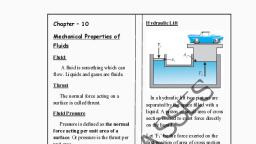
FLUID MECHANICS, , , , , , , , , , . FLUID MECHANICS, , , , , , , , , , ° The liquids and gases together are termed as fluids, in, other words, we can say that the substances which can, flow are termed as fluids., , + We assume fluid to be incompressible (i.e., the density of, liquid is independent of variation in pressure and remains, constant) and non-viscous (i.e. the two liquid surfaces in, contact are not exerting any tangential force on each other)., , 1.1 Fluid Statics, 1.1.1 Fluid Pressure, Pressure p at every point is defined as the normal force, per unit area., oF,, dA, The SI unit of pressure is the Pascal and | Pascal = 1 N/m*, , ° Fluid force acts perpendicular to any surface in the fluid,, no matter how that surface is oriented. Hence pressure,, has no intrinsic direction of its own, it is a scalar., , Pressure, , (a) Pressure at two points in, a horizontal plane or at, same level when the fluid Atrest, . . ‘ormoving, is at rest or moving with with constant, constant velocity is same. eae, , (b) Pressure at two points which, are at a depth separation of h, when fluid is atrest ofmoving Stationary:, with constant velocity is es, related by the expression, P,—P, = pgh, where p is the density of liquid., , (c) Pressure at two points in a 4,, , , , , , , , , , , , , , , , horizontal plane when fluid, container is having some, constant horizontal acceleration, are related by the expression, , , , P,—P,=!pa, , , , (d), , and tan 0 =a/g, where 0 is the angle which the liquid’s free, surface is making with horizontal, Pressure at two points within a liquid, at vertical separation of h when the, liquid container is accelerating up are, related by expression, , , , P,—P,=p(gta)h, , If container is accelerating down, then p,—p, = p(g—a) h., , , , 1.1.2 Atmospheric Pressure, , , , , , , , It is the pressure of the earth’s atmosphere. Normal, atmospheric pressure at sea level (an average value) is 1, atmosphere (atm) that is equal to 1.013 x 10° Pa., , The excess pressure above atmospheric pressure is called, , gauge pressure, and total pressure is called absolute, pressure., , Barometer is a device used to measure atmospheric, pressure while U-tube manometer or simply manometer is, a device used to measure the gauge pressure., , , , 1.1.3 Pascal’s Law, , , , , , , , A change in the pressure applied to an enclosed fluid is, transmitted undiminished to every portion of the fluid and, to the walls of the containing vessel., , There are a lot of practical applications of Pascal’s law one, such application is hydraulic lift., , , , , , , , 1.1.4 Archimedes Principle, , , , When a body is partially or fully dipped into a fluid, the, fluid exerts contact force on the body. The resulatant of all, these contact forces is called buoyant force (upthrust)., F = weight of fluid displaced by the body., , This force is called buoyant force and acts vertically, upwards (opposite to the weight of the body) through the, centre of gravity of the displaced fluid., , F=Vog, , where, v= volume of liquid displaced, , o= density of liquid.
Page 2 :
° Apparent decrease in weight of body = upthrust = weight, of liquid displaced by the body., ° Floation :, (a) A body floats in a liquid if the average density of the body, is less than that of the liquid., (b) The weight of the liquid displaced by the immersed part of, body must be equal to the weight of the body., (c) The centre of gravity of the body and centre of buoyancy, must be along the same vertical line., 1.2. Fluid Dynamics, ° Steady Flow (Stream Line Flow), The flow in which the velocity of fluid particles crossing a, particular point is the same at all the times. Thus, each, particle takes the same path as taken by a previous particle, through that point., ° Line of flow, It is the path taken by a particle in flowing liquid. In case of a, steady flow, it is called streamline. Two steamlines can never, intersect., 1.2.1 Equation of Continuity, Ina time At, the volume of liquid entering the tube of flow, in a steady flow is A, V, At. The same volume must flow, out as the liquid is incompressible. The volume flowing, out in At is A, V, At., A,, i | pe, es, >V, Vv,, SL =, ¢ AV,=A,V,, o mass flows rate = pAV, , (where p is the density of the liquid.), , , , 1.2.2 Bernoulli’s Theorem, , , , , , , , Ina stream line flow of an ideal fluid, the sum of pressure, energy per unit volume, potential energy per unit volume, and kinetic energy per unit volume is always constant at, all cross section of the liquid., , P+pgh+ a =Constant, , , , (a), , ), , , , Bernoulli’s equation is valid only for incompressible, steady flow of a fluid with no viscosity., , Application of Bernoulli’s Theorem., , Velocity of Efflux, , , , Let us find the velocity with which liquid comes out of a, hole at a depth h below the liquid surface., , Using Bernoulli’s theorem,, , E oad Lo, PR, +5 PV, +P Bh, =P, +5 PVa + Pah,, , Pp. 4 pV, +pgh =P,,,, S pV>+0, , (Note: P, = P,,,, because we have opened the liquid to, atmosphere), , V=V,)+2gh, , Using equation of continuity, , AV,=aV, , A: area of cross-section of vessel, , a: area of hole, , 2 a 2, V? =5_v742, 2 gh, , Vgh, V=—+{=— + //2, vi-a/A? an, , Venturi Meter, , (if the hole is very small), , This is an instrument for measuring the rate of flow of, fluids.
Page 3 :
If P, is pressure at A and P,, is pressure at B,, , P,—P,,=hpg [h: difference of heights of liquids of density, p in vertical tubes], , If V, is velocity atA and V, is velocity at B, Q=AV,=A, », , [equation of continuity], , Vv; Vv;, P, +p a =P, +p = [Bemoulli’s Theorem], , 2 2, V-W = (P.-Fa) == bee, , 2, S, -S,=2hg (Q=AV), , , , , , , , 13, , Viscosity, , , , , , The property of a fluid by virtue of which it opposes the, relative motion between its different layers is known as, viscosity and the force that is into play is called the viscous, force., , Viscous force is given by :, dv, F=-nA2, an dx, , where 1 is a constant depending upon the nature of the, liquid and is called the coefficient of viscosity and velocity, gradient = dv/dx, , S.L unit of coefficient of viscosity is Pa.s or Nsm~., , CGS unit of viscocity is poise. (1 Pa.s= 10 Poise), , , , 1.3.1 Stoke’s Law, , , , , , , , When a solid moves through a viscous medium, its motion, is opposed by a viscous force depending on the velocity, and shape and size of the body., , , , (a), , (b), (c), , (d), , The viscous drag on a spherical body of radius r, moving with, velocity v, in a viscous medium of viscosity n is given by, , F cous = OTTV, , This relation is called Stoke’s law., , Importance of Stoke’s law, , This law is used in the determination of electronic charge, with the help of milikan’s experiment., , This law accounts the formation of clouds., , This law accounts why the speed of rain drops is less, then that of a body falling freely with a constant velocity, from the height of clouds., , This law helps a man coming down with the help of a, parachute., , , , , , , , 1.3.2 Terminal Velocity, , , , Itis maximum constant velocity acquired by the body while, falling freely in a viscous medium., , r _ 21° (p-py)g, aan ale, , , , , , , 1.3.3 Poiseuille’s Formula, , oiseuille studied the stream-line flow of liquid in capillary, tubes., , Volume of liquid coming out of tube per second in given by, , _mPr*, , , , 80, , , , , , , , 1.3.4 Reynold Number ), , ¢ stability of laminar flow is maintained by viscous, s. [tis obverved, however that laminar or steady flow, is disrupted it the rate of flow is large. Irregular, unsteady, motion, turbulence, sets in at high flow rates., , Reyonlds defined a dimensionless number whose value, gives one an approximate idea, whether the flow rate would, be turbulent., , This number, called the Reynolds number R, is defined as,, , where, p=the density of the fluid flowing with a speed v., D = the diameter of the tube., 1 = the coefficient of viscosity of the fluid., , It is found that flow is streamline or laminar for R, less, than 1000. The flow is turbulent for R, > 2000. The flow, becomes unsteady for R_ between 1000 and 2000.
Page 4 :
Surface Tension, , , , , , ‘The surface tension of a liquid is defined as the force per, unit length in the plane of the liquid surface at right angles, to either side of an imaginary line drawn on that surface., , So, S= e where S = surface tension of liquid., , Unit of surface tension in MKS system ; N/m, J/m*, CGS system; Dyne/cm, erg/em*, , , , , , 1.4.1 Surface Energy, , , , , , In order to increase the surface area, the work has to be, done over the surface of the liquid. This work done is, stored in the liquid surface as its potential energy. Hence, the surface energy of a liquid can be defined as the excess, potential energy per unit area of the liquid surface., , , , , , W = SAA, where AA = increase in surface area,, , , , 1.4.2 Excess Pressure, , , , , , , , Excess pressure in a liquid drop or bubble in a liquid is, , <i, R, , P, , Excess pressure in a soap bubble is P = z, , (because it has two free surfaces), , , , 1.4.3 Angle of Contact, , , , , , , , ‘The angle between the tangent to the liquid surface at the, point of contact and the solid surface inside the liquid is, called the angle of contact., , If the glass plate is immersed in mercury, the surface is, curved and the mercury is depressed below. Angle of, contact is obtuse for mercury,, , If the plate is dipped in water with its side vertical, the, water is drawn-up along the plane and assumes the curved, shape as shown. Angle of contact is acute for water., , 1.4.4 Capillary Tube and Capillarity Action, , , , , , , , , , A very narrow glass tube with fine bore and open at both, ends is known as capillary tube. When a capillary tube in, dipped in a liquid, then liquid will rise or fall in the tube,, , , , this action is termed as capillarity., , , , ie 2Scos@ _ 28°, tpg Rpg, , where, S = surface tension,, , , , 0 = angle of contact,, , r= radius of capillary tube,, R = radius of meniscus, and, p= density of liquid.
Page 5 :
Adhesion > Cohesion, , Adhesion = Cohesion, , Adhesion < Cohesion, , , , , , wn, , Liquid will wet the solid., , Meniscus is concave., , Angle of contact is acute (0 = 90°)., , Pressure below the meniscus is, lesser than above it by (2T/r),, , ie. Hl, r, , In capillary there will be ascend., , , , Critical., , Meniscus is plane., , Angle of contact is 90°., , Pressure below the, , meniscus is same as, above it, Le. P=P,,, , No capillarity., , , , Liquid will not wet the solid., Meniscus is convex., , Angle of contact is obtuse (0 = 90°)., Pressure below the meniscus, , more then above it by (2T/r),, , : o, 1t., PaB in,, r, , In capillary there will be descend.