Notes of CLASS : 11th, PHYSICS Nuclei.pdf - Study Material
Page 1 :
Chapter, , 13, , Nuclei, Chapter Contents, , •, •, , Introduction, Atomic Masses and, Composition qf Nucleus, , •, , Size of the Nucleus, , •, , Mass-Energy and Nuclear, Binding Energy, , •, •, •, , Nuclear Force, Nuclear Stability, , •, , Nuclear Energy, , •, •, •, , Some I mportant Deflrtlilons, , Radioactivity, , F'onnulne Chart, , Quick Recap, , Introduction, In the previous c hapter. we have learnt that atomic nucleus was, discovered by Rutherfor d and his associates from expertments on, scattering of a-particles from the thin metal foils in the year 19 J 1., Rutherford demonstrated from above experiments that the radius of, a nucleus is smaller than the radius of an atom by a factor of about, 104 and atomic nucleus is the central core of every atom. Nucleus, contains entire positive charge and m ore than 99.9% of th e mass of, the atom. ln other words. an atom Is almost empty., In this c hapter. we shall study the con s Utuen ts of the nucle u s and, h ow they are he.Id together . We s hall discuss various properties of, nuclei such as s ize. mass. d e n s ity and stability o f nuclei and, associated nuclear phenomena s uch as radioactivity. nuclear 11sslon, and nuclear fus ion ., , ATOMIC MASSES AND COMPOSITION OF NUCLEUS, The mass of an atom is very small, kilogram Is not a very convenient unit, to measure such small quantities. The unit in which atomic and nuclear, masses are measured is called atomic mass unit (u), defined as ..!..th of the, 12, 12, mass of an atom of 6 C isotope, Mass of 6.023 >< 1023 atoms of C 12 = 12 g, , 1, 12, - 27, 1 u =-x - - - = 1.66x10, kg, 23, 12 6 .02 x 10, In terms of this unit, Mass of an electron (m.) = 0.00055 u, Mass of proton (mp) = 1.0073 u, Mass of neutron (mn), , = 1.0086 u, , Aakaah Educattonal ServlcN Pvt. Ud. • Regel. C>mce : Aakash T -. 8 , Puu Road, New Oeltu-110005 Ph., , 011 ◄7623456
Page 2 :
______________________________________ ______, ......_, Board & Competitive Exams., , 282 Nuclei, , The atomic masses of various elements expressed in atomic mass unit (u) are close to being integral, multiples of the mass of a hydrogen atom. Further to determine accurately, the atomic mass of an element,, the instrument designed for this purpose is called a mass spectrometer, the measurement o f atomic masses, reveals the existence of different types of atoms of the same element having identical chemical properties., Their physical properties, however differ. such atomic species of the same element differing in mass are called, isotopes., All the known elements have one or more isotopes. The relative abundance of different isotopes differs from, element to element The atomic weight of an element in the weighted average of the masses of all its isotopes, for example chlorine has two Isotopes having masses 34.98 u and 36.98 u , which are nearly integral multiples, of the mass of a hydrogen atom. The relative abundances of these isotopes are 75.4 and 24.6 percent,, respectively., , Average atomic weight of chlorine is, = 75.4 X 34.98 + 24.6 X 36.98 =, , 100, , 35.47 u, , which is in agreement with atomic mass of chlorine., Even hydrogen (lightest element) has three isotopes called protium, deuterium and tritium. Relative abundance, of lightest atom of hydrogen is 99.985%. Tritium nuclei being unstable, do not occur naturally and produced, artificially in laboratories., A proton is stable and carries one unit of fundamental charge. From quantum theory it was concluded that, all the electrons of an atom are outside the nucleus. We know that the number of these electrons Is equal, to atomic number (Z) and total charge of the atomic electron is thus (-Ze). Atom is neutral therefore the, charge of the nucleus is (+Ze)., , Discovery of Neutron, Neutron was discovered experimentally by Chadwick in the year 1932 and was awarded Nobel Prize in, Physics in 1935 for their discovery., A neutron is a neutral particle carrying no charge and having mass roughly equal to the mass of a proton., Chadwick observed emission of neutral radiation when beryllium nuclei were bombarded with alpha-partides, (a-particles are helium nuclei) which could knock out protons from light nuclei like helium. carbon and nitrogen., , Application of princi~ of conservation of energy and momentum shoWed that if the neutral radiation consisted, of photons. the energy of photons would have to be much higher than these neutral radiations., Chadwick satisfactorily solved this puzzle assuming that the neutral radiation consists of a new type of neutral, particles called neutrons. He was able to determine the mass of this new partide from conservation of energy, and momentum as very nearly the same as mass of proton., Now the mass of a neutron is known to a high degree of accuracy and is equal to m" = 1 .00866 u, , = 1 .6749, , ><, , 10"27 kg, , A free neutron is unstable and has a mean life of 1000 second. Whereas a free proton is stable. Neutron is, however stable inside the nucleus., The following terms and symbols are used to describe the composition of a nucleus., , Electron Volt (eV), It is an appropriate unit for measuring small energies accurately. One electron volt Is the energy acquired, , by an electron when accelerated through a potential difference of one volt., Now by definition of potential difference., Work done on the electron = Charge on the electron >< potential difference of 1 volt, or., , 1 eV, , = (1 .6, , ><, , 10-19 C) >< (1 V), , = 1.6, , Aakaah Educational Se""- P,,t. Ltd. · Regd., , x 10-19 joule, , e>mce: Aakaah T - . 8, Pusa Roed. New Delhl-110005 Ph. 011--47623456
Page 3 :
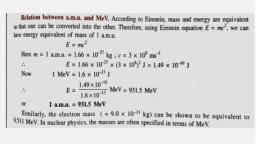
Nuclei, , Board & Competitive Exams., , 283, , 1 MeV = 1 million ev = 108 ev, = 108 (1.6 >< 10-111 joule) = 1.6 >< 10-13 joule, 1 MeV = 1 .6 >< 10-13 joule, Relation between one a.m.u and MeV, According to Einstein's mass energy relation , E = m, , c2, , (which means that mass m is equivalent to energy E)., Substituting m, , E, , = (1.66, -, , = 1 u = 1.66 >< 10-27 kg and c = 3 ><, 10-2 7) (3 )( 108)2 J = 1.49 )( 10-10 J, , 108 ms- 1 in the above relation, we obtain, , X, , 1.49x10⁻¹⁰, 1.6 x 1O-13 MeV, , [ ·.- 1 MeV = 1.6 >< 10-13, , JJ, , = 931 .478 MeV, Hence 1 u, , ~, , 931 .5 MeV, , Composition of Nucleus : Nuclei are composed of protons and neutrons. Following points should be, remembered about protons and neutrons., Proton:, , Proton, (i), , The nucleus of hydrogen atom is called proton., , (ii) II is an essential constituent of all nuclei., , (iii) II carries positive charge = 1.6 >< 10-111C, (iv) Its mass = 1.67262 >< 1o-27 kg, , = 1.OO73u, = 1836 times the mass of an electron, , (v), , Due to Its positive charge, protons are not used as projectile In nuclear fission., , (Iii), , It is stable even outside the nucleus., , (vi), , Its quark content is uud., , Neutron:, , (i), , Neutron, Neutron was discovered in 1932 by James Chadwick., , (il) It has no charge, hence it is a neutral particle., (Iii) Its mass, , = 1.67493, , >< 10-27 kg ::: nearly equal, , to that of proton, , = 1839 times the mass of an electron, = 1.0087u, Aakash Educatlonal S.<otces Pvt. Ud. - Regd. Office : Aakash T - . 8. P\ma Road . New Deltw-110005 Ph. 011 ◄7623456
Page 4 :
284, , ______________________________________ ______, ......_, Board & Competitive Exams., , Nuclei, , (Iv), , It is an essential constituent of all nuclei except hydrogen ( 1 H 1 ) ., , M, , It has very high penetrating power because it can neither be attracted nor repelled by the nucleus., , (vi), , A fast moving neutron can be slowed down by materials called moderators. Examples of moderators are, heavy water, graphite, paraffin wax etc. Neutrons are in thermal equilibrium with the molecules of the, moderator when both attain the same energy. The kinetic energy of a thermal neutron is about 0.04 eV., , (vii), , Thermal neutrons are used as projectiles In a nuclear fission., , (viii) Neutron has very low ionising power., (ix), , A free neutron (i.e., outside the nucleus) Is unstable and decays Into a proton, an electron and an antineutrino., 1, , 0n, , 1H, , -+, , 1, , v, , + _1e 0 +, , (antineutrino), , (proton )(electron), , The half life of a free neutron is about 12 minute. The mean life is about 1000 s ., (x), , Neutron inside the nucleus is stable., , (xi), , The quark content of a neutron Is udd., , Nucleon• : Protons and neutrons taken together are called nucleons. We regard , a proton and a neutron as, two different charge states of the same particle, called · nucleon"., Mass Number (A) : The total number of nucleons (= neutrons + protons) in the nucleus of the atom is called, mass number of the atom. II is denoted by A. It is different from the mass of the atom which includes the, total mass of neutrons plus protons plus electrons., , Atomic Number (Z) : The total number of protons in the nucleus of an atom is called atomic number of that atom., It is denoted by Z. The arrangement of various elements in the periodic table is according to their atomic nl.Wllbers., Let N be the number of neutrons In the nucleus of an atom wl1h A as the mass number and Z as the atomic number., , or, , ThenA=N+Z, , N=A-Z, , . . . (I), , The nucleus of an atom is denoted by the chemical symbol (X) of the atom with the atomic number Z as the, subscript and mass number A as the superscripL Hence we write or represent a nuclide/nucleus as, z(Chemical Symbol)" or, , z><A, , For example, nucleus for uranium is 112U 238, , It contains 92 protons and 238 - 92 = 146 neutrons., Nuclear charge : Total charge of the nucleus is equal to the total charge on all the Z protons in ii = Ze where, e = 1 .6 x 10- 19C., , Isotopes, Nuclei having the same nuclear charge (Ze) but different mass numbers (A) are called Isotopes., Examples:, , (1), (2), , 8, 8, , c 10, 8 C 11 , 8 c 12 , 8 C 13 and 8 C 1', 0, , 18, , and 8 0, 83, , 17, , are isotopes of carbon., , are isotopes of oxygen., , 29Cu, , 65, , (3), , 29Cu, , (4), , Hydrogen has three isotopes given below:, (a), , and, , are isotopes of copper., , Hydrogen ( 1 H 1 ) : II has the simplest nucleus with only one nucleon called proton. It has no neutron., Its relative abundance is 99.85%., , (b) Deuterium ( 1H2) : Its nucleus is called deuteron with one proton and one neutron., (c), , Tritium ( 1H 3) : Its nucleus is called triton with one proton and two neutrons. It is unstable and hence, , not round in the nature., (5), , The element gold has 32 Isotopes fTom A = 173 to 204., , Aakaah Educ:attonal Sa""- Pvt. Ltd. - Regd. Offlce : Aakaeh T - . 8, PuM Road, New Delhl-110006 Ph. 011 ◄7623456
Page 5 :
Nuclei, , Board & Competitive Exams., , 285, , Isobars, Nuclel having the same mass number A but different nuclear charge (Ze) are called Isobars., Examples:, , (1) 11 Na22 and 10Ne22 afe isobars with the same mass number 22., (2) 11 Na24 and 12Mg24 are Isobars with the same mass number 24., Isobars are atoms of different elements and hence they have different chemical properties., , lsotones, Nuclldes having the same number of neutrons are called lsotonea., For example 17Cl37 and 19K 39 are isotones with 20 neutrons., Nucllde : A single nuclear species with specific values of both Zand N Is called a nuclide., , Ex.ample 1, , A nucleus has atomic number 11 and mass number 24. State the number of electrons. protons, and neutrons In the nucleus., , Solution:, , The number of electrons in nucleus = 0, electrons do not exist In the nucleus, He;re Z = 11, A = 24, Number of protons in nucleus (Z), , = 11, , Number of neutrons in nucleus (N)= A - Z, , = 24 -, , 11, , = 13, Example 2 :, , Select the pairs of lsotones from the following nuclei., , Solution :, , (i), , 3, 4, 1H and 2 He, Number of neutrons = 3 - 1 or 4 - 2, , (ii), , ,2Mg2" and , , Na23, , ,zM!l2",, , ,H3,, , .J-le", ,,Na23, , =2, Number of neutrons, , = 24 - 12 or 23 - 11, = 12, , Example 3 :, , Solution :, Ex.ample 4 :, , Write the names and fonnulae of the three isotopes of hydrogen., Protium (1H 1), Deuterium (1H 2 ) , Tritium ( 1H 3 ) ., , The three stable Isotopes of neon Ne20. Ne21 and Ne22 have respective abundances of 90.51%,, 0.27% and 9.22%. The atomic masses of the three isotopes are 19.99 u. 20.99 u and 21 .99 u, respectively. Obtain the average atomic mass of neon., , Solution :, , Average atomic mass of neon., , =, , 90.51 )( 19.99 + 0.27)( 20.99 + 9.22)( 21.99, 100, , = 1809.29 + 5.67 + 202.75, 100, , = 20.184, , Aakash Educational S....tc:es Pvt. Ud. - Regel. Ot'floe : Aakash T - . 8, Pusa Road , New Delhi-110005 Ph. 011-47'623456
Page 6 :
286 Nuclei, , Board, , Competitive Exams., , &, ---------------------------------------'-------, , Try Yourself, 1., , Select the pairs of isobars and lsotones from the following nuclei, , 11, , Na22. 12Mtr". 11Na2'., , 1~ -, , Htnt : Isobars = same mass number (A), , lsotones = same number of neutron (N), , 2., , A nucleus has atomic number 11 and mass number 24. State the number of electrons, protons, and, , neutrons In the nucleus., , Hint : Electrons do not exist In the nucleus., Number of protons In nucleus (Z) = 11, Number of neutrons in nucleus (N) = A - Z, , ·:u ·:u, , 3., , Two stable isotopes of lithium, and, have respective abundances of 7 .5% and 92.5%., These isotopes have masses 6.0152 u and 7.016004 u respectively. Find the atomic weight, of lithium., , Hint : Average atomic mass = Ptm, + P2'"2, P, +P-2, SIZE OF THE NUCLEUS, Experiments on scattering of a -particles by thin metallic foils have established the fact that nucleus has a very, small size. Rutherford has calculated on the basis of such experiments the radius of nucleus to be of the order, of not larger than 10-1 ' m ., Now volume of the nucleus depends upon the total number of nucleons (number of neutrons and protons), contained in il, , .., , V=, , i7tR3 oc, 3, , a, , R3 « A, , c::,;, , R, , oc, , A, , A 113, , .. I R = R, , 0, , A, , 113, , ... (I), , Here R0 is constant having value equal to 1.2 x 10⁻¹⁵ m, , = 1.2, , fm, , ( .·. ferml = 10- 15 m)., , A Is different for different atoms, therefore atomic nuclei of different atoms will be of different sizes., Nuclear Density :, The distribution of matter within the nucleus of an atom is not uniform. It means that the density of nuclear, matter also varies from point to point within the nucleus. Density of nuclear matter is defined as "the ratio of, the mass to volume of the nucleus·., Let m be the average mass of a nucleon and A be the mass number (i.e., total number of nucleons in the, nucleus) of an element. then total mass of the nucleus is equal of m A. If R be the nuclear radius, then volume, of the nucleus =, , 4, , 3 rtR, , 3, , •, , Nuclear mass, Nuclear density (i.e .• density of nuclear matter ) = Nuclear volume, Aakaah Educational~ Pvt. Ltd. - Regd. Office: Aakash Tower, 8, Pusa Road. New Oelhl-110005 Ph., , 011 ◄7623456
Page 7 :
Board & Competitive Exams., , mA, P, , Nuclei, , r-·, , 3m, , mA, , = inR3 = ~1t(RoA113 )3 = 41tRJ, 3, , from equation (ii), R = R 0 A 113J, , 287, , ... (ii), , 3, , In equation, (iii) m , R0 , and 1t are all constants., Thus average density (p) of nuclear matter is the same for all nuclei., , Taking m, , = 1 .66 ><, , We o btain, , = 1.2, , 10-21 kg , R 0, , I p = 2 .29 x 10, , 17, , >< 10-1s, , m, , i ...[Nuclear density), , kg m - 3, , Which Is of the order of 1017 kg m - 3. (Remember], This density is comparable to the density of the matter in neutron stars., , Example 5 :, , What is the ratio of nuclear densities of the two nuclei having mass numbers In the ratio 1 : 4?, , Solution :, , Ratio of nuclear densities is 1 : 1 because nuclear density is independent of mass number., , Example 6 :, , What is the nuclear radius of 126F e if that of 2 7 Al is 3 .6 fenni7, , SoluUon ;, , R = Rc,A 113, , ~, , =, , (A,,·, , RAJ, RFe, , AAJ, , =, , 5, 3, , ) 1/3 = ( 125) 1/3, 27, , 5, , R,._, = 3, , x 3 .6, , = 6 .0, , fem,i., , Try Yourself, 4., , Compare the radii of two nuclei with mass numbers 1 and 27 respectively., Hint: R = RoA 113, , 5., , Assuming the nuclei to be spherical In shape, how does the surface area of a nucleus of mass, number A 1 compare with that of a nucleus of mass number A2 ?, Hint : S = 41tRl - A213, , 6., , Obtain the approximate value of the radius of, (a) a nucleus of, (b) a nucleus of, , 4, , 2, , He, , :u, , 2, , (c ) What Is the ratio of these radii?, Hint: R = RoA113, (R 0 = 1 .2 >< 10-15 m), , (a) For :He nucleus, A = 4, (b) For 2 ~u , A = 238, (c) Ratio =, Aakash, , Educa••-·, , a, b, , Ser~ Pvt. Ltd. - Regel. Office : Aakaah To-. 8 , Pusa Road. N - Oelhl-110005 Ph. 011-47623458
Page 8 :
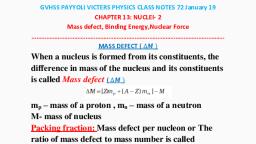
288 _N_u_c_le_i_ _ _ _ _ _ _ _ _ _ _ _ _ _ _ _ _ _ _ _ _ _ _ _ _ _ _ _ _B_o_a_rd_&_C_o_m.....,_pe_t1_·tiv_, . _e_Ex_a_m_s., MASS-ENERGY AND NUCLEAR BINDING ENERGY, Mass-Energy, Before the advent of Einstein theory of special relativity it was presumed that mass and enef'gy were conserved, separately in a reaction. Einstein showed that it is necessary to treat mass as another fonn of energy., Einstein gave the famous mas~nergy equivalence, , E = mc2. here the energy equivalent of mass mis related by the above equation and, in vacuum and is approximately equal to 3 >< 108 mis., , c is the velocity of light, , Einstein's mass-energy relation has been experimentally verified in the study o f nuclear reactions amongst, nucleons, nuclei. electrons and other more recently discovered particles., In nuclear reactions initial energy and the final energy are equal provided the energy associated with mass, is also included., Therefore, the two classical laws of conservation of mass and conservation of energy have been unified into, one law o f conservation of energy., Example 7 :, , Express 1 mg mass equivalent in eV., , Solution :, , E, , = mc2 =(1~ kg) (3 >< 108)2 joule, 18, , =, , 10-6 x9x 10, , - -- --=-19, , e·v, , 1.6 x 10-, , = 5 .66, , ><, , 1029 eV, , Nuclear Binding Energy, The origin of nuclear binding energy has been explained on the basis of Einstein's theory of mass energy, equivalence. NucletJs is made up of neutrons and protons. Therefore mass of the nucleus (M) should be equal, to the total mass of its protons and neutrons. However it is found to be always less than this., This difference in mass (6.M) is called the mass defect. and is given by 6.M = [Zmp + (A - Z)m,J - M ., It is mass defect which appears in the form of binding energy, responsible for binding the nucleons together, in the nucleus., Using Einstein's mass energy equivalence, Binding energy Eb = 6.Mc?, We would have to supply a total energy equal to Eb to separate a nucleus into its nucleons . Nuclear binding, energy is indicator of how well a nucleus is held together. Binding energy per nucleo n E 00 is a more useful, measure of the binding between the constitutents of nucleus, E,,,, = Eb I A., Binding energy per nucleon is the average energy per nucleon needed lo split a nucleus Into its individual nucleons., Following are the main features of the plot of the binding energy per nucleon Eb,, versus the mass number, A for a large number of nuclei., , >, , 10, , ...,,.v-, , 11r.1tO "s, , l, , ~, , "'°I,1o, , .,, , .., , ,, , oN, , ' '&n, , I :'i/J.,J, l, e>, , 4, , I, , 2, , iii, , 00, , f, , ....., , "H, , '"H, 50, , 100, , 150, , 200, , 250, , Mass Number (A ), , Fig. The binding energy per nucleon as a function of mass number., Aakaah Educatlonal Sa""- Pvt. Ltd. - Regd. Office : Aakash Tower, 8, Pusa Road, New Delhl-110005 Ph., , 011 ◄7623456
Page 9 :
Board & Competitive Exams., , Nuclei, , 289, , (i), , For nuclei of middle mass number (30 < A < 170) the binding energy per nucleon is almost constant., Maximum of about 8 . 75 meV for A = 56 and has a value of 7 .6 MeV for A = 238., , (ii), , For both light nuclei (A < 30) and heavy nuclei (A > 170) E,,,, binding energy per nucleon is lower., , From above two observations we can draw following conclusions :, (1), , The force is sufficiently strong attractive to produce a binding energy of a few MeV per nucleon., , (2), , The almost constant value of binding energy in the range 30 <A< 170 conclude the fact that 1nuclear, force is short-ranged., , If we increase A by adding nucleons they will not change the binding energy of a nucleon inside. Since, most of the nucleons in a large nucleus reside inside it and not on the surface, the change in binding, energy per nucleon would be small., (3), , There wil be a gain in the overall binding energy when we move from the heavy nuclei region to the middle, region of the plot, hence release of energy when a heavy nucleus (A = 240) breaks into two roughly equal, fragments, energy can be released. This process is called nudear fission \Nil be discussed later in this chapter., , (4), , Similarly there will be gain in the overall binding energy, when we move from lighter nuclei to heavier, nuclei, lhence release of energy. When two or more lighter nuclei fuse together to form a heavy nucleus, energy can be released. This process is called Nuclear Fusion. This is the energy source of sun. will, be discussed later in this chapter., , Try Y,o urseH, 7., , s _, , c, , The Q value of a nuctear reaction, · A+, + D is defined by Q = (mA + m8 - me - m 0 ')dl, where the masses refer to the nuclear rest masses. Determine from the given data whether the, following reactions or exothermic are endothermic., (I), (H), , 8, , c12, , + 8 c12, , __., , Ne20, 10, , + He°', 2, , Atomic masses are given to be, , mH = 1.007825, , U, , m( 1, , H2 ), , = 2.014102 u, , m( 1, , H9), , = 3.016049 u, , m<ec12) = 12.000000 u, m(10 Ne20), , = 19.992439 u, , ~He~) = 4.002603 u, Take 1 u = 931 MeV, , Hint:, , (i), , Mass of LHS = 4 .023874 u, Mass of RHS = 4.028204 u, Q, , = [(Mass of LHS -, , 0 = -4.031 MeV, (II), , Mass of RHS) u] x 931 MeV, , = reaction Is endothermic, , (12.000000 + 12.000000 - (19.992439 + 4 .002603)) x 931, Q = 4 .616 MeV, Q Is positive, , = reaction is exothermic, , Aallash Educational 8efvlcM Pvt. Ltd. - Regd. Office : Aakash TOW8', 8, Pusa Road , N - Delhl-110005 Ph. 011-47<623456
Page 10 :
290 Nuclei, Example 8 :, , Board & Competitive Exams., , What is the binding energy per nucleon in 1-fe" ?, Given, Mass of 1-fe4 = 4. 002604 amu, Mass of proton= 1.007825 amu, Mass of neutron= 1.008665 amu, , Solutlon :, , Mass defect = (2.01565 + 2 .01733 - 4 .002604) = 0 .030376 amu, Binding energy = (0.030376 x 931) MeV = 28.28 MeV, .·. Binding energy per nucleon=, , Example 9 :, , 28 28, , 4, , = 7.07 MeV, , Obtain the binding energy of the nuclei~ and 8 J3i2!'9 in units of MeV from the following data, mH = 1.007825 amu, mn = 1.008665 amu, m, , (2'¼156), , = 55.934939, m { ~ ) = 208.980388 amu, , Which nucleus has greater binding energy per nucleon? [Take 1 amu = 931.5 MeV], Solution :, , Mass defect in, , 26Fe, , 56, , = 30 x 1.008665 + 26 x 1.007825 - 55.934939, , = 0 .528461, , amu, , .·. Total binding energy= 0.528461 >< 931.5 MeV = 492.26 MeV, .-. B.E. per nucleon=, Mass defect in, , 83Bi, , 209, , 492.26, = 8.790 MeV, 56, nucleus, , = 83, , Total B.E . = 1.760872 >< 931 .5, .-. B .E . per nucleon, 26 Fe, , Example 10 : (a), , 56, , >< 1.007825 + 126 x 1.008665 - 208.980388 = 1.760872, , = 1640.26 MeV, , 1640.26, - - 20 9, , =-, , = 7.848, , MeV, , has greater B .E. per nucleon than, , 2011, •, 113Bi, , How much energy is required to separate a typical nucleus, nucleons? Given atomic masses are, , Sn 120 into its constituent, , 50, , m (Sn'20) = 119.902199 u, m (H') = 1.007825 u, m (i:f1 1) = 1.008665 u, , Solution :, , (b), , What is the b inding energy per nucleon for this nuclide?, , (a), , Number of neutrons= 120 - 50, , = 70, , The mass defect t!.m = Z. (mH) + N (m") - MSn, = 50, , X, , 1.007825 U + 70, , X, , 1.008665, , U -, , 119.902199, , U, , (Taking atomic masses, the masses of el.e ctrons are cancelled out), = 120.99780 u - 119.902199 u, = 1.095601 u "" 1.096 u, The required energy E = t!.m.c.2 = (1 .096u) x (931.5 MeV/u), , = 1021, , MeV, , This is called the binding for this nuclide., , (b), , E, , B.E. per nucleon = A =, , 1021MeV, - 8.51 MeV/nucleon, 120, , Aakash Educational Sen~ Pvt. Ltd. - Regd. Office: Aa.kash T - . 8. Pusa Road. New Delhi-110005 Ph. 011-47623456
Page 11 :
Board & Competitive Exams., , Nuclei, , 291, , Try YourseH, 8., , Calculate the packing fraction of a -particle from the following data :, Mass of helium nucleus = 4 .0028 amu, Mass of free prolon = 1 .00758 amu, Mass of free neutom = 1.00897 amu, mass defect~, Hint: Packing fraction = Total number of nucleons, A, , 9., , The binding energy per nucleon for 6 C 12 is 7.68 MeV and that for 6 C 13 is 7.47 MeV. Calculate, the energy required lo remove a neutron from 6 C 13 ., Hint: 13 x 7.47 - 12 x 7 .68 = 4.95 MeV, , 10., , In a fission reaction, , t, , 36, , u ➔ 117 X +117 Y + n +n, , The binding energy per nucleon of X and Y a re 8 .5 MeV whereas of 236U Is 7 .6 MeV. The total, energy liberated will be about, , 11 ., , 12., , (1) 400 MeV, , (2) 200 MeV, , (3) 300 MeV, , (4) 200 keV, , The mass of proton i s 1.0073u and that of neutron is 1.0087u (u = atomic mass unit). The, binding energy of 2 He4 is (Given, mass of helium nedeus = 4 .0015u), (1) 28.4 MeV, , (2) 62.4 MeV, , (3) 42.4 MeV, , (4) 10.2 MeV, , The average binding energy per nucleon of a nucleus is of the order of, (1) 8 eV, , (2) 8 J, , (3) 8 keV, , (4) 8 MeV, , NUCLEAR FORCE, Nuclear forces are very complex in nature, unlike coulomb's law or the Newton's law of gravitation, there is, no simple mathematical form of nuclear force . Nuclear forces are non central forces., Now we know that for average mass nuclei the binding energy per nucleon is approximately 8 MeV, much, larger than the binding energy in aloms., Therefore to bind a nucleus together there must be strong nuclear forces of attraction which hold together, the nucleons (neutrons and protons) in the tiny nucleus of an atom, to overcome the repulsion between the, (positively charged) protons., Many facts about nuclear binding forces are obtained from a variety of experiments carried out during 1930, to 1950 are summarised below., (1), , Nuclear forces are the strongest forces in nature because of that nucleons are held together in a nucleus, inspite of elecirostatlc force of repulsion between protons. The magnitude of nuclear forces is 1Cl38 times, that of gravitational forces and 100 times that of electrostatic forces., , (2), , Nuclear fon:es are independent of charge. Nuclear forces, neutrons, a pair of protons with the same strength., , (3), , The nuclear forces are very short range forces. From a rough plot of the potential energy between two, nucleons as a function of distance is as shwon in figure., , act between a neutron, proton pair, pair of, , Aakash Educatl-1 Sel<tk:N Pvt. Ltd. - Regd. Offloe : Aakaah To-. 8, Puss Road. New Oelhi-110005 Ph. 011-47623456
Page 12 :
292 Nuclei, , Board, , Competitive Exams., , &, -------------------------------------'------i ----+---+----+-----1, , i ·~, , I, , t-tv, -------t:. . ., , ::::;::::::::=+---t, , F-10, , ~1oil, r (fm), , ., , Potentia l energy of a pair of nuc leons as a function o f their separation. For a separation greater, than r0 , the fo rce is attractive and for separations less than r0 , the force i s strongly repulsive., The potential energy is a minimum at a distance r0 about 0 .8 fm from this the force Is attractive for, dis tances larger than 0 .8 fm and repulsive for d istances less than 0 .8 fm. Nuclear forces are negligible, when distance between nucleons is more than 1 O fm., Some features of nuclear forces are :, (1), , Nuclear forces are charge Independent : Force between a proton and a proton (called ,:rp force) is, equal to the force between a neutron and a neutron (called n-n force) which is equal to the force between, a proton and a neutron (i.e ., called p-n or n-p force). It means that nuclear forces are charge independent, , (i.e., are not electrical in nature)., (2), , Strongest forces In nature : The magnitude of the nuclear forces is about 100 times that of the, electrostatic forces and 1038 times that of the gravitational forces between the nudeons., , (3), , Short range forces : These forces between the nucleons act upto the distances of 1.5 x 10⁻¹⁵ m only., In other words, they act only within the nuclear diameter (which is of the order of 10-15 m)., , (4), , They are attractive In nature : They are generally attractive In nature. At a distance of about 1 fm, , ( = 10-15 m) the nuclear force is highly attractive. When the distance between two nucleons becomes nearty, 0 .4 fm , nuclear force becomes highly repulsive. It is essential, othefWise the whole nucleus would collapse., This distance (= 0 .4 fm) is called hard core. One should not conclude that nuclear forces are repulsive, but they are always attractive. This attractive force is maximum when the separation between two nucleons, is one fermi., , (5), , They show saturation propertl- : It means that a nuc leon Inside a nuc leus does not exert force on, all other nucleons (or it does not experience force from all other nucleons). It exerts forces on the nucleons, tying closest to it (or it experiences force from a few nucleons lying nearest to it). It Is only due to this, property that average binding energy per nudeon is cons tant ('"8 MeV per nucleon) for most of the nuclei., , (6), , Nuclear forces ant non-central : Electrical forces between two charged particles act alomg the line joining, the centres of these charged bodies . Similar is the case with gravitational force. Electromagnetic and, gravitational forces showing this property are called central forces. But nuclear forces d o not show such, property and hence are called non-central forces., , (7), , Different from electrtcal and gravitational forces : Electrical and gravitational forces obey the well-known, , inverse square law (i.e., F oc1/r 2, , )., , But the nudear forces are complicated in naa.e and do not obey any such, , smple law. We can obtain eledrical and gravitational forces from the fomua F = - (q or m) dVldr (where Vis the, , aedJic or gaviational potential). But no such po(ential Ike V can be ftN.nj tom which nuclear foroe may be obtail ied., Aakaah Educational Servlce9 Pvt. Ltd. - Regd. Otflce : Aakash Tower, 8, Puse Road. New Delhi-110005 Ph., , 011 ➔7623456
Page 13 :
Board & Competitive Exams., , Nuclei, , 293, , -, , Content lullder, , Nuclear force• depend on the orientation of the spins of the Interacting nucleons : Forces, between two nucleons having parallel spins are found to be stronger than those between the nucleons, having anti-parallel spins., , F2, , Paralelspins, , Anti-paraHel spins, , Meson theory of Nuclear Forces: According to this theory the nuclear force existing between the, two nucleons Is the result of exchange of p-mesons between these nucleons. This Is also called, Yukawa theory. A meson Is a particle having mass Intermediate between the mass of an electron, and that of proton. Mesons may be neu1ral (p0 ) or may carry positive or negative charge (p• or p-), equal to that on a proton or on an electron. Forces between, (I), , Neutron and proton {I.e. , p-n or n-p forces) are due to n• and tr mesons and, , (ii) Forces between two protons (i.e ., p-p force) and that between two neutrons (/.e., n-n force) are, due to the exchange of 1t0 mesons., (a) (p-n) or (n-p) force: Consider a pair of two nucleons, one is proton and the other is neutron that, is the pair (n, p)., , Now the neutron changes into a proton (p') by emitting a negatively charged meson as follows:, ...(1), Tlhe proton p absorbs this negatively charged meson and changes into a neutron (n') as follows:, , p + n- ·-, , n', , ... (2), , From equations (1) and (2), we notice that (n, p)---+ (p', n') ...(3), Similarly a proton (p) may change into neutron by emitting a positivefy charged meson n• as, , follows:, . . .(4), , This, , 1t•, , meson Is then absorbed by the neutron (n) so that It changes Into a proton as, , n + n.• ·~, , p'', , ...(5), , Firom equations (4) and (5), we observe that, (p, n) . _ (n", p " ), , ...(6), , Im equations (3) and (6), p = p' = p". Hence we conclude that by emitting and absorbing nmesons, protons and neutrons continuously exchange their nature. Thus we may write, NEGATIVE MESON, , I PROTON I ------INEUTRONI, POSITIVE MESON, , This exchange process is responsible for binding a neutron with proton or a proton with a neutron., Aakash Educatl-1 SerrlcN Pvt. Ltd. - Regd. Office : Aakash To-. 8, Pusa Road , New Delhl-110005 Ph. 011-47'623458
Page 14 :
____________________________________ _____, _,__, , 294 Nuclei, , Board & Competitive Exams., , (b) p-p or n--n force : Consider a pair of either two protons or two neutrons, then, between the pair (p, p) or (n. n) as follows:, , ff!' is exchanged, , (I) A proton In a certain state p changes its state to fl by the emission of rfJ meson as, , P '--+P'+rr', The other proton existing In the state p by absorbing rfJ also assumes the state p' as, , p+rr' - - + P', (p', p') where p = p' so far as nature is concerned., , Hence (p, p) ·-, , (ii) Simllarty n '---+ n' + rfJ, , n, , +, , n' and therefore, (n, n) ➔ (n' n') where n' = n., , rfJ ·-, , Conclusk>na:, (I), , Exchange of ,c+, n - mesons between two n.u cleons Is to represent p-n or n-,p force., , (II) Exchange of rfJ mesons between two nucleons represents n-n or p-p force., , NUCLEAR STABILITY, Out o f various isotopes of an element, some may be stable while the others may be unstable. This may be, understood by the discussion given below. Stability of a nuclide is connected to the relative number of neutrons, and protons in that nucieus. The graph of N versus Z has been shown in the Segre chart given below., , r, , z, , i, , i, , 160, 160, 140, , 0 130, , I, z, , 120, , 110, 100, , 90, , 80, 70, , so, 110, 40, , 30, 20, , 10, 0, , 10, , 20, , 30, , 40, , 50, , Black circles • Stable nuclei, White circles• Radioactive nuclei, , SO, , 70, , 80, , to, , 100, , 110, , Number of Protons Z -, , Aakaah Educ:attonal Set.icN Pvt. Ltd. - Regd. Office: Aakaah Tower. 8, Pusa Road, N- Oellv-110005 Ph., , 011 ◄7623456
Page 15 :
Board & Competitive Exams., , Nuclei, , The black circles represent the stable nuclides. For light stable nuclide N = Z. so that, The ratio, , ~, , 295, , ~ =1., , increase for the heavier nuclldes and becomes about 1.6 for the heaviest stable nuclide. White, , circles In the figure represent unstable or radioactive nuc tides. The nuclldes to the left of stability region have, neutrons more than the required for stability. The nuclides to the right of the stability region have protons more, than the required for stability. No nuclide with Z > 83 or A > 209 is stable. The nucleus is unstable If it is, too big., Packing Fraction :, If M = mass of a nucleus, A= mass number (Mass of nucleons), then packing fraction is defined as f = M -A = Mn, , A, , A, , This measures the stability of a nucleus. It may be positive, zero or negative., , Example 11 : Binding energy of /"#9' and j..J7 are 27.37 MeV and 39.3 MeV respectively. Which of the two nuclei, is more stable?, , B.E . per nucleon of 2 He4, , Solution :, , •, , B .E per nucleon of 3 LI7, , = 27.37MeV, =6.84 MeV per nucleon, 4, , = 39.3MeV, = 5.61, 7, , MeV per nucleon, , Since B.E. per nucleon of He4 is greater than that of U 7 , hence He4 nucleus is more stable., , Try Y,o urself, 13., , Binding energy per nucleon versus mass number curve for nuclei is shown in the figure. A . B ,, C and D are four nuclei indicated on the curve. The process that would release energy Is, , (1) C ➔ 2D, (3), , A ➔, , 2C, , Mass. number, (2) A ➔ C + D, (4) S, , EXERCISE, 1., , C + D, , I, , Size of nucleus is in the order of, (1) 10-15 m, (3), , 2., , ➔, , 10-12, , m, , (2) 10-10 m, (4) 10-19 m, , The masses of neutron and proton are 1.0087 amu and 1.0073 amu respectively. If a helium nucleus. (alpha, particles) of mass 4 .0015 amu is formed by combining neutrons and protons. The binding energy of the helium, nucleus will be (1 amu = 931 MeV), (1) 24.8 MeV, , (2) 28.4 MeV, , (3) 14.2 MeV, , (4) 42.8 MeV, , Aakash Educatlonal S.+ices Pvt. Ud. - Regd. Ql'l7c;,e : Aakash T - . 8, PuN Road , New Delhi-110005 Ph. 011~7623458
Page 16 :
296 Nu.c lei, , Board, , Competitive Exams., , &, --------------------------------------'------, , 3., , The binding energy of a -particle ~He is 7 .047 MeV per nucleon and the binding energy of deutron ·~H is, 1.112 MeV per nucleon. Then in the fusion reaction ~H + ~H ➔ ~He + a, , 4., , 5., , 6., , 7., , 8., , (1) 23.74 MeV, , (2) 32.82 MeV, , (3) 11 .9 MeV, , (4) 4 .94 MeV, , , the energy Q, , released is, , Two nucleons are at a separation of 1 >< 10-15 m. The net force between them is F 1 if both are protons, F 2 If, both are neutrons and F 3 if one is a proton and other is a neutron. In such a case, (1 ) F 1 = F 2 = F 3, , (2) F 1 = F 2 > F 3, , (3) F 1 = F 3 > F 2, , (4) F 2 > F 1 > F 3, , The average kinetic energy of the thermal neutron is of the order of, (1) 3 eV, , (2) 0 .03 eV, , (3) 3 keV, , (4) 3 MeV, , Nucleus A divides into two nuclei B and C in a fission process. their binding energies being E•• Eb and Ec, respectively. Then, , (1) Eb + EC > E., , (2) Eb + EC < E., , (3) Eb + EC = E., , (4) Eb - EC = E., , Radius of !He nucleus is 3 Fermi. The radius of ~S nucleus will be, , (1) 6 fermi, , (2) 4 fermi, , (3) 5 fermi, , (4) 8 fermi, , 1 atomic mass unit is equal to, (1), , 1, (mass of 0 2 molecules), 16, , (2), , 1, (mass of F 2 molecules), 25, , 1, 1, ( mass of one C-atom), (4), (mass of N 2 molecules), 12, 14, Binding energy per nucleon curve as a function of atomic mass number has a sharp peak for helium nucleus., We can conclude from this that helium nucleus, , (3), , 9., , 10., , (1) Is very stable, , (2) Is radioactive, , (3) Can easily be broken up, , (4) Can be used as fissionable material, , If m . mn and mp are the masses of, (1) m, , = (A -, , Z) mn + Zmp, , (3) m < (A - Z) mn + ZmP, , zX" nucleus, neutron and proton respectively, (2) m = (A - Z) mp + Zmn, (4) m > (A - Z) mn + ZmP, , RADIOA CTM TY, The phenomenon of radioactivity was discovered by A. H. Becquerel in 1986 purely by accldenl He observed, a peculiar property of uranium salt affecting a photographic plate even when the plate was in a light proof, package. This may be due to certain active radiations emitted by uranium sails. Later it was confirmed this, phenomenon of emission of active radiations by an element was termed radioactivity. The element exhibiting, this property was called radioactive element, In nature three types of radioactive decay occu r., (i), , (II), , ex-decay : Helium nucleus ~He is emitted in a -<tecay., , tMtecay : Electrons or positrons (particles with same mass as electrons, but with a charge opposite, to that of electron) are emitted in ~ecay., , (iii), , y-<tecay : Photons of high energy are emitted in y-decay., In subsequent subsections these decay will be considered., , Aakllah Educational Set<tlcN Pvt. Ltd. - Regel. Office: Aakaah T - . 8. Puea Roed. New Delhl-110006 Ph. 011 ◄7623456
Page 17 :
Board & Competitive Exams., , Nuclei, , 297, , Law of Radioactive Decay, In all above three types of decay of any radioactive sample. It is found that the number of nuclei undergoing, the decay per unit time Is proponional to the total number of active present nuclei In the sample at that Instant, t:,.N ocN, ll.t, , (where t:,.N is number of nuclei undergo decay in t:J time and N is the number of active nuclei present at that, instant), , =, , t:,.N = >.N (where >.. is disintegration constant or decay constant)., l!,.f, , For a very small interval of time t:J -, , dN, , dt, , =-, , 0 above equation becomes, , >.N, , dN, - = - .>.dt, N, After integration of the above equation,, N, , I, , f d:: = - A fdt, , =, , (At time t = 0, number of active nuclei is N0 and at time t, number of active nuclei Is N), No, 0, In N - In N 0 = - >.. (t - 0), , =, , ln(~) = ->..t, , =, , ., , N = N0 e, , - i.1, , Equation shows that radioactive decay Is exponential as shown in figure., , T,a 2T,a 3T,12 4T112, , Tlme t, , Fig. Exponential decay of a radioactive species. After a lapse of, population of the given species drops by a factor of 2, , r,r2,, , We are more interested in number of nuclei decaying per unit time (decay rate) than in number of nuclei (N), itself. We are quite often not interested in the number of nuclei present but more interested in the measure, of the emissions of a, f3 and y particles In a given time Interval., , The decay rate R is defined as R, , = - dN, dt, , Aabsh Educatlonal ... ..._. Pvt. Ltd. - Regel. Ol'IJoe : Aakaah Tow, 8, Puu Road, New Delhi-110005 Ph., , 011 ◄76234158
Page 18 :
298 Nuclei, , Board, , Competitive Exams., , &, --------------------------------------'-----0 ifferen tia ting equation. N, , = N 0 e-iJ, , dN, _;.,, = - AN e, dt, 0, , -, , dN, - ;.,, R= - - = AN0 e, dt, - I.I, , R = Roe, , Here R 0 is the radioactive decay rate at time t = 0 . R is the rate at any subsequent time t., Above is different form of the law of radioactiVe decay. equation can also be written as, , R=AN, The rate of disintegration of sample of one or more radionudides is called the activity of that sample. Becquerel, (Bq) is the SI unit of activity, 1 Bq = 1 decay/s, , An older unit, is still in common use is 1 curie., 1 Ci= 3.7 >< 1010 Bq (3.7 " 1010 decays take place per second), Mean life and half life are two common time measures of how long any given type of radionuclide lasts., Mean life : It is total life time of all the atoms of the element divided by total number of atoms present initially, in the sample of the element., The number of nuclei which decay in the time interval, lived for time t. Thus, , Mean llfe is ,, , ')...N, , t to t, , + M is R(f) M, , = ')...N0e->J M . Each of them has, , fte-l..1dt, , = --0- ' ' - - No, , After integration of above equation, , we get, , , =-A1, Half life : Half life is time in which both N and R have been reduced to one half of their initial values., when, , N, t = T . N = ----E.., 2, No, -;.,, 2 = Noe, , Taking log of both sides, we get, , ')... T log• e, ')... T, , = log• 2 = 2.3026, , = 2 .3026 x, , 0.3010, , log,0 2, , = 0 .6931, , T = 0 .6931, A, Half lives of radioactive elements vary over a v·ery wide range. They can be as short as 10-15 sand as long, as 1010 years. The radioactive elements whose half life Is short compared to the age of the universe are not, found in observable quantities In nature today, however seen In the laboratory in nuclear reactions., Aakaah Educational 8.,,,._ Pvt. Ltd. - Regd. Office: Aakuh T - . 8, Pusa Road. N - Delhl-110005 Ph. 011-47623456
Page 19 :
Board & Competitive Exams., , Nuclei, , 299, , Example 12 : A certain element has half life period of 30 days. Find its average life., , Solution:, , T112 = 30 days, , 1, , T,,.,, , = ~ = 1.44, , T 112, , = 1.44, , >< 30 days, , = 43.2 days, Example 13 : A radioactive Isotope X has a half-life of 3 seconds. At t = 0, a given sample of this Isotope, contains 8000 atoms. Calculate (i) its decay constant (ii) average life (iii) the time t, when 1000, atoms of the Isotope X remain In the sample (iv) number of decays per second in the sample at, t = t, second., , Solution:, , N 0 = 8000, T112 = 3 s, (I), , ;,_ = 0.6931 = 0.6931 =, , 3, , Tv2, , 1, 1, = - = - - = 4.33 s, , (II), , T, , (iii), , N = 1000, , ..,, , 0 _231 8 - 1, , i,., , 0 .231, , ~ =(½r, , =, , =, (Iv), , (;:~)=(ir, (;r =(;r, n=3, , t, = nT, 12 = 3 " 3 s = 9 s, , (~), , ="-N =0.231x1000=231s ~, cit t=t,, , Example 14 : The half-life of radon is 3.8 days. Calculate how much of 15 milligram of radon will remain after, 38 days?, , Solution :, , 38, The number of half-lives In 38 days is given by n = - = 10, , 3.8, , 1)10, (2, , N = 15, , Solving we get, N = 0.014 mg, Aakash Educational S..¥ices Pvt. Ud. - Regd. Office: Aakaah To_., 8, Pusa Road. New Delhi-110005 Ph., , 011 ◄7623456
Page 20 :
300 _N_u_c_le_i_ _ _ _ _ _ _ _ _ _ _ _ _ _ _ _ _ _ _ _ _ _ _ _ _ _ _ _ _B_o_a_rd_&_C_o_m....:...pe_ti_·tiv_, · _e_Ex_a_m_s., Example 15 : Find the haff-life period of a radioactive material if its activity drops of ( ~, , 1, , r, , of its initial value, , In 40 years., , ~ =(Jr, , Solution :, , =(Jr, =·(ir =(Jr, 1~, , = n=4, T.112, , =-nt =-404 =10 years., , Try YourseH, 14. After a certain laps of time, fraction of radioactive polonium undecayed Is found to be, 12.5% of the initial quantity. What is the duration of this time lapse, if half-fife of polonlum Is, 139 days?, Hint:, , N, (1)n, 125 (1)n, N=, 2 ⇒ 1000, = 2, , ., , ⇒ n=3, t=nT112·, , 0, , 15. The half-life of radon is 3.8 days. After how many days, , 19, of the sample will decay?, 20, , 19 )No ⇒ .!:!.... =...!... ⇒-1- =(.!)n ⇒ n =log 2 0, =(1- 20, N, 20, 20, 2, log2 ', , Hint: N, , t = nxT112 ., , 0, , 16. A radioactive element reduces to 25% of its initial value in 1000 years. What I& half-fife of the, element?, , Hint:, , N, , (1~n ⇒ 100, 25 (1~n, •, = V = n = 2, t = nT112 ., , N = V, 0, , Radiatiorns emitted by radioactive elements are of three kinds a,, , 13 and y-rays., , Alpha decay, z_ 2 v>' - + 2 He + Q . where Q is the energy released, 4, , In general, alpha decay is represented as zX" -, , 4, , in the decay., From above equation. when a nucleus emits an alpha particle, its mass number decreases by 4 and charge, , !:u undergoes alpha-decays, it transforms to ·2:,Th ., , decreases by 2 . For example, when ·2, , This can be calculated using Einstein mass energy equivalence, E = (Am).c2 i.e. , Q = (m,. - my - m..._)c2, The energy released (Q) Is shared by daughter nucleus Y and alpha particle., The total mass of the decay products 2:,Th and, , :He, , is less than the mass of the original, , !:u. Therefore, , 2, , . 2311, , the alpha-decay of, , 92, , U can occur spontaneously (without an external source of energy)., , Allkaah Educatloflal Serv'- Pvt. Ltd. - Regd. Office: Aakash Tower, 8, Pusa Road, New Delhi-110005 Ph. 011-47623456
Page 21 :
Board & Competitive Exams., , Nuclei, , 301, , Beta decay, There are three different simple types of beta decay: jr - decay,, , Beta-minus ,(p-,, , :A, , fr- decay and, , electron capture., , bebHTlinus particle (l:l-) is an electron emitted from the nucleus due to transformation of a, , neutron Into .a proton, an electron and a third particle called antineutrlno (V) . In fact, a neutron freed from a, nucleus would decay Into a proton, an electron and an antineutrino in an average time of about 15 minutes., , <f11 -, , 1H, , 1 (proton), , + _1e0 (13- -partlcle) +, , z><A-z.,Y"'+ _,e0 +, where O = U 1 -, , v, , v (antineutrlno), , + Q, , + 0, , u, = (m(z><'4) - m<z., Y"')Jc2, I Here atomic masses (not nuclear masses) are used I, , Note:, , Ir decay usually occurs with nuclldes for which, , (1), , the neutron to proton ratio ( ~) Is, , too large for, , stability., , t3-, , decay, N decreases by one, Z increases by one, and A does not change., , (2), , In, , (3), , From conservation of mass-energy, we can show that 13- decay can occur only when the neutral, atomic mass of the original atom (zXA) Is larger than that of final atom (z. 1VA)., , (4), , An ant/neutrino Is an antiparticle of a neutrino denoted by v. Both v and v have zero charge and, ve,y small mass. Antiparticle was first observed experimentally In 1953 by Frederick Reines and, Cl}ld9Cowan., , Beta-plus (p;+} : A beta-plus particle (13•) is a positron (an antiparticle of the electron) emitted from the nucleus, due to the transformation of a proton into a neutron, a positron and a third particle called neutrino (v)., 1, 1, 0, +, +, v +, 1H - - 4 0 n, 1e, (pmlon), (-.trcn) (pollltronln (nMltrino), , zX"', , --4, , where Q, , 0, , z_, yA + ,eo+v + Q, , = (m(zXA) -, , m<z_, Y"') -, , 2m.Jc2, , Note :, (1), , 13• or positron Is ldentJcal to electron lxd with positive charge., , (2), , 13• decay occurs only when Z Is too small for stablllty., 13• decay can occur only when the neutral atomic mass of the original atom (z><"'), , (3), , N, , Is at least two, , e/ec:tron masses (2m.} larger than that of the final atom (z_ 1 Y,,.J., (4), , /n, , t3•, , decay. Z dectNses by one, N Increases by one, and hence A remains unchanged., , Electron capture : There are a few nuclides in which, , ~, , Is too small for stability but, , 13•, , emission Is not, , energetically possible. Such nuclides can capture an orbital electron (usually in the K-shell) and a proton In, the nucleus can combine to form a neutron and a neutrino. The neutron remains in the nucleus and the, neutrino is emitted, 1, 1H, (pro40n), , + _,e0, , ~ +, , - 1 9 0 - - 4 Z-1, , --t 0n, , 1, , + v +Q, , Y"' +, , V, , + Q, , Where Q = (m(zX"°) - m{z_1 Y"')Jc:2, Aakash Educatlonal S...,._. Pvt. Ud. - Regel. Office : Aakash T - . 8, PuN Road, New Delhi-110005 Ph. 011~7623456
Page 22 :
302 Nuclei, , Board, , Competitive Exams., , &, -------------------------------------'-----After, an electron-capture, a vacancy is created in the atomic shell and hence X-rays are emitted., , (i), , (ii), , (iii), , The electron-capture helps to explain the fonnation of a neutron star., , Electron-capture can occur outside the nucleus only with the addition of some extra energy, as in a, collision., , y-decay, Nucleus are having energy levels just like energy levels In atoms., The y-decay can be represented as, , z x", , ---+, , z XA + y, , After an a -decay or a fl-decay, the daughter nucleus is usually in an excited state. The daughter nucleus, reaches the ground state by a single transition or sometimes by successive transition by emitting one or more, gamma rays. A popular example of such a process is that of ~Co . the fl-decay of ~Co transforms it into, an excited :NI nucleus. This reaches the ground state by successive emisstion of 1 .17 MeV and 1 .33 MeV, gamma rays. This process Is shown through an energy level diagram., , ~Co, , E, = 1.17 MeV, E, = 1.33 MeV, 90, 28 NI, , Fig. Energy level diagram showing the emission of y rays by a :~co nucleus subsequent to beta decay., , Nole:, (1), (2), , In a gamma decay neither the proton number nor the neutron number changes. Only the quantum, states of the nucleons change., In both ex and fl decays, the parent nucleus of one element changes to a nucleus of a different, , atom but In, (3), , (4), , (5), , a y decay, the element does not change., , a, fl and y decays are col/eclively called "radioactive decay" and the materials capable of undergoing, radioactive decay are called "radioactive materials': The a. 13 and y-rays are col/ectillely called nuclear, radiation., , No nucleus can have ex and 13 decays simultaneously. But there may be y-decay simultaneously w#h, , ex or {3-<;lecay. Usually y-rays are emmed Just after a or 13 decay., There Is no way to pl9dict the time of decay of a particular nucleus in a radioactive• sample., , Try Yourself, 17., , If 112LJ2311 Wldefgoes successively Sex-decays and 6!r-decays, then the rasutling nucleus is, , (2), , 82l.P", 82lJ210, , (3), , 82lfllJ8, , (1), , (4)~, Aakash Educational Servk:ea Pvt. Ltd. - Regd. Office : Aakash Tower, 8, Puss Road, New Delhi-110005 Ph., , 011 ◄7623456
Page 23 :
Board & Competitive Exams., 18., , Nuclei, , A radioactive element .;,<'Z'NJ decays into, , 303, , v=. then the number of Jr-particles emitted are, , 83, , (1) 1, , (2) 2, , (3) 4, , (4) 6, , 19. \II/hat are the respedille number d a- and 13""-particles emitted In the folowlng radioactive decay?, , ·=:ox ➔ :;ev, (1) 6 and 8, , (2) 6 and 6, , (3) 8 and 8, , (4) 8 and 6, , Nature of Radioactive Rays, Rutherford (1902) studied the effect of electric and magnetic fields on the radioactive rays emitted by different, , radioactive substances., y-Rays, , He kept a radioactive substance In a thick-walled, , Electric Field, , lead box and applied an electrostatic field to the, radioactive rays emerging from a narrow opening, in the box. He also studied the behaviour of, these radiations in magnetic field. He observed, that radioactive rays or particles are of three, types :, (i), , y, , Alpha rays (a-Raya)- Rays which are, deflected towards the negative plate are, called alpha rays., , Radioactive, substance, Magnetic fteld, , (il) Beta rays {tHaya)-Rays which are deflected, towards the positive plate are called 'beta, rays·., , Radioactive substance, , ®, , (Iii) Gamma rays (y-t'ays)-Rays which go undeflected by the electric field are called ·gamma rays'., , (Iv) The direction of deflection confirmed that a -particles are positively charged and f3-particles are negatively, charged., , No radioactive substance emits both a and, a and fl-particles., , p.p■rtlcles, , simultaneously. y-rays are emitted along with both, , Rutherford (1900) observed that Thorium gave off small amounts of radio active gas called thorium emanation, , or thoron., Curle observed that radium gives off a radioactive gas, radium emanation or radon . Whlle actinium produce, actlnon., Comparison of the properties of a-particle, l}-partlcle and y--raya, Sr. No, , Property, , a-particle, , y-Raya, , f3-partlcle, , 1., , Nature, , Helium nucleus, , Fast moving electron, , Highly energic photons or, electromagnetic waves, , 2., , Penetrating power, , Minimum, , 100 times that of, a-particles, , 100 times that of f3-particles, , 3., , Ionising power, , 100 times that of, !½>articles, , 100 times that of, y-rays, , Minimum, , 4., 5., , Charge, , + 3.2, , Velocity, , 1.4, , X, , I(, , 10-111 C, , - 1.6, , 7, , 1% to 99% of the, velocity of light, , 10 tO, , 2 .2 x 107 m/s, , 6., , Rest mass, , 6.6, , X, , 1()-27 kg, , 9 .1, , X, , I(, , 10-111 C, , 1()-31 kg, , 2M), , 3, , X, , 108 m/S, , Zero, , Aakash Educational S..<tices Pvt. Ltd. - Regd. Office : Aakash To-. 8, Pusa Road. New Delhi-110005 Ph. 011 ◄71623456
Page 24 :
304 _N_u_c_le_i_ _ _ _ _ _ _ _ _ _ _ _ _ _ _ _ _ _ _ _ _ _ _ _ _ _ _ _ _B_o_a_rd_&_C_o_m~pe_ti_·tiv_, · _e_Exa, __, m_s., NUCLEAR ENERGY, To understand the process of energy generation from the nucleus. If we examine the curve of binding energy, per nucleon, we see a long flat middle region between A= 30 and A= 170, therefore binding energy/nucleon, in this region is almost constant (8.0 MeV) for A<· 30 and A> 170, the average B.EJnucleon is comparatively low., From binding energy curve nuclei in the middle region 30 s A s 170 are more tightly bound than nuclei with, A < 30 and A > 170. Therefore, transition of less stable nuclei into more stable nuclei, energy will be released., Fission and fusion are two such process as referred earlier., The energies involved in conventional energy sources like coal or petroleum through chemical reactions are, of the order of electron volts per atom, whereas energies involved in nuclear process is in MeV per nucleon., Nuclear sources will give a million times larger energy than conventional sources., , Nuclear Reactions, The process of obtaining a new stable nucleus from some other stable nucleus by bombarding it with suitable, particles llk.e a-particles, neutrons, protons. deuterons, y-radiations etc., is called artificial transmutation of the, elements (or nuclear reaction). A nuclear reaction is symbolically represented as:, A+ a -, , C, , ---t, , B + b + Q or A(a, b) B ., , The representation A(a, b)B was devised by Bothe., Here A (which is bombarded/struck by the particle 'a ') is called target nucleus, 'a' is called projectile or impinging, particle, C is called compound nucleus which is unstable. The compound nucleus disintegrates to give a product, nucleus B, a product particle 'b' plus some energy Q , called kinetic energy released in the nuclear reaction ., In each type of nuclear reactions, the following conservation laws are always obeyed., (1), , Conservation of electric charge: · LZ = ·:EZ ., llnlllel, , Anel, , (2), , Conservation of total number of nucleons : A 1 =, , ~, , where i,, , (3), , Mass-Energy conservation : M 1 c2 + E 1 + m 1 c2 + E 2, kinetic energies of A , a, B, b respectively), , = M 2 c2, , f, , refer to initial and final values., , + E 3 + m 2 c2 + E• (E1 ,, , .·. Kinetic energy released Q = (E3 + E•) - (E1 + E 2 ) = [(M1 + m 1 ), , Where,, , -, , (M2 + m 2 )], , Ei, E 3, , and E• are, , c2,, , M 1 is the mass of target nucleus,, m 1 = mass of projectile,, M 2 = mass of the product nucleus, , and, , m 2 = mass of product particle., (4), , Con-rvatlon of linear momentum, , (5), , Conservation of angular momentum, , Fission, Chadwick discovered neutron and after discovery of neutron Enrico Fermi found that new radioactive elements, two nearty equal fragments,, when a neutron was bombared on a uranium target and great amount of energy was released . Various, examples o f such reactions are, an, produced, when neutron bombard various elements. Uranium nucleus broke Into, , .1, , 235, , 236, , 235, , 236, , •, , 0n, , •, , 0 n+ 92U---+ 92, , 1, , + 92U---+ 112 U---+, u ---+, , ,.., , 58Ba, , 133, , 89, , 1, , + 36 Kr + 3 0 n, , 51 Sb+, , 99, , + Q, , 1, , .,Nb+4 0 n + Q, , Aakaah Educational SefYlcN Pvt. Ltd. - Regd. Otflce : Aakaah Tower, 8, Pusa Road, New Delhl-110005 Ph. 011~7623456
Page 25 :
Board & Competitive Exams., , 1, , +, , 235, , 112 U, , Nuclei, , 23e, 140, ---+ 112 U ➔ 54 Xe +, , 9', , 311 Sr, , 305, , 1, + 2 0n + Q, , •, , 0n, , •, , e2U23!5+on1 ----+ 112UZ!6 ----+ 6311J1+311yll7+2on1 + Q, , •, , 92U235 + on1 ·-, , 9ZU236 ----+ 56Ba140 + 361<,S4 + 2of71 + Q, , •, , gzU235 + on, · -, , ezUZ!6 ----+ 56Ba1•1 + 36Kr9Z + 3o171 + Q, , It is relevant to mention here that the energy evolved is almost the same in all the cases. Nuclei produced, In fission are unstable and hlghly neutron-rich. They emit beta particles In succession, until each reaches a, stable end product., The energy 1!'8leased in the fission of a single, , 2:u nucleus is about 200 MeV. This is estimated from mass, , defect in the reaction., This energy first appears as the kinetic energy of the fragments and neutrons and is transferred to the, surrounding matter appearing as heat., Example 16 : A deutron strikes 8 0 16 nucleus with the subs equent emission of an a -particle. F ind the atomic, number, mass number and chemical name of the element so produced., , Solution:, , The nuclear reaction may be expressed as under, ,11 0, , 16, , A, , Z, , ,, , + 1H ---+ zX + 2 He (a-particle), , Law o f conservation of charge 8 + 1 = Z + 2, The atomic number of the element is 7, , =Z=7, , = element Is nitrogen, , Law of conservation of mass number 16 +2 = A + 4, ZX, , A _, , -7, , = A = 14, , N1,, , Example 17 : Calculate the energy released In the following reaction, 3, , Solution:, , U, , -6, , 1, , 4, , + 0 n ---+ 2 He + 1H, , 3, , Mass of 3 Li6 = 6.015126 amu, Mass of 1H 3 = 3 .016049 amu, Mass of 2He' = 4 .002604 amu, Mass of of71 = 1.008665 amu, , Total mass of reactants= 6 .015126 + 1.008665 = 7 .023791 amu, Total mass of products= 4.002604 + 3 .016049 = 7.018653 amu, Mass difference = (7.023791 - 7 .018653) = 0.005138 amu, Energy released = 0 .005138 x 931 MeV = 4.783 MeV, Example 18 : The nucleus of an atom Is, ., , equation,, , 235, , 231, , 2, , =;:v. Initially at rest. decays by emitting an a -particle as per the, , 4, , 92Y---+ 90 X+ 2 He+Energy, , It is given that the binding energies per nucleon of the parent and the daughter nuclei are 7.8 MeV, and 7. 835 MeV respectively and that of a -particle Is 7.07 MeV/nucleon. Assuming the daughter, nucleus to be formed in the unexcited state and neglecting its share in the energy of the reacoon,, calculate the speed of the emitted a -particle. Take mass o f a -particle to be 6.68 " 10-27 kg., Aakaah Educatlonal . . .ices Pvt. Ud. - Regel. C>moe : Aakaah To-. 8, PuM Road, New Delhi-110005 Ph. 011 ◄7623458
Page 26 :
306 Nuclei, SolutJon :, , Board & Competitive Exams., Q = ((7.835 ,. 231) + (7.07 ,. 4) - (7.8 ,. 235)) MeV, , = 5.18 MeV, = 5 .18 1.6, )C, , )C, , 10-13 J, , This entire kinetic energy is taken by a-particle as given, , 1, , 2, , i, , 2, , mv = 5.18 x 1.6x10, , - 13, , X 6.68 X 10⁻²⁷ V 2 = 5.18 X 1.6 X 10- 13, , v = 1.57x 10⁷ mis, Example 19 : Calculate the kinetic energy of fJ-partlcles and the radiation frequencies corresponding to the, y-decays shown In figure, , Given, mass of 1zMg2 7 atom= 26.991425 amu and, mass of, , :iAJ27 atom= 26.990080 amu, , 1, , ..Mef'-~----~---...--_._,_- 1.015 MeV, , Y,, , ---..-,---_,._ 0.834 MeV, , ,,.AF----........- - - - 0, Solution :, , Energy of photon v 1 ,, , hv 1, , =, , E3 -E2, , 6.62 x 1Q, , 2, , ,, , 6 .62x10-, , 0.181x1.6x10-, , 3, 1, = --=-_.c., , V, , (1.015 - 0.834) MeV, , =, , h, , E -E, , Energy of photon v 2 ,, Energy of photon v 3, , =, , v3 =, , h, , _34, , 13, , .,Is, , J, , 34, , = 4.37 ,., , Js, 1019 s-1, , (1 .015 - 0) MeV, =- - -_34, - - = 2.45 IC, 6.62x10, , Js, , E 2 - E 1 = (0.834 - 0) -~ev = 2.0, h, 6.62x10, 27, , Now emission of ~ -particle is given by, , 12 Mg, , • .27, , - - + 13 AI, , )C, , 1020 s-1, , 1020 s-1, -, , + 13 + v 2 + Q, , Q = [m(,2Mg27) - m(,~21) - E(v2), , = (26.991425 - 26.990080) u - (E3, , -, , E 1 ) MeV, , = 0 .001345 ,. 931 - 1.015 MeV, .·. K.E. of, , 13;, , Emission of, , particle = 0 .237 MeV, , 13;, , particle is given by, , 27, , Mg, , 12, , 27, , - - + 13 A1, , +13; +v 3 + Q, , = {(26.991425 - 26.990080) 931 - 0.834} MeV, = 0 .418 MeV, Aakaah Educlltlonal . . . _._Pvt.Ltd. - Regd. Office: Aakaah T - . 8, Puaa Road, New Delhl-110006 Ph. 011 ◄7623458
Page 27 :
Board & Competitive Exams., , Nuclei, , 307, , Try Yourself, 20., , The binding energy per nucleon for a deuteron and an a-particle are x 1 and x 2 respectively. The, , fH+f H-; He+Q, , energy (0) released in the reaction, (1) 2(x2, , -, , (2) 2(x1 + x2 ), , x 1), , (3) 4(X1 + x2 ), , 21., , (4), , 4{X:z - x1 ), , The binding energies of the nuclei A and Bare E. and Eb respectively. Three atoms of the, element B fuse to give one atom of element A and an energy Q Is released. Then E •. Eb and, Q are related as :, (1) E. - 3Eb = Q, , (2) 3Eb - E. = Q, , (3) E. + 3Eb = Q, , (4) Eb + 3E. = Q, , Hint : Q = E 8, , 22., , is, , -, , 3Eb, , Complete the following decay,, , ., , 23, , 10Ne, , - - + ? + _1e, , 0, , + ?, , Also find the maximum kinetic energy of the electron emitted during this decay. Given, mass, of 10Ne23 = 22.994465 u and mass of 11 Na23 = 22.989768 u., , Hint : Conservation of charge, Conservation of mass number, , 23., , Find the maximum energy that a f3-particle can have in the following decay., , Hint : Q - value of 13-decay = 171(8 0, The energy is shared by, , 111 ) -, , {m(9 F 111) + m(_1e 0 )}, , fr particle. If v, , does not get any share., , Nuclear fission is the source of energy in nuclear reactors, from which electricity is produced. An atom bomb, is uncontrolled nuclear fission in which enormous energy is released . In next section we are going to discuss, how a nuclear reactor functions., , Nuclear Reactor, 2, , A nuclear reactor is based upon controlled nuclear chain reaction. When ·, , :u, , undergoes a fission after, , bombarded by a neutron. More neutron on an average 2J neutrons per fission of uranium nucleus are, produced, raises the possiblity of a chain reaction with each neutron that Is produced triggering another fission., First time such a possibility was suggested in 1939 by Enrico Fermi., Soon it was discovered that neutrons liberated in fission unless slowed down will escape from the reactor, without interacting with the uranium nuclei. Unless a very large amount of fissionable material is used for, sustaining the chain reaction . Also it was found that slow neutrons have a much higher intrinsic probability, of inducing fission in, , ·:z:~u, , than fast neutrons. Therefore to slow down the fast neutrons elastic scattering, , with light nuclei is used (based on conservation of momentum in collision)., , Ug,t nuclei In reaa::ir Is caled moderalors. The nlOdeiall:n commonly used are waler. heavy water (~O) and graphite., Water Is used as moderator In Apsara reactor at the Bhabha Atomic Research Centre (BARC), Mumbai., Heavy water is used as moderator in other Indian reactors., Aakash Educatlonal, , a..~, , Pvt. Ltd. - Regel. OMoe : Aakash To-. 8, Pu9a Road , New Delhl-110005 Ph. 011-47623458
Page 28 :
308 Nuclei, , Board & Competitive Exams., ---------------------------------------'-------, , The chain reaction once started will remain steady, accelerate or retard will depend upon neutron reproduction, factor or multiplication factor (k) which is defined as, k = Rate of production of neutrons, Rat.e of loss of neutrons, , The operation of the reactor is said to be critical for k = 1 and which is for steady power operation. If k < 1, the chain reaction gradually comes to a halt. The reactor power increases exponentially for k greater than, one. Unless the factor k is brought down very close to unity, the reactor will become supercritical and can, even explode. Such accidents in nuclear reactor can be sudden great disaster. Such accidents has taken, place in 1986 in Ukraine in the chrenobyl reactor., Therefore to reduce k less than unity cxmtrol-rods made out of neutron-absorbing material such as cadmium, is used. Further to reduce k rapidly to less than unity in addition to control rods, reactors are provided with, safety rods which, when required can be inserted into the reactor., , On capturing a neutron,, , 2, , :u, , isotope which does not fission , leads to the formation of plutonium, reactions, , are as under., 238, , 92 U+n, , 239, 93 Np -, , -, , 239, , 92 U, , 239, 94 Pu, , 239, , -, , 93 Np+e, , -, , -, , +v, , _, , +e +v, , Plutonium is highly radioactive under bombardment by slow neutrons and it undergo fission ., Simplified o utlines of nuclear power plant based on pressurised-water reactor is shown in Figure., Steam (high pressure), , ~ - - Electric, power, , r;==p a Coolant In, Steam, condenser, ===1==- Coolantout, , ---------- ...__________.,.,, ~, , Primary loop, , Secondary loop, , Fig. Simplified outlines of a nuclear power plant., In this type of reactor water is used both as the moderator and as the coolant In the primary loop. The coolant, takes up the heat energy produced in nuclear fission in primary loop and passes on this energy to water in, a heat exchanger. As a result of it superheated steam of high temperature and pressure (at about 600 K and, 150 aim) is produced which drives a turbine coupled with an electric generator in the secondary loop., From the turbine the low-pressure steam Is cooled and condensed to water and forced back Into the steam, generator., The energy released in nuclear reactions is million times larger than in chemical reactions. Therefore, fuel, required in the nuclear reactors is million times less than chemical reactors of the same power capacity., However unavoidable feature of reactor operation is the accumulation of radioactive waste., Allkaah Educ:atlonal Se""- Pvt. Ltd. - Regd. Olflce : Aakash Tower, 8, Pusa Road. New Oelhl-110006 Ph. 011-47623456
Page 29 :
Board & Competitive Exams., , Nuclei, , 309, , Hlstorlcally energy has been produced fonn chemical reactions by burning coal, wood, gas and petroleum, products. The environmental pollution produced by these is one of the major problem due to greenhouse effect, leading to global wanning. The problem In the nuclear power station Is spent fuel Is highly radioactive and, extremely hazardous to all fonns of life on earth. Converting radioactive waste into less active and short lived, material is one of the major challenge in nuclear energy., , The necessary requirements for a modem reactor are given below., (1), , Fuel : Usually, U 235 or Pu 239 is used as the fuel In a nuclear reactor. We know that natural uranium, contains only 0 .7% of uranium. The remaining 99.3% being U 238 which is not fissionable by thermal, neutrons. Hence, enriched uranium in which U 235 Is increased from 0 .7% to about 3% Is used as the, fuel In the reactor., , (2), , Moderator : The neutrons produced by fission are lfast with kinetic energies of the order of 2MeV. But,, fission is induced most effectively by thermal neutrons with kinetic energies of about 0.04eV. The, substance used to slow down the fast neutrons to thermal neutrons Is called moderator. A, moderator should have the following properties., (a), , Low molecular weight, , (b), , It should not absorb neutron, , (c), , It should undergo elastlc collision with neutrons and reduce their speeds., , Commonly used moderators are water, heavy water (0 20), graphite and beryllium-oxide. Heavy water is, used in a reactor using uranium as fuel since it has less absorption probability of neutrons than water., The apsara reactor at the Bhabha Atomic Research Centre, Mumbai uses water as the moderator., (3), , Control rods : The rate of reaction is controlled by inserting or withdrawing control rods made of, elements cadmium or boron whose nuclei absorb neutrons without undergoing any additional reaction., When control rods are pushed into the reactor. the fission decreases and when they are pulled out the, fission grows., The ratio of the number of neutrons present at the beginning of a particular generation to the number, present at the beginning of the next generation is called ·multlpllcatlon factor (K)". For K, 1 the, operation is said to be critlcal and a steady power is generated. For K > 1 , the reaction rate increases, exponentially to explode. For K < 1, the reaction rate reduces rapidly., , =, , (4), , Coolant : The energy released inside the reactor in the fonn of heat is removed by coolant. For this, purpose air, ice cold water. molten sodium or CO2 is circulated around the reactor core area which, withdraws the heat produced In the core. This heat is utilised for producing steam which Is then used, to drive turbines for generating electricity., , (5), , Shleldlng Wall : Various types of hannful intense rays are emitted from the reactor. To protect the human, beings !from these rays. the reactor is surrounded by 7 to 8 ft thick concrete walls., Unlike the waste of thermal power stations the waste of a nuclear power station is highly radioactive, and extremely hazardous to all fonns of life. Hence, elaborate safety measures are required., , Breeder Reactors, The reactors , which can produce fuel more than they use, are called "breeder reactors". We have known that, not only U238 but Pu240 is also highly fissionable. Pu240 is obtained by bombarding Pu239 with thermal neutrons., But Pu239 is not a naturally occurring Isotope. However, U 238 can capture a neutron to produce Pu:23-9 which, can be used as fuel., u238 + ir·, ~n -, , 92, , u2!l9 ~, Pu2!l9, p93 Np2~9 · ~, p9o&, , 92, , If more than one neutron can be absorbed by U238 rods per fission, then we produce more fuel in the form, of Pu 239 as we consume In the form of U 235 • Thus. apart from nuclear energy. these reactors give us fresh, nuclear fuel which often exceeds the nuclear fuel used., Aallash Educatlwl --~Pvt.Ltd. - Regel. 0Moe : Aakaah To-. 8, Puu Road, New Delhl-110005 Ph. 011 ◄7623458
Page 30 :
______________________________________ ______, ......_, Board & Competitive Exams., , 31 O Nuclei, , Try Yoursetf, Which of the following is used as a moderator In nuclear reactor?, , 24., , 25., , (1) UranlLm, , (2) Heavy water, , (3) cadmium, , (4) Plutonium, , Nuclear fission can be explained by, (1) Proton-proton cycle, , (2) Liquid-drop model of nudeus, , (3) Independent of nuclear particle model (4) Nuclear shell model, , 26. A chain reaction In a fission of uranium is possible because, (1) Fragments In fission, , are radioactive, , (3) Small amount of energy Is released, , (2) More than, , one neutron is given out, , (4) Large amount of energy Is released, , When a slow neutron Is captured by a U235 nucleus, a fission results which releases 200 MeV, energy. If the output of nuclear reactor is 1.6 MW, then the number of fissions per second of, nudei undergoing fission is, , 27., , (1) 5 " 1010, , (2) 5, , ,c, , 1012, , (3) 5 " 10", , (4) 5, , ,c, , 1016, , Nuclear fusion - Energy generations in stars, In a process two light nuclei combine to form a single larger nucleus and energy is released, this process, is known as fusion., Some examples of fusion, liberating energy are· as under, •, , Two protons combine to form a deutron a positron with a release of 0 .42 MeV energy, 1, , 1H, , •, , 1, , 1H, , 2, , -, , 1H, , + e, , +, , + v + 0.42 MeV, , Two deuterons combine to form the light isotope of helium., '2, 1H, , •, , +, , +, , 2, 1H, , -, , 3, , 2He + n + 3.27 MeV, , Two deuterons combine to form triton and a proton., 2, 1H, , +, , 2, 1H, , -, , 3, 1H, , +, , 1, 1H, , + 4 .03 MeV, , In all above equations two positively charged particles combine to form a larger nucleus and this process is, hindered by the Coulomb repulsion acts to prevent particles getting close enough to be within the range of, their attractive nuclear forces and thus 'fusing'., The value of this Coulomb barrier depends on the charges and the radii of the two interacting nuclei. This, barrier height is - 400 keV for two protons. To overcome the Coulomb's barrier of protons in a proton gas, the temperature required is given by, , ~, , kT = 400 keV Is about 3 " 109 K ., , We require a large amount of energy to bring the two together for fusion against Coulomb repulsion. This, energy may be given in the form of thermal energies by increasing temperature. This process is called, thermonudear fusion. Nuclear fusion must occur in bulk matter to generate useful amount of energy., Extreme conditions of temperature and pressure are required for thermonuclear fusion to take place. which, is available only in the Interiors of stars including sun. The energy generation in stars takes place via, thermonuclear fusion ., Aakaah Educational Sel'Vlces Pvt. Ltd. • Regd. Ot'llce : Aakaah T - . 8, Pusa Road. N - Delhl-110005 Ph. 011 ◄7623456
Page 31 :
Board & Competitive Exams., , Nuclei, , 311, , The fusion reaction In the sun is fusion of four hydrogen nuclei to form a helium nucleus along with the emission, of a huge amount of energy. The proton-proton (p, p) cycle by which this occurs. involved reactions are, 1, 1H, , 1, , 2, , + 1H ---+ 1H + e, , +, , + v + 0.42 MeV, , ...(i), , e+ + e - ---+ y + y + 1.02 MeV, , ...(ii), , .~H + ! H ---+ !He + y + 5.49 MeV, , ... (Iii), , ·3, 2 He, , ... (iv), , 3, 2 He, , +, , ---+, , 4, , 2 He, , 1, , 1, , + 1H + 1H + 12.86 MeV, , The first three reactions must occur twice for the fourth reaction to occur., Summing up 2(i) + 2 (ii) + 2 (iii) + (iv), we obtain, ., , 1, , 4 1H + 2e, , -, , 4, , ---+ 2He + 2v + 6y + 26.7 MeV, , Thus, four hydrogen atoms combine lo form, , a, , ·:He atom with a release of 26.7 MeV of energy., , Calculations show that there is enough hydrogen to keep the sun going for another 5 billion years. By that, , time, the sun's oore will be largely helium. It will begin to cool and the sun will start to collapse under Its, own gravity. This will raise the core temperature and cause the outer envelope to expand, turning the sun, into a red giant., Energy can be produced through fusion once more this time by burning helium to make carbon if llhe core, temperature increases to 108 K again. Other elements ,can be formed by other fusion reactions as a star, evolves further and becomes still hotter., However. elements more massive than those near the peak of the binding energy curve cannot be produced, by further fusion., , Controlled Thermonuclear Fusion, Future source of unlimited and unpolluted energy is controlled thermonuclear fusion but a sustained and, controllable source of fusion power is considerably more difficult to achieve. It is being pursued vigorously in, many countries around the world including India, USA exploded a fusion device at Eniwetok Atoll on November, 1952 first time on earth. In which equivalent to, 10 million tons of TNT energy was generated (one ton TNT on e.xplosion releases 2.6 IC 1022 MeV of energy)., Example 20 : 20 MeV energy Is released per fusion reaction, , ,H2, Solution:, , +, , 1H2, , ---+ 2He• + on,, , Calculate the mass of 11-P consumed in a fusion reactor of power 1 MW in 1 day., P, 1 MW = 108 W = 108 Js-1, , =, , t = 1 day = 24, , >< 60 >< 60 = 86400 s, , .·. Energy released in one day = Pt = 86400 >< 1011 J, Energy released per fusion= 20 MeV = 20 >< 1 .6 >< 10-13 = 3.2 >< 10-12 J, Mass of 1 H 2 consumed in one fusion ( 1H 2 + 1 H 2 ) = 4 u, = 4 >< 1.66 >< 10-27 kg, , = 6.64, , =, , IC, , 1 o-27 kg, , 6 .64 x 1o- 27 x 86400 x 106, 3 .2 x 10- 12, , = 1.79, , >< 1o-4 kg, , Aabsh Educ:atlonal ... rices Pvt. Ud. - Regel. OfflCle : Aakallh Tow, 8. Puu Road. New Delhi-110005 Ph. 011~7623456
Page 32 :
312 Nuclei, , Board & Competitive Exams., , Calculate the energy released when three a-particles (:fie") fuse to form a carbon (6 C 12) nucleus., , Example 21, , given m(:fle4 ) = 4.002603 amu., 12, , Solution :, , 3 2 He• - - t 8 C, .·. Q, , = m(3 2 He•) -, , + Q, m(8 C 12), , = 12.0078 -, , 12 = 0.007809, , .·. Energy released = 0 .007809 x 931 MeV = 7 .27 MeV, , Try Yourself, 28. A star converts all Its hydrogen to hellt.m achieving 100% helium composition. It then converts, helium to carbon via the reaction, 4, , ◄, , 4, , 2He + 2 He + 2 He - - t, , 12, 8C, , + 7 .27 MeV, , The mass of the star Is 5.0 x 1032 kg and It generates energy at the rate of 5 x 1030 W . How, long will it take to convert au the helium to carbon at this rate?, 6 023 1023, 32, · 4 x 10-S, x, x 5 . o x 10 a toms, , Hint : Total number of helium atoms =, , = 7 .52875, , X, , 10!58 atoms, , 3 helium atoms produce 7.27 MeV of energy= 7 .27 x 1.6 x 10-13 J, Total energy p'°:uced by all the atoms, , = Time taken, , ower, , 29., , What is the approximate percentage of mass converted Into energy In the following, thermonuclear reaction?, , ,H2, , +, , ,H2, , +, , ,H2, , 4, , - - t 2He, , 1, , + ,H, , + on, , 1, , +21 .6 MeV, , Hint : The six nucleons have a total mass of 6 amu, whose energy equivalent JS 6 x 931 MeV., Divide energy released by 6 x 931 MeV and multiply by 100., , EXERCISE, 11 ., , A nucleus of a.Po210 originally at rest emit a particle with speed v. Recoil speed of the daughter nucleus is, V, , V, , <1 > 210, , (2) 84, , 4v, , <3 > 206, 12., , <4 >, , A reactor is generating 1000 kW of power and 200 MeV of energy may be obtained per fission of U235 . The, rate of nuclear fission in the reactor is, , (1) 3 .125, , X, , 1016, , (3) 2 x 10⁸, 13., , 3v, , 214, , When 92, , u235, , (2) 1.253, , X, , 1016, , (4) 931, undergoes fission by absorbing 0 n 1 and 58Ba1"" and 36Kr89, , are formed. The number of neutrons, , produced will be, (1) 2, , (2) 3, , (3) 1, , (4) 0, , Aakaah Educ:atlonal, , a...--.- Pvt. Ltd., , - Regd. Office : Allkash T - . 8, Pusa Road. New Delhi-110006 Ph., , 011 ◄7623456
Page 33 :
Board & Competitive Exams., , 14., , Nuclei, , If the half life of a radioactive is T. then the fraction that would remain after a time, , (1), , 1, ../2, , (3), , 2, , 16., , ../2-1, , 20., , i), , th, , part of a sample will decay?, , (2) 15 days, , (3) 10 days, , (4) 20 days, , Radioactive radiations are emitted in the sequence, for the reaction given below is, , X A ➔ Z+1yA ➔ Z - 1KA-4 ➔ Z - 1KA-4, , (3), , 19., , 4, , (1) 7 .5 days, , 13,, , y(2), , y, a,, , 13, , 13. a,, , y(4), , 13. y,, , a, , (1) a,, , 18., , 3, , (4), , The half-life of Bi210 is 5 days. In how much time (, , Z, , 17., , The activity of a sample of a radioactive material is A 1 , at time t1 • and A 2 at time t2 ('2 > t1 ) . If its mean life, T, then, , = t2 - t,, , (2), , A, - A2, , (4), , A:z = .A,e(t,tt,)T, , A nucleus of mass 220 amu in free state decays to emit an a - particle. Kinetic energy of the, a -particle emitted is 5 .4 MeV. The recoil energy of the daughter nudeus is, (1) 0 .25 MeV, , (2) 0 .5 MeV, , (3) 0 .1 MeV, , (4) 0. 75 MeV, , Half lives of two radioactive substances A and Bare respectively 20 minutes and 40 minutes. Initially the, sample of A and B have equal number of nuclei. Find the ratio of remaining number of A and B nuclei after, 80 minutes, (1) 1 : 4, , (2) 1 : 2, , (3) 1 : 1, , (4) 1 : 8, , The control rod in a nuclear reaction is made of, (1) Graphite, , (2) Plutonium, , (3) Cadmium, , (4) Uranium, , ADDITIONAL INFORMATION, 1., , is, , 'Jr, , (2), , 1, , 15., , T, , 2, , 313, , I, , Gamma Knife Radlosurgery, Gamma knife radiosorgery is becoming a ve<y promising medical procedure for treating certain problems of the, brain, including benign and cancef"ous tumors, as well as blood vessel malfonnations. The procedure, which, involves no knife at all, uses powerful, highly focused beams of y-rays aimed at the tumor or malformation., The y-rays aimed at the tumor or malformation. The y-rays are emitted by a radioactive cobalt~ source. In, this procedure, the patient wears a protective metal helmet that Is perforated with 201 small holes. The holes, focus they-rays to a single tiny target within the brain. The target tissue thus receives a very intense dose, of radiation and is destroyed, while the surrounding healthy tissue is undamaged. Gamma knife surgery is a, noninvasive. painless, and bloodless procedure that is often performed under local anesthesia. Hospital stays, are 70 to 90 percent shorter than with conventional surgery, and patients often return to work within a few days., , Aallash Educational S.•icea Pvt. Ud. - Regel. OIIJce : Aakaah, , T-. 8, PuN Road, New Delhi-110005 Ph., , 011 ◄7623456
Page 34 :
314 _N_u_c_le_i_ _ _ _ _ _ _ _ _ _ _ _ _ _ _ _ _ _ _ _ _ _ _ _ _ _ _ _ _B_o_a_rd_&_Co_m~pe_ti_"t_iV, . _e_Ex_a_m_s., 2., , Smoke Detectors, Smoke detectors are frequently used in homes and industry for fire protection. Most of the common ones are, the ionization types that use radioactive materials. A smoke detector consists of an ionization chamber, a, sensitive current detector and an alarrn. A weak radioactive source ionizes the air in the chamber of the, detector, which creates charged particles. A voltage is maintained between the plates inside the chamber,, setting up a small but detectable current in the external circuit As long as the current is maintained, the alarrn, is deactivated. However. if smoke drifts into the chamber, the ions become attached to the smoke particles., These heavier particles do not drift as readily as do the lighter ions, which causes a decrease in the detector, cun,ent. The external circuit senses this decrease in current and sets off the alarrn., , 3., , Radioactive Tracers In Medicine, ( 131 1) is an artificially produced Isotope of iodine (the natural, nonradioactive isotope is 1271). Iodine, a necessary, nutrient for our bodies, Is obtained largely through the Intake of sea food and iodized salt. The thyroid gland, plays a major role in the distribution of iodine throughout the body. In order to evaluate the perforrnance of the, thyroid, the patient drinks a small amount of radioactive sodium Iodide. Two hours later. the amount of Iodine, in the thyroid gland is deterrnined by measuring the radiation intensity at the neck area., A medical application of the use of radioactive tracers occurring In emergency situations is ·t hat of locating a, hemorrhage Inside the body. Often the location of the site cannot easily be deterrnined , but radioactive, chromium can Identify the location with a high degree of precision. Chromium is taken up by red blood cells, and carried uniformly throughout the body. However, the blood will be dumped at a hemorrhage site. and the, radioactivity of that region will increase markedly., , 4., , PET Scanning, The year 1932 saw the discovery of the positron (an acronym for "positive electron"). The positron has the same, mass as the electron but carries an opposite charge of +e. A collision between a positron and an electron is, likely to annlhllate both particles, converting them Into electromagnetic energy In the form of y rays. For this, reason. positrons never coexist with ordinary matter for any appreciable length of time. The mutual annihilation, of a positron and an electron lies at the heart of an Important medical diagnostic technique PET scanning., Positron emission tomography, of PET scanning, as it is known , utilizes positrons In the following way. Certain, radioactive isotopes decay by positron emission, for example, oxygen -~5 0 . Such Isotopes are Injected into, the body. where they collect at specific sites. The positron ·(~e) emitted during the decay of the isotope, enCX>unters an electron (_~e) in the body tissue almost at once. The resulting mutual annihilation produces, two y-rays photons (_~ e + Je-+ y + y) , which are detected by devices mounted on a ring around the patient., The two photons strike oppositely positioned detectors and, In doing so. reveal the line on which the annihilation, occurred. Such information leads to a computer-generated image that can be useful in diagnosing abnormalities, at the site where the radioactive isotope collected., , 5., , India's Atomic Energy Programme, The main objectives of the Indian Atomic Energy programme are to provide safe and reliable electric power, for tlhe country's social and economic progress and to be self-reliant In all aspects of nuclear technology. Before, we go through the three stage strategy of India's nuclear power generation, let us discuss the types of nuclear, materials and mechanism of their reaction. U 235 , Pu239 and U 233 are called 'fissile' materials because they, immediately start fission reaction once a neutron hits them. But U 238 and Th232 are called 'fissionable' material, because adding a neutron makes them fissile (U2 38 with a neutron becomes Pu239 and Th232 with a neutron, becomes U 233 ) and then only they are ready for fission reaction. First generation reactors use U 235 + U 238 . In, these reactors U 235 keeps giving energy and U 238 keeps getting converted into Pu239 . These Pu239 along with, Th232 are put into S&CX>nd generation reactors where Pu238 keeps giving energy and simultaneously Th232 keeps, getting converted into u 233 . And now u 233 will be used in third generation reactors. Because a reactor (first, and second generation reactors) apart from giving energy, breeds fissile materials also for next generation, reactors, they are called 'breeder' reactors as well. In the first generation reactors if we use natural uranium, (U238 + 0.7% of U 235 ) then heavy water is required along with it. But if we use enriched uranium (t.J238 + 3%, of U 235 ) then ordinary water also does the same work. Some of the terminologies we use for them are PHWR, (pressurized heavy water reactor), BWR (boiling water reactor) and FBR (fast breeder reacto r). Fast means, fast neutrons do the reaction., , Aakash Educational Set.,._. Pvt. Ltd. - Regd. Office : Aakaah T_., 8, Pusa Road, New Delhi-110006 Ph. 011-47623456
Page 35 :
Board & Competitive Exams., , Nuclei, , 315, , At present all the reactors in India are in first generation category using either natural or enriched uranium., Research for ,c ommencement of second and third generation is under progress. India has limited reserves for, Uranium but world' best quality thorium To 232 unlimited reserves are with India (in singhbhum, Jharkhand ). Once, we will start our third generation reactors then we can think of becoming self sufficient in nuclear power, generation., , As of now, in advanced countries more than 40% of their total electricity comes from nuclear reactors but in, India hardly 3% electricity comes from nuclear reactors.particles (i.e., nucleons) is called binding energy of, the nucleus., , ~, You Know?, C, ,'Didr------1., , Marie Sklodowska Curle (1987 - 1934) : First person to be awarded two Nobel Prizes for, Physics In 1903, for Chemistry In 1911 ., , 2., , India's Atomic Energy Programme :, •, , Launched around the timed Independence under the leadership of Homl J . Bhabha (1909, , - 1966), , 3., , •, , Apsara Is first nuclear reactor In lndla,, , •, , CIRUS (Cenada India Research U.S.) nuclear reactor constructed In 1960., , Atomic device was used In warfare for the first time on August 6 , 1945. The US dropped an, atom bomb on Hiroshima, Japan., , Some Important Definitions, •, , Atomic mesa unH (u) : It Is defined as 1/ 12111 of the mass of the carbon ( 12C) atom. This Is, equal to 1.660539 >< 10--27 kg. Approximately 1 amu Is equivalent to mass of one proton or mass, done neutron., , •, , Isotope : Atomic species of the same element differing in mass are called isotope.s . For, example, Hydrogen OH). Deuterium nH) and tritium nH)., , •, •, , laobara : All nuclides with same mass number A are called Isobars., laotonea : Nuclldes with same neutron number N but different atomic number Z, are called, isotones., , •, , Maas defect (Am) : The difference in mass of a nucleus and Its constituents, 6/n, Is called, the mass defect, , •, , Binding Energy of a nucleus is the amount of energy released when the nucleus is formed, from Its constituent nucleons. It is the energy with which nucleons are bound In the nucleus., It i s also equal to the energy required to separate the nucleons an infinite distance apart from, the nucleus, so that they may not interact with each other. Binding energy per nucleon is the, ratio of binding energy of a nucleus to the number of nucleons, A In that nucleus., , •, •, , •, , M- A, Packing fraction : -A- . where M Is the actual weight of nuclide In amu and A Is the mass, , number., Saturation of Nuclear forces : The nudear force between two nucleons falls rapidly to zero, as their distance Is more than a few femtometers. This leads to saturation of forces In a medium, or a large-sized nudeus, which is the reason for the constancy of the binding energy per nucleon., Radioactive decay : Radioactivity is a nuclear phenomenon In which an unstable nucleus, undergoes a decay, called radioactive decay., , Aallash Educatl-1 Sw.1cN Pvt. Ltd. - Regd. Office : Aalcash Tower, 8, Pusa Road, N - Oelhl-110005 Ph. 011-47623458
Page 36 :
316 _N_u_c_le_i_ _ _ _ _ _ _ _ _ _ _ _ _ _ _ _ _ _ _ _ _ _ _ _ _ _ _ _ _B_o_a_rd_&_C_o_m_,_p_et_itiv_, . _e_Ex_a_m_s., •, , Decay constant or dlslntagratton constant (A) : If N Is the number of nuclei In the sample, and l!t.N undergo decay in time M, then, , l!t.N, , M = AN, where ).. is called the radioactive decay, , constant or disintegration constant., , •, , Activity (A) : The decay rate of a sample Is called Its activity. A=, , 1:1., , Its SI unit Is becquerel, , or one disintegration per second., •, , Half Life (T112), , :, , Half-life of a radionudide is the time it takes for a sample that has initially,, , say, No radlonuclel to reduce to Nof2 . 7 112, , = 1: 2 = 0 -~93 ., , f., , •, , Average or Mean Life ('r) of the nuclei is given by, , •, , Nuclear Reaction : A nuclear reaction represents transformation of one stable nucleus into, another. In all nuclear reactions, linear momentum, total energy, charge and nucleon number, are oonset'V'8d. Q value of nuclear reaction Is calculated from Einstein's mass energy equlvalenc:e, , E= (6m)C2., •, , Nuclear Fission is the phenomenon of splitting a heavy nudeus into two or more smaller nuclei., Mass defect in this process appears in the form of energy. The fission of 112U235 by thennal, neutrons is represented as :, , 112U235 + on1, , ➔, , 511Ba141 + 36Kr92 + 3 on, + Q, , The Q value of the reaction Is 200 MeV., , •, , Multlpllcatton Factor (Ir) : It is the measure of the growth rate of the neutrons In the reactor., It Is the ratio of number of fission produced by a given generation of neutrons to the number, of fission of the preceeding generation. For k = 1, the operation of the reactor is said, , to be, , critical., , •, , Nuclear Fusion Is the phenomenon of fusing of two or more lighter nuclei to form a single, heavy nucleus. Mass defect in the process appears as energy. For example,, + 1H2 ➔ 2 He4 + Energy, Temperatl6e of the order of 107 Kare required for fusion to take place., 1H, , •, , 2, , Stellar Energy is the energy obtained from the sun and stars. Nuclear fusion is said to be, responsible for stellar energy. ~H + ~H + ~H + ~H ➔ ~He + 2 . ~e + 2v + 6y + 26.7 MeV (Protonproton cycle), , •, , Nuclear Holocaust : The widespread destruction caused by nuclear weapons etc. , is named, nuclear holocaust, , •, , Controlled Thermonuclear Fusion : It is the basis of fusion reactors, which is the promise, for energy In future. When fusion is achieved by raising the temperatllre of the system so that, , particles have enough klnetic energy to overcome the coulomb repulsion behaviour, It is called, thermonuclear fusion., Aakaah Educational ~ P v t . L t d. · Regel. Office: Aakash Tower, 8, Pusa Road. New Delhl-110005 Ph., , 011 ◄7623456
Page 37 :
Board & Competitive Exams., , Nuclei, , 317, , Fonnulae Chart, 1., 2., , 1 amu (u) = 1.66 x 1o-27 kg = 931 .5 MeV, R = R 0 A 113 (R0 = 1.2 x 10- 15 m), , 3., , Nuclear density, p = 2 .29 >< 1017 kglm3, , 4., , Mass defect. 6m = Z · mp+ (A - Z)mn - MN, , 5., , Binding energy = 6m ., , 6., , M-A, Packing Fraction, f = - A-, , a, , 6m = Z • mH + (A - Z)mn - M 8 1Dffl, , c2, (M = mass of nudeus: A = mass number), , Radioactivity:, , 7., , - dN = )...N, , 8., , N = Noe-M, , 9., , Activity A =, , I~~, , 10., , H a If 'ife T ,12, , -, , 11., , Average or mean life =, , 12., , (~)=;, , dt, , I, , = AN = A 0, , e..,.,, , _ ln2 _ 0.693, , T - -)..,-, , .!A., , 1 curie= 3.7 x 10¹⁰ disintegrations/second, 1 rutherford = 106 disintegrations/second, , 13., , SI unit - 1 becquerel = 1 disintegration/second, , A = )... 1 +, , 14., , ½ or,, , 7; T2, T = T, + T, , (If nucleus decays by two processes), , 2, , 15. Alpha decay zX"' = z..:i. yA--4 + 2He' + 0, , zX"' ➔ z+1Y"' + _,e0 + v + 0, Positive beta decay zX"' ➔ z-1 Y"' + .,e0 + v + Q, , 16. Negative beta decay, , Quick Recap, 1., , 2., , Size of an atom is of the order of 1 A and that of Its nucleus Is of the order of one ferml (or, femtometer • 10-15 m). So If an atom Is compared to your football ground then a dust particle, in it should be compared to the nucleus., On atomic scale, mass is measured in atomic mass unit (u)., , 3., , Neutron number N mean numbef" of neutrons in the nudeus., , 4., , Nedeons means the members of a nucleus i.e.• neutrons and protons., , 5., , Nuclei of all the elements have same density (of the Older of 1017 kg/rn3) and It Is Independent, of mass number A., , Aakaah Educatl-1 SeNtcN Pvt. Ud. - Regel. Offlce : Aakaah To-. 8, Pusa Road, New Oelhl- 110005 Ph. 011-47623458
Page 38 :
318 Nuclei, , Board & Competitive Exams., 6., , Neutrons and protons are bound In a nucleus by the short-range strong nuclear force. These, forces are charge Independent; are strongest force in nature, are short range force, are, attractive In nature; show saturation properties, depend on the orientation of the spins of the, lnteractiig nucleons; are non-central, are different from electrical and gravitational forces., , 7., , The nuclear mass Is always less than the total mass of its constituents. This difference is, called mass defect., , 8., , Practically binding energy Is caloolated by multiplying mass defect In amu to 931 .5 MeV. The, formula used Is BE= (61n)c2., , 9., , Binding energy curve predicts fission and fusion processes and It also explains why Fe56 (Iron), Is most abundant on the earth's crust In the mass number range A = 30 to 170, the binding, energy per nucleon Is near1y constant, about 8 MeV/nudeon., , 10. The 0-value of a nuclear process Is Q = final kinetic energy - Initial kinetic energy., Due to conservation of mass-energy, this is also,, , Q = (sum of Initial masses - sum of final masses)c2., , 11 . Radioactive disintegration process Is temperature independent, 12. In alpha decay mass number (A) decreases by 4 and atomic number (Z) decreases by 2 ., In negative beta decay. mass number remains unaffected and atomic number increases by, , one. In positive betti ~ y. mas$ nvmber remains 1,.1naff~ 13nd 13tomic nvrnber decre~s, by one. In gamma decay, the mass number and atomic number remain unaffected., , 13. Law of radioactive decay follows the law N = N 0 e-M. In exponential decay remember that if, t Increases by a fixed number then N is divided by another fixed number. All the numerical, questions on decay can be done through mental cal.c ulation by this rule. Questions of half, lives, , can be done by arithmetic calculation using the formula, , .!i. = ....!... ., No, , '2", , 14. On an average 2.5 neutrons are released per fission of Uranium nucleus., 15. Slow neutrons (thermal neutrons) are much more likely to cause fission in ~ 5 U than fast, neutrons., , 16. In reactors. light nuclei called 'moderators' are provided along with the fissionable nuclei for, slowing down fast neutrons. Commonly used moderators are water, heavy water and graphite., 17. For multiplication factor k = 1 . the operation of the reactor is said to be critical. Fork> 1 ., the reactor becomes supercritical and may explode as it happened in Chernobyl In Ukraine, In 1986., , 18. The reaction rates is controlled through control-rods made out of neutron-absorbing material, such as cadmium. In addition to control rods, reactors are provided with 'safety rods' which,, when required, can be Inserted Into the reactor and k can be reduced rapidly to less than, unity., , 19. Thermonuclear fusion is the source of energy output in the interior of stars., 20. The fusion reaction in the sun is a multi-step process in which the hydrogen is burnt into, helium. Thus. the fuel in the sun Is the hydrogen in its core, following proton-proton cycle., 21 . Helium is not the only element that can be synthesized In the Interior of a star. As the, hydrogen in the core gets depleted and becomes helium, the core starts to cool. The star, begins to collapse under its own gravity which increases the temperature of the core. If this, temperature increases to about 108 K, fusion takes place again, this time of helium nuclei, into carbon., , 22. The sun will finally tum into a 'red giant'., 23. Nuclear Holocaust wiU cause nuclear winter., 24. The major difficulty In fusion reaction Is that no container can sustain its temperature of 108 K., , □, , □, , □, , Aakash Educational Services Pvt. Ltd. • Regd. Office : Aakash Tower, 8, Pusa Road, New Delhi-110005 Ph., , 011 ◄76234-56
Page 39 :
Assignment, (SET - 1), , School/Board Examinations, Students are required to solve and write the, solutions in their exercise book., For referring solutions to the assignment, (Set-I), please visit our Library at the Centre or, log on to our website: www.aakash.ac.in
Page 40 :
320, , _N_u_c_le_i_ _ _ _ _ _ _ _ _ _ _ _ _ _ _ _ _ _ _ _ _ _ _ _ _ _ _ _ _ _ _B_o_a_ro, __, &_C_o_m~p_e_t_itiv_, . _e_Ex_a_m_s_., , SECTION -A, School/ Board Exam. lype Questions, Very Short Answer Type Questions :, 1., , Name three nuclei which are on the 'bottom points' of binding energy curve., , 2., , What exactly makes large nuclel unstable?, , 3., , What holds nucleons together?, , 4., , Which of the following will be affected by electric and magnetic fields?, (i) a-rays, (Ii) f3-rays, (iii), y-rays, , 5., , Write down the radioactlve rays In the oroer of increasing penetrating power., , 6., , H ow is the half-life of a radioactive substance related to Its decay constant?, , 7., , What is Einstein's mass-energy relation?, , 8., , Is free neutron a stable particle?, , 9., , Name two elementary particles which have almost infinite life time., , 10, , How are the two units of radioactivity Curie and Rutherford related to each other?, , Short Answer Type Question• :, 11 ., , Comment on the statement "A nucleus contains no electrons but can eject them·., , 12., , How are fl-particles different from electrons emitted in thermionic emission and photoelectric effect?, , 13., , Calculate the energy equivalent of 1 amu in MeV., , 14., , Give the order of magnitude of nuclear mass density and average atomic mass density. Compare these, densities with the typical mass density of solids, liquids and gases (at ordinary temperature and pressure)., , 15., , Why 92U 238 is not suitable for chain reaction?, , 16., , Name the three essential components of a nuclear reactor., , 17., , Name two radioactive elements which are not found in observable quantities in nature. Why is it so?, , 18., , What are the properties of nuclear forces?, , 19., , Define critical mass for nuclear chain reaction., , 20., , Explain with the help of a nuclear reaction in each of the following cases, how the neutron to proton ratio, changes during (I) ex-decay (ii) 13- -decay?, , 21., , Draw a graph showing variation of potential energy of a pair of nucleons as a functio n of their separation., Indicate the region in which the nuclear force Is (a) attractive (b) repulsive., , 22., , How many ex and 13 particles are emitted when 92U 238 changes to 90Th230?, , 23., , Number of protons and number of neutrons are same on either side of a nuclear reaction. Then how is it, said that energy released In a nuclear reaction is due to conversion of mass?, , 24., , What do you understand by probability of disintegration of a radioactive substance?, , 25., , 'Mass-energy conversion does not take place in a chemical reaction' comment., , Aakaah Educational Set.-.- Pvt. Ltd. - Regd. Offlce: AalcNh T - . 8 . Puaa Road. N - Delhl-110005 Ph. 011 ◄7623466
Page 41 :
Board & Competitive Exams., , Nuclei, , 321, , 26., , Energy released per fission of a nucleus Is of the order •Of 200 MeV whereas that per fusion is of the order, of 10 MeV. But a fusion bomb (Hydrogen bomb) is said to be more powerful than a fission bomb. Explain, why., , 27., , With respect to power generation. what are the relative advantage and dlsadvan~ of fusion type and fission, type reactor?, , 28., , Is It possible that a nucleus has a negative mass defect?, , 29., , The atomic mass are generally not whole numbers, why?, , 30, , Define 'disintegration constant' and 'mean life' of a radioactive substance. Give the unit for each., , Long Answer Type Questions :, , 31., , Show that radioactive disintegration is exponential. Hence define radioactive disintegration constant., , 32., , Explain the terms fission and fusion., , 33., , (i), , Discuss the source of steller energy., , (ii), , Discuss radiation hazards., , 34., , Discuss alpha decay, beta decay and gamma decay., , 35., , What do you understand by atomic nucleus? Who discovered it and what do you understand by atomic, number and mass number? Explain with Illustrations., , 36., , What do you mean by Q-value of nuclear reaction?, , 37., , Give a rough plot of the binding energy per nucleon as a function of mass number. On the basis of the graph,, explain why energy should be released in the process of, (I), , Nuclear fission and, , (ii), , Nuclear fusion, , 38., , What are nuclear reaction? State the laws obeyed by these reactions. Give one example of nuclear reaction., , 39., , Draw a graph showing the variation of binding energy per nucleon with mass number of different nuclei. Mark, the regions where nuclei are (i) prone to fusion (ii) prone to fission and (iii) most stable., , 40., , Explain how radioactive nuclei can emit J3-particles even ·though atomic nuclei do not contain these particles., Hence explain why the mass number of a radioactive nuclide does not change during ~w:lecay., , 41., , Explain nuclear size and nuclear density. Show that nuclear density Is same for all the nuclei., , 42., , What do you understand by isotopes, Isobars and lsotones? Explain with Illustrations., , 43., , What do you understand by nuclear holocaust?, , SECTION• B, Model Test Paper, Very Short Answer Type Questions :, 1., , From a-rays.• ~rays and y-rays select which are similar to X-rays., , 2., , From a -rays, ~rays and y-rays select which are similar In nature to cathode rays., , 3., , Define half lilfe of a radioactive substance., , 4., , What are a -particles?, , 5., , Define the term 'Activity' of a radioactive substance., , 6., , How does the size of a nucleus depend on Its mass number?, , 7., , What Is the order of the nuclear density?, , 8., , What is the effect of temperature and pressure on the radioactivity?, , (1 Mark], , Aabsh Educ:atlonal S.ricea Pvt. Ud. - Regel. Offloe : Aakaah Tow. 8. PuN Road. New Delhi-110005 Ph. 011-47623456
Page 42 :
322 _N_u_c_le_i_ _ _ _ _ _ _ _ _ _ _ _ _ _ _ _ _ _ _ _ _ _ _ _ _ _ _ _ _B_o_a_rd_&_C_o_m--'-p_et_itiv_, · _e_Ex_a_m_s., 9., , What are them,al neutrons?, , 10., , Define S .I. units of 'activity' of a radionuclide., , Short Answer Type Questions :, , (2 Marks], , 11., , Explain which one of given two nuclei ·3 x 7 and ·3y 4 is likely to be more stable., , 12., , Binding energies of 8 0 18 and, are more stable?, , 13., , Some atomic nuclei have the following structures :, , 1,ct35, , are 127. 35 MeV and 289.3 MeV respectively. Which of the two nuclei, , (i), , 8p + 8n, , (ii), , 8p + 9n, , (Iii), , 18p + 22n, , (iv), , 20p + 20n, , Out of these select the isotopes and isobars., 14., , State with reason whether the following statement is true or false . •~articles are those electrons which are, orbiting around the nucleus•., , Short Answer Type Questions :, , [3 Marks], , 15., , Explain why in heavy nuclei the number of neutrons is more than number of protons., , 16., , Prove that the Instantaneous rate of change of the activity of a radioactive substance is inversely proportional, to the square of Its half life., , 17., , Explain why very high temperature is needed to initiate a nuclear fusion reaction., , 18., , A neutron is absorbed by a 3 Li6 nucleus with susequent emission of alpha particle. Write the corresponding, nuclear reaction., , 19., , If the activity of a radioactive substance drops to, , 1, , 6 th of its initial value in 40 years, find its half-life period., , Long Answer Type Qu-tions :, 20., , 21 ., , [5 Marks], , A radioactive sample contains 2.2 mg of pure, , 1}c, , which has half-life period of 1224 seconds. Calculate, , (i), , The number of atoms present initially, , (ii), , The activity when 5 µg of the sample will be left., , In a nuclear reactor. explain the role of, (I), , Moderator (why is heavy water used as a moderator?), , (Ii), , Control rods (why are they made of cadmium?), , (iii), Delayed neutrons., , □, , □, , □, , Aakaah Educettonal Set..,._ Pvt. Ltd. - Regd. Offlce : Aakah T - . 8, ~ - Road, New Delh'-110006 Ph. 011~7823486
Page 44 :
324 Nuclei, , Board, , Competitive Exams., , &, --------------------------------------'------, , 9., , SECTION -A, Objective Type Questions, 1., , 2., , 3., , The, nuclear radius as compared to the atomic, radius is of the order, , (1) 1o-3, , (2) 1o-6, , (3) 10-7, , (4) 1~, , 10., , Two nuclei which are not identical but have the, same number of nucleons represent, , Nuclear energy is released in fusion reaction, since, binding energy per nucleon is, , (2) Isobars, , (2) Same for fusion products as for fusing nuclei, , (3) Larger for fusion products than for fusing nuclei, , In a nuclear fusion reaction, if the energy is, released then, , (4) Sometimes larger and sometimes smaller, 11., , A nucleus X undergoes following transformation, , X~Y, Y--tZ, , then, , 211, , (1) X and Y are isotopes, , The binding energy per nudeon for a 8 C 12 nucleus Is, , (2) X and Z are isobars, , (Nuciear mass of 8 C 12, , = 12.00000 a .m .u ., , (3) X and Y are isobars, , Mass of hydrogen nucleus, , = 1.007825 a.m.u, , Mass of neutron, , = 1.008665 a.m.u), , (1) 2.675 MeV, , (2) 7.675 MeV, , (3) 0 MeV, , (4) 3.675 MeV, , (4) X and Z are isotopes, , 12., , (1) 200 MeV, , (1) Proton and electron (2) Neutron and electron, , (2) X- Y= m, , (3) X + Y = m, , (4) X + Y < m, , 13., , 14., , The nuclear force between two nucleons is, explained by, , 15., , (1) Quark exchange theory, , (2) Meson exchange theory, (3) Photon exchange theory, , (4) Gravitation exchange theory, If FPP, Fpn and Fnn are the magnitudes of nuclear, , 16., , The nuclei, , (4) 90 MeV, , .,A-, , 13, , (2) Isobars, (4) Isotopes of nitrogen, , Ratio of nuclear radii of 1 35Cs to, , (2) 1 .50, , (3) 2.750, , (4) 3 .375, , (3) F,,,, >, , Fpn > F,.,,, , = Fnn, , (4) FPP < Fpn < Fnn, , is, , A nucleus with Z = 92 emits the following In a, sequence a, 13-, 13-, ct, ct, a, ct, ct, 13-, 13-, 13•, ct,, 13•, a. The Z of the resulting nucleus is, (1) 74, , (2) 76, , (3) 78, , (4) 82, , In nuclear reactions we have the conservation of, , (2) Energy only, , F pn, , 40 Ca, , (1) 1.40, , (1) Mass only, , (2) FPP <, , can be described as, , (3) Isotopes of carbon, , neutron-neutron respectively, then, , = F,.,,, , and 7 B, , 14, , (1) lsotones, , force between proton-proton, proton-neutron and, (1) FPP = Fpn, , 900, , (2) 160 MeV, , (3) 110 MeV, , When two nuclei of mass X and Y respectively fuse, to form a nucleus of mass m alongwith the, liberation of some energy, then, (1) X + Y > m, , Consider the nuclear reaction, )(200 ➔ A 110 +, , If the binding energy per nucleon for X, A and B is, 7.4 MeV, 8.2 MeV and 8 .2 MeV respectively, then, the amount of the energy released Is, , Which of the following pairs of particles cannot, exert nuclear force on each other?, (3) Electron and neutron (4) All of these, , 8., , (4) 12.13 eV, , (4) lsotones, , (4) Mass of product > Mass of reactant, , 7., , (3) 13.018 MeV, , (1) lsotones, , (3) BEproc1uc1s > BE,___, , 6., , (2) 12.13 MeV, , (1) Smaller of fusion products than for fusing nuclei, , (2) BE,_n1a > BEproducta, , 5., , (1) 0 .013018 MeV, , (3) Isotopes, , (1) BEproc1um = B E , _, , 4., , The atomic mass of 7 N 15 is 15.000108 a.m.u . and, that of 8 0 18 is 15.994915 a .m .u . If the mass of a, proton is 1 .007825 a .m .u . then the minimum energy, provided to remove the least tightly bound proton Is, , (3) Momentum only, (4) Charge, total energy and momentum, , Aakaah Educattonal ... ~ Pvt. Ltd. • Regd. Office : Aakaah T - . 8, Pusa Road, New Dellw-110006 Ph., , 011 ◄7823456
Page 45 :
Board & Competitive Exams., , 17., , Nuclei, , N, A heavy nucleus is unstable for any value of P, , 24., , because, , At time t = 0 some radioactive gas is injected into, a sealed vessel. At time T some more of the gas, is injected into the vessel. Which one of the, following graphs best represents the logarithm of, the activity A of the gas with time, , n, , (1) Electrostatic repulsion dominate over nuclear, attraction, (2) Nuclear repulsion dominate over nuclear, attraction, , (,,1b. (2)1~,, , (3) Nuclear fon::es are absent in heavy nucleus, , T, , (4) Nuclear fon::e is long range force, , 18., , When 90Th 228 gets converted into 83 81212 , then the, number of ,a- and 13-particles emitted will, respectively be, , 1p, , (2) 4a. 113, , (3) Sa, 713, , (4) 413, 4<X, , (1) 4 a,, , 19., , 20., , 21., , In the radioactive decay of an element it is found, that the count rate reduces from 1024 to 128 in, 3 minutes. Its half life will be, (1) 1 minute, , (2) 2 minute, , (3) 3 minute, , (4) 5 minute, , (2) 8 days, , (3) 64 days, , (4) 28 days, , (2) 200, , (3) 300, , (4) 400, , 22. The radioactivity of a sample is R 1 at a time 7 1 and, R 2 at a time 7 2 • If the half life of the specimen is T., the number of atoms that have disintegrated in the, time ( T2 - T1 ) Is proportional to, (1) (R1 7 1 -, , 23., , T, 25., , Ri 72 ), , (2) (R1 - R 2 ), , A radioactive sample at any Instant has Its, disintegration rate 5000 disintegrations per minute., After 5 minute, the rate is 1250 disintegrations per, minute. The decay constant (per minute) is, , T, , ~°K Isotope of potassium has a half llfe of, , 1.37 x 10⁹ years and decays to an isotope of argon, which is stable. In a particular sample of moon rock,, the ratio of potassium atoms to argon atoms was, found to be 1 : 7. The age of the rock, assuming that, originally there was no argon present. is, (1) 4.11 "100 year, (3) 5 .48 ", , 26., , The count rate of a radioactive source at t = 0 was, 1600 count/s and at t = 8 s. it was 100 count/s. The, count rate (in counts) at t = 6 s was, , (1) 150, , T, , (3)1~, (4)1b_,, , If a radioactive material remains 25% after, 16 days, then its half life will be, (1) 32 days, , 325, , 27., , 108, , year, , (2) 2.74" 100 year, (4) 1.37 >< 108 year, , Two radioactive isotopes P and Q have half lives, 10 minutes and 15 minutes respectively. Freshly, prepared samples of each isotope initially contain, the ~me number of atoms. After 30 minutes, the, number of atoms of P, ratio number of atoms of Q will be, (1) 0.5, , (2) 2.0, , (3) 1.0, , (4) 3.0, , In a radioactive decay let N be the number of residual, active nuclei, D the number of daughter nuclei, Rthe, rate of decay and M the mass of active sample at, any time t. Below are shown four curves., , NR.t, , (I)~, , (UOL,, , (II), , or~,, L_., , (iv), , Mlt, ~, , The correct ones are, , (1) 0 .8 In 2, , (1) (i), (ii) and (iv), , (2) 0.4 In 2, , (2) (ii), (iii) and (iv), , (3) 0.2 In 2, , (3) (iii), (iv) and (i), , (4) 0.1 In 2, , (4) All of these, , Aakash Educational ... ~ Pvt. Ltd. - Regd. Office : Aakash To-. 8, Puss Road. New Delhl-110005 Ph. 011-47623456
Page 46 :
326, 28., , 29., , Nuclei, , Board, , A freshly-prepared radioactive source, half~lfe 2 h, emits radiation of intensity which is 64 times the, permissible safe level. The minimum time after, whieh it would be possible to work safely with this, source is, (1) 6 h, , (2) 12 h, , (3) 24 h, , (4) 128 h, , 35., , 36., , (1) 3.1 >< 1013, , (2) 1.3 >< 1018, , (3) 1 .3 >< 1015, , (4) 3 .1, , (1) 63 )( 107 J, (3) 63, , 37., , 38., , The sample of a radioactive substance has, 108 nuclei. Its half life is 20 s. The number of, nuclei that will be left after 10 s is near1y, , (1) 1, , IC, , 105, , (2) 2, , IC, , 105, , 39., , (3) 7 >< 105, , (4) 11, , IC, , 105, 40., , Half life of radioactive element depends upon, , IC, , (2) Temperature, , 10, , (2) 63 )( 1010 J, J, , (4) 63 >< 1020 J, , Thermal neutrons are those whose energy is about, (1) 1 J, , (2) 0 .03 eV, , (3) 1 MeV, , (4) 0 .03 MeV, , A neutron strikes a 92 U235 nucleus and as a result, Kr93 and 56Ba1.a are produced with, 36, (1) <X-partide, , (2) 1-neutron, , (3) 3--neutron, , (4) 2-~particle, , Control rods used In nuclear reactors are made of, (1) Stainless steel, , (2) Graphite, , (3) Cadmium, , (4) Plutonium, , In the equation, , Je, , (2), , (3) Pressure, , (1), , (4) The natl.Ire of the element, , (3) ;He, , 32_ Neutrino is a particle which, , ~H, , (4) in, , SECTION - B, , (1) Has no charge and no spin, , Objective Type Questions, , (2) Has no charge but has spin, , 1., , (3) Is charged like an electron and has spin, (4) Has no charge but has mass nearly equal, that of a proton, , 14, , fiAl+;He-~P+X ,, The correct symbol for X is, , (1) Amount of element present, , to, , Heavy water instead of ordlnary water is used as a, moderator in nuclear reactor because ordinary water, (1} Cannot slow down neutron, , A certain stable nucleide, after absorbing a neutron,, emits 13-partlcle and the new nuclelde splits, spontaneously into two <X-particles. The nucleide is, (1) ;He, , (2), , ~Li, , :se, , (4), , iu, , (3), , 2., , (3) Is expensive, , After 3 hours. only 0 .25 mg of a pure radioactive, material is left. If initial mass was 2 mg then the half, life of the substance is, , (4) Acoelerates neutron, , (1) 1.5 hr, , (2) 1 hr, , (3) 0 .5 hr, , (4) 2 hr, , (2) Absorbs neutrons, , 34., , 1016, , (1) Pair annihilation takes place, , (4) None of these, , 33., , IC, , y-decay occurs when, , (3) Energy is released due to de-excitation of, nucleus, , 31 ., , In each fission of 92U 235 energy of 200 MeV is, released. How many acts of fission must occur per, second to produce a power of 1kW?, , If 1 gm hydrogen is converted fnto 0.993 gm of, helium in a thermonuclear reaction, the energy, released in the reaction is, , (2) Energy is released due to conversion of, neutron Into proton, , 30., , Competitive Exams., , &, --------------------------------------'-----of, , Out of the following, which one is not emitted by, a natural radioactive substance?, (1) Electrons, , (2) Electromagnetic radiations, , 3., , Pauli suggested the emission of nutrino during, decay to explain, , W, , (1) Continuous energy distribution of positrons, , (3) Helium nuclei with charge equal to that of two, protons, , (2) Conservation of linear momentum, , (4) Neutrons, , (4) All of these, , (3) Conservation of mass-energy, , Aakaah Educattonal . .~Pvt.Ltd. - Regd. Offlce: Aakah T - . 8. PuM Road. New DelN-110006 Ph. 011-'7623466
Page 47 :
Board & Competitive Exams., , 4., , Nuclei, (1) 2.50 gm, , If a heavy nucleus has NIZ ratio higher than that, required for stability, then, (1) It emits, , fr, , (2) It emits, , 13•, , (2) 1.35 gm, , (3) 6.30 gm, , 11 ., , (4) 3 .70 gm, During mean life of a radioactive element, the, , fraction that disintegrates is, , (3) It emits a. partide, , (1) e, , (2), , e - 1, e, , (4 ), , e-1, , (4) It will undergo K electron capture, , 5., , Half lives for a and 13 emission of a radioactive material, are 16 years. and 48 years respectively. When, material decays giving a and 13 emission, , (3 ), , 12., , (1) 29years, , (2) 24years, , (3) 64 years, , (4) 12years, , Two radioactive samples A and B have half lives, T1 and T2 (T1 > T2 ) respectively. At t = 0 , the activity, of B was twice the activity of A. Their activity will, become equal after a time, ( ), 2, , T, - T2, , (4), , T1 + T2, , B ➔ C+2e-, , (3) A and B are Isotopes, 13., , 14., , (3) 3.125%, (4) 0 .2%, The radioactivity of a certain radioactive elements, , 1, of its initial value in 30 seconds. Its, 64, , drops to, , (1) The nuclear force becomes strong if the nudeus, contains too many protons compared to, neutrons, , half life is, (1) 8 seconds, , (2) 15 seconds, , (3) 7.5 seconds, , (4) 5 seconds, , (4) The nuclear force becomes weak If the nucleus, contains a large number of nucleons, , 15., , n, , (2), , N, , (3) 0 .693 N, , n, , N, , 16., , n, , (4) 0 .693 N, , Ten percent of a radioactive sample has decayed in, 1 day. After 2 days, the decayed percentage of nuclei, will be, (1) 81%, , (2) 19%, , (3) 20%, , (4) 100%, , A sample of radioactive element has a mass of, 10 gm at an instant t = 0. The approximate mass of, this element in the sample after two mean lives is, , (2) 3 .2 >< 10S atom/s, (4) 3 .2 " 1011 atom/s, , The average binding energy per nucleon in the, nudeus of atom Is approximately, (1) 8 J, (3) 8 eV, , 17., , n, , Find the decay rate of the substance having, 4 " 1015 atoms. Half life of a radioactive substance, in a -decay is 1.2 >< 107 s, (1) 2 .3 >< 108 atom/s, (3) 2 .3 " 1011 atom/s, , N atoms of a radioactive element emit n number of, a-particles per second. Mean life of the element in, seconds, is, {1), , 10., , (4) A and Care isotopes, After five half lives percentage of original radioactive, atoms left is, (1) 1%, (2) 0 .3%, , Choose the correct statement, , (3) Nudei with atomic number less than 82 shows, a tendency to disintegrate, , 9., , B + 2 He4, , Then,, (1) A and Bare Isobars, (2) A and C are isobars, , 2, , (2) The nuclear force becomes strong If the nudeus, contains too many neutrons compared to protons, , 8., , e, , An element A decays by a two step process into, A ➔, , T1T2, , 7., , 1, e, , element C, , simultaneously then time in which !th of the, 4, material decays is, , 6., , 327, , For, , (2) 8 Kev, (4) 8 MeV, nuclear, , the, , fusion, , reaction, , ~H +f H ➔; He+~ n temperature to which gases, must be heated is 3 .7 >< 109 K . Potential energy, between two nuclei is closest to (Boltzmann's, constant I<= 1.38 ><1o--23 J/K), (1) - 10- 10 J, (2) - 1er12 J, (3) - 10-14 J, , 18. A nucleus, , (4) -10-13 J, 220 x, , at rest decays emitting an, , a -particle. If energy of daughter nucleus Is, 0 .2 MeV, Q value of the reaction is, (1) 10.8 MeV, , (2) 10.9 MeV, , (3) 11 MeV, , (4) 11 .1 MeV, , Aabsh Educatlonal Sen.ices Pvt. Ltd. ... Regel. Otffoe : Aakaah Tower, 8, P\IM Road. New Dellv-110005 Ph., , 011 ◄7623456
Page 48 :
328, 19., , _N_u_c_le_i_ _ _ _ _ _ _ _ _ _ _ _ _ _ _ _ _ _ _ _ _ _ _ _ _ _ _ _B_o_a_~_&_Co_m~pe_t_itiv_e_Exa, __, m_s., , Radioactive nuclei P and Q disintegrate into R w l1h, half lives 1 month and 2 months respectively. At, time t = O. number of nuclei of each P and Q Is, x . Time at which rate of disintegration of P and Q, are equal, number of nuclei of R Is, (1) ", (3) 1.5, , 20., , (4) 1.75, , X, , A radioactive element X emits six a-particles and, , four· !½>articles leading to end product ~Pb . X, , 27., , 21., , 22., , (1) 2 .67 MeV, , (2) 2 .67 KeV, , (3) 26.7 Mev, , (4) 26.7 Kev, , (1) 1 milli bacquerel, , (2) 1 milll curie, , (3) 1 micro bacquerel, , (4) 1 micro curie, , Which of these is incorrect about nuclear forces?, , (1) They are independent of charge, , is, , (3), , In proton -proton cycle, four hydrogen atoms, combine to release energy, , 26. 37 Rutherford equals, , (2) 1.25 x, X, , 25., , ~32 711, , (2), , t, , Th, , (4), , ~~9, , u, , 30, , (2) Nuclear forces are derived from quark-quark, interaction, , (3) Hadrons do not experience strong nuclear, force, , In nature. ratio of Isotopes of Boron. 5 8 10 and 5 8 11 ,, Is (given that atomic weight of boron is 10.81), (1) 81 : 19, , (2) 21 : 44, , (3) 19 : 81, , (4) 44 : 21, , a-value of the decay, , ff Na -. ~Ne+ e • + v, , (1) (m(ffNa)-m(~Ne)Jc, , (4) Nuclear force is not a central force, , SECTION - C, , PNvtous Y•ars Qufftlona, is, , 1., , 2, , (2) (m(ffNa)-m(~Ne)-m.Jc, , 2, , Radioactive material 'A' has decay constant '81-.' and, material 'B' has decay constant ')..'. Initially they, have same number of nuclei. After what time, the, ratio of number of nuclei of material 'B' to that 'A', ., 1?, Wlllbe- ., , (3) (m(ffNa)-m(~Ne)-2m 9 Jc 2, (4) (m(ffNa)-m(~Ne)-3m 8 Jc 2, , 23., , 1, , (1) }:, , Which of the alternatives gives correct match of, ColunvH with Column-II?, , Column-I, , 24., , Column-II, (I), , Binding energy per, nucleon for e8fe, , b., , Energy of a -particle in, (ii) 200 M eV, Geiger Marsden experiment, , c., , Energy of photon of, visible light, , (iii) 8. 75 M eV, , d., , Energy released in fission, of a uranium nucleus, , (iv) 2 eV, , (1) a(i), b(iii), c(iv), d(ii), , (2) a(iii). b(i), c(ii), d(iv), , (3) a(iii), b(i), c(iv), d(ii), , (4) a(i), b(iv), c(ii), d(iil), , Correct increasing order of penetrating powers of a,, f3 particles and y-rays , all moving with same, kinetic energy Is, , (2), , f3,, , (3) y,, , f3, Y, Cl,, , y, , f3,, , Cl, , 2., , 3., , 1, 8/1., , (2), , (4), , 1, 7 ).., , 1, 9A, , The half-life of a radi oactive substance is 30, minutes. The time (In minutes) taken between 40%, decay and 85% decay of the same radioactive, substance is, [NEET-(Phase-2)-2016), (1) 15, , (2) 30, , (3) 45, , (4) 60, , A nucleus of uranium decays at rest Into nuclei of, thorium and helium. Then(Re-AIPMT-2015], (1) The helium nucleus has less kinetic energy, than the thorium nucleus, (2) The helium nucleus has more kinetic energy, than the thorium nucleus, (3) The helium nucleus has less momentum than, the thorium nucleus, , (4) All have same penetrating power as all have, same kinetic energy, Aakaah Educattonal, , (3), , 5.5 M eV, , a., , (1) Cl,, , [NEET - 2017), , e, , s...--.- Pvt. Ltd., , (4) The helium nucleus has more momentum than, the thorium nucleus, , - Regd. Office : Aakaeh T - . 8 , Pusa Road, New Delhl-110005 Ph. 011-47623456
Page 49 :
Board & Competitive Exams., , 4., , If radius of the, , UAl, , Nuclei, , nucleus is taken to be RJ>J,, , 10., , then the radius of ~Te nucleus is nearly, , [AIPMT-2015), 13 ), , (1) ( 53, , 1 3, ', , 113, , RAI, , 53), (2) ( 13, , RAI, 11., , A mixture consists of two radioactive materials A 1, and ~ with half lives of 20 s and 10 s respectively., Initially the mixture has 40 g of A 1 and 160 g of A 2 •, The amount of the two in the mixture will become, equal after, [AIPMT (Prellms)-2012), (1) 20 s, , (2) 40 s, , (3) 60 s, , (4) 80 s, , The half life of a radioactive nucleus Is 50 days. The, time interval (12, , 5., , nudei are 5.60 MeV and 7.06 MeV, respectively. In, , decayed as:, , ·;He, , + ;He + Q ,, , [AIPMT-2014), , 7., , 8., , 9., , 11 ) between the time t2 when, , of it has decayed and the time, , the value of energy Q released is, , 6., , -, , The Binding energy per nucleon of ~LI and ;He, the nuclear reaction -~LI + lH ➔, , (1) 19.6 MeV, , (2) - 2.4 MeV, , (3) 8 .4 MeV, , (4) 17.3 MeV, , A radio isotope X with a half life 1.4 " 1011 years, decays to Y which Is stable. A sample of the rock, from a cave was found to contain X and Y In the, ratio 1 : 7 . The age of the rock is [AIPMT-2014), (1) 1.96" 109 years, , (2) 3.92 >< 109 years, , (3) 4 .20 " 109 years, , (4) 8 .40 " 109 years, , A certain mass of Hydrogen is changed to Helium, by the process of fusion . The Mass defect In, fusion reaction is 0 .02866 u . The energy liberated, per u ls:(Given 1 u = 931 MeV), [NEET-2013), , 12., , 13., , t,, , when, , i, , [AIPMT (Malns)-2012), , (1) 30 days, , (2) 50 days, , (3) 60 days, , (4) 15 days, , The power obtained in a reactor using U 235, disintegration is 1000 kW. The mass decay of u 235, per hour Is, [AIPMT (Pntllms)-2011), (1) 1 m laogram, , (2) 10 microgram, , (3) 20 microgram, , (4) 40 microgram, , The half life of a radioactive isotope X is 50 years., It decays to another element , Y which is stable., The two elements X and Y were found to be In the, ratio of 1 : 15 in a sample of a given rock. The age, of the rock was estimated to be, [AIPMT (P...ilms)-2011), , 14., , (1) 100 years, , (2) 150 years, , (3) 200 years, , (4) 250 years, , Fusion reaction takes place at high temperature, , (2) 6.675 MeV, , because, , (3) 13.35 MeV, , (4) 2.67 MeV, , (1) Molecules break up at high temperature, , (3) 100 years, , (4) 40 years, , If the nuclear radius of 27 Al is 3 .6 Fermi, the, approximate nuclear radius of 64 Cu in Fermi is, , [AiPMT (Preiims)-2011), , (2) Nuclei break up at high temperature, , The half life of a radioactive isotope X is 20 years., It decays to another element Y which Is stable. The, two elements X and Y were found to be in the ratio, 1 : 7 In a sample of a given rock. The age of the, rock is estimated to be, [NEET-2013), (2) 80 years, , ¾, , of It had, , (1) 26. 7 MeV, , (1) 60 years, , 329, , (3) Atoms get ionised at high temperature, (4) KJnetlc energy Is high enough to overcome, the coulomb repulsion between nuclei, 15., , A nucleus ':: X emits one a -partic le and two ~particles. The resulting nucleus Is, (AIPMT (Pntllms)-2011), , (1 ), , '::-2· y, , (1) 4.8, , (2), , r;::z, , (2) 3 .6, , (3), , "'~ Z, , (4), , "'-: X, , [AIPMT (Prellms)-2012), , (3) 2 .4, (4) 1.2, , Allbsh Educatlonal S.rices Pvt. Ltd. - Regel. Offfoe : Aakash To-. 8, Pu9a Road , New Delhl-110005 Ph. 011 ◄7623456
Page 50 :
330 Nuclei, 16., , Board & Competitive Exams., , --------------------------------------'----P, , Two radioactive nuclei, and Q In a given sample, decay Into a stable nucleus R . At time t = -0,, number of P species are 4N0 and that of Q are N 0 •, Half-life of P (for conversion to R} is 1 minute, whereas that of Q is 2 minutes. Initially there are, no nuclei of R present in the sample. When number, of nuclei of P and O are equal the number o f nuclei, of R present in the sample would be :, , 21 ., , : X-+ z +~Y ➔, , (2) 2No, , (3) 'J/1/, , (4), , 1:.~a· ➔ 1:.~a., , in the sequence are:, , [AIPMT (Malns)-2011), (1) . 5No, 2, , In the nuclear decay given below:, , 22., , 29No, , (1) y,, , 13. ex, , (2), , p,, , y, a, , (3), , ex, 13, y, , (4), , 13, a, y, , the particles emitted, , [AIPMT (Prellms)a2009], , The number of beta particles emitted by a, radioactive substance is twice the number of alpha, particles emitted by il The resulting daughter is, an:, (AIPMT (Prellms)-2009), , 17., , The mass of a ·!Li nucleus is 0 .042 u less than, the sum of the masses of all its nucleons. The, , (1) Isomer of parent, (2) lsotone of parent, , binding energy per nucleon of ~ LI nucleus is nearly:, , (3) Isotope of parent, , [AIPMT (Prellms)-2010), , 18., , (1) 46 MeV, , (2) 5 .6 MeV, , (3) 3 .9 MeV, , (4) 23 MeV, , (4) Isobar of parent, 23., , The activity of a radioactive sample is measured as, N 0 counts per minute at t = 0 and NJe counts per, minute at t = 5 minutes. The time (in minutes) at, which the activity reduces to half its value is:, , (1) Directly proportional to z 1.z:z, , [AIPMT (Prellma)-2010), (1) log.215, (3) 5 log10 2, , 19., , (2 ), , (2) Inversely proportional to z 1, (3) Directly proportional to mass M1, , 5, , (4) Directly proportional to M 1, , log.2, , (4) 51og8 2, , 24., , The decay oonstant of a radio isotope is >... If A, and, ~ are its activities at times t 1 and t2 respectively,, the number of nuclei which have decayed during the, time (t1 - 12 ), [AIPMT (Malns)-2010), (1) A 1t 1, , (2) A 1, , -, , after a time, , ~, , (3) (A, - A 2 )1),.,, (4) )..(A 1, , 20., , -, , A 2), , The binding energy per nucleon in deuterium and, helium nuclei are 1 . 1 MeV and 7 .0 MeV,, respectively. When two deuterium nuclei fuse to, form a helium nucleus the energy released in the, fusion is, [AIPMT (Malns)-2010), , 25., , 8, , I', , (2) ).., , (3), , _!_ ).., , (4), , 2, , 1, , 4).., , Two nuclei have their mass numbers In the ratio of, 1:3. The ratio of their nuclear densities would be, [AIPMT (Prellms)-2008), , (1) 1 : 1, , (2) 2 .2 MeV, , (2) 1 : 3, , (3) 28.0 MeV, , (3) 3 : 1, , (4) 30.2 MeV, , (4) (3)113, , a....-.- Pvt. Ltd., , M2, , (AIPMT (Prellms)-2008], , (1), , (1) 23.6 MeV, , Aakaah Educational, , ", , Two radioactive materials X 1 and X 2 have decay, constants 5 ).. and ).. respectively. If initially they, have the same number of nuclei. then the ratio of, , 1, the number of nuclei of X 1 to that of X 2 will be ;, , A 2 t2, , -, , In a Rutherford scattering experiment when a, projectile of charge z 1 and mass M1 approaches a, target nucleus of charge z 2 and m ass M2 , the, distance of closest approach is r0 . The energy of, the projectile is:, [AIPMT (Prellma)-2009), , :, , 1, , - Regd. Offlce : Aalcah Tower, 8, Puu Road. N- Delhl-110005 Ph. 011 ◄7623486
Page 51 :
Board & Competitive Exams., 26., , Nuclei, , If M(A; Z), MP and Mn denote the masses of the, , 30., , nucleus ; X , proton and neutron respectively In, , units of v (1u = 931 .5 MeV / C2 ) and ee represents, [AIPMT (Prellms)-2008), , (1) M(A, Z), , = ZMP +, , = ZMP +, M(A, Z) = ZMP +, , [AIPMT (Prellms)-2007], , 1, , (1), , (A - Z)Mn + BE/C2, , (2) M(A, Z) = ZMP + (A - Z)Mn - BE/C2, , Two radioactive substances A and B have decay, constants 5>.. and >.. respectively. At t = 0 they have, the same number of nuclei. The ratio of number of, nuclei of A to those of B will be (1/e)2 after a time, , interval, , its bonding energy In MeV, then, , (2 ), , 2A, , (3) 4 >.., 31., , 331, , 1, 4>.., , (4) 2>.., , The binding energy of deuteron is 2 .2 MeV and that, , ;1-1e, , is 28 MeV. If two deuterons are fused to, , (3) M(A, Z), , (A - Z)Mn + BE, , of ·, , (4), , (A - Z)Mn - BE, , form one ;He then the energy released is, [AIPMT (Prellma)-2008), , 27., , If the nucleus ~~Al has a nuclear radius of about, , (1) 25.8 MeV, , 3 .6 fm, then 1~~Te would have its radius, approximately as, , (2) 23.6 MeV, , (3) 19.2 MeV, , [AIPMT (Prellms)-2007), , (4) 30.2 MeV, (1) 4.8 fm, , 32., , (2) 6 .0 fm, (3) 9 .6 fm, , In a radioactive material the activity at time t1 is R 1, and at a later time t2 • it is R 2 • If the decay constant, of the material is A, then [AIPMT (Prellms)-2006), , = R2e•h<1,-,,>, , (1), , R,, , (3), , R, = ~ ( ~: ), , (4) 12.0 fm, 28., , In a radioactive decay process. the negatively, charged emitted Jr particles are, [AIPMT (Prellms)-2007), (1) The electrons produced as a result of the, , decay of neutrons inside the nucleus, , (4) R 1 = ~, , 33. The radius of gennanium (Ge) nuclide is measured, , (2) The electrons produced as a result of, collisions between atoms, , nucleons in Ge are, , to be twice the radius of ·:Be . The number of, , (3) The electrons orbiting around the nucleus, , (1) 73, , (2) 74, , (4) The electrons present inside the nucleus, , 29., , A nucleus, , (3) 75, , ;x has mass represented by M(A, Z)., , If MP and Mn denote the mass of proton and neutron, respectively and BE the binding energy in MeV, then, , [AIPMT (Prellms)-2006), , (4) 72, , 34., , In the reaction ~H + ~H -, , ;He + ~n , if the binding, , energies of· ~H , ~H and ·~He are respectively a, b, [AIPMT (Prelims)-2007), (1) BE= M(A, z) - ZMP - (A - Z)Mn, (2) BE, , = [M(A,, , z) - ZMP - (A - Z)M,,)c2, , and c (in MeV), then the energy (in MeV) released, in this reaction is, [AIPMT (Prellms)-2005), , (1), , c, , + a - b, , (2) C - 8 - b, , (3) BE = [zMP + (A. z)Mn - M(A, Z)Jc2, , (3), , a + b +, , C, , (4) BE = [zMP + AMn - M(A. Z)]c2, , (4), , a +b -, , C, , Aakaah Educational S..ices Pvt. Ud. - Regd. Of'lloe : Aakash To-. 8, Pusa Road. New Delhl-110005 Ph. 011-47'623456
Page 52 :
332 _N_u_c_le_i_ _ _ _ _ _ _ _ _ _ _ _ _ _ _ _ _ _ _ _ _ _ _ _ _ _ _ _ _B_o_a_rd_&_C_o_m_,_pe_t_iw_, · _e_Ex_a_m_s., 35., , The nuclei of which one of the following pairs c:A nuclei, are risotones?, (AIPMT (Prellms)-2005], , to be twice the radius of, , <2> "2Mo112. ",;z.re2, , (1) 72, , (2) 73, , (3) 74, , (4) 75, , Sr84,, 38, , Sr88, 38, , 42., , Fission of nuclei is possible because the binding, energy per nucleon in them, , 200:><go -+, , ,eayeo, , (1) 8 and 8, , (1) Increases with mass number at high mass, numbers, , (2) 8 and 6, (3) 6 and 8, , (4) 6 and 6, , numbers, (3) Increases with mass number at low mass, , 43., , numbers, (4) Decreases with mass number at low mass, numbers, In, , any, , fission, , process, , the, , (2) 1 :, , ratio, , [AIPMT (Prellms)-2005], , 44. The most penetrating radiation out of the following, are, (1) ~ys, (2) y-rays, , (3) Equal to 1, , (3) X-rays, , (4) Depends on the mass of parent nucleus, , (4) a -rays, , 45., , The volume occupied by an atom is greater than, the volume of the nucleus by a factor of about, (1) 101, , + 3 0 n1, (3) 54X143 + 3on1, , (2), , (3) 1010, , 46., , (2) Mass number reduces by 4, , (2) Positron, , (3) Mass number reduces by 2, , (3) Protons, , (2) Always more than its atomic number, (3) Sometimes equal to its atomic number, (4) Sometimes less than and sometimes more, than its atomic number, , After 1 ex and 213- emissions, (1) Mass number reduces by 6, , (1) Neutrally charged, , (1) Always less than Its atomic number, , 1, 54X ~, , (4) 54X1•2 + o01, , 39. Alpha particles are, , The mass number of a nucleus Is, , Complete the equation for the following fission, process 92 U 235 + 0 n 1 -+ 38SfSO + . .., , (1) s1X142 + 3on1, , (2) 105, , (4) Ionized helium atoms, , 1, , 3 112, , (4) 1 : 2 113, , (2) Greater than 1, , (4) 101s, , :, , (3) 2 113 : 1, , (1) Less than 1, , Questions asked Prfor to Medical Ent. Exams. 2005, , A nucleus ruptures Into two nuclear parts, which, have their velocity ratio equal to 2 : 1. What will be, the ratio of their nuclear size (nuclear radius)?, , (1) 3112, , massoffission products, is:, massofparent nucleus, , 40., , What is the respective number of ex and ~rticles, emitted in the following radioactive decay?, , [AIPMT (Prellms)-2005], , (2) Decreases with mass number at high mass, , 38., , :Be . The number of, , nucleons In Ge are, , (4) 20Ca4-0, 16S32, , 37., , The radius of gennanlum (Ge) nuclide is measured, , (1) 345e1•, 31Ga11, (3), , 36., , 41., , (4) Atomic number reduces by 4, 47., , For the given reaction, the particle Xis, sc11, , -+, , 5B11 +, , fl•, , + X, , (1) Neutron, (2) Anti-neutrino, , (3) Neutrino, , (4) Proton, , Aakaah Educ:attoftal ... ..._Pvt.Ltd. - Regd. Offlce: Aakaeh T - . 8. Pusa Road. New Delhl-110006 Ph., , 011 ◄7623466
Page 53 :
Board & Competitive Exams., 48., , 49., , Nuclei, 55., , X(n, a ) ~LI. then X will be, , te, , ioe, , c2), , (3), , !, , (4) ~He, , mass = 4 .0015 u), , (1) 0.0305 J, (2) 0.0305 erg, , Mn and MP represent the mass of neutron and, proton respectively. An element having mass M has, N-neutron and Z-protons, then the correct relation, will be, , (3) 28.4 MeV, (4) 0 .061, , 56., , (1) M < {N . Mn+ Z . MJ, , A nucleus represented by the symbol ; X, , (3) Z protons and A neutrons, , = N {Mn+ MJ, , (4) A protons and (Z - A) neutrons, , 50. Which rays oontain (positive) charged particle?, , 57., , How many elementary particles are emitted when, , :c, , (1), , a -rays, , (2) fHays, , 1, , (3), , y-rays, , (4) X-rays, , (1) One, , (2) T\W, , (3) Three, , (4) Four, , 18, , A deutron is bombarded on 8 0, nucleus then, a -particle is emitted. The product nucleus is, , (1), (3), , 7, 4, , has, , (2) Z protons and (A - Z) neutrons, , (3) M = {N . Mm + Z . MJ, , 51 ., , n, , (1) Z neutrons and (A - Z) protons, , (2) M > {N . M n + Z . MJ, , (4) M, , The mass of proton is 1.0073 u and that of neutron, is 1 . 0087 u (u = atomic mass unit). The, binding energy of ~He is (Given helium nucleus, , (1), , 1 Be, , 333, , N13, , (2), , 5, , 9e9, , (4), , .,Nl-4, , 58., , 910, , transforrns to 1tN?, , Q value of a nuclear reaction is positive. The, reaction is, (1) Exotherrnlc, (2) Endotherrnic, , 52. A nuclear reaction given by, , (3) Elastic, (4) Both exothermic and endothermic, , 53., , (1) l}-decay, , (2) y-decay, , (3) Fussion, , (4) Fission, , m,, , + '"2, , (3) m 3 < (m, +, , '"2), , (2) m 3 =, , MP denotes the mass of a proton and Mn that of a, neutron. A given nucleus, of binding energy B,, contains Z protons and N neutrons. The mass, M(N, Z) of the nudet.Js is given by (c is the velocity, of light), (1) M(N, Z), , = NMn +, , (2) M(N. Z), , = NMn + ZMP + Bc2, , (3) M(N. Z), , = NMn + ZMP - Blc2, , (4) M(N. Z), , = NMn +, , ZMP - Bc2, , ZMP + B/c2, , +o n -, , e c•• + ....., , (1) Proton, (2) Neutron, (3) Deutron, , Im, - m21, , (4) m 3 > (m, + m 2 ), , Choose the correct product of nuclear reaction ., ,, N ,., 1, , If in a nuclear fusion process the masses of the, fusing nuclei be m 1 and m 2 and the mass of the, resultant nucleus be m 3 • then, (1) m3 =, , 54., , 59., , (4) Electron, 60., , When two nuclei (with A = 8) join to form a heavier, nucleus. the binding energy (B.E.) per nucleon of, the heavier nuclei is, , (1) More than the B .E. per nucleon of the lighter, nuclei, (2) Same as the B .E. per nucleon of the lighter, nuclei, (3) Less than the B.E. per nucleon of the lighter, nuclei, (4) Double the B . E . per nucleon of the lighter, nuclei, , Aabsh Educatlonal S . ~ Pvt. Ud. - Regel. Office : Aakash T - . 8, PuN Road. New Delhi-110005 Ph. 011 ◄7623458
Page 54 :
334 _N_u_c_le_i_ _ _ _ _ _ _ _ _ _ _ _ _ _ _ _ _ _ _ _ _ _ _ _ _ _ _ _ _B_o_a_rd_&_C_o_m....,_p_et_itiv_, · _e_Ex_a_m_s., 61., , When helium nuclei bombard beryllium nuclei, then, , 68., , (1) Electrons are emitted, , (1) Some mass is converted into charge, , (2) Protons are emitted, , (2) Total binding energy of fragments is more than, the binding energy of parental element, , (3) Neutrons are emitted, , (3) Total binding energy of fragments is less than, the binding energy of parental element, , (4) Protons and neutrons are emitted, , 62., , The binding energies per nucleon for a deuteron, and an a -particle are x 1 and x 2 respectively. The, energy Q released in the reaction 2 H 1 + 2 H 1 -+, 4, He2 + O. is, (1) 4(x1 + x 2 ), (3) 2(x2 - x 1), , 63., , (4) Total binding energy of fragments Is equals to, the binding energy of parental element, , (2) 4(x2 - x1 ), , A sample of radioactive element contains 4 x 10¹⁶, active nuclei. Half life of element is 10 days. then, number of decayed nuclei after 30 days, , (4) 2(x1 + x2 ), , (1) 0 .5 >< 1016, , The count rate of a Geiger Muller counter for the, radiation of the a radioactive material of half-life of, 30 minutes decreases to 5 seconci-1 after 2 hours., The Initial count rate was, , 69., , (3) 3 .5 >< 10, 70., , (1) 80 seconct-1, (2) 625 seconct-1, (3) 20 seconct-1, , 71 ., , (4) 25 seconct-1, , 64., , 65., , Energy released In nuclear fission Is due to, , Half-lives of two radioactive substances A and B, are respectively 20 minutes and 40 minutes., Initially the samples of A and a have equal number, of nudei. After 80 minutes the ratio of remaining, numbers of A and B nuclei is, (1) 1 : 4, , (2) 4 : 1, , (3) 1 : 16, , (4) 1 : 1, , The relation between 11. and 7 112. as (7112., , 16, , (2) 2 >< 10 16, (4) 1, , X, , 1016, , A sample of radioactive element has a mass of, 10 g at an instant t = 0. The approximate mass of, this element in the sample after two mean lives is, , (1) 1.35 g, , (2) 2.50 g, , (3) 3 .70 g, , (4) 6.30 g, , The half life of radium is about 1600 years. Of, 100 g of radium existing now. 25 g will remain, unchanged after, , (1) 4800 years, (2) 6400 years, , (3) 2400 years, (4) 3200 years, , -+, , half life), , 72. When ,.Th- gets converted into .aBi212, then the, number of ex and 13-particle emitted will be, respectively, , ( 1 ) T., , _ ln2, , 112-T, , (3) Sex. 713, , (4) 4a. 4 13, , Nuclear-Fission Is best explained by, (1) Liquid drop model, , (1) 2, , T112 =, , I°, , (2) Yukawa 1t-meson theory, (3) Independent particle model of the nucleus, (4) Proton-proton cycle, , 67., , (2) 4a, 1f3, , A radioactive substance has 1 o• nuclei. Its half, life is 30 s . The number of nuclei left after 15 sis, nearly, , (3), , 66., , 1, , (1) 4a. 7f3, , Half life of a radioactive element is 12.5 hour and, its quantity is 256 gm. After how much time Its, quantity will remain 1 g?, , (1) 50 hrs, (2) 100 hrs, , 73., , 105, 7, , (3) 7 >< 10, , (2) 3, , )C, , 10', , (4) 5 >< 10', , 74. A certain stable nucleide, after absorbing a, neutron. emits 13-particle and the new nucleide, splits spontaneously into two a-particles. The, nuclelde is, (1), , ~He, , (2) ~Li, (3), , :ee, , (4), , ;u, , (3) 150 hrs, (4) 200 hrs, , )C, , Aakaah Educational Set-'- Pvt. Ltd. - Regel. OffJcxl: Aakah T - . 8, Pusa Road. New Delhl-110005 Ph. 011 ◄7823466
Page 55 :
Board & Competitive Exams., , 75., , Nuclei, , Pauli suggested the emission of nutrino during, decay to explain, , 13", , SECTION - D, Asset1ion - R-son Type Qu-tions, , (1) Continuous energy distribution of positrons, (2) Conservation of linear momentum, , In the following questions, a statement of assertion (A), is followed by a statement of reason (R), , (3) Conservation of mass-energy, , (1) If both Assertion & Reason are true and the, reason is the correct explanation of the, assertion, then mark (1)., , (4) All of these, , 76., , In a nuclear reaction transforming a nucleus into, another with the emission of a positron , the, neutron proton ratio, , (2) If both Assertion & Reason are true but the, reason Is not the correct explanation of the, assertion, then mark (2)., , (1) Decreases, , (2) Increases, , (3) If Assertion is true statement but Reason is, false , then mark (3)., , (3) Remains same, , (4) May decrease or increase, , 77., , (4) If both Assertion and Reason are false, , If a heavy nucleus has N/Z ratio higher than that, required for stability, then, (1) It emits, (2) II emits, , statements, then mark (4)., , 1313•, , 1., , (3) II emits a. particle, (4) It will undergo K electron capture, , 78., , (2) No nucleus will decay before, , t = 4 days, t = 8 days, , 2., , t = 16 days, (4) A given nucleus may decay at t = 0, , (3) All nuclei will decay before, 79., , 80., , (2) Plutonium, , (3) Uranium, , (4) Heavy water, , + v) as well as proton decay are possible,, since other nucleons can share energy and, momentum to conserve energy as well as, momentum and both the decays are in, dynamic equilibrium., , Which of the following are suitable for the fusion, process?, , 3., , (1) Light nuclei, , (2) Heavy nuclei, , (3) Element must be lying in the middle of the, (4) Middle elements, which are lying on binding, energy curve, , 4., , Solar energy ,is mainly caused due to, (1) Burning of hydrogen in the oxygen, , (2) Fission of uranium present in the Sun, , (3) Fusion of protons during synthesis of heavier, elements, , A : For fusion, the light nuclei must have sufficient, initial energy to cross the Coulomb barrier., Hence, fusion requires high temperature., however. the actual temperature required is, somewhat less than expected classically., R : It is due to quantum mechanical tunneling of, the potential barrier., , (4) Gravitational contraction, Aakash Educatlonal ... rices Pvt. Ud. - Regel., , A : Exothermic reactions are possible when two, light nuclei fuse or when a heavy nucleus, undergoes fission into Intermediate mass, nuclei., R : The nature of nuclear binding energy curve is, such that it rises for lighter nuclei and slightly, decreasing for heavier nuclei., , periodic table, , 81., , A : A free proton is stable but inside a nucleus, a, proton gets converted into a neutron. positron, and neutrino (p -+ n + e• + v)., R : Inside a nucleus. neutron decay (n -+ p + e-, , Which of the following Is used as a moderator in, nuclear reactor?, (1) cadmium, , A : Uncertainty principle demands that an electron, confined to a nucleus must have very high, energy so that the electron cannot reside in a, nucleus., , R : The electrostatic attraction between electron and, proton is large at such a small distance but is, not enough to bind such a high-energy electron., , The half-life of 11 3 1 is 8 days. Given a sample of 1131, at time t = 0, we can assert that, (1) No nucleus will decay before, , 335, , e>moe : Aakaah, , Tow, 8, Pl.a Road , New Delhi-110005 Ph. 011-47623458
Page 56 :
336 _N_u_c_le_i_ _ _ _ _ _ _ _ _ _ _ _ _ _ _ _ _ _ _ _ _ _ _ _ _ _ _ _ _ _ _B_o_a_rd, __, &_Co, __m__,pe_ti_, ·w_, · _e_Ex_a_m_s_., 5., , R : An a-particle emits from a nucleus when the, N/Z ratio Is less than the stability range (where, N = number of neutrons and Z = number of, protons in a nucleus)., , A : Only in low or medium energy nuclear, reactions, the number of protons and number, of neutrons are separately conserved., , A : In f:kjecay an electron is emitted by the nucleus., , 8., , R : In high energy reactions, protons and neutrons, can be converted into other particles and a, , R : Electrons are not present inside the nucleus., , new quantum number, the Baryon number is, , 9., , A : A radioactive substance has half life of 1 hour., Therefore, if two nuclei of the substance are, present initially, after 1 hour only one will, remain undissociated., , however, always conserved., 6., , A : Nuclear density is almost same for all nuclei., , R : When a nucleus makes a transition from excited, state to ground state, It emits a 13-partlcle., , R : The radius (r) of a nucleus depends only on, the mass number (A) as, , r, , ~ A 113•, , 10., 7., , A : During radioactive disintegration an a-particle, and a ~particle do not emit simultaneously, , R : A fast moving neutron spends very little time, inside the nucleus., , from any nucleus., , □, , Aakaah Educattonal, , a...-..- Pvt. Ltd. - Regd., , A : Fast moving neutrons do not cause fission of, a uranium nucleus., , □, , □, , Office: Allkah T - . 8, Pusa Roed, New Delhi-11000l5 Ph. 011-47623466



 Learn better on this topic