Notes of Physics 12th New 2022-23, Physics #Notes - Gravitation (XI-Class).pdf - Study Material
Page 1 :
Gravitation, , XI (Physics), , Newton's law of Gravitation., Q.1. What is gravitation and gravitational force?, Ans : Gravitation : Any two matter particles of the, universe always attract each other, this attraction, is called as gravitation., * Gravitational force : The force of attraction, between any two matter particles in the universe is, called gravitational force., Q.2)State and explain Newton’s law of gravitation., Ans : Newton’s law of gravitation :, Every particle of matter in the universe attracts, every other particle of matter with a force which, is,, i) directly proportional to the product of their masses,, ii) inversely proportional to the square of the distance, between them and, iii) acts along the line joining between the two particles., Explanation :, , F21, , F, , m1 m 2, 1, F, r2, , F, , m1 m 2, ;, r2, , F G, , m1 m 2, r2, , where G is called as gravitational constant or, universal gravitational constant., The value of G is 6.67 10 11 Nm2 / kg 2 ., Note : The value of G was initially determined by, Cavendish., Q.3)Express Newton’s law of gravitation in vector, form., Ans : Gravitational force is mutual force of attraction, between two masses., , m1m 2, r12, r2, , where,, F12 = Force exerted on mass m1 due to mass, r 21 = Unit vector from m2 to m1., F21 = Force exerted on mass m2 due to mass m1., r12 = Unit vector from m1 to m2., The negative sign is used to denote that the, gravitational force is always a force of attraction., Q.4) Define universal gravitational constant and, why it is called universal constant?, Ans :, 1) The gravitational force of attraction is given by, , F G, , m1m 2, r2, , 2) If we put m1 = m2 = 1 kg and r = 1 m in above, equation, we get, , F G, Let, m1 and m2 be the masses of the two particles, and r be the distance between them., Then, gravitational force of attraction ( F ) between, them is,, , G, , 1.1, 2, , 1, , G, , i.e. G = F, , *, , Gravitational constant (G) :, The gravitational constant is defined as the force, of attraction between two unit masses separated, by a unit distance., 3. Why it is called universal constant :, Newton’s law of gravitation is obeyed for all matter, in the universe irrespectie of their sizes or the, distance between them., Therefore it is called a universal law., Hence the gravitational constant is called universal, gravitational constant., Q.5)Obtain the S.I. unit and dimensions of the, constant of gravitation., Ans : According to Newton’s law of gravitation the force, of attraction between two particles of masses m1, and m2 , separated by a distance r is given by,, , m1 m 2, r2, , F G., , where , G is the universal gravitational constant., , G, , F r2, m1 m 2, , ............. ( i ), , S.I. Unit :, S.I. unit of G, , F12, , G, , m1m 2, r 21, r2, , N m2, kg.kg, , N m 2 / kg 2, , Dimension :, , Chavan’s Perfect Study Material for theory , JEE (Main & Advance) and CET [ 1 ]
Page 2 :
Gravitation, , XI (Physics), Dimensions, of G, , F, , r2, , m1, , m2, , M1 L1 T, , 2, , L2, , M2, 1, , 3, , 2, , = M L T, Q.6)State the characteristics of gravitational force., Ans : Characteristics of gravitational force :, 1. It is always attractive in nature., 2. It form an action reaction pair i.e. the forces are, equal in magnitude but opposite in direction., 3. It is a central force i.e. it acts along the line joining, the centres of two particles., 4. It is independent of nature of surrounding medium., 5. It does not depend upon the presence of other, bodies., 6. It is long range force i.e. it can be effective even if, the distance between the two particles is large., 7., , It obeys inverse square law of distance i.e. F, , 1, r2, , It is negligible in case of light bodies but becomes, appreciable in case of massive bodies like stars and, planets., Q.7)What is meant by gravity and acceleration due, to gravity?, Ans :, 1. Gravity : The force of attraction exerted by Earth, on a body is called gravitational pull or gravity or, weight., * Units and Dimensions :, S.I. system : newton (N)., C.G. S. system : dyne., , It is a vector quantity. It is directed towards the, centre of Earth., The force of gravity on a body of mass m is, F = mg, The value of g is zero at the centre of Earth., Q.8)Show that the acceleration due to gravity due, to Earth of radius R at a point at a height h, , R, from its surface is g h = g, R +h, , where g h is acceleration due to gravity at, height h above the surface of the Earth., Ans :, 1. Let M be the mass and R be the radius of the Earth., 2. Consider a body of mass ‘m’ kept on the surface of, Earth ., , 3., , 8., , gravity, , M1 L1 T, , Unit and Dimension :, S.I. system : m / s2, C. G. S. system : cm / s2, , g, , M 0 L1 T, , The gravitational force of attraction exerted by the, Earth on the body is given by,, , F, 4., , 5., , mg, , 6., , GMm, R2, , GMm, R2, GM, g, R2, , ............ ( iii ), , If the body is at a height h above the Earth’s surface, then,, , F, , GMm, R h, , 7., , ............ ( i ), , By Newton’s second law of motion,, F = ma, F = mg, ............ ( ii ), where g is the acceleration due to gravity on the, surface of the Earth., From equation ( i ) and equation ( ii ) we have,, , 2, , It is a vector quantity. It is directed towards the, centre of Earth., 2. Acceleration due to gravity (g) :, The constant acceleration produced in a body when, it falls freely under the effect of gravity alone is, called acceleration due to gravity., , 2, , 2, , ............. ( iv ), , By Newtons second law of motion, F = m gh, ................. ( v ), where, gh, is the acceleration due to gravity at a, height h above the Earth’s surface., , 2, , The value of ‘g’ on Earth surface in S. I. system is, 9.8 m / s2., The value of ‘g’ on Earth surface in C.G.S. system, is 980 cm / s2., , Chavan’s Perfect Study Material for theory , JEE (Main & Advance) and CET [ 2 ]
Page 3 :
Gravitation, , XI (Physics), , 8., , From equation ( iv ) and equation ( v ) we have,, , GMm, , mg h, , R h, , GM, , gh, 9., , 2, , R h, , ............... ( vi ), , 2, , Dividing equation ( vi ) by equation ( iii ),, , gh, g, , R2, GM, , GM, R h, gh, g, gh g, , 2, , R2, R h, , 2, , R, , 2, , R h, , Note : Equation ( iii ) shows that ‘g’ depends only, on the mass and radius of Earth and not depend on, mass, size and shape of body., , Q.9)What is a satellite? Give any two examples of, natural and artificial satellites. State its uses., Ans: Satellite : A heavenly body which revolves round, the planet in a stable orbit is known as satellite., There are two types of satellites., Natural satellite : A satellite which is created by, nature is called as the natural satellite., All planets are the natural satellite of Sun., * Examples :, i) Earth is the natural satellite of Sun., ii) Moon is the natural satellite of Earth., Artificial satellite : The man made satellite which, have been made to revolve round the Earth are, known as artificial satellite., * Examples :, i) Aryabhatta, ii) Apple, iii) Rohini, iv) INSAT - 1A., *, 1., , Uses :, For communication purpose., , 2. For astronomical study., 3. For study of atmosphere., 4. For military purpose., Q.10) Explain how an artificial satellite is projected, in a circular orbit round the Earth., OR, Why a minimum of two stage rocket is used to, project the satellite in a circular orbit round, the Earth?, Ans : Projection of an artificial satellite, (Launching of an artificial satellite) :, If we use single stage rocket :, 1. Consider a satellite kept at the tip of rocket., 2. First stage of rocket is fired. This gives the vertical, velocity to the satellite., 3. If the vertical velocity is less than the escape, velocity, the satellite will come back on the Earth’s, surface after some time., 4. If vertical velocity is equal or greater than escape, velocity, the satellite will free or escape from Earth’s, gravitational field., 5. Horizontal velocity can not be given to satellite. So, motion of satellite can not be possible., 6. Thus, launching of a satellite in a circular orbit round, the Earth cannot take place by using single stage, rocket., 7. Therefore, at least a two stage rocket is used for, projection of a satellite in a circular orbit., If we use two stage rocket :, 1. First stage of the rocket takes the satellite upto, required height from the surface of the Earth., Then, first stage is detached from the rocket., 2., , Then rocket is rotated through 90° in horizontal, direction with the help of remote control. The second, stage is then fired which gives the horizontal velocity, (vh) to the satellite., 3. When horizontal velocity is equal to the critical, velocity, then satellite revolves in a circular orbit, round the Earth., Thus, an artificial satellite is launched., Q.11) What will happen, when the horizontal, velocity of satellite is,, 1) less than critical velocity,, 2) equal to critical velocity,, 3) greater than critical velocity but less than, escape velocity,, 4) greater than escape velocity., Ans : Let vh be the horizontal velocity of projection, vc, be the critical velocity and ve be the escape velocity, of the satellite., 1. If v h v c , satellite will return to the Earth by taking, , Chavan’s Perfect Study Material for theory , JEE (Main & Advance) and CET [ 3 ]
Page 4 :
Gravitation, , XI (Physics), parabolic path., 2., , 2., , If v h vc , satellite revolves in a circular orbit round, the Earth., , 3., , If v c, , vh, , v e , satellite moves in an elliptical orbit., , 4., , If v h ve , satellite will escape in the space from, the gravitational field of the Earth., , For circular motion of a satellite, centripetal force, is necessary which is given by,, , C.P.F., 3., , GMm, r2, , v 2c, , GMm, r2, GM, r, GM, or vc, r, , vc, 5., , *, i., , GM, R h, , ...... ( iii ), , Critical velocity, i) depends on the mass of Earth,, ii) depends on the radius of Earth,, iii) depends on height above the Earth surface, iv) independent of mass of satellite., Note :, Critical velocity of a satellite in terms of acceleration, due to gravity. at height h :, If gh is acceleration due to gravity at height h then,, , gh, , GM, R h, GM, , 2, , 2, , R h gh, , Putting in equation ( iii ) we get,, , R h, , vc, , ii., , 2, , gh, , R h, vc, , Let,, M = mass of the Earth,, m = mass of the satellite,, R = radius of the Earth,, h = height of the satellite from the Earth surface., (R + h) = r = radius of circular orbit of satellite., vc = critical velocity of the satellite., , ..................... ( ii ), , For circular motion of a satellite, centripetal force, is equal to gravitational force., C.P.F. = G.F., , mv 2c, r, The figure shows 1) Parabolic path. 2) Circular orbit., 3) Ellipitical orbit. 4) Escape into the space., Q.12) Define and explain critical velocity of a, satellite., Ans : Critical velocity or orbital velocity (vc) :, The horizontal velocity given to a satellite so as to, put it into a circular orbit round the Earth is called, as critical velocity., Explanation :, 1. In order to put a satellite in orbit around the Earth, it, is first raised to some height above the Earth surface,, then projected in a horizontal direction., 2. When horizontal velocity is equal to some particular, velocity then satellite revolve in a circular orbit, around the Earth. This particular velocity is called, critical velocity., 3. For circular motion of a satellite, necessary C.P.F., is provided by the gravitational force of attraction, between the satellite and the Earth., Q.13) Derive an expression for critical velocity of, a satellite and on what factors does it depend., Ans : Expression :, 1. Consider a satellite moving in a circular orbit around, the Earth as shown in fig., , ............... ( i ), , This necessary centripetal force is provided by the, gravitational force of attraction between Earth, and satellite. This gravitational force is given as,, , C.F., 4., , mv 2c, r, , R h gh, , ............. ( iv ), , If satellite is orbiting very close to the Earth’s, surface, i.e. h << R, then R h R and g h, Putting in equation ( iv ) , we get,, , vc, , g, , Rg, , Q.14) Show that, the critical velocity of the satellite, close to the surface of the Earth of radius R, , Chavan’s Perfect Study Material for theory , JEE (Main & Advance) and CET [ 4 ]
Page 5 :
Gravitation, , XI (Physics), and mean density, , v c = 2R, , required for it is equal to period of satellite., , is given by,,, , distance covered, in one revolution, Period, velocity, 2 r, T, vc, 2 r, T, GM, r, , πρG, 3, , Ans : Let M be the mass of the Earth and R be the, radius of the Earth. Critical velocity of the satellite, close to surface of Earth is,, , GM, R, , vc, , Since, h << R, (R h) R, Now, mass of the Earth is,, , 4, 3, , M, , vc, , vc, , R3, , 4, R3 G, 3R, 4R2 G, 3, 2R, , T, , 2, , r 2, r, GM, , 2, , r3, GM, , ................ ( i ), , OR, , T, , G, , 2, , 3, 3., GM, Rh, , Q.15) Define the period of a satellite. Obtain its b g, Vc, , expression and hence show that, T2 r 3 ., Ans : Period of satellite ( T ) :, The time taken by the satellite to complete one, revolution round the Earth is known as period of, revolution of the satellite., Expression :, 1. Consider a satellite moving in a circular orbit round, the Earth as shown in the fig., , 2., , r, GM, , 2 r, , Let,, M = mass of the Earth,, m = mass of the satellite,, R = radius of the Earth,, h = height of the satellite from the Earth surface, (R + h)= r = radius of circular orbit of satellite., vc = critical velocity of satellite., During one revolution, distance covered by the, , 4., , 3, , R h, GM, , ............ ( ii ), , This is the expression for period of satellite., Period of a satellite, i) depends on the radius of Earth,, ii) depends on height above the Earth surface,, iii) depends on the mass of Earth,, iv) independent of mass of satellite., To show T2 r 3 :, Squaring equation ( i ), we get,, , 4 2 3, r, GM, 4 2 3, T2, r, GM, 4 2, = constant., since, GM, T2 r3, T2, , i), , Thus, the square of period of a satellite is directly, proportional to the cube of radius of its orbit., Note :, We know that, GM = (R + h)2 gh, Substituting value, of GM from above equation in equation (ii ), we, get,, , T, , 2, , R h, , 3, , 2, , R h gh, , satellite is equal to circumference 2 r and time, , Chavan’s Perfect Study Material for theory , JEE (Main & Advance) and CET [ 5 ]
Page 6 :
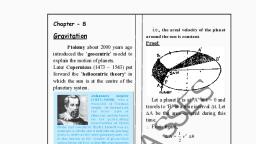
Gravitation, , XI (Physics), T, ii), , R h, gh, , 2, , If satellite is revolving very close to the Earth, surface then (R + h), , T, , R, and g h, , g., , R, g, , 2, , iii) When satellite revolving very close to the Earth’s, surface then (R + h) R, putting in equation ( ii ),, we get,, , T, But, M, , T, , 2, , R3, GM, , 4, 3, , R3, , R3, , 2, G, , iv) T, , 4, R3, 3, , T, , 3R 3 4 2, G4 R 3, , T, , 3, G, , 1, , Explanation :, If in a given time interval, the planet goes from, position P1 to position P2 and in the same time, interval it goes from position P3 to P4 . Then, according to this law, area P1SP2, area P3SP4, where, S = position of the Sun, The linear velocity of the planet when closer to the, Sun is more than its linear velocity when it is away, from the Sun., This law follows the law of conservation of angular, momentum., Note : The areal velocity means area swepts by, radius vector per unit time., 3. Third law (Law of period) :, The square of the period of revolution of a planet, around the Sun, is directly proportional to cube of, , i.e. time period of satellite is inversely, , proportional to square root of density., , Q.16) State and explain Kepler’s law of planetary, motion., Ans :, 1. First law (Law of elliptical orbit) :, Every planet revolves around the Sun in an elliptical, orbit, with the Sun at one focus of the ellipse., 2. Second law (Law of area) :, The radius vector drawn from the Sun to a planet, sweeps out equal area in equal interval of time i.e, areal velocity of the planet around the Sun always, remains constant., Explanation :, , i), , ii), , semi major axis of its elliptical orbit i.e. T 2 r 3 ., Explanation :, Let,, T = period of revolution of planet around the Sun, r = semi major axis, According to Kepler’s 3rd law,, T 2 r 3 OR T2 = K r3, Where, K = constant for planet, Let, T1 and T2 = periods of any two planets around the, Sun r1 and r2 = the respective semi major axes Then, , T12, T22, , r13, r23, , Note : The time period of a planet when closer to, the Sun is less than the period when it is away from, the Sun., Q.17) Explain the terms :, 1. Gravitational field,, 2. Intensity of gravitational field,, 3. Gravitational potential., Ans :, 1. Gravitational field :, The imaginary region round the body in which its, gravitational force of attraction can be experienced, by other bodies is called gravitational field of that, body., 2. Intensity of gravitational field ( E ) :, Intensity of gravitational field at any point in, gravitation is defined as the gravitational force, experienced by unit mass kept at that point., , Chavan’s Perfect Study Material for theory , JEE (Main & Advance) and CET [ 6 ]
Page 7 :
Gravitation, , XI (Physics), F, m, , i.e. E, *, , ii), , Unit and dimension :, S.I. unit : N / kg, C.G.S. unit : dyne / gm, , M 0 L1 T, , E, , According to Newton’s law of gravitation,, , F, , GMm, r2, , F, m, , GM, r2, , But,, , E, , E, *, i), ii), , GM, r2, , Note :, Intensity of gravitational field at a point is equal to, acceleration due to gravity at that point., The intensity is a vector quantity and the direction, , of E is the same as the direction of F ., 3. Gravitational potential :, Gravitational potential at a point is work done in, bringing the unit mass from infinity to that point in, the gravitational field against the gravitational force., The gravitational potential at a point situated at a, distance r from a body of mass M is given by,, , v, *, i), , V, , GM, r, , P.E., m, , 2, , Q.18) Define and explain binding energy of a, satellite, Ans : Binding energy of satellite :, The binding energy. of a satellite is defined as the, minimum energy that must be supplied to the satellite, in order to free it from the Earth’s gravitational field., Explanation :, 1. Due to Earth gravitational field, satellite is bound to, the Earth by the gravitational force of attraction., 2. In order to release the satellite from the Earth, gravitational field, it must be given sufficient energy, so that it can overcome the effect of the Earth’s, gravitational field and escape to infinity. The, minimum energy require for this purpose is called, the binding energy of the satellite., Q.19) Derive an expression for binding energy of, a satellite when it is at rest on the Earth’s, surface., Ans :, Expression for binding energy :, 1. Consider a satellite at rest on the Earth’s surface., Since it is at rest, its velocity is zero therefore its, kinetic energy is also zero., 2., , 3., , Let,, , M = mass of the Earth,, m = mass of the satellite,, R = radius of the Earth,, The potential energy of a satellite is given by,, P.E. = Potential mass of satellite, , GM, m, R, , Note :, The potential at a point in a gravitational field is the, potential energy per unit mass of a body placed at, that point., , v, , M 0 L2 T, , 2, , Explanation :, Let M be the mass of the Earth. Consider a body, of mass m kept at point P in the gravitational field, of Earth. Let r be the distance of the body from, centre of the Earth., , F, m, , P.E. = V. m., Unit and dimension :, S.I. unit : J / kg., C.G.S. unit : erg / gm, , P.E., 4., , GMm, R, , Total energy of a satellite is given by,, Total energy = K.E. + P.E., , Chavan’s Perfect Study Material for theory , JEE (Main & Advance) and CET [ 7 ]
Page 8 :
Gravitation, , XI (Physics), T.E. 0, , B.E., , B.E., 6., , 7., , Q.20) Derive an expression for the binding energy, of a satellite when it is at rest at a height h, above the Earth surface., Ans :, 1. Consider a satellite rest at height h above the Earth’s, surface. Since it is at rest, its velocity is zero,, therefore its K.E. is zero., 2. Let,, , 3., , M = mass of the Earth,, m = mass of the satellite,, R = radius of the Earth,, h = height of the satellite above the Earth surface., The P.E. of a satellite is given by,, P. E. = Potential mass of satellite., , GM, R h, P.E., 4., , 5., , Negative sign shows that the satellite is bound to, the Earth., Binding energy of satellite = - (T.E.), , m, GMm, R h, , Total energy of a satellite is given by,, T.E.= K.E.+ P.E., , GMm, R h, , B.E., , GMm, R, , Binding energy is numerically equal to the, gravitational potential energy of the body on the, surface of the Earth., B.E. of satellite, i) depends on the mass of Earth,, ii) depends on mass of satellite,, iii) depends on the radius of Earth., , GMm, R h, , T.E., , Negative sign shows that the satellite is bound to, the Earth., Binding energy of satellite = - (T.E.), , GMm, R, , GMm, R h, , 0, , GMm, R, , T.E., , 5., , GMm, R, , B.E., , GMm, R h, , 6., , B.E. of satellite, i) depends on the mass of Earth,, ii) depends on mass of satellite,, iii) depends on the radius of Earth,, iv) depends on height above the Earth surface., Q.21) Obtain an expression for binding energy of, a satellite revolving in a circular orbit round, the Earth at height h above the Earth’s surface., Ans :, 1. Consider a satellite is moving round the Earth in, circular orbit., , 2., , Let,, M= mass of the Earth,, m = mass of the satellite,, R = radius of the Earth,, h = height of the satellite from the Earth surface., (R + h) = r = radius of circular orbit of satellite., vc = critical velocity of satellite., The satellite moves in a circular orbit so it has critical, velocity which is given by,, , vc, 3., , GM, R h, , where G = universal gravitational constant., K.E. of a satellite is given by,, , K.E., , 1, m v 2c, 2, , 1, GM, m, 2, R h, , Chavan’s Perfect Study Material for theory , JEE (Main & Advance) and CET [ 8 ]
Page 9 :
Gravitation, , XI (Physics), 1 GMm, 2 R h, 1 GMm, 2 R h, , K.E., 4., , GMm, R h, , 1, 1, 2, , GMm, R h, T.E., , GMm, 2 R h, , Negative sign shows that the satellite is bound to, the Earth., Therefore, binding energy of a satellite is given by,, Binding energy of satellite = - (T.E.), , B.E., , B.E., 7., , 1, 2, , GMm, 2 R h, , GMm, 2 R h, , B.E. of satellite, i) depends on the mass of Earth,, ii) depends on mass of satellite,, iii) depends on the radius of Earth,, iv) depends on height above the Earth surface., , Q.22) Show that B.E. of satellite when it is rest at, height h is twice the B.E. of satellite when, revolving in a circular orbit round the Earth at, same height h above the Earth surface., Ans :, , ............... ( i ), , rev, , GMm, 2 R h, , ............... ( ii ), , Equation ( ii ) can be written as, , B.E., , GMm, R h, , GMm, R h, , rest, , Binding energy of a satellite revolving in a circular, orbit round the Earth at height h above the Earth’s, surface is, , B.E., 3., , Total energy of a satellite is given by,, T. E. = K.E. + P.E., , 1 GMm, 2 R h, , 6., , 2., , m, , GMm, R h, , Binding energy of a satellite when it is at rest at a, height h above the Earth surface is, , B.E., , The P.E. of a satellite is given by,, P. E. = Potential mass of satellite., , GM, R h, , 5., , 1., , B.E., , rev, , rev, , B.E., , 1 GMm, ., 2 R h, 1, . B.E., 2, rest, , rest, , 2 B.E., , [ From eq. ( i ) ], , rev, , Thus, B.E. of satellite when it is rest at height is, twice the B.E. of satellite when revolving in a, circular orbit round the Earth at same height above, the Earth surface., , Q.23) Define and explain the escape velocity of a, satellite., Ans : Escape velocity (ve) :, The minimum velocity with which satellite should, be projected so that it escapes from the Earth’s, gravitational field is called escape velocity., Explanation :, 1. To release a satellite from the Earth’s gravitational, field, the minimum energy which must be given to it, is equal to its binding energy., 2. This energy can be supplied in the form of kinetic, energy for projecting the satellite with a certain, minimum velocity called the escape velocity., 3. If the satellite is projected with a velocity equal to, the escape velocity, its kinetic energy becomes equal, to the required binding energy, so that the satellite, overcomes the Earth’s gravitational field and, escapes to infinity., Q.24) Obtain an expression for escape velocity,, when the satellite is stationary on the surface, of the Earth., Ans : Expression for escape velocity :, 1. Consider a satellite stationary on the Earth’s surface., , Chavan’s Perfect Study Material for theory , JEE (Main & Advance) and CET [ 9 ]
Page 10 :
Gravitation, , XI (Physics), 2., , When a satellite is very close to Earth’s surface,, then, h << R,, Therefore, R h R ., , GM, R, , vc, , 2., , Let,, M = mass of the Earth,, m = mass of the satellite,, R = radius of the Earth,, The binding energy of a satellite is given by,, , where, G = Universal gravitational constant., Let ve = escape velocity,, K.E. supplied to a satellite is given by,, , GMm, R, , 2, e, , 2GM, R, , v, , ............ ( i ), , Escape velocity, i) depends on the mass of Earth,, ii) depends on the radius of Earth,, iii) independent of mass of satellite., Note : We know, g, , GM, , GM, R2, , GM, R, ve, , 2g R 2, R, , GM, R h, , g, , v c (in magnitude)., , Q.26)Show that, the escape velocity of the satellite, close to the surface of the Earth of radius R, and mean density, is given by,,, , 2 π ρG, ., 3, , Ans :, 1. Escape velocity from the surface of the Earth is, given as,, , ve =, 2., , 2GM, R, , But, Mass = volume, , M=, , density.., , 4, π R3 ρ, 3, , ve =, , 2Rg, , Q.25) Show that escape velocity is 2 times, critical velocity when satellite is orbiting very, close to Earth’s surface., Ans :, 1. The critical velocity of, is given by,, , b, , 2 vc, , For revolving satellite, v e, , = 4R 2, , Vc, , vc, , g R2, , Putting in equation ( i ), we get, , ve, , But, , v e = 2R, , 2GM, R, , ve, 5., , 4., , GM, R, , 2, , Note :, , In order to free the satellite from the influence of, Earth gravitational field, we have,, K.E. = B.E,, , 1, m v e2, 2, , 2GM, R, , ve, , 1, m v 2e, 2, , K.E., 4., , The escape velocity from surface of Earth is given, by,, , GMm, R, , B.E., 3., , 3., , .............. ( i ), , 4, 2 G π R 3ρ, 3, R, , 2, πρG, 3, , v e = 2R, , 2πρG, 3, , Q.27) Distinguish between critical velocity and, escape velocity., Ans :, , Chavan’s Perfect Study Material for theory , JEE (Main & Advance) and CET [ 10 ]
Page 11 :
XI (Physics), , Gravitation, , Q.29) What is meant by communication satellite?, Give its uses., Ans : Communication satellite :, An artificial satellite which revolves round the Earth, in stable circular orbit in equatorial plane, having, same direction and period of revolution as that of, the rotation of the Earth about it’s own axis is known, as communication satellite., It is mainly used for communication purpose, so it, is called as communication satellite., , Q.28) Explain, why an astronaut feels, weightlessness in orbiting satellite?, Ans : Weight of the body :, The gravitational force exerted by the Earth on the, body is called weight of the body., Explanation of weightlessness :, 1. When satellite is rest on. Earth’s surface :, When the astronaut is on the surface of the Earth,, his weight acts vertically downward, at the same, time the Earth surface exerts equal and opposite, force of reaction on the astronaut. Due to this, reaction the astronaut feels his weight., 2. When satellite is revolving round the Earth :, When the astronaut is on the floor of an orbiting, satellite, both the astronaut as well as the satellite, are having same centripetal acceleration towards, the centre of the Earth. Therefore, the astronaut, cannot produce any action on the floor of satellite., So that floor does not exerts any reaction on the, astronaut. Therefore, the astronaut has. feeling of, weightlessness. This feeling is also known as zero, gravity condition., , Geo stationary satellite :, The relative velocity of this satellite with respect to, Earth is zero, so satellite appears stationary from, Earth’s surface. Hence, it is known as geostationary, satellite., Geo-synchronous satellite :, Its motion is synchronous with the rotational motion, of the Earth. Hence, it is also called a, geosynchronous satellite., The orbit in which this satellite is revolving is known, as geostationary orbit or synchronous orbit or, parking orbit., Period :, The period of communication satellite is one day or, 24 hours., Height :, The height of communication satellite from the, Earth’s surface is about 36,000 km., Note : Its sense of rotation is same as that of the, Earth about its own axis i.e. in anticlockwise, direction (from West to East)., Uses :, 1. To send radio and T.V. signals from one place to, long distance., 2. It receives the signals from the transmitting centre,, amplify it and sends back to Earth., 3. It is also used for military purposes., 4. It can take the photograph of Earth’s surface which, enables to forecast the weather., Q.30) Obtain an expression for acceleration due, to gravity at height ‘h’ (altitude) above the, , Chavan’s Perfect Study Material for theory , JEE (Main & Advance) and CET [ 11 ]
Page 12 :
Gravitation, , XI (Physics), Earth surface., Ans :, 1. Let M be the mass of the Earth and R be the radius, of the Earth., , *, i), , ii), , 2., , The acceleration due to gravity on the surface of, the Earth is, , g=, 3., , .............. ( i ), , The acceleration due to gravity at height h above, the Earth surface is, , gh =, 4., , GM, R2, , g, 3., , M, , Dividing equation ( ii ) by equation ( i ), we have, , R, , =, , 2, , R2, GM, , 4., , G, g, , 2, , h, R 1+, R, , g, , 2, , 2, , 5., , -2, , gh, 2h, =1, g, R, power of, , density, , where = density of Earth., Putting the value of M in equation ( i ), we get, , R2, , gh, h, = 1+, g, R, , ............. ( i ), , 4, R3, 3, , 2, , R +h, =, , GM, R2, , We know that,, Mass = volume, , .............. ( ii ), , 2, , gh, GM, =, g, R+h, , 5., , Q.33) Obtain an expression for acceleration due, to gravity at depth ‘d’ below Earth surface., Ans :, 1. Let M be the mass of the Earth and R be the radius, of the Earth., 2. The acceleration due to gravity on the surface of, the Earth is, , GM, R+h, , Note :, Equation ( ii ) and equation ( iii ) shows that the, value of acceleration due to gravity decreases if, we move above Earth surface., When h is comparable to R, then equation ( ii ) is, used to find the value of g at height h., , 6., , 4, 3, , 4, R3, 3, R2, GR, , ........... ( ii ), , Consider P is a point in the Earth at depth d below, the surface of Earth. Distance of P from centre of, Earth is (R - d)., Draw a sphere with centre O and radius (R - d)., , term containing higher, , h, ., R, , If h is small, higher powers of, , h, are negligible., R, , gh, 2h, =1, g, R, gh = g 1, , 7., , The acceleration due to gravity at point P due to, sphere of radius (R - d) is, , gd, 2h, R, , ........... ( iii ), , This is the expression for acceleration due to gravity, at height h above Earth surface (h << R)., , GM ', R d, , 2, , where M’ - Mass of inner solid sphere of radius (R, - d), M’ = volume density, , Chavan’s Perfect Study Material for theory , JEE (Main & Advance) and CET [ 12 ]
Page 13 :
Gravitation, , XI (Physics), 4, 3, , 3, , R d, , 1, , Putting the value of M’ in above equation we get, , 4, G, 3, , gd, , R d, gd, , 8., , R d, , 4, 3, , ii), , 2h, R, 2h d, , 3, , 2, , d, , G R d, , d, R, , 2h, , Then, the value of ‘g’ at a height h is same as the, value of ‘g’ at a depth d, if d = 2h (when h << R)., , ............. ( iii ), , Dividing equation ( iii ) by equation ( ii ), we get, , gd, g, , R d, R, , gd, g, gd, g, , R, R, , d, R, d, 1, R, gd, , *, i), , 2h, d, 1, R, R, , g 1, , d, R, , ........... ( iv ), , Q.35) Explain variation of acceleration due to, gravity on the surface of Earth due to shape of, Earth., Ans :, 1. The Earth is not a perfect sphere, it is elliptical., 2. The Earth is flat at the poles and bulge at the, equator., 3. The equatorial radius is about 21 Km greater than, the polar radius., 4. We know that acceleration due to gravity on the, surface is, , This is the expression for acceleration due to gravity, at depth d below the Earth surface., Note :, From equation ( iv ) gd < g i.e. if we go below the, Earth surface (i.e. depth increases), acceleration, due to gravity goes on decreasing., At the centre of Earth, d = R, thus equation ( iv ), becomes., , g, , As G and M are constant, , g, , gd g 1 1, gd, , 5., , 0, , Thus, acceleration due to gravity at the centre of, Earth is zero., , 6., 7., , Q.34) When the value of g at a height h (h << R) is, same as the value of g at a depth d then show, that d = 2h., Ans : The acceleration due to gravity at height h above, the Earth surface and h << R is,, , gd, , g 1, , 2h, R, , GM, R2, , 8., , 1, R2, , i.e. acceleration due to gravity is inversely, proportional to square of radius of Earth at that, place., At equator : Radius of Earth at equator is, maximum, so g is minimum (9.78 m / s2)., At poles : Radius of Earth at poles is minimum, so, g is maximum (9.83 m / s2)., If we go from equator to poles, the radius of Earth, goes on decreasing and hence the value of g goes, on increasing., If we go from poles to equator, the radius of Earth, goes on increasing and hence the value of g goes, on decreasing., , ............ ( i ), , The acceleration due to gravity at depth d from the, Earth surface is,, , gd, , g 1, , d, R, , .......... ( ii ), , If gh = gd then, from equation ( i ) and equation, ( ii ), we get, , Q.36) What do you mean by polar axis, equatorial, plane and latitude., , Chavan’s Perfect Study Material for theory , JEE (Main & Advance) and CET [ 13 ]
Page 14 :
Gravitation, , XI (Physics), Ans :, 1. Polar axis :, The axis passing through North and South pole of, Earth around which Earth rotates is known as polar, axis or axis of rotation of Earth., 2. Equatorial plane :, A plane passing through centre of Earth and, perpendicular to the axis of rotation of Earth is called, equatorial plane., 3. Latitude at a place, , 2, , F m R cos, 2, , F mR, , .............. ( ii ), , cos, , :, , Latitude at a place is defined as the angle which, the line joining the place (P) to the centre of the, Earth (O) makes with the equatorial plane., , 7., , The centrifugal force F can be resolved into two, components i.e., i) Fcos, , 8., , F1 along OP and, , ii) Fsin perpendicular to OP, The component F1 is, , F1, , Fcos, , Putting value of F from equation ( ii ), , F1, , 2, , mR, , cos 2, , ............ ( iii ), , 9., Q.37) Derive an expression for the gravitational, acceleration on the Earth’s surface at a, latitude,, Ans : Variation of ‘g’ with latitude, (Effect of rotation of the Earth) :, 1. Let the Earth rotates about its axis from West to, East with angular velocity ., 2. Consider a body of mass m placed at point P from, the center O on the Earth surface at the latitude, ., ' ' i.e. EOP, 3. Due to the rotation of the Earth, the body revolves, along a circular path whose centre is O’ and radius, ( r ) is PO’., , OPO', 4. In OPO ', PO ', cos, PO, PO ' PO cos, r R cos, 5., , ............. ( i ), where PO = R = radius of the Earth., The centrifugal force acting on the body at P is, , F mr, 6., , EOP, , 2, , Putting value of r from equation ( i ) in above, equation, , The gravitational force (Fg) acting on the body by, the Earth is towards the centre of the Earth is, Fg = m g, ........... ( iv ), 10. The effective force (F’) acting on the body towards, the centre, of the Earth (Fg > F1) is given by, , F ' Fg, , F1, , 11. Putting the value of Fg and F1 from equation (iv), and (iii), we get, 2, , cos 2, , ......... ( v ), 12. The effective force (F’) acting on the body is given, by, F’ = mg’, ............ ( vi ), where g’ = effective value of acceleration due to, gravity, 13. Putting the value of F’ in equation (v), , F' mg m R, , mg ' mg m R, g' g R, , 2, , 2, , cos 2, , cos 2, , ........ ( vii ), , This is the expression for gravitational acceleration, on the Earth’s surface at a latitude, , ., , 14. Thus the value of acceleration due to gravity, changes with ' ' and ' ' ., i), , Variation of g with latitude, , :, , From equation (vii) it is clear that as, , increases,, , Chavan’s Perfect Study Material for theory , JEE (Main & Advance) and CET [ 14 ]
Page 15 :
Gravitation, , XI (Physics), cos, decreases and g’ will increase i.e., acceleration due to gravity increases with increase, in latitude., ii) Variation of g with angular velocity, :, From equation (vii) it is clear that if, increases,, then g’ will decrease i.e. acceleration due to gravity, decrease with increase in angular velocity., 15. At equator : g ', , cos, , g E and, , 00, , 3., , earth is g, 4., , g R, , 16. At poles : g ', , g p and, , = 90°, , cos 90 0, , 5., a., , g, , The value of g at poles is maximum. There is no, effect of rotation of the Earth at poles because there, is no term of in the above equation. The value of, g at poles will remain same, whether the Earth is, rotating or stationary., , g p gE, , 1., , R, , g R, , Earth is spherical,, , M, , 4, R3 x, 3, , Effect on acceleration due to gravity :, Effect of height (h) on g :, i. Acceleration due to gravity at height h above the, surface of the earth is given by, , GM, 2, , R h, , GM, R2, , 2, , gh, , g, , R, R h, , 2, , ii. If h is very small then, , Gm1m 2, r2, , GMm, R h, , gh, , 2, , g 1, , 2h, R, , b. Effect of depth on g :, Acceleration due to gravity at depth (d) is, , gd, , where,, G = universal gravitational constant, m1= mass of the first body, m2= mass of the second body, r = distance between two masses., If a body or satellite is at height h from the earth’s, surface then the gravitational force is, , F, , Vx, , Dividing above equation by g, , 2, , FORMULAE, The Newton’s law of Gravitation :, The gravitational force is given by, , F, , 2., , g, , M, , gh, , Note : The difference between the value of, acceleration due to gravity at poles and equator is, , gE, , M, V, , 2, , Putting these value in equation ( vii ), , gp, , The acceleration due to gravity on the earth surface, in terms of density is given by, We know,, , The value of g at equator is minimum. The effect, of rotation of Earth is maximum at equator., , gp, , GM, R2, , 1, , Putting these value in equation ( vii ), , gE, , Where, M= mass of the earth, m = mass of the body or satellite, R = radius of the earth., Acceleration due to gravity on the surface of the, , c., , g 1, , d, R, , Effect of rotation of earth (latitude) on g :, , g', , g R, , 2, , cos2, , i. Due to rotation of earth at equator :, , gE, , g R, , 2, , ii. Due to rotation of earth at poles :, , gp, , g, , Chavan’s Perfect Study Material for theory , JEE (Main & Advance) and CET [ 15 ]
Page 16 :
Gravitation, , XI (Physics), 6., 7., , Weight of, the body, , Mass of the, body, , Acceleration, due to gravity, , Critical speed or Orbital speed of a satellite i. moving round the earth in a circular orbit is,, , GM, R h, , vc, , iii. orbiting close to the surface of the earth i.e.,, h, R , then, , GM, R, , iv. orbiting very close to earth surface, , R and g h, , R h, , GM, R h, , v. v c, , g, , vc, , Rg, , vc1, , r2, r1, , vc 2, , iii. T.E., , GMm, iv., R h, , B.E., , GMm, R h, , i. K.E., , GMm, 2 R h, , ii. P.E., , GMm, R h, , iii. T.E., , GMm, 2 R h, , iv. B.E., , GMm, 2 R h, , i. B.E., , T.E., , ii. K.E., , iii. K.E., , T.E., , iv. P.E., , 2 B.E., , v. P.E., , 2 T.E., , vi. P.E., , 2 K.E., , B.E., , Periodic time of a satellite in a circular orbit :, i. T, , ii. T, 9., , GMm, R h, , 14. Escape velocity of a body at rest on the earth surface, is,, , v c is maximum when h is minimum., 8., , P.E., , 13. For revolving satellite relation between energies :, , GM, r, , or vc, , 1, r, , vc, , ii., , 12. When satellite is revolving at height h above the, earth surface, then,, , R h gh, , vc, , GMm, R, , B.E., , 11. When satellite is at rest at height h above the earth, surface then,, i. K.E. = 0, , ii. moving round the earth in a circular orbit in terms, of acceleration due to gravity at height h is, , vc, , GMm, iv., R, , iii. T.E., , 2, , i. v e, , R h, vc, R h, , 2, , 3, , T, , or, , GM, , g, , 3, , 2, , r, GM, , ve, , Kepler’s law :, , T2, , r3, , If T1 and T2 are the periods of any two planets and, r1 and r2 be the respective semi major axes of their, orbits then., , T12, i., T22, , r13, r23, , T1, T2, , ii., , 2, , R h1, R h2, , ii., , P.E., , GM, R2, , ii. v e in terms of g :, , GM, , 2gR 2, R, , ve, , gR 2, , 2Rg, , ve, , Dg, , where,, D = diameter of the earth., 15. Escape velocity of a body at rest at height h above, the earth is,, , 3, , T is maximum when h is maximum., 10. When satellite is at rest on the earth surface, then, i. K.E. = 0, , 2GM, R, , GMm, R, , i. v e, , 2GM, R h, , ii. ve in terms of g h :, , gh, , GM, R h, , 2, , GM, , gh R h, , 2, , Chavan’s Perfect Study Material for theory , JEE (Main & Advance) and CET [ 16 ]
Page 17 :
Gravitation, , XI (Physics), 2 x gh R h, R h, , ve, , 7., , 2, , Find acceleration due to gravity on the surface of, the moon. Given that mass of the moon is 1/80 times, that of the earth and diameter of the moon is 1/4, , 9.8 m / s 2, , times that of the earth. g, , ve, , 2 R h gh, , Ans : 1.96 m/s2, 8. Given that the acceleration due to gravity at the, , 17. Relation between v c and ve :, , surface of the planet saturn is 10.28 m / s 2 and the, , i. Near the surface of the earth :, , ve, , 2 x vc OR ve 1.41vc, , ii. For revolving satellite : v e, , vc ., , Numericals, Type I : Newton’s law of Gravitation, 1., , A satellite of mass 800 kg revolves round the earth, in the orbit of radius 2 10 4 km . Find the, gravitational force between the satellite and the, , Mass of the earth, Earth., , G, , 6.67 10, , 11, , 6 10 24 kg, , Nm 2 / kg 2, , Ans :, 2. A body weighs 3.5 kg wt on the surface of the earth., What will be its weight on the surface of a planet, whose mass is 1 / 7th of the mass of the earth and, radius half of that of the earth ?, Ans : (Wp = 2 kg wt. ), Home work I, 3. Calculate the gravitatinal force of attraction between, the Earth and Venus. The distance between them is, 2.5 x 10⁷ km. (Given Mvenus= 4.794 × 1024 Kg), (Ans : 3.07 × 10¹⁸ N), 4. A satellite of mass 1000 kg revolves round the Earth, in a circular orbit. If the gravitational force exerted, by the Earth on the satellite is 6.25 x 10³ N. Calculate the height of the satellite above the Earth’s surface. (Ans h = 1.6 x 10⁶ m), 5. Two homogeneous spheres one of mass 100 kg and, other of mass 11.75 kg attract each other with a, force of 19.6 10 7 N when kept with their centers 0.2 m apart, Estimate constant of gravitation, Ans:, Type II : Acceleration due to Gravity, 6. Calculate the acceleration due to gravity at the, surface of earth., Ans : g = 9.77 m/s2, , radius of saturn is 6.08 108 m , calculate the mass, of saturn., Ans : mass of saturn = 5.697 × 1028 kg, 9. The mass of the planet mars is 10 % of the mass of, the earth and its radius is 50 % of the radius of the, earth. Find the acceleration due to gravity at the, surface of mars, if the gravitational acceleration at, the surface of the earth is 9.8 m / s2 ., Ans : g = 3.92 m/s2, 10. If the value of acceleration due to gravity on the, surface of earth is 9.8 m / s 2 . Find the value of, density of earth., ( G 6.67 10 11 SI unit, R = 6400 km), Ans :, 11. The mass of jupiter is 318 times that of the earth, and its radius is 11.2 times that of the earth. The, acceleration due to gravity at the surface of the, earth is 9.8 m / s 2 . Find the acceleration due to, gravity at the surface of the jupiter., Ans : gj = 24.84 m/s2, Home Work-II, 12. Find the accleration due to gravity at the surface, of the moon. (Mm = 7.35 x 10²² kg and Rm = 1747, Km) (Ans : gm = 1.606 m/s2), 13. The mass of Jupiter is 318 times that of the earth, and its radius is 11.2 times that of the earth. The, acceleration due to gravity at the surface of the earth, is 9.8 m/s2. Find the acceleration due to gravity at, the surface of the Jupiter., , F H int : g, GH g, , FG IJ, H K, , MJ, RE, x, ME, RJ, , J, E, , 2, , Ans : 24.84 m / s 2, , I, JK, , 14. A body weigh 1.8 kg on the surface of the earth., How much will it weigh on the surface of a planet, whoe mass is 1/9 that of the earth and whose radius, is half that of Earth?, , F H int : W, GH W, , E, P, , FG IJ IJ , W, H KK, , ME, RP, x, MP, RE, , 2, , P, , 0 .8 kg wt ., , 15. A satellite revolves around a planet in a circulat orbit with a speed of 7 km.s at a height where the, , Chavan’s Perfect Study Material for theory , JEE (Main & Advance) and CET [ 17 ]
Page 18 :
Gravitation, , XI (Physics), acceleration due to gravity is 7 m/s2. Find the height, of the satellite from the surface of the planet. (Radius of the planet = 5500 km) (Ans : h = 1.5 x 10⁶, m), 16. Calculate the acceleration due to gravity at a height, of 3200 km above the surface of the earth. (M and, , LMH int g GM, R given), MN, bR hg, h, , 2, , 4. 34 m / s 2, , OP, PQ, , 17. Find the acceleration due to gravity at a height of, 3600 km from the surface of the earth. (g and R are, , LMH int g gL R O OP, MN R h PQ P, MM, N g 4.014 m / s PQ, 2, , h, , given), , on surface ?(Radius of the earth = 6400 km), Ans : d = 640 km, 26. At what height above the earth’s surface, value of, g is same as in a mine 100 km deep., Ans: h = 50 km, 27., , 2, , h, , Type III : Variation of ‘g’ due to Height,, Depth and Rotation of Earth, 18. Calculate the acceleration due to gravity at a height, of 3200 km above the surface of the earth., (Mass of earth = 6 x1024 kg , Radius of earth =, 6400 km)., Ans : gh = 4.342 m/s2, 19. Find the value of g at a height of 400 km above the, surface of Earth. (Given R = 6400 km, g = 9.8 m/, s2), Ans : gh= 8.575 m/s2, 20. Find the altitude at which the acceleration due to, gravity is 25% of that at the surface of the Earth., (R = 6400 km), Ans : h = 6400 km, 21. At what height from the surface of Earth will the, value of g be reduced by 36% from the value at the, surface.(R = 6400 km), Ans : h = 1600 km, 22. A body weight 63 N on the surface of the earth., What the body weight at height equal to half the, radius of Earth., Ans : Wh= 28 N, 23. What will be the value of g at the bottom of sea 7, km deep. Radius of earth is 6400 km and g on the, surface of earth is 9.8 m/s2., Ans : gd = 9.79 m/s2, 24. Find the acceleration due to gravity at a depth of, 2000 km from the earth’s surface assuming that, earth has uniform density (R = 6400 km), Ans : gd = 6.737 m/s2, 25. At what distance above the earth’s surface and at, what depth below the earth’s surface is the, acceleration due to gravity less by 10% of its value, , Home work III, 28. At a certain height above the Earth’s surface the, gravitational acceleration is 90% of its value on the, surface. Determine the height. (R = 6400 km), (Ans : 3.46 x 10⁵ m), 29. At what height from the surface of earth, the acceleration due to gravity is the same at a depth 160 km, below the surface of earth. Radius of earth is 6400, km., , LMH int, OP, MMg gLM1 2h OP & g gLM1 d OP PP, MN g gN ; RhQ d / 2 , Nh R80Qkm PQ, h, , d, , h, , d, , 30. A satellite is revolving around the Earth in a circular, orbit with the critical velocity 7 km/s. Find the radius, of the orbit of the satellite and period of its, revolutions., , G, , 6.67 x10, , 11, , Nm 2 / kg 2 , M, , 5.98 x1024 kg, , Ans : (r = 8140 km, T = 7.303 × 10³ s), 31. Calculate the critical velocity of a satellite orbiting, around the earth at a height equal to radius of earth., (G = 6.67 x10 11 Nm2 / kg 2 , M = 6 x1024 kg ,, R = 6400 km), Ans : Vc = 5.591 × 10³ m/s, 32. An artificial satellite is raised to a height of 6400, km above the earth’s surface and then projected in, a circular orbit round the earth. Calculate the speed, of the satellite, if the acceleration due to gravity at, the given height is 2.45 m/s2., (Radius of earth = 6400 km), Ans : Vc = 5.6 km/s, 33. A satellite moving in a circular orbit of radius 60,000, km round the earth has a certain critical velocity., What will be its orbital radius if it were to move, around mars with the same critical velocity ?, As [Mass of mars =, , ]., , Chavan’s Perfect Study Material for theory , JEE (Main & Advance) and CET [ 18 ]
Page 19 :
Gravitation, , XI (Physics), Ans : r = 6387 km, 34. What would be the duration of the year if the, distance between the Earth and the sun becomes, doubled the present distance., Ans : T2 = 1032 days, 35. What shall be the duration of the year if the distance, between the earth and the sun is reduced to half of, the present distance ? (1 year = 365 days), Ans : T2 = 129 days, 36. Calculate the period of revolution of planet jupiter, round the sun, given what the ratio of the radius of, the jupiter’s orbit to that of the earth’s orbit is 5.2., Ans : T2 = 11.86 year, 37. Two satellites orbiting the Earth have periods in the, ratio 8 : 1. Compare their critical speeds., Ans : V1/V2 = 1 : 2, 38. The radii of orbits of two satellites revolving around, the earth are in the ratio 3 : 8. Compare their, i) orbital speeds ii) periods of revolution., Ans : T1/T2 = 0.229, V1/V2 = 1.63, Home work IV, 39. An artificial satellite is raised to a height of 800 km, above the Earth’s surface and then projected in the, horizontal direciton. Calculate the velocity of the, projection if the satellite revolves in a circular orbit, round the Earth (M,G and R are given), (Ans : VC = 7.45 x 10³ m/s), 40. Calculate the critical velocity of a satellite orbiting, around the earth at a height equal to radius of earth, (M, G and R are given), (Ans : VC = 5.59 x 10³ m/s), 41. Find the height of satellite from the surface of the, earth if the orbital speed of the satellite is 4 km/s., , F H int : bR h g, GH, , GM, 2, VC, , I, JK, , ; h = 18.61 × 10⁶ m, , 42. A body is at rest to a height of 3600 km above the, Earth’s surface and then given a horizontal velocity, of 6 km/s. State giving reasons, the path that the, body will follow. (M, G and R are given)., (Ans : VC = 6.315 x 10³ m/s), 43. Two satellite orbiting the earth have radii in the ratio, 100:81. Compare their critical speed., , F H int : V, GH, V, , C1, C2, , I, JK, , VC1, r2, ;, VC2, r1, , 9:10, , 44. Time period of revolution of a satellite around a planet, of radius ‘R’ is 8 years. Find the time period of revolution of another satellite whose radius is 3R. (Ans, : T2 = 41.52 years), 45. The average distance betwen Sun and Mars is 1.524, , times the average distance between Earth and Sun., If the time period of revolution of earth is one year,, find, the, period, of, revolution of, , F H int : T F r I I, G J J, Mars. G, T Hr K K, H, 3/ 2, , 2, , 2, , 1, , 1, , (Ans : T2 = 1.881 years), 46. The geostationary satellite is orbiting the earth at a, height of 6R above the surface of earth, R being the, radius of earth. Find the time period of anothr satellite at a height of 2.5 R from the surface of earth., (Ans : T2 = 8.48 hour), 47. Two satellites of a planet have period 32 days and, 256 days. Find the ratio of their radii., , F H int : F T I F r I I, GH, GH T JK GH r JK JK, 2, , 3, , 1, , 1, , 2, , 2, , r1, r2, , 1:4, , Type V : Energies of satellite, 48. Find the kinetic energy, potential energy, total and, binding energy of an artificial satellite orbiting at a, height 3600 km above the surface of the earth., (Mass of the earth = 6 x10 24 k g , radius of the earth, = 6400 km, mass of satellite = 10 3 kg, G =, , 6.67 x10 11SI unit ), Ans : K.E.= 2.001 × 10¹⁰ J, P.E. = –4.002 × 10¹⁰ J., B.E= 2.002 × 10¹⁰ J, T.E. = – 2.001 × 10¹⁰ J, 49. An artificial satellite of mass 500 kg is revolving in, a circular orbit round the earth with a speed of 6, km/s. Find its kinetic energy, potential energy and, binding energy., Ans : K.E. = 9× 10³ J, B.E = 9 × 10⁹ J.,, P.E = –18 × 109 J, 50. Calculate the binding energy of a body of mass 50, kg situated at rest on the earth’s surface., (Mass of earth = 6 x1024 kg, Radius of earth = 6400, km), Ans : B.E. = 3.127 × 10⁹ J, 51. Calculate the binding energy of an artificial satellite, of mass 1000 kg, orbiting at a height of 3600 km, above the earth’s surface., (Mass of earth = 6 x1024 kg, Radius of earth = 6400, km), Ans : B.E = 2 × 10¹⁰ J, 52. Total energy of a satellite is 2.5 x10¹⁰ J ., Calculate its K.E. and P.E., Ans : K.E. = 2.5 × 10¹⁰ J, P.E. = –5 × 10¹⁰ J., 53. Two satellite A and B moving in circular orbits of, , Chavan’s Perfect Study Material for theory , JEE (Main & Advance) and CET [ 19 ]
Page 20 :
Gravitation, , XI (Physics), radii 3R and 5R respectively round the same planet., If the masses of satellite are in the ratio of 2 : 1., Compare their binding energy., Ans : 10 : 3, 54. Compare the binding energy of a body at rest on, the surface of the earth with the binding energy of, a body of the same mass and at rest on the surface, of the moon., (Given Rmoon=1747 km, gm=1.61 m/s2), Ans : 22.3 : 1, Home work V, 55. Find total energy and binding energy of an artificial, satellite of mass 2000 kg orbting the Earth at a height, of 9600 km above the Earth’s surface. (M, R and G, are given), , dTE, , 2.50 x 10¹⁰ J , BE, , 2.50 x 10¹⁰ J, , i, , 56. Calculate the K.E., P.E., T.E. and B.E. of a satellite, of mass 1000 kg ervolving in a circular orbit at a, height of 600 km above the earth surface., , F KE GMm, GG 2bR hg, GH TE KE PE, , 28.5 x10⁹ J ; PE, , b g, , 2 KE, , 28.5 x 10⁹ J ; BE, , I, JJ, JK, , 5.7 x 10¹⁰ J, , 28.5 x 10⁹ J, , Type VI : Escape velocity, 57. Calculate the escape velocity of a body from the, surface of a planet of diameter 2200 km, acceleration due to gravity on the surface of planet, = 160 cm/s2., Ans : Ve = 1.876 km/s., 58. Calculate the escape velocity from the surface of, the earth, if the radius of the earth is 6400 km and, acceleration due to gravity on the earth’s surface is, 9.8 m/s2., Ans : Ve = 11.2 km/s, 59. The escape velocity of a body from the surface of, the earth is 11.2 km/s. The mass of jupiter is 318, times that of the earth and its radius is 11.2 times, that of the earth. Find the escape velocity of a body, from the surface of the jupiter., Ans : Ve = 59.67 km/s, 60. A satellite is revolving in a circular orbit around the, earth with a speed equal to half the magnitude of, escape velocity from the earth. Find the height of, satellite above the earth’s surface., Ans : h = 6400 km, 61. The escape velocity of a body from the surface of, the Earth is 11.2 km/s. Calculate the mean density, of the Earth. (G = 6.67 x10, , 6 x1024 kg , R = 6400 km), Ans:, , 3, , 11, , Nm2 / kg 2 , M =, , Home Work VI, 62. Find the escape speed of a body from the surface, of mars. (Given Mass of mars = 6.387×10²³ kg,, Radius of Mars = 3330 km), 3, , Ans : Ve 5.026 x 10 m / s, 63. Calculate the escape velocity of a body from the, surface of a planet from the following data. Diameter of planet = 2200 km, g at planet = 160 m/s2, , Vep, , 2gR, , 18.76 km / s, , 64. The escape velocity from the surface of the earth is, 11.2 km/s. If the mass of the moon is 1/80th of the, earth’s mass and diameter of the moon is 1/4th of, the earth’s diameter. Find the escape velocity from, the surface of the moon., , LMH int : V, V, N, , eE, , eM, , VeM, , ME R M, x, MM RE, , OP, Q, , 2.504 x 10 3 m / s, , 65. If the mass of planet venus and the mass of earth, are in the ratio 4:5 and the radii of venus and earth, are in the ratio 24:25. Calculate the escape velocity, from the surface of venus, if the escape velocity, from the earth’s surface is 11.2 km/s. (Ans : Vv =, 10.22 km/s), 1) If R is the radius of a planet and g is the acceleration, due to gravity, then the mean density of the planet is, given by (MHT-CET 1999), a), , 4 GR, 3g, 4 GR, 3G, b), c), d), 3g, 4 GR, 3G, 4 GR, , 2) According to Kepler’s law, the period of revolution, of a planet (T) and its mean distance from the sun, (r) are related by the equation (MHT-CET 1999), a) T2r = Constant, b) T2 r-3 = Constant, c) T2 r3 = Constant, d) T3 r3 = Constant, 3) The angular velocity of rotation of a star (of mass, M and radius R) at which the matter starts to escape, from the equator is (MHT-CET 1999), a), , 2GR, 2GM, b), c), M, R3, , 2GM, d), R, , 2GM 2, R, , 4) The ratio of the radius of earth to that of the moon, is 10. The ratio of acceleration due to gravity on the, earth to the moon is 6. The ratio of escape velocity, from earth’s surface to thatof moon is (MHT-CET, 2000), a)10 b)6, c) 1.66, d) 7.74, 5) A geostationary satellite has an orbital period of, (MHT-CET 2000), a) 2h b) 6h, c)12h d)24h, , Chavan’s Perfect Study Material for theory , JEE (Main & Advance) and CET [ 20 ]
Page 21 :
Gravitation, , XI (Physics), 6) The radius of a planet is (l/4)th of earth’s radius and, its acceleration due to gravity is double to earth’s, acceleration due to gravity. How many times is the, value of escape velocity in the planet as compared, to its value at the earth ? (MHT-CET 2000), a) 1 / 2 b) 2 c) 2 / 2 d) 2, 7) Which of the following graph depicts relation, between time period (T) and radius of orbit (r) of a, planet? (MHT-CET 2001), , 14) The value of gravitational acceleration at a height, equal to radius of earth, is (MHT-CET 2004), a) 50% of value at earth’s surface, b) 25% of value at earth’s surface, c) 75 % of value at earth’s surface, d) same as value at earth’s surface, 15) The ratio of acceleration due to gravity at a height, 3R above earth’s surface to the acceleration due to, gravity on the surface of earth is (R = radius of, earth) (MHT-CET 2005), a)1/9, b) 1/16, c)1/4, d) 1/3, 16) The binding energy of a satellite of mass mm an, orbit of radius r is (R = radius of the earth, g =, acceleration due to gravity) (MHT-CET 2005), a), , mgR 2, b), r, , mgR 2, mgR 2, mgR 2, c), d), r, 2r, 2r, , 17), 8) The escape velocities on the two planets of densities, 1 and, 2 and having same radius are v1 and v2, respectively. Then (MHT-CET 2001), a), c), , v1, v2, v1, v2, , 1, , b), , 2, , FG IJ, H K, , 2, , v2, v1, , v1, d), v2, , 1, , 2, , 1, 2, , b), , mgR, 2, , c) 2mgR, , c) ( 2, , 2, , / 3) GR 2, , b) (4 2 / 3) GR 2, d) ( 4 / 3) GR, 18) The universal gravitational constant has the, dimensions (MHT-CET 2006), 1 3 2, a) M L T, , 1 3, c) M L T, , 1, 1 3, b) M L T, , 2, , 9) How much energy will be required if a mass of 100, kg escapes from the earth? [Re = 6.4 x 10⁶ m, g =, 10 m/s2] (MHT-CET 2001), a) 3.2 x 10⁹ J, b) 6.4 x 10⁹ J, 9, c) 1.6x10 J, d) 8x10⁹ J, 10) The distance between centre of the earth and moon, is 384000 km. If the mass of the earth is 6 x 1024 kg, and G = 6.66 x 10⁻¹¹ Nm2/kg2, the speed of the moon, is nearly (MHT-CET 2002), a)1 km/s b) 4 km/s, c)8 km/s d) 11.2 km/s, 11) When body is raised to a height equal to radius of, earth its P.E. changes by (MHT-CET 2003), a) mgR, , a) (4 / 3 ) GR 2, , d), , 3, mgR, 2, , 12) A planet has twice the radius but the mean density, is (1/4)th as compared to earth. What is the ratio of, escape velocity from earth to that from the planet?, (MHT-CET 2004), a)3:1, b) 1:2, c)1:1, d) 2:1, 13) The masses of two planets are in the ratio 1 : 2., Their radii are in the ratio 1: 2. The acceleration,, due to gravity on the planets are in the ratio (MHTCET 2004), a)1:2, b) 2:1, c)3:5, d) 5:3, , 2, , 1 3 2, d) M L T, , 19) If the distance between the earth and sun becomes, (1/4)th, then its period of revolution around the sun, will become (MHT-CET 2007), a)330 days b) 129 days c)365 days d) 45.6 days, 20) Two planets have density in the ratio 2 : 3 and radii, in the ratio 1 : 2. Then the ratio of acceleration due, to gravity at their surface is (MHT-CET 2007), a) 1:3, b) 3:1, c) 1:9, d) 9:4, 21) The gravitational potential due to the earth is, minimum at (MHT-CET 2008), a) the centre, b) the surface, c), d) infinite distance, 22) The earth rotates about its own axis, then the value, of acceleration due to gravity is (MHT-CET 2008), a) same at any position and constant, b) more inside the earth comparative to surface, c) is different at different latitude, d) is zero on the surface of the earth, 23) The time period ‘T’ of the artificial satellite of earth, depends on the average density ‘ ’ of the earth as, (Board Oct. 08), a) T, , b) T, , c) T, , 1, , d) T, , 1, , Chavan’s Perfect Study Material for theory , JEE (Main & Advance) and CET [ 21 ]
Page 22 :
Gravitation, , XI (Physics), 24) According to Kepler’s law, the areal velocity of a, planet around the sun, always (Board March 2009), a) increases, b) decreases, c) remains constant, d) first increases and then decreases, 25) The fastest possible rate of rotation of a planet is, that for which the gravitational force on material at, the equator just nearly provides the centripetal force, needed for rotation. The corresponding shortest, period of rotation is (If is the density of the earth), (MHT-CET 09), a), , 3, G, , b), , 3, G, , 3 G, c), , d), , G, 3, , 26) Kinetic energy of a satellite performing circular, motion of radius r and period T is related as (MHTCET 09), a) KE, , T2 / 3, , b) KE, , T3 /4, , c) KE T1/ 3, d) KE T 2 / 3, 27) A body is taken to a height of nR from the surface, of the earth. The ratio of the acceleration due to, gravity on the surface to that at the altitude is, (MHT-CET 2010), a) (n+1)2 b) (n+1)-2 c) (n+1)-1, d) (n+1), 28) If the density of the earth is doubled keeping radius, constant, find the new acceleration due to gravity?, (g=9.8 m/s2) (MHT-CET 2010), a) 9.8 m/s2, b) 19.6 m/s2, 2, c) 4.9 m/s, d) 39.2 m/s2, Answer Key : (1) - a, (2) - b, (3) - b, (4) - d (5)-d,, (6) -a , (7) - a, (8)-d, (9)-b, (10)-a, (11) -b, (12) - c,, (13) -b, (14)- b, (15) - b, (16)-c, (17)-d, (18)-b, (19)d, (20)-a, (21)-a, (22)-c, (23)-a, (24)-a, (25)-a,(26)d, (27)-b, (28)-b, , ***********, , Chavan’s Perfect Study Material for theory , JEE (Main & Advance) and CET [ 22 ]



 Learn better on this topic