Page 1 :
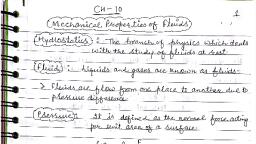
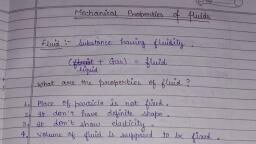
10.1 WHAT IS A FLUID 2, , 1. What are fluids ? Give their important characteristics., , “slo. A fluid isa substance that can flow. It ultimately, , assumes the shape of the containing vessel because it, cannot withstand shearing stress. Thus, both liquids, and gases are fluids., , (i) The atoms or molecules in a fluid are arranged, in a random manner., , It begins to flow, when a shearing stress is applied., , , , , 2) 4 fiuldebcenet tea It, ultimately assumes the shape of the containing, , vessel. So a fluid has no modulus of rigidity., , . So a fluid does, have a bulk modulus of rigidity.
Page 2 :
10.2 THRUST OF A LIQUID, , 4. Define the term thrust. Give its SI unit., , "Thrust. A liquid in equilibrium has a fundamental, property that it exerts a force on any surface in contact, with it and this force acts perpendicular to the surface., , , , , , , , , , is because of this thrust that a liqui, ows out through the holes of the containing vessel., , As thrust is a force, so its SI unit is newton (N)., , os
Page 3 :
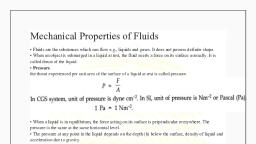
10.3 PRESSURE, , 6. Define the term pressure. Is it a scalar or a vector ?, Give its units and dimensions., , , , , total force F acts normally over a flat area A, then the, pressure is, , , , , , x, , If the force is not distributed uniformly over the, given surface, then pressure will be different at, different points. If a force AF acts normally on a small, , area AA surrounding a given point, then pressure at, , "Pressure is a scalar quantity, because fluid pressure at
Page 5 :
10.4 PRACTICAL APPLICATIONS, OF PRESSURE, , 8. Describe some practical applications from daily life, which make use of the concept of pressure., , Practical applications based on the concept of, , Coat, , The, area Of a sharp edge is much less than the area of a, , blunt edge. For the same total force, the effective force, per unit area (or pressure) is more for the sharp edge, than the blunt edge. Hence a sharp knife cuts better., , This er a he to the weight of the train on a, , larger area and hence reduces the pressure considerably. This, in turn, prevents the yielding of the, ground under the weight of the train., , (, , , , . inspite of the fact that a