Notes of class 11, Physics & Chemistry & Mathematics limits.pdf - Study Material
Page 1 :
CBSE New Pattern, , 91, , Limits, Quick Revision, If x approches a i.e. x → a , then f ( x ) approaches l, i.e. f ( x ) → l , where l is a real number, then l is, called limit of the function f ( x ). In symbolic form,, it can be written as lim f ( x ) = l ., x→a, , Left Hand and Right Hand Limits, If values of the function at the point which are very, near to a on the left tends to a definite unique, number as x tends to a, then the unique number so, obtained is called the Left Hand Limit (LHL) of, f ( x ) at x = a , we write it as, f (a − 0 ) = lim f ( x ) = lim f (a − h ), x →a−, , h→0, , Limits of a Polynomial Function, A function f is said to be a polynomial function if, f ( x ) is zero function, or if f ( x ) = a 0 + a1 x + a 2 x 2 + … + an x n ,, where ai ’s are real number such that an ≠ 0., Then, limit of polynomial functions is, f ( x ) = lim f ( x ) = lim [a 0 + a1 x + a 2 x 2 + ... + an x n ], x→a, , x→a, , = a 0 + a1a + a 2a 2 + ... + an a n = f (a ), , Limits of Rational Functions, , Similarly, Right Hand Limit (RHL) is, f (a + 0 ) = lim f ( x ) = lim f (a + h ), , A function f is said to be a rational function, if, g (x ), , where g ( x ) and h ( x ) are polynomial, f (x ) =, h (x ), , Existence of Limit, , functions such that h ( x ) ≠ 0., , x →a+, , h→0, , If the right hand limit and left hand limit coincide, (i.e. same), then we say that limit exists and their, common value is called the limit of f ( x ) at x = a, and denoted it by lim f ( x )., x →a, , Algebra of Limits, Let f and g be two functions such that both, lim f ( x ) and lim g ( x ) exist, then, x→a, , x→a, , (i) lim [ f ( x ) ± g ( x )] = lim f ( x ) ± lim g ( x ), x→a, , x→a, , x→a, , (ii) lim kf ( x ) = k lim f ( x ), x→a, , x→a, , (iii) lim f ( x ) ⋅ g ( x ) = lim f ( x ) × lim g ( x ), x→a, , (iv) lim, , x→a, , x→a, , x→a, , lim f ( x ), f (x ) x → a, , where lim g ( x ) ≠ 0, =, x→a, g (x ), lim g ( x ), x→a, , Then, lim f ( x ) = lim, x→a, , x→a, , lim g ( x ), g (x ) x → a, g (a ), =, =, h( x ), lim h ( x ) h (a ), x→a, , However, if h (a ) = 0, then there are two cases arise,, (i) g (a ) ≠ 0, (ii) g (a ) = 0., In the first case, we say that the limit does not exist., In the second case, we can find limit., Limit of a rational function can be find with the help of, following methods, 1. Direct Substitution Method In this method,, we substitute the point, to which the variable, tends to in the given limit. If it give us a real, number, then the number so obtained is the, limit of the function and if it does not give us a, real number, then use other methods.
Page 2 :
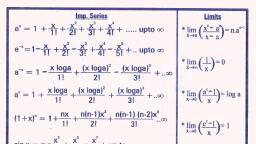
2. Factorisation Method Let lim, , x→a, , f (x ), reduces, g (x ), , 0, to the form , when we substitute x = a . Then,, 0, we factorise f ( x ) and g ( x ) and then cancel, out the common factor to evaluate the limit., 0, 3. Rationalisation Method If we get form and, 0, numerator or denominator or both have, radical sign, then we rationalise the numerator, or denominator or both by multiplying their, 0, conjugate to remove form and then find, 0, limit by direct substitution method., , Some Standard Limits, xn − an, (i) lim, = na n − 1, x→a x − a, (iii) lim, , x→ 0, , 1 – cos x, =0, x, , ax −1, = loge a, x→0, x, , (v) lim, (vii) lim, , x→0, , (ii) lim, , x→0, , (iv) lim, , x→0, , sin x, =1, x, , tan x, =1, x, , ex −1, =1, x→0, x, , (vi) lim, , log (1 + x ), =1, x, , log ( 1 − x ), =1, x→0, −x, , (viii) lim, , Objective Questions, Multiple Choice Questions, 1. The value of lim ( 4x 3 − 2x 2 − x + 1) is, x→ 3, , equal to, (a) 40, (c) 38, , (b) 20, (d) 88, , 1 + x , if 0 ≤ x ≤ 1, , then right, 2, 2 − x , if x > 1, 2, , 2. If f (x ) = , , hand limit of f (x ) at x = 1 is equal to, (a) 1, (c) 3, , (b) 2, (d) 4, , 2x + 3, if x ≤ 2, , then the left, 3. If f (x ) = , x + 5, if x > 2, hand limit of f (x ) at x = 2 is equal to, (a) 6, (c) 9, , (b) 7, (d) 8, , | x − 3 |, , , x≠3, 4. If f (x ) = x − 3, , then left, 0,, x=3, hand limit of f (x ) at x = 3 is equal to, (a) 1, (c) 2, , (b) −1, (d) 0, , 5. The value of lim, , x→ 0, , 2+x + 2−x, is, 2+x, , equal to, (a) 2, (c) 2 2, , (b), (d), , 6. The value of lim, , x→1, , x −4, is equal to, 3 − 13 − x, , (a) 3 + 2 3, (c) 2 + 3, , 7. lim, , (b) 3 − 2 3, (d) 2 − 3, , ( x − 1)( 2x − 3), , x→1, , 2, 3, , 2x 2 + x − 3, , is equal to, [NCERT Exemplar], , −1, 10, (d) None of these, , 1, (a), 10, (c) 1, , (b), , 4 x 2 − 1, is equal to, 2x − 1 , , 8. The value of lim , x → 1/ 2, (a) 1, (c) 3, , (b) 2, (d) 4, , 9. The value of lim, , x→ 2, , (a) 10, (c) 12, , x3 −8, is equal to, (x − 2), (b) 11, (d) 13
Page 3 :
1 , 2, +, is, x → 1 1 − x 2, x − 1, , sin 7x, is equal to, x → 0 tan 5x, , 10. The value of lim , , 17. The value of lim, 5, 7, 2, (c), 7, , equal to, 1, (b), 3, , 11. The value of lim, , 1, x→, 2, , 4x − 1, is equal to, 2x − 1, , (a) 1, (c) 3, , (a) 0, (c) 2, , 2, 3, 3, (d), 4, , (b), , x −2, n, , x→ 2, , n, , x−2, , ( x + 2)1/ 3 − 21/ 3, , x→ 0, , x, , is, , 1, (b), 3 (2)2 / 3, 1, (d), 3 3, , 1 + x − 1, is equal, x→ 0, x, , , , 16. The value of lim , to, 1, 3, 1, (c), 4, , 1, 2, 1, (d), 5, , (b), , x, , is equal to, , (a) 0, (c) 2, , (b) 1, (d) 3, , sin x, is equal to, x → 0 x (1 + cos x ), , 21. lim, , 1, 2, (d) −1, , (b), , 22. lim, , sin( 2 + x ) − sin( 2 − x ), , is equal to p, x, cos q, where p and q are respectively, x→ 0, , (a) 1 , 2, (c) 1, 1, , equal to, 1, (a), 3 (2) 3/2, 1, (c), 2 (3)2 / 3, , 1 − cos 4x, , (b) 3, (d) −1, , (c) 1, , (b) 3, (d) 7, , 15. The value of lim, , (a) 1, (c) 2, , (a) 0, , = 80, then n is equal to, , (a) 1, (c) 5, , (b) 2, (d) 4, , x→ 0, , x 15 − 1, 13. The value of lim 10, is equal to, x → 1 x, − 1, , 3, 2, 4, (c), 3, , sin 4x, is equal to, sin 2x, , (a) 1, (c) 3, , 20. lim, , (b) 1, (d) 3, , (a), , x→0, , 19. lim, , x, is equal to, 1+ x +1, , x→ 0, , 18. The value of lim, , tan x °, is equal to, x→ 0 x °, , (b) 2, (d) 4, , 12. The value of lim, , (a), , (b), , (d) 1, 2, , 14. If lim, , 7, 5, 7, (d), 2, , (a), , 1, (a), 2, 1, (c), 4, , 23. lim, , x→ 0, , (b) 2, 1, (d) 2, 2, , tan x − sin x, sin 3 x, , is equal to, , 1, 2, (c) 1, , (b) 0, , (a), , 24. lim, , x→ 0, , (a) 2, , (d) Not defined, , tan 2x − x, is equal to, 3x − sin x, [NCERT Exemplar], (b), , 1, 2, , (c), , 25. The value of limπ, x→, , (a) 1, (c) 4, , 2, , −1, 2, , (d), , 1, 4, , tan 2x, is equal to, π, x−, 2, (b) 3, (d) 2
Page 4 :
26. lim, , x → π /4, , sec 2 x − 2, is, tan x − 1, , (a) 3, (c) 0, x→ 0, , (a), , [NCERT Exemplar], , (b) 1, (d) 2, , cosec x − cot x, , 27. lim, , 35. lim, , x, , −1, 2, , is equal to, (c), , 1, 2, , (d) 1, , x 2 cos x, is equal to, x → 0 1 − cos x, [NCERT Exemplar], , 28. lim, , (a) 2, (c), , (b), , −3, 2, , 3, 2, , (d) 1, , e 3x − 1, is equal to, 29. lim, x→ 0, x, (a) 1, (c) 3, , (b) 2, (d) 4, , ex −e3, is equal to, x−3, , 30. lim, , x→ 3, , (b) e2, (d) e 4, , (a) e, (c) e 3, , 31. lim, , x→ 0, , e sin x − 1, is equal to, x, , (a) 1, (c) 3, , 32. lim, , (b) 2, (d) 4, , e x + e −x − 2, x2, , x→ 0, , (a) 1, (c) 3, , 33. lim, , is equal to, (b) 2, (d) 4, , 3x − 2x, , x→ 0, , 3, (a) log, 2, 1, (c) log, 2, , x, , is equal to, 2, (b) log, 3, 1, (d) log, 3, , 2x − 1, 34. lim, is equal to, x→ 0 1 + x − 1, (a) log2, (c) 3log 2, , (b) 2 log 2, (d) 4 log 2, , x→ 0, , (a) 1, , x, , is equal to, , (b) 2, , (c) 3, , (d) 4, , Assertion-Reasoning MCQs, , [NCERT Exemplar], , (b) 1, , log e (1 + 2x ), , Directions (Q. Nos. 36-50) Each of these, questions contains two statements, Assertion (A) and Reason (R). Each of the, questions has four alternative choices, any, one of the which is the correct answer. You, have to select one of the codes (a), (b), (c) and, (d) given below., (a) A is true, R is true; R is a correct, explanation of A., (b) A is true, R is true; R is not a correct, explanation of A., (c) A is true; R is false, (d) A is false; R is true., , 36. Assertion (A) lim, , ax 2 + bx + c, , is, cx 2 + bx + a, equal to 1, where a + b + c ≠ 0., 1 1, +, x, 2 is equal to 1 ., Reason (R) lim, x → −2 x + 2, 4, x →1, , sin ax, a, is equal to ., x→0, bx, b, sin x, Reason (R) lim, = 1., x→0, x, sin ax + bx, 38. Assertion (A) lim, is equal, x → 0 ax + sin bx, to −2., Reason (R) lim (5x 3 + 5x + 1) is equal, , 37. Assertion (A) lim, , to 11., , x →1, , 39. Assertion (A) lim, to π., , x→π, , Reason (R) lim, , x→0, , sin( π − x ), π(π − x ), , is equal, , cos x, 1, is equal to ., π, π −x, , a, sin ax, is equal to ., b, sin bx, sin x, Reason (R) lim, =1., x→0, x, , 40. Assertion (A) lim, , x→0
Page 5 :
41. Assertion (A) lim, , x→0, , cos 2x − 1, cos x − 1, , is equal, , to 4., tan x, = 1., x→0 x, ax + x cos x, 42. Assertion (A) lim, is equal, x→0, b sin x, a +1, ., to, b, Reason (R) lim x sec x is equal to 1., , Reason (R) lim, , x→0, , e 3 + x − sin x − e 3, is, x→0, x, , 43. Assertion (A) lim, equal to e 3 + 1., , tan 4x, is equal to 2., x → 0 sin 2x, , Reason (R) lim, , e x − e −x, is equal, x→0, x, , 44. Assertion (A) lim, to 2., , e x −1, = 1., x→0, x, , Reason (R) lim, , e tan x − 1, 45. Assertion (A) lim, is equal, x→0, x, to 1., e 4 x − 1, is equal to 2., Reason (R) lim , x→0, x , , 46. Assertion (A) lim, to −1., , x→0, , e, , −e, is equal, x − sin x, x, , sin x, , 3x − 2x, is equal to, x → 0 tan x, , 48. Assertion (A) lim, 3, log ., 2, , Reason (R) lim, , log (1 + x ), , is equal to 2., tan x, x −1, 49. Assertion (A) lim, is equal to 1., x → 1 log e x, x→0, , Reason (R) lim, , log (sin x + 1), , x→0, , x, , is equal, , to 0., 32 +x − 9, is equal to, x→0, x, , 50. Assertion (A) lim, 9 log 2., , a sin x − 1, is equal to, x → 0 sin x, , Reason (R) lim, log a., , Case Based MCQs, 51. Raj was learning limit of a polynomial, function from his tutor Rajesh., His tutor told that a function f is said to, be a polynomial function, if f (x ) is zero, function., , Limit of a, Polynomial Function, , 32 x − 23 x , is equal to, Reason (R) lim , x→0, x, , 9, log ., 8, , 47. Assertion (A) lim, 1, ., to, 2, , x→0, , x −1, is equal to 1., x −1, 2, , Reason (R) lim, , x →1, , e x −1, is equal, 1 − cos 2x, , Now, let, f (x ) = a 0 + a1x + a 2 x 2 + ... + an x n be a, polynomial function, where ai′ s are real, numbers and an ≠ 0 .
Page 6 :
Then, limit of a polynomial function f (x ), = lim f (x ), x→a, , = lim [a 0 + a1x + a 2 x 2 + ... + an x n ], x→a, , = lim a 0 + lim a1 x + lim a 2 x 2, x→a, , x→a, , x→a, , + ... + lim an x n, x→a, , = a 0 + a1 lim x + a 2 lim x 2, x→a, , x→a, , + ... + an lim x n, x→a, , = a 0 + a1a + a 2 a 2 + ...+ an a n = f (a ), , Based on above information, answer the, following questions., (i) lim (1 + x + x 2 + ... x 9 ) is equal to, x → −1, , (a) 0, (c) 2, , (b) 1, (d) 3, , (iii) lim (x 3 + x 2 + x − 1) is equal to, x→ 2, , (b) 11, (d) 13, , x → −3, , (b) −28, (d) −15, , (b) 180, (d) 165, , 52. A function f is said to be a rational, g (x ), , where g (x ), h (x ), and h (x ) are polynomial functions such, that h (x ) ≠ 0., g (x ), Then, lim f (x ) = lim, x→a, x → a h (x ), , function, if f (x ) =, , lim g (x ), lim h (x ), , x→a, , =, , g (a ), h (a ), , is equal to, , 6, 5, 3, (d), 4, , (b), , , , x2 − 4, (iii) The value of lim 3, is, x → 2 x − 4x 2 + 4x, , , (b) 1, (d) Does not exist, , x 7 − 2x 5 + 1, − 3x 2 + 2, , (a) 0, (c) 2, , x→4, , =, , (x 4 + 1) 2, , x→1x 3, , (v) lim (x − x ) is equal to, , x→a, , (x −1) 2 + 3x 2, , 7, 4, 4, (c), 7, , (iv) lim, , 3, , (a) 192, (c) 50, , (c) 2, , (a) 0, (c) 2, , (iv) lim (x 3 + x + 2) is equal to, , 4, , (b), , (a), , (b) 100, (d) 125, , (a) 28, (c) 30, , −1, 2, 3, (d), 2, , 1, 2, , x → −1, , x→ 5, , (a) 9, (c) 10, , (a), , (ii) lim, , (ii) lim [x 2 (x − 1)] is equal to, (a) 10, (c) 25, , However, if h (a ) = 0, then there are two, cases arise,, (i) g (a ) ≠ 0, (ii) g (a ) = 0., In the first case, we say that the limit, does not exist., In the second case, we can find limit., Based on above information, answer the, following questions., x 10 + x 5 + 1, is equal to, (i) lim , , x → −1, x −1, , , (v) lim, , x→ 0, , (a) 1, (c) −1, , is equal to, (b) 1, (d) 3, , 1 + x 3 − 1− x 3, x2, , is equal to, , (b) 0, (d) 2, , 53. The great Swiss Mathematician, Leonhard Euler (1707-1783) introduced, the number e, whose value lies between, 2 and 3. This number is useful in, defining exponential function., A function of the form of f (x ) = e x is, called exponential function.
Page 7 :
The graph of the function is given below, Y, , X′, , f (x)=e x, , X, , O, Y′, , (i) Domain of f (x ) = ( −∞, ∞ ), (ii) Range of f (x ) = (0, ∞ ), To find the limit of a function involving, exponential function, we use the, following theorem, Theorem lim, , e x −1, , x→ 0, , x, , 54. To find the limits of trigonometric, functions, we use the following, theorems, Theorem 1 Let f and g be two real, valued functions with the same domain, such that f (x ) ≤ g (x ) for all x in the, domain of definition. For some real, number a, if both lim f (x ) and lim g (x ), x →a, x →a, exist, then, lim f (x ) ≤ lim g (x )., , x →a, , x →a, , This is shown in the figure, Y, , =1, , y=g(x), y=f(x), , Based on above information, answer the, following questions., (i) lim, , e x −e 4, x−4, , x→4, , O, , is equal to, 2, , (a) e, (c) e 3, , (ii) lim, , (b) e, (d) e 4, , e kx − 1, , x→ 0, , x, , is equal to, , k, 2, (c) − k, , (a), , (b) k, (d) 1, , e − x − 1, is equal to, (iii) lim , x→ 0, x , (a) 1, (c) 0, , e 5x − e 4x, (iv) lim , x → 0, x, (a) 1, (c) 3, , X, , Theorem 2 (Sandwich theorem) Let, f , g and h be real functions such that, f (x ) ≤ g (x ) ≤ h(x ) for all x in the, common domain of definition. For some, real number a, if, lim f (x ) = l = lim h(x ), then, , x →a, , lim g (x ) = l ., , x →a, , x →a, , This is shown in the figure, , (b) −1, (d) 2, , , is equal to, , , (b) 2, (d) 4, , 2e x − 3x − 2 , is equal to, (v) lim , x→ 0, x, , (a) −1, (c) 1, , a, , (b) 0, (d) 2, , Theorem 3 Three important limits are, sin x, (i) lim, =1, x→ 0, x, 1 − cos x, (ii) lim, =0, x→ 0, x, tan x, (iii) lim, =1, x→ 0, x
Page 8 :
Based on above information, answer the, following questions., sin 3x, (i) lim, is equal to, x → 0 5x, 1, 5, 3, (c), 5, , 2, 5, 4, (d), 5, , (b), , (a), , (ii) lim, , tan(θ − b ), θ −b, , θ→b, , (a) 0, (c) 2, , (iii) lim, , (b) 1, (d) 3, , tan 2x − sin 2x, , x→ 0, , x, , 3, , (a) 4, (c) 2, , (iv) lim, , 2 sin x − sin 2x, x3, , (a) 0, (c) 2, π, x→, 4, , is equal to, , (b) 3, (d) 1, , x→ 0, , (v) lim, , is equal to, , is equal to, , (b) 1, (d) 3, , sin x − cos x, is equal to, π, x−, 4, (b) 3, (d) 3, , (a) 2, (c) 1, , 55. The logarithmic function expressed as, , log e R + → R and given by log e x = y, iff e y = x ., The graph of the function is given below, Y, f (x)=loge x, , X′, , O, , Y′, , (1, 0), , X, , (i) Domain of f (x ) = (0, ∞ ) or R +, (ii) Range of f (x ) = ( −∞, ∞ ) or R, To find the limit of functions involving, logarithmic function, we use the, following theorem, log e (1 + x ), Theorem lim, =1, x→ 0, x, Based on above information, answer the, following questions., log e (1 + 5x ), is equal to, (i) lim, x→ 0, x, (a) 5, (c) 3, , (b) 4, (d) 1, , log e (1 + 6x ) − 5x 2, (ii) lim, is equal to, x→ 0, x, (a) 1, (c) 3, , (iii) lim, , x→ 0, , (b) 2, (d) 6, , 1+ x −1, log(1 + x ), , is equal to, 1, 2, 3, (d), 2, , (a) 1, (c), , (b), , 1, 3, , (iv) lim, , x→ 5, , 1, 5, 1, (c), 4, , (a), , log x − log 5, x −5, , is equal to, 3, 5, 2, (d), 3, , (b), , log(5 + x ) − log(5 − x ), is equal to, x→ 0, x, , (v) lim, , 1, 5, 3, (c), 5, , (a), , 2, 5, 4, (d), 5, , (b)
Page 9 :
ANSWERS, Multiple Choice Questions, 1. (d), 11. (b), 21. (b), , 2. (a), 12. (a), 22. (d), , 3. (b), 13. (a), 23. (a), , 4. (b), 14. (c), 24. (b), , 5. (b), 15. (b), 25. (d), , 31. (a), , 32. (a), , 33. (a), , 34. (b), , 35. (b), , 39. (d), 49. (c), , 40. (a), 50. (d), , 6. (a), 16. (b), 26. (d), , 7. (b), 17. (b), 27. (c), , 8. (b), 18. (b), 28. (a), , 9. (c), 19. (a), 29. (c), , 10. (a), 20. (a), , 41. (b), , 42. (c), , 43. (d), , 44. (a), , 45. (c), , 30. (c), , Assertion-Reasoning MCQs, 36. (c), 46. (d), , 37. (a), 47. (c), , 38. (d), 48. (c), , Case Based MCQs, 51. (i) - (a); (ii) - (b); (iii) - (d); (iv) - (b); (v) - (a), 53. (i) - (d); (ii) - (b); (iii) - (b); (iv) - (a); (v) - (a), 55. (i) - (a); (ii) - (d); (iii) - (b); (iv) - (a); (v) - (b), , 52. (i) - (b); (ii) - (a); (iii) - (d); (iv) - (b); (v) - (b), 54. (i) - (c); (ii) - (b); (iii) - (a); (iv) - (b); (v) - (a), , SOLUTIONS, | x − 3 |, , 1. lim ( 4 x 3 − 2x 2 − x + 1), x→3, , = 4 lim x − 2 lim x − lim x + lim 1, 3, , x→3, , 2, , x→3, , x→3, , x→3, , = 4 ( 3) 3 − 2 ( 3) 2 − 3 + 1, = 108 − 18 − 2 = 88, 1 + x 2 , if 0 ≤ x ≤ 1, 2. We have, f ( x ) = , 2, 2 − x , if x > 1, RHL = lim f ( x ) = lim ( 2 − x 2 ), x →1+, , x →1+, , [Q f ( x ) = 2 − x 2 , if x > 1], = lim [ 2 − (1 + h ) ], 2, , h→ 0, , [putting x = 1 + h and when x → 1+ ,, then h → 0], = 2 −1 =1, 2x + 3, if x ≤ 2, 3. Given, f ( x ) = , x + 5, if x > 2, LHL = lim f ( x ) = lim 2x + 3, x→2, , −, , x→2, , −, , [Q f ( x ) = 2x + 3, if x ≤ 2], = lim [ 2 ( 2 − h ) + 3] = 2 ( 2 − 0 ) + 3, h→ 0, , [ putting x = 2 − h and when x → 2−,, then h → 0 ], = 4 + 3=7, , 4. Given, f ( x ) = x − 3, , ,, , x ≠3, , 0,, x =3, ∴ Left hand limit at x = 3 is, | x − 3|, lim f ( x ) = lim, x → 3−, x → 3− x − 3, , ...(i), , On putting x = 3 − h and changing the limit, x → 3− by h → 0 in Eq. (i), we get, | x − 3|, | −h |, lim f ( x ) = lim, = lim, −, −, h, →, 0, x −3, −h, x→ 3, x→3, h, [ Q| x | = x ], ⇒, lim f ( x ) = lim, h → 0 ( −h ), x → 3−, = −1, 2+ x + 2− x, 5. lim, =, x→ 0, 2+ x, =, , 6. lim, , x→1, , 2+ 0 + 2− 0, 2+ 0, 2+ 2 2 2, =, = 2, 2, 2, , −3, x −4, =, 3 − 13 − x 3 − 12, −3, −3 ( 3 + 2 3 ), =, =, 3 − 2 3 ( 3 − 2 3 )( 3 + 2 3 ), −3 ( 3 + 2 3 ), 9 − 12, −3 ( 3 + 2 3 ), = 3+ 2 3, =, −3, =
Page 10 :
( x − 1)( 2x − 3), x→1, 2x 2 + x − 3, = lim, , x→1, , 2 − (1 + x ), 0, , 2, 0 form , 1− x, 1− x, 1, 1, = lim, = ., = lim, x →11− x2, x →11+ x, 2, 0, 1, 11. On putting x = , we get the form ., 0, 2, So, let us first factorise it., Consider,, ( 2x + 1) ( 2x − 1), 4x 2 − 1, lim, = lim, 1 2x − 1, 1, ( 2x − 1), x→, x→, = lim, , 7. Given, lim, , x→1, , ( x − 1)( 2x − 3), ( 2x + 3) ( x − 1), , ( x − 1)( 2x − 3), x → 1 ( 2x + 3)( x − 1)( x + 1), 2x − 3, −1, −1, = lim, =, =, x → 1 ( 2x + 3)( x + 1), 5 × 2 10, = lim, , 4 x2 − 1, x → 1 / 2 2x − 1, , 8. Given, lim, , 2, , 2, , [using factorisation method], = lim ( 2x + 1), , ( 2x ) 2 − (1) 2, x → 1/2, 2x − 1, ( 2x + 1) ( 2x − 1), = lim, x → 1/2, ( 2x − 1), = lim, , x→, , 1, = 2 +1= 2, 2, , = lim ( 2x + 1), x → 1/2, , 12. lim, , 1, = 2 × + 1 =1 + 1 = 2, 2, x3 −8, 9. We have, L = lim, ., x→ 2 x − 2, 3, Let f ( x ) = x − 8 and g ( x ) = x − 2, , x→0, , x→ 2, , = lim, , x→ 2, , lim g ( x ) = lim x − 2 = 2 − 2 = 0, , and, , x→ 2, , x→ 2, , 0, Thus, we get form., 0, Now, factorise f ( x ) and g ( x ) such that ( x − 2), is a common factor., Here, f ( x ) = x 3 − 8 = ( x 3 − 23 ), = ( x − 2) ( x 2 + 4 + 2x ), and, , 1 + x −1, x, x, = lim, ×, 1+ x +1 x→0 1+ x +1, 1 + x −1, , [multiplying numerator and denominator by, 1 + x − x], , lim f ( x ) = lim x 3 − 8 = 23 − 8 = 0, , Here,, , x→0, , x ( 1 + x − 1), (1 + x ) − (1) 2, , x ( 1 + x − 1), = lim ( 1 + x − 1), x→0, x, [ cancel out x from numerator and denominator ], [put x = 0], = 1 + 0 −1 =1 −1 = 0, x→0, , x 15 − 1 x 10 − 1 , x 15 − 1, = lim , ÷, , 10, x→1 x, x −1 , − 1 x→1 x − 1, , 13. Given, lim, , x 10 − 1 , x 15 − 1 , ÷ lim , = lim , , , x→1, x − 1 x→1 x − 1 , , ( x − 2) ( x 2 + 4 + 2x ), x→2, ( x − 2), , L = lim, , On cancelling the common factor ( x − 2),, we get, L = lim ( x 2 + 4 + 2x ) = ( 2) 2 + 4 + 2 ( 2), x→2, , = 4 + 4 + 4 = 12, x3 −8, Hence, lim, = 12, x→ 2 x − 2, , [Q ( a + b ) ( a − b ) = a 2 − b 2 ], , = lim, , g(x) = x − 2, , ∴, , 1, 2, , = 15(1)14 ÷ 10(1) 9 = 15 ÷ 10 =, , 14. Given,, ⇒, , 3, 2, , x n − 2n, = 80, x→2 x − 2, lim, , n ( 2)n − 1 = 80, , , xn − a n, = na n −1 , Q xlim, →a x −a, , , , 10. We have,, 1 , 1 , 2, 2, lim , +, −, = lim , , x → 1 1 − x 2, x − 1 x → 1 1 − x 2 1 − x , [ ∞ − ∞ form ], , ⇒, , n ( 2)n − 1 = 5 × 16, , ⇒, , n × 2n − 1 = 5 × ( 2) 4, , ⇒, , n × 2 n − 1 = 5 × ( 2) 5 − 1, , ∴, , n=5
Page 11 :
( x + 2)1 / 3 − 21 / 3, x→ 0, x, , 15. Given, lim, , ( x + 2)1 / 3 − 21 / 3, x→ 0, ( x + 2) − 2, , = lim, , 1, , −1, 1, × 23, 3, 1, 1, = × ( 2) −2 / 3 =, 3, 3 ( 2) 2 / 3, , =, , 16. Put y = 1 + x , so that y → 1 as x → 0., Then, lim, x→ 0, , y −1, 1 + x −1, = lim, y →1 y − 1, x, 1, , 1, , y 2 − 12, = lim, y →1 y − 1, 1, , 1 2 −1 1, =, (1), 2, 2, sin 7 x , sin 7 x, 7x , , 7 x 7 xlim, sin 7 x, →0 7x, 17. lim, =, = lim, x→ 0 tan 5x, x→ 0, tan 5x 5 lim tan 5x, 5x , , x→ 0, 5x , 5x, =, , 7 1 7, × =, 5 1 5, sin θ, tan θ, , , lim, = 1 and lim, = 1, θ→ 0 θ, θ→ 0 θ, , sin 4 x, 2x, sin 4 x, , 18. lim, = lim, ⋅, ⋅2, x→ 0 4 x, x→0 sin 2x, sin 2x , =, , , sin 4 x sin 2x , = 2 ⋅ lim , ÷, , x→ 0 4 x 2x , , sin 4 x , sin 2x , = 2 ⋅ lim , ÷ lim, , 4 x→ 0 4 x 2 x→ 0 2x , [as x → 0, 4 x → 0 and 2x → 0], = 2 (1 ÷ 1) = 2, πx, tan, tan x °, π, , , 180, 19. lim, rad , = lim, = 1 Q 1° =, x, π, x→ 0, x, →, 0, x°, 180, , , 180, 1 − cos 4 x, 2 sin 2 2x x, 20. lim, = lim, ×, x→ 0, x→ 0, x, x, x, [Q1 − cos 2θ = 2 sin 2 θ], 2, , x, x, cos, 2, 2, x, , x 2 cos 2 , , 2, x, tan, 1, 2 =1, = lim, 2 x→ 0 x, 2, 2, sin( 2 + x ) − sin( 2 − x ), 22. We have, lim, x→ 0, x, (2 + x + 2 − x), (2 + x − 2 + x), sin, 2 cos, 2, 2, = lim, x→ 0, x, 2 cos 2 sin x, = lim, x→ 0, x, C+D, C − D, , Q sin C − sin D = 2 cos, sin, 2, 2 , , sin x, 21. We have, lim, = lim, x→ 0 x (1 + cos x ), x→ 0, , sin 2x , = lim 2 , × 4x, x→ 0 2x , sin x, , , = 2 ×1 × 0 = 0, Q lim, = 1, x→ 0 x, , , 2 sin, , sin x, sin x, , , = 2 cos 2 Q lim, = 1, x, →, 0, x, x, , , Hence, p = 2 and q = 2, tan x − sin x, 23. We have, lim, x→ 0, sin 3 x, , 1, − 1, sin x , cos x , = lim, x→ 0, sin 3 x, 1 − cos x, = lim, x→ 0 cos x sin 2 x, x, 2 sin 2, 1, 2, =, = lim, x→ 0, x, x, 2, , cos x 4 sin 2 ⋅ cos 2 , , 2, 2, tan 2x − x, 24. Given, lim, x → 0 3x − sin x, tan 2x, , − 1, x, x, , , = lim, x→0, sin x , , x 3 −, x , , tan 2x, lim 2 ×, −1, 2 −1 1, x→0, 2x, =, =, =, sin x, 3 −1 2, 3 − lim, x→0 x, tan 2x, 25. Given, lim, π, π, x→, x−, 2, 2, π, Let x − = h ,, 2, π, when x → , then h → 0, 2, = 2 cos 2 lim, x→ 0
Page 12 :
π, , tan 2 + h , 2, , Therefore, given limit = lim, h→ 0, h, tan ( π + 2h ), = lim, h→ 0, h, tan 2h, = lim, [Q tan ( π + θ ) = tan θ ], h→ 0, h, 2 tan 2h, = lim, h→ 0, 2h, tan x, , , = 2 ×1 = 2, = 1, Q xlim, →0, x, , , 26. Given,, , lim, , x→ π /4, , sec 2 x − 2, tan x − 1, , 1 + tan 2 x − 2, x→ π /4, tan x − 1, , = lim, , tan 2 x − 1, x → π / 4 tan x − 1, (tan x + 1)(tan x − 1), = lim, x→ π /4, (tan x − 1), , e 3x − 1, e 3x − 1 3, = lim, ×, x→ 0, x→ 0, x, x, 3, [multiplying numerator and, denominator by 3], 3x, e −1, ...(i), = 3 lim, x→ 0, 3x, Let h = 3x ., Then, x → 0 ⇒ h → 0, Now, from Eq. (i), we get, e 3 x −1, eh −1, lim, = 3 lim, = 3 (1), x→ 0, h→ 0, x, h, , eθ −1 , = 1, Q θlim, →0, θ, , , =3, x, 3, e −e, 30. We have, lim, x→3 x − 3, , 29. lim, , On putting h = x − 3 we get, ex − e3, eh + 3 − e3, lim, = lim, x→3 x − 3, h→ 0, h, , = lim, , [Q x → 3 ⇒ h → 0 ], e he 3 − e 3, e h −1, = lim, = e 3 lim, h→ 0, h→ 0, h, h, θ, , e −1 , = e 3 × 1 = e 3 Q lim, = 1, θ→ 0, θ, , , , = lim (tan x + 1), x→ π /4, , =2, , cosec x − cot x, x, cos x, 1, −, sin, x, sin x = lim 1 − cos x, = lim, x→0, x → 0 x ⋅ sin x, x, x, x, 2 sin 2, tan, 2, 2, = lim, = lim, x, x x→0 x, x→0, x ⋅ 2 sin cos, 2, 2, x, tan, 2 ⋅ 1 = 1 Q lim tan θ = 1, = lim, , x, x→0, 2 2 θ → 0 θ, 2, x 2 cos x, x 2 cos x, 28. Given, lim, = lim, x, x→0, x → 0 1 − cos x, 2 sin 2, 2, , 2 x, Q1 − cos x = 2 sin 2 , , 27. Given, lim, , x→0, , = 2 lim, , x→0, , x, , 2, sin 2, , = 2 ⋅1 = 2, , 2, , x, 2, , ⋅ limcos x, x→0, , e sin x − 1, e sin x − 1 sin x, = lim, ×, x→0, x→0, sin x, x, x, , 31. lim, , [multiplying numerator and, denominator by sin x], e sin x − 1 sin x , = lim , ×, , x→0, x , sin x, sin x, e sin x − 1, × lim, x → 0 sin x, x→0, x, , = lim, , =1 ×1 =1, , , eθ −1, sin θ, = 1 and lim, = 1, Q θlim, θ→ 0, θ, , →0 θ, e 2 x + 1 − 2e x, e x + e −x − 2, = lim, 2, x→ 0, x→ 0, x 2e x, x, , 32. lim, , 2, , e x − 1, = lim, × e −x, x→ 0 x , 2, , e x − 1, = lim, × lim e − x, x→ 0 x , x→ 0, = (1) 2 × e 0 = 1
Page 13 :
3x − 2x , , x , , x→0, , 3x − 1, 2x − 1, = lim , − lim , , x→0 , x x→0 x , = log 3 − log 2 = log ( 3 / 2), , 34. lim, x→ 0, , sin ax, , , = 1, Q xlim, → 0 ax, , Hence, Assertion and Reason both are true and, Reason is the correct explanation of Assertion., sin ax + bx, 38. Assertion lim, x → 0 ax + sin bx, , =, , 33. lim , , 2x − 1, ( 1 + x + 1), 2x − 1, ×, = lim, 1 + x − 1 x→ 0 1 + x − 1 ( 1 + x + 1), 2x − 1, × { 1 + x + 1}, x→ 0, x, 2x − 1, = lim, × lim ( 1 + x + 1), x→0, x→0, x, = (log 2) 2 = 2 log 2, = lim, , loge (1 + 2x ) 2, 35. We have, lim, ×, x→ 0, x, 2, [multiplying numerator and, denominator by 2], loge (1 + 2x ), = 2 lim, x→ 0, 2x, On putting h = 2x , we get, loge (1 + 2x ), loge (1 + h ), = 2 lim, h, →, 0, x, h, [Q x → 0 ⇒ h → 0 ], loge (1 + x ), , , = 1, = 2 (1) Q lim, x, →, 0, x, , , =2, ax 2 + bx + c, 36. Assertion Given, lim 2, x → 1 cx + bx + a, lim, , x→ 0, , =, , a × (1) 2 + b × 1 + c, c × (1) 2 + b × 1 + a, , =, , a +b +c, =1, c +b +a, , 1 1, +, Reason lim x 2, x → −2 x + 2, (2 + x), 1, = lim, = lim, x → − 2 2x ( x + 2), x → − 2 2x, 1, 1, =, =−, 2( − 2), 4, Hence, Assertion is true and Reason is false., sin ax, ( a ) sin ax, 37. Assertion Given, lim, = lim, x→0, x→0, bx, b ( ax ), [dividing and multiplying by a], , a, a, ×1 =, b, b, , Dividing each term by x, we get, a sin ax, sin ax bx, +b, +, ax, x, x, = lim, = lim, x → 0 ax, b sin bx, sin bx x → 0, +, a +, x, x, bx, sin x, a ×1 + b a + b, , , =, =, = 1, = 1 Q lim, a + b ×1 a + b, x→0 x, , Reason lim ( 5x 3 + 5x + 1), x→1, , = 5 (1) 3 + 5 (1) + 1 = 5 + 5 + 1 = 11, Hence, Assertion is false and Reason is true., , 39. Assertion Given, lim, , x→π, , sin( π − x ), π (π − x), , Let π − x = h , As x → π, then h → 0, sin( π − x ), sin h, = lim, π ( π − x ) h → 0 πh, 1 sin h, = lim, ×, h→ 0 π, h, 1, 1 , sin h, , = × 1 = Q lim, = 1, π, π h→ 0 h, , cos x, Reason Given, lim, x→0 π − x, , ∴ lim, , x→π, , Put the limit directly, we get, cos 0 1, =, π−0 π, Hence, Assertion is false and Reason is true., sin ax, 40. Assertion Given, lim, x → 0 sin bx, Multiplying and dividing by ( ax ) and ( bx ),, we get, sin ax, bx, ax, = lim, ×, ×, x → 0 ax, sin bx bx, a a, =1 ×1 × =, b b, sin ax, bx, , , = lim, = 1, Q xlim, x → 0 sin bx, →0, ax, , , Hence, Assertion and Reason both are true and, Reason is the correct explanation of Assertion.
Page 14 :
cos 2x − 1, cos x − 1, 1 − cos 2x, 2 sin 2 x, = lim, = lim, x, x→0, x → 0 1 − cos x, 2 sin 2, 2, Q1 − cos 2x = 2 sin 2 x , , , and 1 − cos x = 2 sin 2 x , , 2 , , 41. Assertion Given, lim, , x→0, , Multiplying and dividing by x 2 and then, 4, multiplying by in the numerater. we get, 4, x2, 4×, 2, sin x, 4, = lim, ×, x→0, 2 x, x2, sin, 2, 2, x , 2, , , sin x , = lim , × 2 ×4, x→0 x , sin x , , 2, =1 ×1 × 4 = 4, Hence, Assertion and Reason both are true, and Reason is not the correct explanation of, Assertion., ax + x cos x, 42. Assertion Given, lim, x→0, b sin x, Dividing each term by x, we get, ax x cos x, +, a + cos x, x, = lim x, = lim, x→0, x→0, b sin x, sin x , b, , x , x, =, , a + cos 0 a + 1, =, b ×1, b, , sin x, , , = 1, Q xlim, →0, x, , , Reason lim x sec x = 0 × sec 0 = 0 × 1 = 0, x→0, , Hence Assertion is true and Reason is false., e 3 + x − sin x − e 3, 43. Assertion Given, limit = lim, x→0, x, e 3 ( e x − 1) sin x , = lim , −, , x→0, x, x , , = e 3 −1, tan 4 x, sin 2x, tan 4 x 2x , = lim , , , x → 0 4 x sin 2x , , Reason Given limit = lim, , x→0, , 4x , , 2x , , 1, tan 4 x, 4x, ×, ×, sin 2x 2x, 4x, lim, 2 x → 0 2x, = 1 ×1 × 2 = 2, Hence, Assertion is false and Reason is true., e x − e −x, 44. Assertion Given, limit = lim, x→0, x, e 2 x −1, = lim, x → 0 xe x, e 2 x −1, 2, = lim, × lim x, 2x → 0, x→0e, 2x, 2, =1× = 2, 1, Hence, Assertion and Reason both are true and, Reason is the correct explanation of Assertion., e tan x − 1 tan x, 45. Assertion Given limit = lim, ⋅, x→ 0 tan x, x, = lim, , 4x → 0, , = 1 ⋅1 = 1, e 4 x − 1, , Reason Given limit = lim , x→ 0 , x , e 4 x − 1, =4, = lim 4 , 4 x→ 0 4 x , Hence, Assertion is true and Reason is false., e x − e sin x , , x→ 0 x − sin x , , 46. Assertion Given limit = lim , , e x − sin x − 1, = lim e sin x , = e sin 0 × 1 = 1, x→ 0, x − sin x , 32 x − 23 x , Reason Given limit = lim , , x→ 0 , x, , ( 32 x − 1) − ( 23 x − 1) , = lim , , x→ 0 , x, , 23 x − 1, 32 x − 1, = 2 ⋅ lim , , − 3 ⋅ lim , x→ 0 2x , x→ 0 3x , = 2 log 3 − 3 log 2, = log 9 − log 8, 9, = log , 8, Hence Assertion is false and Reason is true.
Page 15 :
47. Assertion Given, limit = lim, x→ 0, , = lim, , e x −1, 1 − cos 2x, e x −1, , x→ 0, , 2, , 2 sin x, e x −1, x, 1, =, lim, ×, x, →, 0, x, sin x, 2, 1, 1, =, ×1 ×1 =, 2, 2, ( x 2 − 1), Reason Given, limit = lim, x→1 ( x − 1), ( x − 1) ( x + 1), = lim, x→1, ( x − 1), = lim( x + 1) = 2, , a sin x − 1, x→ 0 sin x, , Reason Given, limit = lim, , Let y = sin x, Then, y → 0 as x → 0, a sin x − 1, a y −1, ∴ lim, = lim, = log a, x→ 0 sin x, y→0, y, Hence, Assertion is false and Reason is true., , 51. (i) Given, limit, = lim (1 + x + x 2 + x 3 + x 4 + x 5 + x 6, x → −1, , + x7 + x 8 + x 9 ), , = 1 − 1 + 1 −1 + 1 − 1 + 1 − 1 + 1 − 1 = 0, limit = lim [ x 2 ( x − 1)], , (ii) Given,, , x→5, , x→1, , Hence Assertion is true and Reason is false., 3x − 2x, 48. Assertion Given limit = lim, x→ 0 tan x, x, ( 3x − 1) − ( 2x − 1), = lim, ×, x→ 0, x, tan x, , x, 3x − 1, 2x − 1, = lim, − lim, × lim, x→ 0, x x→ 0 tan x, x→ 0 x, , x→5, , x→5, , = ( 5) 3 − ( 5) 2, = 125 − 25 = 100, (iii) Given, limit = lim ( x 3 + x 2 + x − 1), x→2, , = lim x 3 + lim x 2 + lim x + lim ( − 1), x→2, , x→2, , x→2, , (iv) Given, limit = lim ( x 3 + x + 2), , log (1 + x ), log (1 + x ), x, = lim, ×, x→ 0, x→ 0, tan x, tan x, x, = 1 ×1 = 1, Hence Assertion is true and Reason is false., x −1, 49. Assertion Given limit = lim, x→1 loge x, Put x = 1 + h as x → 1, h → 0, 1, 1 + h −1, ∴ lim, =, =1, log (1 + h ), h→ 0 loge (1 + h ), lim, h→ 0, h, log (sin x + 1), Reason Given, limit = lim, x→ 0, x, log (sin x + 1) sin x, = lim, ×, =1, x→ 0, sin x, x, Hence Assertion is true and Reason is false., 2+ x, , 3, , −9, , x, , 32 ( 3x − 1), = 9 log 3, x→ 0, x, , = lim, , = lim x 3 − lim x 2, , = ( 2) 3 + ( 2) 2 + ( 2) − 1 = 8 + 4 + 2 − 1 = 13, , Reason lim, , x→ 0, , x→5, , x→2, , = (log 3 − log 2) × 1, 3, = log , 2, , 50. Assertion Given, limit = lim, , = lim [ x 3 − x 2 ], , x → −3, , = lim x 3 + lim x + lim 2, x → −3, , x → −3, , x → −3, , = ( −3) + ( − 3) + 2 = − 27 − 3 + 2, 3, , = − 30 + 2 = − 28, (v) Given, limit = lim ( x 4 − x 3 ), x→4, , = lim x 4 − lim x 3 = ( 4 ) 4 − ( 4 ) 3, x→4, , x→4, , = 256 − 64 = 192, x 10 + x 5 + 1 ( −1)10 + ( −1) 5 + 1, 52. (i) lim, =, x→−1, x −1, −1 − 1, =, (ii) lim, , x→−1, , ( x − 1) 2 + 3x 2, ( x 4 + 1) 2, , 1 − 1 + 1 −1, =, −2, 2, , =, , ( −1 − 1) 2 + 3 ( − 1) 2, (( −1) 4 + 1) 2, , =, , ( − 2) 2 + 3 (1), (1 + 1) 2, , =, , 4+3 7, =, 4, 22
Page 16 :
x2 − 4, x − 4x 2 + 4x, On putting x = 2, we get, 4−4, 0, f ( 2) =, =, 8 − 16 + 8 0, 0, i.e. it is the form ., 0, So, let us first factorise it., , (iii) Consider f ( x ) =, , (v) Given, lim, , 3, , x→2, , = lim, , = lim, , x→0, , = lim, , ( x + 2) ( x − 2), = lim, x→2, x ( x − 2) 2, , =, , x→0, , ( x + 2), x ( x − 2), , = lim, , x→0, , 2+ 2, 4, =, 2 ( 2 − 2) 0, , = lim, , x→0, , , , x2 − 4, ∴ lim 3, does not exist., x → 2 x − 4x 2 + 4x, , , x→1, , x 7 − 2x 5 + 1, x 3 − 3x 2 + 2, , , 0, 0 form, , x7 − x 5 − x 5 + 1, x 3 − x 2 − 2x 2 + 2, , = lim, , x→1, , x ( x − 1) 1 ( x − 1), −, ( x − 1), ( x − 1), = lim, x → 1 x 2 ( x − 1), 2( x 2 − 1), −, ( x − 1), ( x − 1), 2, , 5, , x 5 − 1, lim x 5 ( x + 1) − lim , , x→1, x → 1 x −1 , lim x 2 − lim 2 ( x + 1), x→1, , 1 × 2 − 5 × (1), 2− 5, =, 1− 2× 2, 1− 4, , , xn − a n, = na n −1 , Q xlim, →a x − a, , , −3, =, =1, −3, =, , x 2( 1 + x 3 + 1 − x 3 ), 1 + x3 −1 + x3, x 2( 1 + x 3 + 1 − x 3 ), 2x 3, x ( 1 + x3 + 1 − x3 ), 2, , 2x, ( 1 + x + 1 − x3 ), 3, , Put, h = x − 4, ex − e4, eh + 4 − e4, = lim, x→4 x −4, h→ 0, h, , ∴ lim, , e he 4 − e 4, h→ 0, h, , = lim, , e h −1, h→ 0, h, , = e 4 lim, , On dividing numerator and denominator, by ( x −1), then, , x→1, , (1 + x 3 ) − (1 − x 3 ), , ex − e4, x→4 x −4, , x 5 ( x 2 − 1) − 1( x 5 − 1), x → 1 x 2 ( x − 1) − 2( x 2 − 1), , =, , 1 + x3 + 1 − x3, , 53. (i) We have, lim, , = lim, , 5, , 1 + x3 + 1 − x3, , =0, , which is not defined., , (iv) Given, lim, , x2, ⋅, , x −4, x − 4x 2 + 4x, , x→2, , 1 + x3 − 1 − x3, , x→0, , 3, , = lim, , x2, , x→0, , 2, , Consider, lim, , 1 + x3 − 1 − x3, , 4, , = e4 ×1 = e4, e kx − 1, x→0, x, , (ii) We have, lim, , e kx − 1, = lim , × (k ), kx → 0 kx , = 1 × k = k [Q x → 0 ⇒ kx → 0 ], e − x − 1, (iii) We have, lim , , x → 0, x , Put, − x = y, as x → 0 ⇒ y → 0, e y − 1, e − x − 1, ∴ lim , , = lim , x → 0, x y → 0 −y , e y − 1, = − lim , = −1, y → 0, y
Page 18 :
= lim, , x→ π /4, , 1, 1, lim, ( 1 + 0 + 1) x→ 0 log(1 + x ), x, 1, 1, =, ×, 1 + 1 lim log (1 + x ), x→ 0, x, 1, 1, =, ×1 =, 1+1, 2, , π , , 2 sin x − , , 4 , , π, , x − , , 4, , =, , [Q sin A cos B − cos A sin B = sin ( A − B )], π, , sin x − , , 4, = 2 lim, = 2, π, π, x− → 0 x − , , , 4, , 4, π, π, sin x, , , , = 1, Q x → 4 ⇒ x − 4 → 0 and xlim, →0 x, , , loge (1 + 5x ), 55. (i) We have, lim, x→0, x, loge (1 + 5x ), = 5 lim, = 5 ×1 = 5, 5x → 0, 5x, [Q x → 0 ⇒ 5x → 0 ], loge (1 + 6 x ) − 5x 2, x→0, x, loge (1 + 6 x ), = 6 lim, − 5 lim x, 6x → 0, x→0, 6x, [Q x → 0 ⇒ 6 x → 0 ], = 6 × (1) − 5 × ( 0 ) = 6, , (ii) We have, lim, , (iii) lim, x→ 0, , 1 + x −1, log(1 + x ), , On multiplying numerator and, denominator by 1 + x + 1, we get, 1 + x −1, 1+ x +1, ×, lim, x→ 0 log(1 + x ), ( 1 + x + 1), = lim, , 1 + x −1, ( 1 + x + 1) log(1 + x ), , = lim, , x, ( 1 + x + 1) log(1 + x ), , x→ 0, , x→ 0, , (iv) Put x − 5 = h and as x → 5, then h → 0, log( h + 5) − log 5, ∴ lim, h→ 0, h, h, , log 1 + , , 5 1, =, = lim, h, h, 5, →0, ×5, 5, 5, m , , Q log m − log n = log n , , , , h, , h → 0 ⇒ → 0, , , 5, x , x , , , log 51 + − log 51 − , , , , 5, 5 , , , , (v) lim, x→ 0, x, x , , x , , log 5 + log 1 + − log 5 + log 1 − , 5, 5 , , = lim , x→ 0, x, x, x, , , log 1 + , log 1 − , , , 5, 5 1, ⋅, − lim, x, x, x, ( −5), →0, −, 5, 5, 5, 5, x, , Q x → 0 ⇒ 5 →, 1, 1, 2, = × (1) + × (1) =, 5, 5, 5, 1, = lim, x, →0 5, , , 0,



 Learn better on this topic