Page 1 :
Newton’s, Laws of, Motion, I. Law of Inertia, II. F=ma, III. Action-Reaction
Page 2 :
While most people know, what Newton's laws say,, many people do not know, what they mean (or simply, do not believe what they, mean).
Page 3 :
Newton’s Laws of Motion, , , 1st Law – An object at rest will stay at, rest, and an object in motion will stay, in motion at constant velocity, unless, acted upon by an unbalanced force., , , , 2nd Law – Force equals mass times, acceleration., , , , 3rd Law – For every action there is an, equal and opposite reaction.
Page 4 :
1st Law of Motion, (Law of Inertia), , An object at rest will stay, at rest, and an object in, motion will stay in motion, at constant velocity, unless, acted upon by an, unbalanced force.
Page 6 :
1 Law, st, , , , Inertia is the, tendency of an, object to resist, changes in its, velocity:, whether in, motion or, motionless., , These pumpkins will not move unless acted on, by an unbalanced force.
Page 7 :
1 Law, st, , , , Once airborne,, unless acted on, by an, unbalanced force, (gravity and air –, fluid friction), it, would never, stop!
Page 8 :
1 Law, st, , , , Unless acted, upon by an, unbalanced, force, this golf, ball would sit on, the tee forever.
Page 9 :
Why then, do we observe every, day objects in motion slowing, down and becoming motionless, seemingly without an outside, force?, It’s a force we sometimes cannot see –, friction.
Page 10 :
Objects on earth, unlike the, frictionless space the moon, travels through, are under the, influence of friction.
Page 11 :
What is this unbalanced force that acts on an, object in motion?, , , , There are four main types of friction:, , , , , , Sliding friction: ice skating, Rolling friction: bowling, Fluid friction (air or liquid): air or water resistance, Static friction: initial friction when moving an object
Page 12 :
Slide a book across, a table and watch it, slide to a rest, position. The book, comes to a rest, because of the, presence of a force, - that force being, the force of friction, - which brings the, book to a rest, position.
Page 13 :
, , In the absence of a force of friction, the book, would continue in motion with the same speed, and direction - forever! (Or at least to the end, of the table top.)
Page 14 :
Newtons’s 1 Law and You, st, , Don’t let this be you. Wear seat belts., Because of inertia, objects (including you), resist changes in their motion. When the, car going 80 km/hour is stopped by the, brick wall, your body keeps moving at 80 m/, hour.
Page 16 :
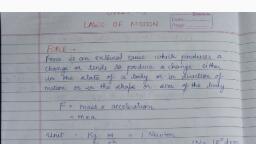
2 Law, nd, , The net force of an object is, equal to the product of its mass, and acceleration, or F=ma.
Page 17 :
2 Law, nd, , , , , , When mass is in kilograms and acceleration is, in m/s/s, the unit of force is in newtons (N)., One newton is equal to the force required to, accelerate one kilogram of mass at one, meter/second/second.
Page 18 :
2 Law (F = m x a), nd, , , , , , , , , , , How much force is needed to accelerate a 1400, kilogram car 2 meters per second/per second?, Write the formula, F=mxa, Fill in given numbers and units, F = 1400 kg x 2 meters per second/second, Solve for the unknown, 2800 kg-meters/second/second or 2800, , N
Page 19 :
If mass remains constant, doubling the acceleration, doubles the force. If force remains, constant, doubling the mass, halves the acceleration.
Page 20 :
Newton’s 2nd Law proves that different masses, accelerate to the earth at the same rate, but, with different forces., , • We know that objects, with different, masses accelerate to, the ground at the, same rate., • However, because of, the 2nd Law we know, that they don’t hit, the ground with the, same force., F = ma, , F = ma, , 98 N = 10 kg x 9.8 m/s/s, , 9.8 N = 1 kg x 9.8 m/s/, s
Page 22 :
Check Your Understanding, , , 1. What acceleration will result when a 12 N net force applied to a 3 kg, object? A 6 kg object?, , , , 2. A net force of 16 N causes a mass to accelerate at a rate of 5 m/s2., Determine the mass., , , , 3. How much force is needed to accelerate a 66 kg skier 1 m/sec/sec?, , , , 4. What is the force on a 1000 kg elevator that is falling freely at 9.8 m/sec/, sec?
Page 23 :
Check Your Understanding, , , 1. What acceleration will result when a 12 N net force applied to a 3 kg object?, 12 N = 3 kg x 4 m/s/s, , , , 2. A net force of 16 N causes a mass to accelerate at a rate of 5 m/s 2. Determine the, mass., 16 N = 3.2 kg x 5 m/s/s, , , , 3. How much force is needed to accelerate a 66 kg skier 1 m/sec/sec?, 66 kg-m/sec/sec or 66 N, , , , 4. What is the force on a 1000 kg elevator that is falling freely at 9.8 m/sec/sec?, , , 9800 kg-m/sec/sec or 9800 N
Page 25 :
3 Law, rd, , , , For every action, there is an, equal and opposite reaction.
Page 26 :
3 Law, rd, , According to Newton,, whenever objects A and, B interact with each, other, they exert forces, upon each other. When, you sit in your chair,, your body exerts a, downward force on the, chair and the chair, exerts an upward force, on your body.
Page 27 :
3 Law, rd, , There are two forces, resulting from this, interaction - a force on, the chair and a force on, your body. These two, forces are called action, and reaction forces.
Page 28 :
Newton’s 3rd Law in Nature, , , , , Consider the propulsion of a, fish through the water. A fish, uses its fins to push water, backwards. In turn, the water, reacts by pushing the fish, forwards, propelling the fish, through the water., The size of the force on the, water equals the size of the, force on the fish; the direction, of the force on the water, (backwards) is opposite the, direction of the force on the, fish (forwards).
Page 29 :
3 Law, rd, , Flying gracefully, through the air,, birds depend on, Newton’s third, law of motion. As, the birds push, down on the air, with their wings,, the air pushes, their wings up
Page 30 :
, , , , , , Consider the flying motion of birds. A bird flies by, use of its wings. The wings of a bird push air, downwards. In turn, the air reacts by pushing the bird, upwards., The size of the force on the air equals the size of the, force on the bird; the direction of the force on the air, (downwards) is opposite the direction of the force on, the bird (upwards)., Action-reaction force pairs make it possible for birds, to fly.
Page 32 :
Other examples of Newton’s, Third Law, , , The baseball forces the, bat to the left (an, action); the bat forces, the ball to the right (the, reaction).
Page 33 :
3, , rd, , , , Consider the motion of, a car on the way to, school. A car is, equipped with wheels, which spin backwards., As the wheels spin, backwards, they grip the, road and push the road, backwards., , Law
Page 34 :
3, , rd, , Law, The reaction of a rocket, is an application of the, third law of motion., Various fuels are burned, in the engine, producing, hot gases., The hot gases push, against the inside tube of, the rocket and escape out, the bottom of the tube., As the gases move, downward, the rocket, moves in the opposite, direction.