Page 1 :
+1 Physics Focus Area Topics, , Chapter - 7 : Systems of Particles and Rotational Motion, , Chapter 7, , 7.6 Angular velocity and its relation with linear velocity, 7.7 Torque and angular Momentum, 7.9 Moment of inertia, 7.10 Theorems of perpendicular and parallel axes, downloaded from HSS REPORTER, , Prepared by : Higher Secondary Physics Teachers Association - Malappuram
Page 2 :
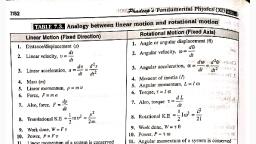
+1 Physics Focus Area Topics, , Chapter - 7 : Systems of Particles and Rotational Motion, , 7.6 Angular velocity and its relation with linear velocity, 𝑑 𝑥Ԧ, Linear Velocity (𝑣Ԧ ) : Time rate of change of linear displacement 𝑣 =, 𝑑𝑡, 𝑑θ, Angular Velocity ( 𝜔 ) : Time rate of change of angular displacement ω =, 𝑑𝑡, Relation Between Linear Velocity And Angular Velocity, , 𝑣Ԧ = 𝜔 × 𝑟Ԧ, where r is the position vector of the particle with respect, to the origin, Translational motion:, All parts of the body having the same linear velocity at any instant of time, , Rotational motion:, All parts of the body having the same angular velocity at any instant of time, downloaded from HSS REPORTER, , Prepared by : Higher Secondary Physics Teachers Association - Malappuram
Page 3 :
+1 Physics Focus Area Topics, , Chapter - 7 : Systems of Particles and Rotational Motion, , Angular Acceleration ( 𝛼Ԧ ), It is time rate of change of angular velocity, , 𝑑𝜔, 𝛼Ԧ =, 𝑑𝑡, , It is analogous to the linear acceleration ( 𝑎Ԧ ) in translational motion, , downloaded from HSS REPORTER, , Prepared by : Higher Secondary Physics Teachers Association - Malappuram
Page 7 :
+1 Physics Focus Area Topics, , Chapter - 7 : Systems of Particles and Rotational Motion, , Conservation of Angular momentum of system of particles, 𝑑𝐿, We know that, = 𝜏𝑒𝑥𝑡, 𝑑𝑡, 𝑑𝐿, 𝑖𝑓 𝜏𝑒𝑥𝑡 = 0, =0, 𝑑𝑡, i.e. 𝐿 = 𝑐𝑜𝑛𝑠𝑡𝑎𝑛𝑡, If the total external torque on a system of particles is zero, then, the total angular momentum of the system is conserved., i.e, remains constant., downloaded from HSS REPORTER, , Prepared by : Higher Secondary Physics Teachers Association - Malappuram
Page 10 :
+1 Physics Focus Area Topics, , Chapter - 7 : Systems of Particles and Rotational Motion, , Moment of inertia of rigid bodies, (i), , Consider a thin ring of radius R and mass M, rotating in its own plane around its, centre., , 𝐼 = 𝑚1 + 𝑚2 + 𝑚3 +. . . . +𝑚𝑛 𝑅 2 𝐼 = 𝑀𝑅 2 or I = MK2, K is called Radius of Gyration , K =, , 𝐼, 𝑀, , (ii) A light rod of length l with a pair of masses rotating about an axis through the, centre of mass of the system and perpendicular to the rod. The total mass of the, system is M, 2, 2, 𝐼=, , 𝑀 𝑙, 2 2, , +, , 𝑀 𝑙, 2 2, , 𝑀 𝑙2, 𝑀 𝑙2, 𝑀𝑙 2, 𝐼=, +, =, 2 4, 2 4, 4, downloaded from HSS REPORTER, , Prepared by : Higher Secondary Physics Teachers Association - Malappuram
Page 11 :
+1 Physics Focus Area Topics, , Chapter - 7 : Systems of Particles and Rotational Motion, , Rigid body, , Axis, , Ring of radius R, and mass M, , Perpendicular to, plane, at centre, , 𝐼 = 𝑀𝑅2, , Disc of radius R, and mass M, , Perpendicular to, plane, at centre, , 𝑀𝑅2, 𝐼=, 2, , Hollow cylinder,, radius R, , Axis of cylinder, , 𝐼 = 𝑀𝑅2, , Solid cylinder,, radius R, , Axis of cylinder, , 𝑀𝑅2, 𝐼=, 2, , Solid Sphere,, radius R, , Diameter, , 2, 𝐼 = 𝑀𝑅2, 5, , Thin rod, length l, , Perpendicular to, rod, at mid point, , 𝑀𝐿2, 𝐼=, 12, , downloaded from HSS REPORTER, , Figure, , Equation, , Prepared by : Higher Secondary Physics Teachers Association - Malappuram
Page 12 :
+1 Physics Focus Area Topics, , Chapter - 7 : Systems of Particles and Rotational Motion, , 7.10 Theorems of perpendicular and parallel axes, Theorem of perpendicular axes, The moment of inertia of a planar body, (lamina) about an axis perpendicular to, its plane is equal to the sum of its, moments of inertia about two, perpendicular axes concurrent with, perpendicular axis and lying in the plane, of the body., 𝑰𝒛 = 𝑰𝒙 + 𝑰𝒚, downloaded from HSS REPORTER, , Prepared by : Higher Secondary Physics Teachers Association - Malappuram
Page 13 :
+1 Physics Focus Area Topics, , Chapter - 7 : Systems of Particles and Rotational Motion, , Theorem of parallel axes, The moment of inertia of a body about any axis, is equal to the sum of the moment of inertia of, the body about a parallel axis passing through, its centre of mass and the product of its mass, and the square of the distance between, the two parallel axes., , 𝑰𝒛 ′ = 𝑰𝒛 + 𝑴𝒂𝟐, , downloaded from HSS REPORTER, , Prepared by : Higher Secondary Physics Teachers Association - Malappuram
Page 15 :
+1 Physics Focus Area Topics, , Chapter - 7 : Systems of Particles and Rotational Motion, , Moment of inertia of a ring about a tangent to the circle of the ring, By the theorem of parallel axes,, , 𝐼𝑧 ′ = 𝐼𝑧 + 𝑀𝑎2, 𝐼𝑡𝑎𝑛𝑔 = 𝐼𝑑𝑖𝑎 + 𝑀𝑅 2, , 𝑀𝑅 2, 𝐼𝑡𝑎𝑛𝑔 =, + 𝑀𝑅 2, 2, 3, 𝐼𝑡𝑎𝑛𝑔 = 𝑀𝑅 2, 2, H.W What is the moment of inertia of a ring about a tangent perpendicular to its plane?, downloaded from HSS REPORTER, , Prepared by : Higher Secondary Physics Teachers Association - Malappuram
Page 16 :
+1 Physics Focus Area Topics, , Chapter - 7 : Systems of Particles and Rotational Motion, , Radius of gyration (k), body, , Axis, , Figure, , Thin circular, ring, radius R, , Perpendicular to, plane, at centre, , Circular disc,, radius R, Circular disc,, radius R, , I, , k, , 𝑀𝑅2, , 𝑅, , Perpendicular to, disc at centre, , 𝑀𝑅2, , 𝑅, , 2, , 2, , Diameter, , 𝑀𝑅2, 4, , 𝑅, 2, , 𝐼 = 𝑀𝑘 2, , Radius of gyration is defined as the distance from the axis of rotation to a point where, total mass of any body is supposed to be concentrated, so that the moment of inertia, about the axis may remain same, downloaded from HSS REPORTER, , Prepared by : Higher Secondary Physics Teachers Association - Malappuram