Page 1 :
CHAPTER EIGHT, , GRAVITATION, , 8.1 INTRODUCTION, , 8.1, 8.2, 8.3, , Introduction, Kepler’s laws, Universal law of, gravitation, 8.4 The gravitational, constant, 8.5 Acceleration due to, gravity of the earth, 8.6 Acceleration due to, gravity below and above, the surface of earth, 8.7 Gravitational potential, energy, 8.8 Escape speed, 8.9 Earth satellites, 8.10 Energy of an orbiting, satellite, 8.11 Geostationary and polar, satellites, 8.12 Weightlessness, Summary, Points to ponder, Exercises, Additional exercises, , Early in our lives, we become aware of the tendency of all, material objects to be attracted towards the earth. Anything, thrown up falls down towards the earth, going uphill is lot, more tiring than going downhill, raindrops from the clouds, above fall towards the earth and there are many other such, phenomena. Historically it was the Italian Physicist Galileo, (1564-1642) who recognised the fact that all bodies,, irrespective of their masses, are accelerated towards the earth, with a constant acceleration. It is said that he made a public, demonstration of this fact. To find the truth, he certainly did, experiments with bodies rolling down inclined planes and, arrived at a value of the acceleration due to gravity which is, close to the more accurate value obtained later., A seemingly unrelated phenomenon, observation of stars,, planets and their motion has been the subject of attention in, many countries since the earliest of times. Observations since, early times recognised stars which appeared in the sky with, positions unchanged year after year. The more interesting, objects are the planets which seem to have regular motions, against the background of stars. The earliest recorded model, for planetary motions proposed by Ptolemy about 2000 years, ago was a ‘geocentric’ model in which all celestial objects,, stars, the sun and the planets, all revolved around the earth., The only motion that was thought to be possible for celestial, objects was motion in a circle. Complicated schemes of motion, were put forward by Ptolemy in order to describe the observed, motion of the planets. The planets were described as moving, in circles with the centre of the circles themselves moving in, larger circles. Similar theories were also advanced by Indian, astronomers some 400 years later. However a more elegant, model in which the Sun was the centre around which the, planets revolved – the ‘heliocentric’ model – was already, mentioned by Aryabhatta (5th century A.D.) in his treatise. A, thousand years later, a Polish monk named Nicolas, , 2021-22
Page 2 :
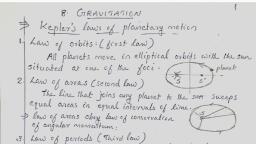
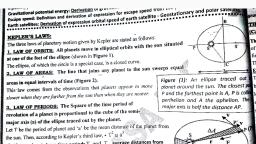
184, , PHYSICS, , Copernicus (1473-1543) proposed a definitive, model in which the planets moved in circles, around a fixed central sun. His theory was, discredited by the church, but notable amongst, its supporters was Galileo who had to face, prosecution from the state for his beliefs., It was around the same time as Galileo, a, nobleman called Tycho Brahe (1546-1601), hailing from Denmark, spent his entire lifetime, recording observations of the planets with the, naked eye. His compiled data were analysed, later by his assistant Johannes Kepler (15711640). He could extract from the data three, elegant laws that now go by the name of Kepler’s, laws. These laws were known to Newton and, enabled him to make a great scientific leap in, proposing his universal law of gravitation., 8.2 KEPLER’S LAWS, The three laws of Kepler can be stated as follows:, 1. Law of orbits : All planets move in elliptical, orbits with the Sun situated at one of the foci, B, , P, , S', , S, , A, , 2b, , of the ellipse (Fig. 8.1a). This law was a deviation, from the Copernican model which allowed only, circular orbits. The ellipse, of which the circle is, a special case, is a closed curve which can be, drawn very simply as follows., Select two points F1 and F2. Take a length, of a string and fix its ends at F1 and F2 by pins., With the tip of a pencil stretch the string taut, and then draw a curve by moving the pencil, keeping the string taut throughout.(Fig. 8.1(b)), The closed curve you get is called an ellipse., Clearly for any point T on the ellipse, the sum of, the distances from F1 and F2 is a constant. F1,, F2 are called the focii. Join the points F1 and F2, and extend the line to intersect the ellipse at, points P and A as shown in Fig. 8.1(b). The, midpoint of the line PA is the centre of the ellipse, O and the length PO = AO is called the semimajor axis of the ellipse. For a circle, the two, focii merge into one and the semi-major axis, becomes the radius of the circle., 2. Law of areas : The line that joins any planet, to the sun sweeps equal areas in equal intervals, of time (Fig. 8.2). This law comes from the, observations that planets appear to move slower, when they are farther from the sun than when, they are nearer., , C, 2a, , Fig. 8.1(a) An ellipse traced out by a planet around, the sun. The closest point is P and the, farthest point is A, P is called the, perihelion and A the aphelion. The, semimajor axis is half the distance AP., , Fig. 8.2 The planet P moves around the sun in an, elliptical orbit. The shaded area is the area, ∆A swept out in a small interval of time ∆t., , Fig. 8.1(b) Drawing an ellipse. A string has its ends, fixed at F1 and F2. The tip of a pencil holds, the string taut and is moved around., , *, , Refer to information given in the Box on Page 182, , 2021-22, , 3. Law of periods : The square of the time period, of revolution of a planet is proportional to the, cube of the semi-major axis of the ellipse traced, out by the planet., Table 8.1 gives the approximate time periods, of revolution of eight* planets around the sun, along with values of their semi-major axes.
Page 3 :
GRAVITATION, , 185, , Table 8.1 Data from measurement of, planetary motions given below, confirm Kepler’s Law of Periods, (a ≡ Semi-major axis in units of 1010 m., T ≡ Time period of revolution of the planet, in years(y)., Q ≡ The quotient ( T2/a3 ) in units of, 10 -34 y2 m-3.), Planet, Mercury, Venus, Earth, Mars, Jupiter, Saturn, Uranus, Neptune, Pluto*, , a, , T, , Q, , 5.79, 10.8, 15.0, 22.8, 77.8, 143, 287, 450, 590, , 0.24, 0.615, 1, 1.88, 11.9, 29.5, 84, 165, 248, , 2.95, 3.00, 2.96, 2.98, 3.01, 2.98, 2.98, 2.99, 2.99, , The law of areas can be understood as a, consequence of conservation of angular, momentum whch is valid for any central force ., A central force is such that the force on the, planet is along the vector joining the Sun and, the planet. Let the Sun be at the origin and let, the position and momentum of the planet be, denoted by r and p respectively. Then the area, swept out by the planet of mass m in time, interval ∆t is (Fig. 8.2) ∆A given by, (8.1), ∆A = ½ (r × v∆t), Hence, ∆A /∆t =½ (r × p)/m, (since v = p/m), = L / (2 m), (8.2), where v is the velocity, L is the angular, momentum equal to ( r × p). For a central, force, which is directed along r, L is a constant, Johannes, Kepler, (1571–1630) was a, scientist of German, origin. He formulated, the three laws of, planetary motion based, on the painstaking, observations of Tycho, Brahe and coworkers. Kepler himself was an, assistant to Brahe and it took him sixteen long, years to arrive at the three planetary laws. He, is also known as the founder of geometrical, optics, being the first to describe what happens, to light after it enters a telescope., , *, , as the planet goes around. Hence, ∆ A /∆t is a, constant according to the last equation. This is, the law of areas. Gravitation is a central force, and hence the law of areas follows., t Example 8.1 Let the speed of the planet, at the perihelion P in Fig. 8.1(a) be vP and, the Sun-planet distance SP be rP. Relate, {rP, vP} to the corresponding quantities at, the aphelion {rA, vA}. Will the planet take, equal times to traverse BAC and CPB ?, Answer The magnitude of the angular, momentum at P is Lp = mp rp vp, since inspection, tells us that r p and v p are mutually, perpendicular. Similarly, LA = mp rA vA . From, angular momentum conservation, mp rp vp = mp rA vA, vp, , or, , vA, , =, , rA, rp, , t, , Since rA > rp, vp > vA ., The area SBAC bounded by the ellipse and, the radius vectors SB and SC is larger than SBPC, in Fig. 8.1. From Kepler’s second law, equal areas, are swept in equal times. Hence the planet will, take a longer time to traverse BAC than CPB., 8.3 UNIVERSAL LAW OF GRAVITATION, Legend has it that observing an apple falling, from a tree, Newton was inspired to arrive at an, universal law of gravitation that led to an, explanation of terrestrial gravitation as well as, of Kepler’s laws. Newton’s reasoning was that, the moon revolving in an orbit of radius Rm was, subject to a centripetal acceleration due to, earth’s gravity of magnitude, am =, , 4π 2 Rm, V2, =, Rm, T2, , (8.3), , where V is the speed of the moon related to the, time period T by the relation V = 2π Rm / T . The, time period T is about 27.3 days and Rm was, already known then to be about 3.84 × 10⁸m. If, we substitute these numbers in Eq. (8.3), we, get a value of am much smaller than the value of, acceleration due to gravity g on the surface of, the earth, arising also due to earth’s gravitational, attraction., , Refer to information given in the Box on Page 182, , 2021-22
Page 4 :
186, , PHYSICS, , Central Forces, We know the time rate of change of the angular momentum of a single particle about the origin, is, , dl, =r ×F, dt, The angular momentum of the particle is conserved, if the torque τ = r × F due to the, force F on it vanishes. This happens either when F is zero or when F is along r. We are, interested in forces which satisfy the latter condition. Central forces satisfy this condition., A ‘central’ force is always directed towards or away from a fixed point, i.e., along the position, vector of the point of application of the force with respect to the fixed point. (See Figure below.), Further, the magnitude of a central force F depends on r, the distance of the point of application, of the force from the fixed point; F = F(r)., In the motion under a central force the angular momentum is always conserved. Two important, results follow from this:, (1) The motion of a particle under the central force is always confined to a plane., (2) The position vector of the particle with respect to the centre of the force (i.e. the fixed point), has a constant areal velocity. In other words the position vector sweeps out equal areas in, equal times as the particle moves under the influence of the central force., Try to prove both these results. You may need to know that the areal velocity is given by :, dA/dt = ½ r v sin α., An immediate application of the above discussion can be made to the motion of a planet, under the gravitational force of the sun. For convenience the sun may be taken to be so heavy, that it is at rest. The gravitational force of the sun on the planet is directed towards the sun., This force also satisfies the requirement F = F(r), since F = G m1m2/r2 where m1 and m2 are, respectively the masses of the planet and the sun and G is the universal constant of gravitation., The two results (1) and (2) described above, therefore, apply to the motion of the planet. In fact,, the result (2) is the well-known second law of Kepler., , Tr is the trejectory of the particle under the central force. At a position P, the force is directed, along OP, O is the centre of the force taken as the origin. In time ∆t, the particle moves from P to P′,, arc PP′ = ∆s = v ∆t. The tangent PQ at P to the trajectory gives the direction of the velocity at P. The, area swept in ∆t is the area of sector POP′ ≈ (r sin α ) PP′/2 = (r v sin a) ∆t/2.), , 2021-22
Page 5 :
GRAVITATION, , 187, , This clearly shows that the force due to, earth’s gravity decreases with distance. If one, assumes that the gravitational force due to the, earth decreases in proportion to the inverse, square of the distance from the centre of the, −2, 2, earth, we will have am α Rm, ; g α R−, and we get, E, , R2, g, = m2, am RE, , 3600, , (8.4), , in agreement with a value of g 9.8 m s-2 and, the value of am from Eq. (8.3). These observations, led Newton to propose the following Universal Law, of Gravitation :, Every body in the universe attracts every other, body with a force which is directly proportional, to the product of their masses and inversely, proportional to the square of the distance, between them., The quotation is essentially from Newton’s, famous treatise called ‘Mathematical Principles, of Natural Philosophy’ (Principia for short)., Stated Mathematically, Newton’s gravitation, law reads : The force F on a point mass m 2 due, to another point mass m 1 has the magnitude, |F | = G, , m1 m 2, r2, , The gravitational force is attractive, i.e., the, force F is along – r. The force on point mass m 1, due to m 2 is of course – F by Newton’s third law., Thus, the gravitational force F12 on the body 1, due to 2 and F21 on the body 2 due to 1 are related, as F12 = – F21., Before we can apply Eq. (8.5) to objects under, consideration, we have to be careful since the, law refers to point masses whereas we deal with, extended objects which have finite size. If we have, a collection of point masses, the force on any, one of them is the vector sum of the gravitational, forces exerted by the other point masses as, shown in Fig 8.4., , (8.5), , Equation (8.5) can be expressed in vector form as, F= G, , = –G, , m1 m 2, m1 m 2 $, r, – r$ = – G, r2, r2, , ( ), , m1 m 2 $, r, 3, r, , where G is the universal gravitational constant,, r$ is the unit vector from m 1 to m 2 and r = r2 – r1, as shown in Fig. 8.3., , O, , Fig. 8.3 Gravitational force on m1 due to m2 is along, r where the vector r is (r2– r1)., , Fig. 8.4 Gravitational force on point mass m1 is the, vector sum of the gravitational forces exerted, by m2, m3 and m4., The total force on m 1 is, , F1 =, , Gm 2 m1 $, Gm 3 m1 $, Gm 4 m1 $, r 21 +, r 31 +, r 41, 2, 2, 2, r21, r31, r41, , t Example 8.2 Three equal masses of m kg, each are fixed at the vertices of an, equilateral triangle ABC., (a) What is the force acting on a mass 2m, placed at the centroid G of the triangle ?, (b) What is the force if the mass at the, vertex A is doubled ?, Take AG = BG = CG = 1 m (see Fig. 8.5), Answer (a) The angle between GC and the, positive x-axis is 30° and so is the angle between, GB and the negative x-axis. The individual forces, in vector notation are, , 2021-22
Page 6 :
188, , PHYSICS, , (b) Now if the mass at vertex A is doubled, then, , t, , Fig. 8.5 Three equal masses are placed at the three, vertices of the ∆ ABC. A mass 2m is placed, at the centroid G., , FGA =, , Gm (2m ) ˆ, j, 1, , FGB =, , Gm (2m ) ˆ, − i cos 30ο − ˆj sin 30ο, 1, , (, , ), , Gm (2m ) ˆ, + i cos 30ο − ˆj sin 30ο, 1, From the principle of superposition and the law, of vector addition, the resultant gravitational, force FR on (2m) is, FR = FGA + FGB + FGC, , (, , FGC =, , ), , (, , FR = 2Gm2 ˆj + 2Gm 2 −ˆi cos 30ο −ˆj sin 30ο, + 2Gm, , 2, , ( ˆi cos 30, , ο, , − ˆj sin 30, , ο, , ), , )= 0, , Alternatively, one expects on the basis of, symmetry that the resultant force ought to be, zero., , For the gravitational force between an extended, object (like the earth) and a point mass, Eq. (8.5) is not, directly applicable. Each point mass in the extended, object will exert a force on the given point mass and, these force will not all be in the same direction. We, have to add up these forces vectorially for all the point, masses in the extended object to get the total force., This is easily done using calculus. For two special, cases, a simple law results when you do that :, (1) The force of attraction between a hollow, spherical shell of uniform density and a, point mass situated outside is just as if, the entire mass of the shell is, concentrated at the centre of the shell., Qualitatively this can be understood as, follows: Gravitational forces caused by the, various regions of the shell have components, along the line joining the point mass to the, centre as well as along a direction, prependicular to this line. The components, prependicular to this line cancel out when, summing over all regions of the shell leaving, only a resultant force along the line joining, the point to the centre. The magnitude of, this force works out to be as stated above., , Newton’s Principia, Kepler had formulated his third law by 1619. The announcement of the underlying universal law of, gravitation came about seventy years later with the publication in 1687 of Newton’s masterpiece, Philosophiae Naturalis Principia Mathematica, often simply called the Principia., Around 1685, Edmund Halley (after whom the famous Halley’s comet is named), came to visit, Newton at Cambridge and asked him about the nature of the trajectory of a body moving under the, influence of an inverse square law. Without hesitation Newton replied that it had to be an ellipse,, and further that he had worked it out long ago around 1665 when he was forced to retire to his farm, house from Cambridge on account of a plague outbreak. Unfortunately, Newton had lost his papers., Halley prevailed upon Newton to produce his work in book form and agreed to bear the cost of, publication. Newton accomplished this feat in eighteen months of superhuman effort. The Principia, is a singular scientific masterpiece and in the words of Lagrange it is “the greatest production of the, human mind.” The Indian born astrophysicist and Nobel laureate S. Chandrasekhar spent ten years, writing a treatise on the Principia. His book, Newton’s Principia for the Common Reader brings, into sharp focus the beauty, clarity and breath taking economy of Newton’s methods., , 2021-22
Page 7 :
GRAVITATION, , (2), , The force of attraction due to a hollow, spherical shell of uniform density, on a, point mass situated inside it is zero., Qualitatively, we can again understand this, result. Various regions of the spherical shell, attract the point mass inside it in various, directions. These forces cancel each other, completely., , 8.4 THE GRAVITATIONAL CONSTANT, The value of the gravitational constant G, entering the Universal law of gravitation can be, determined experimentally and this was first, done by English scientist Henry Cavendish in, 1798. The apparatus used by him is, schematically shown in figure.8.6, , 189, , its neighbouring small sphere. Due to this, torque, the suspended wire gets twisted till such, time as the restoring torque of the wire equals, the gravitational torque . If θ is the angle of twist, of the suspended wire, the restoring torque is, proportional to θ, equal to τθ. Where τ is the, restoring couple per unit angle of twist. τ can be, measured independently e.g. by applying a, known torque and measuring the angle of twist., The gravitational force between the spherical, balls is the same as if their masses are, concentrated at their centres. Thus if d is the, separation between the centres of the big and, its neighbouring small ball, M and m their, masses, the gravitational force between the big, sphere and its neighouring small ball is., , Mm, (8.6), d2, If L is the length of the bar AB , then the, torque arising out of F is F multiplied by L. At, equilibrium, this is equal to the restoring torque, and hence, F =G, , Mm, L =τ θ, (8.7), d2, Observation of θ thus enables one to, calculate G from this equation., Since Cavendish’s experiment, the, measurement of G has been refined and the, currently accepted value is, G = 6.67×10⁻¹¹ N m2/kg2, (8.8), G, , Fig. 8.6 Schematic drawing of Cavendish’s, experiment. S1 and S2 are large spheres, which are kept on either side (shown shades), of the masses at A and B. When the big, spheres are taken to the other side of the, masses (shown by dotted circles), the bar, AB rotates a little since the torque reverses, direction. The angle of rotation can be, measured experimentally., , The bar AB has two small lead spheres, attached at its ends. The bar is suspended from, a rigid support by a fine wire. Two large lead, spheres are brought close to the small ones but, on opposite sides as shown. The big spheres, attract the nearby small ones by equal and, opposite force as shown. There is no net force, on the bar but only a torque which is clearly, equal to F times the length of the bar,where F is, the force of attraction between a big sphere and, , 8.5 ACCELERATION DUE TO GRAVITY OF, THE EARTH, The earth can be imagined to be a sphere made, of a large number of concentric spherical shells, with the smallest one at the centre and the, largest one at its surface. A point outside the, earth is obviously outside all the shells. Thus,, all the shells exert a gravitational force at the, point outside just as if their masses are, concentrated at their common centre according, to the result stated in section 8.3. The total mass, of all the shells combined is just the mass of the, earth. Hence, at a point outside the earth, the, gravitational force is just as if its entire mass of, the earth is concentrated at its centre., For a point inside the earth, the situation, is different. This is illustrated in Fig. 8.7., , 2021-22
Page 8 :
190, , PHYSICS, , The acceleration experienced by the mass m,, which is usually denoted by the symbol g is, related to F by Newton’s 2nd law by relation, F = mg. Thus, g=, , Mr, , Fig. 8.7 The mass m is in a mine located at a depth, d below the surface of the Earth of mass, M E and radius RE . We treat the Earth to be, spherically symmetric., , Again consider the earth to be made up of, concentric shells as before and a point mass m, situated at a distance r from the centre. The, point P lies outside the sphere of radius r. For, the shells of radius greater than r, the point P, lies inside. Hence according to result stated in, the last section, they exert no gravitational force, on mass m kept at P. The shells with radius ≤ r, make up a sphere of radius r for which the point, P lies on the surface. This smaller sphere, therefore exerts a force on a mass m at P as if, its mass M r is concentrated at the centre. Thus, the force on the mass m at P has a magnitude, , F GM E, =, m, R E2, , (8.12), , Acceleration g is readily measurable. RE is a, known quantity. The measurement of G by, Cavendish’s experiment (or otherwise), combined, with knowledge of g and R E enables one to, estimate M E from Eq. (8.12). This is the reason, why there is a popular statement regarding, Cavendish : “Cavendish weighed the earth”., 8.6 ACCELERATION DUE TO GRAVITY, BELOW AND ABOVE THE SURFACE OF, EARTH, Consider a point mass m at a height h above the, surface of the earth as shown in Fig. 8.8(a). The, radius of the earth is denoted by RE . Since this, point is outside the earth,, , Gm (M r ), (8.9), r2, We assume that the entire earth is of uniform, F =, , 4π 3, RE ρ, 3, where M E is the mass of the earth RE is its radius, and ρ is the density. On the other hand the, density and hence its mass is M E =, , mass of the sphere M r of radius r is, , 4π, ρ r 3 and, 3, , Fig. 8.8 (a) g at a height h above the surface of the, earth., , hence, , G m ME, r, (8.10), RE 3, If the mass m is situated on the surface of, earth, then r = RE and the gravitational force on, it is, from Eq. (8.10), =, , F =G, , M Em, R E2, , its distance from the centre of the earth is (RE +, h ). If F (h) denoted the magnitude of the force, on the point mass m , we get from Eq. (8.5) :, F (h ) =, , GM E m, (R E + h )2, , (8.13), , The acceleration experienced by the point, (8.11), , 2021-22, , mass is F (h )/ m ≡ g(h ) and we get
Page 9 :
GRAVITATION, , 191, , GM E, F (h ), =, ., (8.14), m, (R E + h )2, This is clearly less than the value of g on the, GM E, surface of earth : g = R 2 . For h << RE , we can, E, expand the RHS of Eq. (8.14) :, GM E, −2, = g (1 + h / R E ), g(h ) = 2, R E (1 + h / RE )2, g(h ) =, , Thus the force on the point mass is, F (d) = G M s m / (RE – d ) 2, , F (d) = G M E m ( RE – d ) / RE3, (8.18), and hence the acceleration due to gravity at, a depth d,, g(d) =, , h, For R <<1 , using binomial expression,, E, , , 2h , g (h ) ≅ g 1 −, ., (8.15), R E , , Equation (8.15) thus tells us that for small, heights h above the value of g decreases by a, factor (1 − 2h / RE )., Now, consider a point mass m at a depth d, below the surface of the earth (Fig. 8.8(b)), so, that its distance from the centre of the earth is, , ( RE − d ) as shown in the figure. The earth can, be thought of as being composed of a smaller, sphere of radius (RE – d ) and a spherical shell, of thickness d. The force on m due to the outer, shell of thickness d is zero because the result, quoted in the previous section. As far as the, smaller sphere of radius ( RE – d ) is concerned,, the point mass is outside it and hence according, to the result quoted earlier, the force due to this, smaller sphere is just as if the entire mass of, the smaller sphere is concentrated at the centre., If M s is the mass of the smaller sphere, then,, M s/ME = ( RE – d)3 / RE3, ( 8.16), Since mass of a sphere is proportional to be, cube of its radius., , Ms, , ME, , Fig. 8.8 ( b ) g at a depth d. In this case only the, smaller sphere of radius (R E –d), contributes to g., , (8.17), , Substituting for Ms from above , we get, , g (d ) =, , =g, , F (d ), is, m, F (d ) GM E, (RE − d ), =, m, R E3, , RE − d, = g(1 − d / R E ), RE, , (8.19), , Thus, as we go down below earth’s surface,, the acceleration due gravity decreases by a factor, , (1 − d / RE ). The remarkable thing about, acceleration due to earth’s gravity is that it is, maximum on its surface decreasing whether you, go up or down., 8.7 GRAVITATIONAL POTENTIAL ENERGY, We had discussed earlier the notion of potential, energy as being the energy stored in the body at, its given position. If the position of the particle, changes on account of forces acting on it, then, the change in its potential energy is just the, amount of work done on the body by the force., As we had discussed earlier, forces for which, the work done is independent of the path are, the conservative forces., The force of gravity is a conservative force, and we can calculate the potential energy of a, body arising out of this force, called the, gravitational potential energy. Consider points, close to the surface of earth, at distances from, the surface much smaller than the radius of the, earth. In such cases, the force of gravity is, practically a constant equal to mg, directed, towards the centre of the earth. If we consider, a point at a height h 1 from the surface of the, earth and another point vertically above it at a, height h2 from the surface, the work done in, lifting the particle of mass m from the first to, the second position is denoted by W12, W12 = Force × displacement, = mg (h 2 – h 1), (8.20), , 2021-22
Page 10 :
192, , PHYSICS, , If we associate a potential energy W(h) at a, point at a height h above the surface such that, W(h) = mgh + Wo, (8.21), (where Wo = constant) ;, then it is clear that, W12 = W(h2) – W(h1), (8.22), The work done in moving the particle is just, the difference of potential energy between its, final and initial positions.Observe that the, constant Wo cancels out in Eq. (8.22). Setting, h = 0 in the last equation, we get W ( h = 0 ) =, Wo. . h = 0 means points on the surface of the, earth. Thus, Wo is the potential energy on the, surface of the earth., If we consider points at arbitrary distance, from the surface of the earth, the result just, derived is not valid since the assumption that, the gravitational force mg is a constant is no, longer valid. However, from our discussion we, know that a point outside the earth, the force of, gravitation on a particle directed towards the, centre of the earth is, , G ME m, (8.23), r2, where ME = mass of earth, m = mass of the, particle and r its distance from the centre of the, earth. If we now calculate the work done in, lifting a particle from r = r1 to r = r2 (r2 > r1) along, a vertical path, we get instead of Eq. (8.20), F=, , W12 = ∫, , r2, , r1, , GMm, dr, r2, , 1 1, = −G ME m − , r2 r1 , , We have calculated the potential energy at, a point of a particle due to gravitational forces, on it due to the earth and it is proportional to, the mass of the particle. The gravitational, potential due to the gravitational force of the, earth is defined as the potential energy of a, particle of unit mass at that point. From the, earlier discussion, we learn that the gravitational, potential energy associated with two particles, of masses m1 and m2 separated by distance by a, distance r is given by, , Gm1m 2, (if we choose V = 0 as r → ∞ ), r, It should be noted that an isolated system, of particles will have the total potential energy, that equals the sum of energies (given by the, above equation) for all possible pairs of its, constituent particles. This is an example of the, application of the superposition principle., V =–, , t Example 8.3 Find the potential energy of, a system of four particles placed at the, vertices of a square of side l. Also obtain, the potential at the centre of the square., Answer Consider four masses each of mass m, at the corners of a square of side l ; See Fig. 8.9., We have four mass pairs at distance l and two, diagonal pairs at distance 2 l, Hence,, W (r ) = − 4, , (8.24), , G m2, G m2, −2, l, 2l, , In place of Eq. (8.21), we can thus associate, a potential energy W(r) at a distance r, such that, , G ME m, + W1 ,, (8.25), r, valid for r > R ,, so that once again W12 = W(r 2 ) – W(r 1)., Setting r = infinity in the last equation, we get, W ( r = infinity ) = W1 . Thus, W1 is the, potential energy at infinity. One should note that, only the difference of potential energy between, two points has a definite meaning from Eqs., (8.22) and (8.24). One conventionally sets W1, equal to zero, so that the potential energy at a, point is just the amount of work done in, displacing the particle from infinity to that point., W (r ) = −, , 2021-22, , Fig. 8.9
Page 11 :
GRAVITATION, , =−, , 193, , 2G m2, l, , Thus, the minimum speed required for an object, to reach infinity (i.e. escape from the earth), corresponds to, , 1 , G m2, , 2 +, = − 5.41, l, 2, , , The gravitational potential at the centre of, the square, , (r =, , U (r ) = − 4 2, , 1, m Vi2, 2, , ( ), , ), , 2 l/2 is, Gm, ., l, , t, , E ( ∞) = W1 +, , (Vi )min, , mV f2, , (8.26), , 2, , If the object was thrown initially with a speed, Vi from a point at a distance (h+RE) from the, centre of the earth (RE = radius of the earth), its, energy initially was, E (h + R E ) =, , GmM E, 1, mVi2 –, + W1, 2, (h + R E ), , (8.27), , By the principle of energy conservation, Eqs. (8.26) and (8.27) must be equal. Hence, 2, , mV f, mVi2, GmM E, –, =, 2, (h + R E ), 2, , (8.28), , =, , GmM E, h + RE, , (8.30), , If the object is thrown from the surface of, the earth, h = 0, and we get, , 8.8 ESCAPE SPEED, If a stone is thrown by hand, we see it falls back, to the earth. Of course using machines we can, shoot an object with much greater speeds and, with greater and greater initial speed, the object, scales higher and higher heights. A natural, query that arises in our mind is the following:, ‘can we throw an object with such high initial, speeds that it does not fall back to the earth?’, The principle of conservation of energy helps, us to answer this question. Suppose the object, did reach infinity and that its speed there was, Vf . The energy of an object is the sum of potential, and kinetic energy. As before W1 denotes that, gravitational potential energy of the object at, infinity. The total energy of the projectile at, infinity then is, , min, , =, , 2GM E, RE, , (8.31), , Using the relation g = GM E / RE2 , we get, , (Vi )min, , = 2gR E, , (8.32), , Using the value of g and RE , numerically, (V i) min≈11.2 km/s. This is called the escape, speed, sometimes loosely called the escape, velocity., Equation (8.32) applies equally well to an, object thrown from the surface of the moon with, g replaced by the acceleration due to Moon’s, gravity on its surface and r E replaced by the, radius of the moon. Both are smaller than their, values on earth and the escape speed for the, moon turns out to be 2.3 km/s, about five times, smaller. This is the reason that moon has no, atmosphere. Gas molecules if formed on the, surface of the moon having velocities larger than, this will escape the gravitational pull of the, moon., t Example 8.4 Two uniform solid spheres, of equal radii R, but mass M and 4 M have, a centre to centre separation 6 R, as shown, in Fig. 8.10. The two spheres are held fixed., A projectile of mass m is projected from, the surface of the sphere of mass M directly, towards the centre of the second sphere., Obtain an expression for the minimum, speed v of the projectile so that it reaches, the surface of the second sphere., , The R.H.S. is a positive quantity with a, minimum value zero hence so must be the L.H.S., Thus, an object can reach infinity as long as Vi, is such that, mVi2, GmM E, –, ≥0, 2, (h + R E ), , (8.29), , The minimum value of Vi corresponds to the, case when the L.H.S. of Eq. (8.29) equals zero., , Fig. 8.10, , Answer The projectile is acted upon by two, mutually opposing gravitational forces of the two, , 2021-22
Page 12 :
194, , PHYSICS, , spheres. The neutral point N (see Fig. 8.10) is, defined as the position where the two forces, cancel each other exactly. If ON = r, we have, GMm, r2, , =, , 4G M m, , (6 R −r )2, , 2, , (6R – r) = 4r2, 6R – r = ±2r, r = 2R or – 6R., The neutral point r = – 6R does not concern, us in this example. Thus ON = r = 2R. It is, sufficient to project the particle with a speed, which would enable it to reach N. Thereafter,, the greater gravitational pull of 4M would, suffice. The mechanical energy at the surface, of M is, Ei =, , 4G M m, 1, GMm, m v2 −, −, ., 5R, 2, R, , G M m 4G M m, −, ., 2R, 4R, , 2, , 2, , v −, , GM, , −, , R, , 4GM, 5R, , =−, , GM, 2R, , −, , GM, R, , G m ME, (8.34), ( R E + h )2, where ME is the mass of the earth., Equating R.H.S of Eqs. (8.33) and (8.34) and, cancelling out m, we get, G ME, (8.35), (RE + h ), Thus V decreases as h increases. From, equation (8.35),the speed V for h = 0 is, , (8.36), relation, , g = GM / RE 2 . In every orbit, the satellite, , 2G M 4 1 , − , R 5 2, 1/2, , 3G M , v =, , 5R , , directed towards the centre. This centripetal force, is provided by the gravitational force, which is, , V 2 (h = 0) = GM / R E = gRE, where we have used the, , or, v2 =, , (8.33), , V2 =, , From the principle of conservation of, mechanical energy, 1, , mV 2, F(centripetal) = ( R + h ), E, , F(gravitation) =, , At the neutral point N, the speed approaches, zero. The mechanical energy at N is purely, potential., EN = −, , its own axis. Since, 1957, advances in, technology have enabled many countries, including India to launch artificial earth, satellites for practical use in fields like, telecommunication,, geophysics, and, meteorology., We will consider a satellite in a circular orbit, of a distance (RE + h ) from the centre of the earth,, where RE = radius of the earth. If m is the mass, of the satellite and V its speed, the centripetal, force required for this orbit is, , t, , A point to note is that the speed of the projectile, is zero at N, but is nonzero when it strikes the, heavier sphere 4 M. The calculation of this speed, is left as an exercise to the students., 8.9 EARTH SATELLITES, Earth satellites are objects which revolve around, the earth. Their motion is very similar to the, motion of planets around the Sun and hence, Kepler’s laws of planetary motion are equally, applicable to them. In particular, their orbits, around the earth are circular or elliptic. Moon, is the only natural satellite of the earth with a, near circular orbit with a time period of, approximately 27.3 days which is also roughly, equal to the rotational period of the moon about, , 2021-22, , traverses a distance 2π(RE + h) with speed V. Its, time period T therefore is, 2π ( R E + h ) 2π (R E + h )3 / 2, T =, =, (8.37), V, G ME, on substitution of value of V from Eq. (8.35)., Squaring both sides of Eq. (8.37), we get, T 2 = k ( RE + h)3 (where k = 4 π2 / GME), , (8.38), , which is Kepler’s law of periods, as applied to, motion of satellites around the earth. For a, satellite very close to the surface of earth h can, be neglected in comparison to RE in Eq. (8.38)., Hence, for such satellites, T is To, where, T0 = 2π R E / g, , (8.39), , If we substitute the numerical values, g � 9.8 m s-2 and RE = 6400 km., we get, 6.4 × 10⁶, s, 9.8, Which is approximately 85 minutes., T0 = 2π
Page 13 :
GRAVITATION, , 195, , t Example 8.5 The planet Mars has two, moons, phobos and delmos. (i) phobos has, a period 7 hours, 39 minutes and an orbital, radius of 9.4 ×10³ km. Calculate the mass, of mars. (ii) Assume that earth and mars, move in circular orbits around the sun,, with the martian orbit being 1.52 times, the orbital radius of the earth. What is, the length of the martian year in days ?, , =, , T, , 4π, , =, , Mm =, , =, , 4π, G, , 2, , R, , T2 =, , R, T, , 2, , 18, , 2, , 3, , -11, , × ( 459 × 60), 3, , 18, , 4 × ( 3.14 ) × ( 9.4 ) × 10, , aid,, 2, , 3, , R MS, , = 3, 2, TE, R ES, where RMS is the mars -sun distance and RES is, the earth-sun distance., ∴ TM = (1.52)3/2 × 365, = 684 days, We note that the orbits of all planets except, Mercury, Mars and Pluto* are very close to, being circular. For example, the ratio of the, semi-minor to semi-major axis for our Earth, is, b/a = 0.99986., t, t Example 8.6 Weighing the Earth : You, are given the following data: g = 9.81 ms–2,, RE = 6.37×10⁶ m, the distance to the moon, R = 3.84×10⁸ m and the time period of the, moon’s revolution is 27.3 days. Obtain the, mass of the Earth ME in two different ways., , *, , 6.67 × 10, , -11, , 24, , × ( 27.3 × 24 × 60 × 60), , 2, , = 6.02 × 10 kg, Both methods yield almost the same answer,, the difference between them being less than 1%., t, , t Example 8.7 Express the constant k of, Eq. (8.38) in days and kilometres. Given, k = 10–13 s2 m–3. The moon is at a distance, of 3.84 × 10⁵ km from the earth. Obtain its, time-period of revolution in days., , Answer Given, k = 10–13 s2 m–3, = 10, , −13, , , , , 1, 1, 2, , , d , 3, 3, ( 24 × 60 × 60) 2, (1 / 1000) km , , = 1.33 ×10⁻¹⁴ d2 km–3, Using Eq. (8.38) and the given value of k,, the time period of the moon is, T 2 = (1.33 × 10⁻¹⁴)(3.84 × 10⁵)3, T = 27.3 d, t, Note that Eq. (8.38) also holds for elliptical, orbits if we replace (RE+h) by the semi-major, axis of the ellipse. The earth will then be at one, of the foci of this ellipse., 8.10 ENERGY OF AN ORBITING SATELLITE, Using Eq. (8.35), the kinetic energy of the satellite, in a circular orbit with speed v is, 1, m v2, 2, Gm M E, =, 2(R E + h ) ,, K iE =, , Answer From Eq. (8.12) we have, ME =, , 4 × 3.14 × 3.14 × ( 3.84 ) × 10, , 2, , -5, 2, 6.67 × ( 4.59 × 6) × 10, = 6.48 × 10²³ kg., (ii) Once again Kepler’s third law comes to our, , TM, , G T2, , 24, , 2, , Mm =, , 4π2R 3, 3, , =, , 4 × ( 3.14) × ( 9.4) × 10, 6.67 × 10, , 4π2R 3, G ME, , ME =, , 3, , 3, , ), , -11, , 2, , GM m, , 6 2, , 6.67 × 10, = 5.97× 1024 kg., The moon is a satellite of the Earth. From, the derivation of Kepler’s third law [see Eq., (8.38)], , Answer (i) We employ Eq. (8.38) with the sun’s, mass replaced by the martian mass Mm, 2, , (, , 9.81 × 6.37 × 10, , g R2E, G, , Refer to information given in the Box on Page 182, , 2021-22, , (8.40)
Page 14 :
196, , PHYSICS, , Considering gravitational potential energy at, infinity to be zero, the potential energy at distance, (R +h) from the centre of the earth is, e, , G m ME, P .E = −, (R E + h ), , (8.41), , The K.E is positive whereas the P.E is, negative. However, in magnitude the K.E. is half, the P.E, so that the total E is, , E = K .E + P .E = −, , G m ME, 2( R E + h ), , (8.42), , 8.11, , GEOSTATIONARY, SATELLITES, , AND, , POLAR, , An interesting phenomenon arises if in we, arrange the value of (R + h) such that T in, Eq. (8.37) becomes equal to 24 hours. If the, circular orbit is in the equatorial plane of the, earth, such a satellite, having the same period, as the period of rotation of the earth about its, own axis would appear stationery viewed from, a point on earth. The (R + h) for this purpose, works out to be large as compared to R :, E, , E, , E, , The total energy of an circularly orbiting, satellite is thus negative, with the potential, energy being negative but twice is magnitude of, the positive kinetic energy., When the orbit of a satellite becomes, elliptic, both the K.E. and P.E. vary from point, to point. The total energy which remains, constant is negative as in the circular orbit case., This is what we expect, since as we have, discussed before if the total energy is positive or, zero, the object escapes to infinity. Satellites, are always at finite distance from the earth and, hence their energies cannot be positive or zero., t Example 8.8 A 400 kg satellite is in a circular, orbit of radius 2RE about the Earth. How much, energy is required to transfer it to a circular, orbit of radius 4RE ? What are the changes in, the kinetic and potential energies ?, , 1/ 3, , T G ME , RE + h = , , 2, 4π, , 2, , (8.43), , and for T = 24 hours, h works out to be 35800 km., which is much larger than R . Satellites in a, circular orbits around the earth in the, equatorial plane with T = 24 hours are called, Geostationery Satellites. Clearly, since the earth, rotates with the same period, the satellite would, appear fixed from any point on earth. It takes, very powerful rockets to throw up a satellite to, such large heights above the earth but this has, been done in view of the several benefits of many, practical applications., E, , Answer Initially,, Ei = −, , G ME m, 4 RE, , While finally, Ef = −, , G ME m, 8 RE, , The change in the total energy is, ∆E = Ef – Ei, =, , ∆E =, , G M E m G M E, =, R2, 8 RE, E, , , m RE, , 8, , , g m RE 9.81 × 400 × 6.37 × 106, =, = 3.13 × 10⁹ J, 8, 8, , The kinetic energy is reduced and it mimics, ∆E, namely, ∆K = Kf – Ki = – 3.13 × 10⁹ J., The change in potential energy is twice the, change in the total energy, namely, ∆V = Vf – Vi = – 6.25 × 10⁹ J, t, , 2021-22, , Fig. 8.11 A Polar satellite. A strip on earth’s surface, (shown shaded) is visible from the satellite, during one cycle. For the next revolution of, the satellite, the earth has rotated a little, on its axis so that an adjacent strip becomes, visible., , It is known that electromagnetic waves above, a certain frequency are not reflected from, ionosphere. Radio waves used for radio, broadcast which are in the frequency range 2, MHz to 10 MHz, are below the critical frequency., They are therefore reflected by the ionosphere.
Page 15 :
GRAVITATION, , 197, , India’s Leap into Space, India started its space programme in 1962 when Indian National Committee for Space Research was set, up by the Government of India which was superseded by the Indian Space Research Organisation (ISRO), in 1969. ISRO identified the role and importance of space technology in nation’s development and, bringing space to the service of the common man. India launched its first low orbit satellite Aryabhata in, 1975, for which the launch vehicle was provided by the erstwhile Soviet Union. ISRO started employing its, indigenous launching vehicle in 1979 by sending Rohini series of satellites into space from its main, launch site at Satish Dhawan Space Center, Sriharikota, Andhra Pradesh. The tremendous progress in, India’s space programme has made ISRO one of the six largest space agencies in the world. ISRO, develops and delivers application specific satellite products and tools for broadcasts, communication,, weather forecasts, disaster management tools, Geographic Information System, cartography, navigation,, telemedicine, dedicated distance education satellite etc. In order to achieve complete self-reliance in, these applications, cost effective and reliable Polar Satellite Launch Vehicle (PSLV) was developed in, early 1990s. PSLV has thus become a favoured carrier for satellites of various countries, promoting, unprecedented international collaboration. In 2001, the Geosynchronous Satellite Launch Vehicle (GSLV), was developed for launching heavier and more demanding Geosynchronous communication satellites., Various research centers and autonomous institutions for remote sensing, astronomy and astrophysics,, atmospheric sciences and space research are functioning under the aegis of the Department of Space,, Government of India. Success of lunar (Chandrayaan) and inter planetary (Mangalyaan) missions along, with other scientific projects has been landmark achievements of ISRO. Future endeavors of ISRO include human space flight projects, the development of heavy lift launchers, reusable launch vehicles,, semi-cryogenic engines, single and two stage to orbit (SSTO and TSTO) vehicles, development and use of, composite materials for space application etc. In 1984 Rakesh Sharma became the first Indian to go into, outer space aboard in a USSR spaceship. (www.isro.gov.in), , Thus radio waves broadcast from an antenna, can be received at points far away where the, direct wave fail to reach on account of the, curvature of the earth. Waves used in television, broadcast or other forms of communication have, much higher frequencies and thus cannot be, received beyond the line of sight. A Geostationery, satellite, appearing fixed above the broadcasting, station can however receive these signals and, broadcast them back to a wide area on earth., The INSAT group of satellites sent up by India, are one such group of Geostationary satellites, widely used for telecommunications in India., Another class of satellites are called the Polar, satellites (Fig. 8.11). These are low altitude (h l, 500 to 800 km) satellites, but they go around, the poles of the earth in a north-south direction, whereas the earth rotates around its axis in an, east-west direction. Since its time period is, around 100 minutes it crosses any altitude many, times a day. However, since its height h above, the earth is about 500-800 km, a camera fixed, on it can view only small strips of the earth in, one orbit. Adjacent strips are viewed in the next, orbit, so that in effect the whole earth can be, viewed strip by strip during the entire day. These, satellites can view polar and equatorial regions, , at close distances with good resolution., Information gathered from such satellites, is extremely useful for remote sensing,, meterology as well as for environmental studies, of the earth., 8.12 WEIGHTLESSNESS, Weight of an object is the force with which the, earth attracts it. We are conscious of our own, weight when we stand on a surface, since the, surface exerts a force opposite to our weight to, keep us at rest. The same principle holds good, when we measure the weight of an object by a, spring balance hung from a fixed point e.g. the, ceiling. The object would fall down unless it is, subject to a force opposite to gravity. This is, exactly what the spring exerts on the object. This, is because the spring is pulled down a little by, the gravitational pull of the object and in turn the, spring exerts a force on the object vertically upwards., Now, imagine that the top end of the balance, is no longer held fixed to the top ceiling of the, room. Both ends of the spring as well as the, object move with identical acceleration g. The, spring is not stretched and does not exert any, upward force on the object which is moving down, with acceleration g due to gravity. The reading, , 2021-22
Page 16 :
198, , PHYSICS, , recorded in the spring balance is zero since the, spring is not stretched at all. If the object were, a human being, he or she will not feel his weight, since there is no upward force on him. Thus,, when an object is in free fall, it is weightless and, this phenomenon is usually called the, phenomenon of weightlessness., In a satellite around the earth, every part, and parcel of the satellite has an acceleration, towards the centre of the earth which is exactly, , the value of earth’s acceleration due to gravity, at that position. Thus in the satellite everything, inside it is in a state of free fall. This is just as if, we were falling towards the earth from a height., Thus, in a manned satellite, people inside, experience no gravity. Gravity for us defines the, vertical direction and thus for them there are no, horizontal or vertical directions, all directions are, the same. Pictures of astronauts floating in a, satellite show this fact., , SUMMARY, 1. Newton’s law of universal gravitation states that the gravitational force of attraction, between any two particles of masses m1 and m2 separated by a distance r has the magnitude, , F =G, , m1m 2, r, , 2, , where G is the universal gravitational constant, which has the value 6.672 ×10⁻¹¹ N m2 kg–2., 2. If we have to find the resultant gravitational force acting on the particle m due to a, number of masses M1, M2, ….Mn etc. we use the principle of superposition. Let F1, F2, ….Fn, be the individual forces due to M1, M2, ….Mn, each given by the law of gravitation. From, the principle of superposition each force acts independently and uninfluenced by the, other bodies. The resultant force FR is then found by vector addition, n, , FR = F1 + F2 + ……+ Fn =, , ∑ Fi, i =1, , where the symbol ‘Σ’ stands for summation., 3. Kepler’s laws of planetary motion state that, (a) All planets move in elliptical orbits with the Sun at one of the focal points, (b) The radius vector drawn from the Sun to a planet sweeps out equal areas in equal, time intervals. This follows from the fact that the force of gravitation on the planet is, central and hence angular momentum is conserved., (c) The square of the orbital period of a planet is proportional to the cube of the semimajor axis of the elliptical orbit of the planet, The period T and radius R of the circular orbit of a planet about the Sun are related, by, , 4 π2, T2 = , G M, s, , , 3, R, , , , where Ms is the mass of the Sun. Most planets have nearly circular orbits about the, Sun. For elliptical orbits, the above equation is valid if R is replaced by the semi-major, axis, a., 4. The acceleration due to gravity., (a) at a height h above the earth’s surface, , g(h ) =, , ≈, , G ME, R E2, , G ME, , (RE, , + h), , 2, , , 2h , 1 − R , E, , for h << RE, , , 2h , g(h ) = g (0) 1 −, R E , , , 2021-22, , where g (0) =, , G ME, R E2
Page 17 :
GRAVITATION, , 199, , (b) at depth d below the earth’s surface is, , g (d ) =, , G ME, R E2, , , d , 1 − R = g (0 ), E, , , d , 1 − R , E, , 5. The gravitational force is a conservative force, and therefore a potential energy function, can be defined. The gravitational potential energy associated with two particles separated, by a distance r is given by, G m1 m 2, r, where V is taken to be zero at r → ∞. The total potential energy for a system of particles, is the sum of energies for all pairs of particles, with each pair represented by a term of, the form given by above equation. This prescription follows from the principle of, superposition., 6. If an isolated system consists of a particle of mass m moving with a speed v in the, vicinity of a massive body of mass M, the total mechanical energy of the particle is given by, V =−, , 1, GMm, m v2 −, 2, r, That is, the total mechanical energy is the sum of the kinetic and potential energies., The total energy is a constant of motion., 7. If m moves in a circular orbit of radius a about M, where M >> m, the total energy of the system is, E=, , GMm, 2a, with the choice of the arbitrary constant in the potential energy given in the point 5.,, above. The total energy is negative for any bound system, that is, one in which the orbit, is closed, such as an elliptical orbit. The kinetic and potential energies are, GMm, K=, 2a, E =−, , GMm, a, 8. The escape speed from the surface of the earth is, V =−, , ve =, , 2 G ME, =, RE, , 2 gRE, , and has a value of 11.2 km s–1., 9. If a particle is outside a uniform spherical shell or solid sphere with a spherically symmetric, internal mass distribution, the sphere attracts the particle as though the mass of the, sphere or shell were concentrated at the centre of the sphere., 10. If a particle is inside a uniform spherical shell, the gravitational force on the particle is zero., If a particle is inside a homogeneous solid sphere, the force on the particle acts toward the, centre of the sphere. This force is exerted by the spherical mass interior to the particle., 11. A geostationary (geosynchronous communication) satellite moves in a circular orbit in, the equatorial plane at a approximate distance of 4.22 × 10⁴ km from the earth’s centre., , 2021-22
Page 18 :
200, , PHYSICS, , POINTS TO PONDER, 1. In considering motion of an object under the gravitational influence of another object, the following quantities are conserved:, (a) Angular momentum, (b) Total mechanical energy, Linear momentum is not conserved, 2. Angular momentum conservation leads to Kepler’s second law. However, it is not special, to the inverse square law of gravitation. It holds for any central force., 3. In Kepler’s third law (see Eq. (8.1) and T2 = KS R3. The constant KS is the same for all, planets in circular orbits. This applies to satellites orbiting the Earth [(Eq. (8.38)]., 4. An astronaut experiences weightlessness in a space satellite. This is not because the, gravitational force is small at that location in space. It is because both the astronaut, and the satellite are in “free fall” towards the Earth., 5. The gravitational potential energy associated with two particles separated by a distance, r is given by, , V =–, , G m1 m 2, + constant, r, , The constant can be given any value. The simplest choice is to take it to be zero. With, this choice, , V =–, , 6., , 7., , 8., , 9., , G m1 m 2, r, , This choice implies that V → 0 as r → ∞. Choosing location of zero of the gravitational, energy is the same as choosing the arbitrary constant in the potential energy. Note that, the gravitational force is not altered by the choice of this constant., The total mechanical energy of an object is the sum of its kinetic energy (which is always, positive) and the potential energy. Relative to infinity (i.e. if we presume that the potential, energy of the object at infinity is zero), the gravitational potential energy of an object is, negative. The total energy of a satellite is negative., The commonly encountered expression m g h for the potential energy is actually an, approximation to the difference in the gravitational potential energy discussed in the, point 6, above., Although the gravitational force between two particles is central, the force between two, finite rigid bodies is not necessarily along the line joining their centre of mass. For a, spherically symmetric body however the force on a particle external to the body is as if, the mass is concentrated at the centre and this force is therefore central., The gravitational force on a particle inside a spherical shell is zero. However, (unlike a, metallic shell which shields electrical forces) the shell does not shield other bodies outside, it from exerting gravitational forces on a particle inside. Gravitational shielding is not, possible., , 8.1, , EXERCISES, Answer the following :, (a) You can shield a charge from electrical forces by putting it inside a hollow conductor., Can you shield a body from the gravitational influence of nearby matter by putting, it inside a hollow sphere or by some other means ?, (b) An astronaut inside a small space ship orbiting around the earth cannot detect, gravity. If the space station orbiting around the earth has a large size, can he hope, to detect gravity ?, (c) If you compare the gravitational force on the earth due to the sun to that due, to the moon, you would find that the Sun’s pull is greater than the moon’s pull., (you can check this yourself using the data available in the succeeding exercises)., However, the tidal effect of the moon’s pull is greater than the tidal effect of sun., Why ?, , 2021-22
Page 19 :
GRAVITATION, , 201, , Choose the correct alternative :, (a) Acceleration due to gravity increases/decreases with increasing altitude., (b) Acceleration due to gravity increases/decreases with increasing depth (assume the, earth to be a sphere of uniform density)., (c) Acceleration due to gravity is independent of mass of the earth/mass of the body., (d) The formula –G M m(1/r 2 – 1/r 1 ) is more/less accurate than the formula, mg(r 2 – r 1) for the difference of potential energy between two points r2 and r1 distance, away from the centre of the earth., 8.3 Suppose there existed a planet that went around the Sun twice as fast as the earth., What would be its orbital size as compared to that of the earth ?, 8.4 Io, one of the satellites of Jupiter, has an orbital period of 1.769 days and the radius, of the orbit is 4.22 × 10⁸ m. Show that the mass of Jupiter is about one-thousandth, that of the sun., 8.5 Let us assume that our galaxy consists of 2.5 × 10¹¹ stars each of one solar mass. How, long will a star at a distance of 50,000 ly from the galactic centre take to complete one, revolution ? Take the diameter of the Milky Way to be 105 ly., 8.6 Choose the correct alternative:, (a) If the zero of potential energy is at infinity, the total energy of an orbiting satellite, is negative of its kinetic/potential energy., (b) The energy required to launch an orbiting satellite out of earth’s gravitational, influence is more/less than the energy required to project a stationary object at, the same height (as the satellite) out of earth’s influence., 8.2, , 8.7, , Does the escape speed of a body from the earth depend on (a) the mass of the body, (b), the location from where it is projected, (c) the direction of projection, (d) the height of, the location from where the body is launched?, , 8.8 A comet orbits the sun in a highly elliptical orbit. Does the comet have a constant (a), linear speed, (b) angular speed, (c) angular momentum, (d) kinetic energy, (e) potential, energy, (f) total energy throughout its orbit? Neglect any mass loss of the comet when, it comes very close to the Sun., 8.9 Which of the following symptoms is likely to afflict an astronaut in space (a) swollen, feet, (b) swollen face, (c) headache, (d) orientational problem., 8.10 In the following two exercises, choose the correct answer from among the given ones:, The gravitational intensity at the centre of a hemispherical shell of uniform mass, density has the direction indicated by the arrow (see Fig 8.12) (i) a, (ii) b, (iii) c, (iv) 0., , Fig. 8.12, , For the above problem, the direction of the gravitational intensity at an arbitrary, point P is indicated by the arrow (i) d, (ii) e, (iii) f, (iv) g., 8.12 A rocket is fired from the earth towards the sun. At what distance from the earth’s, centre is the gravitational force on the rocket zero ? Mass of the sun = 2×1030 kg,, mass of the earth = 6×1024 kg. Neglect the effect of other planets etc. (orbital radius =, 1.5 × 10¹¹ m)., 8.13 How will you ‘weigh the sun’, that is estimate its mass? The mean orbital radius of, the earth around the sun is 1.5 × 10⁸ km., 8.14 A saturn year is 29.5 times the earth year. How far is the saturn from the sun if the, earth is 1.50 × 10⁸ km away from the sun ?, 8.15 A body weighs 63 N on the surface of the earth. What is the gravitational force on it, due to the earth at a height equal to half the radius of the earth ?, 8.16 Assuming the earth to be a sphere of uniform mass density, how much would a body, 8.11, , 2021-22
Page 20 :
202, , PHYSICS, , weigh half way down to the centre of the earth if it weighed 250 N on the surface ?, A rocket is fired vertically with a speed of 5 km s-1 from the earth’s surface. How far, from the earth does the rocket go before returning to the earth ? Mass of the earth, = 6.0 × 1024 kg; mean radius of the earth = 6.4 × 10⁶ m; G = 6.67 × 10⁻¹¹ N m2 kg–2., 8.18 The escape speed of a projectile on the earth’s surface is 11.2 km s–1. A body is, projected out with thrice this speed. What is the speed of the body far away from the, earth? Ignore the presence of the sun and other planets., 8.19 A satellite orbits the earth at a height of 400 km above the surface. How much, energy must be expended to rocket the satellite out of the earth’s gravitational, influence? Mass of the satellite = 200 kg; mass of the earth = 6.0×1024 kg; radius of, the earth = 6.4 × 10⁶ m; G = 6.67 × 10⁻¹¹ N m2 kg–2., 8.20 Two stars each of one solar mass (= 2×1030 kg) are approaching each other for a head, on collision. When they are a distance 109 km, their speeds are negligible. What is, the speed with which they collide ? The radius of each star is 104 km. Assume the, stars to remain undistorted until they collide. (Use the known value of G)., 8.21 Two heavy spheres each of mass 100 kg and radius 0.10 m are placed 1.0 m apart, on a horizontal table. What is the gravitational force and potential at the mid point, of the line joining the centres of the spheres ? Is an object placed at that point in, equilibrium? If so, is the equilibrium stable or unstable ?, 8.17, , Additional Exercises, 8.22 As you have learnt in the text, a geostationary satellite orbits the earth at a height of, nearly 36,000 km from the surface of the earth. What is the potential due to earth’s, gravity at the site of this satellite ? (Take the potential energy at infinity to be zero)., Mass of the earth = 6.0×1024 kg, radius = 6400 km., 8.23 A star 2.5 times the mass of the sun and collapsed to a size of 12 km rotates with a, speed of 1.2 rev. per second. (Extremely compact stars of this kind are known as, neutron stars. Certain stellar objects called pulsars belong to this category). Will an, object placed on its equator remain stuck to its surface due to gravity ? (mass of the, sun = 2×1030 kg)., 8.24 A spaceship is stationed on Mars. How much energy must be expended on the, spaceship to launch it out of the solar system ? Mass of the space ship = 1000 kg;, mass of the sun = 2×1030 kg; mass of mars = 6.4×10²³ kg; radius of mars = 3395 km;, radius of the orbit of mars = 2.28 ×10⁸ km; G = 6.67×10⁻¹¹ N m2 kg–2., 8.25 A rocket is fired ‘vertically’ from the surface of mars with a speed of 2 km s–1. If 20%, of its initial energy is lost due to martian atmospheric resistance, how far will the, rocket go from the surface of mars before returning to it ? Mass of mars = 6.4×10²³ kg;, radius of mars = 3395 km; G = 6.67×10⁻¹¹ N m2 kg–2., , 2021-22