Page 1 :
Contents and Concepts, 5.1, Introduction, 5.2 Kepler's Laws, 53 Universal Law of Gravitation, 5.6 Variation in the Acceleration due to, gravity with Altitude, Depth, Latitude, and Shape hicn, 5.4 Measurement of, Constant (G), 5.5 Acceleration due to Gravity, 5.7 Gravitational Potential and Potential, Energy, the Gravitational, 5.8 Earth Satellites, It is much weaker than other fundamental, forces. Gravitational force is 10 times, weaker than strong nuclear force., 5.1 Introduction, V., Alt material objects have a natural tendency to, set attracted towards the Earth with constant, acceleration. This fact was .demonstrated by the, Italian physicist Galileo. Indian Astronomer and, mathematician Aryabhatta (475-550 AD) concluded, that the Earth revolves about its own axis and it, moves in a circular path around the Sun. Similarly,, moon revolves in a circular orbit around the Earth., Almost thousand years after Aryabhatta, Johannes, Kepler (1571 - 1630) established three laws of, planetary motion which were afterwards supported, by the Newton's law of gravitation., Gravitation compels dispersed matter to, coalesce, hence, it forms the basis of the existence of, the Earth, the Sun and all material macroscopic, objects in the universe., 5.2, Kepler's Laws, Enrich Your Knowledge, Johannes Kepler analysed the huge data, meticulously recorded by Tycho Brahe and, established three laws of planetary motion., Q.2. Can you recall? (Textbook page no. 78), i. be What are Kepler's laws?, What is the shape of the orbits of planets?, ii., Ans:, i., The Kepler's laws are:, Kepler's first law: The orbit of a planet, is an ellipse with the Sun at one of the, foci., а., [Note: Students can scan the adjacent, QR code to get detailed information, about work of these scientists with the, aid of a linked video.], Kepler's second law: The line joining, the planet and the Sun sweeps equal, areas in equal intervals of time., Kepler's third law: The square of, orbital period of revolution of a planet, around the Sun is directly proportional, b., с., Q.1. Mention some main characteristics of, gravitational force., Ans: Characteristics of gravitational force:, i., Every massive object in the universe, to the cube of the mean distance of the, planet from the Sun., The orbits of the planet are elliptical in shape., ii., experiences gravitational force., ii., It is the force of mutual attraction between any, Q.3. State and explain Kepler's law of orbits., two objects by virtue of their masses., Ans: Statement:, It is always an attractive force with infinite, range., iv., All planets move in elliptical orbits around the, Sun with the Sun at one of the foci of the, ellipse., It does not depend upon intervening medium., 157, Scanned by CamScanner
Page 2 :
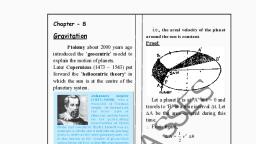
they are nearer to the Sun while they move, Std. XI Sci.: Perfect Physics, Explanation:, The figure shows the orbit of a planet around, the Sun., i., P, Explanation:, Kepler observed that planets move faster wh., 2b, JA, i., slower when they are farther from the Sun, Suppose the Sun is at the origin. The positi, ii., Here, S and S' are the foci of the ellipse and, the Sun is situated at S., ii., of planet is denoted by r and its momentumt, denoted by p(component 1 r)., The area swept by the planet of mass m in, given interval At is AA whích is given hy, P is the closest point along the orbit from S, and is called perihelion., A is the farthest point from S and is called, aphelion., PA is the major axis whose length is 2a. PO, and AO are the semimajor axes with lengths, 'a' each., iii., iii., iv., AA =, At, .(1), v., As for small At, v is perpendicular to r and, this is the area of the triangle., MN is the minor axis whose length is 2b. MO, and ON are the semiminor axes with lengths, 'b' each., AA, ...(2), rxv, At, (3), Enrich Your Knowledge, Linear momentum p is the product of mass, iv., and velocity., Ellipse:, An ellipse is the locus of the points in a plane i, such that the sum of their distances from two, p = m v, .(3), fixed points, called the foci, is constant., putting v =, P in the equation (2), we get,, .., How to draw an ellipse?, Insert two tacks or drawing pins, A and B,, as shown in the figure into a sheet of i, drawing paper at a distance 'd' apart., Tie the two ends of a piece of thread, whose length is greater than distance 'd', between the two tacks and place the loop i, around AB as shown in the figure., ΔΑ, 1, ..(4), i., At, m, ii., v., Angular momentum L is defined as,, L = r xp, ..(5), For central force the angular momentum is, conserved. Hence, from equations (4) and (5),, vi., Place a pencil inside the loop of thread,, pull the thread taut and move the pencil, sidewise, keeping the thread taut. The, pencil will trace an ellipse., iii., AA L, = constant, 2m, ...(6), At, This proves the law of areas., Q.5. What is a central force?, Ans: A central force on an object is a force which is, always directed along the line joining the, position of object and a fixed point usually, taken to the origin of the coordinate system., A, B, Reading between the lines, Q.4. State and prove Kepler's law of equal, areas., Ans: Statement:, The line that joins a planet and the Sun sweeps, equal areas in equal intervals of time., The force of gravity due to the Sun on a planet, is always along the line joining the Sun and the, i planet. It is thus a central force., 158, Scanned by CamScanner
Page 3 :
Chapter 5: Gravítation, Q.11. What would have been the duration of the, year if the distance between the Earth and, the Sun were half the present distance?, 0.6. State and explain Kepler's law of periods., Ans: Statement:, The square of the time period of revolution of, a planet around the Sun is proportional to the, cube of the semimajor axis of the ellipse, traced by the planet., Explanation:, If r is length of semimajor axis then, this law, Solution:, Given:, r2 =, 2, states that,, T, Tcr' or, To find:, Time period (T2), = constant, Formula: -), *0.7. State Kepler's law of equal areas., Ans: Refer Q.4. (Only statement), Calculation: We know, T1 = 365 days, From formula,, *Q.8. State Kepler's law of period., Ans: Refer Q. 6. (Statement only), *0.9. State Kepler's three laws of planetary motion., Ans: Refer Q.3, Q.4 and Q.6 (Only statements), T, 365,, 8, T,, V8, 365, Solved Examples, 1, T2 = 365 x, .., = 365 x 0.3536, +0.10. What would be the average duration of, year if the distance between the Sun and the, Earth becomes, thrice the present distance., = 129.1, T2= 129.1 days, Ans: The duration of the year would be 129.1 days., i., twice the present distance., ii., Solution:, Consider ri be the present distance between, i., the Earth and Sun, We know, T = 365 days., When the distance is made thrice, r2 = 3r, Q.12. Calculate the period of revolution of, Jupiter around the Sun. The ratio of the, radius of Jupiter's orbit to that of the, Earth's orbit is 5., (Period of revolution of the Earth is 1 year.), According to Kepler's law of period,, T c r and T c r?, ( T, Solution:, Given:, TE = 1 year, Period of revolution of Jupiter (T), Tcr, To find:, \3/2, 3/2, Formula:, T,, Calculation: From formula,, 12 -., - /27, T,, T2 = T, x /27 = 365 x 27 = 1897 days, ii. When the distance is made twice, r2 2r,, T = 53/2 = 5 x V5, = 11.18 years., Ans: Period of revolution of Jupiter around the Sun, .., %3D, T r, T, is 11.18 years., 3/2, 2r,, Q.13. A Saturn year is 29.5 times the Earth's, year. How far is the Saturn from the Sun if, 10° km away from the, (NCERT), the Earth is 1.50 x, Sun?, Solution:, T2 = T, /8 = 365 8 1032 days, The duration of the year would be, 1897 days when distance is made thrice., ii., Given:, Ts = 29.5TE,, Ans: i. :, rE = 1.50 x 10* km, Distance of Saturn form the Sun (rs), To find:, The duration of the year would be, 1032 days when distance is made twice., Formula:, Scanned by CamScanner, ::
Page 4 :
of the Earth. From these observations, Newton, Q.19. Diseuss the vector form of gravitational force, particle of matter with a force which is, F- Fn. Thus, F is also proportional to the mass, According to Newton's third law of motion,, concluded that the gravitational force between, Fwry particele of matter attracts every other, the moon revolves around the Eanh, almost circular orbit with CONA, Std. XI Scl.: Perfect Physics, Calculation: From formula,, Chapter 5: Gravitatlon, c., "Q.20. State Newton's law of gravitation and, angular velocity to., Thus, the centripetal force experience, express it in vector form., Ans:, ii., moon (directed towards the centre of, Earth) is given by,, F- mre, Where, m mass of the moon, From Newton's laws of motion,, F-ma, a- reo, i., Refer Q. 18, i., In vector form, it can be expressed as,, nti, Mm, Farth and an object of mass m is Fu, *(1.5 x, For points (i) and (iv), 9.547 א ( I.5)x I0, Iy - 14.32 x 10" km, Ans: Saturn is 14.32 x 10" km away from the Sun., iii., Connections, where, i, is the unit vector from m, to m3., The force Fr is directed from m; to mi., Q.14. The distances of two planets from the Sun, are 10" m and 10" m respectively. Find the, ratio of time perlods of the two planets., iv., elocity (e) and centripetal forve, But, o-, Enrich Your Knowledge, Solution:, n- 10"m, ry- 10"m, Ratio of time periods, The point on the line joining the centres, of two objects where the effect of, gravitational force due to both the objects, is nullified is called the neutral point. i.e.,, At neutral point (N)., Given., Anst Statement:, To find:, Substituting values ofr and T, we get, irectly proportinnral to the prouct of thetr, aser and Inversely proportlonal to the, square of the dlistance between them, (3.85 x 10' x 10'x 4n'), a, (27.3x 24x60 x 60), a 0,0027 m/s, This is the aceleration of the moon diret, towards the centre of the Earth,, This acceleration is much smaller than, acceleration felt by bodies near the surface, the Earth (while falling on Earth)., Formula:, Caleulation: From formula,, between two masses with the help of diagram., Cim,m,, Cim,m,, 10", Ans:, Consider two point masses m, and m; having, 10 102, position vectors and from origin o, respectively as shown in figure., m,, - 31.62 :1, vi., The value of acceleration due to Earth, Q.21. Why is the law of gravitation known as, universal law of gravitation?, Ans: The law of gravitation is applicable to all, material objects in the universe. Hence it is, known as the universal law of gravitation., *Q.22. What do you mean by gravitational, constant? State its SI units., Ans: The ratio of time periods of the two planets is, 31.62 : 1., gravity at the surface is 9,8 m/s?., 9.8, - 3600, 0.0027, ...(3), m2, 5.3, Unlversal law of gravitation, vii., Also,, distance of moon from the Earth's centre, Q.15. Can you recall? (TextloNak pnage na. 78), When released from certain height why do, objects tend to fall vertically downwards?, Ans: When released from certain height, objeets, tend to fall vertically downwards because of, the gravitational force exerted by the Earth., Y, distance of objeet from the Earth's centre, 3.85x 10' km, - 60, Ans:, i., From Newton's law of gravitation,, The position vector of mass m, with respect to, i., m, is given by,, 6378km, .(4), viii. Thus, from equations (3) and (4) we get,, F=G m,m,, distance of moon ), distance of object, where, G= constant called universal gravitational, constant. Its value is 6.67 x 10"N m/kg*., i. Similarly, position vector of mass m, with, Q.16. Heavy and light objects are released from, same height near the Earth's surface. What, can we conclude about their acceleration?, Ans: Heavy and light objects, when released from the, same height, fall towards the Earth at the same, speed, i.e., they have the same acceleration., ..(5), ix., respect to m; is, - = 1;, Fr, G, ii., Newton, acceleration of an object towards the Earth is, inversely proportional to the square of, distance of object from the centre of the Earth., therefore concluded that, the, m,m,, If m, = m; = 1 kg, r=1m then F= G., Hence, the universal gravitational constant is, the force of gravitation between two particles, of unit mass separated by unit distance., iv., Let r=, Ir.=Ir,1. Then, the force acting on, mass m2 due to mass m, will be given as,, min,, Q.17. Explain how Newton concluded that, ii., Unit: N m/kg" in SI system., where, i, is the unit vector from m, to m2., Mm, gravitational force Fc., As, F= ma, Therefore, the force exerted by the Earth on an, object of mass m at a distance r from it is, X., *Q.23. What are the dimensions of the universal, gravitational constant?, Ans: The dimensions of universal gravitational, constant are: [L'M'T)., The force F, is directed from m; to m., Ans: Before generalising and stating universal law, of gravitation, Newton first studied the motion, of moon around the Earth., The known facts about the moon were,, the time period of revolution of moon, around the Earth (T) = 27.3 days., distance between the Earth and the, Similarly, force experienced by m, due to m2, is given as,, Fiz =Gmm, i., Similarly, an object also exerts a force on the, Earth which is, a., Connections, M, FE x, Note: As i,, is defined as unit vector from m, to m, b., In chapter 1, you have studied about units and, dimensions of universal gravitational constant (G)., moon (r) = 3.85 x 10' km., Where M is the mass of the Earth., conceptually force En is directed from n, to m, 60, 161, Scanned by CamScanner
Page 5 :
encel, Q.19. Calculate the force of attraction between, Ans: The gravitational force between the Sun and, the line joining the point mass to the centre and, cancel each other and the resultant fore, hollow spherical shell or solid sphere, uniform density and a point mass situated, Std. XI Sci.: Perfect Physics, qualitative, idea, Q.24. Give formula for the gravitational force due, to a collection of masses and represent it, diagrammatically., Ans;, Q.26. Discuss, for, Chapter 5: Gravitation, From formula,, F= GM, M,, gravitational force of attraction, between, This force can be resolved into horizontal and, vertical components using rectangular unit, vectors as shown in figure., From figure,, m:, outside the shell/ sphere., 6.67 x 10" x1.99 x 10 x5.98 x 10", (1.5x 10")", Ans:, Gravitational force caused by different, i, of shell can be resolved into components a, Gm, A regions, 6.67 x 1.99 x 5.98, F =, x 10-3.5 x 10 N, 2.25, along a direction perpendicular to this line, The components perpendicular, m3, Similarly, gravitational force due to C,, to, this, the Earth is 3.5 x 10" N, line, For a collection of point masses, the force on, any one of them is the vector sum of the, gravitational forces everted by all the other, remains along the line joining the point to, Cametal spheres each of mass 90 kg, if the, istance between their centres is 40 cm., -along DC, сentre., From figure,, Mathematical calculations show ther, ii., resultant force on this point cquals the f, that would get everted by the shell wh, Gm, (G = 6.67 x 10" N m²/kg, 의 cos (45°) (6), point masses., Solution:, Given, m, = 90 kg. m: = 90 kg., 40 cm - 40 x 10 m,, G = 6.67 x 10" N m'kg, Force of attraction (F), For n particles. force on i mass F=SE, (F) - sin (45") (-1), entire mass is situated at its centre, Gravitational force due to B., where, F. is the force on i particle due to i, Solved Examples, particle., To find, Gm, m., -Q.27. The gravitational force between two bodi, is I N. If distance between them is doubled, what will be the gravitational force betwe, Formula, Q.25. Discuss, gravitational force of attraction due to a, hollow, thin spherical shell of uniform, density on a point mass situated inside it., qualitative, idea, for, the, Calculation, From formula., Net horizontal force acting on D., them?, 6.67 x 1090x 90, F, (40 10 ), 667. $100, Solution:, Let m and m: be masses ot the given ta, bodies lf they are r distance apart initiall,, then the force between them will be,, x 10, Ans:, 1600, Let us consider the case when the point mass, A. is at the centre of the hollow thin shell., in this case as every point on the shell is, equidistant from A. all points exert foree of, equal magnitude on A but the directions of, these forces are different., Consider the forces on A đue to rwo, diamerically opposite points on the shell., Gm, *-10 x 7ר33-F, : The force of attraction between the two metal, spheres is 3.377 x 10N., cos (45") (-i), cos (45°) (i), %3D, Gm m., = 0, -IN, Net vertical force acting on D., -0.30. Three particles A. B. and C each having, mass m are kept along a straight line with, AB = BC = 1. A fourth particle D is kept on, the perpendicular bisector of AC at a, distance from B. Determine the, When the distance between them is doubled, r= 2r, F= Gm m., Gm m., Gm, iv., The forces on A due to them will be of equal, magnitude but will be in opposite directions, and will cansel each other., Thus, forces due to all pairs of points, diametrically opposite to cach other will, I and there will be no net force on A due, to the shell, When the point object is siruated elsewhere, inside the shell. the situation is not symmetric., However. gravitational force varies directly, with mass and inversely with square of the, Dividing equation tii by equation ti)., F Gm m, gravitational force on D., Solution: F. cos 145, Gm, sin(45)(-3), Fr cos (45°), -Gim1, +1+, -Gm, tr, Gm m, F-= 0.25 N, Negative sign indicates net force is acting, along DB., Ans: The net force acting on particle D is, Gm, Ans: The force between two bodies reduces to, vi., 0.25 N, 45°, 45, *Q.28. Find the gravitational furce between the, E+1 directed along DB, B, Sun and the Earth., Given Mass of the Sun 1.99 x 10" kg, Mass of the Earth = 5.98 x 10 kg, The average distance between the Earth, and the Sun 1.5 10" m., /Note: When force, in given case is resolved into its, components, its horizontal component contains cos, argument while vertical component contains sine, argument|, distance., vii., Thus, some part of the shell may be closer to, point A, but its mass is less. Remaining part, will then have larger mass but its centre of, mass is away from A., In, From figure., distance of particle D. from particles A and C is,, AD = CD = VAB + BD = + (1) =, Gravitational force on particle D is the vector, sum of forces due to particles A, B, and C., Gravitational force due to A,, Solution:, M - 1.99 x 10" kg., M - 5.98 x 10 kg. R = 15 x 10" m, Gravitational force between the Sun and, the Earth (F), A Connections, this way, mathematically it can be shown, that the net gravitational force on A is still, zero, so long as it is inside the shell., Hence, the gravitational force at any point, inside any hollow closed object of any shape, vi., Given, In chapter 2. you have studied in detail about, resolution of vectors and their components and, rectangular unit vectors., To find, ix., Gm, m., FA =, along DA, Formula, IS zero., 163, 162, Scanned by CamScanner