Page 1 :
MECHANICAL PROPERTIES OF SOLIDS (ELASTICITY);, DEFORMING FORCE: If a force applied on a body produced a change in the normal positions of the, molecules of the body, which results in a change in the configuration of the body either in length, volume, or shape, then the force applied is called deforming force. i.e. a deforming force is one which when, applied changes the configuration of the body., RESTORING FORCE; Whenever en external deforming force is applied on a body which results in a, change in the configuration of the body, then an internal force developed in the body which tries to retain, the original configuration of the body after the removal of the external deforming force. This internal force, is called as the restoring force. Within the limit of elasticity the restoring force is equal to the external, deforming force., ELASTICITY: The property of a body, by virtue of which it tends to regain its original size and shape, when the applied force is removed, is known as elasticity., ELASTIC DEFORMATION: the deformation caused by the external deforming force in the, configuration of a body is known as elastic deformation., PLASTIC: If a force applied on a body produced a change in the configuration of the body and the body, could not regain its original configuration even after the removal of the external deforming force, the body, is called as the plastic body., PLASTICITY: The property of a body, by virtue of which it permanently change its original, configuration i.e. size and shape even after the removal of deforming force , is known as plasticity., STRESS; when a body is subjected to a deforming force, a restoring force is developed in the body. This, restoring force is equal in magnitude but opposite in direction to the applied force. The restoring force per, unit area is known as stress., Stress = restoring force / area., The SI unit of stress is N m–2 or Pascal (Pa) and its dimensional formula is [ML–1T–2]., NORMAL STRESS; when a deforming force acts normally over an area of a body, then the restoring, force set up per unit area of the body is known as stress., TENSILE STRESS; the restoring force set up per unit area of the body when the length of the body, increases, is known as tensile stress. Tensile stress is also called as the longitudinal stress., COMPRESSION STRESS; the restoring force set up per unit area of the body when the length of the, body decreases due to the applied deforming force, is known as compression stress. Tensile stress is also, called as the longitudinal stress., TENGENTIAL STRESS; the restoring force per unit area developed due to the applied tangential force, is known as tangential or shearing stress., HYDROLIC STRESS: When a uniform force is applied from all the sides to change the volume of the, body then the restoring force set up per unit area of the body is known as hydraulic stress. It is also called, as the volume stress., STRAIN; the change in the configuration of the body per unit original configuration of the body on, applying a deforming force is called as the strain., Strain = change in the configuration/ original configuration., LONGITUDINAL STRAIN: the change in length of the body per unit original length of the body on, applying a deforming force is called as the longitudinal strain., Longitudinal strain = change in the length / original length., VOLUME STRAIN: the change in volume of the body per unit original volume of the body on applying, a deforming force is called as the volume strain., Volume strain = change in the volume / original volume., COMPRESSIBILITY: Compressibility is the measure of how much a given volume of matter decreases, when placed under pressure. If we put pressure on a solid or a liquid, there is essentially no change in, volume. The atoms, ions, or molecules that make up the solid or liquid are very close together., Compressibility is reciprocal of bulk modulus. its dimensions=[M–1LT2]., 1
Page 2 :
RIGITITY: It is the state in which the particles of a substance are fixed in their positions and cannot be, compressed easily., , COEFFICIENT OF ELASTICITY OR MODULUS OF ELASTICITY: The modulus of elasticity or, coefficient of elasticity of a body is defined as the ratio of the stress to the corresponding strain produced, within the limit of elasticity., Modulus of elasticity or coefficient of elasticity = stress / strain., SI unit of Modulus of elasticity or coefficient of elasticity is N m–2 or Pascal (Pa) & its dimensions are, [ML–1T–2]., YOUNG’S MODULUS OF ELASTICITY: The Young’s modulus of elasticity is defined as the ratio of, the normal stress to the longitudinal strain within the limit of elasticity., Young’s modulus of elasticity = Normal stress / longitudinal strain., The SI unit of Young’s Modulus of elasticity=N m–2or Pascal & dimensions=[ML–1T–2]., BULK MODULUS OF ELASTICITY: The bulk modulus of elasticity is defined as the ratio of the, normal stress to the volume strain within the limit of elasticity., Bulk modulus of elasticity = Normal stress / strain., The SI unit of bulk Modulus of elasticity, COMPRESSIBILITY: The reciprocal of the bulk modulus is called compressibility., Compressibility = 1/ bulk modulus of elasticity., The SI unit of compressibility is N–1 m2 or Pascal–1 & its dimensions are [ML–1T–2]., MODULUS OF RIGIDITY: The modulus of rigidity is defined as the ratio of the tangential stress to the, volume strain within the limit of elasticity., Modulus of rigidity = tangential stress / shearing strain., The SI unit of Modulus of rigidity is N m–2 or Pascal & its dimensions are [ML–1T–2]., ELASTIC FATIQUE: The elastic fatigue is the property of a body by virtue of which its behavior, becomes less elastic under the action of repeated deforming forces., ELASTIC AFTER EFFECT: The delay in regaining the original configuration by an elastic body after, the removal of a deforming force is called as the elastic after effect., HOOK’S LAW; Within the limit of elasticity the stress is directly proportional to the strain., Stress α strain, i.e. Stress/Strain = E, where E is the constant of proportionality and is called as the, modulus of elasticity. SI unit of Modulus of elasticity=Nm–2 or Pascal & its dimension are [ML–1T–2]., Depending upon the types of stress and strain, modulus of elasticity is of three types;, (a) Young’s modulus of elasticity, (b) bulk modulus of elasticity, (c) Modulus of rigidity, (a) YOUNG’S MODULUS OF ELASTICITY: The Young’s modulus of elasticity is defined as the ratio, of the normal stress to the longitudinal strain within the limit of elasticity., Young’s modulus of elasticity = Normal stress / longitudinal strain., SI unit of Young’s Modulus of elasticity=Nm–2 or Pascal & its dimensions=[ML–1T–2]., Young’s Modulus of elasticity is inversely proportional of the temperature of the body., 2
Page 3 :
Consider a wire of length L and area of cross-section A and the radius of wire is r. when a deforming force, F acts on it, its length increases by ∆L. then, Longitudinal strain = increase in length/original length = ∆L/L., Normal stress = deforming force/ area of cross-section = F/A= F/π r2, Young’s modulus of elasticity = Normal stress/ Longitudinal strain., =( F/A)/( ∆L/L)= (FL/A∆L) = (FL/ π r2∆L)., Young’s moduli of some materials;, S.No. Substance, Density ρ (Kg/m3) Young’s Modulus γ (109 N/m2), 1., Aluminum, 2710, 70, 2., Copper, 8890, 110, 3., Iron (wrought) 7800-7900, 190, 4., Steel, 7860, 200, 5., Glass, 2190, 65, 6., Concrete, 2320, 30, 7., Bone, 1900, 9, 9., Polystyrene, 1050, 3, BULK MODULUS OF ELASTICITY: The bulk modulus of elasticity is defined as the ratio of the, normal stress to the volume strain within the limit of elasticity., Bulk modulus of elasticity = Normal stress / strain., The SI unit of bulk Modulus of elasticity =N m–2or Pascal & dimensions=[ML–1T–2]., , Therefore bulk Modulus of elasticity = ─ PV/∆V., BULK MODULUS OF ELASTICITY OF SOME MATERIALS:, S.No. Substances, Bulk Modulus β (109 N/m2) Shear modulus η(109 N/m2), Aluminum, 72, 25, 1., Brass, 61, 36, 2., Copper, 140, 42, 3., Glass, 37, 23, 4., Iron, 100, 70, 5., Nickel, 260, 77, 6., Steel, 160, 84, 7., Water, 2.2, 0, 9., Ethanol, 0.9, 0, 10., Carbon di sulphide, 1.56, 0, 11., Glycerin, 4.76, 0, 12., Mercury, 25, 0, 13., Air (at ATP), 1.0 × 10⁻⁴, 0, 14., 3
Page 4 :
MODULUS OF RIGIDITY: The modulus of rigidity is defined as the ratio of the tangential stress to the, volume strain within the limit of elasticity., Modulus of rigidity = tangential stress / shearing strain., The SI unit of Modulus of rigidity is N m–2 or Pascal & its dimensions are [ML–1T–2]., , STRESS-STRAIN CURVE; To get the relation between the stress and the strain for a given material, under tensile stress the applied force is gradually increased in steps and the change in length is noted. A, graph is plotted between the stress and the strain produced. A stress versus strain graph for a metal is, plotted; these graphs vary from material to material., (1) in the region between O to A, the curve is linear. In this region, Hooke’s law is obeyed. The body, regains its original dimensions when the applied force is removed. In this region, the solid behaves as an, elastic body. The point A on the graph is called as proportional limit., , Stress-strain curve for a metal wire, (2) In the region from A to B, stress and strain are not proportional. Nevertheless, the body still returns to, its original dimension when the load is removed. The point B in the curve is known as yield point (also, known as elastic limit) and the corresponding stress is known as yield strength (Sy) of the material., (3) If the load is increased beyond the point B, the strain increases much more rapidly with the stress. The, slope of the graph between stress and strain after point C is quite small. If the wire is unloaded at C, the, graph between stress and strain can not be reversed along CBAO but the path is along the dotted line CM., Therefore, even when the wire is completely unloaded, there is a strain in the wire. This strain OM in the, wire is called as the permanent set., (4) Beyond the point C, the length of the wire starts increasing virtually for no increase in stress. The wire, begins to flow after point C and it continues up to point D. The increase in length of the wire for virtually, no increase in stress is called plastic behavior of the wire., , 4
Page 5 :
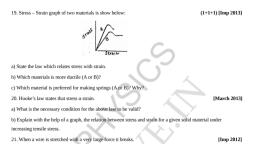
(5) Beyond the point C, the length of the wire starts increases, even if the wire is unloaded. In this region,, the constrictions (called necks and waists) develop at few points along the length of the wire and as a, result of it; breaks ultimately say corresponding to point E. the point E is called the breaking point of the, wire. The portion of the graph between B and E is called plastic region. The stress corresponding to E is, called as the breaking stress., CLLASIFICATION OF MATERIALS FROM THE STUDY OF STRESS-STRAIN CURVE; On, the bases of stress-strain variation, the different materials can be classified as;, (a) DUCTILE MATERIALS: These are those materials which show large plastic range beyond, elastic limit. For such materials the breaking point is widely separated from the point of elastic, limit on the stress-strain graph. Such materials are used for making springs and sheets. Examples, of ductile materials are copper, silver, gold, iron, aluminum etc., (b) BRITTLE MATERIALS: These are those materials which show small plastic range beyond, elastic limit. For such materials the breaking point lies close to the elastic limit on the stress-strain, graph. Such materials can not be used for making springs and sheets. Examples of brittle materials, are glass, cast iron etc., (c) ELASTOMERS: These are those materials for which stress-strain variation is not straight line, within elastic limit and strain produced is much larger than the stress applied. Such materials have, no plastic region. For such materials the breaking point just lies close to the elastic limit on the, stress-strain graph. Examples of ductile materials are rubber, elastic tissue of aorta etc., , ELASTIC AFTER EFFECT: The delay in regaining the original configuration by an elastic body after, the removal of a deforming force is called as the elastic after effect. The elastic after effect is negligible, for quartz and phosphorous bronze, but very large for glass fibers. It is due to that the suspensions, made, from quartz or phosphorous bronze are used in moving coil galvanometers., ELASTIC FATIQUE: The elastic fatigue is the property of a body by virtue of which its behavior, becomes less elastic under the action of repeated deforming forces. The elastic bodies relived of the, fatigue or regain their original degree of elasticity, when allowed to rest for some time., APPLICATION OF ELASTICITY; (1)Cranes used for lifting and moving heavy loads from one place, to another have a thick metal rope to which the load is attached. The rope is pulled up using pulleys and, motors. The thickness of the metallic rope used in the crane in order to lift a given load is decided from, the knowledge of elastic limit of the material of the rope and the factor of safety. Suppose we want to, make a crane of steel rope, which has a lifting capacity of 10 tones or metric tons (1 metric ton = 1000, kg). The elastic limit of the steel is 300 × 106 N m–2. The extension should not exceed the elastic limit, steel has a yield strength of about 300 × 106 N m–2. Thus, the area of cross-section (A) of the rope should, at least be; A ≥ W/ yield strength = Mg/ yield strength, = (104 kg × 10 m s-2)/( 300 × 106 N m–2) = 3.3 × 10─4 m2, Corresponding to a radius of about 1.03 cm for a rope of circular cross-section i.e. a thicker rope of radius, about 1.03 cm is recommended. To provide flexibility and strength to the ropes it is always made of a, number of thin wires braided., 5
Page 6 :
(2) A bridge has to be designed such that it can withstand the load of the flowing traffic, the force of, winds and its own weight. Let us consider a bar of length l, breadth b, and depth d loaded at the centre and, supported near its ends. If Y is the Young’s modulus of elasticity of the material of the bar, when the bar, is loaded at the centre by a load W then the depression δ produce at middle point in the bar is given by, δ = W l3/(4bd3Y), , To reduce the bending for a given load, one should use a material with a large Young’s modulus Y, large, depth d, b should be large and the length l should be small. The most effective method to reduce, depression in the beam of given length and material is to make the depth of the beam large as compared to, its breadth because δ α d -3. But on increasing the depth, unless the load is exactly at the right place which, is difficult to arrange in a bridge with moving traffic, the deep bar may bend. This bending is called, buckling. To avoid this, a common compromise between breath and depth of a beam is made by using I, shape girder, with a large load bearing surface and enough depth to prevent bending. This shape reduces, the weight of the beam & increases the strength and reduces the cost., (3) Maximum height of a mountain on earth is can be estimated from the elastic behavior of earth. At the, base of mountain, the pressure is given as;, P= hρg where ρ is the density of the material of the mountain, h is the height of the mountain and g is the, acceleration due to gravity., The density of the material of the mountain, ρ = 3 × 10³ kg m-3, At the base of mountain, the pressure must be less than elastic limit of earth’s supporting material whose, value for a typical rock =, The material at the bottom experiences this force in the vertical 30 × 107 N m-2. Therefore; hρg < 30 × 107, h < (30 × 107)/ ρg, h< (30 × 107)/ (30 × 107 × 10), h< 104 m., This value of height of a mountain is nearly, the height of Mount Everest., (4) The metallic parts of the machinery are never subjected to a stress beyond elastic limit; otherwise they, will get permanently deformed., POTENTIAL ENERGY IN A STRETCHED WIRE: Consider a wire of length L and area of crosssection A. let F be the deforming force acting on the wire and ∆L be the increase in the length of wire., Initially the restoring force is zero. When the length of wire increases by ∆L, the restoring force is F., therefore; The average the restoring force on the wire = ½ (0+F) = F/2., Work done on the wire, W = Average force x increases in length., This work is stored in wire as potential energy. Therefore; Potential energy in the wire U = ½ F x ∆L, U = ½ (F/A) x (∆L/L) x (A x L), U= ½ stress x strain x volume of the wire., The elastic potential energy of the wire/unit volume; u= U/ A x L = ½ stress x strain, u= ½ stress x strain, But Stress = Young’s modulus x strain, 6
Page 7 :
u= ½ (Young’s modulus x strain) x strain., u= ½ (Young’s modulus) x (strain)2., The elastic potential energy of a wire/unit volume = ½ (Young’s modulus) x (strain)2., STEEL IS MORE ELASTIC THAN RUBBER: Consider two rods of rubber and steel each of length L, and area of cross-section A. Let Yr and Ys be the Young’s modulus of elasticity of rubber and steel, respectively. On applying a stretching forces F on each rod, the extension produced in rubber and steel, rods are ∆Lr and ∆Ls respectively. Then; Yr = (F x L)/ (A∆Lr), ----------------------------------(1), And Ys = (F x L)/ (A∆Ls) ----------------------------------(2), Dividing (2) by (1) we get; Ys / Yr = {(F x L)/ (A ∆Ls)}/{ (F x L)/ (A ∆Lr)}, Ys / Yr = ∆Lr / ∆Ls, But ∆Lr > ∆Ls, ∆Lr / ∆Ls > 1, Ys / Yr > 1, Ys > Yr., Therefore, steel is more elastic than rubber., STEEL IS MORE ELASTIC THAN COPPER: Consider two rods of copper and steel each of length L, and area of cross-section A. Let Yc and Ys be the Young’s modulus of elasticity of rubber and steel, respectively. On applying a stretching forces F on each rod, the extension produced in copper and steel, rods are ∆Lc and ∆Ls respectively. Then; Yc = (F x L)/ (A ∆Lc), ----------------------------------(1), And Ys = (F x L)/ (A ∆Ls) ----------------------------------(2), Dividing (2) by (1) we get; Ys / Yc = {(F x L)/ (A ∆Ls)}/{ (F x L)/ (A ∆Lc)}, Ys / Yc = ∆Lc / ∆Ls, But ∆Lc > ∆Ls, ∆Lc / ∆Ls > 1, Ys / Yc > 1, Ys > Yc., Therefore, steel is more elastic than copper., SPRINGS MADE OF STEEL BUT NOT OF COPPER: A spring will be better one, if a large restoring, force is set up in it on being deformed which in turn depends upon the elasticity of the material of the, spring. Since the Young’s modulus of elasticity of steel is more than that of copper, hence steel is, preferred in making the springs., A BIDGE DELARED UNSAFE AFTER LONG USE; A bridge during its use undergoes alternating, strains for a large number of times each day, depending upon the moment of vehicles on it. When bridge is, used for long time it losses its elastic strength. Due to which the amount of strain in bridge for a given, stress will becomes large and ultimately, the bridge may collapse. This may not happen, the bridges are, declared unsafe after long use., , 7