Notes of CLASS : 11th, PHYSICS Communication Systems.pdf - Study Material
Page 1 :
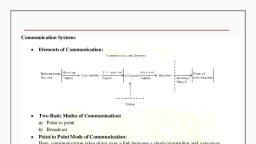
Chapter 15, , Communication Systems, , Chapter Contents, , Introduction, , Elements of a, Communication System, , Basic Terminology Used in, Electronic Communication, Systems, , Band Width of Signals, , Band Width of Transmission, Medium, , Propagation of, Electromagnetic Waves, , Modulation and Its, Necessity, , Amplitude Modulation, , Production of Amplitude, Modulated Wave, , Detection of Amplitude, Modulated Wave, , Some Important Definitions, Formulae Chart, Quick Recap, , Introduction, , The act of transmission and reception of information is known as, communication. Every living creature in the world experiences the, need to impart or receive information almost continuously with others, in the surrounding world. For successful communication, it is essential, that the sender and the receiver understand a common language., Languages and methods used in communication have changed from, prehistoric to modern times, to meet the growing demands in terms of, speed and complexity of information. It would be useful to look at the, major milestones in events that promoted developments in, communications., , The aim of this chapter is to introduce the concepts of communication,, namely the mode of communication, the need for modulation,, production and deduction of amplitude modulation., , ELEMENTS OF A COMMUNICATION SYSTEM, , Irrespective of the nature, every communication system has three essential, elements, transmitter, medium (also known as channel) and receiver., , , , , , , , , , , , , , , , Fig. : Block diagram of a generalised communication system., , Aakash Educational Services Pvt. Ltd. - Regd. Office : Aakash Tower, 8, Pusa Road, New Deihi-110005 Ph. 011-47623456
Page 2 :
412 Communication Systems Board & Competitive Exams., , , , In a communication system, the transmitter is located at one place, the receiver is located at some other, place (far or near) separated from the transmitter and the channel is the physical medium that connects, them. Depending upon the type of communication system, channel may be in the form of wires or cables, connecting the transmitter and the receiver or it may be wireless. The purpose of the transmitter is to, convert the message signal, produced by the source of information, into a form, suitable for transmission, through the channel. If the output of the information source is a non-electrical signal like a voice signal, a, transducer converts it to electrical form before giving it as an input to the transmitter. When a transmitted, signal propagates along the channel it may get distorted due to channel imperfection. Moreover, noise adds, to the transmitted signal and the receiver receives a corrupted version of the transmitted signal. The receiver, has the task of operating on the received signal. It reconstructs a recognisable form of the original message, signal for delivering it to the user of information., , There are two basic modes of communication : point-to-point and broadcast., , In point-to-point communication mode, communication takes place over a link between a single transmitter, and a receiver. Telephony is an example of such a mode of communication. In contrast, in the broadcast, mode, there are a large number of receivers corresponding to a single transmitter. Radio and television are, examples of broadcast mode of communication., , Did You Know?, , , , Modern communication has its roots in the 19" and 20" century in the work of scientists like JC, bose, FB Morse, G.Marconi and Alexander Graham Bell., , , , , , Table 1 : Some major milestones in the history of communication, , , , , , , , , , , , Year Event Remarks, Around The reporting of the delivery of a Itis believed that minister Birbal experimented, 1565 A.D. child by queen using drum beats with the arrangement to decide the number of, froma distant place to KingAkbar. drummers posted between the place where, the queen stayed and the place where the king, stayed., 1835 Invention of telegraph by Samuel It resulted in tremendous growth of messages, F.B. Morse and Sir Charles through post offices and reduced physical, Wheatstone travel of messengers considerably., 1876 Telephone invented by Alexander | Perhaps the most widely used means of, Graham Bell and Antonio Meucci communication in the history of mankind., 1895 Jagadis Chandra Bose and It meant a giant leap — from an era of, Guglielmo Marconi demonstrated communication using wires to communicating, wireless telegraphy. without using wires. (wireless), 1936 Television broadcast (John Logi | First television broadcast by BBC, Baird), 1955 First radio FAX transmitted across | The idea of FAX transmission was patented by, continent. (Alexander Bain) Alexander Bain in 1843., 1968 ARPANET- the first internet came | ARPANET was a project undertaken by the, into existence(J.C.R. Licklider) U.S. defence department. It allowed file, transfer from one computer to another, connected to the network., 1975 Fiber optics developed at Bell Fiber optical systems are superior and more, Laboratories economical compared to traditional, communication systems., 1989-91 Tim Berners-Lee invented the | WWW may be regarded as the mammoth, World Wide Web. encyclopedia of knowledge accessible to, everyone round the clock throughout the year., , , , Aakash Educational Services Pvt. Ltd. - Regd. Office : Aakash Tower, 8, Pusa Road, New Delhi-110005 Ph. 011-47623456
Page 3 :
Board & Competitive Exams. Communication Systems 413, , , , BASIC TERMINOLOGY USED IN ELECTRONIC COMMUNICATION SYSTEMS, , , , To understand the principles of communication, we must know some basic terms which will be used, frequently., , @, , ai), , (ily, , (iv), , ™, (vi), (vil), , Transducer : It is a device that converts one form of energy into another. In electronic communication, systems, we usually come across devices that have either their inputs or outputs in the electrical form., An electrical transducer may be defined as a device that converts some physical variable (pressure,, displacement, force, temperature, etc.) into corresponding variations in the electrical signal at its output., , Signal : It is the Information converted in electrical form and suitable for transmission. Signals can be, either analog or digital. Analog signals are continuous variations of voltage or current. They are essentially, single-valued functions of time. Sine wave is a fundamental analog signal. All other analog signals can, be fully understood in terms of their sine wave components. Sound and picture signals in TV are analog, in nature. Digital signals are those which can take only discrete stepwise values. Binary system that is, extensively used in digital electronics employs just two levels of a signal. ‘0’ corresponds to a low level, and ‘1' corresponds to a high level of voltage/current. There are several coding schemes useful for digital, communication. They employ suitable combinations of number systems such as the binary coded, decimal (BCD). American Standard Code for Information Interchange (ASCII) is a universally popular, digital code to represent numbers, letters and certain characters., , Noise : The unwanted signals that tend to disturb the transmission and processing of message signals, in a communication system is known as noise. The source generating the noise may be located inside, or outside the system., , Transmitter : \t processes the incoming message signal so as to make it suitable for transmission, through a channel and subsequent reception., , Receiver : It extracts the desired message signals from the received signals at the channel output., Attenuation : It is the loss of strength of a signal while propagating through a medium., , Amplification : Amplification refers to the process of increasing the amplitude (and consequently the, strength) of a signal using an electronic circuit called the amplifier. Amplification is necessary to, compensate for the attenuation of the signal in communication systems. The energy needed for, additional signal strength is obtained from a DC power source. Amplification is done at a place between, the source and the destination wherever signal strength becomes weaker than the required strength., , (viii) Range : It is the largest distance between a source and a destination up to which the signal is received, , (by), , 9), , with sufficient strength., , Bandwidth : It is the frequency range over which an equipment operates or the portion of the spectrum, occupied by the signal., , Modulation : The original low frequency message/information signal cannot be transmitted to long, distances because of obvious reasons. Therefore, at the transmitter, information contained in the low, frequency message signal is superimposed on a high frequency wave, which acts as a carrier of the, information. This process is known as modulation. There are several types of modulation, abbreviated as, AM, FM and PM., , Aakash Educational Services Pvt. Ltd. - Regd. Office : Aakash Tower, 8, Pusa Road, New Delhi-110005 Ph. 011-47623456
Page 4 :
414 Communication Systems Board & Competitive Exams., , (xi) Demodulation : It is the process of extraction of information from the carrier wave at the receiver. It is, the reverse process of modulation., , (xl) Repeater : It is a combination of a receiver and a transmitter. A repeater, picks up the signal from the, transmitter, amplifies and retransmits it to the receiver sometimes with a change in carrier frequency., Repeaters are used to extend the range of a communication system as shown in figure. A, communication satellite is essentially a repeater station in space., , , , Fig. : Use of repeater station to increase the range of communication, , Knowledge Cloud, The undesirable effects in the course of signal transmission are, , , , (@ Attenuation : decrease in signal strength due to energy loss., (ji) Distortion : waveform perturbation., , (iii) Interference : contamination by extraneous signals., , (¥) Noise : due to random electrical signal., , , , , , BAND WIDTH OF SIGNALS, , , , The message signal can be voice, music, picture or computer data. In a communication system, each of, these signal has different ranges of frequencies. The types of communication system needed for a given signal, depends on the range of frequencies which is considered essential for the communication process. For, speech signals frequency range has a band width of 2800 Hz (3100 Hz — 300 Hz) for commercial telephonic, communication. To transmit music an approximate band width of 20 kHz Is required because of high, frequencies produced by the musical instruments. The audible range of frequencies extends from 20 Hz to, 20 kHz., , Video signals for transmission of pictures require about 4.2 MHz of band width. A T.V. signals contains both, voice and picture and is usually allocated 6 MHz of band width for transmission., , The transmission medium or communication channel! is a link through which information/message signal may, Propagate from the source to the destination, without any noise or distortion., , It is a sort of electronic roadways along which signals travel., , Aakash Educational Services Pvt. Ltd. - Regd. Office : Aakash Tower, 8, Pusa Road, New Dethi-110005 Ph. 011-47623456
Page 5 :
Board & Competitive Exams. Communication Systems 415, , Broadly, transmission media have been divided into two types :, 1. Guided transmission medium, 2. Unguided transmission medium., , 1. Guided transmission medium : It is that communication medium or channel which is used in point to, point communication between a single transmitter and a receiver. For example, parallel wire line, twisted, pair and co-axial cable are guided transmission media. Optical fibres are other examples of guided, transmission medium. Thus, guided transmission medium is used in line communication., , 2. Unguided transmission medium : It is that communication medium which is used, where there is no, point to point contact between the transmitter and receiver. There are a large number of receivers, corresponding to a single transmitter. Free space is an example of unguided transmission medium. It is, used in space communication and satellite communication, such as in radio and television., , The characteristics and quality of transmission medium depends upon, (i) Nature of transmission medium, (ii) Nature of signal, , We have already studied that there are different band widths for different message signals. In fact,, different transmission media for communication of signals offer different band widths. The commonly used, transmission media are wire, free space and optical fibre cable., , Co-axial cable is a widely used wire medium. It offers a band width of 750 MHz. These cables are, generally operated below 18 GHz., , Communication through free space using radiowaves occurs at frequencies ranging from 105 Hz to, 10° Hz. This range is subdivided further and allocated for various services., , The optical fibre communication is used in the frequency range of 1 THz to 1000 THz (microwaves to, ultraviolet). An optical fibre can offer a transmission band width in excess of 100 GHz., , , , Jagadis Chandra Bose (1858-1937) He developed an apparatus for generating, ultrashort electromagnetic waves and studied their optical properties. He was said, to be the first to employ a semiconductor like galena as a self recovering detector, , of electromagnetic waves. Bose published three papers in the British magazine,, ‘The Electrician’ of 27 Dec. 1895., , His invention was published in the ‘Proceedings of The Royal Society’, on 27 April 1899 over two years before Marconi's first wireless communication on, 13 December 1901., , Bose also invented highly sensitive instruments for the detection of minute responses by living organisms,, established and similarity between animal and plant tissues., , , , , , , , , , In a digital signal, information is carried by the pattern of pulses and not by the shape of pulses., , , , , , , , Aakash Educational Services Pvt. Ltd. - Regd. Office : Aakash Tower, 8, Pusa Road, New Delhi-110005 Ph. 011-47623456



 Learn better on this topic