Page 1 :
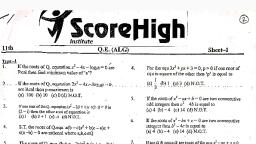
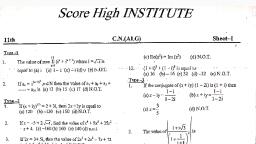
4, , 11th, , Yscorehtigh, , High, , Medical) T-JEETXIT XN. VUT-JEE Xt Xt, , , , Type 1, , Ss, 47 a ©, The value of "C, + CICis, 5, , (a) °C, (b)?C, (c) "Cy (A) not., , The sum of the series ts + nl + Hid panne, n n n, , +k :, (" }s (a) “~~ (b) male,, , (©) mee i (d) n.o.t., , For 2Srsn; ("heal ” e{ ” )isonatt, r r-l) \r-2, (a) n+2) 5 n n, a, : (b) r (c) “43 (d) n.o.t., , Find domain & Range of the following:@”C.5 WC, OC, OP,, , The least positive integral value of x which, satisfies the inequality ( °C ) a2 ( "C,) is, (a)7 (()8 (c)6 (d)not., , The number of positive integers satisfied the, inequality "'C,-2 -"'Cy-1$ 50 is, (a)9 (b)8 (c)7 (d) not., , If P,, stands for "P,,, then 1 + 1P,+ 2P, + 3P; +—+, nP, is equal to, , (an! (b)(n +1)! (c)(n#2)! (d) not., , Find the value of ‘t’ for which the function f(t) =, 21C.,, is maximum?, , Find the maximum value of °C,.2?, , Type -—2, , 1., , Expand the following:, (a) (a+by (b) (& +3y)”, , B.T.(ALG), , 12., , Sheet-1!, , (4) («-y)", , 10, x 4, 03-5), , 10, 5, Find 4th term of the Expansion 24 - °), x, , Find 10th term of the Expansion(x?+7x)", , Find 4th term of the Expansion(x? +7)" from end, Find 6th term of the Expansion(a+25)"" from end, , m4, , If (1 +22) (1 4x)"= a x4, ify, ay, a, —, a, are, ‘k=0, , in A.P. then find ‘n’., , If (tax)! = 1 +8x+242 +—, find a & n?, , Express (x +Vx? +1)° + (x —vx? +1)* asa, , polynomial in x?, , Find the value of (./2 + 1)° + (V2 -1)®, , The expression f(x) = {x + (x°-1)!7}5 + {x(?-1)'7}5 is a polynomial of degree, , (a)5 (b)6 (c)7 (d) not., , In the B.E. of (a-b)", n> 5, then sum of Sth & 6th, , a, terms is zero then equals to, , n-5, , , , , , oF oF OA; @not, , determins the value of x in the expansion, , is, (x+ a) , if the 3rd term in the expansion is, , 10,00,000?, If A be the sum of odd terms and B the sum of, , even terms ii in the expansion of (x + a)" then S.T., A?-B?=(e-a@", , (101) $ (100)*+ (99)**is (a) True (b) false, , , , Page 1
Page 2 :
15., , The coeff. Of three consecutive terms in the expansion, Of (1 +x)" are in the ratio 1: 7: 42 then find n?, , Type -3, 1. Find the coeff. of x? & x’ in the expansion of, , ff, , W, 7, °. Find the coeff. of x’ in the Expansion o{ 4? 1) ;, x=, , 11, 3. Find the coeff, of x’ in the Expansion of G -5) :, 4, Find the term Independent of x in the Expansion of, 100, [28 + 3 9?, x, , 9, & The term free from x in the Exp. of (%-z] is, x, , equalto (a)~"C, (b)°C, (¢)°C, (d) no., , us, 6. The coeff. of x” in the exp, of (« -5] is, (a) 455 (b)-455 (c) 910 (d)~910 (ec) non,, 7, The ratio of the coeff. of x"? to the term, , > as, independent of x in (* + 2) is, , x, (a) 12:32 (b) 1:32, (c) 32:12 (d)32:1 (e)no., , 3, 1)., 8. The term independent of x af -}) is, 2 3x, , 7 7 18, — b)— co) = (d)not, @ rs ( Ms (c) 7 (d), 9 Find the value of *k’ sothat the term independent, 0, ofxin (+4] is 405?, 2, ‘ = 1y", 10. find the term free from x in (1 +x)" | 1+—] ?, x, , Type:- 4, , Page 2, , N, , 1. Find the coeff of x° in (I +22) (1 +)"., 1 8, 2: Find the coeff of x7 in (1 + 3x +2") (2) ;, , 3. Coeff of in (1 +2)"(1 +t?) (1 +4) is, (a)"C,+2 (b)?C,+1 (c)"C,-2 (not., 4. Find the coeff of x’ in (1 + 3x + 3x? +x), , 5; Find the coeff of x'' in (1 + 2x+3°)?, , 6. Find the coeff. of x* in the expansion of 1 + (1 +x), , +(l +x) +----—- + (1 +x)" where k € [0,n]., , 7. If in the expansion of (1 +x)" (1 —x)" then the, coeff of x & x? are 3 and (- 6) respectively then, ‘m’is(a)6 (b)9 (c)12 (d)n.o.t., , Type:-5 (M.T.), , 1, Find the middle term in the following expension of, , so 37 3 2), (a(s0-2)) w(=+3) @s-%, 2\4 39, (+x) (e) ('-5) of], , 2. If the middle term in the Expansion af +4), x, is 924x* then nis, (a) 10 (by 12, , ()14 d)N.OT., , 3. The greatest coeff in the exp. of (1 +x)" is, , 1,3.5.----- =, (a) 135.---—- (n=l) 4 (b) Cs, n!, (c) *C,, (d)N.O.T., , 4, S.T.the M.T. in the exp. of (x — I/x)" is, 13,5,----- 2n-1, BSro-n Galo, , mM, , 5. S.T. the coeff. of the M.T. in the exp. of (1 +x), , is the sum of the coeff. of two M.T. in the exp. of, (1+x)*""! where nel.
Page 3 :
1,, , , , , e, Institute, , Ixl4l.., , Find the value of greatest term in the following, (a) (7 + 5x)"' where x= 2/3, (b) (x +yy where x= 5, y=3, , 20 ., (c) (i + =) (4) (7-Sx)!" where x = 2/3, , (c) (2 + 3x)" where x = 3/5, ()(4- 3x) where x = 2/3, (g) (a+ x)" where a = 5,x=2, , 'ype:-7, , S.T. if the greatest term in the exp. of (1 + x) has, , . n, also the greatest coeff. then x lies b/w nal and, , n+, n+l, n, 3x)", If 6th term in the exp. (2+%) has the, , maximum numencal value then x can lies in the, , interval 0? 2) (b) (2%), , O85, (d) N.0.T., , IfM.T. & G.T. in the exp. of (1 +x)‘ are same, , tehn find the interval in which x are lies ?, , If M.T. & G.T. in the exp. of (3 +x)‘ are same, tehn find the interval in which x are lies ?, , find the limits b/w which x must lies in order that, the greatest term in the exp. of (1 +.x)*° may have, the greatest coefficient ?, , Find unit place digit of the following number, (a) (32) (b) (13)"?_ (c) (6452), (a) (6347) (e) 17)", , Score, , B.T.(ALG), , 3,, , High, , Find last two digits of the following numbers, (a3 (by) 17* (c) (13), , Sheet—2, , The last three digit in 3°? is, , (a) 841 (b) 541 (c) 941 (d) N.O.T., , Type:-9 (Maltinomial), , 1, , C=!, , Find the no. of terms in the expansion of, (2x + 3y— 42),, , Find the coeff. of x‘ in the expansion of (1+ x — 2x’)., Find the coeff. of x’ in the expansion of (1+ 2x — 3x°)*., , If (1 + 2x4 3x2)! = ay + ayx t+ yx? —-—+ ayo”, , then, (a)a,=10 (b)a,=20 (c)a,= 120 (d)a,=210, (c) NOT., , The coeff. of x'”? in the expansion of (1+x*+, 27)! (where n $22 is a positive integer) is, , (a1 @)"C, (°C, @)*C, (NOT., Find coeff. of x**” in the above the Queastion, (@)1 PC, ("C, (PC, (©) N.O.T., , Find the coeff. of xy°z° in the exp. of (3x—4y+ z)!"", , Find the coeff. of a°b'cd in the exp. of (2a ~ 3b + 4c —, Sd), , Type:10 (B.T. for Rational index), Te, , If jx] < 1, expand (1 +x) up to 5 terms, , Mention the condition of validity of the following and, expand up to 4 terms, , (a) (8 +x) () 1, , 27 —6x), , Write general term in each of the following expansions, @)(1-x)* (b) (1+ 2xy'?, Find the Sth term in the expansion of (1 — 2x)!, , Find the coeff, of x’ in the expansion of (1 — 2°)",, , (i+ y)?, , P.T. the coeff of y" in the exp. of, a-yy, , , , is 4n., , , , Page 1
Page 4 :
2 ib 34+2x, 7 Find the coeff. of x'° in the exp. of ———>., (-x), 8. Ifxis patives the first negative term in the exp. of, , (1 +x), (a) Sth term (b) 7th term (c) 8th term (d) n.o.t., , 9. The first negative term in the exp. of (1+x)? where x, , ER, is, (a)-Sth -term: (5) 7th term - (c) 8tk term. (d) N.O.T., 10. When x is so small that itx square and higher powers, can be neglected, then P.T., , 2, of Z :) =1+4x, Il-x, , (16+ 5x)"? —(27-4x)"" -(t- 13, *), , (b), (Sx+6) 6 1296, , nearly, , Ts Ifx is so small that x’ and higher power of x may be, , 1 3, 1+ mist, (+x) i, , neglected, then a x Tr, , may be, kee as, (a) ss (b) <3 ©) : +e (d) not,, , we. L, 12. If the B.E. of (a+ bx)~ sy —3x+—--—; find the, , values of a and b., , 13. If (a+ bx)? = = + x ----- then the ordered pair (a,b), equals (a) (3,9) (b)(3,-9) (c) (-3,-9) (d)n.ot., , 14. The coeff. of x’ in the infinite series expansion of, gE hie kl < lis, (1-x)(2—x), -1 15 1, — 'b) — aS d) not, (a) 16 0). (c) 8 (d) no., , 15. The coeff. of x" in the exp. of (1 + 2x+ 3x7 + —-—, (a)-1 (b)0 (c)1 (d)not., , 16. Tf [x] < 1, then the coeff of x° in the expansion of, qa tx+ey3 is (a)3 (b)6 (c)9 (d)no.t., , 1 l-x, : ie, Hint (1+x+2°) (4 J (55 5), , Notes:, n(n- I)(n=2).(n-=r+)), (Q)In(ltaynEQitert— ., y n(n—1)(n-2).....(n—r +l) ,, rl, +I) Z) sore (ntr- ),, (3) In (14) 9 E Qui bor HY —————— :, nat Ket ae (n+r-l) Z, r!, Type:-11 (sunsmation of series involving Biuomial, coefficients) 1 i‘, lL. Find the sum of the series "G+ "G+ Gtr G, (2)In (1-2)", 0 E Qui te 21, , (4) In 1-2)", nE Qs te =, , é 18 18 18, 2s Find the sum of the series “G+ Gt Cott Ge, , 3. Find the sum of the series"G+ "C+ "G+-—+ BC., , 1 10 aA, 10? » 10)", spaceeet th, $US gp ge Gay, ‘S’ equalsto (a) 0 (b)1 (c)-2 (d)n.o.t., , 2 2/ 2), =Cc,-— = a--t(-1)"| =, 5: TfS,=C, 3 cn-(2) Cuz +(-1)' (2 CG, , lim, then find the value of, , S, where C, = "¢, nz>o, Tepe Oi" method), Find the sum of series C, + 2C, + 3C; + --+nC,, (where C,= "C), 2. Find the sum of series Cy — 2C; + 3C3—--—#(-1)"'nC,., 3. Find the sum of series 2C2 + 4C, + 6Cg + —-+20C2y, 4. Find the sum of series Cy + 3C3 + 5Cs + —-+19Ci9, 5. Find the sum of series Cp — 3C, + SC —7Cy+ —-+(-1)", (2n +1) Cy., Hint:- Replace x by x°—> maltiply by x—> diff—> put x=i, 6. Find the sum of series Cy + 5C, + 9C2 + --+(4n +1)C,., 1. PC, +27 C24 3Cs + — tn °C, is (a) n(n +1) 277, (b) n(n +1) 2"? (c) n(n +1) 2™ (d) not., , Hint:- diff + maltiply by x — diff — putx=1, , , , Page 2
Page 5 :
ScoreHigh, , , , , , , Institute, 11th, Type -13(Integration Method), I. Find the sum of the series Cp +t +2 ++, 2 3, Lu 4, n+l R cisniate, 2. Find the sum ofthe series Cy St + 2-4, 3.4, acy Se, n+l, 3. Find the sum of the series 2Cy +2” 4 +23 a +t, a Ge, n+1, 4. Find the sum of the series 5Cy +5 a +5 & sheet, sie,, n+l, 5. Find the sum of the scies C+ G4 nt Sn, 6. Find the sum of G4 Gy Gye, 1 2.3 3.4, c,, (n+1)(1+2), , Type:-14 sum of series when each term of series contains, , Notes, , product of two B.C.S., (i) Find the sum of G+C, ++ +c, (ii) find sum of Co.C)+ Cy.C2* Cz.Cyt+—# Cs Ca., 30) (30) (30)(30 30) (30, (iii) E = +——+, (oHCo}-() a) —Cale, is equal to (a) C1, (0) Cro (c) “Cio (4) 0.0.1., (iv) P-T. CoC) + °C) "IC, + *C,""'C) + -———, 2n+l!, (n+ ])!nl, (Pt. G-G+G—+1G=, 0, when'a'is odd, (“D7 at, (n/2ye*, , , , "c=, , when'n'is even, , , , B.T(ALG), , Type:-15, rE, , Sheet-3, , Expansion of (1+ byx? + byx*)" may be taken as, agt ayx tap. x° + —— +ay,x! here some of a9,a1,42,, , —— ay, may or may not be zero., Find thé sum of all thé coeff. in thé exp: of, (2+5xy", , If a; is the coeff. of x* in the expansion of (1 + x +x, , 2n, for k= 0, 1, 2, --- 2n than the value of), ka, is, , kel, (a)-a9 (b)3" () n3™! — (d)n.3" (e)no.t., Ifthe sum of the coeff. in the exp. of (2x + 3y— 22." is, 2187 then the greatest coeff. in the exp. of (1+z), , (0)30 (b)35 ()40— (4) N.OT., , Type:-16, ion of (5°, , The no, of irraticnal terms in the expansi, + 2'ayie is, (a) 97 (b)20 (c)32 (d)nott., , The no. of integral terms in the expansion of (3'?, +5" is (a)32 (b)33 (c)97 (d)not, , Type:-17 (problem related to M.L.), , nN, , If ‘n’ is a positive integer then, , S.T. (a) 9°+ 7 is divisible by 8, , (b) 2° — 70-1 is divisible by (a) 64 (b) 36 (c)49(d) n.ot, (c) 3‘*"' + 16n -3 is divisible by 256, , (d)3**"? - 8n — 9 is divisible by 64, , (c) (a*~ b*) is divisible by (ab) ., , Hints a"-b"= — ((a-b)+b)"-b*, , (f) 4"- 3n-1 is divisible by 9, , (g) 2° -31n—1 is divisible by 961., , 10" + 3(4°") + 5 is divisible by (a)7 (b)9 (c) 5 (4), n.0.t,, , If 49° + 16n + p is divisible by 64.V neéN, then the, least negative integral value of P is, (@)-2 (b|)-3 ()-l WNOT, , (23*-1) will be divisible by (V neN), (a)25 (b)8 (c)7 (d) not., , P.T. 6"—5n, when divided by 25, always leaves a, remainder 1, whenneN., , , , Page 1