Notes of CLASS : 11th, PHYSICS Atoms.pdf - Study Material
Page 1 :
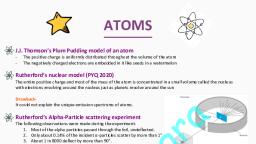
Chapter, , 12, , Atoms, Chapter Contents, •, , Introduction, , •, , Alpha-Particle Scattering, and Rutherford's Nuclear, Model ofatom, , •, , Bohr Model ofthe Hydrogen, At.om, , •, , The Line Spectra ofthe, HydrogenAtom, , •, , Hydrogen Spectrum, , •, , de-Broglie's Explanation of, Bohr's Second Postulate of, Quan.tisatton -, , •, , X -rays and the Atomic, Number, , •, , Spontaneous and Stimulated, Emtsswn - Maser and Laser, , •, , Some Important Deftnil:ions, , •, , Fonnulae Chart, , •, , Quick Recap, , Introduction, In this chapter. we will study about various atomic model. .Initially, J .J . Thomson proposed an atomic model In which h e thought of a s, e lectrons embedded in between protons. In 1911. his student Earnest, Rutherford proposed a nuclear model. on the basis of scattertng, experiment. lnsplte of strong expertmental evide n ce. Rutherford's, m od e l of atom was rejected on the ground of classica l theory of, e lec tromagnetism. So In order lo rec tify the s hort co mings of, Rutherford's model, ln 1913. Niels Bohr combined class.lcal and early, quantum concepts of Einste in and Plank to explain the s tabillty of an, atom. In this chapter we wtll confine our study to Hydrogen atom., , ALPHA-PARTICLE SCATTERING AND RUTHERFORD'S, NUCLEAR MODEL OF ATOM, H. Geiger and E. Marsden performed an expenment on ex-particles scattering,, in 1911 . as suggested by Emst Rutherford., In this experiment. they used a beam of 5.5 MeV. ex-particles obtained from, , ~14 B1, , radioactive source and bombarded It on a thin gold foil. Scattering of, lx-particles was observed through a rotatable detector made up of zinc, sulphide screen and a microscope., Paths of deftec:ted, a 1)8rtlcle8, , Aash of light indicates, a -pertide has struck, the~n, , nuous glow, eamany, a -pa,tlcles, , klngtfleec.._,, Schematic: arrangement of the Gelgw Marsden experlment, , Aalluh Educatlonlll Servtca Pvt. Ltd. - Regel. Offlce : Aalcaah T - . 8, Pusa Road. New Delhl-110005 Ph., , 011◄7623458
Page 2 :
232, , Board & Competitive Exams., , Atoms, Observations :, Most of the a -particles passed through the foil without any deviatlon., 1., , 2., , About 0 .14% of the incident a-particles scattered by more than 1°., , 3., , Deflection of more than 90° was observed In about 0 .0125% of the incident a-particles., , Inferences :, , 1., , Most of the space in an atom Is unoccupied as about 99.86% a-particles passed without deviation., , 2., , There must be an extremely small region of concentrated positive charge at the centre of an atom. This, small region is called nucleus. The scattering of a-particles is due to encounter between the a -particle, and the nucleus of the atom., , 3., , The nucleus of the atom is so massive as compared with the a-particles that it remains at rest during, the encounter. whereas electrons, owing lo their little mass, cannot appreciably deflect the far more, massive a-particles., , 4., , Electrons revolve around the nucleus in orbits just like planets revolve around the sun., , 5., , When an ex-particle strikes the metal foil, It can penetrate the outer electron cloud and approaches the, nucleus closely. It then moves under the action of coulomb's force of repulsion, and its path is hyperbola, with the nucleus as the external forces., , Impact parameter, The perpendicular distance of the Initial velocity vector of the a-particle from the centre of nucleus is called, impact parameter., , bl, , ... ! ... . . . . . . . . . . . ., , f:i, , Fig. Schematic Diagram Showing Path of an a-particle, Making these assumptions Rutherford was able to establish a fonnula for calculating the number of aparticles scattered at an angle 0 as :, , z2, N (0), , where, E, , oc, , sln4, , (, , 0 ►2, , -, , 2, , .., , [Number of a-particles], , = K.E of a -particles = 21 mv 2, , When a beam of a-particles falls upon a thin metal foil, the particles are scattered in various directions by, nuclei of the atoms of the foil. The angle of scattering of a particular a -particle depends upon the impact, parameter [the perpendicular distance from the nucleus to the initial direction of motion (velocity vector) of, the a -particle when it is far away from the nucleus] of particles. Rutherford showed that the angle of scattering, (0) is related to the impact parameter b according to the equation., 2, , Ze co{; ), b= - - - - -, , 4m,0E, , [Impact parameter), , The Impact parameter b Is the perpendicular distance of the Initial velocity vector of the a-particle, from the centre of the nucleus. Thus, smaller the Impact parameter b, greater the scattering, Aakaah Educ:a1tonal 8.,,,._ Pvt. Ltd. • Regd. Office : Aakaah T - . 8, Puaa Roed, N - Delhl-110005 Ph. 011--17623456
Page 3 :
Board & Competitive Exams., , Atoms, , 233, , angle e. When b = O, then 8 = 1800. This means that when the a-particle moves directly (head-on) towards, the nucleus. it is scattered through 1800. i.e .• reflected back along its initial path. Clearly. under this condition, the particle will have its closest approach to the nucleus., , Distance of Closest Approach, Let r0 be the distance of closest approach of the a -particle to the nucleus., The (positive) charge on the nucleus is Ze. and that on the a -partides is 2e, where e is the electronic charge., , Therefore, the electrostatic potential energy of the particle at the instant of closest approach is, 1, (Ze), 1, 41tEo -,:;;- (2e) = 4nEo, , 2Ze 2, -,:;;-, , At this instant. the a -particles is momentarily at rest and the initial kinetic energy Eis entirely converted, into electrostatic potential energy. Hence, at this instant, 1, , 2Ze 2, , E = -- -41t£0, ro, , I ro =, , ~¥, , I -. . (Distance of closest approach), , This is the expression for the distance of closest approach r 0 of the a -particles. It shows that for a given, nucleus. r0 depends upon the initial kinetic energy E of the a -particle., When the kinetic energy E exceeds a certain value. the distance of closest approach r0 becomes so small, that the nucleus no longer appears as a point charge to the a -particle. Then the Coulomb's Inverse-square, law and hence the Rutherford formula breaks down., Note: (1} The scattering is proportional to the target thickness for thin targets., (2} The ex-particle reverses its motion without ever actually touching the gold nucleus., (3} Electrons revolve around the nucleus in circular orbits so that the centripetal force Is, provided by the electrostatic force of attraction given by Coulomb., (4} Almost all mass and total positive charge is in the nucleus of radius not more than 1()-14m ., (5} The size ofatom Is about 1O' times the size ofthe nucleus I.e. the radius ofatom Is about 1o-10m ., (6} Nuclear collision is considered to be perfectly elastic and obey the law of conservation, of energy, momentum and angular momentum., , (T} Rutherford's model Is unstable due to loss of energy In the form of electromagnetic, radiation by orbiting electrons., (8} According to Rutherford's model atoms should emit continuous radiation of BIi frequencies, which is against the observed atomic spectra., , Electron Orbits, Rutherford assumed atom to be an electrically neutral sphere having nucleus at the centre and electrons, revolving around the nucleus in different orbits. The electrostatic force of attraction between the revolving, electrons and nucleus provides the centripetal force to electrons to keep them in their circular orbits., , So. for stable orbit in a Hydrogen atom., Electrostatic force of attraction = Centripetal force, , F 9 = Fe, 1 ee, mv2, 41reo ~ =, r, Where v is the tangential speed of electron moving in an orbit of radius r ., , e2, , r = ---~, 4,u:omv2, , Aallash Educat•-· ServtcN Pvt. Lid. - Regel. Office : Aakash To-. 8. Pusa Road . New Delhl-110005 Ph. 011-47623456
Page 4 :
234, , Board & Competitive Exams., , Atoms, , The kinetic energy (K) and electrostatic potential energy (U) of the electron in hydrogen atom is given by, , K = .!mv 2, 2, 82, , = 8m r, 0, e2, and U= - - 4n£0r, , So. the total energy E of the electron in a hydrogen atom is, e2, , e2, , e2, , E = K+U =, - - - - - =- 8,u:0r 4,u: r, 81tE r, 0, , 0, , What is the mass of an a-particle?, , Example 1, , Alpha partide is a doubly charged Helium nucleus, so it has two neutrons and two protons., , Solution :, , Therefore, M = 4U, , Ve,y thin foil of gold was used in scattering experiment. Why?, , Example 2 :, Solution :, , It was done to avoid multiple scattering., , Example 3 :, , Most of the a -particles passed through the foil undeviated. What can be concluded from this, observation?, , Solution :, , It can be concluded that most or the s pace In an atom Is unoccupied., , Example 4 :, , A ccording to Rutherford, which force was responsible for centripetal acceleration of an electron, revolving around the nucleus?, , Solution :, , Electrostatic force of attraction., , Example 5 :, , What should be the effect of impact parameter upon the deviation of a -particle?, , Solution :, , As the impact parameter decreases, electrostatic force of repulsion and therefore deviation will, increase., , Try Yourself, 1., , What is the ratio of mass of a gold, , atom and an a-partlde?, , 2., , What is the ratio of mass of an a-alpha particle and a proton?, , 3., , Why did a -particles scattered while passing through a gold foil?, , 4., , Alpha particle would go undiviated when it collides with an electron of gold foil. Why?, Hint : Think or the ratio of mass of an a -particle and an electron., , 5., , What was the fraction of a -particles In which deflection of more than 90° was observed?, , 6., , What was the fraction of a -particles In which deflection of more than 1• was observed?, , 7., , Find the expression of radius of an orbit of electron In terms of nucleus charge Q 1 , electronic, charge 0 2 , tangential velocity v and mass of electron m •., Hint: F. = Fe, , Aakaah Educational S.rvk:ea Pvt. Ltd. · Regd. ~ : Aakash T - . 8, Pusa Road, N - Oelhl-110005 Ph. 011 ◄7623456
Page 5 :
Board & Competitive Exams., , 8., , Atoms, , 235, , What would be the change In tangential velocity of an electron. if it remains in same orbit and, electronic charge Is doubled?, , Hint: ·v, , oc, , .Je, , What should be the angle of deviation for, , 9., , 10., , 11., , (i), , b = O, , (ii), , a large value of b, , Rutherford's a -particle experiment showed that the atoms have, , (1) Electrons, , (2) Neutrons, , (3) Nucleus, , (4) Protons, , According to classical theory of Rutherford's model, the path of electron will be, (1) Parabolic, , (2) Hyperbolic, , (3) Circular, , (4) Elliptical, , BOHR MODEL OF THE HYDROGEN ATOM, Rutherford proposed the model of the atom that consists of the nucleus at the centre of an atom with electrons, revolving around it. The nucleus-electron system Is much like sun-planet system and Is considered stable., But. there are some fundamental differences between the two systems. While sun-planet system is governed, by gravitational force, the nucleus-electron system is governed by coulomb's law of force. We know that an, object needs centripetal acceleration so that it can move in circular motion., Classical electromagnetic theory states that if a charged particle is accelerating, it emits radiation in tlhe form, of electromagnetic waves. According to this theory, electron, being a charged particle will oonlinuousl:y loose, energy. This would make electron move spiraling Into the nucleus., Also the frequency of the electromagnetic waves emitted by elecboos In circular orbit Is equal to the frequency, of their respective revolutions. The radius of circular orbit of an electron is continuously decreasing as electron, spiral Inward. This continuously changes angular velocity and hence their frequency would change continuously, because of which electrons would emit a oontinuous spectrum but in reality line spectrum is actually observed., , Nucleus --+--t-:11\::!..__.,, , So, classical physics is not sufficient to explain the atomic structure. It was Niels Bohr (1885-1962) who used, the concept of quantized energy. and explained the model of a hydrogen atom in 1913., Bohr combined classical and early quantum ooncepts and proposed a theory in the form of three postulates., These postulates are:, , Postulate I: An electron In an atom oould revolve in certain stable orbits without emitting radiant energy. Each, atom has certain definite stable orbits. Electrons can exist in these orbits. Each possible orbit has definite, total energy. These stable orbits are called the stationary states of the atom., Postulate II: An electron can revolve around the nucleus in an atom only in those stable orbits whose angular, h, momentum is the integral multiple of n (where h is Planck's constant). Therefore, angular momentum (L), , 2, , of the orbiting electron Is quantised., , L=, , nh, n where, n = 1, 2 , 3 ....., 2, , Aakaah Educational S.+icN Pvt. Ud. - Regel. Offfoe : Aakaah To-. 8, Pusa Road. New Delhf-110005 Ph. 011~7623458
Page 6 :
236, , Board & Competitive Exams., , Atoms, , Postula18 Ill: An electron can make a transition from its stable orbit to another lower stable orbit. While doing, so, a photon is emitted whose energy is equal to the energy difference between the initial and final states., Therefore, the energy of photon Is given by,, , hv = E1 - E,, , where E1 and E, are the energies of the Initial and final states. (E1 > E,), , Mathematical Analysls of Bohr's Theory for Hydrogen atom., From the equations (i) & (Ii) given below. we obtain various results., , 1, 4,a;o, , mv2, , (e)e, , 7, , =, , r, , ... (i), , and, , nh, mvr=-, , ... (ii), , 2n, , (i), , Velocity of electron In n th orbit: By putting the value of mvr in equation (i) from (ii). we get, , 1 ("h), 4ne 7 = 2n 7, e, , 2, , V, , 0, , =, , V, , =..!_(_i!__) = Vo, n 2e0 h, , where,, , Vo =, , ... (iii), , n, , (1 .6 X 10- 1II ) 2, 2 x 8.85 x 10- 12 x 6.625 x 10- 34, , = 2. 189 X, , 106 mis, , = ~ = 2.2 x 10⁶ m/s, 137, , where c = 3 x 1o& mis= Speed of light In vacuum., (ii), , Radius of the ,.,.. orbit : From equation (Ill), putting the value of v in equation (U), we get,, 2, , m x ( -e -) r= -nh, 2e0hn, 2n, , =, , 2, Eoh ] = n 2r0, r = n 2[ nrne, 2, , ... (iv), , 8 .85 X 10- 12 X (6.625 X 1 o - 34 ) 2, where,, , ro = 3.14 x 9.11 x 10- 31 x(1 .6x10- 19 ) 2, , = o .529, (Iii), , x 10-10 m, , = 0 .53 A, , Total energy of electron In rfh orbit:, From eq. (i), , e2, , 1, , KE =- mv2 = - 2, 8ne 0 r, and PE, , 1, , = 4 n:e0, , (e)(-e), , r, , = - 2 KE, , fPEI = 2KE, Allkaah Educational S.nicN Pvt. Ltd. • Regd. Office : Allkaah T - . 8, Pusa Road. New Delhl-110005 Ph. 011-17623456
Page 7 :
Board & Competitive EJ!ams., , Atoms, , 237, , Total energy of the system= KE+ PE, , =, , e2, , E = - 2KE + KE= -KE = - - 6n£or, , By putting the value of r from the equation (iv), we get, 4, , 1 ( me ), E = n 2 - 8E~h2, [IV), , =, , E, , f1, , ... (v), , nme period of revolution of electron in fiit' orbit,, , T=, , 2nr, V, , By putting the values of rand v. from (iii) and (iv)., , 3, -~, = n 3 x (4E~h, - -4- ) = rrT, 0, , T, , me, , where T0, Example 6 :, , =, , 4 x (8.85 x 10- 12 'f x (6.625 x 1041 )3, 9 . 11 X10- 31 X (1.6 X10- 111 ) 4, , = 1.51, , JC, , 10-111 s, , Which of the following can be the angular momentum of an electron orbiting in a hydrogen atom?, , 4h, , (a), , (b), , ,r, , 3h, , (c), , (d), , 4n, , 3h, , 2n, h, ,r, , nh, , Solution :, , For a stable orbit, L = 2n, (a). (b) and (d) are correct answers., , Example 7:, , What should be the velocity of an electron In third stable orbit of Hydrogen atom? (In tenns of, speed of light)., , Solution:, , Velocity of light in ,tt' orbit, V, C, V, , Example 8 :, , V, = _!!_, , n, , C, =, ° 137, , where V, , C, , = 137 x3 = 411, , What would be the change in radius of n 111 orbit, if the mass of electron reduces to haff of its, orig_inal value?, , Solution :, , As r, , Example 9 :, , Total energy of an electron in an atom is negative. What does it signify?, , Solution :, , Negative energy signifies that force between electron and nucleus is attractive. Electron is bound, to the nucleus ., , cc ~ ., , m, , therefore radius would be doubled., , Example 10 : What would be the ratio of product of velocity and time period of electron orbiting in 2"'1 and 3fd, stable orbits?, Solution:, , Time period, T2 v 2, , T3V3, , JC, , ~, , Velocity, , cc, , n2, , 4, , = 3 2 =g, , Allbsh Educatlonal S.4tc:ea Pvt. Ud. - Regd. Ol'floe : Aakallh To-. 8, PIJM Road. New Delhf-110005 Ph. 011 ◄7623458
Page 8 :
238 Atoms, , Board & Competitive Exams., , Try Yourself, 12., , What should be the minimum value of angular momentum 10' an electron Olbitlng In a hydrogen, atom?, , 13. When an electron makes transition from its stable orbit to another stable orbit of lower energy,, where does the remaining energy go?, , 14., , Find the ratio of velocities of electron In 2 nd and 4 111 orbit of hydrogen atom_, , Hint: v, , 1, oc -, , n, , 15., , What should be the maximum velocity of an electron orbiting around a hydrogen nudeus?, , 16., , What is the ratio of radii of 3 rd and 2 nd orbit of hydrogen atom?, , 17. Find the area enclosed by the circular path of an electron in first orbit of hydrogen atom., 18., , What is the ratio of magnitude of potential energy to the kinetic energy for an electron In, , hydrogen atom?, 19., , If total energy of the same electron is E . then what would be its kinetic energy and potential, energy?, , 20. Choose correct option out of following with increase in n :, (a), , T increases and v decreases, , (b), , T and v both increase, , (c), , T decreases and v increase, , (d), , T and v both decrease, , where T is time period and v is velocity of an electron, 21., , What is the value of n for which time period is 8 times the time period of electron in first orbit, of hydrogen atom?, , Hint : T, , oc, , n3, , Energy Levels, As you have studied earlier that an atom consists of electrons orbiting around the nudeus. These electrons, are restricted to orbits with certain energies. They can jump from one energy level to another but they cannot, have orbits with energies other than the allowed energy levels., The energy of an atom is least when electron revolves closest to the nucleus i.e., n = 1 . This lowest energy, state an atom is known as ground state. In this state, the electron revolves in the orbit of smallest radius,, the Bohr radius, a 0 ., The energy of this state (n = 1 ), is E 1 = - 13.6 eV, , 13.6 eV is the minimum energy required to fre.e the electron from the ground state of the hydrogen atom. It, is called the ionisation energy of the hydrogen atom. The experimental value of ionisation energy is perfectly, matched with predicted value of the Bohr's model., At room temperature, most of the hydrogen atoms are in ground state. The atom may acquire sufficient energy, to raise the electron to higher e nergy states . Tlhis higher state Is said as excited state. From equation (v), FOIi" n = 2, E 2 = - 3.4 eV, , So energy required to excite an atom from ground state to first excited state Is equal to, , = - 3 .4 ev - (- 13.6 eV) = 10.2 ev, Similarly. for n = 3 , ~ = - 1.51 eV, and E 3 - E , = 12.09 eV, E2, , -, , E1, , Aakaah Educational SarvlcN Pvt. Ltd. - Regd., , omc.:, , Aakaah T - . 8, Puaa Road. N - Deltu-110005 Ph. 011 ◄7623456
Page 9 :
Board & Competitive Exams., , Atoms, , 239, , THE LINE SPECTRA OF THE HYDROGEN ATOM, The third postulate of Bohr's model states that when an atom makes a transition from the higher energy state, , to the lower energy state, a photon is emitted with energy equal to the difference of energy of the state., Let the quantum number of higher energy state is, emitted photon is v• then, , n1 and, , of lower energy state is, , n, and, , the frequency of, , hv• = E 1 - E,, The E 1 and E, can be defined using previous equation., 4, , So,, , 1rv., , n,e, , 1, , (, , 1 ), , = 8£~if n'f - nl, 4, , or, , v., , ,ne, , (, , 1, , 1 ), , = 8e~h3 n; - nf, , =, The above equation Is the Rydberg formula . The term, , me 4, ~~3, 8 e~h c, , R=, , ":1, , 1, , 4, , 3, , is taken as Rydberg constant R, , 8E0 h C, , =1.03 x 10⁷ m ~1 and - = 912A, R, , The value of Rydberg constant R is very close to the value 1.097 >< 107 m- 1 obtained by Balmer using his, empirical Balmer formula., This confirms the Bohr's model of an atom., , As we can see that n, and n 1 are Integers, so the light which Is radiated when an electron jumps between, different energy levels, is of discrete frequencies moreover, an electron can comeback to its ground state or, lower energy state. When an electron makes this transition from higher energy level to lower energy level, a, photon is released. The energy of photon is equal to the energy difference in the energy levels_, 0 eV - - - - - - - - - - - - - - - - - - - - - - -, , -0.54 eV, , l .,, , -0.85eV, -1.51 eV, , l. ., .,, ,, Balmer, , -3.4eV, , -13.6eV, , .,, , . .' . ',, ,, , Lyman, , l., , l, , Pfund, , Brackett, I,, , Paschen, , n=, n=6, , 00, , n=S, n=4, n=3, , n=2, , n=1, , Light ls emitted from the hydrogen atom only when the electron, makes transitions between stationary states, In figure, n is principal quantum number and labels the stable stales in the ascending order of energy., In the energy level diagram,, , n = oo, corresponds to the energy level of O eV. ( Ionisation energy state), , Aallaah Educational - - ~ Pvt. Ud. - Regd. Offloe : Aalcaah T - . 8, PuA Road , New DelN-110005 Ph. 011~7623458
Page 10 :
240, , Board & Competitive Exams., , Atoms, , HYDROGEN SPECTRUM, (i), , Lyman Series : In this series, the electron jumps from any outer orbit to first orbit The general formula, for wavelength of emitted radiation is given by, , ;, , = R, , ·c!- n~), , where n 2 = 2 , 3, 4 , 5 ...... ., n 2 = 2 for first member of Lyman series, , n 2 = 3 for second member of Lyman series, This series lies in ultraviolet region of the spectrum., , Longest Wavelength of the Lyman Serles : Longest wavelength (minimum energy) of this series is, , I= RC! - 2~)=11-i) = :, .). =~, = 4, =3 x4 ooo, x 103.R 3 x 1.097 x 10, 1.097, 3, , or,, , 7, , 10, , m = 1215 A, , Shortest Wavelength of Lyman Series (Serles limit) : The shortest wavelength (maximum energy) of, this series is obtained by putting n 2 = ..., , ..!. = d .!_2 - ..!.), A "l1, 00, , •·, , 1, 1, 1000, - 10, A= R = 1.097 x 107 = 1.097 x 10 m = 911 .58 = 912 A, , (ii) Balmer Series : In th is series. the electron Jumps from any outer orbit to the second o rbit,, , n, = 2 ,, , i.e.,, , n2 = 3 , 4 , 5 , ....... ... ., , ..).!_ =R(-1, ___, 1), 2, nl, 2, , where n 2 = 3 for 1• member of Balmer series, , n 2 = 4 for ll nd member of Balmer series, n 2 = 5 for lll rd member of Balmer series., , The first, second, third, ..... members of Balmer series are called H.,, H 11, HY, .. ....... This series lies partly, in the visible part of the spectrum., , Longest Wavelength of Balmer Series : Longest wavelength (minimum energy) of Balmer series, corresponds to the transition, , n, = 2, n2 = 3, , i=, , R [ 2~ - 3~, , or,, , .).= 36 =, , 5R, , ]=R[±-¾]=:, 36, , 5x1 .097 x 107, , =, , 36000 x 10- 10m = 6563 A, , 5 x 1.097, , Aakash EducaUonal Seh"tcN Pvt. Ltd. - Regd. Office : Aa.kaah T - . 8, Pusa Road, New Delhi-110005 Ph. 011-47623456
Page 11 :
Board & Competitive Exams., , Atoms, , 241, , Serles llmlt of Balmer series or shortest wavelength (maximum energy) of Balmer series :, , = of_12 _.!_] = R, "L2, 4, , _!, A, , 00, , 4, , A. =R =4><911.58=3646A., (iii) Paschen Series : This series is emitted when the electron jumps from any outer orbit to the third orbit., i.e ., n,, 3 , n2, 4 , 5, 6 . ..... ., , =, , ; =, where, , ,3~ -n~], =, , n 2 = 4, for 1•1 member of Paschen series, n 2 = 5 for ll nd member of Paschen se.r ies, , This series lies in the Infra red region of the spectrum., , Longest wavelength of Paschen series : For longest wavelength (minimum energy) n 1, Therefore, , .!.A = 'l3, ,:[_12, , 1, - - 2], 4, , = of.!. -, , 'lg, , = 3 , n2 = 4 ., , ...!.], 16, , or,, , A. = 144, 7R, , or,, , 144000, 10, x 10- m = 18752 4 A, 7 x 1.097, ', , =, , Serles llmlt of Paschen aeries : For smallest wavelength (maximum energy) (or series limit). n 1 = 3 ,, , n2 =, , oo ., , ~ = ,3~ - ~] =:, A, , = R9 = 9, , >< 911 .58 = 8204, , A, , Note :, Energy Levels: For H-atom, the energy of ,rh level Is given by the relation :, , E =-13.6ev, n, , •., , E1, , n 2', , = - 13.,6 eV, , £ 2 = - 3. 4 eV, , E 3 = - 1.51 eV, , E 4 =- 0.85 eV, , E 15= -0.54 eV, , E 0 = - 0.38 eV, , Aallaah Educatlonal S.•1- Pvt. Ltd. - Regel. Otlfce : Aakaah T - . 8, P\ma Road , New Delhi-110005 Ph. 011 ◄7623456
Page 12 :
242, , Board & Competitive Exams., , Atoms, , Taking these energies on a I/near scale. horizontal lines are drawn which represent the energy levels of, H-atom. The transition of electron shown on these energy levels gives the energy level diagram of H-atom., The arrows ending at n = 1, 2. 3, 4 and 5 represent the transitions responsible for Lyman, Balmer. Paschen., Brackett and Pfund series, respectively., Note : "/lE is the energy difference In electron-volt and ).. is the wavelength of photon emitted or absorbed, (In A) then, l!.E =he, )., , =, , ). =, , 6.63 X 10-34 X 3, , X, , 108, , (!!.£ in eV) X 1.6 x10- 19, , J.. =, , 12431, , A, , ~E (In eV), Ground st.at& •nd &cited Stafes : The lowest energy level of an atom is called the •ground state" and higher, levels are called •excited states". The H-atom has lowest energy in the state for the principal quantum number, n = 1. Since E 1 = - 13.6eV. the ground state energy of H-atom Is - 13.6eV. For He•. the lowest energy level, is E, = (- 13.6eV)Z2, 13.6eV)l2, 54.4eV. Thus for all H-llke Ions the first energy states are their, ground states and all other states (i.e. for n = 2, 3 , 4 ...) are excited states. Thus Ei, E 30 E 4 .. . are called, the first. the second, the third .. . excited states respectively., , = (-, , =-, , Ionisation Energy •nd Ionisation Potential, The minimum energy needed to ionize an atom is called "ionisation energy". The potential difference, through which an electron should be accelerated to acquire this much energy Is called "Ionisation, potential". Hence. ionisation energy of H-atom in ground state is 13.6eV and ionisation potential is 13.6V., V respective, . Iy tior t h e,r, . r,lh states. ), ., (For any H - l,.k e ,ons, th ese are 13.622, e V and 13.622, 2, 2, , n, , n, , In this case the electron is not bound to the nucleus and is free to move anywhere., Binding Energy, , Binding •IMIVY of• system Is defined as the minimum energy needed to separate Its constituents to, , ,.rge (Infinite) distance.., , This .may also be defined as the energy released when Its constltuenf3 •re brought from Infinity to form, the system., , The binding energy of H-atom in ground state is 13.6eV which is the same as its ionisation energy., &citation Energy and &cit.at/on Potential, The energy needed to take an atom from its ground state to an excited state is called the ·excitation energy", of that excited state. The potential through which an electron should be accelerated to acquire this energy, Is ca/led the ·excitation potential"., The H-atom in ground state needs 10.2eV to go into the first excited state, hence the excitation energy or, excltstlon potential of H -atom In first excited state Is 10.2eV or 10.2V respectively., , Bohr's theory Is un•ble to expl•ln the following fact3:, (I), , The spectral lines of hydrogen atom are not single lines but each one is a collection of several closely, spaced lines., , (II}, , The structure of multi-electron atoms is not explained., , (Iii), , No explanation for using the principles of quantisation of angular momentum., , Aakash Educational Semces Pvt. Ltd. • Regd. Olffce: Aakash Tower, 8, Pusa Road, New Oelhl-110005 Ph. 011-47623456
Page 13 :
Board & Competitive Exams., , Example 11, , Solution:, , Atoms, , 243, , What Is the energy required to remove an electron from second orbit of hydrogen atom?, Energy of second orbit, E 2 =, Ionisation energy=, , - y13.6 = - 3 •4 e V, , o - (-3.4) = 3.4 eV, , Example 12 : With the help of Rydberg formula find the wavelength of first line of Pfund series., , Solution:, , .!_ =, >.., , R(_!_, -_1), nJ nJ, , For first line of Pfund series,, , n1 = 6 and n, = 5, , .!. = R(_!_2 __1_), 2, >.., , 5, , 6, , = >.. = 11R, 900, , Try Yourself, 22., , Whal is the energy emitted when an electron jumps from second orbit to first orbit in a, , 23., , hydrogen atom?, Wllh Increase In n, Ionisation energy will Increase o, decrease?, , 24., , Find the ratio of wavelengths of first llne of Lyman sanes and second line of Balmer seriies., , Hint : Use Rydberg formula., 25., , Find the minimum wavelength emitted by a !hydrogen atom due to electronic transition., , DE-BROGLIE'S EXPLANATION OF BOHR'S SECOND POSTULATE OF QUANTIZATION, de-Broglie explained second postulate of Bohr's atomic model by assuming an electron to a particle wave., Therefore, it should form standing waves under resonance condition., According to de-Broglie, for an electron moving In, , rl", , circular orbit of radius rn,, , 2wn = n>.., n = 1, 2, 3, ..., i.e .. circumference of orbit should be integral multiple of de-Broglie wavelength of electron moving in ,th orbit., As we know from previous chapter that de-Broglie wavelength., , >.., , h, >-=mv, , =, , nh, 2nr. = - -, , n, , mvn, , ex, , mvr, n n, , nh, , = -, , 2.n, , Allbsh Educatlonal S...tce. Pvt. Ud. - Regd. Offloe : Aakaah Tow. 8, Pl.a Road , New Delhi-110005 Ph., , 011 ◄7623458
Page 14 :
244 Atoms, , Board & Competitive Exams., , Example 13 : Which of the following is/are possible values of radius of stable orbit of hydrogen atom?, , ,._, , (a), , >.., , (c), , ______, , Solution :, , (b), , 2n, , (d), , 7t, , nA, , rn = 2n, ._, , (a) & (c) are correct answers., , Try Yourself, 26., , de-Broglie e.x plained the Bohr's postulate of quantization by partlcle nature of electron. (True/, False)., , EXERCISE, 1., , 2., , In scattering experiment, find the distance of closest approach, if a 6 MeV a-particle Is used, JC, , (3) 4 .6, , 16, JC 10-, , m, , (2) 2, , JC, , (4) 3 .2, , 10-14 m, JC, , 10- 16 m, , The angular momentum of an electron in a hydrogen atom is proportional to (where, number), , (3), , n3, , (3), , ~ ~, , {4), , Jii, , h, Jt, , 5h, 2n, , 3h, , <2> 2n, , <4 ), , 2h, 2n, , The energies of three conservative energy levels L 3 • ~ and L 1 of hydrogen atom are E 0 ,, respectively. A photon of wavelength ,._ is emitted for a transition, emission for transition ~ to L 1 ?, , 16A, , <1 > 31, (3), , 5., , n is principle quantum, , What should be the angular momentum of an electron in Bohr's hydrogen atom whose energy Is -0.544 eV?, (1), , 4., , 10-16 m, , (1) 3 .2, , ~) n, 3., , I, , .!!,._, 20, , { 2), , ~, , 4E0, , 9, , and, , E0, , 4, , to L 1 . What will be the wavelength of, , 27A, 7, , {4) ,._, , In Bohr's model of the hydrogen atom, the ratio between the period of revolution of an electron in the orbit of, 1 to the period of revolution of the electron In the orbit n 2 Is, , n, , =, , =, , (1) 2 : 1, , {2) 1 : 2, , (3) 1 : 4, , {4) 1 : 8, , Allkaah Educational S e ~ Pvt. Ltd. - Regd. Office: Aakaeh T - . 8. Pusa Road. New Oelhl-110005 Ph. 011-47623456
Page 15 :
Board & Competitive Exams., 6., , (3), , n, , (2) 2n, , n 2 -n, , (4), , 2, , (3), , =4, n =2, , n, , to, , n, , to, , n, , =3, =1, , (2), , 2, , (4), , =4, n =3, , =2, to n = 1, , n, , to, , n, , The speed of an electron In the 4 111 orbit of hydrogen atom is, C, , <2 > 137, , (1) C, , (3 ), , 9., , n 2 +n, , In which transition of a hydrogen atom, photons of lowest frequency are emitted?, (1), , 8., , 245, , When an electron Is excited to n"' energy state In hydrogen, the possible number of spectral lines emitted, are, (1), , 7., , Atoms, , C, , (4 ), , 2192, , Three energy levels L 1 , L 2 and, , l:J of a, , C, , 548, , i.e. ,, Lz lo L 1 and L 3 to L 1 are A:), Az, , hydrogen atom correspond lo increasing values of energy, , E"' < ELa < E 4 . If the wavelength corresponding to the transitions, , l:J to Lz., , and >.. 1 respectively then, , (4), 10., , "-3 =, , A,"-2, , "'-1 + A2, , Using Bohr's formula for energy quantization, the ionisation potential of first excited stale of hydrogen atom, is, , (1) 13.6 V, , (2) 3.4 V, , (3) 2 .6 V, , (4) 1.51 V, , X-RAYS AND THE ATOMIC NUMBER, Prof. WIiheim Konrad Roentgen, a German scientist, in 1895, observed that when fast moving cathode rays, strike a metal piece of high atomic weight and high melting point, a new kind of rays are produced. Since., nothing was known about these rays, Roentgen called these rays as X-rays. These are also called Roentgen, rays. Roentgen was awarded noble prize in 1901 for this discovery., Quality Control In an X-ray tube : X-rays are of two types (i) Soft X-rays (ii) Hard X -rays., , (i), , Soft X-rays: X-rays having wavelength of 4 A or above (have longer wavelength), smaller frequency and, hence smaller energy. These are called soft X-rays due lo their low penetrating power. These are produced, at comparatively low potential difference and high pressure., , (ii), , Hard X-rays : X-rays having low wavelength of the order of 1A have high frequency and hence high energy., Their penetrating power is large. Therefore they are called hard X-rays. These are produced at, comparatively low pressure and high potential difference., , The wavelength of X-rays depend upon the kinetic energy of the electrons producing them and this kinetic, energy depends upon the potential difference between the filament F and the target T (see below Coolidge tube, figure). As the potential difference is inc reased , the wavelength of X-rays produced decreases, i.e ., their, penetrating power is increased or decreased by increasing Of" decreasing the potential difference applied between, the ends of the tube., Aallash Educatl-a Selsoicea Pvt. Ltd. - Regd. 0tnce : Aakaah T - . 8, Pusa Road , New Delhl-110005 Ph. 011 ◄7623458
Page 16 :
246 Atoms, , Board & Competitive Exams., glass, , ,----ti- -~ -... ,I t - - - ,, , chamber, , water, , //=;= :t:=== -, , Properties of X-rays, Properties of X-rays may be divided Into two headings :, (i), , (ii), , Properties slmllar to llght rays:, (a), , These are invisible., , (b), , These travel with the speed of light., , (c), , These travel in straight line., , (d), , These undergo reflection, refraction, interference. diffraction and polarisation., , (e), , The wavelength of X-rays is very small compared to the wavelength of light. Hence, these cany much, more energy. (This Is the only difference between X-rays and light). The wavelength of light rays range, from 4000 to 7500 A. whereas that of X-rays is from 100 A to 1 A., , (f), , These produce Illumination after falling on fluorescent materials., , (g), , X-rays are not deflected by electric and magnetic fields., , (h), , These show continuous spectrum. Hence we conclude that like light rays, X-rays are electromagnetic, waves. These show all important properties of light rays., , Properties of X-rays similar to cathode rays :, (a), , X-rays ionise the gases through which these pass., , (b), , These penetrate through different depths into different substances. e .g ., wood, cardboard, thin metal, sheets., , (c), , If objects are placed In their path, these cast their shadows., , (d), , These affect photographic plates., , (e), , These are very active and may eject electrons from metals e.g .. these show pho toelectric effect., , (f), , Long exposure of both cathode rays and X-rays is injurious to human body., , Absorption of X-rays, If a beam of X-rays of intensity I passes through a length dx of any material , its intensity is decreased by, di. For any given material, the amount of absorbed intensity is µ / dx, where µ is called the absorption, coefficient., Then. -di = µI dx, or, , di/I = - µ dx, , On integration we get,, log/ = -µx+c, , ...(1), , whel"8 ·c· Is constant of Integration., Aakaah Educational . . . _._ Pvt. Ltd. - Regd. Offlce: Aakaah T - . 8, Puaa Road. New Delhl-110005 Ph. 011 ◄7823456
Page 17 :
Board & Competitive Exams., , Atoms, , 247, , When x = 0 then I = 10 ; hence c = log 10, Eq. (1) becomes, , log f = - i1 X + log lo, log I -, , log 10 = - µ, , or log (///0 ) = - µ, or I = t0 fr1"", , X, , x, , where, 10 is the intensity of incident X-rays and, I that of emergent X-rays., , Spectrum of X-nys, The X-rays produced in Coolidge tube gives a continuous spectrum crossed over by characteristic lines. It, means that the X -rays contain a wide range of wavelengths whose intensities are so intermixed that these, cannot be distinguished from the another. The variation of intensity with wavelength in the spectrum of X-rays, is shown In figure., , Wavelength---..., The resulting curve shows that there is a lowest wavelength limit, than "min do not exist In the X-rays emitted from the Coolidge tube., , A,,,1n for X-rays. The wavelengths shorter, , X-ray spectrum Is of two types:, (a), , Continuous X-ray spectrum, , (b), , Characteristic X-ray spectrum, , (a), , ContlnUouA X-ny• : The emission of X-rar-; by electrons striking the target and the loWest wavelength, limit can be explained by the quantum theory. According to this theory, emission of X-rays takes place, in the form of small bundles of energy, called 'photons'. The energy of each photon is hv, where vis the, frequency of X-radiation and h is Planck's constant. When a voltage V is applied across the X-ray tube., the electron emitted by the filament will reach the target with energy eV. When the electron strikes an, atom of the target, It loses a part or whole of its energy. This lost energy Is obtained In the form of an, X -ray photon. given by the relation:, 2 =eV =hv, ..!.mv, 2, , The electron rarely loses whole of Its energy In a slngle colllsion. Generally it undergoes a sequence, of collisions with atoms of the target before coming to rest, thus emitting photons of smaller and smaller, energies i.e., of longer and longer wavelengths. This accounts for the production of a continuous range, of X-rays wavelengths, above a definite limit., , Maximum frequency of continuous X-rays : When the electron loses the whole of its energy in a, single collision with the target atom, an X-ray photon of maximum energy hv,,_ is emitted., Thus, for an accelerating voltage V, the maximum X-rays photon energy is given by hvmu = ell., Consequentty, the maximum frequency of X-rays produced by electron of energy eV is v,,,_ = • :, Aallash Educatlwl ... ~ Pvt. Ltd. - Regel. 0Moe : Aakaah To-. 8, Pusa Road , New Delhf-110005 Ph. 011 ◄71623458
Page 18 :
248, , Board & Competitive Exams., , Atoms, , Minimum wavelength of continuous X-r.ays: The minimum wavelength corresponding to maximum, frequency vma,,. is given by, , = _ c_, , >.., min, , where, , Vmax, , = .!:!!._,. 12400 [A), eV, , V, , c is the speed of light., , Thus, the minimum wavelength limit(>..,..") Is Inversely proportional to the accelerating potential (V)., , (b), , Characteristic X-nys : The spectrum of X-rays is a continuous spectrum crossed over by distinct spectral, lines whose frequencies are the characteristic of the material of the target and the line spectrum is called, characteristic X-ray spectrum of the material of the target. The radiation forming the line spectrum is called, characteristic X-rays., Characteristic X-ray spectrum is simple one. Most element show only K-series and L-series in their, characteristic X-ray spectra., Wavelengths of K-series are generally less than 1A and those of L-series are nearly 10 times longer. First,, second. third •... members of the Kand L series are K" . Kw ~ ... and L,, Lw L_, .... respectively., Elements having atomic number greater than 66 show further series known as M and N series., , Origin of Characteristic X-rays, An atom consists of a central positive nucleus and electrons revolving around It In orbits of definite radii. These, shells are called K, L , M , N ,... shells, K shell being the Innermost shell. The electrons in the K-shell are most, tightly bound to the nucleus, and maximum force is required to eject them. Less energy is required to eject, the electrons from the L-shell and still smaller energy for M-shell and so on., 0, , N, , M, .!, , M, L, , K.., K, , ", , ~. .., , L-1 t..,, , L,, , ,.Mp, , M-series, , ", , L-series, , K,, , .,, , K-series, In an X-ray tube an electron strikes the target with such a large velocity that It can penetrate well Into the, atoms of the target and eject a K-electron. A vacancy is created in the K -shell, and it is immediately filled, by an electron from L-shell. The balance of energy (which is equal to the difference in energies of the two, shells) is emitted out as an X-ray photon. This line corresponds to K ,. line in K-series of X-ray spectra., Similarty. if the vacancy of K-shell is filled by the jumping of electrons from the M, N ... shells, Kw Ky, ... lines, of this series are emitted., If the electron striking the target ejects an electron from the L-shell, of the target atom, an electron from the, M , N ... shell, jumps to occopy this shell. Thus X-ray photons of less energy are emitted. These photons form, L-series. In a similar way the formation of M , N ... series can be explained., , Moseley's Law, Moseley (1913) made an extensive study of the characteristic X-ray spectra of a number of heavy elements,, and observed a simple relationship between them. He found that the spectra of different elements are very, similar, and with increasing atomic number Z , the spectral lines merely shift towards shorter wavelength o r, higher frequencies. He plotted a graph of the K -series between the square-root of frequency ( ✓f) and atomic, number (Z) and found it very approximately to be a straight line. He, therefore, concluded that the squareroot of the frequency of a K-llne is closely proportional to the atomic number of the element., Aakaah Educational ServlcN Pvt. Ltd. - Regd. Office : Aakash T_., 8, Pusa Road, N- Delhl-110005 Ph., , 011 ◄7623456
Page 19 :
Board & Competitive Exams., , Atoms, , J1, , 249, , J1, , This is called Moseley's law and may be expressed as, oc (Z - b), or,, =K(Z - b) . where Z is the atomic, number of the element. and Kand bare constants for a given transition of the K-series., The law is applicable to other series also but with different values of K and b., For K 0 X-ray, take K, , = .J2.48x10 15 Hz, , Hence. the frequency of a Ka X-ray is, , = 1., , and b, f, , = 2.48, , x, , 1015Hz (Z - 1 )2, , ~v, I ,,., , - t , _ . ~,,., , Atomic Number (Z), , J1, , If, however, a ,g raph be plotted between, and the atomic weight, there Is an appreciable departure from, straight line. Moseley concluded that it is the atomic number, and not the atomic weight, which is more, fundamental with regard to the emission of characteristic X-rays., Moseley pointed out that the elements in the periodic table must be arranged in the order of increasing atomic, number Instead of atomic weight. From this point of view he changed the position of certain elements In the, Mendeleev's Periodic Table. When these changes were made, the anomalies of the Mendeleev's table, disappeared., While arranging the elements In the Increasing order of atomic number, Moseley had to leave certain gaps, such as at Z = 43, and 72. He pointed out that these elements may be discovered later on and were, subsequently discovered. These elements are technetium and hafnium, respectively., , Knowledge Cloud, CAT Scanning, The medical profession began using X-rays for diagnostic purposes almost Immediately after their discovery., When a conventional X-ray Is obtained, the patient is typically positioned In front of a piece of photographic, fllm, and a single burst of radiation Is directed through the patient and onto the film. Since the dense structure, of bone absorbs X-rays much more than soft tissue does, a shadow-like picture la recorded on the film . As, useful as such pictures are, they have an inherent limitation. The image on the film la a superposition of all, the •shadows• that result as the radiation passes through Ollle layer of body material after another. Interpreting, which part of a conventional X-ray corresponds to which layer of body material is very difficult, , The technique known as CAT scanning or CT scanning has greatly extended the abifity of X-rays to provide, images from specific locations within the body. The acrony,m CAT stands for computerized axial tomography, , or computer-assisted tomography, while the shorter version CT stands for Computerized Tomography. In this, , technique a series of X-ray Images are obtained. A m.mber of X-ray beams form a "fanned our err&'/ of radiation, and pass simultaneously through the patient Each of the beams Is detected on the other side by a detector,, which records the beam Intensity. The various lntensttles are different, depending on the nature of the, body, material through which the beams have passed. The feature of CAT scanning that leads to dramatic, Improvements over the conventional technique Is that the X-ray source can be rotaled to different orieulations,, so that the "fanned.out" array of beams can be sent through the patient from various directions. The intensity, of each beam 1in the array is recorded as a function of orientation. The way in which the intensity of a beam, changes from one orientation to another Is used as Input to a computer. The computer then constructs a, highly resolved Image of the cross-sectional slloe of body material ttvough which the "fan• of radiation has, passed. In effect, the CAT scanning technique makes It possible to take an X-ray picture of a aoss-sectional, •sl6ce• that Is perpaudlcular to the body's long axis. In fact, the word •axial In the phrase •computerized axlal, tomography" refers to the body's long axis., Aabsh Educatlonal Sel..-1c:es Pvt. Ltd. - Regd. Ol'IJoe : Aakash To-. 8, Pusa Road. New Delhl-110005 Ph. 011◄7623456
Page 20 :
250 Atoms, , Board & Competitive Exams., , Did You Know?, U.lng X-rays ID Study the Wen of Matar Palnt.'9, Interesting Insights Into the process of painting mld revising a masterpiece me being revealed by Xrays. Long tfAl\lelength X-rays me absorbed In varying degrees by some paints, such as lhose having, lead, cadmlwn, ctvomlum, or cobalt as a base. The X-ray Interactions with the paints give cx,11bast, because the dlffer.tnt elemenls In the paints have different electron densities. Also, thicker layers will, absorb mo,e than thin layers. To examine a painting by an old master, a film Is placed behind It, while It Is X-rayed from the front Ghost outlines of eartler paintings and eartler forms of the final, masterpiece are eometimes nri.aalad when the ftlm Is developed., Example 14 : If K,, radiation of Mo (Z = 42) has a wavelength of 0. 71 A, calculate the wavelength of the, corresponding radiation of Cu (Z = 29)., , Solution :, , From Moseley's law, we have v = K (Z - bf., For K,, radiation, Screening constant b, , ..!_ oc (Z >.., , >..eu, , >..Mo =, , =1, , and v, , = (cl>..)., , 1)2, , (ZMo -1)2, (Zcu -1)2, , (41) 2, = (28)2, , Now, given, , >..Mo=, , 0.71, , A, 41 2, , "-eu = (0.71 A) " 282, = 1.52 A, Example 15 : Find the minimum wavelength of the X-rays emitted by an X-ray tube operating at 40 kV., , Solution :, , When the wavelength is minimum, the energy (, , h:) of X-ray photon will be maximum., , Hence, the total kinetic energy (eV) of the electron should be converted into an X-ray photon., So,, , he, - ,._ =eV, , a, , A, , =, , =, , he, , eV, (4.14 x10⁻¹⁵ eV-s) (3x10 8 ms- 1 ), ex40 x 103 V, , = 4.1:x3x 10_11 m, = 3. 1, , ><, , 10-11 m, , Aakaah Educational Se""- Pvt. Ltd. - Regel. Office: Aakuh T - . 8, Pusa Road, New Delhi-110005 Ph. 011 ◄7623456
Page 21 :
Board & Competitive Exams., , Atoms, , 251, , Try Y,ourself, 27., , I, , If the intensity of an X-ray becomes ;, , from 10 after travelling 3 .5 cm inside a target, then Its, , Intensity after travelling ne.xt 7 cm will be, , (1 ) lo, , (2), , ~, , lo, 9, , (4!), , .!s!.., , 6, , (3 ), , 28., , 12, , 27, , The intensity distribution of X-rays from two Coolidge tubes operated at different voltages V1 and, V2 and using different target materials of a1omic numbers Z, and ~ is shown in the f"igure., Which one of the following inequalities is true?, , I, , ________, , ,.._...._._, , (1) V 1 > V2 ,, , 29., , z,, , < ~, , ).., , (2) V1 > V2 • Z 1 > Z 2, , (3) V 1 < V2 , Z 1 > Z 2, (4!) V1 = V2 , Z 1 < Z 2, In the Coolidge tube experiment when the target material is changed then, , (1) Only continuous spectra changes, (2) Only characteristic spectra changes, (3) Both the spectra change, , (4) Neither continuous nor characteristic spectra change, , SPONTANEOUS AND STIMULATED EMISSION - MASER AND LASER, Maser and Laser, An atom can exist either in the ground state with energy E 1 or in an excited state with energy E 2 • This atom, can shift from one of its two allowed states to the other by three ways given below., , (1) Absorption : In the figure a photon of energy hf = E 2 - E 1 interacts with an atom In the ground state, with energy E 1 • The photon is absorbed by the atom, ireaching the excited level E 2 • This familiar process, is called "absorption"., , (2) Spontaneous Emission : In figure the atom is in excited state E 2 and no radiation is present. After a certain, mean life of the order of 1o..as, the excited atom returns to the ground state by emitting a photon of energy, hf= E 2 - E 1 • which Is same as the one originally absorbed. This process is called ·spontaneous emission•., Aakash Educational S..+ices Pvt. Ltd. - Regel. otnce : Aakash To-. 8, Pusa Road. New Delhi-110005 Ph. 011-47623458
Page 22 :
252 Atoms, , Board & Competitive Exams., , because it was not triggered by any outside influence. The direction and the phase of the photons emitted by, different atoms are random. The light from the glowing filament in an ordinary light bulb is generated this way., , (3) Stimulated Emission : In figure, the atom is again in the energy level E 2 , but this time continuous radiation, is also present. A photon of energy hf = E 2 - E, interacts with the atom. A kind of resonance effect, induces the atom to emit a second photon which is in every way identical to the incident photon. It has, the same energy, direction, phase and polarisation. This process is called "stimulated emission·, because, it was triggered by the outside photon. Thus each stimulating photon gives two identical photons after, stimulation. Because the two photons have the same phase, they emerge as coherent radiation., hf, ==:::::::::4, _ __f;E2, , Laser, The word "laser" Is an acronym for "light amplification by stimulated emission of radiation·. This Is based on, the principle of "stimulated emission" disct.1ssed above for a single atom. In usual case. however many atoms, are present. In equilibrium at the temperature T, suppose the number of atoms in the ground and excited levels, are N 1 and N 2 respectively. Then, according to Boltzmann, , N, , 2, , = N,e- <E2 - E,)lkT, , Obviously, N 2 is very less than N 1 and hence the absorption of incident photons is much more probable. To, make "laser" we must generate photons without appreciable absorption., Thus, we need to create a non-equilibrium situation in which N 2 is greater than N 1 . Such a situation is called a, "population Inversion·. In this case the rate of energy radiation by stimulated emission can exceed the rate of, absorption. The resulting radiation is therefore very much more coherent than light from ordinary sources. Another, requi rement for a laser to be the controlling process Is that the higher energy level E 2 must have a relatively long, mean life (of the order of 10-3s) against depletion by spontaneous emission. Such an excited state Is called, ·metastable". The two requirements (I) population inversion and (Ii) metastability can be achieved in a variety of, ways. Some examples are helium-neon laser, semiconductor laser, chemical laser and X-ray laser., , Maser, The word '"Maser" is an acronym for "microwave amplification by stimulated emission of radiation". This operates, on the basis of population inversions in molecules, using closely spaced energy levels. The corresponding, emitted radiation is in microwave range. Maser action even occurs naturally in interstellar molecular clouds., , Propertiies of Laser Light, (I), , Highly monochromatic : Ordinary light Is spread over a continuous range of wavelength. Even the light from a, neon sign Is monochromatic to only 1 part in about 1<>6. But the laser light is monochromatic to 1 part in 10 15., , (ii) Highly coherent: Wave trains for laser light may be several hundred kilometers long. But the coherence, length for light from a tungsten filament lamp is typically less than 1 meter., , (iii) Hlghty dlNctlonal : A laser beam departs from strict parallelism only because of diffraction. Other beams, can be made parallel by a lens or a mirror, but the beam divergence is much greater than from a laser., (Iv) Hlghly Intense: Laser light of about 1017W/cm 2 is readily possible by sharp foct.1ssing. An oxyacetylene, , flame , by contrast has an intensity of only 103 W/cm2 ., Aakaah Educatloflal, , Se""-, , PYt. Ltd. - Regd. Office: Aakash T - . 8. Pusa Road, N - Dellv-110006 Ph., , 011 ◄7623466
Page 23 :
Board & Competitive Exams., , Atoms, , I, 1., , ADDITIONAL INFORMATION, , 253, , I, , Neon Signs and Mercury Vapor Street Lamps, A low pressure gas In a sealed tube can be made to emit electromagnetic waves by applying a sufficiently, large potential difference between two electrodes located within the tube. With a grating spectroscope. the, individual wavelengths emitted by the gas can be separated and identified as a series of bright fringes. The, series of fringes is called a llne spectrum because each bright fringe appears as a thin rectangle (a ''line"), resulting from the large number of parallel, closely spaced slits in the grating. The specific visible wavelengths, emitted by neon and mercury give neon signs and mercury vapor street lamps their characteristic oolors., , 2., , Absorption Lines In the Sun's Spectrum, The various lines in the hydrogen atom spectrum are produced when electrons change from higher to lower, energy levels and photons are emitted. Consequently, the spectral lines are called emission lines. Electrons, can also make transitions in the reverse direction, from lower to higher levels, in a process known as absorption., In this case, an atom absorbs a photon that has precisely the energy needed to produce the transition. Thus,, if photons with a oontinuous range of wavelengths pass through a gas and then are analyzed with a grating, spectroscope. a series of dark absorption lines appear in the continuous spectrum. The dark lines indicate, the wavelengths that have been removed by the absorption process. Such absorption lines can be seen in the, spectrum of the sun. where they are called Fraunhofer lines, after their discoverer. They are due to atoms., , located in the outer and cooler layers of the sun, that absorb radiation coming from the interior. The interior, portion of the sun emits a oontinuous spectrum of wavelengths, since it Is too hot for individual atoms to retain, their structures., , 3., , The Franck and Hertz Experiment, This experiment, which was a direct verification of Bohr's energy level model of the atom, was first peliformed, in 1914. Franck and Hertz used a three electrode tube oontaining mercury vapor at a pressure of about 1 mm, of mercury (about 100 Pa). This is shown In figure below., , A, , G, , The distance between the filament F and the grid G was considerably greater than the mean free path of the, electrons in the gas at this pressure, so that many collisions were made in this region. The distance from the, , grid (G) to anode (A) was however, made relatively small. The anode was slightly negative compared to the, grid. so that electrons were retarded between G and A. The accelerating potential between the filament and, the grid was slowly increased from zero and the current in the electrometer E increased. However, when a, potential Ve was reached, the current fell a litUe before rising again, and this also happened for other values of, the potential (2Ve, 3Ve) and so on., Current in E, , ." '-- - - 4 - - --4-- - - '\A:>ltage, , v., , 2v., , This can be explained as follows. As the voltage across the tube is Increased the current increases, as the, , electrons collide elastically with the atoms of the gas, but when it reaches Ve, inelastic collisions occur, and, the electrons are brought practically to rest. The electric field in most of the tube is small since most of the, potential drop occurs near the very thin wire of the filament. Therefore, when the electrons reach the grid they, have insufficient kinetic energy to overcome the retarding field between the grid and anode, and cannot reach, the anode, so the anode current falls., Aabsh Educational S..+ic:ea Pvt. Ltd. - Regd. Olffce : Aakash To-. 8, Pusa Road. New Delhi-110005 Ph. 011 ◄7'623458
Page 24 :
254 Atoms, , Board & Competitive Exams., , This shows that no increase in the energy of the atom can occur if the energy of the electrons is less than, eve. The existence of a definite series of energ1ies with no intermediate values suggests that the atom must, have a set of well-defined energy levels. A further drop of 2eVc shows electrons losing energy to two atoms, , in successive collisions., The transition of electrons from one energy level to another gives the characteristic spectrum of the material., No two elements have identical energy level s tructures and therefore the s pectrum of an el ement Is unique., Notiice that energy must be put in to raise the electro ns within the atom to h igher energy states., 4., , CAT Scanning, The medical profession began using X-rays for diagnostic purposes almost immediately after their discovery., When a conventional X-ray Is obtained, the patient is typically positioned in front of a piece of photographic, film. and a single burst of radiation is directed through the patient and onto the film. Since the dense strucb.Jre, of bone absorbs X-rays much more than soft tissue does, a shadow-like picture is recorded on the film. As, useful as such pictures are, they have an inherent limitation. The Image on the film Is a superposition of all, the ·shadows• that result as the radiation passes through one layer of body material after another. Interpreting, which part of a conventional X -ray corresponds to which layer of body material is very difficult., The technique known as CAT scanning or CT scanning has greatly e.xtended the ability of X -rays to provide, Images from specific locations within the body. The acronym CAT stands for computerized axial tomography, or computer-assisted tomography. while the shorter version CT stands for Computerized TOIITlOQraphy. In this, technique a series of X-ray Images are obtained. A number of X-ray beams form a Wfanned our array of radiation, and pass simultaneously through the patient. Each of the beams is detected on the other side by a detector., which records the beam intensity. The various Intensities are different. depending on the nature of the body, material through which the beams have passed. The feature of CAT scanning that leads to dramatic, improvements over the conventional technique is that the X-ray source can be rotated to different orientations., so that the Wfanned-out• array of beams can be sent through the patient from various directions. The intensity, of each beam in the array is recorded as a function of orientation. The way In which the intensity of a beam, changes from one orientation to another is used as input to a computer. The computer then coostructs a highly, resolved image of the cross-sectional slice of body material through which the "fan" of radiation has passed., In effect. the CAT scanning technique makes it possible to take an X-ray picture of a cross-sectional •slice", that i s perpendicular to the body's long axis. In fact. the word ·axial in the phrase "computerized axial, tomography" refers to the body's long axis., , 5., , Using X-rays to Study the Work of Master Painters, Interesting insights into the process of painting and revising a masterpiece are being revealed by X-rays. Longwavelength X-rays are absorbed in varying degrees by some paints. such as those having lead, cadmium,, chromium, or cobalt as a base. The X-ray interactions with the paints give contrast because the d ifferent, elements in the paints have different electron densities. Also, thicker layers will absorb more than thin layers., To examine a painting by an old master. a film is placed behind it while it is X-rayed from the rront. Ghost, outlines or earlier paintings and earlier forms of the final masterpiece are sometimes reveal'e d when the film, is developed., , 8., , Photorefractlve Keratectomy, One of the medical areas In which the laser has had a substantial Impact Is In opthalmology, which deals with, the structure, runction. and d iseases or the eye. A laser based procedure known as photorefractlve keratectomy, (PRK) offers an alternative treatment for nearsightedness and farsightedness that does not rely on lenses. It, involves the use of a laser to remove small amounts of tissue rrom the cornea of the eye and thereby change, its curvature. Light enters the eye through the cornea, and it is at the air/cornea boundary that most of the, refraction of the light occurs., , Aakaah Eclucatlonal S.rvlcN Pvt. Ltd. - Regel. 0mce: AakMh T - . 8. Puea Road. New Dellw-110005 Ph. 011 ◄76234ti6
Page 25 :
Board & Competitive Exams., , Atoms, , 255, , Therefore, changing the curval\Jre of that boundary can correct deficiencies in the way the eye refracts light,, thus causing the image to be focossed onto the retina where it belongs. Ideally, the comea is dome shaped., If the dome is too steep, however, the rays of light are focused in front of the retina and nearsight.edness, results. The laser light removes tissue from the center of the cornea, thereby flattening it and increasing its, focal length. On the other hand. if the shape of the cornea is too flat. light rays would come to a focos behind, the retina if they could, and farsightedness occurs. In this case, the center of the cornea is now masked and, the laser is used to remove peripheral tissue. This steepens the shape of the cornea. therby shortening its, focal point and allowing rays to be focused on the retina., The laser light in the PRK technique is pulsed and comes from an ultraviolet excimer laser that produces a, wavelength of 1930 A. The cornea absorbs this wavelength extremely well, so that weak pulses can be used,, leading to highly precise and controllable removal of corneal tissue. Typically, 0.1 to 0.5 micron of tissue is, removed by each pulse without damaging adjacent layers. During the procedure. eye movement presents a, major problem. It can be overcome, however. with the aid of a mechanical device that stabilizes the eye, or,, more recently, with the aid of systems capable of tracking eye movements. These movements occur 1roughly, every 15 millisecond, and the tracking system follows them and retargets the laser accordingly., , 7., , Removing Port-Wine Stains, , Laser has remarkable medical application in the treatment of congenital capillary malformations of port-wine, stains. which affects 0.3% of children at birth. These birthmarks are usually found on the head and neck., Preferred treatment for port-wine stains now utilizes a pulsed dye laser. Excellent result have been obtained, after irradiation with laser light of wavelength 5850 A, in the form of pulses lasting 0.45 millisecond and occurring, every 3 s . The laser beam is focosed to a 5 mnwjiameter spot. The light Is absorbed by oxyhemoglobin In the, malformed capillaries, which are destroyed In the process without damage to adjacent normal tissue. Eventually, the destroyed capillaries are replaced by normal blood vessels, which causes the port-wine stain to fade., 8., , Photodynamlc Therapy for Cancer, , In the treatment of cancer, the laser is being used along with light-activated drugs in photodynamlc therapy., The procedure involves administering the drug intravenously. so that the tumor can absorb it from the blood, stream, the advantage being that the drug Is then located right near the cancer cells. When the drug Is, activated by laser light, a chemical reaction ensues that disintegrates the cancer cells and the sma'II blood, vessels that feed them. For example, if a patient is being treated for cancer of the esophagus. an endoscope, that uses optical fibers is Inserted down the patient's throat to guide the red laser light to the tumor site and, activate the drug. Photodynamic therapy works best with small tumors in their early stages., 9., , Holography, , One of the most familiar appllcatlons of lasers Is in holography, which is a process for producing threedimensional images. The information used to produce a holographic image is captured on photographic film ., which Is referred to as a hologram. Laser light strikes a half-silvered mirror. or beamsplitter, which reflects part, and transmits part of the light. The reflected part is called the object beam because it illuminates the object., The transmitted part Is called the reference beam. The object beam reflects from the object at different points, and, together with the reference beam, falls on the film. One of the main characteristics of laser light is that, it is coherent. Thus, the light from the two beams has a stable phase relationship. like the light from the two, slits In Young's double slit experiment. Because of the stable phase relationship and because the two beams, travel different distances. an interference pattem is formed on the film. This pattem is the hologram and. although, much more complex. is analogous to the pattem of bright and dark fringes formed In the double-slit experiment., , 10., , Discharge of Electrtclty through Gases, Striking phenomena are observed when electric discharge is passed through gases at low pressures., , At pressure of 1 cm. Initially, there Is no eleciric discharge in gas. but when the pressure of the· gas is, reduced to about 1 cm (mercury). then a zigzag thin red spark runs from one electrode to the other and a, crackling sound is heard., Aakaah Educational, , ~, , Pvt. Ltd. - Regd. Offlce : Aakaah To-. 8, Puu Road. New Delhf-110005 Ph. 011-47623456
Page 26 :
256 Atoms, , Board & Competitive Exams., , At pressure of 0.01 mm. When the pressure comes down to about 0.01 mm, some type of rays emerge, from the cathode and produce glow on the wall facing the cathode. The colour of the glow depends upon, the composition of the glass of the tube. These invisible rays emerging from the cathode are called 'cathode, rays'., Finally, when the pressure drops to nearly 10-4 mm, there is no discharge in the tube., , Cause of Discharge, Some ionised molecules and free electrons are always present In the gas/air contained in the discharge tube., These free electrons and ionised molecules are accelerated towards the respective electrodes when potential, difference is applied across the cathode and the anode. These accelerated particles collide with the atoms, of the gas/air in the discharge tube. The gas atoms are e.x cited. When these excited atoms return to their, ground energy state, a light of particular wavelength/colour Is emitted. The colour depends on the nature of, the gas undergoing the process of excitation and de-excitation. It also depends upon the pressure of the gas, for a given potential difference applied between the electrodes of the tube. Dark space (Faraday's or Crooke's), means emitted radiation (from the gas atoms) lies in the invisible region (like infra-red region)., The· density of gas decreases with decrease in pressure. This results In the decrease in the number of, collisions of accelerated electrons with gas molecules present in the discharge tube. When pressure, decreases so much that the number of gas molecules (and hence the number of collisions with them) in the, discharge tube becomes negligibly small, the molecules of the gas (present very small in number) will remain, unexcited (due to non~xistence of collisions with them). It means that no discharge flows. At this stage (when, pressure Is below 0 .01 mm of mercury column) only a stream of electrons (which are Invisible) emitted from, the cathode reaches the anode., , Importance : The phenomenon of discharge through gases has been utilised in the manufacturing of sodium, lamp, fluorescent tube, neon signs, mercury vapour lamp and flood lights, etc., 11., , Cathode Rays, The credit of discovery of cathode rays goes to Sir WIiiiam Crooke. If the gas pressure in a discharge tube, is kept around 1o-2 to 1o-3 mm (mercury), and a potential difference of about 10,000 volt is applied between, its electrodes by means of an induction coil, then the whole tube is filled with darkness (Crooke's dark space), and the wall of the tube facing the cathode is illuminated by fluorescence. The colour of fluorescence depends, upon the composition of the glass. The fluorescence Is produced due to falling of a particular type of Invisible, rays on the glass. These rays emerge from the cathode and are called 'cathode rays·., To vacuum, , pu""', , Pressure 1O"' mm, e-+ e- e-+ e-+ e-+ e-+, -r+--te-+ e-+ e-+ e-+ e-+ e-+ e-+t----t~, e-+e-+, e-+ e-+ e-+, Cathode Rays, , 12. J . J . Thomson's Experiment, Its principle is ,based on the fact that if a beam of electrons Is subjected to the crossed electric field, magnetic field S , it experiences a force due to each field ., Cathode, , E and, , ,, , •, \Y, , ----~,, , p, , ZnS coeted, , screen, Aakaah Educ:aUonal . .,,,._ Pvt. Ltd. - Regd. Offlce : AakMh T - . 8, Puaa Roed, New Delhl-110005 Ph. 011-478234e6
Page 27 :
Board & Competitive Exams., , Atoms, , 257, , When no field is applied, the electron beam produces illuminations at point P. In the presence of any field, i.e. electric or· magnetic field, the electron beam deflected up or down I.e . towards P ' or P "., , Now both electric and magnetic fields are applied simultaneously and adjusted such that electron beam passes, undeviated and produces illumination at point P., Under this condition, Force on beam due to electric field = Force on beam due to magnetic fields, , eE = evB, , E, , V = -, , . ... .. (i), 8, Electrons moving towards screen are accelerated from cathode to anode due to potential difference V between, them, , Kinetic energy of electron =, , =, , e, , v, , Jmv, , 2, , = eV, , 2, , in = 2V, , Using equation (i), , e, E2, m = 2VB2, e, , The value of, , m, , e, determined by Thomson was 1.77 >< 1011 C/kg. This value of -, , m, , ., ., 1s called specific c harge, , and Is independent of nature of the metal forming the cathode and gas filled In the discharge tube., Electron Volt, Electron volt is the unit of energy. It is the energy acquired by an electron (or a proton) when it is accelerated, in a field o f one volt potential difference., , 1 eV = 1.6, , ><, , 10-19 joule, , = 103 eV = 1.6 >< 10-1 6 Joule, MeV = 106 eV = 1.6" 10-1 3 joule, , 1 keV, 1, 13., , Millikan's oil Drop Experiment for Measuring Electronic Charge, Millikan's lngeneous experiment for the measurement of the fundamental charge is based on the study of, the motion of charged oil drops under free fall due to gravity In a uniform electric field. His apparatus consisted, of two horizontal circular metal plates A and B . about 22 cm In diameter and separated by a d istance of, about 16 mm , thus forming a parallel-plate capacitor. The upper plate A had a small hole Hin the middle., The plates were surrounded by a constant temperature bath D and the chamber C containing dry air. The, plates were connected to a high-tension source so that potential differences of the order of 10,000 V could, be established between the plates., D, , . . ' ... ' . . .. .. ' ' .., , Arc~, , E ~::::::::::::::::::::::::::::~~~, Reversible, , Switch, , ~, I, , Millikan's oil drop experiment, Aallaah Educatlonal . . . . . . . Pvt. Ud. - Regel. otlfoe : Aakah T - . 8, PuA Road , New Delhi-110005 Ph. 011 ◄7623458
Page 28 :
258 Atoms, , Board & Competitive Exams., , By means of an atomizer, a spray of fine droplets of a non-volatile liquid (such as glycerine) is produced near, the hole H in the upper plate. The droplets move down slowly and occasionally a tiny drop makes its way, through the hole H. The space F between the plates is strongly Illuminated by an arc lamp. The oll droplets, appear as specks of light against a dark background. The droplets are observed through a microscope whose, eyepiece is provided with a micrometer scale., F. = neE = qE, , I, , F., Air, (a), , F•, , Air, , (b), , (a) Microscopic field of 1/iew (b) Oil drop In free fall, (c ) Oil drop in electric field, The droplets get charged by friction in the spray. Additional charge can also be given by ionizing the air, between the plates by means of X-rays., Ari electric field was established between the plates with the upper plate connected to the positive terminal of a, high-tension source. The magnitude of the field was adjusted so that a chosen oil drop moves slowly upward by, the attraction of the upper plate. The uniform terminal velocity v 0 attained by the drop while moving through the, viscous medium of air, was determined by finding the time tc taken by the drop to cover a known distance between, the aoss-hairs in the field of view of the microscope. The field was then switched off and the drop was allowed to, fall freely under gravity. The uniform terminal velocity of the drop (vg), while moving down through viscous medium, of ajr, was measured by finding the time (tg) it took to travel a known distance between the cross-hairs. By, switching the field on and off, a particular oil drop could be kept In the field of view for a sufficiently tong time., , It is known that when a small sphere falls under gravity in a viscous fluid , it experiences an opposing force, due to viscosity which increases with the increase in velocity of the sphere. Soon a stage is reached when, the iforce due to viscosity becomes equal to the weight of the body and hence, the body moves with a uniform, velocity. called the terminal velocity., , Motion under Gravity : Let a be the radius of the oil drop and p the density of oil. The effective weight of, oil in air is given by, 4n, , 3, , a 3 (p - a)g ( = w'. say), , where a = density of air., , when the drop falls under gravity with a terminal velocity vg, its weight balances with the force due to viscosity,, and from Stokes' law we have, 4n, , 3, , a 3 (p-a)g = 6miavg, , ... (1), , where 'l is the coefficient of viscosity of air., Therefore, the radius of the drop is given by, 9, , l')Vg, , ]1/2, , a = [ 2 (p- a)g, , ...(2), , Motion under Electrtc Fleld : Let q be the magnitude of the negative charge on the drop and E the strength, of the electric field. The upward force on the drop is qE., When the drop moves up with a terminal velocity vc, we have from Stokes' law, qE =, , w ' + 6 m,avc, , ... (3), , Aakaah Educational 8efvlce9 Pvt. Ltd. - Regd. Olllce : Aakaah Tower. 8. Pusa Road. N- Oellv-110005 Ph., , 011 ◄7623456
Page 29 :
Board & Competitive Exams., , Atoms, , 259, , because, in tlhis case, the force due to viscosity acts downwards, opposite to the direction of motion of the, drop. Equations (1) and (3) give, ., , 6m, (Vg+Vc )8, q= - - - - = - - -, , ... (4), , E, , where the radius of the drop (a) Is given by Eq. (2). Using this equation In Eq. (4) then gives, ·, , q, , _ 18m,(vg+vc) .[, 'lVg ]V2, .E, 2(p-o)g, , ... (5), , All quantities on the right hand side being known, the value of q can be calculated., From his numerous observations of various droplets of different sizes having d ifferent charges, MIiiikan, discovered a remarkable fact. He found that each time the charge was an integral multiple (ne) of a certain, minimum quantity e that is the fundamental charge or the charge on an electron. He found that the value of, this elementary charge Is equal to e = 1.6 >< 10-19 C ., Millikan also found that occasionally the velocity of an oil drop changed. He reasoned that this change was, the result of the gain or loss of charge by the drop during its passage through the ionized air. Finding the, change in velocity he determined the charge gained or lost. The change in the charge was never found to, be smaller than the smallest fundamental value e: it was always equal to an integral multiple of e. Thus., Millikan's experiment established that charge is quantized in nature., Knowing the value of elm from Thomson's experiment and the value of e from Millikan's experiment, the mass, (m) of the eledron can be found to be, , m =, , 1. 6 x 10⁻¹ec, = 9 .1x10- J1k, 1.759 x 10¹¹ Ckg- 1, g, , 1·, , Some Important Definitions, •, , Impact Paramet.r : It Is the perpendicular distance of the initial velocity vector of the a-particle, from the centre of the nucleus., , •, , Bohr's Postulates for Hydrogen .Atom :, (a) An electron in an atom could revolve in certain stable Ofbits without the emission of radiant, , energy., (b) The electron revolves around the nucleus o nly in those orbits for which the angular, momentum Is some integral multiple of, , :n ., , where h is the Planck's constant, , (c) An electron might make a transition from one of its specified non-radiating orbits to another, of lower energy. When it does so, a photon is emitted having energy equal to the energy, difference between the initial and final states. The frequency of the emitted photon is then, given by hv = E1 - E,., , (•o> : First orbit of hydrogen atom Is called Bohr radius. Thus, a0 =, , . . h2, , ~., nme, , •, , Bohr Radius, , •, , Ground state : The lowest state of the atom, called the ground state, is that of the lowest, ene,gy, with the electron revolving in the orbit of $1'1\alletlt radius, the Bohr radius, ao-, , •, , Ionization Energy : The minimum energy required to free the electron from the ground state of, the hydrogen atom Is called the Ionization energy of the hydrogen atom. It Is equal to-13.6 eV., , AakNh Educatt-a S..+ices Pvt. Ltd. - Regel. 0Mce : Aakash To-. 8, Pusa Road , New Delhl-110005 Ph., , 011 ◄7623458
Page 31 :
Board & Competitive Exams., , Atoms, , 261, , X-ny, , 3., , ., he, 12400, Continuous X-ray : Am1n = eV • -V--[A), , •, , (BREMSSTRAHLUNG), •, , Characteristic X-ray : Moseley's law, , Jr, , oc, , (z - 1) for K X-ray, , J1 = a(z •, , b) in general, , Absorption of X-ray:, , t: thickness of sample ), ( µ : absorption coefficient, , Quick Recap, 1., , 2., , Atomic Model•, •, , The first model of atom was proposed by Sir J.J. Thomson in 1898. According to this, model, the positive charge of the atom Is uniformly distributed throughout the volume of, the atom and the negatively charged electrons are embedded In It like seeds In a, watermelon. This model was called "plum pudding model of the atom•., , •, , In Rutherford's model (also caled the nuclear model of the atom) the entire positive charge, and most of the mass of the atom is ooncentrated in a small volume called the nucleus, with electrons revolving around the nucleus just as planets revolve around the sun. This, model contradicted the stability of matter and could not explain the characteristic line, spectra of atoms of different elements., , •, , Atoms of each element are stable and emit characteristic spectrum. The spectrum, consists of a set of Isolated parallel lines termed as line spectrum. It provides useful, information about the atomic structure., , •, , To explain the line spectra emitted by atoms. and the stability of atoms, Bohr proposed, a model for Hydrogen and Hydrogen like (single-electron) atom. He introduced three, postulates and laid the foundations of quantum mechanics., , •, , The existence or discrete energy levels In an atom was directly verified In 1914 by James, Franck and Gustav Hertz. They studied the spectrum of mercury vapur when electrons, having different kinetic energies passed through the vapor., , •, , de Broglie hypothesis gave an explanation for Bohr's quantized orbits by using the waveparticle duality. The orbit.s correspond to circular standing waves in which the, circumference of the orbit is equal to integral multiple of wavelengths., , X-nys, •, , •, , Prof. Wilhelm Konrad Roentgen, a German scientist, In 1895, observed that when fast, moving cathode rays strike a metal piece of high atomic weight and high melting point,, a new kind of rays are produced. He called them X-rays. His student Coolidge gave a, formal set-up to the experiment and hence it is also celled Coolidge Tube Experiment., X-ray spectrum (Intensity versus wavelength graph) has mainly two members , viz.,, , continuous and characteristic spectrum. Continuous spectrum was called, BREMSSTRAHLUNG (braking radiation). Characteristic spectrum was explained by, Moseley., •, Aakash Educat•-·, , When X-ray penetrate a substance, its Intensity falls exponentially due to absorption, , Ser.nca, , Pvt. Ltd. - Regd. Office : Aakesh Tower. 8, Puss Road , New Delhl-110005 Ph. 011-47623456
Page 33 :
Assignment, (SET - 1), , School/Board Examinations, Students are required to solve and write the, solutions in their exercise book., For referring solutions to the assignment, (Set-I), please visit our Library at the Centre or, log on to our website: www.aakash.ac.in
Page 34 :
264 Atoms, , Board & Competitive Exams., , SECTION -A, School/Board Exam. Type Questions, Very Short Answer Type Questions :, , 1., , What is the maximum number of emission lines falling in Lymen series when an excited electron of a H-atom, in n = 6 drops to the ground state?, , 2., , Out of Thomson, Rutherford and Bohr, whose model has uniform mass distribution?, , 3., , Whose atomic model is analogous to solar system?, , 4., , According to Bohr's postulate of quantisation, angular momentum of electron, In stable orbit of Hydrogen,, should be an Integral multiple of _ _ __, , 5., , For P-fund series, frequency of photon is minimum for transition of electron from n, , 6., , Total energy _ _ _ _ and kinetic energy _ _ _ _ while moving from ground state to excited state., , 7., , What is the dimension of Rydberg constant?, , 8., , Radius of orbit is directly proportional to n2 (True/False)., , 9., , What is the value of ionisation energy for an electron having kinetic energy 3 .4 eV?, , 10., , Foil of which element. was used in alpha particle scattering experiment?, , =____, to n =____,, , Short Answer Type Questions :, , 11 ., , Calculate velocity of electron In second orbit of hydrogen atom., , 12., , Calculate radius of third orbit of hydrogen atom., , 13., , Calculate time period of an electron moving In third orbit of hydrogen atom., , 14., , Calculate area enclosed by the fifth stable orbit of hydrogen atom., , 15., , Calculate frequency of electron in second orbit., , 16., , Calculate total energy of electron in its second excited state In hydrogen atom., , 17., , Calculate the Rydberg constant if is known that wavelength difference between the first lines of Balmer and, Lyman series is equal to 5312 A., , 18., , The ionisation energy of hydrogen atom is 13.6 eV. It is exposed to electromagnetic waves of 1028 A and, gives out induced radiations. Find the wavelength of these induced radiations., , 19., , In a hydrogen, three electronic transitions are described as shown is figure, , x : n = 4, to n = 1, y:n=5ton=2, z=n=6ton=3, (i), , The photons emitted in which transition x, y or z will have shortest wavelength?, , (ii), , For whic h transition will the electron experience the largest change in orbit radius?, , 20., , What do you mean by atomic spectra? How did Bohr explained hydrogen spectra?, , 21., , A series of lines in the spectrum of atomic hydrogen has wavelengths of emitted photons 656.46 nm. 486.27, nm, 434.17 nm. What is the wavelength of nex:t line of this series?, , Aakaah Educational hr¥'- Pvt. Ltd. - Regd. Office : AakMh Tower, 8, Pusa Road, New Deltv-110005 Ph. 011-t7623456
Page 35 :
Board & Competitive Exams., , Atoms, , 265, , 22., , Calculate the kinetic energy. potential energy and total energy associated with first orbit hydrogen atom (in, joules)., , 23., , Calculate the frequency, energy and wavelength of radiations corTesponding to spectral lines of second lowest, frequency of Balmer series In spectra of H -atom., , 24., , The potential energy of an electron in hydrogen atom is - 3 .02 eV. Find the area enclosed by the orbit o f this, atom., , 25., , Write two differences In Thomson's atomic model and Rutherford's nuclear model., , 26., , Give the details of experiment performed by Geiger and Marsden., , 27., , Explain, why· model proposed by Rutherford was not stable., , 28., , What do you mean by stable orbits?, , 29., , Give details of Bohr's third postulate., , 30., , Rutherford's nuelear model was analogous to solar system. but why it is unstable while later is stable?, , Long An•-r Type Questions :, , 31., , Derive expression for kinetic energy, potential energy and total energy of electron moving in, , n"', , orbit in, , hydrogen like atom., 32., 33., , What is atomic spectra? Describe spectral lines in Hydrogen., Calculate the orbital velocity and the orbital radius of the electron in a hydrogen like atom if 10.2 eV energy, is required to separate a hydrogen like atom into a proton and an electron situated in first excited state., , 34., , Write down the Bohr's three postulates and hence derive En, , 13.6, 2- eV. (where symbols have thei r usual, , =- -, , n, , meaning), , 35., , Derive Rydberg's constant R, , = 8 me•, 2h 3, E C, , on the basis of Bohr's postulates., , 0, , 36., , Describe the experiment according to which Ernst Rutherford proposed the planetary model of the atom., , 37., , What is Bohr's second postulate of quantisation? Who explained Bohr's second postulate? Describe his, explanation., , 38., , An electron in an atom revolves around the nucleus in orbit of radius 0.53A. Calculate the equivalents magnetic, moment if the frequency of revolution of electron is 6.8 >< 109 MHz., , 39., , An electron i n an atom revolves around the nucleus In an orbit of radius 0 .5A Calculate the frequency of, revolution of electron if the equivalent magnetic moment Is 1.25 >< 1~23 Am2., , 40., , The energy levels of an atom of element are shown in the following diagram. Which one of the level transitions,, will result in the emission of photons of wavelength 620 nm? Support your answer with mathematical, calculations., , Aabsh Educational S...tces Pvt. Ud. - Regel. Office : Aakaah Tow. 8, Pusa Road. New Delhi-110005 Ph., , 011 ◄7623458
Page 36 :
266 Atoms, , Board & Competitive Exams., , A, , !, 41., , C, , B, , l Il I, D, , E, , 1 eV, -3eV, 10eV, , In a hydrogen atom, an electron of charge e revolves in an orbit of radius r with a speed v. Prove that, , evr, , magnetic moment associated with the electron is given by, 42., , OeV, , 2, , ., , The energy levels for an electron In a certain hydrogen like atom Is shown below. Which transition shown, represents the emission of a photon with most energy? Explain., , l, , !, II, , n =4, , l, 1, Ill, , n=3, n=2, , n=1, , IV, , 43., , A hydrogen atom is in excited state of princ ipal quantum number (n). It emits a photon of wavelength (>.. ),, when it returns to the ground state. Find the value of n., , 44., , An a -particle of kinetic energy 5 .5 MeV is approaching directly towards gold nucleus (Z: = 79). Estimate, closest approach., , 45., , ., Using Bohr's postulate prove that Bohr radius Bo, , h 2E, , =-0,une2, , •, , (Where symbols have their usual meaning)., , SECTION· B, Model Tnt Paper, , Very Short Answer Type Questions :, , (1 Mart(], , 1., , Write the mathematical form of Bohr's postulate of quantisation., , 2., , Bohr model is applicable to the atoms consisting nucleus and ____ electron/electrons., , 3., , Write one limitation of Rutherford 's model., , 4., , Lyman series orglnates by the transition of electron from an excited state to a state for which value of n is, , 5., , Two different energy levels In an atom has a difference of 5.2 eV. What will be the frequency of wave emitted, when an electron jumps from upper level to lower level., , 6., , T ime period of electron In nth orbit Is directly proportional to ti". What Is the value of )(?, , 7., , In alpha scattering experiment, what was the source of alpha particles?, , 8., , Nudeus is discovered by _ _ __, , Aakaah Educatlonal Se""- Pvt. Ltd. - Regel. Office: Aakash T - . 8, Puea Road. New Delhi-110006 Ph. 011 ◄7623456
Page 37 :
Board & Competitive Exams., , Atoms, , Short Answer Type Qu-tlons :, , 267, , (2 Marks], , 9., , Draw a labelled diagram of experimental setup of Rutherford's alpha particle scattering experiment Write two, important inferences drawn from the experiment., , 10., , State Bohr's postulate for the 'permitted orbits' for the electron in a hydrogen atom., , 11 ., , What do you mean by distance of closest approach?, , 12., , Frequencies of first and third line of Brackett series are F 1 and F2 respectively. What will be the frequency, of second line of P -fund series?, , 13., , Write three short comings of Bohr's theory., , 14., , The energy levels of an atom is as shown in figure., , A_ _ _"T, B_ _ _ _ _ -1 eV, (1)--.l, (2), , -, , (3), , (4), , 1I, C, , - 2 eV, , -, , -4eV, , -, , -7 eV, , Electronic transitions are shown by arrows. Which transition will result in emission of a photon of maximum, wavelength? Find the value of wavelength., , 15., , In a hydrogen atom, an electron of charge e revolves in an orbit of radius, magnetic m oment associated with the electron is given by, , 16., , 8, , r with speed v. Prove that the, , '; ., , An electron in an orbit of hydrogen has total energy of -1.51 eV. calculate, (i), , Its kinetic energy, , (ii), , Its potential energy, , (iii), , Wavelength of light emitted. when the electron makes a transition to first excited state., , 17., , What do you mean by stable orbits?, , 18., , Explain, why· model proposed by Rutherford was not stable., , Short Answer Type Questions :, , 19., , (3 Marks], , Calculate the kinetic energy, potential energy and total energy associated with second orbit hydrogen atom, (in joules), , 20., , What do you mean by atomic spectra? How did Bohr explained hydrogen spectra?, , 21., , The potential energy of an electron in hydrogen atom is -3.02 eV. Find the area enclosed by the orbit of this, atom., , 22., , By using Bohr's postulate of atomic model, derive mathematical expressions for velocity of an electron in r,lt>, orbit of hydrogen atom., , 23., , State the Bohr's postulate of quantization., , 24., , Calculate the wavelength of third member of Balmer series if the wavelength of the first member of Balmer, series In hydrogen spectrum is A., , What do you mean by ionisation energy? Find the value of ionisation energy for an electron In the 1•1 orbit, of hydrogen atom., Aakash Educatlonal S...tc.s Pvt. Ud. - Regel. OtlJce : Aakah To-. 8, Pl.a Road , New Delhi-110005 Ph. 011 ◄7623458, , 25.
Page 38 :
268 Atoms, , Board & Competitive Exams., , n times the present value then what would be the change in present value, , 26., , If mass of an electron becomes, of Rydberg constant?, , 27., , Calculate the Rydberg constant if it is known that wavelength difference belween the first lines of Balmer and, Lyman series is equal to 5312 A., , Long Answer Type Questions :, 28., , [5 Marks], , (a) What is an a-particle? What was the source and energy of a-particle used in Scattering experiment? Why, a-particles were not deviated by electrons in scattering experiment?, {b), , Find the wavelength of photon of minimum and maximum energy in Lyman series., , 29., , What was the explanation given by de Broglie for Bohr's postulate of quantization? Explain., , 30., , Explain with diagram, Rutherford scattering experiment Also write the conclusion of the experiment., , □, , □, , □, , Allkaah Educattonal Set ...SC- Pvt. Ltd. - Regd. Offlce : Aakah T - . 8, Puaa Road. New Delhi-110005 Ph., , 011 ◄7623456
Page 40 :
270, , Board & Competitive Exams., , Atoms, , SECTION -A, , (1), , Objective Type Questlo.,., 1., , An alpha particle colliding with one of the electrons, (3), , in a gold atom loses, (1 ) Most of Its momentum, (2) About, , 2., , 7., , 1, , 3 rd of its momentum, , 3, , The ground state energy of H - atom is - 13.6 eV., The energy needed to ionise H - atom from its, second excited state is, , (4) Most of Its energy, , (3) 13.6 eV, , (4) 12.1 eV, , (1) Electrostatically stable, , If element with principal quantum number n > 4, were not allowed In nature, then the number of, possible elements would be, , (2) Electrodynamically unstable, , (1) 60, , (2) 32, , (3) Semi stable, , (3) 4, , (4) 64, , According to classical theory, Rutherford atom w a s, , 8., , 9., , The angular momentum of an electron in a, hydrogen atom is proportional to (where r is radius, of orbit), -, , 1, , .Ji, , Jr, , (2), , (3) Inversely proportional to, , 1, , 10., , increase, , 11 ., , decrease, decreases, , What Is the angular momentum of an electron in, Bohr's hydrogen atom whose energy is -3.4 eV?, , ( 3), , 7t, , (2), , h, , 2n, , (2) Balmer series, , (3) Paschen series, , (4) Brackett series, , As the n (number o f orbit) Ina-eases, the difference, of energy between the consecutive energy levels, , (4), , (3) Decreases, , (4) Sometimes, 12., , 7t, , 1, , 4, , 13., , E, , 3, , and 2E respectively., , A photon of wavelength J... is emitted for a transition, 3 -1- 1. Whal will be the wavelength of emission for, transition 2 ➔ 1?, , increases, , and, , sometimes, , decreases, , 2h, , The energy levels of a cenain atom for first, second, , and third levels are E . 4, , (1) Lyman series, , (2) Increases, , (4) Potential energy decreases and kinetic energy, increases, , h, , Of the various series of the hydrogen spectrum,, the one which lies completely in the ultraviolet, region is, , (1) Remains the same, , (3) Potential energy increases and kinetic energy, , (1), , n3, , (4) Inversely proportional ton, , When a hydrogen atom is raised from the ground, state to third state, , (2) Both kineti c energy and potential energy, , to ri2, , (2) Directly proportional to n, , r, , (4) r2, , The angular speed of electron in the nth orbit of, hydrogen atom is, (1) Directly proportional, , (1) Both kinetic energy and potential energy, , 6., , 4>.., , (4), , 4, , (2) 3 .4 eV, , (3), , 5., , 3>.., , (1) 1.51 eV, , (1), , 4., , 3A, , (2), , (3) little of its energy, , (4) Stable, , 3., , "3, , The magnetic field Induction produced at the centre, of orbit due to an electron revolving in ,.,. orbit of, hydrogen atom Is proportional to, (1), , rr3, , (2), , (3), , n5, , (4), , tr', n3, , The speed of an electron in the orbit of hydrogen, atom in the ground state is, , (1) C, C, , (3), , 2, , C, , <2 > 10, C, , <4 > 137, , Aakaah Educattonal a.rvlcN Pvt. Ltd. - Regd. Offlce : Aakaah T - . 8 , Puu Road, New Oelhl-110005 Ph. 011--47623468
Page 41 :
Board & Competitive Exams., , 14., , Atoms, , If the radius of the first orbit of hydrogen atom is, 5.29 >< 10-11 m. the radius of the second orbit will, be, , 22., , (1) 21.16 >< 10-11 metre, >< 10-11, , (2) 15.87, , (4) 2 .64 >< 1 0-11 metre, 15., , When an electron is excited to rP' energy state In, hydrogen, the possible number of spectral tines, emitted are, (1), , n, , (2) 2n, , (3), , n2 - n, - 2-, , (4), , metre, , (3) 10.58 >< 10-11 metre, 23., , 271, , n2 + n, , 2, Which series of hydrogen acom lie in infra red region?, , (1) Lyman, , The ratio of minimum to maximum wavelength of, radiation emitted by transition of an electron to, ground state of Bohr's hydrogen atom Is, , (2) Balmer, (3) Brackett, Paschen and Pfund, , (1), , (3), , 16., , 17., , 3, 4, , 1, , 8, , (4), , 3, 8, , (4) All of these, , 24., , 25., , (1) 122 V, , (2) 13.6 V, , (3) 3.4 V, , (4) 10.2 V, , (1) 1 : 2, , (2) 2 : 1, , (3) 1 : 4, , (4) 1 : 8, , (1) 13.6 eV, , (2) 0, , (3) - 13.6 eV, , (4) 6 .8 eV, , How many times does the electron go round the, first Bohr orbit In a second?, ><, , 105, , (2) 6.57, , 26., , 10 10, , ><, , (4) 6 .57 >< 10115, , The ratio of the energies of the hydrogen atom in, its first excited state to second excited state Is, (1) 1/4, , (2) 419, , (3) 9/4, , (4) 4, , 27., , Which of the following transitions in a hydrogen, atom emit photons of lowest frequency ?, (1), , n=, , (3), , n, , 2 to, , =4, , to, , n=, n, , 1, , (2), , n=, , =3, , (4), , n, , 4 to, , =3, , to, , n=, n, , 2, , =1, , 28., , -13.6 eV. The energy of the level corresponding to, n = 5 Is, (1) -0.544 eV, , (2) --5.40 eV, , (3) -0.85 eV, , (4) -2.72 eV, , If the electron In hydrogen atom jumps from third, orbit to second orbil the wavelength of the emitted, radiation Is given by, , (1) 11., , (3), , ~~, SR, , 5, R, , >.. =-, , Aellash Educational, , (2) "- ~ SR, 36, , (4), , s. ...1ces Pvt., , R, A= 6, , The wavelength of first member of Balmer series, in hydrogen spectrum is A. Calculate the, wavelength of first member of Lyman series In the, same spectrum, (1) (5/27)A, , (2) (4/27)A, , (3) (27/5)A, , (4) (27/4)A, , Which state of triply ionised beryllium (Bel+) has, the same orbital radius as that of the ground state, of hydrogen?, (1) 1, , (2) 2, , (3) 3, , (4) 4, , Energy levels A, B. C of a certain atom correspond, to increasing values of energy i.e. E14 < £ 8 < Ee., If ).,1 , "-2 and ¾ be the wavelength corresponding to, the transitions C to B , B to A and C to A, respectively, then which of the following Is correct?, , 20. The energy of hydrogen-atom in its ground state is, , 21., , Using Bohr's formula for energy quantization, the, ionisation potential of the ground state of u••, atoms is, , The total energy of an electron in the hydrogen, atom in the ground state is - 13.6 eV. The, kinetic, energy of this electron is, , (3) 6 .57 )( 1013, , 19., , 1, 4, , In Bohr's model of the hydrogen atom, the ratio, between the period of revolution of an electron in, the orbit of n ,= 1 to the period of revolution of the, electron in the orbit n = 2 is, , (1) 6 .57, 18., , (2), , "3 = "-1 + ½, <3 > "-1=½AA +½, (1), , 29., , (2) "-3, (4), , =, , "-1A2, ("-1 +>..2), , ½2n..,2 + "-22, , The minimum wavelength of the X-rays produced at, accelerating potential V is A. If the accelerating, potential is changed to 2V, then the minimum, wavelength would become, (1) 4.l.., , (2) 2,.., , (3) M2, , (4) >../4, , Ltd. - Regd. Oflloe : Aakash T - . 8, PuN Road. New Delhi-110005 Ph. 011 ◄71623456
Page 42 :
272, 30., , 31., , Board & Competitive Exams., , Atoms, X-rays of a particular wavelength are used 10, irradiate sodium and copper surfaces in two, separate experiments and stopping potentials are, determined. The stopping potentials are, , 38. A situation of population Inversion Is related to, , (1) Equal in both cases, , 39., , (2) y-ray, , (3) X-ray, , (4) LASER, , In He-Ne laser, metastable state exists in, , (2) Greater for sodium, , (1) He, , (3) Greater for copper, , (2) Ne, , (4) Infinite in both cases, , (3) Both (1) & (2), , An X-ray tube has a short wavelength end at 0 .45A, , (4) Neither He nor Ne, , The voltage of tube is, , 32., , (1) Matter wave, , (1) 450000 V, , (2) 9600 V, , (3) 27500 V, , (4) 60600 V, , 40., , (1) LASER, , The frequencies of X-rays, y-rays and U.V. rays are, respectively a, b and c. Then, , a < b, b < c, (3) a > b , b > c, (1), , (2) a< b, b >, (4), , a, , > b, b <, , If the emitted radiation falls in the microwave, region, the device Is termed as, , (2) MASER, (3) Both (1) & (2), , c, c, , (4) None of these, , 33. The wavelength of the K,., line for an element of atomic, , SECTION - B, , number 43 is >.. The wavelength of the K., line for an, element of atomic number 29 is, , (1), , (3), , 34., , (:!)>( : )>-, , (2), , (~!),,, , Objective Type Questions, , 1., , (4) ( : },, , The wavelength of radiation emitted is ).0 when an, electron jumps from third to se<X>nd orbit of hydrogen, atom. For the electron to jump from the fourth to the, second orbit of the hydrogen atom, the wavelength, of radiation emitted will be, , X-rays Incident on a material, (1) Will exert a force on it, , (1), , 16 >., 25 0, , (2), , 20 >., 27, , 0, , (2) Will transfer energy to it, , (3) May cause emission of electrons, , (3), , 27 >., , 20, , 0, , (4), , (4) All of these, , 35., , Penetrating power of X-rays increases with, increase in, , 2., , (2) Wavelength, , (1), , (3) Mass number of the target material, , (2), , (4) Filament current, , (2) Is halved, , Laser is/are, (1) Highly <X>herent, , (4), , 3., , (3) Remains unchanged (4) ts quadrupled, , 37., , (3), , If the potential difference V applied to the coolidge, tube is doubled, then the cut off wavelength, (1) ts doubled, , An electron in a hydrogen atom makes a transition, from n, to n 2 • If the time period of e lectron in the, initial state is eight times that in the final state, then, , (1) Accelerating potential, , 36., , 25 >., 16, 0, , = 3n2, n 1 = 4n2, n,, , n, = 2n2, n, = 5n2, , When a hydrogen atom emits a photon of energy, 12.09 eV, its orbital angular momentum changes by, (where h is Planck's constant), , (1), , 3h, 7t, , (2), , 2h, 7t, , (2) Highly monochromatic, (3) Highly dlrectlonal, (4) All of these, Aakaah Educatlonal . . . ~Pvt.Ltd. - Regd., , (3), , e>mce: Aakaah T - . 8 ., , h, 7t, , (4), , 4h, 7t, , Puaa Road. N - Delhl-110006 Ph. 011 ◄7823458
Page 43 :
Board & Competitive Exams., 4., , Atoms, , If the frequency of K « X-rays emitted from the element, with atomic number 31 is v then the frequency of K,,, X-rays emitted from the element with atomic number, 51 would be, , 11., , (2), , If an eleciron in hydrogen atom jumps from third, orbit to second orbit, the frequency of the emitted, radiation is given by (c is speed of light), (1), , 51, , 5., , 6., , 9, 25 V, (3), , A hydrogen atom is in ground state. In order to get, six lines in its emission spectrum, wavelength of, incident radiation should be, (1) 800A, , (2) 825A, , (3) 970A, , (4) 1025A, , (4), , 12., , The X-ray beam coming from the X-rays tube will be, (1) Monochromatic, , 5Rc, 36, , 7Rc, 36, , 6Rc, 31, , Let F 1 be the frequency of second line of Lyman, series and F 2 be the frequency or first line or, Balmer series then frequency or first line of Lyman, series is given by, , (2) F 1 + F 2, (3) F 2 - F 1, , (3) Having all wavelengths greater than a certain, minimum wavelength, (4) Having all wavelengths between a minimum and, maximum wavelengths, , 8., , 29, , (1) F, - F 2, , (2) Dlchromatic, , 7., , 3Rc, , 31 V, , (2), (4), , If the energy in the first excited state in hydrogen atom, is 23.8 eV then the potential energy of a hydrogen, atom in the ground state can be assumed to be, (1) 10 eV, , (2) 23.3 eV, , (3) - 13.6 eV, , (4) Zero, , (4), , 13., , F,F2, F., , 2, , Identify the incorrect relationship, (1) Number of waves in an orbit., , n=, , 2nr, , T, , (2) Number of revolutions of an electr·o n per, , second in ,-,tt, orbit =, , V, , 2, , ;, , If energy required to remove one of the two, electrons from He atom Is 29.5 eV. then what is, the value or energy required to convert a helium, atom into a -particie?, , h, (3) Wavelength or an electron = p, , (1) 54.4 eV, , (4) Speed of a (de-Broglie wavelength) particle, accelerated by a potential difference V is, , 2eV, m, , 14., , (4) 24.9 ev, , A, , (3) 1028 A, , If the difference between (n + 1 )" Bohr radius and, , n" Bohr radius is equal to the (n - 1 )" Bohr radius, , The maximum wavelength that a sample of, hydrogen atoms can absorb is, (1) 912, , then find the value of n, , (2) 1216 A, , (1) 4, , (2) 3, , (4) Infinite, , (3) 2, , (4) 1, , The lines in Balmer series have their wavelengths, lying between, , 15., , If radius of first orbit of hydrogen atom is, 5 .29 >< 10-11 m . the radius of fourth orbit will be, , A, , (1) 1266 A to 3647 A, , (1) 8 .46, , (2) 642 A to 3000 A, , (2) 10.23 A, , (3) 3647 A to 6563, (4) Zero to infinity, , ft, , V = --, , (3) 29.5 eV, , 10., , F., , I +, , (2) 83.9 ev, , 9., , 273, , A, , (3) 9 .22 A, , (4) 9.48 A., , Aakash Educatlonal S . . ~ Pvt. Ud. - Regd. Office : Aakash T ~ . 8, Pusa Road. New Delhi-110005 Ph. 011-47'623456
Page 44 :
274 Atoms, 16., , Ratio of magnetic d ipole moment to the angular, momentum for hydrogen like atoms i s (e and m, are electronic charge and mass respectively), (1), , (3), 17., , Board & Competitive Exams., , -me, e, 2m, , (2), , (4), , 22., , Which series of hydrogen atom lie in infrared, region?, (1) Lyman, , 2e, , (2) Balmer, , m, , (3) Brackett, Paschen and Pfund, (4) All of these, , e, 4m, , 23., , The ratio of energies of hydrogen atom In its first, excm, ted state to third excited state is, , Total energy of an electron in the hydrogen atom, in the ground state is - 13.6 eV. The potential, energy of this electron is, (1) 13.6 eV, , (1), , (3), 18., , (2), , 3, 4, , (4), , 4, 1, 4, 3, , (2) Zero, (3) - 27.2 eV, (4) - 13.6 eV, , 24., , What should be the ratio of minimum to maximum, wavelength of radiation emitted by transition of an, eleciron to ground state of Bohr's hydrogen atom?, (1), , (3), 19., , 1, 4, , 3, , 4, 1, 8, , (2), , 1, 4, , (4), , 3, 8, , (1) 13.6 eV, (2) 10.2 eV, (3) 3 .4eV, (4 ) 5 .1 eV, , 25., , (1) T0 = 1.5 x 10⁻¹⁸ s , a = 3, , = 6 .6 x 1015 s , a = 3, = 1.5 1 x 1o-18 s. b = 3, T0 = 6 .6 x 1015 s, b = 3, , (2) T0, (3) To, , (4) Independent of n, , (4), , 26., , Maximum wavelength in balmer series of hydrogen, spectrum Is, , (1) 1.51 eV, , (1) 912 A, , (2) 3 .4 eV, , (2) 3645A, , (3) 13.6 eV, , (3) 6561 A, , (4) 12.1 eV, , (4 ) 8201 A, , The energy of hydrogen atom in its ground state Is, - 13.6 eV, the energy of the level corresponding to, n 7 is, , =, , z, , = atom ic num ber, , (3) Inversely proportional to ,-,A, , 21 ., , rP1 ort>it, , z, , (2) Directly proportional to n3, , Ground state energy of H-atom is - 13.6 eV. The, energy needed to ionise H-atom from its second, exciited state is, , nme period of revolution of an electron in, , in a hydrogen like atom is given by T = To:• ., , The product of angular speed and tangential speed, of electron in rP1 orbit of hydrogen atom is, (1) Directly proportional to n2, , 20., , If potential energy of an electron in a hydrogen, atom in first exc ited state is taken to be zero,, kinetic energy (in eV) of an electron in ground, state will be, , 27., , In Rutherford 's experiment, number of particles, scattered at 90" angle are x per second. Number, particles scattered per second at. angle 60" Is, , (1) --0.544 eV, , (1), , (2) -5.40eV, , (2) 4x, , (3) --0.85 eV, , (3), , (4) --0.28 eV, , (4) 16 x, , X, , Bx, , Aakash Educational S4NVk:e9 Pvt. Ltd. - Regd. Office : Aakaah Tower, 8. Pusa Road. N- Dellv-110005 Ph., , 011 ◄7623456
Page 45 :
Board & Competitive Exams., , Atoms, , 28. Compton effect supports that, , SECTION - C, , (1) X-rays are transverse waves, , Previous Years Questions, , (2) X-rays have high frequency compared to visi>le, , 1., , light, (3) X-rays can easily penetrate matter, , The ratio of wavelengths of the last line of Balmer, series and the last line of Lyman series is, , [NEET - 2017], , (4) Photons have momentum, , 29., , 30., , 31 ., , 32., , Which is the correct relation between de-Broglie, wavelength of an electron In the ,.,. Bohr orbit and, radius of the omit R?, , 2., , 2, , (1), , >.. = n2nR, , (2), , >.. = 1tR, n, , (3), , >.., , = 4 1tR, , (4), , >. = 2 1tR, , n, , nh, , (1) 0 .66 A, , (2) 0.76 A, , (3) 0 .82 A, , (4) 0 .88 A, , (2) 4, , (3) 10, , (4) 8, , 3., , (3) 4, , (4) 0.5, , If an electron in a hydrogen atom jumps from the, 3rd orbit to the 2nd orbit. it emits a photon of, wavelength >.. When it jumps from the 4th orbit to, the 3rd orbit, the corresponding wavelength of the, photon will be, [NEET-(Phase-2)-2016), 16 A, , (2) ~A., , 25, , 16, , 20 )., 7, , (4), , When an a-particle of mass m moving with, velocity v bombards on a heavy nucleus of charge, its dist.ance of closest approach from the, nucleus depends on mas, [NEET-2016), (1) m, , If in Bohr's atomic model. it Is assumed that force, between electron and proton varies inversely as ,A., energy of the system will be proportional to, , 4., , (4), , m2, , Given the value of Rydbef'g constant is 107 m - 1 , the, wave number of the last line of the Balmer series, in hydrogen spectrum will be, [NEET-2016], (3) 0 .5, , Which of the following may be representing graph, between number of scattered particles detected, (N) and scattering angle (0) in Rutherford ' s, experiment?, , m, , 1, , Jm, , (1) 2.5 )( 107 m·1, , (3) ~, , 5., , 1, , (2), , 1, , (3), , n4, , (4) ~, , 2011., 13, , ·ze·., , (1) ,jl, , 33., , (2) 1, , (3), , Hydrogen atoms are excited from ground state to, the principal quantum number 5 . Number of spectral, lines observed will be, (1) 5, , (1) 2, , (1), , Atomic number of anticathode material In an X-ray, tube is 41. Wavelength of K« X-ray produced in the, tube is, , (2), , 275, , >< 107, , m-1, , (2) 0.025 )( 104 m·1, (4) 0 .25 X 107 m - 1, , Consider 3 rd orbit of He• (Helium) using nonrelativistic approach the speed of electron in this, orbit wiU be (given K = 9 >< 109 constant Z, 2 and, h (Planck's constant)= 6.6 x 1o-3' Js)., , =, , [AIPMT-2015), (1) 3.0 " 108 mis, 106 mis, (3) 1.46 X 10⁶ mlS, (4) 0 .73><10 6 mls, (2) 2 .92, , 0, , NI, (3), , 0, , Nh, , I, , t\, , ~, 8, , 6., , (4), , ~, 0, , X, , Hydrogen atom in ground state is excited by a, monochromatic radiation of >. = 975 A. Number of, spectral lines in the resulting spectrum emitted will be, [AIPMT-2014), (2) 2, (1) 3, (3) 6, , (4) 10, , Aakaah Educatlwl Sen,ices Pvt. Ltd. • Regd. Office : Aakaah To-. 8, Puaa Road. New Oelhf-110005 Ph. 011-47623"458
Page 46 :
276, 7., , Board & Competitive Exams., , Atoms, Ratio of longest wavelengths corresponding 10, Lyman and Balmer series in hydrogen spectrum is, , 13. Out of the following which one Is not a possible, energy for a photon to be emitted by hydrogen atom, according to Bohr's atomic model?, , [NEET-2013], , 5, , 9, , (4 ) 27, , <3 > 31, , 8., , [AIPMT (Malns)-2011), , 7, <2 > 29, , 3, 1, < > 23, , 14., , Electron In hydrogen atom first jumps from third, excited state to second excited state and then from, second excited to the first excited state. The ratio, of the wavelengths >.., : )., emitted in the two cases is, , 9., , 10., , 11., , 27, , (2), , T, , (3), , 7, , (4), , 27, , 15., , 24m, 25hR, , 24hR, 25m, , 25hR, 24m, , (1) 2, , ➔, , 1, , (2) 3, , (3) 5, , ➔, , 2, , (4) 4 -. 2, , (3), , 16., , 2, , 12., , 1, , 2, , mv2 bombards a, , An electron in the hydrogen atom jumps from excited, state n to the ground state. The wavelength so, emitted illuminates a photosensitive material having, work function 2. 75 eV. If the stopping potential of, the photoelectron is 10 V, then the value of n is, [AIPMT (Malns)-2011), , (2) y2, 1, , 1, m, , (4), , v•, , The electron in the hydrogen atom jumps from, excited state (n = 3) to its ground state (n = 1), and the photons thus emitted irradiate a, photosensitive material. If the work function of the, material Is 5 . 1 eV, the stopping potential is, estimated to be (the energy of the electron in r,lh, state, , En = - ~ e V ), n, , [AJPMT (Malna)-2010], , (1) 5 .1 V, (2) 12.1 V, (3) 17.2 V, , (4) 7 V, , [AIPMT (Prellms)-2011), , (4) 1, , An alpha nucleus of energy, , 1, (1) Ze, , The wavelength of the first line of Lyman series for, hydrogen atom Is equal to that of the second line of, Balmer series for a hydrogen like ion. The atomic, number Z of hydrogen like ion is, , (3) 4, , ev, ev, , of closest approach for the alpha nucleus will be, proportional to, [AIPMT (Prellma)-2010), , The transition from the state n = 3 to n = 1 in a, hydrogen like atom results in ultraviolet, radiation.Infrared radiation will be obtained in the, transltion from, [AIPMT (Malns)-2012), , (2) 3, , ev, , heavy nuclear target of charge Ze. Then the distance, , 25m, 24hR, , (1) 2, , The energy of a hydrogen atom in the ground state, is - 13.6 eV. The energy of a He• ion in the first, excited state will be, [AIPMT (Prellms)-2010), , (4) - 54.4, , An electron of a stationary hydrogen atom passes, from the fifth energy level to the ground level. The, velocity that the atom acquired as a result of photon, emission will be, (AIPMT (Prellma)-2012), , ➔, , (4) 11.1 eV, , (3) -27.2, , 20, , 5, , (3) 1 .9 eV, , (2) - 13.6 eV, , 20, , 5, , (2) 0 .65 ev, , (1) -6.8, , [AIPMT (PreUms)-2012], (1), , (1) 13.6 ev, , 17., , The ionization energy of the electron in the hydrogen, atom in Its ground state Is 13.6 eV. The atoms are, excited to higher energy levels to ,e mit radiations of, 6 wavelengths. Maximum wavelength of emitted, radiation corresponds to the transition between:, , (AIPMT (Prellms)-2009), (1), , n, , =3, , to, , n, , = 1 states, , (2) n = 2 to n = 1 states, , (1) 5, , (2) 2, , (3) n, , (3) 3, , (4) 4, , (4), , =4, , to n, , =3, , states, , n = 3 to n = 2 states, , Aakash Educa11onal Servk:e9 Pvt. Ltd. - Regd. Office: Aakash T - . 8. Pusa Road. New Delhl-110005 Ph. 011-47623456
Page 47 :
Board & Competitive Exams., 18., , Atoms, , In the phenomenon of electric discharge through, gases at low pressure. the coloured glow in the tube, appears as a result of, (AIPMT (Prellms)-2008), , 24., , (1) Collision between different electrons of the, , atoms of the gas, (2) Excitation of electrons in the atoms, , 277, , The total energy of an electron in the first excited, state of hyrogen is about - 3 .4 eV. Its kinetic energy, In this state Is :, [AIPMT (Prellma)-2005), , (1) - 3 .4 eV, , (2) -6.8 eV, , (3) 6.8 eV, , (4) 3.4 eV, , Questions asked Prior to Medical Ent. Exams. 2005, , (3) Collision between the atoms of the gas, (4) Collisions between the charged particles, , 25., , emitted from the cathode and the atoms of, the gas, , 19. The ground state energy of hydrogen atom is -13.6, eV. When its electron is in the first excited state,, its excitation energy is [AIPMT (Prellms)-2008), , 20., , 21 ., , (1) Directly proportional of mass, , ev, , (1) Zero, , (2) 3 .4, , (3) 6 .8 eV, , (4) 10.2 eV, , The total energy of electron in the ground state of, hydrogen atom is -13.6 eV. The kinetic energy of an, electron in the first excited state is, , In a Rutherford scattering experiment when a, projectile of charge z 1 and mass M1 approaches a, target nucleus of charge z2 and mass M2 , the, distance of closest approach is r0 . The energy of, the projectile is, , (2) Directly proportional of M 1 " M 2, (3) Directly proportional of z 1z2, (4) Inversely proportional to, , An electron makes a transition from orbit n = 4 to, the orbit n = 2 of a hydrogen atom. What is the, , (1) 1.7 eV, , (2) 3 .4 eV, , (3) 6 .8 eV, , (4) 13.6 eV, , wavelength of the emitted, (R = Rydberg's constant), , 26., , Ionization potential of hydrogen atom Is 13.6 eV., Hydrogen atoms in the ground state are excited by, monochromatic radiation of photon energy 12. 1 eV., According to Bohr's theory, the spectral lines, emitted by hydrogen will be :, (1) Tv.o, , (2) Three, , (3) Four, , (4) One, , 27., , ( 1), , 16, 4R, , (3), , 2R, , 16, , Energy levels A . B and C of a certain atom, correspond to increasing values of energy i.e.,, E,. < E 9 < Ee· If -"-,, -"-2 and -"-3 are wavelengths of, radiations corresponding to transitions C to B, B to, A and C to A. respectively, which of the following, relations is correct?, [AIPMT (Prellms)-2005), , SR, , (4 ), , 16, 3R, , When a hydrogen atom is raised from the ground, state to an excited state,, , (3) The P.E. decreases and K .E. increases, (4) The P.E. increases and K.E . decreases, , (2) Negative electrons and neutral atoms/molecules, (4) Neutral gas atoms/molecules, , 16, , (2 ), , (2) Both K .E. and P.E, decrease, , (1) Positive ions and neutral atoms/molecules, (3) Photons and neutral atoms/molecules, , radiations?, , (1) Both K-E. and P.E. increase, , In a discharge tube ionization of enclosed gas is, produced due to collisions between :, [AIPMT (Prellma)-2006], , 23., , z1, , [AIPMT (Prellms)-2007), , [AIPMT (Prellms)-2006), , 22., , M1, , 28., , The figure indicates the energy level diagram of an, atom and the origin of six spectral lines in emission, (e.g. line number 5 arises from the transition from, level 8 to A). Which of the following spectral lines, will also occur in the absorption spectrum?, , II I l, 1 2, , 3 4, , I, 5, , I, 6, , C, B, A, X, , (1) 4 , 5, 6, , (2) 1, 2, 3,4, 5 , 6, , (3) 1, 2 , 3, , (4) 1 , 4 , 6, , Aabslt Educatlonal - - ~ Pvt. Ud. • Regel. Otlb, : Aakaah T - . 8, Pl.Isa Road , New Delhi-1100015 Ph. 011-47623456
Page 48 :
278, 29., , 30., , The energy of a hydrogen atom In its ground sta.te, Is - 13.6 eV. The energy of the level C00'8sponding, to the quantum number n = 2 in the hydrogen, atom Is, (2) - 3.4 eV, , (3) - 2 .72 eV, , (4) - 0 .85 eV, , (3) r, , 32., , 33., , 1, , n, , oc, , (4) Hydrogen atom, , 38., , n2, , oc, , (2) Uses Einstein's photo-electric equation, , ,.;z, , (1) Twioe, , (2) 4 times, , (3) Same, , (4) Half, , (3) Predicts continuous emission spectra for, , 39., , (1) 15 : 16, , (2) 10 : 11, , (3) 19 : 81, , (4) 81 : 19, , In the Bohr model of a hydrogen atom. the, centripetal force is furnished by the coulomb, attraction between the proton and the electron. If a 0, is the radius of the ground state orbit. m is the, mass and e is the charge on the eleclron and e0 is, the vacuum permittivity. the speed of the electron is, , =, , n, (3) n, , = 2 to n = 1, = 1 to n = 2, , (1) 1.5 eV, , (2) 0 .85 eV, , (3) 3.4 eV, , (4) 1 .9 ev, , fourth shell of He• ion is, , .J4nr. 0 a 0m, , (1) 1 : 8, , (2) 1 : 4, , (3) 1 : ..fa, , (4) 1 : 3, , The ionisation energy of 1 0 times Ionised sodium, atom Is, , (1) 13. 6 eV, , e, , (2), , n=, , (4), , n, , 6 to, , =2, , to, , n=, n, , 2, , =, , 40. The ratio of radii of first shell of H atom and that of, , Maximum frequency of emission Is obtained for the, transition, (1), , 1 6, , n is given by E = - ~· eV . The, n, , energy of a photon ejected when the electron, jumps from n, 3 state to n 2 state of hydrogen, is approximately, , 41 ., , (4), , Energy E of a hydrogen atom with principal, quantum number, , e, , a0 m, , (3), , 42., , =6, , When an electron do transition from n = 4 to, n = 2 , then emitted line in spectrum will be, , 13.6, , (11)2 e, , V, , (2) 13.6, , (3) First line of Paschen series, , the energy In, will be, (1) 4En, , (3) 2En, , rP' orbit of singly Ionised helium atom, , (3), , 43., , 11 eV, , The wavelength of radiation emitted is A0 when an, electron jumps from third to second orbit of hydrogen, atom. For the electron to jump from the fourth to the, second orbit of the hydrogen atom, the wavelength, of radiation emitted will be, , (2) Second line of Balmer series, , (4) Second line of Paschen series, , ,c, , (4) 13.6 x (11)2 eV, , (1) First line of Lyman series, , 36. The energy of hydrogen atom In rP' orbit Is En then, , atoms, , (4) Predicts the same emission spectra for all, types of atom, , Atomic weight of Boron is 10.81 and it has two, isotopes 5 B 1 0 and 5 B 11. then the ratio of, 10 : B11 in nature would be, 5, 5B, , (3) Zero, , The Bohr model of atoms, (1) Assumes that the angular momentum of, electrons is quantized, , When hydrogen atom is in its first excited level, its, radius is ...... .. .... ... . of the Bohr radius., , J4xE0, , 35., , (1) Doubly ionized lithium, , 1, , (4) r oc, , n, , (1 ), , 34., , r, , (2), , oc -, , In which of the following systems will the radius of, the first orbit (n = 1) be minimum?, , (3) Deuterium atom, , According to Bohr's principle, the relation between, principal quantum number (n) and radius of orbit is, , r, , 37., , (2) Singly Ionized helium, , (1) 0 .54 eV, , (1), , 31 ., , Board & Competitive Exams., , Atoms, , 27, Ao, 20, , (2), , ~~ Ao, , (4), , 16 Ao, , 25, , The ratio of wavelengths of the 1st line of Balmer, series and that of the 1st line of Paschen series is, , (2) E,14, , (1) 20 : 7, , (2) 7: 20, , (4) E,12, , (3) 7 : 4, , (4) 4 : 7, , Aakaah Educational S e ~ P¥t. Ltd. - Regd. Otflce : Aakaah T - . 8, Puaa Roed. N - Delhl-110005 Ph., , 011 ◄7623456
Page 49 :
Board & Competitive Exams., , 44., , Atoms, , The shortest wavelength of Balmer series of H -atom, is, , 1., , 279, , A : Both the Thomson's as well as the Rutherlord's, models constitute an unstable system., R : Thomson's model is unstable electrostatically, , 45., , (1), , 4, R, , (2), , 36, SR, , (3), , 1, R, , (4), , 3, 4R, , =, , n, n;, , 3., , (1) 2, , (2) 3, , (3) 4, , (4) 8, , electric force interaction is comparable in, , (2) 91 .8 eV, , magnitude to the electron nucleus electric, , (4) 3.4eV, , force., , The absorption transition between the first and the, fourth energy states of hydrogen atom are 3 . The, emission transition between these states wiU be, (1) 3, , (2) 4, , (3) 5, , (4) 6, , 4., , (where h is Pilanck's constant), , (1), , (2), , h, (3), , 5., , 2h, , It, , (4), , 1t, , A : In Bohr model, the frequency of revolution of an, electron In its orbit is not connected! to the, frequency of spectral line for smaller principal, quantum number n., R : For transitions between large quantum number, the frequency of revolution of an electron in its, orbit is connected to the frequency of spectral, line, as per Bohr's Correspondence principle., , 48. When a hydrogen atom emits a photon of energy, 12.1 eV, its ort>ital angular momentum changes by, 3h, , A : Bohr's model with its planet-like electron is not, applicable to many electron atoms., R : Unlike the situation in the solar system, where, planet-planet gravitational forces are very small, as compared to the gravitational force of the, sun on each planet, the electron-electron, , Assuming Bohr's model for LI.. atom, the first, excitation energy of ground state of LI" atom is, (3) 13.6 eV, , A : Bohr's orbits are regions where the electron, may be found with large probability., R : The orbital picture in Bohr's model of the, hydrogen atom was inconsistent with the, uncertainty principle., , =, , (1) 10.2 eV, 47., , 2., , An electron in a hydrogen ato m makes a transition, from n n1 to n "z· The time period of the electron, in the initial state is eight times that in the final state., Find the ratio, , 46., , while Rutherford's model Is unstable because, of electromagnetic radiation of o rbiting, electrons., , A : Spectral analysis can differentiate between, isotopes, as, per, the, equation, , It, , ! "' Rz2, , 4h, , A, , It, , R : Rydberg's constant R is not a universal, constant and is dependent on the mass of, nuclei as well., , SECTION - D, Assertion - Reason Type Questions, , 6., , In the following questions, a statement of assertion (A) is, followed by a statement of reason (R), , (3) If Assertion is true statement but Reason is, false, then mark (3)., (4) If both A s sertion and Reason are false, statements, then mark (4)., , A : If the accelerating potential in ani X-ray, machine Is deaeased, the minimum value of, the wavelength of the emitted X-rays gets, , increased., , (1) If both Assertion & Reason are true and the, reason is the correct explanation of the, assertion. then mark (1)., (2) If both Assertion & Reason are true but the, reason is not the correct explanation of the, assertion. then mark (2)., , [.!.n1 -_nf1_] ., , R : The minimum value of the wavelength of the, emitted X-rays is inversely proportional to the, accelerating potential., 7., , A: According to Bohr's atomic model the ratio of, angular momenta of an electron in first e.xcited, , state and In ground state Is 2 : 1., R : In a Bohr's atom the angular momentum of the, electron is directly proportional to the principal, quantum number., , Aakash Educational ....1cea Pvt. Ltd. - Regel. Office : Aakash To-. 8, Puu Road. New Delhi-110005 Ph. 011 ◄7623458
Page 50 :
280 Atoms, 8., , Board & Competitive Exams., , A : If a beam of photons of energy 10.0 eV each,, , R : At low pressures, ions have a chance to reach, , is Incident on a sample of hydrogen gas, containing all atoms in the ground state, then, the beam of the photons is completely, transmitted through the gas without absorption., , their respective electrodes and con stitute a, current but at ordinary pressures, Ions undergo, collision with gas molecules and recombination., 12., , R : The minimum energy required, , by an electron to, make a transiti o n to an excited state Is, 10.2 eV., , 9., , of m icroscopic size., , R : For larger drops the electric fields needed in the, , A : The nature of the characteristic X-rays does not, , experiment will be impractically high., , depend on accelerating potential., 13., , R : X-rays are electromagnetic radiation., 10., , R : Stoke's formula Is valid for motion through a, , X-rays will not be produced., , homogeneous continuous medium and the size, of the drop should be muc h larger than the, intermolecular separation in the medium for this, assumption to be valid., , electrons are not emitted by the filament., , A: Gases are insulators at ordinary pressure but, they start conducting at very low pressure., , □, , Aakaah, , ~.., , A : Stoke's formula for viscous drag is not really, valid for oil-drops of extremely minute sizes., , A : If vacuum Is not created inside an X-ray tube,, , R : Without vac uum inside the X-ray tube the, 11., , A : The oil-drops of Millikan's experiment should be, , □, , □, , 8efvlcea Pvt. Ltd. - Regd. Office : Aakaah Tower. 8. Pusa Road. N- Delhl-110005 Ph. 011-47623456



 Learn better on this topic