Notes of 11 Preparing, Physics & Chemistry & Maths ATOMIC STRUCTURE(Module). - Study Material
Page 1 :
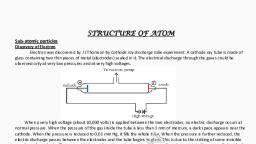
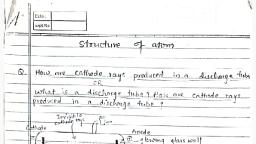
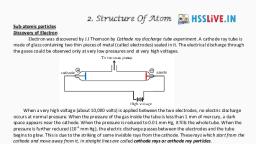
Atomic Structure, , , , ATOMIC STRUCTURE, , , , INTRODUCTION TO ATOM, The ideas of classical mechanics developed by Galileo, Kepler and Newton, when applied to atomic, and molecular systems were found to be inadequate. Need was felt for a theory to describe, correlate, and predict the behaviour of the sub-atomic particles. The quantum theory, proposed by Max Planck, and applied by Einstein and Bohr to explain different aspects of behaviour of matter, is an important, milestone in the formulation of the modern concept of atom., , In this unit , we will study how black body radiation, heat capacity variation, photoelectric effect, and atomic spectra of hydrogen can be explained on the basis of theories proposed by Max Planck, Einstein, and Bohr. They based their theories on the postulate that all interactions between matter and radiation, occur in terms of definite packets of energy, known as quanta. Their idea, when extended further, led, to the evolution of wave mechanics, which shows the dual nature of matter and energy., , Atom is a Greek word and its meaning is Indivisible i.e. an ultimate particle which cannot be further, subdivided., , John Dalton (1803 - 1808) considered that "all matter was composed of small particles called atoms"., Daltons Atomic Theory :, , This theory is based on law of mass conservation and law of definite proportions., , The salient feature's of this theory are :, , @ Each element is composed of extremely small particles called atoms., , (ii) | Atoms of a particular element are like but differ from atom's of other element., , (iii) Atom of each element is an ultimate particle and it has a characteristic mass but is structureless., (iv) Atom's are indestructible i.e. they can neither be created nor be destroyed., , (v) Atom of element's take part in chemical reaction to form molecule., , Fundamental particle's :, , Atom has many types of particles i.e. electron, proton, neutron,, , positron, antiproton, neutrino, meson, antineutrino etc. The main, , fundamental particles are electron, proton, neutron., , CATHODE RAYS-DISCOVERY OF ELECTRON-DISCHARGE TUBE EXPERIMENT, , Introduction :, , Gases are bad conductors of elctricity. However under reduced pressure and at high potential difference gases conduct electric current., , Discharge tube :, , Discharge tube is a glass tube fitted with two electrodes placed opposite to each other. The tube is, sealed and contains a vacuum pump. The function of vacuum pump is to reduced or change the, , pressure inside the tube. The two electrodes are connected to a high voltage battery., , , , 1
Page 2 :
JEE-Chemisiry, , , , , , eS, oo, , te, , ”, , te, , ”, , te, , ”, , te, , ”, , Experiment :, Air at very, , low pressure Green glow, , Discharge, tube \, , os OOO9OGO0 | ie, >, Cathode rays, , Cathode Anode, To vaccum pump, , , , , , , , , , , , , , , , , , , , , , , , , , , , , , , , , -— +}+High voltage generator, , , , A high voltage electric current pass through gases under reduced pressure led to Julius Plucker's, , discovery (1859) of cathode rays., , Observation :, , Under different pressures different observations were noted ;, , At 0.001 mm Hg :, , At 0.001 m Hg, the glow disappears and the walls of the glass tube begin to glow with a brilliant, , green light., , Result ;, , These observations indicate that some radiation or rays are emitted from cathode. These rays are known as, , “Cathode Rays". The cathode rays stream from the negative electode , which is called the cathode., , Application :, , If anode has holes (perforated) and tube behind anode is coated with ZnS (phosphorescent material), , which glows when hit by cathode rays.Similarly televisions picture tubes are also cathode ray tubes, , in which pictures result due to fluoroscence on television screen coated with phosphorescent or, fluoroscent materials., , Properties :, , Cathode rays are fast moving beams of electrons which have following properties :, , @) ~~‘ They are negatively charged known from their deflection in external electrical or magnetic field., , Gi) Start from cathode and end at anode., , (ii) By changing electrode material or gas in the tube there is no effect on nature of cathode rays, which means that "electrons are basic constituents of all atoms"., , (iv) Their velocities change with the applied voltage., , (v) They penetrate through the metals and other substances and also produce flourescence., , (vi) An obstacle placed in the path of cathode rays is heated up and thus cathode rays possess, heating effect., , (vii) Cathode rays on striking solid objects of high melting point produce X-rays., , (viii) They affect the photographic plate., , (ix) They can ionise gases., , (x) Their e/m is constant., , (xi) Like ordinary light, cathode rays come out at right angles to the surface of cathode and travel, in a straight line normal to the cathode. It casts sharp shadows, if any opaque solid object, is placed in their path., , (xii) They rotate a light paddle wheel if placed in their path and thus shows mechanical effect i.e., they have momentum and energy and therefore, mass. The cathode rays are material particles., , , , 2
Page 3 :
Atomic Structure, , , , Conclusion :, Different scientists tried different discharge tubes with different electrodes and different gases but results, , of all the experiments gave same value for charge to mass ratio. This shows that there is something, , common in all materials., , Experiment shows that these particles could be produced from any kind of material. Cathode rays, , consist of particles which are known as electrons and electron is a fundamental particle in all matter., , Calculate charge to mass (e/m) ratio :, , In 1897, J.J. Thomson measured the ratio of electrical charge (e) to the mass of electron (m,) by using, , cathode ray tube and applying electrical and magnetic field perpendicular to each other as well as to the, , path of electrons. Thomson argued that the amount of deviation of the particles from their path in the presence, of electrical or magnetic field depends upon:, , G) The magnitude of the negative charge on the particle, greater the magnitude of the charge on, the particle, greater is the interaction with the electric or magnetic field and thus greater is the, deflection., , (ii) The mass of the particle — lighter the particle, greater the deflection., , (iii) The strength of the electrical or magnetic field — the deflection of electrons from its original, path increases with the increase in the voltage across the electrodes, or the strength of the magnetic, field., , When only electric field is applied, the electrons deviate from their path and hit the cathode ray tube, , at point A. Similarly when only magnetic field is applied, electron strikes the cathode ray tube at point, , C. By carefully balancing the electrical and magnetic field strength, it is possible to bring back the, , electron to the path followed as in the absence of electric or magnetic field and they hit the screen, , at point B. By carrying out accurate measurements on the amount of deflections observed by the, electrons on the electric field strength or magnetic field strength, Thomson was able to determine the, , value of e/m, as :, , = 1.758820 x 10" C kgt, m,, , Where m, is the mass of the electron in kg and e is the magnitude of the charge on the electron in, , coulomb (C). Since electrons are negatively charged, the charge on electron is -e., , Cathode Anode, , , , , , , , , , Fluorescent, screen, , Electromagnet, , , , 3
Page 4 :
JEE-Chemistry, , , , , , %, 9, , MILLIKAN'S OIL DROP EXPERIMENT, An experiment performed by, Robert Millikan in 1909 deter- Oil droplets., mined the size of the charge on an, electron. He also determined that, , Charged plate (+), , , , , , Small hole, there was a smallest ‘unit’ charge,, , , , X-ray from, the source, , or that charge is 'quantized'. He Bi ot | xu, received the Nobel Prize for his ‘Telescope a, , work., , We're going to explain that s, Charged plate (—) Oil droplet, , experiment here, and show how, under observation, , Millikan was able to determine the, size of a charge on a single, electron., , Apparatus consist of an atomizer, which helps to spray tiny droplets. By means of a short focal, distance telescope, the droplets can be viewed. There are two plates, one positive and the other, negative above and below the bottom chamber.de supply is attached to the plates. Some of the oil, drops fall through the hole in the upper plate., , Using X-rays the bottom chamber is illuminated causing the air to ionize. As the droplets traverses, through the air, electrons accumulate over the droplets and negative charge is acquired. With the help, of de supply a voltage is applied. Speed of its motion can be controlled by altering the voltage applied, on the plates. By adjusting the voltage applied, drop can be suspended in air. Millikan observed one, drop after another, varying the voltage and noting the effect. After many repetitions he concluded that, charge could assume only certain fixed values., , He repeated the experiment for many droplets and confirmed that the charges were all multiples of, some fundamental value and calculated it to be 1.5924 x 10" C, within one percent of the currently, accepted value of 1.602176487 x 10’ C. He proposed that this was the charge of a single electron., Here's how it worked. Have a look at the apparatus he used :, , The charge q on a drop was always a multiple of -1.6 x 10⁷” C, the charge on a single electron., This number was the one Millikan was looking for, and it also showed that the value was quantized;, the smallest unit of charge was this amount, and it was the charge on a single electron., , Mass on the Electron :, , R.A. Millikan (1868-1953) devised a method known as oil drop experiment, to determine the charge, on the electrons. He found that the charge on the electron to be -1.6 x 10°? C. The present accepted, value of electrical charge is — 1.6022 x 10- C. The mass of the electron (m,) was determined by, combining these results with Thomson’s value of e/m, ratio., , e, , m,=, , , , = 9.1094 x 10⁷! ke, e/m,
Page 5 :
te, , o, , . Atomic Structure, , CANAL RAYS (OR ANODE RAYS) — DISCOVERY OF PROTON, , Atoms are electrically neutral. Hence after the discovery of the negatively charged constituent (electron), of an atom, attempts were made to discover the positively charged counterpart of electrons. By using, a discharge tube containing a perforated cathode. Goldstein (1886) found that some rays passed, through these holes in a direction opposite to that of the cathode rays., , , , , , , —+Vaccume, pump, , Perforated, cathode ZnS coating, , , , , , , , © H, gas inside at, low pressure, , Positive Rays or Canal Rays, , These are called the positive rays or canal rays. J.J. Thomson (1910) measured their charge by mass, , ratio from which he was able to deduce that these contain positive ions., , Properties :, , (i) They are positively charged., , (ii) The positive charge is either equal to or whole number multiple of the charge on an electron., , (ii) When hydrogen gas was filled in the discharge tube the positive charge on the positive rays, was equal to the negative charge on an electron, and the mass was slightly less than the hydrogen atom., , (iv) Unlike cathode rays the properties of positive rays are characteristics of the gas in the tube., , (v) The deflection of positive rays under the influence of an electric or magnetic field is smaller, than that of the cathode rays for the same strength of field. This shows that the positive rays, have a greater mass than that of electrons., , (vi) ‘The mass of the positive rays depends on the atomic weights or molecular weights of the gases, in the discharge tube. The charge/mass ratio also varies because the change in positive charge, on the rays. It may be either equal to or integral multiple of the charge on an, electron. Also masses were different for different gases., , (vii) The lightest of all particles identified in positive rays from different elements was one with a, mass very slightly less than that of hydrogen atom (or nearly equal to H-atom)., , The lightest positively charged particle is called a proton (P or P'). Positive rays are atomic or, molecular cations from which some electrons have been removed. The removed electrons constitute the cathode rays and the positive cations form the positive or canal rays., , , , , , , , Element Positive Rays Cathode Rays charge / mass, H > H eo e/1 amu, oO > or eo e/16 amu, oO, > Oo, eo e/32 amu, 0, > 0," e e/16 amu



 Learn better on this topic