Page 1 :
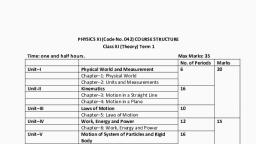
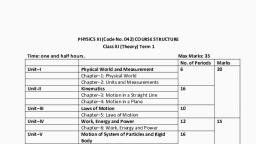
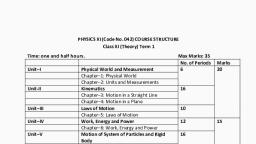
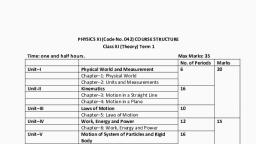
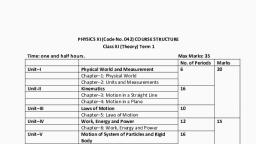
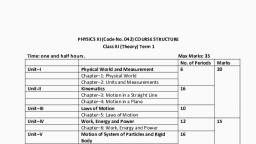
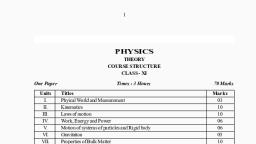
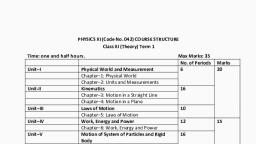
1, 1, 1, , 1, , Curriculum and Syllabus for Classes XI & XII, , 1, , 1, , PHYSICS, THEORY, COURSE STRUCTURE, CLASS - XI, One Paper, Units, I., II., III., IV., V., VI., VII., VIII., IX., X., , Times : 3 Hours, , 70 Marks, , Titles, Phyical World and Measurement, Kinematics, Laws of motion, Work, Energy and Power, Motion of systems of particles and Rigid body, Gravitation, Properties of Bulk Matter, Thermodynamics, Behaviour of Perfect Gas and Kinetic Theory of gases, Oscillations and Waves., Total, , Unit-I :, , PHYSICAL WORLD AND MEASUREMENT, Forces in nature., Need for measurement. Units of measurement; system of units; S.I. units,, fundamental and derived units, length, mass and time measurements; accuracy, and precision of measuring instruments; errors in measurements; significant, figures., Dimension of physical quantities, dimensional analysis and its applications., , Unit-II :, , KINEMATICS, Elementary concepts of differentiation and integration for describing motion., Uniform and non uniform motion, average speed and instantaneous velocity., Uniformly accelerated motion, velocity-time, position-time graphs, relations, for uniformly accelerated motion (graphical treatment)., , Marks, 03, 10, 10, 06, 06, 05, 10, 05, 05, 10, 70
Page 2 :
2 2, 222, 2, Scalar and vector quantities; Position and displacement vectors, general vectors, and notation; equality of vectors, multiplication of vectors by a real number; addition, and subtraction of vectors. Relative velocity., Unit vectors, Resolution of a vector in a plane-rectangular components., Scalar and Vector product of vectors. Motion in a plane. Cases of uniform, velocity and uniform acceleration - projectile motion. Uniform circular motion., Unit-III : LAWS OF MOTION, Law of conservation of linear momentum and its applications., Equilibrium of concurrent forces; Static and Kinetic friction, law of friction,, rolling friction., Dynamics of uniform circular motion : Centripetal force, examples of circular, motion (vehicle on level circular road, vehicle on banked road)., Unit-IV : WORK, ENERGY AND POWER, Work done by a constant force and a variable force; Kinetic energy, Workenergy theorem, power., Notion of potential energy, potential energy of a spring, conservative forces:, conservation of mechanical energy (kinetic and potential energies):, non-conservative forces: motion in a vertical circle, elastic and inelastic collisions, in one and two dimensions., Unit-V :, , MOTION OF SYSTEM OF PARTICLES AND RIGID BODY, Centre of mass of a two-particle system, momentum conservation and centre, of mass motion. Centre of mass of a rigid body; centre of mass of uniform rod., Moment of a force, torque, angular momentum, conservation of angular, momentum with some examples., Equilibrium of rigid bodies, rigid body rotation and equations of rotational, motion, comparison of linear and rotational motions; moment of inertia, radius, of gyration. Values of moments of inertia for simple geometrical objects (no, derivations).
Page 3 :
3, 3, Unit-VI : GRAVITATION, The Universal law of gravitation, Gravitational constant., Gravitional potential energy; gravitational potential, Escape velocity. Orbital, velocity of satellite. Geo-stationary satellites., , Unit-VII : PROPERTIES OF BULK MATTER, Stress-strain relationship, Hooke’s law, Young’s modulus, bulk modulus., Pressure due to a fluid column; Pascal’s law and its applications (hydraulic lift, and hydraulic brakes). Effect of gravity on fluid pressure., Viscosity, Stokes’ law, terminal velocity, Reynold’s number, streamline and, turbulent flow. Critical velocity. Bernoulli’s theorem and its applications., Surface energy and surface tension, angle of contact, excess of pressure,, application of surface tension, ideas to drops, bubbles and capillary rise., Thermal expansion; thermal expansion of solid, liquids and gases, ideal gas, laws, isothermal and adiabatic processes; anomalous expansion and its effect,, specific heat capacity: Cp, Cv-Calorimetry; change of state-specific latent, heat capacity., Blackbody radiation Kirchoff’s law, absorptive and emissive powers and green, house effect thermal conductivity, Newton’s law of cooling, Wein’s, displacement law, Stefan’s law., , Unit-VIII :THERMODYNAMICS, Thermal equilibrium and definition of temperature (Zeroth law of, thermodynamics)., Heat, work and internal energy. First law of thermodynamics., Second law of thermodynamics-Reversible and irreversible processes.
Page 4 :
4, Unit-IX : BEHAVIOUR OF PERFECT GAS AND KINETIC THEORY, Equation of state of perfect gas, work done on compressing a gas., Kinetic theory of gases-assumptions, concept of pressure. Kinetic energy and, temperature, rms speed of gas molecules; degree of freedom, law of, equipartition of energy (statement only) and application to specific heat of, gases, concept of mean free path, Avogadro’s number., Unit-X :, , OSCILLATIONS AND WAVES, Periodic motion-Period, frequency, displacement as a function of time. Periodic, functions., Simple Harmonic motion (SHM) and its equation, phase; oscillations of a, spring-restoring froce and force constant, energy in SHM-kinetic and potential, energies. Simple pendulum-derivation of expressions for its time period; free,, forced and damped oscillations (qualitative ideas only) resonance., Wave motion : Longitudinal and transverse waves; speed of wave motion., Displacement relation for a progressive wave. Principle of superposition of, waves, reflection of waves, standing waves in strings and organ pipes. Beats., , ªªªªªªª, , (28 Periods)
Page 5 :
5, , PHYSICS, PRACTICAL, CLASS - XI, Note : A., , B., , Every student will perform 15 experiments (8 from section A and 7 from section B). The, activities mentioned are for the purpose of demonstration by teachers only. These are not to, be evaluated during the academic year. For evaluation in examination, students would be, required to perform two experiments - one from each section. The report of one Activity, should be submitted at the time for Examination., Evaluation Scheme of Practical Examination :, Two experiments one each of the two sections :, Theory, 3+3=6, Observation/Data (procedure), 5+5=10, Conclusion, 1+1=2, Accuracy of result, 1+1=2, Total, 20, , Practical record of experiments :, Viva and experiments :, , 10+10=20 Marks, , 6 Marks, 2+2= 4 Marks, Total, 30 Marks, SECTION-A, , EXPERIMENTS:, ( Any 8 experiments out of the following to be performed by the students), 1., , To measure diameter of a small spherical/cylindrical body using Vernier Callipers., , 2., , To measure internal diameter and depth of a given beaker/calorimeter using Vernier Callipers, and hence find its volume., , 3., , To measure diameter of a given wire using screw gauge., , 4., , To measure thickness of a given sheet using screw gauge., , 5., , To measure volume of an irregular lamina using screw gauge., , 6., , To determine radius of curvature of a given spherical surface by a spherometer., , 7., , To find the weight of a given body using parallelogram law of vectors., , 8., , Using a simple pendulum, plot L-T and L-T2 graphs. Hence find the effective length of a, second’s pendulum using appropriate graph.
Page 6 :
6, , 9., , To study the relationship between force of limiting friction and normal reaction and to find, co- efficient of friction between a block and a horizotal surface., , 10., , To find the downward force, along an inclined plane, acting on a roller due to gravitational, pull of the earth and study in relationship with the angle of inclination by plotting graph, between force and sinθ., SECTION-B, , EXPERIMENTS:, ( Any 7 experiments out of the following to be performed by the students), 1., , To determine Young’s modulus of elasticity of the material of a given wire., , 2., , To find the force constant of a helical spring by plotting graph between load and extention., , 3., , To study the variation in volume with pressure for a sample of air at constant temperature, by plotting graphs between P and V and between P and I/V., , 4., , To determine the surface tension of water by capillary rise method., , 5., , To determine the coefficient of viscosity of a given viscous liquid by measuring terminal, velocity of a given spherical body., , 6., , To study the relationship between the temperature of a hot body and time by plotting a, cooling curve., , 7., , To determine specific heat of a given (i) solid, (ii) liquid, by method of mixtures., , 8., , (i), , To study the relation between frequency and length of a given wire under constant, tension using sonometer., , (ii), , To study the relation between the length of a given wire and tension for constant, frequency using sonometer., , 9., , To find the speed of sound in air at room temperature using a resonance tube by, two-resonance positions.
Page 7 :
7, , PRESCRIBED TEXT BOOKS:, 1., , Physics Part I &II (Textbook for Class XI), Published by : The Council of Higher Secondary Education, Manipur with copy right from, the NCERT, New Delhi., , REFERENCE BOOKS:, 1., , Pradeep’s Fundamental Physics, By: K.L. Gomber and K.L. Gogia, Published by : Pradeep Publications,, Jalandhar - 144008, , 2., , Dinesh New Millennium Physics for Class XI, By: S.K. Sharma, Published by: S. Dinesh & Co., Jalandhar City., , 3., , Modern’s abc of Physics for Class XI, By: Satish K. Gupta, Published by : Modern Publishers, Jalandhar City., , NAME OF THE RECOMMENDED PRACTICAL TEXT BOOK, A Textbook of Practical Physics for Class XI, By: O. Kuber Singh, Published by: Writers Book Store, Paona Bazar, Imphal
Page 8 :
8, , PHYSICS, THEORY, CLASS - XII, One Paper, Unit, I., II., III., IV., V., VI., VII., VIII., IX., X., , Time : 3 Hours, , 70 Marks, , Contents, , Marks, 08, 07, 08, 08, 03, 14, 04, 06, 07, 05, 70, , Electrostatics, Current Electricity, Magnetic effects of current and Magnetism, Electro magnetic induction and Alternating current, Electromagnetic waves, Optics, Dual nature of matter and Radiations, Atom and Nuclei, Electronic Devices, Communication systems, Total, , Unit-I :, , ELECTROSTATICS, Electric Charges: conservation of charge, Coulomb’s law-force between two, point charges, forces between multiple charges; Superposition Principle and, continuous charge distribution., Electric field, electric field due to point charge, electric field lines; electric, dipole, electric field due to a dipole; torque on a dipole in a uniform electric, field., Electric flux, statement of Gauss’s theorem and its application to find field due, to infinitely long straight wire and uniformly charged infinite plane sheet, Electric potential, potential difference, electric potential due to a point charge,, a dipole and system of charges; equipotential surfaces, electrical potential, energy of a system of two point charges and of electric dipole in an electrostatic, field., Conductors and insulators, free charges and bound charges inside a conductor., Dielectrics and electric polarisation, capacitors and capacitance, combination, of Capacitors in series and in parallel, capacitance of a parallel plate capacitor, with and without dielectric medium between the plates, energy stored in a, capacitor. Van de Graaff generator.
Page 9 :
9, Unit-II:, , CURRENT ELECTRICITY, Electric current, flow of electric charges in a metallic conductor, drift Velocity,, mobility and their relation with electric current; Ohm’s law, electrical resistance,, V-I characteristics (linear and non-linear), elecrical energy and power, resistivity, and conductivity., Temperature dependence of resistance., Internal resistance of a cell, potential differance and emf of a cell, combination, of cells in series and parallel. Elementary idea of secondary cells., Kirchhoff’s law and simple application. Wheatstone’s bridge, meter bridge., Potentiometer-principle and its applications to measure potential difference, and for comparing emf of two cells; measurement of internal resistance of a, cell., , Unit-III:, , MAGNETIC EFFECTS OF CURRENT AND MAGNETISM, Concept of magnetic field, Oersted’s experiment., Biot-Savart law and its application to current carrying circular loop., Ampere’s law and its applications to infinitely long straight wire, straight and, toroidal solenoids., Force on a moving charge in uniform magnetic and electric fields., Force on a current-carrying conductor in a uniform magnetic field. Force, between two parallel current-carrying conductors-definition of ampere. Torque, experienced by a current loop in a uniform magnetic field; moving coil, galvanometer-its current sensitivity and conversion to ammeter and voltmeter., Current loop as a magnetic dipole and its magnetic dipole moment. Magnetic, dipole moment of a revolving electron. Bar magnet as an equivalent solenoid,, magnetic field lines. Earth’s magnetic field and magnetic elements.
Page 10 :
10, Unit-IV:, , ELECTROMAGNETIC INDUCTION AND ALTERNATING CURRENT:, Electromagnetic induction; Faraday’s laws, induced emf and current; Lenz’s, Law, Eddy currents, self and mutual induction., Alternating currents, peak and rms value of alternating current/voltage; reactance, and impedance; LC oscillations (qualitative treatment only), LCR series circuit,, resonance; power in AC circuits., AC generator and transformer., , Unit-V:, , ELECTROMAGNETIC WAVES, Electromagnetic waves and their characteristics (qualitative ideas only)., Transverse nature of electromagnetic waves., Electromagnetic spectrum (radio waves, microwaves, infrared, visible,, ultraviolet, X-rays, gamma rays) including elementary facts about their uses., , Unit-VI:, , OPTICS, Refraction of light, total internal reflection and its applications, optical fibres,, refraction at spherical surfaces, lenses, thin lens formula, lens-maker’s formula., Magnification, power of a lens, Combination of thin lenses in contact,, combination of a lens and mirror. Refraction and dispersion of light through a, prism., Optical instruments: Human eye, image formation, and accommodation,, correction of eye defects (myopia, hypermetropia, presbyopia and astigmatism), using lenses. Microscopes and astronomical telescopes reflecting and refracting, and their magnifying powers., Wave optics: wave front and Huygen’s principle, reflection and refraction of, plane wave at a plane surface using wave fronts. Proof of laws of reflection, and refraction using Huygen’s principle. Interferance, Young’s double slit, experiment and expression for fringe width, coherent sources and sustained, interferance of light. Diffraction due to a single slit, width of central maximum.
Page 11 :
11, , Unit-VII: DUAL NATURE OF MATTER AND RADIATION, Dual nature of radiation. Photoelectric effect, Hertz Lenard’s observations;, Einstein’s photoelectric equation-particle nature of light. Matter waves-wave, nature of particles, De Broglie relation., Unit-VIII: ATOMS AND NUCLEI, Alpha-particle scattering experiment; Rutherford’s model of atom; Bohr Model, levels, Hydrogen spectrum., Composition and size of nucleus, atomic masses, isotopes, isobars; isotones., Mass-energy relation, mass defect; nuclear fission and fusion., Unit-IX:, , ELECTRONIC DEVICES, Energy bands in solids, conductors, insulators and semiconductors;, semiconductor diode- I-V characteristics in forward and reverse bias, diode, as a rectifier; I-V characteristics of LED, photodiode and solar cell. Junction,, transistor action, characteristics of a transistor; transistor as an amplifier, (common emitter configuration) and oscillator. Logic gates (OR, AND, NOT,, NAND and NOR). Transistor as a switch., , Unit-X:, , COMMUNICATION SYSTEMS, Elements of communication system (block diagram only); bandwidth of signals, (speech, TV and digital data); bandwidth of transmission medium. Propagation, of electromagnetic waves in the atmosphere, sky and space wave propagation., Need for modulation. Production and detection of an amplitude-modulated, wave., , ªªªªªªª
Page 12 :
12, , PHYSICS, PRACTICAL, CLASS - XII, Note : A., , Every student will perform at least 15 experiments (7 from section A and 8, from section B). The activities mentioned here should only be for the purpose, of demonstration. One project of three marks is to be carried out by the, students., The report of the project work should be submitted at the time of Practical, Examination, , B., , Evaluation Scheme of Practical Examination :, Two experiments one from each of the two sections :, Theory, Observation/Data (procedure), Conclusion, Accuracy of result, Total, , 10+10=20 Marks, , 3+3=6, 5+5=10, 1+1=2, 1+1=2, 20, , Practical record of experiments :, Viva on experiments :, , 6 Marks, 2+2=4 Marks, Total = 30 Marks, , Section-A, EXPERIMENTS:, (Any 7 experiments out of the following to be performed by the students), 1., , To find resistance of a given wire using meter bridge and hence determine the specific, resistance of its material., , 2., , To determine resistance per cm of a given wire by plotting a graph of potential difference, versus current., , 3., , To verify the laws of combination (series/parallel) of resistances using a matter bridge.
Page 13 :
13, , 4., , To compare the emf of two given primary cells using potentiometer., , 5., , To determine the internal resistance of given primary cell using potentiometer., , 6., , To determine resistance of a galvanometer by half-deflection method and to find its figure of, merit., , 7., , To convert a given galvanometer (of known resistance and figure of merit) into an ammeter, and volmeter of desired range and to verify the same., , 8., , To find the frequency of the a.c. mains with a sonometer., , Section-B, EXPERIMENTS:, (Any 8 experiments out of the following to be performed by the students), 1., , To find the value of v for different values of u in case of a concave mirror and to find the, focal length., , 2., , To find the focal length of a convex mirror, using a convex lens., , 3., , To find the focal length of a convex lens by plotting graphs between u and v or between I/u, and I/v., , 4., , To find the focal length of a concave lens, using a convex lens., , 5., , To determine angle of minimum deviations for a given prisms by plotting a graph between, the angle of incidence and the angle of deviation., , 6., , To determine refractive index of a glass slab using a travelling microscope., , 7., , To find refractive index of a liquid by using, (i) Concave mirror, (ii) Convex lens and plane mirror., , 8., , To draw the I-V characteristic curve of a p-n junction in forward bias and reverse bias., , 9., , To draw the characteristic curve of a Zener diode and to determine its reverse break down, voltage., , 10., , To study the characteristics of a common - emitter npn or pnp transistor and to find out the, values of current and voltage gains.
Page 14 :
14, , PRESCRIBED TEXTBOOKS:, 1., , Physics Part I &II (Textbook for Class XII), Published by : The Council of Higher Secondary Education, Manipur with copy right from, the NCERT, New Delhi., , REFERENCE BOOKS:, 1., , Pradeep’s Fundamental Physics, By: K.L. Gomber and K.L. Gogia, Published by : Pradeep Publications,, Jalandhar - 144008A Textbook of Physics Book-II, by : Stalin Malhotra, Published by: Macmillan Publishers India Pvt. Ltd., , 2., , Dinesh New Millennium Physics for Class XII (Vol. I & II), By: S.K. Sharma & R. Jerath, Published by: S. Dinesh & Co. Jalandhar City., , 3., , Modern’s abc of Physics for Class XII, By: Satish K. Gupta, Published by : Modern Publishers, Jalandhar City., , 4., , A Textbook of Practical Physics for Class XII, By: O. Kuber Singh, Published by: Writers Book Store, Paona Bazar, Imphal, , ªªªªªªª
Page 15 :
DESIGN OF QUESTION PAPER, Subject, Paper, Class, Full Mark, Time, , I, , : PHYSICS, :, :, :, :, , Theory, XI, 70, 3 Hours, , WEIGHTAGE TO OBJECTIVES, Objectives, Knowledge (K), Understanding (U), Application (A), Skill (S), Total :, , II, , III, , IV, V, VI, , Marks, 21, 32, 14, 3, 70, , Percentage, 30, 46, 20, 4, 100, , WEIGHTAGE TO FORM OF QUESTIONS:, Form of Questions, No. of Question Time (in minute) Marks, Percentage, Essay/Long Answer (E/LA), 3, 60, 15, 21, Short Answer (SA-I), 7, 42, 21, 30, Short Answer (SA-II), 10, 40, 20, 29, Very Short Answer (VSA), 10, 30, 10, 14, MCQ, 4, 8, 4, 6, Total:, 34, 180, 70, 100, WEIGHTAGE TO CONTENT:, UNIT/CONTENTS :, Marks, Percentage, 1, Physical World and Measurement, 3, 5, 2, Kinematics, 10, 14, 3, Laws of Motion, 10, 14, 4, Work, Energy and Power, 6, 9, 5, Motion of Systems of Particles and Rigidity Body, 6, 9, 6, Gravitation, 5, 7, 7, Properties of Bulk Matter, 10, 14, 8, Thermodynamics, 5, 7, 9, Behaviours of Perfect Gas and Kinetics Theory, 5, 7, 10, Oscillations and Waves, 10, 14, 70, Total :, 100, SCHEME OF SECTIONS :, Nil, SCHEME OF OPTIONS :, Internal option may be given in LA Type of Questions and, SA I (4 question only)., DIFFICULTY LEVEL, :, Difficult :, 20% marks, Average : 50% marks, Easy, : 30% marks, , Abbreviation :, , K(Knowledge), U(Understanding ), C(Comprehension), Exp.(Expression), (S)Skill, ,, E(Essay Type), SA (Short Answer Type), VSA (Very Short Answer Type),, MCQ(Multiple Choice Question)
Page 16 :
DESIGN OF QUESTION PAPER, Subject : PHYSICS, Paper : Theory, Class : XII, Full Mark : 70, Time : 3 Hours, , I, , WEIGHTAGE TO OBJECTIVES, Objectives, Knowledge (K), Understanding (U), Application (A), Skill (S), Total :, , II, , III, , IV, V, VI, , Marks, 21, 32, 14, 3, 70, , Percentage, 30, 46, 20, 4, 100, , WEIGHTAGE TO FORM OF QUESTIONS:, Form of Questions, No. of Question Time (in minute) Marks, Percentage, Essay/Long Answer (E/LA), 3, 60, 15, 21, Short Answer (SA-I), 7, 42, 21, 30, Short Answer (SA-II), 10, 40, 20, 29, Very Short Answer (VSA), 10, 30, 10, 14, MCQ, 4, 8, 4, 6, Total:, 34, 180, 70, 100, WEIGHTAGE TO CONTENT:, UNIT/CONTENTS :, Marks, Percentage, 1, Electrostatics, 8, 11, 2, Current Electricity, 7, 10, 3, Magnetic Effects of Current and Magnetism, 8, 11, 4, Electromagnetic Induction and Alternating Current, 8, 11, 5, Electromagnetic Waves, 3, 5, 6, Optics, 14, 20, 7, Dual Nature of Matter and Radiations, 4, 6, 8, Atoms and Nuclei, 6, 9, 9, Electronic Devices, 7, 10, 10, Communication Systems, 5, 7, 70, Total :, 100, SCHEME OF SECTIONS :, Nil, SCHEME OF OPTIONS :, Internal option may be given in LA Type of Questions and SA, I (4 question only)., DIFFICULTY LEVEL, :, Difficult :, 20% marks, Average :, 50% marks, Easy, :, 30% marks, , Abbreviation :, , K(Knowledge), U(Understanding ), C(Comprehension), Exp.(Expression), (S)Skill, ,, E(Essay Type), SA (Short Answer Type), VSA (Very Short Answer Type),, MCQ(Multiple Choice Question)