Page 2 :
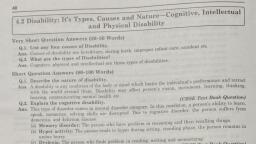
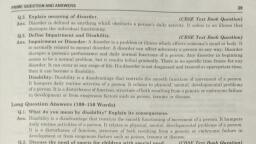
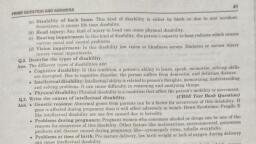
Question 1., , Define disability., , Answer:, , Disability is defined as a condition or function, judged to be significantly impaired relative to, the usual standard of an individual or group., , Question 2., , How disability is different from a disorder?, Answer:, , Disability, whether it is physical or mental, is, of permanent nature, but disorder can be, temporary or permanent., , Question 3., , Why the word ‘differently abled’ is used in, place of disabled nowadays?, , Answer:, , Differently abled is used in place of disabled, nowadays to give a more positive message, and to avoid any kind of discrimination in the, society.


Page 3 :
Question 4., , Give some examples of cognitive disability., Answer:, , Some examples of cognitive disability are, children suffering from dyslexia, speech, disorders, problems in solving mathematical, calculations, short attention span, short, memory and learning difficulties., , Question 5., , What is ADHD?, , Answer:, , ADHD stands’ for Attention Deficit, Hyperactivity Disorder. This brings, behavioural changes and is normally seen is, school going kids. Here the attention span is, very short, kids are hyperactive and face, trouble in focussing on a task.
Page 4 :
Question 6., , What do you understand by disability, etiquettes?, , Answer:, , Disability etiquettes is a set of guidelines to, deal with people facing physical or mental, disabilities., , Question 7., , Write two ways to communicate with people, suffering from cognitive impairments., Answer:, , e Use acalm voice and be comfortable:, e Treat the person as an individual with, talents and abilities, , Question 8., , What do you understand by physical activity?, Answer:, , Physical activity means the movement of the, body and use of energy Walking, running,
Page 5 :
dancing, swimming, yoga, and gardening are, few examples of physical activity., , Question 9., , Write any one advantage of physical activity., Answer:, , Physical activity enhances the metabolism of, brain in the children. It leads to cognitive, improvement in children with special needs, allowing them to acquire new skills, learn new, things and focus on specific goals., , Question 10., , Explain the strategy of positive behaviour in, brief., , Answer:, , The strategy of positive behaviour relates to, showing a positive attitude and having, healthy interactions with children with special, needs. The teachers should prevent negative, behaviours and encourage these children to