Notes of Class XI, Physical Education EDBTBDBTB SUPPORT MATERIAL 2.pdf - Study Material
Page 2 :
Production Team, , Anil Kumar Sharma, , Published at Delhi Bureau of Text Books , 25/2 Institutional Area, Pankha, Road, New Delhi-110058 by Prabhjot Singh, Secretary, Delhi Bureau of, Text Books and Printed by Arihant Offset, New Delhi-110043
Page 3 :
MANISHA SAXENA, IAS, , DO No. DE. 5/228/Exam/Message/S.M./2018, Dated, , MESSAGE, The importance of adequate practice during examinations can never be, overemphasized. I am happy that support material for classes IX to XII has been, developed by the Examination Branch of Directorate of Education. This material is, the result of immense hard work, co-ordination and cooperation of teachers and, group leaders of various schools. The purpose of the support material is to impart, ample practice to the students for preparation of examinations. It will enable the, students to think analytically & rationally and test their own capabilities and level of, preparation., The material is based on latest syllabus prepared by the NCERT and adopted, by the CBSE for the academic session 2020-21 and covers different levels of difficulty., I expect that Heads of Schools and Teachers will enable and motivate students to, utilize this material during zero periods, extra classes and regular classes best to, their advantage., I would like to compliment the team of Examination Branch for their diligent, efforts of which made it possible to accomplish this work in time. I also take this, opportunity to convey my best wishes to all the students for success in their, endeavours., , (MANISHA SAXENA)
Page 11 :
DIRECTORATE OF EDUCATION, Govt. of NCT, Delhi, SUPPORT MATERIAL, (2020-2021), , PHYSICAL EDUCATION, Class : XI, , NOT FOR SALE, , PUBLISHED BY : DELHI BUREAU OF TEXTBOOKS
Page 14 :
Contents, 1., , 2., , 3., , 4., , Changing Trends & Career in Physical Education, 1.1, , Meaning and Definition Physical Education, , 1.2, , Aim and Objectives of Physical Education, , 1.3, , Career Options in Physical Education, , 1.4, , Competitions in Various Sports at National and International Level, , 1.5, , Career options in Physical Education, , 1.6, , Khelo India Programme., , Olympic Value Education, 2.1, , Olympics, Peraolympics and Special Olympics, , 2.2, , Olympic Symbols, ideals, Objectives and Value of Olympism, , 2.3, , International Olympic Committee, , 2.4, , Indian Olympic Association, , Physical Fitness, Wellness and Lifestyle, 3.1, , Meaning and Importance of Physical Fitness, Wellness and Lifestyle, , 3.2, , Components of Physical Fitness and Wellness, , 3.3, , Components of Heath Related Fitness, , Physical Education and Sports for CWSN, 4.1, 4.2, 4.3, 4.4, 4.5, , Aims and objectives of adaptive physical education, Organisations promoting adaptive sports (Special Olympic Bharat,, Paralympics, Deaflympics), Concept of Inclusion, its need and implementation, Concept of Inclusion, its need and implementation, Role of various professionals for children with special needs (counsellor, occupational therapist, physical education, physical education, teacher, speech therapist and special education), 2, , XI – Physical Education
Page 15 :
5., , Yoga, 5.1, , Meanig and Importance of yoga., , 5.2, , Elements of Yoga, , 5.3, , Introduction of of asanas, Pranayama, Dhyana & Yogic Kriyas, , 5.4, , Yoga for concentration and related Asanas –, (Sukhasana, Tadasana, Padmasana, Shashank asana, Naukasana,, Vrikshasana(Tree pose), Gasudasana (Eagle pase), , 5.5, 6., , Relaxation Techniques for improving concentration - Yog Nidra, , Physical activity and Leadership Training, 6.1, , Leadership Qualities and Role of a Leader, , 6.2, , Creating Leaders through Physical Education, , 6.3, , Meaning, Objectives and Types of Adventure Sports, (Rope climbing, Tracking, River Rafting, Mountaineering, Surfing,, and Paragliding), , 6.4, 7., , Test, Measurement & Evaluation in Sports, 7.1, , 8., , Safety measures to Prevent Sports Injuires., Definition of Test, , 7.2, Definiton of Measurement, 7.3, Definition of Evaluation, 7.4, Importance of Test, Measurement and Evaluation, 7.5, Calculation of B.M.I and Waist-Hip ratio, 7.6, Somato-Types (Endomorph, Mesomorphy & Ectomorphy), 7.7, Measurement of Health Related Fitness, Fundamentals of Anatomy and Physiology and kinesiology in Sports, 8.1, , Definition of Anatomy, Physiology and its importance, , 8.2, , Functions of skeleton system, classification of bones and types of, joints, , 8.3, , Properties and Functions of muscles, , 8.4, , Function and structure of Respiratory system and circulatroy system, , 8.5, , Equilibrium Dynamic and Static, centre of Gravity and its application, 3, , XI – Physical Education
Page 16 :
in sports., 9., , Psychology and Sports, 9.1, , Definition and Importance of Psyhology in Physical Education &, Sports., , 9.2, , Define and differentiate between Geowth and Divelopment, , 9.3, , Development Characteristics at different stages of Development, , 9.4, , Adolescent Problems and Their Managements, , 10. Training and Doping in Sports, 10.1, , Meaning & Concept of Sports Training., , 10.2, , Principles of Sports Training., , 10.3, , Warming-up & limbering down., , 10.4, , Skill, Technique & Style., , 10.5, , Concept & classification of doping., , 10.6, , Prohibited Substances & their side effects., , 10.7, , Dealing with alcohal and substance abuse., , 4, , XI – Physical Education
Page 17 :
Unit - 1, Changing Trends And Career in Physical Educatin, 1.1 Meaning and Definition Physical Education, 1.2 Aim and Objectives of Physical Education, 1.3 Career Options in Physical Education, 1.4 Competitions in Various Sports at National and International Level, 1.5 Khelo India Programme., , 5, , XI – Physical Education
Page 18 :
1.1, , Meaning and Definition of Physical Education, Physical Education is composed of two words ‘Physical’ means body and, ‘Education’ means modification of behauinur thus means Education through, the medium of physical Activities. It aims on overall development of human, being through participating in various games and sports activities. Modern, Physical Education was started in 18th century in Germany. Where Physical, Education was an integral part of School Curriculum, Since then many changes, have taken place and various aspacts have emerged with time., , 1.1, , Definitions of Physical Education:, In fact the basis of physical education is difficult and very broad with changing, time, its meaning also kept changing. Following time, its meaning: According, to Charles A Bucher, "physical education is an integral part of total education, process and has its aim in the development of physically, mentally, emotionally, and socially fit citizens through the medium of physical activities which have, been selected with a view to realize these out comes.”, “Physical education is the sum of changes in the individual caused by, experience which can bring in motor activity.”, , 1.2, , Aims and objectives of Physical Education :, Physical education has been defined in different ways by experts and institutes, in this field. These are as follows:, “Physical education is that phase of education which deals with big muscle, activites and their related responses.”, —J.B. Nash, “Physical education is that phase of education which is concerned, first, with, the organisation and leadership of children, in big muscle activities, to gain, the development and adjustment inherent in the activites according to social, standards, and second, with the control of health or growth conditions naturally, associated with the leadership of the activites so that the educational process, may go on without growth handicaps.”, —Clark W. Hetherington, “Physical education is an integral part of the total educational process, and has as its aim the development of physically, mentally, emotionally, and, socially fit citizens through the medium of hpysical activities which have been, 6, , XI – Physical Education
Page 19 :
selected with view to realising these outcomes.”, Charles A. Bucher, , —, , “Physical education is education through physical activites for the development, of the total personality of the child to its fullness and perfection in body, mind, and spirit.” —Central Advisory Board of Physical Education and, Recreation, 1.2, , Aim and Objectives of Physical Education:, Aim is the ultimate one, i.e., all-round development of an individual. The, means and ways we adopt to achieve our aim are called objectives and those, are:, Physical development, , Mental development, , Social development, , Emotional development, , Spiritual development, , All Round Development, , Spiritual, Development, , Physical, Development, Mental, Development, , Social, Development, , Emotional, Development, , Fig. Aim and Objectives of Physical Education, Objectives :, 1., , Physical Development: The main objective of physical education is, physical development. Physical education is related to several physical, activities. When we do any physical activity, it effects our different body, systems— blood circulation, respiratory system, muscular system,, digestive system, etc. It results in the development of the size and shape, of organs. It is helpful to make body healthy and strong. If our body, systems are fine and healthy, only then we shall be able to do our work, efficiently and be safe from several disease like high blood pressure,, 7, , XI – Physical Education
Page 20 :
diabetes, obesity and arthritis. For e.g., Running increases the heart rate, which helps the blood to flow efficiently through the whole body., , 1.3, , 2., , Mental Development: This objective is related to mental development., There should be some activities in physical education which keep our, brain alert and concentrated. Now-a-days, physical education is not related, to physical exercises only but it also includes rules of game, principles,, structures of body, personal cleanliness, etc. These physical activities, sharpen the brain. By taking part in physical activities a person learn to, tackle various situations. During sport many situations occur in which, player takes his/her self-decision. So, this results in their mental, development and decreases the stress level., , 3., , Social Development: This objective of physical education is related to, social skills which are helpful in coordination. During a competition,, players of different region come together on single platform. So, they, learn cooperation, support, respect, good sportsmanship, etc. through, these skills, players can make their nation healthy and strong., , 4., , Emotional Development: The objective of physical education is to make, an individual emotionally develop through physical activity. A man is, endowed with different emotions like happiness, jealousy hope, despair,, joy, fear, loneliness, weal and woe, etc, If they do not control these, emotions, thes there will be no place for them in the society, which can, be harmful for them. Physical education programme develop these, emotions and teach us to control them., , 5., , Spiritual Development: The objective of physical education for an, individual is to reflect time to evaluate their experiences to allow them, to build a positive mindset and promote progression., , Career Options in Physical Eduecation, The opportunities in the field of physical education were teaching and training, only till 1990. There are ample employment opportunities for people in the, field of physical education due to increase in interest towards training and, increase in number of activites. Ther are two types of career options in physical, education. The first kind is related to teaching and training of physical, education. These are called traditional careers also. The second kind is related, to the careers when emerge out of it related to health, management, sports, performance and media. Their descriptions are as follow:, 8, , XI – Physical Education
Page 21 :
1. In Teaching, Sector, , 2. In Training, Sector (Coaching), , 3. In Health/Fitness, related Sector, , 4. In Performance, relatd Sector, , 5. In Media, Sector, , At Primary level, , In Schools, Colleges, University, , Sports Fitness, Trainer Medicine, Sports Dietician, , Professional Players, , Sports, Journalism, Book Author, , At Middle, , In Various Sports, Institution, , Sport Psychology, , Sports Planning, Officer, , Sports, Photography, , At Secondary level, , Industrial, Recreation, , Sport Nutritionist, , Sports Management, , Sports Broadcasting, , At College and, University level, , Sports Facility, Management, , In Gyms as, Athletic Trainer, , Recreational, Sport Management, , Sports advertising, (Sports equipments, marketing), , Teaching at other, Professional, Institution, , Administration, , Health/Fitness, Industry, , Performance, , Sports Industry, , Competition in Various Sports at National and International Level, Introduction, India is home to a diverse populatin playing many different sports. Field Hockey, is the most successful sports for India at Olympics in which India has won, eight Olympic gold medals. Cricket is most popular sport in India. Kabaddi is, most popular indigeneous sport in the country. Other popular sports in India, are Athletics, Badminton, Judo, Football, Basketball, Chess, Shooting,, Wrestling, Boxing, Tennis, Squash, Weightlifting, Gymnastics and TableTennis. Some indigeneous sports like Kho-Kho and Kabaddi are very popular., Some other sports were originated in India Such as Chessm, Leg Cricket,, Snooker. etc. are also very popular., The National Games of India is a national domestic sports event organisation, which has been held in the country since 1924 and for developing multi-sports, cultrure in India. Khelo India School Games, an event for Under-17 School, Kids, had been started from 2018 as its first edition., Political responsibility for sport in India is with the Ministry of Youth Affairs, and Sports, which is headed by a cabinet minister and managed by National, Sports Federations. The only major exception is the BCCI which is the, administrative body of Cricket but not a NSF. Presently, there are more than, 70 recognised National Sports Federations (NSF)., , 9, , XI – Physical Education
Page 22 :
Sport Authority of India, the field arm of the ministry, supports and nurtures, talent in youth and provides them with requisite infrastructure, equipment,, coaching, facilities and competition exposure. Sir Dorabji Tata with the support, of Dr. A.G.. Noehren established the Indian Olympic Association (IOA) in, 1927. IOA is responsible for the Indian continents participation in the Olympic, Games, Commonwealth Games, Asian Games and South Asian Federation, Games. Each Olympic and Non-Olympic Sport has a federation at the national, level., Major Responsibilities of National Federations, 1., , To Select the National Teams., , 2., , To recommend the Indian Olympic Association (IOA) for official sponsorship., , 3., , To participate in games conducted under the auspicious of the Intcrnational, Olympic Committee (IOC), Olympic Council of Asia (OCA), Commonwealth, Games Federation (CGF) and South Asian Games (SAG) Federation, , 4., , To supervise the conduct of State Associations under them., , 5., , To promote the sport and maintain the decorum of the game., , 6., , To ensure coordination among state sports., , 7., , To prepare budget for respective sports., , 8., , To recommand the names for awards like Rajiv Gandhi Khel Ratna Award,, Arjuna Award and Dronacharya Award for excellence in sports., , 9., , To elect the governing body at regular period., , 10., , To follow the latest rules of intemational federations., , List of International Competitions, In the sport of athletics. international competitions between national teams can be, distinguished into four main types:, , , Multi-sports events, commonly referred to as Games, where athletics events, form part of wider sporting programme., , , , World championships. the primary competitions where all nations may, compete., , 10, , XI – Physical Education
Page 26 :
, , , Continental or regional championships, between nations of a specific, geographical area., Competitions where the invited nations or athletes have a shared language,, religion, ethnicity, occupation or polittical allegiance., , Competition, Event, , 1st Held, , Level of Competition, , Participants, , Olympic Games, , 1896, , World games, , Worldwide, , Worldwide Championships, , 1983, , World championships, , Worldwide, , World Indoor Championships, , 1985, , World indoor championships, , Worldwide, , Universiade, , 1959, , University games, , Worldwide (college athletes), , Military World Games, , 1995, , Military games, , Worldwide (military, athletes), , World Military Track & Field, , 1941, , Military championships, , Worldwide (military atliletes), , Asian Games, , 1951, , Continental games, , Asia, , Asian Indoor Games, , 2005, , Continental indor games, , Asia, , Pan American Games, , 1951, , Continental games, , Americas, , African Games, , 1965, , Continental games, , Africa, , European Games, , 2015, , Continental games, , Europe, , European Championships, , 1934, , Continental championships, , Europe, , European Indoor, , 1966, , Continental indoor, , Europe, , Championship, , Championships, , championships, , South American Championships 1919, , Continental championships, , South America, , Asian Championships, , 1973, , Continental championships, , Asia, , African Championships, , 1979, , Continental championships, , Africa, , Oceanian Championships, , 1990, , Continental championships, , Oceania, , Mediterranean Games, , 1951, , Regional games, , All nations bordering, the mediterranean sea, , 14, , XI – Physical Education
Page 27 :
Event, , 1st Held, , Level of Competition, , Participants, , Pan Arab Games, , 1953, , Regional games, , Arab World nations, , Commonwealth Games, , 1930, , Regional games, , Commonwealth of Nations, , Centrai American and, , 1926, , Regional games, , Central American and, , Caribbean Games, , Caribbean nations, , East Asian Games, , 1983, , Regional games, , East Asian nations, , South Asian Games, , 1953, , Regional games, , South Asian nations, , Southeast Asian Games, , 1959, , Regional games, , Southeast Asian nations, , Island Games, , 1985, , Regional games, , European islands and other, small territories, , Games of the Small States, , 1985, , Regional games, , Small states of Europe, , 1932, , Ethnoreligious games, , Jewish athletes and israeli, , of Europe, Meaccabiah Games, , athletes (including, Arab Israelis), Lusophony Games, , 2006, , Language games, , Portuguese speaking nations, , Jeux de la Francophonie, , 1989, , Language games, , French-speaking nations, , Central American and, , 1967, , Regional championships, , Central American and, , Caribbean Championships, North American, Central, , Caribbean nations, 2007, , Regional championships, , North American, Central, , American and Caribbean, , American and, , Championships, , Caribbean nations, , Ibero-American, , 1983, , Regional championships, , Ibero-American countries, , 1969, , Invitational championships, , Five Pacific-coast countries, , Championships, Pacific Conference Games, , (later invitational), FAJR Indoor Championships, , 1992, , Regional championships, , Asia, , World Deaf Athletics, , 2008, , World championships, , Worldwide, , Khelo India Program, Introduction, The importance of sports and fitness in one’s life is invaluable. Playing sports, inculcates team spirit, develops strategic and analytical thinking, leadership skills,, 15, , XI – Physical Education
Page 28 :
goal setting and risk taking. A fit and healthy individual leads to an equally healthy, society and strong nation., Sports is an extremely important component for, the overall development or our nation. India, in the, last five years has made steady progress in the field of, sports. This tremendous potential needs to be, showcased at a global platform. It’s time we inspire, young talent, give them top notch, infrastructure and, training of the highest level. We need to inculcate a strong spirit of participation in, sports that enables players to demonstrate their true potential. Only then can India, realise its dream of becoming a sports super power., The Khelo India Program has been introduced to revive the sports culture in, India at the grass-root level by building a strong framework for all sports played in, our country and establish India as a great sporting nation., To accomplish the above objectives, Khelo India Program has been divided, into 12 verticals, namelyKheio India Program, (i) Play field development, (ii) Community coaching development, (iii) State level Khelo India centres, (iv) Annual Sports Competitions, (v) Talent search and development program, (vi) Utilization and Creation/Upgradation of Sports Infrastructure, (vii) Support to National/Regional/State Sports Academics, (viii) Physical fitness of school children, (ix) Sports for Women, (x) Promotion of Spoils amongst people with disabilities, (xi) Sports for peace and development, (xii) Promotion of rural and indigenous/tribal games, , 16, , XI – Physical Education
Page 29 :
Talented players identlised in priority sports disciplines at various levels by the, high powered committee will be provided annual financial assistance of “INR 5, Lakh per annum for 8 years”., Khelo India school games, which are a part of the Khelo India Program, are, First being held from 31st January to 8th February, 2018 in New Delhi. Under-17, athletics have been invited to participate across 16 disciplines, which are as follows:, (i) Archery, (ii) Athletics, (iii) Badminton, (iv) Basketball, (vii) Gymnastics, , (v) Boxing, (viii) Hockey, , (x) Kabaddi, , (xi) Kho-Kho, , (xiii) Swimming, , (xiv) Volleyball, , (vi) Football, (ix) Judo, (xii) Shooting, (xv) Weightlifting, , (xvi) Wrestling, Khelo India Program meaning play India youth games, held annually in January or, February, are the national level, multidisciplinary grassroot games in India’s held, for under-17years school students. Every year best 1000 students will be given an, annual scholarship of INR 5,00,000 for 8 years to prepare them for the international, sporting events., First event, – 2018, Occur every, – Annually, Last event, – 2019, Headquarters, – New Delhi, Purpose, – Grassroot level talent hunt, In First Khelo India games small state of Haryana (102 medals including 38, gold, 26 silver and 38 bronze) which is considered a sports powerhouse was the top, team in 2018, followed by Maharashtra (111 medals including 36 gold) and Delhi, (94 medals including 25 gold)., History, On 31st January, 2018 the Prime Minister Narendra Modi, inaugurated Khelo India, school games at the opening ceremony based on Guru-Shishya tradition held at Indira, Gandhi Stadium, New Delhi., , 17, , XI – Physical Education
Page 30 :
Selection Criteria, Only selected school kids below the age of 17 years are eligible to compete in the, individual sports. Top 8 sports person from the school games federation of India’s, National School Games. 4 nominations from federation, one from Central Board of, Secondary Education, one from the host state and one from the organising committee, will be selected. For Archery, Badminton and Shooting, the top 16 from the National, School Games, 8 nominations by the federation, one from CBSE, one from host, slate, one from organising committee, and 6 from wild cards will be selected., Aim of the Khelo India Program, “To make popular the rural, indigenous and the Tribal sport/Games to disseminate, information and pique the curiosity of the present generation about these games and, also to encourage children and youth to take up these games in a major way, paving, way for their mainslreaming., Objectiveness of Schemes, To encourage, promote and popularize the indigenous sports and games and those, played in the rural and tribal areas ol the country., , Objective Type Questions (1 Marks Each), Q.1. “Physical Eduction is the sum of changes in an individual caused by, experience centring motor activity” Who said this?, (a) Prince martin, , (b) Millions, , (c) Charls A.Butchar, Ans. (d) CASSIDY, , (d) Cassidy, , Q.2. “Physical Education is the sum of men’s physical activities selected as, to kind and conducted as to outcomes” who said this?, (a) C.C.Covel, , (b) Charls A Butcha, , (c) Williams, Ans. (c) Williams, , (d) J.B. Nash, , Q.3. How many objectives of physical Education are there?, (a) Four, , (b) Five, , (c) Three, Ans. (b) Five, , (d) Six, , 18, , XI – Physical Education
Page 31 :
Q.4. What is the aim of physical Education?, (a) Physical development, (b) Motor development, (c) Mental Development, (d) All Round development, Ans. (d) All Round development, Q.5. Sports management is bassed upon....?, (a) Efficient and Talented officials (b) Smart and clever officials, (c) Weak and Greedy officials, (d) None of these, Ans. (a) Efficient and Talented officials, Q.6. For A Reporter what Qualities are desired most?, (a) Sweet Speaking skills, (b) Soft Speaking skills, (c) Excellent Speaking skills, (d) Beautiful Personality, Ans. (c) Excellent Speaking skills, Q.7. What is the scope of Coaching?, (a) Social Parks, (c) Hotels, Ans. (d) All of the above, , (b) Sports Clubs, (d) All of the above, , Q.8. Thomas cup is Related to which Game?, (a) Hockey, (b) Judo, (c) Badminton, (d) Football, Ans. (c) Badminton, Q.9. Where was first khelo India Gemes held?, (a) Mumbai, (b) Delhi, (c) Hyderabad, (d) Kolkata, Ans. (b) Delhi, Q.10. Which state of India stood just in khelo India Gemes in 2018?, (a) Delhi, (b) Punjab, (c) Kerala, (d) Haryana., Ans. (d) Haryana, Q.11. How many sports discipline are there in khelo India Games?, (a) 12, (b) 14, (c) 16, (d) 18, Ans. (c) 16, Q.12. When was the first khelo India Games held?, (a) 2016, (b) 2018, (c) 2017, (d) 2019, Ans. (b) 2018, 19, , XI – Physical Education
Page 32 :
Short Answer Type Questions (3 Marks), Q.1 What do you mean by sports journalism?, Ans. Through sports journalism we mean that we can gather information regarding, all sports acitivites and to callect different types of material required for physical, education. Such physical education teachers who have skill in communicating, by oral or writing can avail the career option in the field of sports journalism., Q.2. What do you mean by Health related careers?, Ans. In the modern world, people are more aware of their health related issues., Each and very person is awake to his health. He remains to be hale and healthy., He wants to adopt a healthy life style. So there is an increase in job, oopportunities in health related careers in field of physial education. The number, of health and weight control clubs has increased tremendously. The another, field related to health career is athletics training., Q.3 What is the objective of physical education?, Ans. Physical education facilities and ample time for the individual and the groups, to paricipate in activities that are physically wholesome, mentally stimulating, and socially sound., Q.4 Discuss the teaching career in physical education., Ans. Physical education has traditional been diclared as a professional field., Appropriate career offers many rewards to the teachers whether they are, engaged in elementary school middle schools. High school, senior secondary, schools. College or universities. This career is usually considered to have many, benefits. The teacher, in the field of physical education has deep respect among, the students because he makes a good contribution to society this career, provides internal satisfaction, •, , Elementary School, , •, , Middle School, , •, , High Secondary School, , •, , College and university, , 20, , XI – Physical Education
Page 33 :
These are teaching opportunities in the field of physical education at different, rules., Q.5 Write a note on career in book writing?, Ans. Career opportunities are widely available in book writing in the field of physical, educations and sports, specially in India. As a matter of fact, there is shortage, of books on physical education and its allied subjects in India. Some physical, educators, who have deep knowledge of various. Sub-disciplines of physical, education, such as sports biomechanies, sports sociology, sports medicine,, exercise physiology, research methods, sports psychology, sports philosophy,, sports pedagogy, sports management and various sports, may write textbooks, as a part time careers., Q.6 Write a note on career in sport Industry?, Ans. Careers are also available in sports industry. A person who wants a careers in, sports industry, must have the knowledge of physical education and sports., One may establish a sports industry at a small scale. It may be related to only, T-shirts and Track suits. It may be related to only sports footwear. The, knowledge of research and designing is also vital for such jobs, because new, types of sports equipments and new types of tracksuits or swimsuits which are, beneficial for increasing the performance of sportpersons are always in demand., , Long Answer Type (5 Marks), Q.1 What is physical education? Explain the aim and objectives of, physical education., Ans. Physical education is a vast subject and it has been given importance, since ages. Modern • frends have increased its importance as modern, physical education stresses on balanced development of body and, mind. It brings harmonious growth and development so that, optimum health as well as good personality can be developed., Physical education is studied as regular subject at par with other, academic subjects. The activities of physical education programmes, are used by other academic subjects for better learning. This subject, has been found to develop good health. Its activities are also followed, 21, , XI – Physical Education
Page 34 :
for disabled students, occupational and professionalism of other, subjects. Thus, we can say that physical education has great, importance in the society, moreover, the trends in physical education, and sports are also changing., Physical Education refers to the instruction of physical activities and, games. Specifically, it is used to denote the courses in school in which, students receive instruction and practice in physical exercise in order to, promote good health., Central Advisory Board of Physical Education: “The aim of Physical, Education is to make every child physically, mentally and constitutionally, fit. To develop in him such personal and social qualities that help him, to five happily with others and build him into a good citizen.”, Thus, the aim of physical education are as follow:, 1. Develop a wide range of psychomotor skills., 2. Maintain and increase physical mobility and flexibility., 3. Increase in strength and endurance., 4. Develop understanding and appreciation for a wide range of physical, activities., 5. Develop positive values and attitudes., 6. Acquire self-esteem and confidence through the acquisition of skills,, knowledge and values., Aim:, , All Round Development, , Objective: Physical Development, Mental Development, Social Development, Emotional Development, Spiritual Development, Q.2, , Write a short note on the following :, (i) Book Publishing, (ii) Sports Photography, , Ans. (i) Book Publishing: There are a number of publishing houses who, 22, , XI – Physical Education
Page 35 :
publish books concerning physical education, its sub-disciplines and, such other subjects related to it., They need highly qualified Physical Education experts who possess, extraordinary knowledge in this field. Alongwith its sub-discipline, health education is developing and in all these disciplines publishing, houses need persons to take care of books in the process. Editorial, workers are also badly needed by most of the publishing houses., They need such persons who are aware of publication needs. These, personnels should have knowledge of physical education writing and, Ed itorial skill- they should be well aware of publication needs., Personnels are also required to the field of sales, for direct sales a, number of persons who can move from and approach directly to sale, these books are required. The person doing this job should have a, good knowledge of the field of physical education and comparative, value of the available books. They should have the idea of market, and experience in organising sales and convincing power. Thus, there, are a lot of opportunities in every field to step in. Sales opportunities, are available almost on similar lines in the fields of magazines and, journal particularly those which are related with sports., (ii) Sports Photography: This is again a vast open field but this field, again needs physical education experts who have particular interest, in photography. They should have the capacity to communicate with, the masses through clear and illustrative photographs. The photographs, should be self-explanatory. The person should first be a talented, photographer, then the rest comes to play., These are scores of journals, newspapers which require such, photographers. At times, photographers from alien fields have to cover, up sports to a bridge the gap., Therefore, here we see lot of scope available for physical education, experts who have aptitude to be a photographer. Courses in photography, coupled with experience is a must for these kind of jobs. In the real, sense to be a good photographer, these are the basic requirements., Q.2., , Discuss administration careers in detail., , Ans. (i) Department of Physical Education. There are many universities and, some colleges in India, where various courses of physical education, are being run. In such departments, the administration lies in the, hands of chairman or head. He is the sole administrator of the teaching, 23, , XI – Physical Education
Page 36 :
department. Teachers of physical education and other clerical staff, work under the chairman/head. The senior teachers of the department, usually acts as the chairman’ India, there is no need for separate, management qualifications for such post, because it is based on the, seniority., There are always a number of people and organisations who want to, have sports facilities where they can exercise to remain healthv and, fit or for the purpose of recreation. They desere facilities of gymnasium,, health club, fitness centre, stadium, sports complexes, ice arenas,, and aquatic centre or swimming pool. In such fields, facilities managers, are required. The requirement of such facilities is more in western, countries in comparison to India in fact, we are lagging too much in, this field. The sports facility manager may perform all the, responsibilities by himself or may have an assistant or several staff, members under his direction. He may have to perform additional, responsibilities, for example, in a health or fitness club, the faculties, manager may conduct exercise classes and monitor individuals’, workouts using the facility. He should make sure that the facility, and equipments are maintained according to the accepted standards., , 24, , XI – Physical Education
Page 37 :
2.1 Olympics, Paralympics and Special Olympics, 2.2 Olympic Symbols, ideals, Objectives and Value of Olympism, 2.3 International Olympic Committee, 2.4 Indian Olympic Association, , 25, , XI – Physical Education
Page 38 :
2.1. Olympic, Paralympic and Special Olympics, Olympics, History Reveals that Ancient olympics were held in the honour of god zues, at city, of olympic around 776 BC as the part of Religious festivals. Representative of whole, Greek used to gather at dympia and exhibit their unity during ancient olympic gemes., The revival work of the games wad undertaken by Barron Piere Decubation who is, also know as father of olympics. Que to their hard efforts the just modern olympic, Games held in 1896 at Athens Greece and Since then these game are held every four, years. The Nest olympics are scheduled for 2020 at Tokyo, JAPAN., Paraolympics, The wore paraolympics is compositions of two words para and olympics. The word, ‘Para’ has been derived from preposition of Greek which means beside or along side, which means that the paraolympics are the parallel games to the olympics and illustrate, how the two movements assist side by side. These events are held for the person, with range of disabilities, including musde impaired, impaired range of movements,, limb deficiency, Leg length differences, short stature, hypertonia vision impalement., This is similar to Olympic game for disabled sports person in 1960 first time it was, organized in Rome. The head quarter of international para Olympic is situated at, Born, Gernmany. The international para Olympic is responsible for organizing, summer and winter Olympic games. At present it comprises of 176 National Para, Olympic Committees., Special Olympics, Special Olympics is the world's largest sports organisation for children and adults, with intellectual disabilities and physical disabilities providing year round training, and competitions to 5 million athletes and unified sports partons in 172 counties., Special olympics competition are held every day all around the world in clouding, local, national and regional competitions, adding upto more than 1 Lakhs events a, year. like International paraolympic committee the special olympic Organisation is, sroognised by IOC called International special oympic committee. The major special, olympic world Games is a major went put on by the special olympics. These games, alternate between summer and winter games, in two year cycles recurring every for, the year. First special olympics held on July 20, 1968 at Chicago., 26, , XI – Physical Education
Page 39 :
Summer Olympic Games, The Summer Olympic Games or the Games of the Olympiad first held in 1896, is an, international multi-sport event that is hosted by a different city every four years. The, most recent Olympics were held in Rio de Janeiro, BrazilThe International Olympic, Committee organises the games and oversees the host city's preparations In each, Olympic event, gold medals are awarded for first place, silver medals are awarded, for second place, and bronze medals are awarded for third; this tradition began in, 1904 The Winter Olympic Games were created due to the success of the Summer, Olympics., Eighteen countries have hosted the Summer Olympics. The United States has hosted, four Summer Olympics (1904. 1932, 1984, 1996), more than any other nation, and, Great Britain has hosted three Summer Olympics (1908, 1948. 2012). All in London., Four cities have hosted two Summer Olympics: Athens (1896. 2004), Paris (1900,, 1924). Los Angeles (1932, 1984). and Tokyo (1964. 2020). Tokyo is the first city, outside of the Western world to host the Summer Olympics multiple times., Olympic Symbols, The Olympic symbol was created and designed by pierre-de-coubertin himself., He created Olympic flag which is of a milky white texture in the background with, five inter linked rings of different colours. The rings symbolize the union of five, continents and meeting of the atheletes form all over the world at Olympics. The, five colours are Blue, Black, Red, Yellow & Green. Represents America, Africa,, Australia, Asia and Europe respectively., , Olympic Motto, , 27, , XI – Physical Education
Page 40 :
Olympic motto is made from three Latin Words., Objectives of Olympics, (a) To generate the sense of loyalty, brother hood and team spirit among the, participants., (b) To bring the attention of the world community to understand the values of, the programmes of physical education., (c) To Promote amateurism among the sport men., (d) To remove the barriers of caste, creed, religion and colour., (e) To develop good habits among sports persons., (f) To encourage moral values and unbiased behaviour through sports., Olympic Values, If we look at the objectives of Olympic games, we come to learn that Baron De, Coubertin wanted to develop values through Olympic games. The following values, can be developed through Olympic movement:, 1. Brotherhood: Olympic movement is instrumental in developing, brotherhood when players of different countries play together, come together,, sit together, dine together—they develop unity among themselves. Thus, brotherhood develops., 2. Impartial game: The Olympic games provide opportunities for impartial, games. These games are based on justice. So. each player and each team, should be judged fairly. Rules and regulations should be applied to each, and every team. There should be no partiality towards a specific team or, player. The sports officials should be true to their words and actions. “Live, by code or get out”—such slogans should be raised., 3. No discrimination: According to the suggestion of Mr. Coubertin, there, should not be any discrimination on the basis of caste, colour and creed., Olympic games promote the spirit of brotherhood and try to abolish, discrimination. The players of different countries, cultures, tradition, and, caste—take part. They should not treated unfairly. The players forget their, background or roots and they help promote Olympic values. But exceptions, 28, , XI – Physical Education
Page 41 :
are always there. In 1972, Olympic games in Munich, Israeli players were, killed ruthlessly. In 1936, Berlin Olympic Jesse Owens bagged four gold, medals but on the grounds of racial discrimination. Adolf Hitler refused to, honor Jese Owens, some countries have vested interest in these games., They want to prove that they are a better than the other countries. But it, can’t be stated that Olympic movement has failed to promote values, we, should have positive outlook so that values may be promoted through, Olympic movement., 4. Friendship: Olympic movement presents such opportunities as instrumental, in developing friendship not only among players but also among countries., Players of different countries come to take part in Olympic games. When, they get together, they become friends. Even when there is tension going, on between two countries, they come close to one another through Olympic, games., 5. Respect: This value motivates the players to show sportsman spirit. Every, player should retrospect and also respect the opponents, rules of game and, environment., 6. Values: friendship, brotherhood, unbiased sports and partiality free: It can, be said that Olympic plays an important role in development of these values, but a dark side of Olympics is also seen. Many countries participate in, Olympics just to show their superiority on other countries. This is also a, downfall of these values that many countries of the world boycotted 1980, Moscow Olympics and 1984 Los Angeles Olympics. The Olympic, movement fails to develop the above said values. There should a positive, thinking towards these values so that these values can be developed., 7. Excellency: This value motivates a person to give the best performance on, field and outside the field., 2.3, , International Olympic Comittee, , The headquarters of Olympic Committee is situated at Lausanne, Switzerland. It, was formed on 23 June, 1894 by Pierre, Baron De Coubertin. This committee is, comprised of 105 active members and 32 honorary members. Its first president was, a Greek named Demetrius Vikelas., 29, , XI – Physical Education
Page 42 :
This committee once every four years holds summer and winter modern Olympic, games. This committee organized the first summer Olympic games in 1896 in the, Greek city Athens. And the first winter Olympic games were organized in 1924 in, Chamonix. France. Till 1992, summer games, to help space the planning of the two, events two years apart from each other. The first summer youth Olympic Games, were organized in 2010 in Singapore, whereas the first youth winter Olympic games, were organized in 2012 in Innsbruck, city in Austria., Governing Council, In International Olympic Committee, there are members of different countries. In, present there are 15 members which constitute 1 President, 4 Vice-Presidents, and, 10 Executive Board Members. They are as follows:, 1. President: The President of International Olympic Committee is chosen, by the members of this committee. The President tenure is for 8 years., After the expiry of his tenure his period can be extended once only for four, years., 2. Vice-President: International Olympic Committee has four Vice-President., They too are chosen by the member of International Olympic Committee., Their tenure is for 4 years. After the expiry of their tenure they can be, chosen again if the members desire so., 3. Executive Board: The Executive Board in chosen by the members of, different countries in a secret ballot. The Executive Board of International, Olympic Committee is held responsible for the administration of, International Olympic Committee and the management of its affairs., Functions of International Olympic Committee, IOC does different functions which are as follows:, (i) The venue where the Olympic games will be organized is decided by this, committee., (ii) To elect the new members, proper functioning of sports programmes, and, selection of host city., (iii) The promotion of sports/games,, (iv) Fight against doping., 30, , XI – Physical Education
Page 43 :
(v) Making rules and regulation for the smooth functioning of games., (vi) To encourage the different organizations for the support by social and, economical way to the players., (vii) It encourages and supports the promotion of ethics in sports as well as in, education of youth through sports., (viii) To motivate the culture and education combined along with sports,, (ix) Fight against political or commercial abuse of sports and athletes., (x) Encouraging and supporting the promotion of women in sports at all levels., (xi) Acting against any form of discrimination affecting the Olympic movement., (xii) To motivate the development of sports., (xiii) Taking action in order to strengthen the unity and to protect the independence, of the Olympic movement., Indian Olympic Association, Indian Olympic Association was founded in 1927. Sir Dorabji Tata and Dr. Noehren, became the founder President and Secretary General respectively. Sir Dorabji Tata, was also the first member of IOC. Its members are chosen once every four years., This committee is comprised of a president, 9 Vice Presidents, 6 Secretaries, one, Honorary Treasurer. Apart from this, 12 representatives of national sports committee, and the representative of State Olympic Committee are also included. After some, time. Sir Dorabji Tata resigned from his post. After that Shri Bhupinder Singh., Maharaja of Patiala became the President. India participated for the first time in, 1928 Amsterdam Olympic games and won Gold in Hockey. From that time onwards, IOA is working continuously for Olympic movement., IOA is responsible for the participation in Olympic games and some other games, such as—Asian games. Commonwealth games etc. All sports federations work to, help IOA., Objectives of Indian Olympic Association, The objectives of Indian Olympic Association are mentioned below:, (i) Development and promotion of the Olympic movement., , 31, , XI – Physical Education
Page 44 :
(ii) Enforcement of all rules and regulation of the International Olympic, Committee and Indian Olympic Association., (iii) To be the official organizations in complete form and whole charge of all, the matters related to Olympic event., (iv) Promotion and encouragement of the physical, moral and cultural education, of the young people of the nation so that their character can be developed., (v) Admitting the membership of the stale Olympic Association and national, sports federation for which submission of their annual reports and audited, statement of accounts are necessary. These documents should be deposited, to the IOA for information., (vi) To be a government organization and control the related matters., (vii) To undertake with assistance of national sports federations the financial, management, transportation, maintenance and welfare of teams from India, taking part in the Olympic games and other games which are organized, under the patronage of IOC., (viii) To suggest the names of selected participants to participate in Olympic, games., (ix) To take disciplinary action against any federation for misbehavior or any, other undesirable activity bringing discredit to the country., (x) In cooperation with the National Sports Federation/Associations IOA, organizes and control selection, training, coaching of the teams that will, represent India., (xi) To enforce and defend the exclusive rights of the association to use the, Olympic flag and Olympic insignia., (xii) To organize national and international competitions., (xiii) To remove the discrimination of caste, religion, color and area etc., (xiv) To apply the code of conduct of World Anti-Doping Agency., Functions of Indian Olympic Association, (i) To promote Olympic movement., (ii) To organise the games at national and international level., 32, , XI – Physical Education
Page 45 :
(iii) To give names and to support the players to participate at interactional level., (iv) To synchronize between different federations and Indian government., (v) To make a healthy relationship amongst the different slate federations. State, Olympic Associations and National Federations and Associations., , Objective Type Questions (1 Marks Each), Q.1. The Paralympic games are organised after the completion of:, (a) Asian Games, , (b) SAF Games, , (c) Olympic Games, , (d) Comman wealth Games, , Ans. (c) Olympic Games., Q.2. IOC was formed in, (a) 1886, , (b) 1884, , (c) 1892, , (d) 1880, , Ans. (b) 1884, Q.3., , Ancient olympic Games wart organised in the honour of good., (a) Hercules, , (b) Theondosis, , (c) Posedon, , (d) Zues, , Ans. (d) Zues, Q.4., , How many rings olympic symbol has, (a) Three, , (b) Two, , (c) Five, , (d) Four, , Ans. (d) Five, Q.5., , Where is the headquarters of IOC., (a) Newyork, , (b) Switzerland, , (c) Paris, , (d) France, , Ans. (b) Switzerland, Q.6. Who is the first president of Indian olympic Association (IDA), (a) Sir Dorabji tata, , (b) Jawaharhal Nehru, , (c) Sardas vallabh Bhai Patel, , (d) M.K. Gandhi, , Ans. (a) Sir Dorabji Tata, 33, , XI – Physical Education
Page 46 :
Q.7. When was IOA Established, (a) 1937, , (b) 1935, , (c) 1925, Ans. (d) 1927, , (d) 1927, , Q.8., , When was the first special olympics held., (a) 1966, (b) 1968, (c) 1970, (d) 1972, Ans. (b) 1968, Q.9., , Who is known as the father of modern olympics?, (a) Prof Jigaro kano, (b) Sir Dorabji Tata, (c) P.B.D. Coubertin, (d) Jocr Rogges, Ans. (c) Perrie berron de coubertin, Q.10. Where 2020 olympics are scheduled, (a) Los angles, (b) India, (c) Maxico, (d) Tokyo, Ans. (d) Tokyo, , Short Type Question (3 Marks Each), Q.1. Briefly explain the development of values through Olympic movement?, Ans. The aim of Olympic games is to create peace and co-operation amongst the nations, with the spirit of sports competition, Olympic games plays a significant role to develop, the following values :, (a) Friendship, (b) Solidarity, (c) Fair Play, (d) Freedom from discrimination, (a) Friendship: The value of friendship is steeped in the tradition of the, ancient Olympic. The athletes express this value by forming life long, bonds with their teammates as well as their opponents., (b) Solidarity: The Olympic movement is committed to developing, programmes that, together creates a meaningful and comprehensive, social response., (c) Fair Play: Olympic movement ensures fair play. Athletes participate, in the Games in Loyal competition with respecting the regulation., Fair play means without using any doping aid to enhance the, performance for winning medal and not using and wrong method for, winning medal., 34, , XI – Physical Education
Page 47 :
(d) Free of Discrimination: Main aim of Olympic is that there should be no, racial discrimination of the athletes all are equal. They have equal right to, participate in every event to show their performance., Q.2., , What is Olympic Oath?, , Ans. At the beginning of the game, the host country representative will take oath, on behalf of all participating athletes. That is "we swear that will take part in, the Olympic games in loyal competition respecting and abiding by the rule, which govern them without the use of doping and drugs in the true spirit of, sportsman ship for the glory of sports and the honour of our teams". The flag, bearers of the competing nations also take up their positions at the time of, oath taking ceremony., , Long Type Questions (5 Marks Each), Q.1. Give a brief account of the ancient Olympic Games., Ans. The Sports was by no means a Greek invention. Despite severe condition of, life; athletes down the history, men found time to enjoy a variety of sports., According to available history, the first ancient Olympic games were started, in Olympic valley in 776 B.C. at that time that the games were held in honour, of God Zeus, later on. Hercules, started the games and sports in the honour, of his father. Although there was a lot of stories about the origin of ancient, Olympic games. According to some other learned person there was wrestling, competition between God Zeus and God Koronus in which the organization, of games and sports was started. Whatever the reason behind the beginning, of the game Olympic game was in beautiful valley named Olympia, due to this, feet these games were called Olympic Games. During the games period or, month any war or dispute might be taking place, would be stopped at once, and a true would be declared., The games were conducted in following way:, 1. Opening Ceremony 2. Assembly, 3. Oath, , 4. Events, , 5. Awards, The Ancient Olympic Games continued and was held for approximately thousand, fears . In 394 A.D. The king of Rome stopped the organization of games,, stadiums were destroyed and revived after many decades, that called Modern, Olympic Games., 35, , XI – Physical Education
Page 48 :
Q.2. Give the important function of International Olympic Association., Ans. The international Olympic Association consists of members from various countries., President: The President of IOC is selected by its members for a term of eight, years. The current IOC president is Thomas Bach., Vice President: In the IOC four vice presidents are elected. They are elected, for four years. Executive Board: The IOC executive board consist of President,, Vice President and other members. Main Function of International Olympic, association committee:, 1. It decides the venue and date of Olympic games., 2. It ensure the regular celebration of Olympic games., 3. For conducting the competition and general for the Olympics, fundamental rules set by this committee., 4. It also acts against any form of discrimination affecting Olympic, movements., 5. It leads the fight against doping in sports., Q.3 Describe the formation and objectives of Indian Olympic association., Ans. Indian Olympic Association was established in 1927 sir Dorabji Tata and, Dr. Noehren became the founder President and General Secretary of the, International Olympic committee, the election of the office bearers of the Indian, Olympic Association is held after every four years The council consists of, various members., (a) President, (b) Vice President-9, (c) Joint secretaries-6, (d) Secretary General-1, Executive Members: One honorary Treasurer, seven representative of state, Olympic association s and twelve representatives national sports federations., Objective of Indian Olympic Association:, The main objectives of Indian Olympic Association are:, (1) Enforcement of all rule and regulations of international Olympic committee, , 36, , XI – Physical Education
Page 49 :
and in Indian Olympic association., (2) Development and promotion of the Olympic movement., (3) To take disciplinary action against and federation for misbehavior or any, other undesirable activity discredit to the nation, (4) To co-operate with national sports federation, organize and control selection,, training, coaching of the team that will represent India., (5) Admitting the members of state Olympic association/national sports, federations which submit their annual reports and audited statements, of accounts., , 37, , XI – Physical Education
Page 50 :
3.1 Meaning and Importance of Physical Fitness, Wellness and Lifestyle, 3.2 Components of Physical Fitness and Wellness, 3.3 Components of Heath Related Fitness, , 38, , XI – Physical Education
Page 51 :
3.1, , Meaning and Importance of physical fitness, wellness and lifestyle, , Physical fitness: Physical fitness means the capacity to do the routine work without, any fatigue or exertion and after doing the work the person has power to do some, more work and recovery is quicker., Wellness: Wellness is the capacity of an individual by which he leads a balanced, life., Lifestyle: A way of life of style of living that reflects the attitude and values of, a person of group Importance of Physical fitness, wellness and lifestyle, Importance of Physical Fitness, 1. To live a long and healthy life: A physically fit person not only lives a, healthy life but also a longer life., 2. To increase the energy, power and capacity of the body: A physically fit, person can do his routine work without undue fatigue. The strength and, capacity is increased because of internal energy due to which he can perform, extra curricular task after finishing the routine work. For e.g..- entertainment,, aerobics, dance, gardening, etc., 3. To reduce the.probability of getting a disease: Due to the physical fitness,, important parts of the body, such as heart, lungs and brain remain strong, and there is a less probability of getting disease because of the continuous, activity of these parts., 4. For strong and active muscular and skeletal system: Due to the physical, fitness, a person can do any physical activity with ease, posture is maintained,, muscles and bones stay strong, joints and muscles have flexibility and body, posture looks toned and attractive., 5. To increase the memory and recall capacity of mind: Physical fitness, also affects the mind of a person. A physically fit person has higher recall, capacity and memory., 6. To improve mental health: Physical fitness improves mental health as, well. It leads to increase in self confidence and positive body image., 7. To get rid of excess fat: Due to the physical fitness, a person is always, active. Due to this activeness, the fat in the body continuously get converted, into energy which does not allow the fat to accumulate in the body., 39, , XI – Physical Education
Page 52 :
8. To live a happy life: Physical fitness is also necessary for enjoyment and, happiness of mind. A fit person remains happy and joyful which increases, his self-confidence and positive body image., Importance of Wellness, 1. To live a high quality life: Wellness increases the quality of life of a person., A capable and healthy person can experience more enjoyment by, participating in games and sports and working with other people., 2. To achieve the maximum growth and development: Wellness is helpful in, growth and development of a person. The growth and development of a, healthy person can happen easily without any diseases., 4. To be a good citizen: A capable person knows how to balance his rights, and duties because of which he can become a good citizen of the country., 5. To live a stress-free life: If a person is physically and mentally fit. then the, negative thoughts like stress, tension and anxiety cannot affect him. If the, negative thoughts come, then he can manage these emotions very well., These people arc capable of living a balanced life., 6. To enjoy the life: A capable person has the full knowledge of his physical,, mental, spiritual and social capabilities. That’s why a capable person lives, his life joyfully. Wellness is important for enjoying the life and happiness, of mind., 7. To be an active member of the society: Wellness provides the opportunities, to a person to attach with the society and the environment. A capable person, actively participates in the social activities. Wellness motivates the moral, behaviour of a person which is very important to live in the society., Importance of Herlthy Lifestyle, 1. Increases the Level of Physical Fitness: Physical fitness helps in better, co-ordination with muscles so that here may be an increase in flexibility,, tolerance, etc. of the body. This makes a person’s life simple and easy and, a lot of improvement takes place in the quality of life., , 40, , XI – Physical Education
Page 53 :
2. Increases Longevity: Healthy lifestyle leads to have a healthy body. It, helps delay the old age quite late. The risk of diseases can be minimized, and a man’s age lengthens., 3. Prevents Cardio-Vascular Disease: Healthy lifestyle protects our body, from cardio-vascular diseases It leads to a reduction of extra fat from our, body. Thus the heart becomes strong. It leads to improve the blood circulation, in the body., 4. Helps in Reducing Depression: Due to healthy lifestyle the level of, hormones leading to the regularity of the state of body increases. As a result, the person is at a minimum risk of plunging into depression., 5. Increases Energy Level: Due to healthy lifestyle a person feels more, energized and rejuvenated. As a result, he can do most of the work, devotionally and successfully., 6. Increases Self-Confidence: Due to healthy lifestyle a person develops more, awareness and self-confidence and it also helps in building mental toughness., 7. Helps in Coping with Stress: Due to healthy lifestyle one’s psychological, strength gets a boost. It leads to a reduction in stress, pressure and worry., So, it helps in developing mental health as well., 8. Improves Posture: Healthy lifestyle improves an individual’s posture and, as results into the minimum risk of getting hurt. Improved posture helps in, making body beautiful., We can say that healthy lifestyle keeps our body away from cancer, diabetes,, blood pressure, etc. It also leads to an increase in a person’s self-confidence, and also contributes various diseases like positively to an all-round, development of an individual., 3.2, , Components of Physical Fitness and Wellness, , Components of Physical Fitness, For the overall development of fitness. It is necessary to know the different kinds of, fitness required for specific programmes. Physical fitness can be divided into three, main areas:, , 41, , XI – Physical Education
Page 54 :
• Skill Related Fitness, • Health Realted Fitness, • Cosmetic Related Fitness, The difference between three categories of fitness is given below:, Skill Related Fitness, , Health Reltated Fitness, , Cosmetic Related Fitness, , Important in the performance of, specific functional motor tasks., , Ingredient in the national, public health agenda., , For many people, looking good, is an important outcome of fitness activities., , Important in sport performance, and in certain kinds of job performance that require physical, skill and strength., , Important for prevention, and remediation of disease, and illness, both physical, and mental., , Looking fit is in and looking, strong is an important part of, looking fit. This is true for both, men and women., , Being able to carry out the, special skills that are a, necessary part of certain sports, or activities that can help in, becoming physically fit involve, one or more parts of skill, related fitness. It is more, functional and specific., , It applies to everyone and, is a general concept. Each, should achieve and maintain certain levels of health, fitness to stay as healthy as, possible throughout a lifetime and to improve the, quality of life., , Cosmetic fitness is fine as long, as it takes place in an, educational environment where, acceptance of different body, shapes is the norm or the, criteria., , Physical fitness has five components; which measures the physical fitness of a, person. Various experiments have been conducted to measure the physical fitness of, a person. Various exercises have done to develop these components. The five, components of physical fitness may also be called by 5 ‘S’ of Physical Fitness which, are as follows:, , 42, , XI – Physical Education
Page 55 :
43, , XI – Physical Education
Page 56 :
Components of Wellness, , 3.4. Components of Health Related Physical Fitness, COMPONENTS OF HEALTH RELATED FITNESS, Flexibility, , Cardio-respiratory, Endurance, , Muscular, strength, , Muscular, Endurance, , Body, Composition, , Objective Type Questions (1 Marks Each), Q.1., , How many components do physical fitness have?, (a) Five, (b) Four, (c) Three, (d) Six, Ans. (a) Five, 44, , XI – Physical Education
Page 57 :
Q.2. What is the another name of synchronisation?, (a) Speed, , (b) Coordination, , (c) Strength, , (d) Endurance, , Ans. (b) Co-ordination, Q.3. What is the supplness called in another words., (a) Speed, , (b) Strength, , (c) Endurance, , (d) Flexibility, , Ans. (d) Flexibility, Q.4., , The percentage of fat, bone, water and muscle in human body is, called., (a) Muscular endurance, , (b) Muscular strength, , (c) Body composition, , (d) Flexibility, , Ans. (c) Body composition, Q.5., , The ability to overcome resistance for longer duration is called:, (a) Speed, , (b) Strength, , (c) Endurance, , (d) Flaxibility, , Ans. (c) Endurance, Q.6., , The ability of body to execute movements with greater amplitude or, range is called:, (a) Stength, , (b) Flexibility, , (c) Body composition, , (d) Stamina, , Ans. (b) flexibility, Q.7. The ability to overcome resistance is called:, (a) Muscular stength, , (b) Muscular Endurance, , (c) Flexibility, , (d) Body composition, , Ans. (a) Muscular strength, Q.8. The aim of heath related fitness is to prevent., (a) Power, , (b) Way, , (c) Capacity, , (d) Diseases, , Ans. (d) Diseases, 45, , XI – Physical Education
Page 58 :
Short Type Question (3 Marks Each), Q.1, , Briefly explain the importance of wellness., , Ans. Importance of wellness:, (1) It help in the improvement and tonning up the muscle., (2) It reduces the recovery time after injury or illness., (3) It help in fulfilling proper nutritional requirements., (4) It helps in better management of stress and tension., (5) Regulates and improves overall bodyfunction., (6) Motivate positive lifestyle habits or changes., (7) It helps people to meet the challenges of life and also unforseen, situation as and when required., Q.2, , Describe the importance of healthy positive lifestyle., , Ans. Importance of healthy/ positive lifestyle are(1) Increase the longivity: A healthy lifestyle increases the longivity. It, slows down the ageing process and helps the older person to stay, strong and healthy., (2) Increase the level of energy: An individual with a healthy lifestyle, feels more energetic which means more productivity in day to day, living., (3) Helps in reducing depression: Healthy lifestyle helps in accomplishing, a healthy body which in turn elevates hormone level in the body that, regulates the mood., (4) Increase the level of Physical fitness: Physical fitness helps in, better cordination of muscles and an increase in strength, flexibility, and endurance., (5) Increase self confidence: Level of fitness of individual tends to, become more self confident and self aware., (6) Helps in coping with stress: Healthy life style enhances the, Psychological power of an individual to cope with the stress as well, as anxiety., Q.3, , Discuss 'healthy diet' as a component of positive lifestyle., , Ans. Healthy diet or good nutrition is one of the main components of positive, 46, , XI – Physical Education
Page 59 :
lifestyle. In fact, a healthy diet of good nutrition is necessary to lead a, healthy or positive lifestyle. The basic of a healthy diet are lots of fruits, and vegetable, whole grain food and low fat diary products. Such diet, required everyday in order to maintain the adequate amount of vitamins, nutrients and minerals needed to maintain a healthy body. That is why it, is rightly said that to eat is a necessity but to eat intelligently is an art., , Long Type Questions (5 Marks Each), Q.2, , Enumerate the factors affecting physical fitness and wellness in detail., , Ans. The following factors usually affect the physical fitness and wellness of, an individual:, 1. Regular exercise: It is the most important factor which affects the, physical fitness of an individual., 2. Amount of Training: The amount of training also affects the physical, fitness. If the amount of training is not upto desirable level he will, be incapable of improving his physical fitness. It should be increased, slowly., 3. Rest and Relaxation: It also affect the physical fitness of an individual., If proper rest and relaxation are taken, there will be positive effect, on the physical fitness of an individual., 4. Stress and Tension: It tend to have a negative effect on physical, fitness and wellness. Stress and tension decreases the psychological, power of on individual., 5. Age: It is also one of the major factors which affects the physical, fitness and wellness of an individual., 6. Gender: It also affects the level of physical fitness and wellness., Infact there are anatomical, physiological, and psychological difference, between males and females., 7. Environment: The environment, which includes climate, temperature,, altitude, social, and cultural factors affect the physical fitness and, wellness of a person., 8. Diet: It also influence the level of physical fitness and wellness., Good diet helps not only in maintaining the physical fitness but it, also improves the level of physical fitness., , 47, , XI – Physical Education
Page 60 :
Q.2, , How can health threat be prevented through lifestyle change? Discus, in detail:, , Ans., , 1. Regular Physical Exercise: It helps in preventing obesity, high blood, pressure, heart diseases, stroke, diabetes, some types of cancer,, constipation, depression and other healthy threats., 2. Healthy eating habits: Healthy eating habits can help the individuals, in preventing as well as controlling the disease such as high blood, pressure, heart disease, diabetes, osteoporosis, muscular degenerating, renal stones, dental diseases and including certain type of cancer., 3. Limit T.V. Watching: Watching T.V. for a number of hour regularly, is associated with increased various research studies., 4. Quit Smoking: Quitting smoking is significant for a healthy lifestyle., Infact smoking, use of tobacco in any form increases the blood pressure, which may cause stroke and coronary artery disease., 5. Sufficient sleep: Sufficient sleep is also very significant part of a, healthy lifestyle., 6. Prevention of injury: Prevention of various types of injuries owing, to fatal accidents plays a vital role in maintaining a healthy lifestyle., 7. Limit the amount of alcohol: To use alcohol in limited amount is, also an important part of healthy lifestyle., , Q.3, , Explain the component of physical fitness., , Ans. There are five physical fitness components they are:, 1. Speed : It is ability fo perform movement at a faster rate or it is the, ability to perform movement in a short period of time and sports e.g., practicing with faster rhythm, speed endurance, repetition method, acceleration runs etc., 2. Strength : It is an ability of muscle to overcome or to act against, resistance exercise, pushups etc., 3. Endurance : It is the ability do sustain or continue activity of it is, the ability to rest fatigue. It is one of the important components for, middle and long distance races and it is required for almost all, major games like football, hockey and basket ball., 4. Flexibility : It is the capacity of a muscle to extend without any, damage. Flexibility is measured by range of motion around a joint., It is affected by muscle length, joint structure and other factors, it, is measured through flexometer., 48, , XI – Physical Education
Page 61 :
5. Co-ordinate ability : It is the ability of the body to perform movement, with perfection and efficiency. In other words it is ability to change, movement or direction in the shortest time without getting disbalanced., Q.4, , Narrate the components of positive lifestyle in detail., , Ans. Positive healthy lifestyle is the most valuable source of reducing the, incidence and impact of a number of health problems, for recovery, for, coping with life stressors and for improving the quality of life., 1. Healthy Diet: Healthy Diet or good nutrition is one of the main, components of positive lifestyle. Infact, a healthy diet is necessary, to lead a healthy diet of good positive lifestyle., 2. Physical Activity: It is another component of positive life style., Regular physical exercise is needed to maintain a healthy weight, and to enhance strength and flexibility of the body., 3. Stress Management: Stress can be managed properly through, meditation and relaxation techniques only., 4. Socialization : An individual should develop good social relations, with his fellows and neighbours. He should pay visits to his home, from time to time. Such relations strengthens the social bondage, among them., 5. Personal Hygiene : Stress should be laid on personal hygiene such, as cleanliness and proper care of eyes, nose, ears, throat, hair, teeth,, etc., 6. Proper Sleep: Lack of sleep may cause exhertion or fatigue. It also, cause the body to release Cortisol which further leads to heart diseases., So it is significant to have proper and sound sleep for healthy lifestyle., Q.5, , Describe the components of wellness?, , Ans. Components of wellness:, 1. Physical Activity : It makes the person fit and active. It improves, various system of body and improves our health. It also improves, our growth and development., 2. Balanced Emotional life: Wellness requires balanced emotional life, and release of emotions. More ever it should be under control., 3. Intellectual Attitude: Wellness requires positive intellectual attitude., It improves our behaviour, intelligence, alertness, futuristic and insight, thinking., 49, , XI – Physical Education
Page 62 :
4. Spiritual wellness : It makes the person ethically good, morally, good, peaceful more over guides the value of life., 5. Occupational wellness : It makes the person to be hard worker and, earn the livelihood with honesty. It helps to achieve the balance of, work and leisure and gives satisfactions., 6. Managing Stress : Wellness needs the proper management of stresses, and tension of life. It keeps us calm and controls our anxiety., Q.6, , Enlist the different components of Health related fitness and explain, them in detail?, , Ans. There are following components of Health related fitness:, (1) Body composition, (2) Cardio-respiratory Endurance, (3) Flexibility, (4) Muscular Endurance, (5) Muscular strength, 1. Body Composition: The body composition means the amount of the, fat-free body weight. It is well known that a high percentage of body, fat in relation to the total body weight is harmful and may lead to, obesity from the health point of view, the normal percentage of body, fat for young men and women should not exceed 15 and 25 percentage., It means that for health related fitness an individual should have, ideal body weight and fat percentage., 2. Cardio-Respiratory Endurance: It is the maximum functional capacity, of the cardio-respiratory system to carry on the work or Physical, activity involving large muscle group over an extended period., 3. Flexibility: Flexibility is the range of movements of joints. It is, important for all individuals in daily life. It can be classified into, passive flexibility and active flexibility. Active flexibility can be, further classified into static flexibility and dynamic flexibility., 4. Muscular Endurance: Muscular endurance is the ability of a muscle, or group of muscles to repeat muscular contractions against a force, or to carry on contraction over a maximum period., 5. Muscular Strength: Muscular strength is the maximum amount of, force that can be exerted by a muscle group against a resistance, during a sengle contraction., 50, , XI – Physical Education
Page 63 :
4.1 Aims and objectives of adaptive physical education, 4.2 Organisations promoting adaptive sports (Special Olympic Bharat,, Paralympics, Deaflympics), 4.3 Concept of Inclusion, its need and implementation, 4.4 Concept of Inclusion, its need and implementation, 4.5 Role of various professionals for children with special needs (counsellor,, occupational therapist, physical education, physical education teacher,, speech therapist and special education), , 51, , XI – Physical Education
Page 64 :
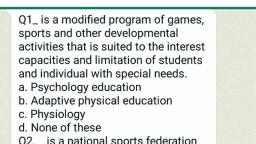
4.1, , Aims and Objectives of Adaptive Physical Education, , To identify the disabled children so many programmes have been conducted by the, government. Some of there are corrective physical education, remedial physical, education, physical therapy, corrective therapy development physical education and, individual physical education., Adaptive Physical Educations is a modified program of games, sports and other, development activities that is suited to the enterest. Capacities and limitations of, students and individuals with special needs. It is created for students with special, needs so they can also enjoy the experience of sports and recreations. Every school, has students who are differently abled and require special service to be able to realise, their maximum potential., Objectives:, 1. Through medical checkup, 2. The programme based on Interest and capacity of the students., 3. Easy enivronment, 4. Proper equipment should be provided., 5. Teaching strategies based on students level, 6. Rule should be easy., Integrated Physical Education : Concept and Principles : Under this one, must have the knowledge of different sub topic and other utility, so that the students, could be trained properly. The knowledge of integrated physical education will, promote the fitness and willingness of the individuals. It will help in designing high, quality programmers., Adaptive Physical Education : Concept and Principles there are many children, who suffer from various types of disabilities like mental retardation, deafness,, blindness, speech impairment etc. For such children and special programme may be, organized, so that physical, musical cognitive, social and emotional abilities can be, developed in them., Principles : For successful implementation of adaptive physical education, certain principles may be kept in mind such as medical examination interest and, capacity of the students, appropriate equipment, proper environment, specific, instructional strategies etc., , 52, , XI – Physical Education
Page 65 :
4.2, , Special Olympic Bharat, , This organization prepares the progress with physical and mental disability for special, Olympic. At national level, they are trained to participate in 24 single and team, games by the sports authority of India. This organization was established in 2001 as, per the act of 1982., Para Olympics, This is similar to Olympic game for disabled sports person in 1960 first time it was, organized in Rome. The head quarter of international para Olympic is situated at, Bonn, Germany. The international para Olympic is responsible for organizing summer, and winter Olympic games. At present it comprises of 176 National Para Olympic, Committees., Deaflympics, The ‘Deaflympics’ are games for deaf atheletes. Previously they were called the, International games for the Deaf. These games are organised by “The Internatinoal, committee of sports for the Deaf” since the first event and they are sanctioned by, Internation Olympic commttee. The deaf olympion can not be guided by sounds for, example, the starter gun, bullhorn commands or refree whistles. The Deaflympics, were held in paris in 1924 and were also the first ever international sporting events, for athletes with disability., The Deaflympic wintergames, was added in 1949. The games began as a small, gathering of 148 atheltes. Now these games are grown into a global movement., To qualify for the games, athletes must have a hearing loss of atleast 55db in, their “better ear”., Hearing aids, cochlear implant and the leke are not allowed to be used in, competetion., Deaflympions can not be guided by sounds so atternative mathods are used to, address the athletes. For example the football refrees wave a flag instead of blowing a, whiste, on the track races are started by using a light, instead of using a starting pistol., Host cities (summer), Year, Sobia, Bulgaria, , August 2013, , Samsun Tunkey, , July 2017, , Host cities (Winth Diaflymics), , March 2015, , Khanty mansiysk Rissia Torino Italy, , 2019, 53, , XI – Physical Education
Page 66 :
4.3, , Concept and need of Integrated Physical Education, , Integrated Physical Educations using physical activites and games to teach others subjects., this is a new concept in the field of Physical Education. Research and studies have shown, that integrating two or more subject at areas can stimulate the interest of students and, hence promote the learning of each subjects. Teachers are increasing conducting activities, both side and outside the classroom to teach various concepts of Science, Social science, and Mathematics., Integrated physical education is a comprehension concept. It is not only limited to, physical activities, games and sports but has become a complete discipline within the past, two decades the knowledge in this field has increased termendously. Due to research, works, various subdisplines such as sports sociology, sports Biomechanics, Sports, medicine, sports pedagogy, Exercise Physiology, Sports Psychology, Sports Philosophy, and sports management, etc. Integrated physical edudcation lays emphasis on, multidisciplinary learning ith the integration of its subdisciplines., Integrated physical education provides opportunities for students to see new, relationships, to transfer what they have learnt from are setting to the next and to, reinforce learning in various ways., This knowledge of integrated physiucal education would be able to help in the, fitness, health and wellness of all individuals. High quality physical education, programmes can be prepared with the help of integrated physical education., Concept of Inclusion, , 54, , XI – Physical Education
Page 67 :
4.4 b. Need of Inclusion, Inclusion in physical education helps the students with disabilities to increase their, social skills and in making trinds., A child feels that he/she also belongs to the entire group of class so a feeling of, belongingness is developed., Inclusion helps a child to increase his/her motor skills and expence success, with peers., Inclusion Implementation, To make inclusion work, general classroom teachers, support specialist, parents and, students themselve must work together to create the best educational environemnt, possible., 55, , XI – Physical Education
Page 68 :
With knowledge of inclusive practices and strategies, teachers can manage,, classrooms that encourage learning and discovery among all students, regardless of, physical abilities., School principals must cooperate and share the message that all staff members,, not just special education teachers, are expected to be involved in education children, with disabilities., Inclusion also requires specially trained staff. Since classroom teachers need, training and ongoing support to effectively teach many types of learners, they must, meet regularly with inclusion specialists., School Counselor, Special education counsellors work with special need children in elimentary school,, middel schools and high schools to ensure they have the support serivices they need, in order to achieve their highest potential in the areas of academics, personal and, social and career development., Occupational Therapist, The goods of occupational therapy for a child are to improve participation and, performance of a child and all the child’s “occupation” like self care, play, school, and other daily activities., The occupational therapist well assess the child and modify the environment,, or the way of doing a task to promote a better participation and independance., Physical Education Teacher, Physical education program plays a very progressive role in imporving congitive, functions and academic performance. Social skills and collaborative team work can, also be enhanced through the different programs of physical education., The physical education teacher helps in exicuting these programs., Physiotherapist, Physiotherapist the best known therapist who work with children with special needs., They use exercises to help their patients and keep the best possible use of their, bodies. They also try to improve breathing to prevent the development of deformities, and to slowdown the detoriation caused by some progressive diseases., 56, , XI – Physical Education
Page 69 :
Speech Therapist, Speech therapist is know by many names like speech language pathologist, speech, pathologist and speech teacher. They work with children with a variety of delays and, disorders spanning from mild articulation delays to more complex disorders such as, autism, down syndroms, hearing imparment, motor speech disorders and other, developmental delays., Speech teacher helps your child with speech, talking and communication., Special Education Teacher, Special education teachers work in classrooms or resource centers that only include, students with disabilities. Students with disability may attend classes with general, education students also known as inclusive classrooms. special education teacher’s, duties vary by the type of setting they work in, student disabilities and teacher, specialty., , Objective Type Questions (1 Marks Each), Q.1., , The head quarter of paralympics is at, (a) Paris, (b) New york, (c) Germany, (d) Denmark, Ans. (c) Germany, Q.2., , Deaf lymics started in, (a) 1924, (c) 1947, Ans. (a) 1924, , (b) 1960, (d) 2001, , Q.3. Cochlear implant is not allowed in, (a) Special olympics, (c) Asian games, Ans. (b) Deaflymics, Q.4. Speech therapist helps a child in, (a) Grooming, (c) in hancing mobility, Ans. (b) Communication, , 57, , (b) Deaflymics, (d) olymic games, , (b) Communication, (d) playing, , XI – Physical Education
Page 70 :
Q.5., , "Let me win. But if I cannot win, let me be brave in the attempt". In, which game this oath is taken?, (a) Special olympic Bharat, (b) Paralympic, (c) Deaflymipic, (d) Asian games, Ans. (a) Special olympic Bharat, Q.6. 'Spirit in motion' is the motto of, (a) Paralympic, (c) Common wealth games, Ans. (a) Paralympic, , (b) Special olympic Barat, (d) Deaflympic, , Q.7. What is the motto of deaflymic?, (a) Spirit in motion, (c) Cetius, altius fortius, Ans. (b) Per ludos aequalitas, , (b) Per ludos aequalitas, (d) Let me win brane in my attempt, , Q.8., , In clusion is needed to...., (a) Social development of CWSN, (b) To incerease motion skills, (c) To improve academic perfermance, (d) All of these., Ans. (d) All of these., Q.9., , Name the teacher who is specially trained to work with CWSN...., (a) Physical education teacher, (b) Physiotherapist, (c) Principal, (d) Special educator, Ans. (d) Special educator, Q.10. Whisles or guns are not used in these games..., (a) Common heath, (b) Deaflympic, (c) Paralympios, (d) Spcecal olymic, Ans. (b) Deaflympic, , Question for 3 Marks (60 Words), Q.1, , Write a short note on the origin of Para Olympic Games., , Ans. In the second world war majority of people suffered . They lost their will, power and kept remembering the horrors of wars all the time. In1960, Rome Olympic, Sir Ludwig Collected 400 disabled Athletes and organized, games and it was named Para- Olympics. Shooting was the first game to, be introduced in Para Olympic games, the international Para Olympic, 58, , XI – Physical Education
Page 71 :
committee is responsible for organizing summer and winter Olympic game., The head quarter IPC is situated in Bonn (Germany). The symbol of Para, Olympic Games is three colours red, Blue and green flag and the motto of, Para Olympic is 'Spirit in Motion' 2014 winter para Olympic games was, successfully hosted by Russia., Q.2, , Describe the principles of integrated and comprehensive physical, education., , Ans. (i) It should be based on the inter related sub-topics of physical education., (ii) It should cater to the requirements of different people., (iii) It should be capable of facing the challenges of the present and the, future., (iv) It should be capable of providing comprehensive and deep knowledge, about physical education., (v) It should motivate an individual to engage in a lifelong healthy and, active lifestyle., (vi) It should be able to develop social and emotional skill among people, Q.3, , Write a note on special Olympic Bharat?, , Ans. This organization was established in 2001, its aims is to increase the, participation of differently abled person's in games and sports. Its another, objectives was to develop leadership quality and healthy. This organization, organizes sports competition at state level. It also serve talented players, and train them for international games. After 2002, about 23,750 participants, have participated in national games. Between 1987 and 2013, a total of, 671 Indian athletes participated in Olympic. They won 246 Gold medals,, 265 Silver medals, 27 bronze medals and they raised the glory of the, country in the world., Today around 1 million athletes are the members of this organization and, 84905 coaches train these athletes. This organization does the all round, development of the players through games and sports., Q.4, , How can we implement inclusive education in physical education?, , Ans. PEER TO PEER: EVERYONE'S A PLAYER, EVERYONE'S A, LEADER, Special Olympics believes in the power of sport and in the power of young, people to build a more inclusive world. In a high quality Inclusive Physical, 59, , XI – Physical Education
Page 72 :
Education classroom students recognize their abilities to create inclusive, communities as they learn to value difference and appreciate each, individual's unique gifts and talents., Peer to peer teaching is a fundamental strategy for implementing successful, Inclusive Physical Education programs, but it is important that it be, implemented in a truly inclusive manner and grounded in equality., An inclusive peer to peer teaching model provides opportunities for students, of all abilities to participate as leaders in some way, reinforcing and confirming, the potential of every student to lead and contribute meaningfully., , Question for 5 Mark (150 Words), Q.1, , Which principles are required to be followed to make the adapted, physical education effective? Explain., , Ans., , 1. Medical Examination : It is very important for the success of, programme related to adapted physical education. Otherwise it will, be difficult to find out what kind of disability, the student is suffering, from., There fore it is imperative to conduct medical examination of the, students., 2. Programmes according to the interest of the students: programmes, should be made keeping in mind the interest, capacity and previous, experience of the students. The teachers should also have deep, knowledge about it, then only they can make any successful programme., 3. Equipment should be appropriate : Students should be provided, with equipments asper disability concerned for example, students, suffering from visual impairment should be given a ball with bell so, that they may catch the ball as it rolls because of the sound. Thus, such students can make out the direction and distance of the ball., 4. Proper Environment: The play area also should be limited because, of the limited speed capacity of the children for example, speech, impaired children be given rest in between the games. The play area, should be limited to top smaller area., , 60, , XI – Physical Education
Page 73 :
5. Modification of rules: Rules and regulation of the game and sports, should be modified depending on the specific needs of students. In, order to learn new skill they may be given extra time, extra effort,, extra rest and 2 marks in place of 1 mark., Thus, they might be given the opportunity for all round development., Q.2, , Explain the concept of Inclusion., , Ans. A defining characteristic of an excellent physical education program is, that it includes students with a diverse range of abilities, needs, interests, and learning styles in meaningful learning experiences. The term "Inclusive, Physical Education" reflects a program where respect and acceptance of, all students, specifically students with disabilities, is an essential component, of the classroom environment and teaching strategies., Inclusion is about creating a classroom in which every student is welcomed,, valued, respected and enabled to reach his her full potential. In a successful, Inclusive Physical Education program, all students are fully engaged in, instructional activities, sharing equally and learning together. Although, the activities may be modified or adapted, students with disabilities learn, the same concepts, skills and content as all other students in the class. The, result is educational equity and access for all students!, Inclusive Physical Education requires educators to believe in the concept, that success for each student can be different The educator must be willing, to modify and adapt lessons and activities to ensure that every student, learns and achieves success at his own pace and according to his own, abilities. Educators see the abilities of all students as contributing to the, whole class. Effective teaching for students with disabilities is basically, the same as effective teaching for all students., Q.3, , What is the role of school counsellor in special education?, , Ans., , 1. The role of a school counsellor is to help all students, including, those with special needs, to achieve there full potential. Introducing, an appropriate individualised education programme (IEP) at early, age can make all the differance, not only in these children’s academic, , 61, , XI – Physical Education
Page 74 :
learning but in their emotional health and social adjustment and ultimately, in their ability to become productive, contributing member of society., 2. Counselling sessions with specail education students., 3. Encouraging family involvement in IEP., 4. Consulling with and working with other school staff to better understand, the childs spcial needs., 5. Collaborating with other school and community professionals like,, teachers, school, psychologist, physical therapist and occupational, thrapist etc., 6. Identifying other students who should be assessed to determine the, eligibility for speical education., , Q.4, , What is the need of inclusion in physical educaton?, , Ans. Inclusion is needed for following reasons—, 1. Inclusion in physical education increases social skills of students, with disabilities ., 2. Inclusion is needed to increase motor skills of students with disabilities., 3. A disable student gets equal chance to participate in age appropriate, activities so, it increases the confidence level., 4. Typical students get a chance to increase friendships with disable children., 62, , XI – Physical Education
Page 75 :
5. Inclusive education provides an opprotunity to a typical students to go, beyond tolerance to acceptance and advocacy., 6. Inclusive education enable a student to increase their knowledge and, acceptance based on the “contact theory”. Through frequency,, meaningful and pleasent interactions, changes in attitude can occur., What is the role of occupolional therapist for special need children?, — Self care – An occupational therapist will help a child perform and, be independent in self care skills like cating, dressing, toileting,, bathing and grooming., — Play – An occpational therapist helps children participate and intercet, with others in play. They may suggest modify cations in the position,, mobility aids or modified toys to help a child to play., — School – Occapational therapists help children participate and adcept, to regular school. They may suggest aids for writing and other classroom, activities to help them participate equally with other children. Children, with special needs may also require special furniture to help them sit, and write better., — Environmental modificatons: Occuapational therapists can suggest, modifications in the house, school or playgroud that will help the, child participate more easily. Helping the child became independent, early in life, will encourage them to live independently as an adult., — Fine motor skills and Hand writing occupational therapists also, play a role in helping a child improve their fine motor skills, handwritting. They will be able to identify the specific deficits int he, child and suggest activities that will help improve these skills., — Splinting – Occupational & learapists can also make simple splints, to help the child perform activities in a better way., , 63, , XI – Physical Education
Page 76 :
Q.5., , What is the contribution fo special education teacher in developing, education plans for special need children?, , Ans., , 1. Assess student’s skills to determine their needs and to develop teaching, plans., 2. Adapt lessons to meet the needs of students., 3. Develop Individualised education programs (IEPs) for students., 4. Plan, organise, and assign activities that are specific to each student’s, ability., 5. Implement IEPs, assess students., 6. Update IEPs throughout the school year to reflect student’s progress, and goals., , 64, , XI – Physical Education
Page 77 :
Q.6., , What is the role of a Physical Education teacher for children with, special needs., , Ans. — The rights of persons with disabilities Act 2016, that gives pupil a, right to inclusiver activity. So physical education teachers are expected, to take action within the individual school context and modify and, adopt existing practices in order to facilitate full entitlement to the, access of physical activity for pupils with special need., — The PETs organise ball games for disabled children to improve overall, strength and agility hand eye co-ordination and gross motor skills., Students have shown that throwing, catching, rolling and passing the, ball improves the dsiabled child’s muscle response., — Scientific research has demonstrated that physical education can, ehnhance academic performance and cognitive function. So parents, with the help of teachers should always encourage the child with, special need to participate in activities., Q.7. What is the role of speech language pathologist for special need children?, Ans. Speech therapist/pathologist works with children with a varietes of delay and, disorder such as autisum. Down syndrome, hearing imparirment, motor speech, disorders, and other developmental delays., They help child with :, 1. Articulation skills/speech intelity articulation is the physical ability, to move the togue, lips, jaw and palate (known as the articulators), to produce individual speech sounds which we phonemes., 65, , XI – Physical Education
Page 78 :
2. Expressive Language Skills: While speech involves the physical motor, disability to talk, language is a symbolic system used to convey a message., Proper use of these is developed by speech therapist., 3. Receptive Language/Listening Skills: Receptive language, refers to, child’s ability to listen and understand language. Therapist can help teach, the child new vocabulary and how to use that knowledge to follow, direction, answer question and participate in single conversations with, others., — Physical education teacher need to determine the abilities of students, with speical needs so that to design special sports activities acording, to their need., 4. Speech Fluency/Stuttering: Sluttering is a communication disorder, that affects speech fluency. Therapist can teach the child startegies, on how to control behaviour like tension in the neck, showdess,, face, jaw, chest, eye blink, etc. and thus increasing lies speech fluency, and intelligibility., 5. Voice and Resonance: Voice disorders refer to disorders that effect, the vocal folds that allow us to have a voice. These can include, vocal cord paralysis, nodales or polypes on vocal folds. Therapists, can work with children to decrease these behaviours (vocal classess), and repair the strain/damage of the folds., Physiotherapist – Physiotherapist are trained to evaluate and improve, the function of the body, with particular attention to physical mobility,, balance, posture, fatigue and pain., The physical therapy programme involves educating the child about the, physical problems caused by their disability, designing and invidualised, wise programme to address the problems, and enhancing mobility and, energy conservation through the use of a variety of mobility aids and, adaptive equipments., Physiotherapy can be used to help children who have a neurological, condition that affects the nervous system, such as multiple sclerasis,, stroke and cerebral palsy., Physiotherapy can be used to treat injuries that affect the bone, joints, and muscles such as sports injuries and arthritis., , 66, , XI – Physical Education
Page 79 :
Paedeatric treatment – Physiotherapy can be used to treat children affected, by ‘Muscular Dystrophy’. These and other conditions may require the, child to have help to improve balance, strength and co-ordination., Techniques of physiotherapy, 1. Massage and manipulation, 2. Exercise and movement, 3. Eloctrotherapy, 4. Hydrotherapy, , 67, , XI – Physical Education
Page 81 :
YOGA, Meaning and Importance of Yoga :, 5.1, , Meaning, , The term yoga is derived form a Sanskrit word 'Yuj' which means join or union. In, fact joining the individual self with the divine or universal spirit is called yoga. It is, a science of development of man's Consciousness., Patanjali - “Checking the impulse of mind is yoga”., Maharishi Ved Vyas - “Yoga is attaining the pose”., In Bhagwat Gita, Lord Krishna says, “Skill in action or efficiency alone is yoga., Importance of Yoga :, , Prevention from Disease, Relationship, , Increase in Flexibility, , 5.2, , Elements of Yoga, , The main aim of yoga is to control over the mind. This is Possible only follow to, eight fold Paths or eight steps also know as "Ashtang Yoga". This system was, Developed by Maharashi Patanjali., Elements of Yoga, Pratyahara, , 69, , Dharna, , XI – Physical Education
Page 82 :
5.3, , Introduction to Asanas, Pranayam, meditation & yogic Kriyas, , Asana: According to Patanjali Means "Sthiram Sukham Asanam" i.e. that possible, which is comfortable and steady.", Pranayama: The word Pranayama is comprised of two words "Prana Plus, Ayama" Prana means life force and Ayama means control. In this way pranayama, means "The control or regulation of Prana", , 5.4 Yoga for Concentration and Related Asanas (Sukhasana,, Tadasana, Padmasana, Shashankasana, Vrikshasana, Garudasana, and Naukasana), We all know about the amaging health benefits of Yoga, but the greatest thing amongst, all is that Yoga works on changing our internal make-up., According to a recent study conducted at the university of Ellinois at Urbana, Champaign, practicing Yoga daily for 20 minutes can improve brain function and, actually focus better on daily task at hand., Yoga helps in improving concentration and focus by, calming the mind and getting rid of distracting thoughts., Here are 5 easiest effective Yoga asanas you need to try, to boost concept rating and jump start your brain., 1. Tadasana (Mountain posa), 2. Vrikshasana (Tree pose), 3. Savasana (Corpse pose), 4. Padmasana (Lotus pose), 5. Bhramari Pranayama, , 70, , XI – Physical Education
Page 83 :
SUKHASANA, Sukhasana or the easy sitting pose is one of the simplest pose for meditation suited for all, beginners. Sukhasana comes from the Sanskrit work 'Sukham' which can mean 'comfort',, 'easy', 'joyful', 'pleasure', etc. Sukhasana can be done by all age groups., , SUKHASANA, THE EASY SITTING POSE, , TADASANA (MOUNTAIN POSE), This asana is like the base or the mother of all asanas, from within the other asanas emerge., Tadasana increases the levels of oxygen in the spinal cord and frontal part of the brain”., It improves concentration and boosts energy., The word ‘Tada’ is come form the sanskrit word, which menaing is ‘palm tree’ or, another meaning is mountain and meaning of asana is posture or ‘seal’ so this asana is, , 71, , XI – Physical Education
Page 84 :
called Tadasana. Tadasana is the begining and ending asana of Surya Namaskar according, to Ashtang Yoga., This is the best exercise to increase the height., Shashankasana, , Shashankasana (Hare Pose), The Sanskrit home for Hare pose is Shashankasana. The meaning of ‘Shashank’ is moon., Shashank itself is made up of two words ‘shash’ meaning ‘hare, and ‘ank’ meaning ‘lap’., The Shashankasana pose is said to benefit the practitioners by helping in calming the, nerves and providing a feeling of tranquility. The Shashanksaha similar to a sitting hare,, from which it derives its name., , 72, , XI – Physical Education
Page 85 :
PADMASANA (LOTUS POSE), , Padmasana (Lotus Pose), The word Padmasana is a Sanskrit word which means "lotus flower" so it's also known, as the "Lotus pose". It is so called because of the lotus- like formation which made by, our legs during this asana. Another name of Padmasana is "kamalasan" The word, Kamal is a hindi word which means a lotus flower. It is a yogic exercise in which one, crosses the legs while maintaining a straight posture. It is a important position for, meditation., Naukasana, Naukasana comes from the two sankrit words' nauka' which means 'boat' and 'asana', meaning 'posture' or 'Seal'. It is a posture in which our boty takes the shape of a boat., 73, , XI – Physical Education
Page 86 :
If you hav always had a problem losing the extra paunch in four stomach area, then, this asana is food for those who wish to reduce belly fat as well as to tone the abs., Naukasana is one of the few yoga poses that can be performed lying both on the stomach, (prone position) and back (supine position.), Vrikshasana or Tree pose, It is a balancing asana. It is one of the very few, standing poses in medieval hatha yoga, and remains, popular in modern yoga., The names comes from the sanskrit words, vrksa meaning 'ture' and asana meaning 'posture'., This posture replicates the gsaceful, steady stance, of a ture. Unlke most yoga poses, the ture pose, requires keeping one eyes open in order to maintain, body balance., Gasudasana, Gasudasana or eagle pose is a standing balancing asana in modern yoga. The name was, used in medieval hatha yoga for a different pose., Gasuda - the mythic 'king of the birds,” the vehicle of vishnu. The wod is usually, sendered into english as '‘eagle,” though according to one dictioncy the name literally, means “devourer,” because Garuda was originally identified with the "all consuming fire of, the sun's rays”., 5.5, , Relaxation Technique for Improving Concentraion (Yog-Nidra), , 74, , XI – Physical Education
Page 87 :
A yoga routine provides deep restoration to your body and the mind. And to make, your practice more effective, it's ideal to end your yoga sequence with yoga nidra (yogic, sleep) In yoga nidra, we consciously take our attention to different parts of the body and, relax them., Simply described as effortless relaxation, yoga nidra is an essential end to any yoga, pose sequence. Yoga postures 'warm up' the body; yoga nidra 'cools it down'., Yoga practices increase the energy levels in the body., Yoga Nidra helps conserve and consolidate this energy and relax the entire system,, preparing it for pranayama and meditation. It is. therefore, important to keep aside sufficient, time for yoga nidra after yoga postures., Relax Yourself With Yoga Nidra - As Restorative As Sleep, , Objective Type Questions (1 Marks Each), Q.1. Who is the writer of 'yogsutra'?, (a) Vedyas, (c) Swami vivekanand, , (b) Baba Ramdev, (d) Maharshi patanjali, , Ans. Maharshi patanjali, , 75, , XI – Physical Education
Page 88 :
Q.2., , The components of yoga are, (a) Four, (c) Eight, Ans. Eight, , (b) Six, (d) Two, , Q.3., , Which of the follwoing is not a part of yama?, (a) Sataya, (b) Aprigrah, (c) Asteya, (d) Santosh, Ans. Santosh, Q.4., , The components of pranayama are, (a) Three, (b) Two, (c) Five, (d) Seven, Ans. Three, Q.5., , Which is the eighth limb of Ashtany yoga?, (a) Dhyana, (b) Dharana, (c) Samadhi, (d) Pratayahara, Ans. Samadhi, Q.6., , Which of the following is not a body building Asanas?, (a) Dhanurasana, (b) Ehakrasana, (c) Mayurasana, (d) Savasana, Ans. Savasana, Q.7., , The number of yogic kriyas are, (a) Four, (c) Six, Ans. Six, , (b) Five, (d) Three, , Q.8., , Which of the following asana is also called 'hare pose'?, (a) Padmasana, (b) Tadasana, (c) Shashankasana, (d) Halasana, Ans. Shashankasana., Q.9., , Complete stability of mind is known as, (a) Samadhi, (b) Pratayahara, (c) Dharana, (d) Dhyana, Ans. Dhyana, 76, , XI – Physical Education
Page 89 :
Q.10. Which of the following is helpful in increasing height?, (a) Padmasana, (b) Tadasana, (c) Halasnana, (d) Sukhasana, Ans. Tadasana, Q.11. Which of the following asana is helpful in controlling diabetes?, (a) Vrkasasana, (b) Mandukasana, (c) Vajrasana, (d) Garudasana, Ans. Mandukasana, Q.12. Which of the following is related in developing the character of a, person?, (a) yama, (b) Niyama, (c) Pratayahara, (d) Dharana, Ans. Niyama., , Short Type Question (3 Marks Each), Q.1, , What is the role of yoga in sports?, Or, Importance of yoga? Describe it?, , Ans. Yoga consists of both mental as well as physical exercise., 1. It help to keep the body fit., 2. Relief from any kind of tension, 3. Improves the heart and lung-functioning capacity., 4. It helps in curing and prevention from disease., 5. Improves, agility, flexibility, co-ordination, strength etc., 6. Improves the co-ordination of body system., 7. Improves correct body posture., Q.2, , What is the role of meditation in sports?, Or, Importance of meditation? Describe it?, , Ans., , 1. Meditation helps to increase concentration., 2. It gives relaxation to the body and mind., 3. It cures stress and Anxiety., 4. It improves the function of nervous system., 77, , XI – Physical Education
Page 90 :
5. It activates the brain and mind properly., 6. It controls anger problem., Q.3, , What is Yog Nidra?, , Ans. Yog nidra is an effortless relaxation. It is an essential end to any Yoga, pose sequence. Yoga posture warms up the body; Yoga nidra ‘cools’ it, down., Q.4, , What are the benefits of Yog Nidra?, , Ans., , 1. Cools down the body after yoga postures., 2. Restoring normal temperature., 3. Activates the nervous system to absorb the effects of Yoga asanas., , Q.5, , How to get ready for a Yoga Nidra., Or, What are the preparations on the part of performer before doing, Yog Nidra?, , Ans. Getting ready for Yog Nidra:, 1. The stomach has to be empty or light before the practice It is not, recommended to practice Yoga asanas or Yoga nidra after a full, meal., 78, , XI – Physical Education
Page 91 :
2. A comfortable clutter free space A yogi’s home is calm, comfortable., 3. Some people may feel a little cold after Yoga Nidra, so, it is a good idea, to keep a light blanket handy., Q.6, , Explain the procedureof Padmasana., , Ans. Steps of Padmasana (Lotus Pose), Sit on the floor and stretch your legs, your legs should be straight in front., Hold the right leg in both the hands, fold the legs slowly and place it on your, left thigh. Ensure that your feet should touch your navel., Padmasana step 1, Same like earlier fold the left knee, and hold it with both hands and place it, on the right thigh close to the other. At this point your both knees should touch, the floor and the foot should face upwardly., Your spinal cord should be straight at this point. If you feel some difficulty, while sitting in the posture for a long time, you can change the legs and, then sit on the same position., Padmasana step 2, Your spinal cord should be erect, your both hands should be together or, put the palms facing upside on the knee joints and the thumb must touch, your index finger and the other fingers should face the upward., Q.7, , Write the procedure, benefits and Precaustions of Sukhasana., , Ans. Sit erect with spine straight., Relax your whole body and breathe normally., Maintain this position for as long a comfortable., Benefits To Body Part:, The Sukhasana is a comfortable, sitting yoga pose that is ideal for meditation., In Sanskrit, Sukh means, happiness, peace or relaxation and this pose is, aimed at providing all of it. There are many physical, emotional and, mental benefits associated with this pose, some of which include Amplifying your state of serenity and tranquility, Broadens your collarbones and chest, Calming your brain, Eliminating stress, anxiety and mental exhaustion, , 79, , XI – Physical Education
Page 92 :
Improving alignment, Lengthening your spine, Opening your hips, Promoting inner calm, Reducing fatigue, Strengthening your back, Stretching your ankles and knees, Precations:, • Don’t do sukhasana in inflammation in the knee or hip, spinal disc problems, and chronic khee injries., • Perform this asana under the Guidance and supervision of a certified, Yoga guru at least until you master it., Q.8, , Explain in detail the procedure, precautions and benefits of Shashankasana., , Ans. Procedure:, 1. First assume vajrasana. Both your arms should be placed on your, knees., 2. Keep your neck and spinal cord straight., 3. Shut your eyes and begin focussing on your breathing and your, body., 4. Take a deep breath and without allowing the elbow to bend, bring, your hands above your shoulders., 5. Slowly exhale and reach down to touch the ground while your head, and both your hands., 6. Let your upper torso relax and remain in this position for a while., The neck should be kept straight between the arms., 7. To finish, you should exhale and place your plams on your knees., Precautions, Avoid practice of this pose if you suffer from vertigo, slipped disc, high, blood pressure and heart related problems., Benefits, 1. It strengthens the muscles., 80, , XI – Physical Education
Page 93 :
2. It helps in the extension of the neck, arms and spine., 3. Practicing this pose helps improve the circulation of blood to the scalp,, face and brain. It gives a nice glow to the face., 4. This pose helps in regulating the adrenal glands., 5. The hare pose is also peneficial to the reproductive organs., Precautions, Avoid practice of this pose if you suffer from vertigo, slipped disc, high blood, pressure and heart related problems., Benefits, 1. It strengthens the muscles., 2. It helps in the extension of the neck, arms and spine., 3. Practicing this pose helps improve the circulation of blood to the scalp,, face and brain. It gives a nice glow to the face., 4. This pose helps in regulating the adrenal glands., 5. The hare pose is also beneficial to the reproductive organs., Q.9, , What is he procedure, precautions and benefits of Tadasana?, , Ans. Procedure:, 1. Stand erect, and place your legs slightly apart, with your hands hanging, alongside your body., 2. You must make your thigh muscles firm., 3. Strengthen the inner arches of your inner ankles as you lift them., 4. Now, imagine a stream of white light (energy) passing through your, ankles, up to your inner things, gently turn your upper things inward., Elongate the tailbone such that it is toward the floor. Lift the pubis, such that it is closer to the navel., 5. Look slightly upward., 6. Now breath in and stretch your shoulders, arms and chest upwards., Raise your heels, making sure your body weight is on your toes., 7. Feel the stretch in your body right from your feet to your head. Hold, the pose for a few seconds. Then, exhale and release., Precautions:, It is best to avoid this asana if you have the following problems—, 81, , XI – Physical Education
Page 94 :
1. Headaches, 2. Insomnia, 3. Low blood pressure, Benefits of Tadasana, These are some amazing benefits to Tadasana., 1. This asana helps improve body posture., 2. Your buttocks and abdomen get toned., 3. This asana reduces flat foot., 4. It also makes your spine more agile., 5. It is an excellent asana for those who want to increase their height in their, formative years., 6. It also helps improve balance., , Long Answer Type Questions (5 Mark Each), Q.1, , Explain the benefits of Yog Nidra in detail., , Ans. 10 REASONS, , YOG NIDRA, IS GOOD FOR YOU, , YOG NIDRA BENEFITS ARE, 1. It helps in relieving muscular, emotional,, and mental tension., 2. Yog Nidra relaxes the mind by relieving, stress and anxiety., 82, , XI – Physical Education
Page 95 :
3. It treats insomnia, psychological disorders, and psychosomatic diseases., 4. It trains the mind and helps in enhancing memory and increasing learning, capacity., 5. Yogic sleep also results in increased energy levels., 6. It heals endocrinal imbalances., 7. Yog Nidra not only detoxidfies the body, but also clears up the subconscious., 8. It improves creativity., 9. It also leads to improved senses and more cultivated body awareness., 10. Yoga nidra restores the mind and body., , Q.2, , What is the procedure to do a perfect Yog Nidra?, , Ans. How to do a perfect Yog Nidra:, 1. Lie down straight on your back in Corpse Pose (Shavasana). Close your, eyes and relax. Take a few deep breaths in and out. Remember to take, slow and relaxed breaths, and not ujjayi breaths., 2. Start by gently taking your attention to your right foot. Keep your attention, 83, , XI – Physical Education
Page 96 :
there for a few seconds, while relaxing your foot. Then gently move your, attention up to the right knee, right thigh and hip. Become aware of your, whole right leg., 3. Gently, repeat this process for the left leg., 4. Take your attention to all parts of the body: genital area, stomach, navel, region chest, 5. Take your attention to the right shoulder and right arm, palms and fingers, then repeat this on the left shoulder and left arm, torso, face and finally, the top of the head., 6. Take a deep breath in, observe the sensations in your body, and relax in this, still state for a few minutes., 7., , Now, slowly becoming aware of your body and surroundings, turn to your, right side and keep lying down for a few more minutes. Rolling over to the, right side makes the breath low through the left nostril which helps cool the, body., , 8., , Taking your own time, you may then slowly sit up, and whenever you feel, comfortable, slowly and gradually open your eyes., , Yoga Nidra Instructions by Sri Sri Ravi Shakar, Note that Yoga Nidra is not about 'conscious effort' but 'conscious relaxation'., For example, the moment you hear the word 'apple,' its image instantly, flashes through your mind. You don't need put in an effort to think, whether it's small or big. red or green. The same happens during yoga, nidra, You don't need to 'concentrate' or 'focus' on what a leg is, or touch your, nose. Nor do you need to physically move these body parts. You only, need to gently take your attention to them, while taking deep breaths., The trick in yoga nidra is to: relax with awareness, remain effortless and, consciously relax the body and mind., It is quite natural to be distracted by random thoughts during yoga nidra., Do not try and curb them. If you fall asleep naturally, don't feel guilty, once you wake up., Yoga nidra is thus a joyous, effortless way to end your yoga practice. Let go,, , 84, , XI – Physical Education
Page 97 :
relax and enjoy the experience that follows, “As refreshing as sleep, I fondly call yoga nidra my ‘super nap’. In just a short, while, it leaves me deeply rested and freshens me up in a way no tea or coffee, does,” shares Pritika Nair. an avid meditator., Q.3, , Elaborate Naukasana in detail., , Ans. In Sanskrit ‘Nauka’ means Boat and ‘Asana’ means ‘Pose’. So this asana is, called as naukasana while practicing boat pose you will see the entire body, takes a shape of a boat. This boat pose is beneficial cure many physical, disorders., Basically, naukasana helps to strengthen the lungs, liver and pancreas. Helps, to increases the circulation of blood andmaintain the sugar level., Steps for Naukasana, — Lie flat on your back on the yoga that with your arms by your side., — Relax in this position for some time and keep breathing normally., — Now inhale slowly and lift your both legs., — Keep legs straight and should net be bent., — Raise your upper body to touch your legs with both hands., — Try to maintain the angle of 45°., — Hold your breath and the posture for 10-15 seconds. You can increase, the time of holding posture by practicing regularly., — Now exhale slowly and get back to your starting postion., Duration, — 3-4 repetitions daily but showed not overdo., Precaustions for Naukasana, — Suffering from low or high blood pressure, hip, joint pain, arthritis,, severeheadache, migraine, hernia and ulcer patients should not practice, Naukasana., — Consult a doctor first before practicing any exercise and practice, under expert guidance., — Pregnant women should not practice this boat pose., — Avoid practicing during periods but if you all comfortable to practice, then go ahead., 85, , XI – Physical Education
Page 98 :
Benefits of Naukasana, — Helps to reduce belly fat., — Improve the function of digestion., — Good for developing six packs ABS., — Regulates the function of pancreas, liver and lungs., — Strengthens abdominal muscles, — Good for a diabetic patient to maintain the sugar level., — Improves the blood circulation., — Strengthens the muscles of thighs, hips, necks and shoulder., — Improves the function of kidney, thyroids and prostate glands., Q.4, , Write down the steps, procedure, benefits and precautions of Vrikshasana., , Ans. Vrikshasana has taken from Sanskrit word Vraksh (, , ), , While performing it gives the true spirtit of tree, thus named as tree pose., , How to perfrom tree pose, 86, , XI – Physical Education
Page 99 :
— Stand erect, keep the feet together., — Fold the right leg and placed it at the top of left thighs with the toes of, right leg showed pointed downwards., — The right leg showed perpendicular to left leg., — Extend your arms above your head., — Inhale and try to make Namaskar mudra with your palms., — Balance the pose as long as you can because balancing is utmost important, in tree pose., — Try to make your spine straightand feel the stretching from toes to fingers., — With deep exhale bring your arms and legs down., — Repeat the same with left leg. It completes one round., — Do three-five rounds., — No. of rounds may increase as per your convenience., Health Benefits of Tree Pose Yoga (Vrikshasana), — It stretches the entire body from toes to fingers, thus invigorates you., — It gives tranquillity to your mind thus good for those who are facing the, problems of depression and anxiety., — It increase your stamina, concentration and immunity., — It is good for your hips as it helps to open it., — It is beneficial for those who are experiencing Sciatica. But one should, practice it under the supervision of a yoga expert., — It enhances the flexibility of legs, back and chest muscles., — It makes your ankle stronger., — It is also good for your knees., — It strengthens thighs and calves., — It gives suitable stretching to the groins., — Person suffering from flat feet should practice it., — It makes you more focussed and concentrated., — By practicing this asana, the ligaments and tendone of the feet get strengthen., — It is also good for pelvic region., — It develops esteem and self-confidence., 87, , XI – Physical Education
Page 100 :
— It caloms and relaxes the central Nervous system., — It hels to cure rheumatic pain and also treats numbness., Tree Pose Yoga Precaustions, — High blood pressure, — Low blood pressure, — Migraine, — Insomnia, — Acute knee problems, — Hip injury, , Q.5, , Explain in detail the procedure, benefits, and precuations while performing, Garudasana (Eagle Pose)., , Ans. The mythology behind garudasana (Eagle pose). Although it is called ‘eagle, pose’ in English, garudasana is named for a divine creature., In the south Asia, a garuda is a huge, mythical bird with the golden body of, a man, a white face, red wings, and an eagle’s beak. He is the king of the, bird community, the enemyofsnakes, and the friend of human. Garuda is the, vehicle of Lord Vishnu, the aspect of divinity which sustain the universe and, takes birth as a man., How to do the Garudasana, 1. Stand erect. Gently bendyour rightknee, and wrap your left leg around, 88, , XI – Physical Education
Page 101 :
your right, such that the knees are stacked over each other. Your left foot, must touch your right shin., 2. Raise your arms to the shoulder height and wrap your right hand around, your left., Ensure that your elbows are bent at 90° angles and are also stacked., 3. Strike a balance in the pose as you gently bring downyour hips. Your, knees must move towards the midline instead of leaning to one side., 4. Hold the pose for a few seconds. Breathe deeply and slowly. Focus, on the third eye, and let go of your negative emotions., 5. Release the pose, swtich the limbs, and repeate the pose., , Contraindications, — Knee injuries/Ankle or elbow injuries., — Late teem pregnancy., , 89, , XI – Physical Education
Page 102 :
6.1 Leadership Qualities and Role of a Leader, 6.2 Creating Leaders through Physical Education, 6.3 Meaning, Objectives and Types of Adventure Sports, (Rope climbing, Tracking, River Rafting, Mountaineering, Surfing, and, Paragliding), 6.4 Safety measures to Prevent Sports Injuires., , 90, , XI – Physical Education
Page 103 :
Introduction to Physical Activity and Leadership Training, 6.1a Physical Activity, Physical activity simply means movement of the body that uses energy., The four main types of physical activities are—, 1. Aerobic, 2. Muscle – strengthening, 3. Bone – strengthening, 4. Stretching, , heart and, , 6.1 (b), , Leadership, , Leadership can be described as the ability of an individual to influence, motivate, and, 91, , XI – Physical Education
Page 104 :
enable others to contribute toward the effectiveness and success of an organiszation or a, group of which they are members., Leader – A person who can bring about change, therefore, is one who has the ability, to be a leader., Or, A person or thing that holds a dominant or superior position within its field, and is able, to exercise a high degree of control or influence over others., , LEADERSHIP, , 6.1(c) Qualities of a Leader, , TRAITS, , 1. Awareness — As the leader of, a team awareness is a key. A, leader should be aware of, different scenarios., , L — Loyalty, E — Empathy, A — Accountability, D — Duty & Determination, E — Energy & Encouragement, R — Respect, S — Selflessness, H — Honorable and humble, I — Integrity & Innovation, P — Passion for and pride in work, , 2. Passionate – The leader should, be passionless enough to, motivate other players., 3. Energetic, 4. Friendliness and affection, 5. Decisiveness, , Be a Leader!, , 6. Technically skilled, 92, , XI – Physical Education
Page 105 :
7. Intelligent, 8. Teaching skill, 9. Creative, 10. Interest in Research, Leadership: Leadership is the quality of, a person to lead others in a family, society,, tribe, group, or country., 6.1 (d) Role of a leader in Sports, 1. Organiser—A good leader in sports is a good organiser in organizing different, sports events., 2. Motivator—A leader in sports understands his students and their mental needs., So, he plays the role of a good motivator., 3. Guardian—A good leader plays the role of guardian. A good leader understands, the personal problem of an athlete and provides solution for the problems., 4. Teacher—A good leader in sports performs the role of a teacher by helping, participants in developing teaching techniques, educate them and improve their, range of styles., 5. Psychologist—A good leader plays the role of a psychologist. He knows the, mental skills and toughness of their players., 6. Role model—As leader, you should be able to set a role model., 6.2, , Creating leaders through physical education, , Creating leaders through physical education we can make leaders through physical education, by adopting the following approach—, 1. Give various responsibilities of an event, 2. Provide leadership training, 3. Provide regular opportunity to improve, 4. Recognize their achievement by facilitating them at different forms., 5. Have faith and confidence in your students if they they are defaulter., , 93, , XI – Physical Education
Page 106 :
6.4 (a) Adventure Sports, Meaning : Adventure sports are such type of sports, which involve extraordinary speed,, height, physical exertion, and surprising stunts., 6.3 (b) Objectives of Adventure Sports, Aim: the main aim of adventure sports is to provide a carefully planned stimulating, environment which will help each individual and excellent foundation for, creative learning and independence., Objectives:, —, , Thrill, excitement and fun., , —, , Exposure to nature., , —, , Self assessment., , —, , Over come fear and develop self confidence, , —, , Enhancement of decision making power., , —, , Canalizing energy., , —, , Stress buster., , —, , Information and knowledge enhancement., , —, , Development of positive attitude toward life., , —, , Build concentration., , —, , Encouragement of social relationship and teamwork., , —, , Develop motor and cognitive skills, creative learning., , —, , Inculcate values amongst children., , 94, , XI – Physical Education
Page 107 :
Types of Adventure Sports, , - Mountaineering, - Treakking, - Mountain biking &, cycling, - Rock climbing, , - Surfing, - Extreme canoeing, - Cliff diving, - Barefoot water skiing, - Windsurfing, - Scuba diving, - Rowing, - Water Polo, - River rafting, , - Ice climbing, - Ice Boating, - Snow Boarding, - Skiing, - Snowmobiling, - Helisking, - Mountaineering, - Sketting, - Bobsledding, , - Para-gliding, - Hotair, Ballooning, - Zip - lining, - Bungee, jumping, - Base Jumping, - Sky diving, - Hang gliding, - Sky surfing, , Types of Activities, Camping: Camping means going away temporarily to a place having temporary, accommodation. It is like going away from home to a new home (camp) with limited, facilities. There are various types of camping such as scout camp, N.C.C. Camp,, N.S.S. Camp, Sports camp, adventure camp and social camp etc., Rock Climbing, Rock climbing is a sport in which participants climbs up, down or across a natural rock or, artificial rockrose. In rock climbing, the objective or goal of a climber is to reach the end, point or summit of a prejudiced route without falling. There are different types of climbing, such as Aid climbing, foreclosing, trade or traditional climbing “Sport climbing top rope, climbing free soloing and bewildering., , 95, , XI – Physical Education
Page 108 :
Trekking :, Trekking means going on a long and difficult journey, especially on foot. Its course often, includes journey over mountainous regions and woods. Types of trekking, a) Easy trekking : The individuals specially the beginners are offered easy treks., b) Moderates trekking : Moderates trekking are slightly difficult and challenging, than easy treks., c) Strenuous trekking : Strenuous trekking a lot of physical effort energy and, determination is required., d) Difficult trekking : Such type of trekking is suitable only for real adventure, seekers., River Rafting :, River rafting is another adventure sport. It is a river journey under taken on a raft or boat, made of inflatable material. The difficulty of river rafting is from grade I to VI, Mountaineering : Mountaineering is another type of adventurous sports prevailing, all over the world. It is one of the finest outdoor opportunities available to the lovers of, high places. Mountaineering is an adventurous sport that combines climbing and hiking up, mountains or mountain terrains., , Surfing is a surface water sport in which the wave rider, referred to as a surfer, rides, on the forward or deep face of a moving wave, which is usually carrying the surfer towards, the shore. Waves suitable for surfing are primarily found in the ocean, but can also be, 96, , XI – Physical Education
Page 109 :
found in lakes or in rivers in the form of a standing wave or tidal bore. However, surfers, can also utilize artificial waves such as those from boat waves and the waves created in, artificial wave pools., Paragliding, , A sport resembling hang gliding, in which a person jumps from an aircraft or high place, wearing a wide, rectangular, storable parachute., Or, Paragliding is the recreational and competitive adventure sport of flying partakers;, lightweight, free-flying, foot-launched glider aircraft with no rigid primary structure., The pilot sits in a harness suspended below a fabric wing comprising a large number, of inter connected baffled cells., 6.3 (d), , Safety Measures During Adventure Sports, , Camping, Safety Measures: Camping sight, must be plain and clean, never approach wild, animals, always be alert and aware of your surroundings, look out for snakes, spiders and other, creatures, protect your eye, maintain discipline, careful around water,, pay attention to, 97, , XI – Physical Education
Page 110 :
weather condition etc., ROCK CLIMBING, Safety Measures, 1. Choose appropriate venue., 2. Find an experienced mentor., 3. Always check harness and all equipment., 4. Check your knot., 5. Do not cross your legs etc., TREKKING, Safety Measures, Safety Measures : An experience group leader required to ensure your trekking route,, use anklet boots, always trek in group, keep sufficient food, know about flora and fauna of, your route etc., MOUNTAINEERING, Safety Measures, Safety Measure : Mountaineering must be followed by an experienced guide, all safety, measures of camping, climbing, and trekking must be followed, be cautious of avalanche, etc., River Rafting, Safety Measure: Don’t go for river rafting alone. Swimming ability is required. Wear life, vast and helmet. Check equipment for defects. Raft only in day time., Surfing, Safety Measures: Read and obey the signs. Don’t swim directly after meal. Don’t swim, under the influence of drugs or alcohol. Always swim under supervision or with a friend., Always swim or surf at places patrolled by surf lifesavers or life guard., 98, , XI – Physical Education
Page 111 :
Paragliding, Safety Measures: Paragliding safety includes four items:, 1. Preparation—(a) Gather information about the weather fore cast, the actual, wind conditions, the site etc., (b) Maintain your equipment with regular inspection and monitoring., 2. A Good Launch, A good launch requires keeping the legs down until well clear of the hill., 3. Reaching the landing zone with sufficient altitude for an approach. During the, flight, the number one goal should be to make sure and reach the Landing Zone, (LZ) with enough altitude to assess wind conditions and plan a safe approach., 4. A good Landing — Landing in the LZ into or mostly wind is the priority., 6.3 (e) Safety Measures during Physical Activities, Almost anybody can safely take up walking and light to moderate exercise is usually fine, for healthy adults with no troublesome symptoms. It is wise to talk to a doctor if you have, any questions about your health or plan to start more vigorous workouts, especially if you, haven’t been active recently., Tips for Avoiding Injuries during Physical Activities, 1. Take 5 to 10 minutes to warm up and cool down properly., 2. Plan to start slowly and boost your activity level gradually., 3. Listen to your body. Hold off on exercise when you are sick or feeling very, fatigued., 4. Drink plenty of water during physical activity., 5. Choose clothes and shoes designed for your type of exercise. Replace shoes, every six months as cushioning wears out., 6. Exercising vigorously in hot, humid conditions can lead to serious over heating, and dehydration. Slow your pace when you feel exhausted., 7. Dress properly for cold - weather workouts to avoid hypothermia., , 99, , XI – Physical Education
Page 112 :
6.4, , Safety Measures to Prevent Sports Injuries, , You can reduce the risk of sports injuries if you adopt these safety measures—, 1. Warm up thoroughly by gently going through the motions of your sport and, performing slow, sustained stretches., 2. Wear appropriate footwear., 3. Tape or strap vulnerable joints, if necessary., 4. Use the appropriate safety equipment, such as mouth guards, helmets and pads., 5. Drink plenty of fluids before, during and after the game., 6. Try to avoid exercising in the hottest part of the day, between 11 am and, 3 pm., 7. Maintain a good level of overall fitness, particularly in the off season (in the, months between playing seasons for a sport.), 8. Cross-train with other sports to ensures overall fitness and muscle strength., 9. Ensures training includes appropriate speed and impact work so muscles are, capable of the demands of a game situation., 10. Don’t exert yourself beyond your level of fitness, Gradually increase intensity, and duration of training., 11. Use good form and technique., 12. Cool down after sport with gunnel, sustained stretches., 13. Allow adequate recovery time between session., 14. Have regular medical check ups., , Objective Type Questions (1 Marks Each), Q.1., , Which of the following is not a physical activity?, (a) Dancing, (b) Gardening, (c) Domestic work, (d) Reading a book, , 100, , XI – Physical Education
Page 113 :
Ans. (d) Reading a book, Q.2., , Which of the following is not a qualityof a good leader?, (a) Cooperative, (b) Organisational ability, (c) Attractive personality, (d) Richness, Ans. (d) Richness, Q.3., , Another name of adventerous sports is—, (a) Risk-taking game, (b) Adventure related game, (c) Thrilling game, (d) All of the above, Ans. (d) All of the above, Q.4., , Which of the following sport is not related to air?, (a) Paragliding, (b) Free-flying, (c) Bungee Jumping, (d) Rock Climbing, Ans. (d) Rock climbing, Q.5., , Which of the following is a water sport?, (a) River Rafting, (b) Skate boarding, (c) Trekking, (d) Sky-diving, Ans. (a) River Rafting, Q.6., , Riding on the foward or face of a moving wave is called:, (a) Surfing, (b) Paragliding, (c) Rock climbing, (d) Scuba-diving, Ans. (a) Surfing, Q.7., , Sports injuries can be prevented by:, (a) Keeping the body hydrated, (b) Proper diet, (c) Using of common sense, (d) All of the above, Ans. (d) All of the above., Q.8., , Which of the following is not an adventurous sport., (a) Surfing, (b) Para-gliding, (c) Bungee jumping, (d) Rock climbing, Ans. (c) Bungee Jumping, Q.9., , Types of Trekking are, (a) One, (c) Five, Ans. (d) Four, , (b) Three, (d) Four, , 101, , XI – Physical Education
Page 114 :
Short Answer Type Questions (3 Marks Each), Q.1, , Is physical activity increase the quality of life. If yes, then how?, , Ans. Physical activities can play a major sole in increasing the quality of life in, following ways:, (1) Increase in the health of the heart—The efficiency of heart increases, and various changes takes place in heart., (a) Lower blood pressure, (b) Less chance of heart attack, (2) Increase Mental Health, Physical Activities, , Increased circulation of oxygen to working muscles, , Increases energy level of body, , A person feels happy, , Improves mental health, (3) Helps in controlling weight, Physical Activities, , Burning of extra calories, , Maintain weight control, , Protection of diseases like diabetes, Heart problems etc., Q.2, , Explain the three qualities of a leader in sports., , Ans. (i) Motivators—Team players respect a sports leader who is a hard worker, and maintains enthusiasm for team goals, as well as for individual player, success. One of the most important qualities you need as a coach is, passion—for the sport itself and toward individuals on the team., 102, , XI – Physical Education
Page 115 :
A successful sports leader keeps team members motivated and optimistic, eventually realizes positive outcomes, such as team cohesion, performance, and satisfaction., (ii) Effective communicator in sports—A team filled with the best players, in the league who communicates poorly will, flounder in mediocrity, while, a team filled with run of-the mill players who communicates flowlessly, will be contenders every year. Effective communication in sports in an, absolute essential trait that quality teams must have to be successful, from, the coaches, to team leaders, all the way down to the role players., (iii) Visionaries—Sports leaders inspire other because they maintain a positive, attitude, high morale and persistent drive toward goals, Johnson says., Effective leaders, including coaches and team leaders, are highly focused, on a vision for their team and drive other toward outcome and results for, trekking that vision., Q.3 What is trekking and explain the types of trekking., Ans. Trekking: Trekking means going on a long and difficult journey, especially on, foot. Its course often includes journey over mountainous regions and woods., (a) Easy trekking: The indiviudals specially the beginners are offered easy, treaks., (b) Moderates trekking: Moderates trekking are slighty difficult and challenging, than easy treks., (c) Strenous trekking: Strenous trekking a lot of physical effort, energy, and determination is required., (d) Difficult trekking: Such type of trekking is suitable only for real adventure, seekers., Q.4, , Explain the safety measures during surfing., , Ans. Always swim or surf at places patrolled by surf lifesavers or lifeguards., Swim between the red and yellow flags. They mark the safest area to swim., Always swim under supervision or with a friend., Read and obey the signs., Don't swim directly after a meal., Don't swim under the influence of drugs or alcohol., If you are unsure of surf conditions, ask a lifesaver or lifeguard., 103, , XI – Physical Education
Page 116 :
Never run and dive in the water. Even if you have checked before, conditions, can change., If you get into trouble in the water, don't panic. Raise your arm for help, float, and wait for assistance., Float with a current or undertow. Stay calm. Don't try to swim against it., Signal for help and wait for assistance., Q.5, , Explain the safety measures during paragliding., , Ans. With a good attitude, safety during paragliding can be simplified into four, elements for each flight to be safe., These four items are :, Preparation, A Good Launch, Reaching the Landing Zone with Sufficient Altitude for an Approach, A Good Landing, Preparation, Gather information about the weather forecast, the actual wind conditions, the, site and anything that will help you decide if flying on such a day and time will, be safe., Maintain your equipment with regular inspections and monitoring., Prior to each flight do a thorough preflight of your equipment. If there are any, issues, do not fly!, Do a harness connection check prior to each flight., Check your own mindset and fly only when you feel sure you are in the, correct state of mind., Practice regularly your ground handling and launch techniques to keep them, current for each technique., Make all of the above a routine that you do out of habit. Habits make all of, the above much more predictable and harder to forget., A Good Launch, Each successful flight begins with a good launch that includes keeping, the legs down until well clear of the hill., 104, , XI – Physical Education
Page 117 :
During each launch, have the ability and be prepared to abort quickly if any, factor does not feel right or goes wrong. Knowing when to abort and having, this ability will make you a better pilot., Reach the Landing Zone with Adequate Altitude, During the flight, the number one goal should be to make sure and reach the, LZ with some enough altitude to assess wind conditions and plan a safe, approach., Any other goals during the flight fall below this priority!, Failure to reach the LZ will mean landing out. Landing out is much more, hazardous and greatly increases the chances for an accident., A Good Landing, Each successful flight ends with a nice landing., Landing in the LZ into or mostly into the wind is the priority., Practice landing approaches and master being able to land as close as possible, to your intended target., Practice flair timing and touch on each and every flight., Q.6, , What are the safety measures during mountaineering?, , Ans. Safety Measures: Mountaineering activities must be done under the experts, and experienced leader, should have a thorough knowledge of track route of, mountaineering, one should know flora and fauna of the route, always be alert, and aware of your surroundings, keep sufficient food for the group, all the, equipments should be checked before use, beware of avalanche., , Long Answer Type Questions (5 Mark Each), Q.1, , What are do's and don'ts for Adventure Activities?, , Ans. Do's :, Adventure activities must be organized under the expert guidance., Proper knowledge of sight and route., Ensure safety of participants., Keep first aid arrangement., Arrangement of good quality of equipment., Be prepared to face weather change while you are camping., 105, , XI – Physical Education
Page 118 :
Bio-degradable and non-biodegradables waste products should be, thrown in proper bins., Cleanliness should be maintained on camp site., Fire should be properly extinguished during camping in forests or hilly areas., Don’t: Throw eatables and empty bottles on camp site., Clothes and utensils should not be washed in running rivers and canal waters., Used plastic cans and aluminum and toffee wrappers should not be thrown on, hills and mountains., People should not defecate and urinate near river banks., Raincoats or clothes that have been only been used once should not be left, in hills., Cutting of tress is prohibited in forest and hilly areas during camping., Drinking water river canal water should not be polluted under any circumstances., There should be no noise pollution during trekking that can disturb the lifestyle, of wild animals., Deforestation is prohibited in forest and hilly areas during camping., Q.2, , How adventure sports helps to inculcate the quality of leadership?, or, How does leadership quality develop through participation in, physical education?, , Ans. Leadership is nothing but the quality of a person to lead a group. Through, participation in adventure sports a numerous quality of leadership develops., They are as:, L : Loyalty, Leadership, E : Endurance, Engaging personality, A : Alertness, Adjustment, Absence of organic or functional defects, Ability, to coordinatate activities ., D : Discipline, dutifulness, dependability, desire to help others., , 106, , XI – Physical Education
Page 119 :
E : Energetic, earnestness., R : Reliability, right thinking, right judgement., S : Sincerity, sympathy, self control, sociability, scholarship, sacrifice, super, motor capacity., H : Health, Honesty, I : Intelligence, industriousness, impartiality, interest in teaching., P : Patience, perseverance, personality, physical skills, public relations., When a student or individual takes part in adventure sports he or she develops, the above qualities. By assigning the duties in physical education it develops, confidence, to lead their team. By doing adventure activities, it develops the, discipline, confidence and the ability to take decisions. By taking part in those, activity the student become energetic, reliable, social and honest., Different adventure sport activities develop the quality of patience, public, relation and it grooms the personality of an individual. Hence at last we can, say that through participation in adventure sports, we can develop the leadership, qualities in the individual., Q.3, , What are the objective of adventure sports?, or, How adventure sports helps in achieving the objectives of physical, education?, , Ans. The objectives of physical education are the development of an individual, mentally, socially and emotionally fit. Through participation in adventurous, sports, following objectives can be achieved., To develop self confidence : By overcoming the fear and experiencing the, thrill one can develop self confidence. To build the concentration : In these, sports a person has to be very alert and attentive all the time. It develops the, concentraition., To develop mental and physical fitness : These sports help in developing, the mental and physical fitness. Such sports fitness skills like jumping, climbing, and swimming etc. To improve social relations : During participation in adventure, sports qualities like sympathy, co-operation, helpfulness, adjustment, group, cohesion, unity, sincerity, patience, fraternity are developed., To have bonding with Nature: Most of the adventure sports are outdoor, 107, , XI – Physical Education
Page 120 :
activity which give enough opportunities to experience nature which develops, the bonding with nature. To face the challneges against the Nature : These, sports enhance once capacity to deal odd situations with courage and, determination., Proper use of abundant energy : Adventure sports provide the participant, a positive and a healthy channelization of their abound and energy., To provide amusement and excitement : It is the vital objective of adventure, sport to provide amusement and excitement., To encourage creativity:These sports allow and encourage creativity of an, individual., Inculcate adventure : Motivate to learn sportsmanship., , 108, , XI – Physical Education
Page 121 :
7.1 Definition of Test, 7.2 Definiton of Measurement, 7.3 Definition of Evaluation, 7.4 Importance of Test, Measurement and Evaluation, 7.5 Calculation of B.M.I and Waist-Hip ratio, 7.6 Somato-Types (Endomorph, Mesomorphy & Ectomorphy), 7.7 Measurement of Health Related Fitness, , 109, , XI – Physical Education
Page 122 :
7.1, , Test, , “A test is a tool which is used to evaluate the skill, knowledge, capitulates or aptitudes of, an individual or a group.”, OR, “A Test is a tool which is used to evaluate the quality, performance and reliability of the, task completed by a person.”, 7.2, , Measurement:, , “Measurement is a collection of data and information about certain skill or level of fitness, of an individual by using test and relevant techniques.”, OR, “Measurement is about the collection of data about performance or task completed by a, sports person by using a test.”, 110, , XI – Physical Education
Page 123 :
OR, “Measurement refers to the process of administrating a test to obtain quantitative data.”, 7.3, , Evaluation, , “It is a systematic determination of a subjects merit, worth and significance, using criteria, governed by a set of standards.”, OR, “It is the process of education that involves collection of data from the products which can, be used for comparison with the preconceived criteria to make judgement.”, 7.4, , Importance of Test, Measurement and Evaluation in Sports, To frame the objectives., To help the selection of player., To help the evaluate the learners., To evaluate the teaching programme., To know the capacities and abilities of players., To study the need of the participants., Help to conduct the research., Help to Achieve Aims and Objectives., Help to prepare norms and standards., Help to predict in advance the performance potentials of player., To help the individual game classification of player., , 7.5 a) Body Mass Index (BMI), BMI of any individual can be calculated with the help of the following formula., Body Mass Index (BMI) =, , Body weight, Height × Height, , or, , Body weight (in Kg), Height × Height (in Metre), Here the weight of the individual’s is measured in kilograms and the Height of that, individual is taken in meter., =, , 111, , XI – Physical Education
Page 124 :
Example 1: Calculate the BMI of a male person whose body weight is 80 kg, and his heightis 1.60 m. Also state the category in which he falls?, Solution:, Body weight = 80 kg, Height = 1.60 m, Weight (in Kg), BMI =, Height × Height (in Metre), =, , 80, 80 100 8000, , , 31.25, 1.60 × 1.60 16 16, 256, , He falls obesity type I., BMI Table, BMI is categorized below:, Category, Under weight, Normal weight, Over weight, Obesity class I, Obesity class II, Obesity class II, , BMI, < 18.5, 18.5–24.9, 25.0–29.9, 30.0–34.9, 35.0–39.9, > 40.0, , 7.5(b) Waist Hip Ratio (W.H.R.), Waist-hip ratio is defined as the measurement of waist circumference divided by Hip, circumference., It is used as a risk factor assessment tool for heart diseases, Hypertension and, Type-II diabetes. Excess body fat is considered a risk factor of deceases., Waste hip ratio (W.H.R.) =, , Waist circumference (in inches), Hips circumference (in inches), , Waist-Hip Ratio (Males), , Waist-Hip Ratio (Females), , BMI, , < 0.85, , 0.85–1.0, , 1.0, , 0.70, , 0.70–0.85, , > 0.85, , 20 to < 25, , Very low, , Low, , Moderate, , Very low, , Low, , Moderate, , 25 to < 25, , Low, , Moderate, , High, , Low, , Moderate, , High, , 30 to < 25, , Moderate, , High, , Very high, , Moderate, , High, , Very high, , 35 to < 25, , High, , Very high, , Very high, , High, , Very high, , Very high, , 40, , Very high, , Very high, , Very high, , Very high, , Very high, , Very high, , 112, , XI – Physical Education
Page 125 :
Example 2: If an individual (male) waist circumference measurement is 30 inches, and hip circumference measurement is 44 inches. Than calculate his waist hip ratio., Also state the category of his health risk., Solution:, Waist circumference = 30, Hip circumference = 44, Waist circumference, W.H.R. =, Hips circumference, , 30, 0.68, 40, It means the individual (male) is not at health risk. In case of male if the W.H.R. Is, more than 1.00, than he is at the health risk., =, , Example 3: If the waist circumference measurement of a female is 30 inches and her, hip circumference measurement is 32 inches. Then calculate her W.H.R., Solution:, Waist circumference = 30, Hip circumference = 32, Waist circumference, W.H.R. =, Hips circumference, , 30, 0.93, 32, In case of female, if the W.H.R. Is more than 0.85, she is at the health risk. Therefore, above W.H.R. of a female is under very high health risk., =, , 7.6, , Somato Types (Endomorph, Mesomorph, Ectomorph), , Somata types means human body shape and physique type., According to W.H. Shielding, human beings can be classified into three extreme, body types i.e., 1. Endomorphy: People with endomorph body structure have rounded physique., Their excessive mass hinders their ability to compete in sports. Suitable games, weight lifting and power lifting., 2. Mesomorphy: People with mesomorphy body structure have thick bones and, muscles with rectangular shaped body. They have larger and broader chest and, shoulders can be top sports person in any sport., 113, , XI – Physical Education
Page 126 :
3. Endomorphy: These realism person because their muscles and limbs are, elongated. They have flat chest and have less muscle mass. They have less strength, but dominate endurance sports., 7.8, , Measurement of Health Related Fitness, , Health related fitness is related with the development and maintenance of fitness components, that can increase the level of health through prevention and remedies of various diseases., Health related fitness enhance one’s ability to function efficiently and maintain a healthy, life-style., In this way, it can be said that health related fitness is very significant for all the, individuals through our life., There are following components of health related fitness., 1. Body composition, 2. Cardiorespiratory endurance., 3. Flexibility, 4. Muscular Endurance, 5. Muscular strength, 1. Body composition: The body composition means the amount of fat-free body, weight. It is well known that a high percentage of body fat in relation to the total, body weight is harmful and may lead to be obesity. From the health point of, view, the normal percentage of body fat for young men and women should not, exceed 15 and 25 percent, respectively. Various methods for measuring body, composition can be used by individuals, such as under water weighing, skin fold, measurements and anthropometric measurements., It means that for health related fitness an individual should have ideal body weight, and fat percentage., 2. Cardiorespiratory endurance: It is the maximum functional capacity of the, cardiorespiratory system to carry on the work or physical activity involving large, muscle group over an extended period., 3. Flexibility: It is the range of movements of joints. It is important for all individuals, in daily life. It can be classified into passive flexibility and active flexibility. Active, flexibility can be further classified into: Static flexibility and dynamic flexibility., 114, , XI – Physical Education
Page 127 :
Flexibility can be measured with help of sit and reach test., 4. Muscular Endurance: Muscular endurance is the ability of a muscle or group, of muscles to repeat muscular contractions against a force or to carry on, contraction over a maximum period., It can be measured by the number of sit-ups your can do correctly. It also, measured by weight lifting etc., 5. Muscular strength: It is the maximum amount of force that can be exerted by, a muscle or muscle group against a resistance during a single contraction., It can be measured by pull-ups, weight lifting and push ups etc., , Objective Type Questions (1 Marks Each), Q.1., , Which of the following body type like a pear shape?, (a) Endomorph, , (b) Mesomorph, , (c) Ectomorph, , (d) None of the above, , Ans. (a) Endomorph, Q.2., , Which of the following body type like a round shape?, (a) Endomorph, , (b) Mesomorph, , (c) Ectomorph, , (d) None of the above, , Ans. (b) Mesomorph, Q.3., , Which ofthe following body type like a slim shape?, (a) Endomorph, , (b) Mesomorph, , (c) Ectomorph, , (d) None of the above, , Ans. (c) Ectomorph, Q.4., , Which of the following body type person good for weight lifting activity?, (a) Endomorph, , (b) Mesomorph, , (c) Ectomorph, , (d) None of the above, , Ans. (a) Endomorph, Q.5., , Which of the following type ofpeople good for adventure activity?, (a) Ectomorph, , (b) Mesomorph, , (c) Endomorph, , (d) None of the above, , Ans. (b) Mesomorph, 115, , XI – Physical Education
Page 128 :
Q.6., , Which of the following body type of people good for gymnastic activities?, (a) Endomorph, , (b) Mesomorph, , (c) Ectomorph, Ans. (c) Ectomorph, , (d) None of the above, , Q.7., , What is the full form of B.M.I.?, (a) Body Management Index, (c) Body Mass Index, Ans. (c) Body Mass Index, Q.8., , Which one of the following formual of calculation of BMI?, (a), , Weight of body, Height of body, , (b), , (c), , (Length of body) 2, Weight of body, , (d), , Ans. (d), Q.9., , (b) Body Mold Index, (d) Body Motivation Index, , Weight of body, Length of body, Weight of body, (Height of body) 2, , Weight of body, (Height of body) 2, , Which of the following formual of calculation waist hip ratio?, (a), (c), , Circumference of waist, Circumference of hip, , (b), , Circumference of waist, , Circumference of hip, Circumference of waist, , (d) None of the above, , (Circumference of hip) 2, , Circumference of hip, Circumference of waist, Q.10. What is the range of healthy body mass index?, (a) 20–25, (b) 25–30, (c) 18.5–24.9, (d) 30.0–34.9, Ans. (c) 18.5–24.9, Ans. (b), , Short Answer Type Questions (3 Marks Each), Q.1, , Explain the procedure of measuring Somato Types in brief., , Ans. Somatotypes means human body shape, and physique types. Somato types, helps the physical education and sports teaches to classify the students for, particular sports and games on the basis of physical, mental and practical, aspects., 116, , XI – Physical Education
Page 129 :
The procedure of measuring somatotypes is based on the classification by, W.H. SHELDON., 1. Endomorphy: Such individuals have short arms and legs and rounded, physique. The upper parts of arms and legs are significantly thicker than, the lower parts. Their excessive mass hinders their ability to compete in, sports., 2. Mesomorphy: Such individuals have balanced body compositions and, athletic physique. They are able to increase their muscle size quickly and, easily and have rectangular shapes body. Their chest and shoulders are, broader in comparision to their waist line., 3. Ectomorphy: These individuals are generally slim because their muscles, and limbs are elongated. As they have weak constitution of body and, usually face difficulties in gaining weight. Their light body constitution, makes them suited for aerobic activities like gymnastics., Q.2, , What do you mean by BMI ? Write down the scale of BMI., , Ans. BMI is a stastistical measurement that let us know whether the person is, underweight, normal weight or overweight., BMI is categorized as below -, , 117, , XI – Physical Education
Page 130 :
Q.3, , Category, , BMI, , Underweight, , < 18.5, , Normal Weight, , 18.5-24.9, , Overweight, , 25.0-29.9, , Obesity Class I, , 30.0-34.9, , Obesity Class II, , 35.0-39.9, , Obesity Class II, , > 40.0, , Enlist the different health related fitness components. Explain any one, component measurement procedure?, , Ans. These are the following components ofhealth related fitness., 1. Body composition, 2. Cardio-respiratory Endurance, 3. Flexibility, 4. Muscular endurance, 5. Muscular strength, Measurement of Flexibility: It is the ability to use your joint fully. You are, flexible when the muscles are long enough and the joint are free enough to, allow movement. People with good flexibility have fewer sore and injured, muscles. Stretching before and after activities will improve flexibility. The sitand-reach and the trunk lift are two test used to measure flexibility., Q.4, Ans., , Calculate the BMI of a male person whose body weight is 70 kg and, his height is 1.70 m. Also state the category in which he falls?, Body weight = 70 kg, Height = 1.70 m, BMI =, , Weight, (Height)2, 70, , =, , (1.70)2, , =, , 70 × 100 × 100, 170 × 170, , 118, , XI – Physical Education
Page 131 :
700000, 24.22, 28900, He falls in Normal Weight category., =, , Long Answer Type Questions (5 Marks Each), Q.1, , Explain any four importance of test, measurement & evaluation in, detail?, , Ans. The four importance in the physical education field are given below of test,, measurement & evaluation:, 1. To frame the objectives: Test and Measurement helps in setting the, target or goal according to the need and requirement. By adopting the, Test and Measurement techniques the physical education teachers get an, accurate idea about the progress made by the students., 2. To evaluate the learners: In the field of physical education and sports, Test and Measurement helps in collection of data which further helps in, evaluating the learners ability separately. It also helps the sports person, in enhancing his sports performance., 3. To evaluate teaching programme: Test and Measurement is a scientific, tool which helps the teacher to adopt correct methodology upon the, sportsman so that desired results may be achieved., 4. To discover the needs and requirements of the participants: Needs, of the participants are correctly assessed by the scientific approach of, Test and Measurement. It helps in knowing where more emphasis is, needed so that target may be achieved., Q.2, , Enlist different of health related fitness components. Explain any three, of them in detail?, , Ans. These are the following health related components:, (i) Body composition, (ii) Cardio-respiratory endurance, (iii) Flexibility, (iv) Muscular endurance, (v) Muscular strength., (iii) Flexibility: It is the range of movement of joint. It is important for all, individuals in daily life. It can be classified into passive flexibility and, 119, , XI – Physical Education
Page 132 :
active flexibility. Active flexibility can be further classified into static flexibilty, and dynamic flexibility. Flexibility can be measured with the help of “Sit, and Reach Test”., (iv) Muscular endurance: It is the ability of muscle or muscle group to, repeat muscular contraction against a force over a maximum period. It, can be measured by ‘weight lifting’ and sit-ups etc., (v) Muscular strength: Muscular strength is the maximum amount of force, that can be exerted by muscle or muscle group against the resistance, during the single contraction., It can be measured by push-ups, heavy weight lifting and pull-ups etc., Q.3, , What is the difference between Endomorph and Mesomorph types of, personalities?, , Ans., Endomorph, , Mesomorph, , (i) An individuals have short, , (i) An individuals have balanced, , arms and legs., , body composition., , (ii) An individuals have rounded, physique., , (ii) An individuals have athletic, physique., , (iii) Under developed muslces, , (iii) Strong muscles., , (iv) High fat storgage, , (iv) Fat evenly storted all over, the body., , (v) Pear shaped body, , (v) Rectangular shaped body., , (vi) Less ability to compete, , (vi) Can excel in sports., , in sports., (vii) They are less active., , (vii) The are capable of doing lot of, activities., , 120, , XI – Physical Education
Page 133 :
8.1 Defination and importance of Anatomy, Physiology and Kinesiology, 8.2 Functions of skelatel system, classification of bones and Types of joints., 8.3 Properties and Functions of muscles, 8.4 Function and structure of Respiratory system and circulatroy system, 8.5 Equilibrium Dynamic and Static, centre of Gravity and its application in sports., , 121, , XI – Physical Education
Page 134 :
8.1, , Anatomy : Anatomy is a branch of biology that deals with the study of body structure, of organism which includes then systems, organs and tessues., Physiology: Physiology is the branch of biology that deals with the functions and, activities of living organisms and their parts, including all physical and chemical, processes., Kinesiology: Kinesiology is the study of human or non-human movements,, performane and functions by appliying the science of biomechanics, anatomy,, physiology, psychology and neuroscience., , 122, , XI – Physical Education
Page 135 :
Evaluation of a, , 8.2 Skeleton System: This is the bony frame work of body consisting of numbers of, bones. Total bones in human body are 206., , to the body, , Sesamaid bones, (eg. Knee, Hand,, Foot), , Carpal,, , Types of Joints, 1. Immovable Joints:, , These joints are fixed and do not, move e.g.. Skull Joint, , 2. Slightly Movable Joints:, , The movement of such joints is very limited e.g.., Inter-vertibrations., , 3. Freely Movable Joints:, , Such joints are freely movable., , 123, , XI – Physical Education
Page 136 :
Joints are divided into six categories, Gliding Joints, eg. (at carpals), , 8.3, , (eg. shoulder, joint, , Muscular System : Properties of Muscles, Definition of Muscle : Muscle is the tissue composed of fibers capable to effect, bodily movement or muscle is the body tissue that can contract to produce movement., 1., 2., 3., , 4., , Excitability—Excitability is the ability of a muscle to activate. If the excitability, of the muscle is greater, its force, velocity and indurance will also be greater., Contractibility—Contractibility is the ability of the muscle to shorten forcibly, when it is simulated adequately. The muscle changes its shope when stimulated., Extensibility—Extensibility is the ability of the muscle to be stretched or, intended. The muscle fibers shorten while contracting. But they can be streched,, then beyond their resting length when relaxed. If muscle tissue could not strech,, you would not have the mobility you have., Elasticity—Elasticity is the ability of the muscle tissue to return to its normal, resting length to return to its normal resting length and shape after being, stretched. If the muscle tissue does not have elasticity, it would remain as its, stretched length., , muscle, , 124, , XI – Physical Education
Page 137 :
Structure of Muscle :, , Every muscle fibre made up of very large number of, microscopic threads called myofibril. Each myofibril, consists of protein molecules called Acting and myosin., , 8.4 Structure and functions of Respiratory system and circulatory system:, —, , Respiratory System:, , The Respiratory system regulates the exchange of gases., , Structure of the respiratory system involves the following organs in human beings, , Types of Respiration, 1., , External Respiration, , 2., , Internal or Tissues Respiration, , Functions of Respiratory no System, —, , To provide oxygen to blood, , —, , Removal of waste products from the body e.g.. CO2, , —, , Maintain body temperature, , —, , It affects circulation of blood, , Structure of Heart and introduction of circulatory system, Circulatory System :, , Circulatory system serves the function of transporting materials in, the body. It consist of heart and blood vessels (arteries, veins,, capillaries), , 125, , XI – Physical Education
Page 138 :
Heart: The human heart is a hollow cone-shaped muscular organ. It is a pumping system, inside the body., Structure of Heart:, , The heart is divided into four chambers. A septum divides it into a, left and right side. Each side is further divided into an upper and, lower chambers. The upper two chambers called auricles and the, bottom chambers are ventricles., , Function of Heart :, , • Systemic Circulation, • Pulmonary Circulation, , Arteries -, , Arteries are blood vessels that take blood away from the heart,, except for pulmonary artery, which carries deoxygenated blood, from the heart to the lungs., , Classification of Arteries, , Veins, , :, , Veins are blood vessels that return blood to the heart., , Capillaries, , :, , Exchange of material take-place in capillaries., , Blood, , :, , Blood is a special mixture of fluid which acts as a medium of, transporting nutrients and gases from one part of body to, another., , Heart Rate, , :, , It is number of pumping of heart in one minute., , Stroke Volume, , :, , It is the volume of blood pumped by heart in one beat. It is, approximately 80 ml per beat in normal adult, whereas trained, players have 100 ml per beat as stroke., , Cardiac Output, , :, , Stroke volume x heart rate. It is 5 to 6 liters at basal level., , Blood Pressure, , :, , It is the force exerted by the blood on the walls of the blood, vessels, , Second Wind, , :, , The breathlessness caused due to prolonged exercise is, removed automatically by our body. It is called as second wind., , Oxygen Debt, , :, , The amount of oxygen taken by an athlete during the recovery, period after strenuous activity is called oxygen debt., 126, , XI – Physical Education
Page 139 :
8.5, , Equilibrium : DYNAMIC AND STATIC AND CENTER OF GRAVITY, AND ITS APPLICATION IN SPORTS, Equilibrium : It is defined as a state of balance or a stable situation, where opposite, forces cancel each other out and where no changes are occurring., Types of Equilibrium, , (i), , Dynamic Equilibrium : It is the balance of the body during movement., , (ii), , Static Equilibrium : Dynamic stability is a balance of the body during its rest or, stable position., Or, Static equilibrium is when the centre of gravity is in a stable position., , GUIDANCE PRINCIPLES TO DETERMINE THE DEGREE OF STABILITY, 1., 2., 3., 4., , Broader the base, greater the stability., Lower the centre of gravity, higher the stability, When the body is free in the air, if the head and feet moves then hips help move up, and vice-versa., Body weight is directly proportional to stability., Centre of gravity : Centre of gravity is that point in a body or system around, which its mass or weight is evenly distributed or balanced and through which the, force of gravity acts. The centre of gravity is fixed, provided the size and shape of, the body do not change., , Objective Type Questions (1 Marks Each), Q.1., , Anatomy is the study of—, (a) Application of the Principles, (b) Study of movement, (c) all systems of humanbody and their mutual relationship, (d) structure, shape, sire and weight of all the organs of the body, Ans. (d) structure, shape, sire and weight of all the organs of the body, Q.2., , It provides protection to vital organs of the body—, (a) Respiratery system, (b) Muscular system, (c) Sketatal system, (d) Cardiovascular system, Ans. (c) Sketatal system, , 127, , XI – Physical Education
Page 140 :
Q.3., , Sesamoid bones are found in—, (a) Shoulders, (b) Patella, (c) Wrist, (d) Thigh, Ans. (c) Wrist, Q.4. This joint facilitates turning and twisting movements—, (a) Hinge joint, (b) Pivot joint, (c) Gliding joint, (d) ball and socket joint, Ans. (b) Pivot joint, Q.5. Ball and Socket joint is setuated at—, (a) shoulder, (b) wrist, (c) neck, (d) knee, Ans. (a) shoulder, Q.6. Contractability is one of the properlies of the—, (a) skelaton, (b) muscle, (c) Respiration, (d) blood, Ans. (b) muscle, Q.7. Number of bones in an-adult human body are approximatelly—, (a) 215, (b) 210, (c) 218, (d) 206, Ans. (d) 206, Q.8. Alvioli are situated in the—, (a) Bone marrow, (b) heart, (c) Lungs, (d) voluntary muscles., Ans. (c) Lungs, Q.9. It is the volume of blood pumped out by the heart in one beat—, (a) stroke volume, (b) tidal volume, (c) cardiac output, (d) oxygen dept, Ans. (a) stroke volume, Q.10. Stroke volume × heart rate =, (a) heart rate, (b) second wind, (c) tidal volume, (d) cardiac output, Ans. (d) cardiac output, 128, , XI – Physical Education
Page 141 :
Q.11. Which is the main artery of circulation of pure blood to the body—, (a) pulmonary, (b) Aorta, (c) trachea, (d) sarcolemma, Ans. (b) Aorta, Q.12. Fast twitch fibres are of which colour—, (a) white colour, (b) red colour, (c) blue colour, (d) skin colour, Ans. (a) white colour, Q.13. Which is the function of heart from the following—, (a) Systemic circulation, (b) Pulmonary circulation, (c) Regulation of heart beat, (d) All of these, Ans. (d) All of these, Q.14. Which of the following is a symtom of second wind—, (a) faster breathing, (b) suffocation in the chest, (c) none of the above, (d) all the above, Ans. (d) all the above, Q.15. Which of the following is a function of respiratory system—, (a) to regulate blood pressure, (b) to produce sound, (c) to produce RBC, (d) to produce control and movement of the body, Ans. (b) to produce sound, Q.16. Static stability is important in—, (a) shooting, (c) volleyball, Ans. (a) shooting, , (b) football, (d) Judo, , Q.17. It is a point in body around which the weight is evenly dislributed—, (a) Dyamic equilibrium, (b) Stati equilibrium, (c) Centre of gravity, (d) Buoyancy, Ans. (c) Centre of gravity, Q.18. Which of the following will have greater stability—, (a) Spiking posilion in, (b) Standing start for 1500 m race, (c) stance of a golfer, (d) tackling in football., Ans. (c) stance of a golfer, 129, , XI – Physical Education
Page 142 :
SHORT ANSWER TYPE (60 WORDS - 3 MARKS), Q.1., , Explain structure of the muscle with the help of a diagram., , Ans. There are about 600 voluntary muscles in the body. Each muscle is made up, of thousands of long and narrow muscle cells called muscle fibers. These, muscle fibers are arranged in bundles and enclosed within a tough layer of, connective tissue called epimysium (sarcolemma). Every muscle fiber is made, up of very large number of microscopic threads called myofibril. Myofibril, consists of protein molecules called actin and myosin., , Q.2. Explain external and internal respiration., Ans. Inhalation and exhalation are the two processes of external respiration. This, breathing process oxygenate to the blood. It gets purified as carbon dioxide is, removed from the blood. External respiration takes place in the lungs. Internal, respiration is the process of respiration that takes place in the tissues and cells., Blood full of oxygen reaches the tissue where oxygen is used up during energy, production process and carbon dioxide is then taken by the blood to the lungs., Q.3 Define the phenomenon of second wind. What are its causes and symptoms?, Ans. The breathlessness caused due to prolonged exercise is removed automatically by, our body within short span of time of such exercise. This sense of relief is called, 'second wind'., Causes of second wind: When we perform strenuous exercise, our body takes, some time to adjust according to the increased demand of energy. So, the second, wind occurs before the adjustment., Symptoms of second wind:, (i), , Faster breathing, 130, , XI – Physical Education
Page 143 :
(ii), (iii), (iv), (v), (vi)., , Signs of tension and worry on the face, Headache, Suffocation in the chest appears, Pain in muscles, Condition of giddiness appears. These painful feelings disappear with the onset, of second wind., Q.4 What are the functions of respiratory system?, Ans. The main functions of respiratory system are given as under:, (i), , To exchange oxygen and carbon dioxide between the air and blood,, , (ii), , To produce sound, it helps vocal chords to produce sound,, , (iii) To regulate blood PH level., (iv) To protect against some micro organism. Respiratory system blocks the entry, of microorganism in the body at various levels, thus it provides protection, against harmful microorganisms like virus, bacteria, etc., Q.5. Explain the functions of heart., Ans. The main functions of heart are given below., (i), , It circulates the pure blood to all parts of the body. This is called systemic, circulation., , (ii), , It carries the impure blood from all parts of the body to the lungs for purification., This is called pulmonary circulation., , (iii) It regulates the blood pressure., (iv) It regulates the heart rate., (v), , Regular exercise improves the efficiency of the heart., , Q.6 Write down the main functions of muscles, Ans. Function of muscles : Muscles are machine for converting chemical energy into, mechanical work. The contractions and relaxations of muscles due to certain chemical, changes in our body are:, 1., , To produce and control movements of the body, , 2., , To maintain natural posture of the body acting on the bony structure, , 3., , Helping in the economy of effort by working in association with long levers, and pulleys., 131, , XI – Physical Education
Page 144 :
Q.7 Write difference between slow twitch fibre and fast twitch fibre., Ans. Slow twitch fibre are also know as red fibers which contract slowly. These play, significant role in aerobic activities as we may see in long distance and cross country, races. Fast twitch fibers: These fibers are also known as white fibers. These fibers, contract quickly and provide strength and speed but they fatigue more quickly., Those individuals who need intense burst of energy for shorter duration as in boxing,, jumping events or throws need more percentage of fast twitch fibers., Q.8. Explain dynamic equilibrium., Ans. Dynamic stability is balancing the body during movement. It frequently happens that, the line of gravity of an athlete will fall outside the base of support for movement., , Dynamic equilibrium., For example, in a sprint start, the body weight is ahead of the supporting foot but, before the body can fall forward the other foot moves ahead to provide support, and the process repeats itself. A man carrying heavy bucket in his right hand leans, towards his left hand side to maintain equilibrium. While climbing up a hill the climber, bends forward so that he does not fall. The equilibrium is maintained by bringing the, CG down., Q.9 What is static equilibrium?, Ans. A body is said to be in stable equilibrium if it comes back to its original position, when it is slightly displaced.'Static stability is very important in shooting, archery, and hand stand in gymnastics, etc. Stable objects generally have wide bases and, low CG. Bottom of the ship is made heavy to keep CG as low as possible. This, makes the ship stable., , 132, , XI – Physical Education
Page 145 :
Static equilibrium, , LONG ANSWERS QUESTIONS, (150 WORD CARRYING 5 MARKS), Q.1 What are the functions of blood?, Ans. Important functions of blood are given as under:, (i), , Transport of oxygen from the lungs to the tissues and carbon dioxide from the, tissues to the lungs., , (ii), , It carries food material absorbed from the intestines to the tissue, cells for, growth, energy and repair process., , (iii) It carries the waste products of cellular activity and carries them to kidneys,, lungs and intestines for excretion., (iv) It carries hormones, vitamin and other chemicals to the place of need., (v), , It helps to maintain water balance in the body., , (vi) It regulates the body temperature., (vii) White blood cells of the blood acts as a defensive mechanism, Q.2 What are the functions of skeletal system?, Ans. Main functions of skeletal system are given below., (i) Shape and structure : The boney framework gives human being its shape, and structure like tall or small, thin or stout, 133, , XI – Physical Education
Page 146 :
(ii) Support, , : It gives support to the body. The bones provide, support to our muscular system., (iii) Protection, : Bones protect our vital organs. Example: skull, protects brain, thoracic cage protects heart, lungs, and pancreas., (iv) Lever, : Bones act as a lever like a simple machine. For, example while lifting a weight, movable joints like, elbow joint acts like fulcrum and length of arm bone, acts like crow bar to reduce effort and helps to lift, weight(v) Storehouse, : The hollow space of bones acts like a storehouse, of different minerals and salts like calcium,, potassium, iron, etc., (vi) Production of RBCs, : Red blood cells are produced in the bone marrow., It is the factory to produce RBCs., (vii) Junction, : Bones provide junction or attachment to skeletal, muscle that helps in visible movement., (viii) Self-repair, : Whenever bones are damaged, they are capable, of doing self repair., Q.3 Explain the structure of heart with the help of diagram., Ans. The human heart is a four chambered muscular organ shaped and sized, roughly like a man's closed fist with two-thirds of the mass to the left of, midline., Internal View of the Heart, , 134, , XI – Physical Education
Page 147 :
Chambers of the Heart, The internal cavity of the heart is divided into four chambers:, *, , Right atrium, , *, , Right ventricle, , *, , Left atrium, , *, , Left ventricle, , The two atria are thin - walled chambers that receive blood from the veins. The two, ventricles are thick- walled chambers that forcefully pump blood out of the heart., The right atrium receives deoxygenated blood from systemic veins; the left atrium, receives oxygenated blood from the pulmonary veins., Valves of the Heart, Pumps need a set of valves to keep the fluid flowing in one direction and the heart is, no exception. The heart has two types of valves that keep the blood flowing in the, correct direction. The valves between the atria and ventricles are called, atrioventricular valves (also called cuspid valves), while those at the bases of the, large vessels leaving the ventricles are called semilunar valves. When the ventricles, contract, atrioventricular valves close to prevent blood from flowing back into the, atria. When the ventricles relax, semilunar valves close to prevent blood from flowing, back into the ventricles., Q.4 Explain different types of joints in human body., Ans. Following are the different types of joints,, (i), , Immovable or fibrous joints: They are fixed joints. They never move. Example:, joints of skull., , (ii), , Slightly movable or cartilaginous joints:, These joints provide very little movement. Example: backbone joints, pelvic, joints., , 135, , XI – Physical Education
Page 148 :
(iii), , (a), (b), (c), , (d), , (e), , Freely movable or synovial joints., These joints provide different movements. There are five main types of movable, joints,, Hinge joint. These joints allow a forward and backward movement. Example;, knee joints, elbow joints., Pivot joint. These joints give a rotation movement. Such as the movement of, neck., Ball and socket joint. In these joints one bone has ball like shape and other, has a socket like shape. They are fit together to make a free movable joint., Example shoulder joint and hip joint., Saddle joint. It is a joint where one of the bones forming the joint is shaped, like a saddle with the other bone resting on it like a rider on a horse. Example:, wrist joint., Gliding joint. It is a joint in which articulation of contiguous bones allows only, gliding movements, as in the wrist and the ankle., , 136, , XI – Physical Education
Page 149 :
Q5. Write in detail about classification of bones., Ans. Classification of Bones, 1., , Long bones: They are long and wide. They act as lever. They are found in legs, and arms. Example: humerus, femur, tibia and fibula., , 2., , Short bones: They are short in size and cube shaped. They are found in wrist, and phalanges. Example: metatarsal and carpal., , 3., , Flat bones: These bones are flat and thin. They are composed of a central, layer of sponge bone fixed between two outer layers of compact bone., Example: ribs and shoulder., , 4., , Sesamoid bones: These bones are seed like shaped and developed in the, tendons where there is more friction. Example: palms of hands, sole of feet, and knee caps,, , 5., , Irregular bones: These bones have in complete shaped as compared to other, types. The bones of spinal column and skull are examples of these bones., , 6., , Sutura bones: They are situated in Sutura points in the skull., , Q.6 Elucidate the importance of anatomy and physiology in the field of sports., Ans. Study of anatomy and physiology plays very important role in the field of sports, because of following reasons., (i), , Helps in physical fitness: Strong and fit body is an inevitable asset in the field of, sports. Study of anatomy and physiology helps a sport person to understand, 137, , XI – Physical Education
Page 150 :
the structure and function of different parts of human body and to acquire a fit, and healthy body., (ii), , Provides knowledge about body structure; on the basis of knowledge of body, structure, a sports person knows about the strength and weakness of his, body and accordingly they can develop forte in the field of game which is, suitable for the sports person as per their body structure., , (iii) Helps in selection of games: on the basis of knowledge of body structure, the, coach and player can choose an appropriate sport/ game which is suitable for, a particular sport. Like tall students can be selected for basketball and volleyball., And short and stout students can be selected for weight lifting., (iv) Protects from sports injuries: on the basis of anatomy, sports equipments are, designed that help in safe play., (v), , Helps in the process of rehabilitation: knowledge of ligaments, tendons and, muscles helps in rehabilitation from the injuries sustained during the game or, sport., , (vi) Helps in maintaining healthy body: study of anatomy and physiology provides, detailed knowledge about all body parts, their nature and functions. This helps, the player to adopt good, safe and healthy use of body., (vii) Helps to know about individual differences: there is a lot of difference between, the body of male and female. The knowledge of anatomy and physiology, helps in understanding these individual differences. On the basis of these, differences, the size of the court, time of game and equipment are designed, differently for male and female players., Q.7. Explain in detail the principle of stability and its uses in sports., Ans. (i), , Broad base of support : for greater stability increase the area of the base and, lower the centre of gravity as much as is consistent with the activity involved., Examples:, , (a), , a basketball player stops, spreads his feet wide as shoulder line and lowers his, CG to dodge the opponent., , 138, , XI – Physical Education
Page 151 :
(b) Defense position of the player in volleyball., (c), , Wide stance of a golfer., , (d) Tackling position of a player in football., (ii), , Stability is directly proportional to the weight of the body the object or a, person with heavy weight will have greater stability as compared to person, with less weight. Example: it is difficult to move a heavier person as compared, to less heavier person. On the basis of this principle, wrestling, boxing, judo,, etc. are organized according to different age groups., , (iii) Direction of an acting force: to start quickly in one direction, keep the-CG as, high as possible and as near as possible to the edge of the base nearest to the, direction of intended motion., Example:, , The crouched position in starting a race, the CG is kept high by not bending, the knees extremely and by keeping the hips high, also the lean of the body is, towards the hands so that the weight rests on the hands. From this position,, 139, , XI – Physical Education
Page 152 :
the movement hands are raised from the ground; motion starts by reason of, the pull gravity. This pull is added to the force exerted against the starting, block by the feet and thus aids in speed., , (iv) When the body is free in the air, if the head and feet move down, the hips, move up and vice versa., Example:, a., , This principle is applied in the high jump in western or valley roll technique at, the take of, the head and one foot is thrust up as high as possible. As the head, and one leg clear the bar, they are dropped which raises the hips to clear the, bar. As the hips are lowered, the opposite leg is raised to clear the bar., , b., , This is also used in pole vault, hurdles and jacknife, dive in swimming., , 140, , XI – Physical Education
Page 153 :
9.1 Definition and Importance of Psyhology in Physical Education & Sports., 9.2 Define and differentiate between growth and development, 9.3 Development Characteristics at different stages of Development, 9.4 Adolescent Problems and Their Management, , 141, , XI – Physical Education
Page 154 :
9.1 (a) Psychology: Psychology is the study of mind and behaviour., , 9.1. (b) Sports Psychology : Sports Psychology is an applied Psychology involving, applications of psychological principles to the field of physical education and, sports., 9.1. (c) Importance of sports psychology, Helps in understanding behaviour, , Helps to control, emotions, , 9.2. Growth and Development: The term ‘growth’ means the growth of parts of the, body, may be in size, height and weight., Development can be defined as progressive series of changes in an orderly coherent, pattern., 9.3. Different stages of growth and development, 5 stages of growth and development :, , 142, , XI – Physical Education
Page 155 :
9.4. Adolescence, Problems of Adolescence and Management of Problems of, Adolescents, Adolescence : Adolescence is the period of change from childhood to adulthood, , Pre marital, Sex, , 143, , XI – Physical Education
Page 156 :
Objective Type Questions ( Marks Each), Q.1., , What is the meaning of ‘Psyche’?, (a) Soul, , (b) Behaviour, , (c) Environement, , (d) Science, , Ans. (a), Q.2., , What is not come under growth?, (a) Increase in Height, , (b) Increase in Weight, , (c) Increase in size, , (d) Increase in obestiy, , Ans. (d), Q.3., , Soul, , Increase in obestiy, , What is the meaning of development., (a) Change in structure of body? organ, (b) Change in size, (c) Change in maturity, (d) All of the above, , Ans. (d) All of the above, Q.4., , Adolescent age is—, (a) 12 to 18 years, , (b) 13 to 18 years, , (c) 9 to 18 years, , (d) 10 to 18 years, , Ans. (b), Q.5., , In the childhood, Individual’s behaviour in most influenced by—, (a) Community, , (b) School, , (c) Peer group, , (d) family, , Ans. (d), Q.6., , 13 to 18 years, , family, , The cuase of frustration among sports person is—, (a) Result of own performance, (b) Normally due to mismatched level of aspiration and ability, (c) Result of good performance, (d) Natural outcome of compretitive sports, , Ans. (b), , Normally due to mismatched level of aspiration and ability, , 144, , XI – Physical Education
Page 157 :
Q.7., , How is psychology defined today?, (a) The science of behaviour and mental processess, (b) The science of human behaviour and mental processess, (c) The science of mind, (d) The study of motivation, emotion, personality, adjustment and abnormality, , Ans., Q.8., , Who is regarded as the father of psychology?, (a) Sigmund Frend, (b) Iran Pavlor, (c) John B. Watson, (d) Wilhelm Wundt, Ans. (d) Wilhelm Wundt, Q.9., , When catching a ball, your hand knows when to group because?, (a) Your Parasympathetic nervours system is active, (b) Alpha waves are being generated by your brain, (c) Participating muscles receive efferent signals from the brian, (d) Afferent signals inform your hand that the ball is about to make contact., Ans. (d) Afferent signals inform your hand that the ball is about to make contact., , Short Answers Question for 3 Marks (60 Words), Q.1 Mention the importance of sports psychology., Ans. Improve performances - The Knowledge of sports psychology helps to improve, performance and personality of players by scientific ways of modifying behavior., 2., , Motivation and feedback - proper motivation and proper feedback enhances, the performance of players. It gives counselling to players. This can be guided, by sports psychology., , 3., , Better selection: The knowledge of sports psychology guides the coaches for, better selection of players., , Q.2 Describe any two developmental characteristics of adolescence, Ans. Physical characteristics, (i), , Gain in height, weight and ossification of bones is almost complete, , (ii), , Endurance is developed to a great extent, , (iii) Co-ordination of muscles reaches its peak., , 145, , XI – Physical Education
Page 158 :
Mental characteristics, People of this age begin to think and feel differentially. Hormonal changes reflect in, behaviour and mood. Teenagers become short tempered, moody and irritable. They, also become very self conscious and extra sensitive., Q.3 Highlight the differences between growth and development, Ans., , Growth, Growth is used in, purely physical terms. It, generally refers to change in, size, length and weight of, an individual., Growth is one of the, aspect of development, process, , Development, (i), (i), Development implies, changes in shape, form or, structure resulting in, improved functioning or, working., (ii), (ii), Development is a wider, and comprehensive term; it, refers to overall changes in, the individual, (iii) Growth does not, (iii), Development is a, continue, continuous process, Q.4. Describe the devlopmental characteristics during early childhood., Ans. Physical characteristics, — It is a period of slow but steady growth in height. Bones are soft., — Weight increase is steady, — Pulse rate is higher than adults, — The heart size is smaller in comparison to the body, — Strength is not well developed, , LONG ANSWER TYPE QUESTION, (150 WORDS) 5 MARKS, Q.1 Explain any four problems of adolescents, Ans. (1) Aggressive and Violent Behaviour : Adolescent has aggressive behaviour, and often becomes violent very fast. They easily become, irritated and repulsive, when work is not of their interest., , 146, , XI – Physical Education
Page 159 :
(2) Problems related to physiological growth. The physiological changes, associated with adolescence present conditions and problems that the, adolescence has not met upto this time and in may cases is ill prepared to, meet them when they appear., (3) Confusion between adolescent's role and status unfortunately neither the, adolescent's role nor his status is clear cut in the society. A boy may be treated, like a man in many situations outside but like a child in his own home., (4) Problems related with the future : The adolescence is a period when the, individual is not a child, he has emerged from the safe and protected life of, childhood. He has now to decide to what course of life he has to follow., Q.2 Discuss methods adopted for management of adolescent problems in, details:, Ans. Management of Adolescent problems, 1., , Sympathetic and liberal attitude of parents : A sympathetic and liberal, attitude of parents and their cooperative nature can help in solving many, problems of adolescents, Parents should take note of the change take, place during growth and development of children and adjust their own, behaviour towards the adolescents. Liberal and sympathetic attitude of, parents develops self confidence., , 2., , Healthy atmosphere at home and school : Unhealthy atmosphere at, home or in school or carelessness towards children can force children to, fall in bad company. In orders to save children from bad habits and, company, it is important to provide sufficient means for the satisfaction of, their interests at home or school. Activities like music, arts or sports can, help in keeping the children busy and indulge in healthy recreation., , 3., , Moral and Religious Education : Religious and moral education can, help adolescents to get some peace of mind and direction in their lives., Moral education should be a part of school education while home is the, best institution for religious education., , 4., , Friendly attitude : At this stage, adolescent want to accept the friendly, attitudes. So parents and teachers should act more as friends rather strict,, disciplined and rigid parents. More over this friendly attitude will bring them, more close instead of making gaps between them., 147, , XI – Physical Education
Page 160 :
5., , Reasonable Independence : They should be given reasonable amount of, independence. They should be given the freedom to express themselves and, their point of views should be discussed in reasonable manner. They should, also be given freedom to go out reasonably keeping their safety in mind., , 148, , XI – Physical Education
Page 161 :
10.1 Meaning & Concept of Sports Training., 10.2 Principles of Sports Training., 10.3 Warming-up & limbering down., 10.4 Skill, Technique & Style., 10.5 Concept & classification of doping., 10.6 Prohibited Substances & their side effects., 10.7 Dealing with alcohal and substance abuse., , 149, , XI – Physical Education
Page 162 :
10.1 Meaning and concept of sports training, Training has been referred to as a systematic exercise of effort for a considerable, time, to develop ability to face greater load, specially for competitions. Sports training, provides the other with the basic means to adapt to his particular stressor, through, controlled exercise. This adaptation on the part of an athlete’s body answered, that, his body is prepared for a greater load, This process is called training., Concept of Training : Training for achieving something of for competition is not a, new idea, with the passage of time, more time and efforts are being devoted to, training of preparation for competitions, with the invention of new techniques every, now and then in the field of athletics, weight training methods has shown very, encouraging results., Training for any game or event has become very technical and a scientific approach, is needed to get the desired results., 10.2 Principles of Sports Training, The principles of sports training are as following :, 1. Principles of continuity, 2. Principle of over load, 3. Principle of Individual Differences, 4. Principle of general and specific preparation, 5. Principle of progression, 6. Principle of specificity, 7. Principle of variety, 8. Principle of warming up and cool down, 9. Principle of rest and recovery., 10. Warming up and Limbering Down, 10.3 Warming up: It is a short term activity carried out prior to any severe or skilled, activities. Warming up is an essential before a competition. Through such a workout, we try to bring the group of muscles expected to take part in the activity to follow., It is primarily preparatory activity in which physiological and Psychological, preparation of an athlete is done for the main activity., Types of Warm up:, , (1) General Warm-up, (2) Specific warm-up, , 150, , XI – Physical Education
Page 163 :
Limbering down or cooling down :, At the end of the training session or competition, athletes are normally advised, to cool down. This is done normally in the shape of a light but continuos activity, such as jogging or walking for some time at the end of the event. Such an, activity after the competition of an event is called limbering down or cooling, down., 10.4 SKILL, TECHNIQUE AND STYLE, (i), , Skill is an element of performance that enables the performer to do a large, amount of work with little effort. The apparent visible ease of muscular work, indicates a skill ful movement or performance. In other words it can be said that, skill is the ability to do something well. Skill that are unnatural and complex can, be learned more easily if the different elements in the movements can be, separated and learned by parts., , (ii), , Technique, It means the way of doing a particular task scientifically. This way of doing a thing, should be based on scientific principles and be effective in achieving an aim. It is a, basic movement of any sports or event. We can say that a technique is the way of, performing skill., , (iii), , Style, It is the manner of doing something that is characteristics of a particular person or, pattern. It may or may not be based on sound principles. A style of doing a movement,, if perfect, looks graceful and appealing. It is an individuals expression of technique, in motor action, there fore each sports person due to his specific physical and, biological capacities realize the technique in different way. symptoms of over load, and how to over come it., , 10.5 (a) Meaning of Doping : When an athlete uses banned substances or methods to, improve performance in sports it is called as doping., Example: Drugs and steroid used., (b) Concept of Doping : ‘Doping’ is the word, which is used in the field of sports,, when athteles use prohbited substances on methods to unfairly improve their sporting, performance. In general way, doping is the use of performance enhancing substance or, methods by sports person to gain an advantage ever their competitors. In fact, some sport, person take illegal substance to enhance their performance. The activity is known as doping., 151, , XI – Physical Education
Page 164 :
The use of banned performance inhancing drugs in sports is commonly referred to, as doping. The use of drugs are considered unethical by most international sports, organisations. The anti doping authorities state that using performance inhancing drugs, goes against the ‘‘spirit of sports’’., , Anabolic steroids, , Cafine, Alchohal, , Doping Controlling AgenciesWAdA-World anti doping agency, NADA-National anti doping agency., 10.6 Prohibited Substances and Methods, , (CNS), , 152, , XI – Physical Education
Page 165 :
weak, , 10.7 Dealing with alcohal and Substance abouse: Intoxicants are the substance, used, for the purpose of Intoxication by the individuals. Those, who use intoxicants, lose their, balance of mind or becomes unconscious. The individual who uses, intoxicants becomes, habitual very easely. Nicotine, alcohal, Herion, LSD, Cocaine, connabis and morphines, etc are the main examples of introxicants. The person who take these intoxicants everyday,, not only loses his physical, ental and also loses memoryh. themself and family but also, burden on the nation, because they can not give their contribution in he developement of, their nation., 1. Alochal: In the modern era there is highly increasing trends of alcohal. Some of the, doctors said that if small quanity of alcohal is consumed it help in digestion, but if it is, consumed in large quantiy it has bad effects on our health. It also stimulates the nervous, system. It it takes it large quantity, it makes the consumer semi-conscious or even, unconscious., Effects of alchohal: These is no doubt that alchal has many bad effects not only on, the individuals but on his/her family and society also. Its effects can be studied under, two sub-heads., , 153, , XI – Physical Education
Page 166 :
(i) Effects on individual, (ii) Effects on family and Society, I. Effects on Individual: These are certain bad effects of alcohal on individual., (a) Effects on Nervous system: Brain and nervese of the individual become weak, Neuro-muscular co-ordination decreases, concentration power declines. Reaction, time of such individual increases., (b) Effects on digestive system: It has bad effects on the organs of digesive system., Membrances of digestive organs becomes fatty. The degestive juices, which help, in degestion, are produced in less quantily., (c) Effects of Muscular system: The extension and conracion capacity of the muscles, become less. These muscles are not able to exert maximum force., (d) Effects on excreatary system: Alchal also effects the organs of the excreatory, system. These organs lose their efficiency and concequently waste products like, acid phosphate, lactic acid etc, are doposited in the body. These waste product, not removed from the body. Failure of kidneys in common in such people. Liver is, usually damaged by alcohal., II. Effects on family and Sociely: Family of an alcohalic is always disturbed. If he, economic condition of the family is not good even than the individual arranges the, money for alcohal by hook or by crook. They are unable to maintain the standard of, their families. The family life becomes hell. These alchohalic people can not contribute, any thing to their country or society. Such peoples are burden on sociey., 2. Drug Addiction: It is realise by all that drug abuse in our country is increasings day by, day. It is resulting in suicidal deaths from overdosage. Privale suffering, divorce, reduce, working efficiency and lose to the society. These are a number of drugs which if taken, persistently for a prolonged period. An individual can become addicted to these drugs., This habit is termed as ‘drug addiction’. Alcohal, Nicotine, LSD, Heroin, cocaine and, are endangering he youth are our country., Sportman also take drugs such as steriods, amphetamines, beta-blockers, Diuretics, and erythropoietin. They take such drugs for one or the other reason. Some take these, drugs for body building, for reducing weight and for muscle growth. Other take such, drug for fast movement endurance, removal of pain and fatigue., The civil effects of drugs could be stridiad earlier topic of doping., , 154, , XI – Physical Education
Page 167 :
10.8, , Methods to deal with substance abouse and Alcoholo, Alcohal and substance abuse are treatable conditions that can be overcome, with the help of treatment specialests. The following methods can be applied to, deal with alcohol and substance abuse –, 1. Ask for help – You can take help from your parents, teachers, counselor, or, doctor – you can get rid of the problem if you seek proper help., 2. Detoxification – It helps the affectid person to stop taking the harmful, subslances as quickly as possible. Detoxification may involne gradually, ruducing the dose of the drug., 3. Behavioural therapy – The theraypist can help in copying with your drug, cravings. He can suggest stratiges to avoid alcohal and drugs. Behaviour, therapy helps the individuals to manage their thought pattern essentially, controlling negative thought patterns that leads to alcohol and substance, abuse., 4. Motivational enhancement theropy, In This process, a therapist helps a patient to tap into their personal motivations to resist drug use., 5. Inform your briends about your dicision to stop using drugs or alcohol – so, that they also help you to get rid of this bad habbit., 6. Remain away from your friends who sell endndge is substance abuse., 7. Involne your self in different hoppies is distract your self from indulegeng in, substance abuse., 8. Talk to your family and good friends when craning occurs. They will help, you in distracting you., 9. Medication: Medicine also helps to curb cravings. But medicine combined, with counselling gives better results., , Objective Type Questions ( Marks Each), Q.1., , Alcohal Stimulate the—, (a) Muscular system, (c) Nervous system, Ans. (c) Nervous system, , (b) Digestive system, (d) Excretory system, , 155, , XI – Physical Education
Page 168 :
Q.2., , Woman who take _____ tend to masculinize?, (a) Beta-blockers, , (b) Amphetamines, , (c) Diuretics, , (d) Steroids, , Ans. (d) Steroids, Q.3., , Which of the physical method of doping is—, (a) Stimulants, , (b) Steroids, , (c) Gene doping, , (d) None of the above, , Ans. (c) Gene doping, Q.4., , Which substance help in increasing oxygen in the body—, (a) Blood doping, , (b) Gene doping, , (c) Homologous doping, , (d) Autologous doping, , Ans. (d) Autologous doping, Q.5., , Which substance is help in increasing strength of the musles in the, human body., (a) Homologous doping, , (b) Autologous doping, , (c) Blood doping, , (d) Gene doping, , Ans. (a) Homologous doping, Q.6., , Which of the one is the performance inhancing substance—, (a) Blood doping, , (b) Gene doping, , (c) Narcotics, , (d) Auto Logous doping, , Ans. (c) Narcotics, Q.7., , What is the full form of ‘NADA’, (a) National Auto doping Agency, , (b) Natural Anti doping Academy, , (c) National Anti drugs Agency, , (d) National Anti doping Agency, , Ans. (d) National Anti doping Agency, Q.8., , What is the full from of ‘WADA’, (a) White Anti doping Agency, , (b) Wide Anti doping Academy, , (c) World Anti doping Agency, , (d) None of the above, , Ans. (c) World Anti doping Agency, 156, , XI – Physical Education
Page 169 :
Q.9., , “Taking of prohibited or banned substances is calleld_______”, (a) Steriods, , (b) Alcohal, , (c) Doping, , (d) Autologous doping, , Ans. (c) Doping, Q.10. Which is a short term activity carried out prior to any severe activity?, (a) Skill, (b) Technique, (c) Limbering down, (d) Warming-up, Ans. (d) Warming-up, Q.11. Which is the short term activity carried out after the severe activity?, (a) Technique, (b) Warming-up, (c) Limbering down, (d) None of the above, Ans. (c) Limbering down, Q.12. How many types of warming-up ?, (a) 3, (b) 4, (c) 10, (d) 2, Ans. (d) 2, , Short Answers Question for 3 Marks (60 Words), Q.1 What is meant by limbering down ? Explain the beneficial effects of limbering, down., Ans. Limbering down means lowering down the intensity of the work by performing the, stretching exercise followed by deep breathing, relaxation exercise is called cooling, down., Beneficial effects of limbering down., When we do exercise there is a lot of blood flow in our muscle if we stop suddenly, there may be pooling of blood in the extremities and cause giddiness and some time, collapse. Limbering down exercise prevent the post exercise soreness and stiffness., Q.2 What are the Physiological reasons in support of warming up?, Ans. Warming up does produce physiological changes in the looking of a muscle and that, warming up serves as basis or foundation for the efficient warming of muscle., Warming up possibly helps in the following ways to increase muscular efficiency:, 1., , There is a local rise in temperature and accumulation of metabolic products. It, 157, , XI – Physical Education
Page 170 :
helps in the efficiency of contraction and relaxation of muscles., 2., , Warming up brings the muscles in a state of readiness to responds to stimuli, efficiently., , 3., , The development of the neuron muscular co-ordination between the group of, muscles required to be involved in an activity also demands some initial, warming up., , Q.3 Write down the guiding principles of warming up in brief., Ans. In the warming up there are certain guiding principles of warming-up as in the, following ways :, (a) Simple to complex, (b) Exercise for all parts of the body., (c) Stretching and loosening exercise should be included., (d) Intensive enough to increase body temperature., (e) Warming-up should be according to the activity or sports, (f) Concerned Movement of games should be included., g) Warming-up should be done at exact time., (h) Warming-up should be according to Age and sex., Q.4 Explain the principles of sports training ?, Ans. To perform physical activities and sports if we want to remain healthy and fit for, longer duration, there are certain principles we have to follow. They are as under :, (a), , The principles of use : The Principle of use indicates that if we use any part, of the body then that part will remain healthy for longer duration. It is essential, to perform one or the other physical activity. Regular exercise also improves, muscular strength, will power, increased metabolic changes that are responsible, for increased efficiency of the total body, improves the system due to regular, input and out put of healthy impulse., , (b) Principle of Disuse: Principle of disuse means absence of physical activity., It may be due to any fracture, illness, old age or any personal reason. If we, stop using of our body, our growth and development of muscles, brain, system, etc. will also either stop or the growth will be very slow., , 158, , XI – Physical Education
Page 171 :
(c), , Principle of over load : Principle of overload means using the body beyond, its capacity. It is necessary for an athlete to use his body maximum to get a, better result but on the other hand over use of the body is also very harmful, for the body., , Q.5 Make a list of performance enhancing substances and describe any two?, Ans., , 1., , Stimulants : The athlete uses cocaine, amphetamines, Modafinil etc. as a tablet,, injection or spray to improve his level and performance on sports. It reduces the, reaction time and the rate of fatigue of the athlete., , 2., , Anabolic steroids : The athlete uses these substances to improve the strength and, growing of the muscles. These are taken orally or by injection to enhance their, performance in sports., , Q.6 Explain the blood doping, Ans. It is the process of increasing the red blood cells by blood transfusion. Blood doping, increases hemoglobin level due to which higher amount of oxygen (O2) is supplied, to the athletes muscles, which further leads to strengthening and growing of muscles, blood doping improves stamina and performance, especially it is done by long distance, running. Cyclist and boxers etc., Q.7 How does Beta-Blockers affect the sports performance., Ans. Aflects of Beta- Blockers in sports performance are as follows., 1. Reduction in Blood pressure and heart rate, 2., , Reduce shaking of hands., , 3. It reduce level of anxiety, 4. It improves concentration, 159, , XI – Physical Education
Page 172 :
Use of Beta- Blockers are prohibited in sports like archery, shooting and golf, etc., , Long Question [150 words ] 5 Marks, Q.1 Write down the method of warming up in detail, Ans. The following are the methods of warming-up which are generally used :, 1., , General Method, (a), , Jogging : Every athlete should perform jogging or slow running for 5 to 10, minutes to increase the body temperature., , (b) Simple exercise : This is also a way of warming up. The exercise should be, performed from simple to complex., (c), , striding : It means running the distance with long strides. The distance of, running should not be more then 50 meters., , (d) Stretching exercise : Stretching is one of the most critical part which is, stronger and healthier., 2., , Warm -up with water : Warm-up with luke warm water gives relaxation to the, muscles, which is usually followed in developed countries. Before a competition, a, hot bath helps to raise the body temperature and thus activate muscles by increasing, blood circulation in muscles., , 3., , Warm -up Through Massage : The massage of muscles helps the muscles to, tone up and is, therefore considered as a means of warming up., , 4., , Through Sun Bath : The body can be warmed up through sun bath up to some, extent, but in most of the sports this method of warming-up is not usually applied., , 5., , Through steam both : The body can be warmed up through steam bath. Energy, can be saved through steam bath but this method of warming-up is also not used, frequently., , Q.2 Explain in detail the classification of skills., Ans. There are a number of sports activities and each activity requires a set of skills., Owing to many characteristics of skill , it is difficult to classify. Generally there are, the following skills:, , 160, , XI – Physical Education
Page 173 :
(a), , Open skill : The Skill which are not under control and are unpredictable are, classifieds open skill., , (b) Closed skill : Closed skill take place in a stable, predictable environment, (c), , Simple skill : The skill which do not require large amount of co-ordination,, timings and decision. These skills are straightforward, easy to learn and not, difficult to perform, e.g. chest pass, under arm service., , (d) Complex Skill : The skills which requires large amount of co-ordination,, timing and quick thought process are called complex skills e.g. over head, kick in football., (e), , Continues skills : These skills have no obvious beginning and of one of one, cycle of movement and beginning of next. e.g. cycling is an example of continues, skills., , (f), , Fine skills : These skills include complex precise movements using small, muscle groups e.g. snooker shot., , (g), , Individual skills: Individual skills are thore skills which are performed in, isolation, e.g. high jump and long jump., , Q.3 Explain in detail the side effects of the use of banned or prohibited substance, is sports., Ans. The athletes uses different types of banned substances to, , Beta blockers, , Stimulants 1. Cause insomnia, anxiety and aggressiveness, 2. Poor Judgement, 3. Increases hypertension and body temperature, 161, , XI – Physical Education
Page 174 :
2., , Anabolic steroid, 1. Can cause Sudden heart attack, 2. High blood pressure, 3. Mood swings, aggresion/depression, 4. Can cause impotency and bald ness in males, 5. Can cause facial hair growth and deep voice in females, , 3., , Cannebinoids :, 1. Reduce concentration and co-ordination, 2. Reduce lung capacity, 3. May cause heart decease and lung cancer, 4. Loss of memory, , 4., , Beta Blockers :, 1. Reduces endurance, 2. Headache and weak digestion., 3. Risk of heart attack due to slow heart rate., , 5., , Narcotics :, 1. Loss of balance and coordination, 2. May cause drowsiness, vomiting, constipation, 3. May cause fainting and coma, , 6., , Diuretics :, 1. Can cause dehydration, 2. May lead to kidney damage, 3. Mineral imbalance and low blood pressure and drowsiness, , 7., , Beta-2 Agonists, 1. Cold hands, drowsiness, 2. Headache, vomiting etc., 3. May cause insomnia and depression., , Q.4 What are the side effects of prohibited substances?, 1. Increased heart rate and Blood pressure, 2. Sexual dysfunction, 162, , XI – Physical Education
Page 175 :
3. Features like male in females, 4. Physical and mental weakness, 5. Complications like stroke, cardiac problems and even death, 6. Breast enlargement in males, 7. Premature baldness, 8. Enlargement of the prostate gland, 9. Irregularity in menstruation, 10. Problem of depression & aggression, Q.5 What are the physical methods of doping? Define methods prohibited in, sports., , AUTO LOGOUS, Blood Doping: Blood doping is a method to increase the count of red blood cells,, which is done by the use of wrong banned substances. There are two methods, under this., (a), , Autologous blood doping : Two units of bloods are taken some weeks prior to, competition. Then the blood is frozen until one or two days before competition, when it is injected into the athlete. This is called autologous blood doping., , (b), , Homologous blood doping : The injection of fresh blood, taken from a second, person, straight into the athlete is called homologous blood doping. This improves, the oxygen carrying capacity to the muscles by increasing the count of red blood, cells (RBC) so the muscle endurance is increased which improves the aerobic capacity, and sports performance., , 2., , Gene Doping : Gene doping is the manipulation of cells or genes to enhance the, body's sports performance. It can be used to improve the work function of normal, 163, , XI – Physical Education
Page 176 :
healthy cells. Gene therapy plays an important role in growth and development of, muscles and bones. It also speeds up the person to repair of the injured muscle, tendons and ligaments., 3., , Chemical and Physical Manipulation:Any tampering with the samples during, doping control during or after any competition is prohibited., , 164, , XI – Physical Education
Page 177 :
Physical Education, (Sample Paper), 3 Hrs., General Instructions, (i), (ii), (iii), (iv), (v), , MM-7, , The Question paper contains 34 Questions in all, All Qustions are compulsory., Q-1 to 20 Carries 1 mark each, Q-2 to 30 Carries 3 mark each, Q-3 to 34 Carries 5 mark each, , (Section-A), Q.1., , Physical Education is sum of men’s physical activities selected as to, kind and conducted as to outcomes. Who said this, (a) C.C. Covel, (b) J.F. Williams, (c) J.B. Nash, (d) Charts. A. Butcher, Ans. (b) J.F. Williams, Q.2., , Where was the first Moder Olympic Games held?, (a) Althens, (b) Atlanta, (c) Los Angeles, (d) Maxico, Ans. (a) Althens, Q.3., , When was the first Khelo India Programme held., (a) 2012, (b) 2014, (c) 2016, (d) 2018, Ans. (d) 2018, Q.4., , How many Discipline of Sports were there in khelo India Event., (a) 14, (b) 15, (c) 16, (d) 18, Ans. (c) 16, Q.5., , ICO (International Olympic Committee was established in the year., (a) 1886, (b) 1892, (c) 1894, (d) 1890, Ans. (c) 1894, Q.6., , The important thing in olympics is not to win but to., (a) Loose, (b) Take part, (c) Struggle, (d) Overtake, Ans. (b) Take part, 165, , XI – Physical Education
Page 178 :
Q.7., , What is the tenure for the President of (IOC) Internaional olympic, committee., (a) 20 years, (b) 16 years, (c) 12 years, (d) 8 years, Ans. (d) 8 years, Q.8., , The ability to overcome resistance is called., (a) Speed, (b) Strength, (c) Endurance, (d) Flercibility, Ans. (b) Strength, Q.9., , The aim of health Related Fitness is to prevent the., (a) Power, (b) Obesity, (c) Diabeties, (d) Diseases, Ans. (d) Diseases, Q.10. Adoptive Physical Education is not only for the disabled infants and, students but also for the., (a) Common Man, (b) People of all age groups, (c) Teenagers, (d) Women, Ans. (b) People of all age groups, Or, The ideal sentence of paralymic is, (a) Motion and Spirit, (b) Spirit in Motion, (c) Human and Motion, (d) Spirit with Motion, Ans. (b) Spirit in Motion, Q.11. The main objective of Special Olympic Bharat is to organise tournaments, for., (a) Girls only, (b) Boys only, (c) Physically challenged children, (d) None of these, Ans. (c) Physically challenged children, Q.12. What do you mean by the word ‘‘Yoga’’?, (a) To transport, (b) To Giveway, (c) To discard, (d) To join, Ans. (d) To join, , 166, , XI – Physical Education
Page 179 :
Or, Yoga is helpful in reducing., (a) Tension, (c) Health, Ans. (d) Tension, , (b) Heppiness, (d) Capacity, , Q.13. Pranayama is the control on., (a) Lauyhing, (c) Running, Ans. (b) Breathing, , (b) Breathing, (d) Walking, , Q.14. Who many kinds of Tratak is there?, (a) Two, (b) Four, (c) Five, (d) Six, Ans. (a) Two, Q.15. Variometer is useful in., (a) River rafting, (c) Paragliding, Ans. (c) Paragliding, , (b) surfing, (d) Rock climbing, , Q.16. Measurement is a process of obtaining., (a) Desired Results, (b) Numerical Data, (c) Important Data, (d) None of these, Ans. (b) Numerical Data, Or, Test is commonly defined as a ...., (a) Tool, (b) Instrument of Measurements, (c) Box of Key, (d) Both A and B, Ans. (d) Both A and B, Q.17. Human Skeleton is made up of...., (a) Bones, (b) Muscles, (c) Skin, (d) Blood, Ans. (a) Bones, Q.18. To, (a), (c), Ans. (c), , maintain the balance, the centre of gravity should be kept...., ABOUE BASE LINE, (b) Between Base Line, Under Base Line, (d) None of these, Under Base Line, 167, , XI – Physical Education
Page 180 :
Q.19. Growth Can be....., (a) Measured, (c) Both of these, Ans. (a) Measured, , (b) Can not Measured, (d) None of these, , Or, Growth is related to the process of development in height. Weight and, (a) Body, (b) Size, (c) Brain, (d) Skin, Ans. (b) Size, Q.20. Blood Doping is a method to increase the count of...., (a) While blood, (b) Green cells, (c) Red blood cells, (d) None of these, Ans. (c) Red bood cells., (Section-B), Q.21. What is Khelo India Programme?, Ans. Khelo India Programme has been introduced in to revive the sports culture in, India at the grass-root level by building a strong framework for all Sports, played in our country and establish India as a great sporting nation. The main, aim of Programme is to Nature the talent of Grassroot level. This programme, held annualy at national level for under 17 year athletes across 16 disciplines., Every year top 1000 students are relected and given annual scholarship of, INR 5,00,000 for 8 years and providing facilities for further training so that, they propare for International Sporting events., Q.22. Write a short note on the Olympic Flag., Ans. The Olympic Flag, made of white silk, represents the Olympic symbol, consisting, of Olympic rings, which represents the unity of the five inhabited continents:, North and South America Europe, Australia, Asia and Africa. The color, interlocked rings of blue, yellow, black, green red colour symbolize the union, of five continents., Or, Briefly describe about the Olympic Oath., Ans. The Olympic Oath is an important ceremony during opening of the games. A, representative athlete of the host country, holds a corner of the Olympic Flag, while reciting the oath:, In the name of all the competitors I promise that we shall take part in these, Olympic Games, respecting and abiding by the rules which govern them,, 168, , XI – Physical Education
Page 181 :
committing ourselves to a sport without doping and without drugs, in the true, spirit of sportsmanship, for the glory of sport and the honour of our teams., Q.23. Describe the importance of healthy/positive lifestyle., Ans. A healthy lifestyle is absolutely vital for reducing the incidence and impact of, problems, for recovery, for coping with life stressors and for improving quality, of life. There are a number of research studies which show that lifestyle play, a huge part in how healthy we are. A matter of fact, what we eat and frink,, how much exercise we perform and whether we smoke or take drugs, all, effect our health. It is usually seen that conditions such as heart disease,, concer, diabetes and mental illness etc., are responsible for a vast number of, deaths and sisabilities. A healthy or positive life style is really very important, for all of us in ways., Q.24 Write a short note on the origin of Para Olympic Games., Ans. In the second world war majority of people suffered . They lost their will, power and kept remembering the horrors of wars all the time. In1960 Rome, Olympic, Sir Ludwig Collected 400 disabled Athletes and organized games, and it was named Para- Olympics. Shooting was the first game to be introduced, in Para Olympic games, the international Para Olympic committee is responsible, for organizing summer and winter Olympic game. The head quarter IPC is, situated in Bonn (Germany). The symbol of Para Olympic Games is three, colours red, Blue and green flag and the motto of Para Olympic is 'Spirit in, Motion' 2014 winter para Olympic games was successfully hosted by Russia., Or, What are the principles of Integrated Physical Education., Ans., , Various important principles of integrated physical education are given below:, (i) Integrated physical education should be based on various important, subdisciplines of physical education which are helpful to people., (ii) Integrated physical education programme is applicable to all the people., (iii) Integrated physical education programme develops motor skills, physical, fitness level and health related fitness of the people., (iv) It contributes to learning cognitive and affective fitness, social, moral, development of the individuals., (v) It is capable of melting the needs of present and futuristic society., (vi) It programme should be able to provide deep knowledge of physical, education of the teachers as well as students., 169, , XI – Physical Education
Page 182 :
(vii) It should involve all the persons., (viii) Integrated physical education programme should be able to serve as the, good and healthy foundation for a lifetime participation., Q.25 What is Yoga? Write its elements., Ans. Meaning: The term yoga is derived form a Sanskrit word 'Yuj' which means, join or union. In fact joining the individual self with the divine or universal spirit, is called yoga. It is a science of development of man's Consciousness., Patanjali - “Checking the impulse of mind is yoga”., Maharishi Ved Vyas - “Yoga is attaining the pose”., Elements of Yoga, Pratyahara, , Dharna, , Q.26 What do you understand by adventure Sports?, Ans. Adventure Sports are also known as ‘Exteme Sports’ or ‘Action Sports’, which are performed in an environment involving great physical risks. Such, Sports involve activities that have a high level of inherent danger. However,, these sports are an extra or dinary human experience and therefore, people, who love to face such extreme or demanding physical and psychological, challenges likely to participate in such sports. A good adventures automatically, becomes a good human being and ultimately a good citizen., Thrill of adventure and love of nature always push to explore remote and farflung areas and to find new destinations. To face the hardships of such kind, of experience and in order to quench the thirst of a vagabond instinct, there, are several activities in the world which can be included in the category of, adventure-mountaineering, rock climbing, trekking/hiking, sking, hot air ballooning,, paragliding, canoeing, sailing, rafting and mountain biking, etc., Q.27 What is the importance of Test, Measurement Evaluation in the field, of Sports?, Ans. The following are the importance of Test, Measurement and Evaluation:, (i) To frame the objectives: Setting target and goal according to the need and, requirement., (ii), , To realize that the objectives are achieved or not., 170, , XI – Physical Education
Page 183 :
(iii) To understand the need, ability and capacity for any individual., (iv) To evaluate the learner: so that feed back can be given., (v), , To evaluate teaching programme., , (vi) For the classification or grading of the students., (vii) To check the progress or improvement of the learner time to time., (viii) For diagnosis of learning program: Bio-mechanics, motor skill and cognitive, etc., (ix) Prediction of future performance., (x), , Selection of team or individual events and a player., , (xi) For intensive type of research it is essential., (xii) For the pose of guidence of counselling., (xiii) Evaluate different methods of instruction., Q.28 Explain structure of the muscle with the help of a diagram., Ans. There are about 600 voluntary muscles in the body. Each muscle is made up of, thousands of long and narrow muscle cells called muscle fibers. These muscle fibers, are arranged in bundles and enclosed within a tough layer of connective tissue, called epimysium (sarcolemma). Every muscle fiber is made up of very large number, of microscopic threads called myofibril. Myofibril consists of protein molecules, called actin and myosin., , 171, , XI – Physical Education
Page 184 :
Or, Explain external and internal respiration., Ans. Inhalation and exhalation are the two processes of external respiration. This breathing, process oxygenate to the blood. It gets purified as carbon dioxide is removed from, the blood. External respiration takes place in the lungs. Internal respiration is the, process of respiration that takes place in the tissues and cells. Blood full of oxygen, reaches the tissue where oxygen is used up during energy production process and, carbon dioxide is then taken by the blood to the lungs., Q.29 Explain any three differneces between growth and development., Ans. There difference between growth and development are:, (i), , Growth describes the changes which take place in particular aspect of the, body and behaviour of an individual. These changes may be physical or, physiological. Development implies improvement in functioning and behaviour, and hence brings qualitative changes., , (ii), , Growth may or may not bring development. Achieved may grow by becoming, fat but his growth may not bring any functional improvement or developement., Development is functinal or organizational, thus a subjective interpretation of, one’s changes., , (iii) Growth is one of the aspect of development. Development is continous Process., (iv) Growth does not continue througout life it stops when maturity has been attained, Development describes the changes in the individual as a whole and does not, list changes in parts. These changes are functional psychological etc., Q.30 Write down the guiding principles of warming up in brief., Ans. In the warming up there are certain guiding principles of warming-up as in the, following ways :, (a) Simple to complex, (b) Exercise for all parts of the body., (c) Stretching and lousing exercise should be included., (d) Intensive enough to increase body temperature., (e) Warming-up should be according to the activity or sports, 172, , XI – Physical Education
Page 185 :
(f) Concerned Movement of games should be included., (g) Warming-up should be done at exact time., (h) Warming-up should be according to Age and sex., (Section-C), Q.31 What are the career options in Physical Eduacation?, Ans., 1.6 Career option in physical education, , 1) Teaching Career, (i) Elementary School level, (ii) Middle school level, (iii) High school and seniors, School level, (iv) College and university level, , 2) Coaching Career, , 3) Coaching Career, , (i) Administration slates cusses, (ii) Physical education department, (iii) Sports department, (iv) Industrial recreation, (v) Sports facilities Management, , 4) Performance selected career, , (i) Health club, (ii) Athletic training, , 5) Career in Communication and media, (i) Sports Journalism, (ii) Book Publication, (iii) Sports Photography, (iv) Book publication, (v) Sports board casting, , (i) As professional player, (ii) As official, , Or, What are the main objectives of physical education?, 1. Physical development : Development of organ systems such as circulatory, system, nervous system, muscular system, digestive system etc., 2. Mental development: Physical activities require alertness of mind, deep, concentration and calculated movement. This objective is related to the mental, development of an individual., 3. Social development : This objective is related to the development of social, traits, which are essential for better adjustment in life. It is a better source for, attaining the qualities like. Co-operation, fair play, sports man ship tolerance, and sympathy., 4. Neuro Muscular Co-ordination : This objective is centered with a better, relationship between nervous system. Education provide ample opportunities, of physical neuro muscular coordination., 5. Emotional Development: The emotional development of an individual is, also the major objectives of physical education every individual has various, types of emotions viz. Pleasure, hope, jealousy, hateredness, fear, depression,, anger, wonder, lust, loneliness etc., 173, , XI – Physical Education
Page 186 :
6., , Development of Health : This develops health related habits through health, education. This also provides education about the prevention of communicable, diseases., , Q.32 What are the functions of skeletal system?, Ans. Main functions of skeletal system are given below., (i) Shape and structure : The boney framework gives human being its shape, and structure like tall or small, thin or stout, (ii) Support, , : It gives support to the body. The bones provide, support to our muscular system., , (iii) Protection, , : Bones protect our vital organs. Example: skull, protects brain, thoracic cage protects heart, lungs, and pancreas., , (iv) Lever, , : Bones act as a lever like a simple machine. For, example while lifting a weight, movable joints like, elbow joint acts like fulcrum and length of arm bone, acts like crow bar to reduce effort and helps to lift, weight-, , (v) Storehouse, , : The hollow space of bones acts like a storehouse, of different minerals and salts like calcium,, potassium, iron, etc., , (vi) Production of RBCs, , : Red blood cells are produced in the bone marrow., It is the factory to produce RBCs., , (vii) Junction, , : Bones provide junction or attachment to skeletal, muscle that helps in visible movement., , (viii) Self-repair, , : Whenever bones are damaged, they are capable, of doing self repair., , Q.33 Define Circulatory system. What are the functions of blood?, Ans. Circulatory System: Physiological aspects of Physical Education order to remain, in a state of good health body cells, tissues and organs supply of nutrients and, oxygen. The waste products and carbondioxide must also be continuously removed, along side-by-side. The system of the body that carries the heart and the blood, vessels through which the blood is continuously circulated to and fro., 174, , XI – Physical Education
Page 187 :
Functions of circulatory system: Circulatory system plays an important role in, the human body. The primary function of the circulatory system is to give constant, support inside the body by transporting oxygen, food material and hormones to the, tissue cells and removing waste products from different organs including blood. The, different functions of the circulatory system are as follows: The heart pumps and, circulates blood thorughout the body. Arteries enable pure blood to pass throughout, the body. In capillaries, the exchange of nutrients, oxygen and waste products takes, place., (i) Blood carries oxygen from the lungs to the different parts of the body and CO2, from the cells of the body to the lungs., (ii) Blood carries digested food and nutrients and supplies them to all the parts of, the body., (iii) Blood carries waste products like urea, lactic acid, uric acid and sulphate to the, kidneys for excretion., (iv) Blood regulates the body tempereature and also protects the body from diseases., Or, What is Sports Training? Describe any four principles of Sports Training., Ans. Sports training is a long term training programme which aims to the improve, performance of sportsmen. It makes a sportsman psychologically and physiologically, conditioned to exhibit peak sports performance. Sports training is a planned process, by which a sportsman aquires sports perfection. Its main objective is to get a peak, performance at a specific time., The principles of sports training are as following :, 1. Principles of continuity, 2. Principle of over load, 3. Principle of Individual Differences, 4. Principle of general and specific preparation, 5. Principle of progression, 6. Principle of specificity, 7. Principle of variety, 8. Principle of warming up and cool down, 9. Principle of rest and recovery., 10. Warming up and Limbering Down, 175, , XI – Physical Education
Page 188 :
Q.34 Explain in detail the principle of stability and its uses in sports., Ans. (i), , (a), , Broad base of support : for greater stability increase the area of the base and, lower the centre of gravity as much as is consistent with the activity involved., Examples:, a basketball player stops, spreads his feet wide as shoulder line and lowers his, CG to dodge the opponent., , b. Defense position of the player in volleyball., c. Wide stance of a golfer., d. Tackling position of a player in football., (ii) Stability is directly proportional to the weight of the body the object or a person, with heavy weight will have greater stability as compared to person with less, weight. Example: it is difficult to move a heavier person as compared to less, heavier person. On the basis of this principle, wrestling, boxing, judo, etc. are, organized according to different age groups., , (iii) Direction of an acting force: to start quickly in one direction, keep the-CG as, high as possible and as near as possible to the edge of the base nearest to the, direction of intended motion., 176, , XI – Physical Education
Page 189 :
Example:, , The crouched position in starting a race, the CG is kept high by not bending, the knees extremely and by keeping the hips high, also the lean of the body is, towards the hands so that the weight rests on the hands. From this position,, the movement hands are raised from the ground; motion starts by reason of, the pull gravity. This pull is added to the force exerted against the starting, block by the feet and thus aids in speed., , (iv) When the body is free in the air, if the head and feet move down, the hips, move up and vice versa., Example:, a., , This principle is applied in the high jump in western or valley roll technique at, the take of, the head and one foot is thrust up as high as possible. As the head, and one leg clear the bar, they are dropped which raises the hips to clear the, bar. As the hips are lowered, the opposite leg is raised to clear the bar., , b., , This is also used in pole vault, hurdles and jacknife, dive in swimming., , 177, , XI – Physical Education
Page 190 :
Model Test Paper (Annual), SUBJECT : Physical Education, CLASS : XI (2019-20), Max Marks : 70, , Duration : 3 Hrs, , All Question are compulsory., , Q.1., , What do you mean by ‘motor’?, (a) Muscle, (b) Motion, (c) Science, (d) Force, Ans. Motion, Q.2. ‘Durand cup’ is associated with which sport?, (a) Volleyball, (b) Hockey, (c) Football, (d) Basketball, Ans. Football, Or, , Ans., Q.3., , Ans., Q.4., , Ans., Q.5., , Ans., , ‘Aaghan khan’ Trophy is related to which sport?, (a) Hockey, (b) Volleyball, (c) Netball, (d) Football, Hockey, ‘Altius’ stands for, (a) Higher, (b) Farter, (c) Stronger, (d) None of the above, Higher, Where is IOC headquarter situated?, (a) Lacen, Switzerland, (b) Zeneva, (c) Washing ton, (d) Haig, Lacen, Switzerland., Which of the following is not the component of heath related fitenss?, (a) Body composition, (b) Cardio-Vascular Endurance, (c) Flexibility, (d) Speed, Speed., Or, , International yoga day is celebrated on, (a) 2 June, (b) 27 June, (c) 13 June, (d) 17 June, Ans. 2 June, 178, , XI – Physical Education
Page 191 :
Q.6., , Flexibility is difined as, (a) Range of motion of joints, (c) Range of motion of ligaments, Ans. Range of motion of joints, , (b) Range of motion of tendons, (d) None of the above, , Q.7., , Special olympics Bharat deals with children with, (a) Physical abnormatities, (b) Social abnormalities, (c) Mentally abnormal chiedren, (d) None of the above, Ans. Mentally abnomal children, Q.8., , Agitos is a symbol of, (a) Power, (c) Endurance, Ans. Motion, , (b) Motion, (d) Light, , Q.9., , Exhalation is called as, (a) Poorak, (c) Kumbhak, Ans. Rechak, , (b) Rechak, (d) None of the above, , Q.10. ‘Tratak’ is related to, (a) Eyes, (c) Ear, Ans. Eyes, , (b) Nose, (d) Throat, , Q.11. AMS is a condition due to, (a) Hign Altitude, (c) Excessive cold, Ans. High Altitude., , (b) Excessive Heat, (d) Humidity, , Q.12. Hybothermia occuse due to, (a) Low body temperature, (b) increased body temperature, (c) Dehydration, (d) Lack of minerals/electrolytes in the body., Ans. Low body temperature, Q.13. The BMI of an Individual is 30.5. In which categeoy he belongs to?, (a) Under weight, (b) Over weight, (c) Obesity I category, (d) Obesity 2nd catgory, Ans. Obesity I category, 179, , XI – Physical Education
Page 192 :
Q.14. A pesson with pear shaped body comes under which body type?, (a) Mesomorph, (b) Ectomorph, (c) Edomorph, (d) None of the above, Ans. Endomorph, Q.15. The number of vertebraes in our body is, (a) 24, (b) 9, (c) 33, (d) 27, Ans. 33, Q.16. Thumb is the example of which joint?, (a) Saddle joint, (b) Condyloid joint, (c) Pivot joint, (d) Hinge joint, Ans. Saddle joint, Q.17. ‘Adolescence’ is a period between, (a) 12 to 18 year, (b) 13 to 18 year, (c) 11 to 18 year, (d) 12 to 16 year, Ans. 12 to 18 year, Or, , Adulthood is the age of, (a) 18 year, (c) After 18 year, Ans. After 18 years., , (b) After 18 year, (d) None of the above, , Q.18. Puberty begins at, (a) Childhood, (c) Asulthood, Ans. Adolescence, , (b) Adolescence, (d) None of the above, , Q.19. Which of the following is consumed by defensive sports?, (a) Beta-2 Agonists, (b) HGH, (c) Diuretics, (d) Anabolic steriods, Ans. Diuretics, Q.20. Cycling is the example of, (a) Serial skills, (c) Continuous skills, Ans. Continuous skills., , (b) Interactive skills, (d) Fine skills, , 180, , XI – Physical Education
Page 193 :
Or, , Sports day is celebrated on which dates?, (a) 29 August, (b) 23 August, (c) 27 August, (d) 12 August, Ans. 29 August, Q.21 Explain the aime and any two objcetives of physical Education., Ans. The aim of physical education is all sound or whole some development of the, perssonality of an Individual., The two objcetives of physical education are as follows, 1. Physical development : Development of organ systems such as circulatory, system, nervous system, muscular system, digetive system etc., 2. Mental development : Physical activities require alertness of mind, deep, concentration an calculated movement. This objective is related to the mental, development of an individual., Q.22 Write short note on IOC., Ans. International Olympic Committee (IOC), For proper organization of Olympic games, the International Olympic Committee, was constituted. One representative was included in this committee from each, country. The head quarters of this committee is situted in Switzerland and five, executive members of this committee This committee decides the venue and, time for Olympic Games., Q.23 Enlist the different components of Health related fitness and explain, them in detail?, Ans. There are following components of Health related fitness:, (1) Body composition, (2) Cardio-respiratory Endurance, (3) Flexibility, (4) Muscular Endurance, (5) Muscular strength, 1. Body Composition: The body composition means the amount of the, fat-free body weight. It is well known that a high percentage of body fat, in relation to the total body weight is harmful and may lead to obesity, from the health point of view, the normal percentage of body fat for, young men and women should not exceed 15 and 25 percentage. It, 181, , XI – Physical Education
Page 194 :
means that for health related fitness an individual should have ideal body, weight and fat percentage., 2. Cardio-Respiratory Endurance: It is the maximum functional capacity, of the cardio-respiratory system to carry on the work or Physical activity, involving large muscle group over an extended period., 3. Flexibility: Flexibility is the range of movements of joints. It is important, for all individuals in daily life. It can be classified into passive flexibility, and active flexibility. Active flexibility can be further classified into static, flexibility and dynamic flexibility., 4. Muscular Endurance: Muscular endurance is the ability of a muscle or, group of muscles to repeat muscular contractions against a force or to, carry on contraction over a maximum period., 5. Muscular Strength: Muscular strength is the maximum amount of force, that can be exerted by a muscle group against a resistance during a, sengle contraction., Q.24 Write short note on ‘paralympics’, Ans. Para Olympics, This is similar to Olympic game for disabled sports person in 1960 first time it was organized, in Rome. The head quarter of international para Olympic is situated at Bonn, Germany., The international para Olympic is responsible for organizing summer and winter Olympic, games. At present it comprises of 176 National Para Olympic Committees., Q.25 Enlist the elements of Yoga and explain ‘Yama in detail’, Ans., Elements of Yoga, , Yama, , Niyama, , Asanas, , Pranayama, , Pratyahara, , Dharna, , Dhayana, , Samadhi, , There are eight elements of yoga. yama is the first limb of ashtang yoga yama, is alos sometimes called” the five restraints” because it describes what one, should avoid to advance on the spiritual path., There are five types of yoma. They are as follows:, (1) Ahimsa – None voilece or hasmlessness. To perfect animsa one must not, with hasm on any creature., (2) Satya – Non lying or truthfulness. This does not mean to be tactless, but, to always tell the highest turth., 182, , XI – Physical Education
Page 195 :
(3) Asteya – Noe-covetousness. not wishing for more than one has, or for, what another has., (4) Brahmachartya – Sexual self – restraint. Celibacy means flowing with, Brahma”., (5) Aprigraha – Non – possessiveness. Letting go of all attachment to one’s, possession, including one’s body, and being willing to rlinquish them all at, a moment’a notice., Q.26 Write five objectives of Advanturous sports., Ans. (1) To develop self comfidence– By overcoming the fear and expericncing, the then one can develop self confidence., (2) To build the concentration– In these sports, a pesson has to be very alest, and attentive all the time. It develops the concentration., (3) To develop mental and phsical fitness– These sport help in developing the, mental and physical fitness., (4) To have bonding with nature– most of the adventure sports are outdoor, activity which give enough opportunity to experience nature which develops, the bonding with nature., (5) To encouqage creativity– These sports allow and encourage creativity of, an individual., Q.27 The weight of a person is 60 kg and his height is 1.50 m. Find/Calculate, his BMI and category in which the belongs to?, Ans. Weight of the pesson = 60 kg, Height = 1.50 m., BmI =, , Weight (in kg), Height (in m 2 ), 60, , = 1.50 × 1.50, = 26.6 kg/m2, He falls in obesity I categony., , Q.28 Write short note on Blood., Ans. Blood is a body fluid in humans. Blood is both a tissue and a fluid. These are, there types of living cells in blood red blood cells (or erythrocytes), WBC (or, leukocytes) and platelets (or theombocytes)., Or, 183, , XI – Physical Education
Page 196 :
Important functions of blood are given as under:, (i) Transport of oxygen from the lungs to the tissues and carbon dioxide from the, tissues to the lungs., (ii) It carries food material absorbed from the intestines to the tissue, cells for, growth, energy and repair process., (iii) It carries the waste products of cellular activity and carries them to kidneys,, lungs and intestines for excretion., (iv) It carries hormones, vitamin and other chemicals to the place of need., (v) It helps to maintain water balance in the body., (vi) It regulates the body temperature., (vii) White blood cells of the blood acts as a defensive mechanism, Write short notes on blood vessels., Ans. The blood vessles are part of the circulatory system and function to transport, blood theoughout the body., The most important types, arteries an veins, carry blood away from or towards, the heart There all five main types of blood vessels:, (1) Arteries, (2) Arterioles, (3) Capillaries, (4) Venules, (5) Veins, Arteries carry blood away from the heart to other organs. Arteres also respond to, signells form out nervous system., Arterioles are the smallesst arteries in the body. They deliver blood to capillaries., Capillearies are tiny vessls that connet arterioles to venules waste products from, body tissues can also pass intoo capillanes. Veins are the blood vessels that carry, blood back to the heart., Q.29 Differentiate between growth and development., Ans., Growth, 1. Growth is quantitative., 2. Growth comprises of height,, weight, size and shape of body, organs like brain etc., 3. It is due to cell division., 4. It is for limited period., 5. It can be measured., , Development, 1. Development is quantitative as well as qualitative., 2. In this with the physical changes cognitive social, and emrtional change are also in cluded., 3. It happen due to motor and adjust, mental proceffess and their interplay., 4. It takes place till death., 5. It can be observed by matured behavious., , 184, , XI – Physical Education
Page 197 :
Or, Q.9 Explian the physical charactersties of adolesecne., Ans. 1. Experience onest of puberty, develop secondary sex characristies., 2. Growth rapidly, are often clumsy and uncoordinated., 3. Become highly self-conscious, body image can affect self-image., 4. Fluctuate between hgheractivity and lethargy., 5. Need physical astivity., These are the five physical characteristics which every adolescent experience during, adolescency., Q.30 Explain any three principles of sports training., Ans. To perform physical activities and sports if we want to remain healthy and fit for, longer duration, there are certain principles we have to follow. They are as under :, (a) The principles of use : The Principle of use indicates that if we use any part, of the body then that part will remain healthy for longer duration. It is essential, to perform one or the other physical activity. Regular exercise also improves, muscular strength, will power, increased metabolic changes that are responsible, for increased efficiency of the total body, improves the system due to regular, input and out put of healthy impulse., (b) Principle of Disuse: Principle of disuse means absence of physical activity., It may be due to any fracture, illness, old age or any personal reason. If we, stop using of our body, our growth and development of muscles, brain, system, etc. will also either stop or the growth will be very slow., (c) Principle of over load : Principle of overload means using the body beyond, its capacity. It is necessary for an athlete to use his body maximum to get a, better result but on the other hand over use of the body is also very harmful, for the body., Or, Explain physical methods of doping., , AUTO LOGOUS, , 185, , XI – Physical Education
Page 198 :
Blood Doping: Blood doping is a method to increase the count of red blood cells,, which is done by the use of wrong banned substances. There are two methods, under this., (a), , Autologous blood doping : Two units of bloods are taken some weeks prior to, competition. Then the blood is frozen until one or two days before competition, when it is injected into the athlete. This is called autologous blood doping., , (b), , Homologous blood doping : The injection of fresh blood, taken from a second, person, straight into the athlete is called homologous blood doping. This improves, the oxygen carrying capacity to the muscles by increasing the count of red blood, cells (RBC) so the muscle endurance is increased which improves the aerobic capacity, and sports performance., , 2., , Gene Doping : Gene doping is the manipulation of cells or genes to enhance the, body's sports performance. It can be used to improve the work function of normal, healthy cells. Gene therapy plays an important role in growth and development of, muscles and bones. It also speeds up the person to repair of the injured muscle, tendons and ligaments., , 3., , Chemical and Physical Manipulation:Any tampering with the samples during, doping control during or after any competition is prohibited., , Q.31 What is the role of speech therapist and special educator for CWSN., (children with special needs)., Ans. Speech therapist/pathologist works with children with a varietes of delay and disorder, such as autisum. Down syndrome, hearing imparirment, motor speech disorders,, and other developmental delays., They help child with :, 1. Articulation skills/speech intelity articulation is the physical ability to move, the togue, lips, jaw and palate (known as the articulators) to produce, individual speech sounds which we phonemes., 2. Expressive Language Skills: While speech involves the physical motor, disability to talk, language is a symbolic system used to convey a message., Proper use of these is developed by speech therapist., 3. Receptive Language/Listening Skills: Receptive language, refers to, child’s ability to listen and understand language. Therapist can help teach, the child new vocabulary and how to use that knowledge to follow, direction, answer question and participate in single conversations with, others., 186, , XI – Physical Education
Page 199 :
Role of Special Educator for CWSN., 1. Assess student's skills to determine their needs and to develop teaching, plans., 2. Adapt lessons to meet the needs of students., 3. Develop Individualised education programs (IEPs) for students., 4. Plan, organise, and assign activities that are specific to each student's, ability., 5. Implement IEPs, assess students., 6. Update IEPs throughout the school year to reflect student's progress and, goals., , Q.32 Explain the benefits, Proccdure and Precautions of any one inveditative, ananas., Ans. Sukhasana is a ineditative asana., 1. Sit erect with spine straight., 2. Relax your whole body and breathe normally., 3. Maintain this position for as long a comfortable., Benefits To Body Part:, The Sukhasana is a comfortable, sitting yoga pose that,is ideal for meditation. In, Sanskrit, Sukh means, happiness, peace or relaxation and this pose is aimed at, providing all of it. There are many physical, emotional and mental benefits associated, with this pose, some of which include., Amplifying your state of serenity andtranquility, Broadens your collarbones and chest, Calming your brain, Eliminating stress, anxiety and mental exhaustion, Improving alignment, Lengthening your spine, Opening your hips, Promoting inner calm, 187, , XI – Physical Education
Page 200 :
Reducing fatigue, Strengthening your back, Stretching your ankles and knees, Precations:, • Don't do sukhasana in inflammation in the knee or hip, spinal disc problems, and chronic khee injries., • Perform this asana under the Guidance and supervision of a certified Yoga, guru , at least until you master it., Or, What are the benefits, Procedure, and Contraindications of Padamasana, Explain in detail., Ans. Steps of Padmasana (Lotus Pose), Sit on the floor and stretch your legs, your legs should be straight in front. Hold the, right leg in both the hands, fold the legs slowly and place it on your left thigh. Ensure, that your feet should touch your navel., padmasana step 1, Same like earlier fold the left knee, and hold it with both hands and place it on the, right thigh close to the other. At this point your both knees should touch the floor, and the foot should face upwardly., Your spinal cord should be straight at this point. If you feel some difficulty while, sitting in the posture for a long time, you can change the legs and then sit on the, same position., padmasana step 2, Your spinal cord should be erect, your both hands should be together or put the, palms facing upside on the knee joints and the thumb must touch your index finger, and the other fingers should face the upward. Padmasana step, Breathing process should be slowly-slowly and deeply. (Inhale and Exgake and, focus on your breathing. Do this asana for 2 to 3 minutes in the beginning stage,, once you are used to it then increase the time 15 to 30 minutes. Remember, one, most important thing don't bend your body or head while doing this Asana, Benefits of Padmasana ., Padmasana is the highly preferred asanas by yoga practitioner in the beginning stage, for increase the focus of mind and concentration. It helps in improving the,, concentration power and it will calms the brain also., , 188, , XI – Physical Education
Page 201 :
This Asana helps to preserve vital fluids in the body and prevents abdominal disease, and female disorders connected with the reproductive organs., Doing this Asana gives your mind peace, solitude and longevity to the practitioner. It, increases the hunger and helps to relax the body., It can also help in the stretches the ankle and knees. This Asana is the base for all, asanas and it strengthens the hip and knee joints of the female., You can reduce the unwanted fat of hip and the thigh. This is the simplest and easiest, asana which can practice by all trie age group of men and women they can get, benefits of yogasana., Cautions, People who are suffering from ankle injury should not practice this asana. In case, you have undergone a recent knee surgery please avoid this asana. If you have are, sorain in the leg, then our advise is not to do this asana. Don't perform this if you, suffering from severe back pain., Note: Do all the Asana under the Yoga instructor., Q.33 Elaborate the structure of respiratory system with diagram., Ans. Structure of Respiratory system:, — Respiratory System:, The Respiratory system is a system which regulates the, exchange of gases., Structure of the respiratory system involves the following organs in human beings, , Types of Respiration, 1., 2., , External Respiration, Internal orTissues Respiration, 189, , XI – Physical Education
Page 202 :
Functions of Respiration System, —, , To provide oxygen to blood, , —, , Removal of waste products from the body eg. CO2, , —, , Maintain body temperature, , —, , It affects circulation of blood, Or, Explain in detail fore problems of adolescents., Is the atmosphere of home and school contribute in solving the adolescents?, Problems-If yes, then how? Explain., , Ans. (1) Aggressive and Violent Behaviour : Adolescent has aggressive behaviour, and often becomes violent very fast. They easily become, irritated and repulsive, when work is not of their interest., (2) Problems related to physiological growth. The physiological changes, associated with adolescence present conditions and problems that the, adolescence has not met upto this time and in may cases is ill prepared to, meet them when they appear., (3) Confusion between adolescent's role and status unfortunately neither the, adolescent's role nor his status is clear cut in the society. A boy may be treated, like a man in many situations outside but like a child in his own home., (4) Problems related with the future : The adolescence is a period when the, individual is not a child, he has emerged from the safe and protected life of, childhood. He has now to decide to what course of life he has to follow., Yes, It is true that atmosphere of school and home plays a very important role in, resolving adolescent? problems Unhealthy atmosphere at home or in school or, carelessness towards children can force children to fall in bad company. In, orders to save children from bad habits and company, it is important to provide, sufficient means for the satisfaction of their interests at home or school. Activities, like music, arts or sports can help in keeping the children busy and indulge in, healthy recreation., Q.34 How limbering down can help a player? Explain any two method of, limbering down in detail., Ans. Limbering down means lowering down the intensity of the work by performing the, stretching exercise followed by deep breathing, relaxation exercise is called cooling, down., 190, , XI – Physical Education
Page 203 :
Beneficial effects of limbering down., When we do exercise there is a lot of blood flow in our muscle if we stop suddenly, there may be pooling of blood in the extremities and cause giddiness and some time, collapse. Limbering down exercise prevent the post exercise soreness and stiffness., Two methods of limbering down are as follows:, 1. Stretching exercise— one can cool down his/her body by stretchibg their, body. It can be done with the help of partner or alone. This will help in mormalizing, the body temperature and relacina the muscles., 2. Massage— This can also be one of the method used to relax the body after, strngthnous exercises. It gives a soothing effect., , 191, , XI – Physical Education
Page 204 :
Practice Paper, SUBJECT : Physical Education, CLASS : XI, Max Marks : 70, , Duration : 3 Hrs, , All Question are compulsory., , Q.1., , Ans., Q.2., , Ans., Q.3., , Ans., Q.4., , Ans., , What is the aim of physical Education?, (a) Physical development, (b) Mental development, (c) Social development, (d) All round development, (d) All round development, When did “khelo India” program was started first?, (a) 21 January, 2017, (b) 31 January, 2018, (c) Ist January 2019, (d) 31 January, 2019, (b) 31 January 2018, What is the full form of IOC?, (a) Indian olympic committeee, (b) International olympic committee, (c) Indian olympic company., (d) None of the above, (b) International olympic committee, When did the first modren olympic gemes was held?, (a) 1896, (b) 1986, (c) 1996, (d) 1857, (a) 1896, Or, , Olympic flag consists of how many cireles?, (a) 3, (b) 4, (c) 5, (d) 6, Ans. (c) 5, Q.5. Isotonic strength also called the?, (a) Strength, (b) Static strength, (c) Dynamic strength, (d) None of the above, Ans. (c) Dynamic stength, Q.6., , How many types of active flexibility., (a) 2, (b) 3, (c) 4, (d) None of the above, Ans. (a) 2, 192, , XI – Physical Education
Page 205 :
Q.7., , When did the first para olympic game was help?, (a) 1950, (b) 1960, (c) 1961, (d) 1962, Ans. (b) 1960, Q.8., , When did the first- ‘special olympic Bharat organisation was established?, (a) 2000, (b) 2001, (c) 2002, (d) 2003, Ans. (b) 2001, Q.9. Which one of these is not a elements of yoga?, (a) Pranayam, (b) Sharma, (c) Karma, (d) Dhayana, Ans. (c) Karma., Q.10. Which Asana’s is known as ‘tree pose’, (a) Tadasana, (b) Padmasana, (c) Vrikshasana, (d) Garudasana, Ans. (c) Vrikshasana, Or, , How many components of pranayama?, (a) 3, (b) 2, (c) 4, (d) 5, Ans. (a) 3, Q.11. Which one of them is not a Adventure sport?, (a) Rock climing, (b) Tracking, (c) River Rafting, (d) Swimming, Ans. (d) Swimming, Q.12. What is the normal range of body mass index?, (a) 20 – 25, (b) 25 – 30, (c) 18.5 – 24.9, (d) 30.0 – 34.9, Ans. (c) 18.5 – 24.9, Or, Which of the following body type person good for Adventure activity?, , (a) Ectomorph, (c) Endomorph, Ans. Mesomorph, , (b) Mesomorph, (d) None of the above, , 193, , XI – Physical Education
Page 206 :
Q.13. What is the formula of calculation waest hip ratio?, (a), , Circumference of waist, Circumference of hip, , Circumference of hip, , (b) Circumference of waist, , Circumference of waist, , (c) (Circumference of hip) 2, , (d) None of the above, , Circumference of hip, , Ans. (b) Circumference of waist, Q.14. Which one is not considered as a components of heath related physical, fitness?, (a) Muscular strength, (b) Body composition, (c) Flexibility, (d) Speed, Ans. (d) Speed, Q.15. How many bones are there in a child and an adult., (a) 214, 206, (b) 206, 213, (c) 215, 206, (d) 208, 206, Ans. (a) 213, 206, Q.16. Which is the longest bone in human body?, (a) Stapes, (b) Femur, (c) Carpal, (d) Humerus, Ans. (b) Femur, Or, , Which is the smallest bone is human body?, (a) Femur, (b) Stapes, (c) Humerus, (d) Carpal, Ans. (b) Stapes, Q.17. Which process is continue from birth to till death of human?, (a) Growth, (b) Development, (c) Both a and b, (d) None of the above, Ans. (b) Development, Q.18. Who says, “Adolescence is the period of great stress and strain, storm, and strife”?, (a) Jersield, (b) Sadler, (c) Stanley Hall, (d) Ross, Ans. (c) Stanley Hall, 194, , XI – Physical Education
Page 207 :
Q.19. Taking of prohibited or banned substances is called?, (a) Steroids, (b) Alcohal, (c) Doping, (d) Autologous doping, Ans. (c) Doping, Or, , Which of the one the performance enhancing substance?, (a) Blood doping, (b) Gene doping, (c) Narcotics, (d) Auto logous doping, Ans. (c) Narcotics, Q.20. How many types of warming-up?, (a) 3, (b) 4, (c) 10, (d) 2, Ans. (d) 2, Q.21 Write a note on career in sport Industry?, Ans. Careers are also available in sports industry. A person who wants a careers in, sports industry, must have the knowledge of physical education and sports. One, may establish a sports industry at a small scale. It may be related to only T-shirts, and Track suits. It may be related to only sports footwear. The knowledge of research, and designing is also vital for such jobs, because new types of sports equipments, and new types of tracksuits or swimsuits which are beneficial for increasing the, performance of sportpersons are always in demand., Q.22 Briefly explain the development of values through olympic movement?, Ans. The aim of olympic games is to create peace and Co-operation amongst the nation, with the sprit of sports competition. Olympic games plays a segnificant role to develop, the folloiwng values:, (a) Friendship, (b) Solidarity, (c) Fair play, (d) Freedom from discrimination, Friendship : The value of friendship is steeped in the tradition of the ancient, Olympic. The athletes express this value by forming life long bonds with their, lean-mates as well as their opponents., Solidarity : The Olympic movement is committed to developing programmes, that, together create a meaningful and comprehensive social reponse., Fair Play : Olympic movement ensures fair play. The Athletes particepate in, the games in loyal competition with respecting the regulation. Fair play menas, 195, , XI – Physical Education
Page 208 :
without using any doping to enhance the performance for winning medal and, not using any wrong method for winning medal., Q.23 Enlist the any six points important of wellness?, Ans. (i), (ii), (iii), (iv), (v), (vi), , It help the improvement and tonning up the muscle., It reduce the recovery time after ingury or illness., It helps in fulfilling power of nutritional requirements., It helps in better menagement of stress and tension., It helps to regulates and improves overall body function., It also motivate positive lifestyte habits or changes., Or, Enlist the different components of heath related fitness and explain any one, of them in detail?, , Ans. (i) There are the following components of heath related fitness., (i) Body Composition, (ii) Cardio-respiratory endurance, (iii) Flexibility, (iv) Muscular endurance, (v) Muscular strength, (i) Body Compositon : The body composition means the amount of the fat-free, body weight. It is well known that a high percentage of body fat in relation to the, total body weight is harmful and may lead to obesity from the heath point of view,, the normal percentage of body fat for young men and women should not exceed 15, and 25 percentag. It menas that for health related fitness and individual should have, edeal body weight and fat percentage., Q.24 What is the role of ‘special education teacher developing the plans for, CWSN., Ans. These are the following of ‘special education teacher in developing education plans, for the CWSN:, (i) Assess the student’s skill to determine their needs and to develop teaching, plans., (ii) Adapt lessons to meet the needs of students., (iii) Develop individualised education programs (IEP’s) for students., , 196, , XI – Physical Education
Page 209 :
Q.25 What are the preparation in the part of performer before doing ‘Yoga-Nidra’?, Ans. (i) The stomach has to be empty before the practice. It is not recommended to, practice yoga asanas or yoga Nidra after a full meal., (ii) A comfortable clutter free space. It means a yoga’s home is calm and comfortable., (iii) Some people may feel a little cold after yoga-Nidra, so it is a good idea to keep, a light blanket handy., Q.26 Explain any three qualities of a good leadership?, Ans. A good leader has many qualities but some of them are as fellows., (i) Firm determination: A determined person can do what ever it takes to complete, the next step towards accomplishing the task., (ii) When you are responsible for a team of people, its imprtant to raise the bar, even heigher your buisness and its employees are reflection of yourself, and if, you make honest and ethical behaviour a key value, you team will follow suit., (iii) Disceplained and responsibility: A leader showed have willingeness to take, responsibility of self discipline and to descipline the team or group., Or, What is Adventure sports? Entist any four adventure sports?, Ans. Adventure sports are usually outdoor sports which involue intense, and some times, life threatening actions, which create an adventurus atmosphere., These are the four adventure sports are given below:, (i) Rock climbing, (ii) River refting, (iii) Surfing, (v) Mountaineering, Q.27 If a height of man is 1.70 m and his body weight is so kg, than calculate his, BMI. Also calculate his category which he falls?, Ans. Height of aperson = 1.70 m, Body weight of person = 80 kg, Body weight, , BMI = Height × Heeght, 80, , 80 × 100, , 8000, , = 1.7 × 1.7 = 17 × 17 =, = 27.68, 289, He falls in overweight category., 197, , XI – Physical Education
Page 210 :
Q.28 Write down the main functions fo muscles?, Ans. Muscles are work like a machine for converting chemical enery into mechanical, work. The contractions and relaxations of muscles due to certain chemical changes, in our body are:, (i) To produce and contral movements of the body., (ii) To maintain natural posture of the body acting on the bony structure., (iii) Helping in the economy of effort by working in association with long levers and, pulleys., Or, What are the functions of respiratory system?, Ans. The main functions of respiratory system ar given as under:, (i) To exchange oxygen and carbon dioxide between the air and blood., (ii) To produce sound, it helps vocal chords to produce sound., (iii) To regulate blood PH level., (iv) To protect against some micro organism. Respiratory system blocks the entry, of micro organism in the body at vorious levels, Thus it provides protection, against harmful miero organism leke virus, Bacteria etc., Q.29 Distinguish between growth and development?, Ans., Grouth, (i) Growth is used in purely, physical terms. It generally, referes to change in size, length, and weight of an individual, (ii) Growth is one of the aspect of, comprehansive, development process., individual., (iii) Growth does not continue., , Development, (i) Development implies changes in shape., form or structure resulling in improved, funclioning or working., (ii) Development is a wider and, term; it refers to all changes in the, (iii) Development is a continous process., , Q.30 Write a short not on style?, Ans. A style is an individuals expression of technique in motor action. No to sports persons, ar alike in different factors which determine the motor action. There fore, each, sports person due to his specific or perticular physic, physical and biological capacities, realizes the teahnique in different way. It is called his style., , 198, , XI – Physical Education
Page 211 :
Long Question [150 words] 5 Marks, Q.31 Enlist the defferent career options in the field of phsical Education and explain, any three of them?, Ans. There are different career options in the field of physical education:, 1. Teaching related career, (a) Elementary school level, (b) Middle school level, (c) High school and senior secondary school level., (d) University and college level, 2. Coaching related career, (a) Administration relaled career., (b) Physical education department, (c) Sports department, (iv) Industrial recrcation, (v) Sports facilities., 3. Health related carrer, (a) Heath club, (b) Athletic training, 4. Performance related career, (a) As a player, (b) As an official, 5. Career in communication and media, (a) Sports journalizm, (b) Book Publication, (c) Sports photography, (d) Sports Broad Casting, , •, , Sports Jouralism: Through sports journalism we mean that we can gather, information regarding all sports activities and to collect different types of material, required for physical educaiton such person have an ability of reading and wriling, can avail the career option as sport journalism., (Explain any other two points), Q.32 Write a short note on International olympic Association?, Ans. The international olympic association was established on-23 June, 1894 in paris, (France)., 199, , XI – Physical Education
Page 212 :
The international Olympic Association consists of members from various countries., President: The President of IOC is selected by its members for a term of eight, years. The current IOC president is Thomas Bach., Vice President: In the IOC four vice presidents are elected. They are elected for, four years. Executive Board: The IOC executive board consist of President, Vice, President and other members. Main Function of International Olympic association, committee:, 1. It decides the venue and date of Olympic games., 2. It ensure the regular celebration of Olympic games., 3. For conducting the competition and general for the Olympics fundamental, rules set by this committee., 4. It also acts against any form of discrimination affecting Olympic movements., 5. It leads the fight against doping in sports., Or, Explain the component of physical fitness., Ans. There are five physical fitness components they are:, 1. Speed : It is ability fo perform movement at a faster rate or it is the, ability to perform movement in a short period of time and sports e.g., practicing with faster rhythm, speed endurance, repetition method acceleration, runs etc., 2. Strength : It is an ability of muscle to overcome or to act against, resistance exercise, pushups etc., 3. Endurance : It is the ability to sustain or continue activity or it is the, ability to rest fatigue. It is one of the important components for middle, and long distance races and it is required for almost all major games like, football, hockey and basket ball., 4. Flexibility : It is the capacity of a muscle to extend without any damage., Flexibility is measured by range of motion around a joint. It is affected, by muscle length, joint structure and other factors, it is measured through, flexometer., 5. Co-ordinate ability : It is the ability of the body to perform movement, with perfection and efficiency. In other words it is ability to change, movement or direction in the shortest time without getting disbalanced., Q.33 What is the role of a Physical Education teacher for children with special, needs., Ans. Physical Educations teacher : Physical Education forms an important part of the K200, , XI – Physical Education
Page 213 :
12 curriculum. It helps to develop physical abilities and healthy habits in students., Regular phsical exerteacher must find out the abilities of the children with special, needs and adopt necessary measures to support their participation in Physical, activities and improve their overall fitness levels., 1. Conducting physical activity programs help children to cope with anxiety,, depression and stress. These help in their interaction with other students, which increases their self steem and confidence levels. Such interactivions, also enhance their communication skills and decision making skills., 2. Session are conducted with parents and teachers to implement ways to, encourage children with special needs to participate in sports activities., — Physical education teacher need to determine the abilities of students, with special needs so that to design sports activities acording to their, need., Q.34 Explain in detail the side effects of the use of banned or prohibited substance, in sports. (any five), Ans. The athletes uses different types of banned substances to, , Beta blockers, (A) Stimulants 1. Cause insomnia, anxiety and aggressiveness, 2. Poor Judgement, 3. Increases hypertension and body temperature, (B) Anabolic steroid, 1. Can cause Sudden heart attack, 2. High blood pressure, 3. Mood swings, aggresion/depression, 4. Can cause impotency and bald ness in males, 5. Can cause facial hair growth and deep voice in females, 201, , XI – Physical Education
Page 214 :
(C) Cannebinoids :, , (D), , (E), , 1. Reduce concentration and co-ordination, 2. Reduce lung capacity, 3. May cause heart decease and lung cancer, 4. Loss of memory, Beta Blockers :, 1. Reduces endurance, 2. Headache and weak digestion., 3. Risk of heart attack due to slow heart rate., Narcotics :, 1. Loss of balance and coordination, 2. May cause drowsiness, vomiting, constipation, 3. May cause fainting and coma, Or, Discuss methods adopted for management of adolescent problems in, details:, , Ans. Management of Adolescent problems, 1., , Sympathetic and liberal attitude of parents : A sympathetic and liberal, attitude of parents and their cooperative nature can help in solving many, problems of adolescents, Parents should take note of the change take, place during growth and development of children and adjust their own, behaviour towards the adolescents. Liberal and sympathetic attitude of, parents develops self confidence., , 2., , Healthy atmosphere at home and school : Unhealthy atmosphere at, home or in school or carelessness towards children can force children to, fall in bad company. In orders to save children from bad habits and, company, it is important to provide sufficient means for the satisfaction of, their interests at home or school. Activities like music, arts or sports can, help in keeping the children busy and indulge in healthy recreation., , 3., , Moral and Religious Education : Religious and moral education can, help adolescents to get some peace of mind and direction in their lives., Moral education should be a part of school education while home is the, best institution for religious education., , 4., , Friendly attitude : At this stage, adolescent want to accept the friendly, attitudes. So parents and teachers should act more as friends rather strict,, 202, , XI – Physical Education
Page 215 :
disciplined and rigid parents. More over this friendly attitude will bring them, more close instead of making gaps between them., 5., , Reasonable Independence : They should be given reasonable amount of, independence. They should be given the freedom to express themselves and, their point of views should be discussed in reasonable manner. They should, also be given freedom to go out reasonably keeping their safety in mind., , 203, , XI – Physical Education
Page 216 :
Practice Paper, Annual Examination, Max Marks : 70, , Duration : 3 Hrs, , Choose the Correct Answers:, Q.1. Which one of the following is not a component of wellness., (a) Mental well being, (b) Maximum strength, (c) Moral well being, (d) Emotional well being, Q.2., , Who was the first president of Indian Olympic association IOA?, (a) Sir Dorabji Tata, (b) Jwahan Lal Nehru, (c) Sarder Patel, (d) Mahatama Gandhi, , Q.3., , The 2020 Olympic aril be held in—, (a) Los Angleo, (b) India, (c) Mexico, (d) Tokyo, , Q.4., , The Ancient Olympic games user organised in he honour of—, (a) Heracules, (b) Theondosis, (c) Posedon, (d) Zues, Or, Who is known as the father of modern Olympic games, (a) Prof Jigaro kino, (b) Sir Dorabji Tata, (c) Jacu Rogges, (d) Perrie D Coubertin, , Q.5., , How many rings are their in Olympic flag—, (a) Three, (b) Two, (c) Five, (d) Four, , Q.6., , Which of the following is coordinatine obility—, (a) Sports announcer, (b) Spots photo grapher, (c) Umpires, (d) Sports Jour nalist, , Q.7., , Special Olympic Bharat started in—, (a) 2001, (b) 1948, (c) 1995, (d) 2005, , Q.8., , Deaf Olympic started in—, (a) 1960, (c) 1947, , (b) 1924, (d) 2001, 204, , XI – Physical Education
Page 217 :
Q.9., , Q.10., , Q.11., , Q.12., , Q.13., , Q.14., , Q.15., , Q.16., , Q.17., , The head ouartn of parolympic are situated in—, (a) Paris, (b) New yrok, (c) Germany, (d) Denmark, ‘Spirit in motion’ is the motto of—, (a) Paralympic, (b) Special Olympic, (c) Modern Olympic, (d) Deaf lympic, Inclusion is needed for—, (a) Hearing impaired, (b) Loss of limb, (c) Blind people, (d) All of these, Which of the following in not a asana—, (a) Kapalbharti, (b) Trikonasana, (c) Shashankasana, (d) Naukasana, Or, Which of the following is adventure sports, (a) Trekking, (b) Paragliding, (c) Surfing, (d) All the above, Find one word answers foot for the statement taise your heal, sland, erect, taise your arms—, (a) Padmasana, (b) Garudasana, (c) Tadasana, (d) Shashankasana, Which in not a quality of a good leader, (a) Autocratic, (b) Dictator, (c) Both, (d) Non of the above, Who has a pear shape body, (a) Endomerph, (b) Mesomerph, (c) Ectomorph, (d) All the above, Body weight = 50 kg, Height = 155 cm, find the Bm1, (a) 20.81, (b) 21.53, (c) 19.81, (d) 23.02, Or, BM1 of a person is 32, 50 he is..., (a) Over weight, (b) Obesity grade-II, (c) Healthy, (d) Under weight, Ball and socket joint is situated at, (a) Shoulder, (b) Wrist, (c) Neck, (d) Knee, , 205, , XI – Physical Education
Page 218 :
Q.18. A 19 year old boy fall in the catagery of, (a) Late childhood, (b) Adoloscance, (c) Infancy, (d) None of these, Q.19. Which of the following is not a sign of growth, (a) Increase in height, (b) Increase in weight, (c) Increase in talking, (d) Increased hair length, Q.20. Which is a method of warming up, (a) Sauna bath, (b) Jogging, (c) Streching, (d) All of them, Q.21. Write a short note on khelo India, Q.22. What is the imparlance of physical education programmes in modern, India?, Q.23. What are the objectives of Indian Olympic Association?, Q.24. What steps should be taken to emplement inclusion education?, Or, Explain the principles of Adapted physical education., Q.25. Specify the qualities of good leader., Q.26. Explain the objectines of adventure sports., Or, During adventure sports what safety measures to be taken care of?, Q.27. What are the properties of musdes?, Or, , Explain the functions of skeletal system?, Q.28. Define the phenomena of second wind. Explain the causer and symptoms., Q.29. What are the side effects of prohibited substances?, Or, , What are principles of sports training explain the benefits of warming, up?, Q.30. Explain the benefits of warning up., Q.31. How can we prevent the health threats through life style changes, Q.32. Explain the procedure of yog Nidra. What are the benefits of practicing, yoga Nidra., Or, , Explain the proecdure and benefits of any two asana for concentration., Q.33. What is the importance of test, measurement and evaluation., Q.34. The style is responsible for the lack of ethical value in adolescents Discuss., Or, , What is the difference between growth and development., 206, , XI – Physical Education
Page 219 :
207
Page 220 :
208
Page 221 :
209
Page 222 :
210
Page 223 :
211
Page 224 :
212



 Learn better on this topic