Notes of Class 11, Physical Education Chapter - 10.pdf - Study Material
Page 1 :
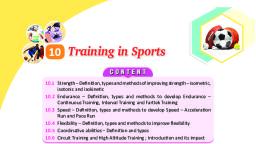
10, , Training and Doping in Sports, CONTENT, , 10.1, 10.2, 10.3, 10.4, 10.5, 10.6, 10.7, , 10.1, , Meaning and Concept of Sports Training, Principles of Sports Training, Warming up and Limbering Down, Skill, Technique and Style, Concept & Classification of doping, Prohibited Substances & their side effects, Dealing with alcohol and substance abuse, , MEANING AND CONCEPT OF SPORTS TRAINING, , Training methods are based upon the scientific principles in a systematic order. It is based, on many aspects in its process like specific individual care, improve specific fitness, scientific, ways, psychological feedback, technical help, good machines and apparatus, considering, climate, diet, safety means, etc. It helps develop basic skills, advanced skills, techniques,, tactics, strategies, emotional stability during competition, motivational forces, etc. In simple, words, we can say that these are the methods to improve general and specific performance, in games and sports. It gives us practical and theoretical knowledge regarding performance, and it also guides us how to improve further through different ways. The following definitions, may be helpful to understand the meaning of sports training., Definition, 1. Mathew : “ Sports training is the basic form of preparation of sportsman.”, 2. Hardyal Singh : "Sports training is a pedagogical (educational) process, based on, scientific principles aiming at preparing sportsman for higher performances in sports, competition.”, Aims of Sports Training, 1. Development of physique, 2. Development of technical and tactical efficiency, 3. Conditioning of body for specific sports, 4. To improve physical fitness of the individual, 5. Psycho-motor development: It includes, (i), Beliefs, values, interest, attitudes, motives, etc., (ii), Cognitive abilities development, like perception, thinking and memory.
Page 2 :
202 Physical Education-11, (iii), , Development of personality traits such as regularity, hard work, editing and, sleeping habits, hygiene, spending of leisure time, etc., , 10.2 PRINCIPLES OF SPORTS TRAINING, For formulation, implementation and development of players and guidelines for coaches,, certain principles of sports training are followed, which are given below:, 1. Principle of Continuity : The training should be a continuous process. There should not, be any break. It should be a regular phenomenon. If long intervals are there between, training sessions, then fitness of an individual starts decreasing and human body adopts, itself to reduced load. Few points to be kept in mind while following this principles :, (i), Avoid occurance of stages of over loading, (ii), While developing one's fitness component, some amount of training should be, there for maintaining other fitness components also, (iii) In case of injury to one part, the players should continue with exercises for, other body parts., 2. Principle of progression load and over loading : The principle of overload states that, there should be greater than normal load on the body as required for training adaptation, to take place. It means that the training load should be increased for improving the, performance of sports persons. Load should be given carefully. If more load is given to, the trainee constantly, performance may decline. So, for better performance following, methods can be adopted:, (i), Keeping the load same and number of repetitions can be increased., (ii), Increasing the load and keeping the repetitions same., 3. Principle of Specificity of Training : For the improvement of performance, both the, general and specific training are equally important. Initially general training should be, given to develop all components of fitness and later on proportion of specific training, should be increased gradually. For examples, the speed improved through running, will also be beneficial in football. All athletes need development of general fitness, but, throwers need more of strength training., 4. Principle of Uniformity : Firstly training is uniform to all players to spots talent. But, training should have an individualistic approach with passage of time. A coach should, take the following points into consideration :, (i), Sex, (iii) Psychological difference, (ii), Age, (iv), Training level, 5. Principle of periodization : It is the process of preparing the sportsperson to give his/, her best performance in a particular competition. It has three phases:, macro, meso and, micro cycles., (i), Macro cycle: Duration of three months to one year. Last macro cycle should be, aimed at recovery and relaxation., (ii), Meso cycle: Duration of three to six weeks. Here also last cycle should be aimed, at recovery.
Page 3 :
Training and Doping in Sports, , 203, , (iii), , Micro cycle: Duration of three to ten days. Last training session should aim at, recovery and relaxation., 6. Principle of Warming up Limbering Down: Warming up is must before any training, session as it prevents muscle soarness and muscle injury. At the completion of training, session, gradual cooling down or limbering is also essential for returning to normal level., 7. Principle of Active Participation : Active participation means player should follow the, principle a law of readiness which is very much significant for getting good sports result, in various level of competition. Player and teacher should participate actively., 8. Principle of Variety : Training is a long term process and load and recovery can become, boring for both the athlete and the coach. So a successful coach should plan variety, into the training programme to maintain the interest and motivation of the athlete., Sometimes, change and variety may be done by changing the nature of exercise, time of, the day of the session, training group and the environment., 9. Principle of Ensuring Results : The apex aim of sports training is to attain good results., It can be said that the aim of sports training is to enable the sportsperson to put up, better performance in the competition. This principle cannot be achieved without, implementation of other principles. So, the stress should be laid on the implementation, than other principles by the coach., 10. Principle of Rest and Recovery : The training programmes should be made in such a way, that there should be proper rest and interest between training activities because the, body regenerates during rest and becomes better and stronger than before., , 10.3, , WARMING-UP AND LIMBERING DOWN, , Warming-up is a process by which human machine is brought to a condition at which it safely, responds to the nerve impulses of the persons for quick and efficient action. Warming-up, is a process of heating the muscle of body and making them ready to start work. It helps, the athletes prepare physically, mentally and physiologically for any type of training or, competition. If proper warming up is done, muscles become ready to respond efficiently., In this process muscles are warmed-up by running, jogging and performing some free hand, exercises prior to the training or competition. This preparation before training or competition, is called warming up. The following definitions may help to know more about warming up :, 1. "Warming-up is a process of heating the whole body by running and performing exercises, prior to the activity or competition.", 2. "Warming-up is a practice in itself.", 3. "Warming-up is a process by which human machine is brought to a condition at which it, safely responds to the nerves impulses of the persons for quick and efficient action.", 4. "Warming-up is done to tone up the body, so as to meet the ensuring activity.", 5. "Warming-up consists of a series of preparatory exercises either before a training session, or competition."
Page 4 :
204 Physical Education-11, , TYPES OF WARMING-UP, A., , B., , There are following types of warming up :, Passive Warming-up : In this the player warms up his body through external sources and, not with actual participation in physical activity. It can be done through various ways, like sunbath, steambath, wearing heavy uniform, hot water, massage and hot drinks,, etc. Performing Passive Warming-up by these means is beneficial because there is no, expenditure of energy in the process of warming-up., Active Warming-up : In active warming-up the individual warms his body through actual, participation in physical activities. These activities improve his efficiency and tone up the, muscles for the training for competition. Its duration is 10 to 30 minutes. Warming-up is, done slowly without spending much energy just before the workout. In active warming-up, the temperature of body increases up to required level. Jogging and stretching exercises, are included in such type of warming-up. There are two types of active warming up :, (i) General Warming-up (ii) Specific Warming-up, (i), General Warming-up : General warming-up is usually performed in all types, of activities. This type of warming-up includes jogging, jumping-running,, stretching, striding, wind sprints, callisthenics and other general exercises. It, increases the mobility of all the joints and improves the co-ordination of body, and mind. It also improves muscles tone. It prepares the body physically and, mentally. The duration of general warming up depends upon the nature of, work to be performed., (ii), Specific Warming-up : These specific exercises are performed after the activities, of general warming-up. Specific type of game to game. This type of warming up, increases the mobility of all joints and improves the co-ordination of body and, mind. For example, a sprinter may take few starts and run for short distance, before the actual competition. A basketball player may practice for lay up shots or, free throws before the competition. The main stress in laid down on the practice, of various skills to be performed in the game, in the specific warming-up.
Page 5 :
Training and Doping in Sports, , 205, , SPECIFIC WARMING-UP FOR SOME GAMES, 1., 2., 3., 4., 5., 6., 7., 8., , Hockey : Stick rotation dribbling, tapping, hitting, stopping the ball with stick, short, passes, long hits, scoops, etc., Basketball : Dribbling, shooting, shuttle run, lay up shots, dodging, free throws and take, practice, etc., Cricket : Dummy bowling and batting, catching, fielding, etc., Badminton : Tossing, high clear, low clear, smashing, making with jumps, dropping, practice and court crafting, etc., Tennis : Knocking, wall practice, volley clear service practice clear slice, lob return, etc., Shot Put : Shifting the shot from left hand to right hand and vice versa, standing throws,, putting the shot with both hands, gliding practice with or without shot, etc., Kho-kho : Dodging, Zig-zag running pole to pole running., Volleyball : Blocking, passing, smashing, etc., , BENEFITS OF WARMING-UP, 1., , Warm up increase the blood circulation which is helpful in delivering more oxygen and, nutrients to the tissues., 2. Warm up helps in concentrating the mind on upcoming exercise., 3. Warm up makes the body feel relax, as it increases the core body temperature., 4. Warming up of muscles releases the energy., 5. Warming up makes the body and nueron system ready for exercises., 6. It improves the concentration and increases the speed of reaction., 7. It makes the muscles flexible and more capable to stretch., 8. Increasing capacity of stretching the muscles helps them to become ready for physical, exercise and it also prevents them from injuries., 9. Warm up prevents the body from fatigue and stress that otherwise can be caused from, hard exercise/physical activities., 10. It increases the heart rate and makes heart prepare for physical activity., , MEANING OF LIMBERING DOWN, Limbering down/cooling down is also called warming down. This is an easy exercise that, will allow the body to gradually transient from an exertional state to a resting or near resting, state. It is a necessary activity after training or competition. Depending on the intensity of the, exercise, cooling down can involve a slow jog or walk, or with lower intensities, stretching can, be used.
Page 6 :
206 Physical Education-11, , Stretching exercises for Limbering down, , The major static stretching exercises which are very important for cooling down are, described here :, 1. Ham strings : Lying on your back, raise straight one leg directly, above hips. Holding the, calf or thigh, press the heel towards ceiling as you pull the leg back towards the chest., And do the same for next leg., 2. Chest : Standing straight, interlace fingers behind your back. As you straighten out your, arms, lift your chin towards ceiling., 3. Glutes : Lying on your back, cross right leg over bent left knee. Then bring the left knee, to chest, holding onto the back of your thigh, gently pressing right knee wide., 4. Quadriceps : Lying on your right side, pull left into left glute, feeling the stretch in front, of the thigh., 5. Triceps/Shoulders : Take one arm overhead, bent at elbow joint and extend palm down, centre of your back, gently pulling elbow with opposite hand. Take same arm across the, chest gently pulling at the elbow joint, to extend through the shoulder., , BENEFITS OF LIMBERING DOWN, 1, 2., , 3., , Appropriate cooling down or limbering down helps in reducing the body temperature., Proper cooling down reduces the heart rate slowly and blood does not pool in the legs, and feet. It continues to flow back to the heart through veins and consequently such, process reduces the chances of dizziness or fainting., Proper cooling down supports in supplying the blood and oxygen to muscles, restoring, them to the position they were in before performing training.
Page 7 :
Training and Doping in Sports, , 4., , 5., , 207, , Proper cooling down reduces the accumulation of waste products like lactic acid, uric, acid, phosphate, sulphates, chlorides and carbondioxide etc. very quickly from the, muscles., Proper cooling/limbering down reduces the muscular tension and mental tension also., , 10.4, , SKILL, TECHNIQUE AND STYLE, , Skill : Skill can be defined as the capacity of the, sportsman to realise technique in actual motor, action. Skill is defined as automatisation of motor, action. Skill is sport specific. It exists within all, sports but each sport needs different skills. A skill, is seen as a co-ordinated act, involving a group of, movements put together in a consistent and smooth, manner. There are many interpretations as to what, constitutes a skilful movement because views vary, from no vice to expert level. Skill has been defined, by a number of different experts. The following are, some definitions :, , DEFINITION OF SKILL, 1., , "An organised co-ordinated activity in relation to an object or situation, which involves a, whole chain of sensory, central and motor mechanisms."�, –By Galligan, 2. "Excellence of performance - the successful integration of a hierarchy of abilities, appropriate to a task under given conditons."�, –Prof. G.P. Meredith, Types of Skill, There are a number of different types of skills., 1. Motor Skills : These skills involve movements being performed such as running, jumping, or striking a football., 2. Perceptual Motor Skills : Perceptual motor skills are also called psychomotor skills which, involve components of all 3 of the other skills. The individual is required to think, detect, and interpret and perform a movement to complete a skill. Once a player has the ball he, must think what to do with it, may analyse and assess what is happening around them, and then perform their decision., , 10.5, , CONCEPT & CLASSIFICATION OF DOPING, , Meaning of Doping : 'Doping' is the word, which is used in the field of sports, when athletes use, prohibited substances or methods to unfairly improve their sporting performance. In general, words, doping is the use of performance enhancing substances or methods by athletes to, gain an advantage over their competitors. In fact, some athletes take illegal substances to, enhance their performance. This activity is known as 'doping.'
Page 8 :
208 Physical Education-11, , TYPES OF DOPING, Doping is generally resorted to in a training period., There are two types of doping :, 1. Performance enhancing substances, 2. Physical methods, 1. Performance enhancing substances :, (i), Stimulants : Cocaine is a stimulant, which is more commonly used as a, recreational drug than for performance, enhancement. Stimulants are related to, a group of drugs that enhance alertness, and physical activity by increasing heart, and breathing rates and the functions, of the brain. They stimulate the body, physically and mentally. They also, increase aggressiveness. Amphetamines,, cocaine, ephedrine and adrafinil are, commonly used stimulants which are, used by athletes. These are taken orally, by nasal spray and by injection., (ii), Anabolic Steroids : They are synthetic chemicals designed to have effects similar, to a natural steroid produced in the body – the harmones testosterone. Natural, testosterone provides anabolic and androgenic (masculinising) effect misused, in sports to increase muscle strength and bulk and to promote aggressiveness, and as a result increase athletic performance.These are taken to reduce the, weight loss rapidly as in weight-lifting, boxing and wrestling, etc. These drugs, are also taken to evade anti-doping tests by removing the traces of other doping, substances from the body. Diuretics are sometimes misused by competitors for, two main reasons :, (a), To reduce weight quickly in sports where weight categories are involved., (b), To reduce the concentration of drugs by diluting the urine. Diuretics are, drugs including Frusemide, Chlorothiazide and Hydrochlorothiazide, , Side-effects of Duuretics are : dehydration, hypotension (low blood, pressure), muscle cramps. Electrolyte disturbances, muscle weakness,, seizures or fits, gout (caused by a build-up of uric acid) and fatigue., 2. Physical Methods : Physical methods include blood doping chemical and gene doping., (i), Blood Doping : WADA has defined blood doping as the misuse of tenchiques or, substances to increase one's red blood cells count. Usually two units of athlete's, blood is taken some weeks prior to competition. The blood is then frozen until, 1-2 days before the competition, when it is thawed and injected back into the, athlete. This is known as autologasus blood doping Homologous blood doping, is the injection of fresh blood, removed from a second person, straight into the
Page 9 :
Training and Doping in Sports, , , , 209, , athlete. The oxygen carrying capacity to the muscles is increased by increasing, the number of RBCs, so the muscle endurance is increased which ultimately, enhances the sports performance. A second method of blood doping includes, the use of artificial oxygen carriers. Haemoglobin oxygen carriers are chemicals, or purified proteins which have the ability to carry oxygen. They have been, developed for therapeutic use. However, they are now being misused as, performance enhancers. Tests were introduced in 2004 which are capable to, detect the use of artificial oxygen carriers., They were developed for use in emergencies when there is no time for, determining and cross-matching patients blood type for transfusion, when, there is a high risk of infection, or simply when no blood is available., , SIDE-EFFECTS OF BLOOD DOPING, Increased blood viscosity (thickness), heart attack, pulmonary embolism, cerebral, embolism, allergic reaction and risk of blood-borne diseases., (ii), Gene Doping : Gene doping is the manipulation of cells or genes to enhance, the body's sports performance. Modifying genes enable faster reaction and, increase physical strength. It is based on the principles of gene therapy. The, process of gene doping is likely to be used by athletes in future in an attempt, to enhance the function of normal healthy cells. This therapy may play an, important role in growing and developing of musculo-skeletal structures. It will, speed up the repair of the injuries of muscles, tendons and ligaments, etc., , 10.6, , PROHIBITED SUBSTANCES & THEIR SIDE EFFECTS, , The prohibited substances is a list of all drugs, supplements and other substances and methods, which are banned from using in sports. WADA (World Anti-Doping Agency) is responsible for, maintaining and updating this list. Some substances on the method of administration such, as inhalation, tablet or injection. A substance is added to the list of prohibited substances, and methods if it enhances the sports performance or damages the health of the athlete or, violates the spirit of sports. If any athlete takes such substance for therapeutic use, he will, have to apply to the International Federation for exemption, and it must be verified by the, physician. In order to be accepted the following points must be true :, (i), The athlete would face many health problems if he does not take such drug or, substance., (ii), There is no considerable performance enhancing benefit., (iii) There is no other suitable alternative to that drug., Methods Prohibited at all Times or In-and-out-of Competition, The methods or tenchiques that are prohibited at all times or in-and-out-of competition, are given below :, 1. Blood Doping : The count of red blood cells is increased in the human body by blood, doping method. Autologous blood doping and homologous blood doping are further
Page 10 :
210 Physical Education-11, two methods of blood doping by which number of red blood cells is increased which, ultimately enhances the oxygen carrying capacity of an individual. All these techniques, are prohibited., , SIDE-EFFECTs OF PROHIBITED SUBSTANCES, Stimulants : Stimulants increase heart rate and palpitation. They usually cause insomnia,, anxiety and aggressiveness. Users of stimulants are not able to judge properly. In fact, they, inhibit in decision-making. There may be maximum chances of getting dehydration. They, increase anxiety, hypertension and body temperature. They reduce the rate of respiration., They can cause heart failure., Narcotics : Excessive use of narcotics may cause sedation, loss of balance and coordination., Development of a false feeling of invincibility may arise., Cannabinoids : Use of cannabis for a long time may develop mood swings, anxiety,, memory loss, chronic bronchitis. The chances of development of cancer of lungs, mouth,, tongue, and throat cancer may occur. In addition to this lack of coordination decreased, concentration span and drowsiness and dryness may develop., Peptide Hormones : The use of peptides hormones can lead to heart disease, carpal, tunnel syndrome and over growth of hand, feet and face. This may cause thickening of the, blood clots that may lead to increased risk of heart attacks. These may also lead to joint pains., Beta-2 Agonists : It cause fatigue, dizziness, cold hands, sleep disorders, sexual, dysfunction and depression. They can also lead to headache, nausea, nervousness, tremor,, muscle cramps, increased' heart rate, increased blood pressure. The psychological symptoms, like withdrawl, dependence and habituation may appear The use of of beta-2 Agonists can, develop tendency of increased risk or myocardial infraction and sudden death., Diuretics : They cause dehydration which can seriously affect the health of the, sportsperson. They may lead to mineral imbalances, muscle weakness, irregular heart beat, and low blood pressure. The amount of potassium and sodium decreases in the body. Diuretics, may also cause kidney damage., Glucocorticoids : Use of glucocorticoids for a long time can cause various side effects, like weak tendons, torn muscle, slower healing of wounds, sodium and water retention which, can result in edema and weight gain. Fat is deposited around the neck and face. Blood sugar, tends to increase which may lead to diabetes. Use of glucocorticoids can also result in physical, dependence, chronic fatigue., Anabolic Steroids : The regular use of steroids elevate the blood pressure and decrease, high density lipoprotein. Use of steroids also increase the risk of atherosclerosis. It can also, lead to sudden cardiac death. The use of steroids increase aggressiveness, sexual appetite, and some times lead to criminal behaviour. Males become impotent, testicles shrink, breast, gets enlarged, reduce the sperm production and become bald., , DOPING CONTROL PROCEDURE, Procedure for the prevention of doping fall into three broad categories--control by, governmental or inter-governmental legistation, regulation by athletic association and gentle, persuation :
Page 11 :
Training and Doping in Sports, , 211, , 1., , Sports associations make various types of sport-checks to ensure that their rules are, observed., 2., The testing of the urine of winners is required., 3. The innocent athletes should not be disgraced and the guilty should be disqualified., 4. A list of prohibited drugs should be distributed to all team physicians before the, competition, and in the medical centre at the competition site and the drugs should be, marked with a special colour coding., 5. The pharmaceutical companies label their products with chemical rather than high, sounding trade marks., 6. To make random spot checks on the urine of competitors at unannounced times during, their preparations, but it is quite expensive., 7. To keep a close and regular check on the weights of top athletes and make careful, examination of any who show a surprising gain or loss., 8. Regular weight records should be maintained., 9. The trainer must explain the effects of drugs rationally rather than emotionally. All types, of drugs have no place in sports because of both immediate and long-term harmful, effects., 10. All drug addicts should have the knowledge of physiological harmful effects of the drugs, on human body., 11. Any athlete caught using these drugs must be disqualified., , 10.7, , DEALING WITH ALCOHOL AND SUBSTANCE ABUSE, , If a person experiences cravings for alcohol and cannot stop consuming it, they are likely, experiencing alcohol addiction, otherwise known as alcoholism. Alcoholism is a medical, disorder. Fortunately, drug addiction rehab is proven to treat it effectively. One of the most, significant issues concerning drug abuse is the high risk for developing an addiction. The, abuse of drugs can have serious ramifications on a person’s physical health, mental health,, and overall well-being., Diagnosed clinically as a substance use disorder, addiction is a recognized condition, involving compulsive use of a substance despite negative consequences. Drug abuse is the, inappropriate use of substances – including alcohol, prescription medication, or illegal drugs, – for purposes such as pleasure, to feel or perform better in certain situations, or to change, one’s perception of reality., Effects of Alcohol and other Substance Abuse : Abusing substances creates both changes, in behavior and in the way the brain works, specifically in the areas governing judgment and, reward. Continued abuse of substances can be a warning sign that an individual is beginning, to lose control over their drug use Alcohol addiction is a medical disorder. It can affect any, person, regardless of their age, sex, race, socioeconomic status, region, education level or, profession. The following characteristics are some factors that may increase an individual’s, risk of alcoholism:
Page 12 :
212 Physical Education-11, • Family history of alcohol use disorder, • Mental illness, such as depression or anxiety, • Low self-esteem, Some serious effects of alcohol and other substance abuse are :, dizziness, slowed breathing, drowsiness, alcoholic intoxication, heart arrhythmia, liver, damage, increased risk of seizures., Dealing with Alcohol and Other Substance Abuse : Physicians in the emergency, department (ED) regularly encounter patients seeking treatment for alcohol or substance, abuse problems. Data supports the notion that the ED serves an important role in identifying, and helping patients with alcohol and substance abuse issues. [1] The initial evaluation may, seem routine, yet these patients have multiple physical and emotional issues that should be, addressed whenever possible. The emergency physician (EP) should strive to identify patients, who might benefit from appropriate referrals for drug and alcohol problems. The ED may be, the initial or only point of contact with the health care system for these patients., There are studies that have shown that a brief intervention in the emergency department, may be effective for alcohol users. This concept is sometimes called the "teachable moment"., Many Drug and Alcohol addiction rehabilitation centers are working for the treatment of, alcohol abuse and drug abuse. Alcohol is addictive, but help is available if someone is struggling, with alcohol abuse. he can regain his health and life after going through rehabilitation and, learning the sober living skills that will help resist this dangerous drug in the future.
Page 13 :
Training and Doping in Sports, , EXERCISES, Very Short Answer type Questions (30 to 60 Words), 1., 2., 3., 4., 5., 6., 7., 8., 9., 10., 11., 12., 13., , What do you mean by sports training ?, Define the term "sports training.", Enlist the principles of sports training., What do you mean by warming-up ?, What is psychological warming-up ?, What do you mean by limbering down ?, What is passive warming-up ?, What do you mean by active warming-up ?, What is general warming-up ?, What is specific warming-up ? , Define skill., Define technique. , What is Style ?, , Short Answer type Questions (60 to 100 Words), 1., , What is the meaning and concept of sports training ?, , 2., , Write any two principles of sports training ?, , 3., , Explain the types of warming-up in detail., , 4., , What is physiological warming-up ? What are its types ?, , 5., , What are general and specific warming-up ?, , 6., , What is limbering down ?, , 7., , What is load ? What are its types ?, , 8., , Describe the major stretching exercises of muscles for limbering down., , 9., , Explain the methods of warming-up in detail., , 10. Explain the technique in detail., 11., , Describe about any three skills in detail., , Long Answer type Questions (150 to 200 Words), 1., 2., , What do you mean by sports training ? Enumerate the principles of sports training., Define warming up. Explain the types of warming-up., , 213
Page 14 :
214 Physical Education-11, 3., 4., 5., 6., 7., , What about the physiological basis of warming-up ?, What do you mean by limbering down ? Explain the benefits of limbering down., Explain the process of recovery and adaptation in detail., What do you mean by skill ? Explain in detail the classification of skill., What do you mean by warming-up ? Elucidate the principles of warming-up in detail., qqq
Page 15 :
Training and Doping in Sports, , 215, , SOLVED PRACTICE QUESTIONS, Very Short Answer Type Questions (30 to 60 Words), Q1., Ans., , Q2., Ans., , Q3., Ans., , Q4., Ans., , Q5., Ans., , What do you mean by "Training" ?, The word 'training' means preparation for some task. The regular and systematic use of, physical exercises alone does not guarantee maximum improvement in performance,, but aiding factors like verbal instructions by coach, sports equipments, presence of, audience, psychological factors, etc. also play an important role., Define Sports Training., Sports training is a long term training programme. It is a systematic and regular process, which is generally used for a longer duration., Martin : “Sports training is a planned and controlled process in which for achieving a, goal, changes in complex, sports motor performance, ability to act and behaviour are, made through measures of content, methods and organization.”, Hardyal Singh: "Sports training is a pedagogical (educational) process, based on, scientific principles aiming at preparing sportsman for higher performances in sports, competition.”, What is warming-up ?, Warming-up is a process by which human machine is brought to a condition at which, it safely responds to the nerve impusses of the persons for quick and efficient action., Warming-up is a process of heating the body muscle and making them ready to start, work. It helps the athletes to prepare physically, mentally and physiologically for any, type of training or competition. If proper warming-up is done, muscles become ready, to respond efficiently., What is limbering down/cooling down ?, This is an easy exercise that will allow the body to gradually transient from an, exertional state to a resting or near resting state. It is a necessary activity after training, or competition. Depending on the intensity of the exercise, cooling down can involve, a slow jog or walk, or with lower intensities stretching can be used. This will help in, reducing the body temperature and removing the waste products from the working, muscle., What is specific warming-up ?, These specific exercises are performed after the activities of general warming-up., Specific type of game to game. This type of warming-up increases the mobility of all, joints and improves the co-ordination of body and mind. For example, a sprinter may, take few starts and run for short distance before the actual competition. A basketball, player may practice for lay up shots or free throws before the competition.
Page 16 :
216 Physical Education-11, Q6., Ans., , Q7., Ans., , Q8., Ans., , Q9., Ans., , Q10., Ans., , Q11., Ans., , What do you mean by load ?, Training Load feature tells you how hard your training session was and how much time, you will need to fully recover from it before further training. Training load is a term, Polar uses to describe the cumulative amount of stress placed on an individual from a, single workout or over a period of time. The concept of training load is defined as the, sum of all the training we do :, Load = (Volume + Intensity) × frequency, Volume : The duration/distance of a particular training session., Intensity : The level of exertion at which an athlete performs a particular session., Frequency : The repetition of volume + intensity over many training sessions., What is adaptation ?, Adaptation is the process of long-term adjustment to a specific stimulus. Continued, exposure to an extra load in the training of an athlete leads to an adjustment in his, body functions that enable him to bear the extra load without feeling. This adjustment, is termed as adaptation., What do you mean by recovery ?, Recovery is to regain what was lost. Recovery is an essential part after exercise or, training load. This period is also referred to a period of regeneration or recuperation, during which stress related effects are gradually eliminated. As a general principle, the, recovery period should be of such a duration that the individual should feel fresh for, starting the next., Define Skill., Skill can be defined as the capacity of the sportsman to realise technique in actual, motor action. Skill is defined as automatisation of motor action. Skill is a sports specific., It exists within all sports but each sport entails different skills., Definition : "An organised co-ordinated activity in relation to an object or situation,, which involves a whole chain of sensory, central and motor mechanisms." –By Galligan, What is style ?, Style is an individual's expression of technique in motor action. No two sportspersons, are alike in different factors which determine motor action. Therefore, each sportsman, because of his specific or particular psychic, physical and biological capacities realises, the technique in a different manner. This is called his style., What is technique ?, Technique are the basic movements of any sport or event. For example, a block start, in a 100 metre race is a technique. A number of technique are combined into a pattern, of movement in triple jump (running and then hop, step and jump phases.) In fact, a, technique is the way of performing a skill., Ozolin N. defines, "Technique as the most rational and effective form to perform, exercises."
Page 17 :
Training and Doping in Sports, , Q12., Ans., , 217, , A technique involves scientific and economical methods adopted to achieve top, performance in sports competitions., What is passive warming- up ?, In this a player warms up his body through external sources and not with actual, participation in physical activity. It can be done through various ways like sunbath,, steambath, wearing heavy uniform, hot water, massage and hot drinks etc. Performing,, passive warming-up by these means is beneficial because there is no expenditure of, energy in the process of warming-up., , Short Answer type Questions (60 to 100 Words), Q1., Ans., , Write any two principles of sports training., 1., Principle of Continuity: The training should be a continuous process. There, should not be any break. It should be a regular phenomenon. If long intervals are, there between training sessions, then fitness of an individual starts decreasing, and human body adapts itself to reduced load. Few points to be kept in mind, while following this principles :, (i), Avoid occurance of stages of over loading., (ii), While developing one's fitness component, some amount of training, should be there for maintaining other fitness components also., (iii), In case of injury to one part, the players should continue with exercises, for other body parts., 2., Principle of Uniformity : Firstly, training is uniform to all players to sport talent., But training should have an individualistic approach with passage of time. A, coach should take into consideration the following points:, , (i) Sex (ii) Age (iii) Psychological difference (iv) Training level, Q2., What is Physiological warming up ? What are its types ?, Ans. Physiological basis of warming-up :, 1., Increases the Body Temperature : The temperature of the body and muscles is, increased through a proper warming-up. So, it is beneficial for the sportspersons, and athletes. If the muscles have been warmed up just before the activity, the, performance is improved. Failure to warm up before vigorous activity may lead, to tearing of muscle fibres., 2., Increases the speed of Nerve Impulses : Warming-up increases the speed of, nerve impulses, which improves and sharpens the reaction time of athletes., And it is always beneficial in most of the games and sports., 3., Decreases the resistance in muscle capillaries : Warming-up decreases the, resistance in muscle capillaries., 4., Reduces the Blood Lactic Acid : Researchers state that consumption of, oxygen and heart ratio are directly related to muscle temperature. Higher the
Page 18 :
218 Physical Education-11, , Q3., Ans., , Q4., Ans., , temperature, higher will be the consumption of oxygen and heart rate and thus, blood lactic acid is reduced., 5., Increase Metabolic Rate : Warming-up increases the metabolic rate due to which, energy level rises. The metabolic rate increases due to rise in temperature. If, the metabolic rate is higher, there will be higher production of energy., Explain the methods of warming-up in detail., Methods of warming-up : The methods which are generally used for warming-up are, given below :, General Method : General method of warming-up includes the following sequences, and points :, (i), Jogging : Every sportsperson should perform jogging or slow running for 5 to, 10 minutes for increasing the body temperature. Jogging should be started, slowly and then gradually increase the speed to its completion., (ii), Simple Exercise : After jogging, the simple exercises should be started from, relaxed position. The exercises should be simple to complex which means, simple exercises should be done first and then complex exercises., (iii), Striding : It means running the distance with long strides. These strides are, long, i.e. the steps should be stretched out but not too much stretched. The, distance of running should not be more than 50 metres., (iv), Stretching Exercises : Stretching is one of the most criticial parts of warmup and of an athlete's performance. A more flexible muscle is stronger and, healthier. The stronger and healthier muscle responds better to exercise and, activities and helps in preventing athletic injuries., (v), Wind Sprints : It is the last part of warming up. It is usually done with sprints on, the distance of 25 to 30 mts. may be be covered in wind sprints. There can be 4, to 8 repetitions depending on age, sex and experience of the sportsperson., Warm-up through Massage : This is an old method of warm-up. Mostly wrestlers used, this method to get warmed up. The massage was good for curing some injuries of, muscles. But it is not applicable now., Warming-up with warm water : Warm up with warm water is usually done in developed, countries. Taking shower is also used to get prepare for swimming, sychronized, swimming, waterpole and diving., By Hot Drinks : Some people take a cup of tea or coffee and get themselves warmed, up, but this is not considered good method., Through Sunbath : The body can be properly warmed by by sunbathe up to some, extent, but in most of the sports this method of warming-up is not usually applied., Through Steambath : Through steambathe, the body can be warmed up and energy, can be saved but this method is not used frequently., Explain the technique detail., Techniques are the basic movements of any sport or event. For example, a block start
Page 19 :
Training and Doping in Sports, , Q5., Ans., , 219, , in a 100 metre race is a technique. A number of technique are combined into a pattern, of movement in triple jump (running and then hop, step and jump phases.) In fact, a, technique is the way of performing a skill., Ozolin N. defines, Technique as the most rational and effective form to perform, exercises., The world 'technique' does not have the same meaning in all sports. Yerjoshanskit (1985), developed different meaning of technique even within the same sports (athletics)., For explosive strength specialities, he states that the technique must guarantee the, capacity of producing a strong and concentrated impulse just at the time of execution., A technique involves scientific and economical methods adopted to achieve top, performance in sports competitions. Sportspersons select different techniques of a, skill on the following basis :, They prefer the technique which suits to their level, they select the technique that gives, them most success and they also select that technique which is best at a given time, and place and is within the rules. The most suitable examples of different techniques, for performing a skill are given below :, Skill Shooting in basketball, Techniques, (i), Lay up Shot : Lay up shot is used when there is no defender between you and, the basketball., (ii), Jump Shot : Jump shot is used to elevate yourself above a defender standing in, front of you to stop you from getting closer to the basket., Describe any three skills in detail., There are a number of sports activities and each activity requires a set of skills. Owing, to many characteristics of skills, it is really difficult to classify them. As a matter of, fact, skills cannot be classified in a clear cut way. So they are placed on a continuum., Generally, the skills can be classified as follows :, 1., Open Skills : The skills which are not under control and are unpredictable are, classified as open skills. Sports such as netball, football, hockey, badminton and, lawn tennis, etc. involve open skills. For example, in badminton, performing any, skill may be affected by many different circumstances such as your opponent's, position on the court., 2., Closed Skills : Closed skills take place in a stable, predictable environment and, the performer knows explicitly what to do and when to do. These skills have, clear beginning and end. For example, free throw in basketball and serving in, squash or tennis., 3., Fine skills : Fine skills involve complex precise movements using small muscle, groups. A high-level of hand-eye co-ordination is required while performing, these skills. For example, a snooker shot and playing the piano.
Page 20 :
220 Physical Education-11, , Long Answer type Questions (150 to 200 Words), Q1., Ans., , What do you mean by warming-up ? Elucidate the principles of warming up in detail., Meaning of warming-Up : Warming up is a process by which human machine is brought, to a condition at which it safely responds to the nerve impulses of the persons for quick, and efficient action. Warming-up is a process of heating the body muscle and making, them ready to start work. It helps the athletes to prepare physically, mentally and, physiologically for any type of training or competition. If proper warming-up is done,, muscles become ready to respond efficiently. In this process muscles are warmed-up, by running, jogging and performing some free hand exercises prior to the training or, competition. This preparation before training or competition is called warming-up. The, following definitions may help know more about warming up :, 1., "Warming-up is a process of heating the whole body by running and performing, exercises prior to the activity or competition.", 2., "Warming up is a preliminary exercise of physical and mental preparation for a, strenuous exertion., 3., "Warming-up is done to tone up the body, so as to meet the ensuring activity.", Moreover warming-up helps in performing an activity skillfully and efficiently and is, most important to bring the exercising muscles in a state of readiness. This preparation, is most important necessary before competition. Before any activity or games the, temperature of the body and muscle is low and not ready for the hard exercise or, cannot tolerate the load of activity. So we have to warm up the body with the help of, exercise before taking part in any hard exercise so that our muscles are enable to bear, the load of exercise. If proper warming-up is not done before competition or training,, the muscles are torn and damaged. It further leads to temporary or permanent, inefficiency and disability. Therefore, most of the scholars and physical educators are, in favour of intensive warming-up before participating in any event, game or sports. It, enhances the performance of the sportspersons., Principles of Warming-up : The systematic way of doing things usually increases, the efficiency. In warming-up, there are also some vital principles which guide the, sportspersons in the way of achieving best results. The principles of warming-up are as, follows :, 1., Simple to complex exercises : Light exercises should be done before warmingup. The load of the exercises should be increased as the body temperature, rises. In other words, light exercise should be done in the beginning and heavy, afterwards., 2., Selection of Exercises according to the competition : The player should have, right precision of the strength needed in competition so that exercises done at, the time of warming up have positive effect on competition., 3., Selection of clothes during warming-up : The player should wear clothes, according to weather during warming-up. He/she should wear a nicker-vest, during summers and a warm track suit during winters.
Page 21 :
Training and Doping in Sports, , 4., , Q2., Ans., , 221, , Stretching and Loosening exercises should be included : Stretching and, loosening exercises should be included in warming-up programme. These, exercises avoid injuries and increase flexibility. After performing such exercises,, we can exert the force up to maximum range., 5., Warming should be according to Age and Sex : Warming-up is usually done for, 20 to 30 minutes but it should be based on the age factor and sex factor. The, selection of exercises should be according to age, sex and physical structure., The players of different ages should do exercises of different stress levels. Girls, should do lighter warm-up exercises than boys., 6., Selection of Exercises According to Capacity : The selection of warming-up, exercise should be according to the capacity of the body. If the selection is not, done according to the capacity, it can basly effect the performance of a player., 7., Exercise of all body parts : During warming-up those organs should be warmed, up first which are to be used in the competition and all other organs should be, warmed up after so that whole of the body can become active., 8., Warming should be according to the Activity or Sports : It is most significant, that warming up should be according to activity or type of sports. For example,, chess requires a deep concentration and alertness instead of physical power., But sprinters need more warming-up than long distance runners., 9., Warming-up should be done at exact time : To achieve better performance,, warming-up should be performed at accurate time so that temporary fatigue, could be recovered. So it is better to start warming-up 15 to 20 minutes prior to, the competition and should be finished 5 minutes before to performance., What do you mean by limbering down ? Explain the advantages of limbering down., Limbering down/cooling down is also called warming down. This is an easy exercise, that allows the body to gradually transit from an exertional state to a resting or near, resting state. It is a necessary activity after training or competition. Depending on the, intensity of the exercise, cooling down can involve a slow jog or walk, or with lower, intensities, stretching can be used. So, after any workout of training or competition,, we should not stop the movements of our body immediately. Cooling down allows, the heart rate to return to its resting rate. Contrary to popular belief, cool down not, only reduces delayed-on set muscle soreness but also muscle soreness is not caused, by lactate production during intense exercise. There is no strong evidence that cooling, down is necessary, although anecdotally cooling down may reduce dizziness for, professional or serious athletes after strenuous workouts. For appropriate cooling, down, we should perform jogging as well as walking for 5 to 10 minutes. This will, help in reducing the body temperature and removing the waste products from the, working muscles. After that, static stretching exercises should be performed for 5, to 10 minutes. Stretching exercises help muscles to relax and restablish their normal, range of movement., The major static stretching exercises which are very important for cooling down are, described here :
Page 22 :
222 Physical Education-11, 1., , Ham strings : Lying on your back, raise straight one leg directly, above hips., Holding the calf or thigh, press the heel towards ceiling as you pull the leg back, towards the chest. And do the same for next leg., 2., Chest : Standing straight, interlace fingers behind your back. As you straighten, out your arms, lift your chin towards ceiling., 3., Glutes : Lying on your back, cross right leg over bent left knee. Then bring the, left knee to chest, holding onto the back of your thigh, gently pressing right, knee wide., 4., Quadriceps : Lying on your right side, pull left into left glute, feeling the stretch, in front of the thigh., 5., Triceps/Shoulders : Take one arm overhead, bent at elbow joint and extend, palm down centre of your back, gently pulling elbow with opposite hand. Take, same arm across the chest gently pulling at the elbow joint, to extend through, the shoulder., Benefits of Limbering Down, 1, Appropriate cooling down or limbering down helps in reducing the body, temperature., 2., Proper cooling down reduces the heart rate slowly and blood does not pool, in the legs and feet. It continues to flow back to the heart through veins and, consequently such process reduces the chances of dizziness or fainting., 3., Proper cooling down supports in supplying the blood and oxygen to muscles,, restoring them to the position they were in before performing training., 4., Proper cooling down reduces the accumulation of waste products like lactic, acid, uric acid, phosphate, sulphates, chlorides and carbondioxide, etc. very, quickly from the muscles., 5., Proper cooling/limbering down reduces the muscular tension and mental, tension also., 6., By performing cooling down properly, muscles do not remain stiff but get, relaxed very fast., 7., Performing cooling down after strenuous workout or competition, heart rate, does not return to its initial stage immediately but it definitely takes sometime., 8., Proper cooling down reduces the level of adrenaline in the blood which, ultimately normalizes the blood flow in the body., qqq
Page 23 :
Training and Doping in Sports, , 223, , MULTIPLE CHOICE QUESTIONS, 1., , What is the duration of meso cycle, (a) Three to ten days, (b) Three months to one year, (c) Three to six weeks, (d) Three to seven months, 2. What is duration of micro cycle, (a) Three to ten days, (b) Three to six weaks, (c) Three months to one year, (d) Three to 12 months, 3. Process of heating the body muscle and making them ready to work is known as :, (a) sports training, (b) limbering down, (c) warming-up, (d) None of the above, 4. Dribbling is specific warming up process which is related to :, (a) badminton, (b) basketball, (c) kho-kho, (d) skipping, 5. What happens if the number of RBCs increases?, (a) Oxygen carrying capacity to muscles decreases., (b) Oxygen carrying capacity to muscles increases., (c) Oxygen carrying capacity to muscles remains the same., (d) None of these, 6. Who is responsible for maintaining and updating the list of prohibited substances?, (a) WADA, (b) TADA, (c) ADA, (d) NADA, 7. What does stimulant do?, (a) Increase heart rate and palpitation (b) Develop mood swings, (c) Decrease heart rate and palpitation (d) All of the above, 8. What is the role of peptida Harmones, (a) Increase heart rate and palpitation, (b) This may cause thickening of blood cells, (c) Both (a) and (b), (d) Neither (a) nor (b), 9. What can cause sedation and loss of balance, (a) Proper nutrition, (b) Mechanical Aids, (c) Narcotics, (d) Stimulants, 10. Which can cause kidney failure?, (a) Peptide Harmone, (b) Diuretics, (c) Stimulants, (d) Narcotics
Page 24 :
224 Physical Education-11, 11., , When was WADA created?, (a) 2002, (b) 1993, (c) 1999, (d) 1998, 12. Full form of WADA, (a) World Anti Doping Agency, (b) Warrior Education Development Act, (c) World Education Location Development Act, (d) None, 13. .......................... is defined as the single motor procedure for tracking a single most task., (a) Style, (b) Skin, (c) Technique, (d) None, 14. Anabolic steroids, stimulants, narcotics, peptide harmones are :, (a) prohibited substance, (b) health supplements, (c) disease curing medicine, (d) vitamins, Answer : 1. (c) 2. (a) 3. (c) 4. (b) 5. (b) 6. (a) 7. (a) 8. (b) 9. (c) 10. (b) 11. (b) 12. (a) 13. (c), 14. (a), qqq
Page 25 :
PHYSICAL EDUCATION CLASS 11, SUBJECT CODE: (048), , MODEL SAMPLE PAPER, TIME 3 HOURS�, , MM 70, General Instructions, , (i), (ii), (iii), (iv), (v), 1., , , , , , The question paper consists of 30 questions and all are compulsory., Question 1–12 carry 01 mark each and are Multiple-Choice Questions., Questions 13–16 carry 02 marks each and shall not exceed 40–60 words., Questions 17–26 carry 03 marks each and shall not exceed 80–100 words., Questions 27–30 carry 05 marks each and shall not exceed 150–200 words., , Time spent in warming-up and cooling down will, (a) improve an individual’s level of performance accelerate the recovery process, (b) improve metabolism and boost confidence, (c) improve muscular flexibility and reduce reflection time, (d) improve appetite and boost immunity, OR, , Which of the following is a substance prohibited at all times or in-and-out-ofcompetitions?, , (a) Narcotics, (b) Diuretics , (c) Cannabinoids, (d) Beta-blockers, 2. Which of the following is not a scope for practice of kinesiology?, , (a) Neuroplasticity , (b) Motor redundancy, , (c) Adaptation through exercise , (d) Reflexive capability, 3. A may be defined as a tool, a question or an examination which is used to measure a, particular characteristic of an individual or a group of individuals., , (a) measurement , (b) test, , (c) evaluation , (d) both (b) and (d), OR, , For which of the following are tests, measurements and evaluation in the field of, sports and physical education important?, , (a) Motivation, (b) Goal setting, (c) Research , (d) All of these, 4. Sports psychology is not important for which of the following reason(s)?, , (a) Development of social and interactive skills, , (b) Development of physiological capacities, , (c) Aiding the learning of motor skills, , (d) Understanding the behaviour of players
Page 26 :
226 Physical Education-11, 5., , Which of the following disability makes it difficult for children to compete with their, abled peers on the same level?, , (a) Poverty , (b) Illiteracy , (c) Autism , (d) Casteism, 6. The aims and objectives of physical education include:, , (a) Social aspect of development, , (b) Neuro-muscular aspect of development, , (c) Organic aspect of development, , (d) All of these, 7. Which of the following is not a somatotype?, , (a) Endomorphy (b) Mesomorphy, (c) Physiomorphy (d) Ectomorphy, OR, , What is skinfolds measurement?, , (a) Manual technique of measuring body fat, , (b) Manual technique of measuring body composition, , (c) Manual technique of measuring body mass, , (d) Manual technique of measuring body weight, 8. can lead to infection and over-hydration., , (a) Chemical and physical manipulation (b) Gene doping, , (c) Alcohol consumption , (d) Stimulants, 9. An ectomorph’s diet should be rich in, , (a) calories and fat. , (b) fibre and fat., , (c) protein and minerals. , (d) vitamins and fibre., 10. How can physical fitness and wellness be cultivated?, , (a) By exercising for at least 30 minutes a day, , (b) By eating a balanced diet, , (c) Spending time in clean and calming environment, , (d) All of the above, 11. Given below are the two statements labeled Assertion (A) and Reason (R)., Assertion (A): Physical education is recognised as an indispensable portion of the, school curriculum., Reason (R): It helps students attain physical, emotional, mental and social prowess, and builds-up their self-esteem., , In the context of the two statements given above, which one of the following is, correct?, , (a) Both (A) and (R) are true and (R) is the correct explanation of (A)., , (b) Both (A) and (R) are true but (R) is NOT the correct explanation of (A)., , (c) (A) is true, but (R) is false., , (d) (A) is false, but (R) is true.
Page 27 :
Training and Doping in Sports, , 227, , 12. Match List – I with List – II and select the correct answer from the code given below:, List I – Name, List II – Meaning, , i. Pranayama, 1. Control of the sense, , ii. Dhyana, 2. Union with the divine, iii. Samadhi, 3. Breathing exercises, iv. Pratyahara, 4. Devotion, meditation on the divine will, , Select the correct set of options:, Code, , i, ii, iii, iv, , (a) 3, 2, 1, 4, , (b) 4, 4, 2, 3, , (c) 3, 4, 2, 1, , (d) 1, 3, 4, 1, 13. Identify the following adventure sports and write its name:, , , , (a) __________________ , , (a) __________________, , , , (c) __________________ , , (d) __________________, , 14. Identify the types of synovial joints and write their names:, , , , (a) __________________ , , (a) __________________
Page 28 :
228 Physical Education-11, , , , (c) __________________ , , (d) __________________, , 15. Write any two benefits of naukasana., 16. Write any two achievements of Special Olympics Bharat., OR, , What are some qualities that trainers of students with special needs should have?, (any two), 17. Given below is the data which depicts the number of participants with disability, under different categories in Paralympic Games 2020:, , , , , , , , , , , , 18., , , On the basis of the pie-chart given above, answer the following questions:, (a) Under which category does the maximum number of participants fall?, (i) Physical Impairment, (ii) Visual Impairment, (iii) Auditory Impairment, (iv) Intellectual Impairment, (b) Under which category does the minimum number of participants fall?, (i) Physical Impairment, (ii) Visual Impairment, (iii) Auditory Impairment, (iv) Intellectual Impairment, (c) Which of the following categories is related to defect in hearing?, (i) Physical Impairment, (ii) Visual Impairment, (iii) Auditory Impairment, (iv) Intellectual Impairment, A football player did not warm-up before the game. As a result he got cramps in his, calf muscles., On the basis of the case given, answer the following questions:
Page 29 :
Training and Doping in Sports, , , , , , , , , , , , , 19., , 20., 21., , 22., 23., 24., 25., 26., , 27., 28., , , 29., , , 30., , (a), , 229, , Which of the following warming-up techniques should the football player have, adopted before playing the game?, (i) Lunge walks, (ii) Dribbling, (ii) Fielding, (iv) Passing shots, (b) What type of warming-up session should the player have indulged in?, (i) General Warming-Up, (ii) Specific Warming-Up, (iii) Passive Warming-Up, (iv) Both (a) and (b), (c) How can the cramps be treated?, (i) By applying ice packs, (ii) Proper stretching and taking a warm bath, (iii) Removing safety gears, (iv) Gradual slowing down of the activity, What are differences between IOC and IOA? (any three), OR, Write briefly on Baron de Coubertin and how he helped bring the Olympics back to life., How is WHR calculated and how can it be used to assess the healthiness of a person?, Write any three safety measures to prevent sports injuries during pre-activity., OR, Write any three roles of a leader., What are the functions of respiratory system? (any three), Enlist any three harmful effects of substance abuse., What are the obstacles faced in the implementation of adapted physical education in, India?, Name the schemes that have been merged and revamped as Khelo-India Scheme., Give three reasons why sports psychology is important., OR, Differentiate growth and development. (any three), What are the problems faced by adolescents and how can they be managed?, Briefly explain the Heath-Carter somatotype measurement system with the help of a, somatograph., OR, Write any five benefits of Vrikshsana., What are the different types of exercises that can be done to prevent various health, threats?, OR, What are the categories of disabilities accepted by the Paralympic Games for, participation?, Elaborate the meaning and objectives of adventure sports.
Page 30 :
230 Physical Education-11, , Answers to Selected Questions, 1., 5., 9., 13., 14., 17., 18., , (a) OR (b) , 2. (d) , 3. (b) OR (d) , 4. (a), (c) , 6. (d) , 7. (c) OR (b) , 8. (a), (a) , 10. (d) , 11. (a) , 12. (c), (a) Zorbing; (b) Mountaineering; (c) Paragliding; (d) Trekking, (a) Hinge joint; (b) Ball and socket joint; (c) Gliding joint; (d) Saddle joint, (a) (i) Physical Impairment; (b) (iv) Intellectual Impairment; (c) (iii) Auditory Impairment, (a) (i) Lunge walks; (b) (iv) Both (i) and (ii); (c) (ii) Proper stretching and taking a, warm bath



 Learn better on this topic