Page 1 :
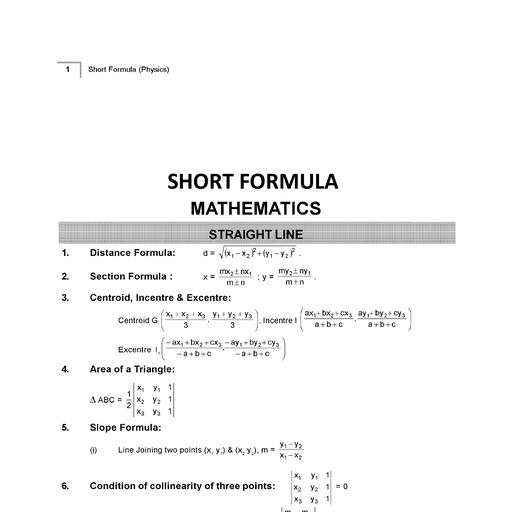
1|Page, , Class 11 Maths Chapter 10. Straight Lines, Coordinate Geometry, The branch of Mathematics in which geometrical problem are solved through algebra by using, the coordinate system, is known as coordinate geometry., Rectangular Axis, Let XOX’ and YOY’ be two fixed straight lines, which meet at right angles at O. Then,, , (i) X’OX is called axis of X or the X-axis or abscissa., (ii) Y’OY is called axis of Yor the Y-axis or ordinate., (iii) The ordered pair of real numbers (x, y) is called cartesian coordinate ., Quadrants, The X and Y-axes divide the coordinate plane into four parts, each part is called a quadrant, which is given below., , Polar Coordinates, In ΔOPQ,
Page 4 :
4|Page, , Shifting/Rotation of Origin/Axes, Shifting of Origin, Let the origin is shifted to a point O'(h, k). If P(x, y) are coordinates of a point referred to old, axes and P’ (X, Y) are the coordinates of the same points referred to new axes, then, , Rotation of Axes, Let (x, y) be the coordinates of any point P referred to the old axes and (X, Y) be its, coordinates referred to the new axes (after rotating the old axes by angle θ). Then,, X = x cos θ + y sin θ and Y = y cos θ + x sin θ, , Shifting of Origin and Rotation of Axes, If origin is shifted to point (h, k) and system is also rotated by an angle θ in anti-clockwise,, then coordinate of new point P’ (x’, y’) is obtained by replacing, x’= h + x cos θ + y sin θ, and y’ = k – x sin θ + y cos θ, Locus
Page 5 :
5|Page, , The curve described by a point which moves under given condition(s) is called its locus., Equation of Locus, The equation of the locus of a point which is satisfied by the coordinates of every point., Algorithm to Find the Locus of a Point, Step I Assume the coordinates of the point say (h,k) whose locus is to be found., Step II Write the given condition in mathematical form involving h, k., Step III Eliminate the variable(s), if any., Step IV Replace h by x and k by y in the result obtained in step III. The equation so obtained is, the locus of the point, which moves under some stated condition(s)., Straight Line, Any curve is said to be a straight line, if two points are taken on the curve such that every point, on the line segment joining any two points on it lies on the curve., General equation of a line is ax + by + c = o., Slope (Gradient) of a Line ), The trigonometric tangent of the angle that a line makes with the positive direction of the Xaxis in anti-clockwise sense is called the slope or gradient of the line., So, slope of a line, m = tan θ, where, θ is the angle made by the line with positive direction of X-axis., Important Results on Slope of Line, (i) Slope of a line parallel to X-axis, m = 0., (ii) Slope of a line parallel to Y-axis, m = ∞., (iii) Slope of a line equally inclined with axes is 1 or -1 as it makes an angle of 45° or 135°,, with X-axis., (iV) Slope of a line passing through (x, y,) and (x2, y2) is given by, m = tan θ = y2 – y1 / x2 – x1., Angle between Two Lines, The angle e between two lines having slopes m1 and m2 is
Page 6 :
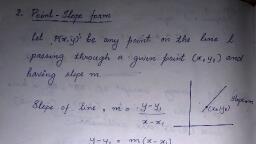
6|Page, , (i) Two lines are parallel, iff m1 = m2., (ii) Two lines are perpendicular to each other, iff m1m2 = – 1., Equation of a Straight Line, General equation of a straight line is Ax + By + C = 0., (i) The equation of a line parallel to X-axis at a distance b from it, is given by, y=b, (ii) The equation of a line parallel to Y-axis at a distance a from it, is given by, x=a, (iii) Equation of X-axis is, y=0, (iv) Equation of Y-axis is, x=0, Different Form of the Equation of a Straight Line, (i) Slope Intercept Form The equation of a line with slope m and making an intercept c on Yaxis, is, y = mx + c, If the line passes through the origin, then its equation will be, y= mx, (ii) One Point Slope Form The equation of a line which passes through the point (x1, y1) and, has the slope of m is given by, (y – y1) = m (x – x1), (iii) Two Points Form The equation of a line’ passing through the points (x1, y1) and (x2, y2) is, given by, (y – y1) = (y2 – y1 / x2 – x1) (x – x1)
Page 7 :
7|Page, , This equation can also be determined by the determinant method, that is, , (iv) The Intercept Form The equation of a line which cuts off intercept a and b respectively, on the X and Y-axes is given by, x/a+y/b=1, The general equation Ax + By + C = 0 can be converted into the intercept form, as, x / – (C A) + y / – (C B) = 1, (v) The Normal Form The equation of a straight line upon which the length of the, perpendicular from the origin is p and angle made by this perpendicular to the X-axis is α, is, given by, x cos α + Y sin α = p, , (vi) The Distance (Parametric) Form The equation of a straight line passing through (x1, y1), and making an angle θ with the positive direction of x-axis, is, x – x1 / cos θ = y – y1 / sin θ = r, where, r is the distance between two points P(x, y) and Q(x1, y1).
Page 8 :
8|Page, , Thus, the coordinates of any point on the line at a distance r from the given point (x 1, y1) are, (x1 + r cos θ, y1 + r sin θ). If P is on the right side of (x1, y1) then r is positive and if P is on the, left side of (x1, y1) then r is negative., Position of Point(s) Relative to a Given Line, Let the equation of the given line be ax + by + C = 0 and let the Coordinates of the two given, points be P(x1, y1) and Q(x2, y2)., (i) The two points are on the same side of the straight line ax + by + c = 0, if ax 1 + by1 + c and, ax2 + by2 + c have the same sign., (ii) The two points are on the opposite side of the straight line ax + by + c = 0, if ax1 + by1 + c, and ax2 + by2 + c have opposite sign., (iii) A point (x1, y1) will lie on the side of the origin relative to a line ax + by + c = 0, if ax 1 +, by1 + c and c have the same sign., (iv) A point (x1, y1) will lie on the opposite side of the origin relative to a line ax + by + c = 0,, if ax1 + by1 + c and c have the opposite sign., (v) Condition of concurrency for three given lines ax1 + by1 + c1 = 0, ax2 + by2 + c2 and ax3 +, by3 + c3 = 0 is a3(b1c2 – b2c1) + b3(c1a2 – a1c2) + c3(a1b2 – a2b1) = 0, , or, (vi) Point of Intersection of Two Lines Let equation of lines be ax1 + by1 + c1 = 0 and ax2 +, by2 + c2 = 0, then their point of intersection is, (b1c2 – b2c1 / a1b2 – a2b1, c1a2 – c2a1 / a1b2 – a2b1)., Line Parallel and Perpendicular to a Given Line, (i) The equation of a line parallel to a given line ax + by + c = 0 is ax + by + λ = 0, where λ is a, constant., (ii) The equation of a line perpendicular to a given line ax + by + c = is bx – ay + λ = 0, where, λ is a constant., Image of a Point with Respect to a Line, Let the image of a point (x1, y1) with respect to ax + by + c = 0 be (x2, y2), then, x2 – x1 / a = y2 – y1 / b = – 2 (ax1 + by1 + c) / a2 + b2