Notes of Class 11th, Maths Parabola (R.D.) Ex & MCQ - Study Material
Page 1 :
PARABOLA, , , , 95.1 CONIC SECTIONS, , A conic section, as the name implies, is a section cut-off from a circular (not necessary a right, circular) cone by a plane in various ways. The shape of the section depends upon the position of, the cutting plane., , Consider a double right circular cone of semi vertical angle a and let it be cut by a plane inclined, at an angle 0 to the axis of the cone. We will get different sections (curves) as follows:, , CASEI If the plane passes through the vertex O, , The curve of intersection is a pair of straight lines passing through the, vertex which are, (i) real and distinct for @ <a., (i) coincident for ® = a ie. the plane touches the cone., (ii) imaginary for 6 > a., CASEI If the plane does not pass through the vertex O, The curve of intersection is called, , (i) acircle if @ =>, , , , (ii) a parabola for 0 =a. ie. if the plane is parallel to the generator PQ., (iii) an ellipse for 0 >a. (0 # n/ 2)ie. if the plane cuts both the generating lines PQ and RS., , (iv) ahyperbola for 6 <a ie. if the plane cuts both the cones., , Thus, we may get the section either as a pair of straight lines, a circle, a parabola, an ellipse or a, hyperbola depending upon the different positions of the cutting plane. These curves of, intersection are called the conic sections., , , , , , , , , Parabola Hyperbola, , (0=), , , , , , , , , , , , Fig. 25.5, , Fig. 25.2 Fig. 25.3 Fig. 25.4, , 25.2 ANALYTICAL DEFINITION OF CONIC SECTION ; ; ;, CONIC SECTION A conic section or conic is the locus of 4 point P which moves in such away that :, distances from a fixed point S always bears a constant ratio to its distance from a fixed line, all being in the, , same plane., , Scanned with CamScanner
Page 2 :
25.2 MATHEMATICg », , Focus The fixed point is called the focus of the conic section., , DIRECTRIX The fixed straight line is called the directrix of the conic section., , In general, every conic has four foci, two of them are real and the other two are imaginary. Du, to two real foci, every conic has two directrices corresponding to each real focus. le, ECCENTRICITY The constant ratio is called the eccentricity of the conic section and is denoteg bye., , Axis The straight line passing through the focus and perpendicular to the directrix is called the As of, the conic section., VERTEX The points of intersection of the conic section and the axis are called vertices of the conic Section,, CENTRE The point which bisects every chord of the conic passing through it, is called the centre Of the, conic., LATUS-RECTUM The latus-rectum of a conic is the chord passing through the focus and perpendicular ty, the axis., NOTE As mentioned above the eccentricity of a conic is generally denoted by e and, (i) for e <1, the conic obtained is an ellipse;, , (ii) for e = 1, the conic obtained is a parabola;, , (iii) for e > 1, the conic is a hyperbola;, , (iv) for e = 0, the conic is a circle., , , , 25.3 GENERAL EQUATION OF A CONIC SECTION WHEN ITS FOCUS, DIRECTRIX, AND ECCENTRICITY ARE GIVEN, , Let S(a, B) be the focus, Ax + By + C =Obe the directrix and e¢ be the eccentricity of a conic. Let, , P (h, k) be any point on the conic. Let PM be the perpendicular from P, on the directrix. Then, by, definition, , LZ, SP = e-PM M vn, > sp? = e? pM?, 2 i S(a, B), > (ha)? +(k -p)? =e? eee ? & ~, A? + B2 Bly, + |., Thus, the locus of (h, kis = A, ‘A! 2, (ea)? + yp? = 2 eB Or z, - (A* + B*) Fig. 25.6, — is the cartesian equation of the conic section which, when simplified, can be written in the, orm. ‘, 2 2, ax" + 2 hay + by* +2 9x +2 fy+c=0, which is the general equation of second degree., , It can be easily shown that the general e, +2 fy +c=Oalways represents:, (i) 4 pair of straight lines, if A = abc + 2 fgh — af?, (ii) acircleifAx 0,a=bandh=0, (iii) 4 parabola if A # 0 and h? = gb, (iv) an ellipse if A # 0 and h? < ab, (v) ahyperbola if A+ 0 and h2 > ab, (vi) a rectangular hyperbola if A « 0, n2, , quation of second degree viz. ax? +2 hxy + by” +28, , —bg? ~ch? =0, , >abanda+b=0,, , Scanned with CamScanner
Page 3 :
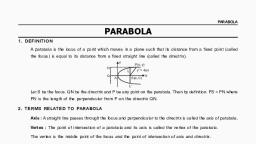
eS, , pARABOLA 25.3, , 95.4 THE PARABOLA, , ANALYTICAL DEFINITION A parabola is the locus ofa point which moves in a plane such that its distance, froma fixed point in the plane is always equal to its distance froma fixed straight line in the same plane., , As defined in section 25.2, the fixed point is called the focus and the fixed Z, , straight line is called the directrix of the parabola. The line through the M Ls, focus and perpendicular to the directrix is the axis of the parabola. The, point on the axis midway between the focus and directrix is called the $, vertex of the parabola. Bus, Let S be the focus, ZZ’ be the directrix and let P be any point on the £, parabola. Then, by definition E, SP = PM, z, where PM is the length of the perpendicular from P on the directrix ZZ’. Fig, 25.7, , ILLUSTRATION 1 Find the equation of the parabola whose focus is (- 3, 2) and the directrix is x+y = 4., , SOLUTION Let P (x, y) be any point on the parabola whose focus is S (- 3, 2) and the directrix, x+y-—4=0. Draw PM perpendicular to x + y—4=0. Then,, , SP = PM [By definition] Zz, P(x,y), , , , => SP? = PM? M, 2, -4, , x+ 3) +(y—2)? =| *Y © 5-3, 2), , > ( )" + (y - 2) eas u, , 4, , 24 42 2442 4, , > a(x +y wxnayera}- b +y* +16 + 2xy - 8x -8y x, , => x? 4y? -2 xy +20x+10=0 z, , Fig. 25.8, , Thus, the required equation of the parabola is x? + y* —2 xy+20x+10=0., , ILLUSTRATION 2 Find the equation of the parabola whose focus is (—3, 0) and the directrixis x +5 =0., , SOLUTION | Let P (x,y) be any point on the parabola having its focus at S (3, 0) and directrix as, the line x + 5 = 0. Then,, SP = PM, where PM is the length of the perpendicular from P on the directrix, , => sp? =PM?, , , , Fig. 25.9, , Scanned with CamScanner
Page 4 :
oN, , MATHEMAT|, 25.4 eS, +0y+5 ?, 2 2 |, ge ee, > (x + 3)* + (y—0) Jr+0, , , , , , parabola., , — y? =4x + 16, which is the required equation of the, , 25.4.1 EQUATION OF THE PARABOLA IN ITS STANDARD FORM gon the directrg, Let $ be the focus, Z Z' be the directrix. Draw SK perpendicular from and, , bisect SK at A. Then,, , = os directrix, Distance of A from the focus = Distance of A from the dire: By ae, ef., > A lies on the parabola ], , Let SK =2 a. Then, AS = AK =4. a-axis and AYa line perpendicular to AS as y-axis. Then, the, , Let us choose A as the origin, AS as L ¢ Neo, coordinates of S are (a, 0) and the equation of the directrix ZZ’ is x, , , , , , —>_, N Directrix 17", , ng y? = 4ax, Fig. 25.10, , Let P (x, y) be any point on the parabola. Join SP and draw PM and PN perpendiculars on the, , directrix Z Z' and X-axis. Then,, PM = NK = AN + AK =x + 4., Since P lies on the parabola. Therefore,, , SP = PM [By definition of parabola], > sp? = PM?, > (x -a)? +(y-0)" = (x+a)?, => y = 4ax, , This is the equation of the parabola in its standard form., , NOTE The parabola has two real foci situated on its axis one of which is the focus S and the other lies at, infinity. The corresponding directrix is also at infinity., , 25.4.2. TRACING OF THE PARABOLA y= 4 ax, a>0, The given equation can be written as y = + 2 Vax., We observe the following:, , (i) Symmetry: For every positive value of x, there are two equal and opposite values of ¥, (ii) Region: For every negative value of x, the value of y is imaginary. Therefore, no part of the, curve lies to the left of y-axis ., , Scanned with CamScanner
Page 5 :
PARABOLA 25.5, , (iii) Origin: The curve passes through the origin and the tangent at the origin is x = Oie.,, y-axis, (iv) Intersection with the axes: The curve meets the coordinate axes only at the origin., (v) Portion Occupied: Asx —> 0, y — . Therefore the curve extends to infinity to the right of, axis of y., With the help of the above facts and by joining some convenient points on the parabola the, general shape of the parabola y? = 4 ax is as shown in Fig. 25.10., 95.4.3 VARIOUS RESULTS RELATED TO THE PARABOLA, , As discussed in section 25.4, the focus of the parabola y? = 4 ax is at (a, 0) and the directrix is x = — a., The axis is a line passing through the focus and perpendicular to the directrix. In Fig. 25.10 x-axis, ie, y=0is the axis of the parabola y =4ax. The axis meets the curve y =4axat A, the origin. So,, the coordinates of the vertex are (0, 0). Clearly, the vertex A is the midway between the focus and, the directrix i.e., the vertex is equidistant from the focus and the directrix., , DOUBLE ORDINATE Let P be any point on the parabola ¥ = 4 ax. A chord passing through P, perpendicular to the axis of the parabola is called the double ordinate through the point P., , In Fig. 25.10, PP" is the double ordinate of point P., , LATUS-RECTUM A double ordinate through the focus is called the latusrectum i.e. the latusrectum of a, parabola is a chord passing through the focus perpendicular to the axis., , In Fig. 25.10, LSL' is the latusrectum of the parabola yv =4 ax. By the symmetry of the curve, SL =SL' =) (say). So, the coordinates of L are (a, 4). Since L lies on ¥v = 4 ax. Therefore,, , , , Fig. 25.11, , ada? > A=2a => LL'=20=4a., Latusrectum = 4 a., The coordinates of Land L’ ,end points of the latusrectum, are (a,2.a) and (a,—2a) respectively., , FOCAL DISTANCE OF ANY POINT The distance of P (x, y) from the focus S is called the focal distance of, the point P., , Clearly, SP = (x =a)? +(y- 0)2, , Wd SP = y(x-a? +y", > SP = ,(x-a)? +4 ax [- P(x, y) lies on the parabola -. y? =4ax], > SP = a(x + a) =|x+a|=a+x [- x>0,@>0 -.x+a>0], , Scanned with CamScanner



 Learn better on this topic